Here is an interlude post about my trip to Okinawa. Next week, back to bonsai, where I hope to share some wonderful old bonsai on Honshu.
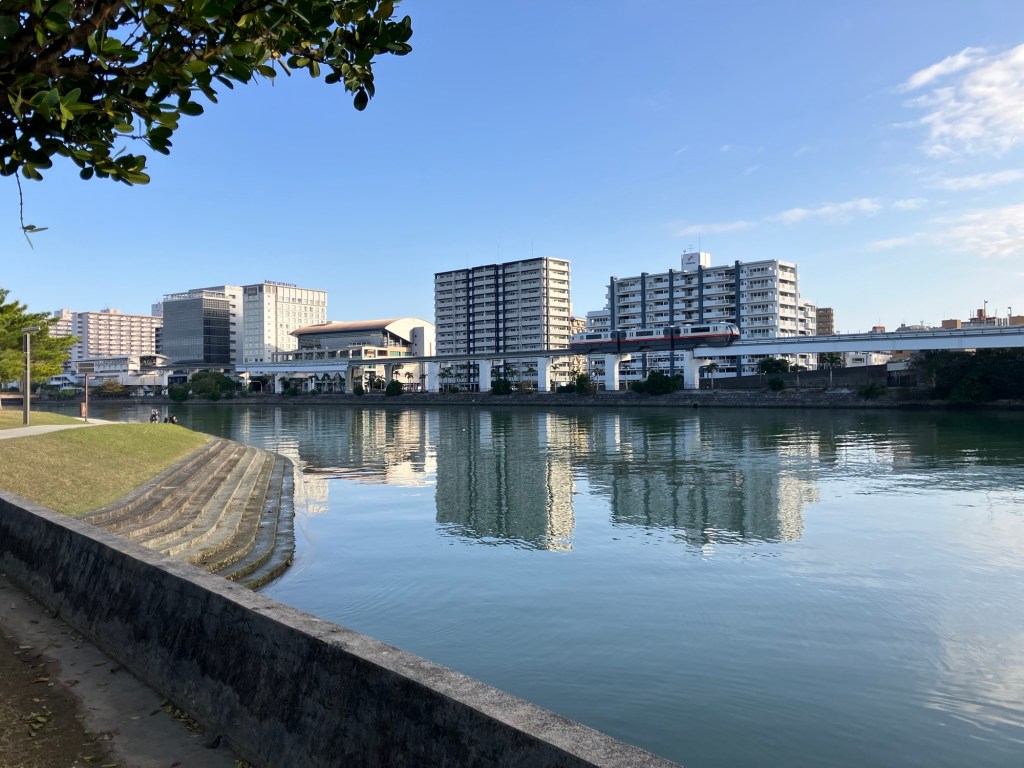
The city of Naha, at the southern end of Okinawa.
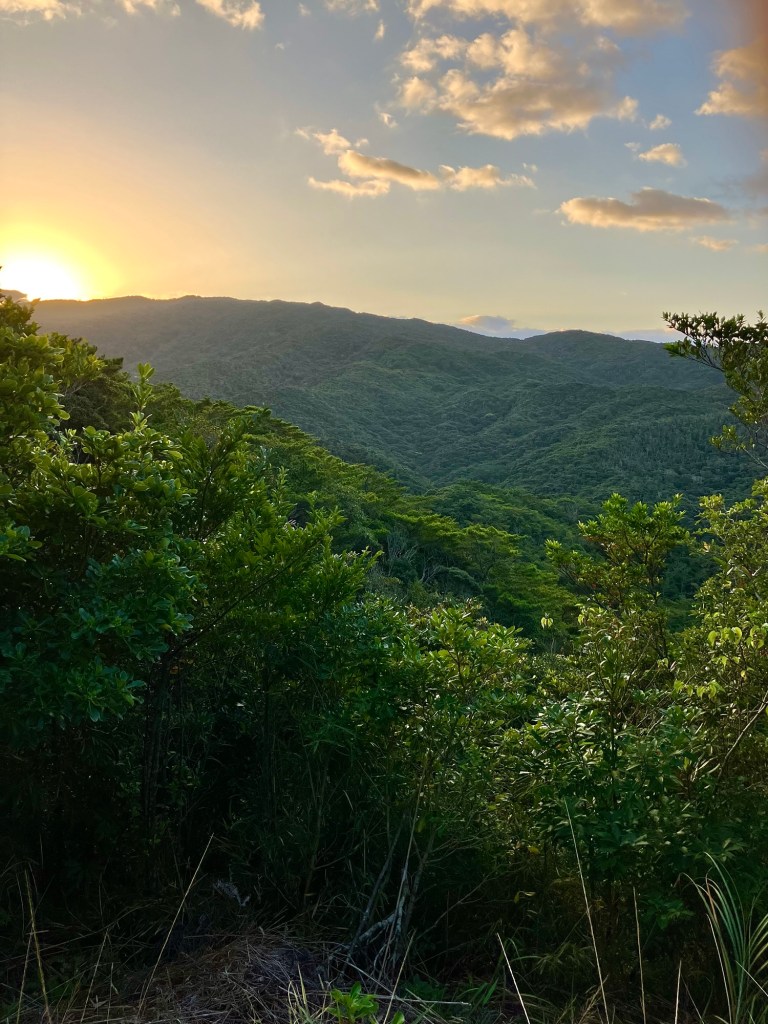
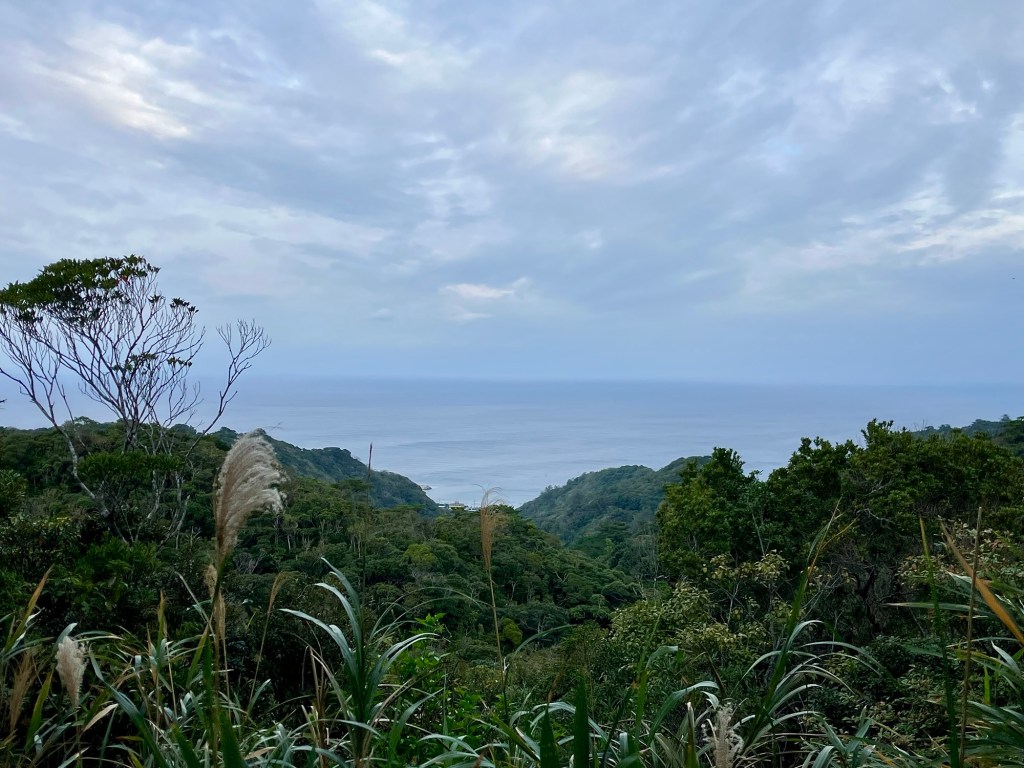
At the top of the main island is a large laurel forest. I went up there for a few days.
At the guest house I misunderstood the food situation. Thought there would be dinner, as we were miles from town. The owner was busy and said he’d take me in the next day so I could shop. So I didn’t eat for 24 hours. I survived off a drink vending machine on property. An inadvertent juice fast.
These vending machines are everywhere. They’re even nowhere. A little delivery truck trundles up the barren road once every couple weeks to supply the mistaken.
Site of my starvation
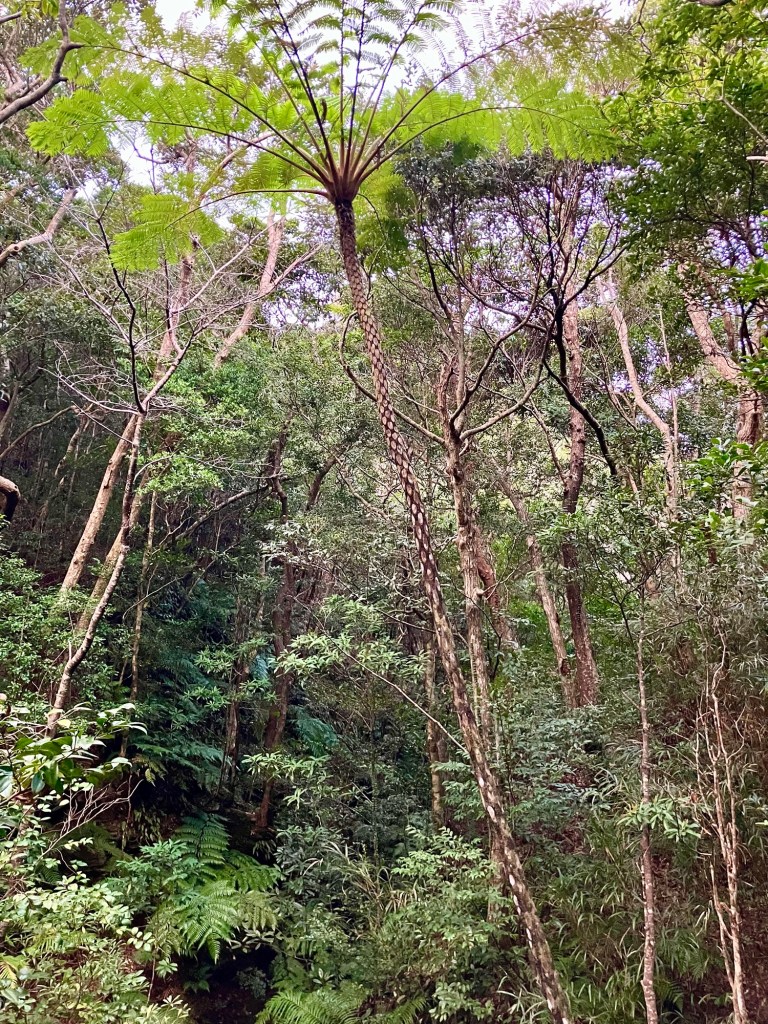
Laurels and tree fern. Okinawa is subtropical, around 60 F this time of year. This is the dry season.
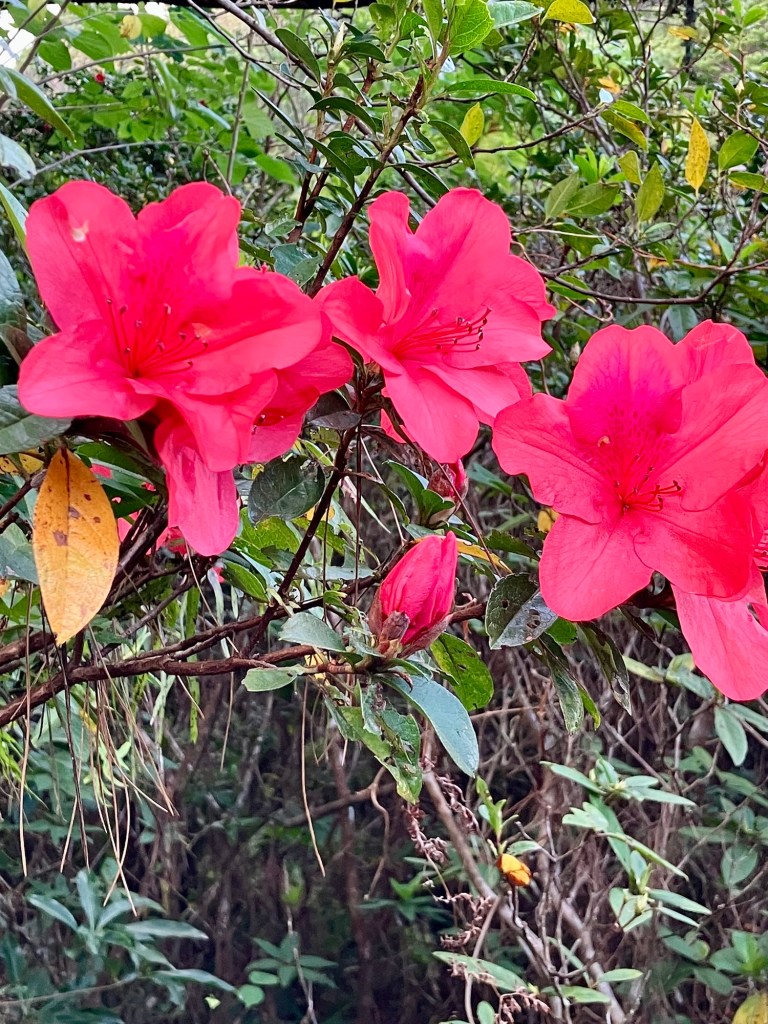
Azalea
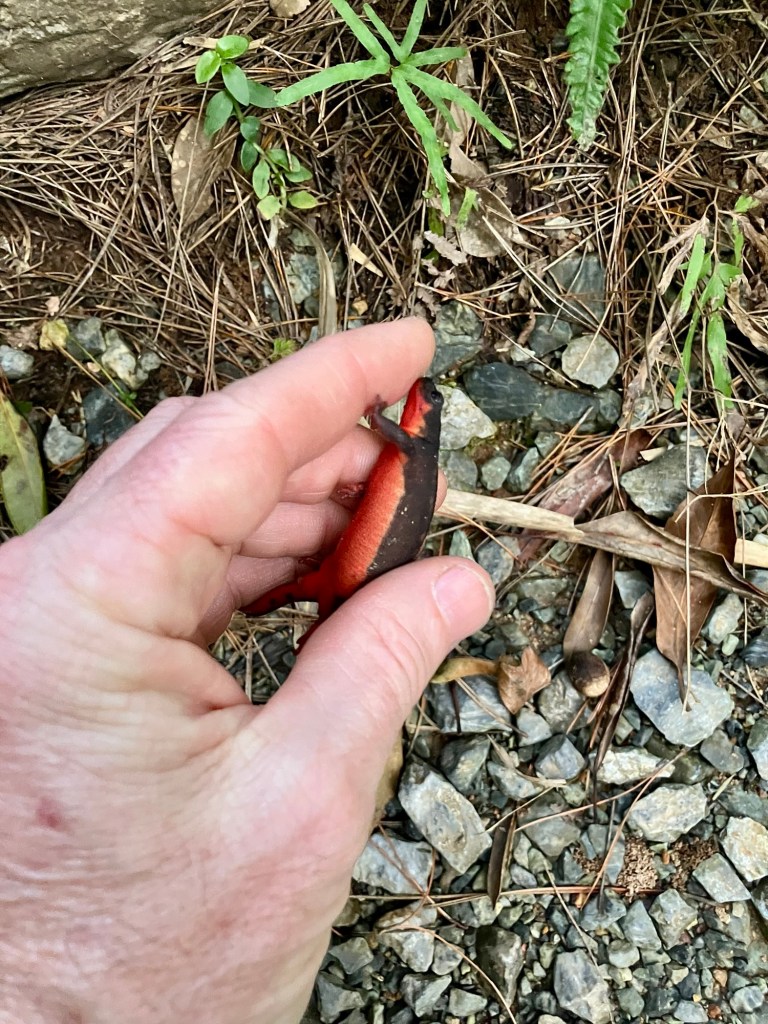
Fire-bellied Newt. I shouldn’t have picked this up, as a friend later told me. The newt’s skin has toxins.
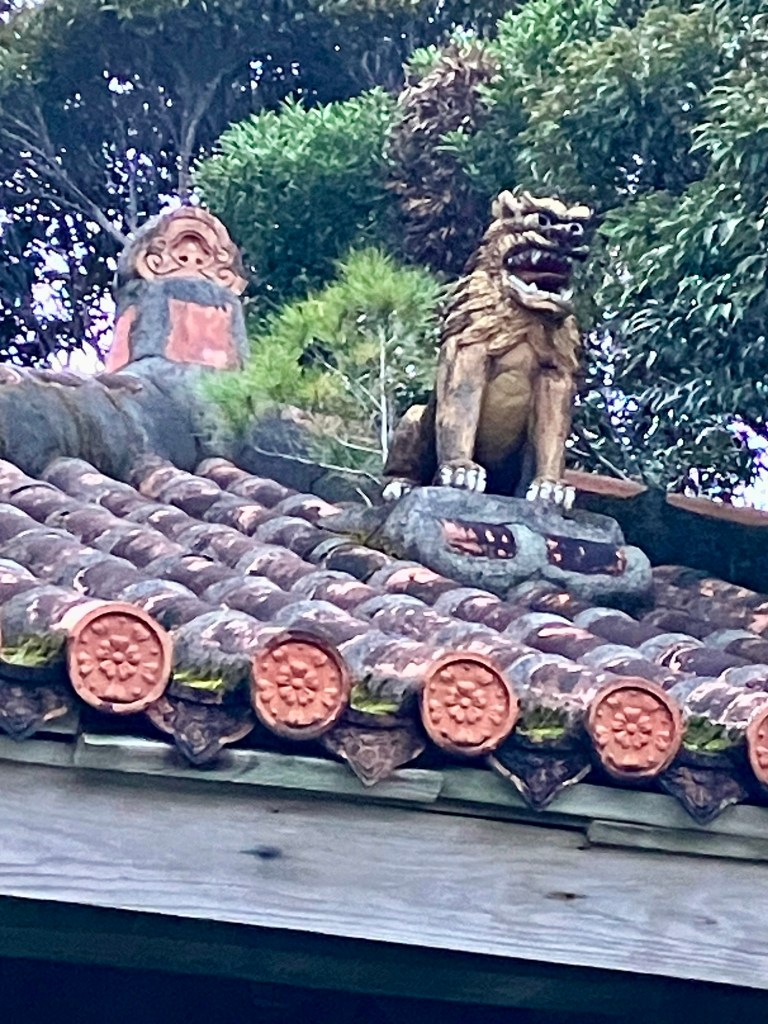
A protector deity on a roof. Behind the lion grows a sapling pine, I think a Ryukyu Pine. “Ryukyu” is the name of the sea-trading Okinawan culture that dates back thousands of years.
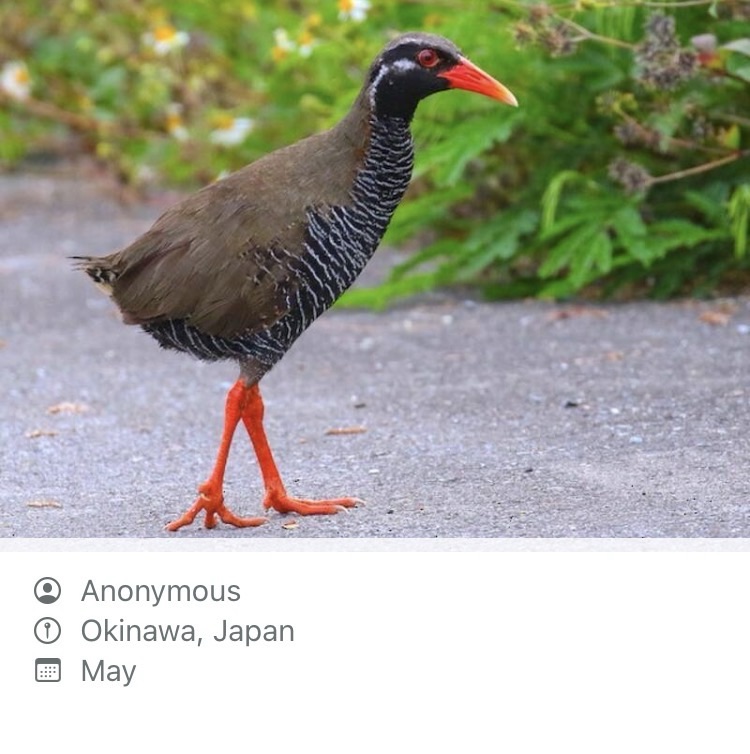
Photo courtesy Merlin app
I did some birding, including trying to find this bird, the Okinawa Rail. It’s a sneaky shorebird that lives in the lush laurel woods and it eluded me for several days. I heard many of them in the deep ravines but had no intention of slithering to my demise over a bird so intent on not being seen. That they were only described to science in 1981 is no mystery to me.
It’s rural and quiet in the north. Or so I thought on the first day.
Right at 6 pm a loudspeaker blared out over the sparsely inhabited forest: It’s time to go home to your children, the day is done, good night.
This was LOUD. And it made me jump—
What?! A fire, an earthquake, a liquid beverage delivery?!
Then, my feathers smoothed out again, a huge shape swooped in to hang on a branch. Another few flew by. Bats, flying foxes with 3-foot wingspans.
Another evening shock. Would they quietly munch on fruit as advertised, or skip that amuse-bouche and go for the main course?
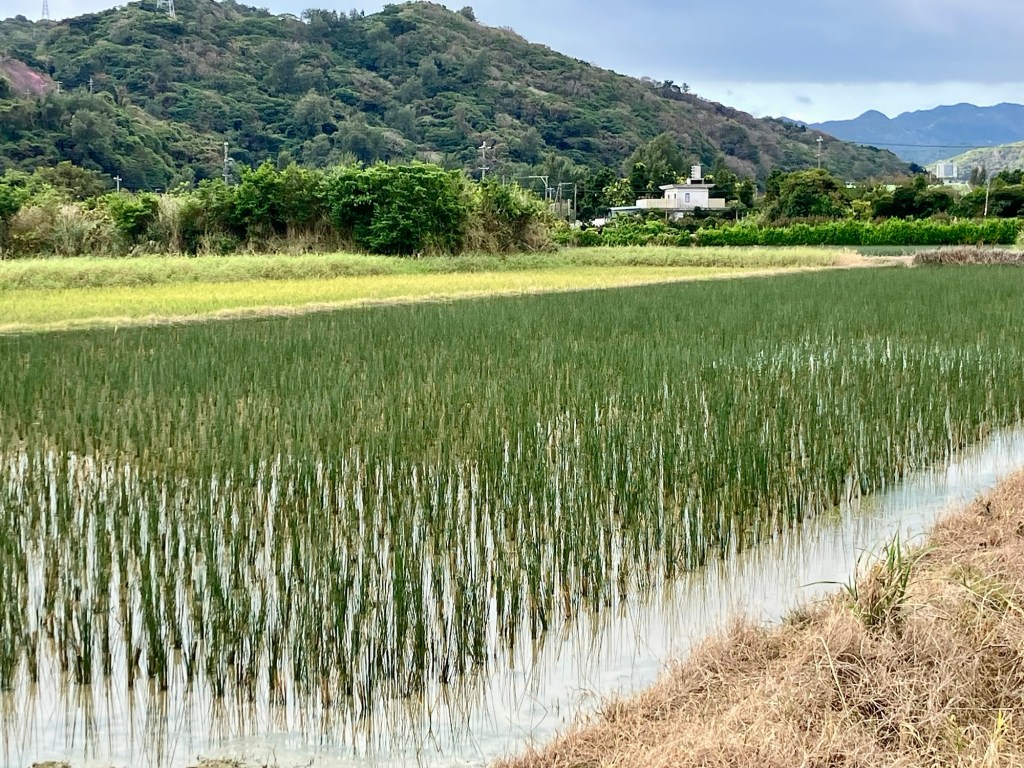
Back in the south in a rice paddy. Many crops grew there, including taro.
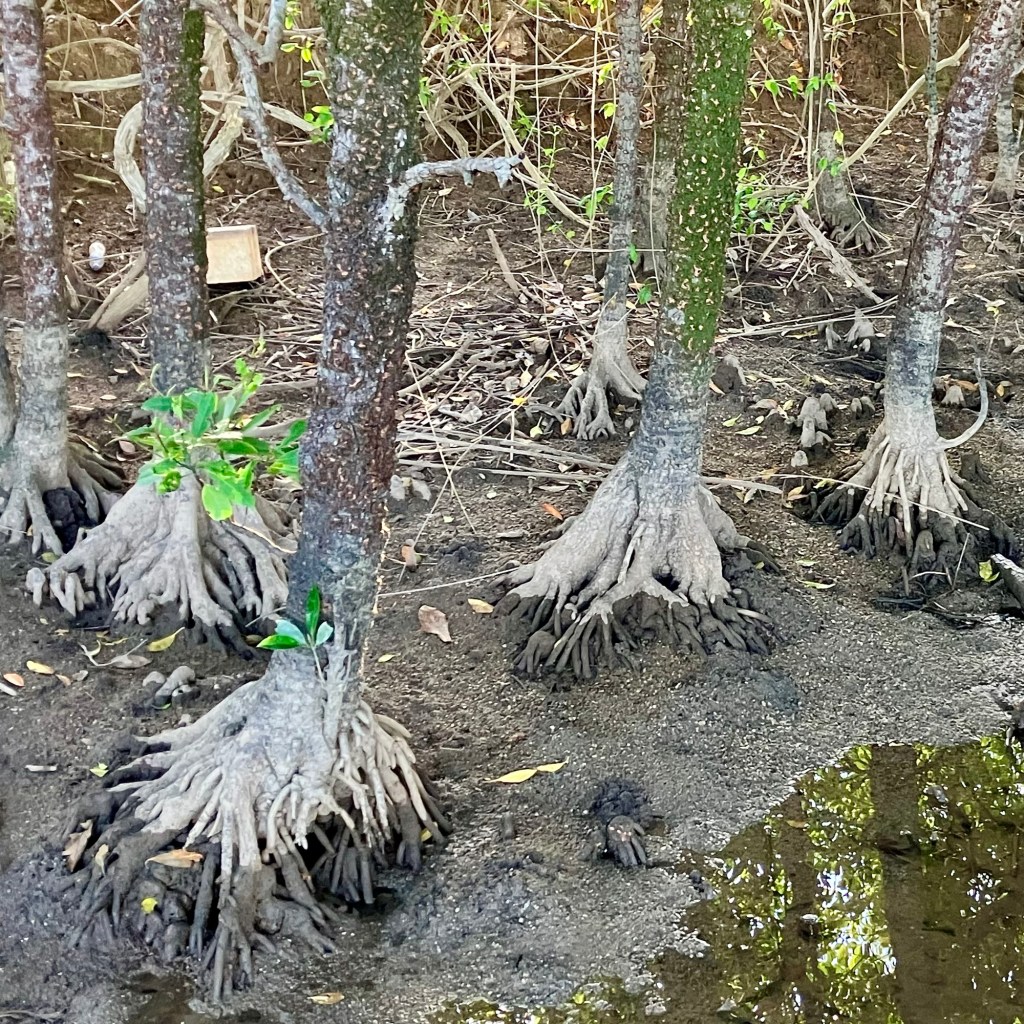
Impressive root flares help stabilize these tree mangroves in the mud.
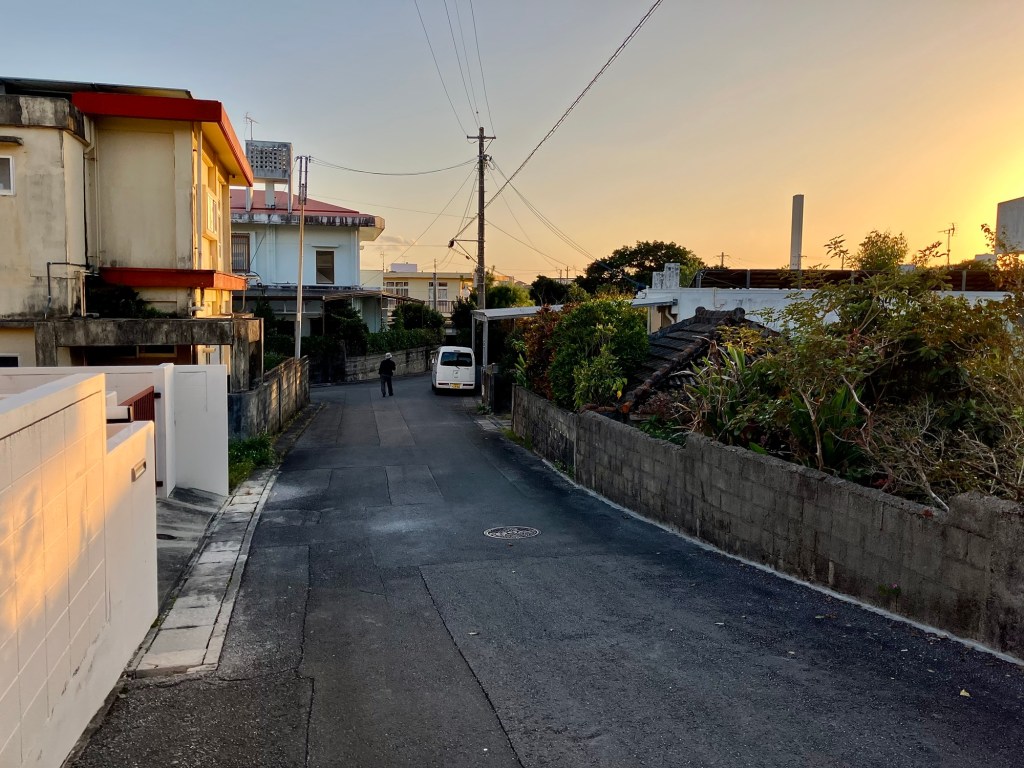
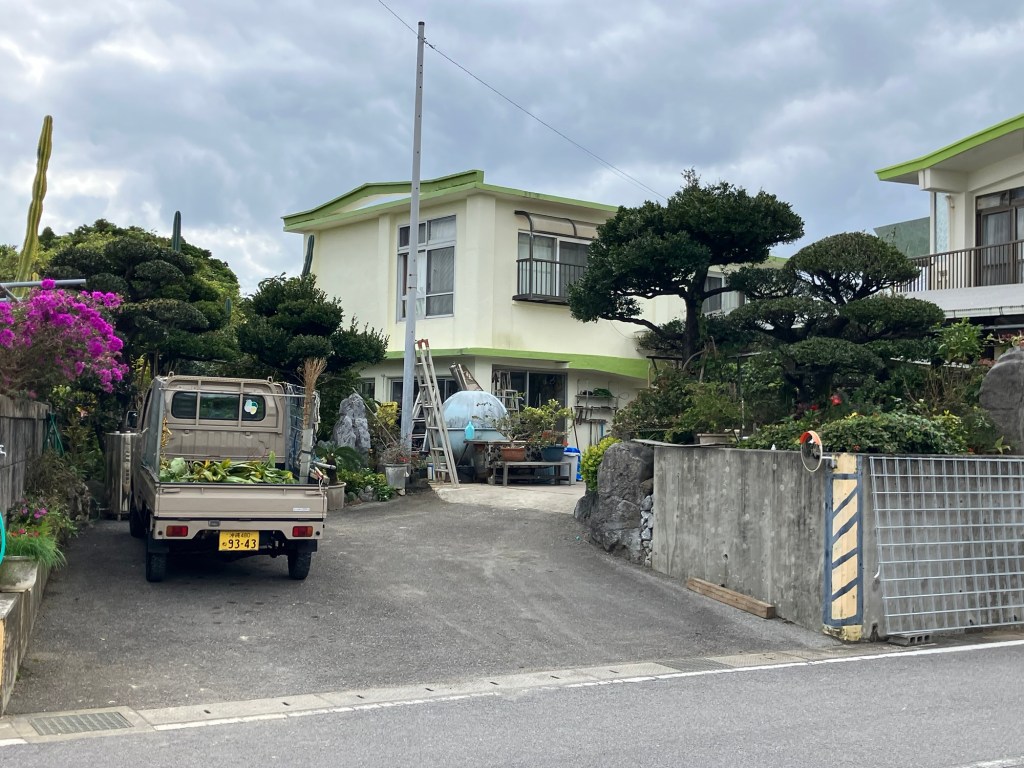
A quiet street in a small coastal town.
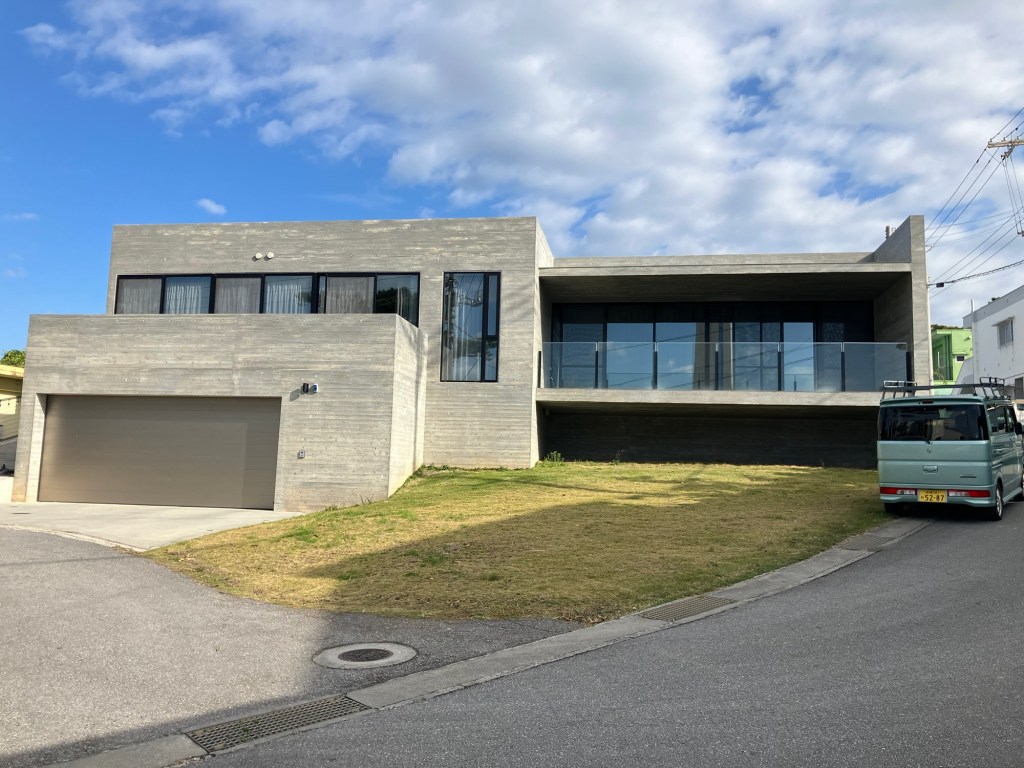
The current trend in Okinawan homes is concrete, with a brutalist flare.
A more typical older home.
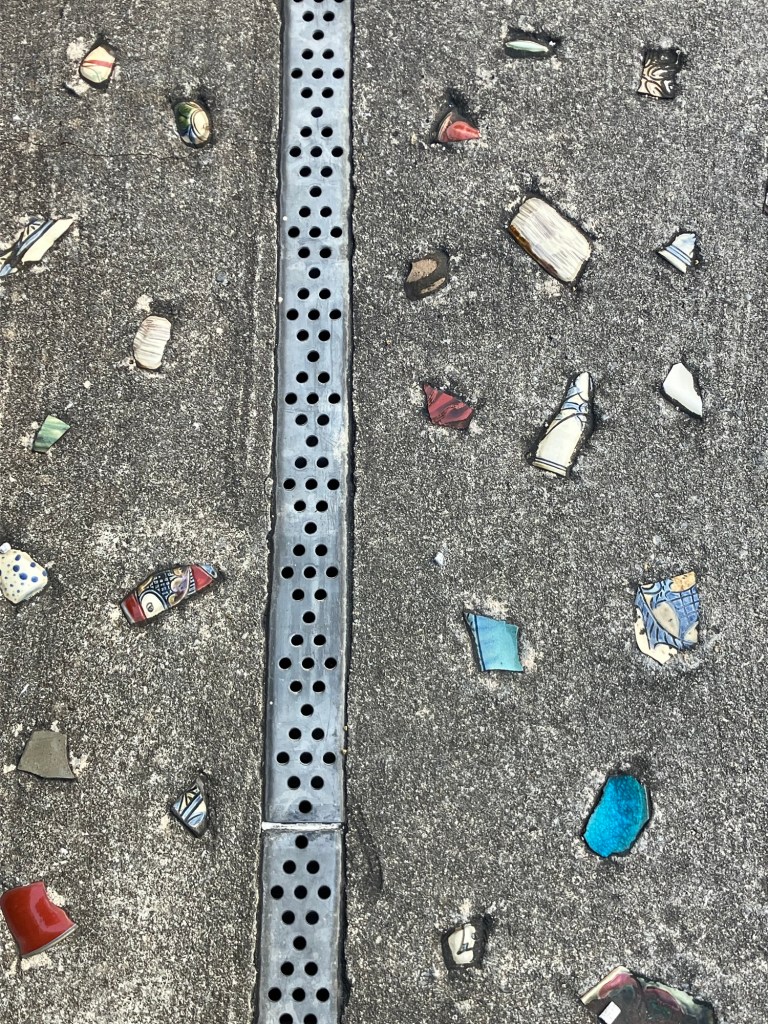
Back in Naha for the flight to Tokyo, I found this sidewalk with embedded broken pottery shards.
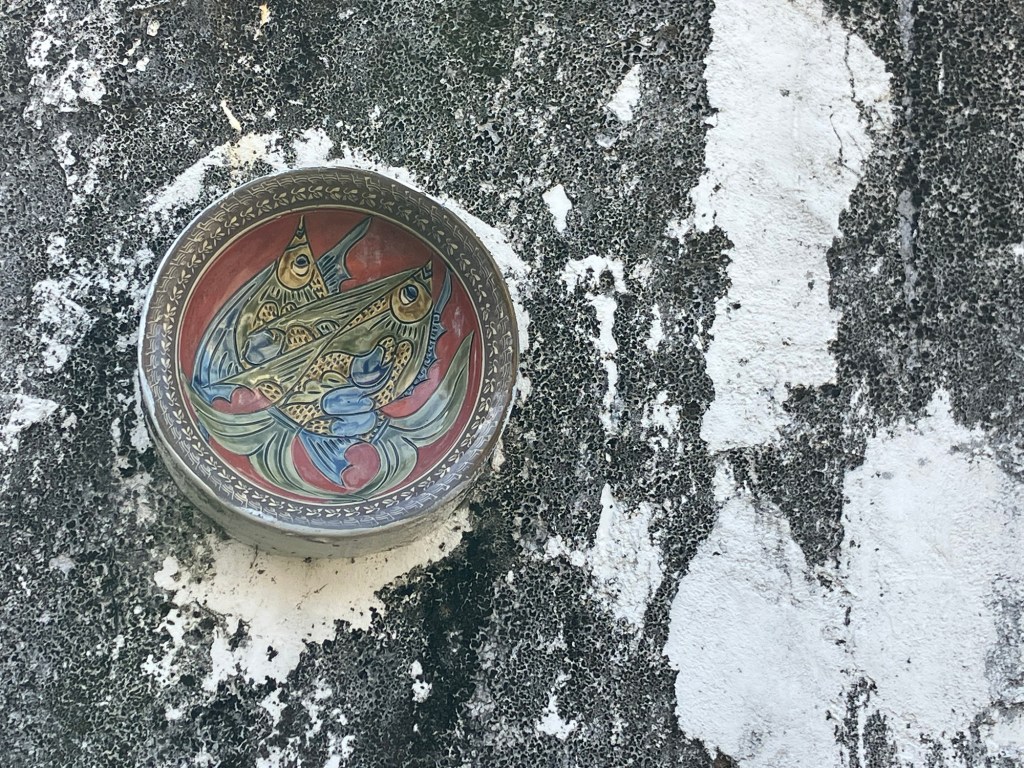
Naha is proud of its past potters. Here the masonry wall of a building holds a platter.
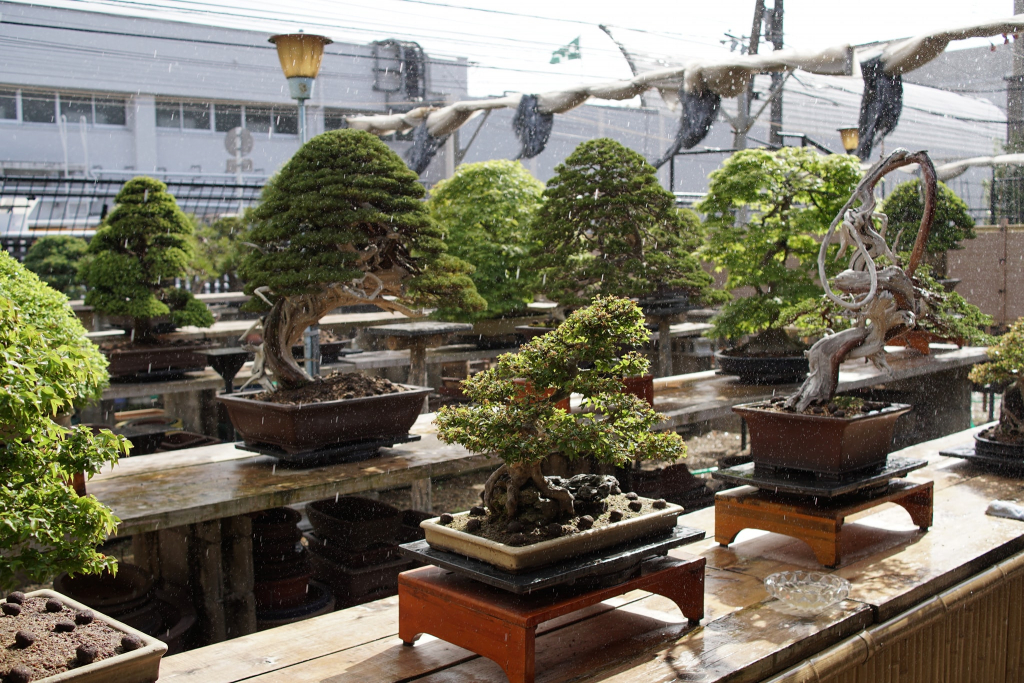
NO these bonsai are not packed for sale! That’s winter protection for valuable bonsai masterpieces at Mr. Takeyama’s Fuyo-en bonsai garden.More later
Today Diane, Corin, Lee and I spent a COLD day with our friend Megumi Kadokura, who lives in Omiya. Her grandfather was a prominent bonsai artist. Unfortunately the garden does not exist now but, I feel fortunate to have met in in 1970.
It has been unusually COLD here in Japan. Yesterday was 24-33oF with wind. At home, in Rochester, New York, it is now -1oF and is still getting colder with over 100 inches, and it not over until May.
Throughout the bonsai village many trees have been moved for a bit of protection, much more than I’ve seen in the past 56 years.
We first visited Toju-en Bonsai Garden of Hirota Katana, the new owner. This young 26 year old man now runs the bonsai garden where Masahiko Kimura and Shinji Suzuki studied. The garden was established by Motosuke Hamano in 1934. I saw several unusual container stands. He has an EXCELLENT YouTube channel “Bonsai Q”. After serving us delicious soup he made for lunch, he showed us around and answered every question we had, in English too.
Of course, we stopped by the Omiya Bonsai Art Museum to study their masterpiece bonsai. Like in all the other gardens the trees were dormant and all the foliage on the Juniper bonsai was a lovely “bronze” color most people would consider to be dead. Many plants prepare by changing color to adapt to the cold winter weather. The recent water garden seems to be maturing and is surrounded by bonsai. Photos are now allowed, except the indoor gallery.
Moving on, we made brief stops at Mansei-en (Takahiro Kato) and Seiko-en (Tomio Yamada) bonsai gardens.
Of course, our final visit was to Hiroshi Takeyama’s Fuyo-en Bonsai Garden. He specializes in fine deciduous and unusual species and forest plantings. Throughout the past decades I’ve seen a couple of his bonsai protected with blankets then covered with poly. There were many more this year. He even builds boxes which are covered with blue tarps which can be seen. The roots of plants are NOT as winter-hardy as the trunks and branches. All the bonsai protected were deciduous flowering and fruiting species, like Chinese quince, Flowering quince and a few Zelkova.
Additionally, Mr. Takeyama carefully removes a ring of soil on many of his pot bound bonsai in autumn. Then he fills the ditch with fresh soil. Yes, many of the circling roots were trimmed. He does this for two reasons, as the soil freezes in winter it expands and often breaks valuable antique containers. These bonsai will be repotted in spring so trimming the roots is fine. Also, they are easier to accept water. His best deciduous trees and those in shallow containers are kept in an unheated poly house.
He showed us a new double flowering winter flowering cherry. I’ve seen a great number of Winter flowering cherry, Prunus campanula, especially at winter exhibitions, but they were light pink with larger blossoms. He mentioned that it came from Taiwan. I thought Taiwan was a warm sub-tropical country.
100th Koku-Fu Bonsai Exhibition opened today, February 8, 2026, at the Tokyo Metropolitan Art Museum in Ueno Park, Tokyo, Japan. When it began in March 1934 two exhibitions were held yearly, one in winter and autumn. This schedule was repeated until World War II began and stopped and began after a few years. Several decades ago a double exhibition was held on the tenth years to commemorate the milestones. Then the Nippon Bonsai Association began to sponsor the exhibition in 1964. Before it was sponsored by the Koku-Fu Bonsai Club. Then it was decided to hold double show yearly where approximately all 250 masterpieces were replaced by new bonsai. So, this historic exhibition commemorates the 100th anniversary, not 100 years.
The weather is unusually cold this year and we had about two inches of snow. Where I come from we don’t even count two inches, and I remember six inches of the white stuff on the ground in mid-May. It was amusing to see the vendors using leaf blowers and water sprayers to remove the snow since paying customers could not even see the smaller size bonsai in the outdoor sales area. The three- story Ueno Green Club, owned and operated by the Nippon Bonsai Growers Association, are packed with trees, containers, tools, supplies, suiseki and even hanging scrolls for the first time. Quite a few masterpiece bonsai were for sale which were displayed in past exhibition. Once a bonsai receives the coveted Koku-Fu Award it is not allowed to win the same award, however, it can be displayed again. All around the world people like to win awards and the Japanese bonsai community is not different. In this case the value of the tree often decreases because it can never win again. However, many bonsai do increase in value because they are award winning trees. The professional bonsai artists tend to promote the unaware trees to their clients because they still have a potential to win. And, the professionals make quite of bit of money shaping, refining, boarding and preparing trees for several years prior to showing.
I have personally visited this exhibition for about forty years and today’s Part I is one of the finest in quality. Often the bonsai in Part I and Part II vary in fine quality, which the public is not even aware of. Usually the bonsai are better in Part II. This year additional display tables were added and the NBA did not have tables to sell the commemorative albums and memberships.
I have seen larger crowds on opening days, but never have seen such a great number of foreign bonsai lovers from around the world. Even the Japanese public braved their “severe” weather to attend.
Tomorrow I will report, with new photos of course, on the statics and more personal comments on the 100th Koku-Fu Bonsai Exhibition Part I after I complete my calculations since one visit is long enough for me to study the 200 plus trees, I’m a slow learner but thorough.
A few of the ridiculous trees in Part I of the Kokufu-ten. Wednesday was the take-down and switch-out to new trees. And now it’s open again for Part II.
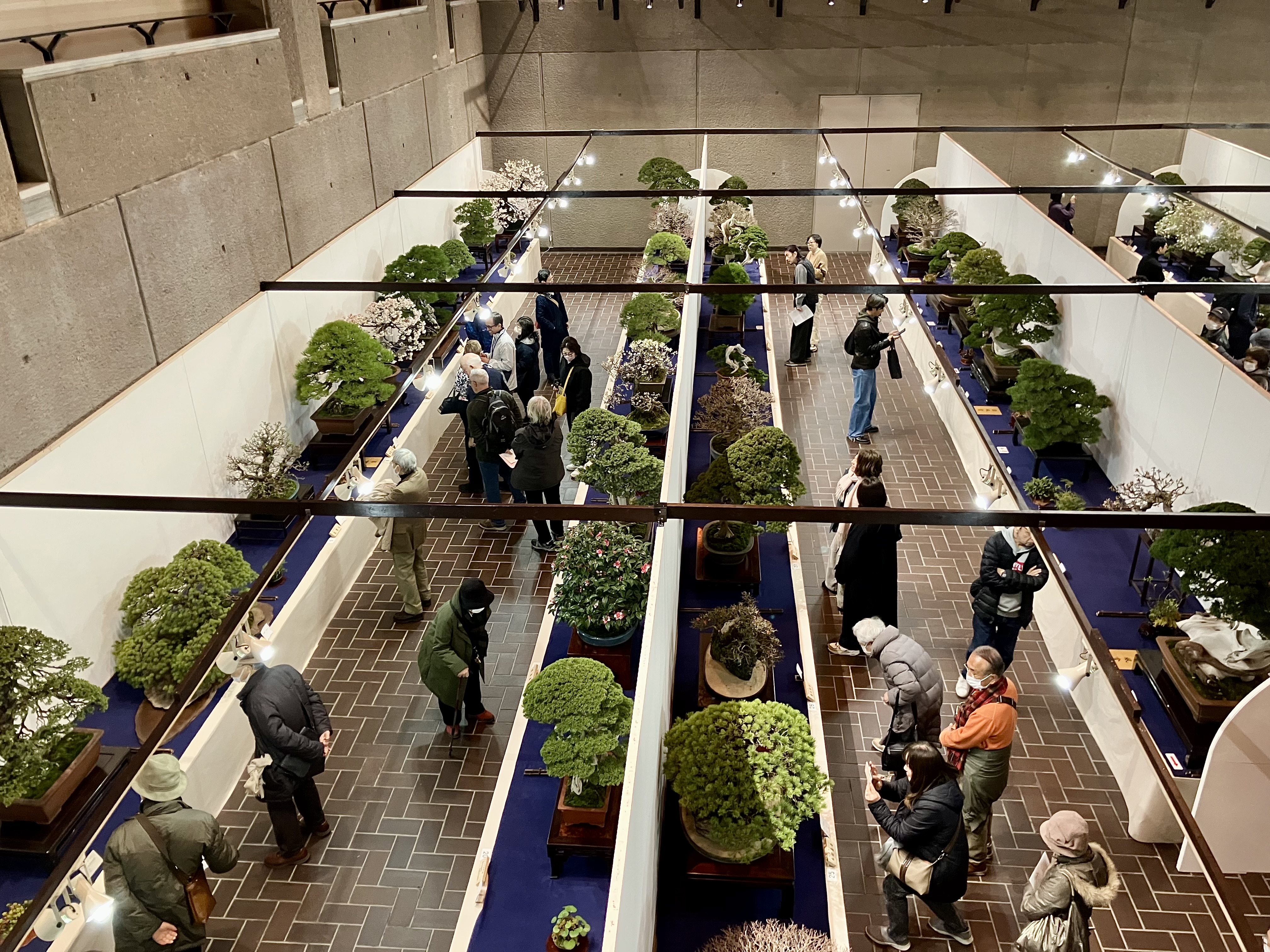
The entrance to the show looks down on the large displays. This is in the Tokyo Metropolitan Art Museum in Ueno. This view gives a sense of the scale and impact these huge trees might have only a few feet away.
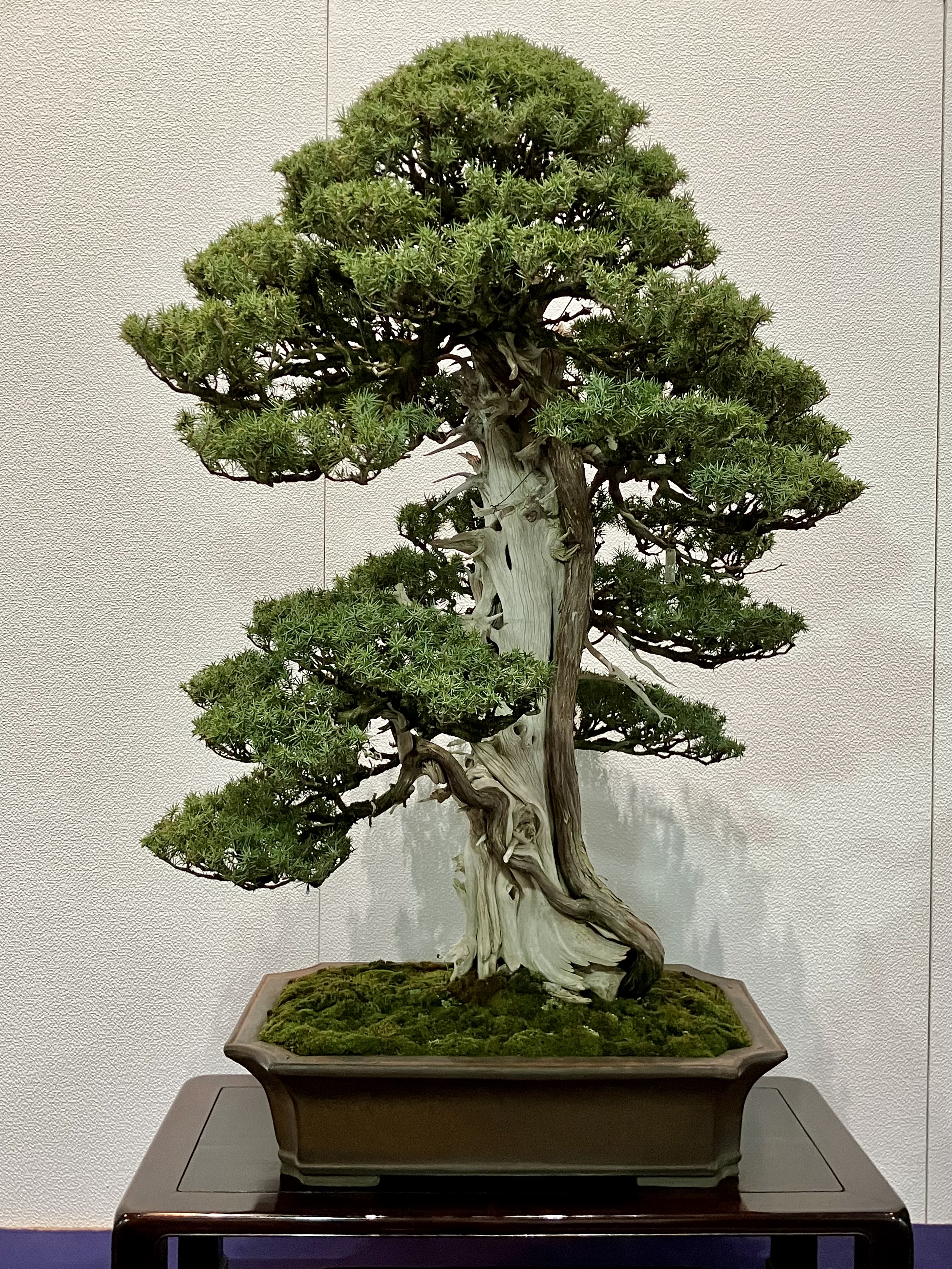
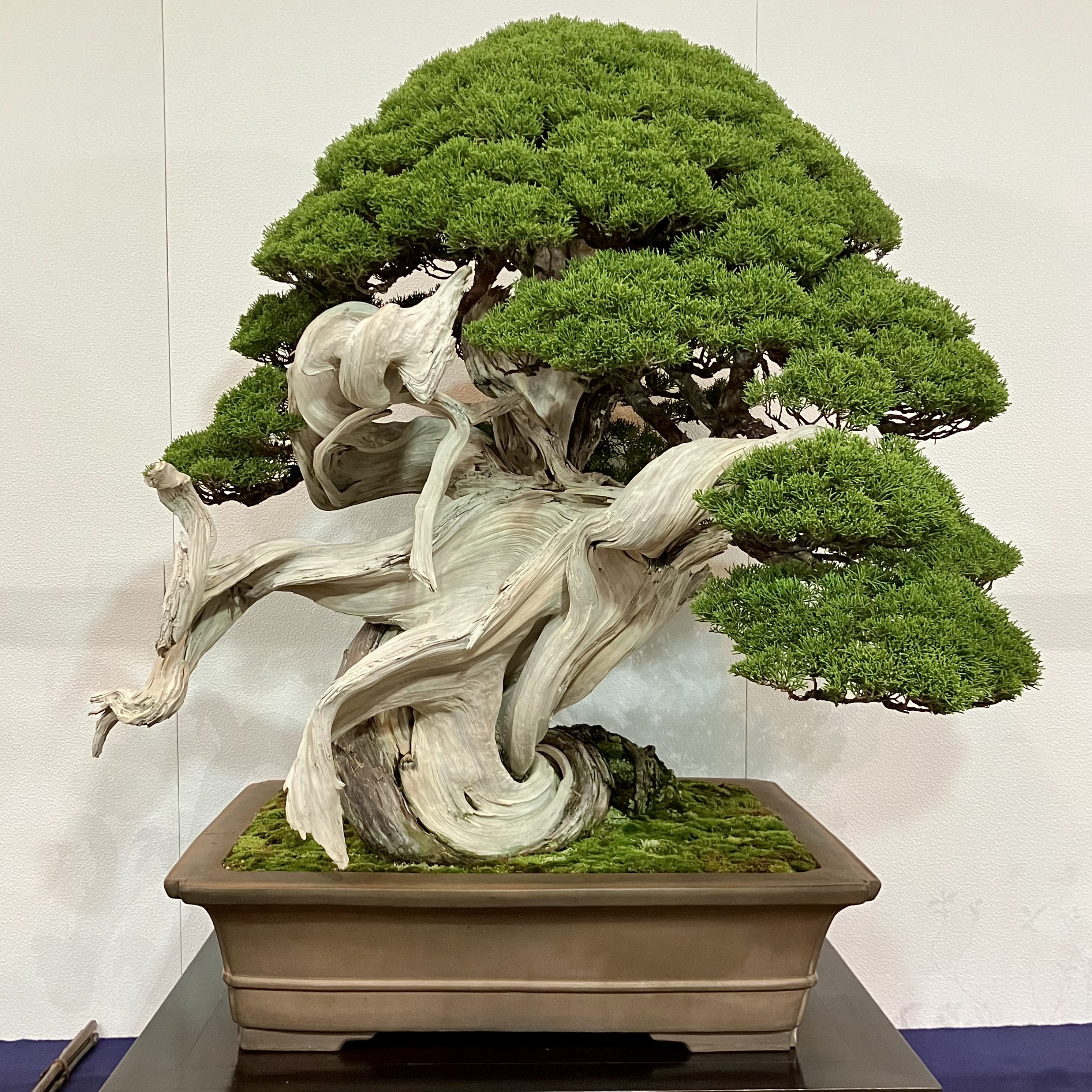
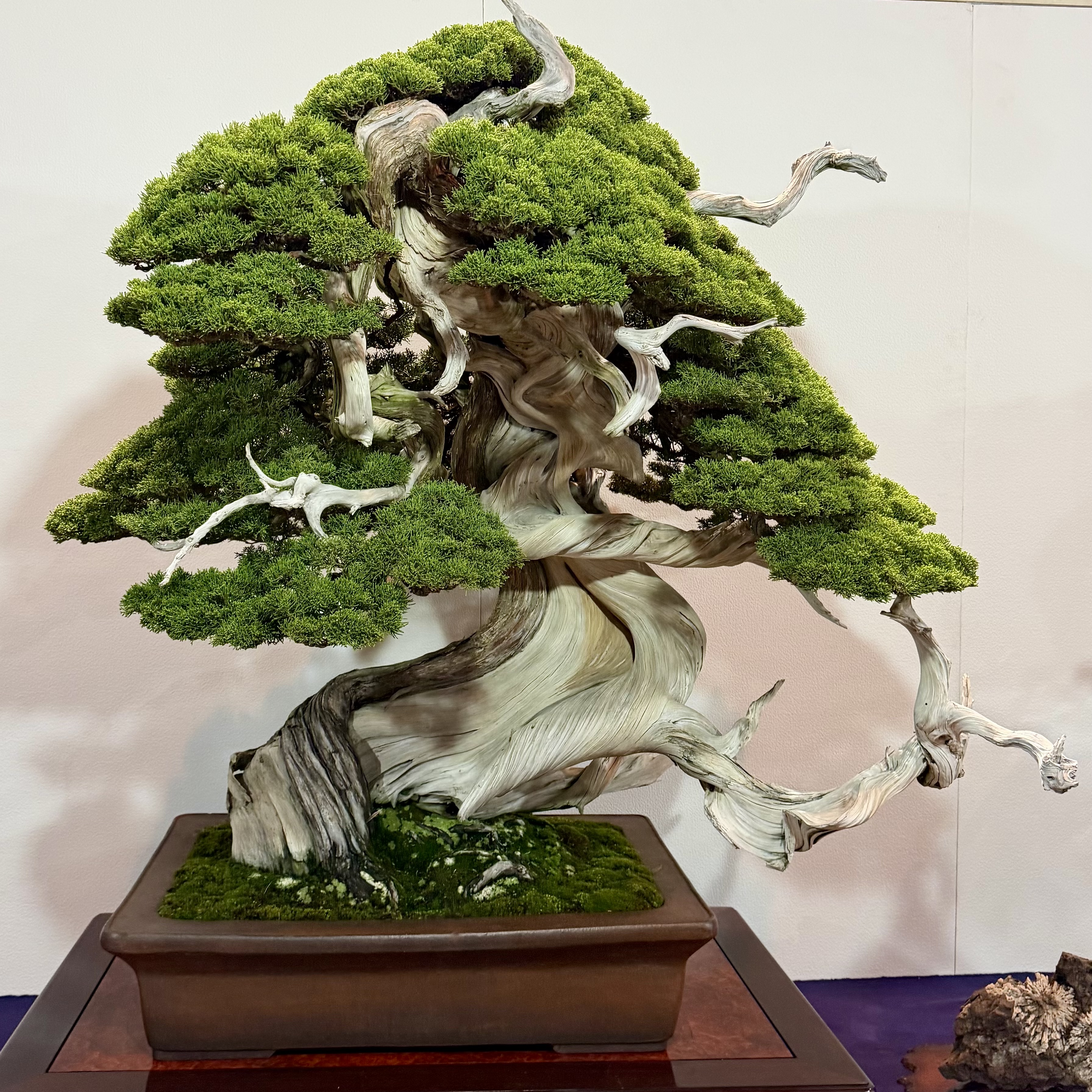
Needle Juniper. A well-known juniper making an appearance in the 100th Kokufu.
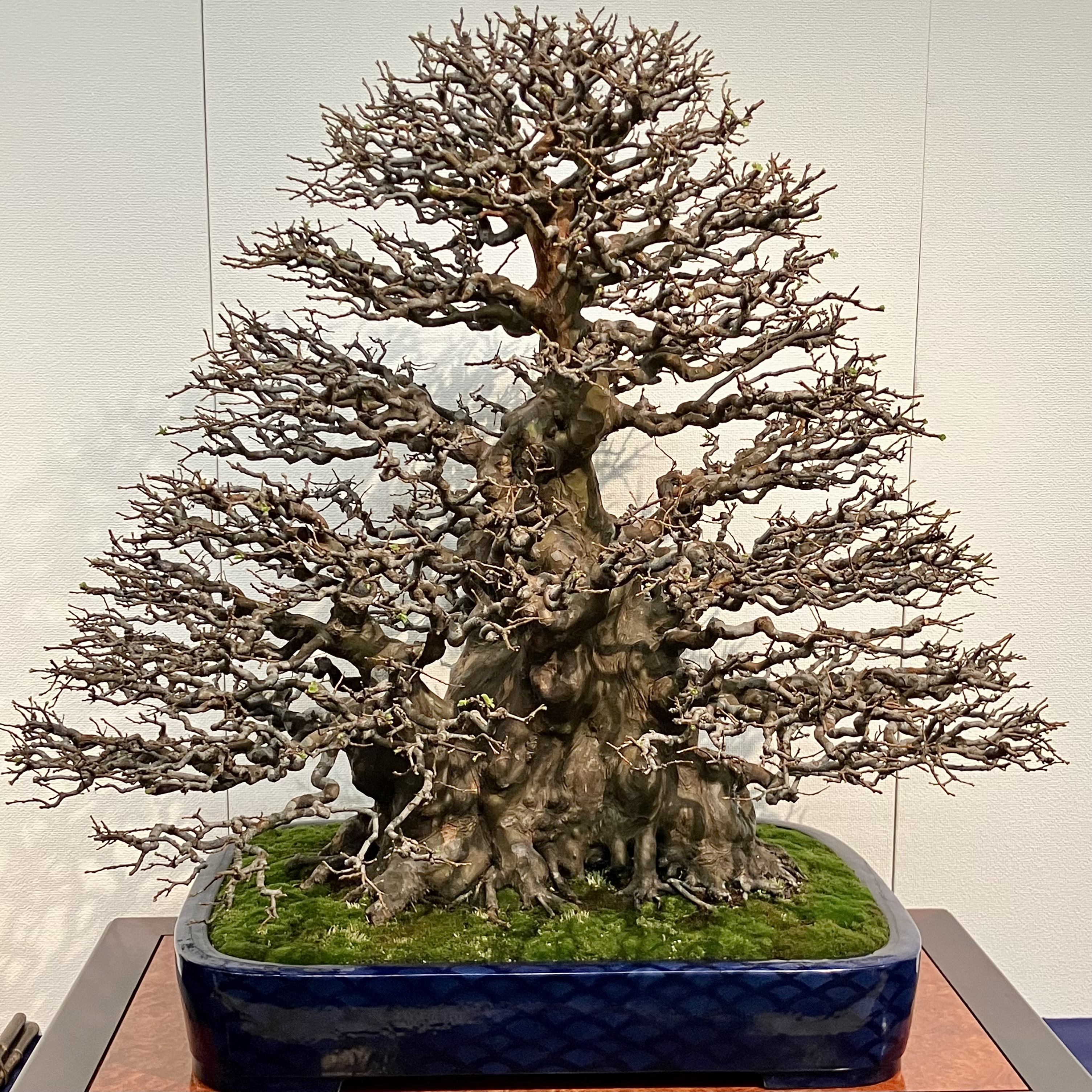
Chinese Quince. Every last twig had once been wired on this massive specimen.
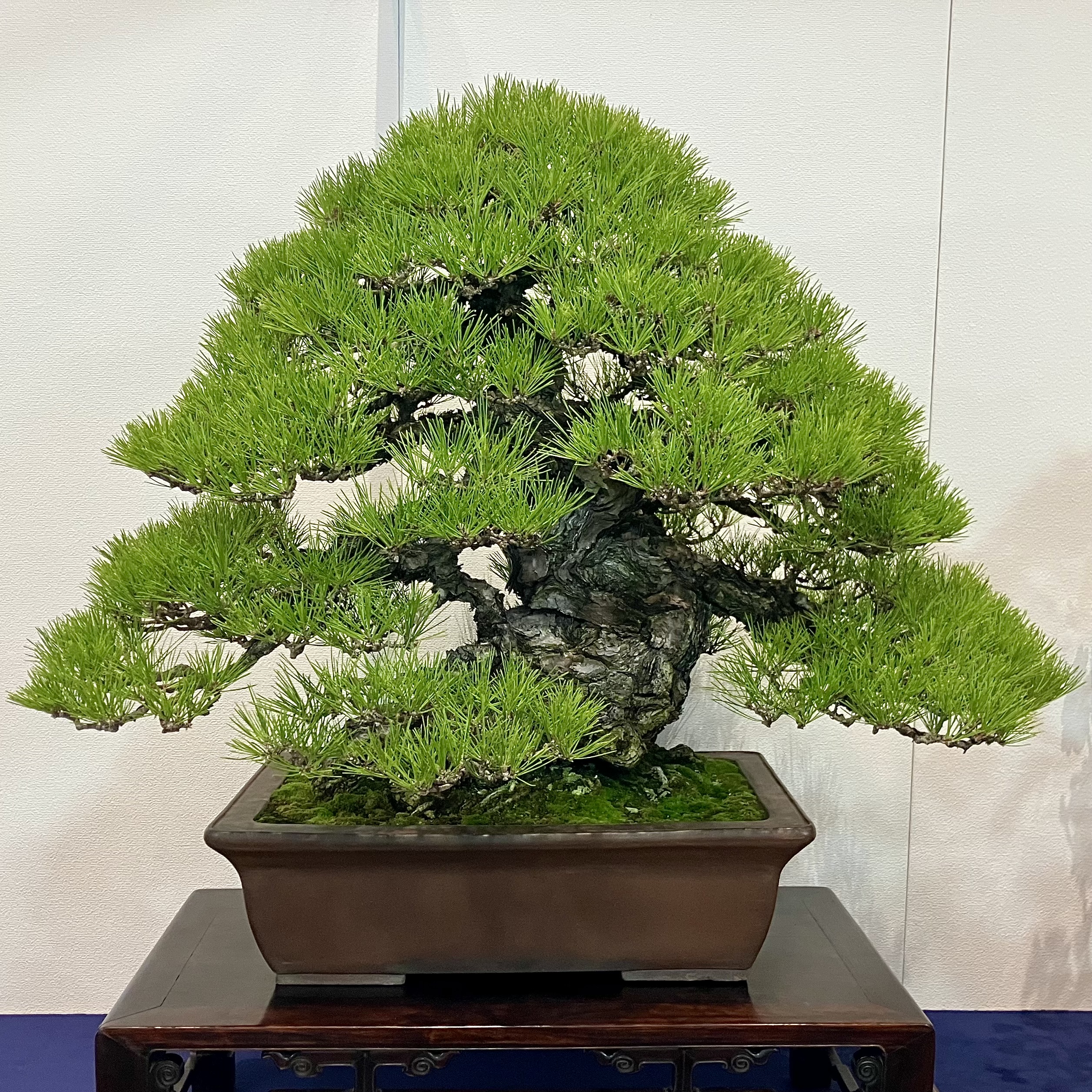
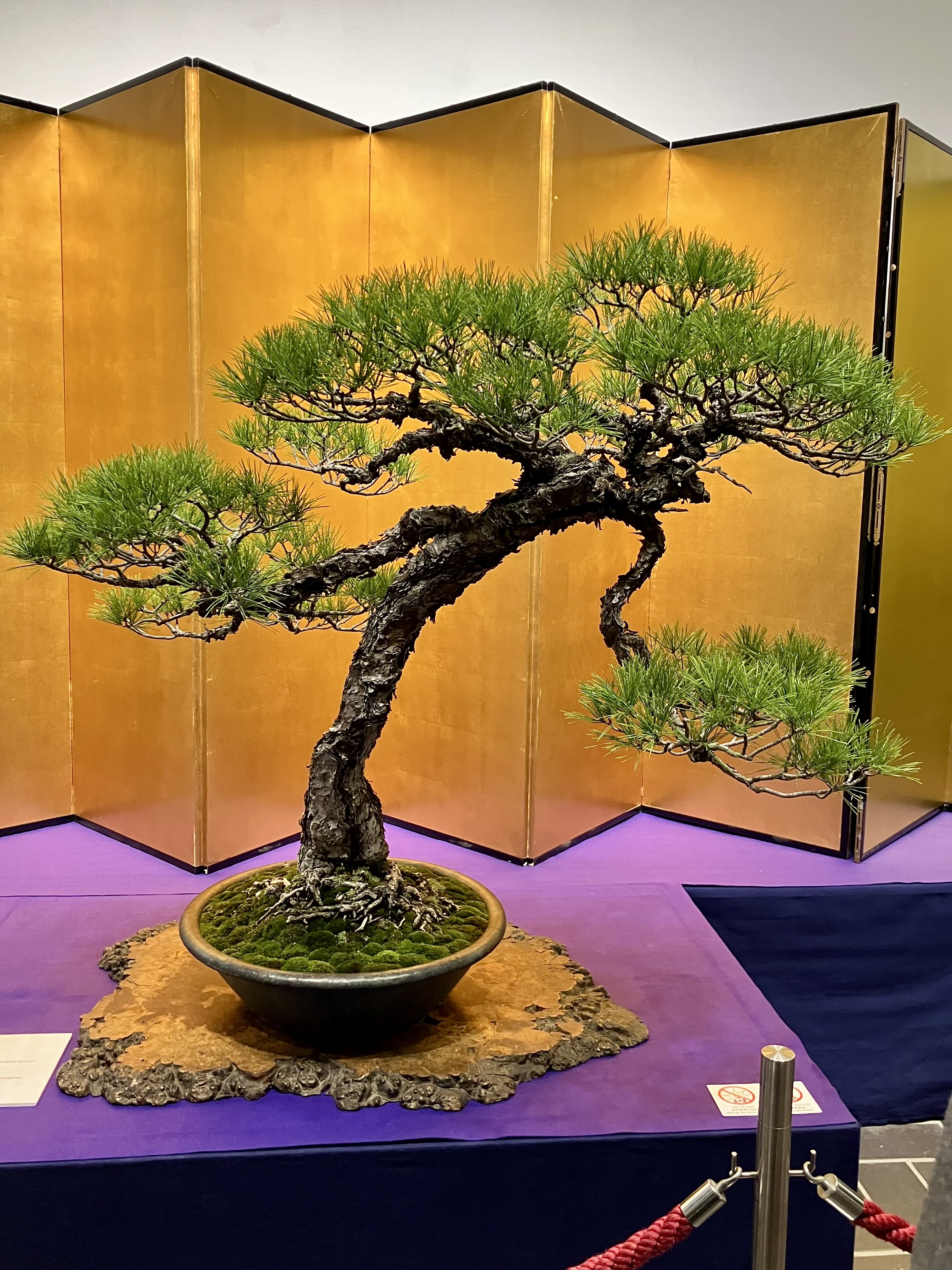
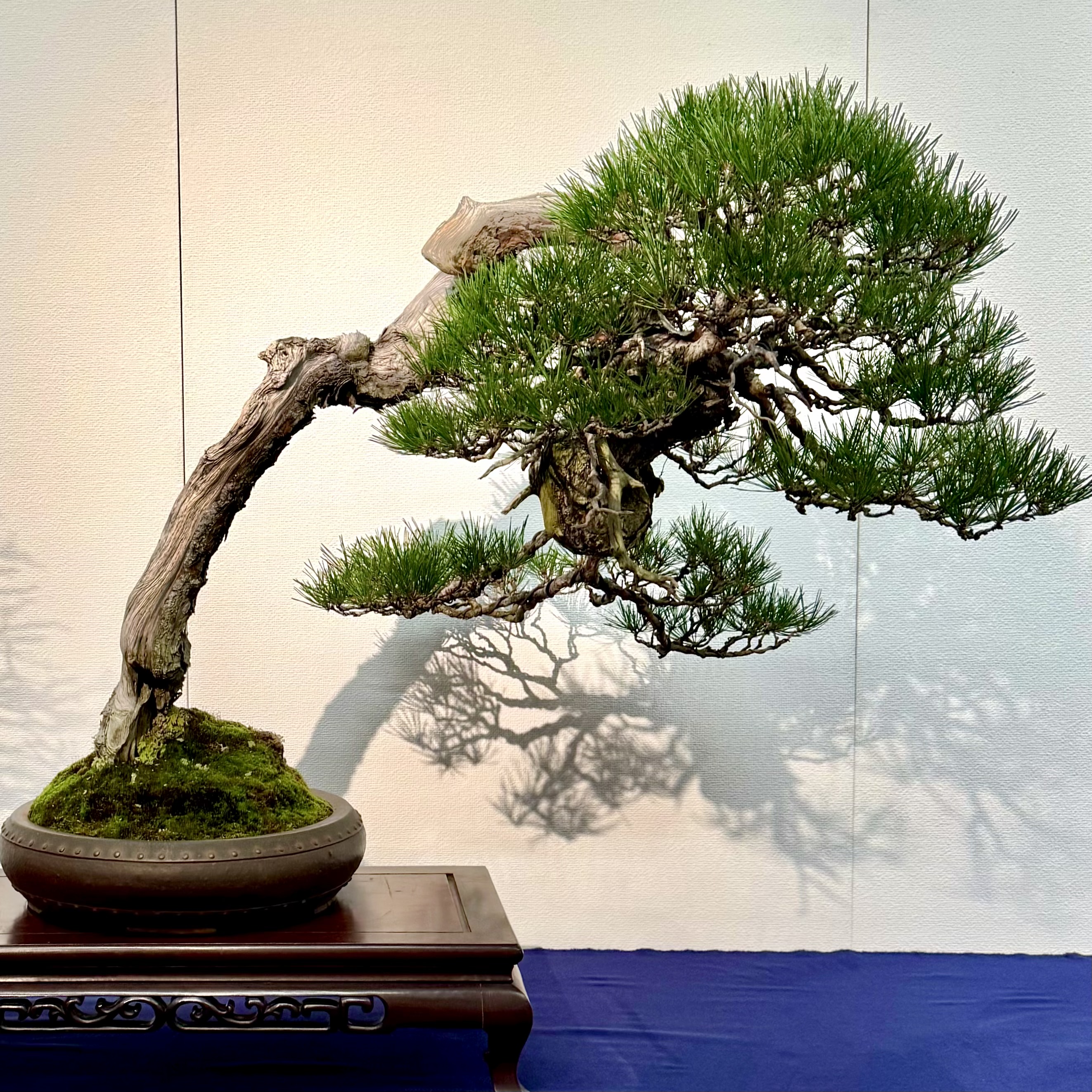
Japanese Black Pine; Kokufu Prize. Huge tree.
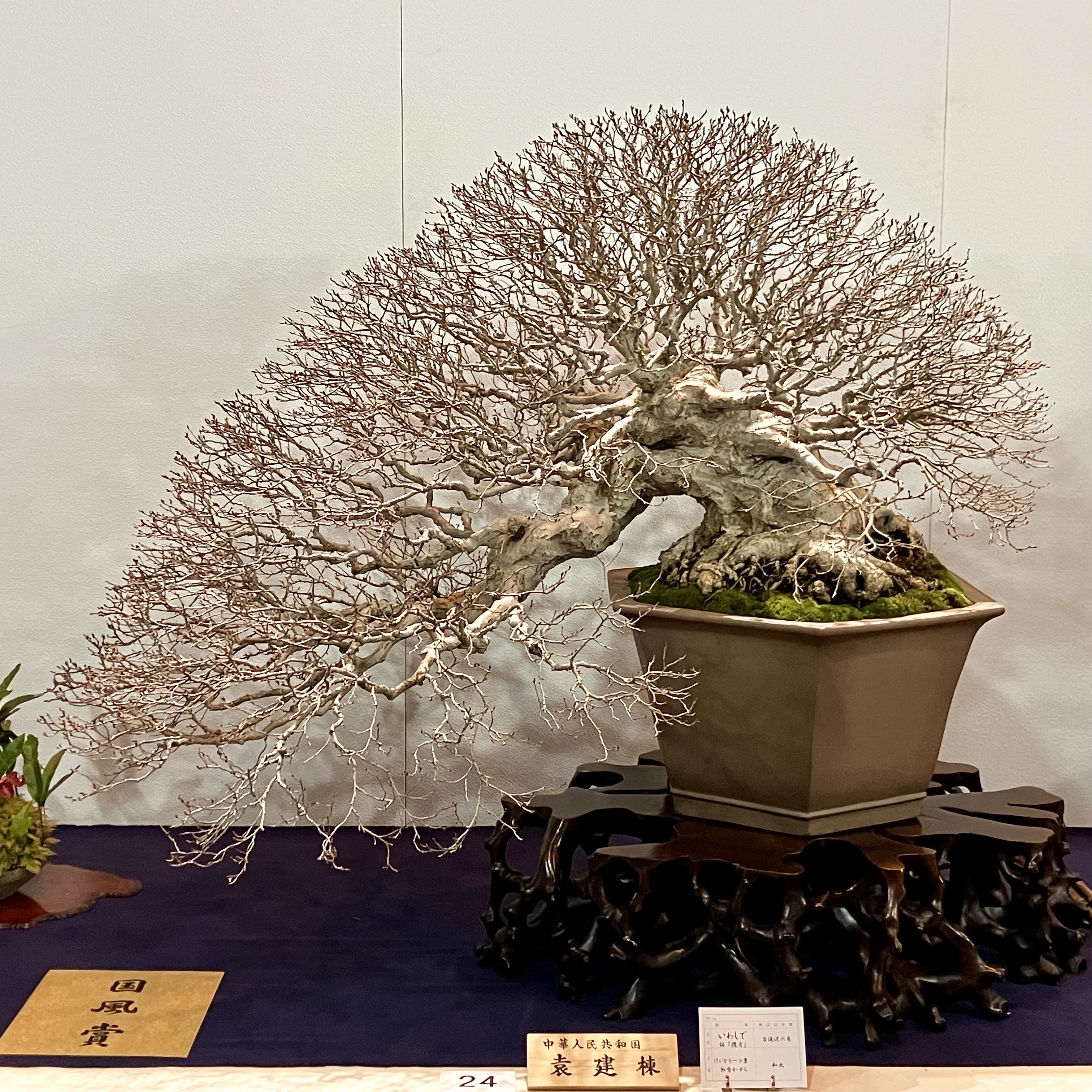
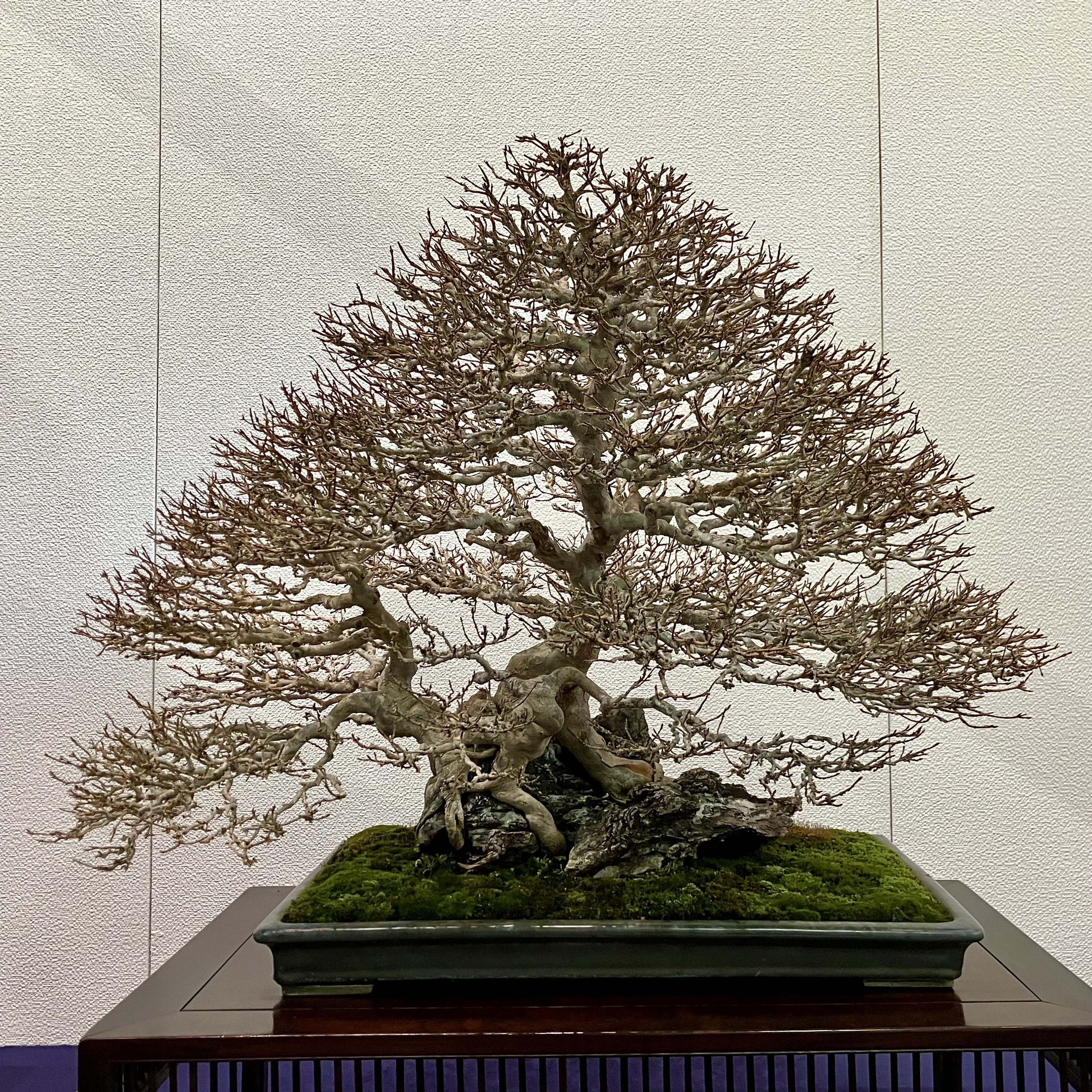
Korean Hornbeam; Kokufu Prize.
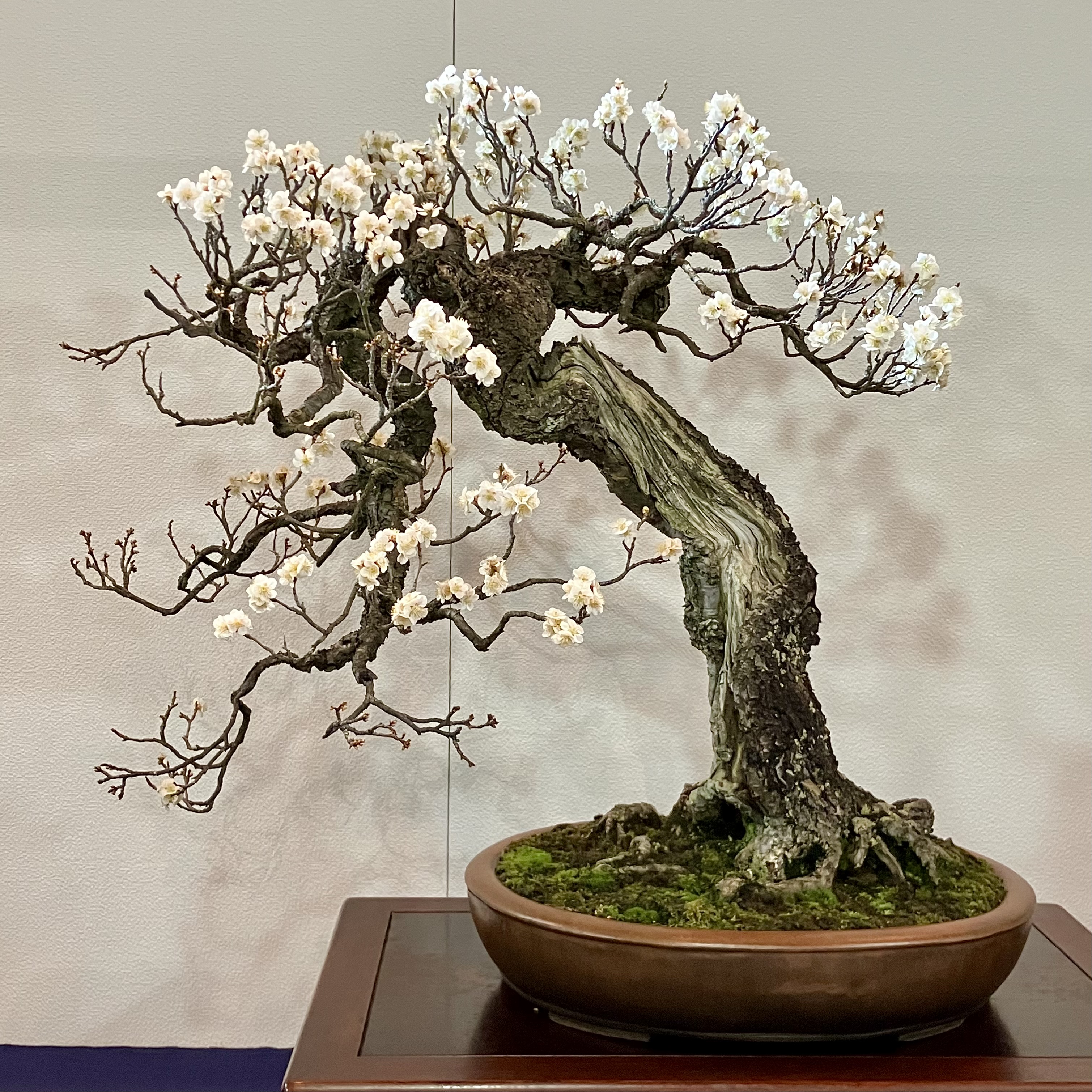
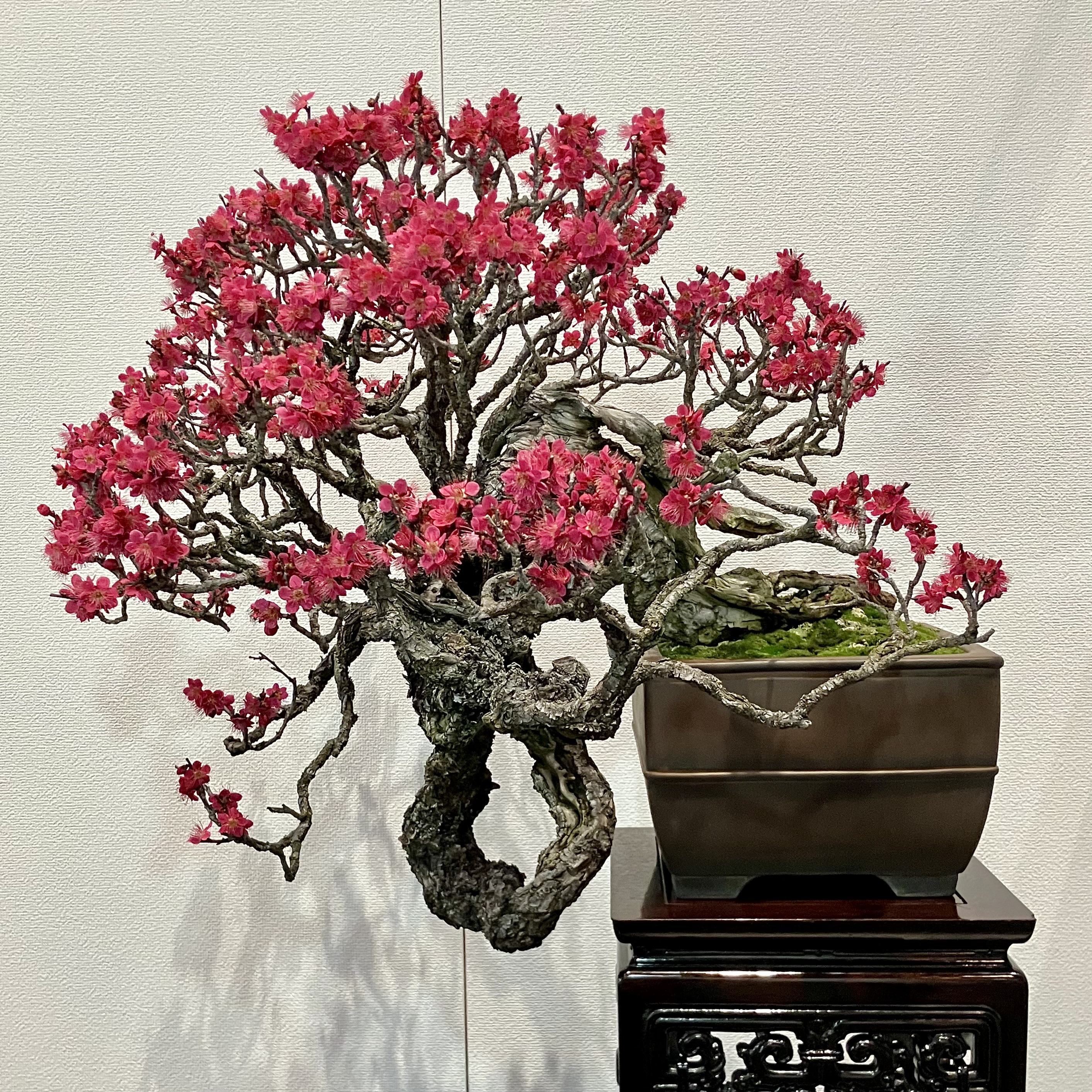
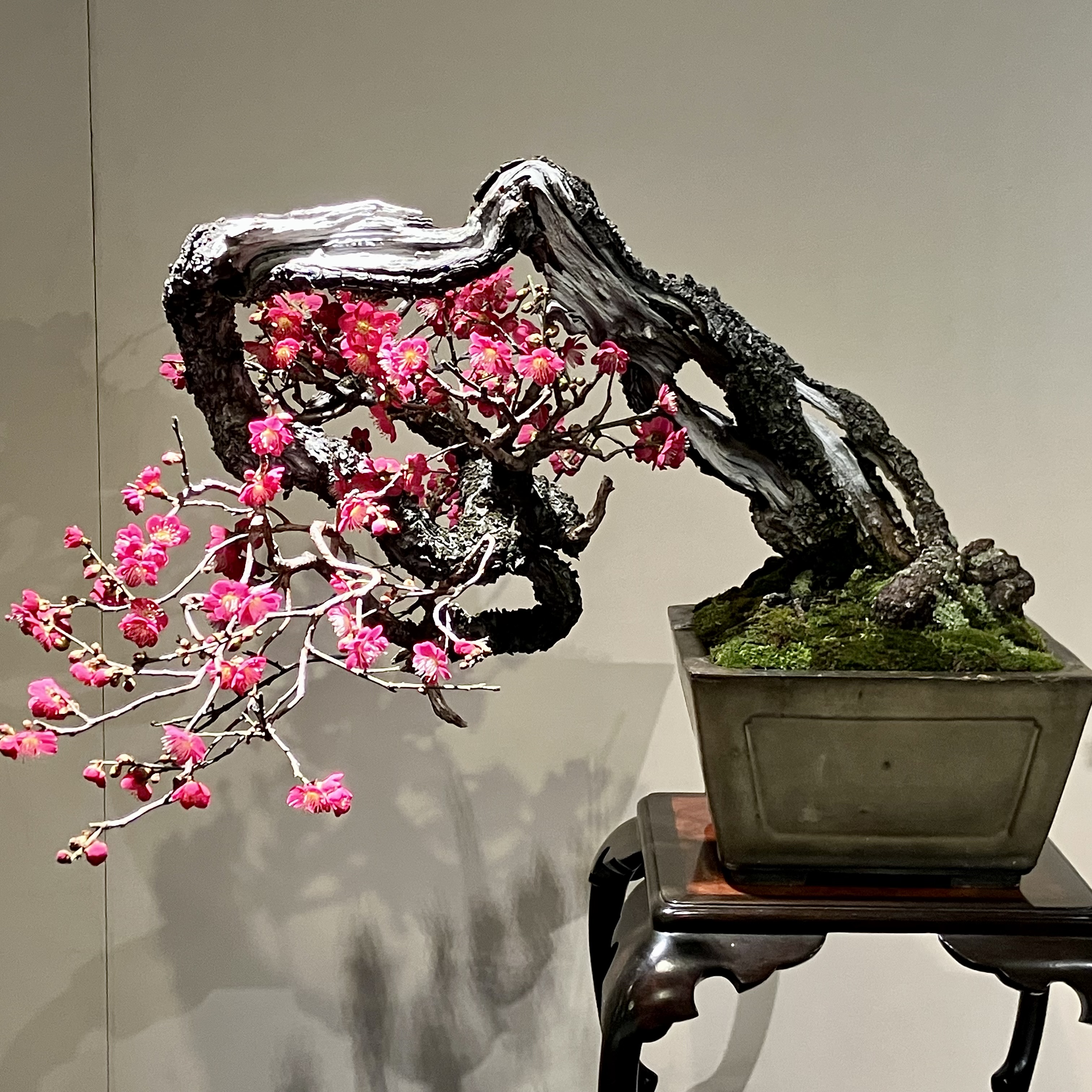
Ume. Excellent Ume in this year’s show.
Satsuki Azalea.
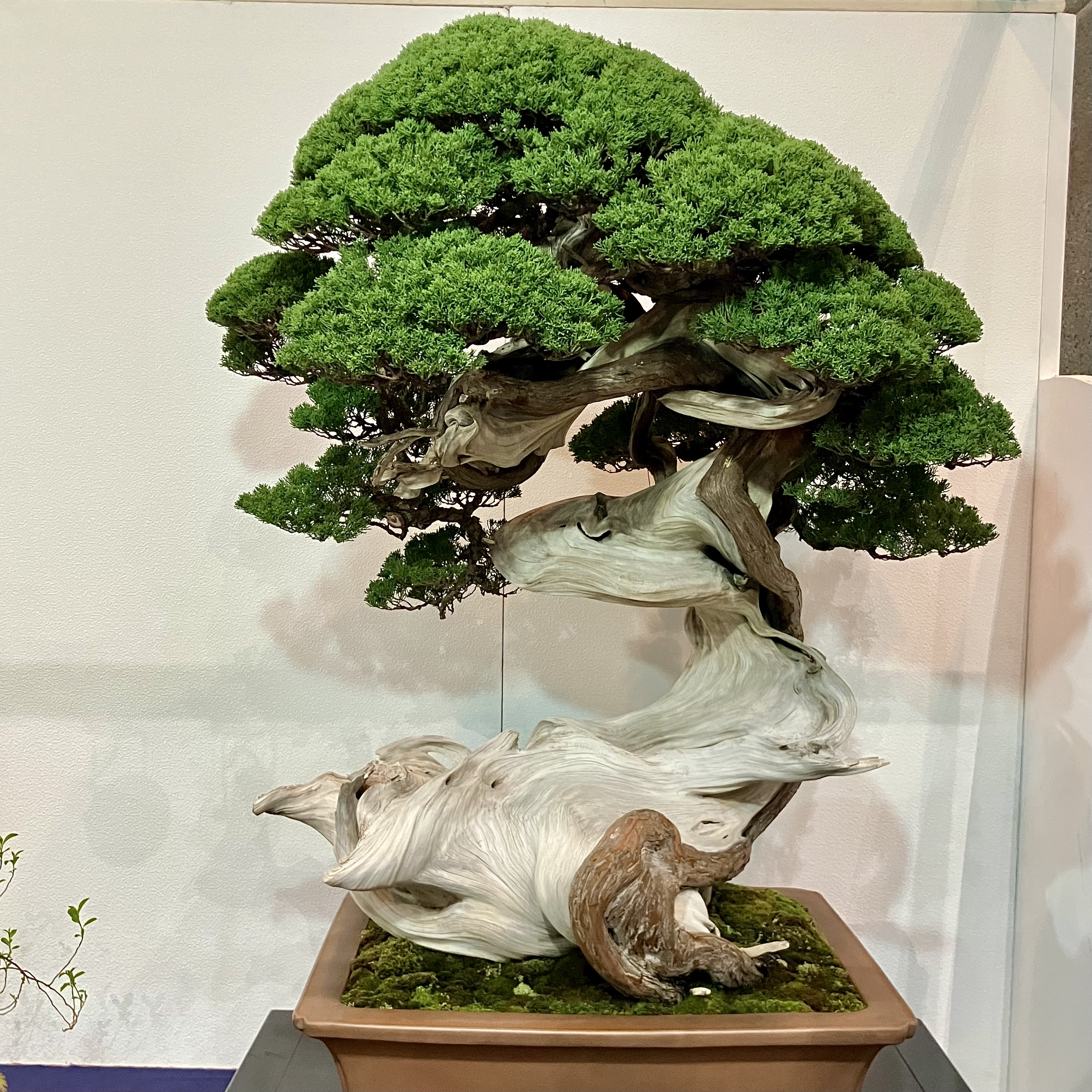
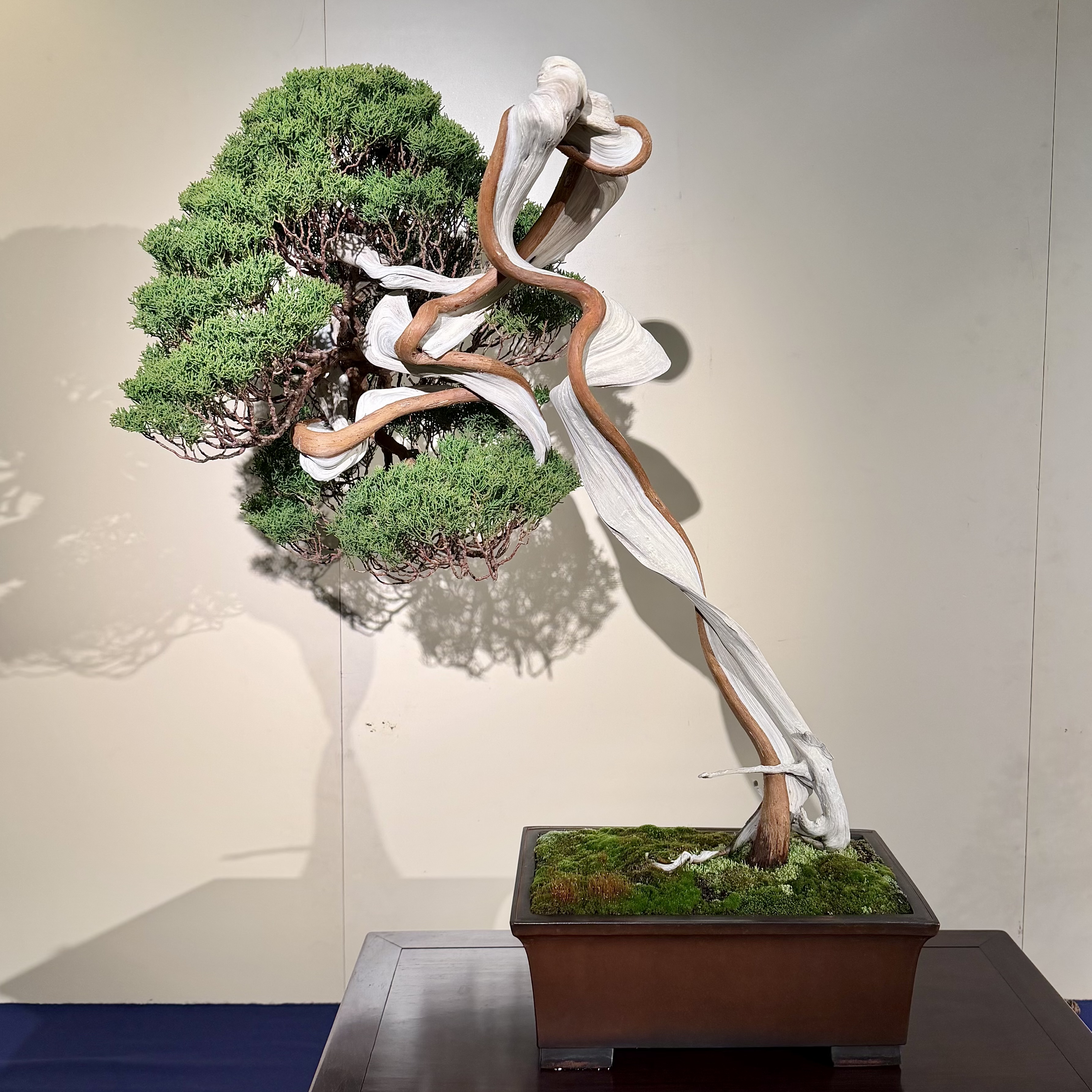
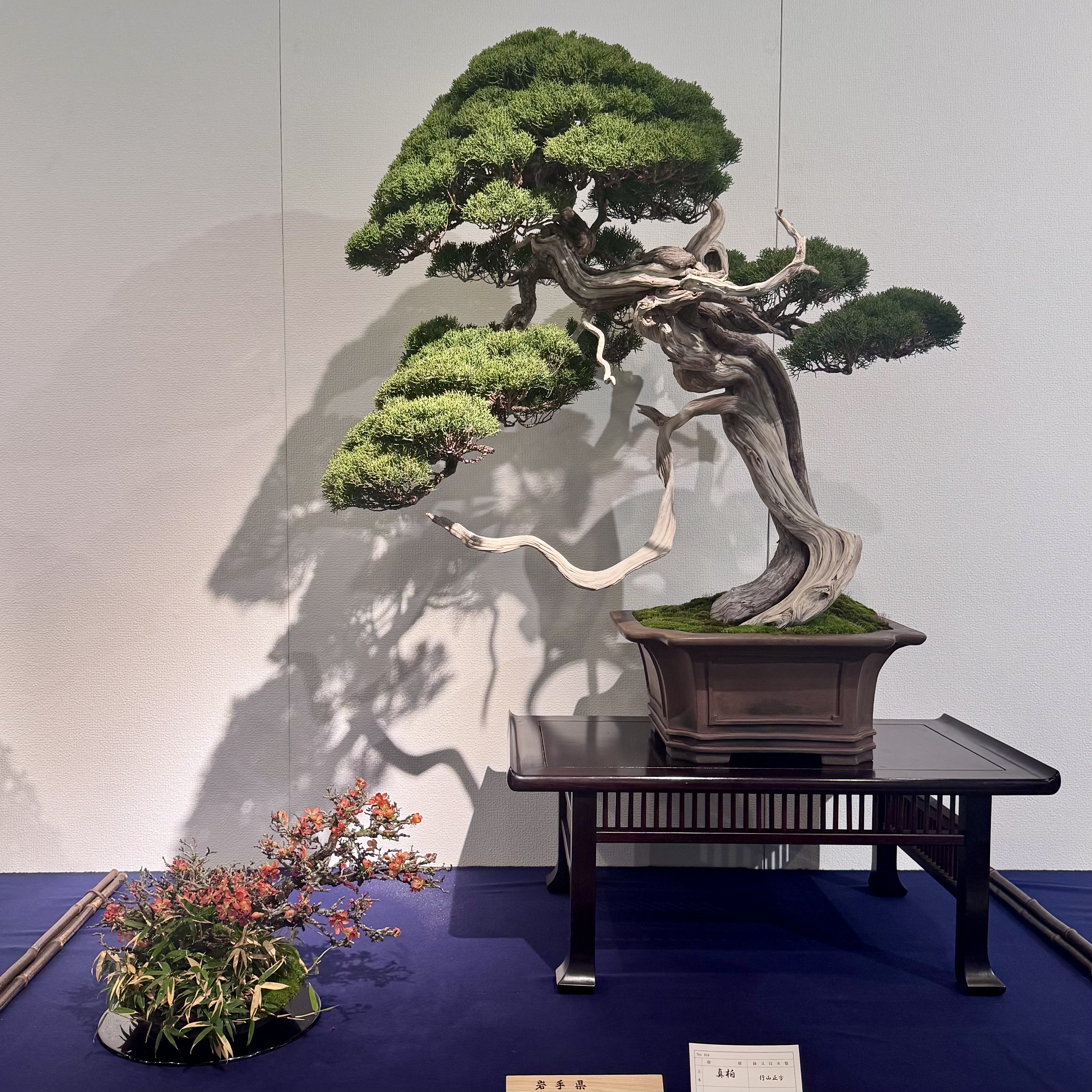
Shinpaku Juniper; Kokufu Prize.
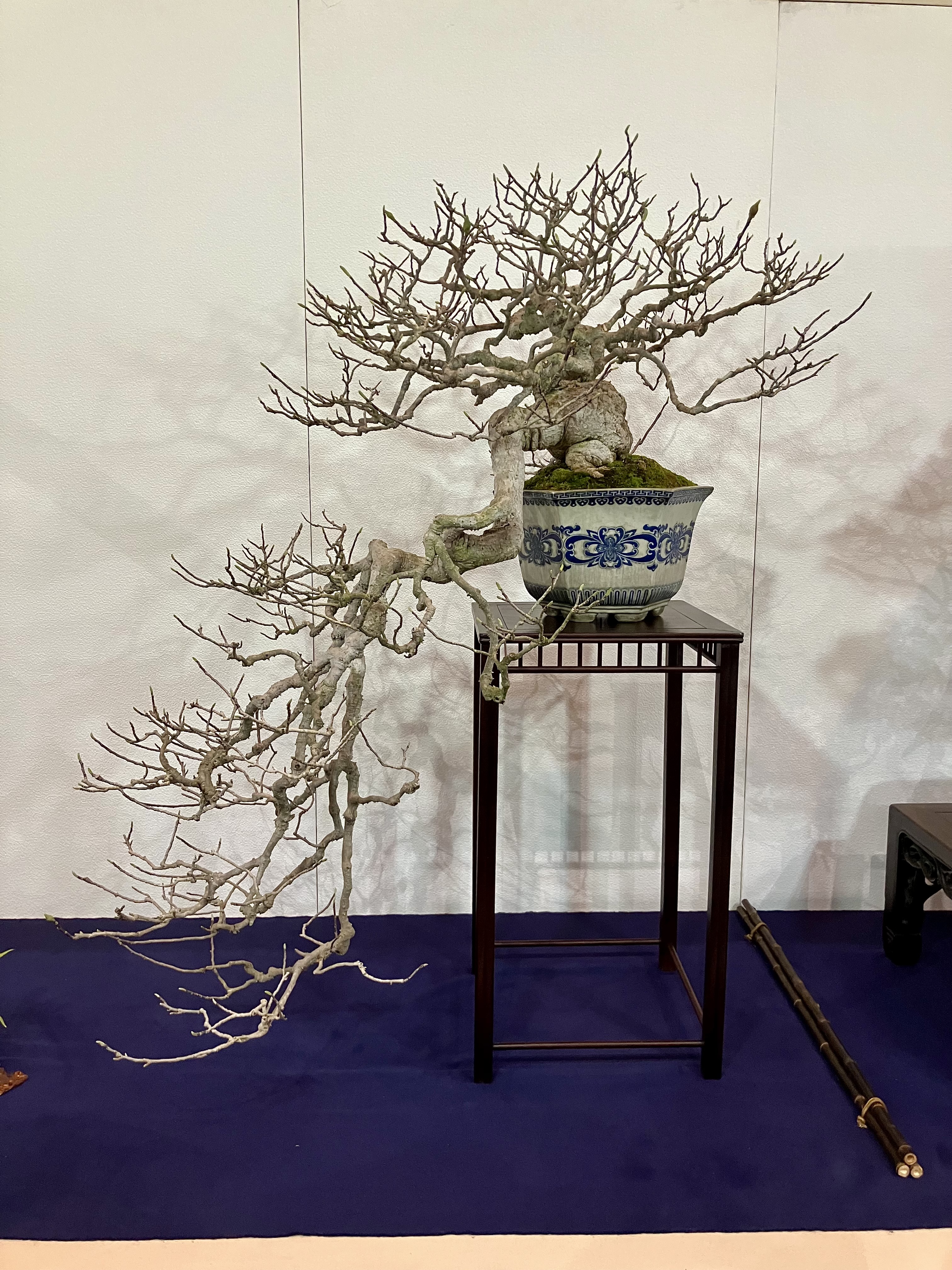
Magnolia. Resets the tone with an airy whimsicality.
Shinpaku Juniper; Kokufu Prize.
Selaginella, or club moss (light green plant).
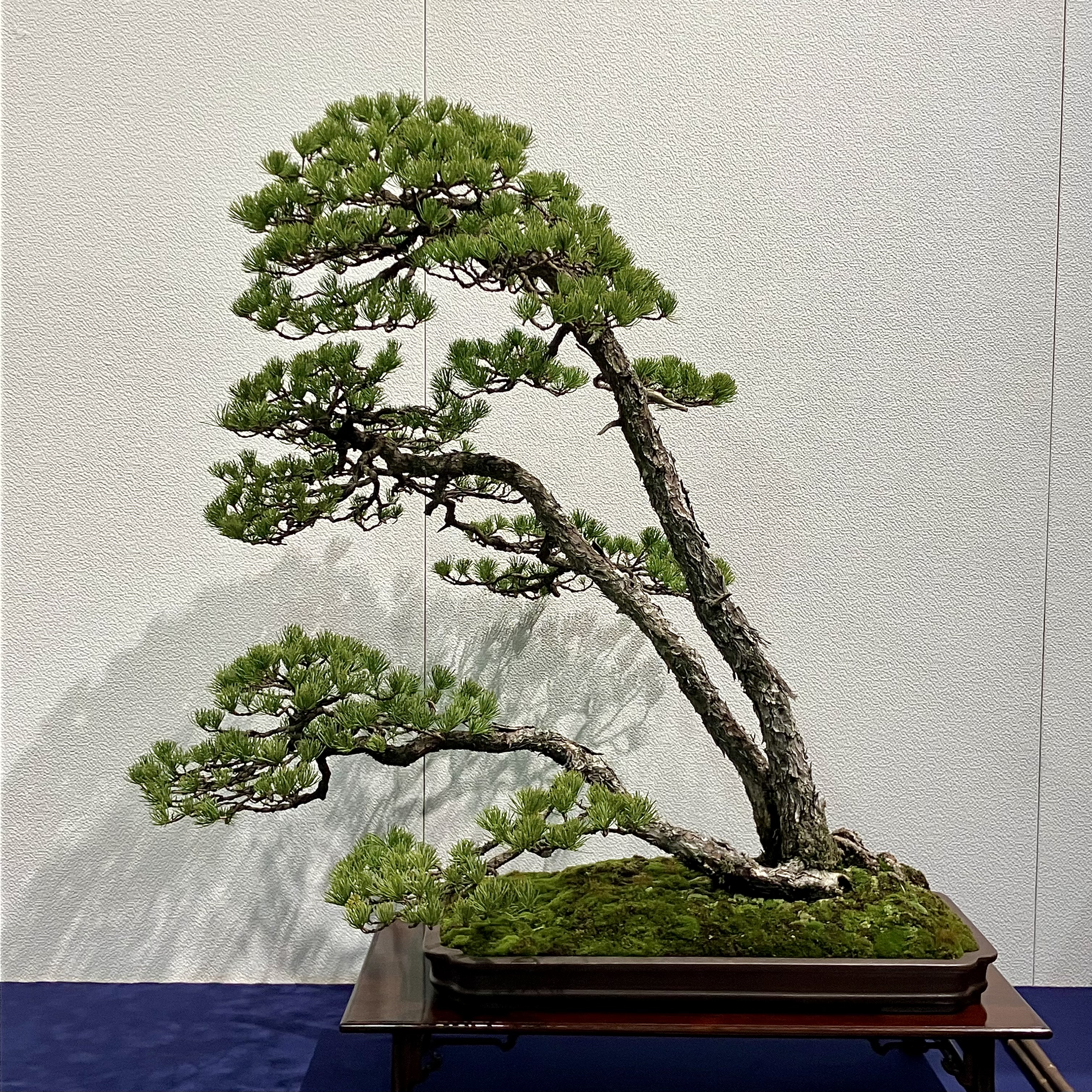
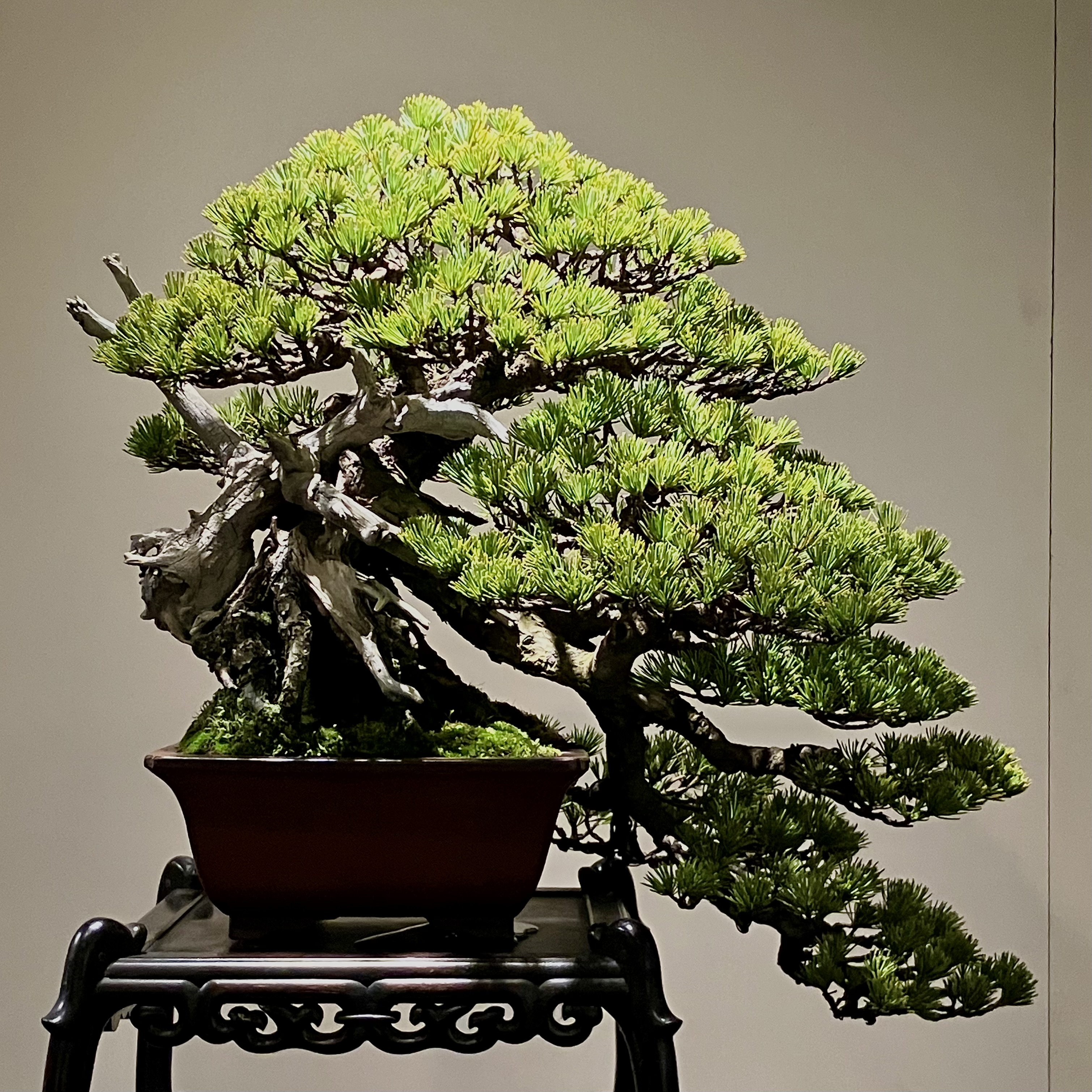
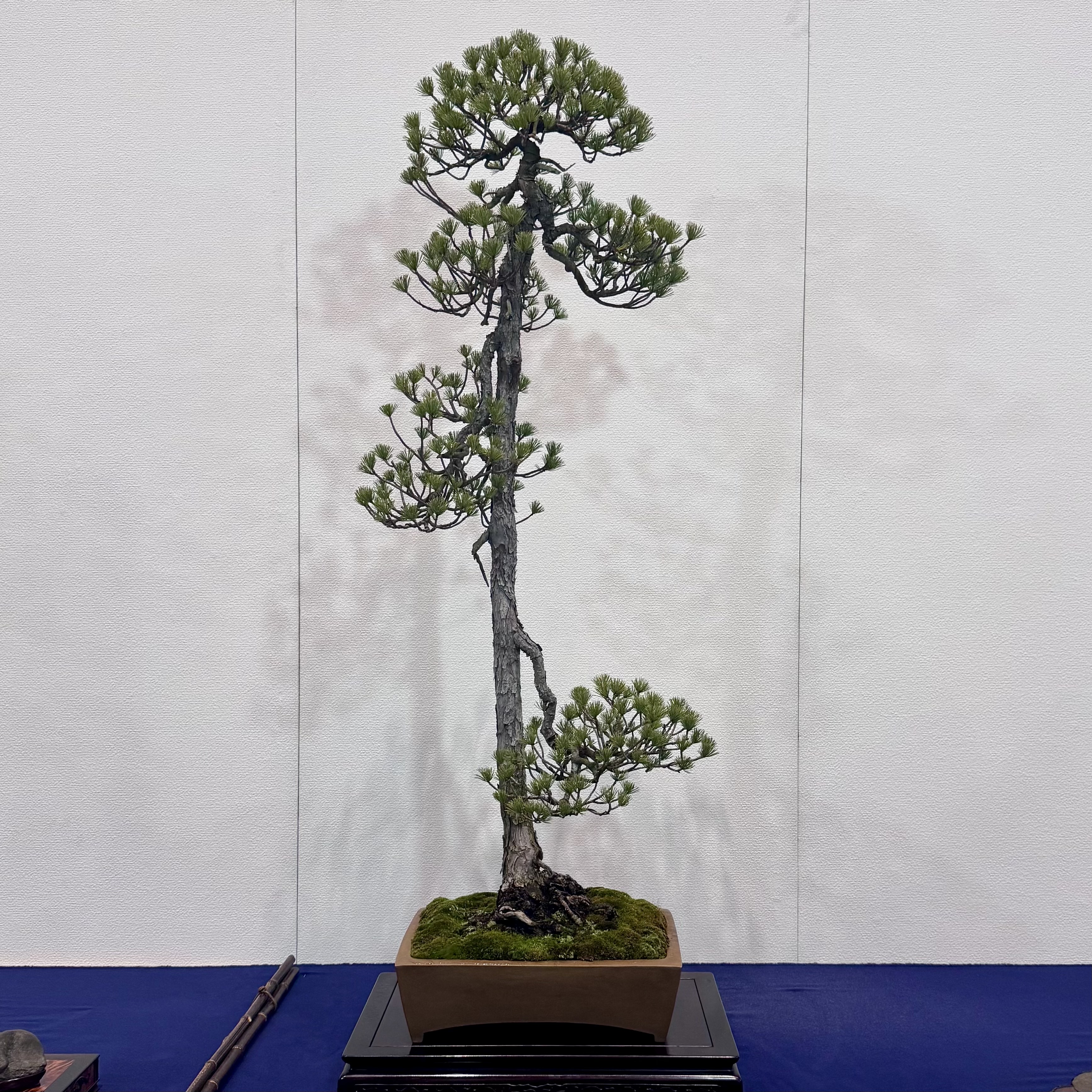
Japanese White Pine. A quiet multiple-trunk bunjin. The Kokufu highlights thicker-trunked trees.
Trident Maple. Grown in a small pot it’s whole life, maybe 75 years.
Ume.
Red Pine from the Imperial Family. Notice the lack of conformity to modern bonsai expectations, particularly the lack of compaction.
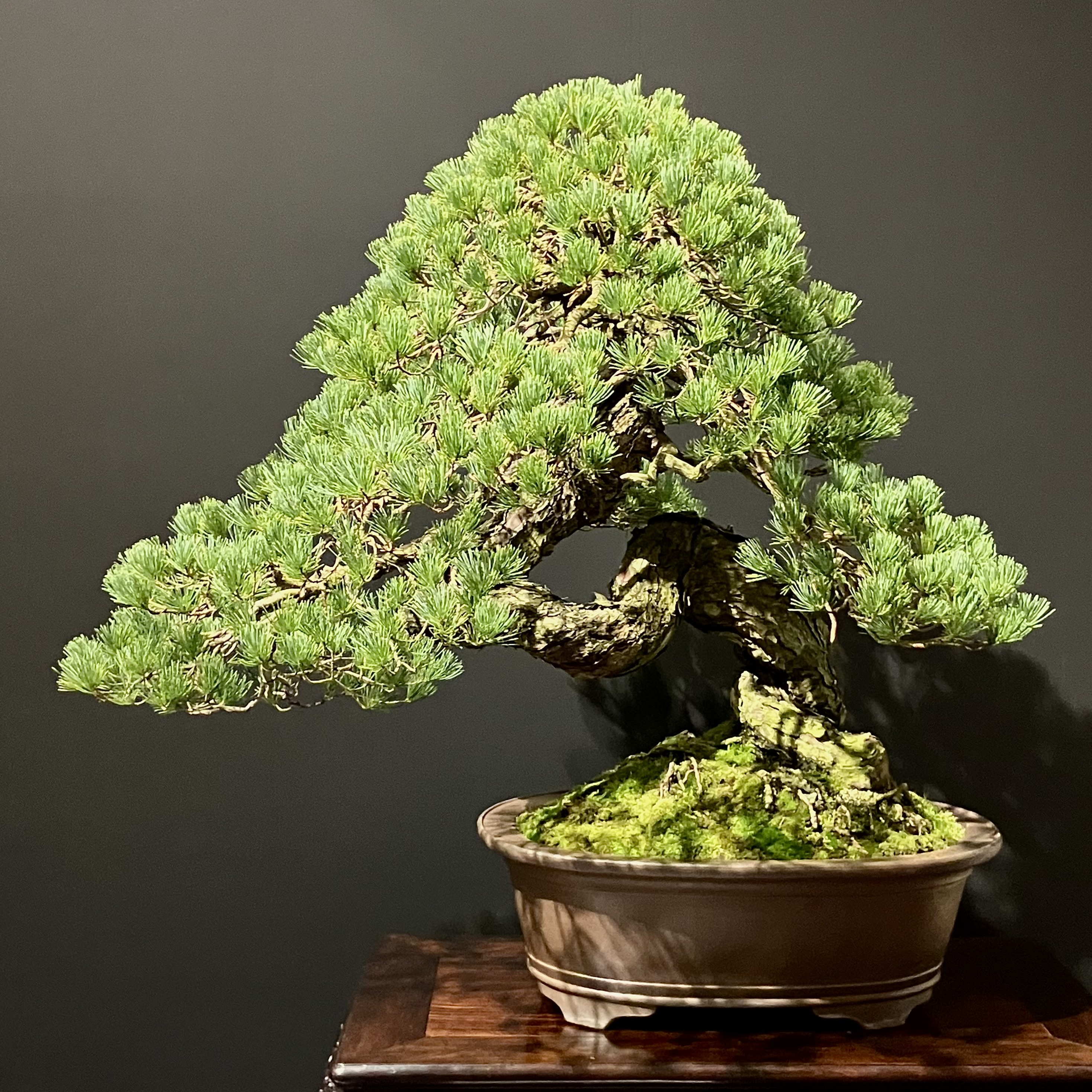
Japanese White Pine worked on by Mr. Shinji Suzuki. He was excited about this entry as it has a grand history…
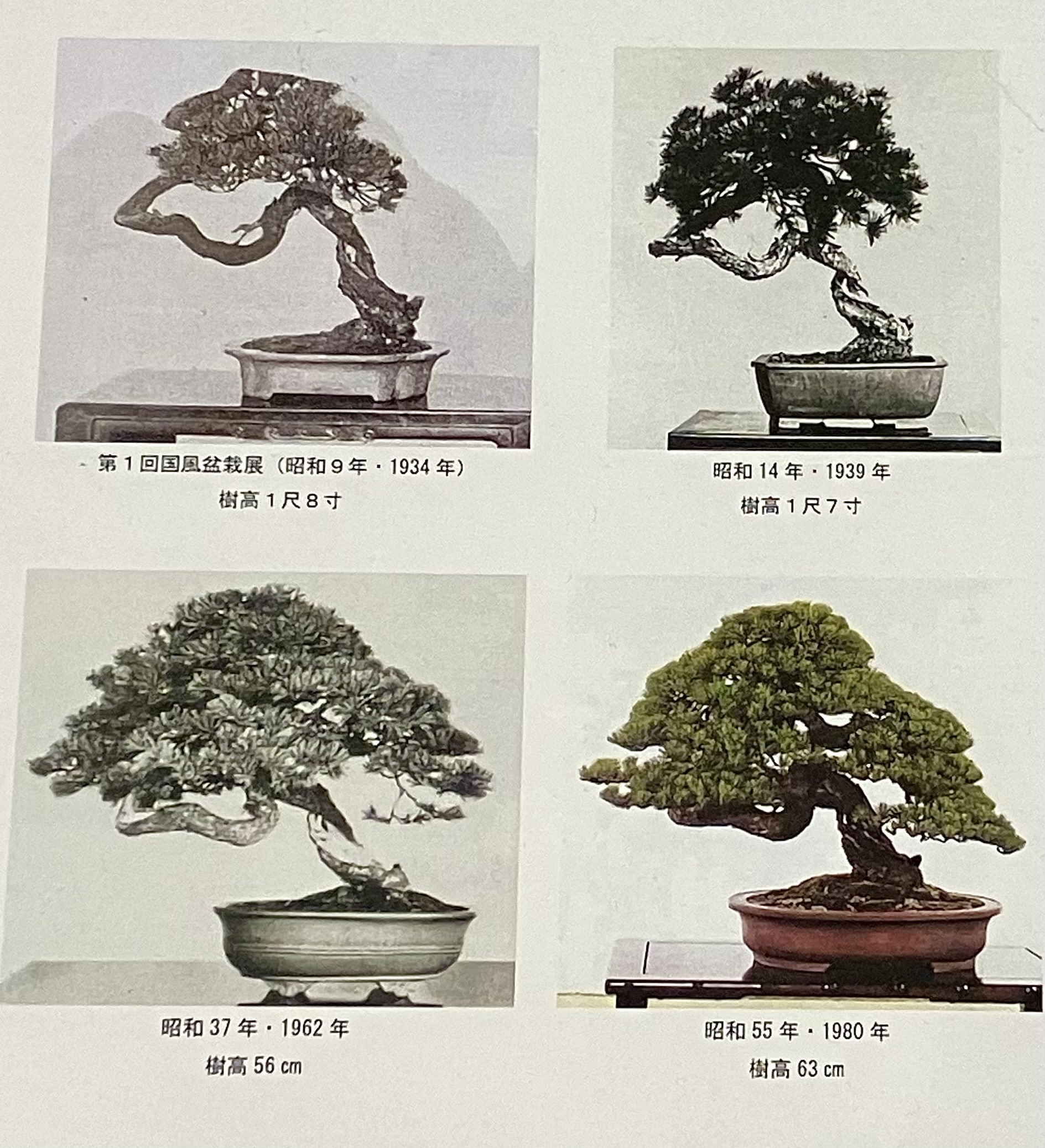
The White Pine was shown in the first Kokufu-ten in 1934. It’s a great addition to this 100th show (not year, they took two years off and some of the early years had double shows). The entry is a nod to the durability of the show and the trees in it.
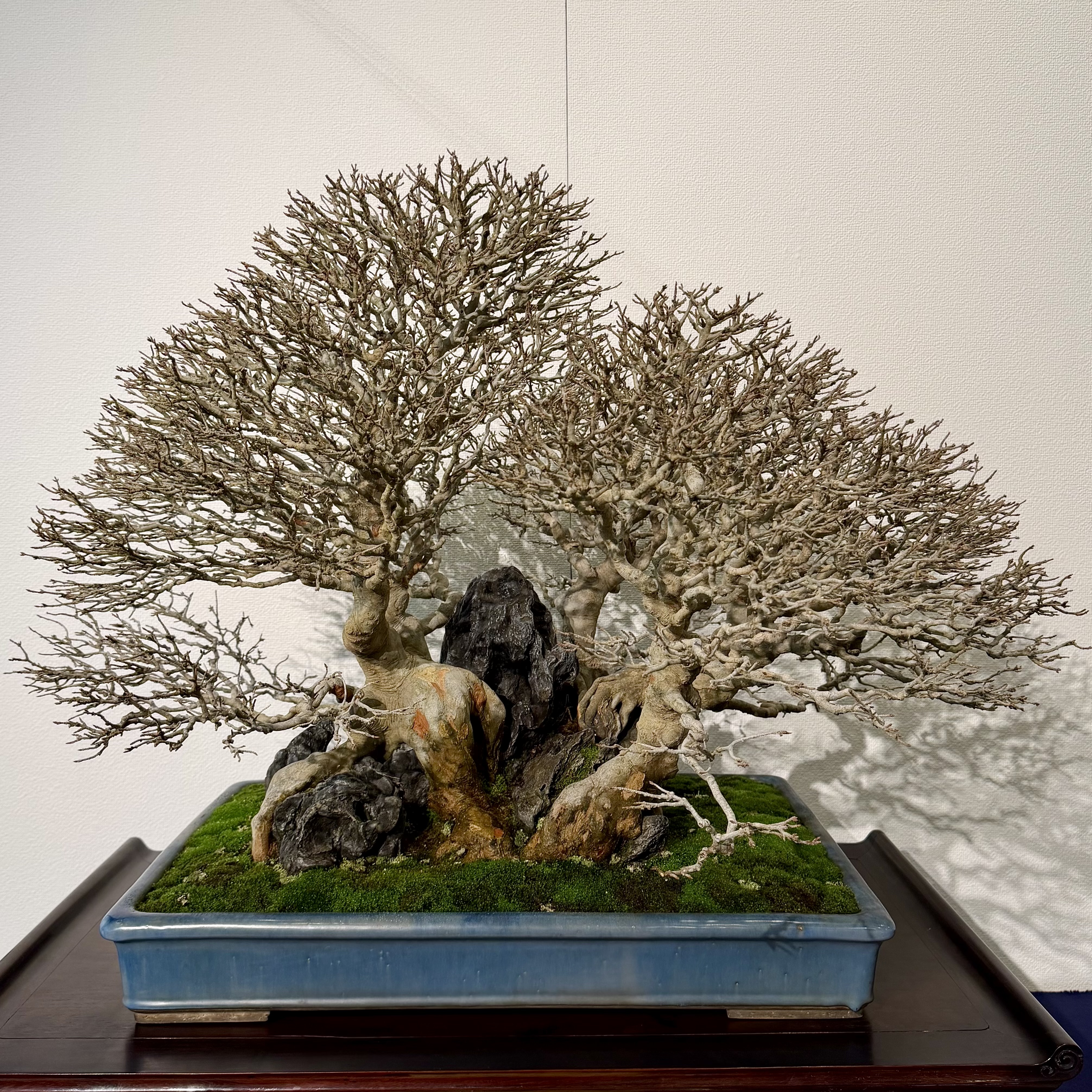
Zelkova.
Dwarf Flowering Quince ‘Chojubai’.
Honeysuckle.
Chinese Quince. The intense ramification at this small scale is not easy.
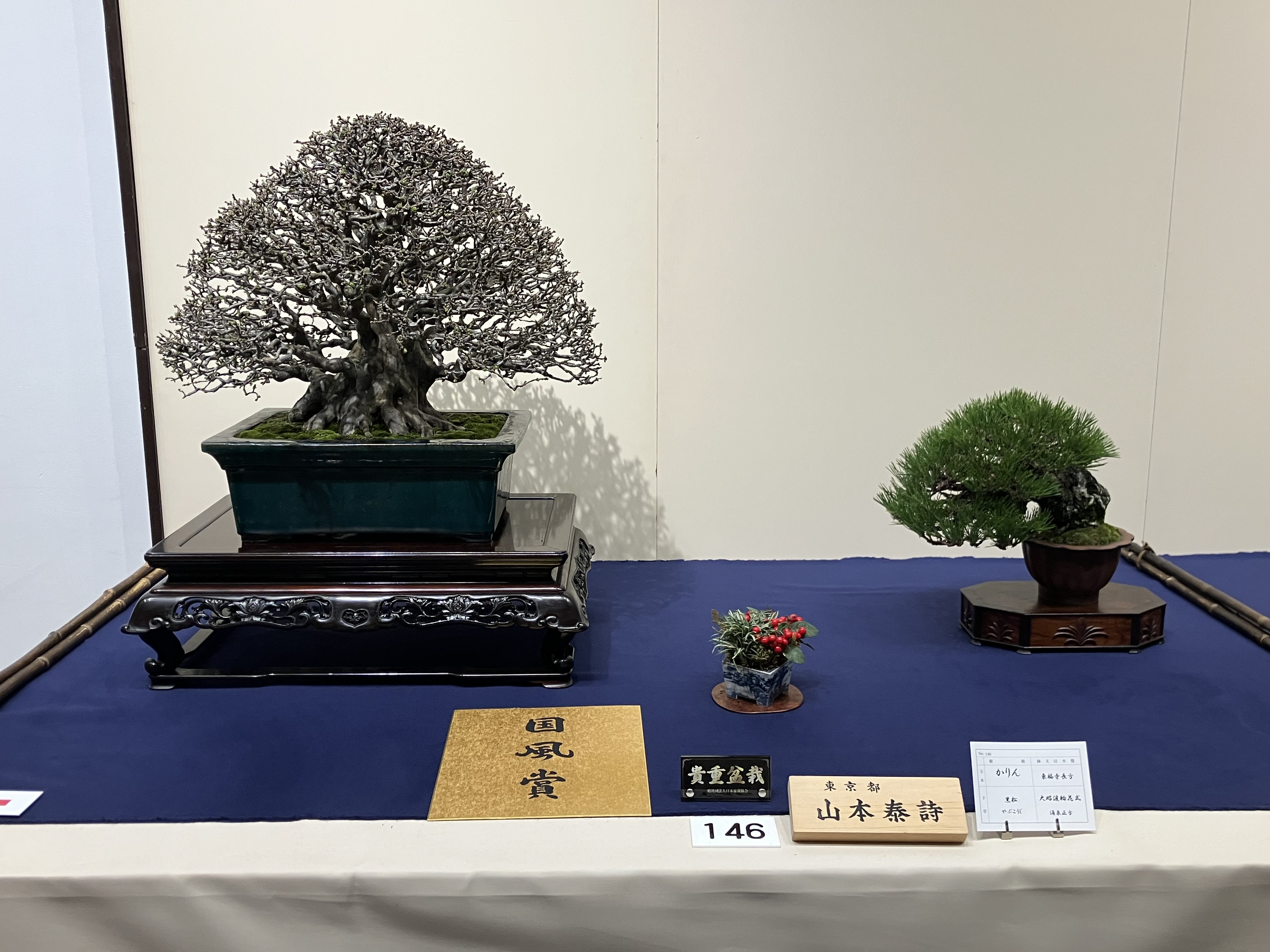
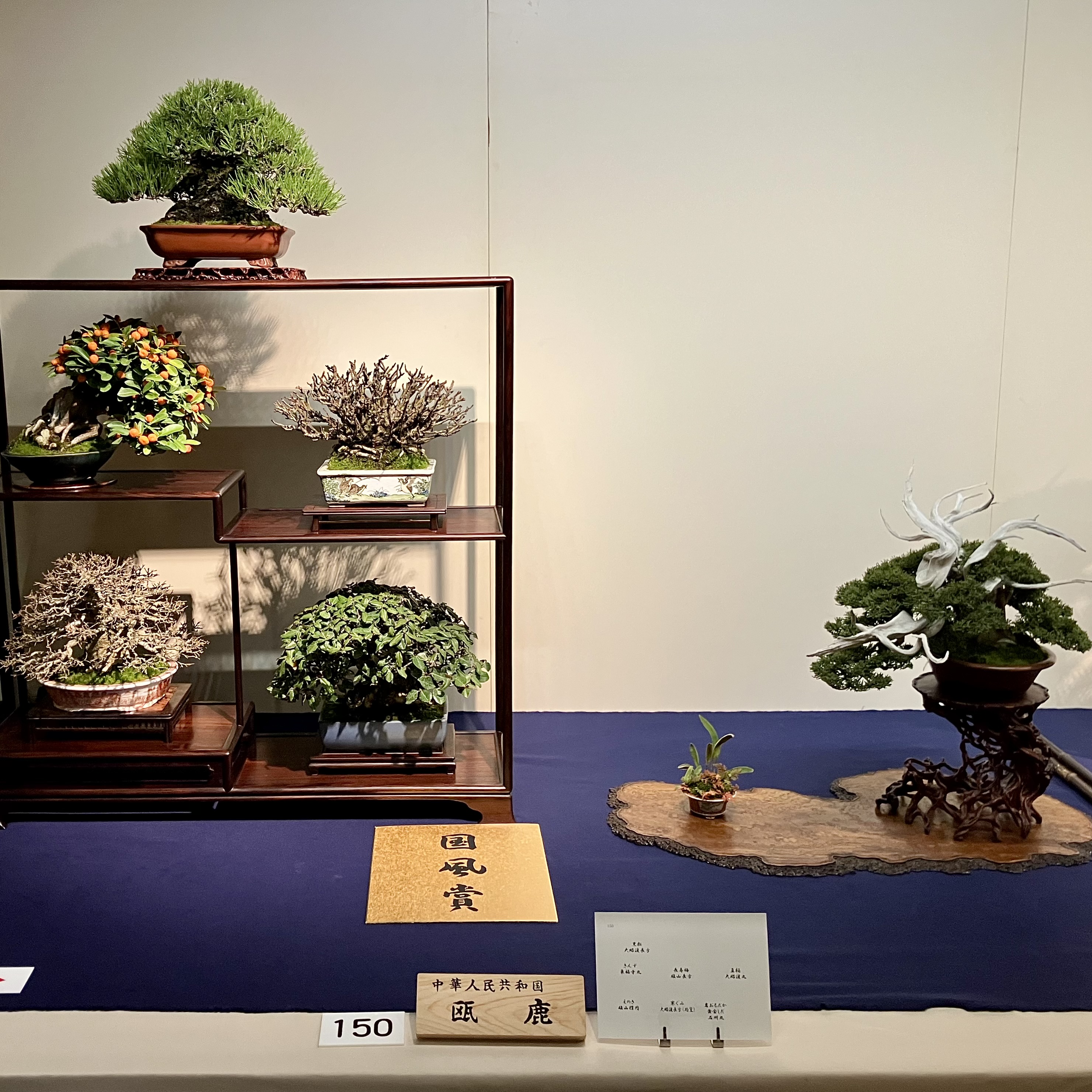
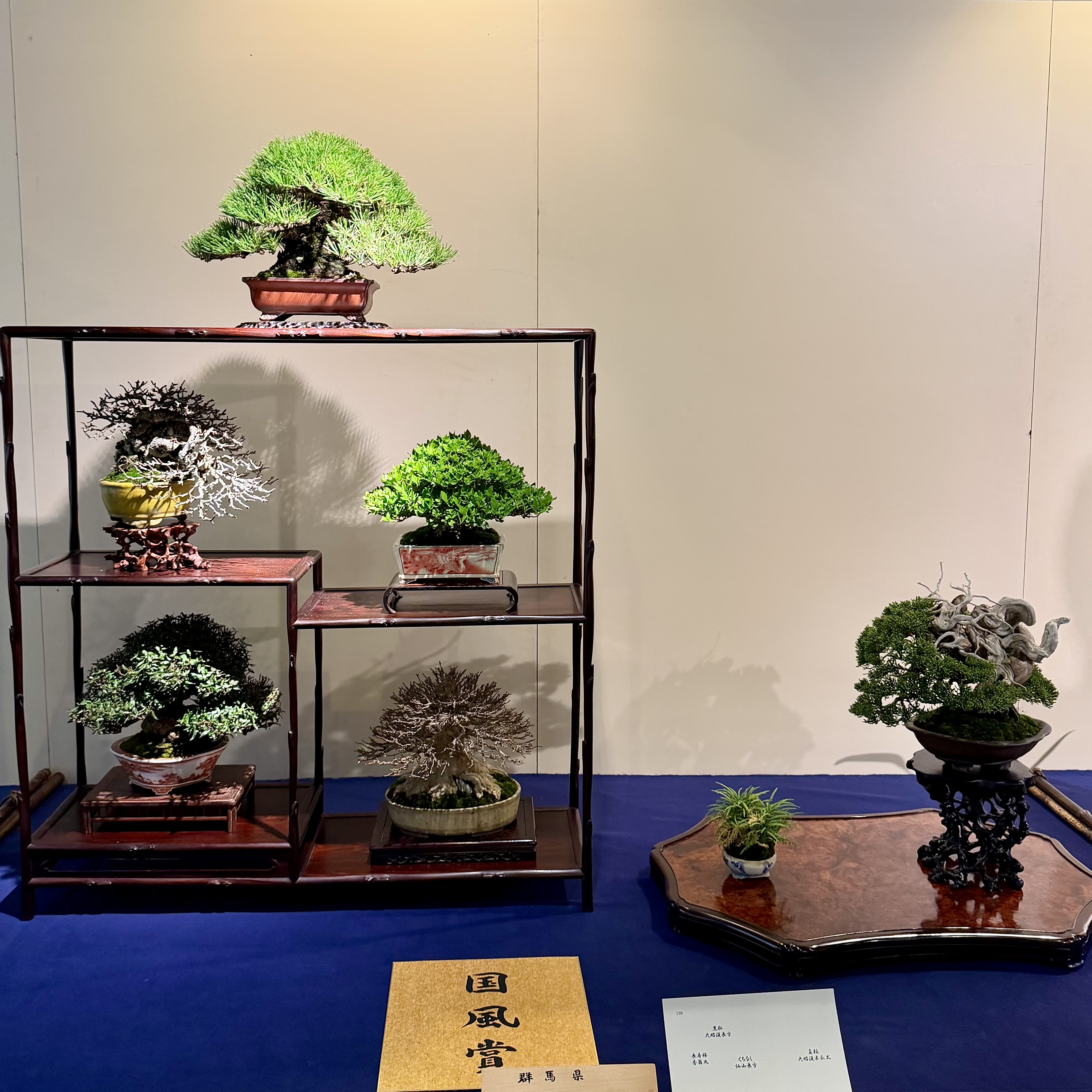
This medium sized display won a Kokufu Prize.
And the shohin displays notched a prize winner.
An unusual raised-root Japanese White Pine—the lowest branch falls away to the back.
Ume.
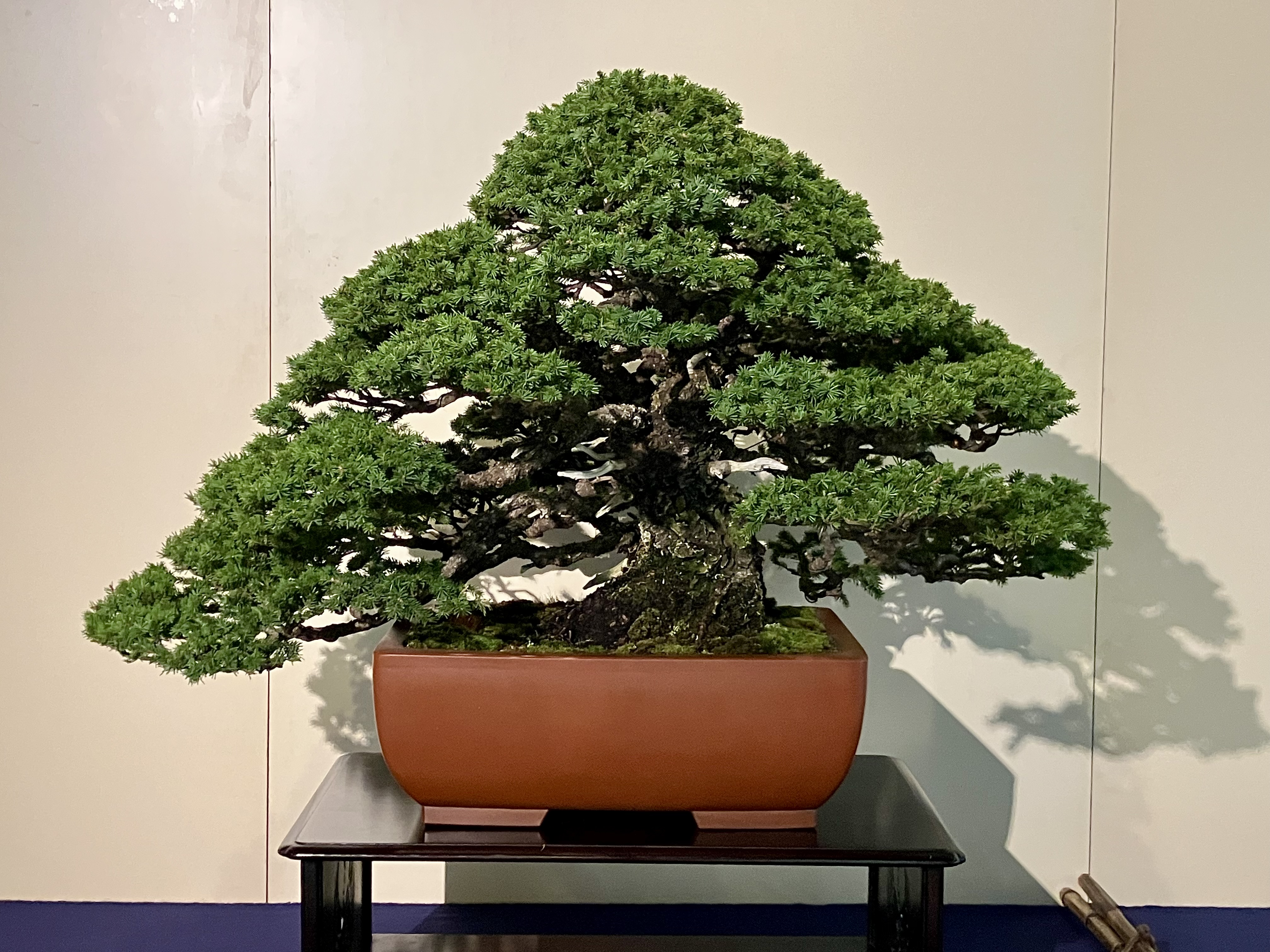
Ezo Spruce. Only a few spruce in this year’s show.
A gathering of global bonsai friends—left to right—myself, Juan Andrade, Mario Komsta, Peter Gregg, John Eads, Carmen Leskoviansky, Evan Cordes, and Masaki Shimada.
I’m back home already, but with spies abroad I hope to offer a photo reel of Part II—
Part I of the exhibition continued for four days, Sunday through Wednesday. On Thursday and Friday all the bonsai on display will be removed and replaced with fresh trees. That’s a monumental task, especially since all the bonsai are quite large and heavy, usually requiring two, three or four people to lift the largest bonsai. The flatbed rolling carts are limited in number so that makes the time longer for moving. Fortunately, all the large size bonsai are on the first floor. The smaller trees require using elevators which also takes time.
2026 Part I Exhibition Statics\
181 display areas
287 individual bonsai–
Counting the individual medium and shohin specimens
159 Large Bonsai
39 Medium Size Bonsai Compositions– 78 Specimens
10 Shohin Bonsai Compositions–50 Specimens
11 Important Bonsai Masterpieces–
Hawthorn displayed in Part I by Frank Jesse from Germany on right
There are a great number of bonsai which have been cultivated and loved for several generations by many people which have been elevated to the level of art, making them valuable cultural assets. The Nippon Bonsai Association examines bonsai which art artistically shaped with the understanding excellence, having horticultural values in terms of their species, shapes and have historical value in terms of Provence and history. With the understanding of their owners every method possible for preservation of future generations. To date there have been approximately 2,000 bonsai registered.
Hawthorn displayed in Part I by Frank Jesse from Germany. Flowering image courtesy of Sara Camacho from Team Suzuki.
11 Kokufu Awards–
The following images are Kokufu Winners
The greatest number of awards ever presented. Perhaps because of the exceptional fine-quality bonsai displayed this year commemorating the 100th exhibition. This coveted award is selected by a committee after a careful and comprehensive examination of all the bonsai are placed. It is presented to bonsai of particularly outstanding beauty, considering the species, container quality and appropriate to the tree, display table, training techniques, accessory and presentation to the viewers.
25 Foreign Exhibitors–
Representing approximately 20 different countries. These are bonsai which have been trained and refined in Japan and purchased by foreigners waiting to be imported to the owner’s countries.
Approximately 20%– of the displayed bonsai are owned by foreigners.
Masahiko Kimura’s Artistry– was represented by over 40 bonsai owned by clients.
Kunio Kobayashi’s Artistry– represented by approximately 24 clients.
Shinji Suzuki’s Artistry– represented by approximately 20 clients.
Opening Day Attendance– 2,500 visitors (over 70% foreigners.)
A Few Observations– Most common species were Japanese black and five-needle pines. Closely followed by Sargent’s juniper and Japanese flowering apricot and Japanese maple and Trident maple. Several rock plantings, both clinging-to-a-rock and root-over rock. Only two Ezo spruce. Normally the number of species are split between Part I and Part II.
There were a tremendous number of old famous masterpieces, making Part I the best representation of Japanese bonsai.
I wonder what Part II will bring along with the opening of the 63rd Masterpiece Suiseki Exhibition held on the 4th floor of the same building.
100th Kofu-Fu Bonsai Exhibition- Part I, 2026– Part 2
Part I of the exhibition continued for four days, Sunday through Wednesday. On Thursday and Friday all the bonsai on display will be removed and replaced with fresh trees. That’s a monumental task, especially since all the bonsai are quite large and heavy, usually requiring two, three or four people to lift the largest bonsai. The flatbed rolling carts are limited in number so that makes the time longer for moving. Fortunately, all the large size bonsai are on the first floor. The smaller trees require using elevators which also takes time.
2026 Part I Exhibition Statics
181 display areas
287 individual bonsai–
Counting the individual medium and shohin specimens
159 Large Bonsai
39 Medium Size Bonsai Compositions– 78 Specimens
10 Shohin Bonsai Compositions–50 Specimens
11 Important Bonsai Masterpieces–
There are a great number of bonsai which have been cultivated and loved for several generations by many people which have been elevated to the level of art, making them valuable cultural assets. The Nippon Bonsai Association examines bonsai which art artistically shaped with the understanding excellence, having horticultural values in terms of their species, shapes and have historical value in terms of Provence and history. With the understanding of their owners every method possible for preservation of future generations. To date there have been approximately 2,000 bonsai registered.
11 Kokufu Awards–
The greatest number of awards ever presented. Perhaps because of the exceptional fine-quality bonsai displayed this year commemorating the 100th exhibition. This coveted award is selected by a committee after a careful and comprehensive examination of all the bonsai are placed. It is presented to bonsai of particularly outstanding beauty, considering the species, container quality and appropriate to the tree, display table, training techniques, accessory and presentation to the viewers.
Frank Jesse from Germany displayed his Hawthorn in Part I. Flowering Image courtesy of Sara Camacho of Team Suzuki.
25 Foreign Exhibitors–
Representing approximately 20 different countries. These are bonsai which have been trained and refined in Japan and purchased by foreigners waiting to be imported to the owner’s countries.
Approximately 20%– of the displayed bonsai are owned by foreigners.
Masahiko Kimura’s Artistry– was represented by over 40 bonsai owned by clients.
Kunio Kobayashi’s Artistry– represented by approximately 24 clients.
Shinji Suzuki’s Artistry– represented by approximately 20 clients.
Opening Day Attendance– 2,500 visitors (over 70% foreigners.)
A Few Observations– Most common species were Japanese black and five-needle pines. Closely followed by Sargent’s juniper and Japanese flowering apricot and Japanese maple and Trident maple. Several rock plantings, both clinging-to-a-rock and root-over rock. Only two Ezo spruce. Normally the number of species are split between Part I and Part II.
There were a tremendous number of old famous masterpieces, making Part I the best representation of Japanese bonsai.
I wonder what Part II will bring along with the opening of the 63rd Masterpiece Suiseki Exhibition held on the 4th floor of the same building.
Part II of the exhibition on Saturday. I have never seen such a crowd in the 40 years I’ve attended. It looked that there were even more foreign visitors than Part I. There were no Stewartia displayed. Lots of cascade styled trees.
In the past, both parts of this exhibition has had magnificent bonsai, often the bonsai in Part II seemed to be better. NOT this year the NBS went all to get superb trees for both part I and Part II. I asked a skilled professional bonsai dealer and a leader of the Japanese bonsai community and he said both parts were equal AND there were too many visitors. Usually in the morning the crowds are heavy, then lessen. Not this year. Many friends went early to photograph and they did not even try. The room was packed and made it difficult to even move. In the late afternoon the crowds are less.
2026 Part I Exhibition Statistics
181 display areas
253 individual bonsai–
Counting the individual medium and shohin specimens
131 Large Bonsai
36 Medium Size Bonsai Compositions– 76 Specimens
10 Shohin Bonsai Compositions–50 Specimens
28 Important Bonsai Masterpieces–
There are a great number of bonsai which have been cultivated and loved for several generations by many people which have been elevated to the level of art, making them valuable cultural assets. The Nippon Bonsai Association examines bonsai which art artistically shaped with the understanding excellence, having horticultural values in terms of their history. The judging is usually done in autumn.
10 Kokufu Awards–
This coveted award is selected by a committee after a careful and comprehensive examination of all the bonsai are placed. It is presented to bonsai of particularly outstanding beauty, considering the species, container quality and appropriate to the tree, display table, training techniques, accessory and presentation to the viewers. This year a small black plaque was displayed for these important bonsai
12 Foreign Exhibitors–
Representing approximately 10 different countries. These are bonsai which have been trained and refined in Japan and purchased by foreigners waiting to be imported to the owner’s countries.
The 63rd Japanese Suiseki
Heled on the 4th floor of the museum, but this distinguished will be covered in a future blog post
These two bonsai were displayed next to each other.
Many thanks to Evan Cordes, Carmen Leskoviansky, and Masaki Shimada for these photos of Kokufu-ten Part 2.
The Kokufu is well-known to showcase impressive, thick-trunked, dizzyingly developed old bonsai. I’ve included some of those meat and potato trees, but whimsy also shows up here and there. In this Part 2 I’ve included some of that.
Shinpaku. Crazy live vein.
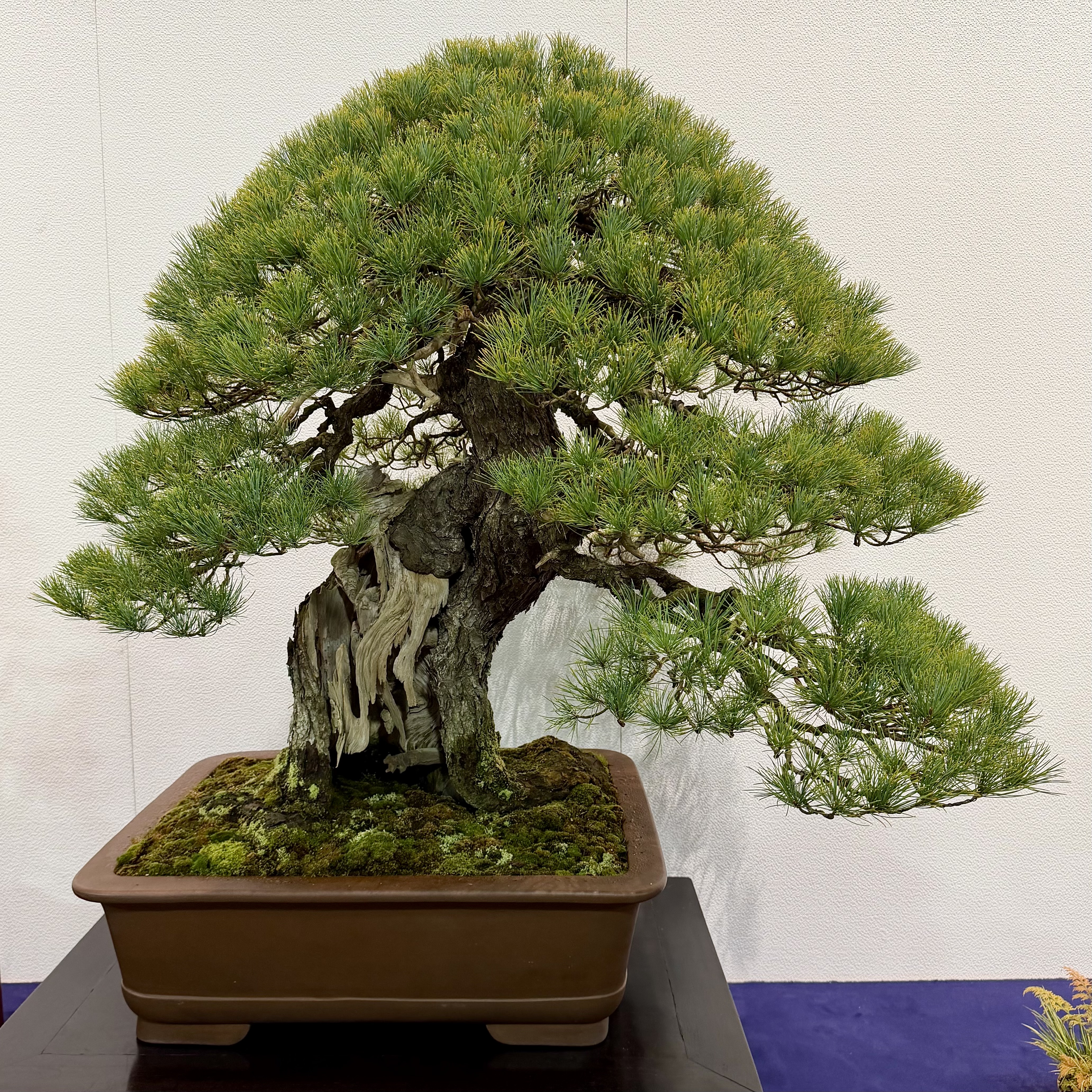
Japanese White Pine. A formal-ish upright bunjin in a simple bridge pot.
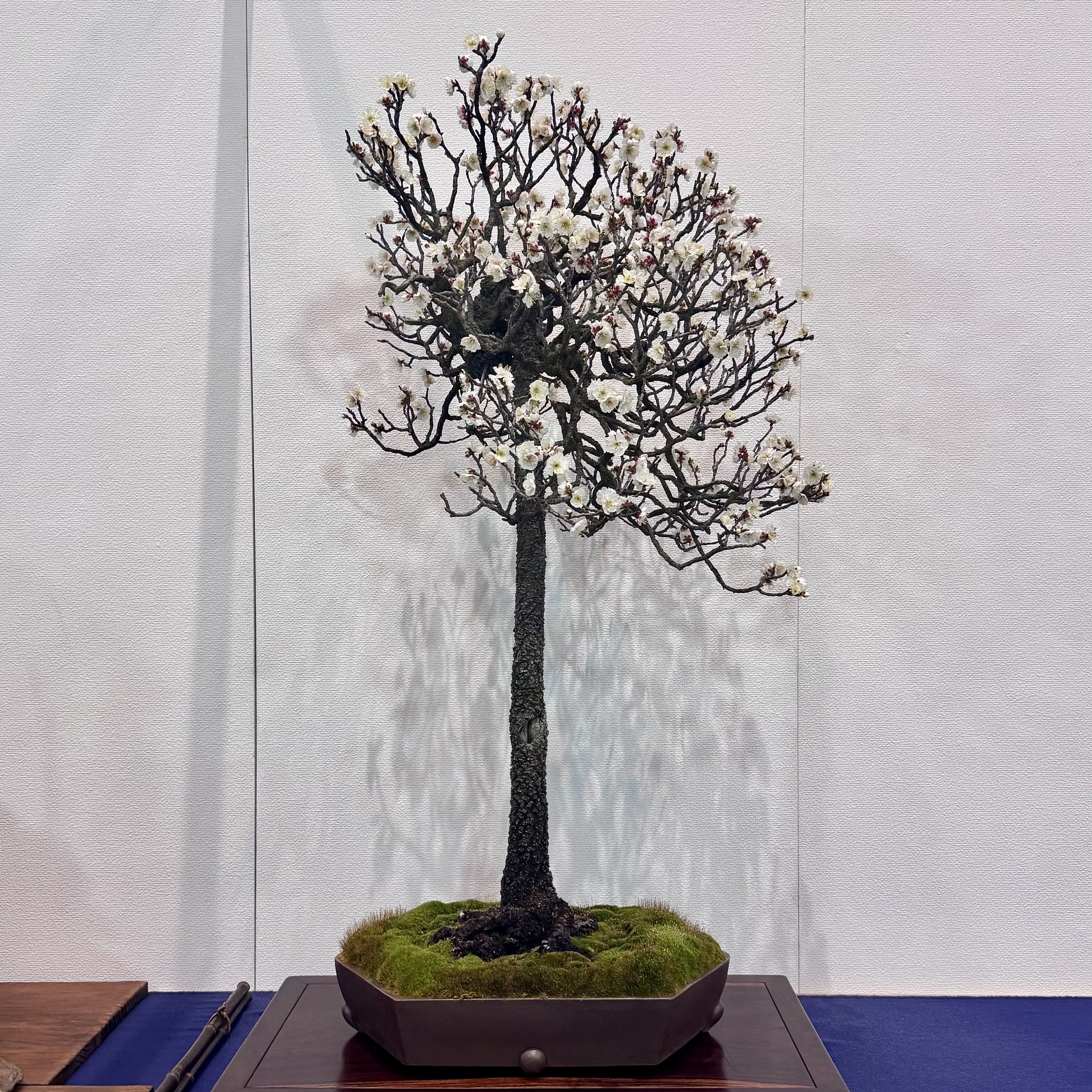
Hitting the same note twice, here’s a formal upright Ume. Never seen that before. Appears to be in a hexagonal rectangle.
Japanese White Pine. Big famous tree. This was in Mr. Suzuki’s garden when I first arrived in 2003.
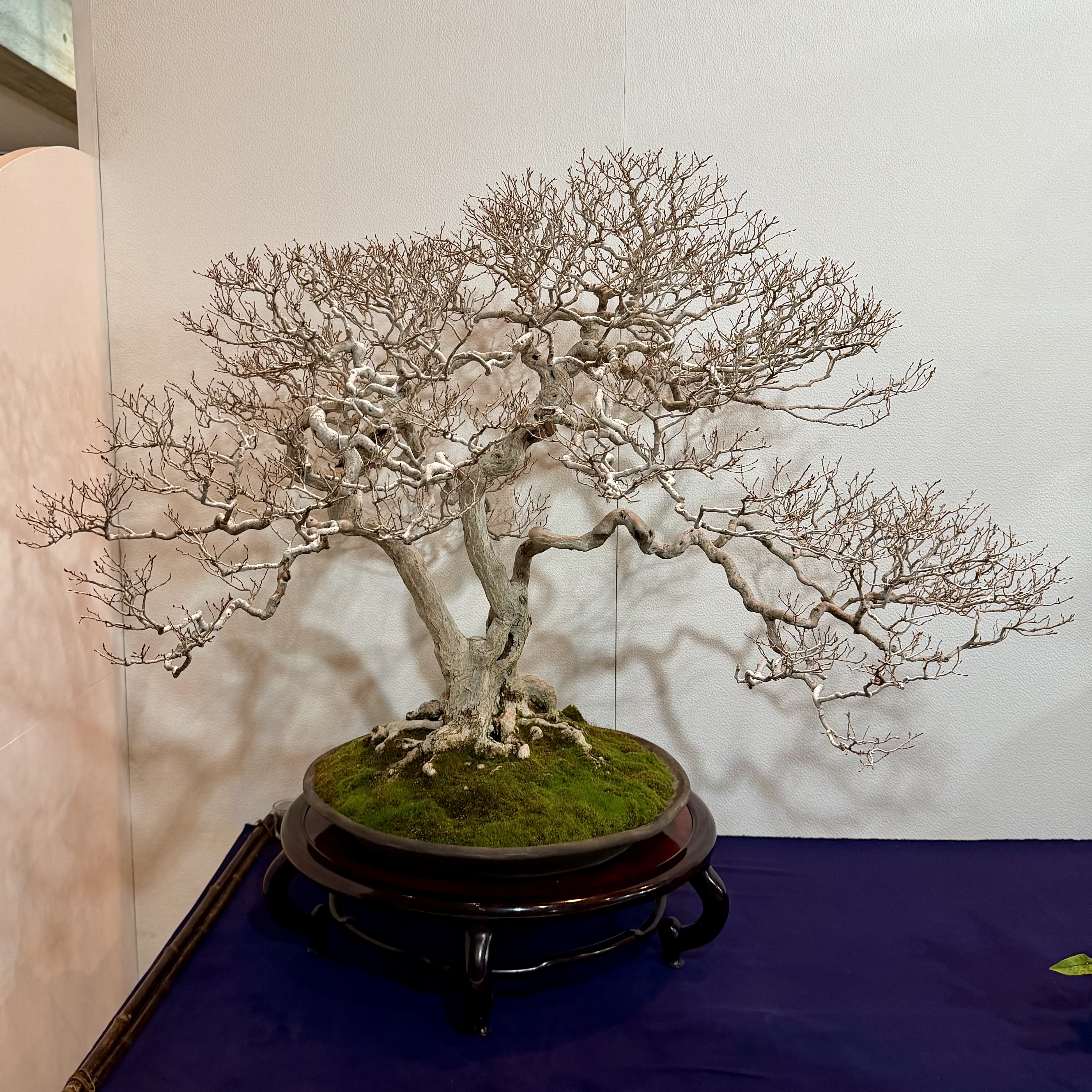
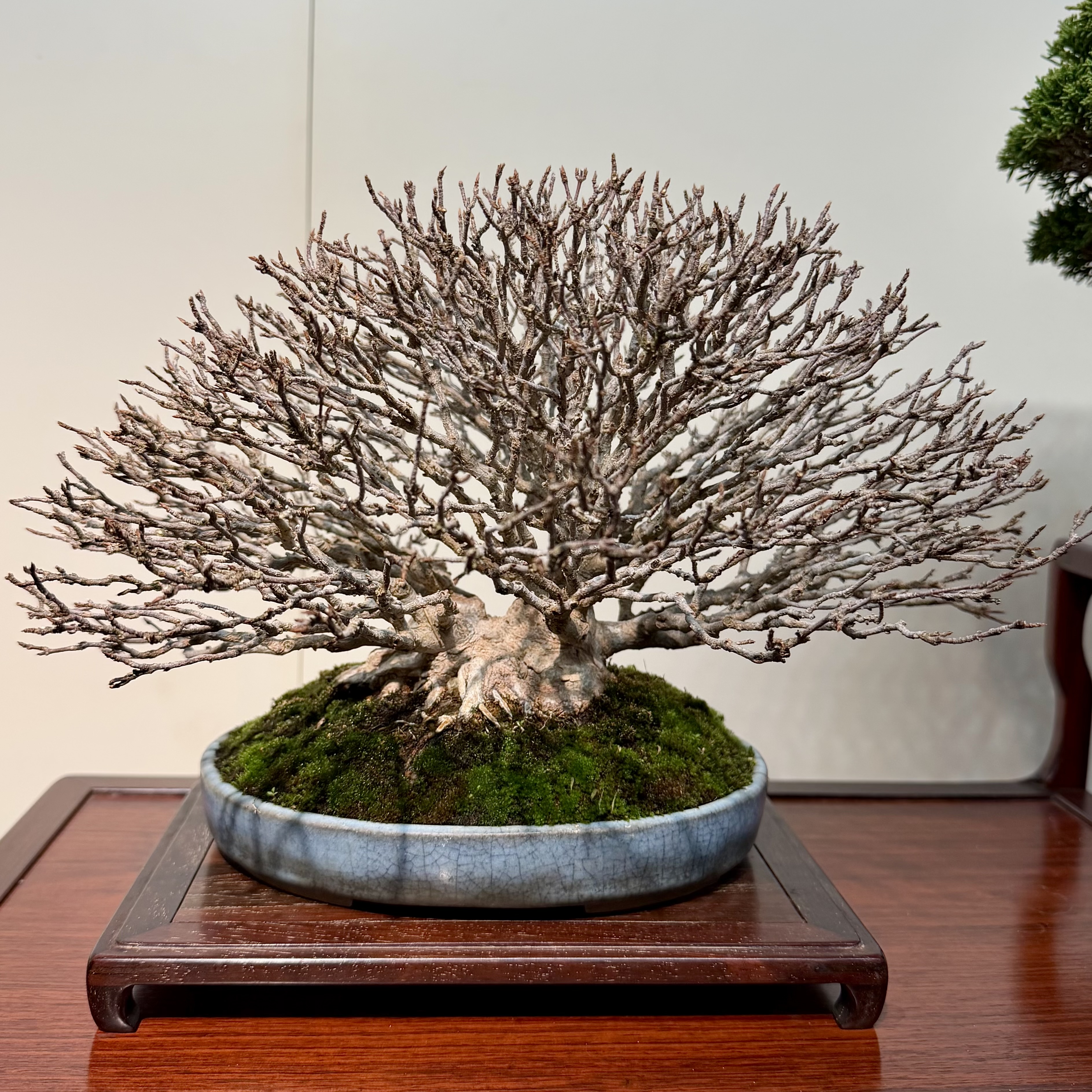
Hornbeam.
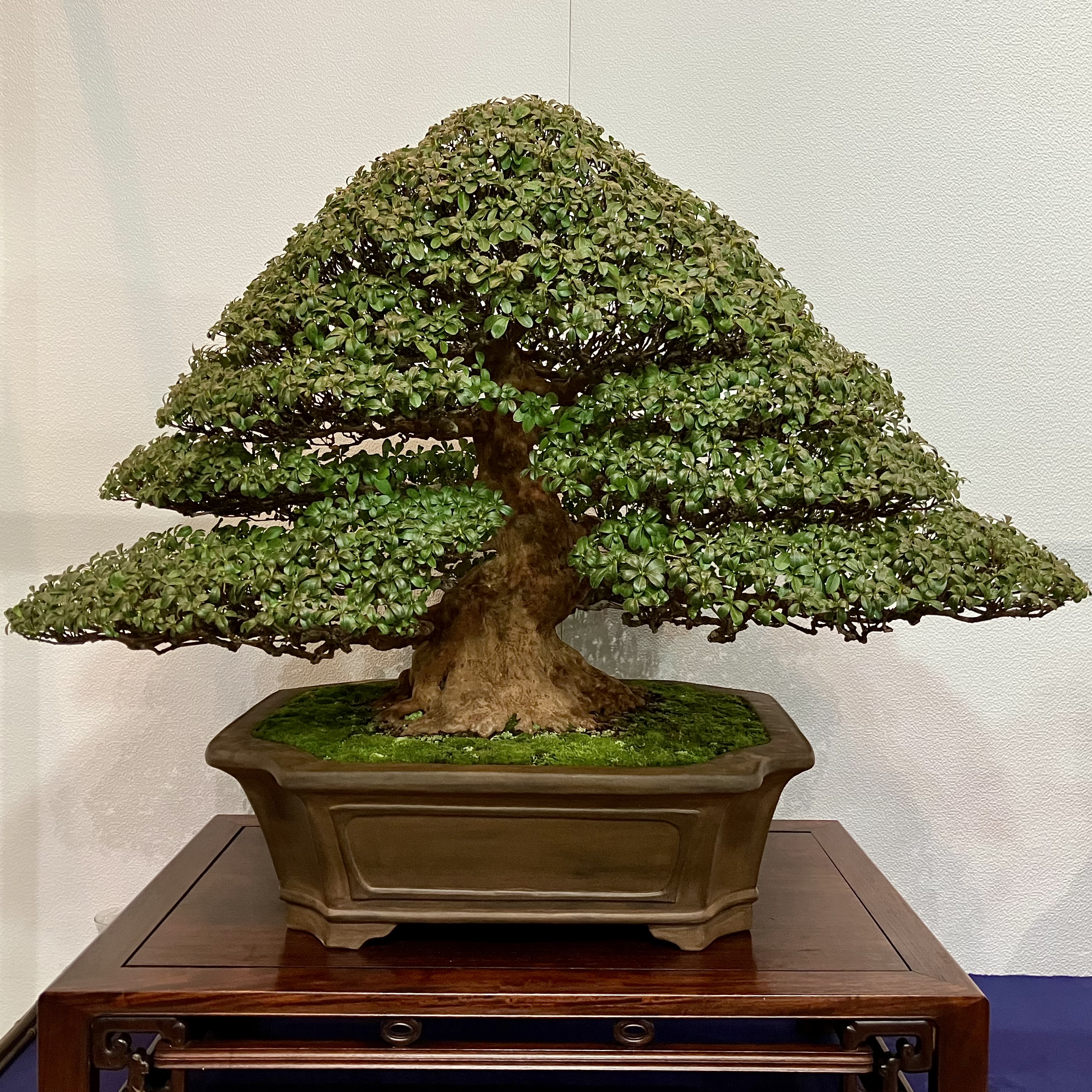
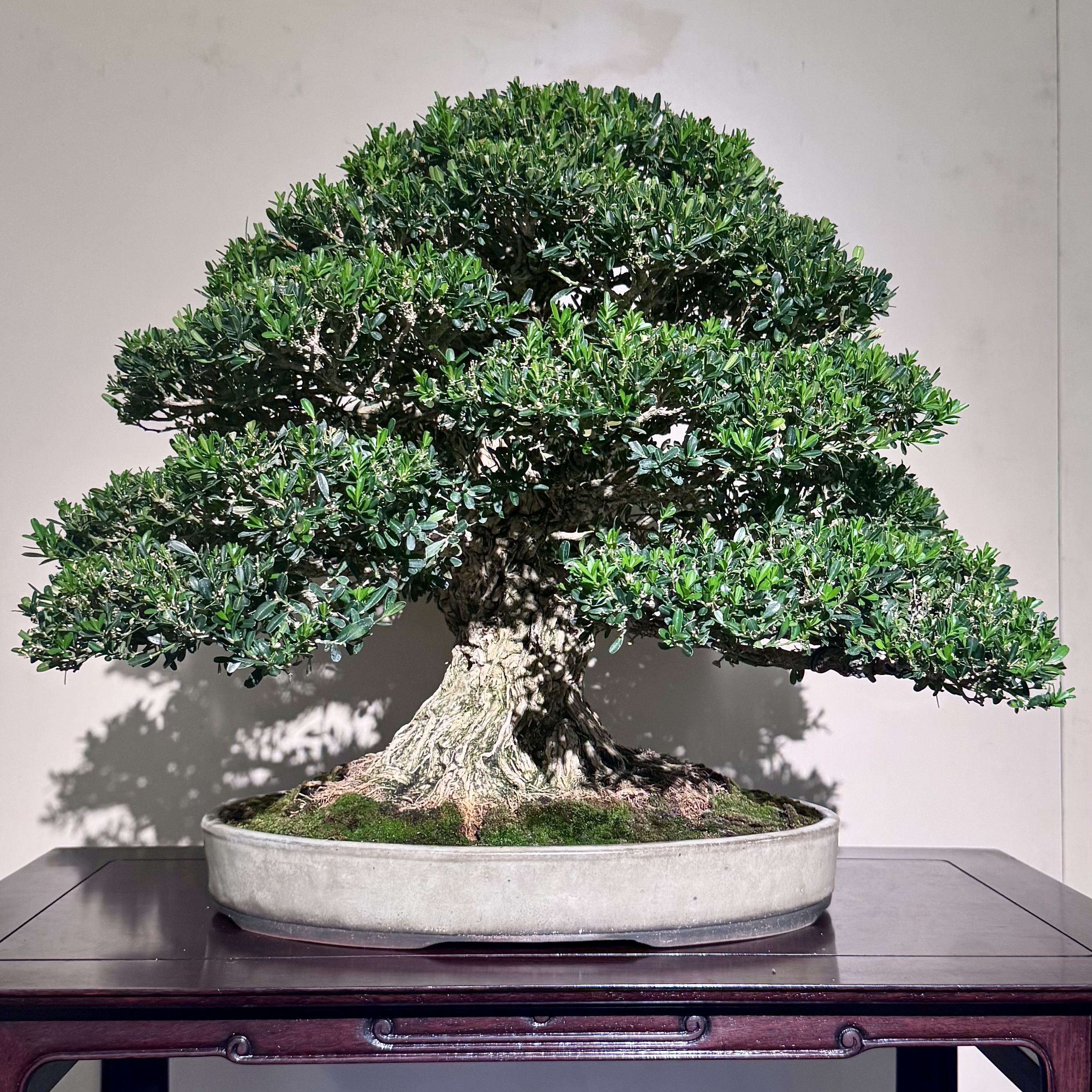
A Harland Boxwood. Unusual in the Kokufu. Excellent nebari. You’d struggle to get a fine and detailed nebari like this in the ground, likely pot-grown from a cutting or air-layer.
Root over rock Trident Maple.
This shohin display got a Kokufu Prize.
A swirling Shinpaku. Likely grafted foliage, it usually is when fine and tight. But not always.
A smaller Trident Maple.
Lovely accent.
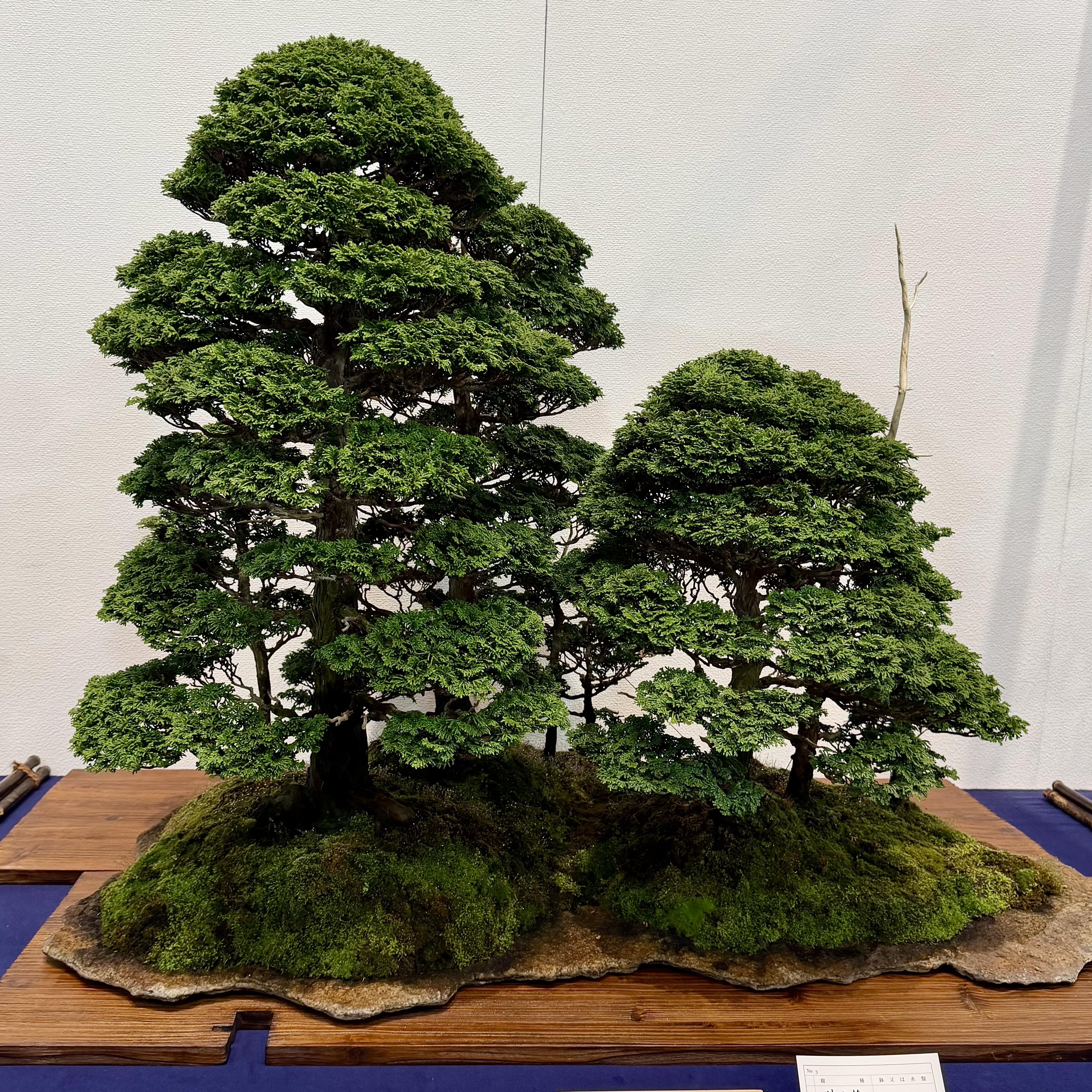
Hinoki forest. That tenjin deadwood rising off the right side strikes me as odd and out of place. Especially coming from one of the younger trees.
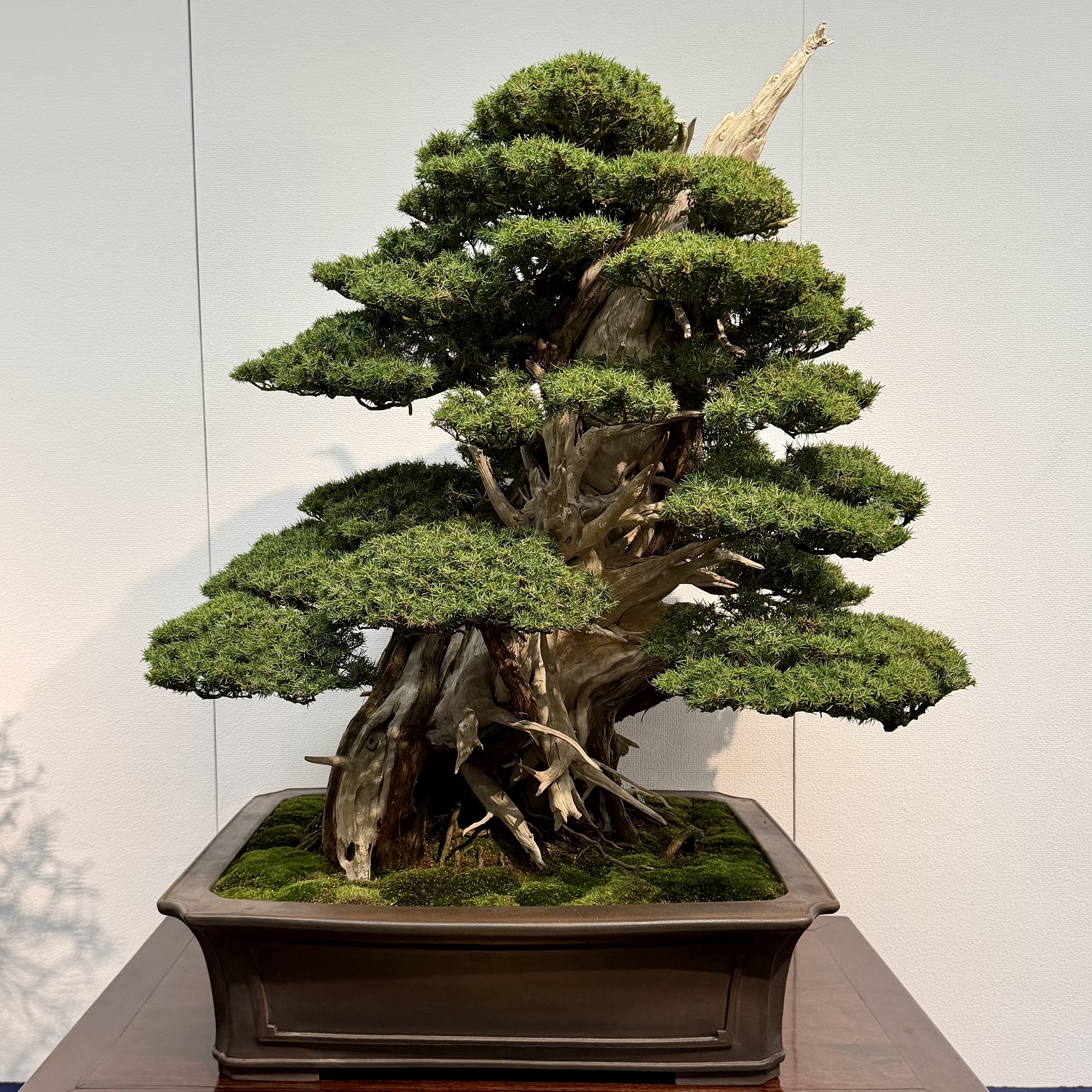
Needle Juniper. Kokufu Prize.
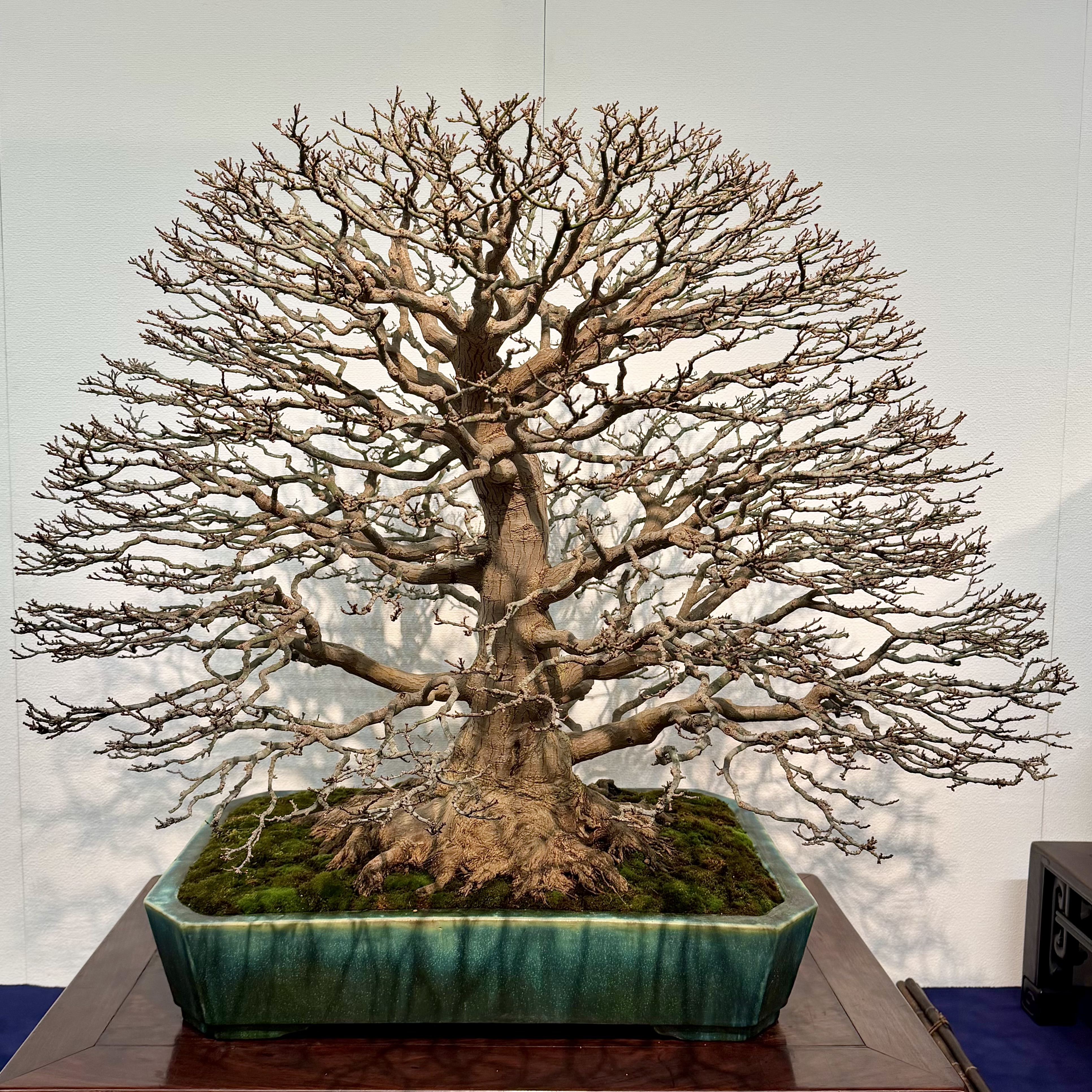
Japanese Maple.
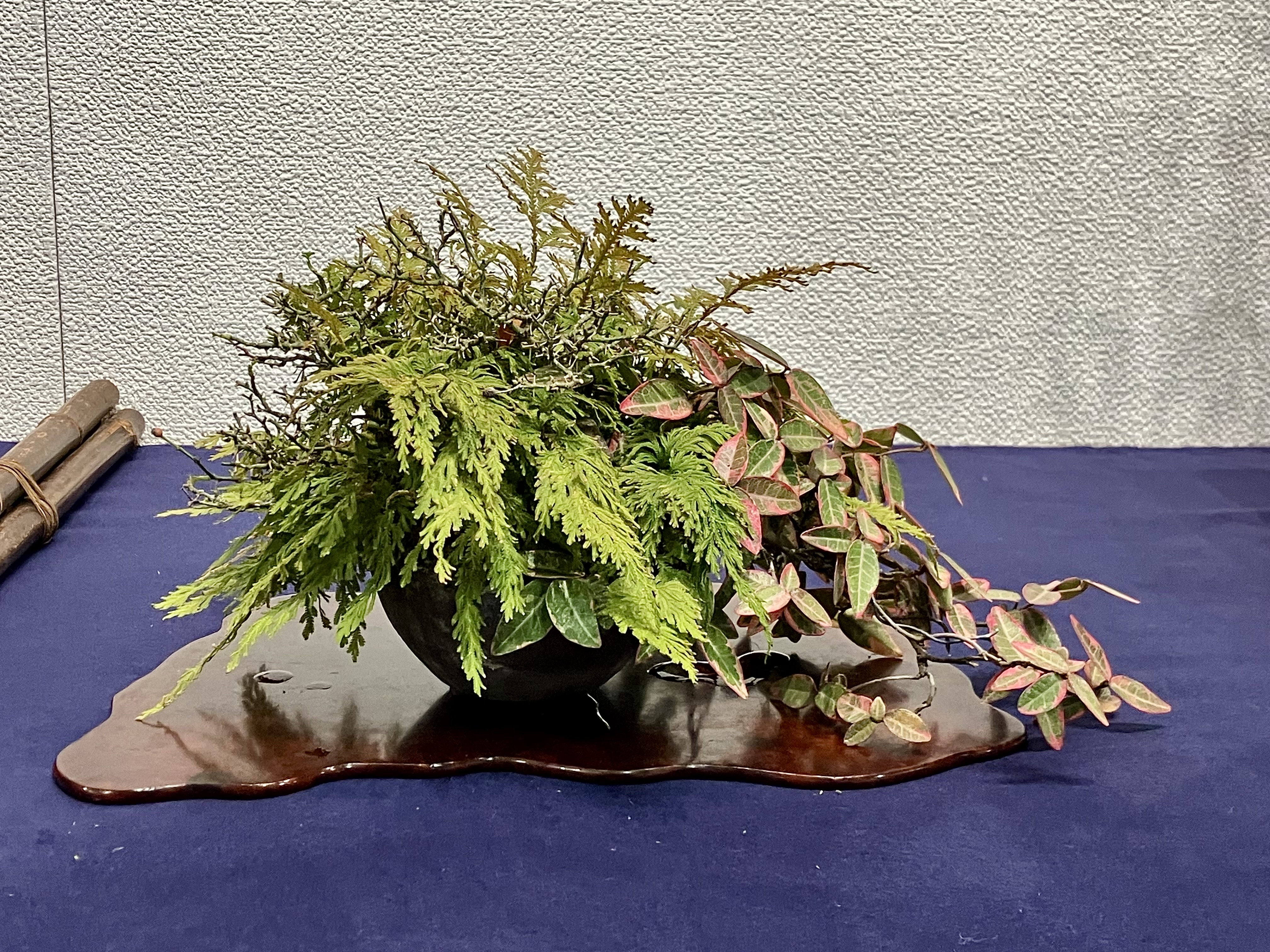
A dancing pair of Shinpaku and Chojubai.
Japanese Red Pine.
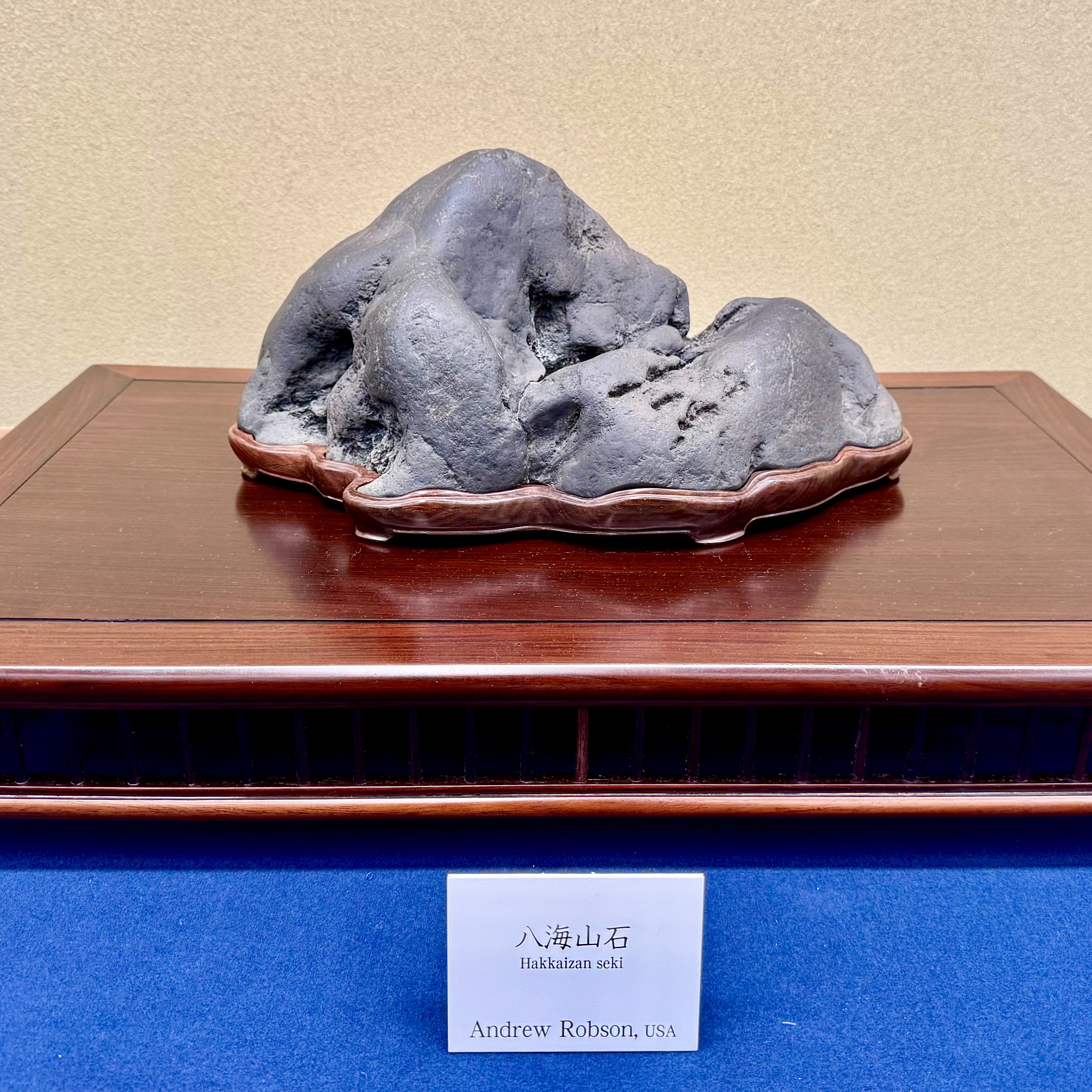
A stone exhibited by former apprentice Andrew Robson.
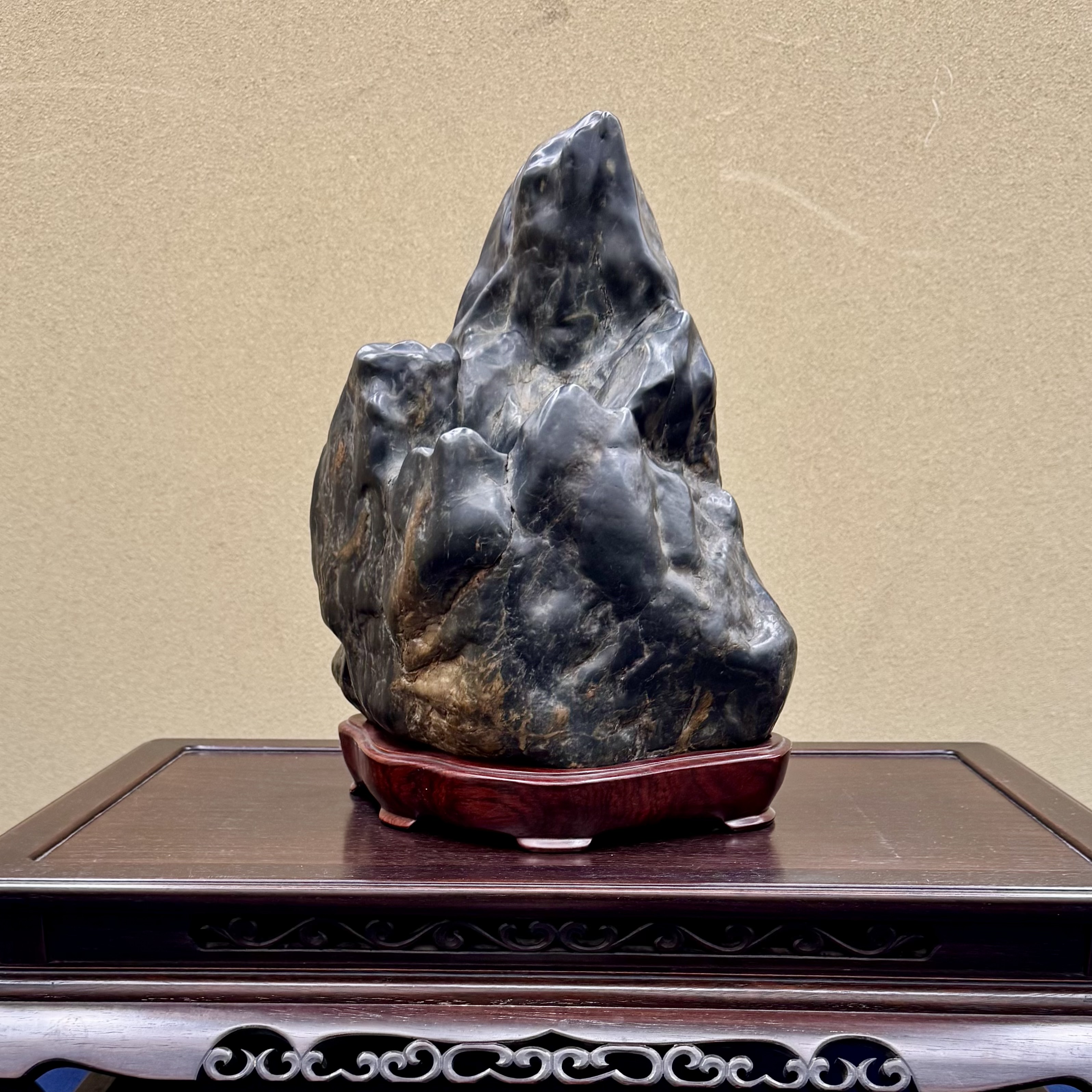
And another stone shown by Andrew’s father, Jeffrey Robson.
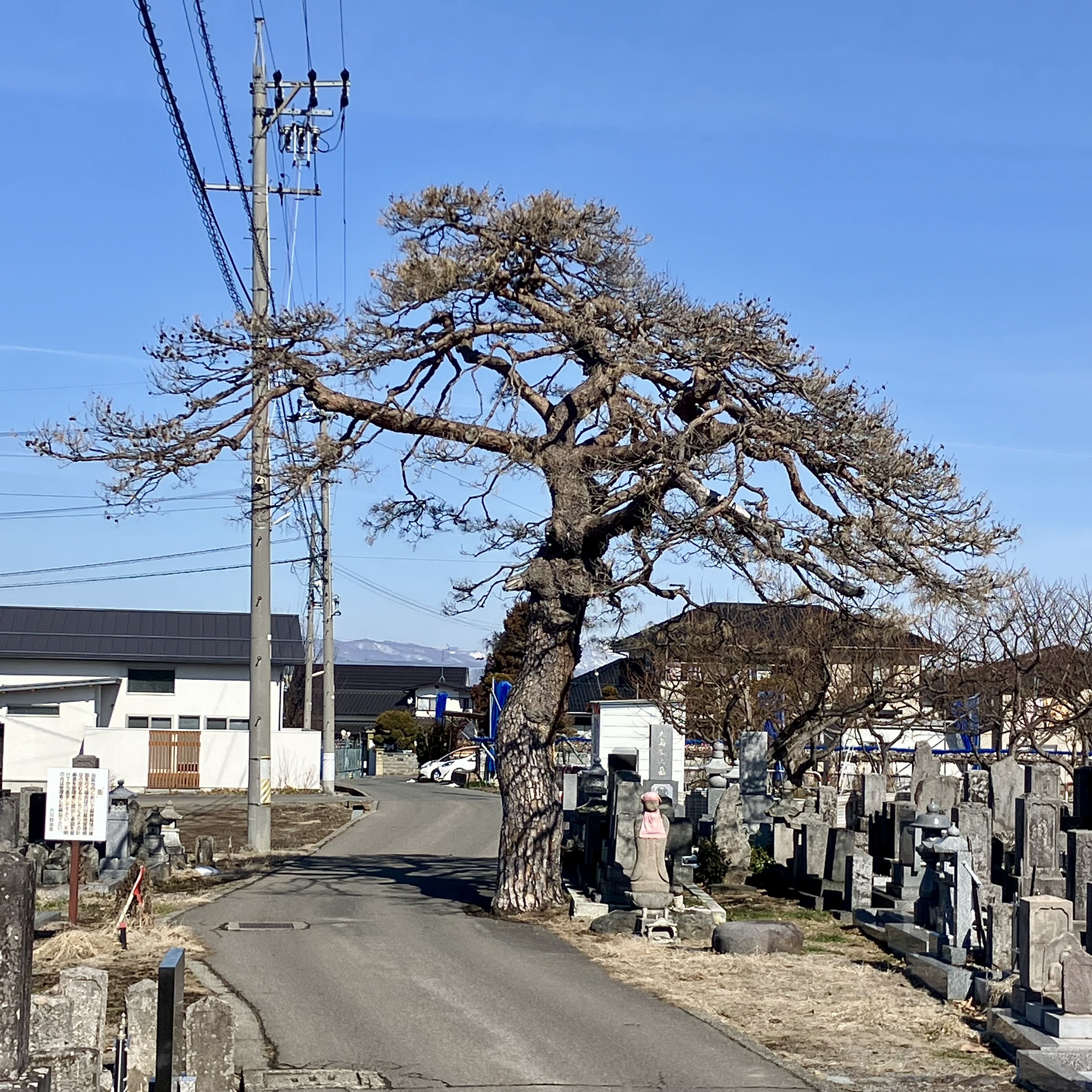
You might recognize this tree from a photo in Post-dated: The Schooling of an Irreverent Bonsai Monk. Walking home after a long day I’d pat its trunk or raise my fist passing under it, and say some version of, you and me pal, we’ll make it.
When we arrived in Obuse I split off to visit a small temple at the edge of town. I often went there as an apprentice, finding these quiet temples (some were Shinto shrines) restful. They drew me in.
On my way to the temple I didn’t realize I’d crossed the road I’d taken daily to and from work. I glanced left and stopped. Here was my tree.
But it was dead.
I stood there breathing. My tree was dead, my brother tree. We’d kept each other going, or at least, it had kept me going.
My memory of Obuse is no longer true. Not true for today. In my absence the place is changing. And next time I go, my tree may be gone entirely.
The next stop cheered me up.
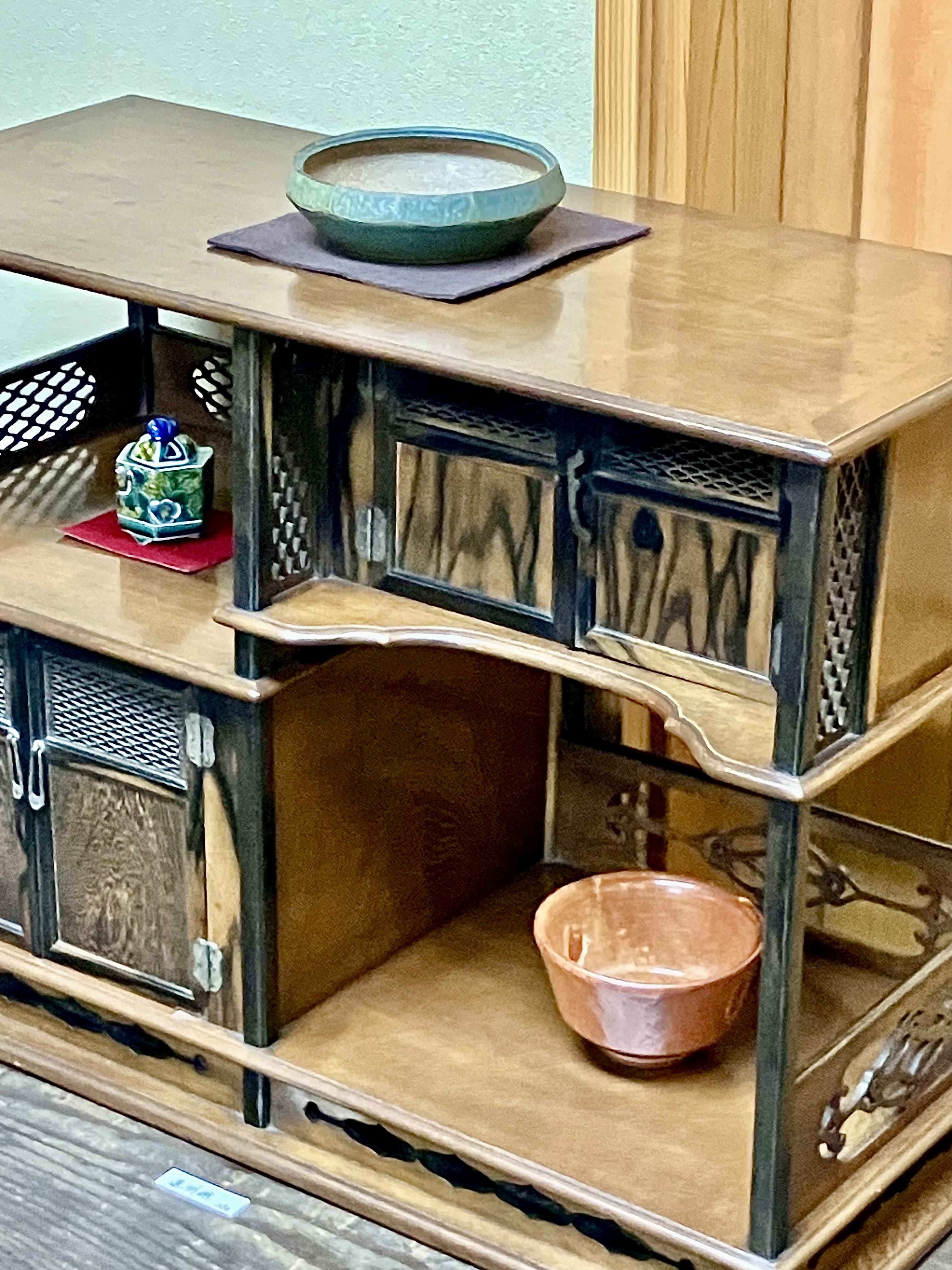
Reunited with my group, we went to Mr. Suzuki’s garden. He met us in the teahouse, and brought out two pots, setting them on this wooden stand.
I knew these pots!
The blue one is a bonsai pot I’d given Mr. Suzuki in the states in 2003, a few months before I started my apprenticeship. The bottom one was a gift on a return trip to Japan after my apprenticeship ended. It was from a kiln I fired around 2012, my last kiln. A winter tea bowl.
And he had them there in the teahouse.
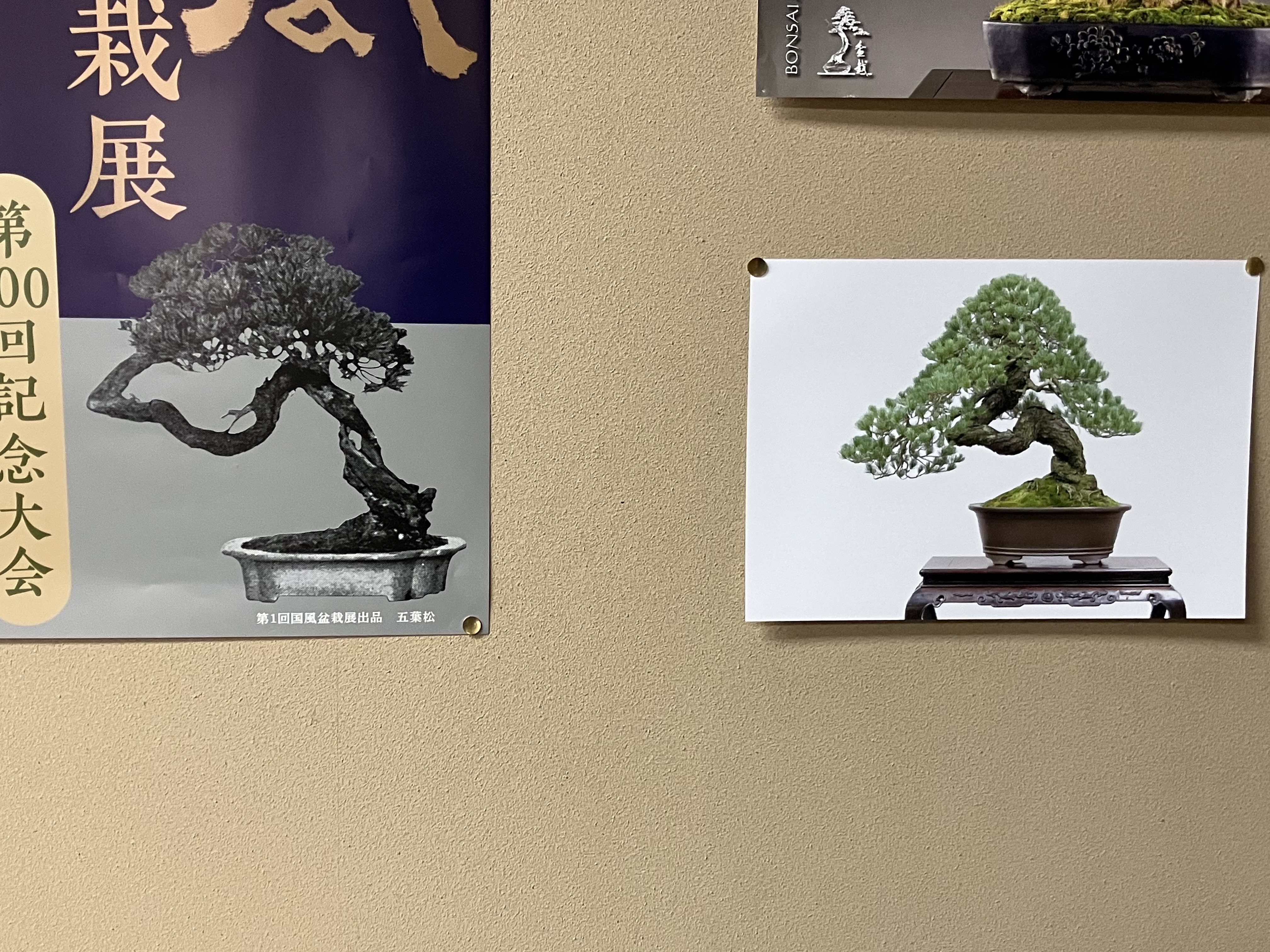
On a wall of the teahouse was a Japanese White Pine shown in the first Kokufu show, in 1934. The photo to the left is from that year, and on the right how it looked in this year’s Kokufu.
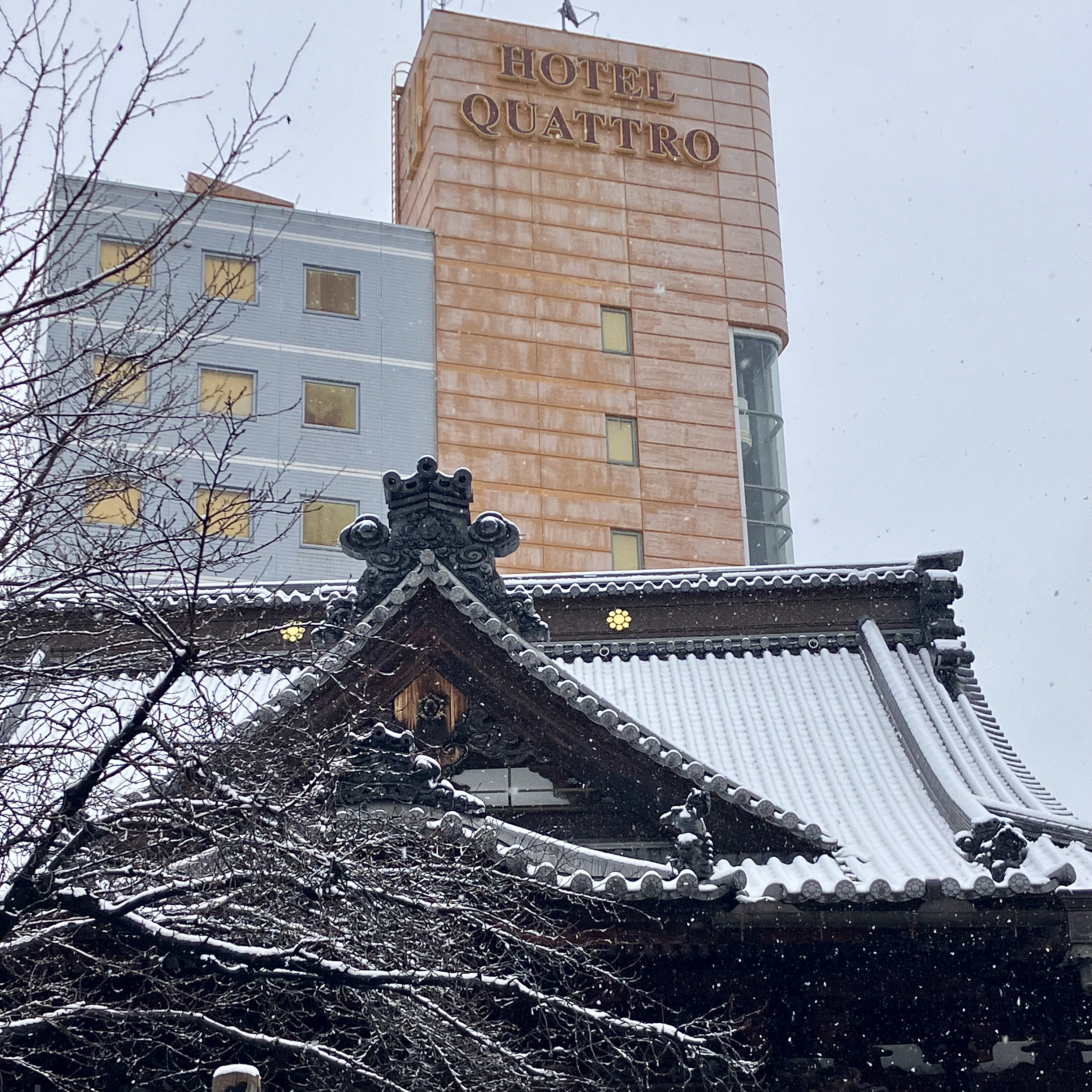
The next day our group split up for various adventures. My friend Evan Cordes and I stayed in Nagano to tour around a bit. This temple wasn’t on our itinerary, but it sums up the architectural chiaroscuro you can encounter in any urban Japan setting: an old temple, with a modern high-rise framing it.
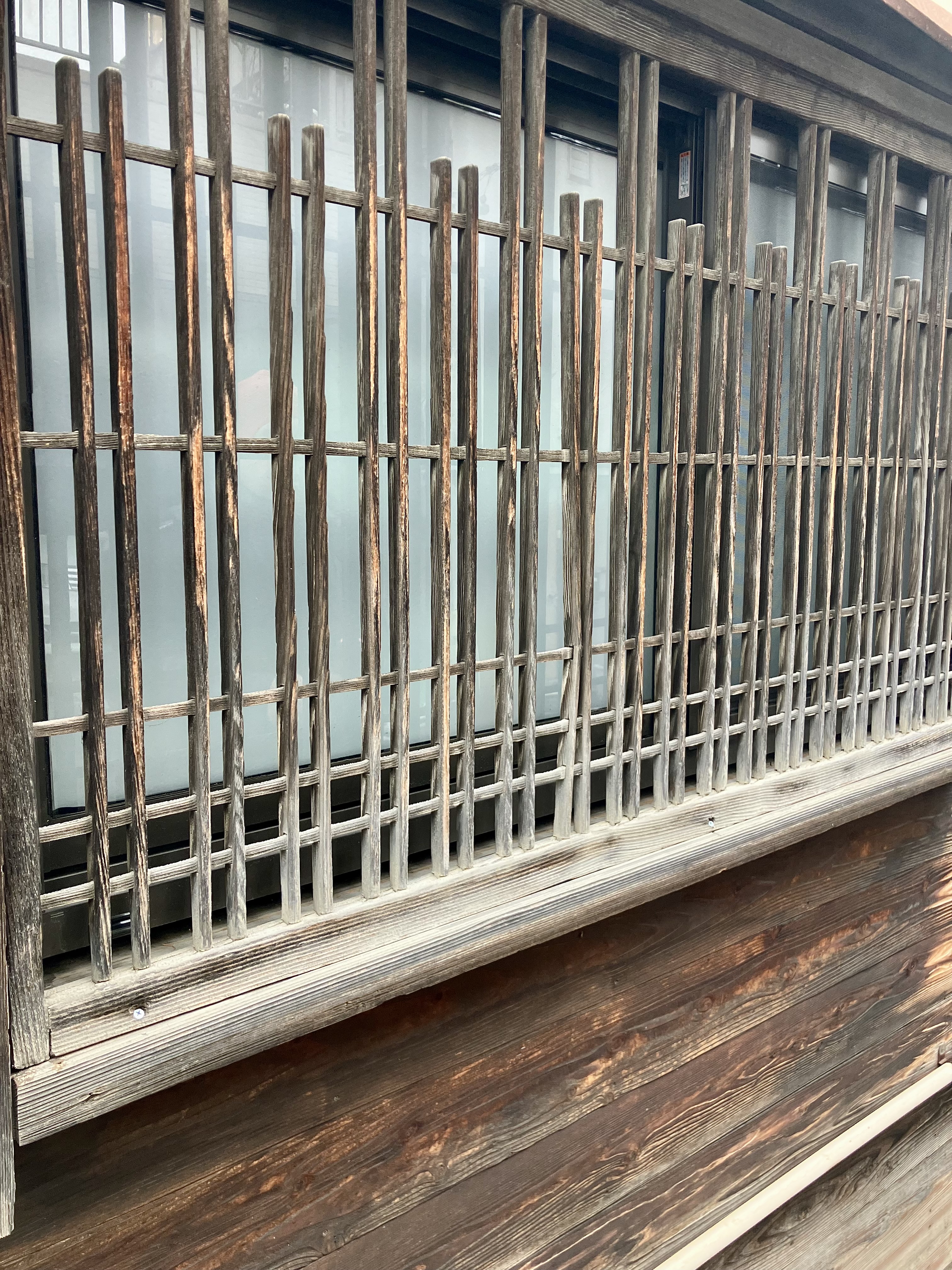
Any walk along the cold, snowy city streets of Nagano may pass by yakisuki—charred cryptomeria—on the older buildings. I fell in love with yakisugi while living in Japan 20 years ago, and had to have it for my tiny house siding. (Making it involved a lot of smoke and flames, loss of eyebrows, and even a run to the ER…a story in my forthcoming tiny house memoir.)
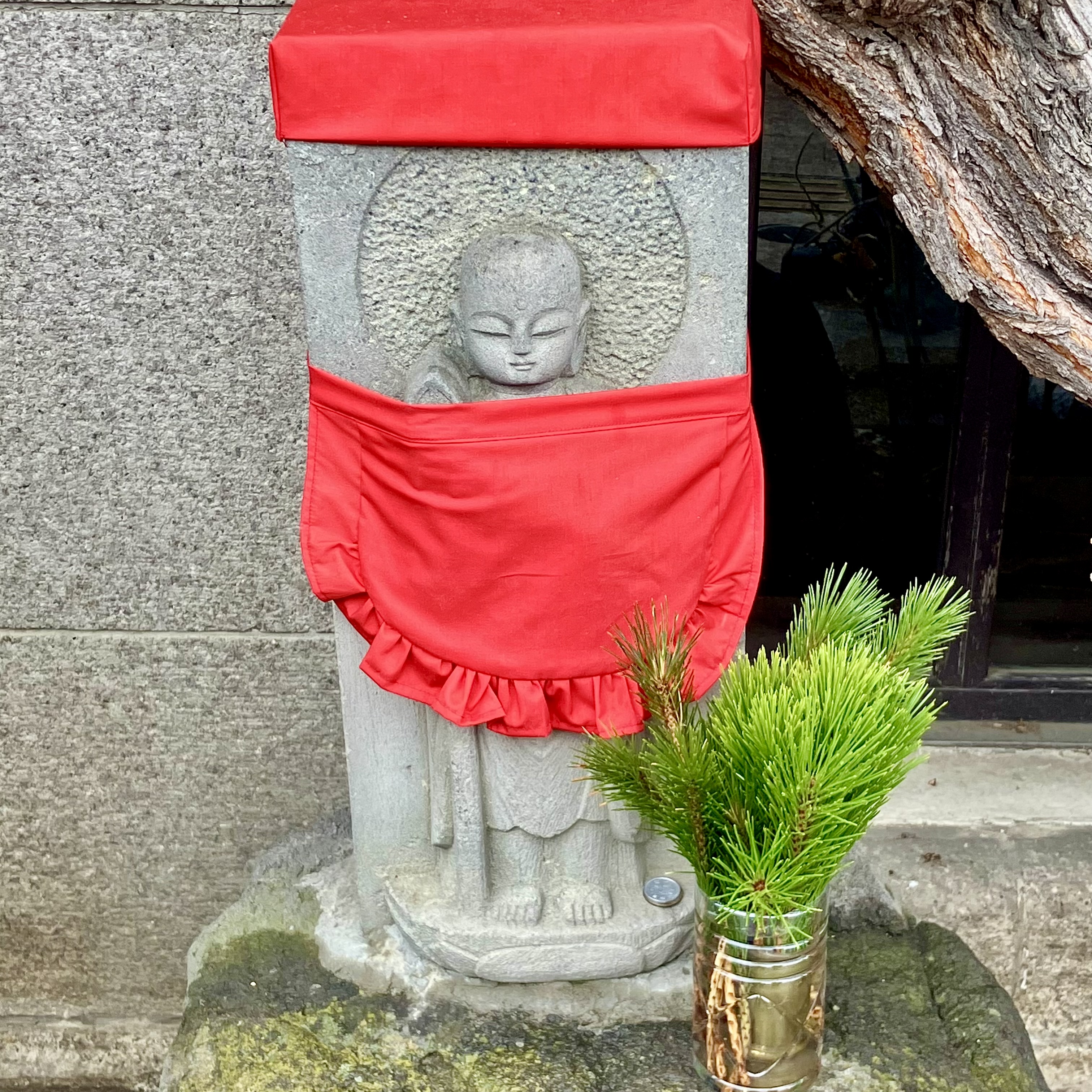
A Jizo statue with pine shoots. The red cloth is protective for children and travelers. The pine shoots are for longevity and good fortune.
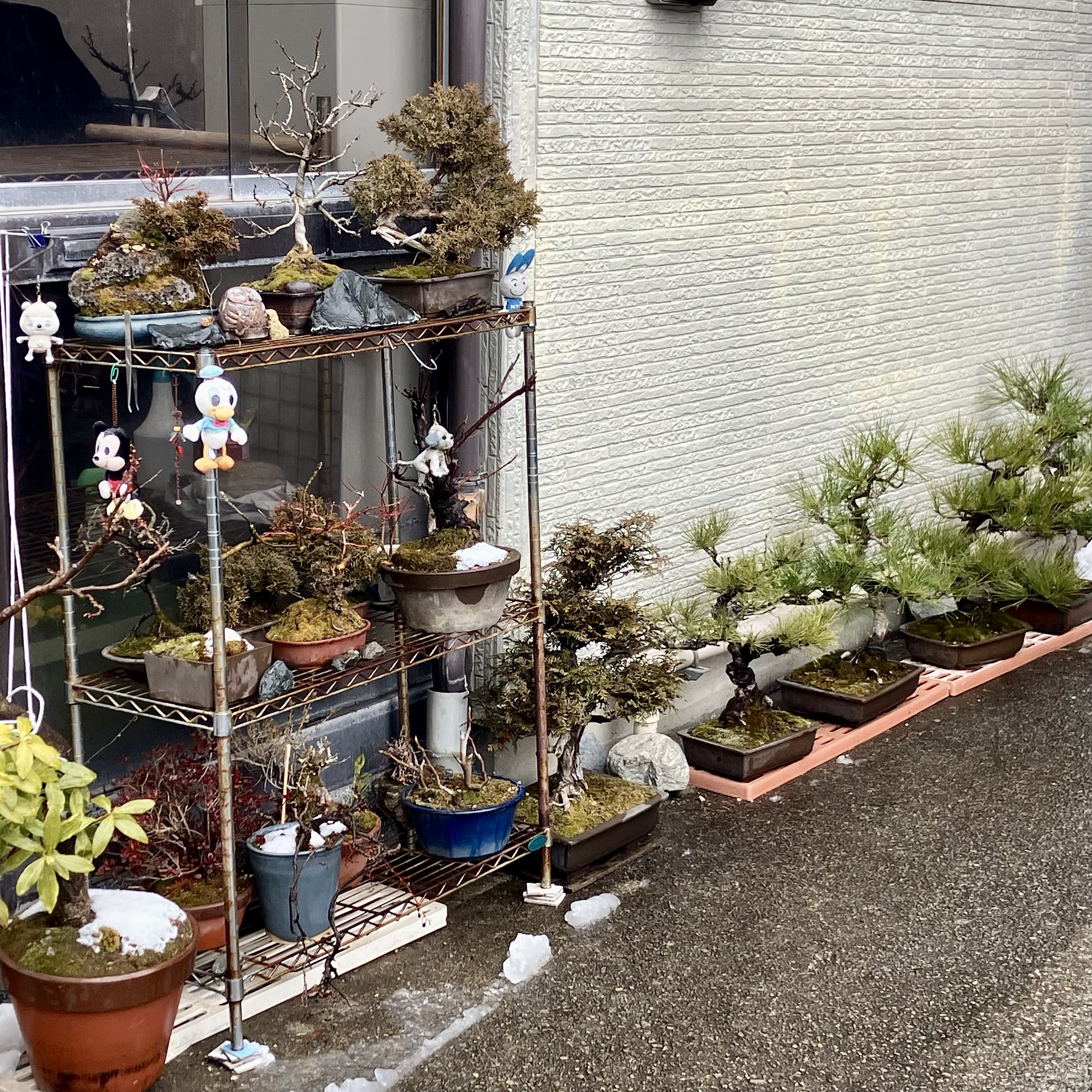
To the side of a house in Nagano we saw a common sight anywhere in Japan: bonsai. Dangling Disney characters optional.
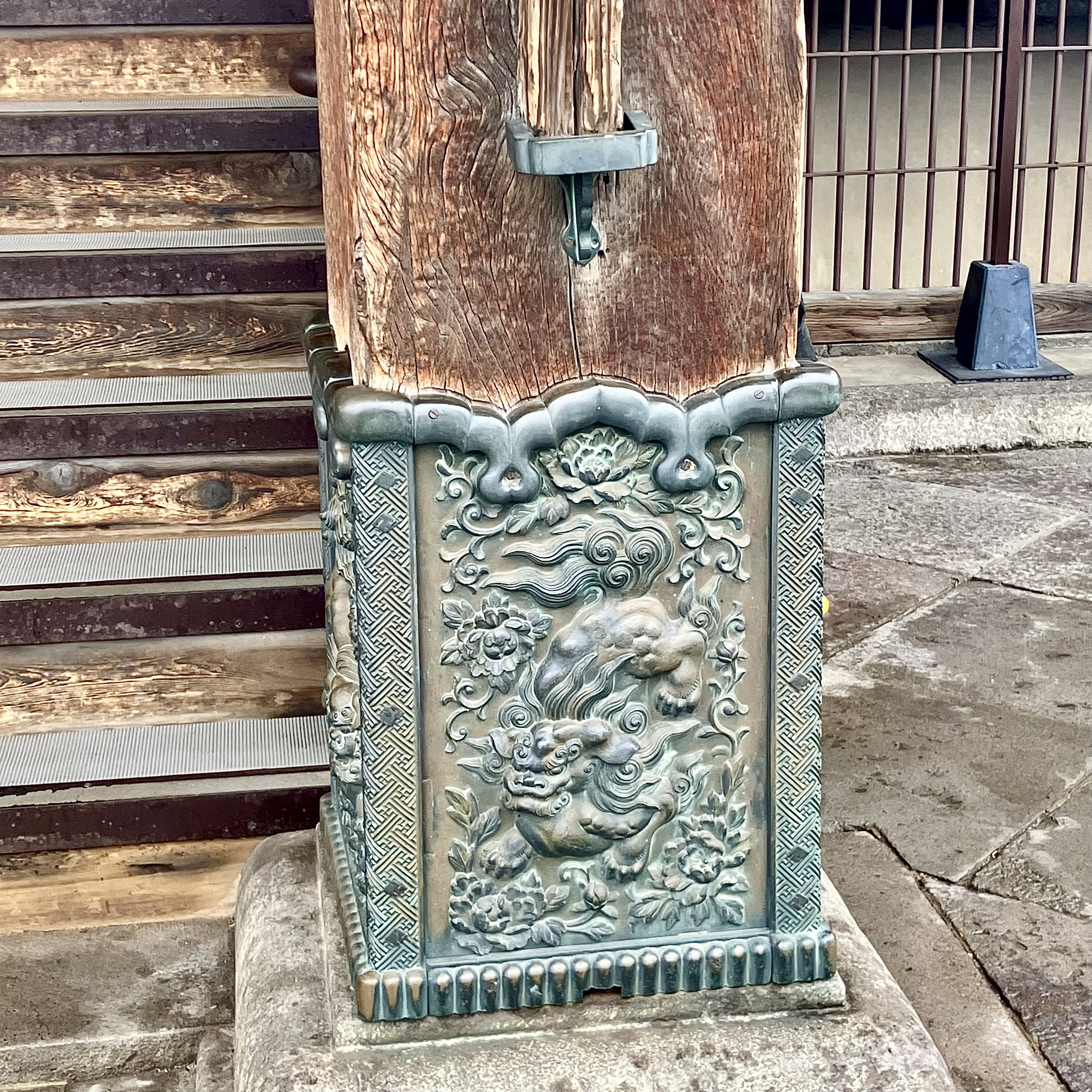
Metalwork on the Zenkoji temple. This is one of the oldest wooden buildings in Japan. Most of the older ones have burned down and been rebuilt, but this one dates to 1707.
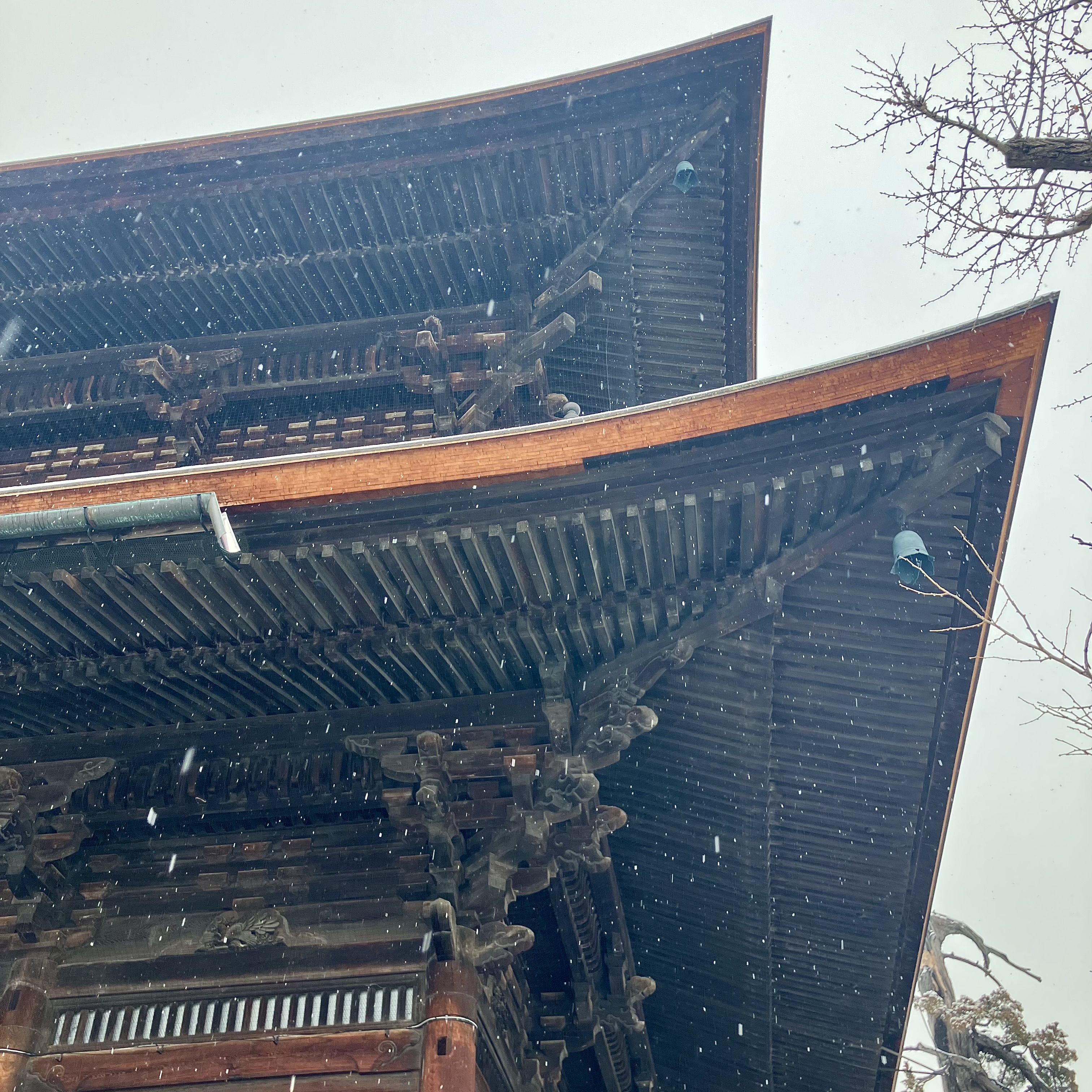
The roof of Zenkoji is itself worth a visit. The layers of wood that hold up that slope and overhang are part of a traditional system of carpentry called kigumi. It uses interlocking joints that shift and absorb stresses, like earthquake. Which can make you think of aikido, the Japanese martial art that redirects an opponents energy.
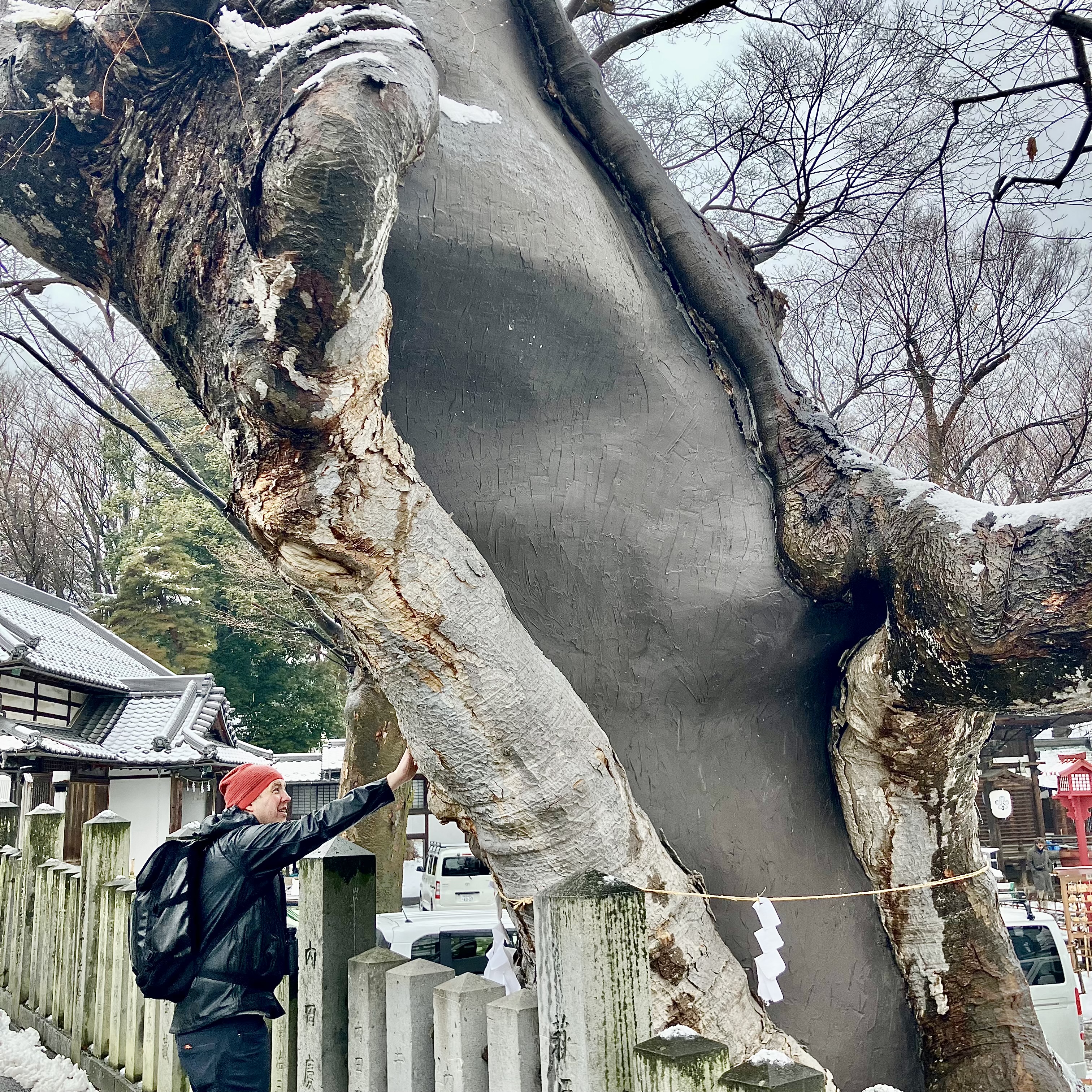
Evan with a ridiculous Zelkova. A concrete filling or something similar supports the hollowed trunk. The white paper zigzag in front of the trunk is called a shide. These protect from evil and purify a place, and its presence suggests the building beyond is a Shinto shrine.
The Kokufu show is a goldmine. You can walk through it or flip through a show book and realize you’re just looking at the stands. Or the branch setting. Or the pots.
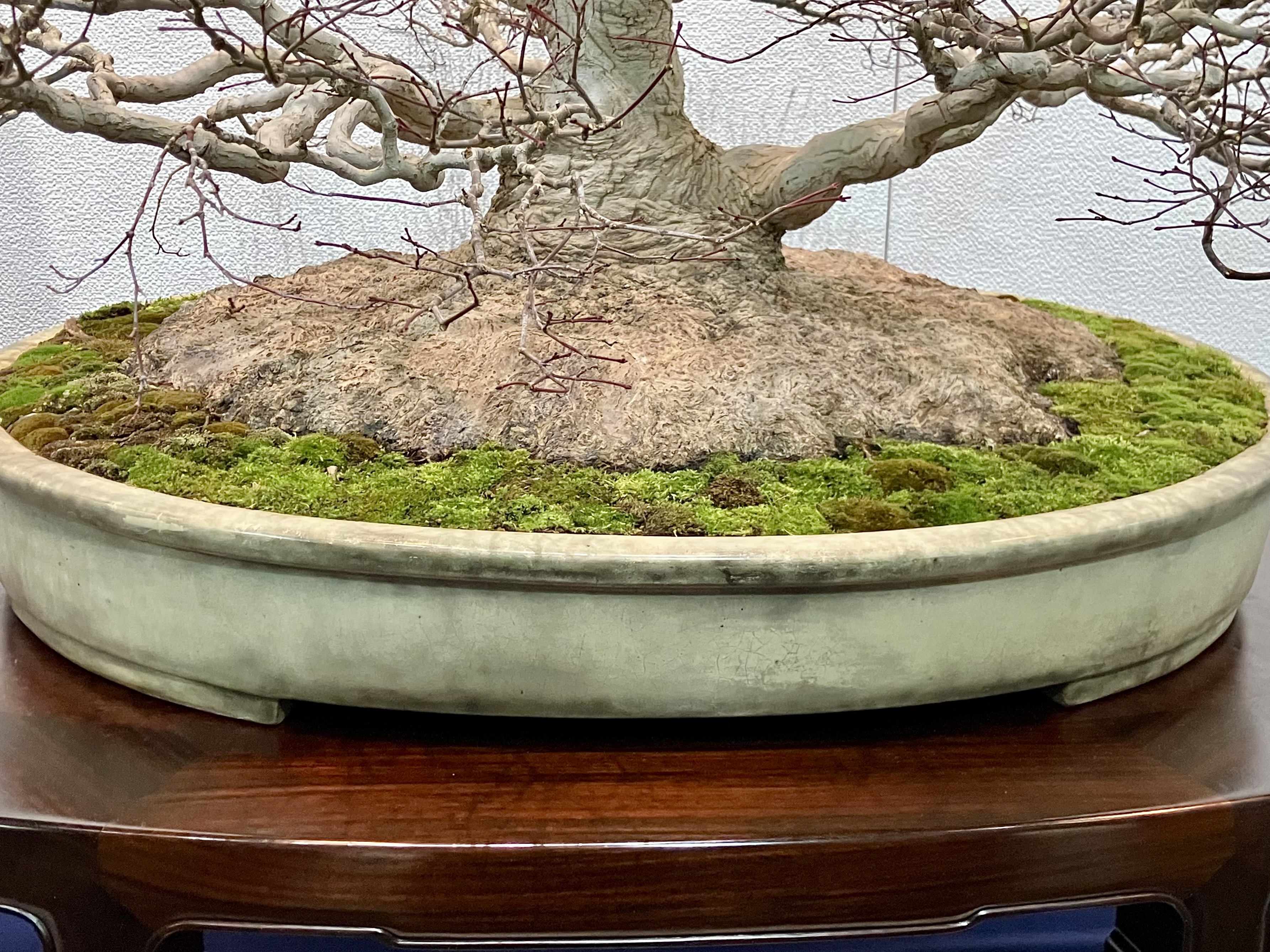
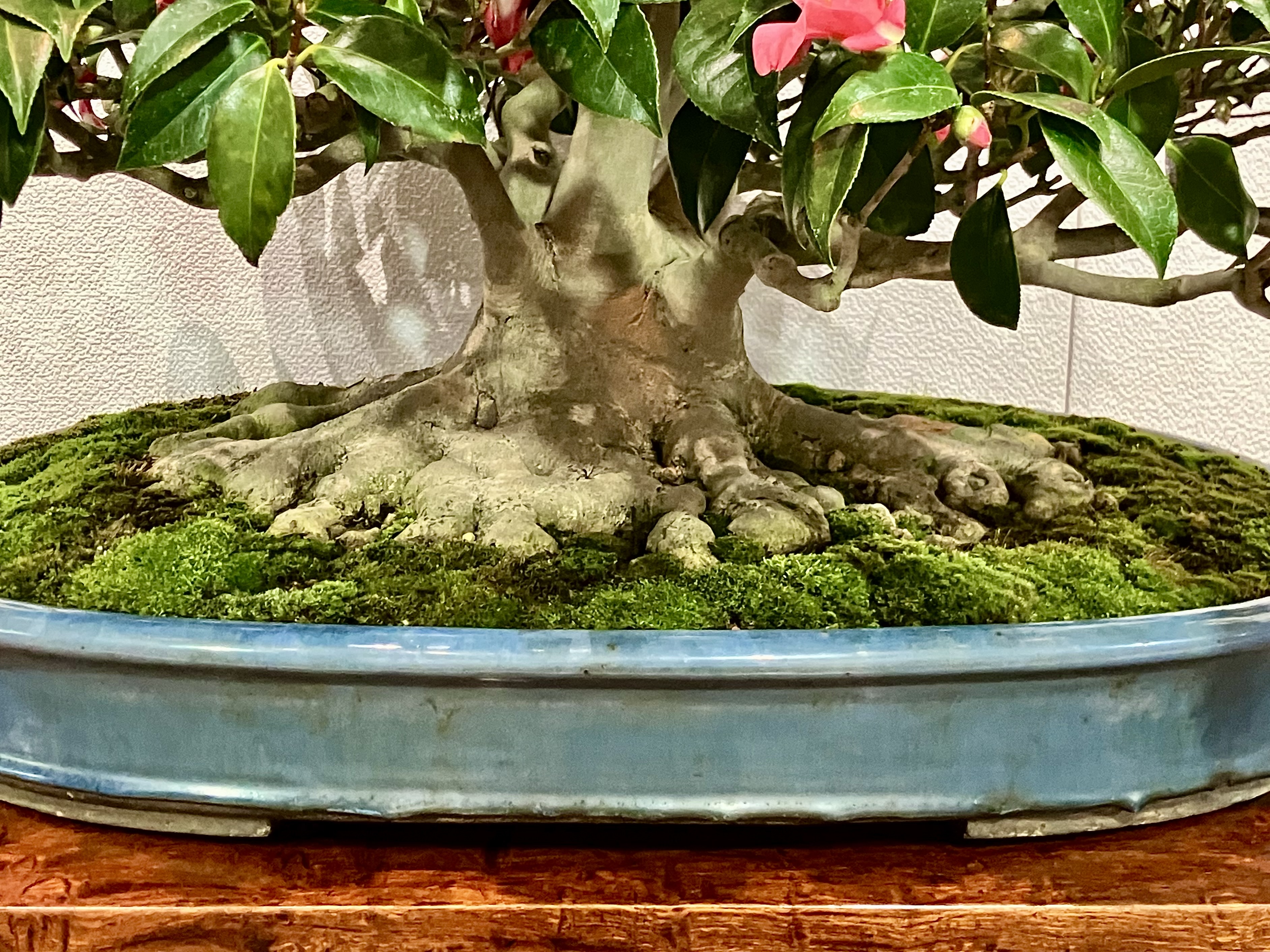
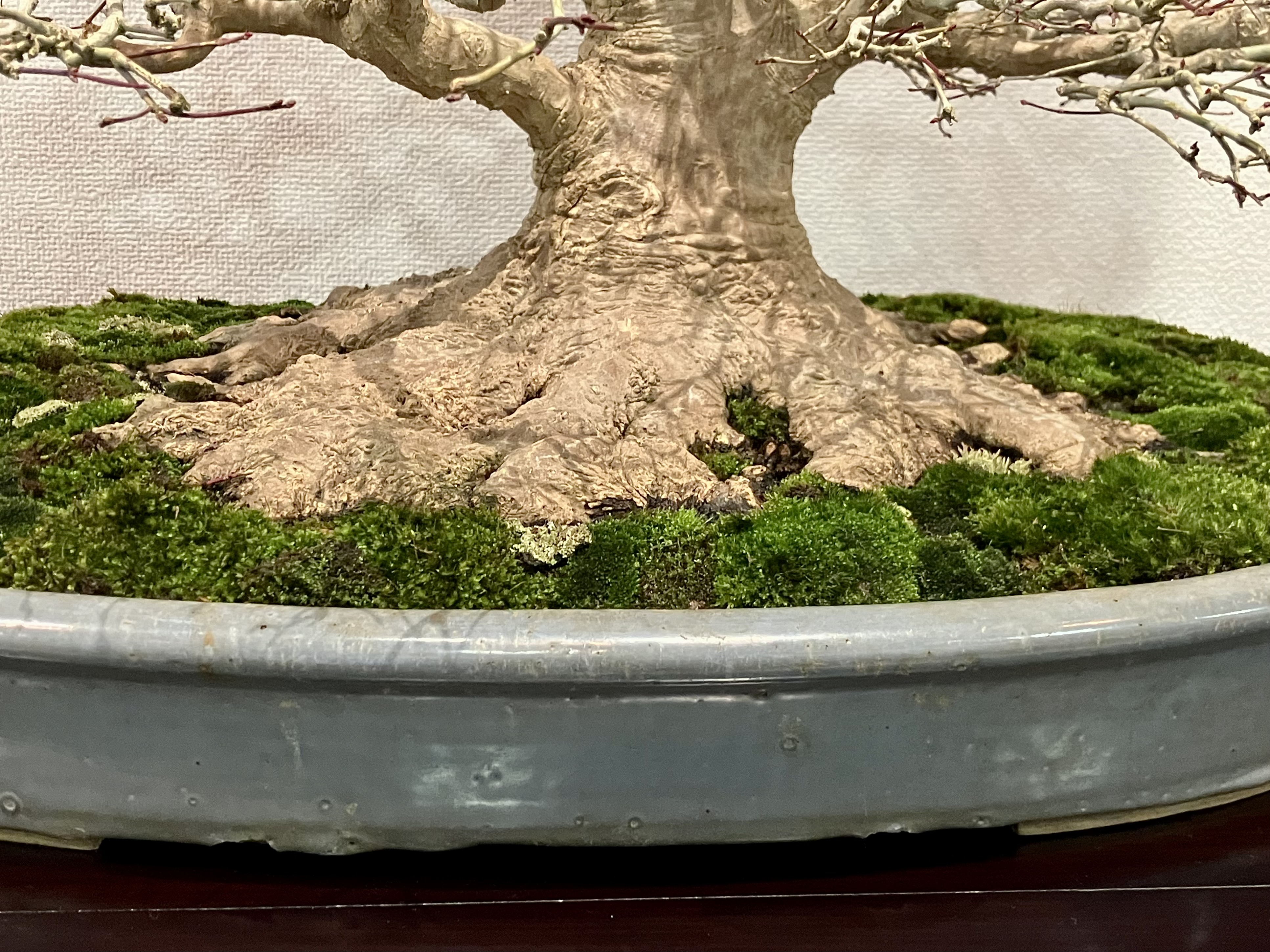
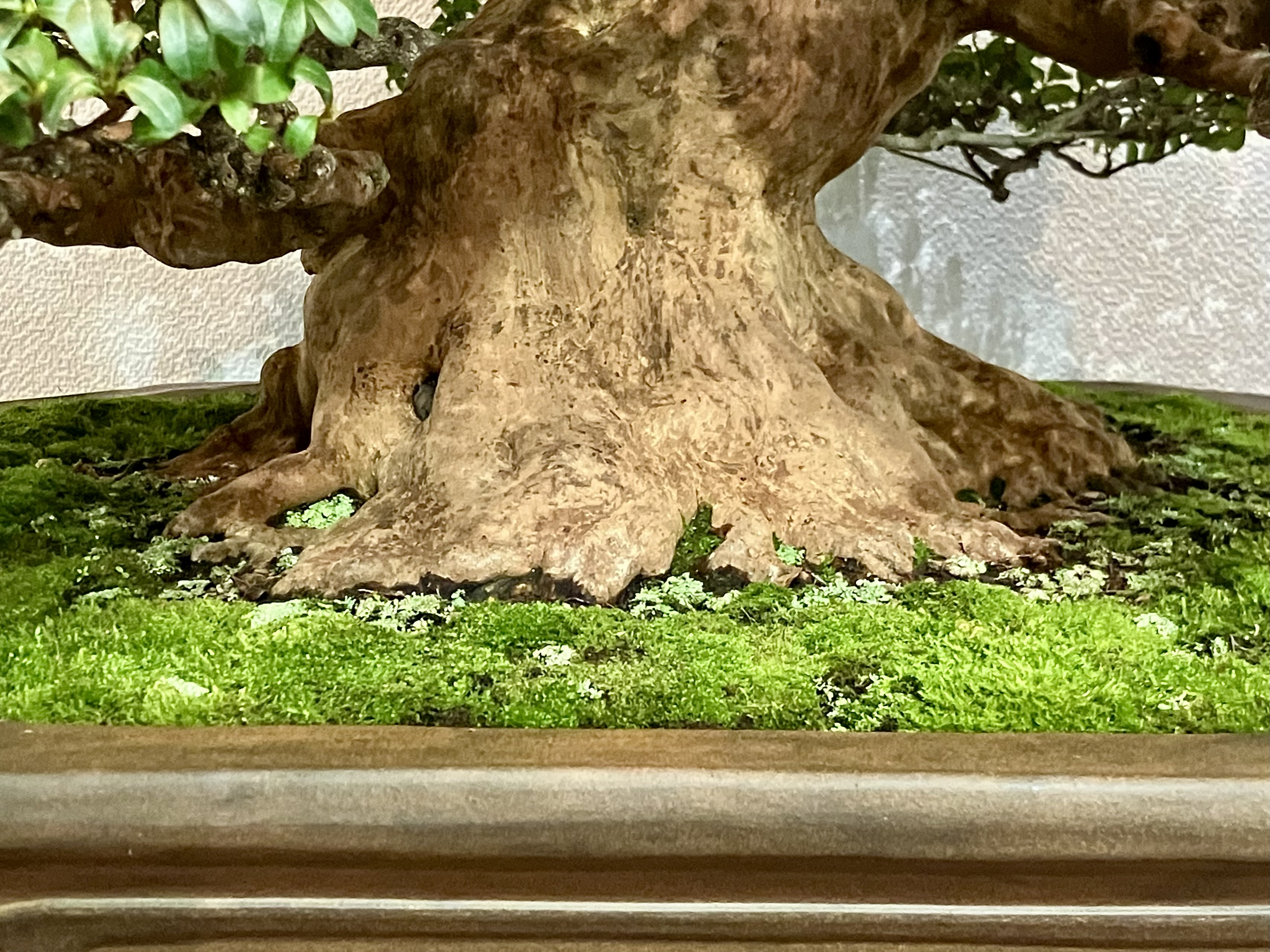
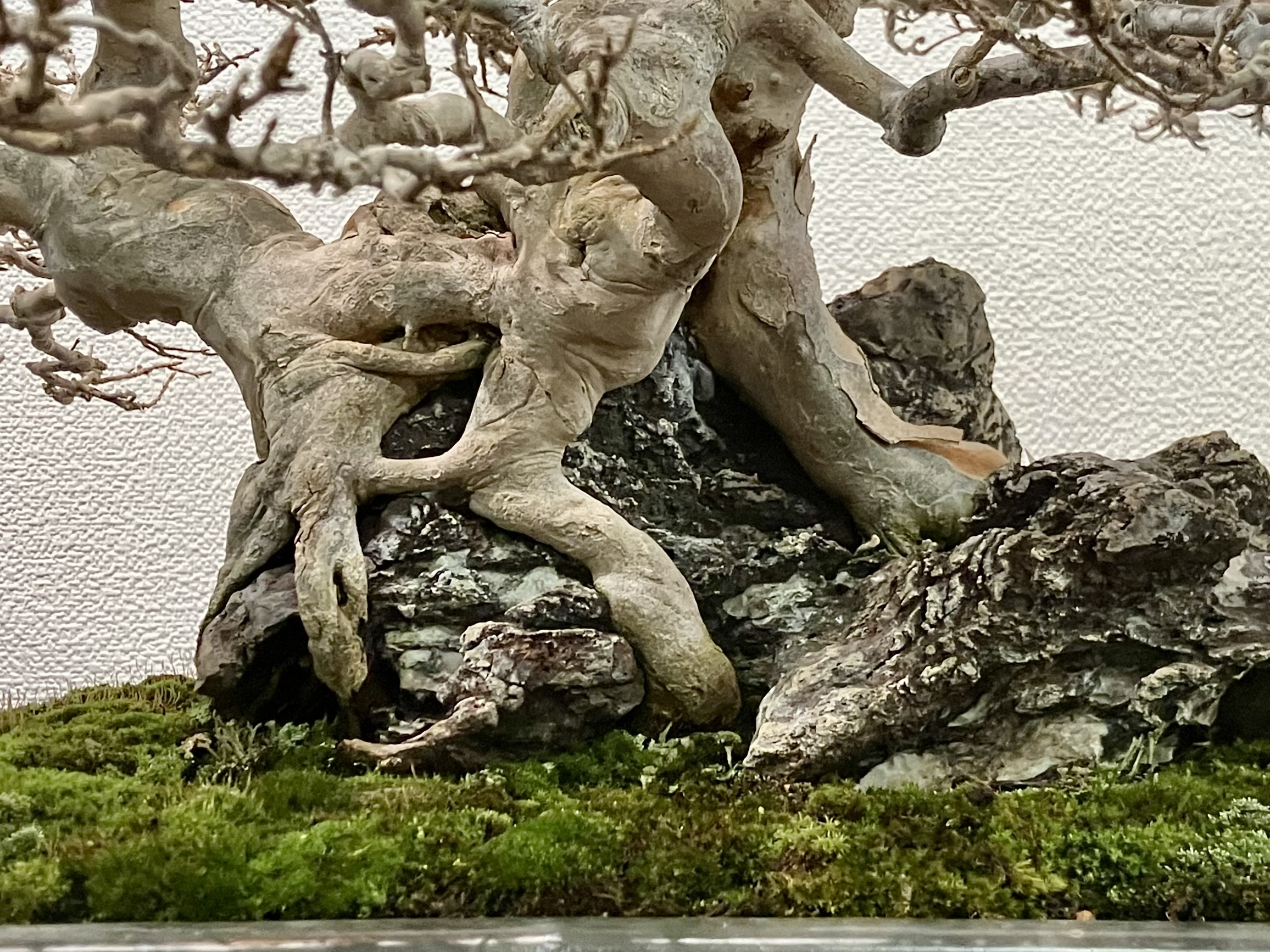
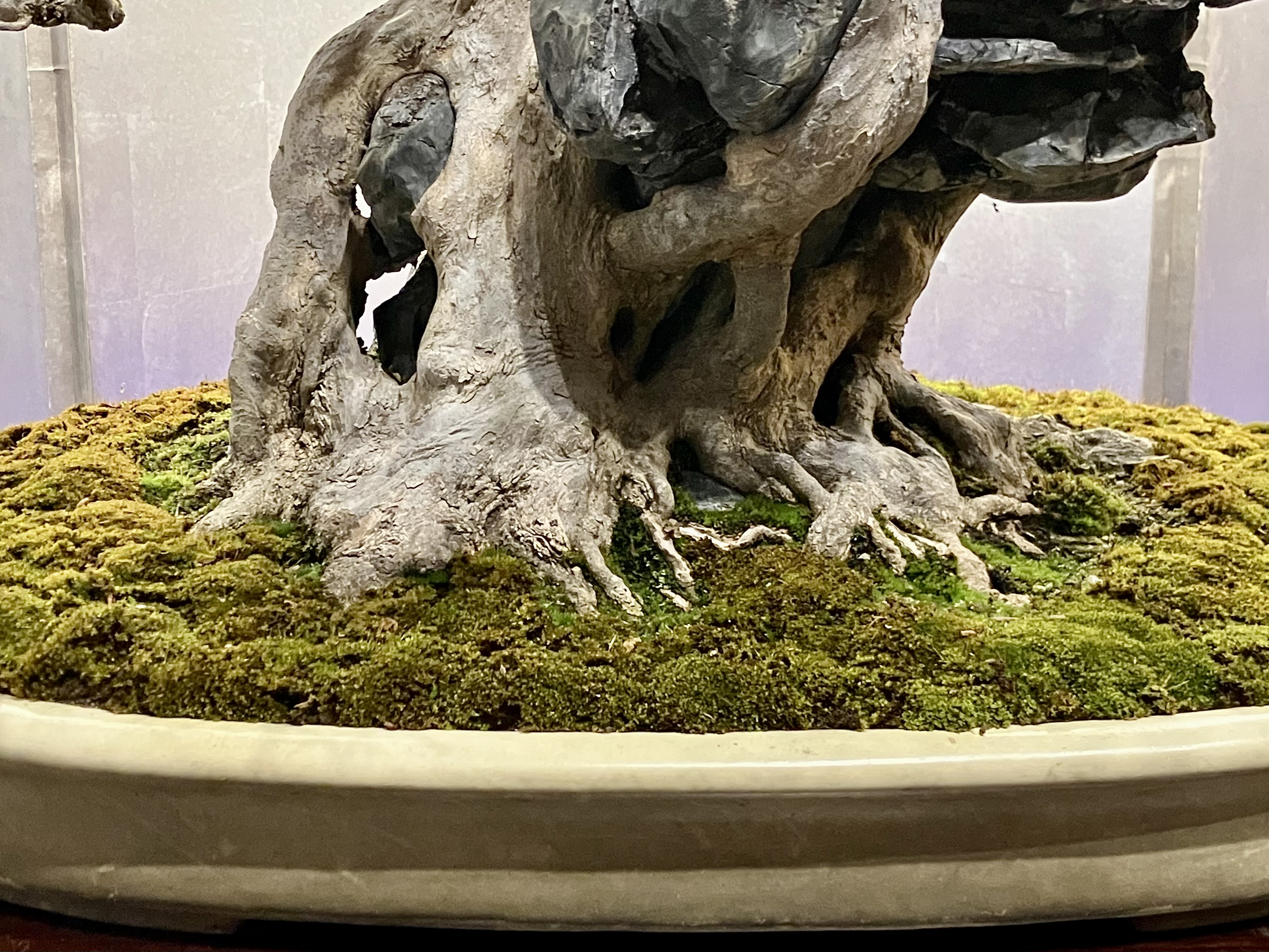
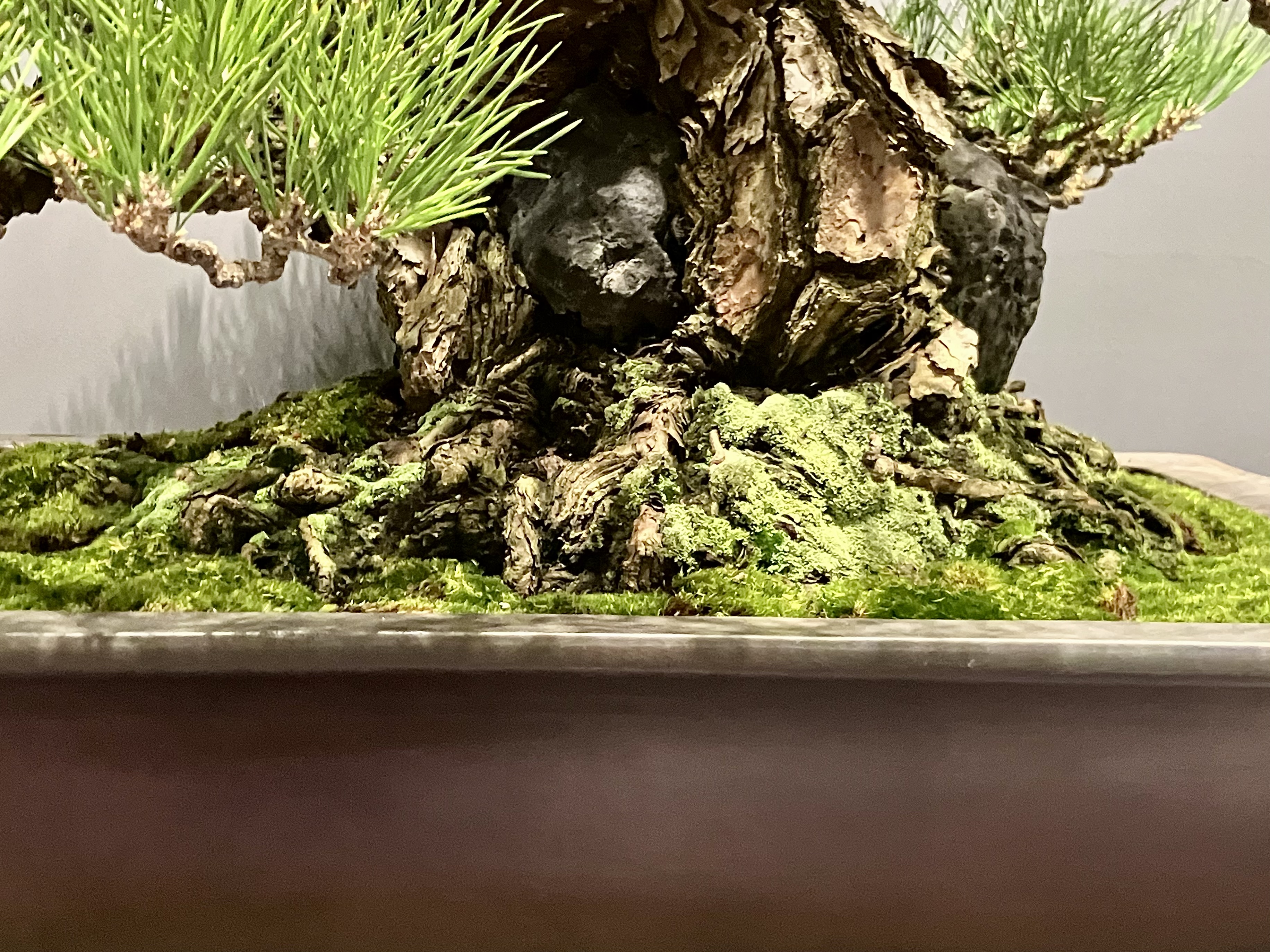
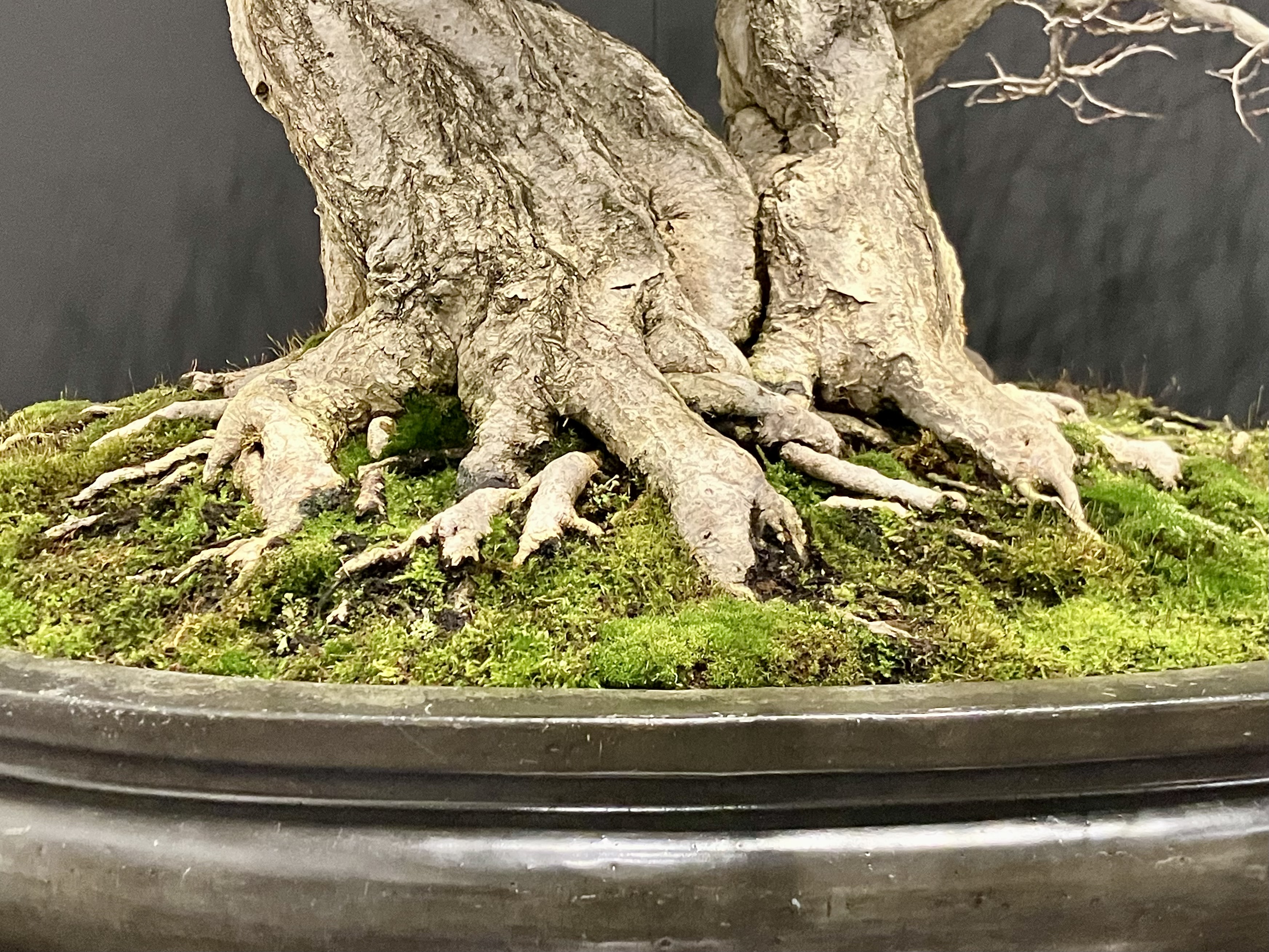
In this year’s Kokufu I took some closeups of the nebari. Here’s a handful of them.
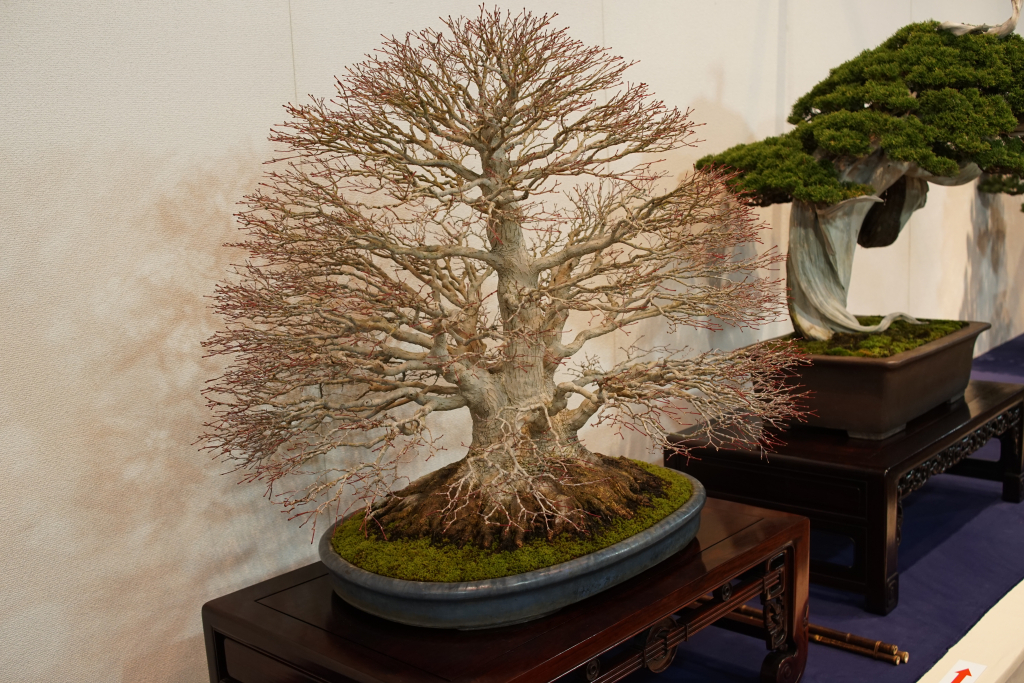
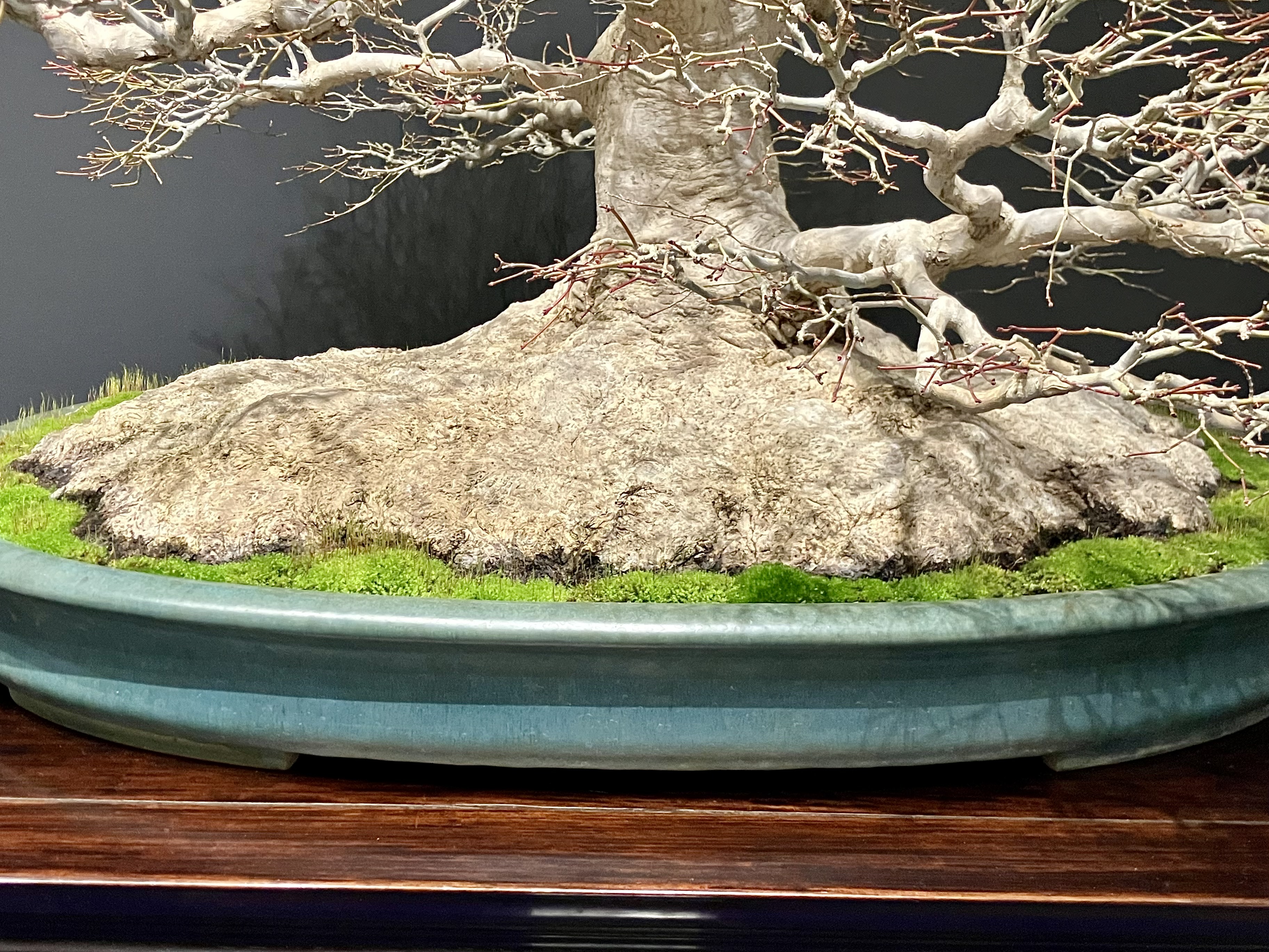
Japanese Maple with a wide, fused nebari. Hard to create without root grafting. Grafting is usually done by inserting a rooted cutting into a hole in the nebari, which will fuse and grow roots. Do that a LOT of times and you might make something like this. The extent of this root flare is a construct, a stylistic exaggeration that exists in almost any art.
Not to knock root grafting, a useful skill for sure.
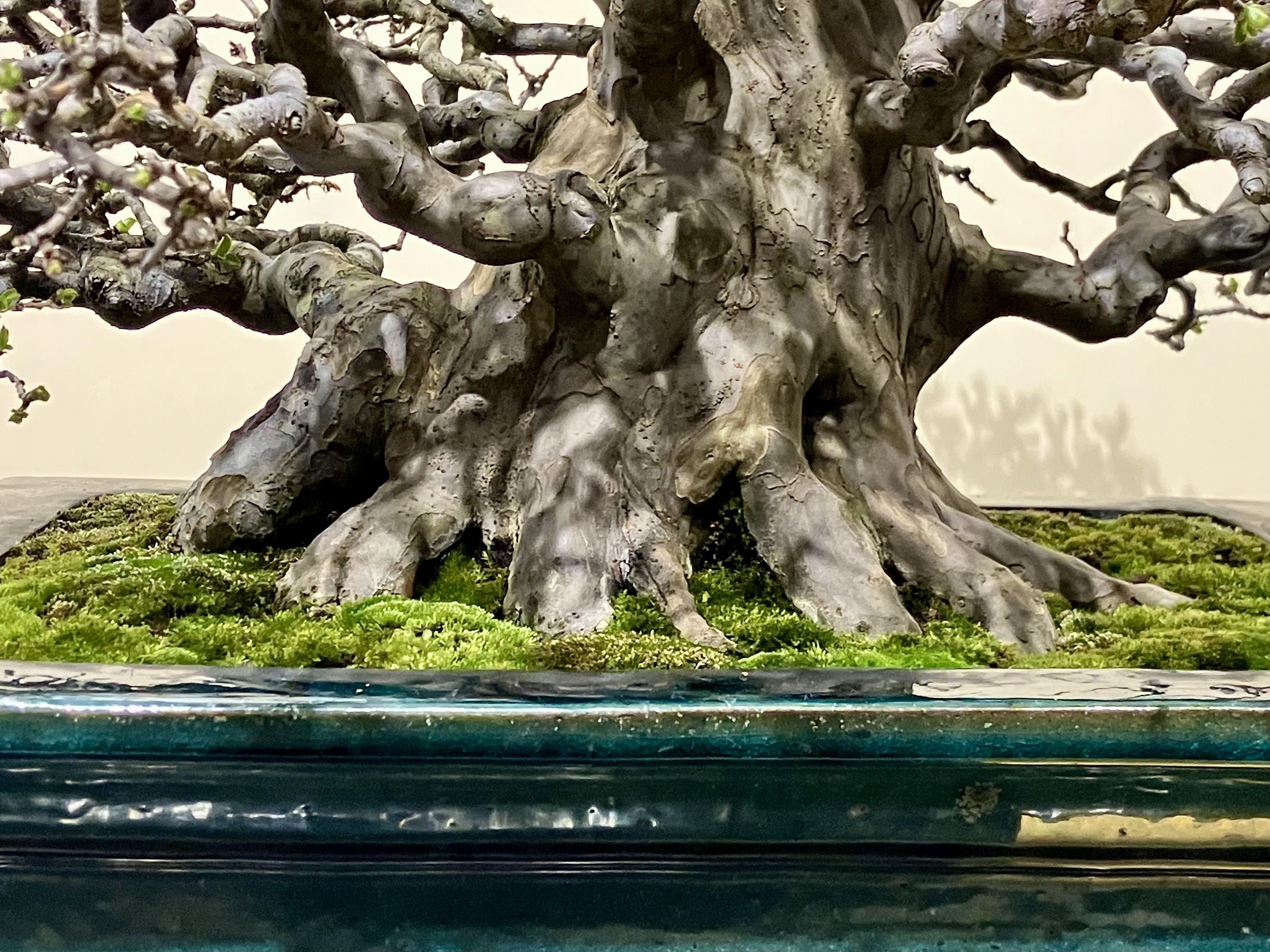
Camellia with a solid, broad nebari. It’s a lot, but not overdone. The tree feels stable.
Another Japanese Maple. To my sensibility, this is near ideal. It has a few holes in it, with minimal or no grafting. It looks natural.
An Azalea with a nice root flare. Like Maples, Azaleas will often create a respectable nebari without much fiddling. Just growing in a pot (rather than the ground) and either trimming the bottom roots hard under the trunk base and / or planting in a shallow pot can make a nebari like this. Although Azaleas prefer deeper pots, so the root trim technique would get the nod here.
You do see non-impressive—or absent—nebari in the Kokufu. This is a Trident Maple.
Another root-over-rock Trident but with a more mature root structure.
A Pine with a respectable nebari. Also a root over rock. Nebari tends to be minimal on root over rock plantings.
A Hornbeam with an average nebari. Or, rather, a good one for a Hornbeam. Elm is another plant often reluctant to fuse roots into a broader nebari. I think rather than forcing it’s nice to accept this reality. Root grafts would not disappear as well on a Hornbeam as on a Maple, the wound would last a long time. So you don’t see many attempts at it.
Another Japanese Maple with a grafted nebari. It looks like the foot of a snail to me. About ready to slither off to the next stand. Would be wonderful to have in the backyard. But the mollusk vibe might be hard to shake.
Hope the creator isn’t reading this.
A Chinese Quince. Possibly grown in the ground or a growing bed for a time. Root fingers like this are often the result of that sort of strong growth. Chinese Quince, Hornbeam, and Azalea are examples of plants which have much better nebari if grown in a pot. There’s more fine definition in the nebari structure, more in scale with the tree. Not unlike fine twigging versus coarse.
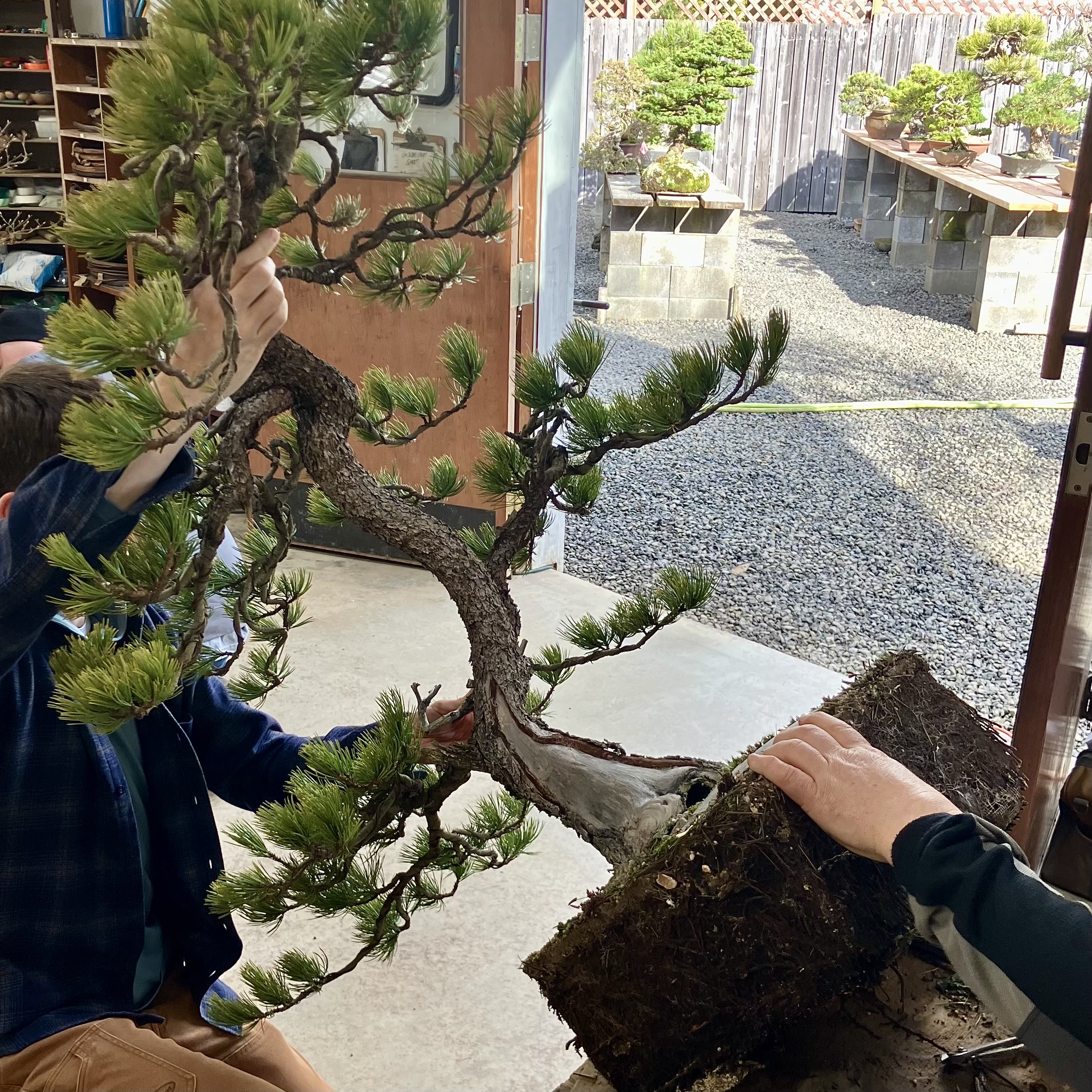
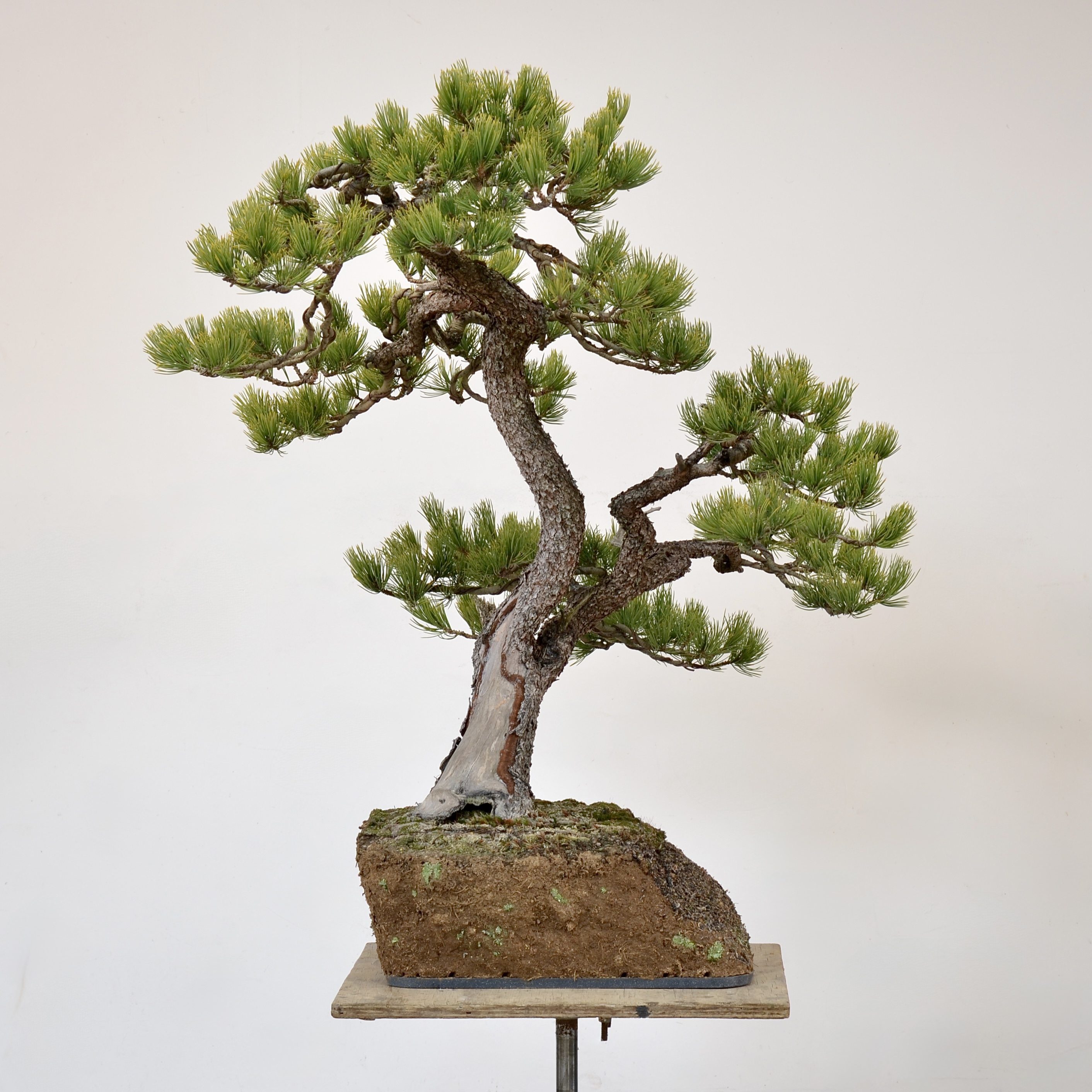
I collected this Limber Pine with Steve Varland and Dan Wiederrecht about a decade ago. It looked younger than the delicious, half-deadwood trees on the slopes nearby. Then a couple years ago bark started to peel in the front and—delight of delights—the whole front had died, leaving a swath of shari.
Last week we potted this tree for the first time. In the Seasonal class we failed to find a suitable pot, so it went on a slab.
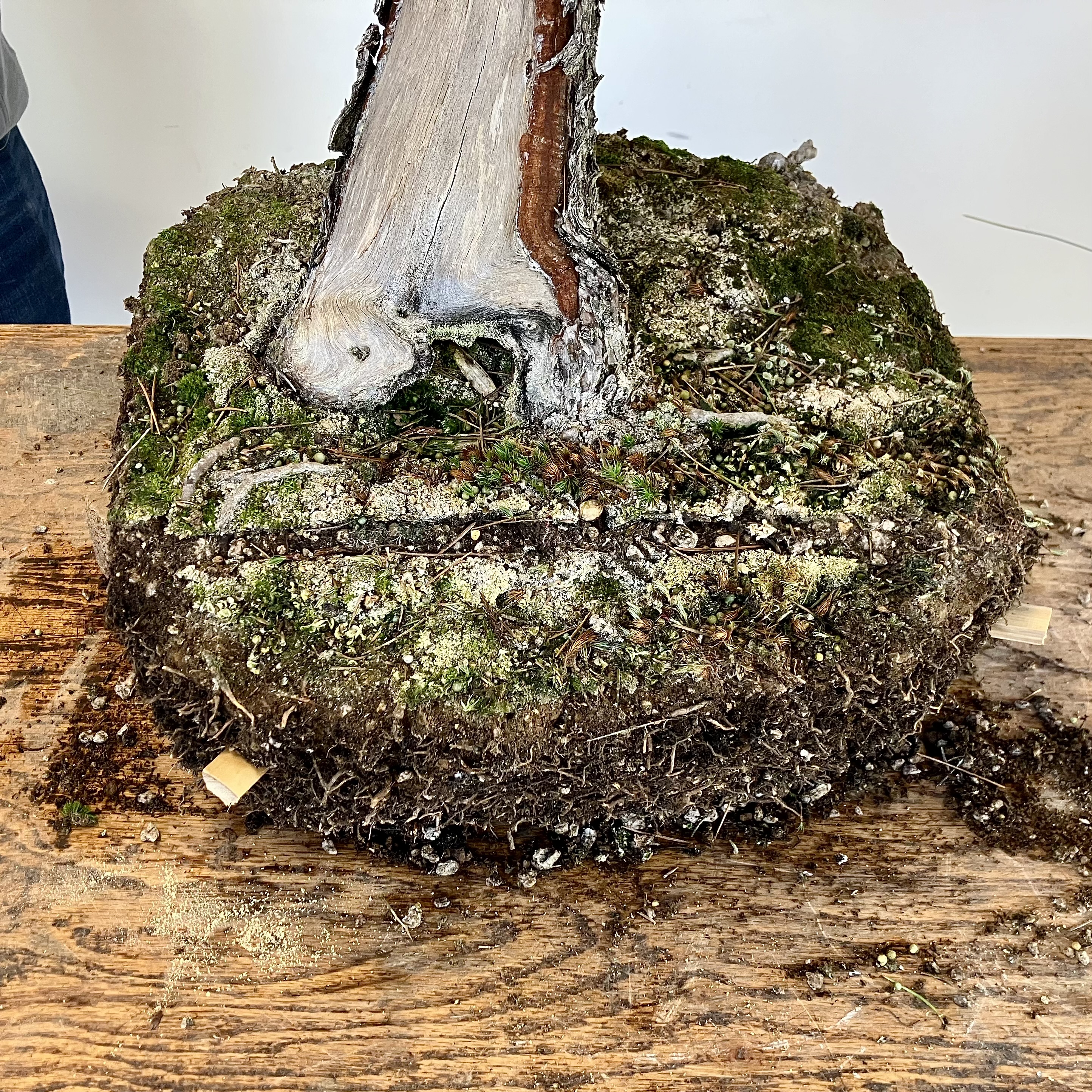
For years I’ve made slab plantings with juicy, organic root masses. I’ve wanted to try a root mass that suggested the shape and volume of a typical pot, so here’s our effort at that. A block of roots and soil that hints at a harder material.
Here’s the Limber Pine being prepared for its slab adventure.
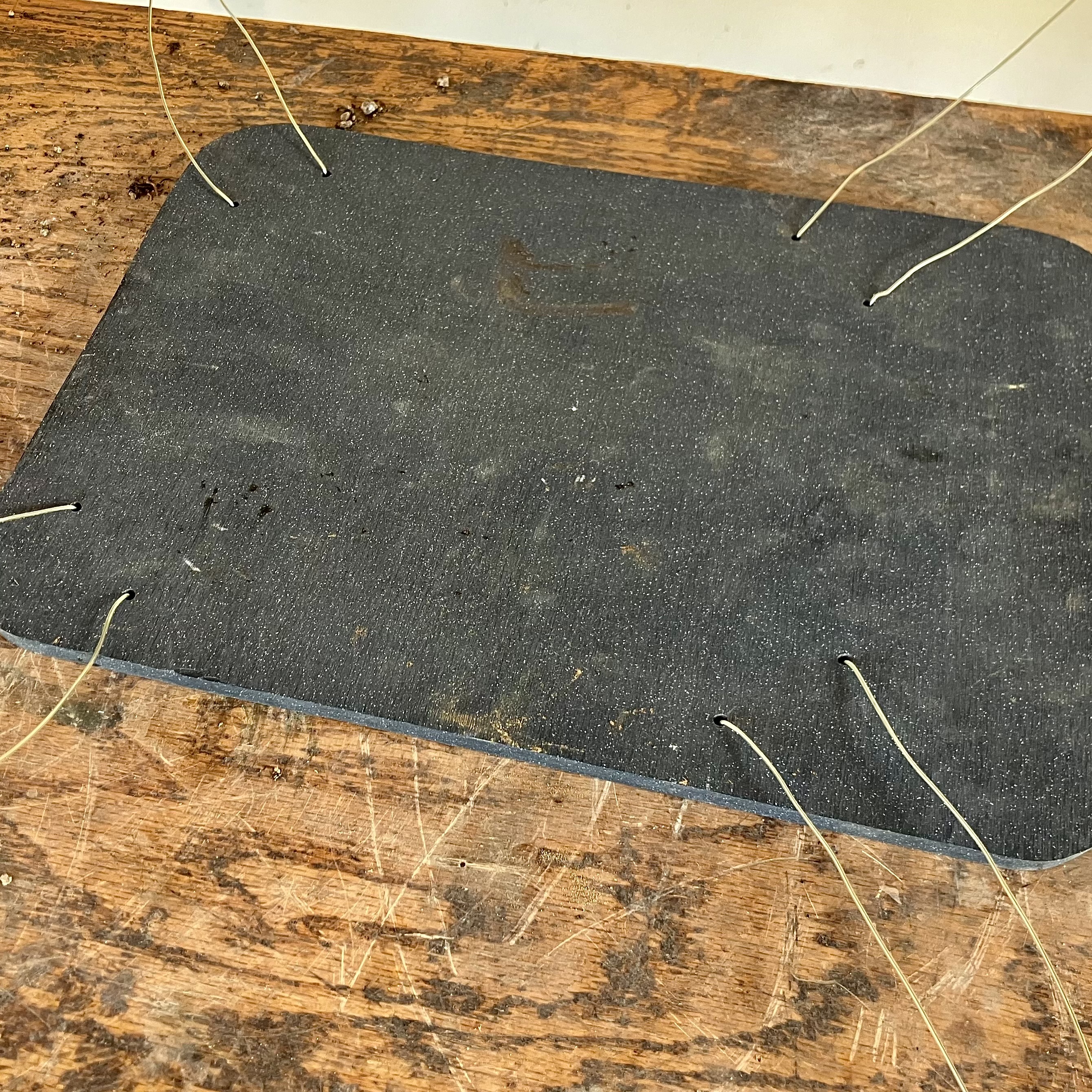
Our Corian slab ready for the rootball, cut to a soft rectangle. The bottom has grooves cut between the wiring holes so it sits flat. No need for drainage holes as the water will just go sideways.
The root ball prepared with stout bamboo stakes in four corners to be used as tie-downs.
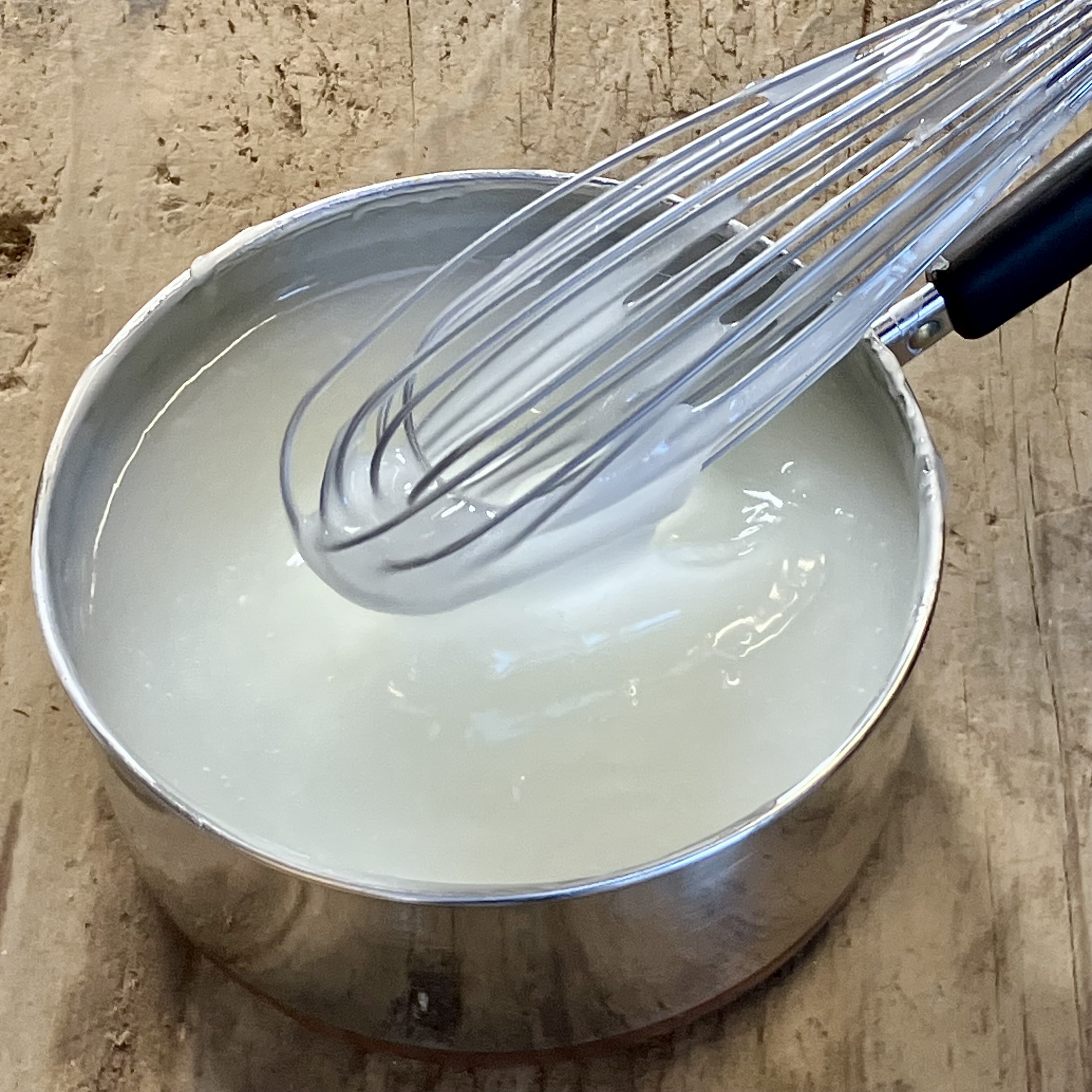
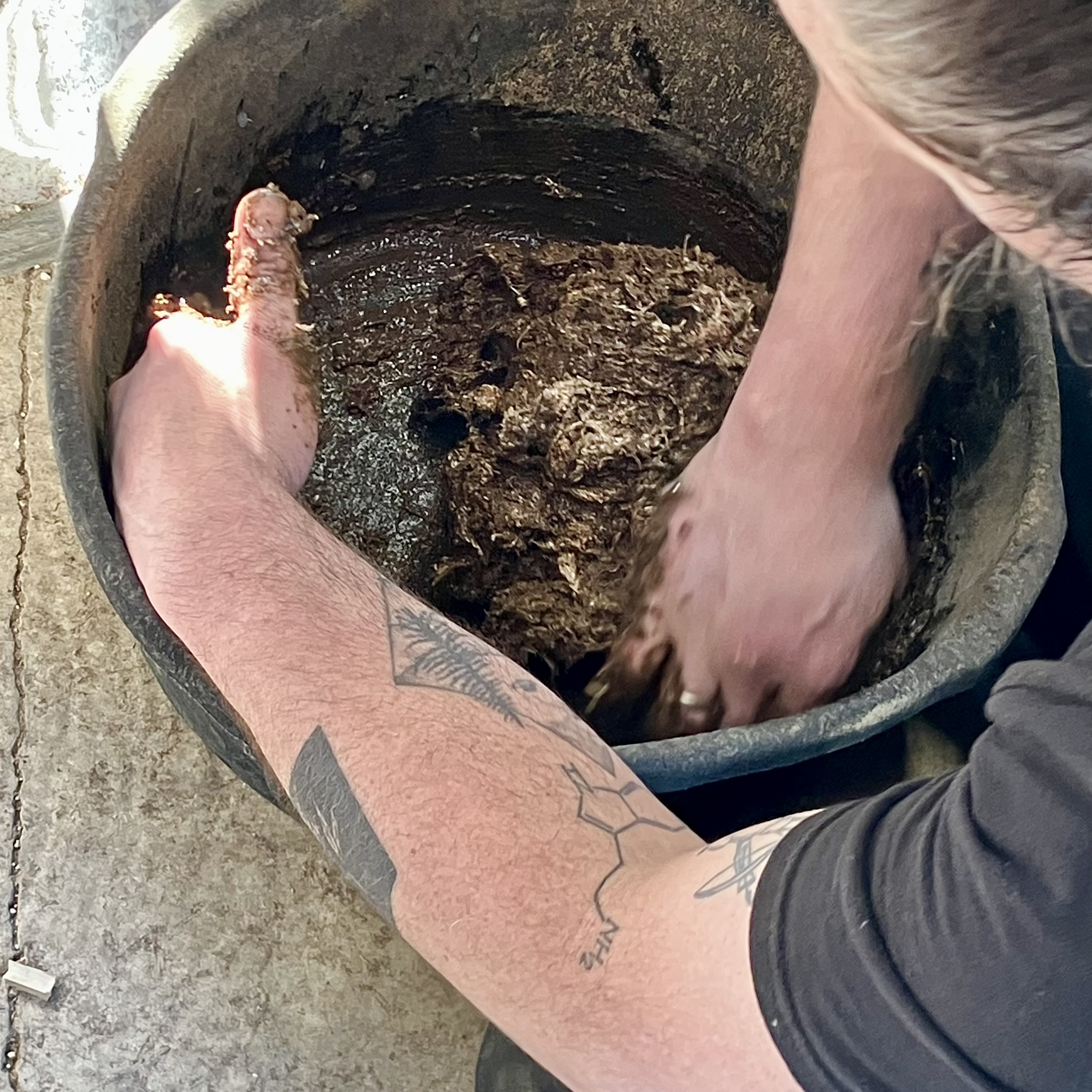
Gelatinous cooked corn starch helps firm up our muck. We use 1/3 corn starch, 1/3 long-fibered (unshredded) orchid moss, and 1/3 akadama dust. Sometimes more corn starch is needed for a sticky mass that doesn’t crack when you squish it.
Mixing the muck.
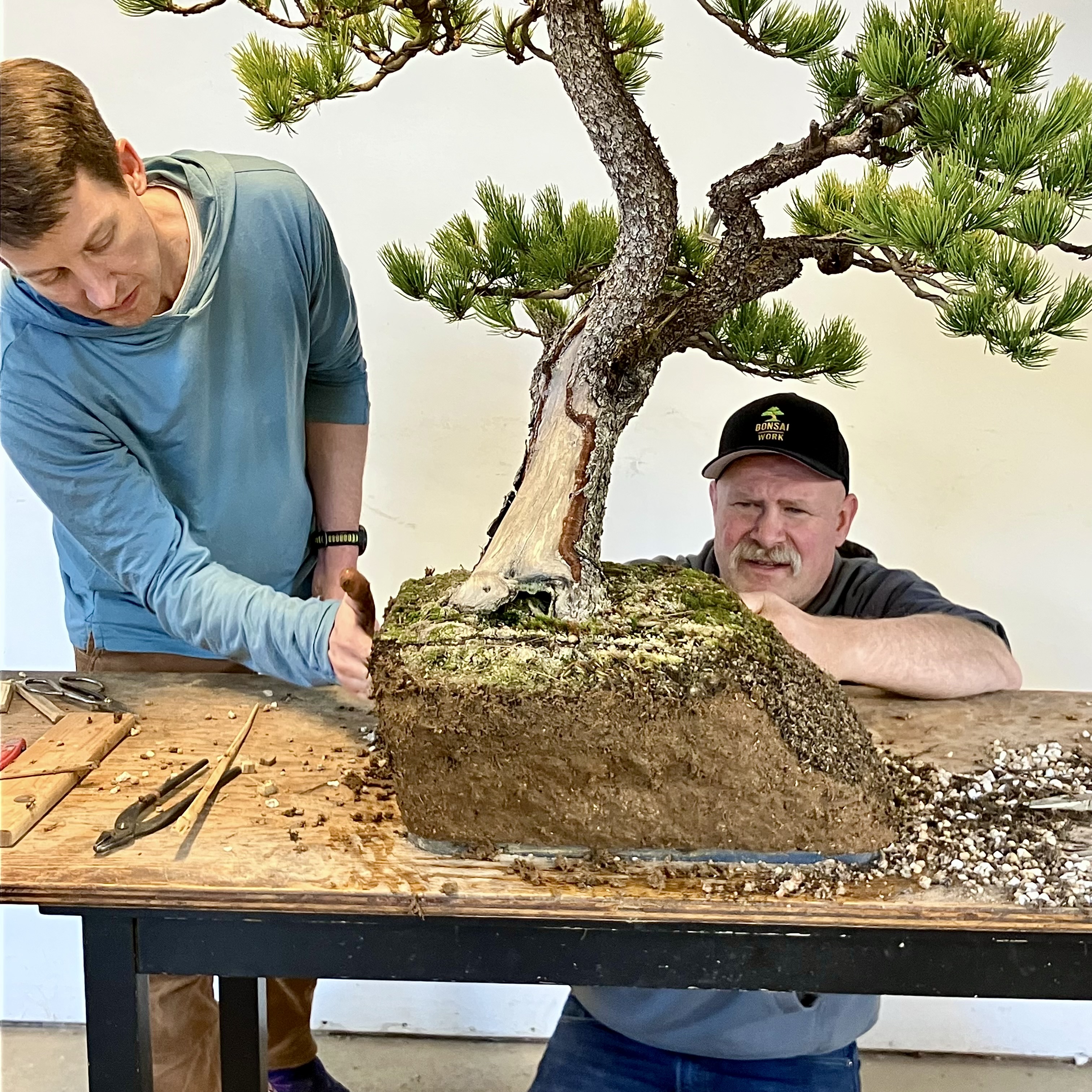
Ted and Chad work the ball. Chad’s hat is clever: bonsai overwork.
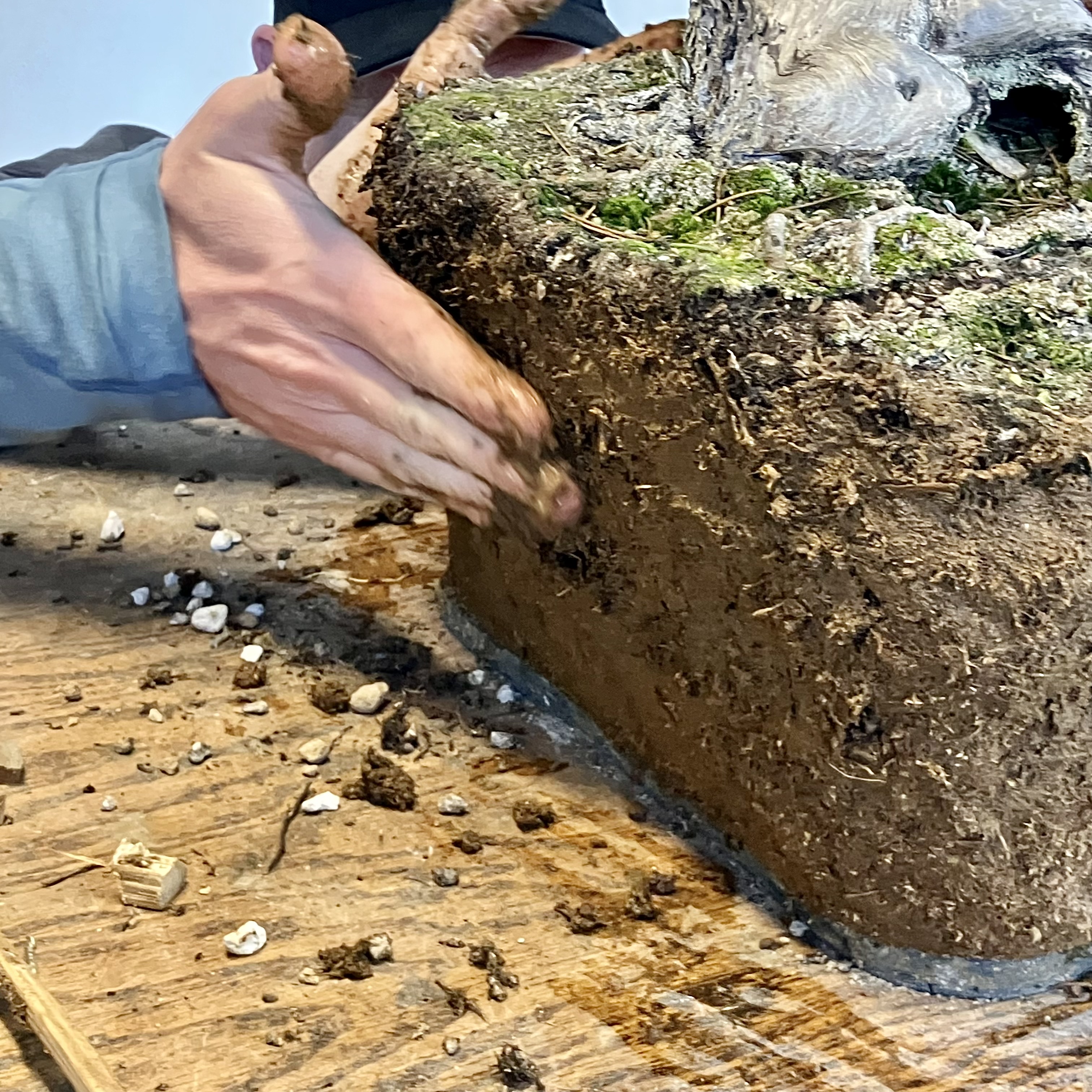
The bottom has a muck wall about 1” thick. Above that is the root mass where we spread on a watered-down muck like a slurry over the cut ends of the fine roots.
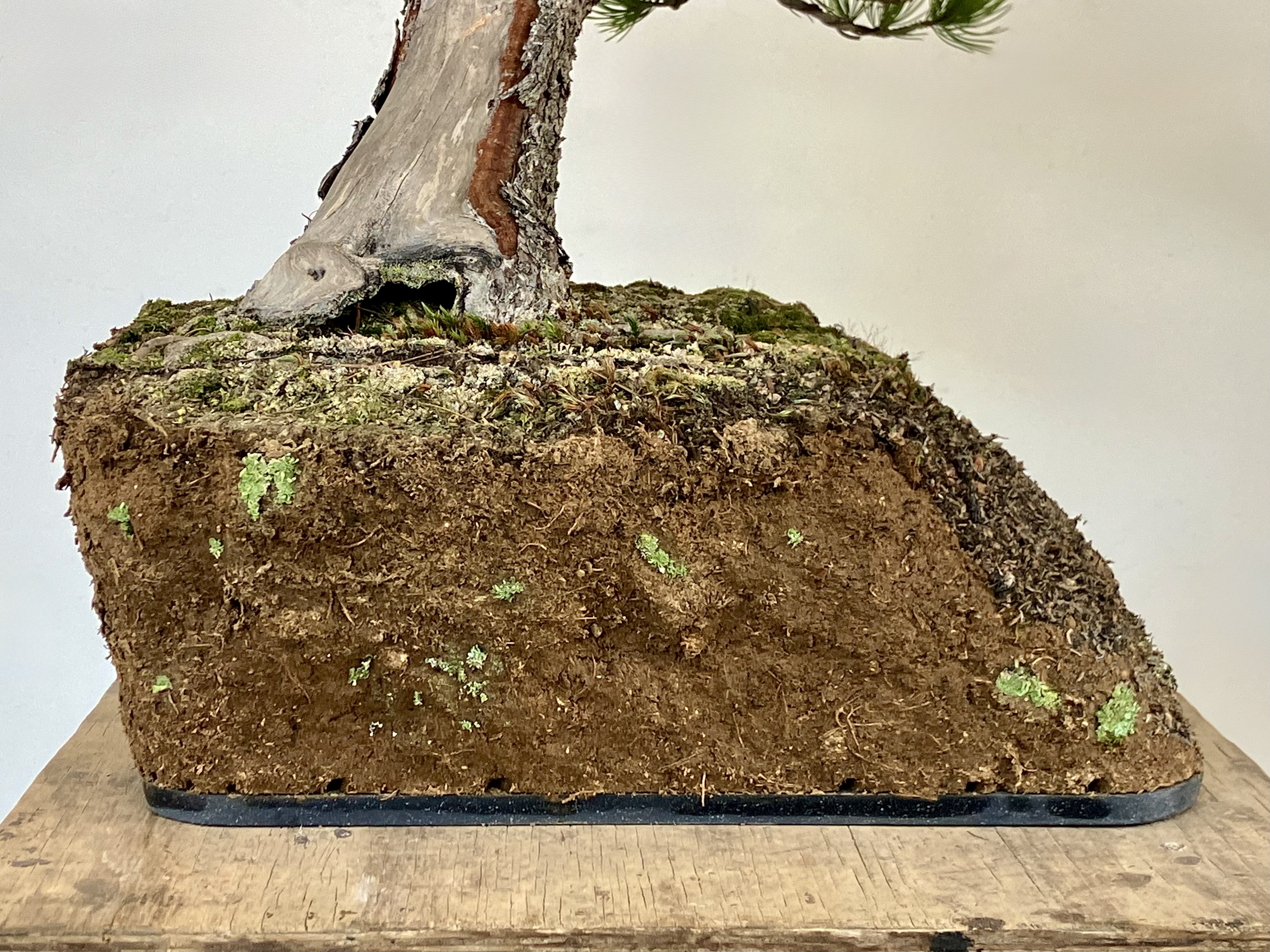
The finished slab planting. A few lichens adorn it to jumpstart the colonization of the new surface. Holes were punched in the bottom edge so when it’s watered, we don’t get a blowout of the muck wall from a gallon of water seeking escape. Had that once. Moss and lichen will cover the holes in a year or two, but once roots grow into the muck the protective job of those holes is finished.
The slope to the right has no muck on top, just soil with sphagnum over it for better water penetration.
Here’s the finished piece. It’s not like a pot. But it has some clean lines and a pot-like mass. The slopes might suggest movement and direction with a flow to the right.
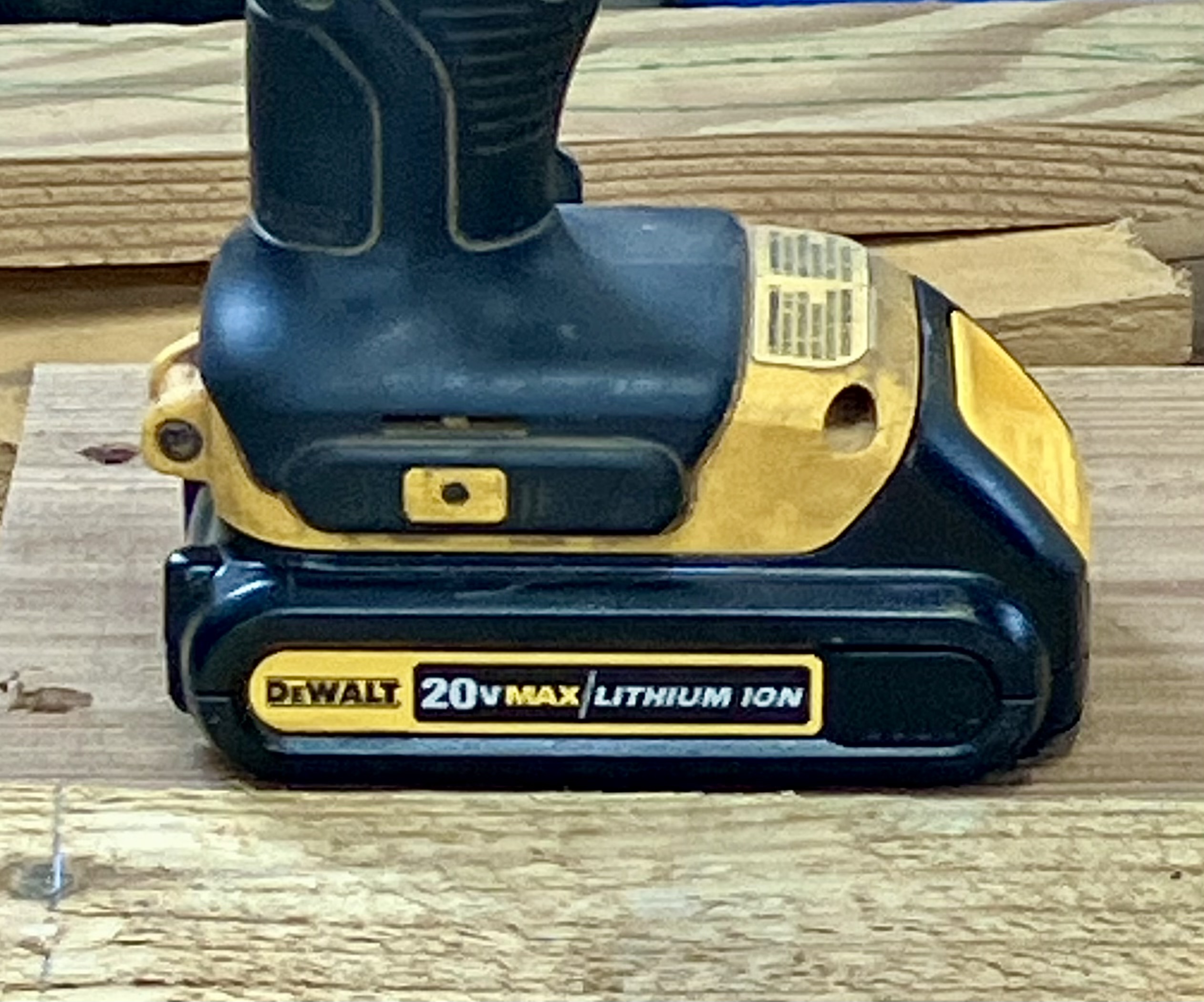
Inspiration? I didn’t notice the similarity of this DeWalt battery pack until several days later. Hard to claim inspiration if you don’t remember seeing it, though the mind is a funny thing.
The last post showed some branch work. Now, a few weeks later it is time to continue the work on this Japanese maple, by repotting, evening out the trunk tones with some lime sulfur, and beginning the bud-removal work associated with developing short internodes and controlled growth. Here is a quick rundown on the annual… Continue reading Continuing spring work on the Japanese Maple
Tomio Yamada, 3rd generation proprietor of Seiko-en Bonsai Garden in Omiya Bonsai Village has passed away quite recently. Seiko-en Bonsai Garden was founded by his grandfather Shonosuke but was then named the Oukei-en Bonsai Garden in Ugusudani during the Kaei Period (1848-1854) in Edo (now Tokyo) Japan. The garden was moved to Omiya Bonsai Village in 1943 with his father Kamajiro and the name was changed.
Kamajiro Yamada
He started his formal bonsai training with his father in 1965. Both were outstanding sensitive arts I had the honor to meet them on my second day of study with Kyuzo Murata in June 1970. Preserving the taste and art of Edo, Seiko-en Bonsai Garden pursues the refined beauty and elegance of the seasons. They have authored many books together. This garden is one of the highlights of my bonsai tours.
Mr. Yamada first displayed a Needle juniper at the 1976 Saku Fu Bonsai Exhibition and won an award. He displayed often and won the coveted “Prime Minister’s Award” in 1985. Tomio Yamada specialized on evergreen bonsai but was skilled with all species. His literati and clinging-to-a-rock plantings were exceptional.
He was the curator of the famous Takagi Bonsai Collection which later became the basic core of the Omiya Bonsai Art Museum. In 2012 he became an officer of the museum and greatly supports their mission. As the Director of the Omiya Bonsai Union he worked tersely establishing the “Omiya Brand” of bonsai He establishes the Japan Bonsai Artists Association in 1991. Mr. Yamada also established the Nippon Bonsai Sakka Association which has a chapter in Europe. He is a superb bonsai display master and often travels to Europe to teach his display principles.
The Omiya Bonsai Art Museum celebrating their 10th Anniversary presented a series of five-week one man bonsai exhibitions of the Top Contemporary Bonsai Masters in the world. Hiroshi Takeyama (2018) was the first to present his one-man show in spring, followed in autumn by Masahiko Kimura (2018.)
“Tomio Yamada– Bonsai Quest for Beauty” Exhibition was held from January to March 2020.
It featured 42 famous and well-known bonsai Tomio Yamada created or is credited for his design.
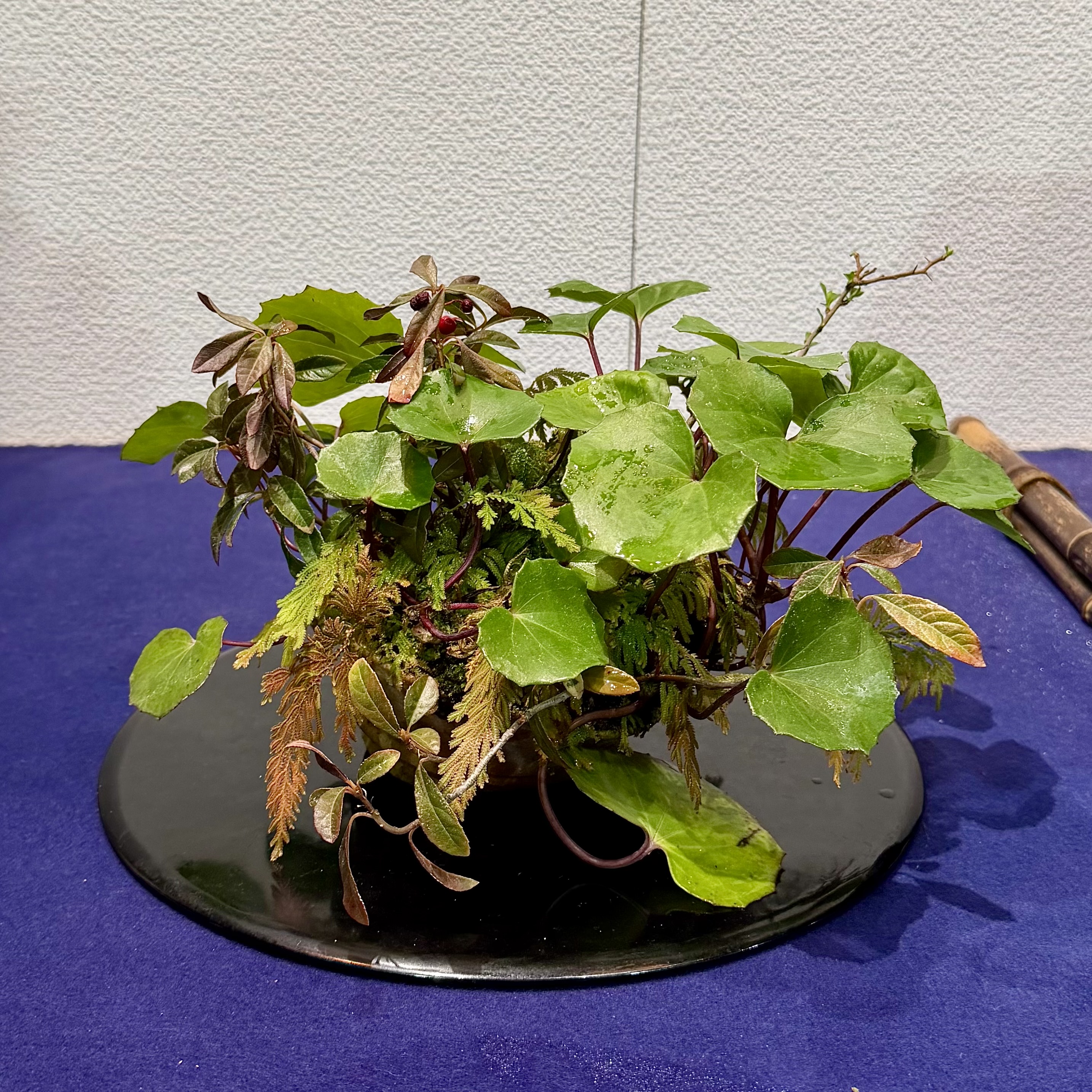
Mr. Yamada’s daughter, Kaori is now the 4th generation proprietor of Seiko-en Bonsai Garden. “Saika Bonsai” (Colorful Flowers) is an original creation of hers. It is kind of a crossover of bonsai and Ikebana but, using living rooted plants. In order to promote and introduce bonsai to the younger generation and ladies by using common smaller inexpensive plants and combining them in containers. She is now well-established teaching through videos and TV appearances.
Seiko-en is one of the remaining six bonsai gardens in the Omiya Bonsai Village. Although small in size, this beautiful and unique garden houses many famous classical bonsai masterpieces. There are fine-quality bonsai displayed at every turn and corner.
For those who can’t get enough words about trees, here are a selection of books you might enjoy.
These books cover a wide arc of tree storytelling, from their lives in nature to how we interact with them. They are not about bonsai, but rather might illuminate why bonsai captivate us.
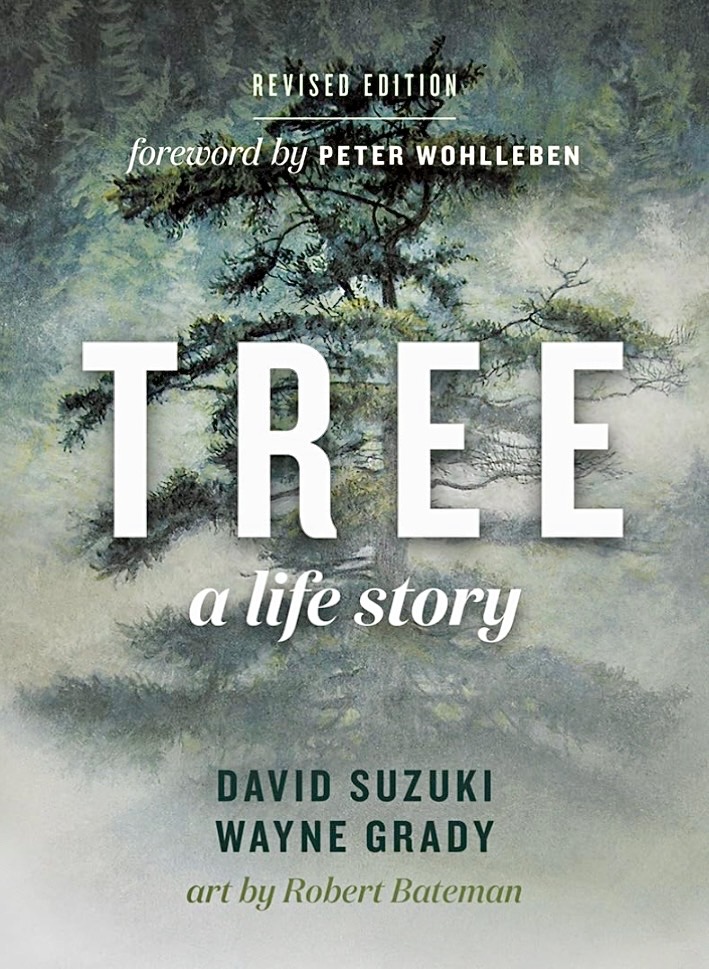
Tree: A Life Story— A penetrating view through the lens and experience of an ecologist, David Suzuki, this tree biography takes a Douglas Fir from seedling to toppling over at great age. Suzuki leads us on a macro and micro journey through the Fir’s lifespan and how it changes and is changed by the biotic life around it. You learn as much about the nitrogen cycle, carpenter ants, and the haunting similarity of chlorophyll and blood as about the tree. A small treasure.
The Overstory: A Novel— No fewer than five people have gifted or suggested this book to me, and I’ve done about the same for others. A reviewer wrote, “…trees…are both the stealth protagonists and the beating, fine-grained heart of this strange, marvelous book.” It’s a Pulitzer Prize winner, a generational effort, and, if you have the emotional bandwidth for a deep dive of several generations of people and their lives with trees, worth it. A delicious set of stories.
In Trees: An Exploration— Due to be released on April 7, 2026 (pre-ordering has begun), Robert Moor’s book has already received strong reviews from Kirkus, Publisher’s Weekly, and dignitaries from natural history circles. From the top of a sequoia filming a documentary with David Attenborough to a tree full of chimpanzees, this investigative romp wonders what a tree is from the vantage of science, history, and philosophy. Moor interviewed me for an article in The New Yorker about bonsai, and I’m personally looking forward to this one.
I’ll offer another short book list again soon. Feel free to suggest your favorite “bonsai-adjacent” books in the comments.
This week, an assortment of puzzlers from this spring’s repots, with comments.
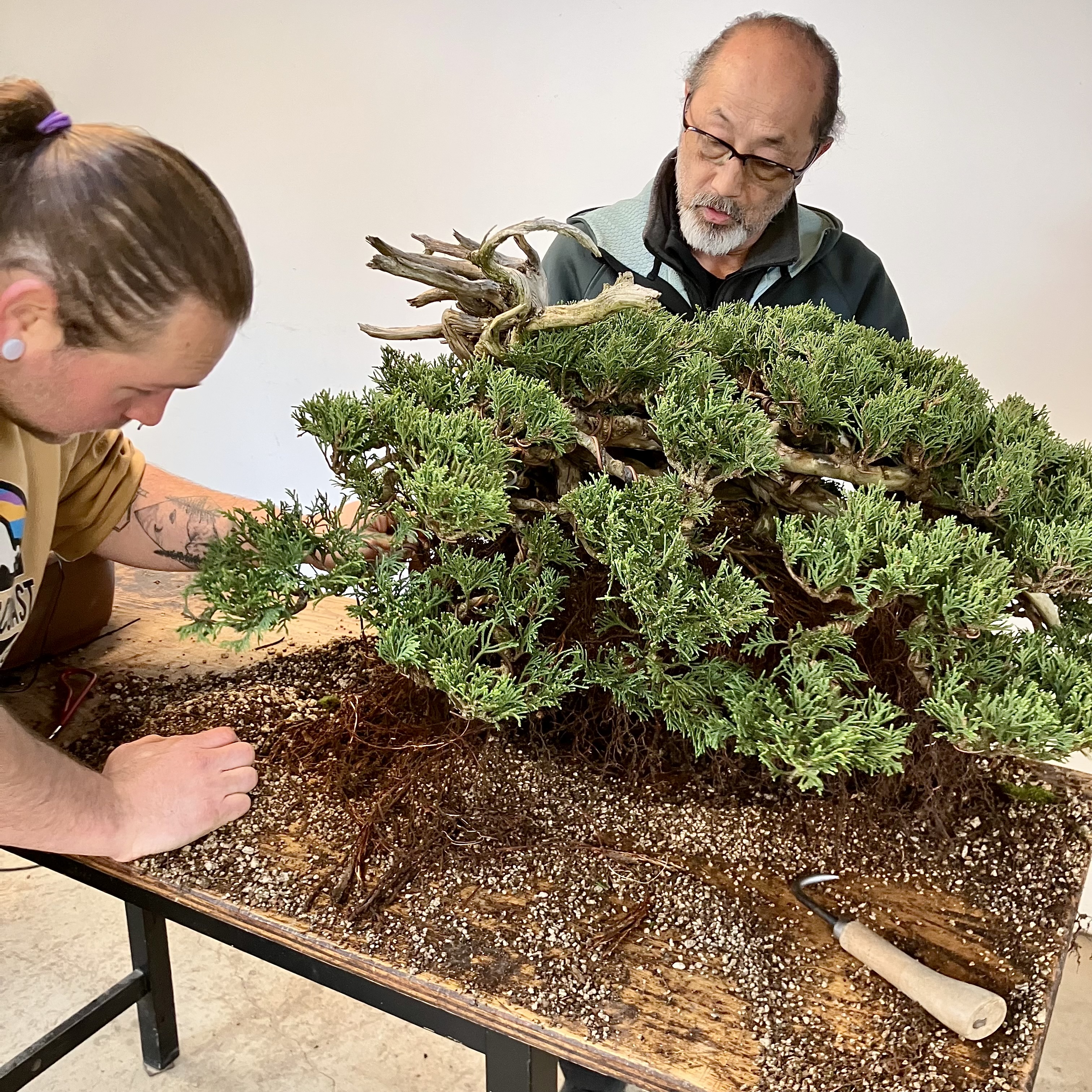
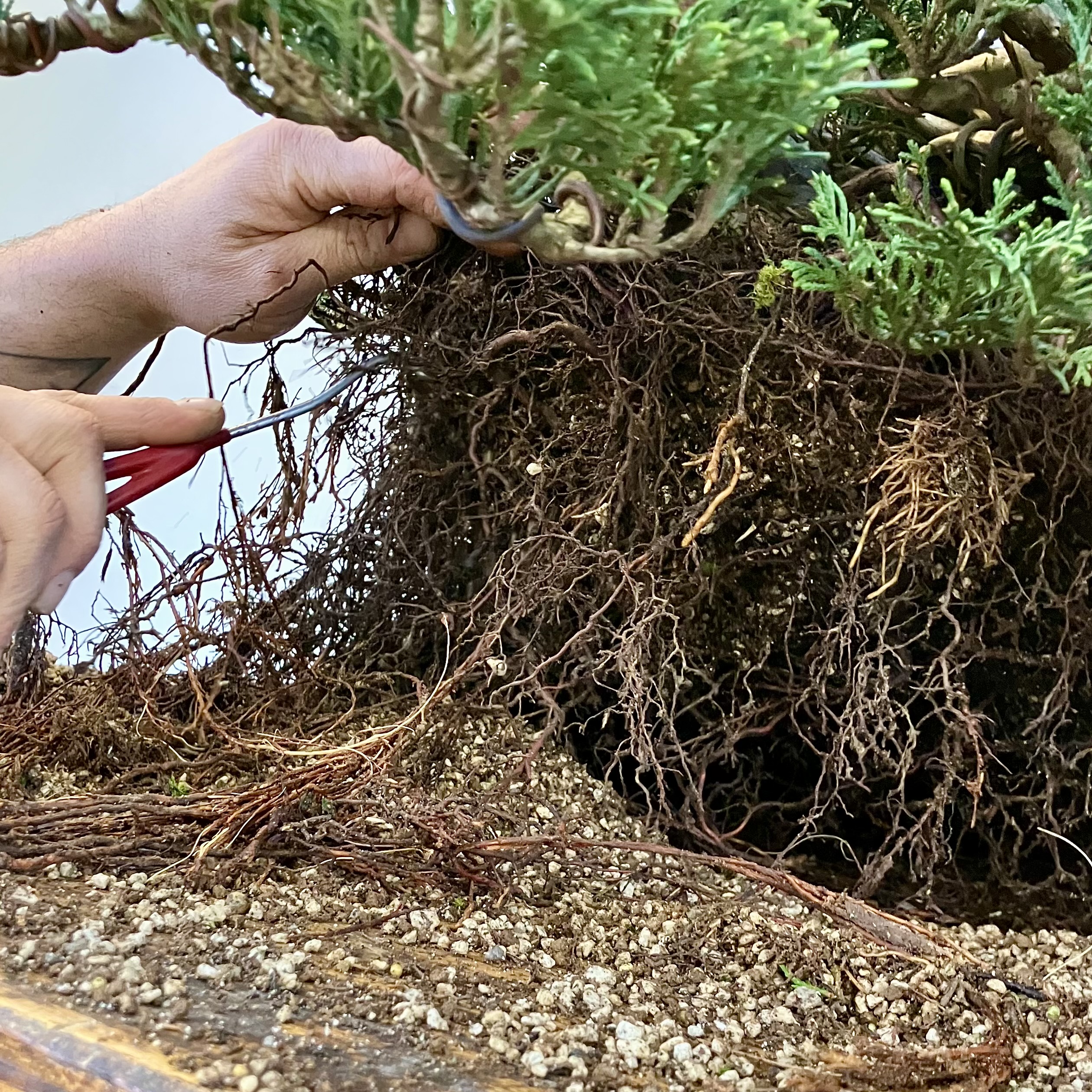
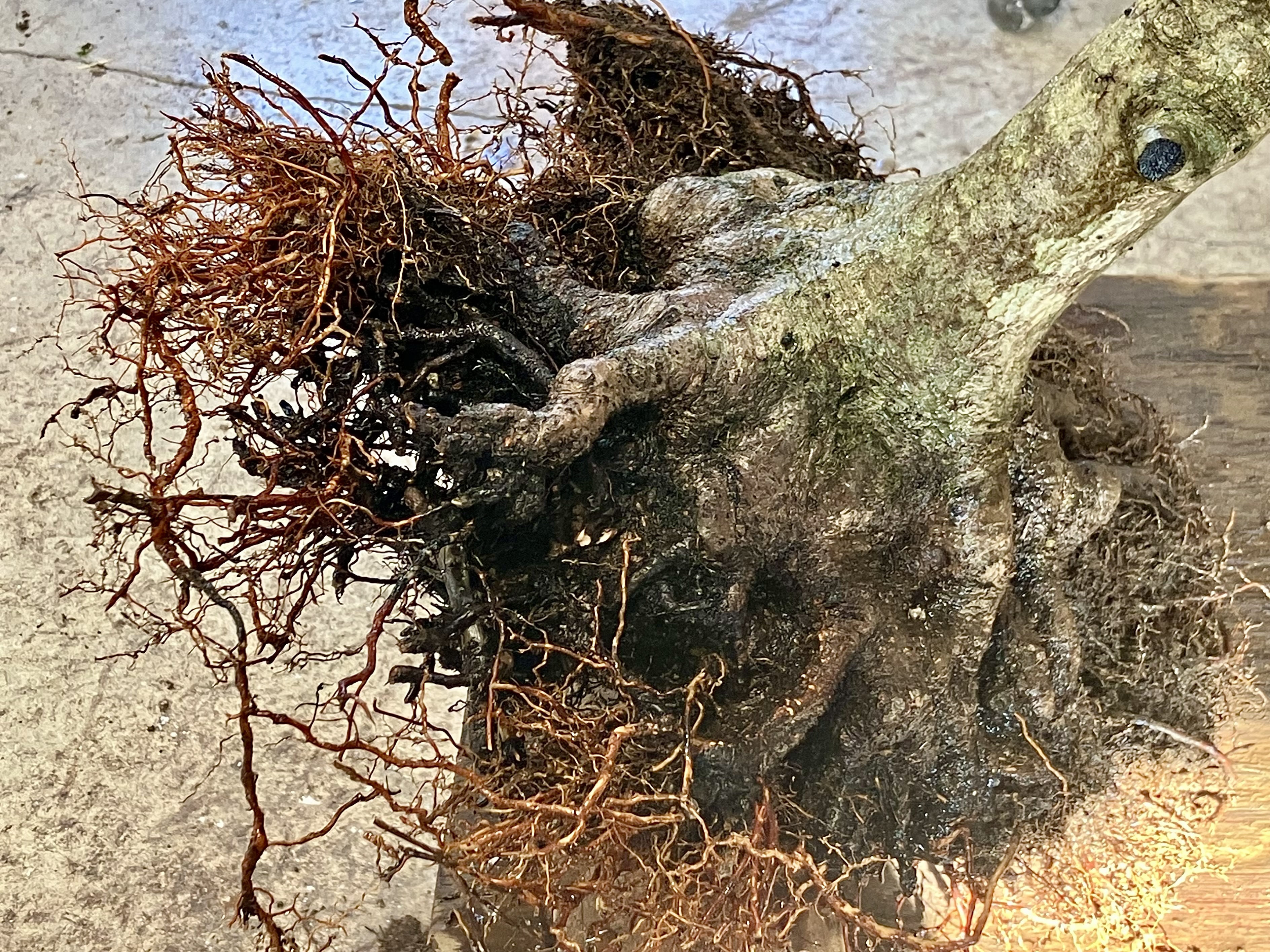
A Japanese Beech with an unfortunate root system. Chunks of roots have died, identified by being black, unlike the living ones, which are light brown. Spraying with water helps see which is which. Then cut away the black areas until you see healthy tissue.
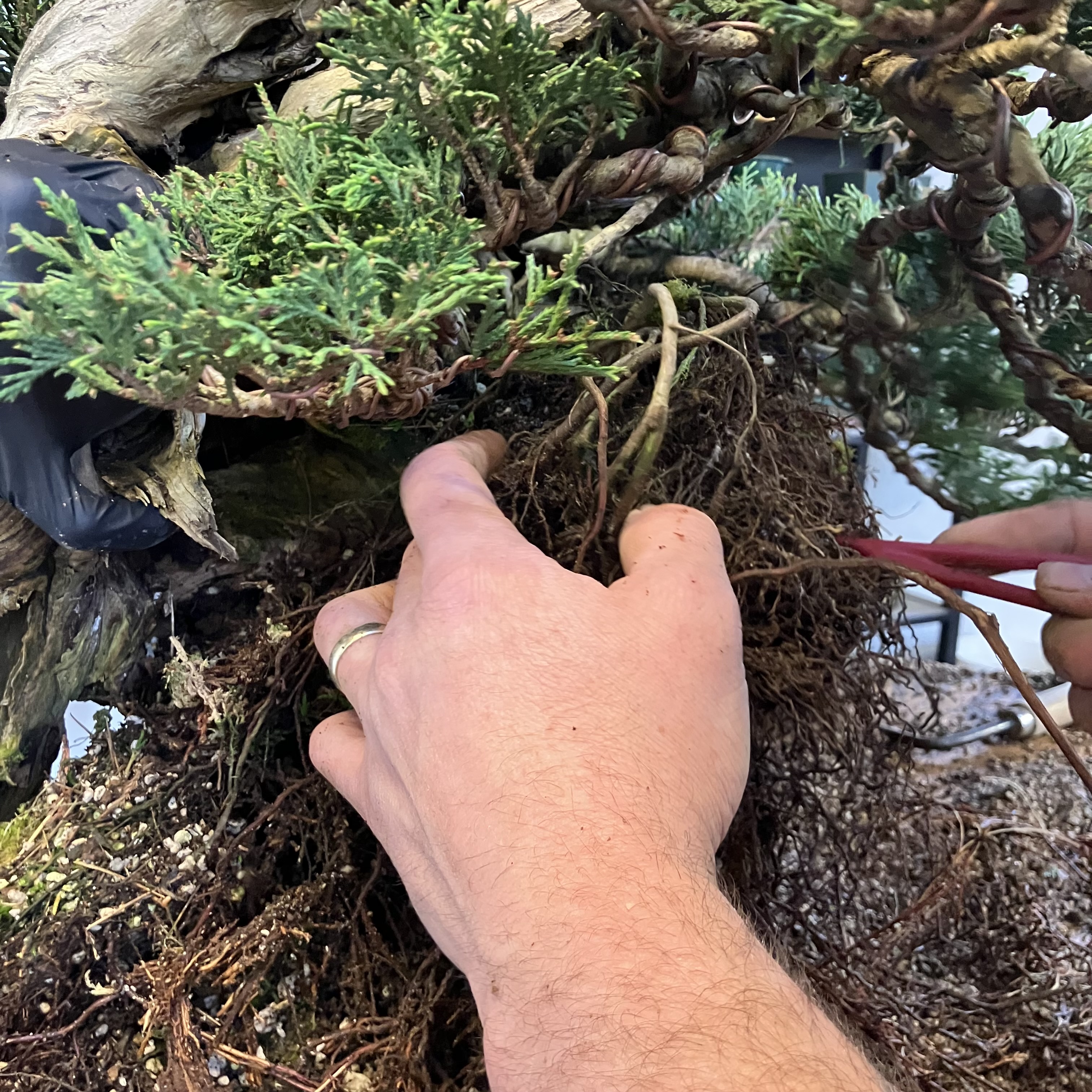
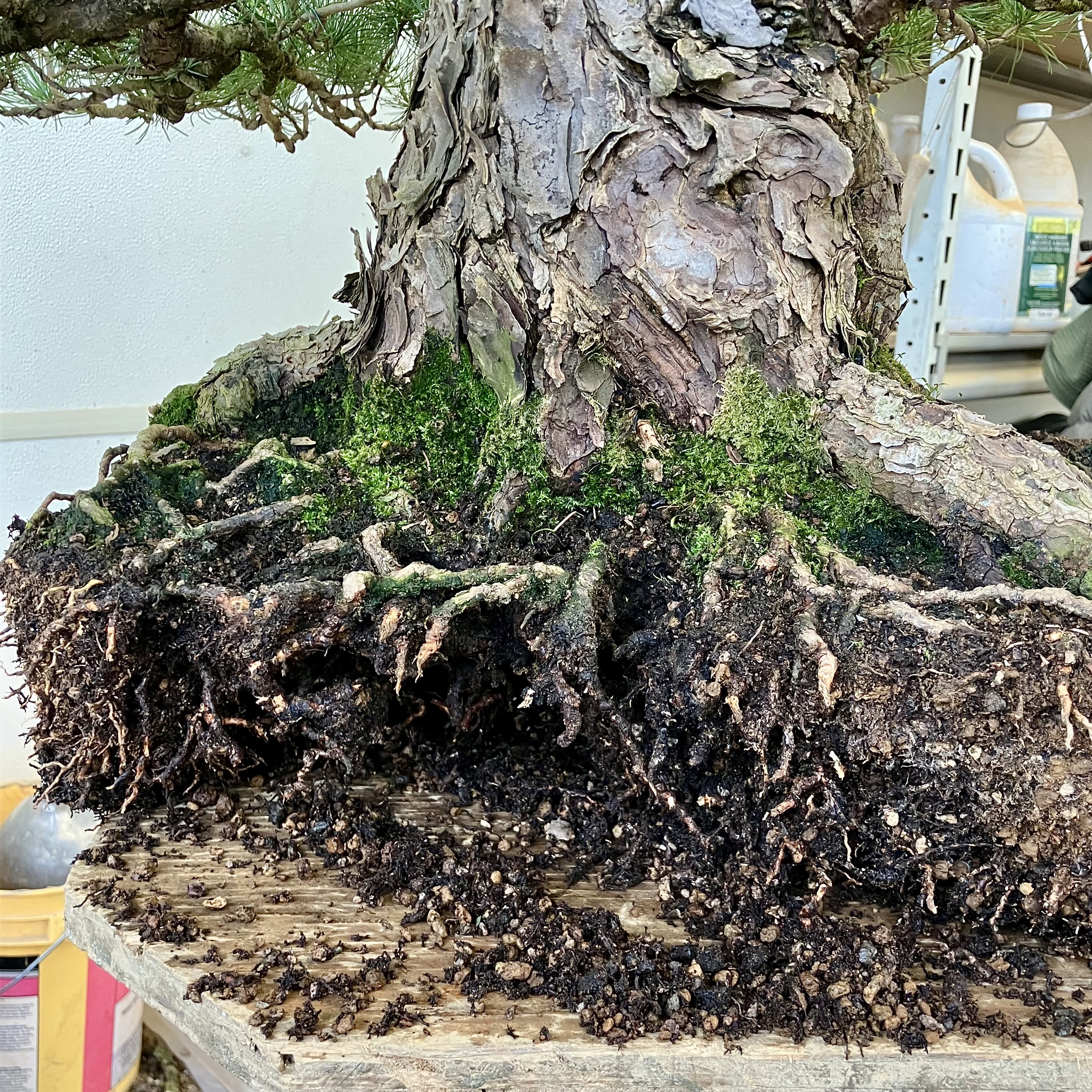
Here is a Japanese White Pine with a similar issue. One possible reason for a pocket of root death is that the tree dried out completely, causing root death in areas, then was watered as usual, and then rot sets in. Correction is the same as with the Beech. It is easy to get air pockets when removing big chunks of the root mass like this, so have large mounds of new soil wherever there is a hole under the root mass before settling the tree in, and take more time chopsticking in soil. Having a “porthole” through the nebari helps drop soil in.
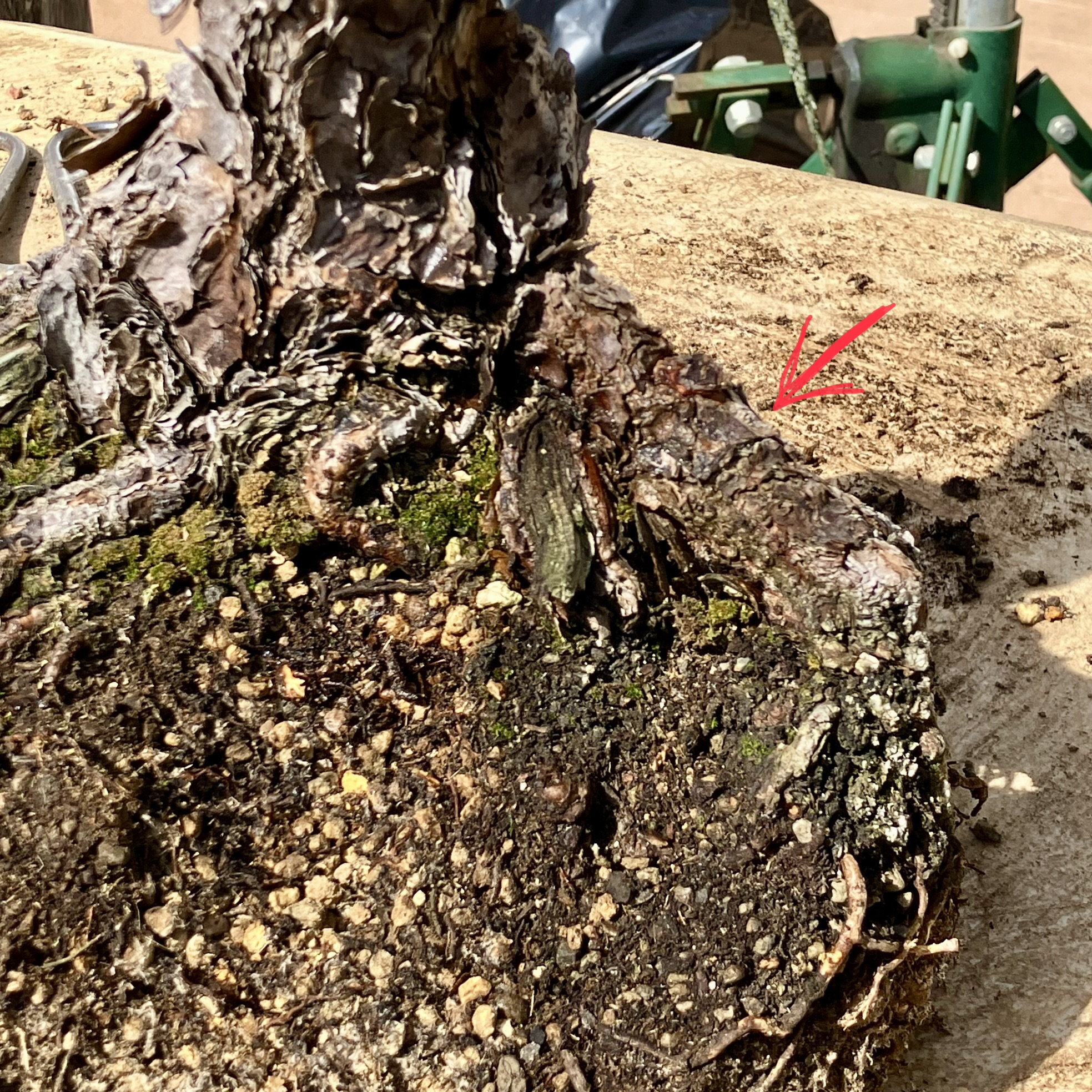
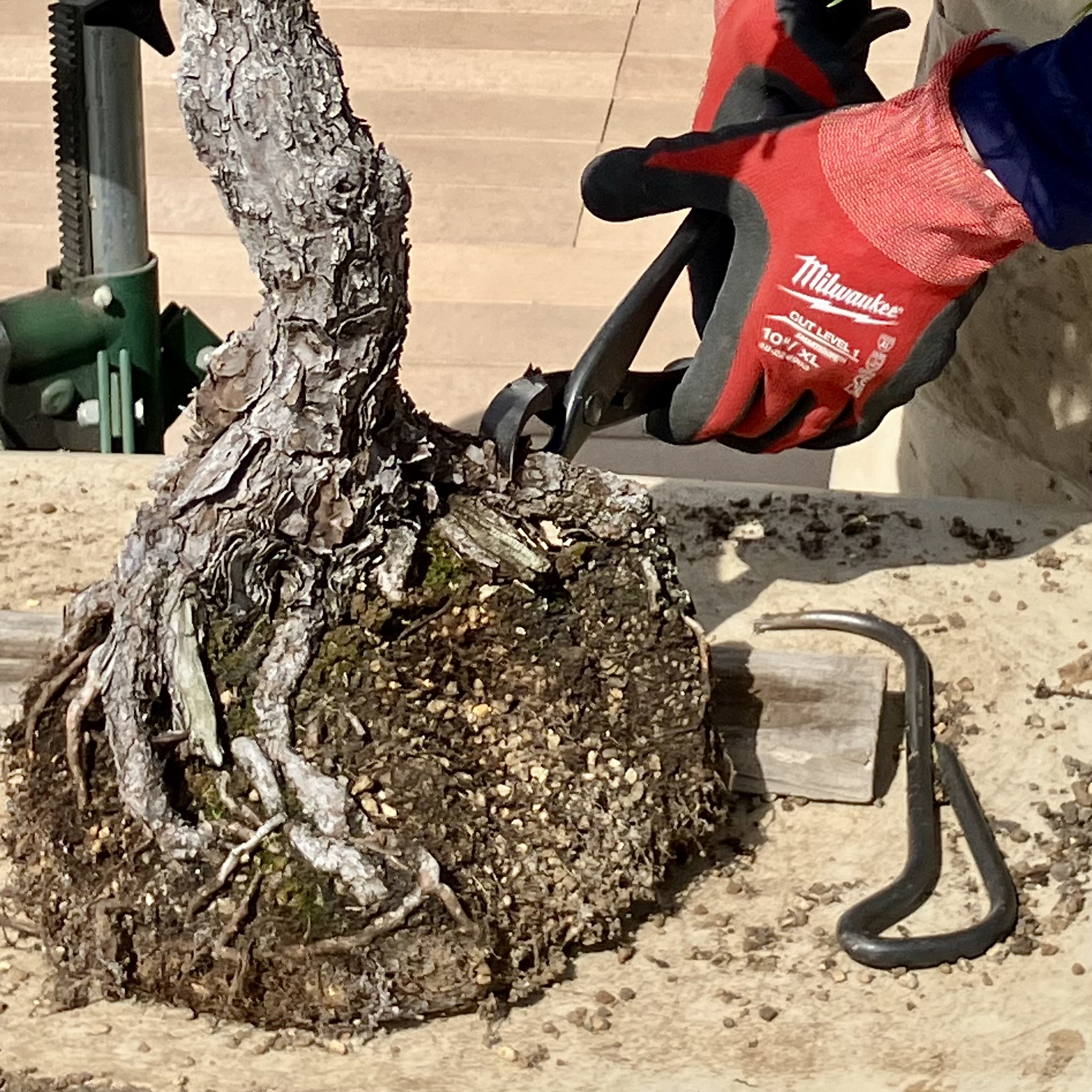
This one is an aesthetic decision—removing a high, ugly root on a Japanese Black Pine.
Cutting off the root.
Root removed, leaving one with some shari on it just below, which slopes into the soil better.
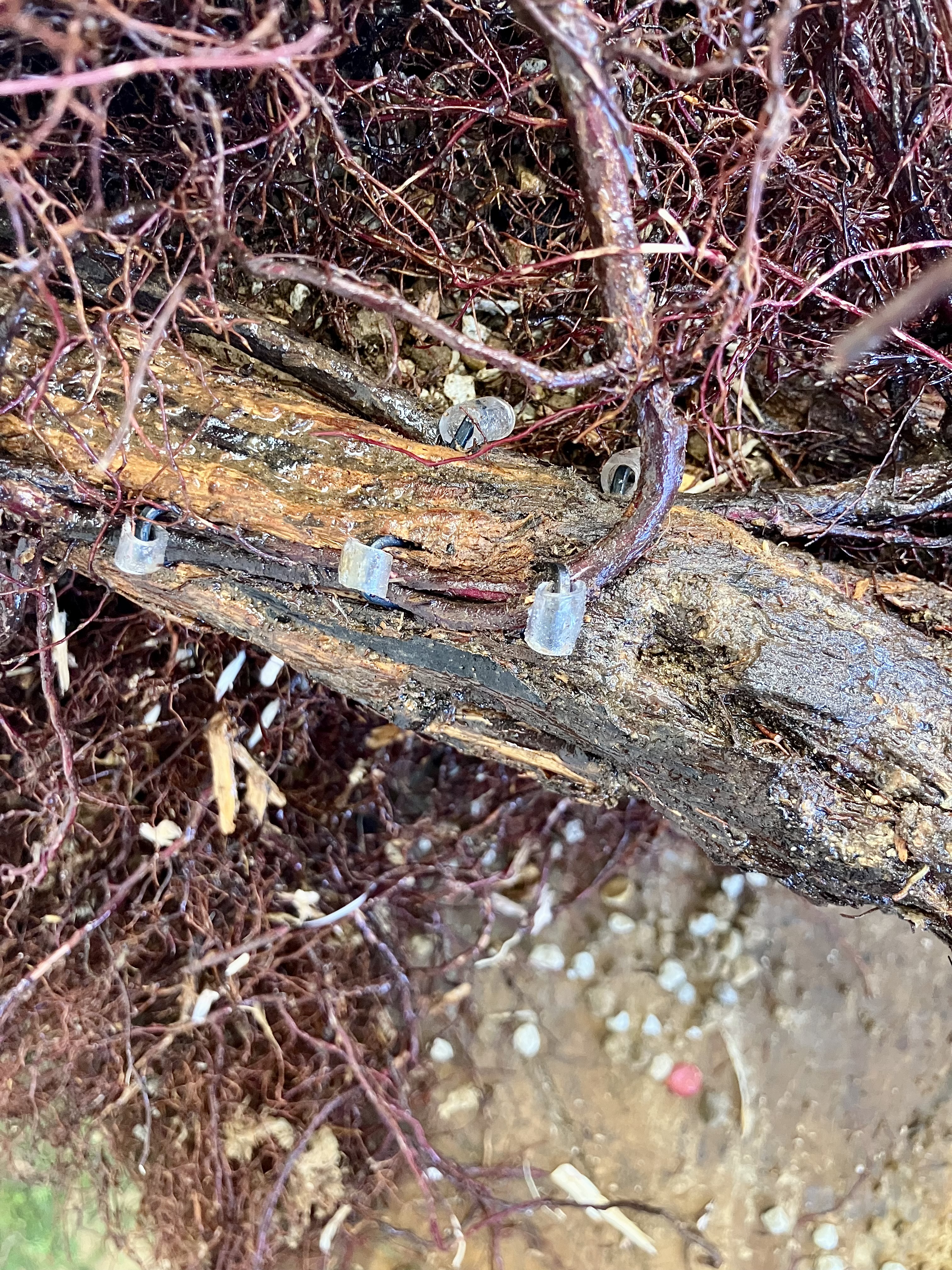
Approach grafting roots on a Rocky Mountain Juniper. This technique is not used much to get better juniper nebari, but rather to shorten an uninteresting trunk to the area it starts to get jazzy. U-pins with protective rubber hold 1/4” roots into grooves cut in the live vein.
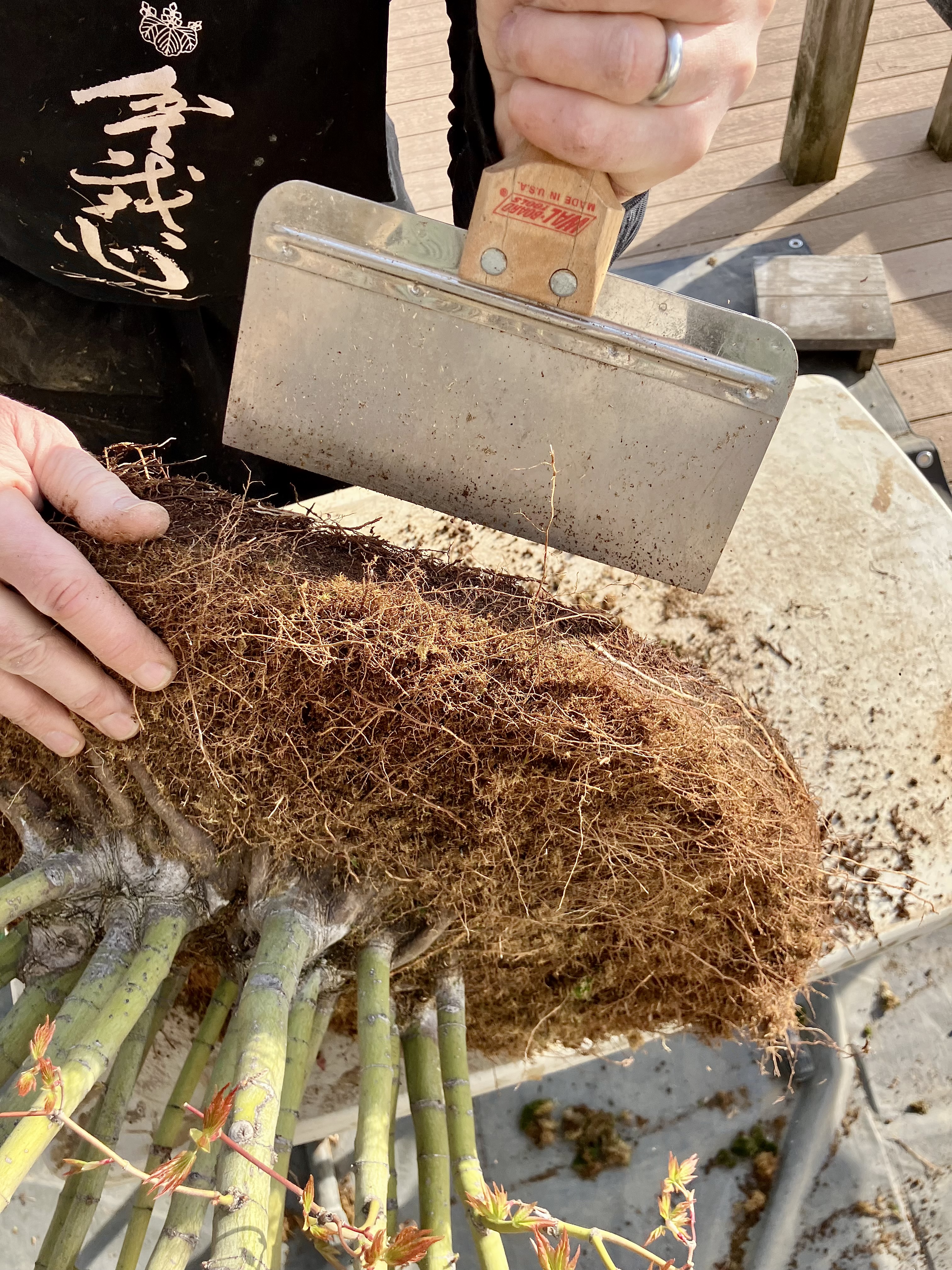
A sharp, stainless steel spatula used in a stab-it-kill-it repetitive chopping motion is handy for removing the bottom snarl of roots on trees like this Japanese Maple.
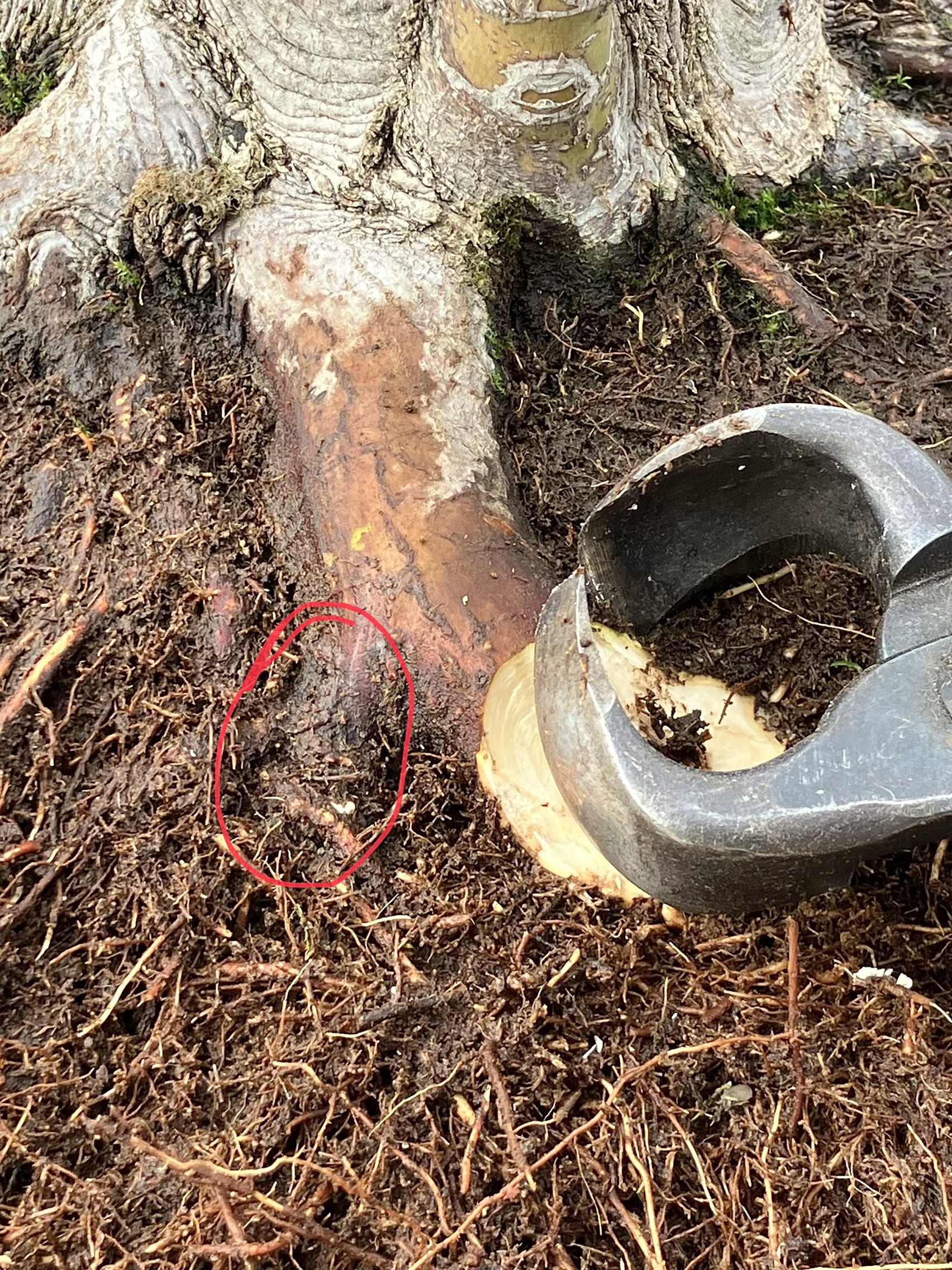
An over-large and over-long surface root on a Japanese Maple is shortened. Red circle indicates a side root of some size that will take over.
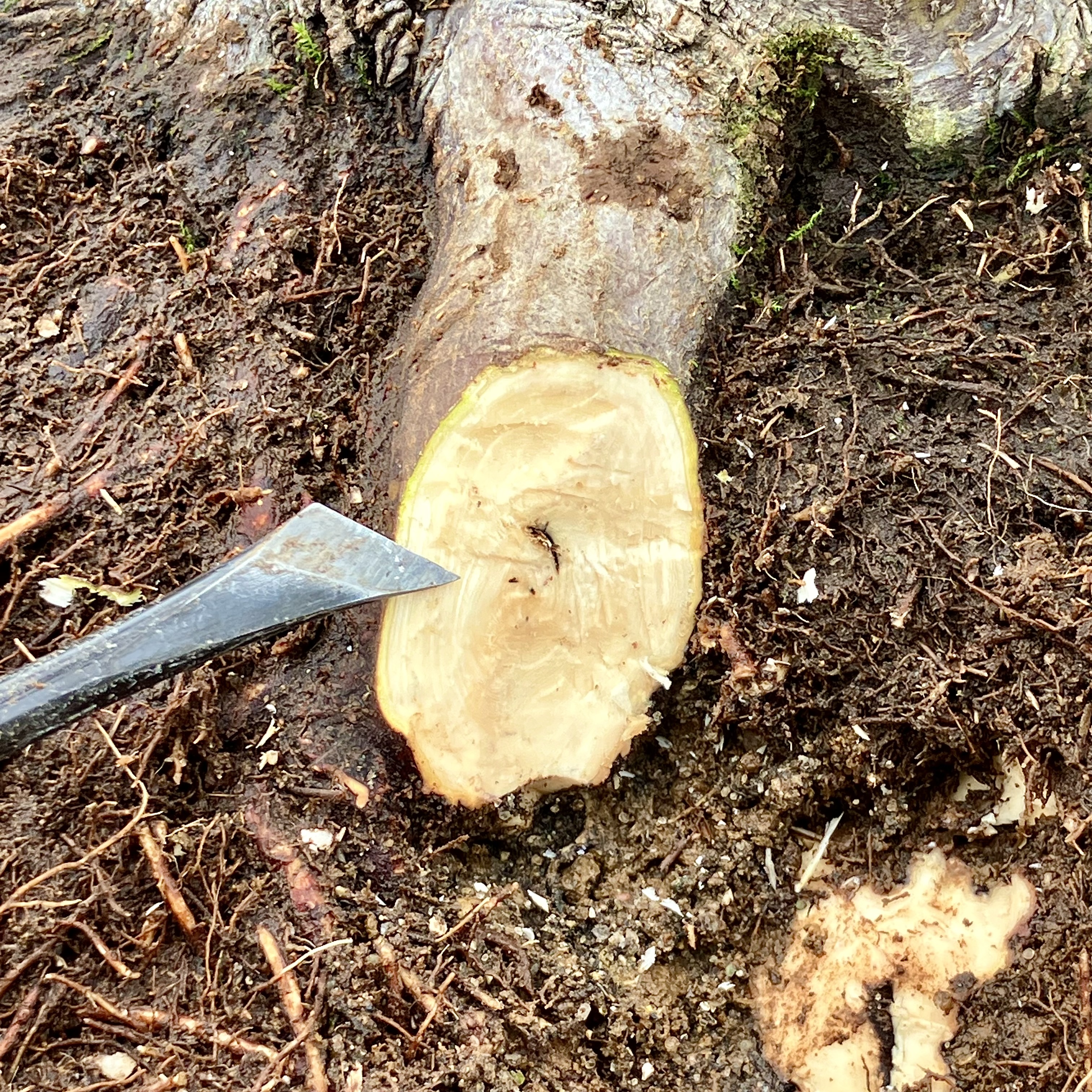
After whittling back with a ball cutter, the wound is smoothed with a chisel. Good idea to sterilize and seal wounds on Japanese Maple due to some of the diseases that can enter wounds on this species.
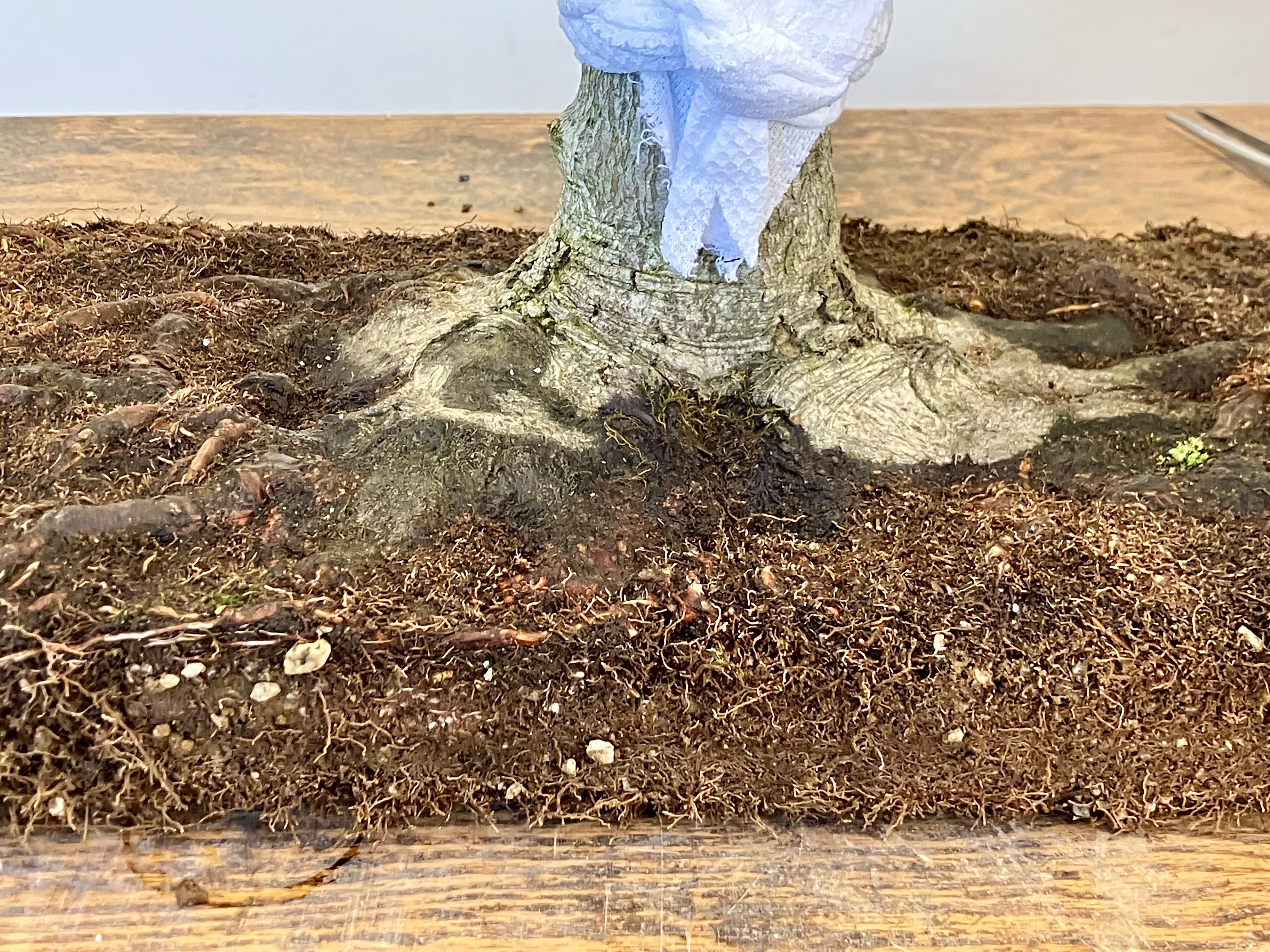
A Red Maple that came out of a narrow, rectangular pot. The nebari of this tree has been squoozed on the front and back and needed more room. White cloth is to keep the trunk clean while grabbing.
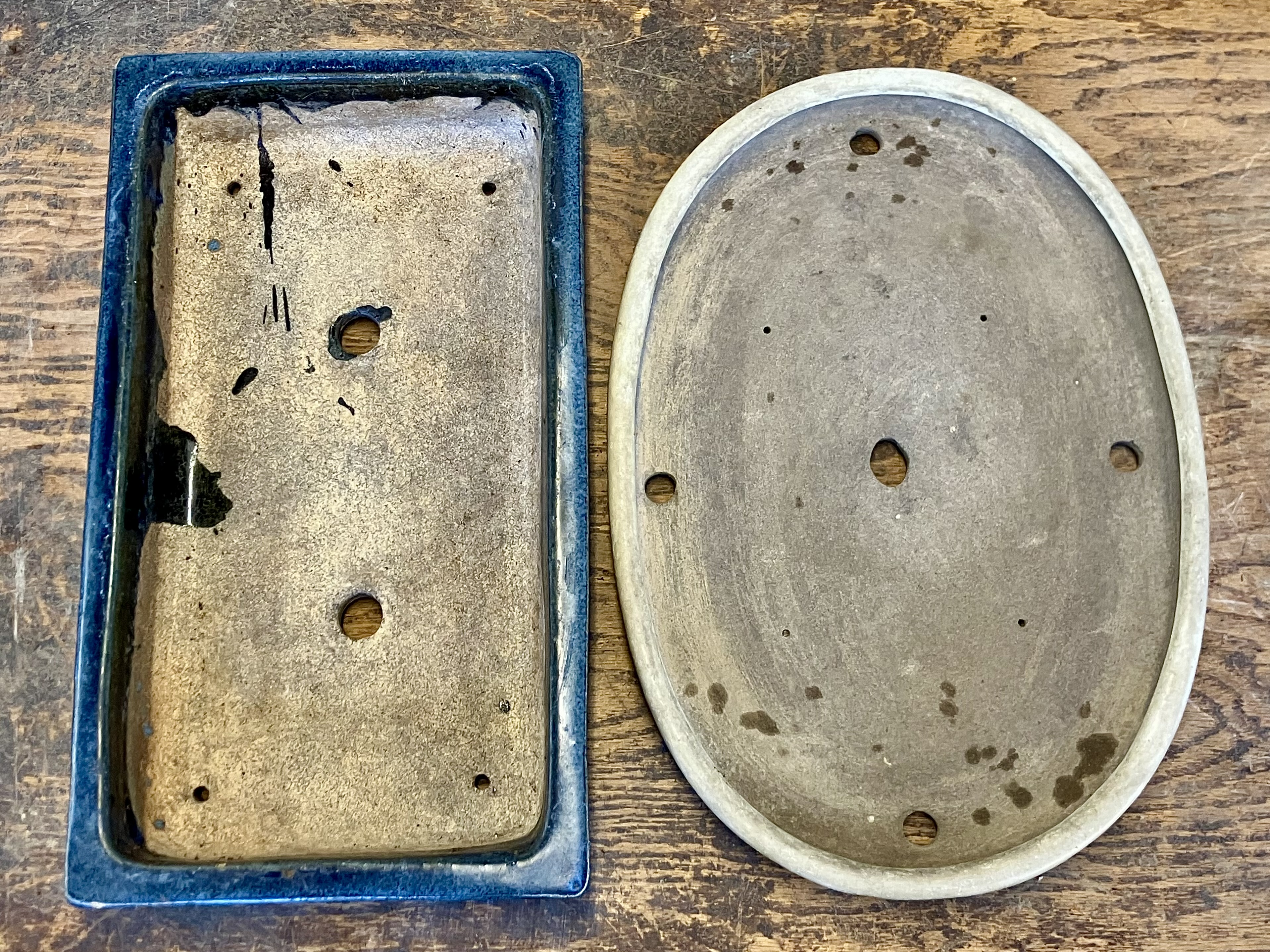
On the left, the pot the Maple came out of. On the right, the one it might go into.
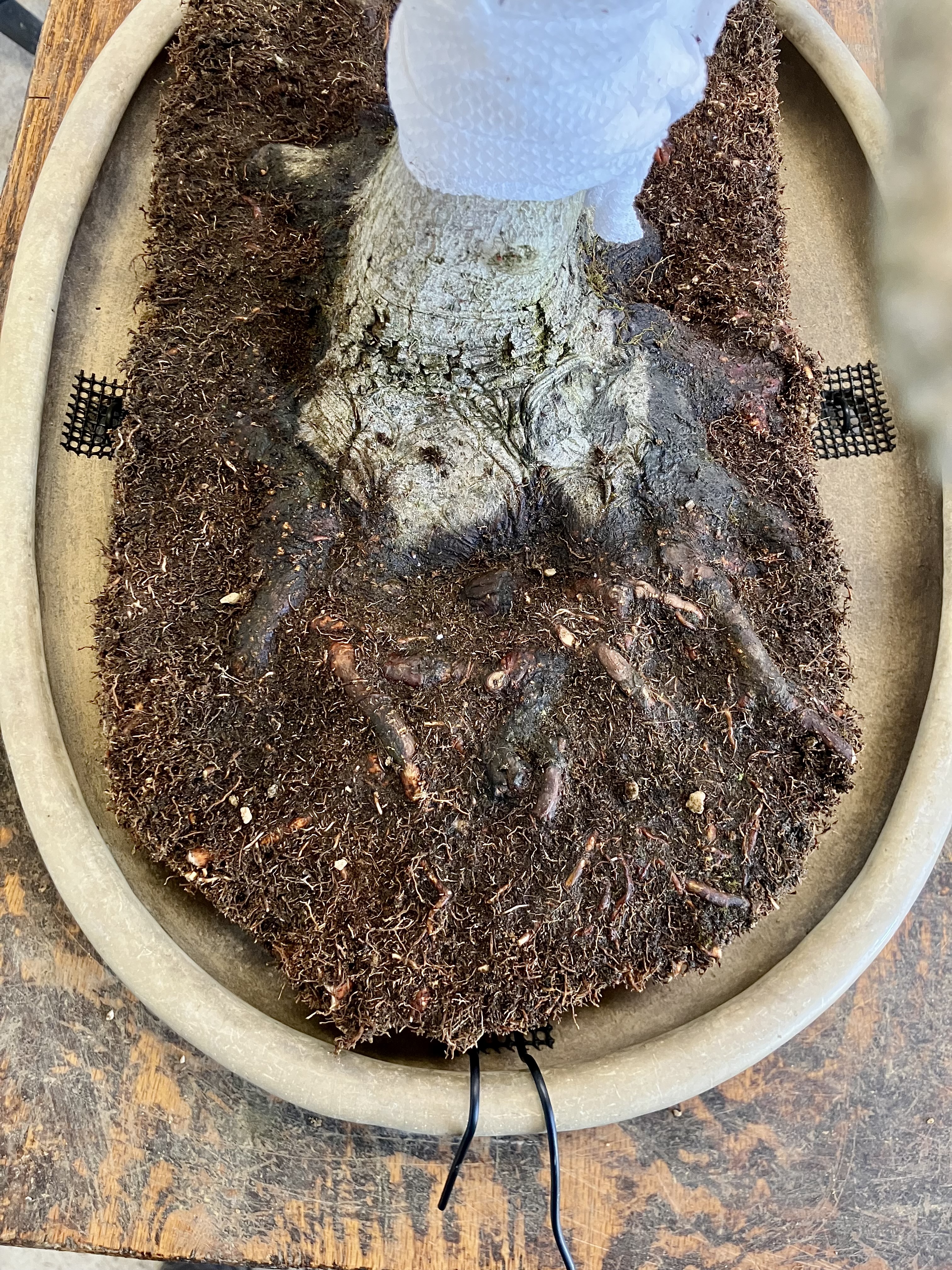
In this pot there is more room for the front and back roots. Another reason to choose a pot is for better root spread.
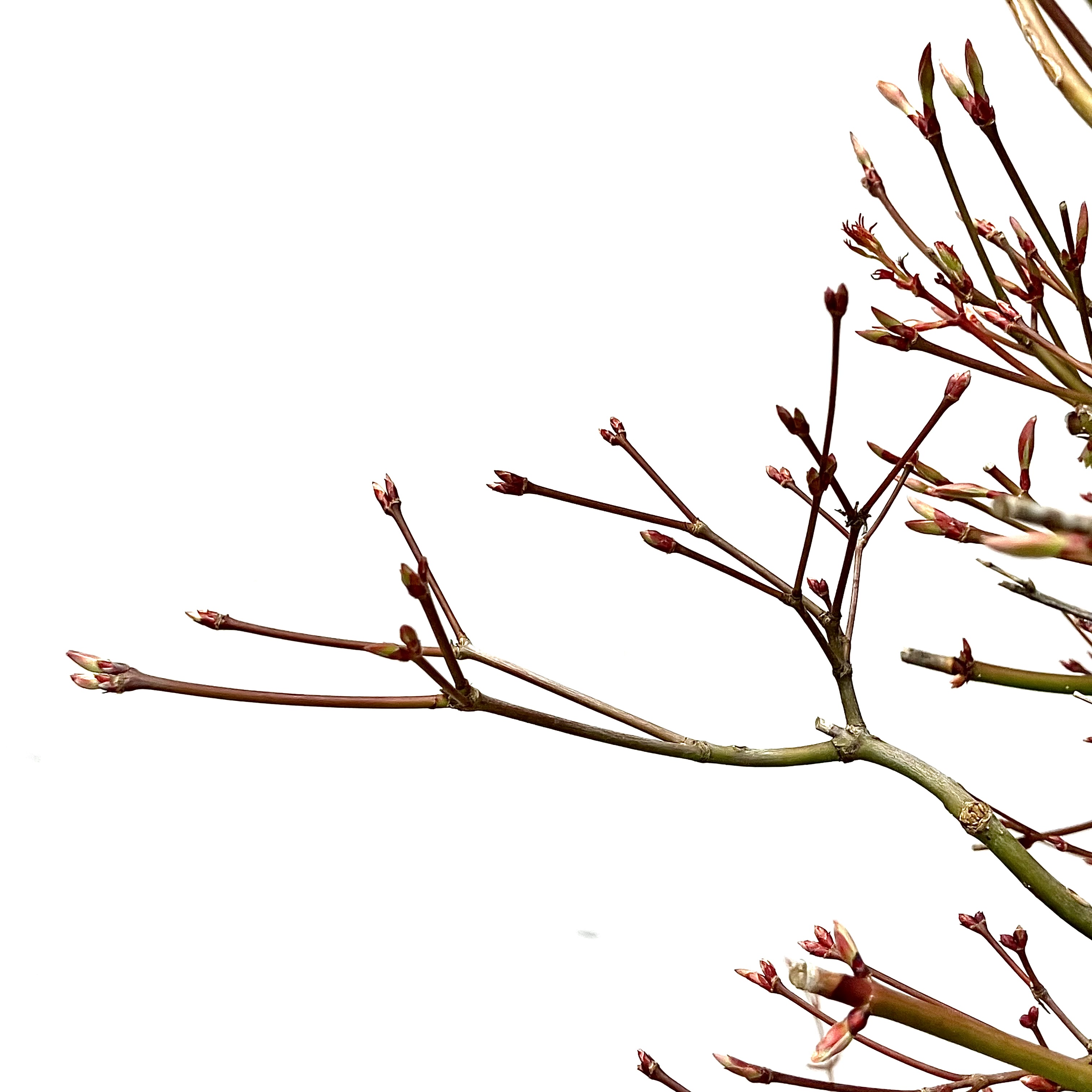
This 20-year old Japanese Maple has never been pinched. Freely grown, a maple will have a coarse shoot structure, but this early period of no pinching develops the trunk and branches and roots.
Pinching a maple when young stunts development.
This Japanese Maple might be pinched this year. The branching is past tertiary and has good structure.
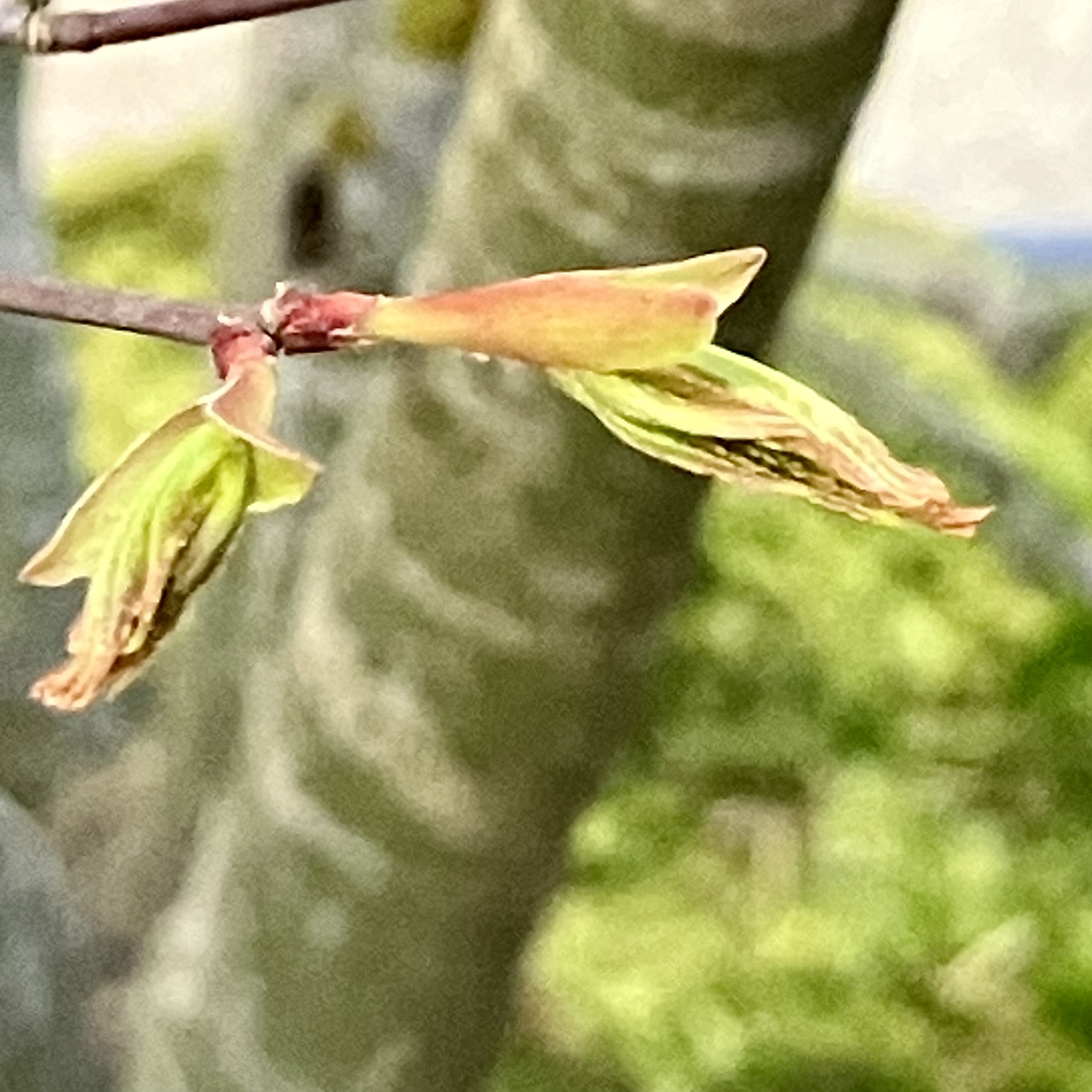
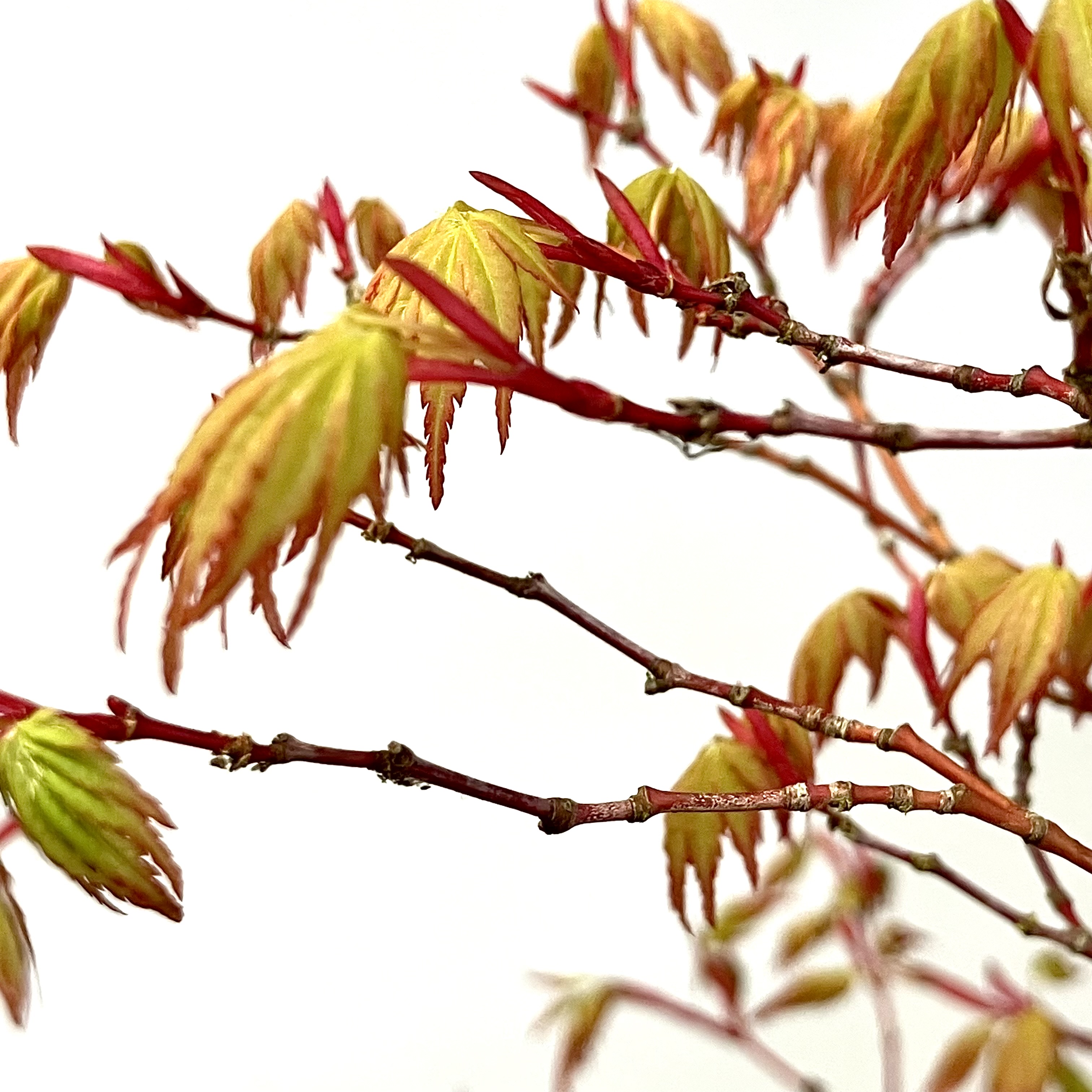
A Japanese Maple shoot about a day away from opening its first leaves.
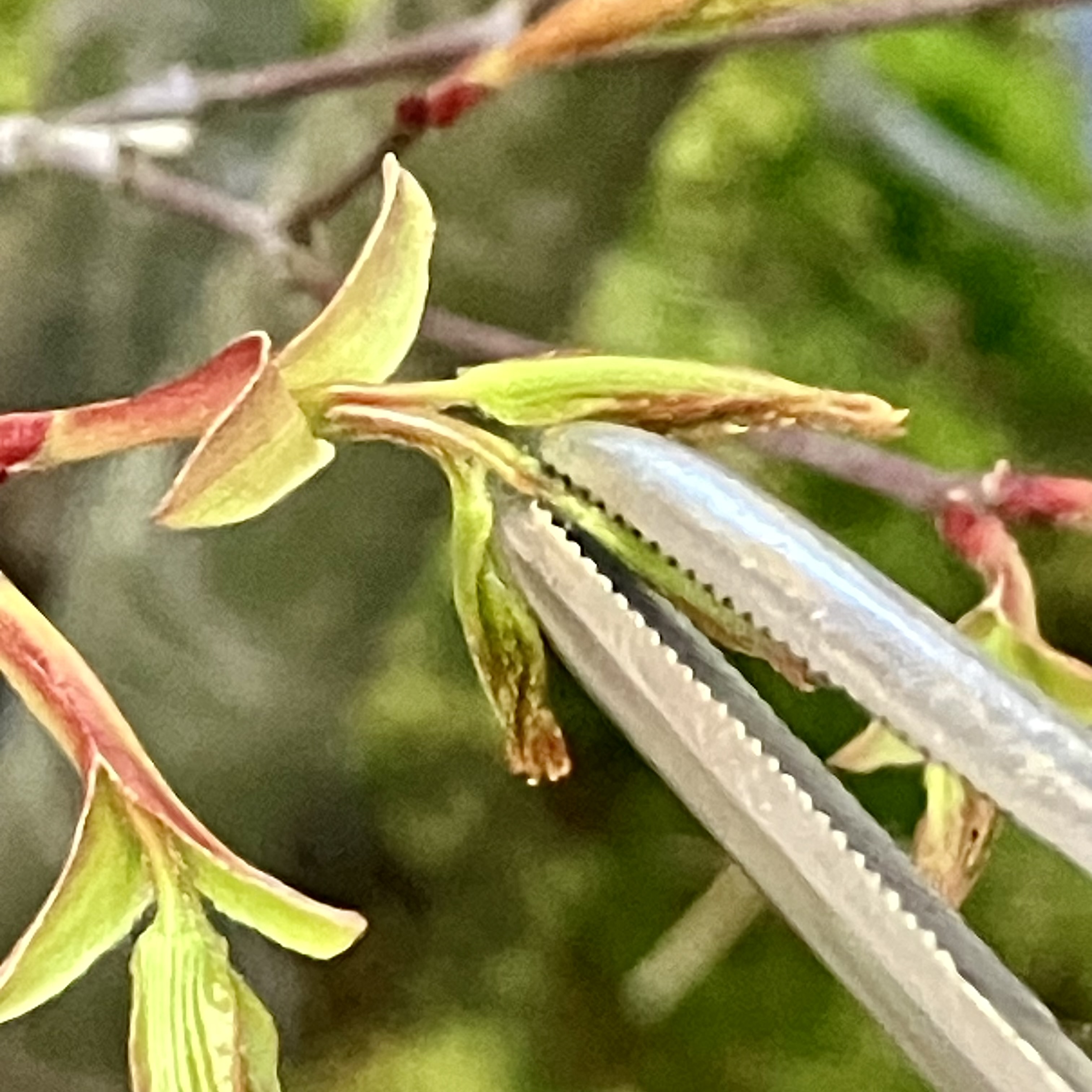
Push the first pair of leaves apart with a tweezer, grab the interior shoot, and pull off. If you catch it right here, the internode will be shorter.
This is some of the first bonsai work we do after spring repotting.
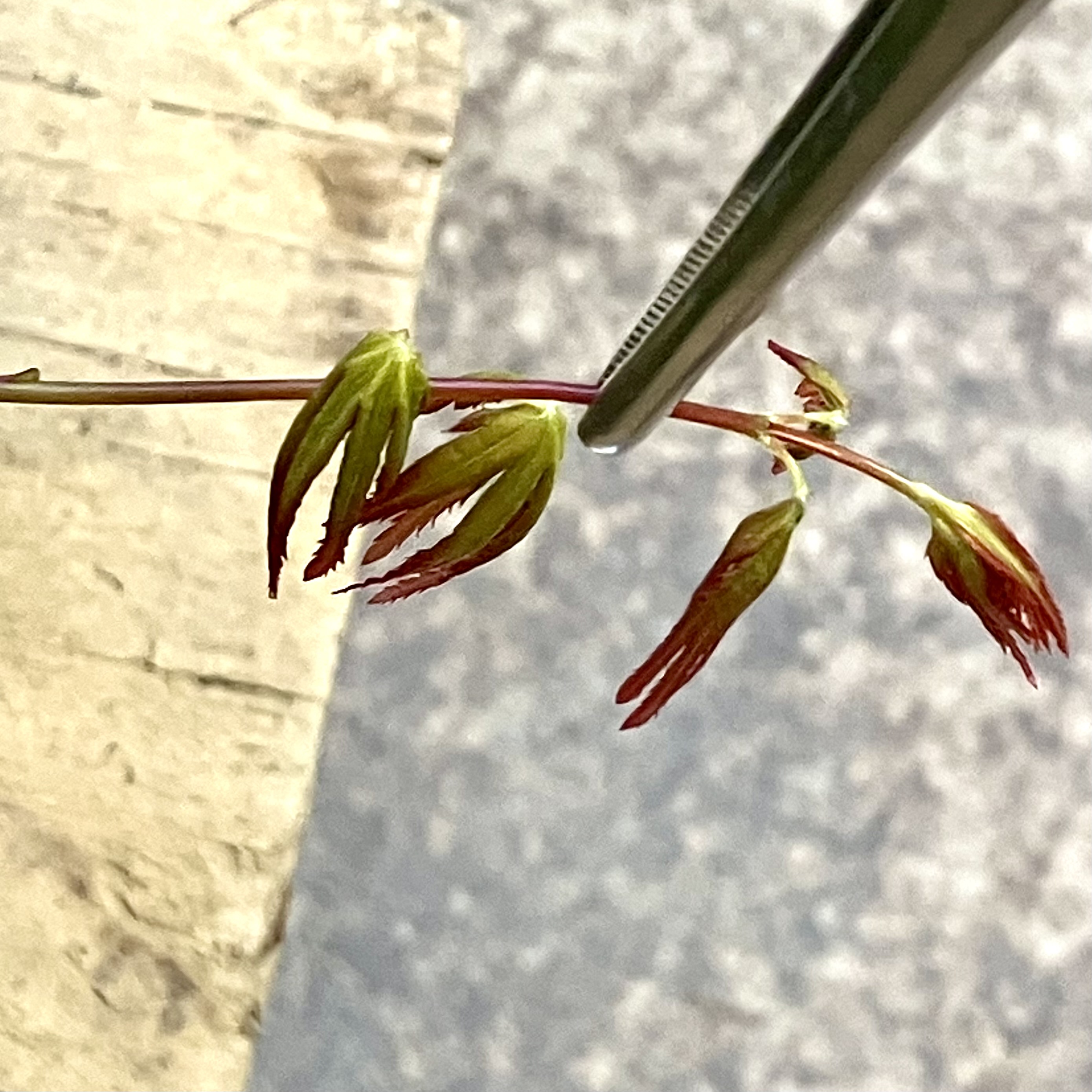
This shoot has elongated several days past ideal, though it should still be pinched to the first set of leaves. As this is a single flush plant when mature, we get one chance a year to shorten the internode.
A note of patience:
When first pinching a specimen, it will likely have a thicker twig. This translates to a couple years where even if you pinch, it will have a longer internode. Keep at it and you can get a thin twig, with a short internode. This offers the delicacy Japanese Maples are known for.
A maple following years of pinching. Notice the thin twigs and short internodes.
There is a point at which pinching goes the other way. The first pair of leaves open to no shoot inside. If that goes on, those branches may die back. No shoots elongating is our clue to fertilize more.
When should we start pinching?
Some will pot-grow their Japanese Maples 10-30 years before pinching. There are also those who prefer a stronger tree and never pinch—a possible direction for those in stressful climates for Japanese Maple: hot and dry with little winter cold. This is likely to stress them and leaving longer shoots may be best.
In some situations pinching is useful to rein in this coltish species, especially for small specimens like shohin.
Many find Japanese Maple a tough, forgiving plant. Pinching is maybe best thought of as optional, and applied dependent on goals.
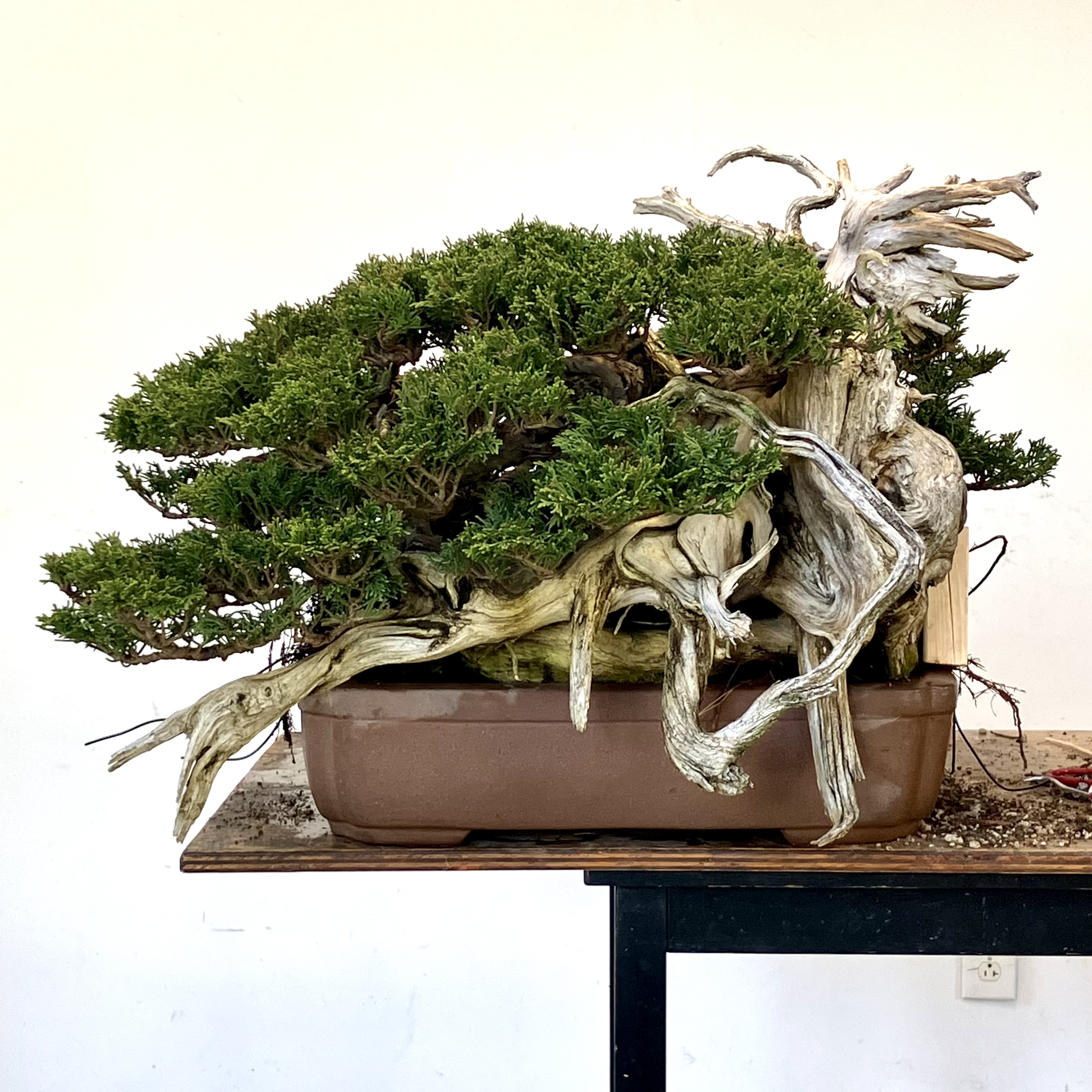
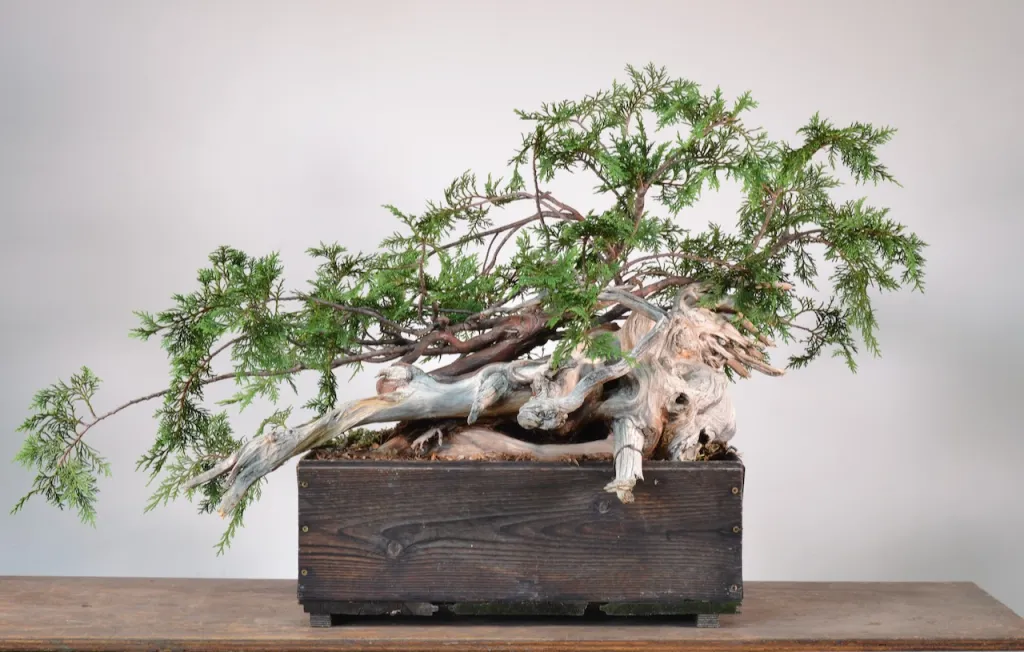
This collected Yellow Cedar, Callitropsis nootkatensis, came from Vancouver Island, BC. We designed it six years ago, and in the following photo essay we transfer it from a box to a pot, and adjust the branches.
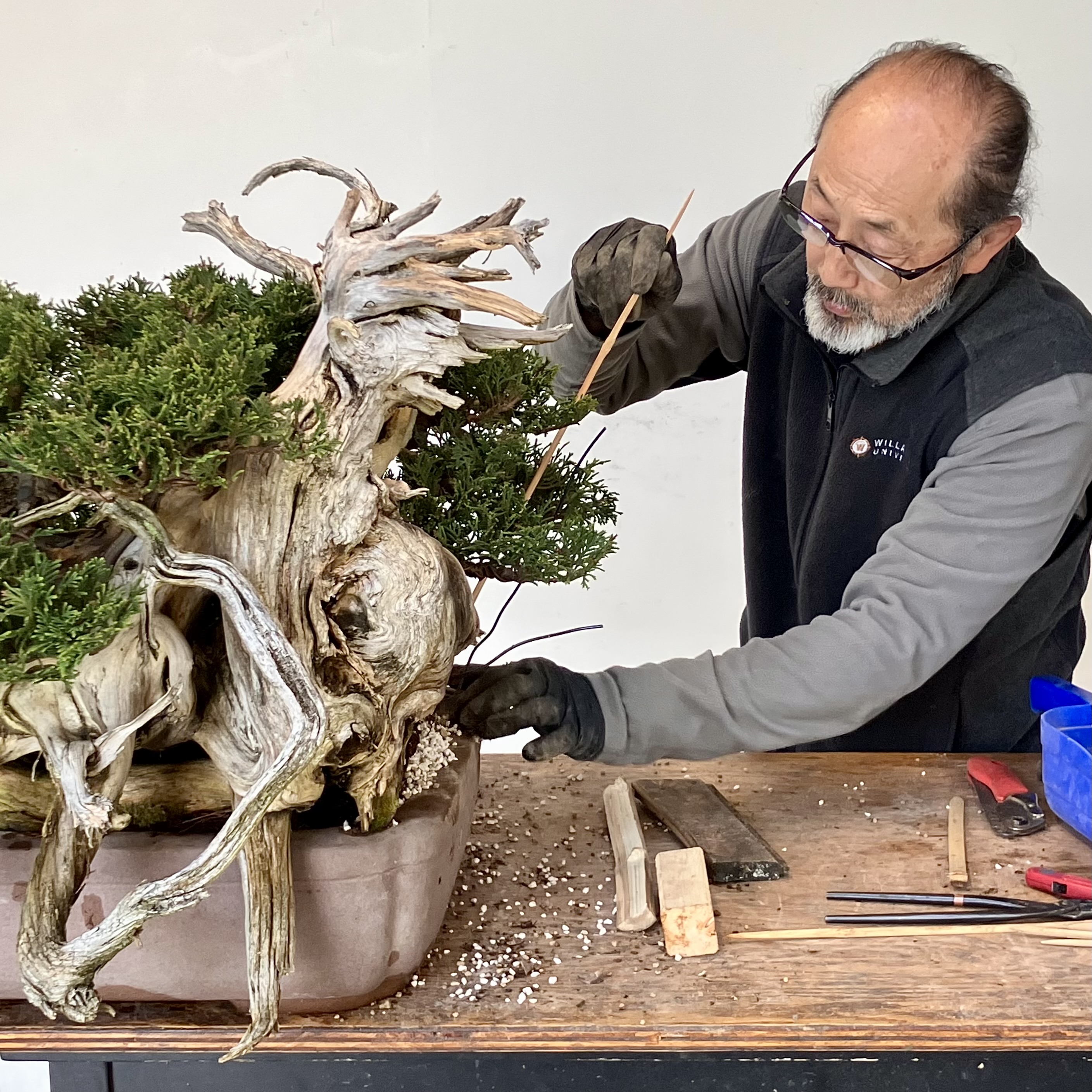
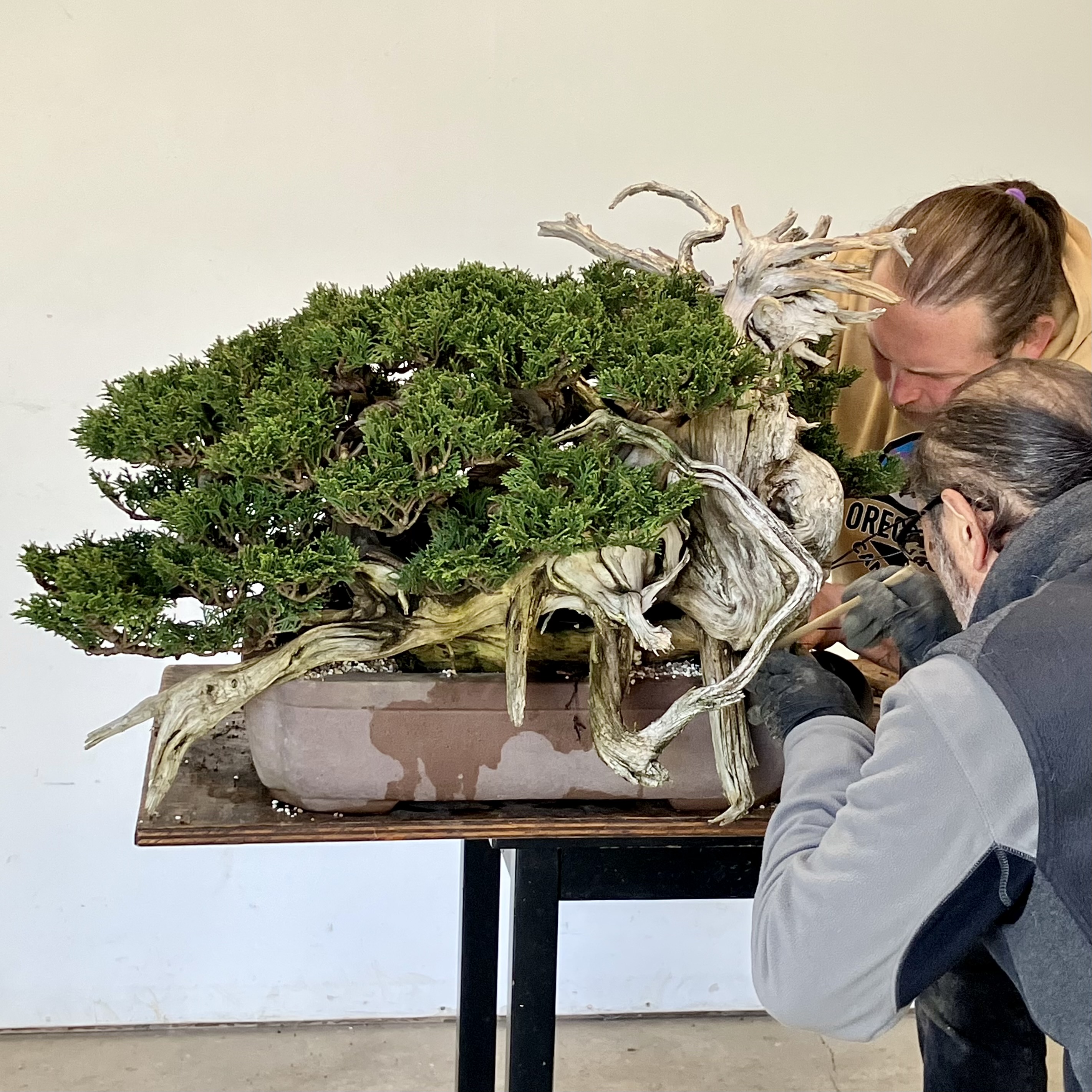
Patch and Masaki removed the Yellow Cedar from the box and began exploring the root mass. We hoped it might fit in a pot we had, but didn’t know if its large base of deadwood and living tissue would allow that. We went slow and with a backup plan.
A root hook assisted bringing in the sides.
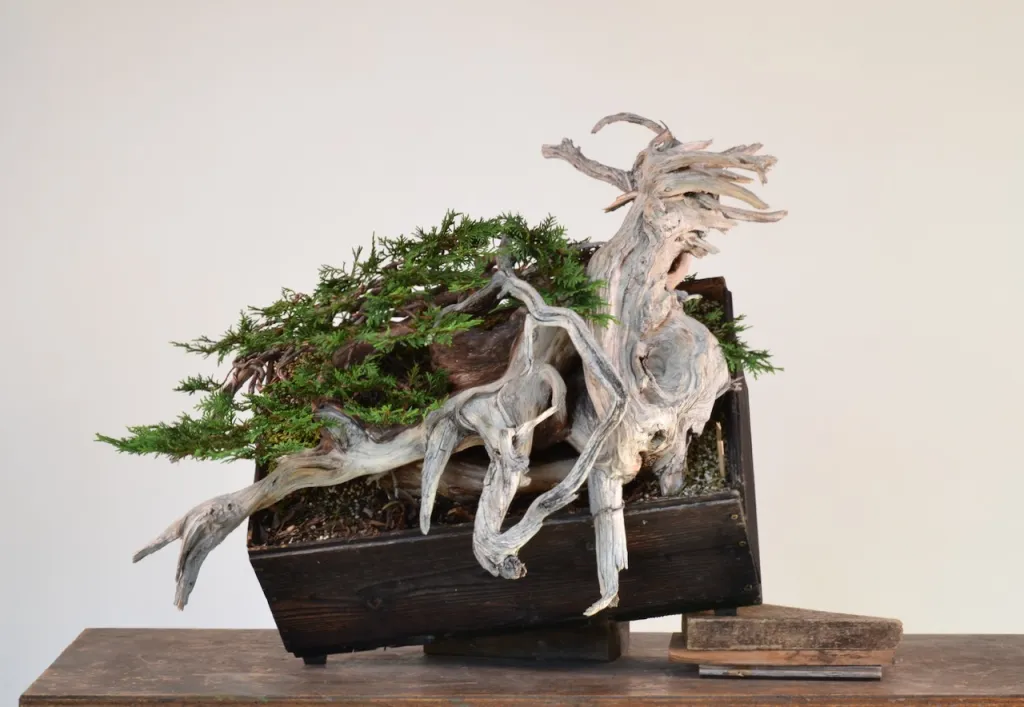
One of the challenges with this specimen was the inclination forward to present the front. At about a 75 degree tip, a large portion of the rear root ball would become a high root sail. Patch works away at that back area to lower it.
The rough set to check fit. A block of 2×2 to the right temporarily braces against the deadwood for this strong forward tip.
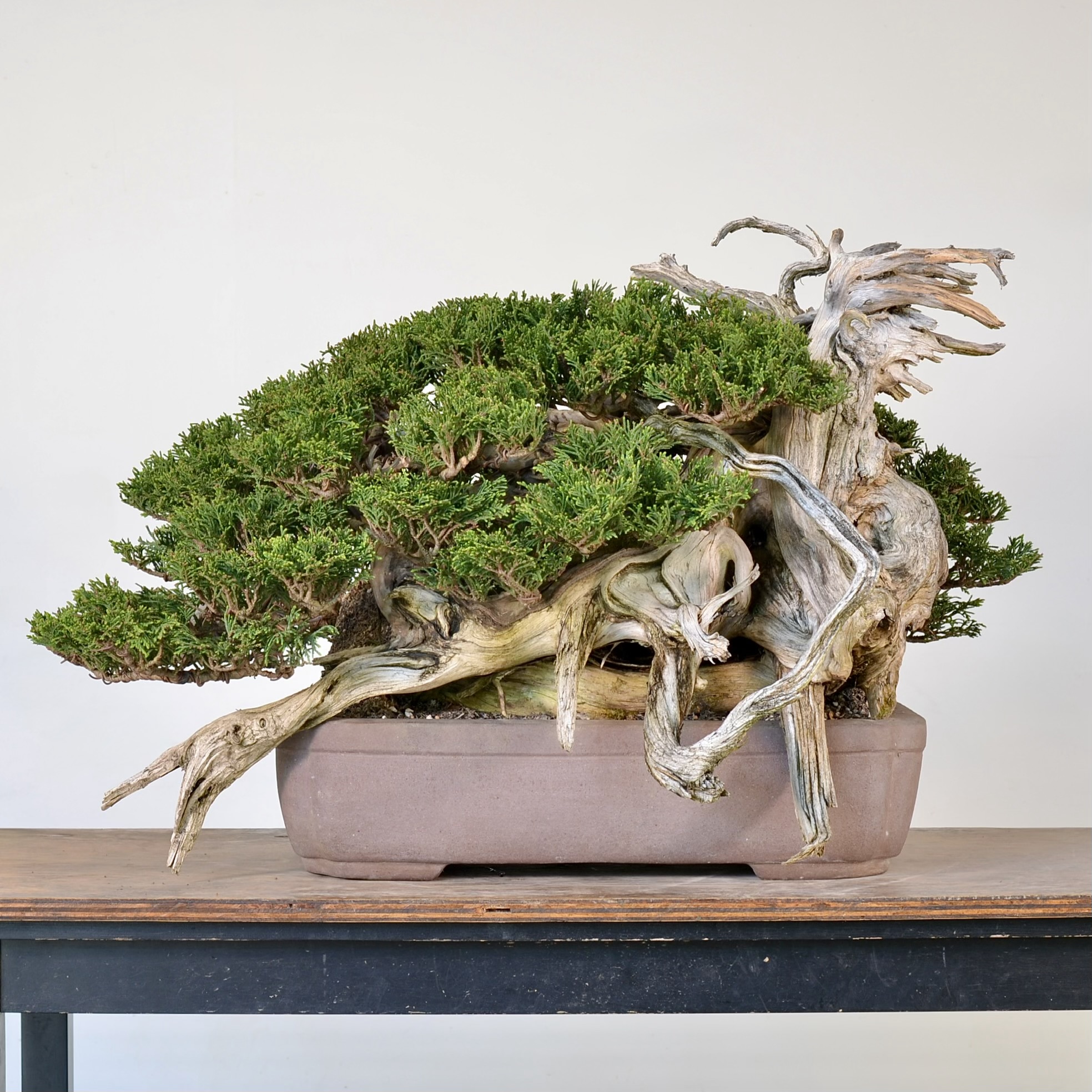
For a while I considered a slab for this one, but worried the hanging deadwood in front would make that presentation problematic—at least, without a tall mound. Luckily the pot we had slipped around the low, long deadwood like a shoe around a foot, and over which the frontal jin had enough height to hang.
Masaki works a very long chopstick, which helps protect the foliage as he does his sewing action. Note that he’s flipped it point side up—not a textbook move—but in areas where you are sure there are no fine roots, the blunt end can help push soil underneath areas and into holes. With tighter root masses, with more fine root, or with moist soil, it is better to use the sharp end.
Like any tool, having the right one defines the game—it helps to have long chopsticks, short ones, thick ones, and skinny ones on hand. Timber bamboo with its many dimensions of length and thickness is used to make these. A great way to play with an hour.
Already the foliage has a cupped finger-like presentation, not unlike old needle juniper or hinoki bonsai, though we’ve only pinched this tree for six years. Unlike junipers, Yellow Cedar can be pinched without weakening the plant.
As it looks in early April 2026, after touching up branch placement. Interesting species for its quick foliage density achieved through 2x a year pinching.
For a brief look at what we started with…
Here is the raw tree in a box in 2020. Anton Nijhuis collected the specimen in British Columbia and said it had been sitting in his garden a few years and no one wanted it. Yellow Cedar is a newish species for bonsai—certainly new to me at the time—so I took it.
This is after the styling session in 2020. The wild snags of deadwood on this side (there’s none on the other) made for a simple front choice. We left the tree at this rakish inclination for six years while pinching it, and, distracted by other projects, finally got to potting it this spring.
A note on the species name. Yellow Cedar is a curiosity, including, apparently, to taxonomists. Since 1824 the genus has bobbled back and forth between Cupressus and Chamaecyparis. At the time this tree was styled, in 2020, Cupressus nootkatensis was its name, considered a cypress. Now it goes by Callitropsis nootkatensis.
April 2026 Bulletin Board:
Some big news! Mr. Shinji Suzuki is coming to the Portland Art Museum on Sunday, July 19. He’ll also be presenting that week at our local bonsai group, the Bonsai Society Of Portland, and I’ll share more as plans firm up. Here’s some deets for the museum event: The Way of Bonsai
I wanted to announce the restructuring of my LA based classes and to discuss the merits of an intensive based learning structure. Since returning from Japan in 2020 and starting my bonsai business in 2022, I’ve worked with and have taught thousands of individuals. Working on a deep breadth of material has continually expanded and refined my bonsai ability, and I’ve also gained great insight and deep understanding on how people learn and improve.
Bonsai is really unique as both an art and craft. On the surface, there can be obvious aesthetic appeal. You have a plant with interesting colors and textures that can have aesthetically clean shapes or dramatic forms. It’s miniaturized–there is a sense of intimacy and engagement that’s similar to standing next to a giant tree. People begin here and feel a sense of awe and excitement when working with these small trees. So naturally when practicing bonsai, the average enthusiast will start by thinking how do they want their tree to look.
As people get a bit deeper, it becomes more apparent that bonsai is a living tree. We begin to understand that there are considerations to make a tree grow healthy and strong. We start to develop a give and take relationship, where we impose less on the tree but work with it more to give a favorable response.
Eventually, we’ve played out this relationship with enough time and sincerity. Both our skills and understanding of the tree grows. From here, some of the finer subtleties of bonsai emerge and this is when trees really start to become great.
From my professional experience working with people, it’s just as much of teaching skills and techniques that I am really teaching a mindset that can produce excellence in bonsai. It is necessary to practice with clarity–we understand how a tree grows and what type of response is elicited from the work we apply. It is important to practice with honesty–we align our expectations of the result our work produces with the end goal we desire. Lastly it is important to conduct our work with sincerity–anything meaningful we accomplish requires both time and deliberation. Work that is done with respect, love, and patience will always be better than work that is done quickly, crude, and without thought. With a great mindset in clarity, honestly, and sincerity we can draw the full potential out of bonsai, which is an art form that can transpire over our lifetime.
With this in mind I will be transitioning away from the prior workshop format and will begin to offer a limited number of “intensives” in the LA area. This format will have several goals:
To enable participants to meaningfully increase their skill in bonsai
To create a passionate and serious group of peers who enable and improve each other’s work
To produce trees at the highest level, capable of being exhibited at national shows (you do not necessarily need a desire to exhibit your trees)
There are 3 levels of educational opportunity that will be provided in these intensives:
Deep bonsai theory/lecture/discussion providing holistic context on the work we do and why
Real world and practical case studies by working on all the participant’s trees
Work samples provided by trees within my private garden
This intensive format will differ from typical workshops in the following ways. First is that participants will be capped at 5 members of relative proficiency. This is to provide a deeper 1 on 1 experience that larger workshops are unable to accommodate. Second is that the workshop will be formatted to run through a full day, 8 am – 5 pm. Most workshops are truncated over <6 hour working periods which does not allow for extensive or more technical work.
Lastly, I will provide my experience to these workshops which encompass professional training in Japan and a deep breadth of experience operating as a full-time bonsai professional in the US. I have vetted and transparent work portfolio that showcases high level work from complete raw material development to refinement by Japan’s standard. I operate via very strong growing and technique principles create very robust work and teaching methodologies to be able to tackle any kind of material.
If you’re serious about bonsai and based in the LA or greater Southern California scene, then this is highest quality intensive/”workshop” type instruction available.
Currently I only have 3 slots available for 2026. More to be added depending on availability.
6/20 (topics include wiring, deciduous leaf and structural branch techniques, pine decandling and needle pulling)
8/8 (Heavy wire focus, styling for aesthetic goals vs building, temperate deciduous/broadleaf last major round)
12/12 (Fall season work, temperate species balancing, wire and styling)
Cost is $225 per person, lunch provided. Duration will run from 8 am – 5 pm. Participants to bring their own trees, but there is opportunity to assist with other trees within the group. Slots capped at 5. Please contact me at [email protected] with any questions.

 Login
Login


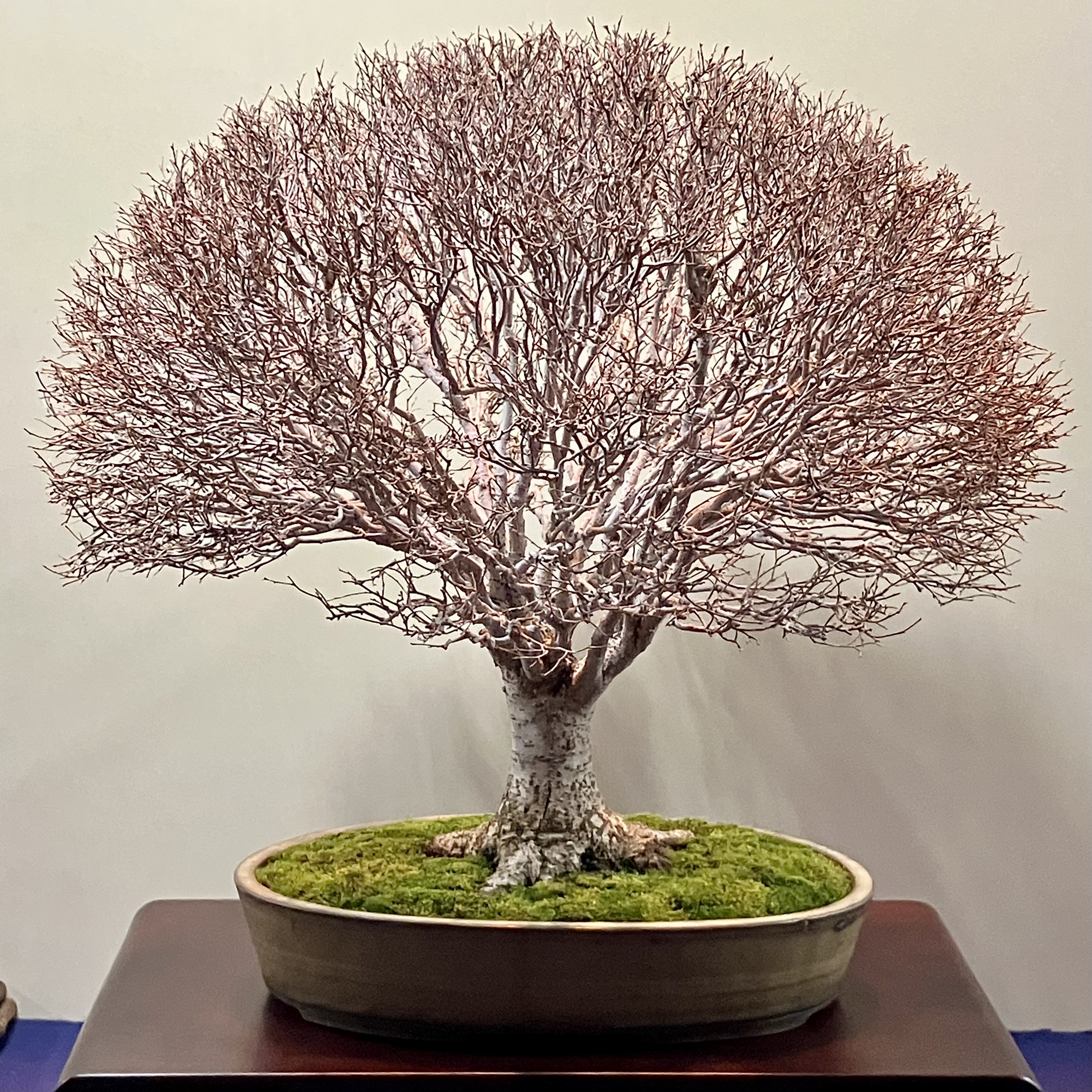
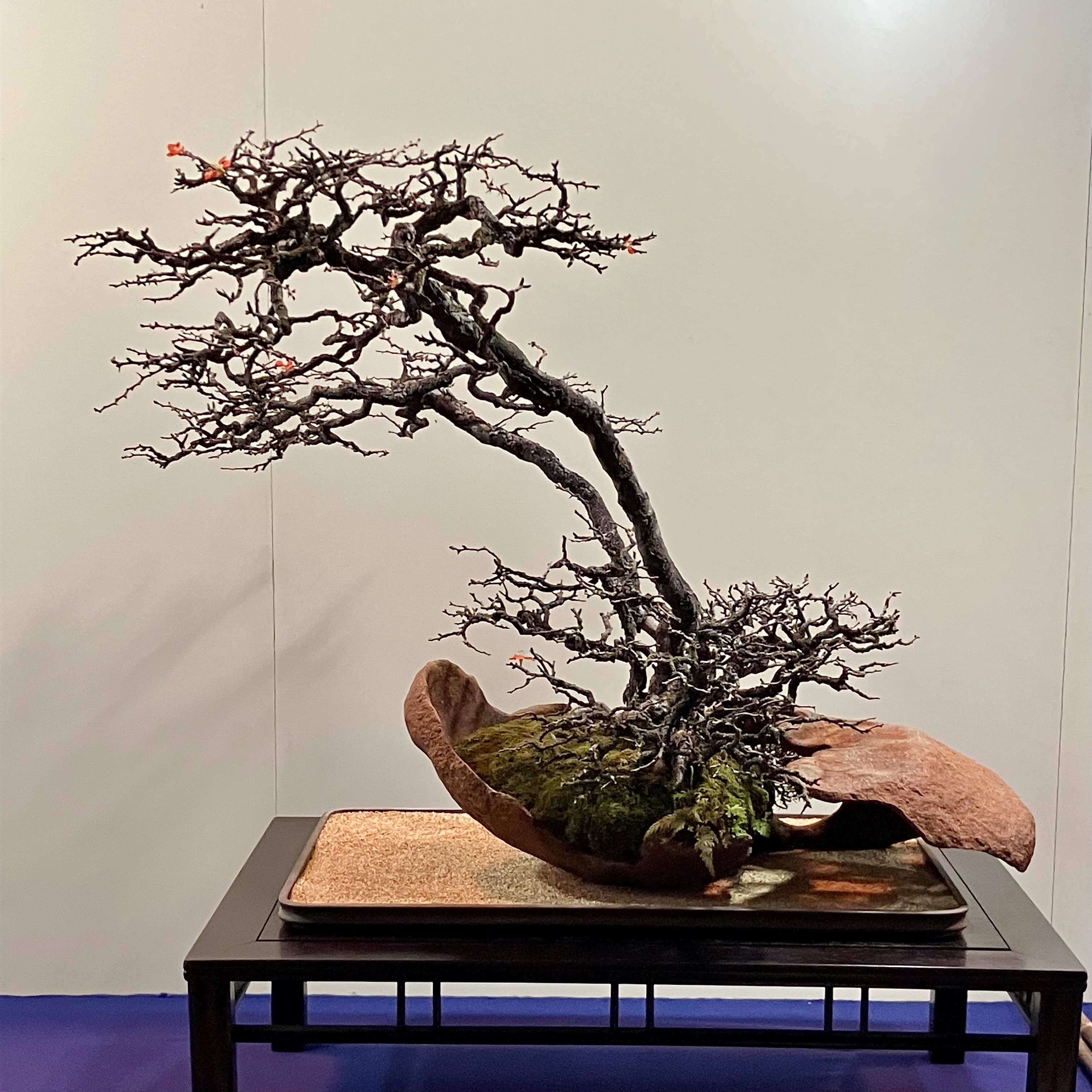
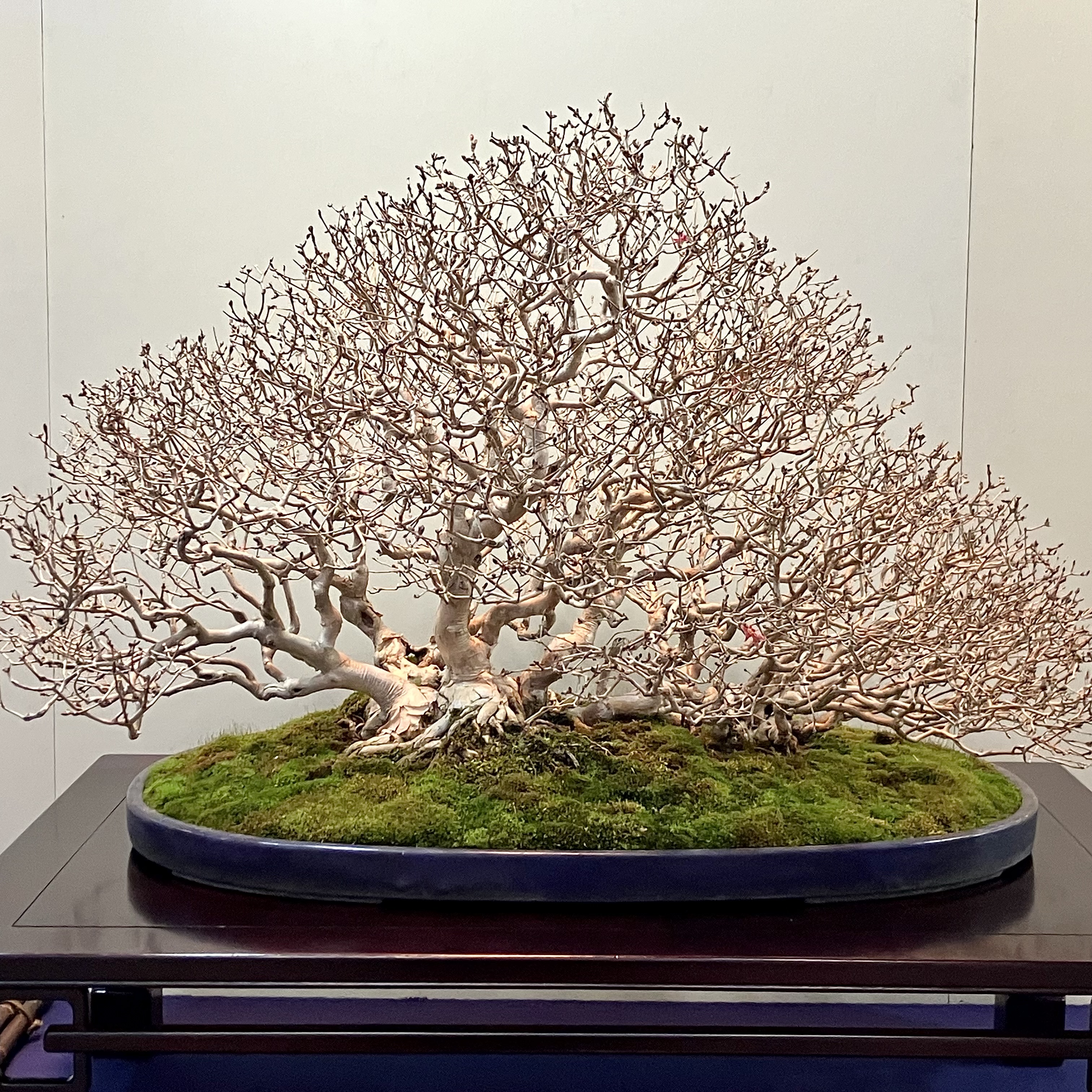
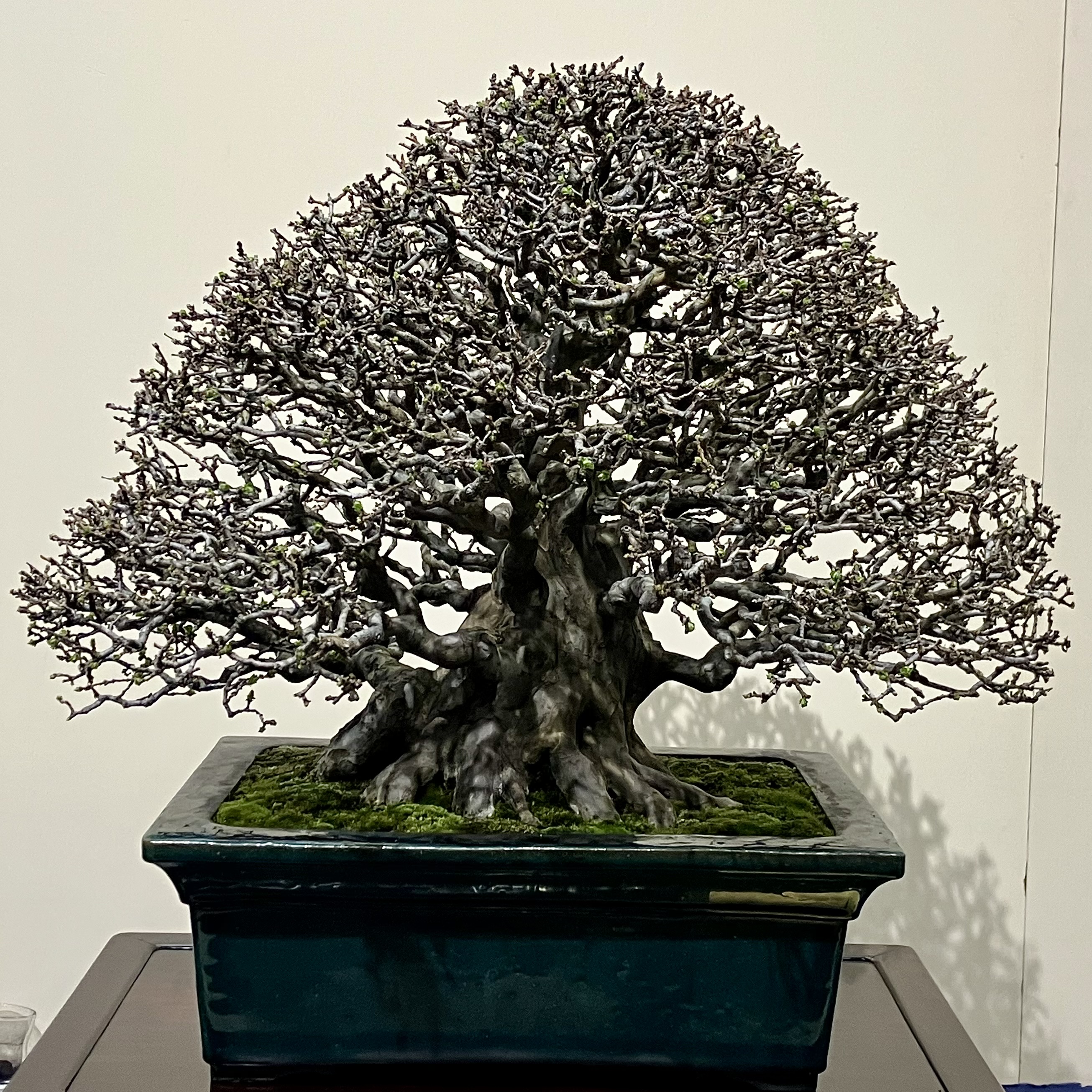
 Ezo Spruce. Only a few spruce in this year’s show.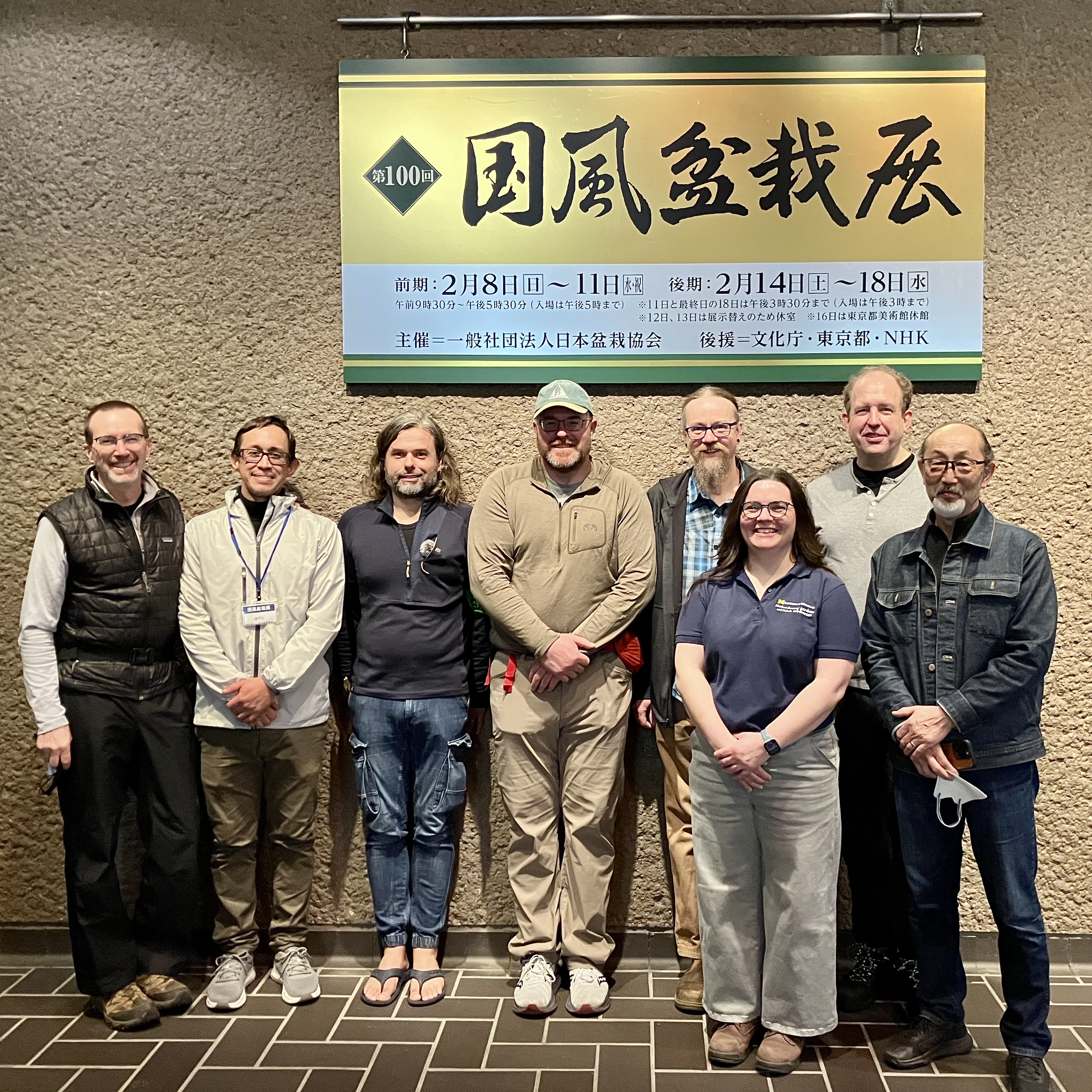






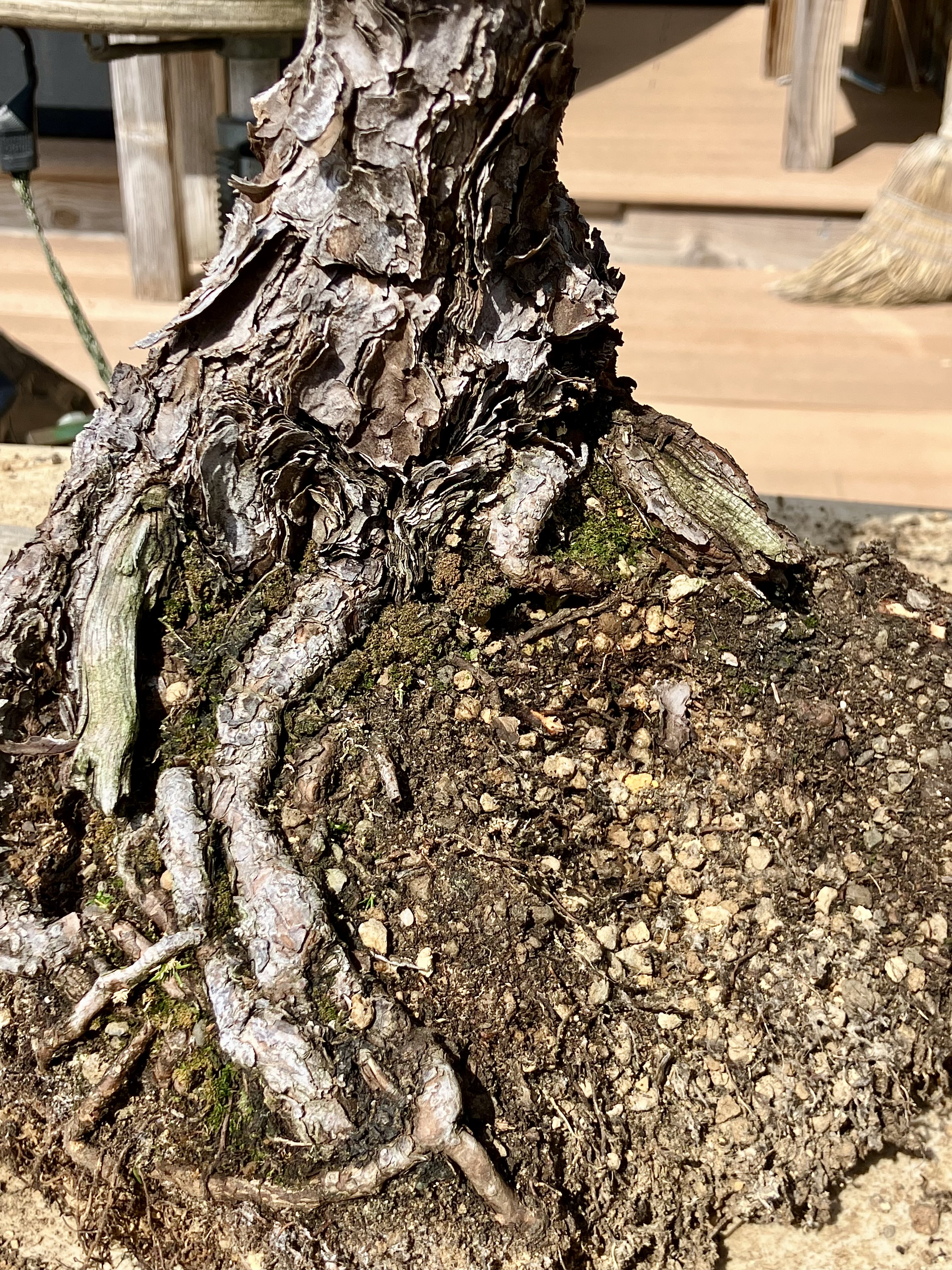 Root removed, leaving one with some shari on it just below, which slopes into the soil better.