For years now I’ve wanted to write a guide to help judges think through the process of scoring the trees displayed in the Pacific Bonsai Expo. It’s one of a small number of exhibits where the exhibitors are the judges, and we don’t expect the members of the judging panel to all have broad experience scoring bonsai. In an effort to encourage more people to gain this experience as judges, the PBE provides incentive for enthusiasts to learn how to evaluate bonsai effectively and an opportunity to practice.
The scoring system is simple: “Provide a score of 1-5 for each display in the exhibit with 1 being the lowest and 5 being the highest.”
As a starting point, I’d like to encourage the judging panel to take full advantage of the 1-5 scale. It’s perfectly reasonable, for example, to award equal numbers of 1s, 2s, 3s, 4s, and 5s.
I think of 3 as being an appropriate score for displays of average quality among the displays in the exhibit. Scores of 4 or 2 can be applied to displays that are somewhat above or below average quality for the event. Scores of 5 are appropriate for trees that are contenders for awards. Remaining trees can receive a score of 1.
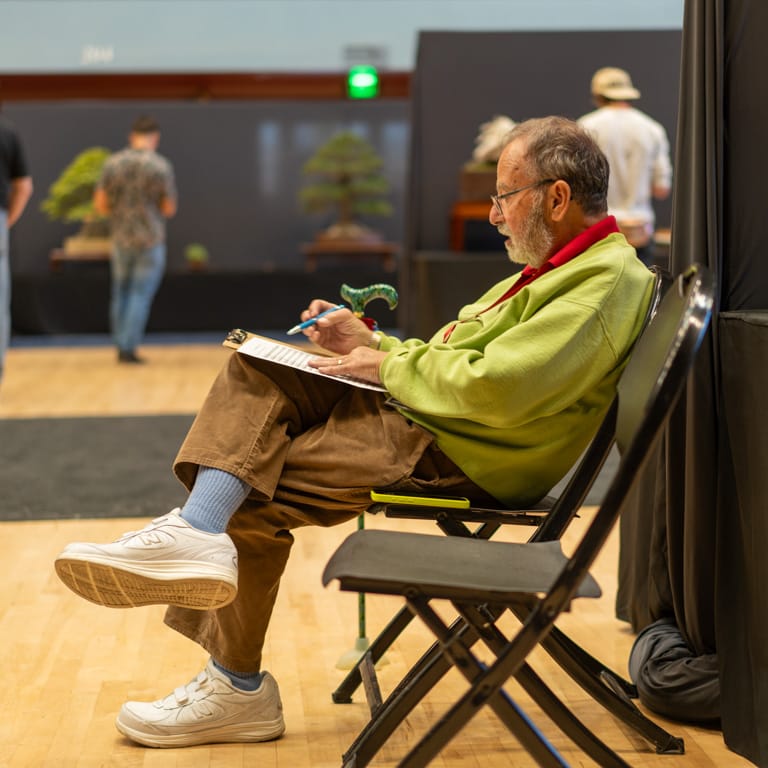
Bill Valavanis double checks his scores at the 2024 Expo
In the past, some judges avoided using scores of 1 or 2 arguing that the trees in the show were a high quality. Doing this effectively limits these judges to using a 3-point system – a system that’s far less granular than the 5 point approach.
Put another way, by using a 5 point system, we’re asking judges to sort the trees into five categories for the purposes of identifying the displays with the highest scores for each category.
That covers the basics for using a 5 point scale to score the show. How then to determine which displays receive which scores? Here’s where a judging rubric enters the picture.
The best outline of how to judge a bonsai show that I know of is Ryan Neil’s Judging Rubric from the 2015 Artisans Cup. After setting out how the judging will occur, the rubric describes successful displays in terms of both technical and artistic merit.
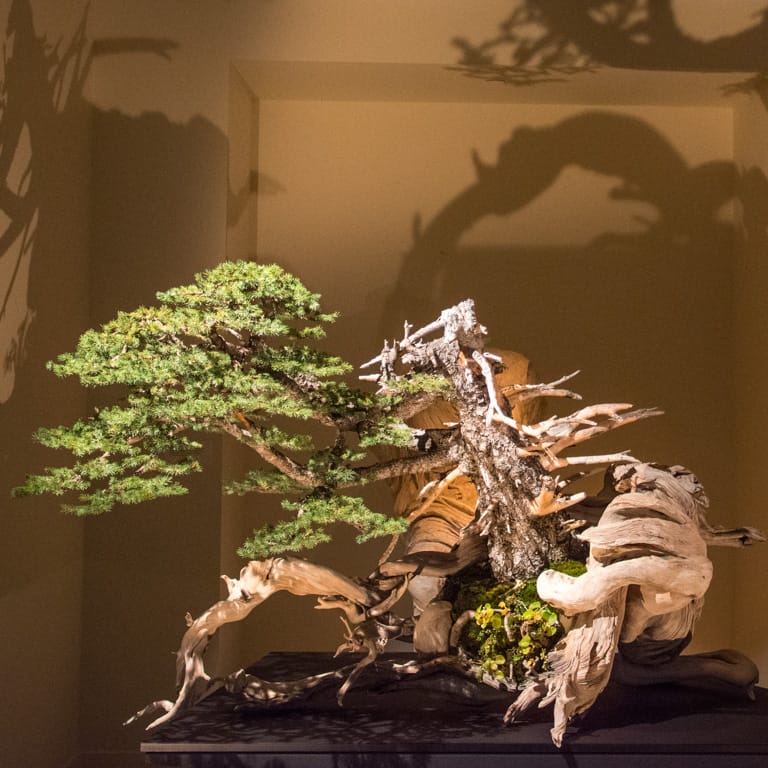
Engelmann spruce at the Artisans Cup
Among technical considerations, the rubric calls out tree health, branch density, and the idea of craftsmanship as it pertains to cleanliness, development, pruning, wiring, pot preparation, and accents. Among artistic criteria, the rubric calls out features to consider for each element of a display, the tree or trees, container(s), stand(s), and accent(s).
I think this is one of the strongest passages. Here’s the full section relating to trees.
- Material is of quality and value/interest
- Design is a good representation of the species as it occurs in the natural environment, OR design is a good representation of a shape as a bonsai. (Some trees look like trees in nature, other trees look like a bonsai. Both are equally as valid. Is the design well executed? Personal opinions and personal preferences are not welcomed or permitted. Judge Objectively!)
- Features of tree are well considered and utilized in design
- Design flaws may exist but have been addressed
In just a few bullet points, the rubric gets to the heart of the matter: is the tree interesting, and is the design well considered and well executed. Similar criteria guide the scoring for containers, stands, and accents.
My approach to judging often begins with a consideration of what the tree brings to the equation and what the artist does with it. All bonsai have starting points, whether as seeds in our care or ancient specimens found in nature. Characteristics inherent to a tree matter when evaluating bonsai, as does the work of the artist in terms of material selection, care, design, and maintenance.
To provide more structure to the process, I’ve created draft instructions for judges for the upcoming Expo. My hope is to receive feedback from the community over the next month so we can publish final instructions before the submission period opens on October 15th.
Draft Instructions for Judges
Feel free to check out the instructions and let me know if you have comments or suggestions that can inform future drafts.
News & Updates
[Local Event]
- The Redwood Empire Bonsai Society is hosting their annual exhibit this weekend at the Rohnert Park Community Center, 5401 Snyder Lane, in Rohnert Park, California. The event features an eighty tree exhibit and demonstrations both days from 1:00 – 4:00 by Sam Tan. Shopping options include member tree sales and a great selection of bonsai and supplies from thirteen vendors.
I’ll be vending at the event so feel free to stop by and say hi!
[Regional Event]
- The Naka Memorial Exhibit Bonsai Show is this weekend, August 22 & 23, at the George J. Doizaki Gallery in Los Angeles. The exhibit is open from 11:00 a.m. to 4:00 p.m. both days.
For those who haven’t visited before, it’s a juried bonsai event held in conjunction with the Nisei Week Celebration at the JACCC. If you get the chance to visit, be sure to thank event chair Julian Tsai and co-chair Ryan Pitts for coordinating the event. Learn more at the Naka Memorial Exhibit website.

 Login
Login