Reading view

A New Beginning + Bonsai in Iowa

I thank my family, supporters, and my customers in bonsai who help enable my pursuit and passion of this art. In 2018 I made the decision to pursue an apprenticeship at Fujikawa Kouka-en, in Osaka Japan. Regrettably, after 2 years from unforeseen conflicts and my own maturity at that time I chose to return to the US. I returned to the corporate work force, employed as an engineer for a medical device start up while I continued my bonsai pursuits semi-professionally for a small clientele base in central and southern California. I thank professionals, Peter Tea and John Wang, who were resources to provide some mentorship as well as to continuously further my knowledge/skills during this time.

After much contention and indecision, as well as the pathological obsession that bonsai is to me I’ve once again taken the plunge and chose to pursue bonsai as my full time career. Coincidingly with this decision, I had prior a week of work booked with the Iowa Bonsai Association. It was my first gig outside of California so I was quite nervous as to whether I could deliver to expectations, but it could not have went any better. I thank the hospitality of my host, Scott Allen and his wife Jenn, and the IBA club which was great to work with. I did a few private days, a workshop, 3 demos/talks at the Des Moines Botanical Gardens, followed by judging of the annual show held at the Iowa state fair.

Following my week work I received so much positive feedback from all the members as well as plans for repeat booking and piggybacking adjacent states that I have at least some sense of confidence that I’m headed in the right direction. Thank you Susan Daufeldt for providing some of the workshop and demo photos. One member sent me a testimonial to share which I will include at the end of this post.

It has been my emphasis in my teaching style to be very explicit on why we do things, what we expect out of the work, and the long term implication of the techniques/work applied. Both in my private days, demos, workshops, and judging the overarching basis of my work can be broken into 2 criteria:

  1. Will the work applied improve the tree can can it be continued and built upon in the future?
  2. Will the work capture and show a history of “age in cultivation”

From my time in Japan I’ve noticed a distinction when professionals say a tree is old. Age is not only implying the age of the tree, although this may be part of the case especially intrinsic to collected yamadori, but often age is referring to age in cultivation. For example, consider a deciduous tree which over 10, 20, 50 years has had branches meticulously maintained and a dense silhouette create from thin (and old!) branches.


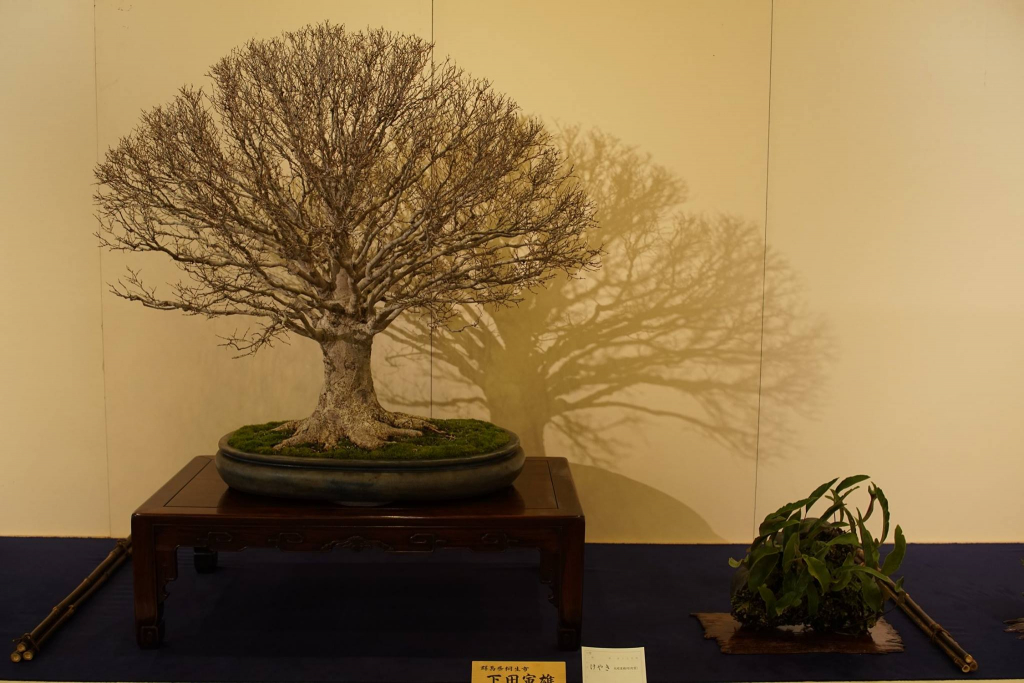
At immediate glance we can not only tell that the trees are old, but that it’s time cultivated as a bonsai is long too! The branches carry a sense of time giving more presence and impact to the tree. This is also why we show deciduous trees in winter silhouette–to show off the branches that were so meticulously developed over many years.

Of course this applies to coniferous material as well, but will have some species specific characteristic in terms of the branch density, coarseness, as well as stylistic intentions of the professional.

I say this to imply that when we work on our trees, we want to most efficiently use our time so our trees and can continuously progress and improve. In this era of exciting collected yamadori it is quite achievable to rapidly set an aesthetic and full silhouette, but if the work done needs to be reset every 2-5 years, then even if we worked on that tree for 25 years its age as a bonsai, or age in cultivation will forever be stuck at that 2-5 year mark! Of course this is not an attempt to claim superiority, as I am very much continuously learning and improving my skills, but is something we all can consider and keep in the back of our minds as we work on our trees.

That said, now into the work. Iowa is a temperate climate with very cold winters and hot humid summers. The season is comparatively short say to Southern California so in doing work we should consider the current season as well as remaining time left the tree can respond to a given technique. When we enter the peak temperatures of summers, roots will enter a “summer dormancy” which counter-intuitively means the tree is taking in less water with rising temperatures. With reduced transpiration and sap flow, trees are less rapidly able to move water and heal damage. Meaning at this time (mid August) for Iowa is not ideal for heavy bending and hard work.

As for deciduous there is about 1-1.5 months of warm weather left for trees to grow–cutting it very close say for deciduous defoliation or heavy cut backs which will encourage a soft successive flush. Ideally this work would of had been done in July to start of August at latest, so deciduous work was restricted to general cut backs, partial defoliation to prevent further weakening of interior shoots (not enough removal of foliage to generate a secondary flush), and only more significant work on very strong trees that seemed apt to rapidly produce another flush before the end of the season.

For the most part work was on conifers–junipers which are completely lignified at this time, some yews, and ponderosa which were the notable species. I was not able to get photos of everything done but here is a collection of some over the week.

Shohin kishu, back turned into front (sorry I do not have original front)

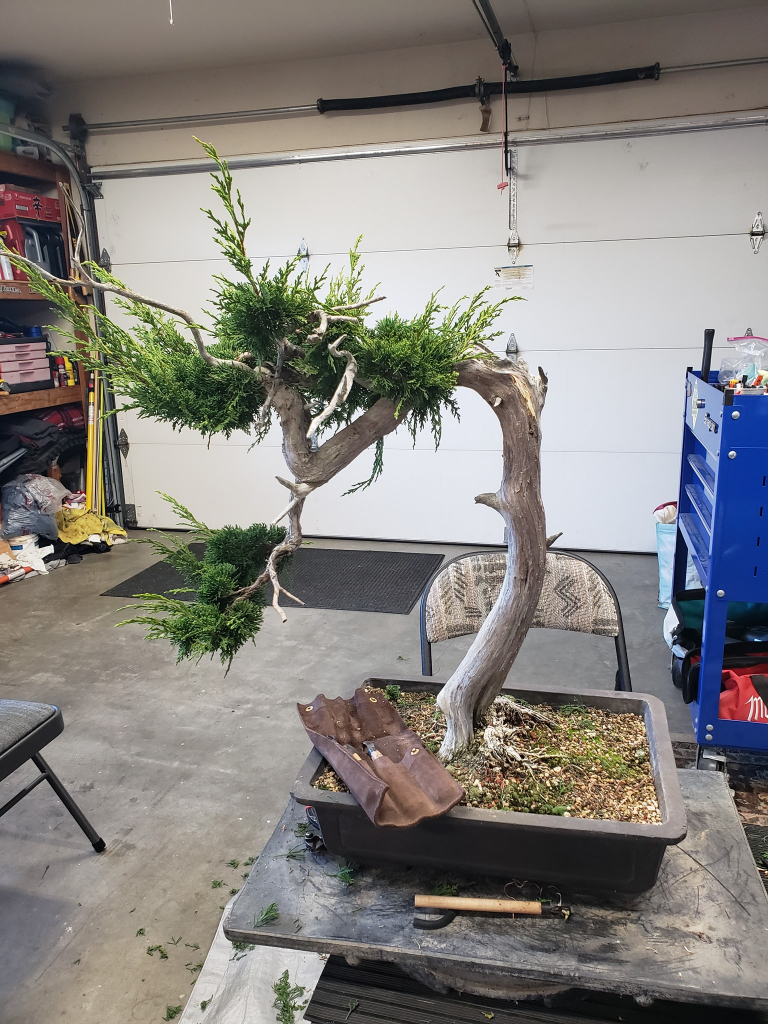
Here is an interesting windswept, penjing-esk juniper. We contemplated lifting the angle up and making a more bunjin, informal upright style but ended up going with a more unconventional look. The tree previously had spider mites last year but the current growth otherwise seemed healthy enough to be worked on.

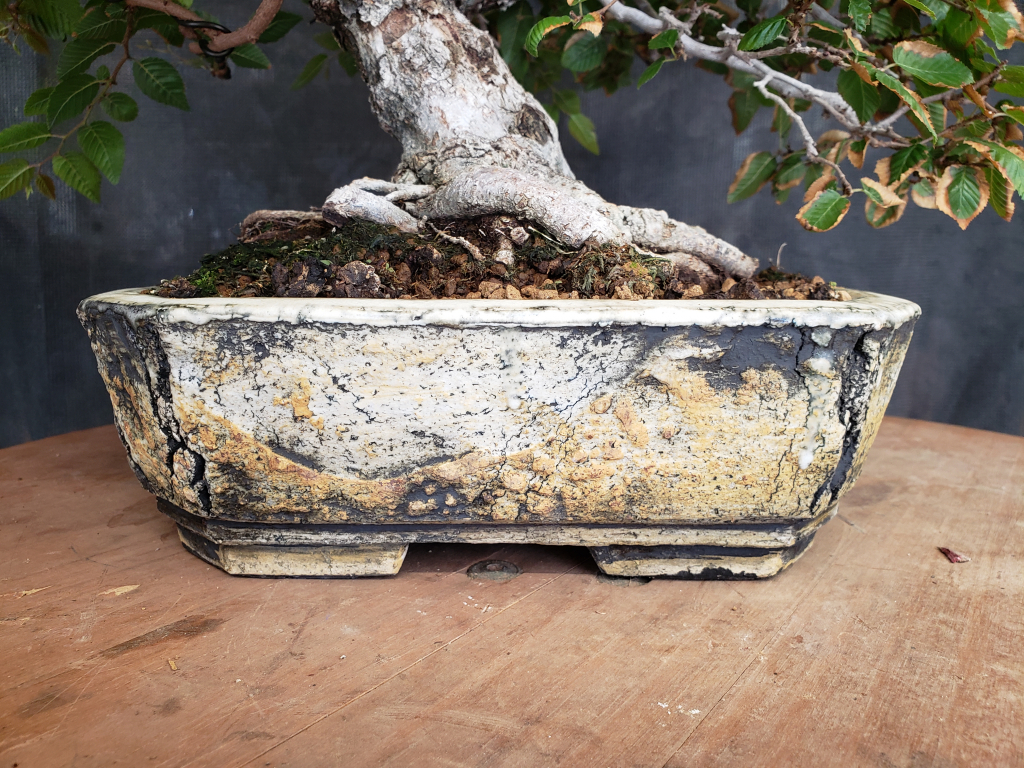
Here is an old Korean hornbeam planted in a very nice Horst pot. A few things to note. The tree suffered some leaf burn–many IBA members mentioned that this year was an uncharacteristically hot and low precipitation season. The inner canopy has been neglected resulting in some dieback. If the tree was vigorous enough and it was a month earlier in the season, I would completely defoliate the outer canopy, only leaving interior branches and some weak branches alone. We ended up cutting back extensions on stronger regions, and partial defoliating (removing 1 leaf of each alternating outer pair) to enable more light on interior foliage.

Refinement work on another telperion juniper that Bjorn did the initial styling on several years back. It has since become overgrown with many branches that are too thick. I did a significant cut back, some thinning, and wired out the tree. It should be allowed to grow and fill in. We can do more detail wiring next season to get better pad definition.

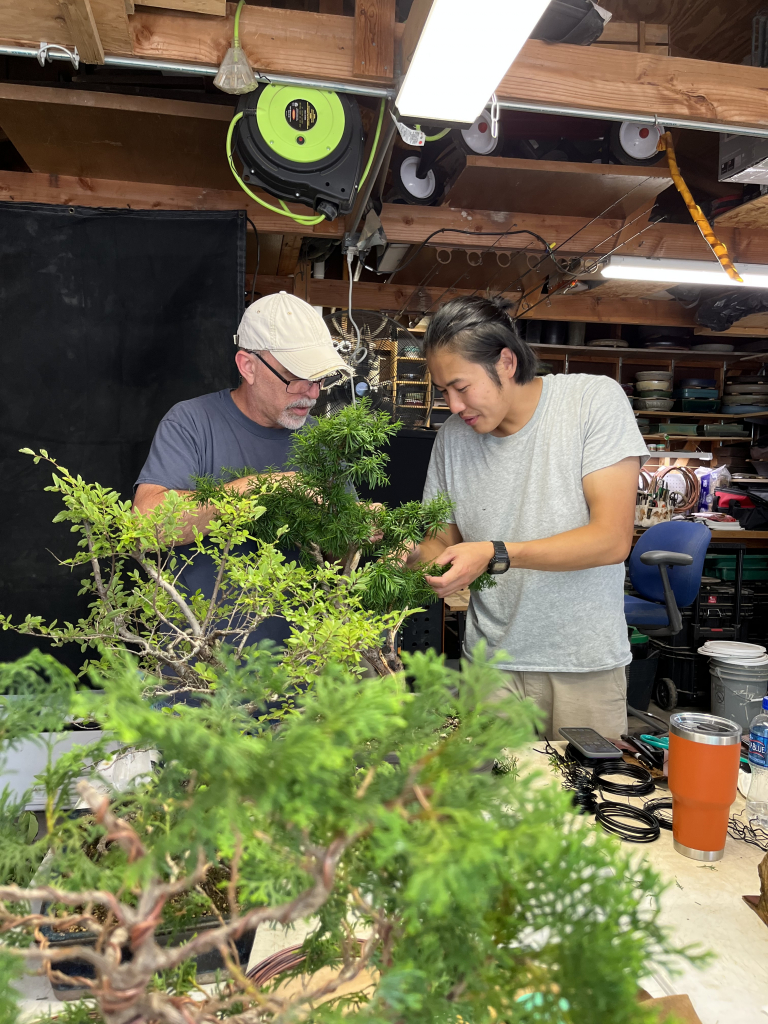
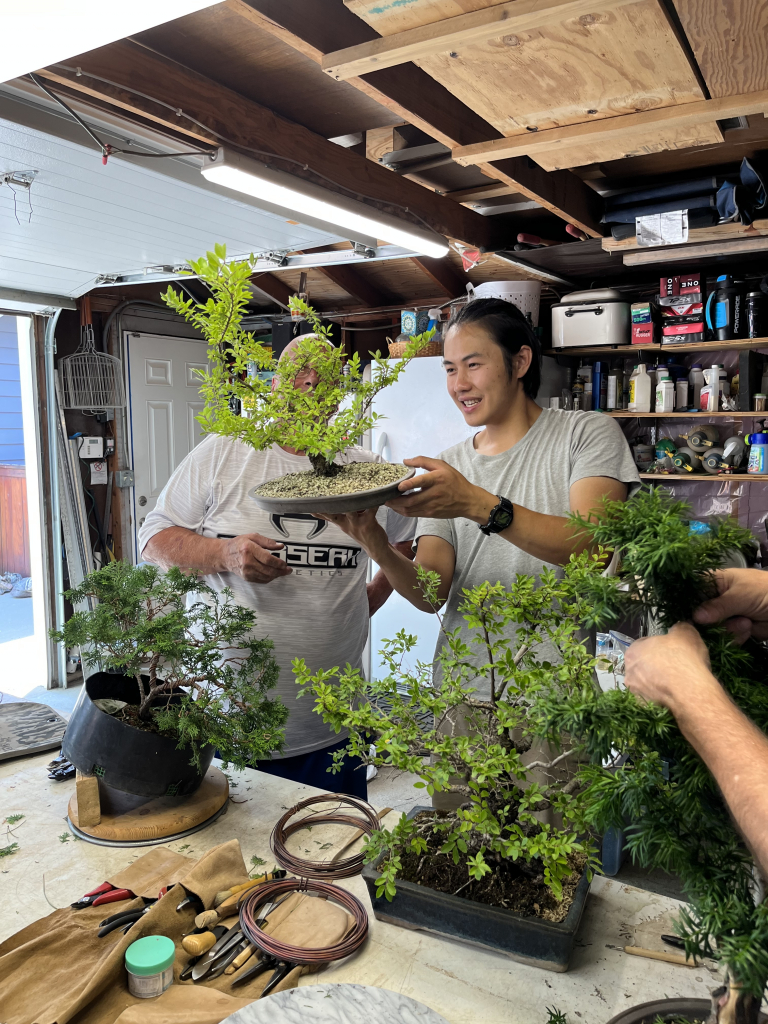
Some workshop shots:

A big yew brought and worked on by Dan Morton

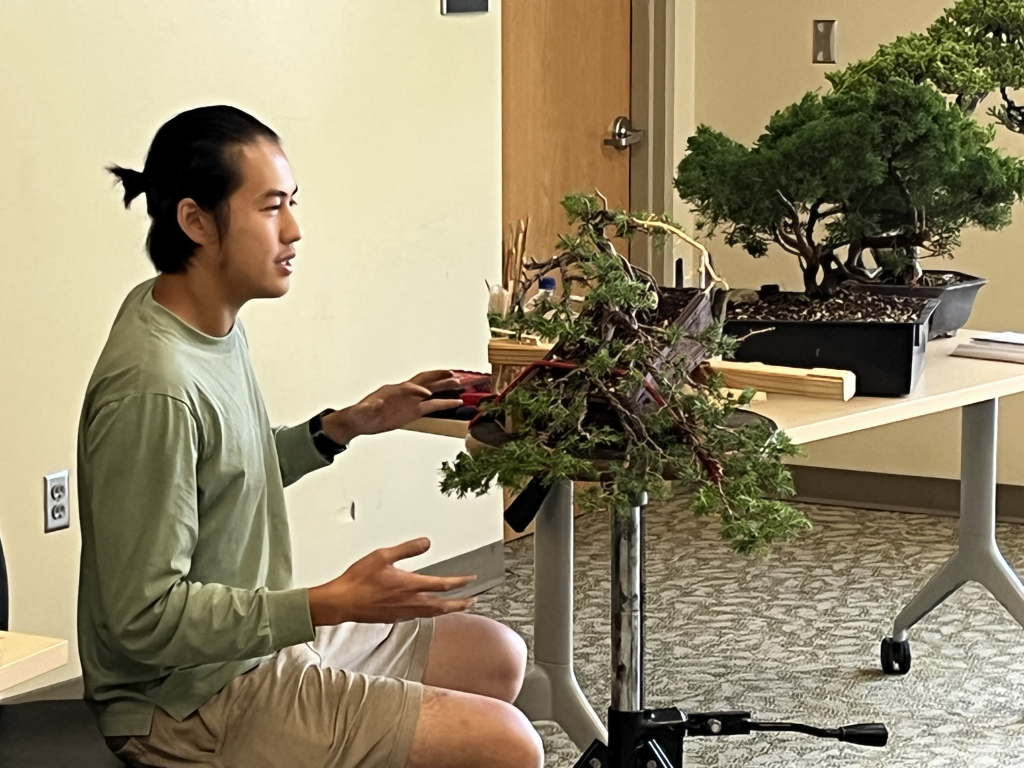
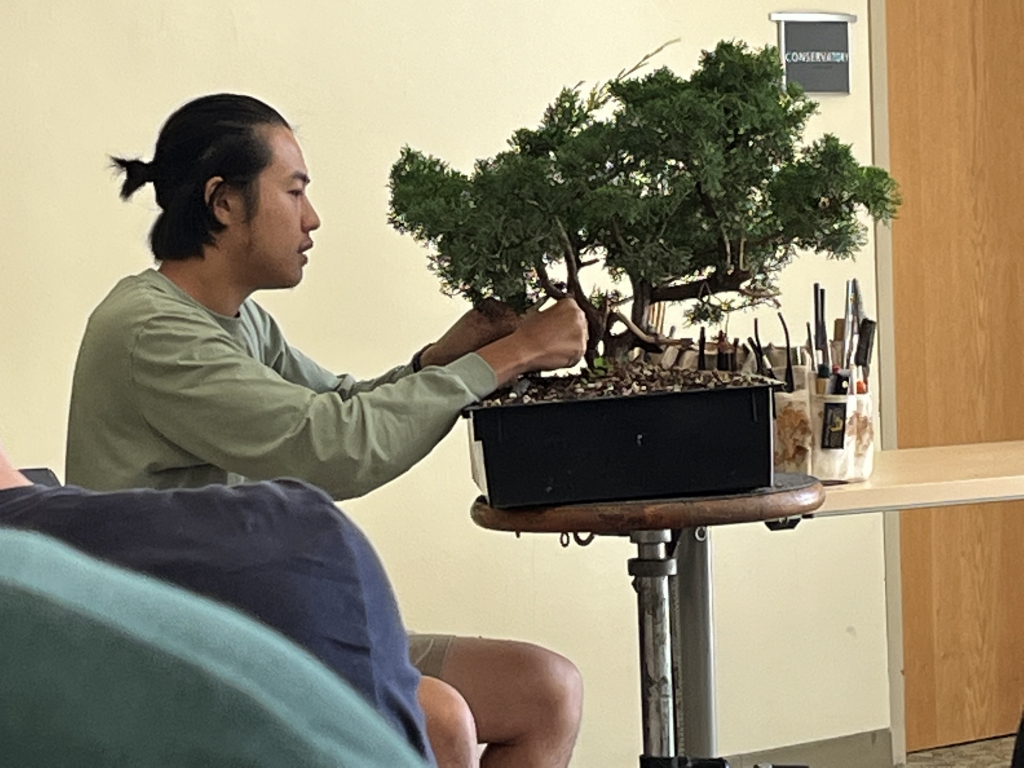
I did 3 demos and talks to both bonsai enthusiasts and the general public at the Des Moines Botanical Gardens. I talked a lot about my bonsai philosophy, some stories from my apprenticeship in Japan, and of course the trees on hand. Club members brought several trees I could select from and pick for the demonstrations. I looked for trees that were 1) healthy and 2) would tolerate demonstration type work that would not infringe on my previous criteria mentioned earlier.

Common juniper, wiring out branches and setting some pad structure. I wanted a steeper angle for the tree but just worked with the available blocks.

Telperion farms field grown kishu. Discussed approach and methodology for establishing a style or design. Ended up making a multi-trunked clump type composition.

Another taxus brought by Dan Morton. I believe he mentioned these were collected from the old Ford factory in the 80s.

Some of the results:

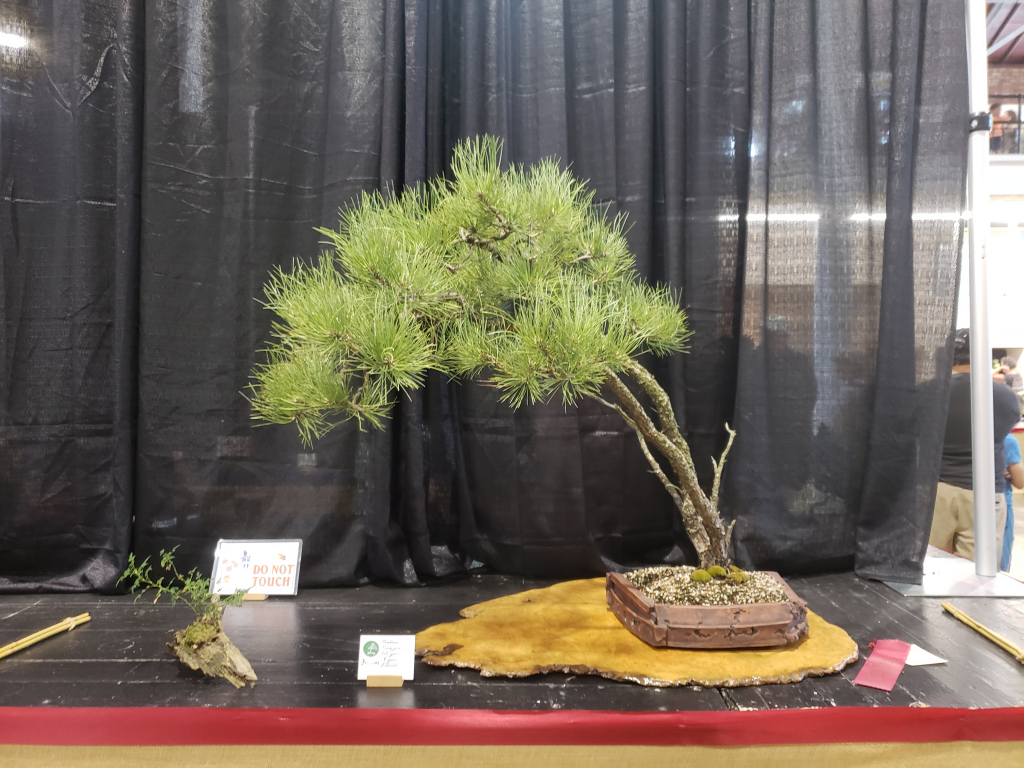
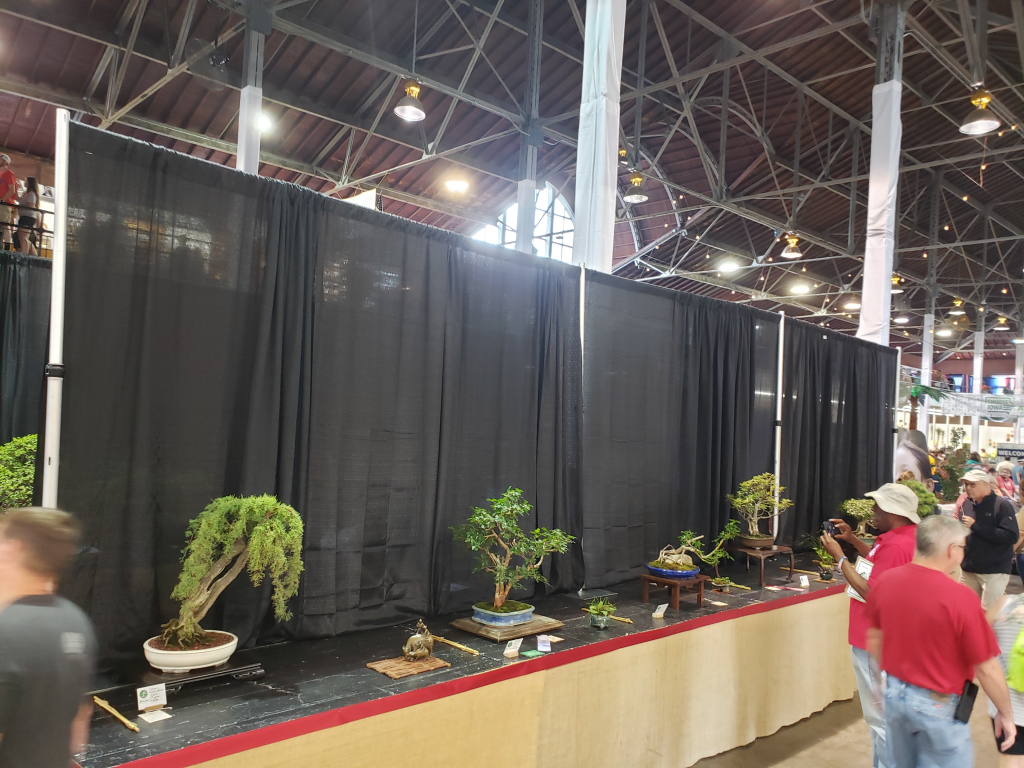
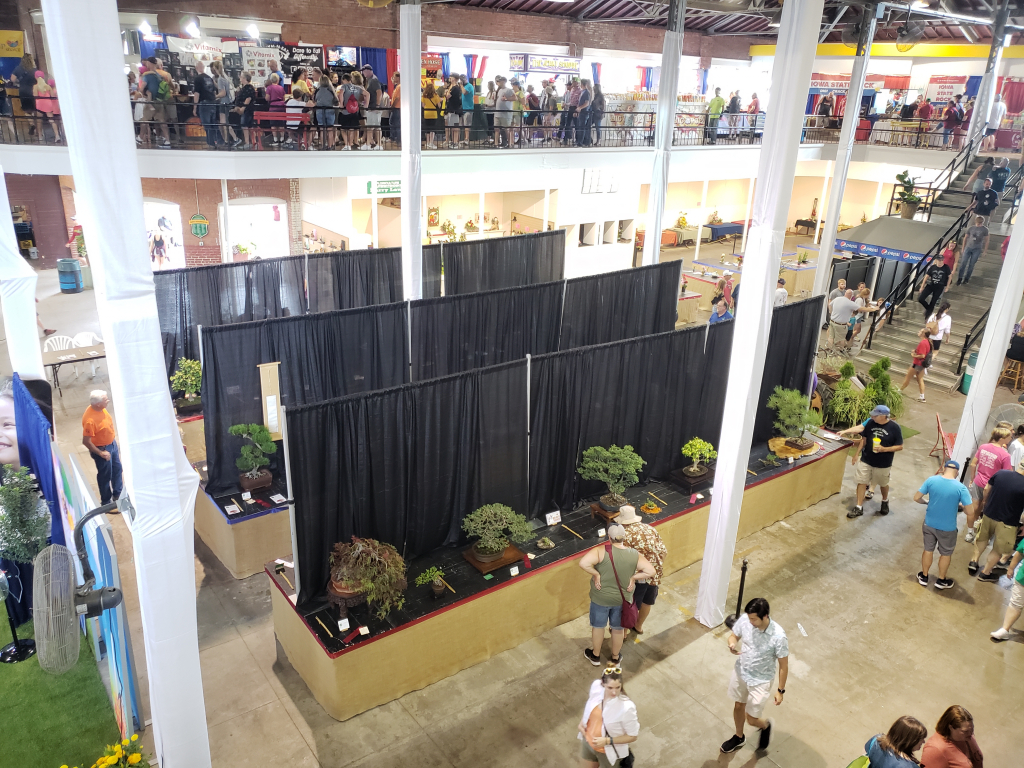
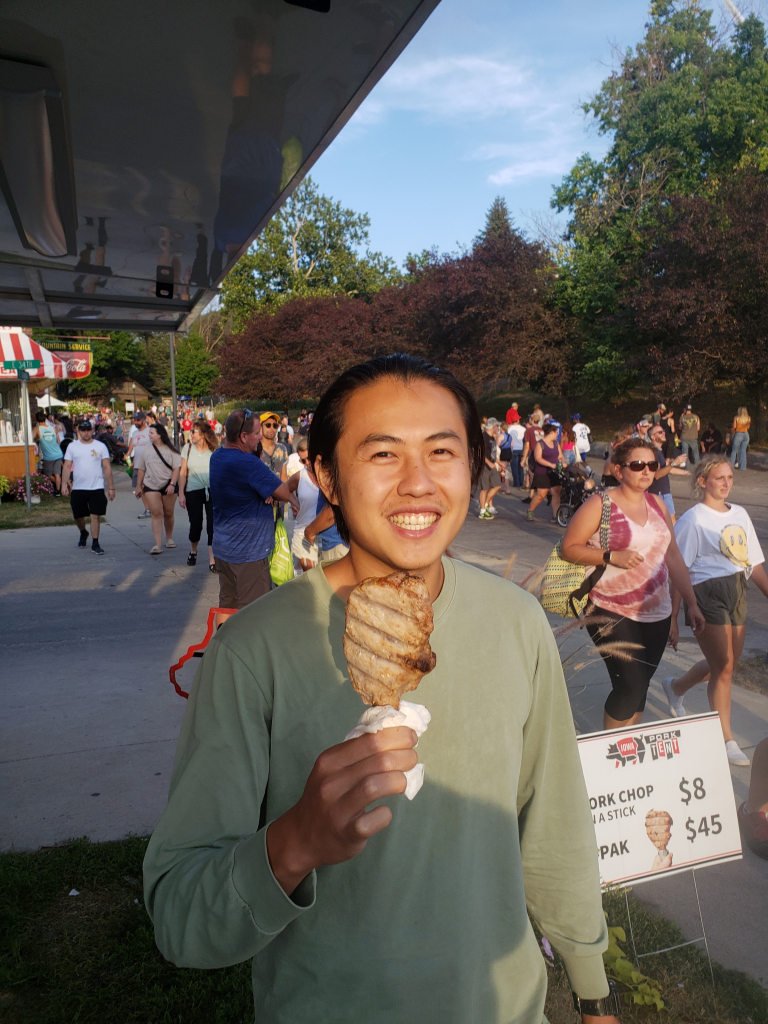
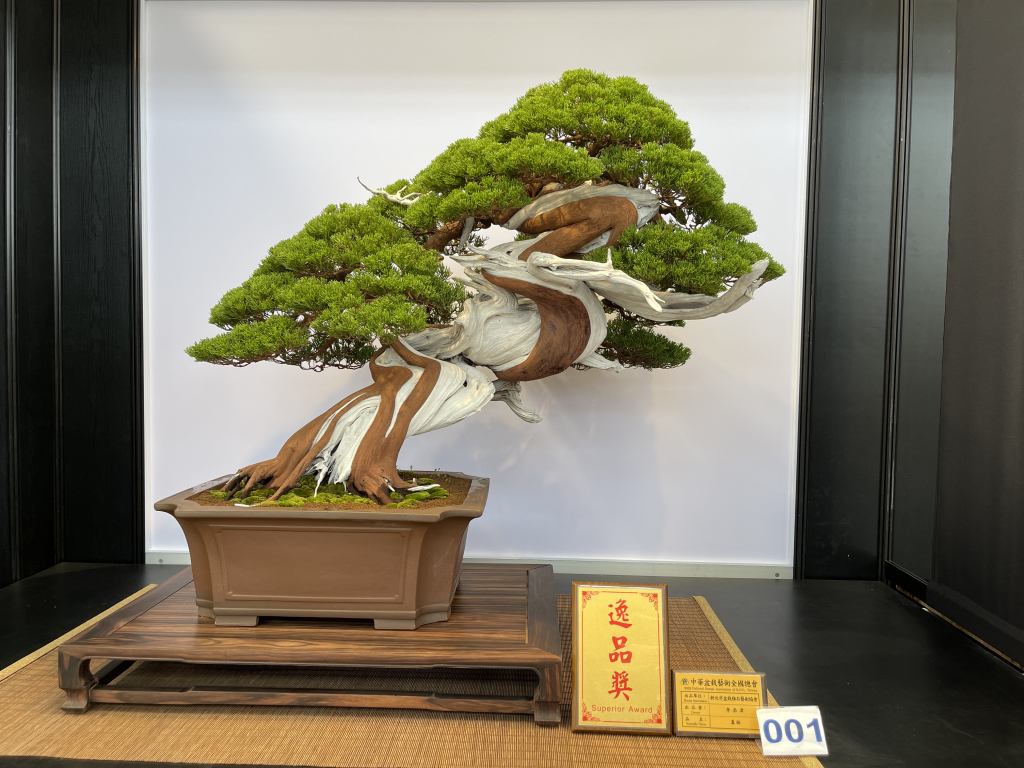
Lastly was the Iowa Bonsai Show held at the state fair. Coming from California, I had no idea that state fairs were a huge deal in the midwest. Hundreds of thousands of people present at a given time and a lot going on. The quality of the show was mixed, and I judged the trees and did a critique. Main criteria was trees showing age in cultivation, then considerations to style, pot/stand combination, and display. I did not take very many pictures of the show. It was hard to judge in that I would say there were not any singular outstanding trees from the rest but in comparable quality brackets. Definitely some nice conifers but felt “young” as bonsai and trees which if they were worked on more or had a bit more refinement/development I would have allocated awards differently.

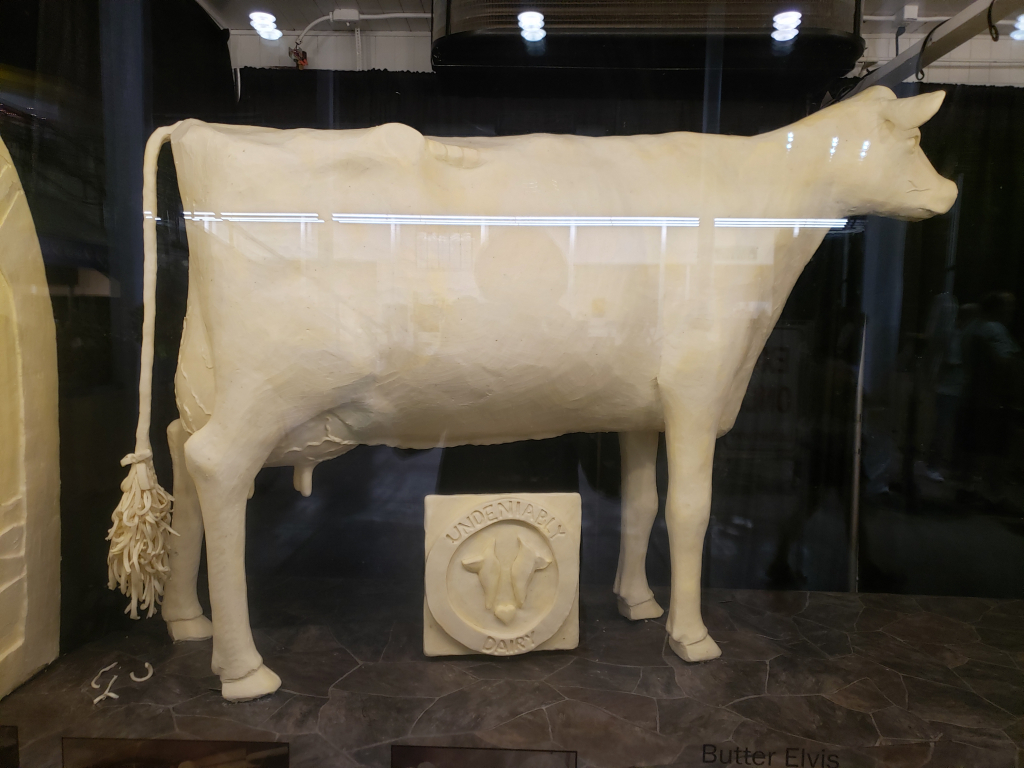
Butter cow…

All in all it was a great week of work and I enjoyed the friendliness and hospitality of those I met.

For those that made it to the end of my post, I am booking my 2023 calendar and I still have some openings left for this year. I am eager to work, so if you are interested in any of my services, please contact me at [email protected] or through my website: here.

Here is the testimonial sent to me by Dan Morton about my work in Iowa:

I recently attended a workshop sponsored by our local club , a young man I’d never heard of , so I checked out a few of his videos and thought I’d give him a challenge , a rough collected Yew I had dug up in the late 80s and just put it in a grow pot this year , many have seen it and made suggestions on it’s style , but there was something missing so I rented a cargo van and loaded it up , after 6 hours of work I was pleasantly surprised with the outcome , the lines that was created by showing the trunk , the Shari that was carved , so impressed with his style and knowledge that I took another to a demo hoping to get it worked on (the smaller one) and he choose the small one . As he was working with me he explained the reasons why he was doing what he was doing , but he explain that this this is what to expect in 3 to 5 years , what to do and how to achieve it . I was so impressed with his knowledge of this species that I had him sign and date the metal tags to stay with them forever , I hope our club can get him back again next year to continue his work . I speak for all the students that were at the workshop ,the demos had a total of 84 visitors for the 3 trees , this was open to the public , I don’t recall anyone leaving once he started styling a tree , those that had there tree chosen for the demo was quite pleased .

Dan 


  •  

Good Bonsai Takes Time + Penjing vs Bonsai

This is perhaps a redundant subject and likely understood by most enthusiasts, but it is something I found worth emphasizing in my recent travels–good bonsai takes time. Borrowing a bit from my previous writings…

Recently I have been thinking deeply about what is my bonsai philosophy and how to express it in my work. Time is irrefutably intertwined with bonsai, and perhaps a tree which does not express this element is not bonsai at all.
I think there are 2 expressions of time we can demonstrate. First, is through the artists intent in the image they want to evoke—maybe you are inspired by the harshness of an alpine tree, subject to the elements and with minimal resources to grow resulting in craggy, spindly branching. (Deciduous may evoke a different feeling although that is another discussion.) Second is through age in cultivation; I think we forget sometimes that those old craggly trees is a result of innumerous years of response to it’s growing environment. It may be disingenuous to think that we can emulate that look in short order, circumventing that very critical aspect of time.
This leads me to my current feelings that in cultivating and improving bonsai it is imperative that the work done is one that can be built upon—so that in our self-imposed harshness of the human hand the tree can emerge proud and bearing a dignified record of the past. This is my take on mochikomi.
So when we think about qualities that evoke mochikomi, especially through cultivation, it can imply old but thin branching and dense ramification. For conifers this may imply the balance between enough sparseness or negative space that frames an old elegant tree while still maintaining a density that shows age in cultivation. A green helmet is not visually compelling, but a tree that is too thin may also look immature.
My take on this balance:
The back, looks less bonsai like and more penjing esk but I kind of like it:
Very classical Japanese white pine, Kouka-en circa 2018. Powerful tree, I definitely feel the age in cultivation but perhaps not compelling material.
For deciduous trees this shows itself in carefully curated branching, ramification, and varying degrees of softness vs contortion depending on how branches were grown.
Japanese deciduous trees:
Soft silhouette, technique is to maintain thinness and taper of the branch tips as you progressively grow the tree outwards. Note that branches are GROWN in deciduous trees, not thick branching wired out to silhouette. Think about how they are able to maintain branches that are decades old, but still retain a fine, dense, and soft outer canopy.
Here is one of my tridents in an early stage of branch development. I will progressively build the internodes outwards to avoid coarse or heavy tips. Building branches are time intensive but when you finally reach your desired silhouette the branch quality and density will be magnitudes better quality then trying to wire young thick branches out and relying on interior buds to grow out and build density that way.
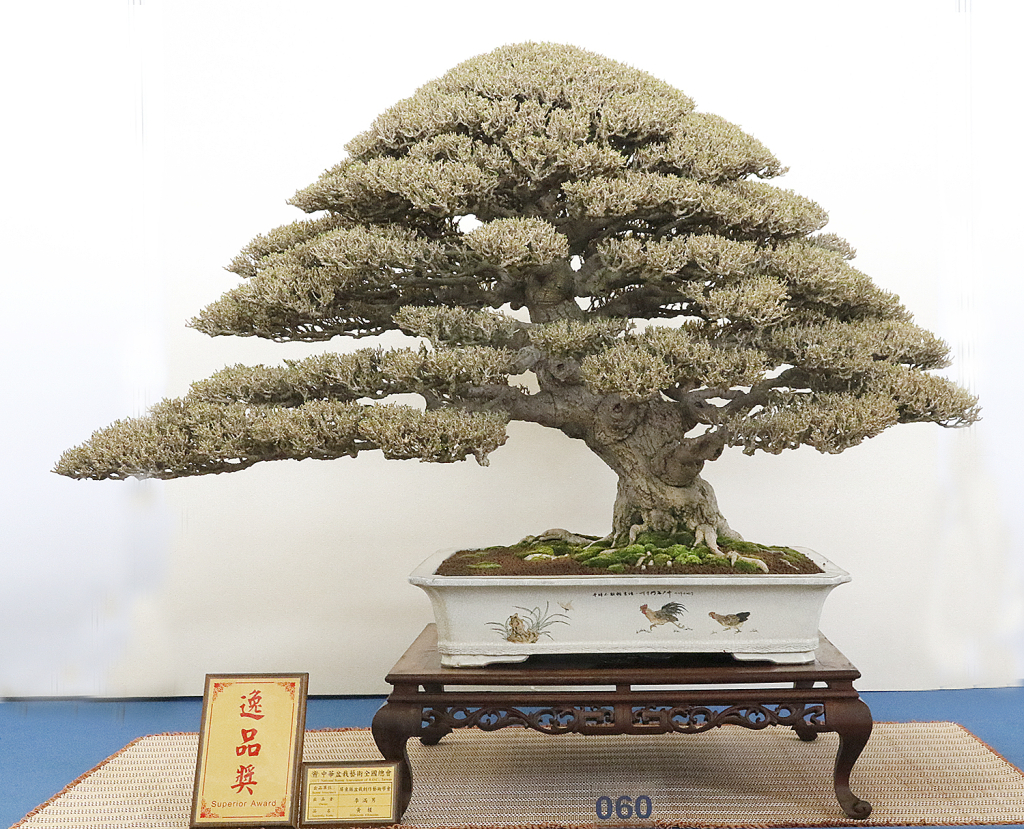
Here are some more penjing influenced, deciduous material from Taiwan. My father visited the Hwa Fong Exhibition recently and took these photos. I was deeply moved by what I saw, especially on the deciduous/broadleaf/tropical material.
I’ve had this conversation with many people and we seem to generally agree that in penjing, apex and pad lines are broader, there is stronger directionality, and more emphasis on primary lines relative to bonsai.
The above 3 trees feel much more aggressive compared to their Japanese counter parts with stronger primary lines. Often in Japanese bonsai (not always) we pursue compact shapes. Leggy branches are opted for those with better ramification, internodes, and overall there is a greater emphasis on the cleanliness of branching and silhouette. This perhaps has to do more with the craft aspect vs aesthetic approach to bonsai where leggy branching is often difficult to sustain, floppy or aesthetically unattractive.
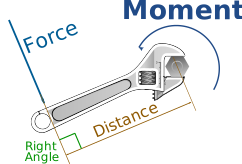
Here is a simple lesson on mechanics. Torque or the moment leveraged on an axis is equal to the force exerted times the length of the lever arm:
Moment or Torque
This is common sense right? That’s why we use longer wrenches to exert more force over a tight bolt. If we consider this concept in reverse, the weight of a long branch exerts a greater moment vs a short one–considering all things equal that the longer branch was also the same weight–which it isn’t!
So long leggy branches are heavy and often cannot be physically supported by the tree. Thus they flop!! In my observations of contemporary American bonsai, I feel (intentional or not) we are slightly gravitating towards penjin-esk designs with greater “asymmetry” or directional shapes. I think this is super cool and I love it, but often we utilize long branches which would be cut out in the traditional scope of Japanese bonsai.
The problem therein lies here. In penjing and some other non-Japanese bonsai in Asia, hobbyists and professionals there grow these primary lines for years to decades before “styling” the tree! To justify elongated primary lines, first the branch must be grown thicker to develop the lignified structure to support it’s weight. Second to carry visual interest over a longer space the branch must have more movement–often of which is produced through growing and cutting back as opposed to strictly wiring. Employing both of these measures may not be as culturally compatible with the American bonsai scene, where instant gratification is sought after as well as for the traveling professional whose visitation period is a smaller window than what these development methods implore!
Field grown Taiwanese junipers at Hwa Fong Exihibition:
Here is a tree I recently worked on a month ago originally styled by another professional in 2017. The tree had looked amazing after the work was done, but fast forward to 2022 all the branches had flopped. Using long leggy branches and forcibly contorting them into a compact silhouette meant there was no structure developed and inhibited all interior growth. Additionally due to the concept explained above, these branches did not have the lignified structure to support the branch weight. Thus the tree slowly lost shape, the technical work went to waste, and the tree needed to be rebuilt.
After opening up apex and cutting out many spaghetti branching. Need to grow out the tree for at least 1-2 seasons and a secondary styling can be done.
Here are some recent projects in varying stages of development. The first tree was originally a prostrata juniper worked on by Mike Pistello for Santa Cruz Bonsai Club in 2016. The tree was won by my friend Drew Tucker who then subsequently grafted itoigawa on the tree. We did the initial styling on the new foliage, ensuring to set up the structure so that in successive rounds of work we can improve the tree:
Here’s another juniper, a San Jose with a great story. This could be a blog post in itself so I’ll link the story here.
We did all the structural work over 1.5 years ago, then GREW branches to utilize for refinement work. Last March I did the California Bonsai Society visiting artist program and did the 2nd styling on live stream. Finally we did a 3rd round of work recently, scissor work and light wiring. The tree consistently improves on previous work each time and is looking pretty good now!
I started doing some work at the Clark Bonsai Collection up in Fresno. Bob Hilvers does a great job managing the collection, and the team of volunteers there are highly passionate, attentive, and do good work to upkeep their collection! This is an old historic Hatanaka juniper, likely once prostrata landscape material that was grafted with kishu. It has grown relatively freely all it’s life and ended up in a pom pom shape. We opened up the structure, a few large bends and cutting out unnecessary branching. It is tempting at this stage to give the tree a finished look, but the reality of material grown like this for many years is that there is no interior branches! We will wait for some interior buds to fill in which will allow for successive refinement. Trying to force a finished image at this stage relegates us to using only the leggy growth and will perpetuate coarseness in the structure and design.
After work:
In it’s previous form:
Recently I am trying to get in the shohin game more too. Here are 2 trees which I grew from cutting and seedling respectively:
Well that’s a wrap! I am trying to get back in the rhythm of writing again, as I do enjoy sharing my experience and thoughts. I’ve been booking out more of my 2023 calendar to hit up several states so hopefully I can meet more of my non-California supporters in the near future!
  •  

A Discussion on Deciduous Bonsai + Why did I cut off all the branches?

One of the greatest aspects of bonsai for me is its’ diversity–not to be understated, in both practitioner and hobbyist but of course in the great variety of species across coniferous and deciduous trees. While a conifer may have more individual character, think yamadori with old bark or deadwood, a deciduous tree offers a soft elegance paired with the seasonality of spring, summer, fall, and winter. Deciduous trees offer a great way to experience time in the present moment and brings a sense of vigor in the garden.

To preface this entire discussion I would like to start with an old trident maple whose branches I’ve all cut off. At first glance, it seems almost sacrilegious to remove many old branches and the general shape of the tree but I humbly request to impede judgement until reading through this article!


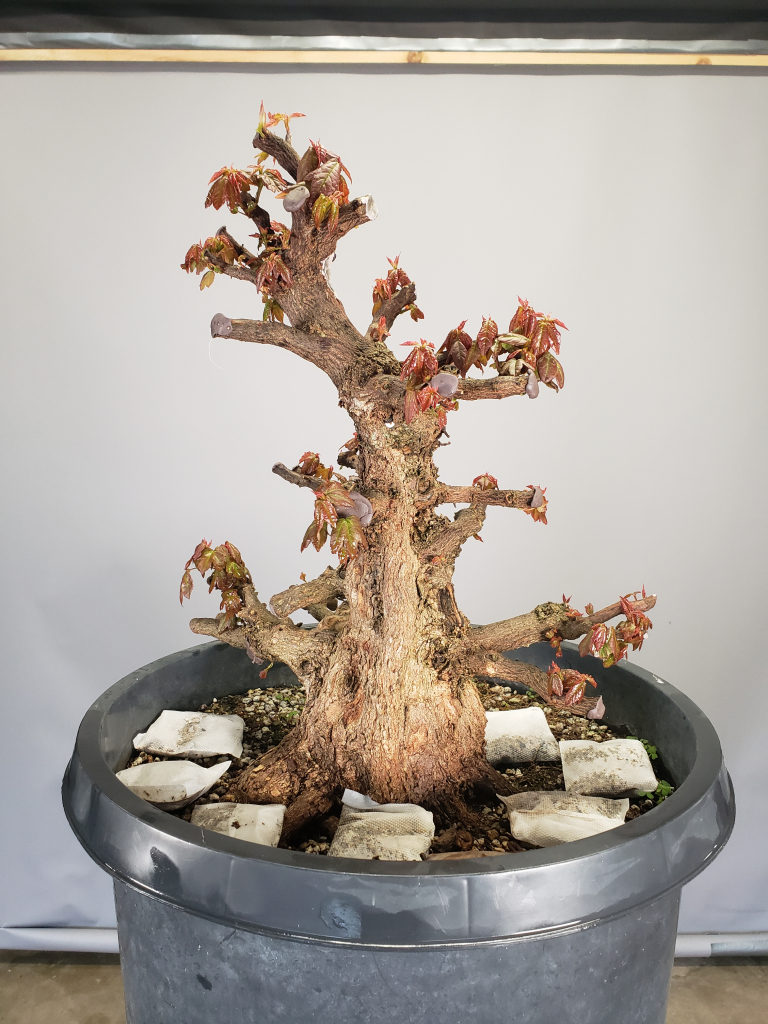
*Large trident maple, appx 10-12 in base before cut backs


*After primary branch cut backs

For starters lets define the qualities of deciduous trees. We know that they change with the seasons (excluding broadleaf evergreens and tropicals) and notably will be laid bare in the winter. Although deciduous trees can look great year round, it is not uncommon or rather frequently preferred that they are shown without foliage. The fine branching and soft silhouette can be appreciated in this form and tells the story of the tree in how the branches were grown and developed. With this, we can establish a premise that good deciduous trees are valued for their branching rather then just a silhouette. This brings us to the second point that good quality branching are built overtime rather then styled in just one iteration which would place more emphasis on the latter aspect.

To start, I’d like to discuss the concept of branch building. Branches are built through cut backs. Cut backs enable:
1) Increase in ramification from elongation of lateral or back bud
2) As well as directional branch movement which we will discuss later

Ramifying Trees Through Cut Back

Branch building in it’s simplest form is an increase of ramification. The more opportunities of cut backs we have the more intervals of bifurcation that is possible. This is highly related to internode size or distance from bud to bud. It is no mystery why trees with small branch internode capability is sought after for bonsai.


* Early stage trident maple I previously shared, undergoing the branch building process

A way to think about this concept is to consider if we have (arbitrarily) 10 inches of canopy radius we are trying to build branches in. Although bonsai may, in theory, grow indefinitely bigger there will be some proportion relative to the trunk size, height, and style of tree that can look aesthetically optimal. So for this example, lets just state that 10 inches is this target size.

If each cut back interval is 1 inch, we have theoretically 10 times to double our branching. There are physical limitations however, relating to tree health on how many buds and branches a tree can reliably support. We are omitting that in this example.

If we double our branching 10 times, by the time we hit our target silhouette we would have over 1000 branches! What if either by health, the tree could not ramify and only elongate or the cut back process was started further out to the silhouette? Say we only did this cut back process 5 times. Upon hitting the target silhouette there would be only 32 branches or a 3200% difference in silhouette density! The above picture is a graphical example of this concept, basically to show that the difference in branching is exponential! Certainly, say for up to 20 perfectly bifurcating cut backs, there are probably no deciduous bonsai in existence with 100,000 branches. But 10,000 branches? Well lets see:


*Above photo from Bill Valavanis’s blog from the 2017 BCI exhibition in Taiwan

Not all bonsai necessarily need such a degree of density, but as a rule of thumb branches help provide scale to our bonsai. Just as we consider a tree in nature, which may in fact have thousands of branches, to maintain the relative proportion as bonsai the number of branches must remain or at least be similarly the same. This is so when we look at our bonsai, they both evoke and have the presence of a larger tree.

My bonsai friend and a fellow professional, Tony Bebb, took these photos in Japan at the Gomangoku exhibition showing an amazing degree of ramification on a trident maple. Note that the style of this tree exhibits slightly more downward branching which “natural” deciduous purists may not appreciate, but to achieve that density requires skill, consistency in application, and many many years of dedication as well as forethought.

To contrast this method of branch development, I will go over the most commonly seen branch building practice I’ve observed. Very frequently, practitioners will take long and often young primary branches and wire it out to silhouette or their envisioned tree size. As that branch elongates and breaks the silhouette shape the tips will be cut back down to the desired size–the assumption is that then latent back buds elongate which adds ramification to the tree. This works, however there are significant draw backs. Please see the following graphics for context (please excuse the poor graphic design skills, which was limited to ms paint and a laptop touchpad).

Methodology of poor branch building:

Stage 1:
A primary line is wired out to silhouette–it may have some degree of secondary or tertiary branching as well. As terminal buds elongate and break past desired design profile they are cut to shape

Stage 2:
After strong terminal tip growth is removed, latent back buds gain terminal dominance and begin to elongate. The tree gains more secondary and tertiary ramification. Process can be repeated.

Stage 3:
After every iteration of the outer silhouette tip cut back the original primary branch line, which all future ramification is derived from, will get slightly thicker with each round of growth. A way to consider this concept is how triplets or whorls of branches from one junction will cause knuckling and thickness in one spot. We can consider this to be “knuckling” of the primary line but dispersed across the length


At first glance, people may ask what is wrong with this method of branch building? For starters by cutting back only on the very tip, we limit the capacity as well as physical space for ramification. The original primary line occupies a lot of silhouette volume and (referring to the bifurcation graph) with less opportunities for cut back across a growing space we will have less branching. Second, by repeatedly cutting off terminal growth (while maintaining the same silhouette size), the branch tips will get increasingly thicker and thicker. There is a lack of taper along the branch line and softness at the branch tip which diminishes the elegance of our tree.

Invariably, with enough repetition of this process, it becomes necessary that the branches must be cut back hard to finer branch lines.


*Cutting back thick branch tips to fine branches will create taper, canopy softness and create space for more bifurcations.

Although the same result could have been achieved more quickly if the initial cut back process began smaller than the target silhouette size accommodating space to grow the canopy bigger. This is to say that deciduous trees are NOT bonsai we can make in one iteration and certainly not trees that can only be wired to shape.

It is necessary to start your silhouette smaller and build your tree to a larger silhouette. Especially in an early stage of development do not try to rush the outer silhouette volume.

Creating Branch Movement Through Cut Back

Now rewinding back a lot, I mentioned that there is a second advantage to building branches via cut back–that is, branch movement! All deciduous and broadleaf trees exhibit lateral bud placement in either a symmetric or alternating fashion. Upon cut back, elongation of this lateral bud guarantees a change of direction. The more cut backs across a built branch length, the greater capacity for movement. To provide a foil to this statement, why don’t we just wire movement in the branch instead of cut and growing, node by node, to produce movement? Well it is not that you can’t however the nature of the branch movement is different.

When wiring a fully lignified branch, even for the highest degree of bending, the movement will be of some ratio of a curve. There are some physical limitations that will result in most sharp bends cracking a branch. Whereas movement created through cutback, irrespective of the emergent angle, can have sharp lines. This seems counterintuitive, that sharp aggressive branch lines would be deemed more appealing then flowing curves. But as the branch thickens, the sharp edges soften and the branch retains the overall greater directional density then if built by wiring.

A more apt way of depicting this is through the penjing model. Primary branch lines have more aggressive movement and directional changes which are derived from “clip and growing.” Although cutback can result in increase in branch ramification they are not mutually inclusive. That is, upon cutting a branch we can thin shoots and direct the new growth into a line of our choice. The subsequent isolation of energy into one line will further thicken the branch in that direction. It is then to the artists discretion on how thick to let it run, successive cut back intervals, and at which point to start focusing on ramification.

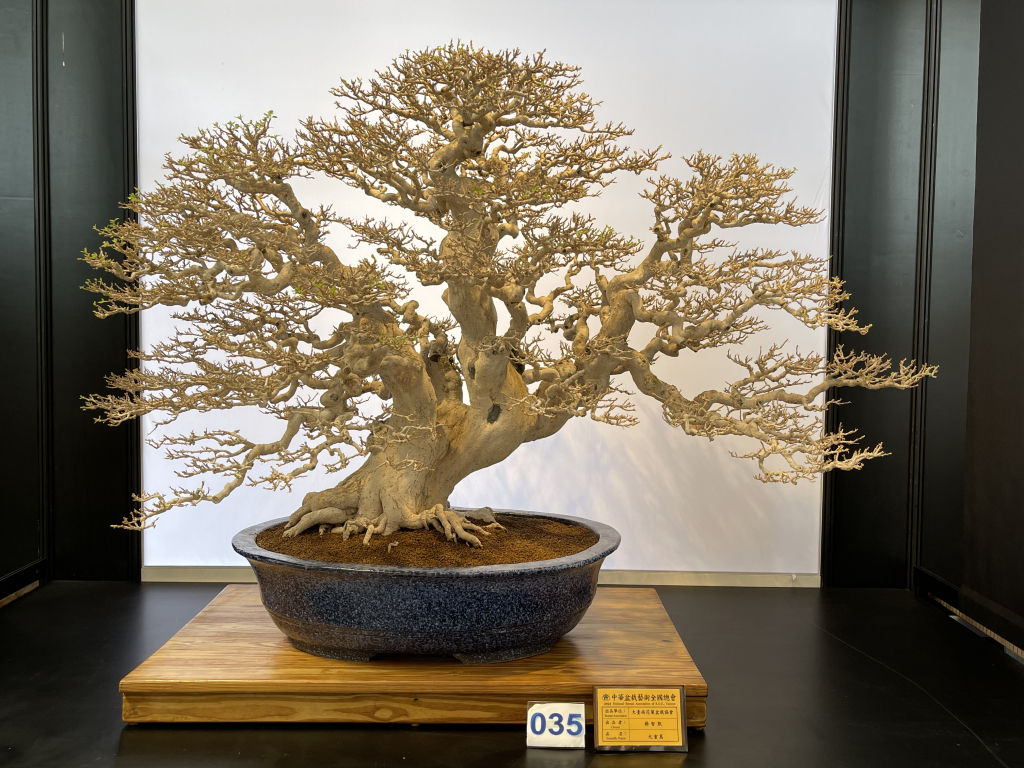
Hwa Fong Exihibition 2022:

Here is work (a chinese elm) from Zhao Che, the penjing curator of the Huntington Gardens. He does excellent work in the “lignan” style. Notice the aggressive movement in the primary lines. They hold much more visual weight compared to some Japanese counterparts.

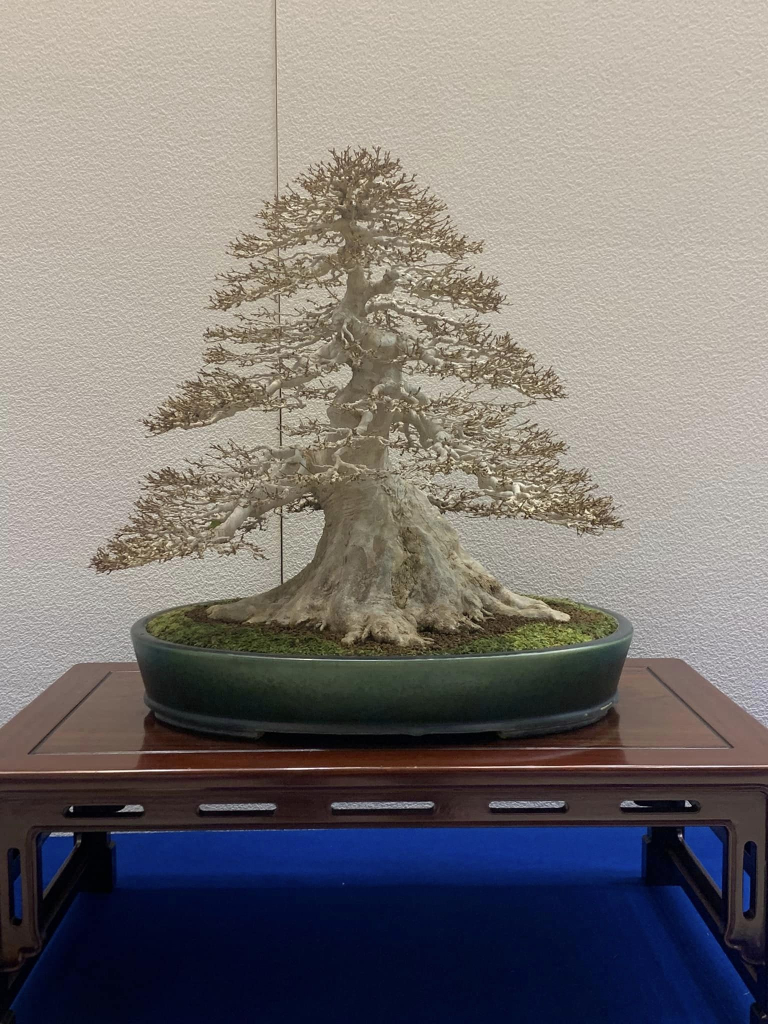
To contrast, a zelkova from Kokufu (2019):

I chose to contrast these two trees as they exhibit similarly high degrees of ramification but exhibit difference in the primary branch movement and net directionality of the tree. Visual weight and focus can be created through movement. We can consider the movement to be anchors in the primary lines. Primary lines are to the shape of a tree as framing is to a house. Without it, the design will collapse.

This is not to say one method is better than another, rather these are aspects in branch building that can influence how the tree looks. From my cultural experiences and understanding, in Japan there is this essence of quiet beauty. Rather than bold statement or expressions, beauty is in the subtleties. There is a criticism of bonsai in Japan as being too craft derived and through this pursuit of perfection, producing highly ramified “ultra-manicured” trees. But perhaps its this extreme juxtaposition of perfection as a craft against an organic, living, and forever changing life form that makes bonsai in the Japanese scope so widely appreciated. Think about wabi-sabi where there is this appreciation of transience and imperfection. Or in the Japanese tea ceremony where more “ordinary” everyday ceramic vessels began being employed instead of these highly valuable antique Chinese ceramics. There is a subtle beauty to be appreciated through this approach and in a sense this feeling of naturalness and belonging of the tree–through a very manipulative and unnatural means! I talked more about my general bonsai philosophy in my last post linked here: Good Bonsai Takes Time


*Ishitsuki momiji from Kouka-en, apprenticeship circa 2019

In many penjing trees stylistically there is more creativity which is observed in the primary lines and shapes. This may also relate to the study of calligraphy and by extension the emphasis and beauty in lines in the tree. The forms are more diverse, but technically no bit inferior to Japanese bonsai. There are perhaps more cultural layers and influences, but my knowledge on this end is limited. If any of my readers know a bit on the history and cultural influences of penjing I’d love to hear your thoughts!

Below photos posted from “Black Scissors Bonsai.” Unfortunately the artist names were not shared, if you know the respective owners of the work please let me know so I can credit them.

For me, this is where I believe the potential lies and creativity of the artist in how they apply the craft. Note that I make the explicit distinction of application of craft to create art. Bonsai, as a growing and changing medium that is bound to rules of horticulture, will not achieve its pinnacle being approached as an static art. What kind of lines, movement, or shape do we want? Aggressive vs soft primary lines? Thickness? When do they start tapering? Density or ramification? Silhouette softness? From our own value set, cultural, or natural environmental influences we can take our inspiration into reality.

So oh yeah, why did I cut the tree? Well in context of the previous discussion, that trident exhibited coarse branch nodes which were both thick and long. The lines are visually not as interesting and the capacity for ramification is decreased.


*Branch internode length vary from 1-3 inches. For a 12 inch canopy radius I would only have 4-8 bifurcation intervals.

If I try to maintain the tree by only cutting the tips, it may marginally increase in density but the branch ends will grow even coarser and the tree quality will actually decrease. It can be argued that there was already a general tree form in place, but in my pursuit of bonsai as a professional I am constantly seeking to increase my skill and make trees at the highest level possible. Restarting the branches shorter will enable more space for increase in ramification as well as cut derived directional movement.


Its alive and budding! I opted to not repot the tree while doing these heavy cut backs. I acquired the tree out of leaf, but from not knowing the care last season and seeing dead branch tips implied that it may have grown weakly. To maximize backbud potential I chose to leave all the roots and will do root work next season after growing it strongly. The tree will be allowed to grow freely to generate strength and for me to evaluate the branching I have. It may be necessary to do some thread grafts and cut back further later. Future updates to come as I develop this tree!

There is still so much more to be said, and managing branching and internode length is not always as simple as just cutting a branch. It will relate to the species, stage of development, and care. Additionally one should ensure a branch is sufficiently thick enough before cutting. But I hope this article will get you thinking next time you work on your deciduous trees, and for you to act with greater intentionality towards your desired end goal!

  •  

How to Have Greater Success Doing Bonsai in LA–a discussion on care, climate, and practice

I wanted to share my thoughts, having had been a bonsai hobbyist turned professional, practicing bonsai in LA through my experience of engaging with hundreds of people through workshops and private work  as well as having worked on thousands of trees. This can apply to Southern California at broad, but may contain commonality towards the practice of bonsai as a whole. It is not my intention to paint all hobbyist of a region within a common brushstroke–rather to share my experience of locality based hurdles through observed experience.

Post Topic Index:
Climate Considerations
Disease Considerations
Chemical Product Recommendations
Water Quality
Addressing Water Quality
The Practice of Bonsai and “Maturing a tree”
Early Development 
Intermediate Development
Advanced Development/Refinement

I will break this down into 2 categories of critique:

First through the horticulture of bonsai as it pertains to the local climate, water quality, hardiness of species, and how we can evaluate all of the prior. Second is application of bonsai as a craft and an art–what can we enable in our practice to increase our long term success and enjoyment of bonsai?

As how all bonsai work should be derived from, we always consider the health of the tree first. With many Japanese and domestic trained professionals, as well as abundant information from the internet, we are inundated with the latest techniques, aesthetics, and bonsai trends. I think people are very eager to apply and show off their knowledge of techniques, but it is important to remember a technique is only a tool and it is rather the application of the tool that is more important than it’s use. Just as a chef with superb knife skills, but a terrible palate makes awful tasting food the practice of bonsai without understanding of motivation, purpose, and principal results in inferior trees. The most fundamental of this principal is the health of trees!

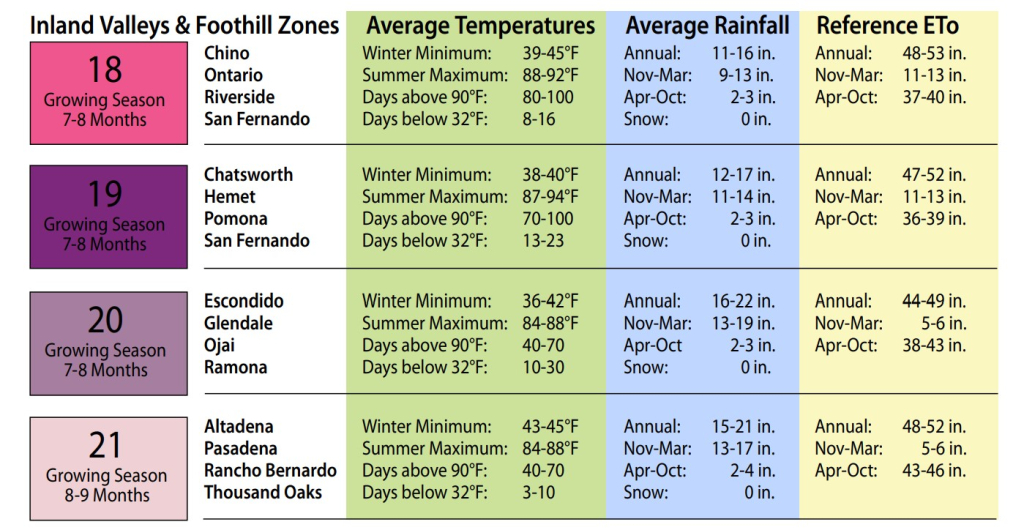
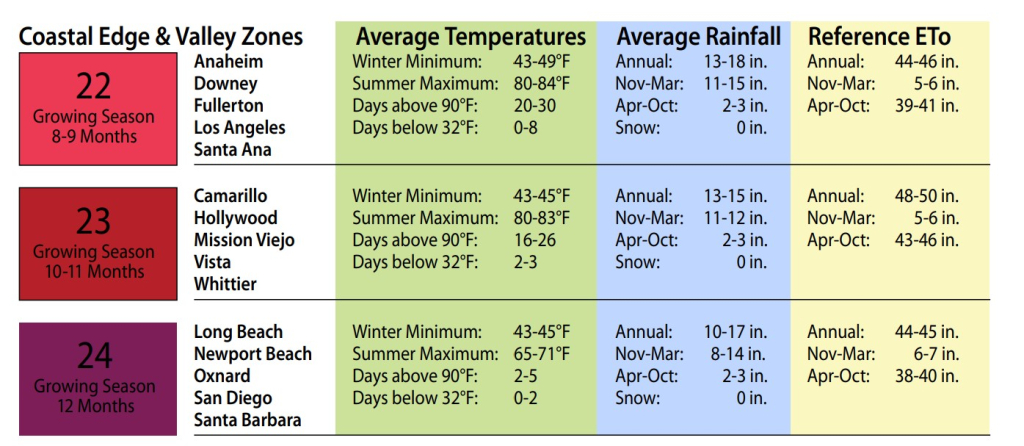
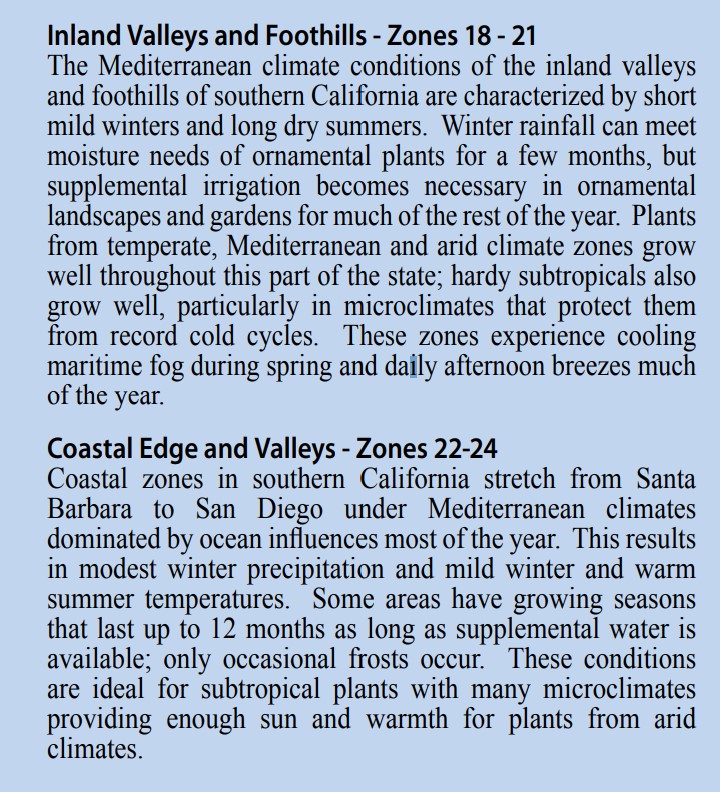
To start lets consider the climate of Southern California. We have quite a few microclimates (I will exclude the mountains and high desert which are the most deviant and have the smallest bonsai practitioner populace) which include coastal regions, low elevation hills, the valleys that lie in-between, and mountain foothills. In general Southern California is a mild, slightly temperate climate–deemed Mediterranean with low annual precipitation (mostly around winter) and arid weather. During the late spring to early summer months we experience significant marine layer as result of cool, moisture laden air coming off the ocean being trapped by hot air off the land. Your proximity to the coast then determines the amount of offshore humidity and subsequent reduction in temperature received. In general coastal climates will have greater overcast weather, higher humidity, and smaller range in temperature from the annual absolute low to high. Moving inland to low elevation foothills (500-1000 ft appx) such as the West LA hills or similarly low topography mountains, are less afflicted by deep marine layer with more sun, a wider temperature range but overall still mild. In between these 2 regions we have the valleys which are significantly hotter, with abundant sunshine and colder winter temperatures. Humidity is further decreased. Lastly we have the mountain foothills which exist on the fringe of the valleys against our large mountain ranges in the 800-2000 ft range. Climate in those regions are quite similar to the valleys but have lower winter temperatures.

The following pictures are from a free PDF provided by: https://landdesignpublishing.com/lpcg/
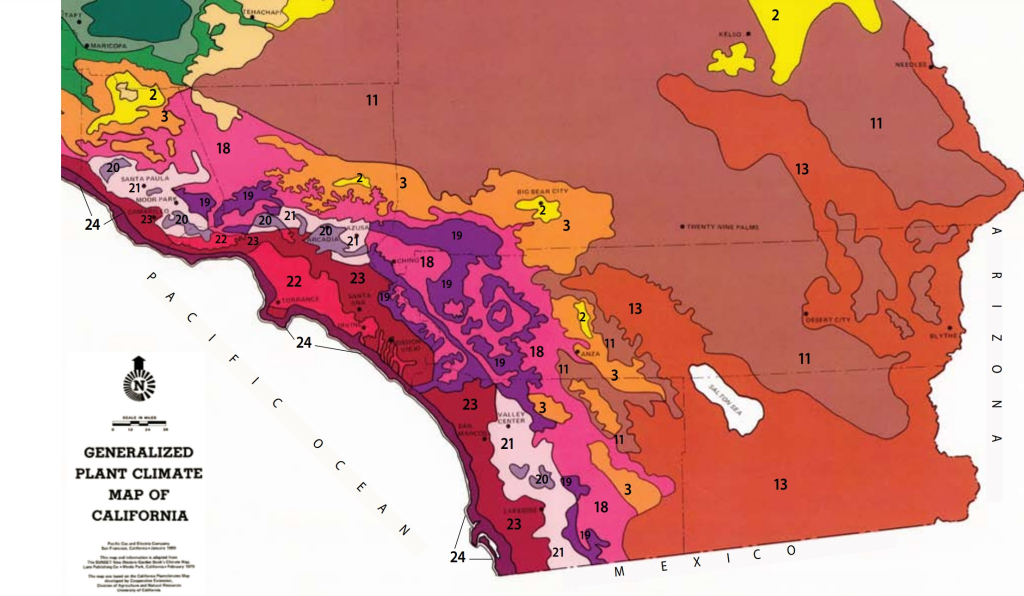
Climate Considerations:

Okay well that was a lot of information just on climate zones. How does this apply then to bonsai? Well we can first separate these by regions which are more or less temperate. The coastal regions and low elevation hills tend to be much more mild and winter temperatures seldom dropping below the high 40s. Trees that prefer some semblance of dormancy such as maples, prunus species, native mountain junipers, and others tend not to be as hearty. The valleys and mountain foothills are much colder in the winter, to the low 40s (occasionally high 30s). In general, short of tropical varieties most species benefit from some chill period and will grow heartier in the spring as a result. Even so temperatures are not truly cold enough for high mountain species like white and ponderosa pine.

Humidity levels also vary relative to your proximity to the coast which sometimes enable trees like black pines and high surface area junipers, like chinensis varieties (kishu, itoigawa) to grow faster, but some potential concerns with fungus. A big influence in growth characteristics and hardiness will be the amount of sun or our local marine layer which changes seasonally but generally is more dominant on the coast. Areas like the low elevation foothill or transition regions to the valleys tend to benefit from the humidity of the coast but are not burdened by marine layer and get great sun. These are great microclimates for many species, but tend to be mild overall in the absolute temperature range. More inland during intense summer heat shade cloth is absolutely necessary. But on the coast you might be able to get away not using it at all! This of course is relative to your sun exposure. Are you getting the full day of sun or windows cut off by buildings and surrounding land?

Disease Considerations:

There is another factor that relates to health I like to call disease pressure. Are you located in areas with minimal airflow or without daily breezes? Close proximity to industrial/dense residential areas? Cool humidity with not enough sunlight? It is important to note that there are pathogens everywhere, some harmful to plants and others not. There are introduced diseases from plant/food import and conversely, high elevation species or non native ornamental varieties may not have natural resilience to fungus/insects in our local areas. The best approach to deal with all these potential issues is just to grow your tree strong! Just as a strong immune system resists the abundant bacteria that surrounds us daily, a healthier tree will be more robust against disease. In short, a preventative approach is best! Although there are systemic fungicides and insecticides, in general application of these are more akin to treating symptoms as opposed to addressing the root cause. It’s like seeking dopamine hits for my depression instead of addressing the sources and working with my therapist, only that I don’t have a therapist.

BUT…inevitably it is impossible to grow trees in 100% perfection and health all the time, so here is a list of products I use and recommend. I just would advise that if your trees are constantly getting sick, maybe more chemicals is not the answer and you need to think about why its happening!

Chemical Product Recommendations:

Fungicides: Thiomyl based systemics (cleary’s 3336, bonide infuse-granular), mancozeb (great for blights, needle issues), immunox (powdery mildew, leaf spot), daconil (leaf curl/blights), zerotol (soil drenches, foliar spray), lime sulfur (dormant spray), copper (good general fungicide, but causes phytotoxicity and leaf deformation on soft/new deciduous growth)

Insecticides: Imidacloprid (systemic – bonide granular is the one I use), Malathion (aphids, leaf sucking bugs, also can use for root drenches), *Floramite (miticide – I strongly recommend a real dedicated miticide to deal with spider mites in Southern California)

*Often people are hesitant to buy dedicated miticides (this is NOT Bayer 3 in 1) because they are more pricey. Floramite for example is $120 for an 8 oz bottle, but the dilution rate is 1/4 tsp per gallon. For the average hobbyist that container of miticide will last you many years–if you have a lot of time and money invested in junipers it is a no brainer purchase instead of allowing your trees to get set back or destroyed by mites!

Water quality:

Water quality is a major issue in Southern California! Because we spend significant years in drought, water sources will shift between local ground water/reservoirs to “imported” or Colorado River water. If you’re lucky you get mountain run off/ground water which is the cleanest or in Carlsbad for example one of their sources is a desalination plant which is just a giant RO facility! But for the majority of socal residents, we have hard and akaline water! This makes deciduous trees such as Japanese maples notoriously hard to grow healthy in some areas with constant leaf deformation and fringe burning.

There are 3 general considerations to water quality. TDS, pH, and lastly mystery city ingredients.

TDS (Total Dissolved Salts):
This is the most impactful measure of water quality. TDS represents the all inclusive number of salts–not the stuff you put on your shitty mashed potatoes, but soluble ionic compounds, which may include calcium, magnesium, iron, manganese, etc

While our trees do need some degree of trace elements and “salts” in the water, a TDS value that is too high can have a negative effect. Looking back on our grade school science lessons, we learned about something called osmosis. Simply put, it is the diffusion of water across a semi-permeable membrane from a region of lower to higher concentration of solutes.

In theory if the water surrounding the roots have a high enough solute concentration, think sea water, the roots can actually desiccate and water will be removed. What this implies for high TDS city water however, is that the mobility or efficiency of the tree to uptake and move water is reduced. Additionally high TDS may contain salts/micronutrients in too great of an excess resulting in phytotoxicity.

Here are some TDS ranges:

Distilled Water: 0 ppm
RO Water: 5-30 ppm
Bottled Drinking Water: 15 ppm
Local Groundwater (natural source): 180-300 ppm
Imported Reservoir Water: 300-550 ppm (water that travels great distances have more dissolved minerals/salts in it)

Generally about 50-150 ppm is a good range to be in that contains enough dissolved salts to provide the tree micronutrients, but not so much in excess. Roughly 200 ppm is my observed max that Japanese maples still are okay in (not great). Over 300 ppm your deciduous trees will struggle and not grow as hearty.

pH:

A lot of people misunderstand pH what it means for the plant. We know that the acidic range of pH is 1-6.9 while the alkaline or basic range is 7.1-14. What pH is doing is determining the solubility of different micronutrients in the water and thus the plants ability to access it. A way to imagine this is pouring salt in a cup of water. After stirring it a lot it dissolves into the water and thus we say it is soluble. For discussion sake imagine that after stirring that cup that the salt your poured in still remained. That would be insoluble, in its precipitated crystal mashed potato additive form. Plants can access nutrients that are soluble, but not as mashed potato dressing.

This graph shows the different solubilities of common micronutrients across the full pH range. Thinner is less, thicker is more. Hint hint. Notice in the pH 8-9 range, commonly what city water is at there is a very high amount of soluble calcium and magnesium. Hmm makes sense with those white stains on our pots. Looking at iron the bar, it is very thin in this range. It is no mistake that when you buy soil acidifier products, they contain large amounts of iron! It is to make up for the deficit in these alkaline pH ranges.

A lot of literature, plant people, and professionals recommend a pH range around 6.5. Looking at the graph we can see that there is a little bit of everything available in that range. The sweet spot!

Mystery City Ingredients:

This is 100% anecdotal and speculation, so I don’t have clear quantifiable explanations here. But generally speaking, many counties will disinfect their water with algicides, bactericides, chlorine, and other chemicals that are deemed safe for humans in low enough ppm ranges but potentially can be phytotoxic or harmful for plants. This is not so measurable, but I believe it is another factor at play in water quality.

Addressing Water Quality:

So if we do not have access to good water quality, what are ways we can mitigate these issues? Solutions and trades offs listed below.

RO Water:

Pros – The brute force method of water filtration, will remove 95% of all salts in tap water. Filters can last years in bonsai use. Creates very pure water and clean slate to modify with micronutrients or fertilizers. When solute level of water is very low, not necessary to pH water either. Soil environment will dictate pH for clean, non salt buffered water.
Cons – Wastes water, RO systems use a back line to flush the filters. Initial cost can be expensive
Verdict – Recommended, but if you have a large number of trees the wasted water can be a concern

Dosatron Injection Systems or Siphon Systems:

Pros – Can introduce varying degrees of controlled injection of a fertilizer or acid into water line. Can correct for pH issues.
Cons – Does not address TDS, which is main pressing factor for water quality
Verdict – Recommended if your city water TDS is not too high and you just need to correct for pH. If RO is not practical or too expensive pH-ing your water to a slightly acidic range is still better than if you did nothing

Polyphosphate Water Softeners:

Pros – Cheap, polyphosphate beads form complexes with solutes in water that flush out without binding to surface. No hard water stains!
Cons – Changes water chemistry, not only binds to calcium and magnesium but other micronutrients as well. Tree may have growth deformities.
Verdict – Not recommended (I tested this for 1.5 years on my own trees). Maybe for a drip or soaker hose irrigation that you use when you are busy or traveling to prevent calcium clogging, but not good as a primary water treatment

Carbon Filters:

Pros – Cheap, removes chlorine, heavy metals, perhaps the mystery ninja turtle creating compounds in the water.
Cons – No effect on TDS or pH
Verdict – Recommended, but not as a primary treatment of poor water quality. Can be used in conjunction to previous methods.

Hardiness Tier List of Common Species for SoCal (recommended varieties)

Junipers: Very hardy, cold temperatures preferred but not necessary. Tolerates wider TDS range. Spider mites can be problematic. Native California junipers quite strong except on coastal regions. Procumbens, San Jose, and prostrata very strong also and acceptable in most micro climates. Chinensis varieties like kishu resists fungus more but can get heavy spider mites. Itoigawa resists spider mites but more susceptible to blight. Necessary to experiment to determine which one is better in your local area.
Oaks and Olives: Hardy, semi tolerant of high TDS . Likes heat and sun, not idea in coastal marine layer belt. Best in valley and transition zones.
Elms: Hearty, semi tolerant of high TDS. Will grow in most microclimates. (includes chinese elm, winged/texas elm)
Black Pines: Tolerant of high TDS and pH, but highly influenced by local microclimate. Low elevation foothill/transition region is best micro climate, valleys and coastal produce comparable growth, they like sun and heat. Can be fungus susceptible. Mycorrhizae does not develop in city water in socal, but can show up with RO. Clean water makes things easier but I have found through customers black pines thriving on otherwise very poor water. Tricky overall but if it does grow well in your area, it can be a very hearty choice.
Pomegranates: Hardy, semi tolerant of high TDS like oaks. Likes heat and sun, bad choice for coastal belt
Tropicals (Ficus, bougainvillea, etc): Not happy below high 40s, but tolerant of wide TDS range and will grow in most socal micro climates. Trees can get leggy and slow to develop in high marine layer climates however.

(I will add to this in the future and also include a list of trees which can be grown well with treated water)

Topic 2, The Practice of Bonsai

Now onto the second consideration, how do we practice bonsai as a craft turned art? I believe often that we are very much in an instant gratification society. This is not necessarily a bad thing, as the pursuit of efficacy, efficiency, and the production and subsequent packaging of information, technology, and food have often lead to great societal advances. It is easy to take for granted, as an end user consumer, the innumerous years of engineering, ingenuity, and hard work it takes to develop products and information we use everyday. I believe this also applies to bonsai. We see so many great photos of bonsai online and naturally, are inspired to make creations of our own. In absence of seeing great trees in person, as well as the ability to see or ask how it was made, we have nothing to go off of other than the apparent aesthetic–this is especially true for self practicing hobbyists. Bonsai however is an iterative and emergent art whereby application of the craft in stages, the final aesthetic is realized (this process can range from a few years to several decades). Taking a “front-end” approach or aesthetic motivated design practices bonsai as a pure art, such as a painting or sculpture that can be realized and maintained in “one iteration.”
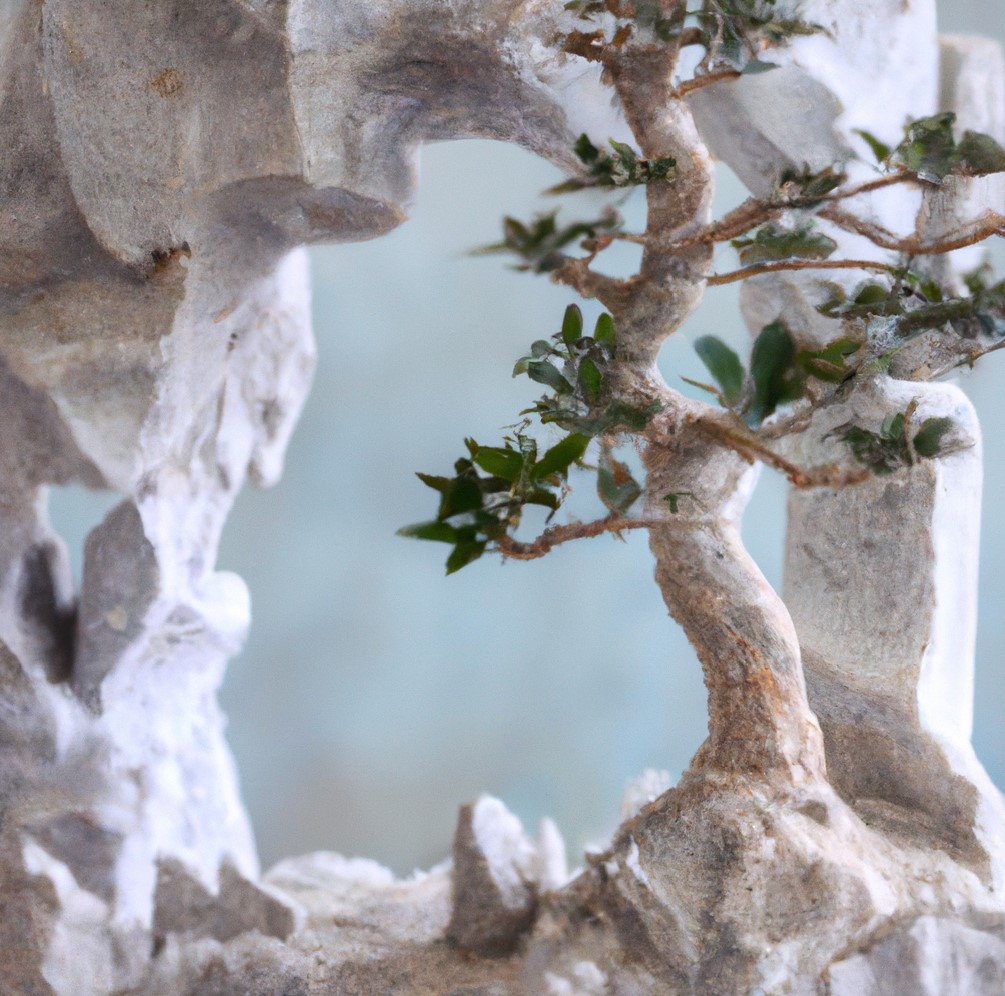
My observation is that frequently trees that lack maturity, the necessary branching, the necessary health, are prematurely styled or forced into a finish aesthetic. We can wire, manipulate, and style branches to fit into a desired silhouette and aesthetic. This is fine if the tree could be maintained in perpetuity, however the reality is that all trees will continuously change and grow! A discuss this concept in my previous blog articles as well.

Maturing a bonsai + what stage is it at?

It is important to assess what stage your tree is at. Am I building the core features that may minimally change over the long term? Think trunk line, roots, and primary branching that can build the foundation of a design. Do I need to thicken the trunk? Create taper? Develop deadwood/lifelines (for junipers)? Thicken main branches (showing thick primary branch lines carry visual weight and can help convey age)? Do I need physically more compact growth? Smaller internodes? Earlier foliage origin point? It is important to invest time to develop these features that will result in a higher quality, more sustainable, and older looking tree. I call this maturing the tree. Would you drink the first decant of a freshly distilled hard liquor?! Maybe!!! But you also might go blind, destroy your liver…or die! Haha just kidding doing instant bonsai is not gonna kill ya. There is value in maturing a tree as opposed to rushing for a finished aesthetic. In bonsai there are not that many true shortcuts–they all entail some form of a trade off.

I have observed many practitioners so eager for the finished image, that the future is sacrificed as a result and the tree constantly cycles through stages of intermediate refinement and getting “restarted” every few years. Essentially a tree that no matter how many years you work on it, will never mature or improve. I say this not as a discouragement to bonsai, but rather that we should enjoy the process of creating trees and having nice bonsai will be a natural result.

Examples of early development

Growing trunk:
This may entail management of chops and thinning to direct growth, but more or less a tree is being grown strongly and less restricted.

Cork Oak trunk, 2015 or 2016 pre apprenticeship

Developing roots:
Nebari can actually be continuously matured overtime, but the initial stages may involve developing the some degree of lateral root mass. Another consideration is the transition of trees from field grown/container situations to eventually bonsai pots, as well as the ability to get a tree in the smallest pot possible. Do you have a well ramified dense feeder root system immediate to your trunk? Is space being wasted by large tap roots? Building a compact and healthy root system means in the confined space of a bonsai pot, the tree has greater ability to thrive.

Trident maple nebari, circa Kouka-en 2018 apprenticeship

Developing branches:
Perhaps the most susceptible area for mistakes, branch development is influenced by species and can be tricky. For deciduous do the initial primary segments have sufficient thickness? Depends on the size of a tree but often a primary branch may need to grow for years before the first cut! Branch thickness for the primary line has some relevance in conifers as well as the degree of lignified mass also determines whether a branch flops in the absence of wire.

Cork Oak, potted version of this one year later is in my work portfolio. Still necessary to thicken some primary branches. Those branches I ended up growing close to 4 years before I finally decided to cut it from the first photo.

Examples of Intermediate Development:

Trunk lines, directionality, and/or taper should be established. We can start considering branch placement and design–also where is the origin point of foliage? Is necessarily compact or needlessly long? Perhaps through cut back, a good state of health, or structural wire we can produce foliage where desired. In general wiring of primary branch lines can involve a lot of creative bending (conifers) but once you get to the foliage bearing lines, the structure must be clean for sustainable design.

Secondary branch placement is being set, which is perhaps the future foliage pad bearing branch or in deciduous work we may be creating taper, cut derived movement in branches, and/or the starting bifurcations.

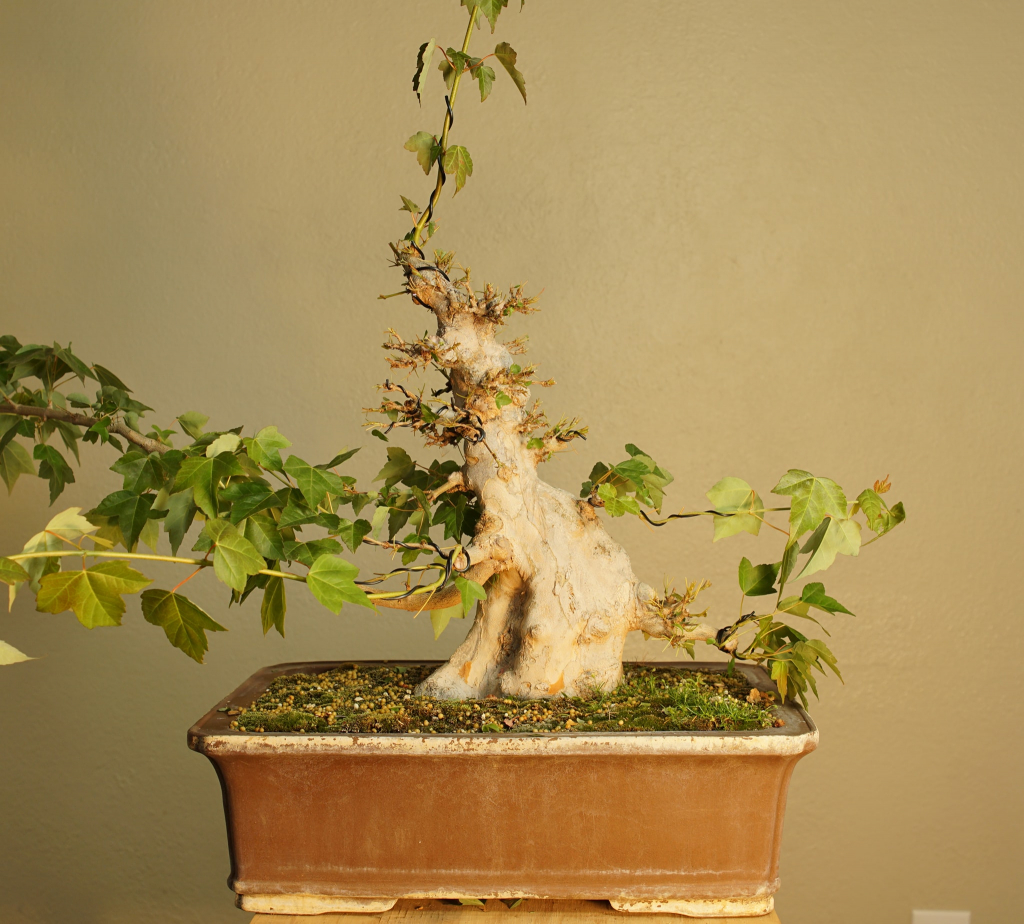
Branch building on trident maple:
Structural work, repotting, and setting up branches on redwood (work carried out over 6 months). Some regions left long to thicken.

Examples of Advanced Development or Refinement:

At this stage all the elements or building blocks of our design are present. Even major restylings are dependent upon available branching for cleanliness of the desired design. Deciduous may start focusing on density, the outer silhouette, as well as the softness or fineness of the branch tips. We can really start to showcase age at this step, rather then just a shell of foliage it is important to show off interesting branch lines (that we built in the previous steps) as well as fine branching that supports the foliage.

You must assess which stage of development your tree is at and the necessary work involved, or buy a tree which has adequate maturity from the point which you’d like to continue development.

Some black pine wire work, circa Kouka-en apprenticeship 2019


One of my favorite trees, a bunjin procumbens juniper styled post apprenticeship 2022:


Well that was another long one. I don’t write too often these days, but when I do it will always be a high quality substantial article. I hope this was of interest and provided some good food for thought. Blessed may you be in your bonsai journey.

  •  

What is the value of a public bonsai collection? Biopic, narrative, and philosophy

I wrote this article for a newsletter with the GSBF Clark Bonsai collection last summer. I had meant to share it on my blog, but my professional life has been very hectic and intense (fortunately mostly good) and the article escaped me. I’ve been thinking a lot recently that there is a significant percentage of the American bonsai demographic in their 70s. Many of these individuals are understated backbones of local bonsai communities who have done a lot to promote and support bonsai. The reality is many of these individuals will slowly begin aging out of the hobby–it’s neither a bad nor good thing, but just to be expected with life. Although I have my own qualms and disagreements with old school style clubs and orgs, I can appreciate dedication some of these members have invested to grow our local communities. One part of that is our public bonsai collections. Public collections can create a space for collaborative effort between hobbyists and professionals, but even greater they probably are the best outlet for direct exposure to the general public. Everyone starts from nothing, and seeing that first bonsai could be the catalyst for creating a future supporter of our community. As much passion people have, life is short for all and as older members age out public resources we took for granted can disappear! This article is a plea to consider supporting your local collection–whether by volunteering, donating, or even just visiting. Older members are always ecstatic to see younger faces interested and helping out, and there is always work to be done. That said I hope this biopic and narrative is enjoyable!

*I was not able to perfectly match photos to the narrative, some photos are from the winter although this narrative is based in the summer. I did not have pictures from when I wrote this article, incase you’re wondering about the bare trees and roots!
It’s midday in the central valley. Following a record and uncharacteristic California winter, temperatures are beginning to rise. The air feels dense, and seeking respite from the heat an older gentleman sits beneath a deep pavilion. His name is Bob Hilvers, who curates the Clark Bonsai Collection located in the Shinzen Gardens.

His hands and body, having weathered a long career prior to and within bonsai, bears signs of age. His expression is stern, but even so there is a great eagerness and passion emanating from Hilvers, who has dedicated over 20 years cultivating and curating these trees. Surrounding Bob is a team of volunteers, of varying backgrounds and ages, but all bearing wide smiles sharing a common passion for the art of bonsai.

The atmosphere is energetic and lively, quite the juxtaposition against these seemingly timeless and unchanging trees. I asked long-time volunteer Linda Jacobsen about her feelings about working at this collection. She replied, “Having been a docent for the Clark Collections of both art and bonsai since 2010, for me personally, I feel proud of continuing the legacy of the Clarks whose mission was to   preserve and promote the art and culture of Japan. Every day in the bonsai garden it is a great pleasure to witness the admiration and delight of our visitors experiencing the beauty of the garden and the art of bonsai in this great variety and quality, most for the first time.”


All the volunteers seem to share similar thoughts to one extent or another and are compelled by these small trees. From this one layer of value we can infer from a public bonsai collection is engagement with the community–professionals, volunteers, and visitors. It is a very human aspect to share passion for common goals and interests. But I think the value goes a bit deeper than this, because community engagement is obtainable in all manners of interests, and perhaps more easily done with other mediums. After talking with visitors, who may have little to no knowledge about bonsai, a common observed sentiment to bonsai is some sense of awe and even bewilderment. I believe there are two layers to this. First from not being knowledgeable about the art of bonsai and curious as to where the trees came from and how they were made.

The second aspect, especially for the very attuned or “present” visitor, is this inexplicable attraction and beauty. On the surface, one can easily agree that the bonsai are beautiful. But is there more than meets the eye? It may be presumptuous of me but let me infer the second aspect. Bonsai is a unique art form with no equal–that is, as a living art. We are contending with nature, to borrow her beauty, but also subject to her whims. A tree is forever growing, forever changing, despite what intentions we have planned. While one may visit a gallery to witness an artist’s work in its immutable greatness, a bonsai is quite literally alive and will change for better and worse.

There is this concept called “wabi-sabi” in Japan which in simple terms describes imperfections and qualities brought about by age. Think of a weathered stone pathway, whose once sharp edges are now soft and further covered by lichen and moss. Or perhaps the patina on an antique watch or set of tools. Wabi-sabi finds beauty in impermanence, in acceptance of the natural flaws and passage of time in this world. Bonsai embodies the values of wabi-sabi and gives us a unique opportunity to appreciate age. We value the weathered trunks, fine branches, and fissured bark in a life that is often as old if not older than ourselves. There is an expression of seasonality throughout the year (think fall colors, bare branches in winter, and the green vigor of spring and summer), but also a broader story of how the tree developed and changed overtime. As we celebrate bonsai, more than just an art, we are celebrating life. No different than in a person who similarly ages and changes over time. I’d like to imagine that unknowingly, as a visitor gazes upon and appreciates a bonsai they in turn appreciate themselves. Or maybe that is just my hope. In an increasingly fast paced world with all manners of media and medium, bonsai offers a unique opportunity to slow down, to engage with art, nature, time, and ourselves. A public collection such as the Clark Bonsai Collection creates a space for this engagement where not only trees, but people can be cultivated.

  •  

Will watering the foliage of my bonsai on a hot day burn the leaves?

These thoughts have been cooking in my brain the past year and I haven’t really had time to put it in text. This is purely a discussion and model on paper, not reaffirmed through live, multiple sample, multi-variable experiments. Bonsai is largely anecdotal which there is nothing wrong with. Something is to be said about the multi-generation, accrued experience that refine techniques and allow bonsai to be practiced at the highest levels where it is today. But anecdotal knowledge is just that. A personal account or observed response to a set of conditions experienced by that individual. While it can bear truths and contain value, we should be hesitant to extrapolate such knowledge quickly without a BIG contextual and considered asterisk that says BUT. 

In the midst of a state wide, maybe historic, heat wave I wanted to talk about watering the foliage in hot weather. It’s a contested statement of whether you should water foliage or not, with observations of the foliage getting burned. The commonly attributed reason for such is that water droplets create magnifying glasses. This is unlikely to be the case as bound droplets to leaf surface are unable to create a centered and concentrated beam of light. Exceptions would be plants with very extended stem/leaf hairs or very waxy or hydrophobic leaf surfaces that result in suspended or more spherical water droplets.

Both in my discussions with other professionals, even my Oyakata in Japan, had told me not to water foliage when the temperature is very high. Personally I’ve observed some small amounts of burning post foliar watering on a hot day, but not consistently and not on everything. Also the tree may have just been normally sunburned, it’s hard for me to conclude it was from the water. And I probably won’t run an experiment to see what conditions will burn my bonsai. This really made me think about under what conditions this may be held true and if it has any relevance or warranting concern for bonsai practitioners.

My thought for a long time was that the most efficient mechanism for a plant or foliage to cool itself is via transpiration of water via the stomata into the air. Water within a leaf typically maintains at or near saturation (think 100% humidity), which is typically higher than ambient conditions. Because of the difference in vapor pressure, water is then transpired out of the leaf and through that process pulling heat out of the plant. When we coat foliage with water, we’re not just cooling the foliage but changing the mechanism by which heat is transferred. 

a mountain covered in clouds and trees

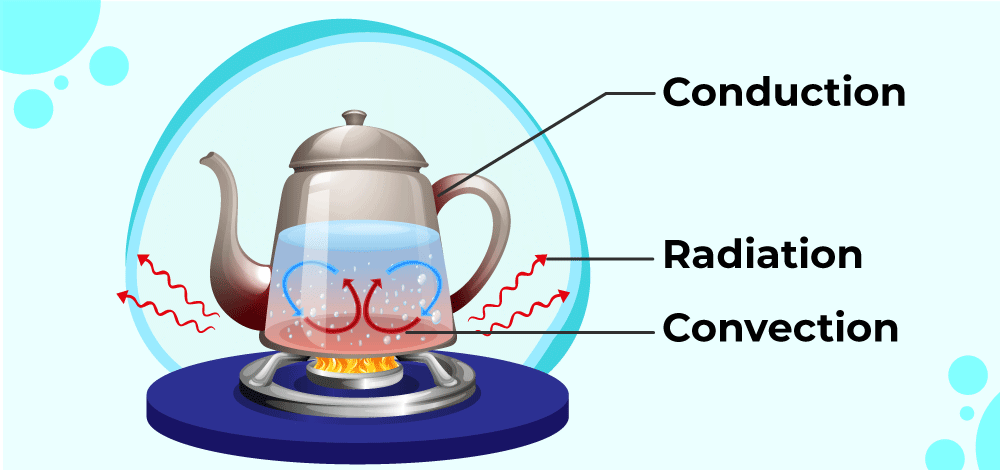
Let’s consider all the major mechanisms for heat transfer in the model of a leaf. Firstly, there is radiation which is generated from the sun hitting the leaf surface, some of which is reflected. Heat can then be transferred via conduction or migration between other solid/liquid interfaces. There is convection occurring with the air and water. And lastly evaporation or transpiration from the stomata. 

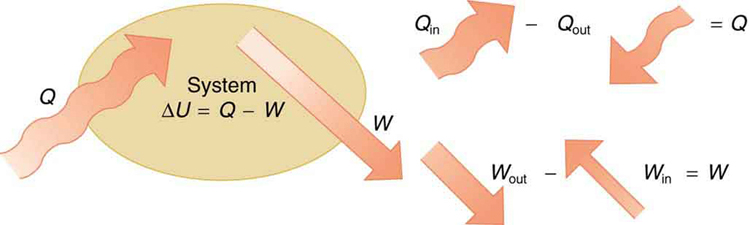
We can say for a steady state system where energy in = energy out

The First Law of Thermodynamics | Physics


Thermal Energy gained = Thermal Energy loss

Absorbed radiation = reflected radiation + convection + conduction + evaporation


When foliage is covered with water, for the covered stomata bearing surface area we are effectively halting transpiration which relies on a vapor pressure difference of water in the leaf vs outside of the leaf. With “ 100% ” water on both sides nothing is then transpired. Heat then must rely on existing methods of convection (heat transfer via the air) as well as conduction+convection through the leaf water-droplet interface. 

What we must discern is whether the heat transferred by means of conduction and convection through water is greater than that of the transpiration through the now covered stomata. Does the plant cool faster with water droplets coating the leaf or are existing mechanisms of transpiration and convection more efficient? If the latter is true it means your plant cools faster with wet foliage. If not it means by watering your foliage you actually decrease the rate of cooling in the leaf, which conditionally could be detrimental to its health. Exceeding temperatures of 42C or 107F many temperate species may experience degradation of metabolic processes, denaturing of proteins, and other irreversible damage.

I’ll be completely honest in that I only took one course in thermodynamics in college and I forgot almost everything. Fortunately for me, the energy model of a leaf has already been modeled and we can vet this idea with hypothetical numbers and existing literature. This article consists of my thoughts after affirming a concept with existing literature. 

I will skip defining all the variables and just review the relevant concepts and factors. As previously discussed, a leaf absorbs thermal radiation from the sun. While some is reflected, this absorbed heat exits the leaf through 2 primary mechanisms. Convection via the leaf air interface and transpiration through the stomata. 

Convection - Definition, Heat Transfer, Types, Examples, and FAQs

An assumption I will make here is that the difference from cooling by air is negligible from cooling by water. This is not necessarily true, as convection by water is significantly more efficient than air. However there is more to factor such as wind speed and temperature of ambient air and water. This starts to complicate this discussion, so we’ll simplify this case study and purely evaluate how impactful transpiration is. 

Firstly to restate, Heat in = Heat out

So the thermal energy or radiation from the sun causes the leaf temperature to increase. This accrued heat can be released by means of transpiration, convection, and minimally reflected off the leaf. I will reference literature where the leaf temperature is evaluated with and without the presence of transpiration, at different values of total absorbed radiation defined by Q in W/m^2. Just think of the last part as different sun intensities. Here is the defined model for reference:

Anyways we’ll just review the relevant parts. 

First let’s define how hot the leaf gets if the leaf was in a vacuum and could not cooled by convection or transpiration. 

For Q = 800 W/m2 the leaf temperature is 75.2 C

For Q = 600 W/m2 the leaf temperature is 51.1 C

For Q = 400 W/m2 the leaft temperature is 19.8 C

Now let’s add in convection, while omitting the effects of transpiration. By using the following formula we can see how only convection, or transfer of heat via the leaf to air interface, influences leaf temperature. As a brief note at higher wind velocities (V) and smaller leaf diameters (D) both transpiration and convection rates are increased. This is not relevant to what we are vetting, but the successive charts map the leaf temperature influence at varying V/D ratios.

Anyways we can observe that convection definitely plays a role in cooling leaf temperature. This effect is increased for small leaf diameters or high wind velocities. We can also make another inference. When sunlight is very low such as in the evenings (Q = 400), the ambient air temperature is higher than the leaf temp. This results in the leaf temperature increasing.

And finally we can incorporate the effects of transpiration. We have to draw some additional assumptions about the relative humidity or humidity outside of the leaf, as well as resistance to water leaving the leaf. In this model rH was defined as 50% and r = 100 s/m

This is too many numbers for some people so just just focus on the relevant columns. The temperature difference with and without transpiration for V/D = 1

Notice there is an observed 40% additional reduction in leaf temperature for the highest observed Q value. The relative difference between transpiration and convection is diminished as Q decreases. Another pertinent note from the original chart, that when V/D is high or conditions are very windy or leaf diameter is very thin/small the relative difference between transpiration and convection is also diminished.  

So what does this mean? At higher temperatures, transpiration plays a significant role in cooling of the leaf compared to solely convection by air. This suggests that at extreme weather conditions, let’s say in excess of 100+ F if we water our foliage with water, conditionally this may result in heat being trapped LONGER in the foliage. Assuming the non transpired heat is significant enough, this can attribute to damage in the foliage or burning! So maybe, just maybe as the reality of climate change/instability is readily observable and more hobbyists experience extreme heat watering the foliage may not be a good idea. Perhaps utilizing things like shade cloth to protect foliage or insulating pots with towels/cloth to prevent them from heating in the sun is a more reliable method. And if you are going to water the foliage of your plants anyways, DRENCH them so you can utilize the cooling effects of convection by water to the fullest and immediately cool the foliage. Misting plants in 100 degree weather is probably the worst option, as micronized droplets will quickly adjust to ambient air temperature so you get less cooling benefit and you also prevent transpiration. ***Additional notes in the end

Additionally I noted that for thinner leaf types or in windy conditions the effect of transpiration is diminished. The referenced article discusses this in regards to boundary layer resistance of air around the foliage, I won’t discuss this in my post but you can read it yourself if interested. There is a secondary implication I wanted to state that as the plant loses water/turgidity and the internal vapor pressure of water is reduced, convection plays a more significant role compared to transpiration. Trees also have an internal mechanism to close the stomata if the water deficit is too high. This is problematic as the tree loses 1 mechanism to cool itself. 

But in average temperate climates, especially if you are not experiencing extreme heat this concern is less relevant. I will still water the foliage of my plants in low 90 degree weather with no observable detriment. Anyways, just food for thought. Think critically, and clearly. In reality, we are all just dabbling and making inferences from our observations.

For people who just only read the conclusion here is my synopsis:

In 100+ temperatures on temperate species do not mist the foliage of your trees. If you do water the foliage, drench the foliage and ensure the water coming out of your hose is not warm or hot. Sub 100 temps it is highly unlikely that watering your foliage will burn the leaves. In hot weather it is likely more effective to keep trees well watered and roots cool as well as utilize shade cloth, so that the plant can continue to transpire and cool itself.  

Up next I’m going to feed my bonsai an infusion of HB-101, decomposed cat food, while whispering to my trees everyday and tell you how healthy it will make my trees. 


Reference: See chapter 11

University of Washington Center for Quantitative Science, Updated by the TrEnCh Project. (2020b, November 23). Physical Processes in ecosystems https://bookdown.org/huckley/Physical_Processes_In_Ecosystems/


***Regarding some of my comments, I hypothesized that in misting the foliage in high temperatures there could be an ill effect where small water droplets (quickly adjusting to ambient temperature conditions) landing on the leaf prevent transpiration while not providing significant enough cooling benefit. This would result in a net decrease rate in loss of heat which could cause the foliage to burn.

I posted this article on my social media and received some great comments from Addison Galambos to point out some holes in my statements. First is that there is still evaporative heat loss from the water on the foliage. Evaporation is a similar mechanism to transpiration however as a physical process its not subject to the resistance of water moving through the plant tissue and is more efficient. Water would evaporate, drawing heat from the leaf, perhaps minimally by natural convection from the air, as well as direct radiation from the sun. It would be interesting to compare the rate of heat loss compared to transpiration (which is primarily transferring heat from out of the leaf) vs evaporation which is more efficient, involving higher local amounts of water, but also is transferring heat from 2 additional sources not just the leaf.

  •  

Thoughts After Retrieving Bonsai From a Fire

There are many things that have been weighing heavily on my mind over the past few months. My thoughts culminated after these devastating fires in LA that resulted in the destruction of many homes, including those of friends and clients. I am thankfully safe, as are my family and loved ones.

We live in a highly modern world. Of course, not everyone does, but relative to past generations, there is more abundant food, amenities, and a general semblance of material wealth and accessibility. Those of us, including myself, who lead these great privileged lives often take for granted where such abundance comes from and the consequent impact from procuration and consumption of such. I am a firm believer that in every facet of life, the quote, “there is no free lunch,” holds true.

Last year I was introduced to this substack which is a compilation of considered, critical analysis on the progression of modern human society which is also correlated to discovery and consumption of different fuel sources. I haven’t even delved past the initial writings, but it is perhaps the best modern take on our world I have found that is non politicized with a critical big picture view.

https://postdoomprimer.substack.com/

It delves deeply into describing our labor model, where most modern societies have an inverted labor pool—that is, primary and secondary needs such as farming, food distribution, and construction represent a small percentage of the total labor force, while tertiary work such as HR, IT, and accounting constitutes the majority. The inherent instability is pseudo supported by post-industrial revolution innovations and the high and efficient use of fossil fuels, including manufacturing, plastics, resource extraction, and direct fuel consumption, that leverage our production ability multi-fold. This system looks great on paper and has given us many modern-day conveniences and luxuries. Those who aligned themselves with such innovations or invested in the markets during such times experienced unparalleled economic gain. However, there is no such thing as infinite growth. The modern-day gains we enjoy are built upon the destruction of the natural world, resulting in measurable and notable effects.

I believe that overall, people today are more educated, with greater wisdom available to us. However, in modern society, we are increasingly itemized and individualized. We are so self-centered, contending with issues of identity (and I mean no disrespect), and discourse is conducted with a lack of respect for one another. I try not to be jaded. I believe people are fundamentally well-intentioned, so I lend the benefit of the doubt. People carry beliefs shaped by their life experiences and from which conduct themselves accordingly to the standards they believe are good. Overall, my life experience has shown me this to be true. I work with an incredibly diverse cross-section of people spanning ages 20s to 80s, from various ethnic, cultural, and socioeconomic backgrounds, and with differing political biases. Yet, reality feels more combative. The world is increasingly chaotic, and an abundance of information does not correlate with an increased ability to process it all. Amid this chaos, we tend to dig in our heels and take a “me versus you” stance. A great quote I recently heard is that while society as a whole is materially wealthy, we are both spiritually and emotionally poorer than ever.

Usually, when some major or tragic weather event is on the news, I think about it briefly, but I soon forget and go on with my life. I tell myself that there isn’t much I can do, and the more immediate and pressing needs in my life get addressed. Last night, we were hit with the double whammy of incredibly strong Santa Ana winds, comparable to those of 2011, and fires. There could not have been worse timing or combination.

Southern California has not received any notable rain since February 2024. In what should be our rainy season, in this very brief window of the entire year, there is no rain. It is beyond dry. I have asked myself, and discussed with others, after witnessing this complete destruction, how we should feel about it. Common sentiments are as follows: “Nature is indiscriminate”—this is true. “There is no reason; it is just senseless.” But I have come to realize that there are some reasons for this. Weather is inherently more unstable these days, and it is closer to the norm, not the outlier, to have years of record rain followed by years of drought.

Practicing bonsai, to some level, requires good awareness of seasonality and the weather. I’ve discussed this topic with all my bonsai friends in every state I’ve worked in (California [throughout the state], Washington, Arizona, New Mexico, Iowa, Nebraska, North Carolina, Texas, Minnesota, Oklahoma, Ohio, and Illinois). Bonsai people, as well as old timers who’ve worked in the nursery trade, tend to follow weather religiously and mentally note annual trends. Everyone I’ve talked to, including those significantly older than me, unanimously agree that there are observable and notable weather shifts. It’s difficult to predict seasonal changes like the onset of spring, temperature ranges are unstable, and the frequency of extreme weather events are increasing.

Unfortunately, the reality of fires in highly urbanized areas is that most are human-related—intentional or not. It is not a random act of God nor a random senseless act that brought about this destruction. It is a culmination of our actions, malignant neglect, and lack of awareness. But I am not here to just criticize others, nor claim any semblance of moral superiority. Perhaps this is more of a critique of myself and an evaluation of how I conduct myself in day-to-day life.

When I was driving home Tuesday night from a job, I saw distant fires in the foothills to the northwest. It crossed my mind that I worked with and know several people living there, but I didn’t investigate further. The winds were intense, and I needed to secure my trees and prep the yard for the night. In the morning, it came to my mind as an afterthought to ask a friend/client who lived in the afflicted area how he was doing or if he needed help. He had already evacuated and told me there was “utter destruction.” I did not probe further.

I ended up driving to Altadena to do a last-ditch rescue of bonsai on his driveway. I was shocked by what I saw. Complete neighborhoods reduced to just foundation and dirt, and homes on fire. There was nothing left of his house. A beautiful garden that was loved and nurtured over decades was gone. I really thought deeply about this because I aspire one day to have my own garden—a place to create beautiful bonsai, perhaps a family, but ultimately culminating together to what is a home. I have worked diligently and extremely hard over the past several years, knowing that this goal for me is difficult, but perhaps one day attainable. It’s a dream that drives and gives me hope. What I witnessed were not just structures of wood, metal, and concrete burning. They were homes. Sanctuaries. Someone’s dream. When I realized that, I felt great sadness, like a heartbreak. Enough to bring tears to my eyes.

I more than love bonsai. Bonsai is not just a livelihood, but it is also a way of life. I appreciate deep philosophies like wabi-sabi, which embrace impermanence, transience, and appreciation for age and imperfection. The intentionality of your work and the actions you take to embody wabi-sabi in a tree can be easily paralleled to lessons on how to live and conduct your life. I try to conduct myself with greater calmness, awareness of these values, and gratitude for the blessings I have in my life.

But really, I feel overwhelmed by it all. There are some things I can do, and some things I can’t. My bandwidth is small, and the amount of work and responsibilities in my life continues to grow. But I know in my gut that something is wrong. It was a saddening but, in some sense, good experience for me to witness the fires to have this realization.

How can we live more compassionate lives? Just like in bonsai, where the best work is imbued with time, can we, too, conduct life where we fulfill not just our immediate gratifications but also for the health and success of future generations to come?


  •  

A Critical Discourse on the Philosophy of Bonsai and the Artistry of Laurent Darrieux–Cosmic Bonsai

It’s been another hiatus since my last article. It seems to be how things go these days. Never enough time for the things you want to do. I wanted to share my thoughts about Laurent Darrieux, namely his bonsai style dubbed “cosmic bonsai.” Laurent is an interesting character: he is seemingly a turned mad bonsai artist with strong global political views and a healthy appreciation for the post-apocalyptic, and all of this is wrapped in the guise of a sarcastic and humorous personality.

However, I say this to mean no offense—I believe Laurent is a very considered individual whose views, much like his bonsai, are shaped by real world and significant life experience. I preface this article to say that I am no expert in cosmic bonsai. I met Laurent last in late 2023 and have only recently dabbled in “cosmic” techniques the past year. But I believe my experience in bonsai is sufficient to give fair descriptors to Laurent’s work and philosophy.

Elm by Benoit Fabrega in cosmic style

To better frame Laurent’s work, I thought first to describe the practice of bonsai—what it embodies and what we value. This will be a rather long segway, but please bear with me as it i’s pertinent to describing cosmic bonsai. Of course, we work with living plant material whether that be tree, shrub, or bush. We cultivate said material in some containerized environment. But “potted plant” isn’t quite an apt descriptor for the practice of bonsai. Beyond the literal cultivation of plant material in a pot, there’s a greater depth to the practice of bonsai. I’ve come to the realization in recent years, in its purest distillation, bonsai is the cultivation of time. As ambiguous or nondescript as that may feel, I cannot find a simpler way to define bonsai. We cultivate bonsai through years of careful consideration of branch technique, development, and perhaps inspiration from nature. In doing so, we impart a literal history or record of the work and intentionality from the artist/practitioner. There is a bit of variability in this result due to the entropic character of nature and the seasons, but for the trees that survive this great passage of time we gain the privilege to gaze upon old meandering branches, foliage that is well balanced and fine, and the presence of a seemingly free-standing entity—a guardian of the forest or perhaps lonely sentinel on a hill.

Although the practice of bonsai did not originate in Japan nor do I feel that it is intrinsic to Japanese cultural values, the Japanese were the ones to pursue and describe deep philosophies that help explain bonsai as popularly recognized today. I’ve written about this in the past, but it is worthwhile to reiterate again.

First, there is wabi-sabi, a philosophy that discusses transience of time and imperfection in the world. The former component wabi is perhaps an appreciation for simplicity, understated beauty and elegance, and natural imperfection. I think it is worthwhile to note that wabi is not necessarily something that is done explicitly, but the byproduct of some process. Examples of this may include functional ceramics, like bowls or tea ware made for the purpose of food or drink, but when made with only those considerations in mind may bear an uneven surface or random deformations. Of course, nature can have wabi. Think about old branches on a tree—driven by search for sunlight and influenced by the harshness of mother nature. These branches randomly meander and twist into different lines and shapes. In wabi, we appreciate these subdued, elegant, and often imperfect qualities found in nature or created items.

Sabi on the other hand, by literal definition, means rust. Sabi reflects the passage of time. It’s the patina on an old watch or set of tools. It can be the surface of a weathered stone pathway or the lichen and moss that clings to the bark of a tree. The passage of time is inevitable, and we accept its transience, and the effect age imparts as things of beauty and value.

Bonsai embodies wabi-sabi. First, as a living tree and a part of nature, there is an organic and variable aspect to how a tree grows and the resulting form—wabi.

Laurent’s work on scotts pine

Hibiscus Tiliaceus from Taiwan Hwa Fong Exhibition 2022

Second, as a living entity, bonsai bears the record of time. There is an imparted history that reflects the stressors, seasons, and work all the branches and tree experienced—sabi.

Bonsai that have great spirituality, presence, quality, or character will have a deep expression of wabi-sabi. There is another phrase describing trees that best bear this quality—mochikomi. Trees bearing mochikomi have a “settled” appearance. They feel dignified, old, and often with the illusion that the tree, despite being heavily manipulated for many years, grew that way on its own.

So how does this relate to cosmic bonsai? Laurent’s technique embodies the values of wabi-sabi through his original technique methodology. It seems very simple, but this is a great accomplishment. Frequently in the pursuit of a unique style or identity within bonsai we are led astray by more immediate or fast aesthetic gratifications. I don’t make light of these attempts either, because often the work has great technical accomplishments or very considered aesthetics to convey a feeling or inspiration from nature. The aspect of bonsai that makes it difficult to realize as an art is that trees are always growing. Thus, to realize an identity in a static form (in bonsai) is impossible and we must consider how our work parallels the tree’s growth, embodying wabi-sabi in the work.

Water color concepts from Herve Dora, photos taken from Laurent’s book with permission.

First drawing by Laurent.

To further give context, we can consider aspects of work within bonsai that lead to wabi-sabi and the mochikomi feeling. Trees that best exhibit these qualities have received work that was progressive, or very considered, toward long term goals. An analogy to this would be a violinist who repeated their first year of study for twenty years versus one who advanced every year. Although the effective time of study for both is twenty years, the latter could be performing concertos while the former is still a beginner musician. The same holds true for bonsai where the clarity and intentionality of your work needs some alignment with the future growth of the tree.

For example, on well-developed deciduous bonsai (this is a big tip I am giving out here) there will be a great correlation between cutting interval and target silhouette size. In one of my previous writings, I discussed principles of building deciduous branches. If you grew your branching out to silhouette too quickly and were forced to cut the tree at silhouette many times, the branch ends would inevitably knuckle.

Pollarding / RHS

This is because on average the majority of latent buds when cutting to silhouette emerge closer to the tips where sun is most prevalent. Repeated iterations of growth in the same region cause thickening, resulting in branching that is coarse, leggy, and too heavy on the ends. This forces you to a crossroad where you, one, must cut back the branch ends resulting in wasted time (like repeating year one multiple times) or, two, you compromise on your design and make a larger tree. The tree that is built successfully, with the greatest theoretical expression of age, will take advantage of the time aspect to iteratively build upon previous work each year.

Pomegranate from Takeyama, photo taken by Bastian Busch

Very mature branching with good time/age accrual in technique

There is a sweet spot, however, as the human lifespan is finite. Theoretical cut iterations, when at a high level of branch density, will only expand a tree by a ¼ – ½ inch (about 1 cm) per year. This means if you want to make a huge tree, it could take fifty-plus years at that growth rate. Such results are possible and have possibly the greatest age expression, but often are multi-generational trees.

Trident maple from Aichi-en, Peter Tea bonsai blog

Ideally, you plan the progression of your technique together with the size scale and design of the tree—early stages may be faster but as you reach approach your target size you should be at a pure refinement stage where annual growth progressions are slow thus slowing the progression to where you need to cut back and restart branching. Cosmic bonsai develops in a way where it undergoes continuous development with no plateau of design or forced reconstruction. There is continuous work for as long as the tree is alive, and an infinite accrual of age. I’ll discuss this more in the next part.

If you made it this far, I thank you for your patience. I know this article is supposed to be about cosmic bonsai, but it was imperative to discuss these concepts first for me to frame Laurent’s technique and philosophy. We’ll focus on cosmic bonsai now.

When first looking at cosmic bonsai, we are met with expansive and chaotic forms. There is some asynchronous rhythm at times—then lines with mathematical movement or iterations on the same tree. It is unlike popularized or commonly seen bonsai, where there are perhaps more common variations of an aesthetic repertoire. Cosmic bonsai is wholly unique in that every tree presents itself with a seemingly abstract form. But if you look past the shock of being presented with something new, there is further depth to be found in the work.

When we consider the construction of a “conventional” bonsai, they are built in components first with the roots, base, the trunkline, then to primary and secondary branch structure, eventually leading to the fine branching composing our silhouette and design. For such a tree, you eventually hit a natural plateau in development where the relative design doesn’t change much. At this point techniques are employed where we try to maintain the health, age, quality, and balance of the branching without compromising on the design. Inevitably, even for the oldest and most refined tree, we cannot escape the reality that trees are always growing. Thus at some point we are forced to restructure our bonsai—this is in the form of cut backs, grafting, redesign, main branch thinning, etc.

Cosmic bonsai takes a unique approach where there is a protracted building phase in the trunkline and main branches. The trunkline and main branching tend to be the oldest parts of a tree. Work invested in these areas will be visually prominent, perhaps for the entirety of a tree’s life. Considering this, Laurent’s work uses an original technique. Branches are never cut (initially). Long branches are wired out with equally rhythmic and random movement. Invariably, when aggressively wiring a branch (especially for deciduous trees) the terminal tip is prone to weakening and the tree responds by sending a new latent bud at the tallest point of the bent branch. This new shoot is allowed to elongate, and the same process is repeated.

In conifers, back budding and subsequent elongation is not as direct so preservation of tip health is very important. Conifers require a longer elongation and thickening period to set lignified lines that retain the branch movement. Laurent utilizes metal rods to maintain branch line and position after wire is removed. This buys additional time to allow for lignification.

In theory, this work can be carried indefinitely (which Laurent actually suggests). Only for exhibition purposes, you will cut the branches two to three years prior and make fine tips on the branch structure that has been developed. Following exhibition, the branch tips can be cut and thinned, and the evolution/construction can resume. This work principle and philosophy creates a tree that has interest from all sides, and suggests to the practitioner that the tree should be in constant evolution. The tree is never finished and for as long as it lives, it can be progressed indefinitely. Additionally, because the building work is iterative and does not converge to a predetermined end goal, you are not forced into scenarios where the branches must be cut to maintain size scale or the tree significantly reworked to regain balance.

This is a very original conception within bonsai because Laurent deliberately chooses to keep a tree in perpetual development. There is constant work imparted via iterative wiring of new runners as well as shari/scarification techniques that build up the trunk lines. The result is a significant accretion of time dependent techniques to create a bonsai (while not aesthetically recognizable by conventional means) that embodies wabi-sabi.

I believe Laurent’s approach both in the work philosophy as well as the statements he makes in his exhibits are a counterculture to much of the modern bonsai world. We value hyper efficacy and pursue results that look good in name and appearance. Consider the modern demo or instant bonsai approach where sometimes, we take a tree with insufficient branching or development and create a “finished” shape in one iteration.

Although we’ve created a “bonsai” by appearance, this tree is wholly lacking in the depth and qualities that make bonsai unique. There is no cultivation of wabi-sabi nor pathway to developing mochikomi. The result is a bonsai that is very shallow that misses the point. Supposed proprietors of Japanese culture and patrons of Japanese bonsai end up advocating for and depicting a version of bonsai that is wholly less Japanese than the nebulous forms of cosmic bonsai.

The prior statements, however, should not feel like a criticism but liberating. The implication is that to fulfill the values unique to the utilization of living plant material, which philosophies are named and described in Japanese bonsai, we do not need to be bound to a fixed aesthetic form. There is discretion, depending on your intentionality and goals as the practitioner, to convey your artistry while still embodying the values of wabi-sabi and mochikomi. Laurent fulfills this in a more dramatic fashion, pairing such intentionality with displays that critique modern flaws of human society.

Further notes:

Cosmic bonsai may be difficult to appreciate in the current traveling professional model, where on average there is a bias for “fast” work or styling to an immediate recognizable shape. This is impossible in cosmic bonsai, as the development of trees is an iterative process and seeks form beyond a superficial shape. The building process in which Laurent creates his trees also requires that the practitioner have good horticultural skill (more so than “conventional” bonsai). Additionally, when aggressively bending branches, the tree may respond by throwing out strong basal shoots which can weaken the worked branch. Trees seek the path of least resistance to grow, so a strongly contorted branch is not the ideal pathway. Ability to thin and balance the tree, such that it maintains vigor on desired branches in construction, is pertinent.

This means that success in the cosmic bonsai form cannot be purely obtained through input and artistry from Laurent but is contingent on the awareness and ability of the receiving practitioner. Perhaps in a work model where people preferred to be wowed and receive “magic” work from the professional, cosmic bonsai can appear less attractive. This also implies that if you cannot already obtain success in bonsai within a “conventional” sense, a failure to achieve form in cosmic bonsai is not the fault of the professional but a lack of ability from the hobbyist.

This seems very negative; however, I have deep and great appreciation for how considered Laurent’s technique is to the understated but fundamental tenets of bonsai. If you would like to push the boundaries in exploring an expression of wabi-sabi, as well as your horticultural ability as a practitioner, cosmic bonsai achieves this beautifully. Laurent is perhaps an atypical mind—deeply curious, a philosopher, and critical of the world. He can rub people the wrong way, but his expression of self is authentic and genuine. To be able to translate one’s identity and lived experience into an original and unique style is no easy feat, and is worthy of respect.

Laurent Darrieux biography (from Cosmic Bonsai book)

Began bonsai in 1987 with father Bernard Darrieux
Director of Bonsai Club of Aquitaine in Bordeaux 1995-2000
Award – Premio Olea (Spain) from Masahiko Kimura – 2003
Award – FFB 2005 congress (France) from Toru Suzuki – 2005
Award – EBA, European Bonsai Association (Lithuania) – 2012
Study in Taiwan – 2009-2018
– Min Hsuan Lo, Chen Jian Liang, Chen Cheng Kung, etc

  •  

The John Naka Memorial Exhibit–Past Legacy and the Future

About 2 years ago I was asked by Ted Matson if I had interest in taking over the John Naka, formerly Nanpukai, exhibit in Little Tokyo. It is a historic show noted by its namesake, John Naka, who is well recognized in the western bonsai world for increasing the accessibility and popularity of bonsai. Originally founded in 1959, the club was named “Seinan,” or southwest bonsai club, but later renamed as Nanpukai in 1964. The club, whose participants represented a hand-selected group of both teachers and passionate and skilled individuals, would annually exhibit trees in conjunction with JACCC’s (Japanese American Community Cultural Center) Nisei Week. I believe, omitting some years during the COVID pandemic, this exhibit has been continually run since, representing a legacy of over 60 years.

(I’ve included a sample of trees exhibited at the Naka Memorial show, that help share the story of this event. A big thanks to Kyle Hansen who volunteered this time to help take photos!)

Exhibitor: Sebastian Fraye Tree: Prostrata grafted w/ juniper chinensis var. kishu
The tree was originally created by Wally Kunimoto, a legacy member and patron of the Santa Barbara Bonsai Club. It was later acquired by Sebastian, a member of the same club, who has continued its refinement to the present day. It’s an old elegant tree that represents the intergenerational hand off and continuity of bonsai into the future

John Naka passed away in 2004, and a community of local elders, Frank Goya, Harry Hirao, Shig Miya, Ben Oki and Richard Ota, took over and appointed Mel Ikeda as the president. Something beautiful I find in bonsai is the aspect of time. John Naka was once quoted, “What I like about bonsai is that it has a beginning but no end.” There is a timeless sentiment that as long as someone is willing, bonsai can thrive beyond human life. A legacy is no different and the exhibit continued its history through these succeeding members. In the prior 10–15 years, Ted Matson, who was the recently retired bonsai curator at the Huntington Library Collection and Gardens, took over as the 3rd exhibit chair and carried the legacy to the present day.

Exhibitor: Jeremiah Lee Tree: California Coast Redwood, Sequoia sempervirens
Jeremiah is a “newer” generation bonsai practitioner of the last 15 years who has intensively built his bonsai skill and collection quality. He has traveled to Japan and has collaborated with many professionals representing a newer era of bonsai work

When I was asked by Ted to take over and become the next exhibit chair, I was hesitant for several reasons. I felt disconnected from the deep history and lineage of early Japanese American teachers and elders. Their journey in bonsai represents one of resourcefulness, pure passion, and community. It was from many of these early members that bonsai in Southern California was able to gain a foothold.

My journey in bonsai only spans the last 12–13 years, so many of these individuals predate my lived experience in the bonsai world. As it became clearer to me that bonsai was my calling, I pursued an apprenticeship in Japan and later transitioned to becoming a full-time bonsai professional. This meant, to me, that in order to practice bonsai at the capacity and ability level I desired, I had to leverage the entirety of myself—quite literally as a way of life both in philosophy and as a means to live. I am grateful for the opportunities I’ve had that have brought me to my current stage in my life.

Exhibitor: Doyle Saito Tree: Procumbens juniper
Anyone active in the Southern California bonsai community knows that Doyle is the man. Doyle is the president of the bonsai club, Dai Ichi Bonsai Kai. It’s a great organization, in part from Doyle, that provides a lot of educational resources for the bonsai community. Doyle extremely generous and has helped anyone and everyone who has needed help. He’s been the bridge from past older generations and those practicing bonsai today.

Yet as I intermingled and integrated back into the Southern California community, I felt that my chosen path could be interpreted as slight or disrespectful to the legacy teachers. Those who had selflessly shared their time and value with the community would receive a member who would charge and make a living from the same work.

I bring this up neither as a criticism nor as a sense of remorse but to share the sentiment from my heart with the community at large.

As a bonsai professional, I’ve chosen to dedicate my life to this practice. It has not been an easy path, and I’ve learned many hard lessons along the way. In my early 20s, I left my original career trajectory to pursue a full-time apprenticeship at Fujikawa Kouka-en in Osaka, Japan. After 2 years of dedicated study, I left my apprenticeship. I was a responsible, diligent, and skilled, quickly improving apprentice. My decision then to leave Japan in that early pandemic period was heartbreaking for me and internally conflicting. I almost quit bonsai and didn’t touch trees for a 6-month period.

Exhibitor: Tak Shimazu Tree: Needle Juniper “Tosho”
Tak Shimazu is well recognized in the bonsai community for his grafting work on collected junipers and producing trees of a high level of refinement. Tak is a humble, kind individual who has been involved in the community for over 40 years. Tak provided an exhibit that would feel more recognizable to the Japanese community–the accent plant is called “akebi” or chocolate vine which is endemic to Japan and produces a sweet purple fruit

As I later found work in my prior career path and had time to reconcile my feelings, I realized that bonsai was still my ultimate goal and that I did not want to give up on my professional pursuits. Yet I felt highly unqualified and guilty—how dare someone who once gave up on their dreams try to bear the right to pursue them again? I didn’t want to disrespect the notion of being a professional and if I were to be one, it would have to be with the corresponding authenticity, integrity, and ability. I thought to myself that if I was of aptitude and capable of being a real bonsai professional, then what can I do now to bring myself closer to that goal?

Over the pandemic period I was very fortunate to have good friends, mentors, and other professionals who helped me bridge that gap. My professional peers from Japan, Seth Nelson and Michael McTeague, now both certified Nippon Bonsai Association professionals, provided support and encouragement to re-pursue my goal. A recently retired, but also Japanese trained LA based professional John Wang, who can be an eclectic and difficult personality, gave me advice that led me to reconcile my relationship with my Oyakata, Keiichi Fujikawa. And Peter Tea, a Sacramento based Japanese trained professional, has been a professional mentor to me and also enabled me to grow and diversify my skillset. After 3 years of dedicating all my spare time to additional bonsai study, I made the transition to become a full-time bonsai professional and haven’t looked back.

Exhibitor: Jeff Stern Tree: Hinoki Cypress and Trident Maple
Jeff has been engaged with the bonsai community for several decades and has maintained a long continuity of work on his trees with various Japanese trained professionals over the years. These trees which receive both a high degree of horticultural and technical awareness have been able to mature well as bonsai and express a lot of age in their branching.

I am proud of the fact now that while there is still great capacity for me to learn more, I can conduct myself as a professional in the truest sense and produce authentic and great work in the bonsai world. I share this personal story without any preconceived expectation, rather just to share myself with the community for who I am.

In taking over the John Naka exhibit, I wanted to honor the legacy of the past, but also push it to a new level to showcase bonsai at its highest standard. Bonsai, as living trees, have infinite potential to grow and the ability to embody the history of time. It is important to me, in undertaking this exhibit, to provide a free public and community event that embodies these values and showcases excellence in bonsai.

Exhibitor: Michael Roberts Tree: Cork Oak, Quercus Suber
Michael Roberts has been in bonsai for over 30 years. He’s the current president of the GSBF (Golden State Bonsai Federation) org and is an active teacher, exhibitor, and participant of our bonsai community. Many of these trees started from simple nursery material that he’s patiently grown for decades. This cork oak is one such bonsai which represents both patience and diligence in the bonsai art.

Exhibitor: Matthew Gelacio Tree: San Jose juniper grafted w/juniper chinensis var. kishu
Matthew is one of our great young talents in the Southern California bonsai community who gained interested in bonsai around the COVID pandemic. He became acquainted with Fred Miyahara, another longtime patron and legacy member of our community, who has supported and mentored Matthew. This tree was originally grafted and grown by Fred, who later gave the tree to Matthew. With his passion and quickly developing skill, the tree reached a new level of refinement and quality. It’s another story representing the continuity of bonsai, and the limitless potential for trees to advance.

A successful exhibit was run in August, and we were able to achieve that to some degree. I am very grateful for everyone who participated and helped run the exhibit. This exhibit would not be possible on my own, so I am appreciative of those who support it.

But to continue the legacy and to sustain the event for current and future generations I need help. I am not making any money off this exhibit, nor have I positioned myself to use this exhibit as just a means of self-promotion. Trees are juried in an impartial, objective manner using skilled practitioners or professionals in the community. Within the exhibit we celebrate the legacy of the past as well as community members who’ve invested years of work to bring quality trees to a public venue.

Exhibitor: Peter Tea Tree: Japanese Maple, Acer Palmatum
Peter is a skilled, Japanese trained bonsai professional who did his apprenticeship under Junichiro Tanaka of Aichi-en nursery. Since returning to the US in 2013, he’s operated his business full time. He is well regarded for producing high quality, refined bonsai work and has also provided many educational resources to the American bonsai community. Currently based in Sacramento, we were fortunate to have his participation to help support the show.

While we have been fortunate to receive sponsors who help cover the room rental costs, we are not guaranteed to receive funding in the future. There are recurring expenses for supplies and insurance, and I would like to rent a storage unit to keep display materials in as well.

Beyond that, running this exhibit incurs a significant time expense for me. While I deeply appreciate and love the bonsai community, helping transport, facilitate, and exhibit trees costs me weeks of my time. This is disregarding all the time spent on administrative work and building and maintaining a new exhibit website myself. As a young self-employed individual trying to make it in this world losing weeks of my income is non-insignificant for me. There are a lot of changes in the modern era that necessitate that I work extremely hard for my future ambitions and goals.

Exhibitor: Ryan Pitts Tree: California Juniper
Ryan is another newer era bonsai practitioner. He initially started studying under David Nguy of “Bonsai Jidai” and has helped run the Chino Bonsai Club as their president. Ryan has been actively engaged within the bonsai community, both producing his own work and volunteering at many events. He is also co-chair of this exhibit and has helped make this event possible. This California juniper is his own original creation, which is an atypical design seen for the species with 3 trunks.

Exhibitor: John Jackson Tree: Oriental Sweet Gum, liquid amber orientalis
John is another longtime member of our bonsai community, practicing bonsai in Southern California for over 50 years. He has been affiliated with the San Diego Bonsai Club and is also the curator of the public collection hosted at the San Diego Zoo Safari Park. I believe this specific tree has been in his development for over 40 years.

Exhibitor: Che Zhao Sheng Tree: Chinese elm, ulmus parviflora
Mr. Che is the curator of the Chinese penjing collection at the Huntington Gardens. Bonsai and penjing are perhaps more than tangentially related. Although some aesthetic or philosophical expressions may differ, there is a root commonality with the cultivation of trees and the embodiment of time. We are also fortunate in California to have several public bonsai collections, which several of were represented at this exhibit.

To secure a future for this exhibit and to preserve the legacy of the past we need help. I need more members of the community willing to exhibit trees. We had a good mix of community elders and young new exhibitors in August, and I would like to keep that going. I’d love to get more long-time members from the club scene with historic and high-quality trees along with new era practitioners and professionals.

We need volunteers who are willing to assist with some of the logistical burden and can help during the actual event.

Lastly, we need funding to cover the recurring expenses of this exhibit. The room cost is the greatest hurdle which is somewhere around $3000 during the Nisei Week festival weekend. We’ve historically received a private non-profit donation and JACCC has sponsored the remaining cost as well. But uncertain federal and private grant funding in the future makes this not guaranteed. Web hosting and services cost me around $300, insurance $200–400, exhibit media and supplies $100–500, and a proper storage unit would run $300/month. Current donations are insufficient to cover all expenses, and I am not capable of subsidizing the cost myself.

Exhibitor: Julian Tsai Tree: Coast Live Oak, quercus agrifolia
This tree was my own contribution to the show, which is a live oak I’ve been cultivating the last 5 years. The prior owner was my friend, Bob Bugay who passed peacefully a few years ago. This cultivation of this oak has been carried for over 40-50 years, with me being the 3rd or 4th owner. I hope to continue its journey as the current caretaker and will pass it to the next generation when my time is up.

I am looking for sponsors to help cover these expenses. We have a private exhibit account, which I use for donations to cover recurring expenses like insurance, website maintenance, and supplies. But if there are any concerns about fund misuse, you can directly donate to JACCC (a 501(c)(3) nonprofit) on our behalf which can be tax deductible. I will later confirm if JACCC is able to disburse or reimburse funds to me for exhibit use, or if donations would only cover the sponsored expenses for the exhibit. I will provide clarity on funding goals and arrangements later, but if this is something you would be interested in, please contact me.

I am more than willing to support and nurture this historic exhibit to not only preserve the past legacy, but to continually evolve and carry it toward the future. But as a community event, this exhibit needs community support. I need both the old-timers and longtime members of the community as well as the new generation of bonsai practitioners. Together we can nurture the bonsai community and provide an event that draws out excellence and the greatest potential in bonsai. Thank you.

If you are able to support in any way, as a potential exhibitor, volunteer, or donor please contact via the form on my website or at [email protected]

https://nakamemorialexhibit.com/

https://nakamemorialexhibit.com/supportus/

  •