Reading view

Highlights from the 47th Mid-America Bonsai Exhibit

This past weekend I had the pleasure of serving as the featured guest at the 47th Annual Mid-America Bonsai Exhibit hosted by the Midwest Bonsai Society. It was a fantastic weekend thanks to the hard work of the organizers and volunteers that made the event possible.

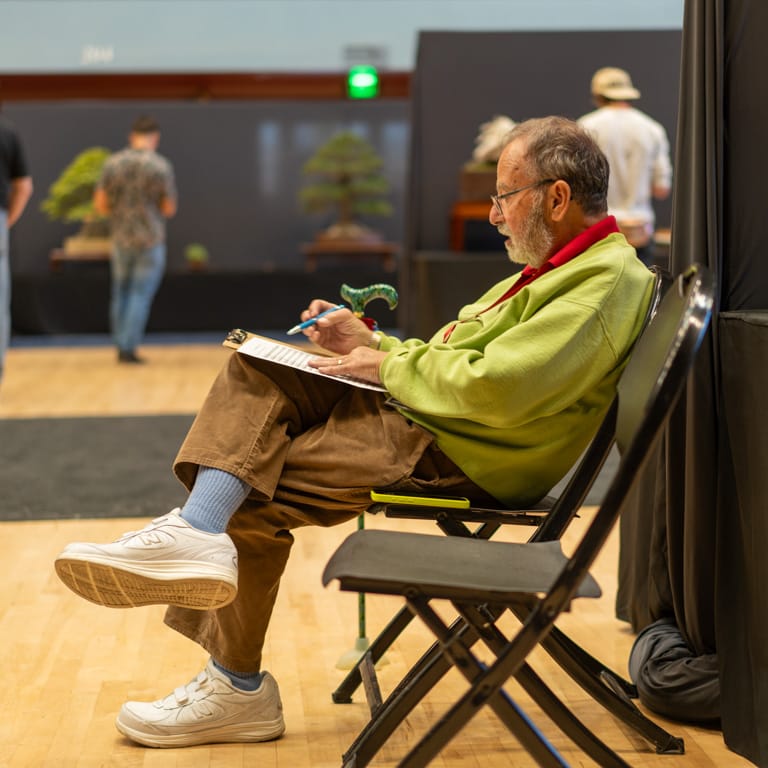
The show takes place at the Chicago Botanical Gardens, a beautiful setting for a bonsai event, in Glencoe, Illinois. I spent Friday morning judging the exhibit and provided a critique that evening. I’m always looking for a better word than ‘critique’ as it’s more of an opportunity to highlight work that’s done well and to provide suggestions for further improvements. The rest of the weekend featured workshops, a demonstration, and plenty of shopping opportunities with the 36 vendors on site.

Visitors come from all over the Midwest making this a great opportunity to catch up with friends from throughout the region – a rare treat as I haven’t had the chance to visit the area recently.

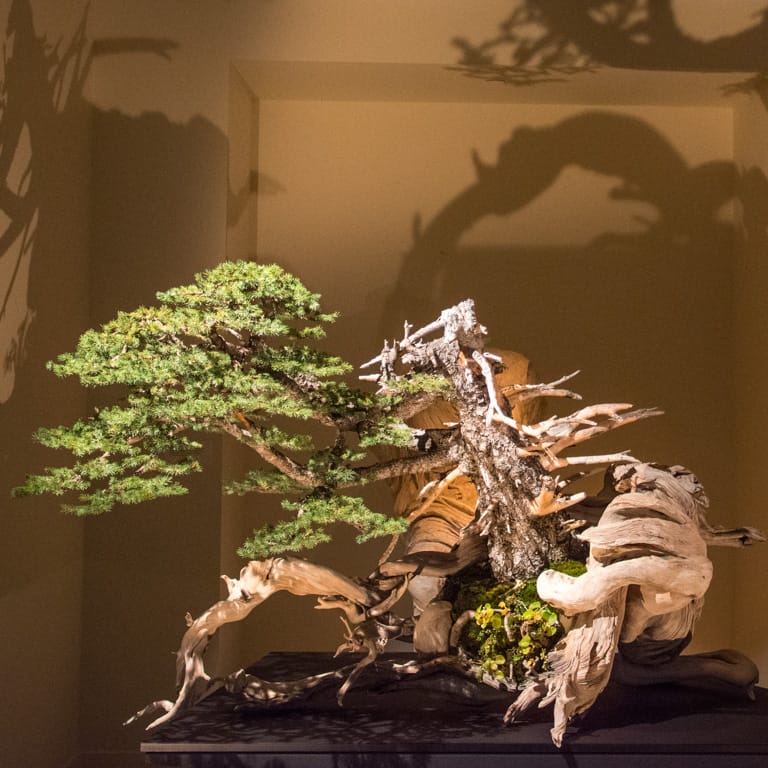
At the event’s core, however, is the exhibit. Here are some of the highlights.

Hinoki

Hinoki

Clump-style Japanese maple

Clump-style Japanese maple

Limber pine

Limber pine

White pine and zelkova

White pine and zelkova

Variegated Asian jasmine

Variegated Asian jasmine

Foliage detail

Foliage detail

Eastern white cedar

Eastern white cedar

Eastern white cedar

Eastern white cedar

Umbrella tree

Umbrella tree

Juniper display

Juniper display

Thanks again to everyone who made the event a success and a special shout out to VP of Special Events Matt Mazza who coordinated the festivities and made my participation possible – thanks, Matt!

News & Updates

  • The Redwood Empire Bonsai Society’s annual exhibit is this weekend, August 23-24, in Rohnert Park. Demonstration by Mike Pistello on Saturday at 1pm (there’s no demonstration on Sunday). Learn more at the event website.
  • I recently had a fun chat with Evan Pardue on the Little Things for Bonsai People Podcast – you can listen to the interview here.
  •  

Award winners from the 9th US National Bonsai Exhibition

Last month, William N. Valavanis hosted the 9th US National Bonsai Exhibition in Rochester, New York. The event brought bonsai enthusiasts together from across the US and around the world to enjoy an awesome exhibition, a superb collection of vendors, and a weekend of bonsai programs.

This year’s judges, Toru Suzuki from Japan, Tony Bebb from Australia, and Pedro Morales from Puerto Rico, selected the twelve award-winners shown below.

Rounding out the weekend, the American Bonsai Society hosted their annual Learning Seminar at a nearby hotel. The event featured workshops, lectures, and demonstrations plus a huge bonsai pot competition (more on that in an upcoming post).

As part of the Learning Seminars, I led two sessions at the National Exhibition itself: a bonsai critique focusing on design and display, and a guide to shopping in the vendor area.

Here are photos of the award winners. I’ll share more photos from the event next week.

Black pine

The National Award – Finest Bonsai Masterpiece
Black pine

Juniper

Joshua Roth Award – Finest Evergreen Bonsai
Juniper

Japanese maple

Michael Blanton Award – Finest Deciduous Bonsai
Japanese maple

White pine

Bonsai By Fields Award – Finest Medium Size Bonsai
White pine

Black pine

Joshua Roth Award – Finest Individual Shohin Bonsai
Black pine

Shohin display

Custom Oriental Woodcraft Award – Finest Shohin Bonsai Composition
White pine, black pine, oriental bittersweet, dwarf Asian jasmine, Chinese hackberry, trident maple

Black pine

New England Bonsai Gardens Award – Finest Classical Literati Bonsai
Black pine

Accent

Bonsai Travel Award – Finest Companion Combination

Hinoki

Award-winning tree/accent combination
Hinoki

Ficus

Futago Bonsai Award – Finest Tropical Species
Ficus

American Bonsai Society North American Award – Finest North American Species
Bald cypress

Lodge pine pine

National Bonsai Foundation All American Award – Finest American Species, In An American Container
Lodge pole pine

pine

Judges’ Special Award – Excellence In Bonsai
Pine

Next up, a look at more trees from the 9th US National Bonsai Exhibition.

  •  

Highlights from the 9th US National Bonsai Exhibition

Attending regional events like the US National Bonsai Exhibition is a good way to gain an understanding of the work happening within a given community. At the National, the community showing trees represents a big swath of the US. As a result, it features a lot of great trees.

I don’t tire of visiting events like these because there are always opportunities to learn about new trees or see trees in person that I’ve seen in photos for years. The latter is true for the dwarf corkbark elm by Sergio Cuan below.

corkbark elm yatsabusa

Yatsabusa corkbark elm

It’s a big tree, and the craggy bark and fine twigs give it extraordinary character. If you’re curious to learn more about the tree’s history, check out Sergio’s account at Bonsai Nut.

Regional events like the National also tend to feature a mix of exotic species as well as natives. The former are often well-developed specimens that took shape over many years.

black pine

Japanese black pine

Korean hornbeam

Korean hornbeam

The native trees in regional events are often in earlier stages of development but offer huge potential for future development.

Eastern white cedar

Eastern white cedar

Ponderosa pine

Ponderosa pine

Engelmann spruce

Engelmann spruce

When it comes to shohin displays, it’s simply fun to see well-executed displays. It takes a lot of effort to create a six-tree display so it’s great when you can enjoy them in person.

shohin display

Shohin display

shohin display

Shohin display

It’s also fun to see different takes on similar material, whether species or size and style. There were a number of white pines, for example, at this year’s event. By comparing the branch work on each we can get ideas for how to style similar trees and refine our sense of which approaches we like best.

white pine

White pine

white pine

White pine that flows to the left

Zuisho white pine

White pine ‘Zuisho’ that flows to the right

I expect a show book will be available next year featuring the photos from the exhibition – I’ll post a link when pre-orders open.

News & Updates

[San Diego Area Event]

  • This Sunday the San Diego Bonsai Club is hosting their second Bonsai Blast – a one-day affair featuring vendors, workshops, and demonstrations. Japanese bonsai professional Hiroyoshi Yamaji and I will be doing demonstrations at 8:30am (me) and 1:30pm (Yamaji).

    I’m really looking forward to the demonstration as it’s a departure from the regular format. Instead of completely styling a single tree, I’ll be working with two trees in earlier stages of development for each of the following species: black pine, cork oak, silverberry, lavender star flower, and Chinese quince.

    Learn more and see the complete schedule at the San Diego Bonsai Club website.

[California Regional Event}

  • The Golden State Bonsai Federation Rendezvous is coming up next weekend! Visitors coming for the day are welcome. Learn more at the Rendezvous website.
  •  

Highlights from the 2025 North American Bonsai Pottery Competition

After a long hiatus, the US again has a juried bonsai pottery competition. After an initial pair of events in 2001 and 2002 and a follow-up in 2015, we now have an updated competition sponsored by the American Bonsai Society and managed by Angelica Ramirez.

Angelica Ramirez

Angelica’s dedication to promoting bonsai potters is unparalleled. Her online database, Discover Potters, features almost 500 bonsai pot makers working in 50 countries. For this year’s bonsai pottery competition, Angelica coordinated over 100 submissions from around the US and a multiple-round judging process that included a mix of professional ceramicists and bonsai practitioners.

The exhibit

Early rounds were held remotely. Artists submitted photos of their work and a prose description of their process to provide context for the judges. The final round of judging took place in person at the exhibit.

Bonsai potter Roy Minarai and I served as the in-person judges. The process was fantastic and one of the highlights of my trip to the National Bonsai Exhibition this year. Before getting started with the judging, Angelica gave Roy and me an hour-long tour of the exhibit providing information about the process by which the containers were made. (The submissions themselves were anonymous.) Roy and I then spent the next hour casually appreciating and inspecting the containers to get a good sense of build quality, design, and usability.

Handling pots can reveal a lot about the build of a container. When there’s a tree planted in a pot, we tend to focus on the suitability of the design for a given tree. On it’s own, one can consider the container’s weight, balance, and construction.

I can’t convey how fun it was to get to handle such well-made ceramic works. It was like visiting a museum where visitors are encouraged to interact with the collection.

Roy and I spent the next hour in silence independently judging the exhibit using a crafty online interface that involved scanning QR codes and using sliders to indicate our scores relating to build quality and artistic merit.

After enjoying the exhibit room on our own for several hours, the awards were distributed, information cards went out, and visitors entered the space. Here are some of the fantastic containers from the exhibition.

Nao Tokutake
Traditional Unglazed – First Place

Mary J. Lai
Traditional Unglazed – Second Place

Doug Trythall
Contemporary Unglazed – First Place

Denise Soultanian
Contemporary Unglazed – Second Place

Thomas Adcock
Contemporary Unglazed – Third Place

Nao Tokutake
Traditional Glazed – First Place

Mary J. Lai
Traditional Glazed – Second Place

Kenneth V. Hanna
Traditional Glazed – Third Place

Yrene C. Vasquez
Traditional Glazed – People’s Choice Award

Kevin Yates
Traditional Glazed

Pitoon Ekarintaragun
Traditional Glazed

Antony Smith
Contemporary Glazed – First Place

Stacy Allen Muse
Contemporary Glazed – Second Place

To learn more about the event and to see photos from every displayed entry, check out the North American Bonsai Pottery Competition website.

News & Updates

[Save the Date]

  • The 2027 Pacific Bonsai Expo will be held on February 6-7, 2027, at the Alameda County Fairgrounds in Pleasanton, California. We’ll have updates about the event soon so stay tuned!

[Podcast]

  • Related to the Expo, I had a chance to talk about the show’s judging system with Ryan Neil and Brandon Roberts. You can check it out on the Asymmetry Podcast.

[Shohin School]

  • The 2026 Winter Shohin School will be held on January 31 – February 1 at Lincoln Park’s Harrison Recreation Center in Alameda, California. Registration will open in about a week.

    The event features one day of display education (Saturday) led by Daisaku Nomoto, a judge for the Gafu-ten exhibition in Japan, and one day of workshops. This year we’re teaming up with Eric Schrader of Bonsaify to provide hand-picked workshop material, and we’ll have time for bring-your-own-tree sessions too. Vendors will be on hand with trees, stands, and containers for shohin bonsai. More info coming soon!

[Seattle Area Event]

  • Visit the 11th annual Winter Bonsai Solstice at the Pacific Bonsai Museum in Federal Way, Washington. The event is one of just two evenings all year when the Museum opens its gates after sunset. December 13 from 4:00 p.m. – 7:00 p.m. Related, see the Pacific Bonsai Museum’s recent feature on CBS News Sunday Morning.
  •  

Highlights from the Bay Area Bonsai Associates 42nd exhibit

Last month the Bay Area Bonsai Associates held their 42nd annual exhibit at the Lake Merritt Garden Center in Oakland, California. The event featured an exhibit, sales area, and Saturday evening demonstration by Adam Toth.

Japanese black pine

Japanese black pine

California juniper

California juniper

I appreciated that the show included a good mix of deciduous, broadleaf evergreen, and coniferous bonsai. Trees ranged in size from large down to shohin with plenty of trees somewhere in the middle.

It was also fun to see different approaches to the same species. The two coast redwoods below, for example, feature different branch angles, different branch thickness, and different approaches to foliar development.

Coast redwood

Coast redwood

Coast redwood

Coast redwood

It was also fun to see so many deciduous bonsai in winter silhouette.

Cork elm

Cork elm

Elm and azalea

Elm and azalea

Jacqueline Hillier elm

Jacqueline Hillier elm

Pomegranate

Pomegranate

Several small-tree displays provided good contrast to the larger trees in the room.

Shimpaku

Shimpaku

Shohin display

Shohin display

Shohin display

Shohin display

The show also featured native material including Sierra juniper and Coast live oak.

Coast live oak

Coast live oak

Sierra juniper

Sierra juniper

Sierra juniper

Sierra juniper

Walking through a bonsai show has made me excited for the upcoming Kokufu exhibit in Japan. More on that in an upcoming post.

  •  

Special trees at the 100th Kokufu exhibit

Last month the Japanese Bonsai Association hosted the 100th national exhibit, the Kokufu, at the Tokyo Metropolitan Art Museum in Ueno Park, Tokyo.

The event was busier than it has been in recent years, and a larger percentage of the visitors were foreign. As for the bonsai, there was a good number of special trees that are always a treat to see.

Rose

Rose

Black pine

Black pine

Some of my favorites won awards, others simply made the room look great. Some, like the Chinese quince below, were so twiggy that I had to reset my thinking about what’s possible with the species.

Chinese quince

Chinese quince

Chinese quince

Chinese quince

A lot of the trees that stood out to me this year were deciduous.

Japanese maple

Japanese maple

When standing in front of these trees, it was easy to get lost following the branches as they meandered from the trunk out towards the edges of the canopy. Trees like these had been skillfully worked on for decades – and it showed.

Korean hornbeam

Korean hornbeam

Korean hornbeam

Korean hornbeam

Trident maple

Trident maple

Of course there were spectacular conifers in the exhibit as well. Here are some of the remarkable junipers on display.

Shimpaku juniper

Shimpaku juniper

Shimpaku juniper

Shimpaku juniper

Shimpaku juniper

Shimpaku juniper

Although in recent years it’s become common to see large junipers with massive trunks, it’s the exceptions that stand out the most to me. The juniper below has fantastic character along the trunk. Slender lifelines supported by undulating deadwood feature more delicate movement with give this old tree – and its viewers – a very different feeling.

Shimpaku juniper

Shimpaku juniper

Up next, highlights from the second half of this year’s two-part exhibit.

News & Updates

[Northern California Event]

  • The Bonsai Garden at Lake Merritt’s annual fundraiser, the Mammoth Auction and Sale, will be held this Saturday and Sunday in Oakland, California. On Saturday the main event is the largest auction in Northern California. On Sunday, it’s a plant sale and vendor area. Learn more at the Mammoth Auction & Sale website.

[Auction Tips]

In preparation for this weekend’s auction, here are some tips to help you get the most out of the event.

  • If you’re interested in taking home an item but want to feel good about the purchase, set limits ahead of time for how much you’d like to spend (and how much above this limit you’re willing to actually bid).
  • Check the health of the tree before setting your buy price. For deciduous trees, check the health of the buds and look out for dead branches or dead areas along the trunk. For conifers, check the number and size of visible buds as well as the color and character of the foliage.
  • Don’t let inside information influence your bids. A long time ago, I stopped bidding on a tree because I knew how much the owner had originally paid for it. It didn’t feel right to pay twice as much as my friend had paid for the tree. This was foolish as the second the bidding ended I remembered that the tree was worth almost double the amount it went for.
  • Take note of who you’re bidding against, but stick to your plan. Once I stopped bidding on a tree because I didn’t think I could keep up with the other bidder. When the bidding ended, the other bidder ran over with a big smile to let me know how relieved he was I stopped bidding as he’d reached the limit he was willing to pay for the tree. Another lost opportunity!
  • Above all, remember that the event is a fundraiser. Bonsai auctions are typically organized by volunteers who work hard to provide us with the opportunity to build our collections and have fun while doing it. Keeping the spirits (and the bids) high can make the event a pleasant experience for everyone.
  •  

Part two of the 100th Kokufu exhibit

For the past twelve years, the Kokufu-ten has been divided into two halves. For these double shows, the organizers set up the exhibit and open it to the public for a few days, then close for a day or two to reset the show with all new displays. This year the exhibit featured a whopping 181 displays in each half for a total of 362 displays!

Large displays

Large displays

Shohin displays

Shohin displays

This years exhibit featured some pretty big bonsai – here are some of the large conifers.

Shimpaku

Shimpaku

White pine

White pine

Needle juniper

Needle juniper

White pine

Semi-cascade white pine

Juniper

Shimpaku

One of my favorite medium-size trees in the exhibit was a black pine shown with a trident maple. I liked that the tree had strong movement to the left and a surprisingly large trunk for a tree under 18″ tall.

Black pine

Trident maple and black pine

Black pine

Black pine

One of the trees that received the most attention in part two was a juniper with a slender trunk. The movement was fantastic and the ribbon of deadwood that formed the trunk was surprisingly thin.

Shimpaku

Shimpaku

The deciduous bonsai were equally awesome. Here are some of my favorites.

Four trident maples

Four trident maples on a stone

Koran hornbeam

Koran hornbeam

Japanese maple

Japanese maple

Chinese quince

Chinese quince

  •  

Shohin bonsai at the 100th Kokufu exhibit

Each half of the Kokufu exhibit features a small number of shohin displays. The exhibit is set up to present the large trees first, then the medium bonsai, and finally the shohin. They’re the last bonsai you see before leaving the exhibit.

Shohin display

Six-tree shohin display

Like the larger trees in the exhibit, shohin bonsai are eligible to receive the Kokufu prize. However, instead of awarding an individual small tree, the award is presented to the top display.

The display above received the Kokufu prize in the first half of the event. The display below won the award in the second half.

Shohin display

Shohin display

Not all of the displays featured six shohin bonsai. Some displays featured five trees. Displays with mini bonsai featured far more trees.

Shohin display

Shohin display featuring a Rokko-style stand

Mini-bonsai display

Mini-bonsai display

The conventions for displaying shohin bonsai are relatively narrow by US standards. Junipers are the most common species displayed across from the box stand. They are typically shown on root stands, some taller than others.

Junipers on root stands

Junipers on root stands

Some of the individual trees in these displays were fantastic. Here’s a small sample. Note the remarkable branch density for trees that are roughly 8″ tall.

Black pine

Black pine

Trident maple

Trident maple

Black pine

Black pine

Japanese maple

Japanese maple

Black pine

Black pine

Kinzu (dwarf kumquat)

Kinzu (dwarf kumquat)

News & Updates

[Southern California Exhibition]

  • If you’re thinking about submitting to this year’s Naka Memorial Exhibition, August 22-23 in Los Angeles, the deadline is June 15th. The event website has instructions for How to prepare your submission.

    And like so many other bonsai events, the Naka Memorial would not be possible with the generous support of donors and volunteers. Learn how you can help at the John Naka Memorial Exhibition website.
  •  

Highlights from the MidAtlantic Bonsai Societies’ 2026 Exhibit

The Mid-Atlantic Bonsai Societies is a network of eleven bonsai clubs in New Jersey, New York, Connecticut, Delaware, and Pennsylvania. Each spring these clubs are invited to display trees at the region’s annual convention, the Spring Festival.

Peter Warren, Kaya Mooney, and I were invited guests at the event and we had a great time. In addition to performing demonstrations and leading workshops, we had the opportunity to critique the exhibit. When the time came for us to get started, Kaya and I decided to blend our groups together and do a group critique which was fun as we got to point out different things that had been done well and offer multiple suggestions for improving the trees on display.

Before we got to the exhibit, we got to enjoy trees from the Longwood Gardens’ Bonsai Collection.

Eastern white cedar

Eastern white cedar

Exposed root satsuki azalea

Exposed root satsuki azalea

The trees in the exhibit were mostly set up in traditional displays with stands and accents with awards recognizing excellence in several categories. One award winner was the white pine below. It’s a great example of an informal upright bonsai with good balance from the highest branches to the lowest.

White pine

White pine

This hinoki cypress has been in training for a long time. Kaya noted that although the tree doesn’t take the typical formal upright form, it has gentle movement appropriate for a hinoki and branch pads that convey age as well as the trunk.

Hinoki

Hinoki

I really enjoyed the Chinese elm forest below as it does a good job of suggesting a much larger stand of trees growing in nature. The slender branch tips and ascending primary branches are the composition’s key features for suggesting scale.

Chinese elm forest

Chinese elm forest

The critique participants enjoyed an extended conversation about flow when looking at this Colorado blue spruce. Although it’s clear that the owner intends the tree to flow to the left, different elements of the design suggest flow to the right which to create an interesting composition.

Colorado blue spruce

Colorado blue spruce

The larch forest below makes a nice contrast to the elm forest above. Because the trunks are larger and the primary branches extend from the trunks slightly downward, the composition creates an impression of much older trees. As fine twigs continue to develop, this group planting will convey age well.

Larch forest

Larch forest

The last three trees were shown together in a kifu-size display. They’re great examples of the branch density that results from good techniques applied repeatedly over time.

Black pine

Black pine

Shimpaku

Shimpaku

White pine

White pine

Thanks again to everyone who participated in the event and took the time to say hi. To learn more about how you can participate in the future, visit the MidAtlantic Bonsai website.

2026 Spring Intensive Dates

It’s been a number of years since I’ve made time for teaching regular classes at my workshop and I’m really excited to get back to it! I’m starting with intensives as I’ve found them to be the most effective and satisfying way to improve one’s trees and skills.

This season’s courses will cover timely techniques including pinching, pruning, and decandling plus other seasonal topics. The dates are June 6-7 for session 1 and July 11-12 for session 2.

Registration is now open – learn more about the Bonsai Development Intensives today!

  •  

Bonsai United: new exhibit at the Pacific Bonsai Museum

“How do landscape, native flora, and cultural practices shape bonsai expression?” This is the question Aarin Packard and the Pacific Bonsai Museum investigate in their current exhibit, Bonsai United.

The exhibit investigates ways in which the environment, the culture, and the expression of bonsai differ in fifteen countries around the world.

Shimpaku grafted on Sierra Juniper (Brazil)
(all photography by Matthew Aimonetti)

Hemlock and eastern white cedar (Canada)

Although the exhibit is best experienced on-site at the museum, you can see images of the trees on display, listen to interviews with professionals from around the world, and read all accompanying text via the Bloomberg Connects app and website.

Trident maple forest (China)

Korean hornbeam (Korea)

The exhibit is organized in a way that reflects the spread of bonsai beginning in China and eventually reaching Korea, Japan, and beyond. Some of the trees featured came from these countries or have been worked on by prominent figures from these countries.

White pine (Japan)

Japanese maple (Japan)

Pyracantha (Taiwan)

When I first heard about the project I wondered if the focus would be on explaining why trees from a given country can have an identifying “look” to them not found elsewhere. Instead, what I found was that gaining a broader understanding of the context within which a community operates determines not only why trees may look one way or the other (based on the local environment or how native trees develop in these spaces) but how a given community interprets what it means to do bonsai (via imports and exports, focusing on native or exotic material, or establishing aesthetic norms or goals for the hobby).

I recently had the opportunity to speak with the curator and creator of the exhibit, Aarin Packard, on the Bonsai Wire Podcast. During our chat Aarin provides an overview of how the exhibit came together and shares some of the discoveries that made their way into the exhibit. For example, in Mexico a big part of the challenge is finding species that survive extreme heat, seasonal monsoons, and hurricane-force winds while responding well to bonsai training techniques. In Canada the extreme cold in winter and the compact growing season characterized by explosive growth rewards species with very different characteristics.

Black pine (Taiwan)

Yew (England)

The exhibit is open now and runs through December 19, 2027. Here are some links for learning more.

  •