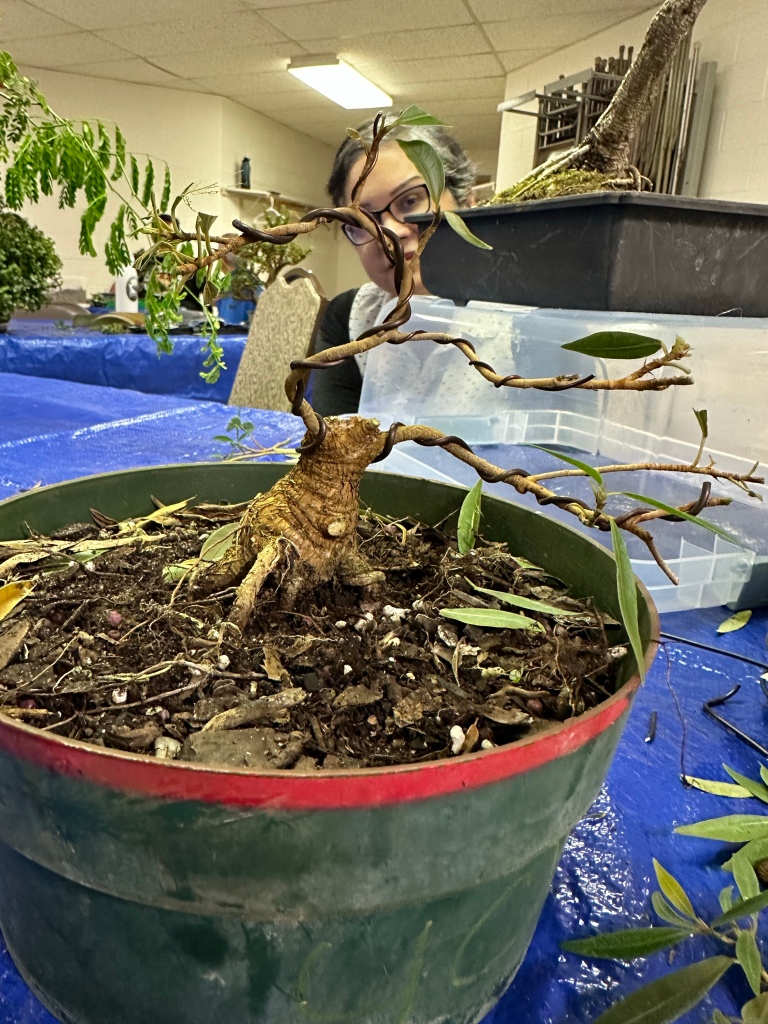
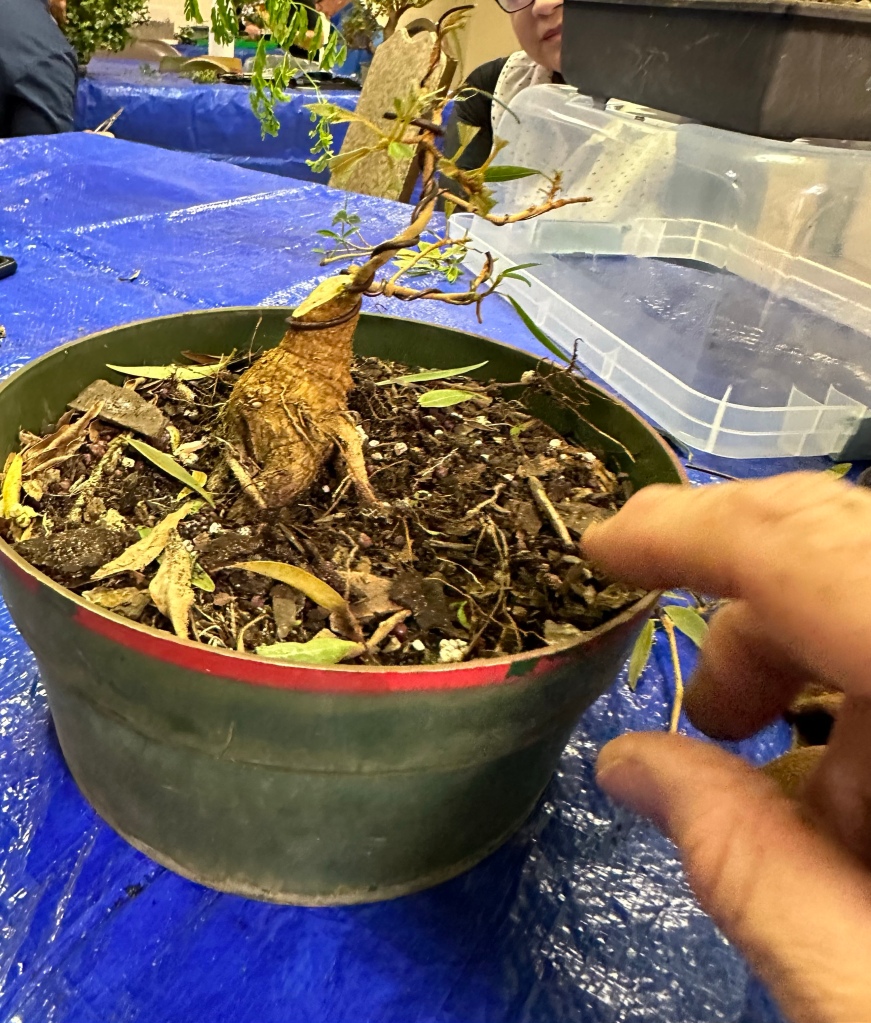
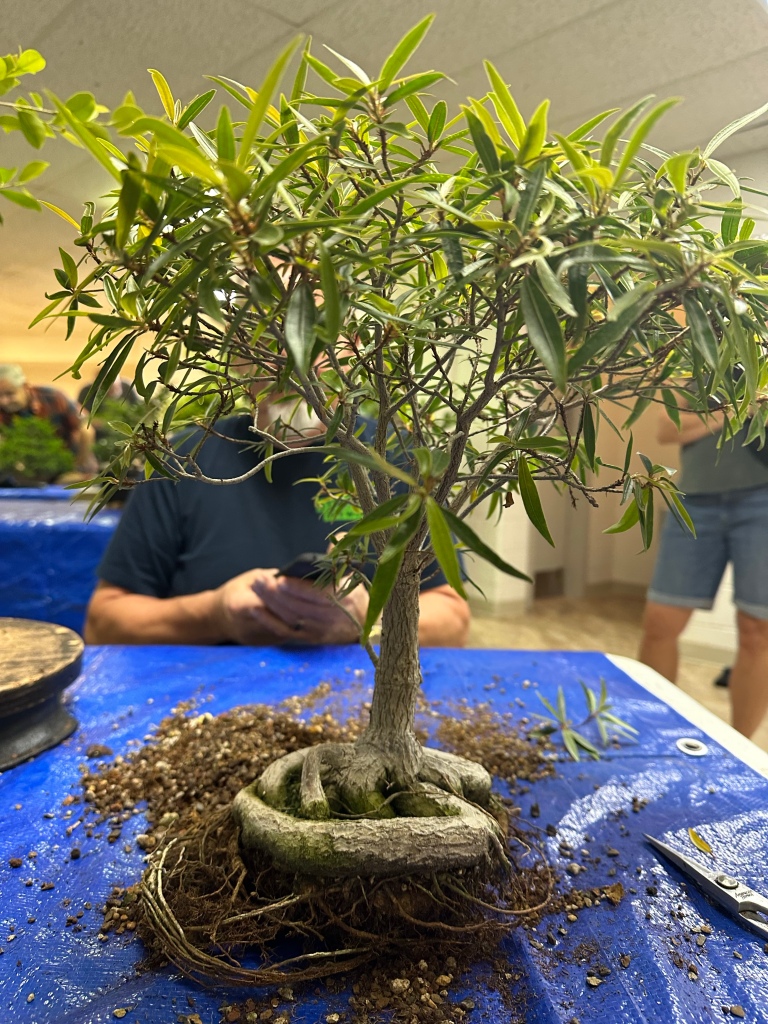
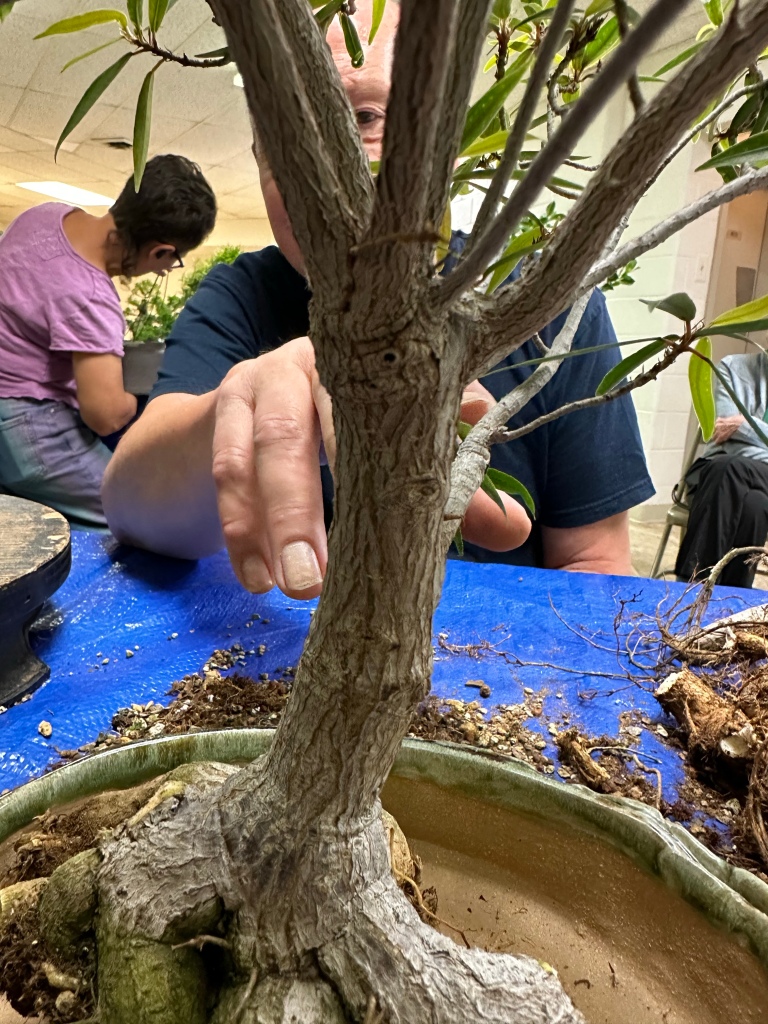
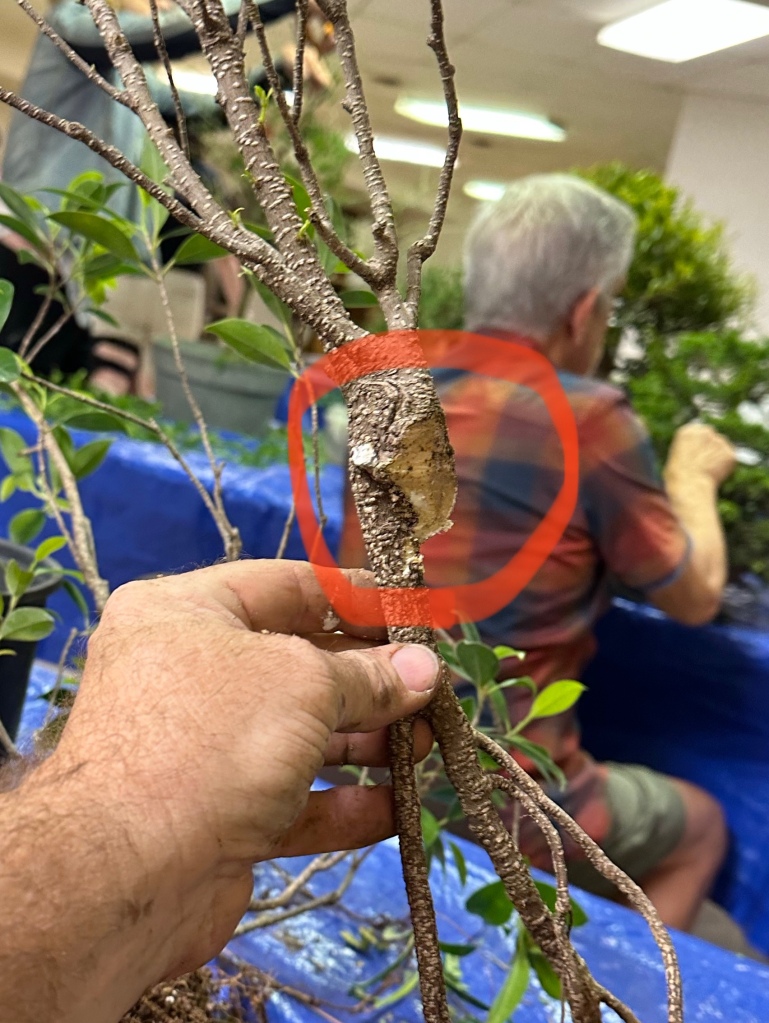
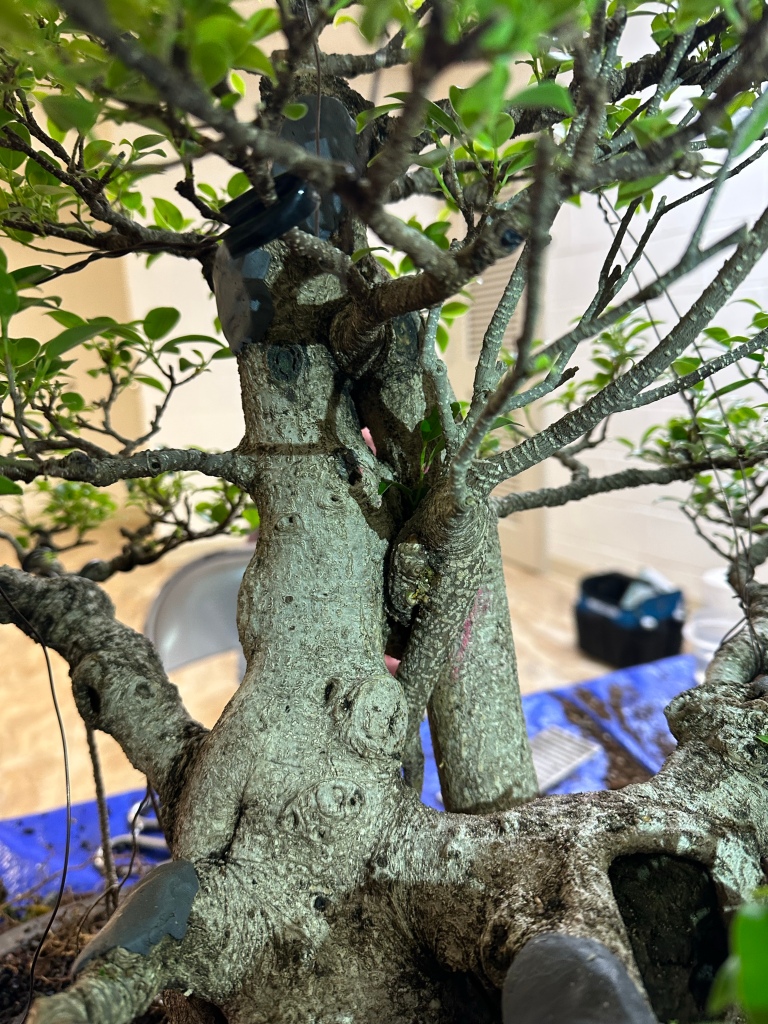
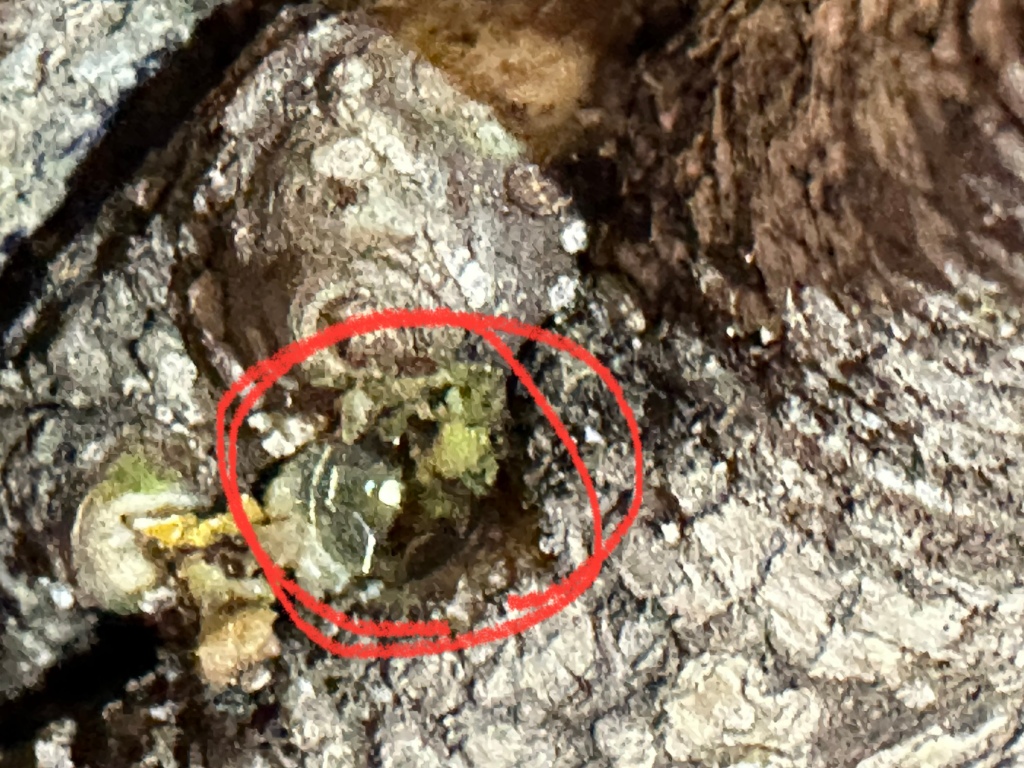
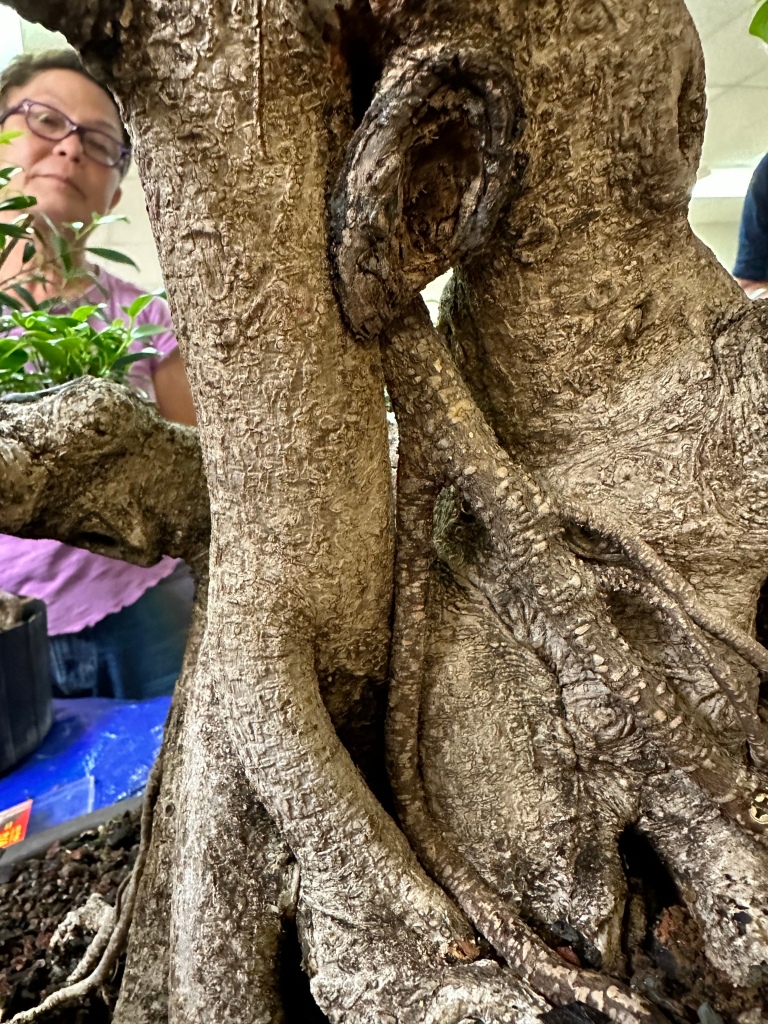
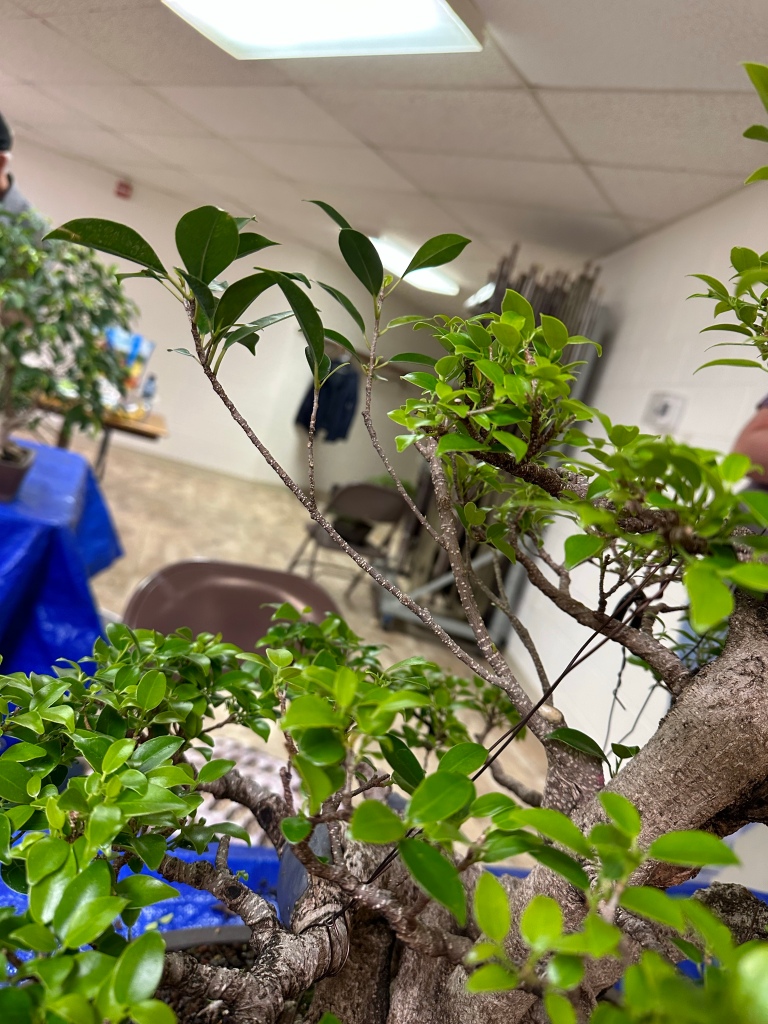
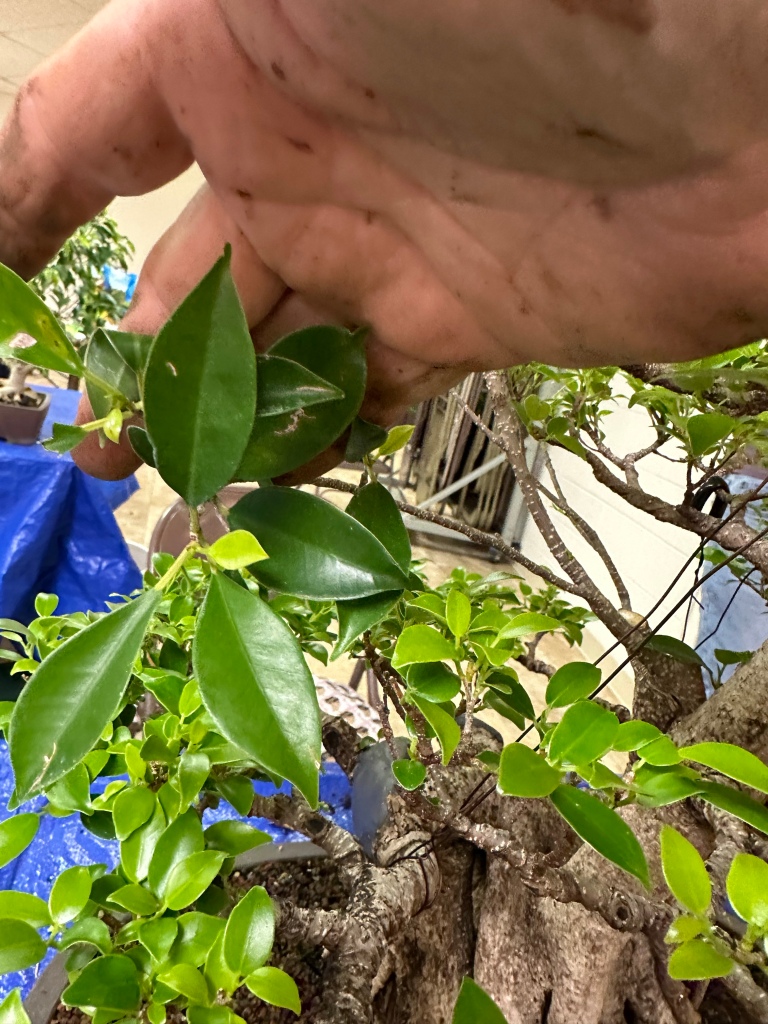
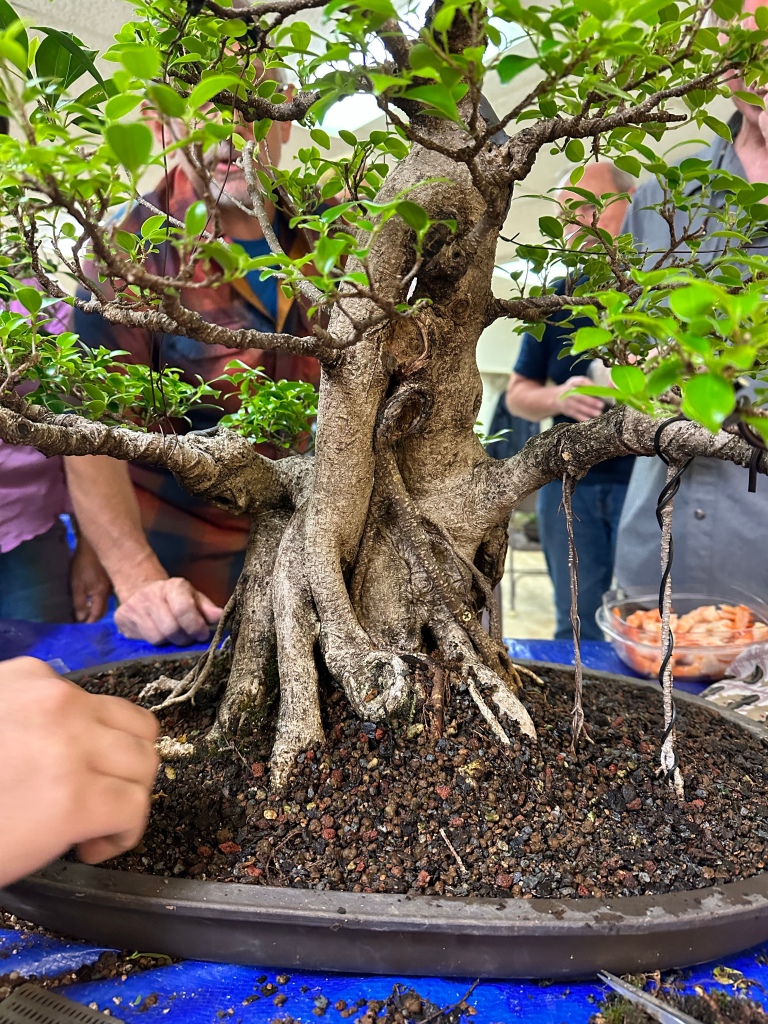
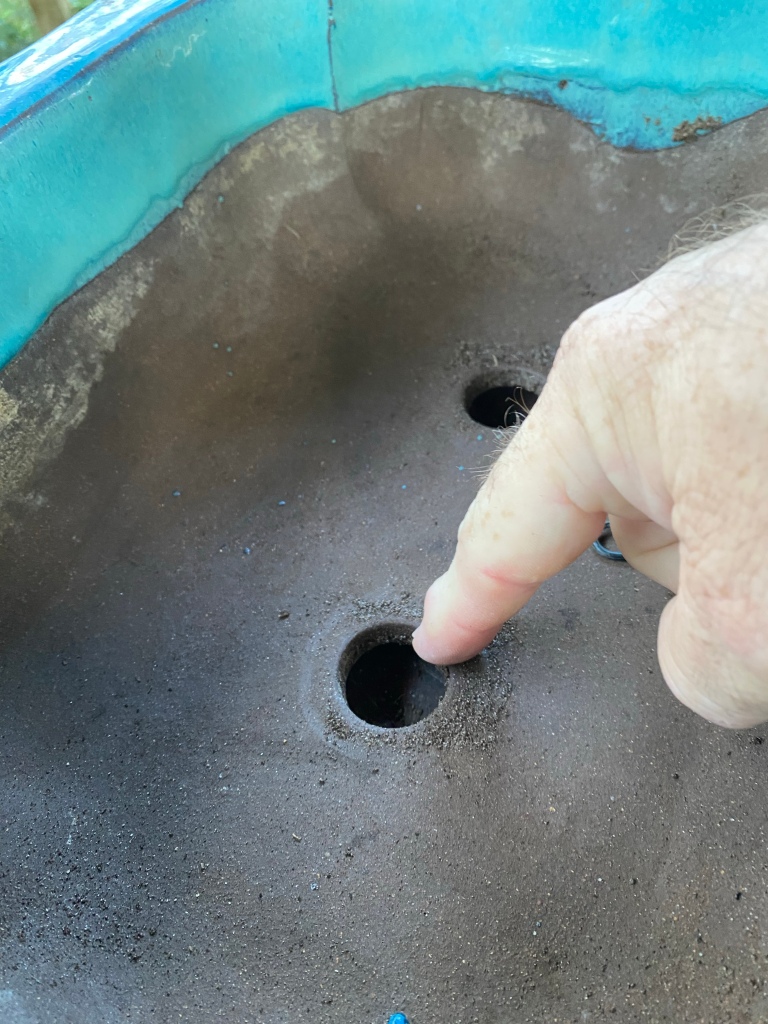
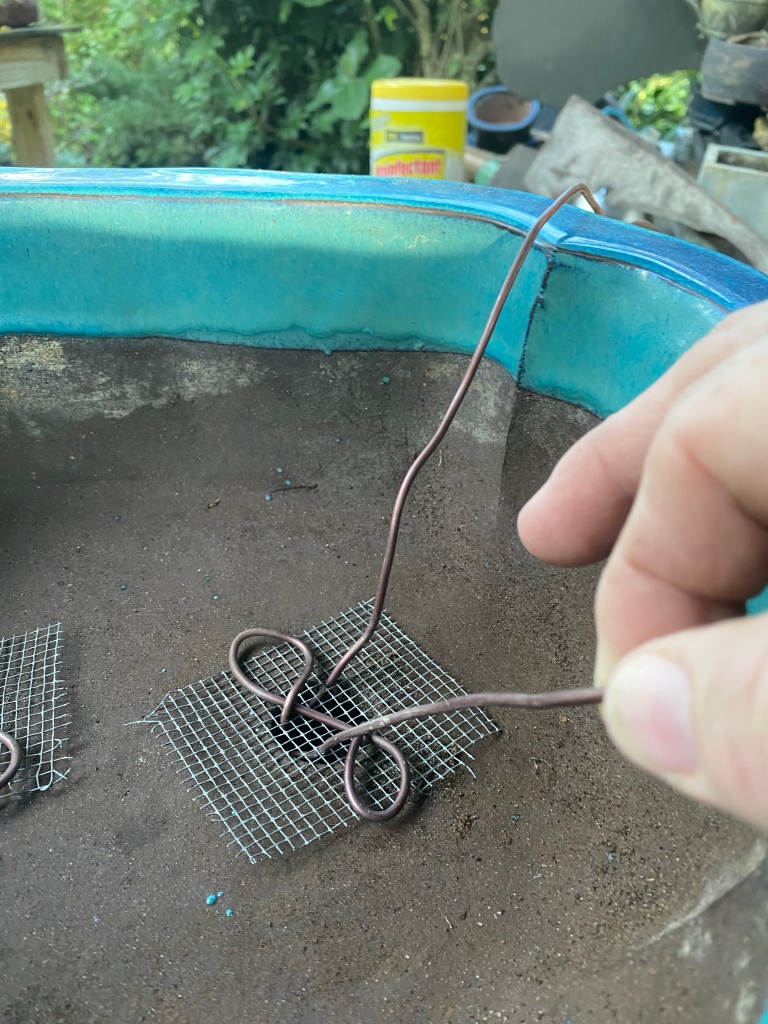
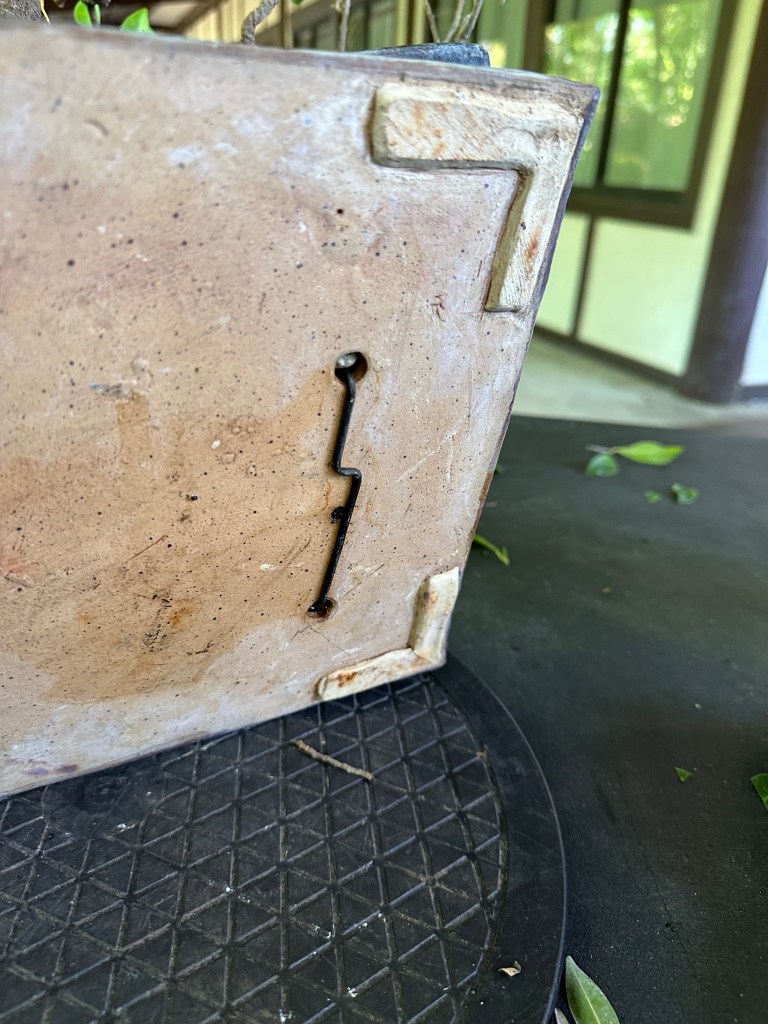
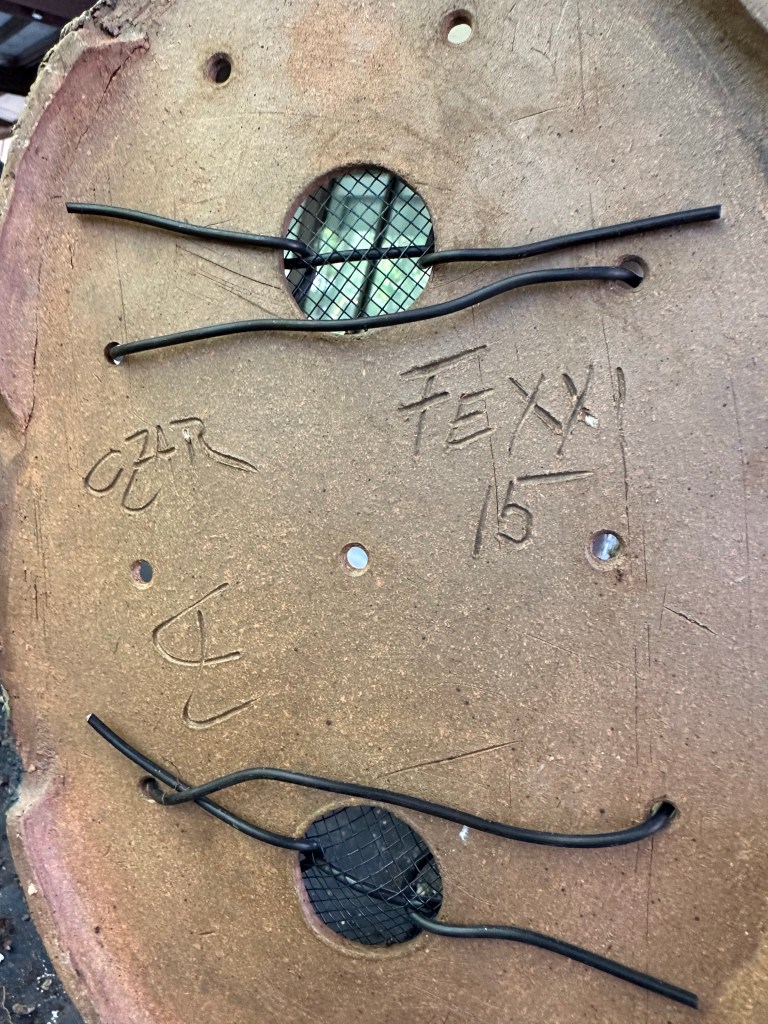
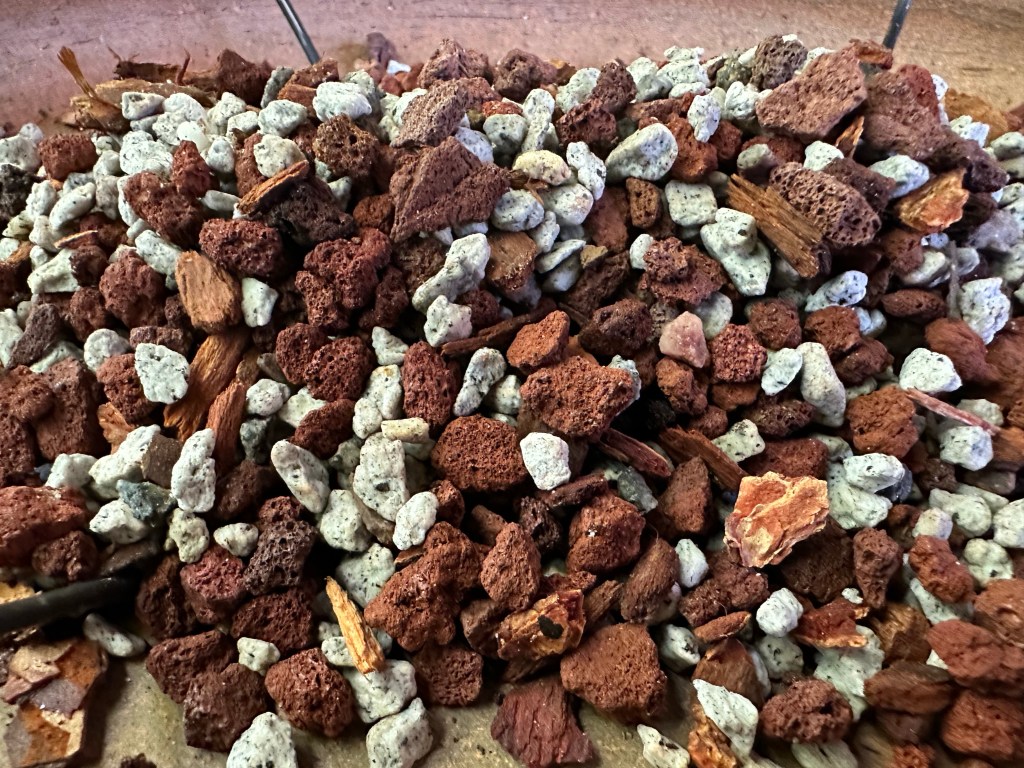
Here’s a pet peeve. And I’ll start with “there are many ways to skin a cat” but there are ways, and better ways. See the hole above? A drain hole in a bonsai pot. We cover these with screen so the bonsai soil we use (use what you like and what works for you) doesn’t fall out the bottom.
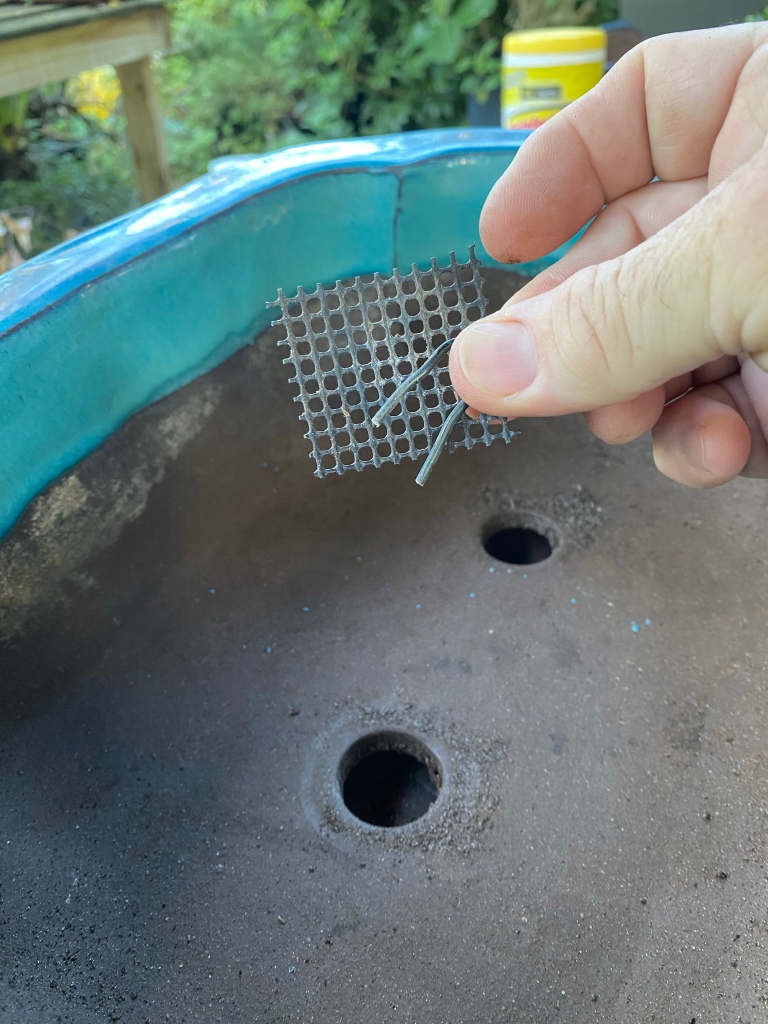
I’m repotting a client’s tree. I find this as the drain hole screen. It’s good material, actual bonsai screen, but would it hurt you to cut it a little bigger? It’s not even a penny’a worth to add an extra half inch to it.
And the wire holding it? It doesn’t even bend around the floor wall of the pot.
What’s that gonna hold?
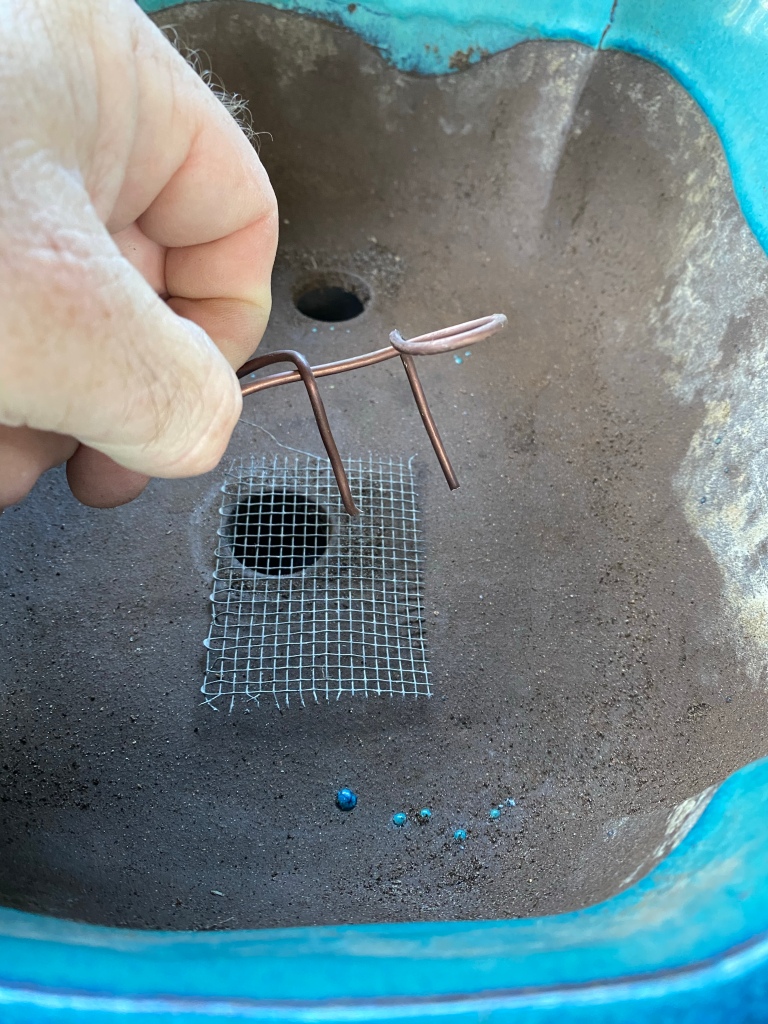
I’ve been using galvanized steel. It’s strong, lasts for years, and drains well.
And I don’t skimp.
And the wire I use to hold it in: it’s heavy gauge, and bent so as to hold the screen in place.
The loops hold the screen and there’s enough underneath to hold it to the pot. (Ignore the calcium buildup, it’s from south Florida, where the water is hard as a politicians heart.
See that? It ain’t moving.
And while I’m at it, tie down wire should be heavy too. At least 2mm, this is 2.5.
I can pick the tree up by the trunk, with no worries that the tree will be damaged (could, but not usually….well, sometimes. Do as I say, not as I do…).
Here’s the tree. Portulacaria afra. It’s not going anywhere.
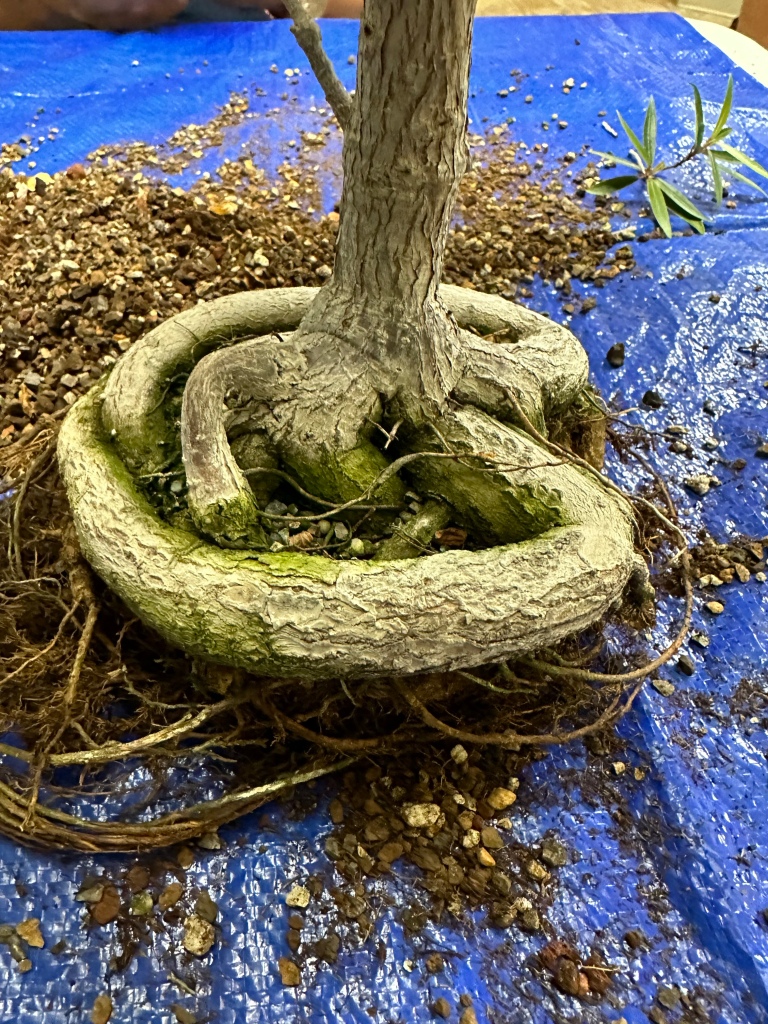
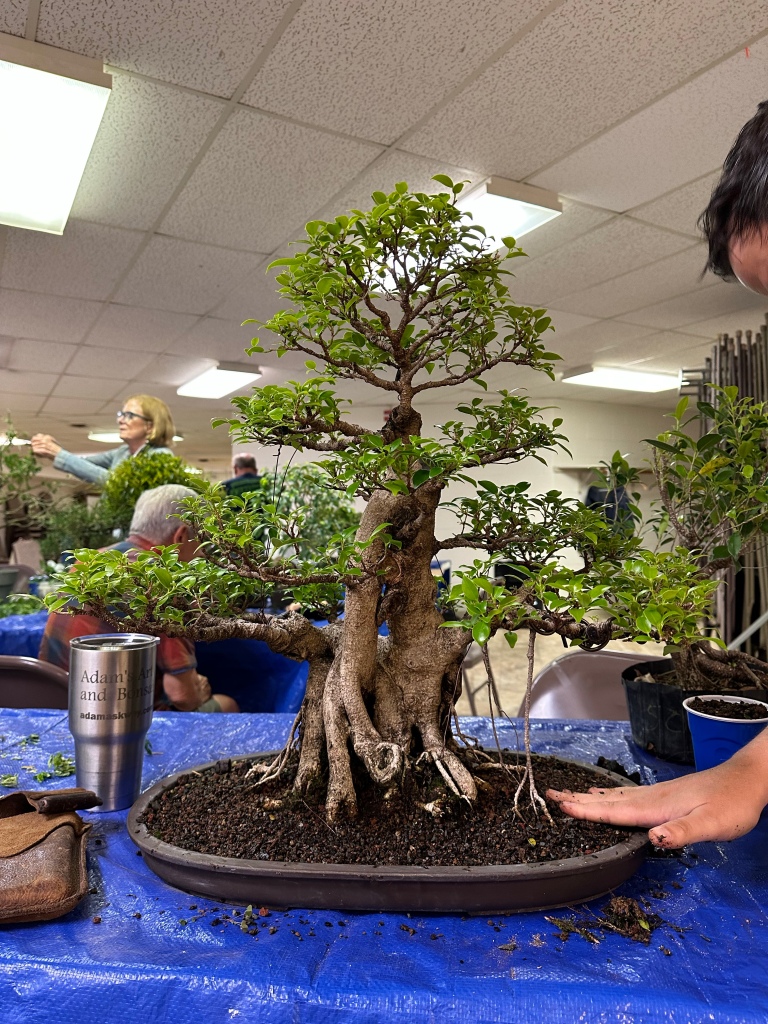
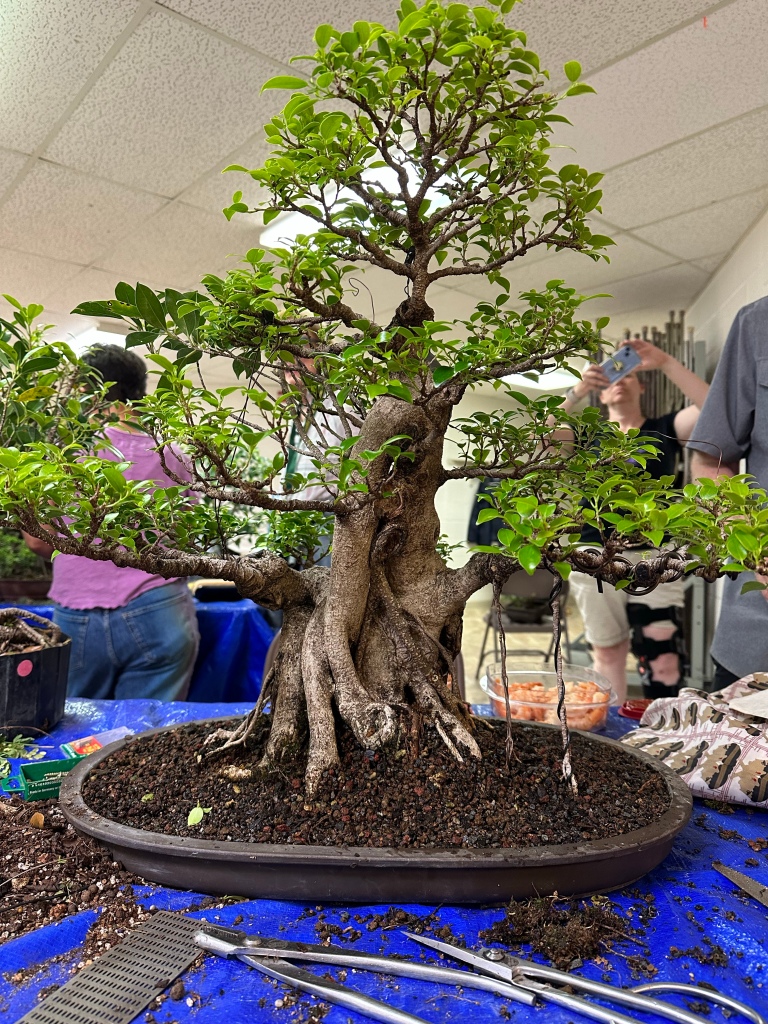
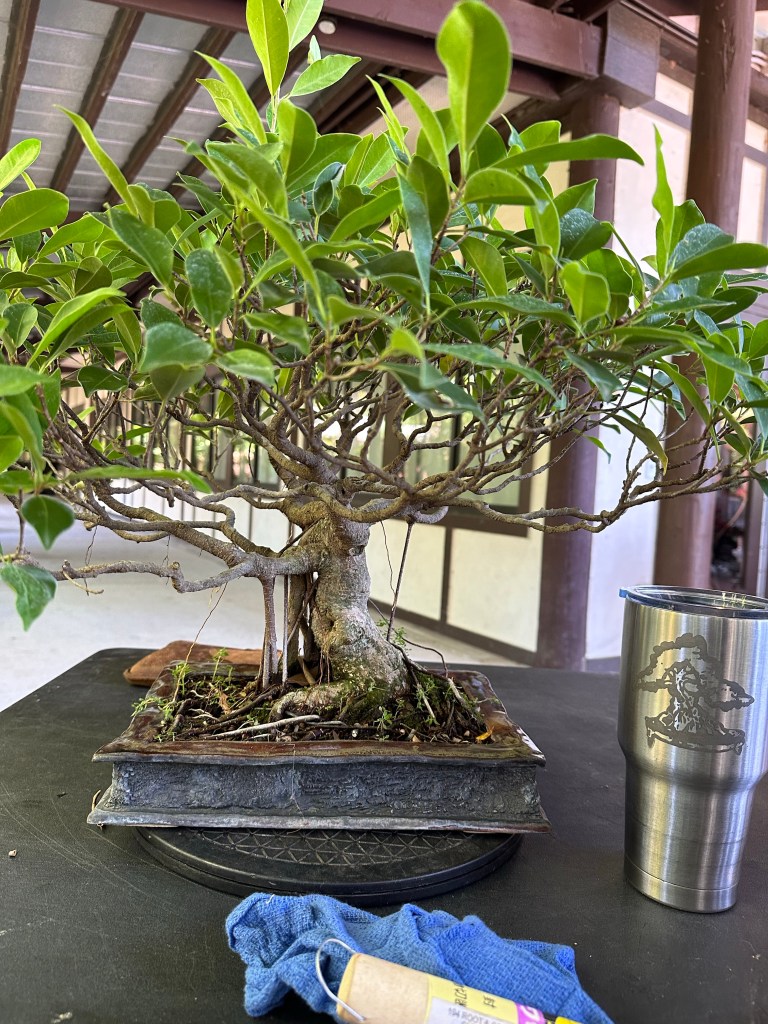
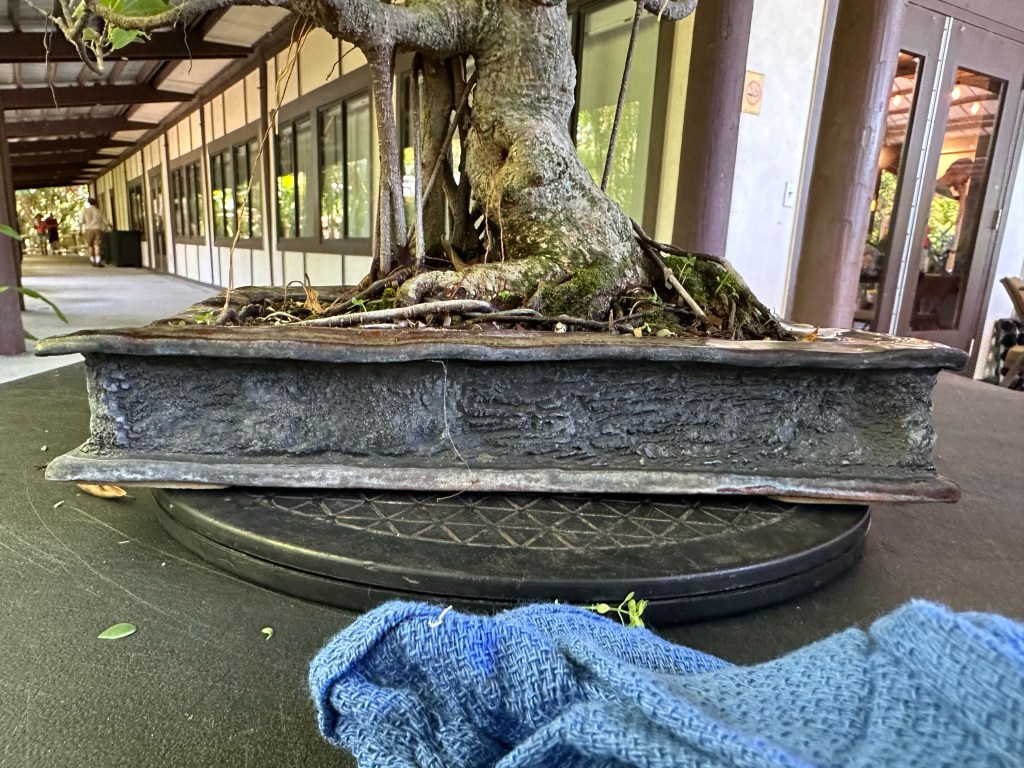
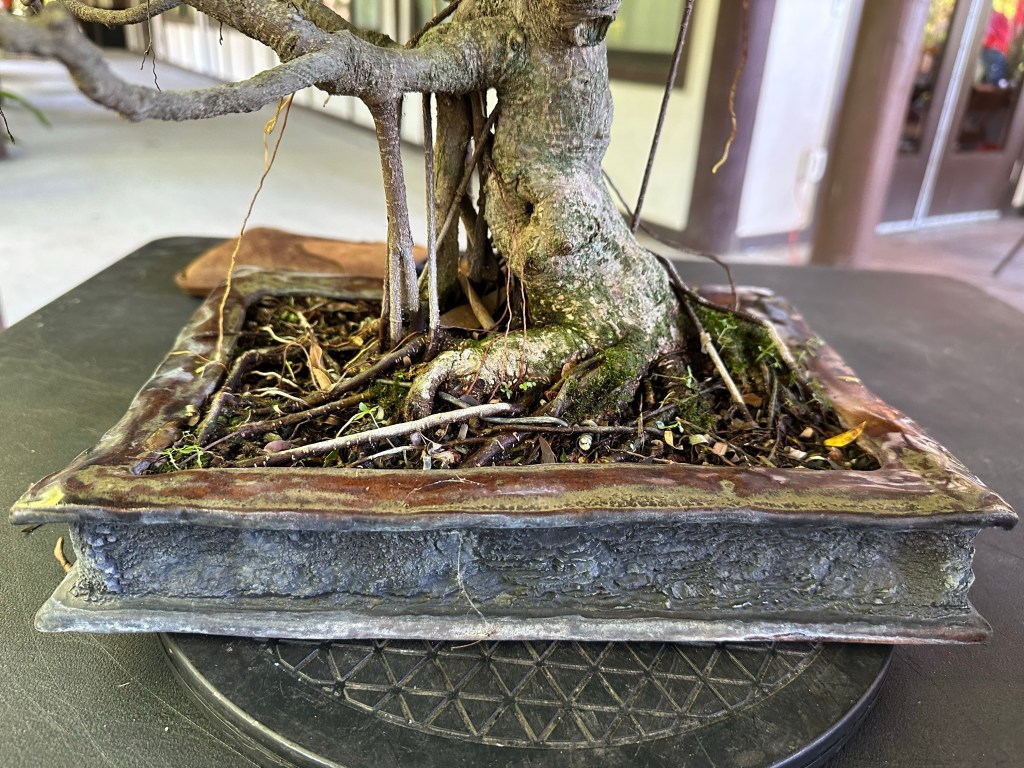
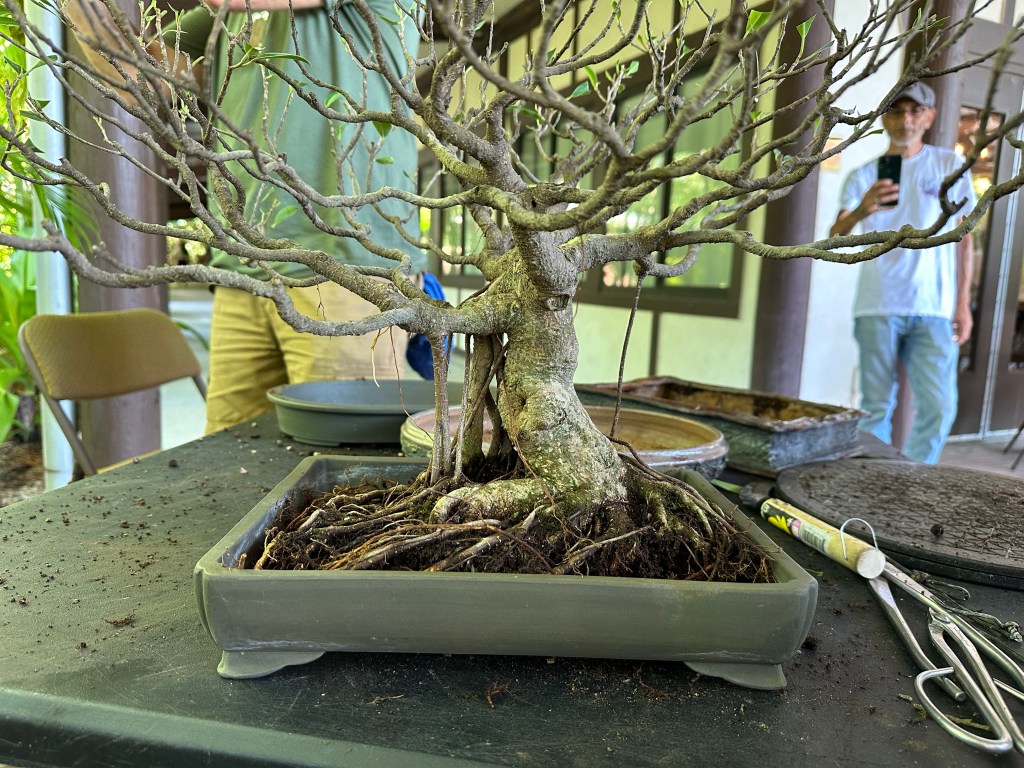
This ficus has been in this remarkable container for..ahem..four or five years, without a repot. I’m sad to say it needs a bigger pot. Sad because I love the pot and the tree combo.
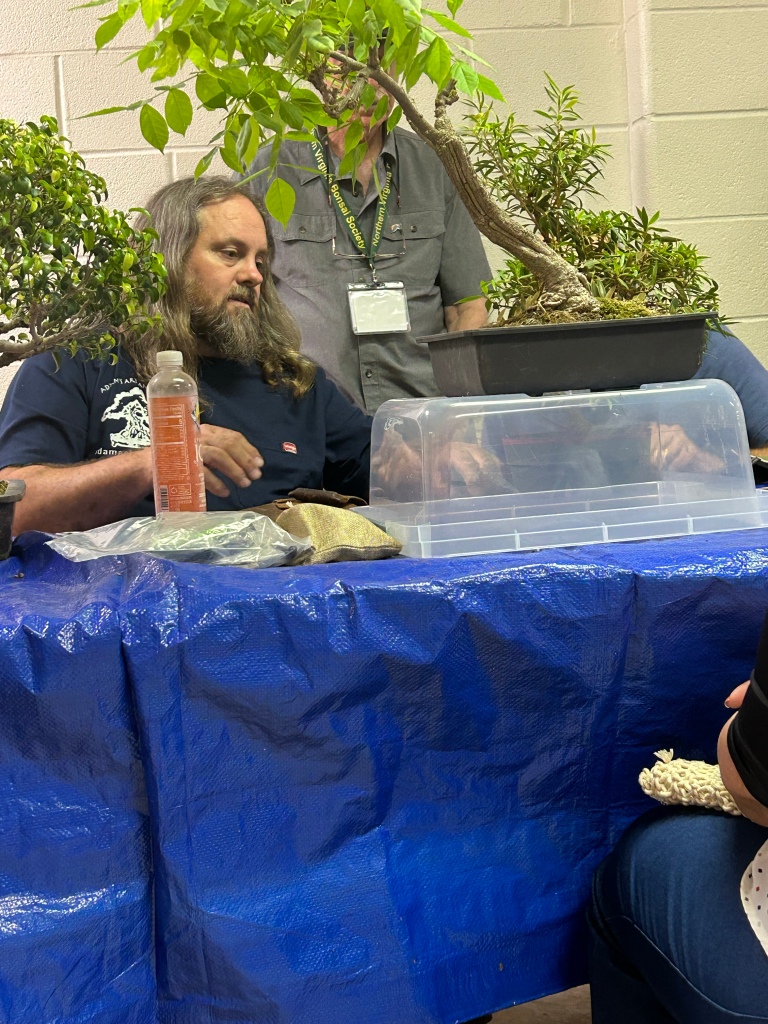
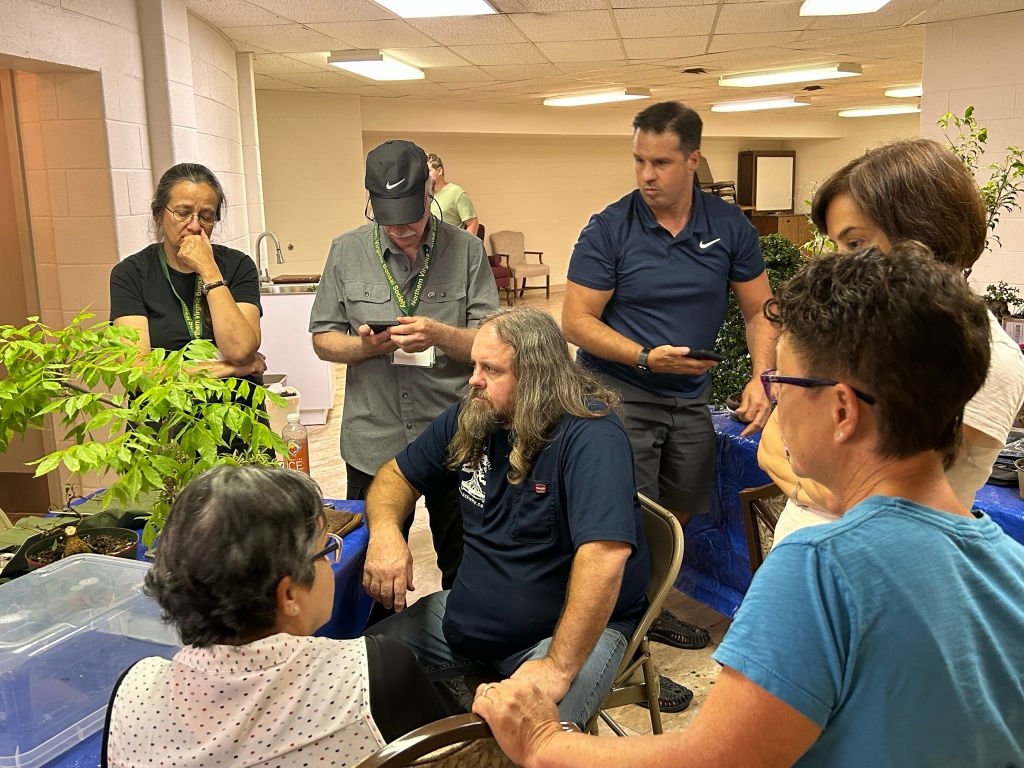
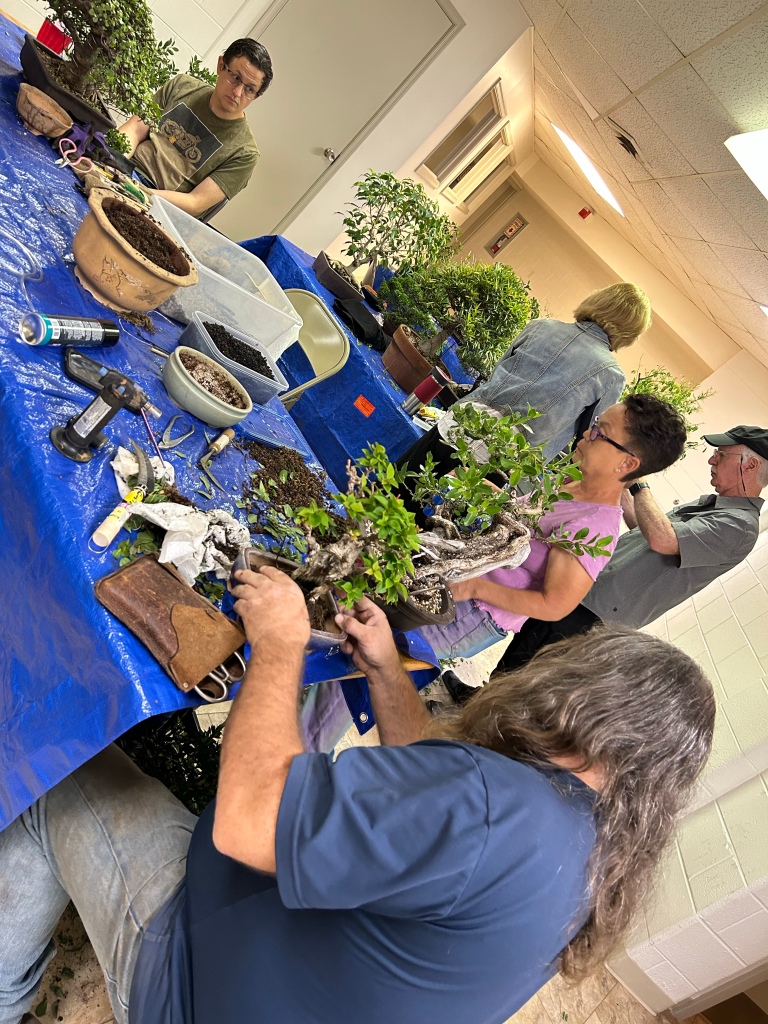
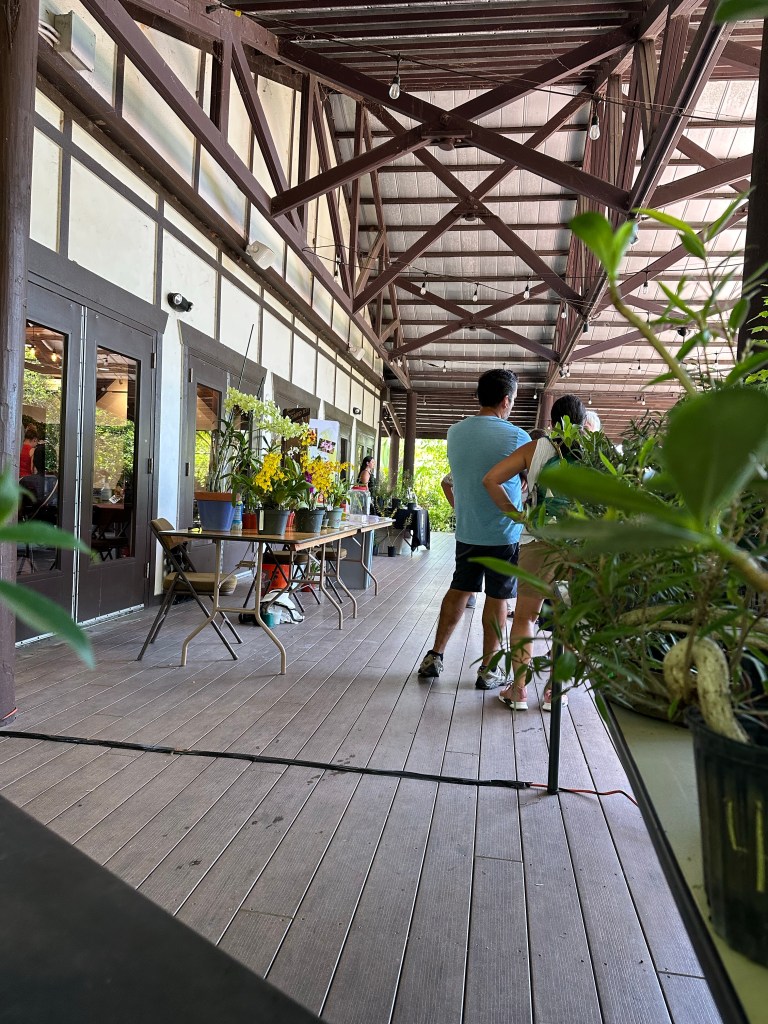
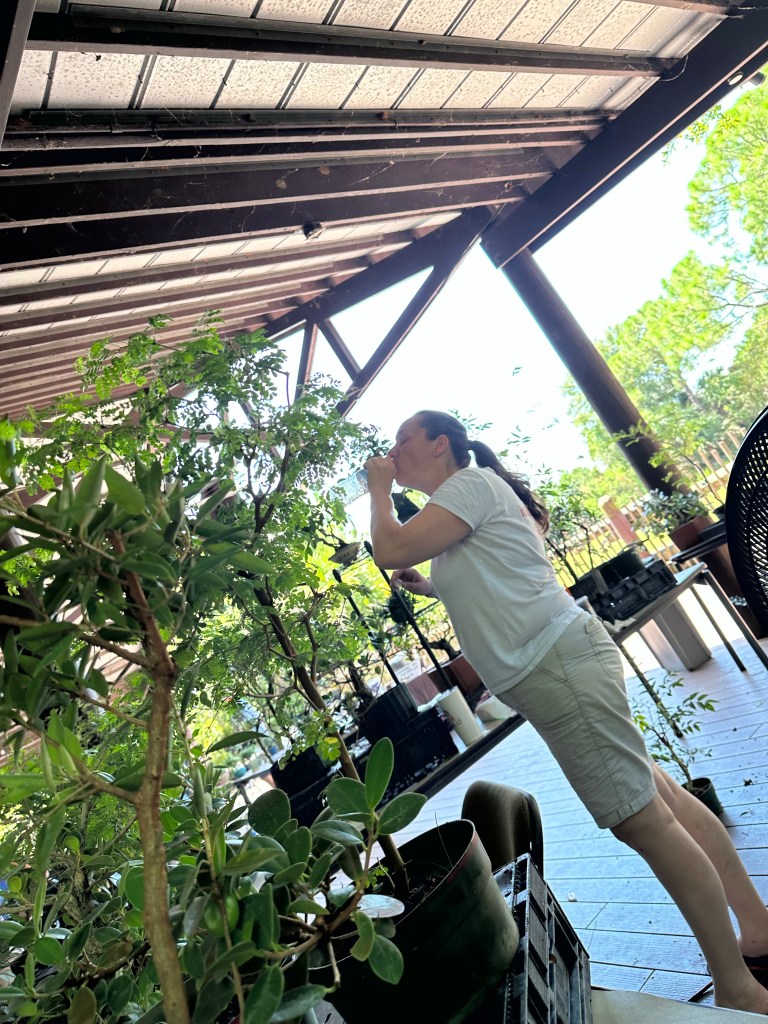
Today, I’m hanging out, selling my wares and shooting the shit (as I’m known to do) at the Brevard Zoo. No, I’m not joining the swamp ape exhibit as the first living specimen ….
…the Bonsai Society of Brevard has an annual show at the zoo, uh…every year (I guess that’s what “annual” means), and I’m here (or there. Sometime the tenses get mixed up in my wandering and rambling prose style. I think it adds flavor and character. Some people say it drives them crazy. I say to those people that their insanity was there already, and I just exacerbated it, allowing it to blossom into the full blown psychotic episode that they’ve been waiting for their whole lives. You see, some people need an excuse but we of lesser gods, we know you don’t…..).
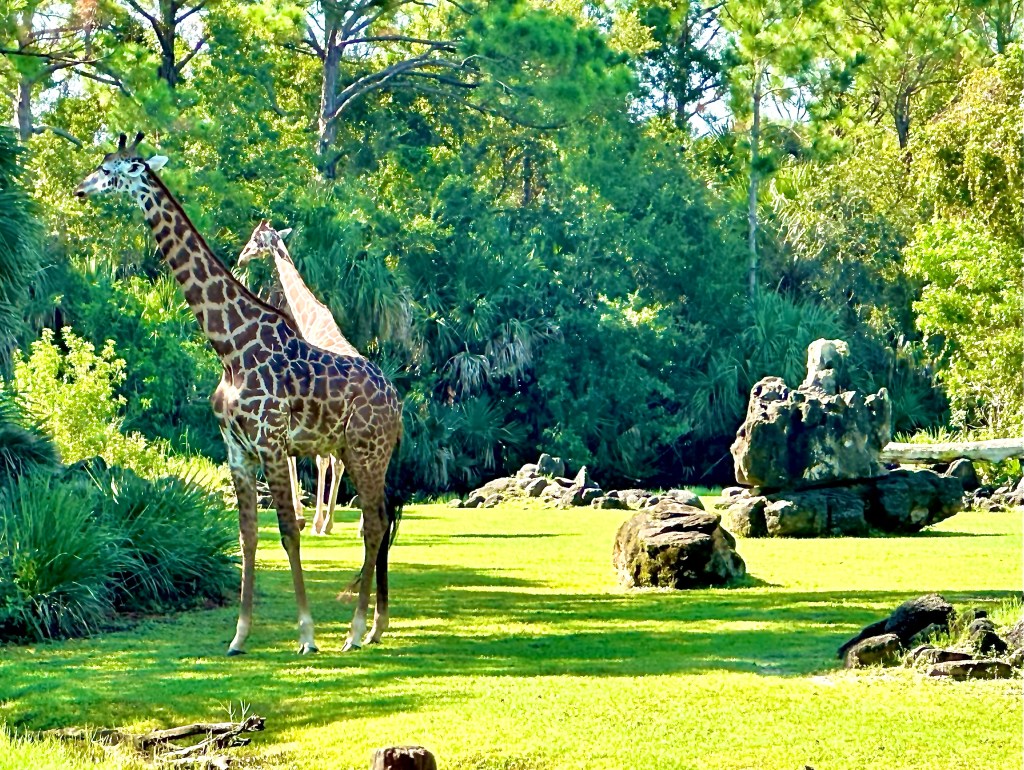
Above, we have the local fauna, Floridanus nativitus, below, are some imported beasts, Giraffa camelopardalis.
And my wife, or, as we call her on Da’ Blog, “She Who Must Be Obeyed”; she’s from Indiana.
Now, since you know where I am, and what I’m doing, and I’ve gotten in enough trouble with the wife, let’s get back to the tree.
The job is to remove the tree from the pot.
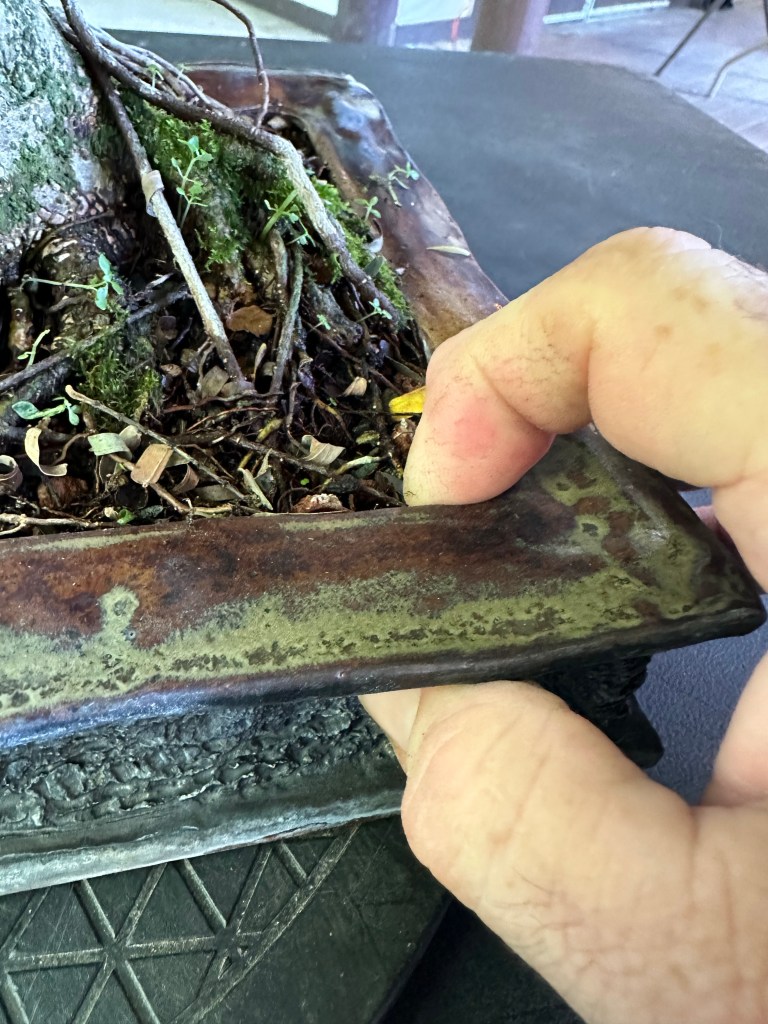
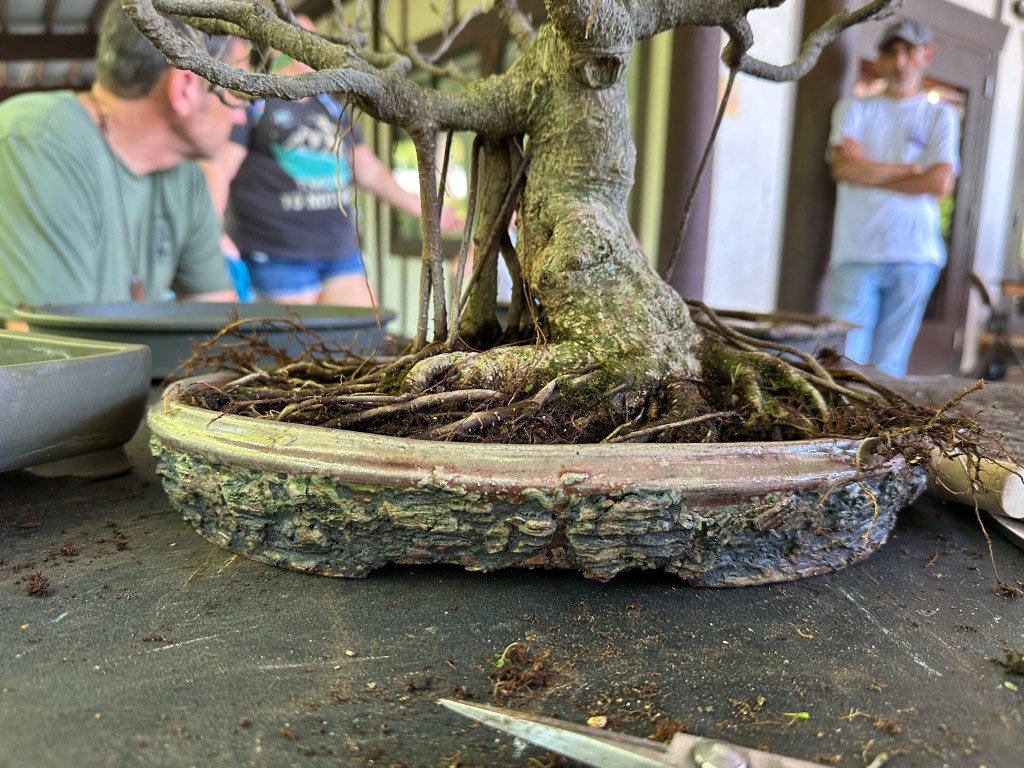
For those “in the know”, it’s really really really (really) advised against potting a ficus in a pot that has an inwardly curving lip.
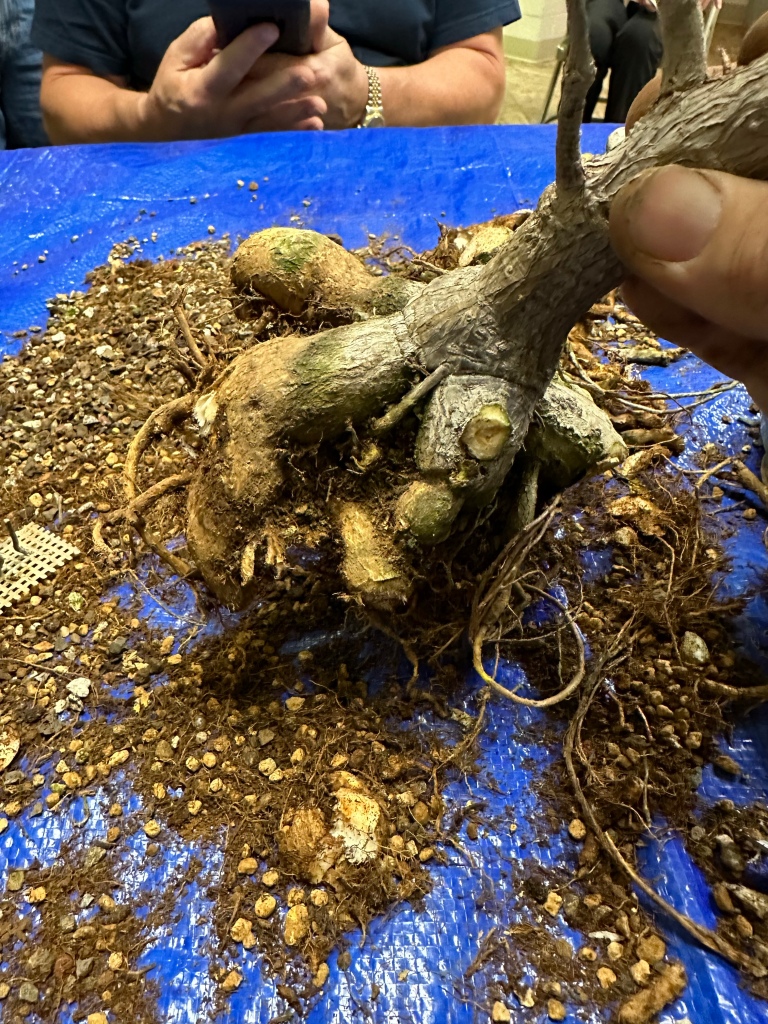
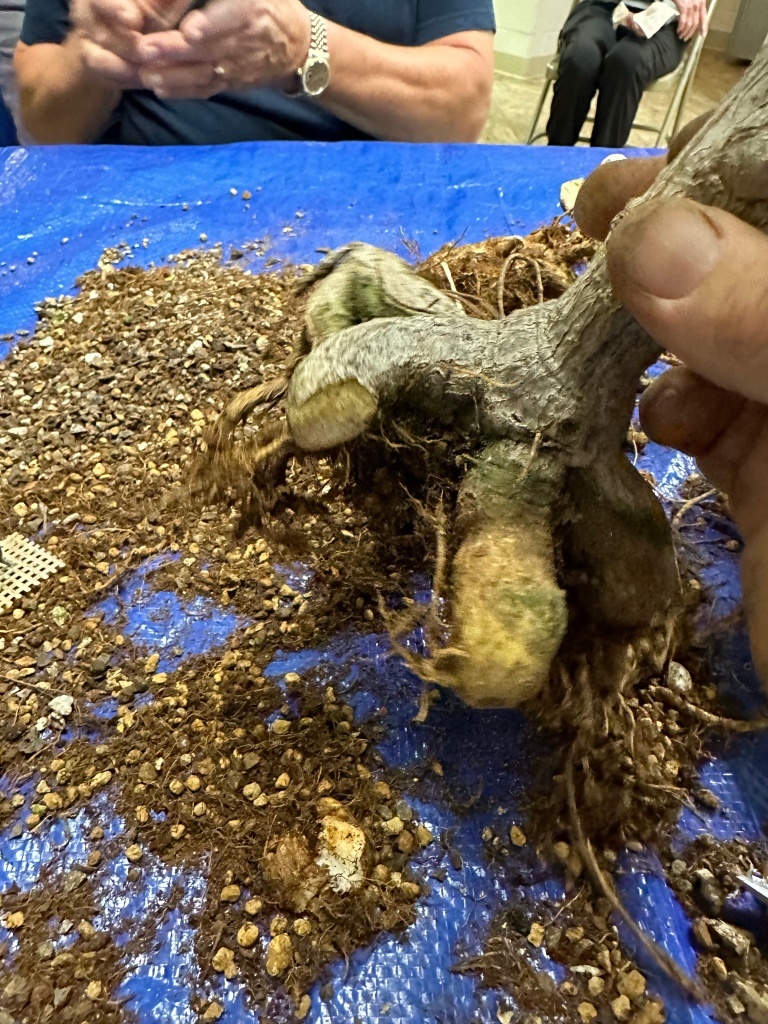
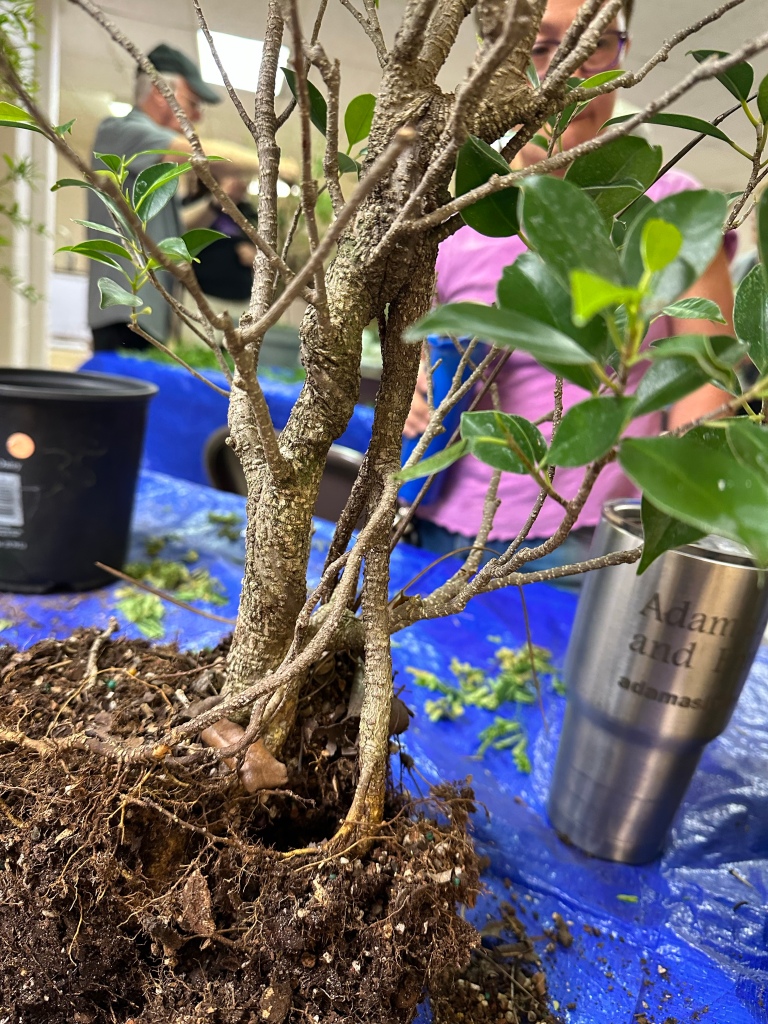
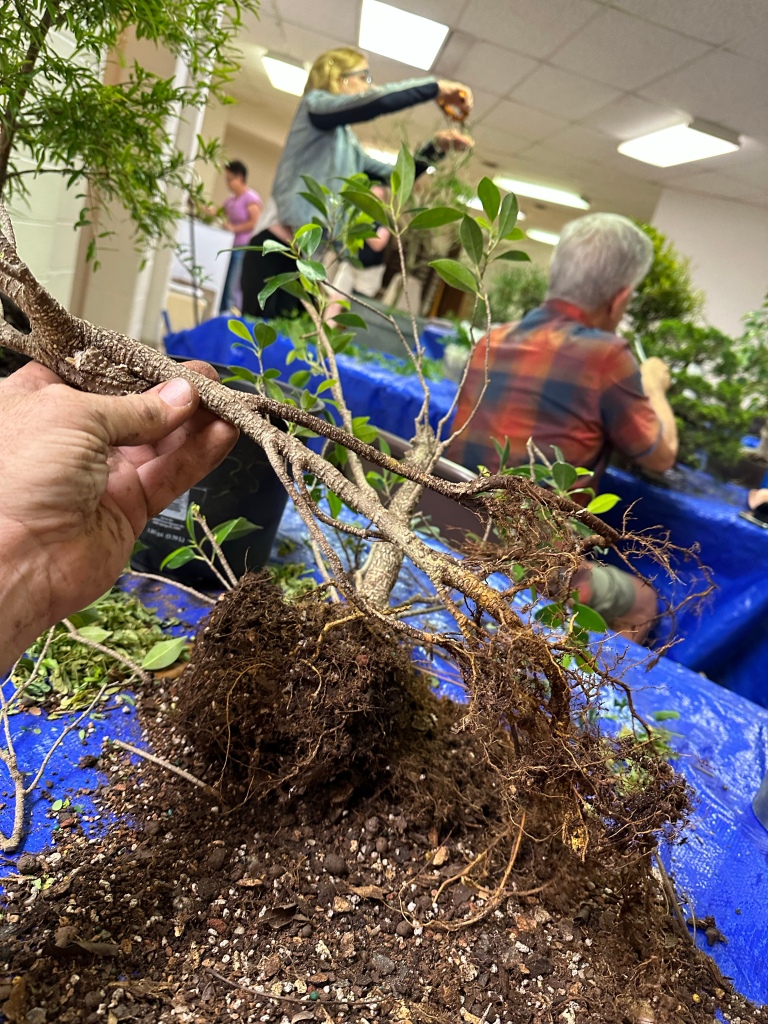
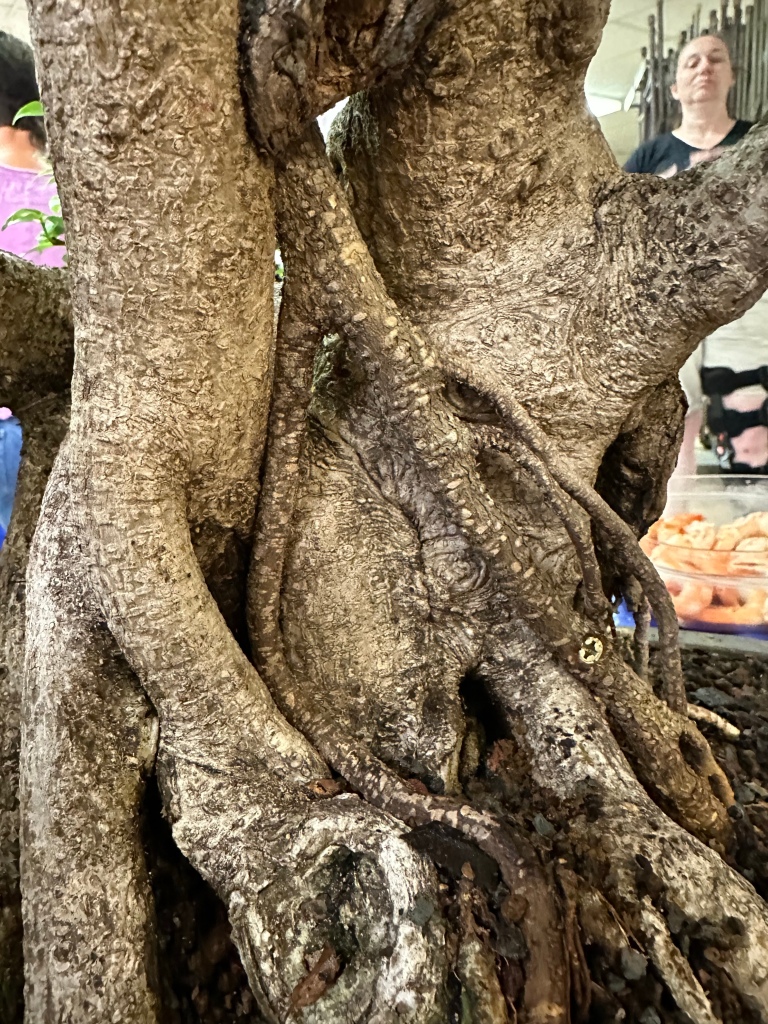
Ficus (I’m going to pronounce that the British way, “Fick-us”, as I’m feeling all fancy right now), make roots. Lotsa roots.
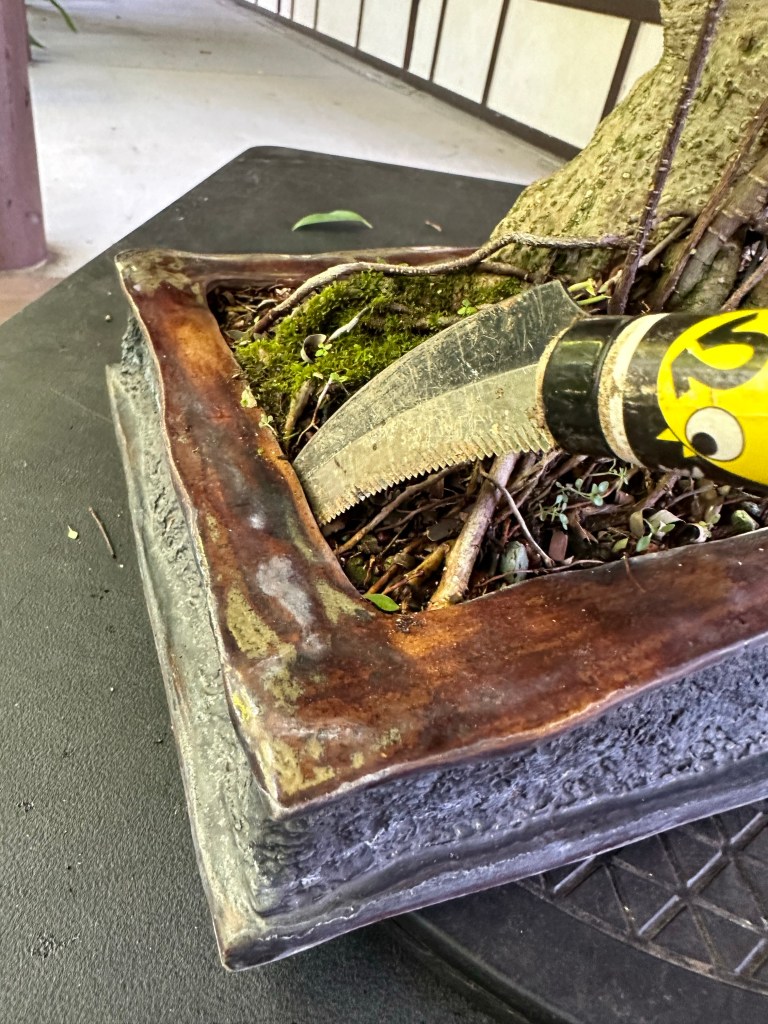
I have to bring in a highly specialized (and imported) root cutter (and sod cutter too, I guess, if you read the handle. But I just don’t see myself on my knees, my face in the grass, cutting out pieces of sod).
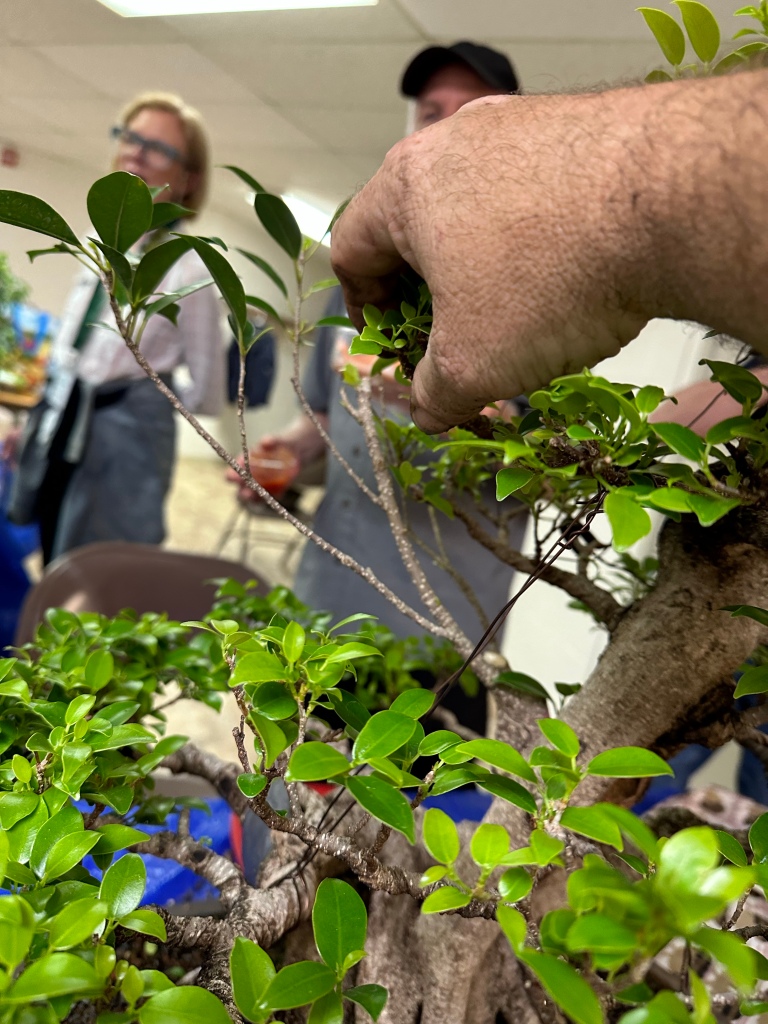
But first, the inevitable cutback and defoliation.
You don’t need to see that part, just scroll back to the hundreds of articles I’ve written and in which I’ve described the process.
I will, however, note that this tree is the species standard Ficus microcarpa. And that means I leave a little green on the tips so there won’t be dieback.
Now to the hard part, removing the tree from the pot. First, cut the tie down wires, on the bottom and top.
Then we start cutting around the pots perimeter.
As shown below.
Not too hard with that tool. I usually use a steak knife (which was stolen from The Sizzler Steakhouse and Buffet) but it’s at home in The Book. The gentleman I’m speaking with is Doug, The Hippie Dad.
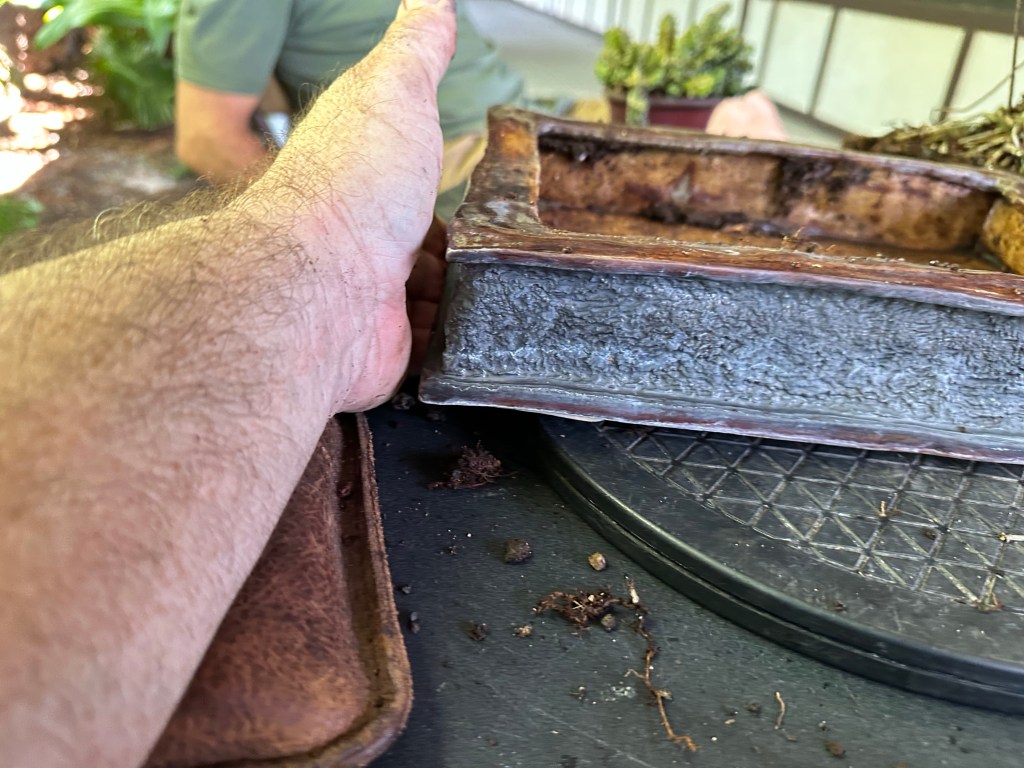
Now to birth the tree. Another video. Yes, I’m using my scissors. They worked. I use my scissors for many things I’m not supposed to use them for.
Looks like a tortoise mouth, right? And again, that was Doug. Thanks for the muscles.
The pot was made by Daniel Holderer. He called it “Cradle for Life”.
I’ll find something else to put in in. It’s been a good container for this tree.
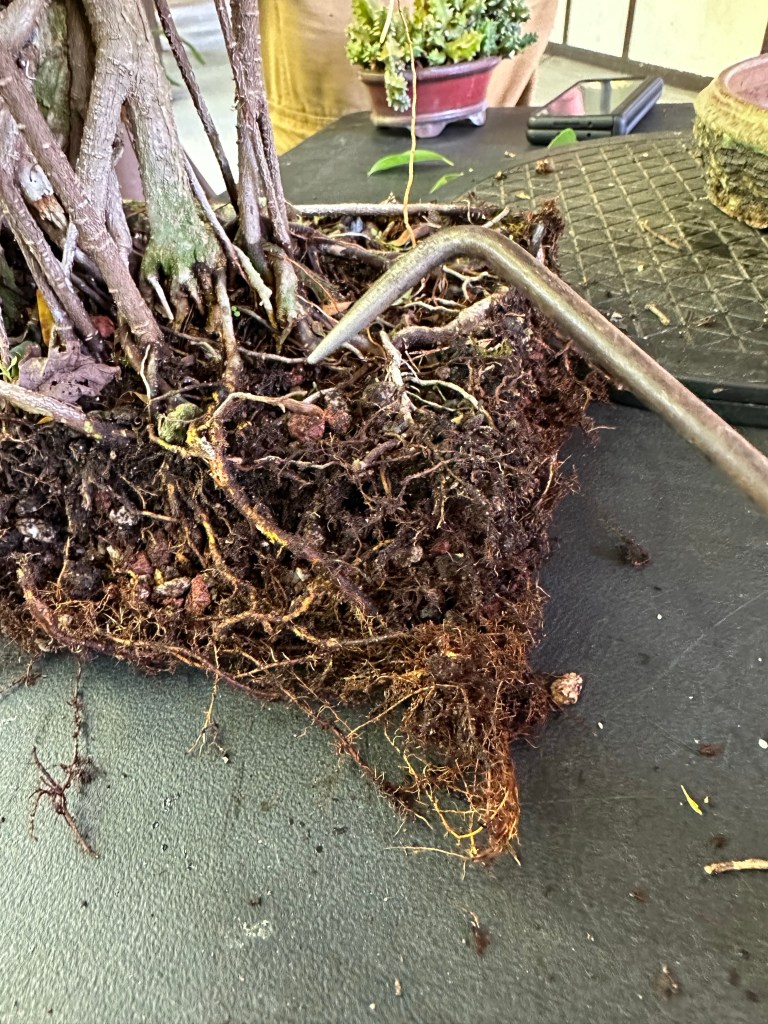
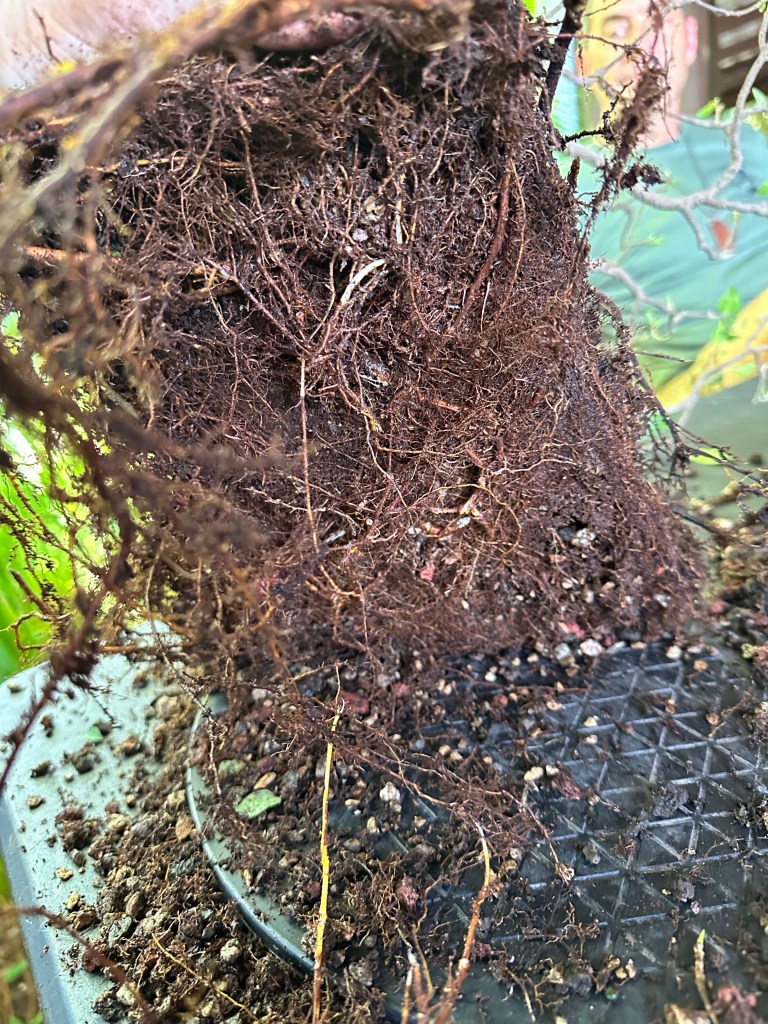
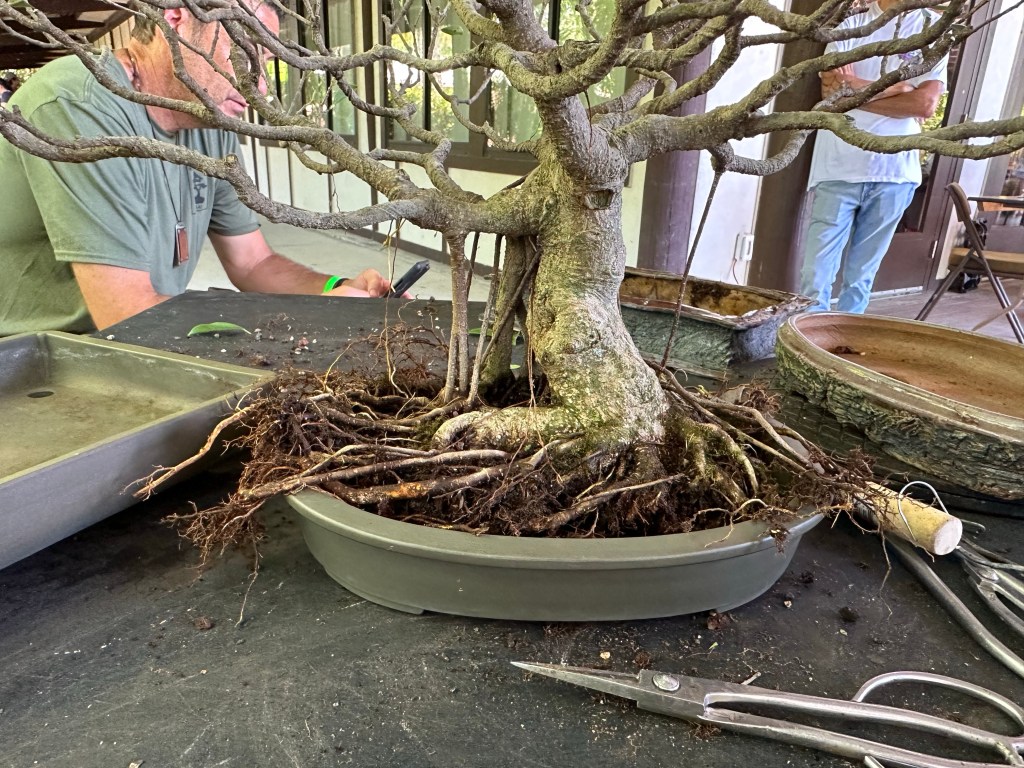
Now to rake out the roots.
It’s just a little root bound.
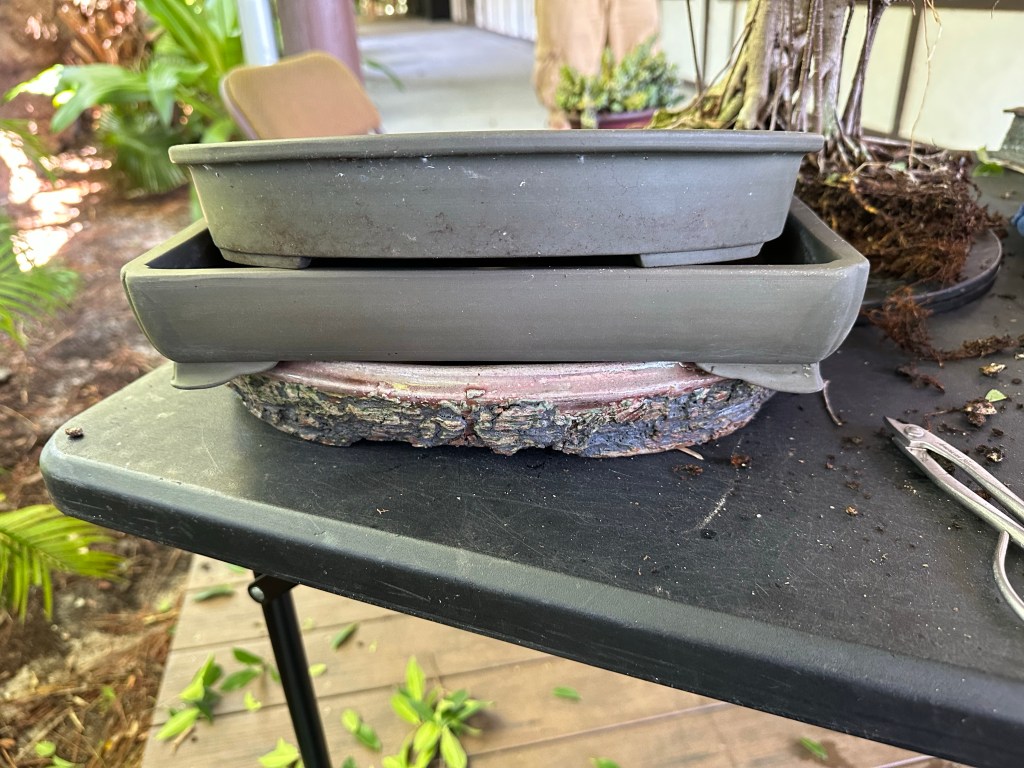
I brought three pots with me to choose from. Two of those antique Japanese pots with the weird green clay, and a beautiful oval from my friend Cesar Labrador.
The oval one’s too small…
….the rectangle one’s about right, but the style is too formal for my “Tropical Broom Style” ficus….
….ahhh, this one is just right!
Some screen, tie down wire….
Soil….
And we are done.
Looks good back on the bench at the nursery.
Tropical Broom Style. I made that up years ago but I think it’s appropriate for this ficus. And everything was made up in the beginning anyway. Whoa! Wait! Mind blown! Right? You mean you can just make up things?
Well now, did the story start with scotch? Or end with scotch? It’s kind of hazy looking back now. But I’ll try….wait, I remember…it started with bourbon!
It actually began in 2019, but you didn’t see the tree until 2021, 2 years ago (or, two years from the post, in case you are reading this in the year 3023. It’s now 2023, taking place in the month of July. If you don’t use the word July, it’s the seventh month of the solar year, named for Julias Caesar, the first Roman emperor (or dictator) after abolishing the Roman republic. the Terran summer solstice in the northern hemisphere occurred on June 21, 2023, and this debauchery occurred 28 days later. Terra or Earth, is the third planet from our sun, called Sol, in the Solar System, in the Milky Way Galaxy. Hopefully that’s enough for the far future readers to understand how we told time back in the ancient 21st century days of legend.)
Today , or rather, late July (don’t make me go through that again). We have a ficus microcarpa, what one might call “ginseng”. But that’s just a marketing term. Ginseng are not figs, figs aren’t ginseng. You make Newtons out of figs, and Monsters out of ginseng. The cookie and beverage, that is.
Ok, now that you’re up to speed, let’s get to the work….
I’m in Toledo, or Maumee, to be precise. It’s pronounced just like “mommy” by the locals. I feel a song should be sung. I wanna go back to my Maumee.
I’m with my two good friends, John and Julie. They take care of me when I’m there.
The tree is potted in an aluminum serving container. There were a few who said that we’d be poisoning the tree with the metal tray.
Looking below…
….I’d say, naaah! in fact, it looks good for a ficus in the north. Damn, I mean, it’s almost Canada fer crissakes. They don’t say “Holy Toledo!” for nothing.
Anyway, we did a lot of work that day. But not much on this ficus. We didn’t have a pot, you see. So we decided to get all “Muckety Mucked” up.
24 year…25 year….26 year, or, as the bottle suggests, one little piggy, two little piggies, and three little piggies.
We finished the 24 year. Made a dent in the 25 and 26. Wait, is this a bonsai blog or a drinking blog?!
It’s both. Sometimes.
And to the dead soldiers, we salute you!
The next morning, hangovers and bright lights notwithstanding, we had to get up early to go to Michigan (I know, that sounds like the first line in the “Great American Novel” we writers all would love to write. Maybe…..).
We had to get a decent pot, so we visited the Flower Market (Which has changed its name to Green Witch Gardens)
It’s a damn cool place to visit. Not only do they have bonsai, but there are cats…
…that’s cats, plural.
And pottery from amazing American artists.
The trees!
Julie hiding behind a tree.
Familiar weeds. These are what are called wandering dudes now. I feed them to the tortoises. Speaking of which….
Tortoises!
Only the best bonsai nurseries have tortoises.
We got some pots.
Then went back to Toledo.
And we got back to work.
For being in a shallow aluminum pan, it’s grown some good roots.
The “pot” has even held up well. We could use it again.
Looks solid.
Raking out the roots….
Here’s the new pot we got for the ficus.
Sweet, ain’t it?
Tree is ready
Can I mention again how good the roots are?
We had split some of the larger ones (go back and read the first post).
Hey, it even fits in the new pot.
Damn those are sexy roots. Must be the soil. The vaunted, rare and near mythic “All-American Red, White, and Blue, Adamaskwhy SuperMix” .
Just to prove we did other work, here’s some examples. A willow leaf.
A tigerbark.
An azalea.
A willow leaf root cutting.
And another.
I must say, I can’t believe what an amazing two days that was.
But I had a hard day while I was writing this piece. Something that should not be happening is. And I posted to Facebook; I quoted JRR Tolkien, the part where Frodo asks of Gandalf:
“I wish it need not have happened in my time,” said Frodo. “So do I,” said Gandalf, “and so do all who live to see such times. But that is not for them to decide. All we have to decide is what to do with the time that is given us.” J.R.R. Tolkien, The Fellowship of the Ring
And John replied “and what you do happens one word at a time, one leaf at a time, one sunrise at a time.”
Here’s the tree all those years ago. We ground layered it (hence the post title).
One tree at a time. Even if it takes years to bring it to its potential.
One leaf at a time.
One branch.
One root sometimes.
The two years ago..
And now.
Bonsai is a journey. And getting there is sometimes the only reason to go somewhere. You can buy a tree, but making a tree, especially this one, that started so humbly, is way more fun.
John has done well with it. I’m honored to have helped him, and thanks to both John and Julie for letting this strange bonsai guy (me) into their home.
I promise, I wasn’t hanging out with any rich men in Northern Virginia. It was all cool bonsai peoples. See?
Not a single politician (I don’t consider Roberto a politician, and he was in Peru anyway).
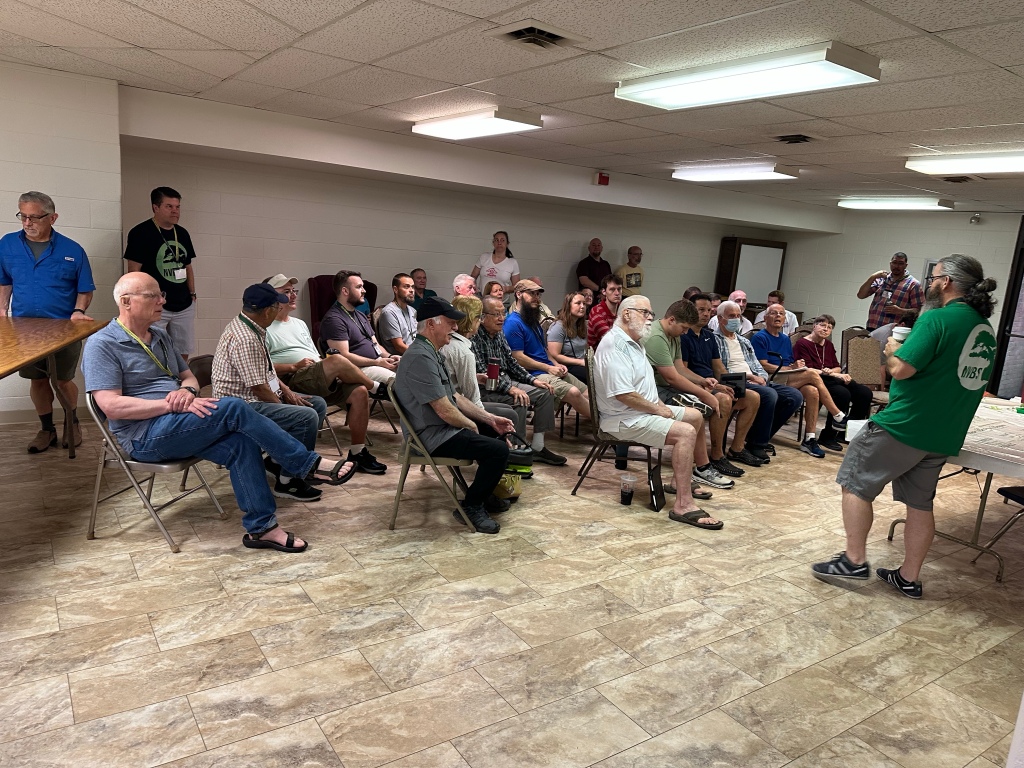
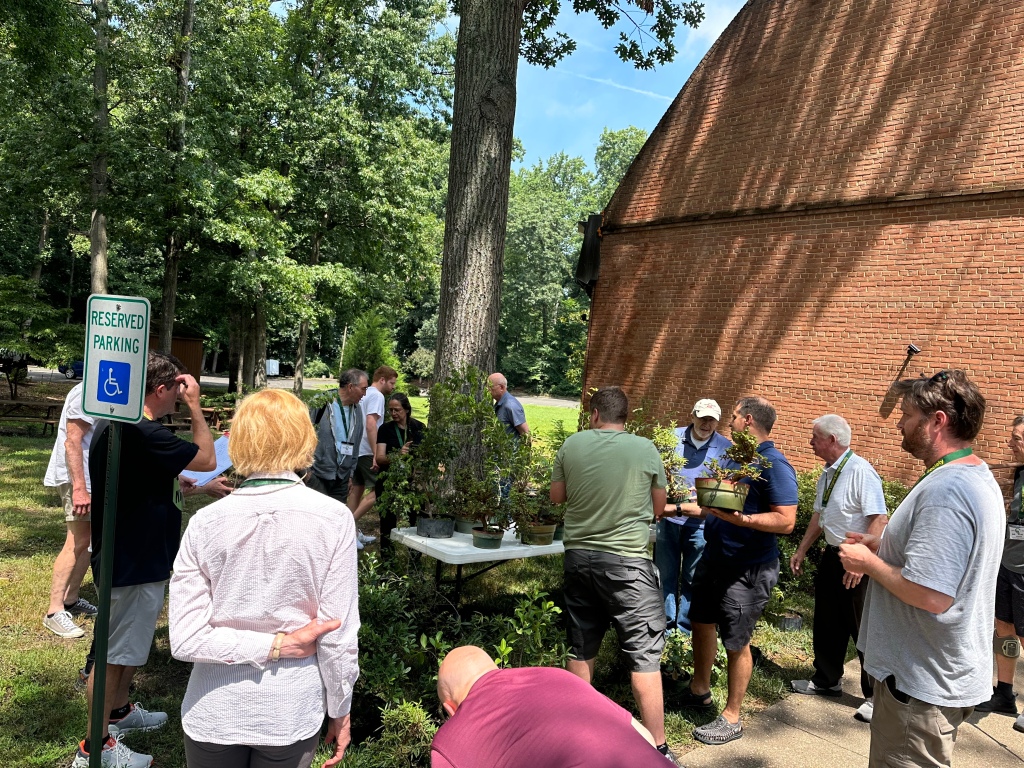
I was at the beginning of my summer tour, making a triumphant return to the Northern Virginia Bonsai Society. I brought a lot of trees for the workshops.
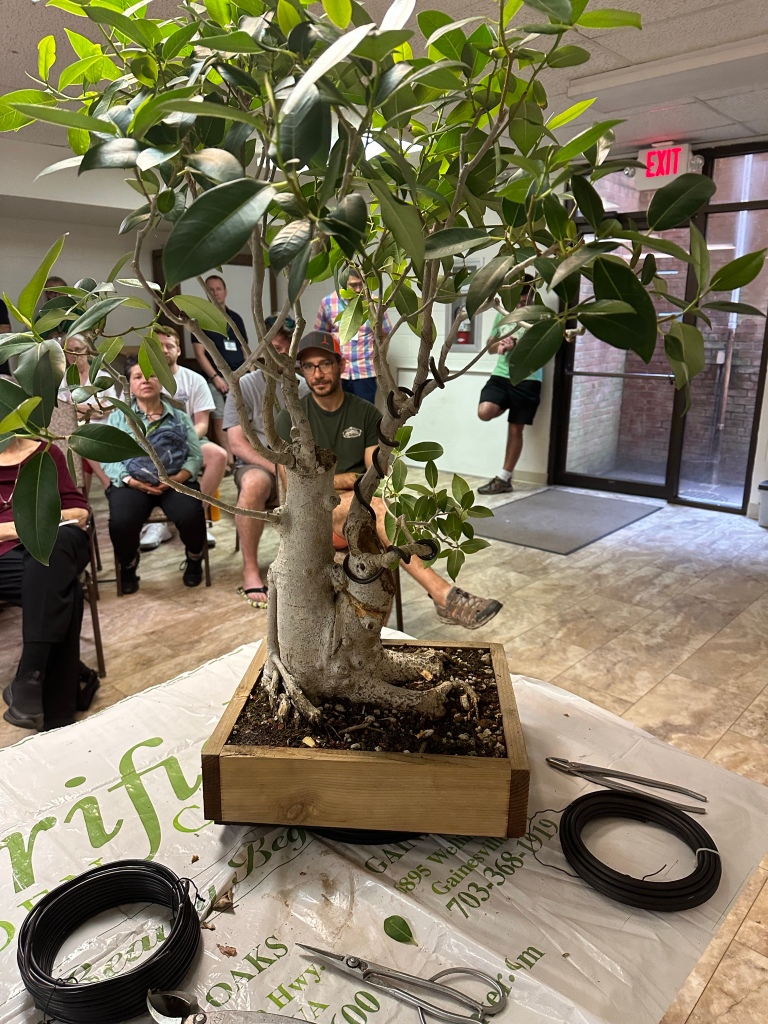
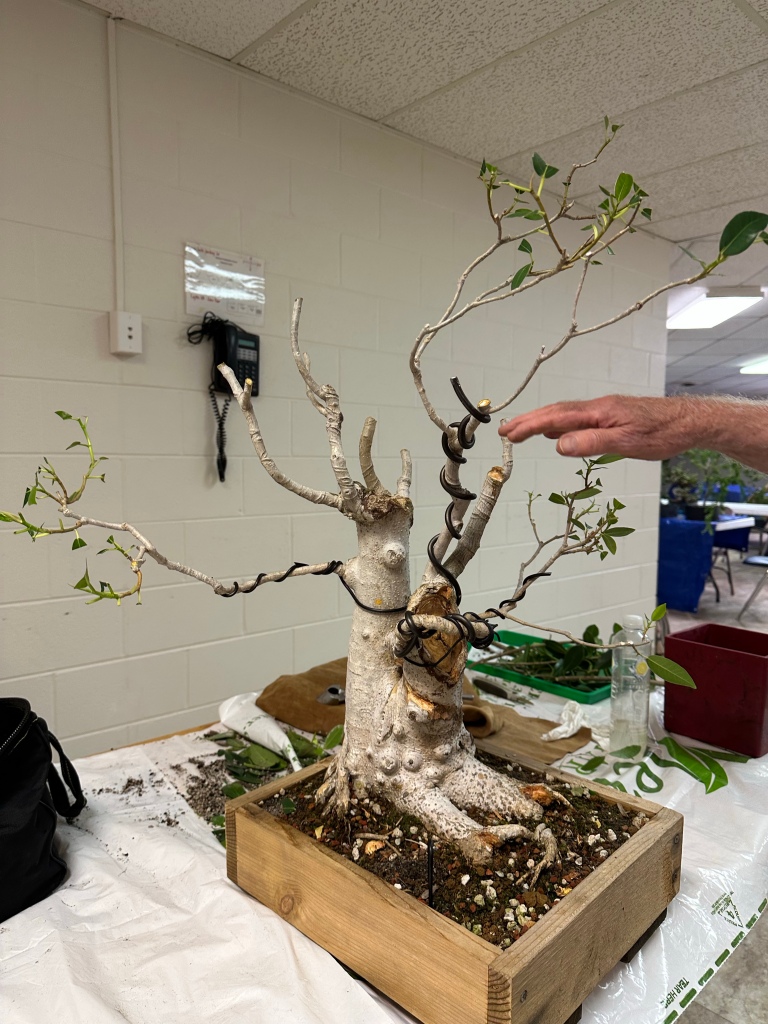
They gave me a tree, what I believe is a Ficus macrophylla (or the Moreton Bay fig, a ficus from Australia) as the demo tree. . This particular specimen has been passed around in the club a few times, with no one really doing much with it. Maybe a trunk chop or two. I liked it and the challenge.
I kinda like an underdog, so I tried my best, using my tropical tree bonsai superpowers to bring out the most I could from the tree.
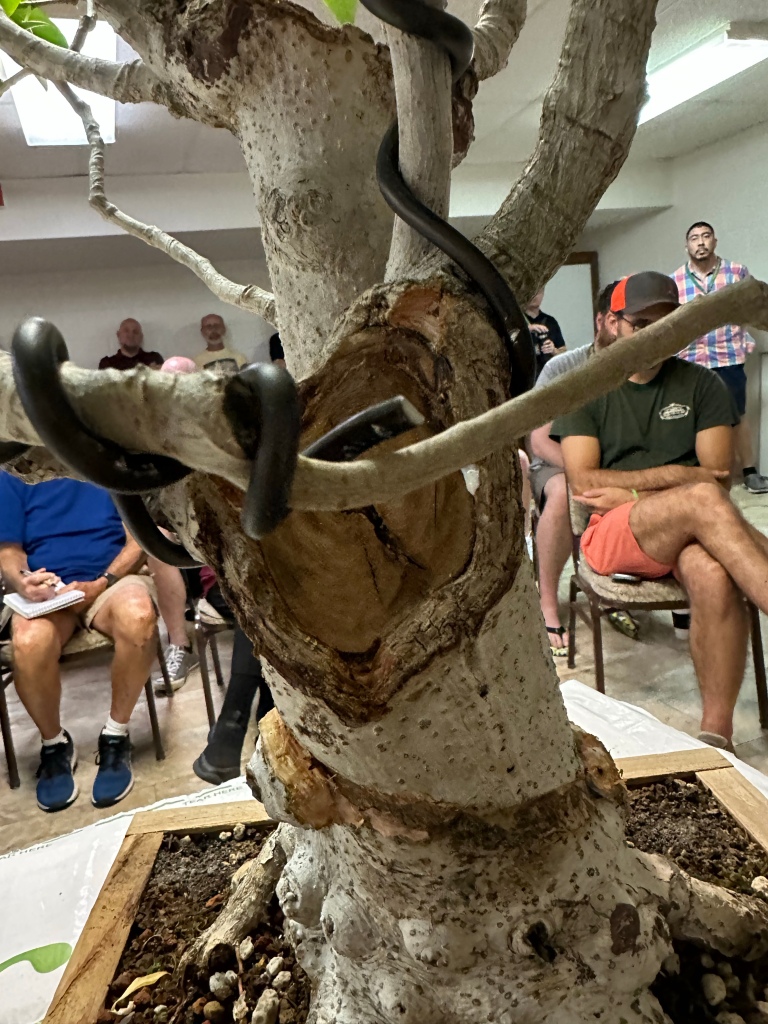
We start with an approach graft.
Cut it back in places, let it grow in others.
The graft….
The growth….
The cut back.
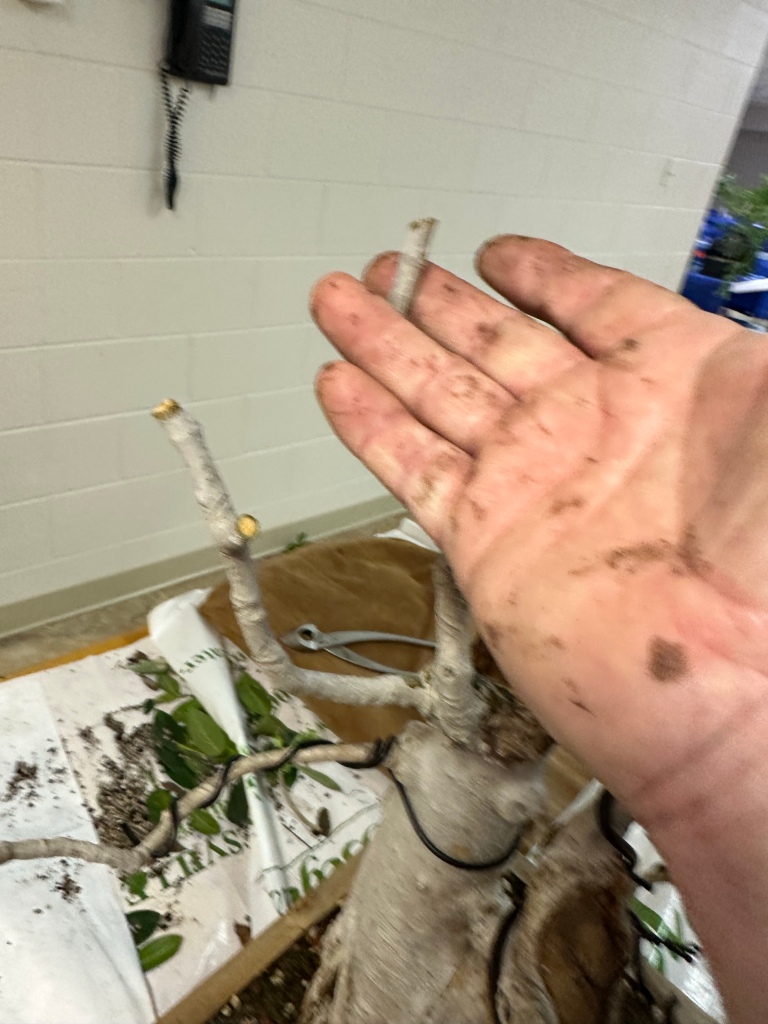
And below, my hand in an anticipatory gesture of the “Let it grow!” number, along with choreography and three part harmony.
This was the demo. Along with the work, I told the chicken sexter story (I’ll have to tell you, the readers, that story sometime), I explained what different plant growth growth hormones do (see this post: I use some fancy words to justify my defoliation habit, go figure ). I talk about my childhood trauma and how I use it in the styling and care of tropical trees in the sunshine state (not really, my trauma is manifested in less healthy ways, as it should be).
I told the story of my youth in bonsai, trying to find as much about bonsai as I could, and happening upon a website from a guy that not only grew tropical bonsai in the Great White North (coincidentally, in Massachusetts, about four miles from where I grew up), but developed spectacular tropical bonsai, better than most bonsai artists from Florida. His name is Suthin Sukosolvisit. One of the only true Masters in American Bonsai.
Anyway, I had some fun making a fool of myself on stage and hopefully imparting some knowledge.
I’d love to have the tree for myself. Maybe there will be some altruistic NVBS member who bids on it and sends it down to the FLA as a gift.
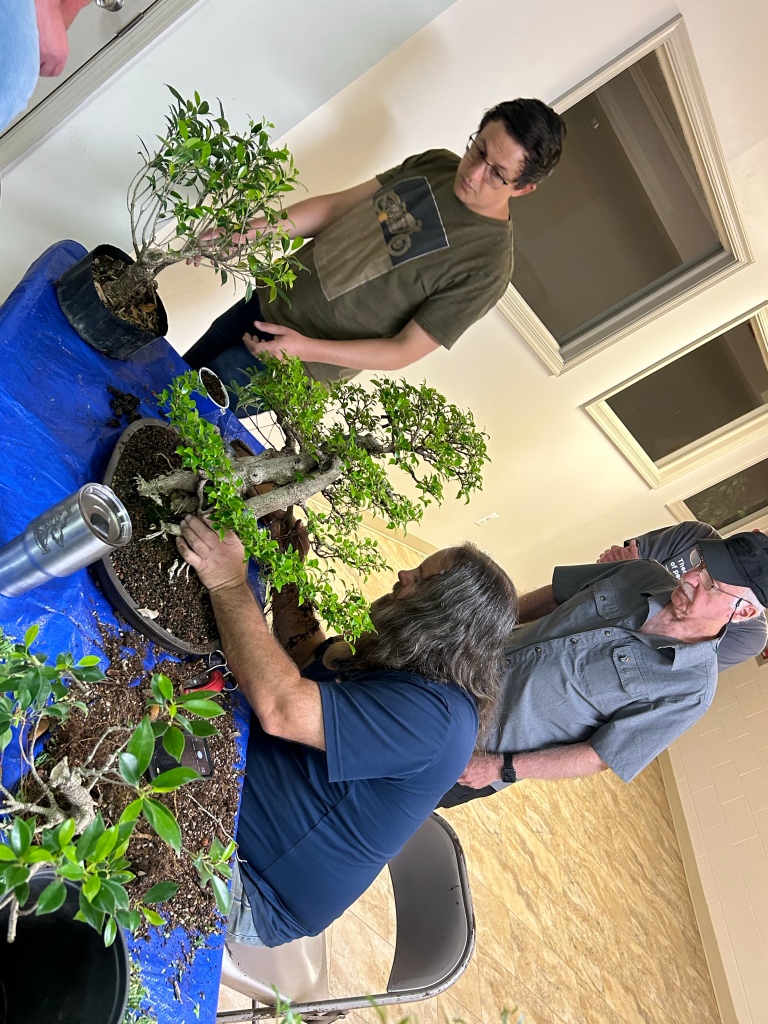
After the demo, and some lunch, we had a workshop. My wife took the pics with me in them. I think she’s biased, but she likes them.
In my element, surrounded by trees and students.
The trees got smaller as my ego got bigger.
Love a good trunk chop. It’s like the smell of napalm in the morning.
And just the video. For those that don’t like Led Zepplin.
My wife channeling her inner Jack Kirby with the wacky camera angle.
Now, we get to a cool tree. It’s a tree originally from Ed Trout, one of the last true gentlemen of bonsai. Ed had sold it to a man named Jonah Hill.
I know. Adam lavigne helping Jonah Hill work on a bonsai tree. The joke writes itself.
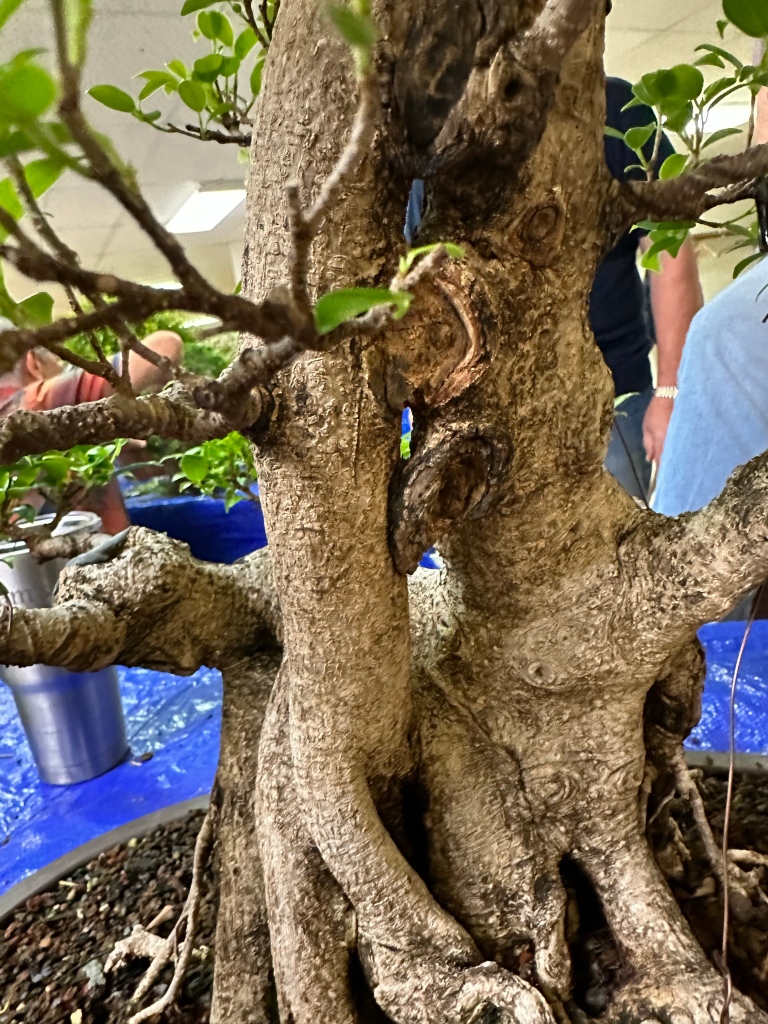
Study the pic just above. You’ll notice a hole in the middle of the trunk.
Below, I have a tree that no one wanted. So we are going to graft that into the hole.
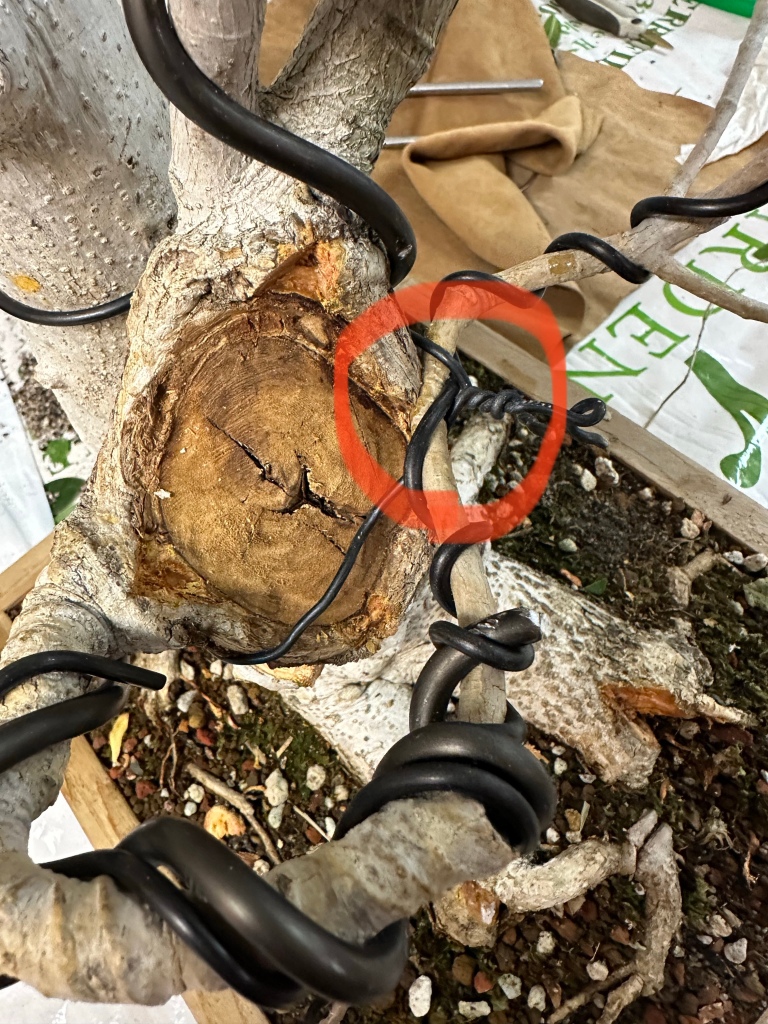
I cut off a piece of the tree, a piece with a good aerial root. The red circle is where I cut it and the graft will occur.
This, below….
….needs to fit into here. that’s the front of the tree, to keep you correctly oriented.
There’s Jonah, at the top of the pic. I’m about to stick the graft through the hole. Yup. Through it. That’s Jack behind me.
This is the back of the tree. The leaf end of the graft will act as a new back branch.
We use a brass screw (use a non reactive metal) to attach the graft.
Here’s the front of the tree. I arrange the roots, artistically, so that they compliment the tree. Notice the screw in the bottom left. And my wife giving me the “Look”
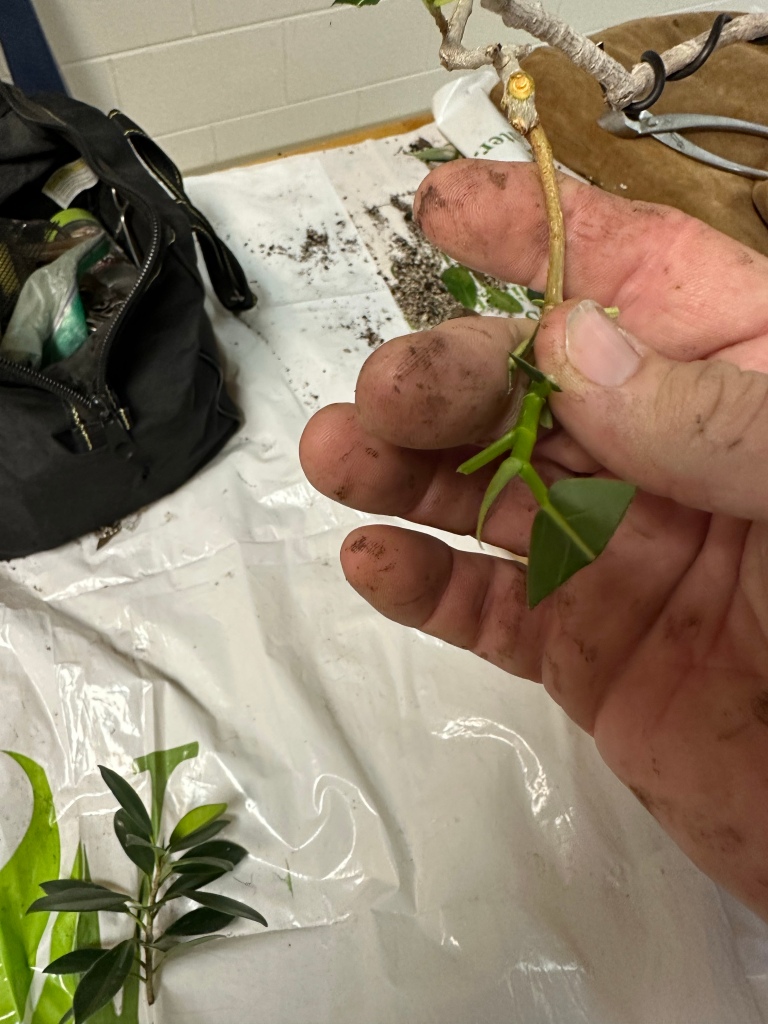
To get the graft to grow faster, I remove all the leaves except the last few, and I leave the grow tip.
There is still a hole, but as the graft grows, it’ll fill it up. That’s LeAnn, on the left, who was my host, giving me the same look my wife gave me. Both of them want me to work on her buttonwood. don’t worry ladies, it’s next.
Some more pics to give you some detail.
Jonah has done well reducing the leaf size.
Just about done. We tied some aerial in place (bottom left).
And, finito!
For the next tree, and the next post, we get to meet LeAnn’s buttonwood. An amazing tree, also from Florida (like Jonah’s tigerbark), and originally from none other than Mary Madison, the Buttonwood Queen.
It’s been about four years since I found this, and every year, looking at it and pondering the next move, I’ve missed the opportunity to work it. Why? I needed to repot it, get a look at the roots, figure out what was happening under the soil. You can only do the root thing in the late winter/early spring, before the tree sprungs, or you’ll tend to kill it. We don’t try to do no killin’ ’round here.
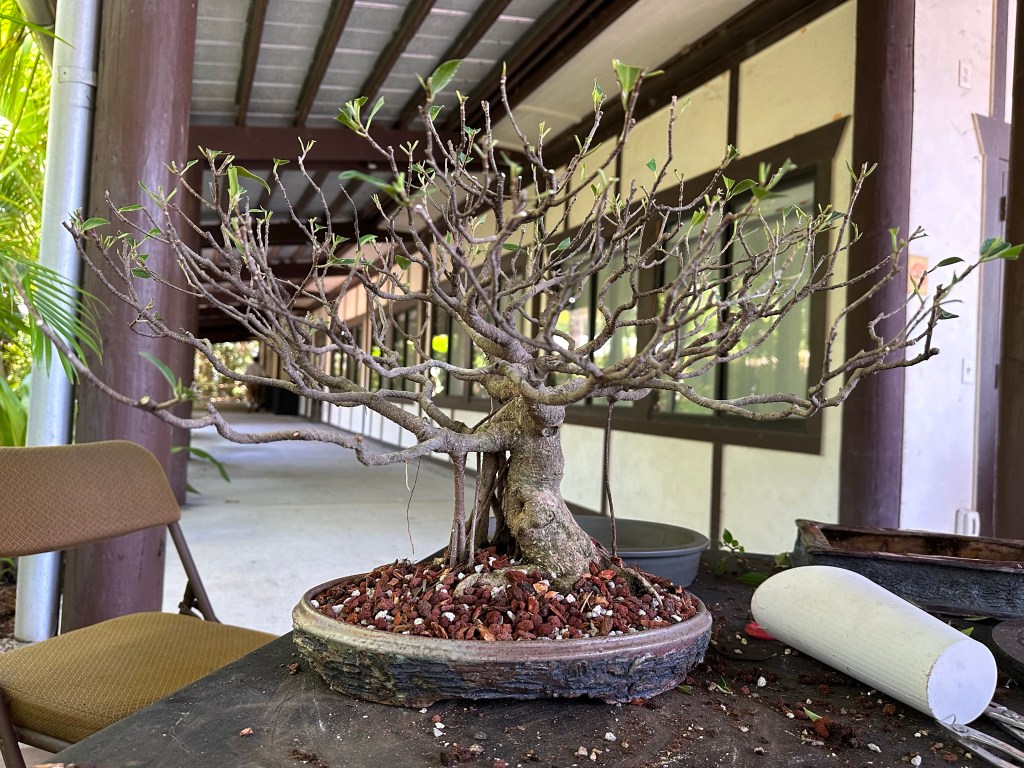
It’s my favorite deciduous tree, Celtis lævigata, and you need to repot it before the new leaves emerge. This year I got to it in time.
Let’s see what we can figure out.
I love odd shapes and challenging trunk lines in my personal trees. This is a root, I’m sure, off a bigger tree, and I love it.
The dead wood. The reverse (inverse, obverse, blah blah blah) taper. The species. I call it the ficus of the deciduous world. You just have to search “Hackberry ” in the search on the front page and you’ll get a bunch of hits on articles I’ve written on the tree (except that one Brazilian Raintree hit….).
Funny thing just occurred to me. When I write my blog I try to explain what’s happening, or what’s going through my head, as I work on the tree.
During a demo, I’ll often just get lost in the tree, and forget that the audience is there and I’m supposed to be performing. A bonsai demo is really a kind performance art (and I say that tongue in cheek, because many bonsai practitioners are kind of conservative when it comes to bonsai-as-Art, no matter their taste in art or politicians. Me, I can’t stand the taste that a politicians actions leave in my mouth, except I don’t mind that one bonsai guy in Virginia. You know who you are, Roberto).
When I’m asked what’s going through my head during a demo I usually say “not much”. It gets a few laughs. Or I’ll say “you don’t wanna know what lives inside my brain”. That gets some too.
Sometimes I tell the story of how the chicken came to the west.
I’ll say, ” How many of you have heard the chicken story?”
Those who have, groan. But they encourage it because, though they’ve suffered through it, they want others to know the pain of sitting through it as well.
Shared pain is lessened, after all.
Anyway, the chicken story:
What you may not know, is that the chicken originally came from Asia. Look it up, I ain’t lyin’. And in Asia, there is a strong Master/Apprentice relationship in the passing down of knowledge.
Now, anyone who’s raised chickens knows that it’s prit’near impossible to tell the difference between a male and a female chick (baby chicken). And it should be self explanatory that a female chick is more valuable than a male chick, because of, you know, eggs and all that, so there evolved a very prestigious occupation in the world of animal husbandry know as a “Master Chicken Sexer”. A real job. A dirty job you might say (you remember Mike Rowe and Dirty Jobs? There was an episode about just this thing).
So, being that chickens are from Asia, and they were imported into the West (how else do we have omelettes?), it soon became clear that the western farmers needed help trying to figure out how to distinguish between a male and female chick. Still obvious, right?
So the western farmers hired the Asian Master Chicken Sexers to teach the westerners how to do this.
The scene: we have the apprentice chicken sexers sitting at the conveyor belt, and the yellow chicks are coming down the chute, onto the belt, and the apprentice picks up the chick, tickle its butt or something, and throw the chick into either the male bin, or the female bin.
The poor male chicks are mostly made into….ah, feed for other chickens. The females were let go to make nests and lay eggs for the farmers to harvest and make their scrambled egg breakfast or quiche (if they’re French farmers).
As I mentioned before (about 100 words earlier) it is exceedingly hard to figure out the difference between the male and female chicks; they’re both yellow, the males haven’t learned to cock-a-doodle yet, the females don’t even gossip. So the apprentices are sitting there, chucking the yellow birds in whatever bin they thought they should go into. When they got it wrong, the master, who was standing behind the apprentice, would whack the poor student on the back of the head.
Slap!
Eventually, the apprentice could unfailingly tell the difference between male and female chicks.
Now, they had no idea how they knew, but they did know. That slap hurt.
Again, obviously, the point of the story isn’t about chickens or East and West or even farmers. It’s more about how to teach. Some bonsai teachers teach using the rod, telling you you’re wrong and to do it again, and again, and again, until you have it right.
That’s not me. My online name is Adamaskwhy. Most people think it’s that way so you can ask me “Why?”
And you can.
Most of the time I know the answer, or I can find it.
Or I make something up that sounds plausible.
But the real reason for my name is that, as a student, I don’t just want to know the answer. I want to know why. I was (and still am) that annoying kid in the back row that said “oh yeah, prove it!” And it angered some teachers, bothered others, and I was loved by the smallest percentage. Those were the good ones.
I’ve talked about this before, so excuse me if I’m repeating myself, but a teacher who doesn’t know why, ain’t much of a teacher.
If you can only recite your lessons, then you haven’t learned a thing.
Which brings us to the initial styling of this hackberry. You remember it? The subject of this article and all? I know, you got lost in the chicken story. It happens.
What in the hell is going through my head?
Well, you’ll have to trust me on this one, and see what happens this year.
It seems that a lot of “rules” are being thrown away with this tree.
I mean, they do say that “rules are meant to be broken”. But why do they say that?
Let me tell you another story, this time about a boy named Pablo. Pablo’s father, Ruiz, was an artist that specialized in realistic drawings and paintings of wildlife. He was an instructor and professor at several art schools. He started training Pablo at the age of seven, and insisted that Pablo learn how to draw and paint properly, in the classical and realist style that was popular at the time, and was profitable, as artists jobs back then was to paint portraits and art to be hung in wealthy patrons homes.
So Pablo learned. It came easily to him. At age thirteen, his father, Ruiz, proclaimed that Pablo had surpassed him in talent and technique, and enrolled him in a prestigious art school in Spain.
Pablo quickly understood what art school was for, and formed serious friendships that would help him later in life, all the while slacking off on his lessons. He knew them anyway.
That, by the way, would be the one lesson to take away from this parable, college is to make contacts in school, that will help you later in life. The bosses who hire you only want to know that you got the degree, not that you were a “C” student. But if they know you were in their sorority or the chess club they were in, you, my friends, are in, as they said in my youth, like Flynn.
Pablo was so good a draughtsman that, in his later years, when everyone called him Picasso, he would sit and drink his coffee at the cafés in Paris, and draw photorealistic flies and bugs on the walls. Drawings so real the waiters would rush over and try to swat the fly off the wall. Pablo, as you might think, got great pleasure in these escapades.
We are all just boys and girls, trying to smile at the tragedy that life sometimes is.
What is to be learned by this last story?
If you learn to do the work, as a craftsman should, you can then use that work to accomplish the Art that your soul requires to feel alive.
It seems I’m at the end of the work.
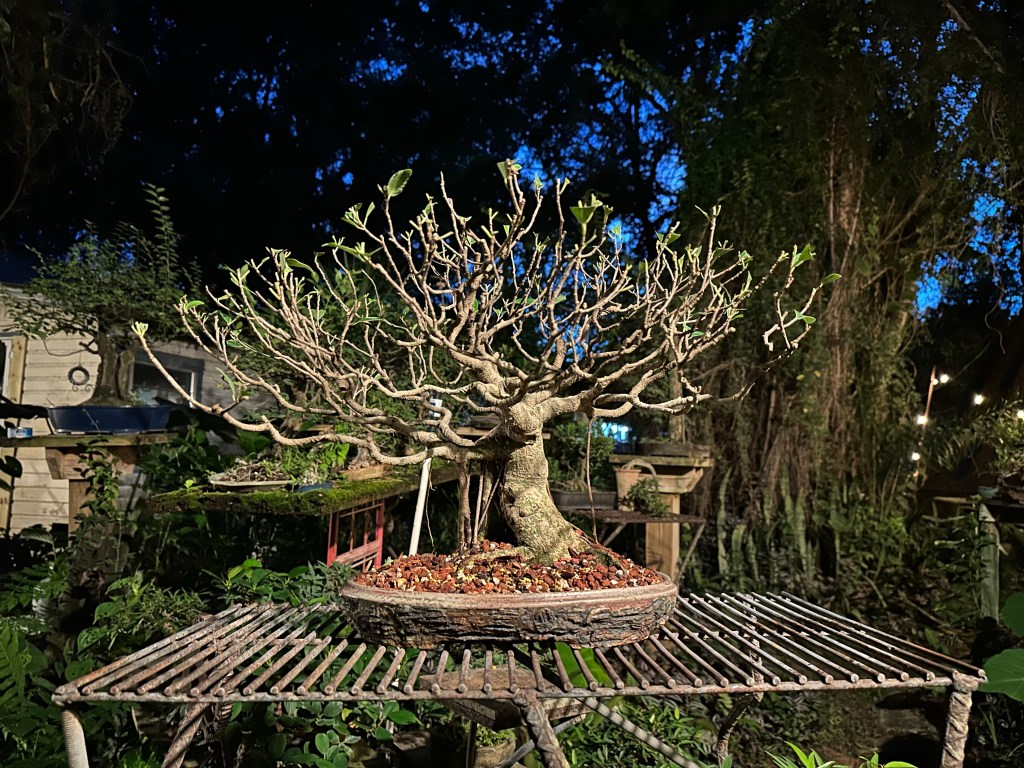
I would try to get a good pic, but my photography area has been battered by a hurricane or two. It’s on the list to repair.
And here’s the obligatory tortoise pic. I need to build him a proper enclosure. That’s sooner on the list than the photo spot.
This is the best I can do for now.
I’ll post updates as I make changes in the tree. Maybe. I have a long list of “To-Do’s”.

 Login
Login












 I wanna go back to my Maumee


 ” .
” .