Today, I got to diagnose what’s wrong with a 2012 Jeep Compass, take my daughter to PT, and go and take a dog outside to poop.
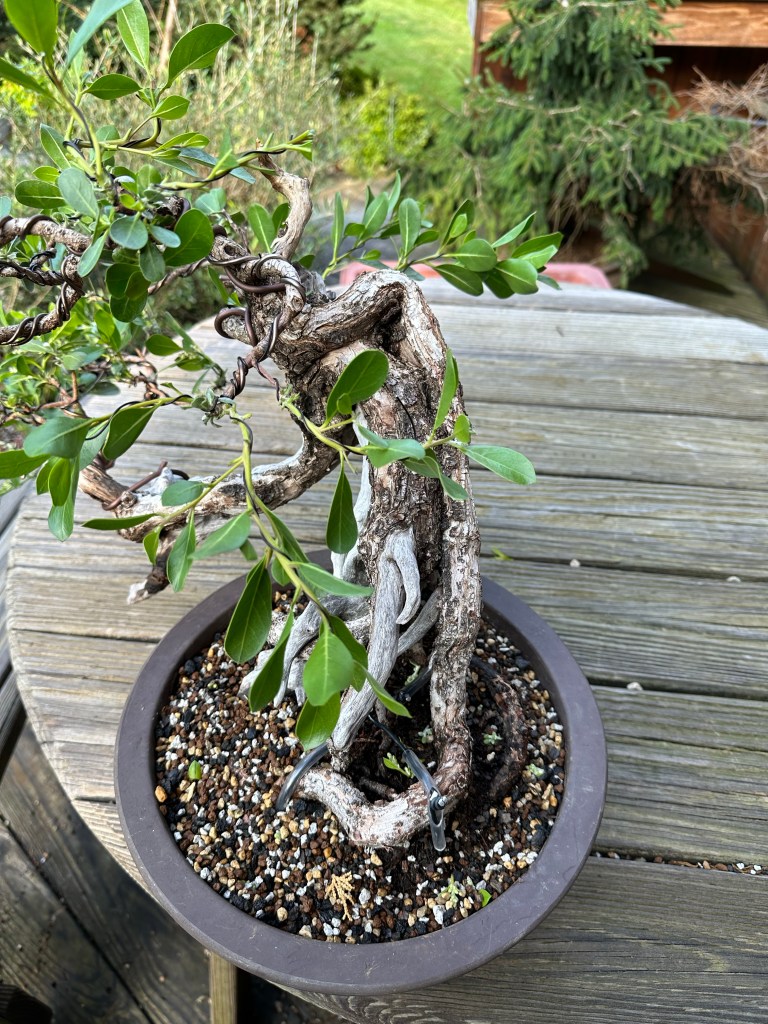
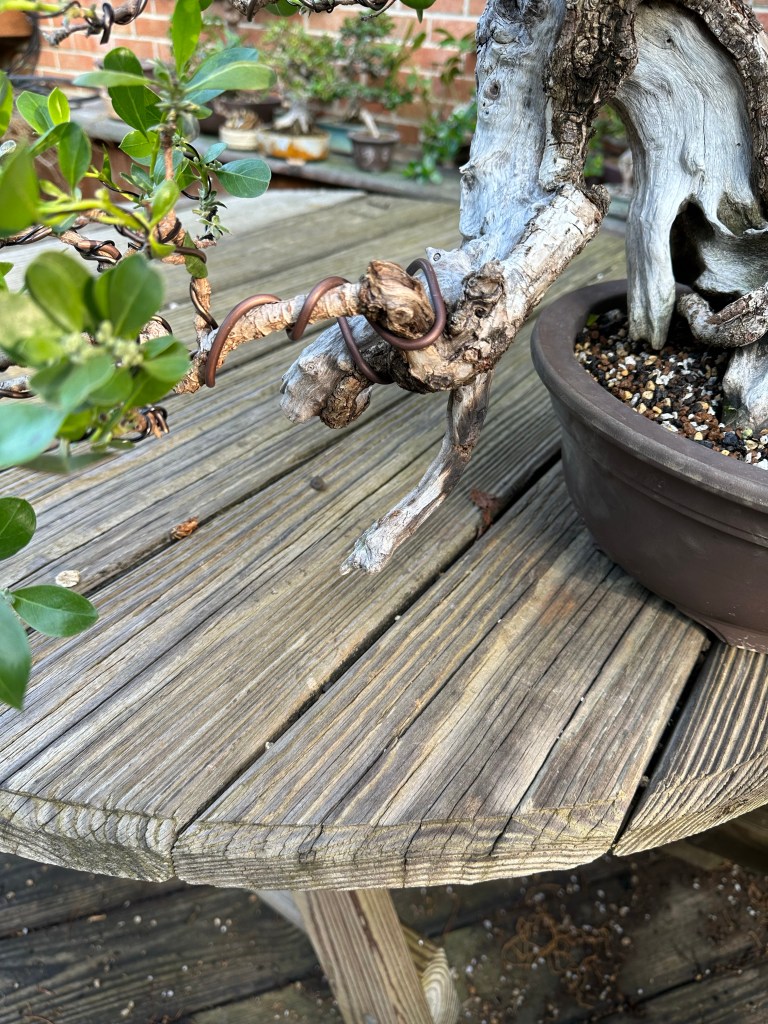
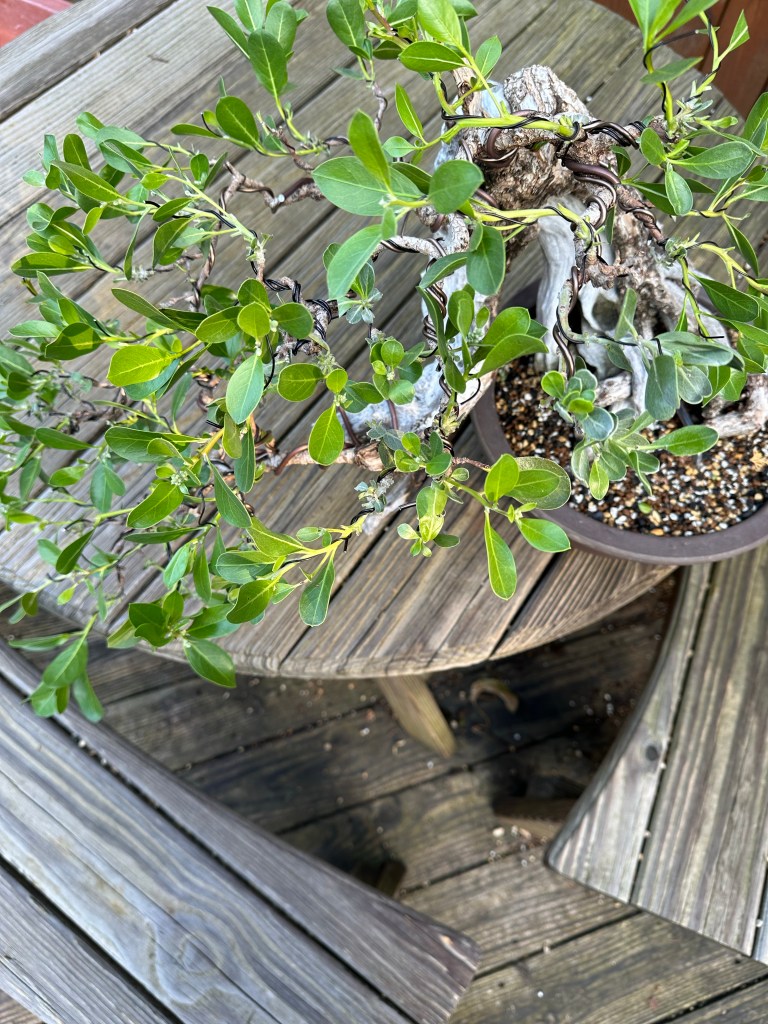
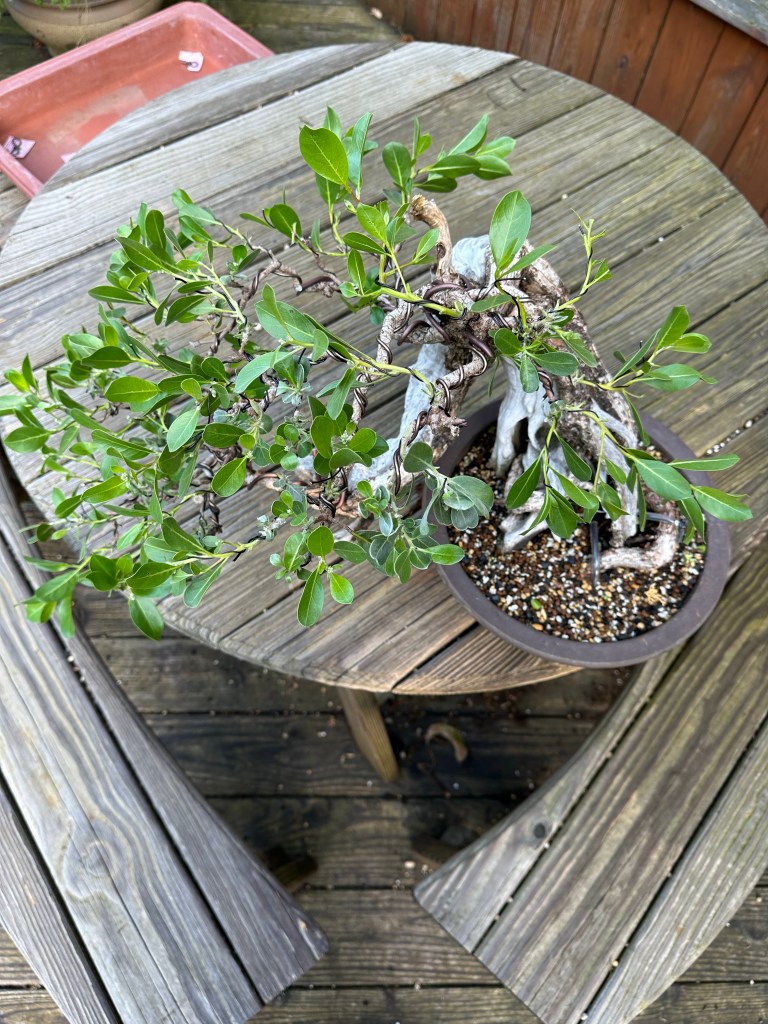
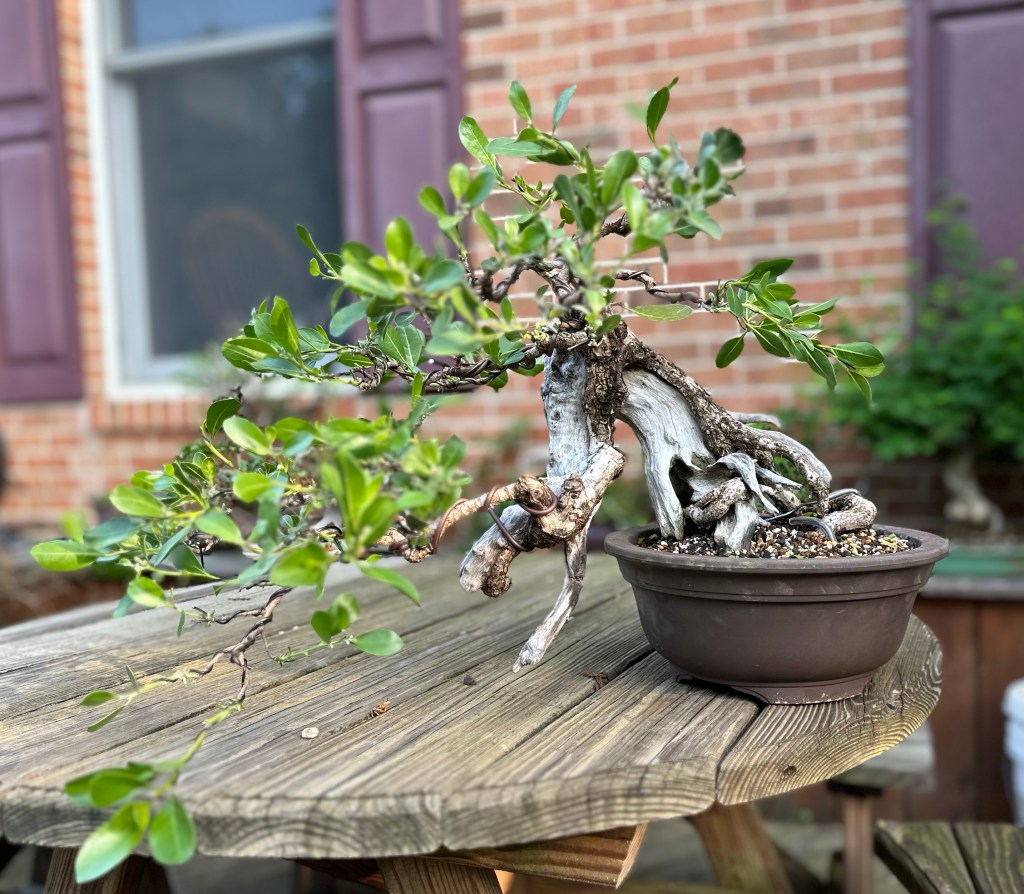
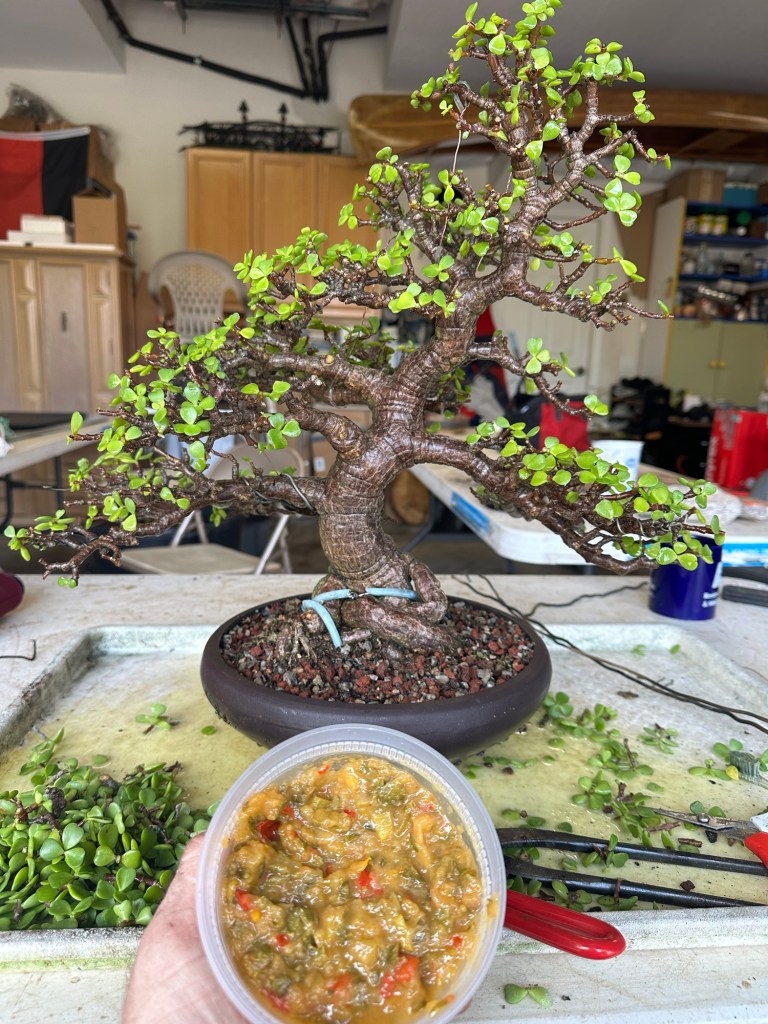
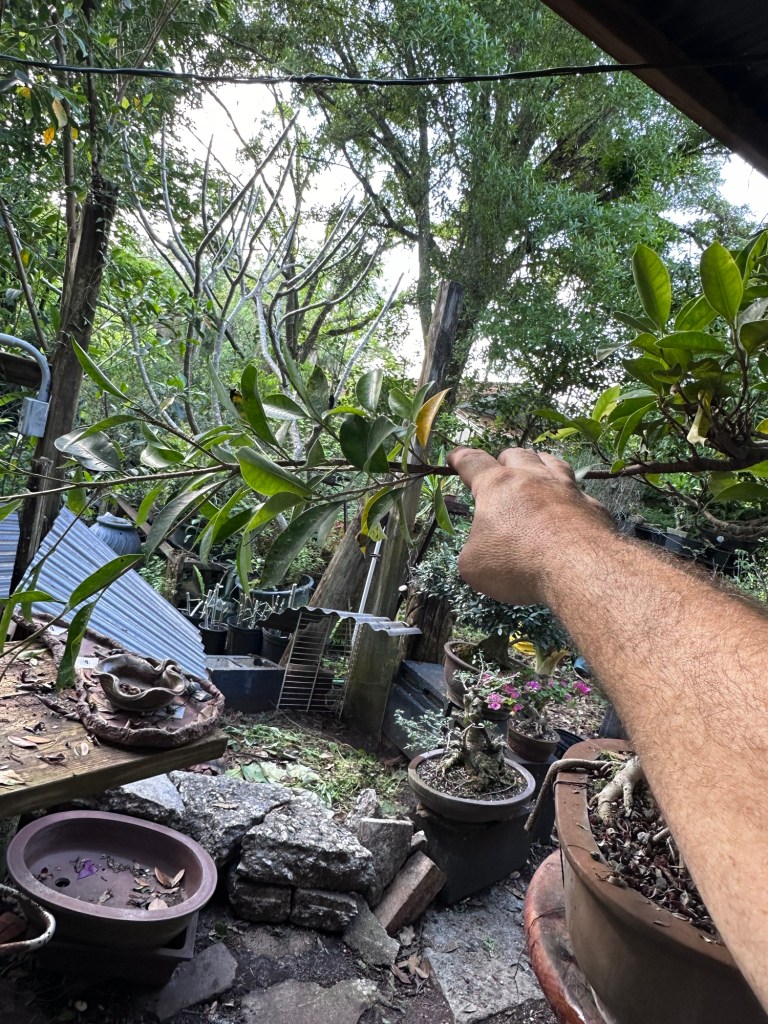
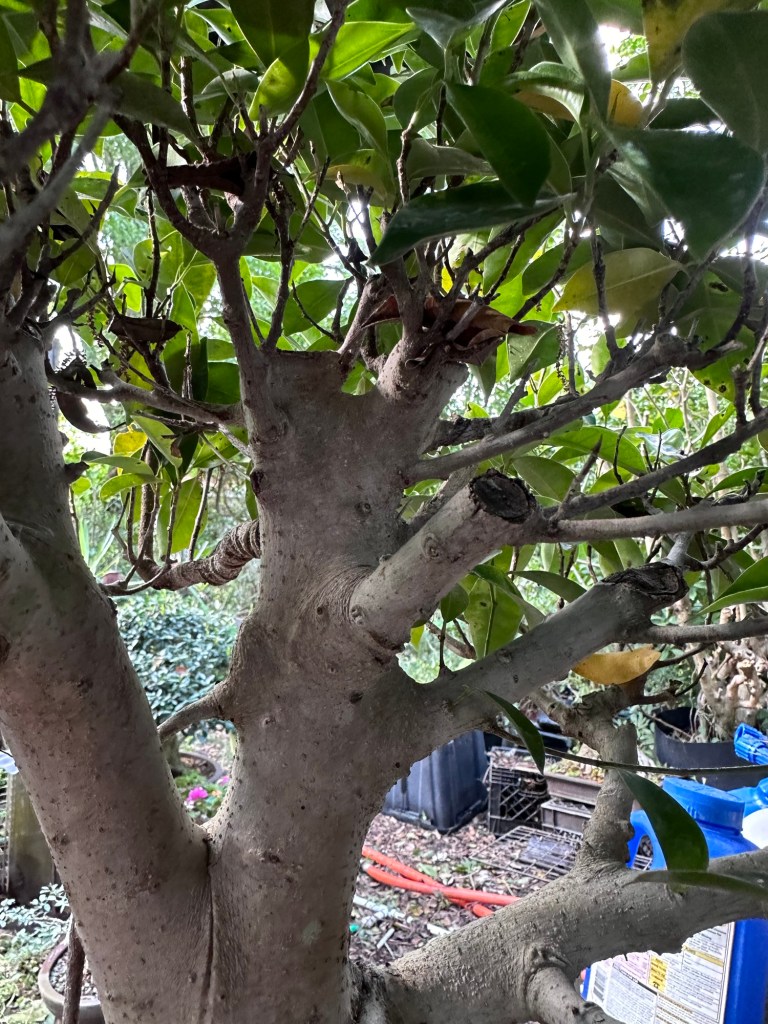
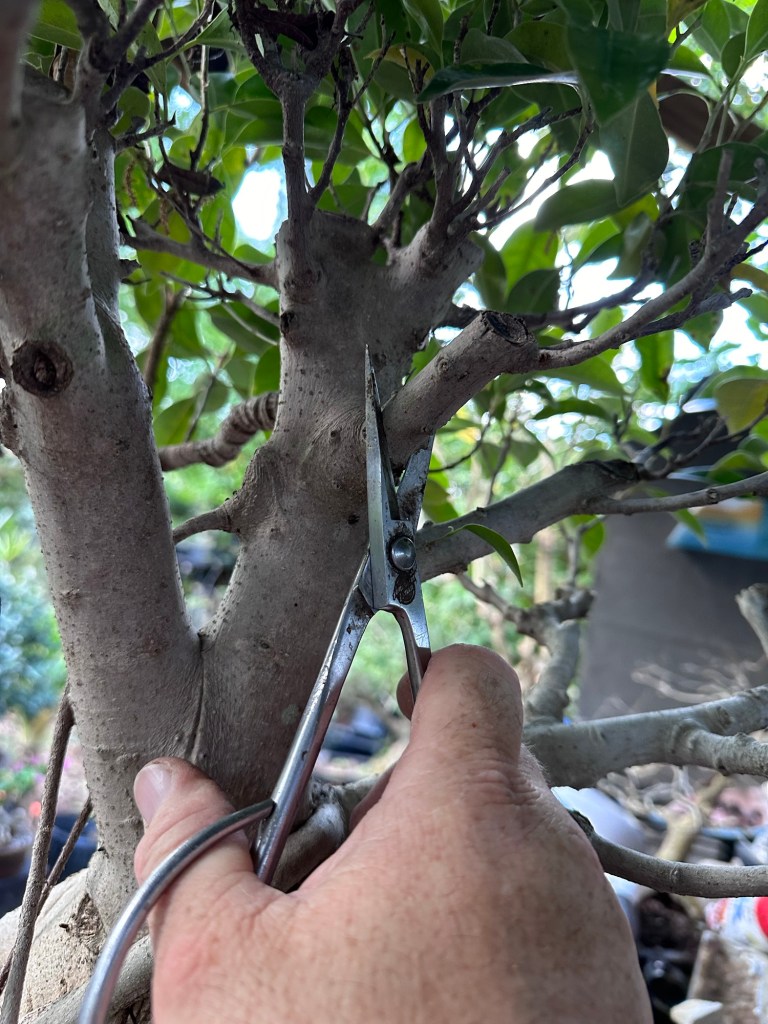
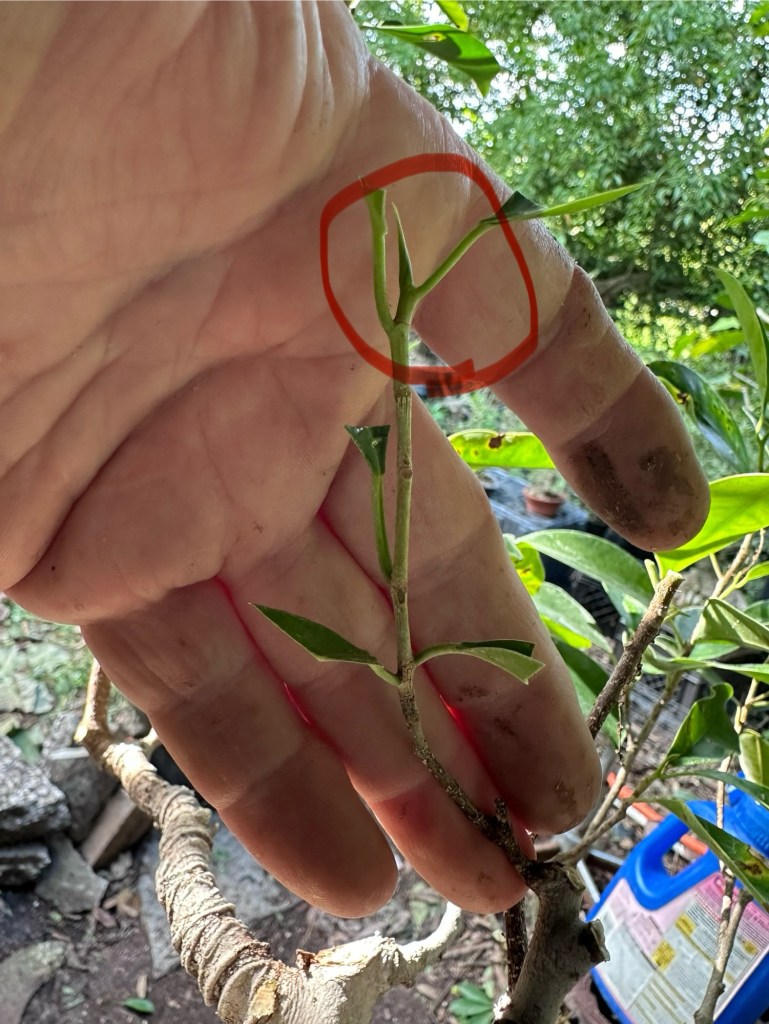
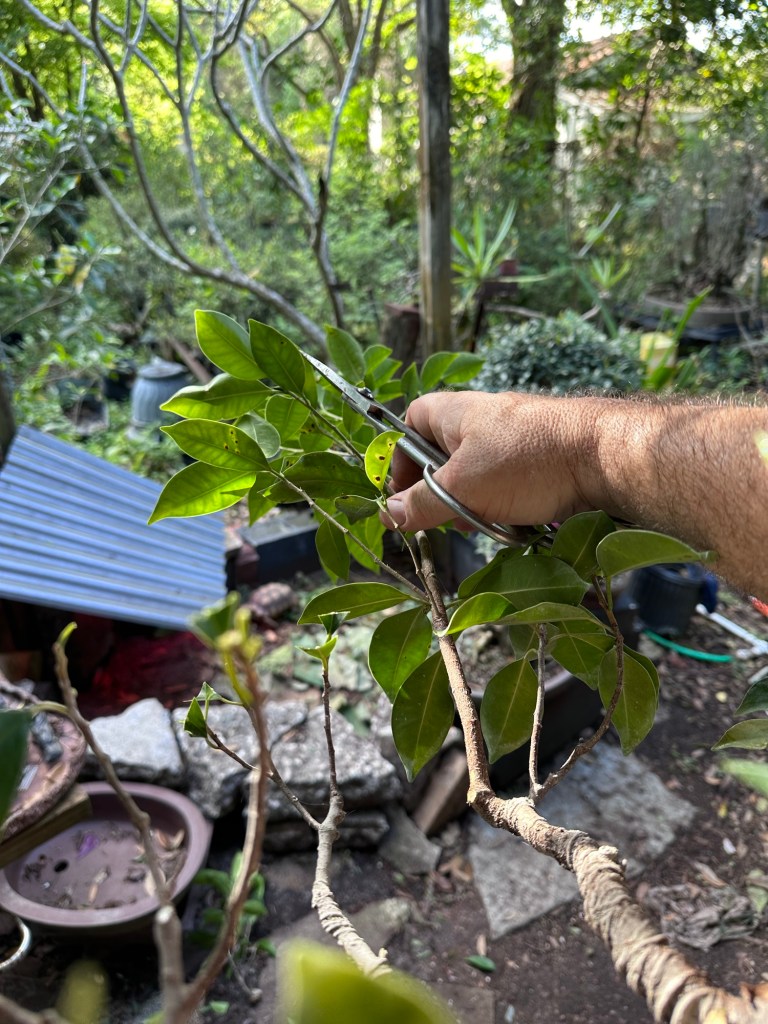
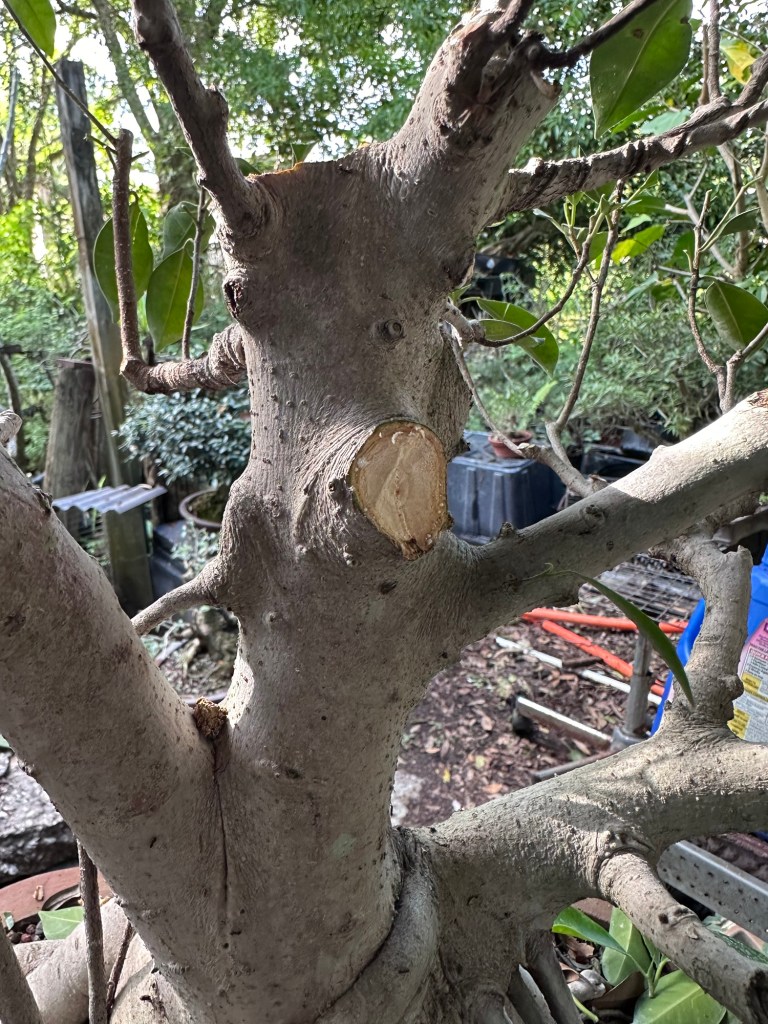
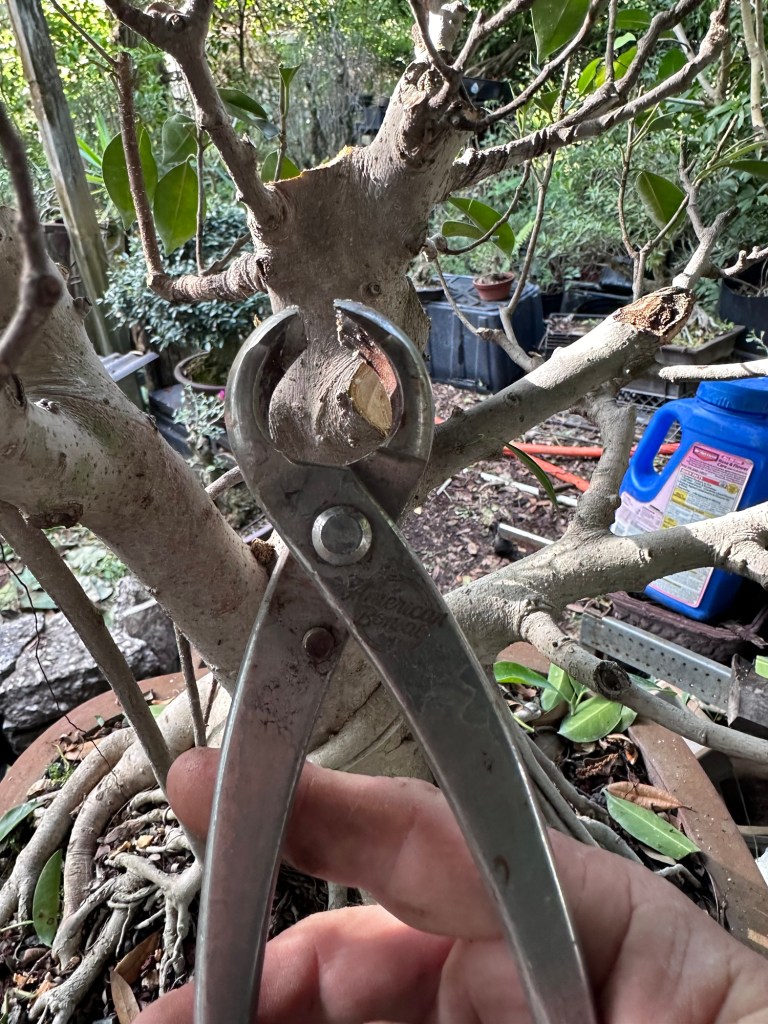
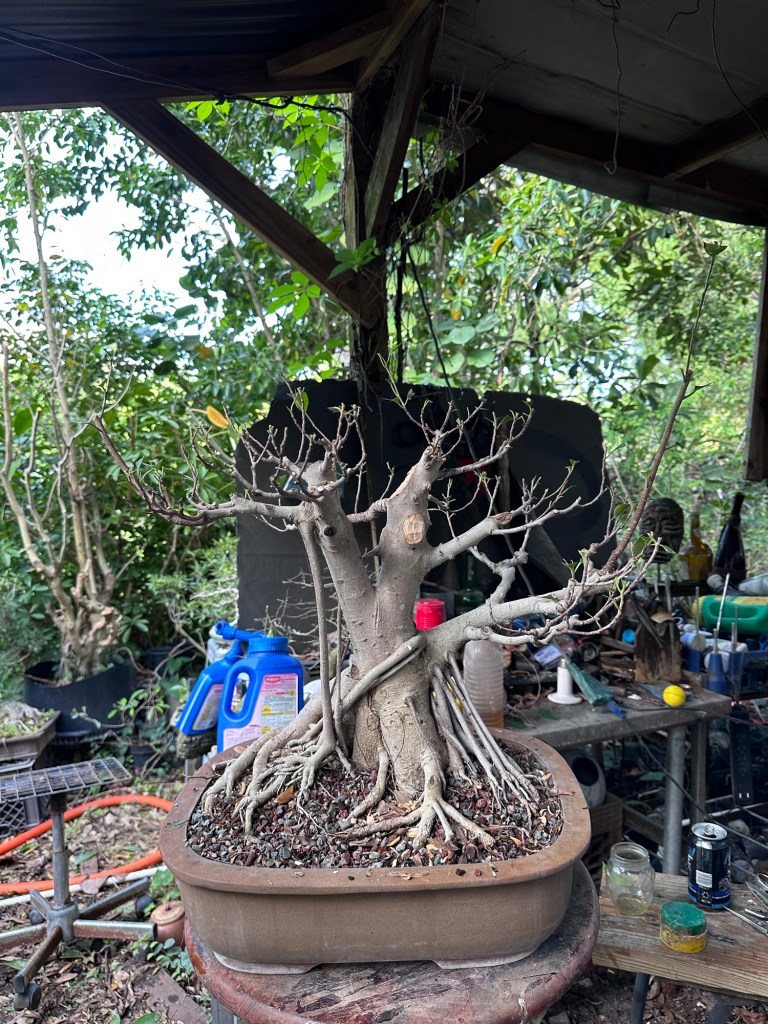
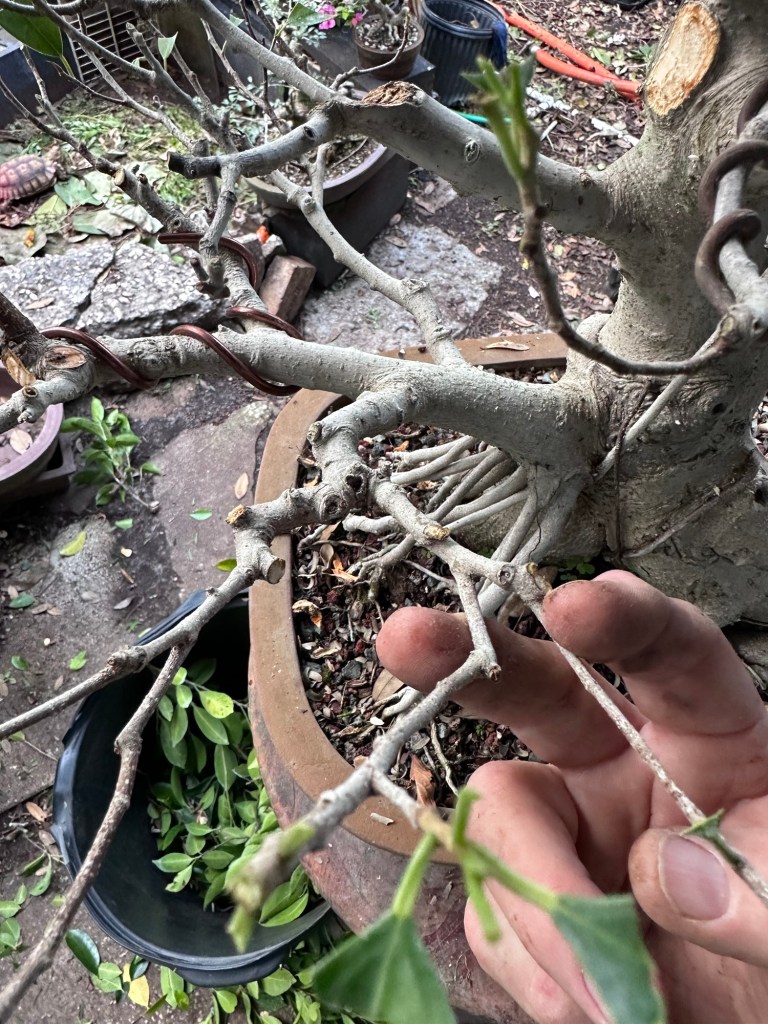
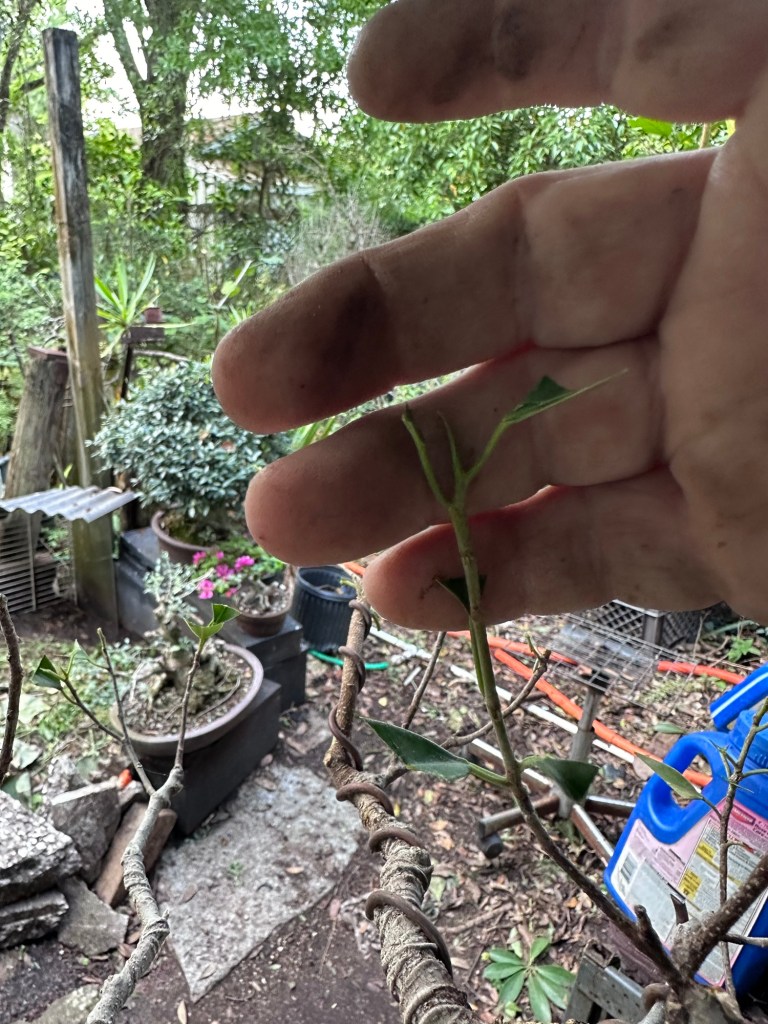
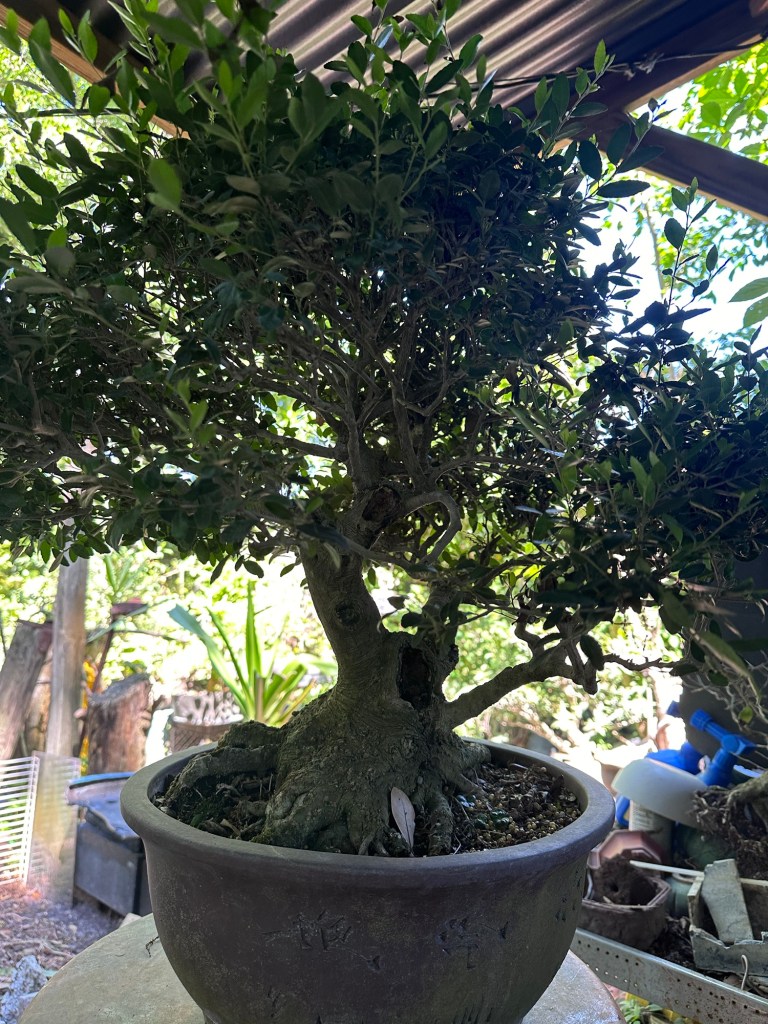
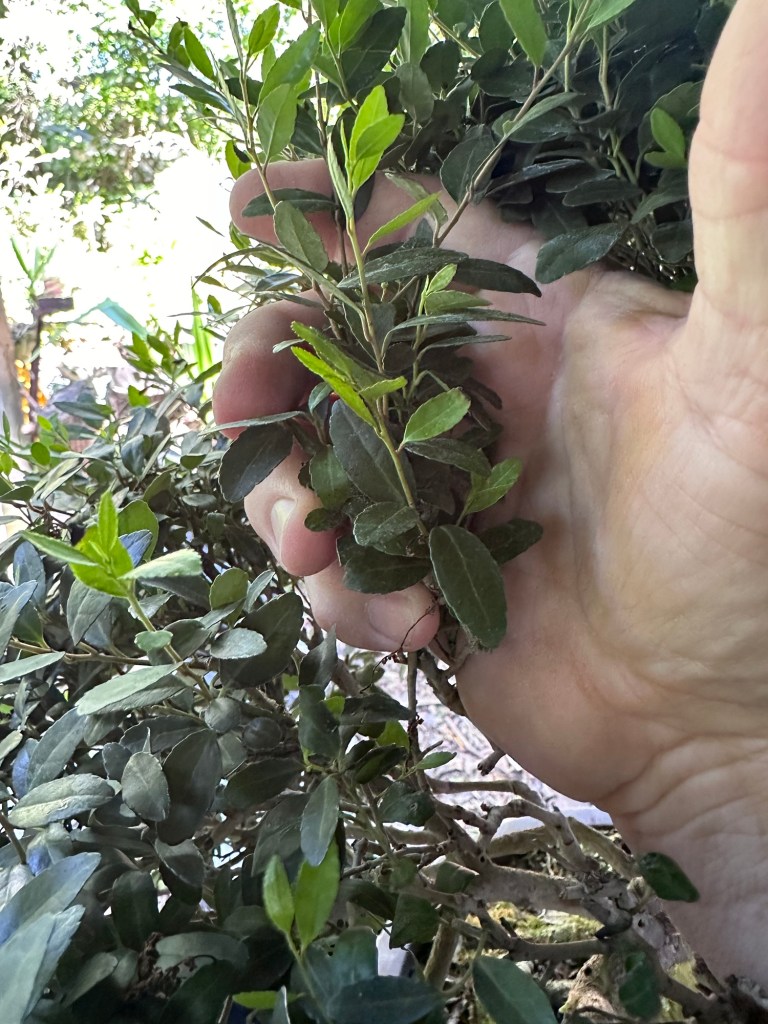
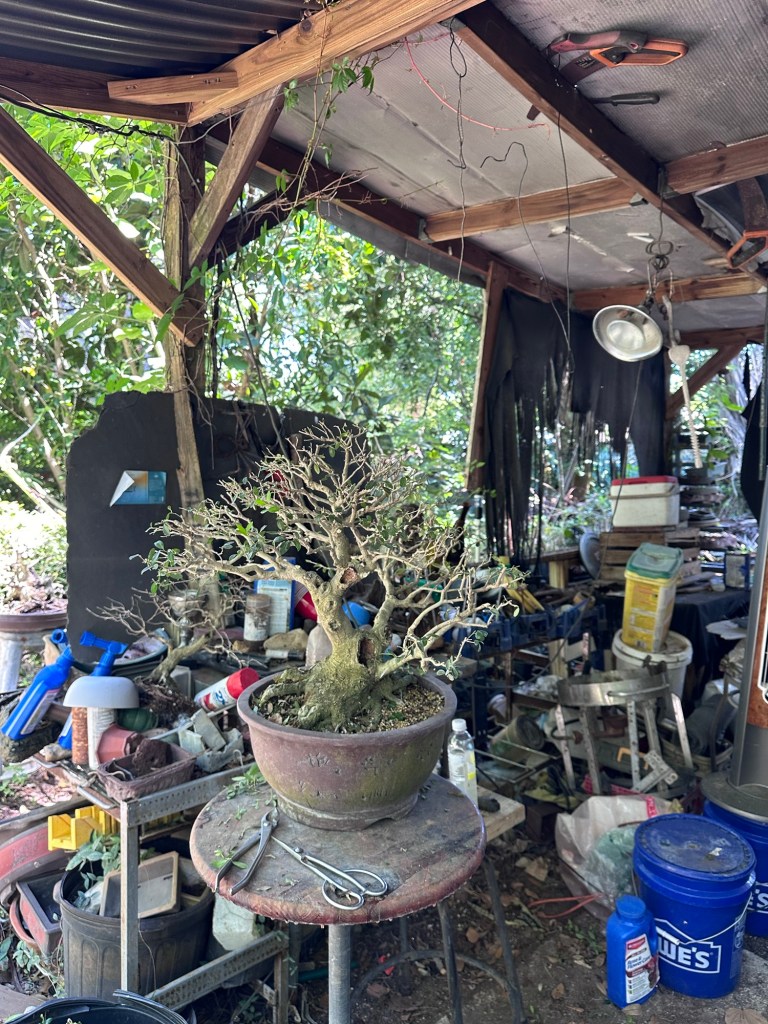
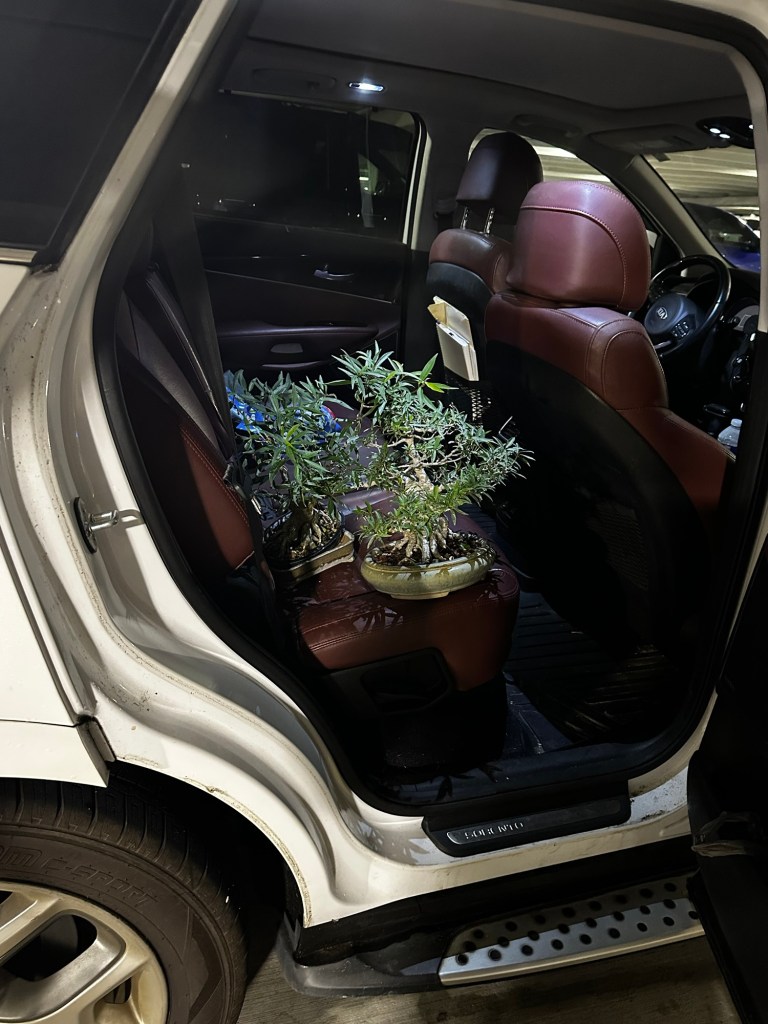
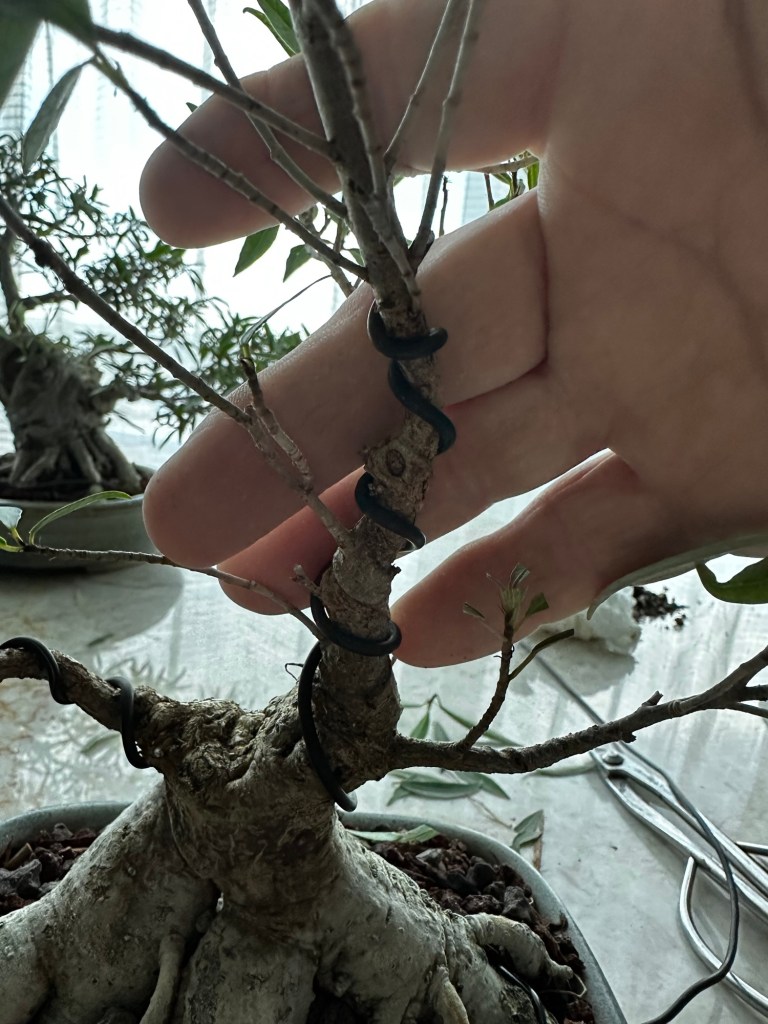
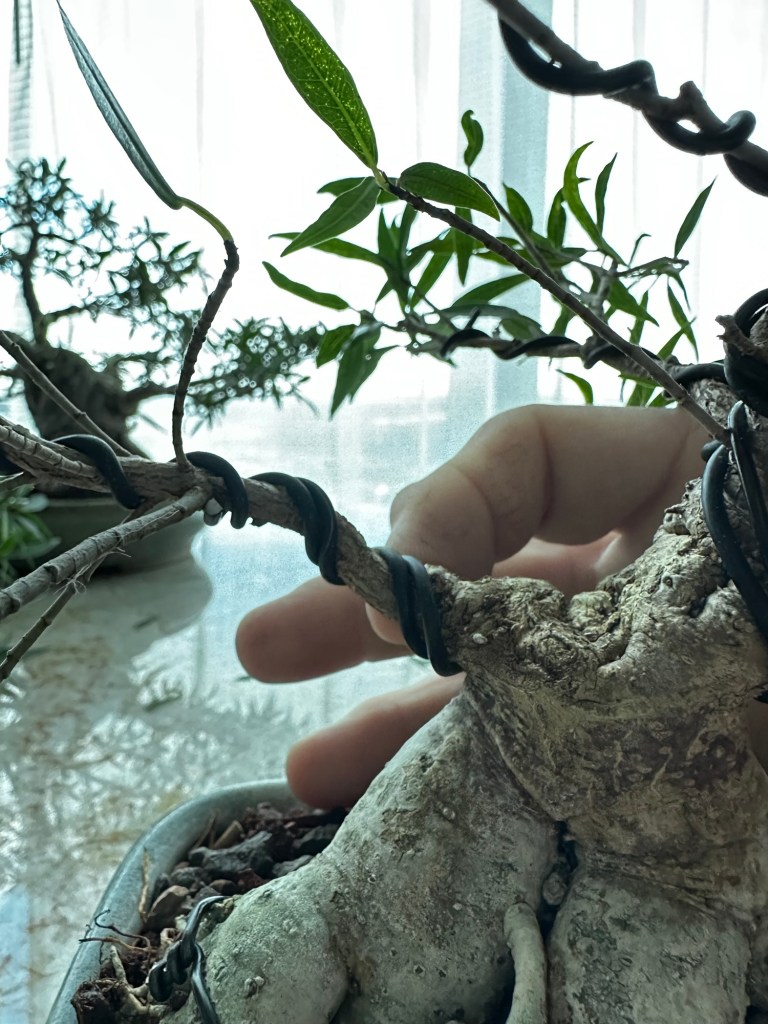
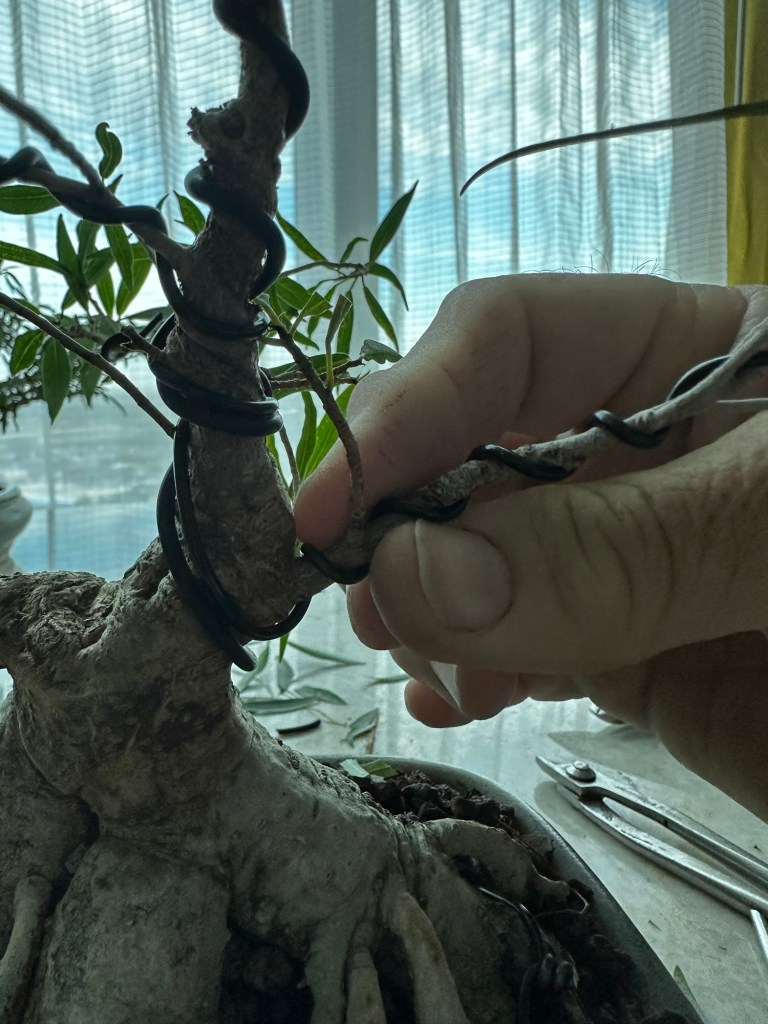
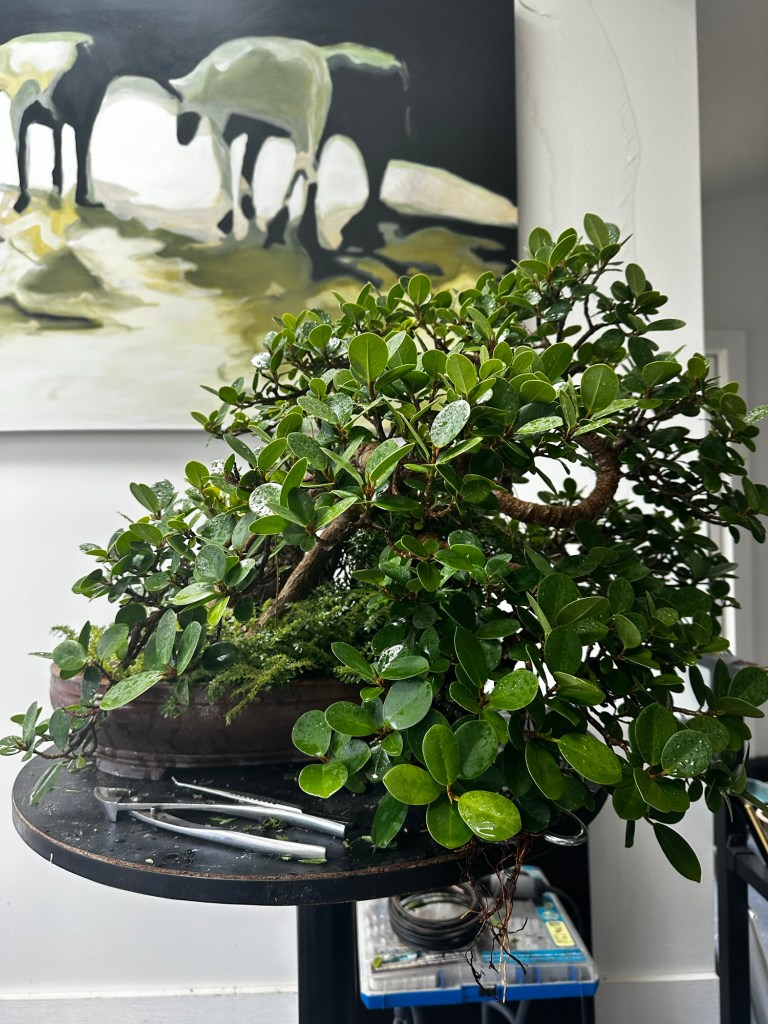
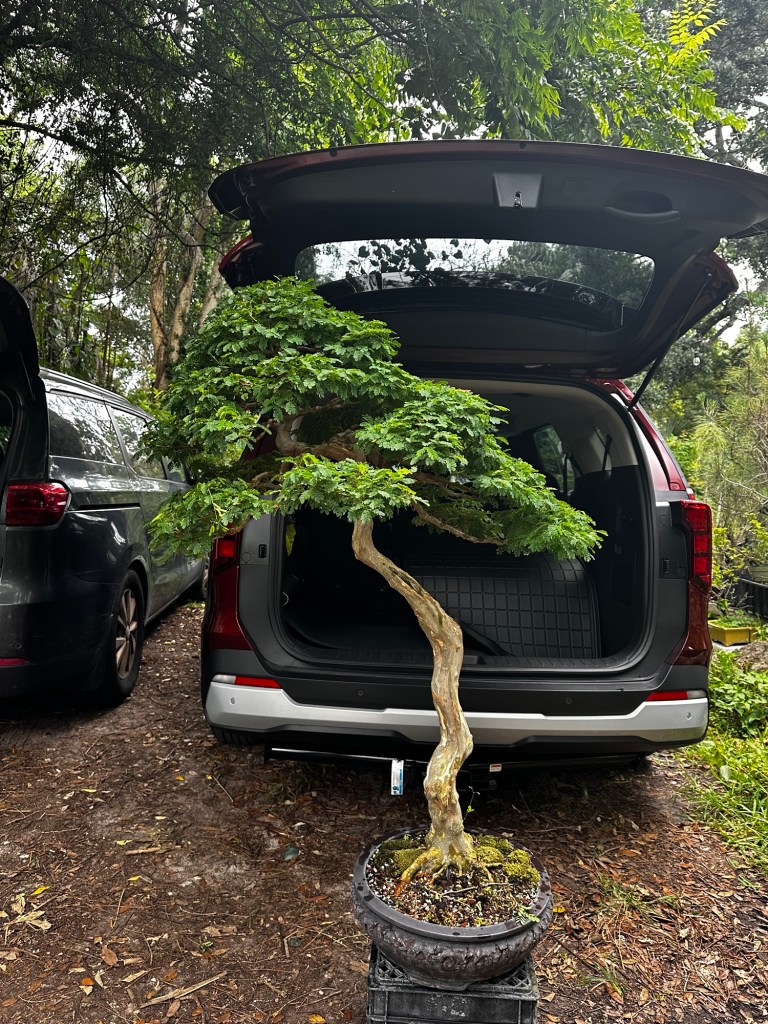
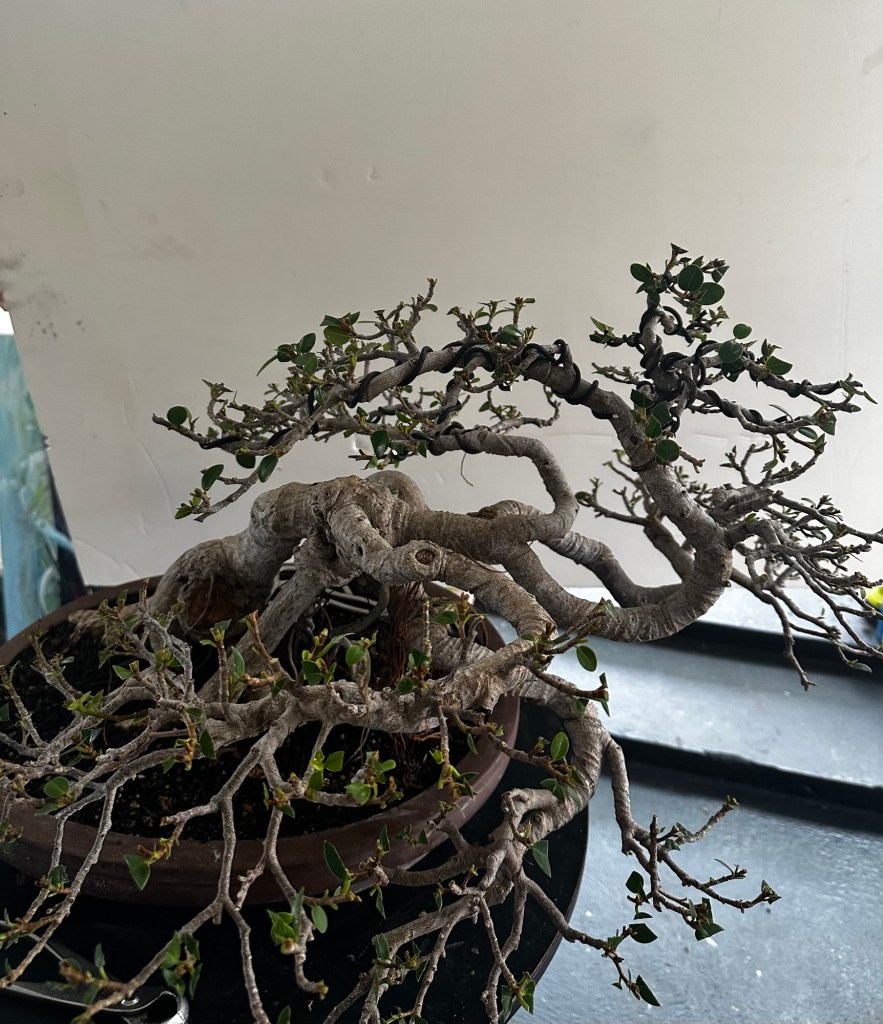
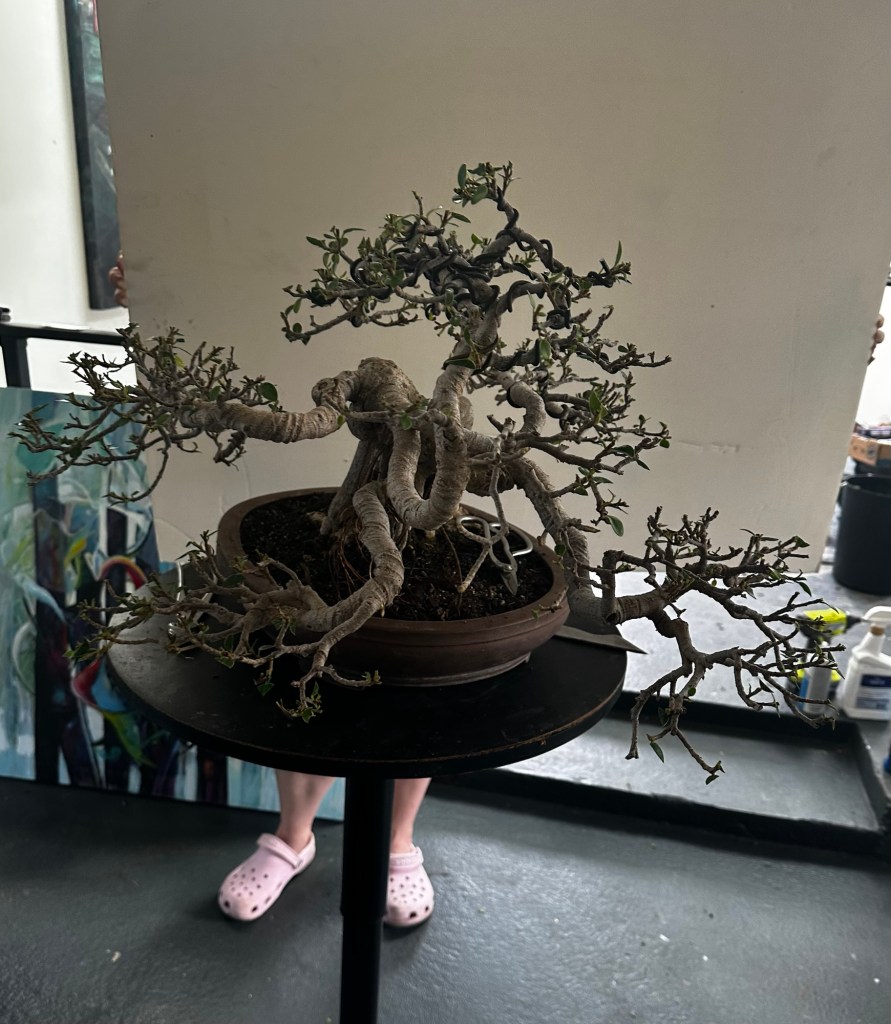
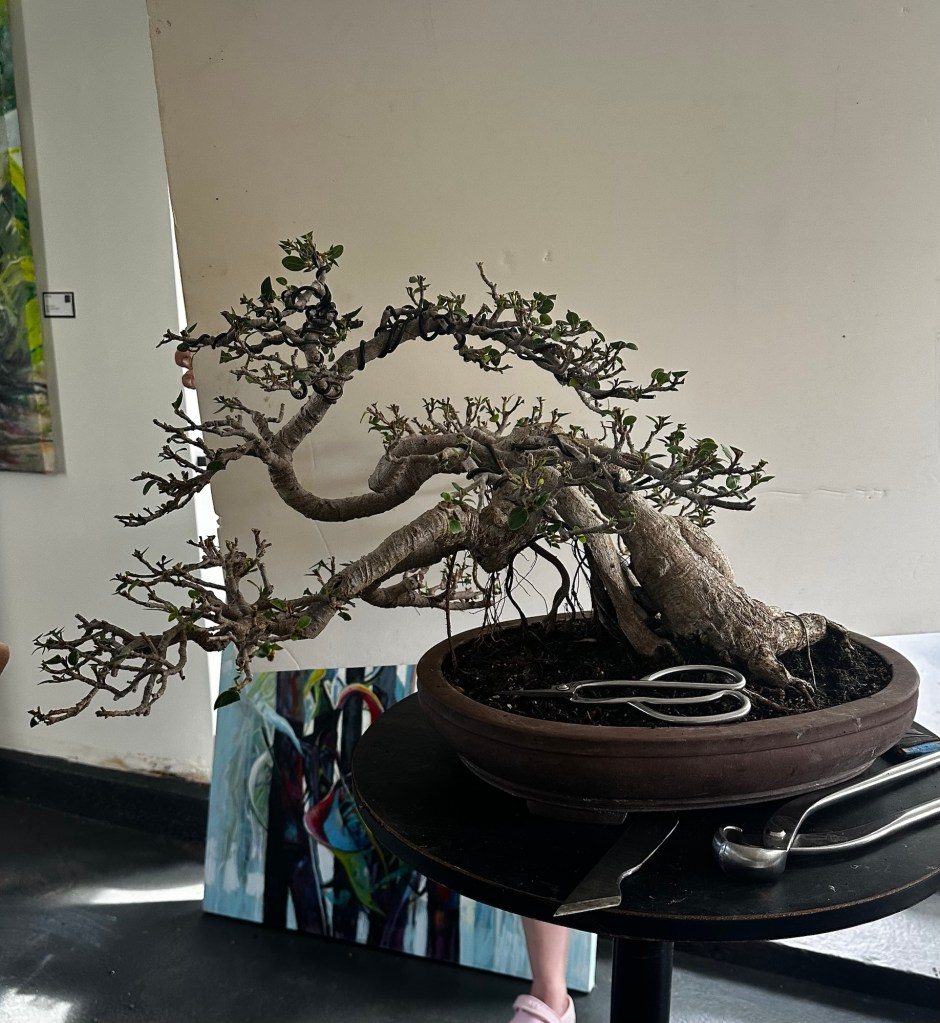
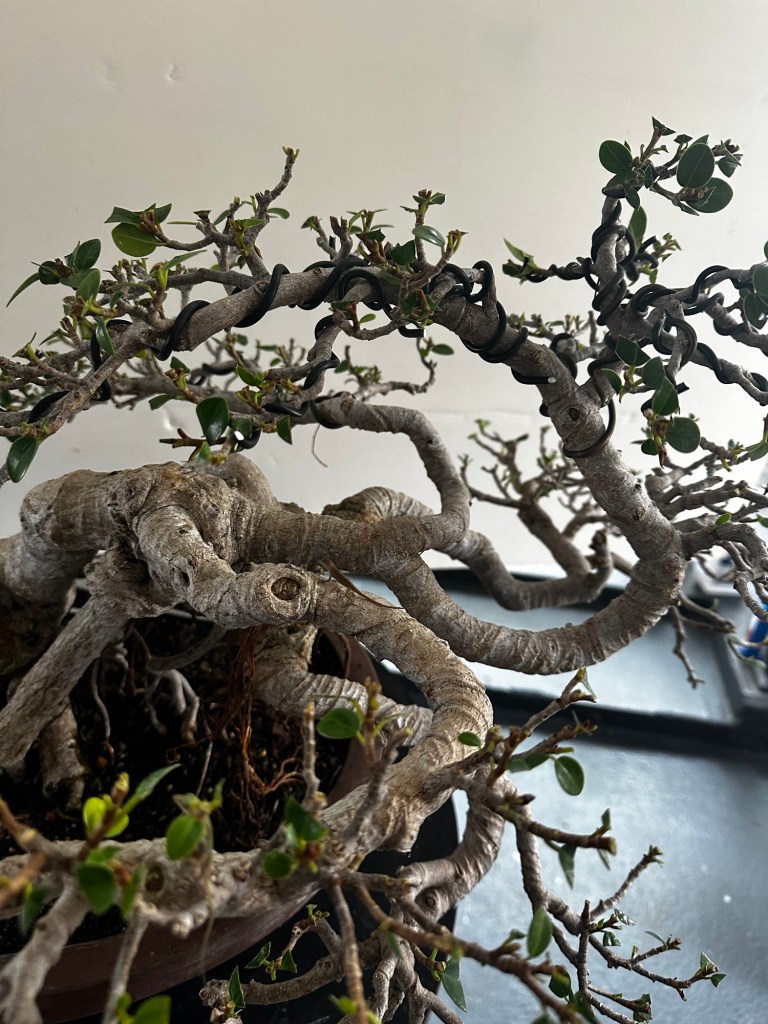
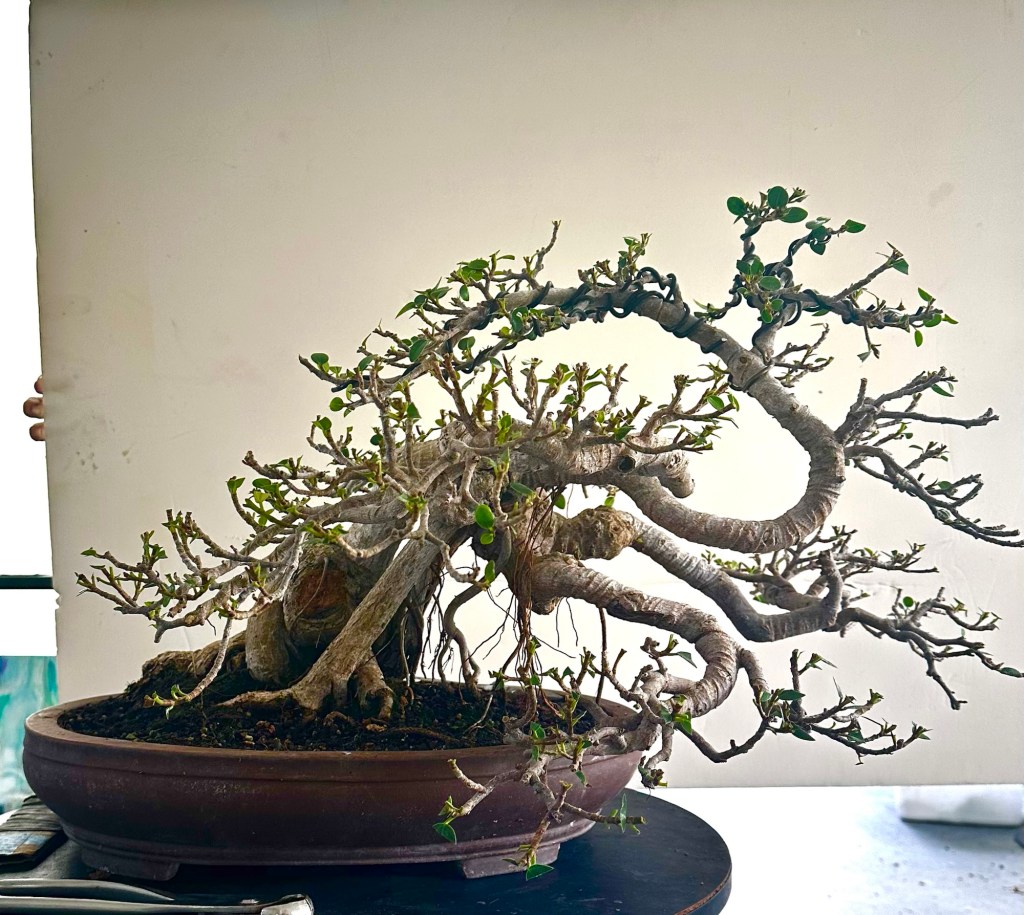
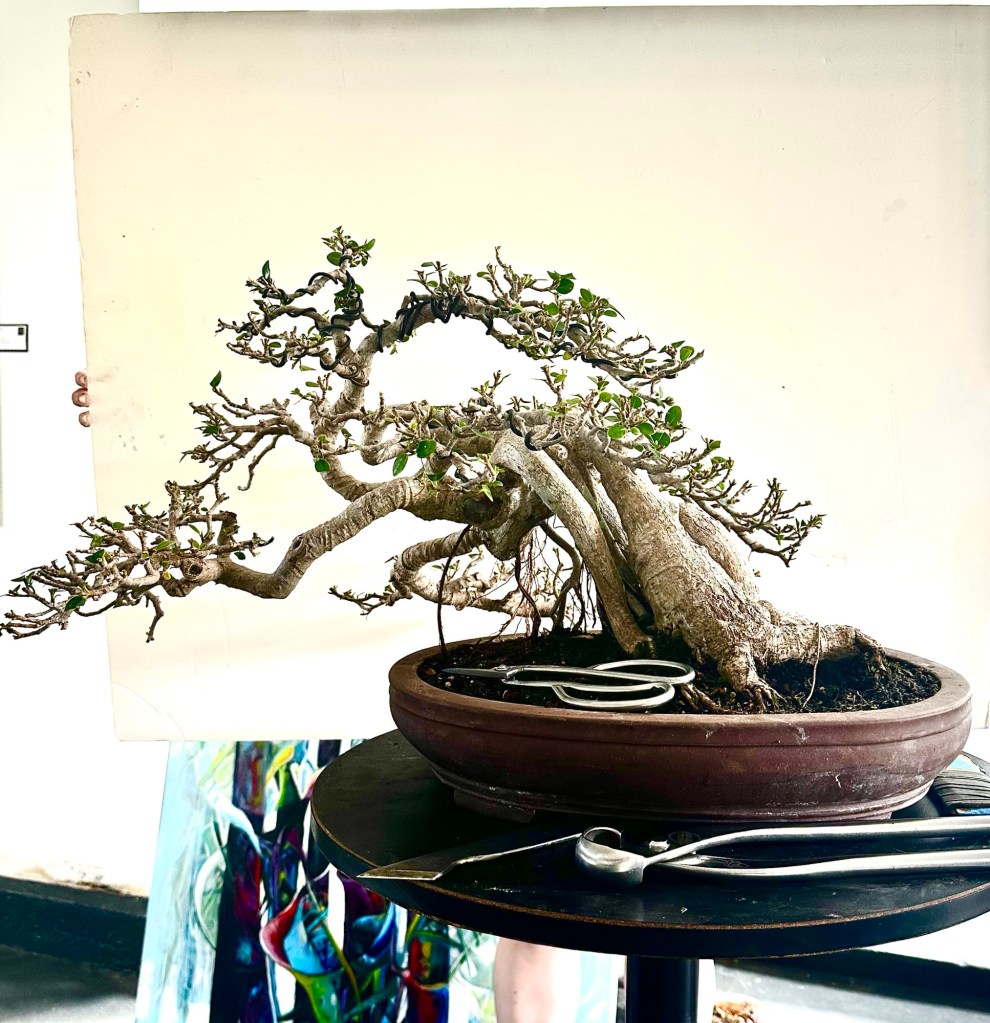
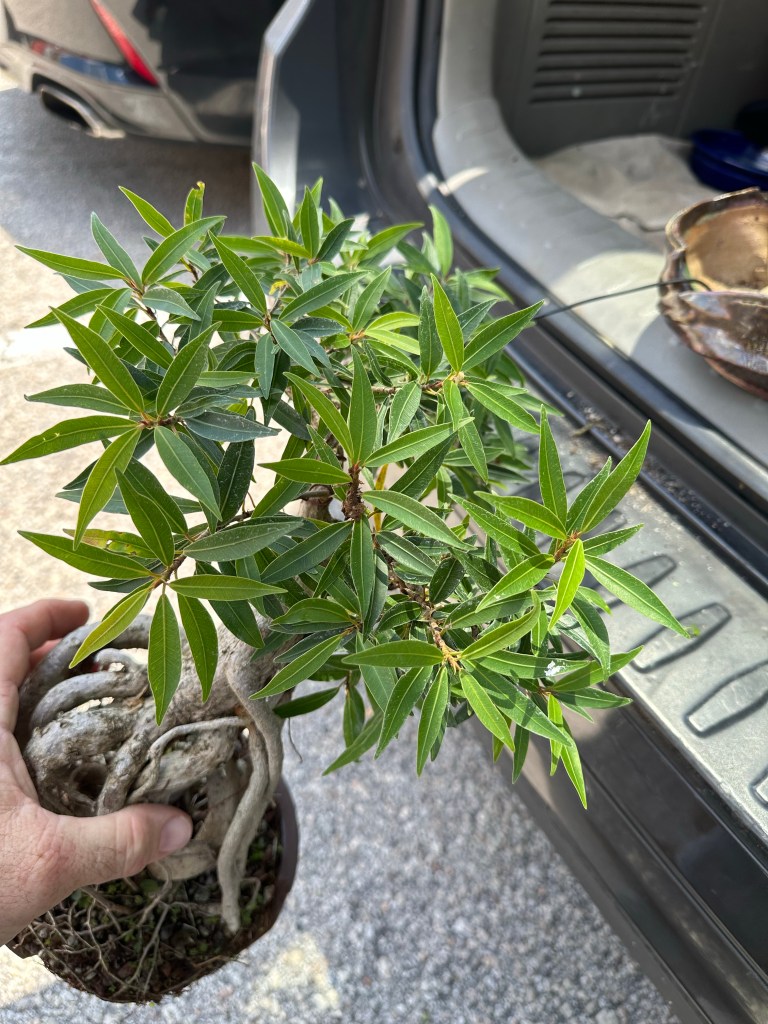
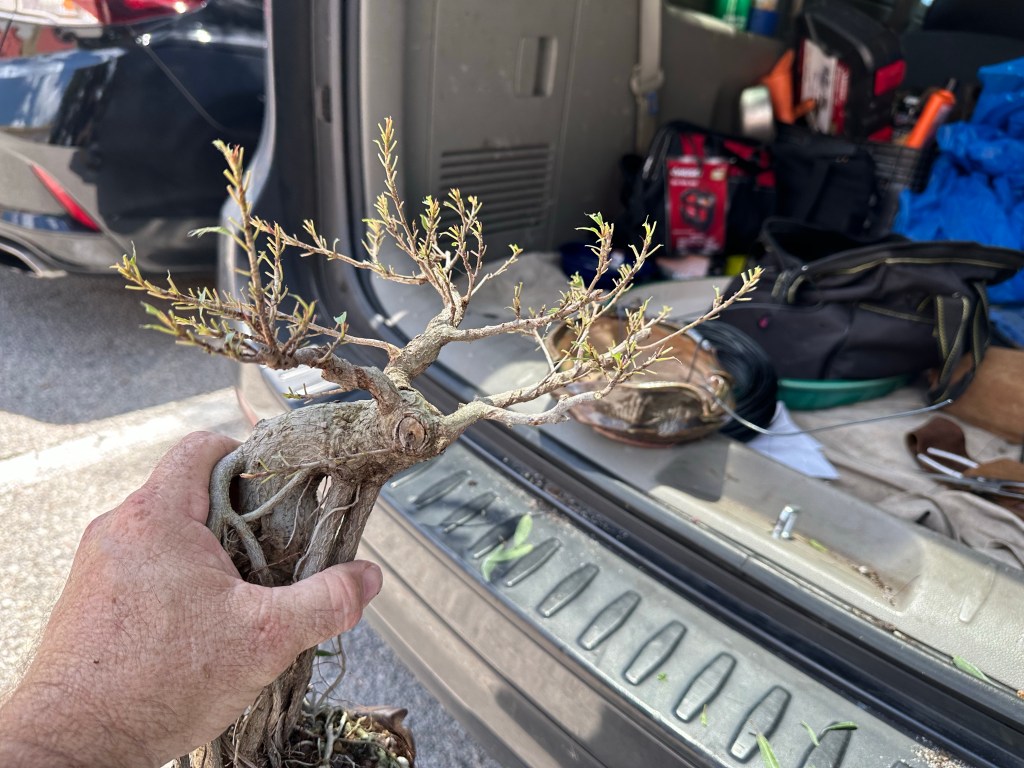
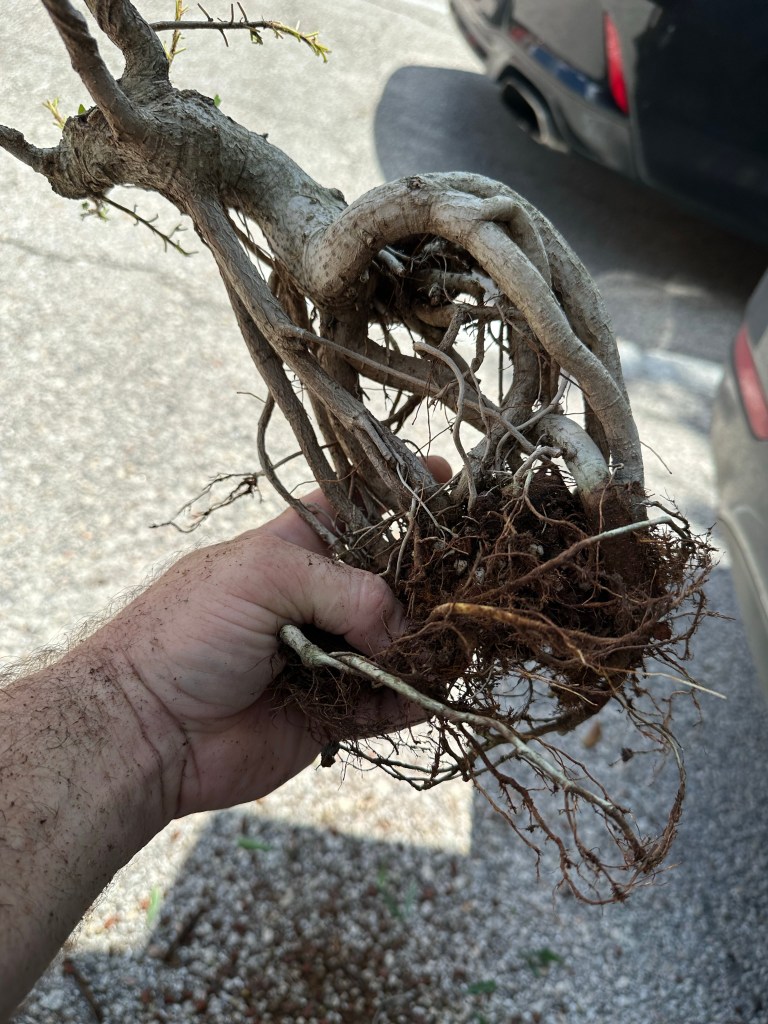
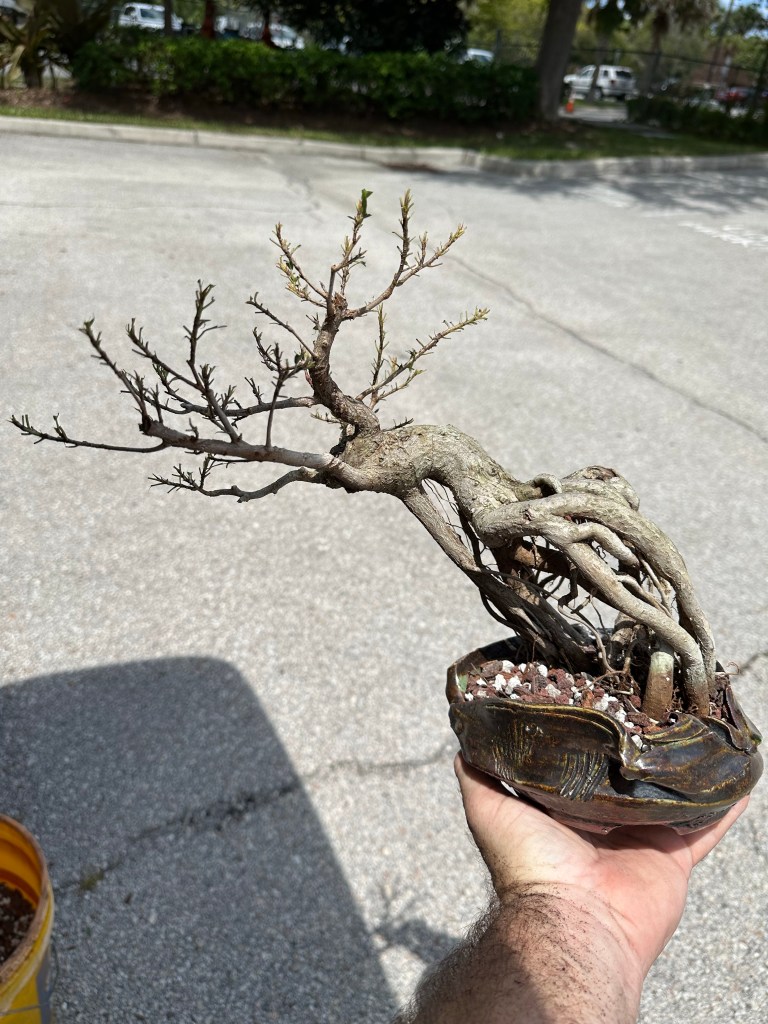
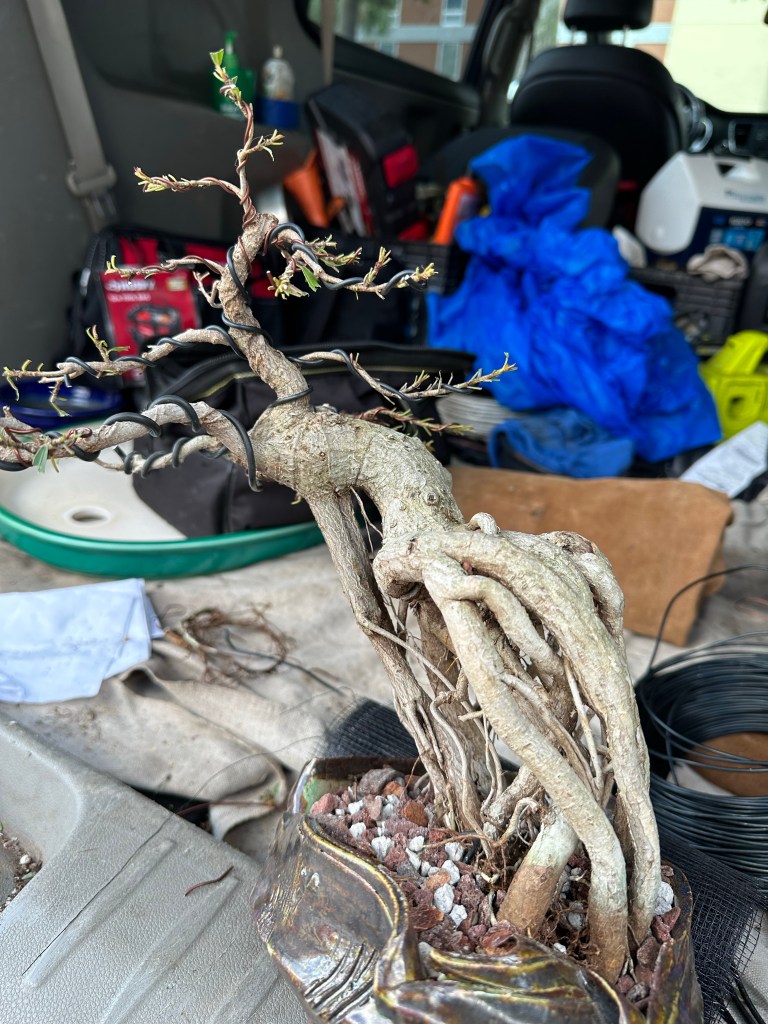
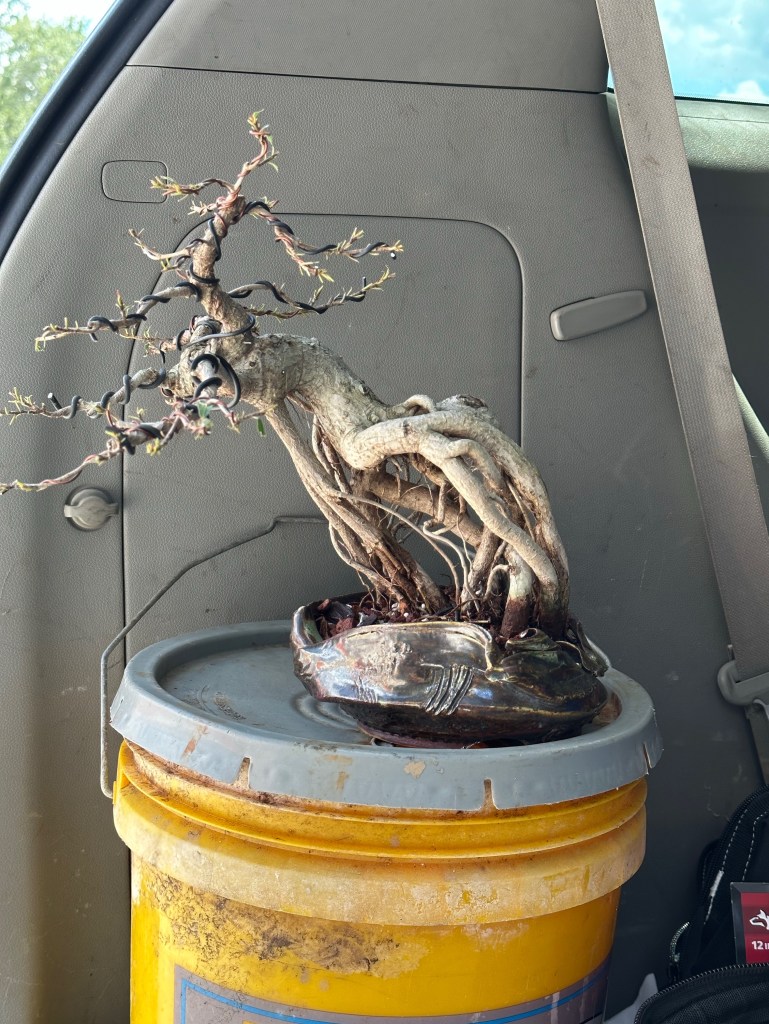
In between the PT and the Dog poop, I practiced a little Back Bumper Bonsai, just like the old days. Here’s the tree, a willow leaf fig (Ficus salicaria, ofttimes erroneously called Ficus nerifolia, or F. salicifolia, or whatever it was called when you grew up in bonsai).
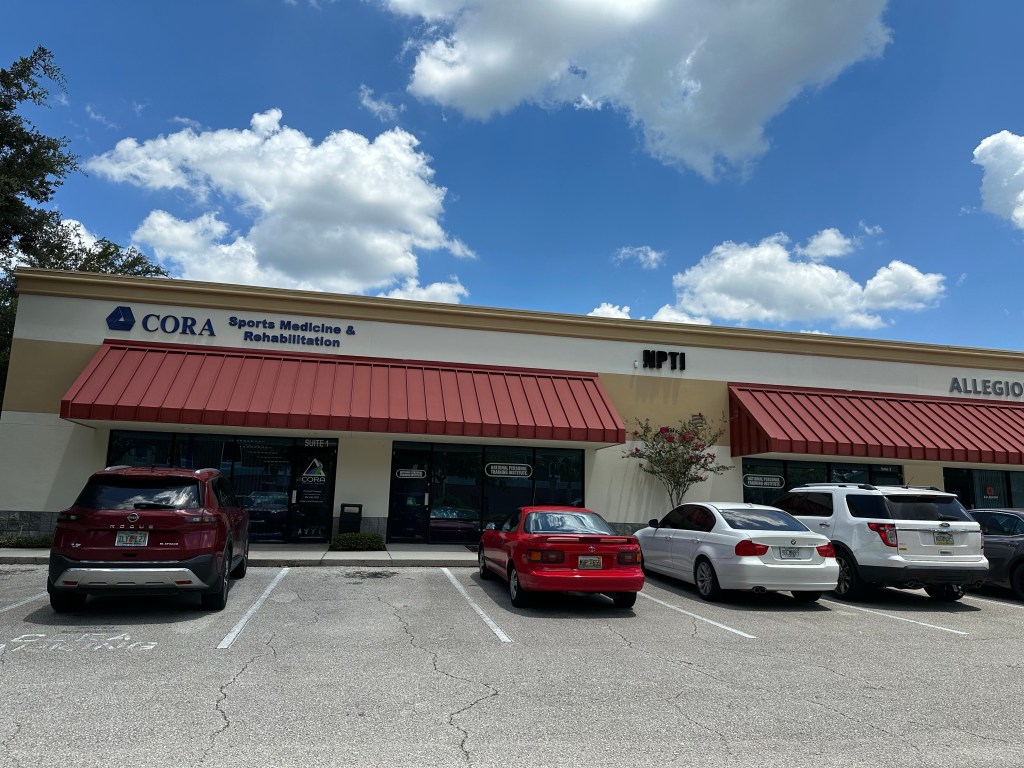
Here’s the facility my daughter is getting tortured at.
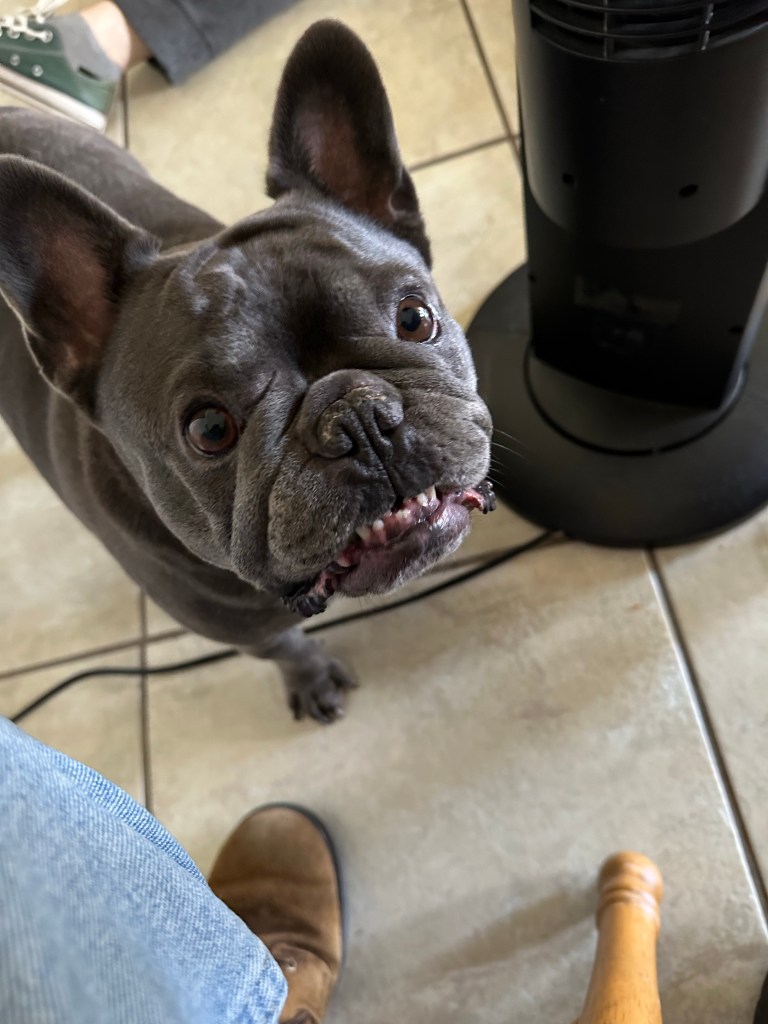
Here’s the dog. Ugly thing, ain’t it? Lily. Stupid dog. It has no tail, so when it poops, you have to wipe its ass. Not me, no way, no how, not ever. My sister does though.
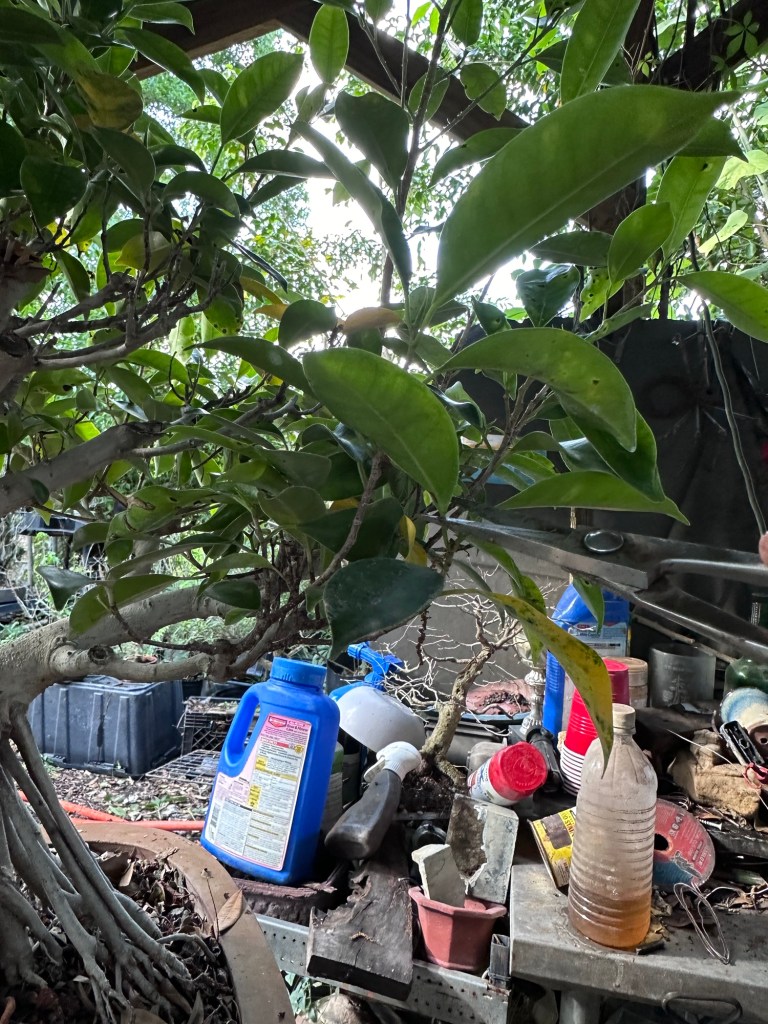
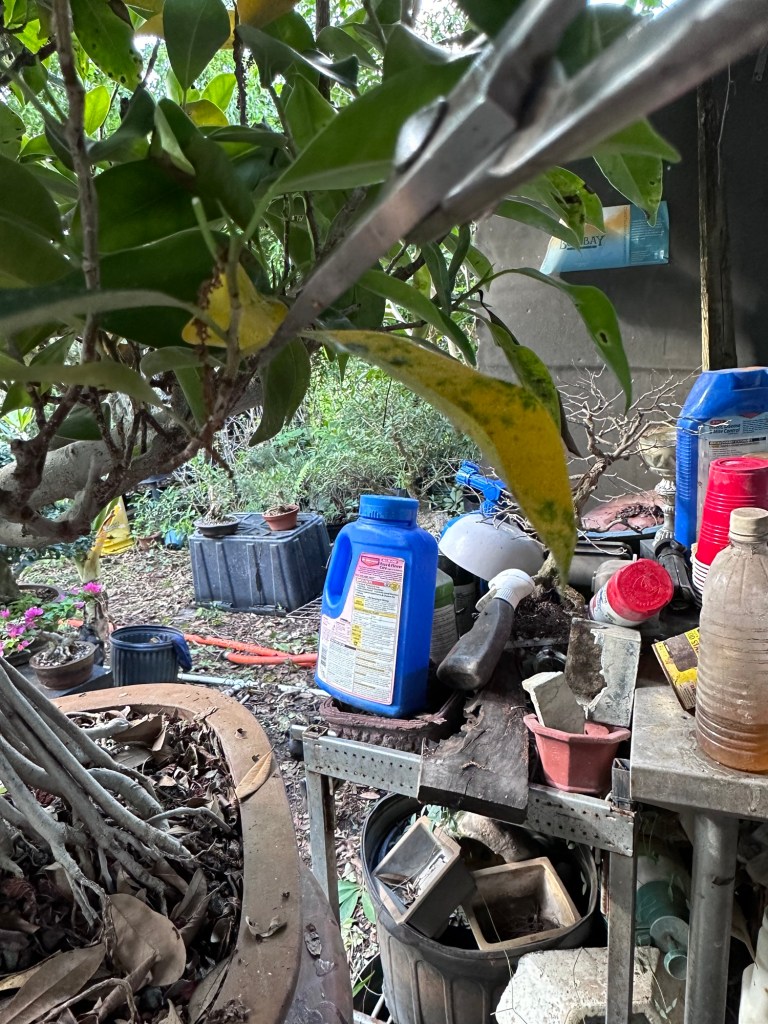
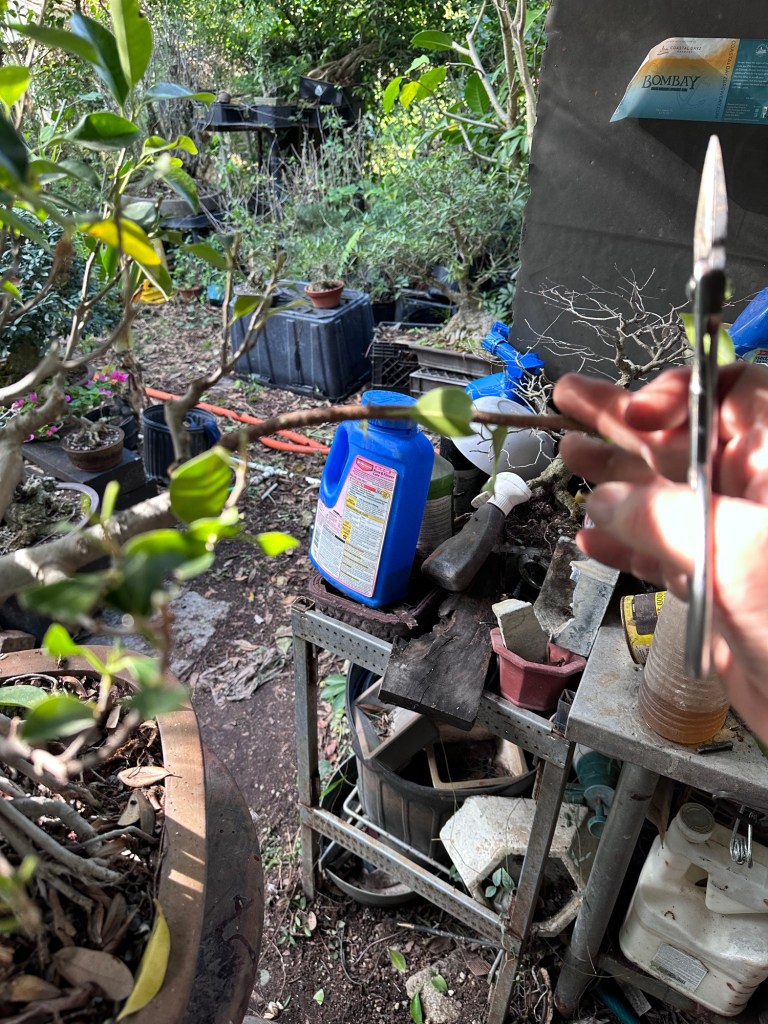
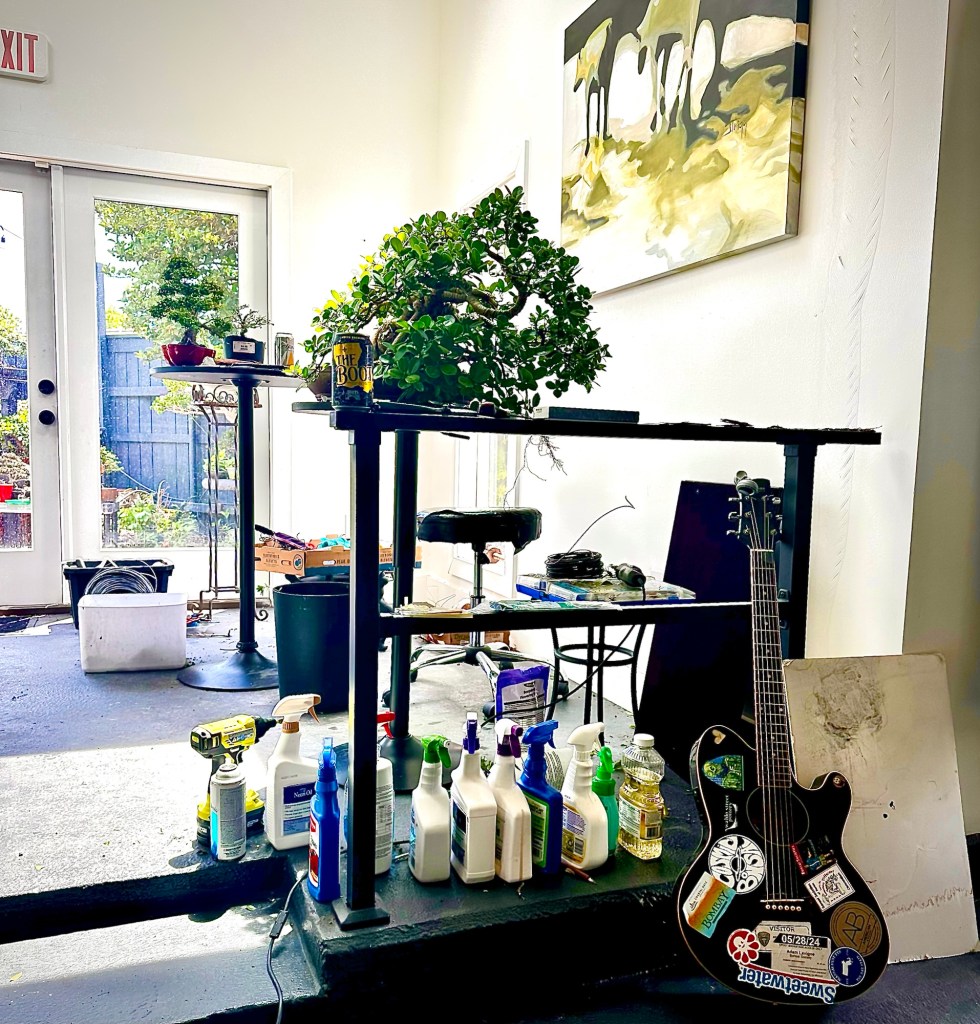
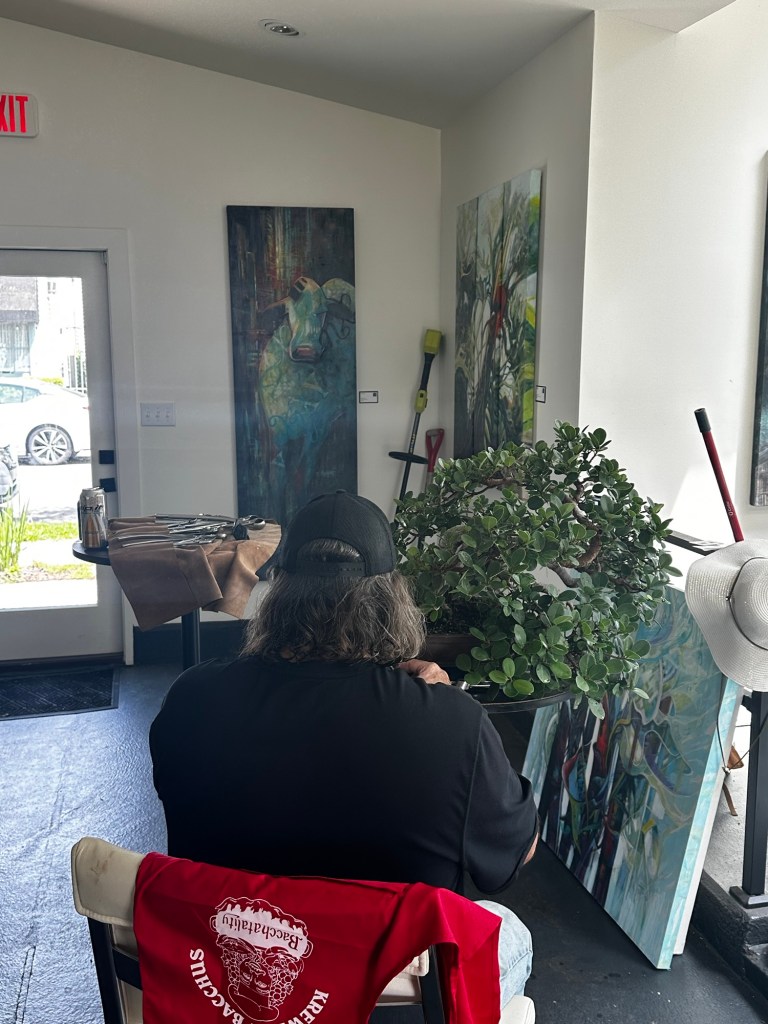
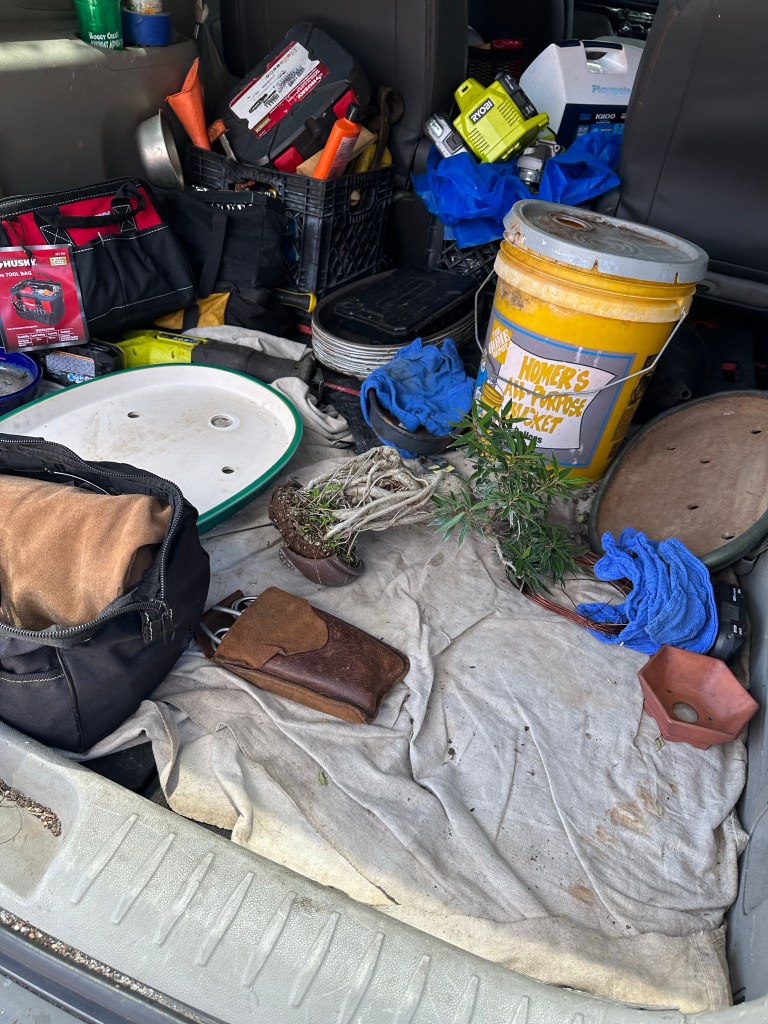
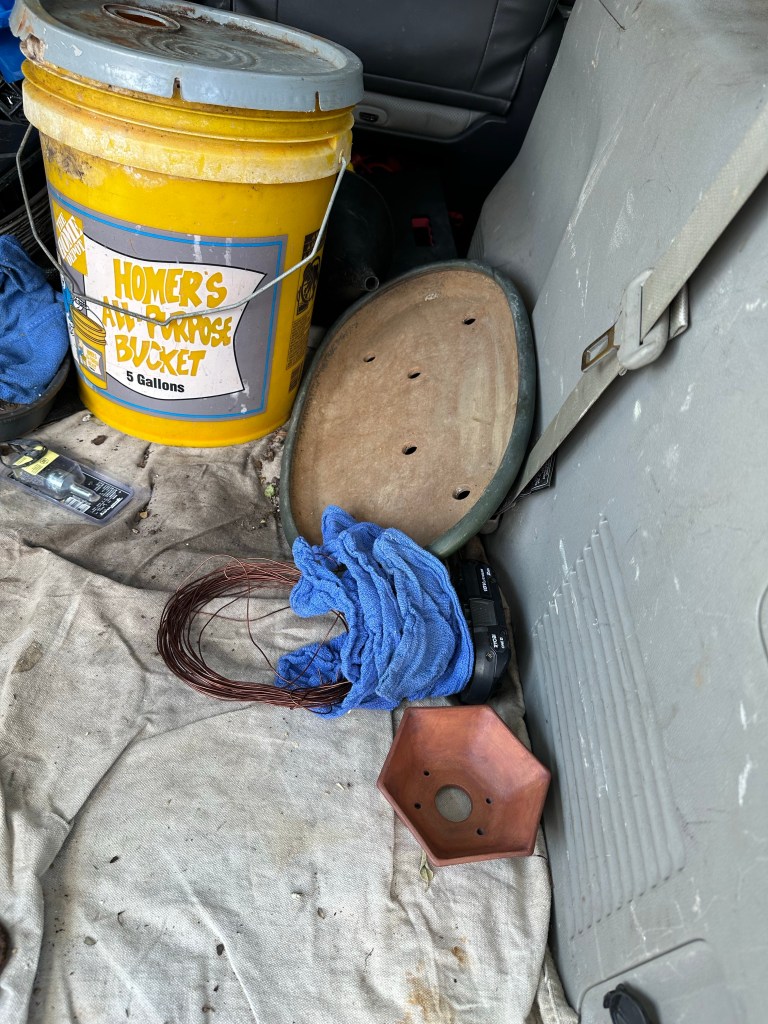
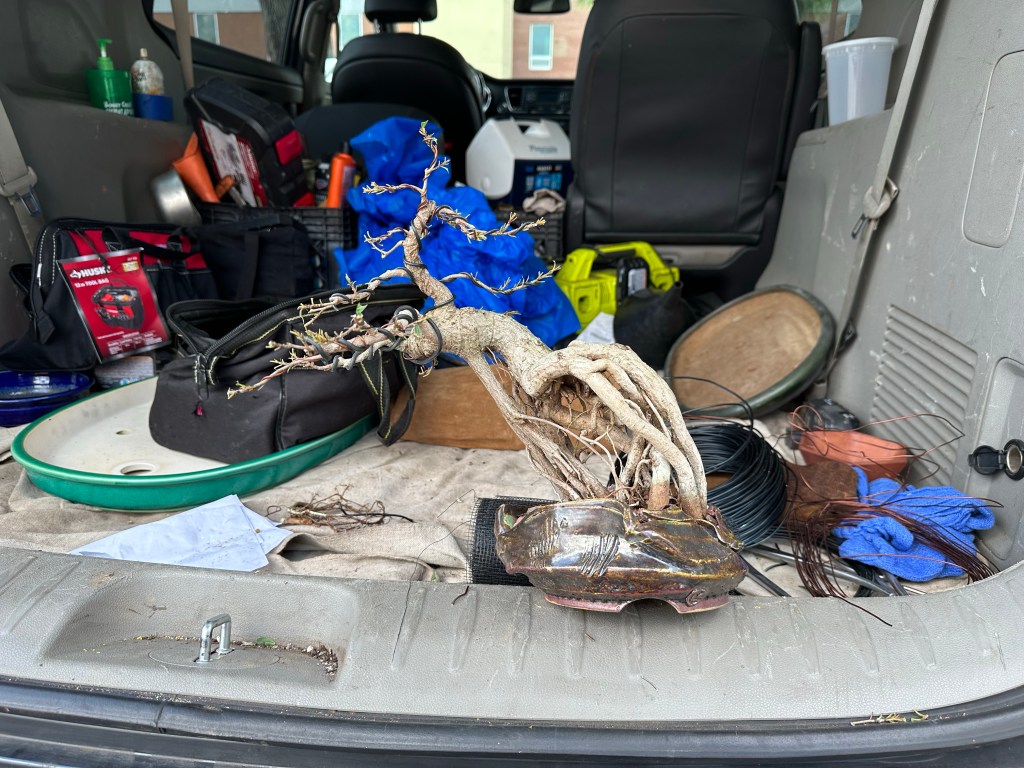
And here’s the Back Bumper bonsai studio.
A Kia minivan. For those that remember the old days, I graduated the PT Loser to the junkyard years ago.
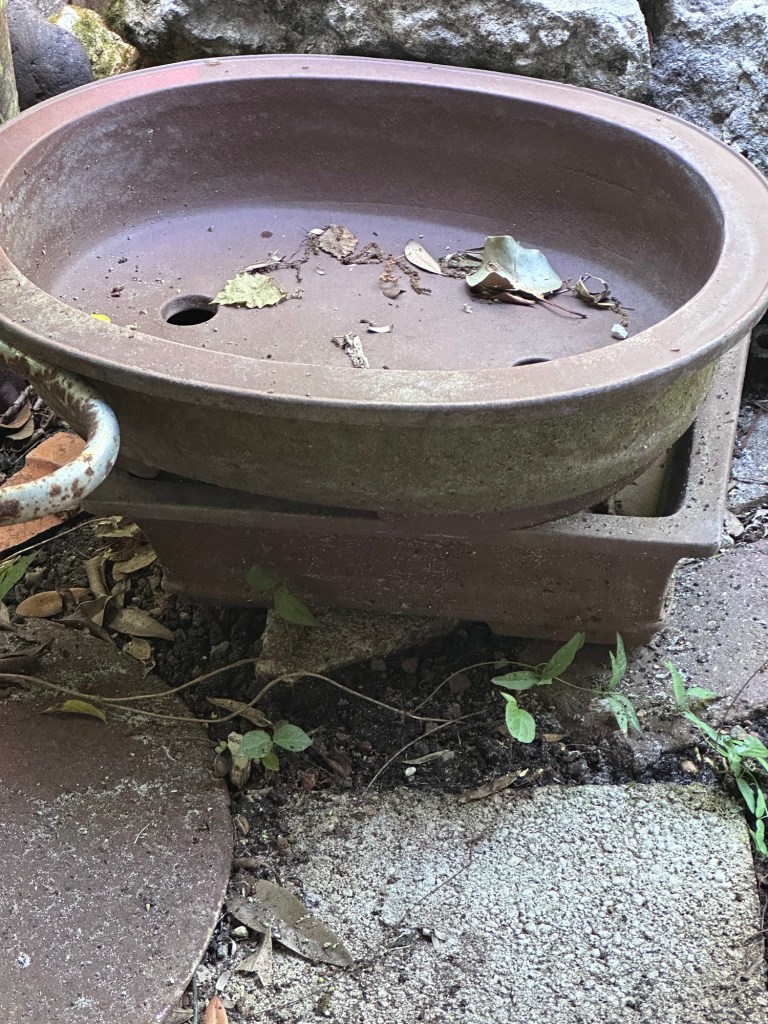
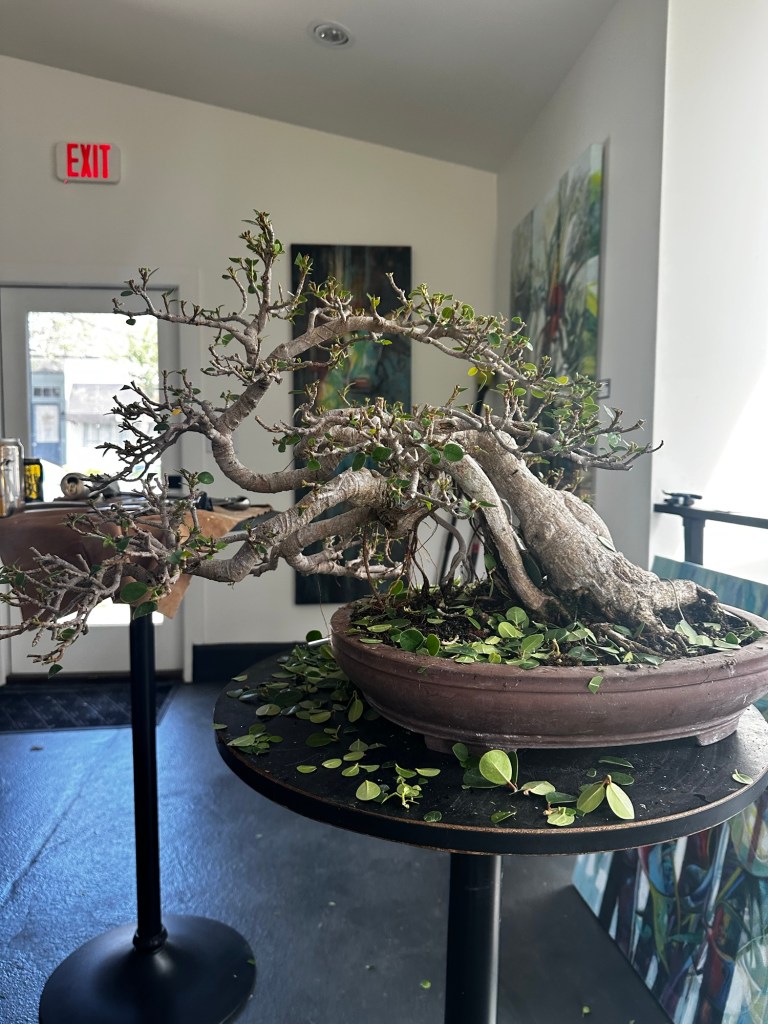
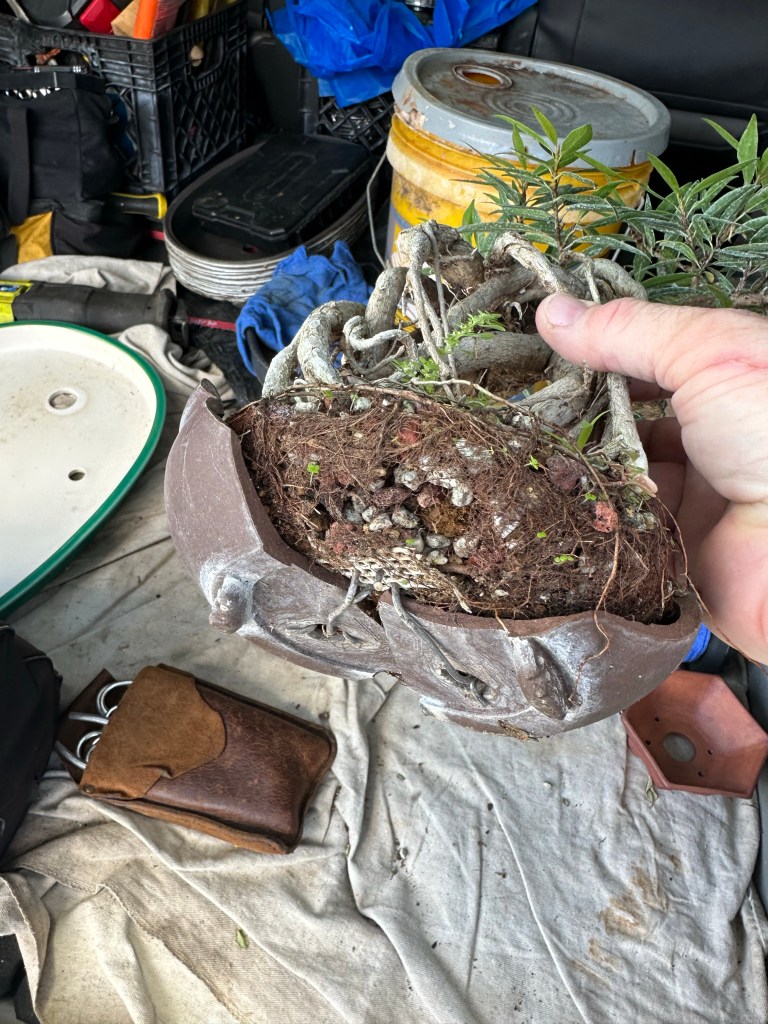
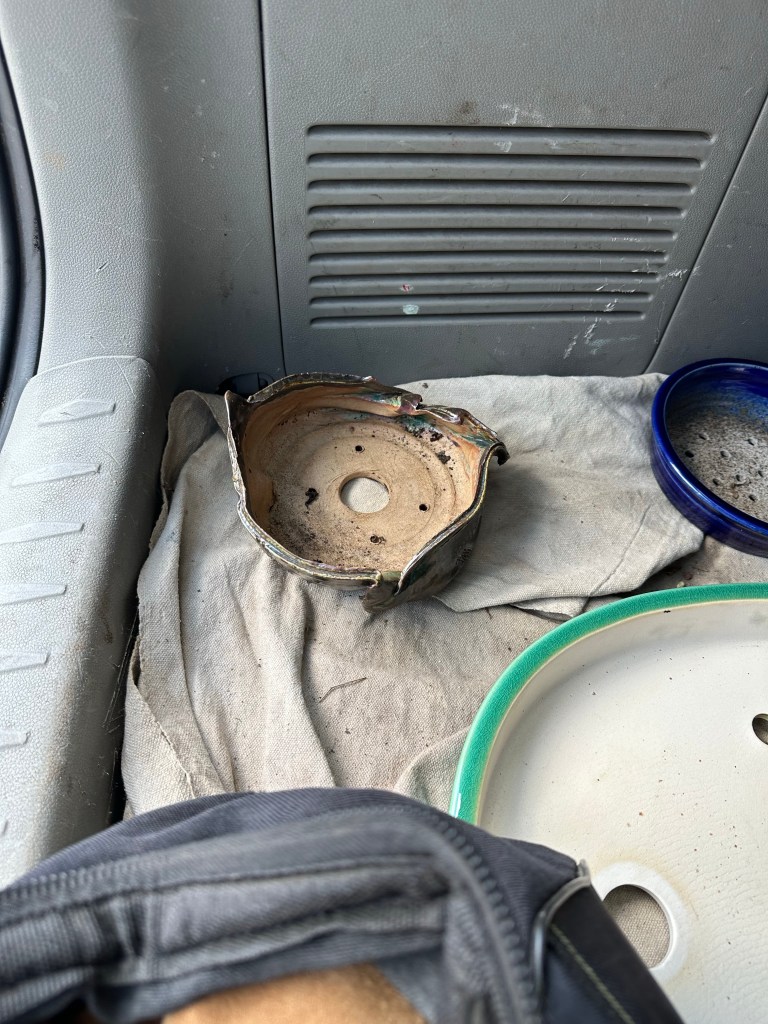
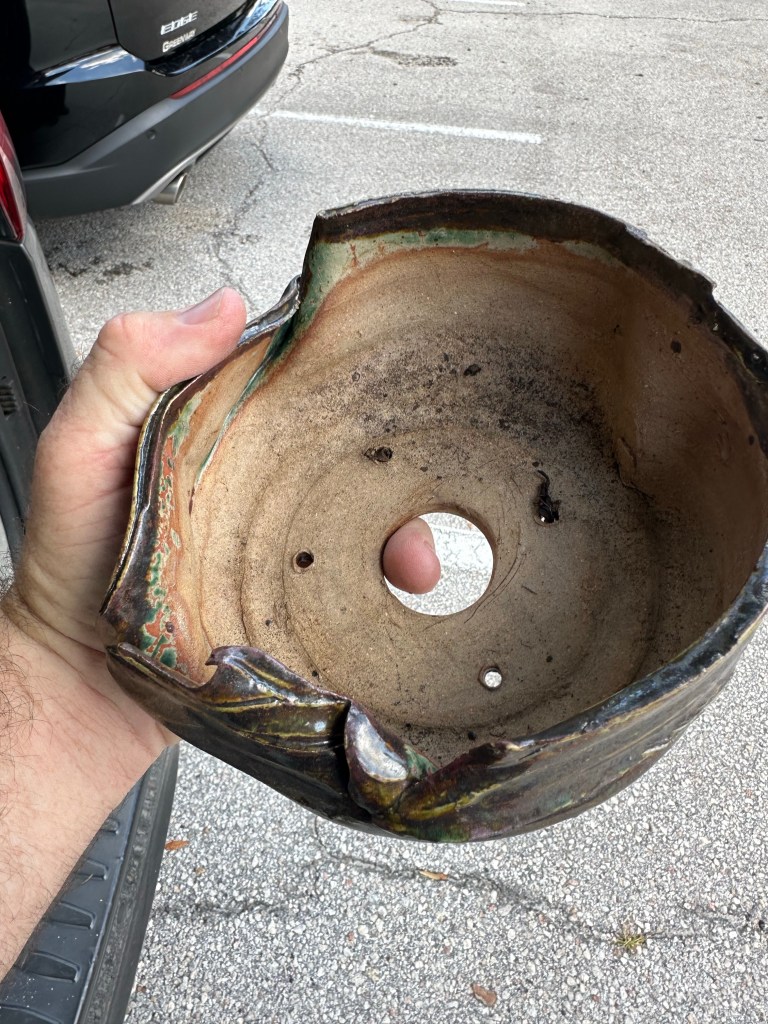
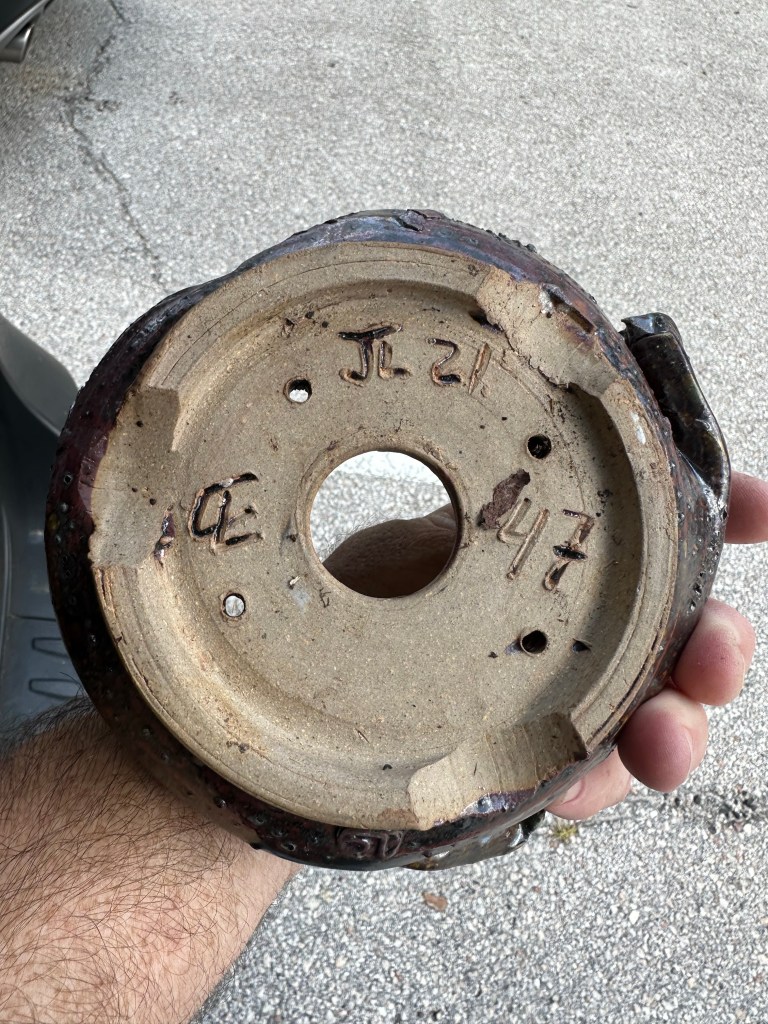
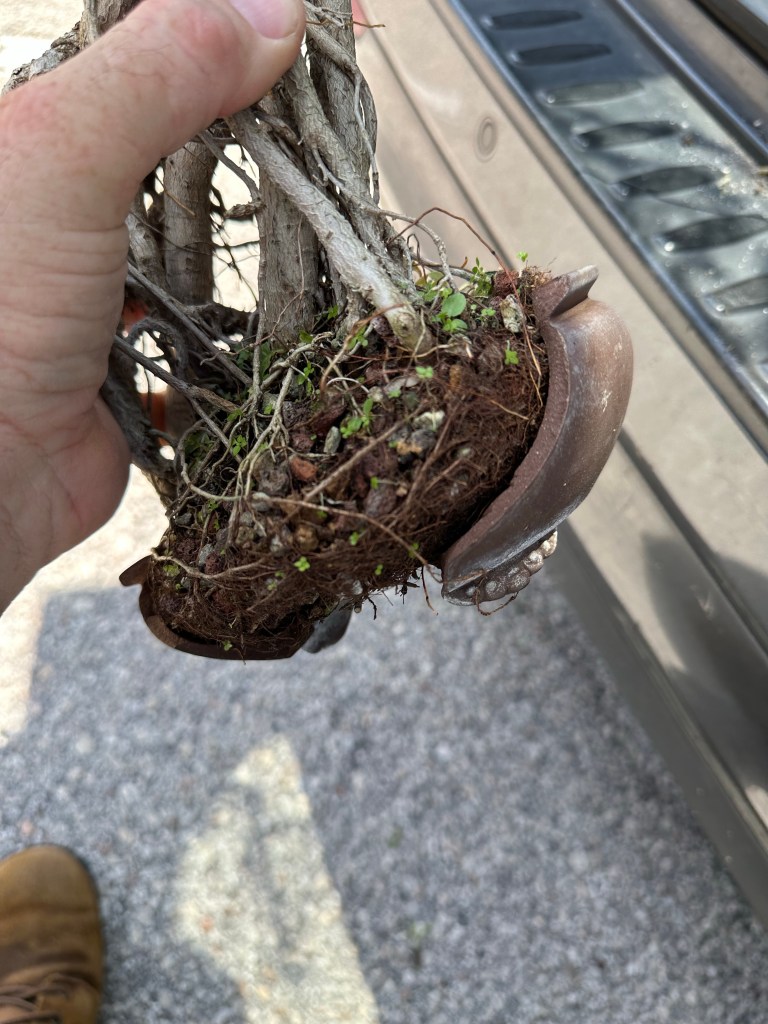
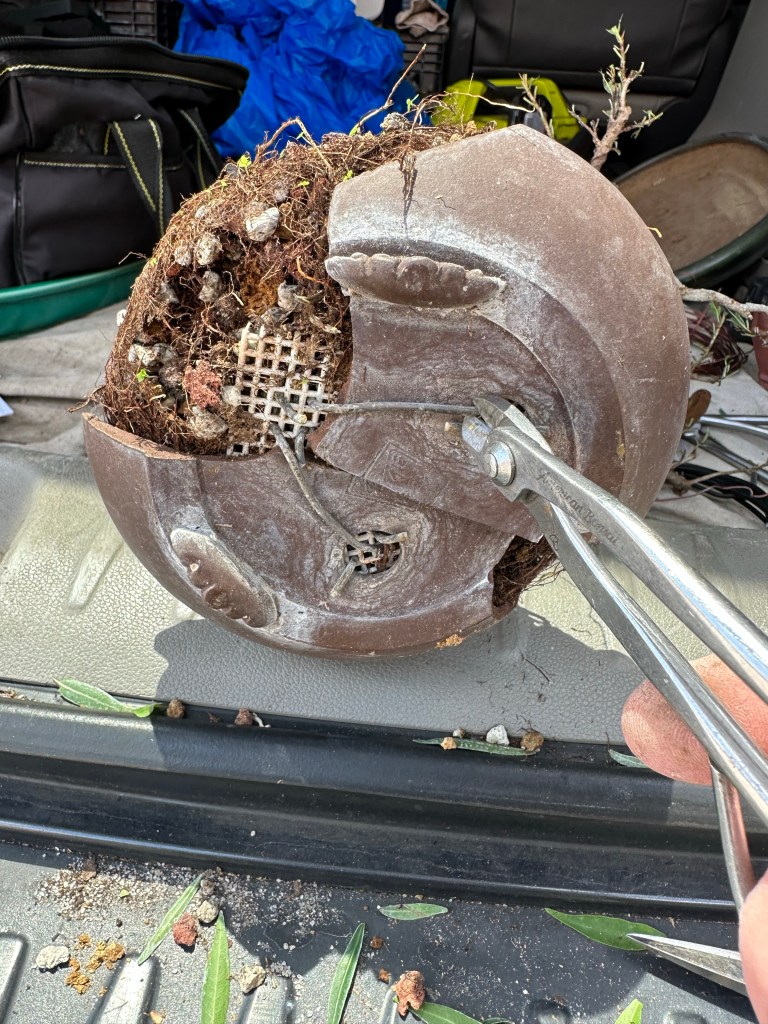
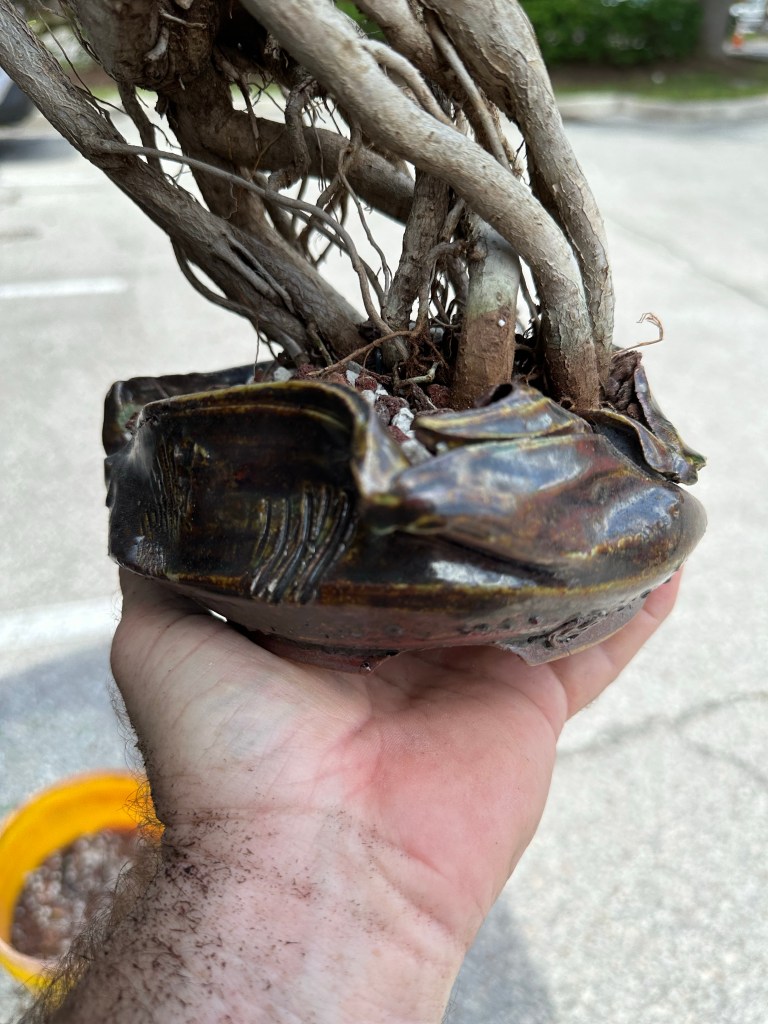
The willow leaf has a, uh, structural problem with the pot.
It done broke.
So today, I’m going to repot it, cut it back, defoliate, and wire. In that general order I guess.
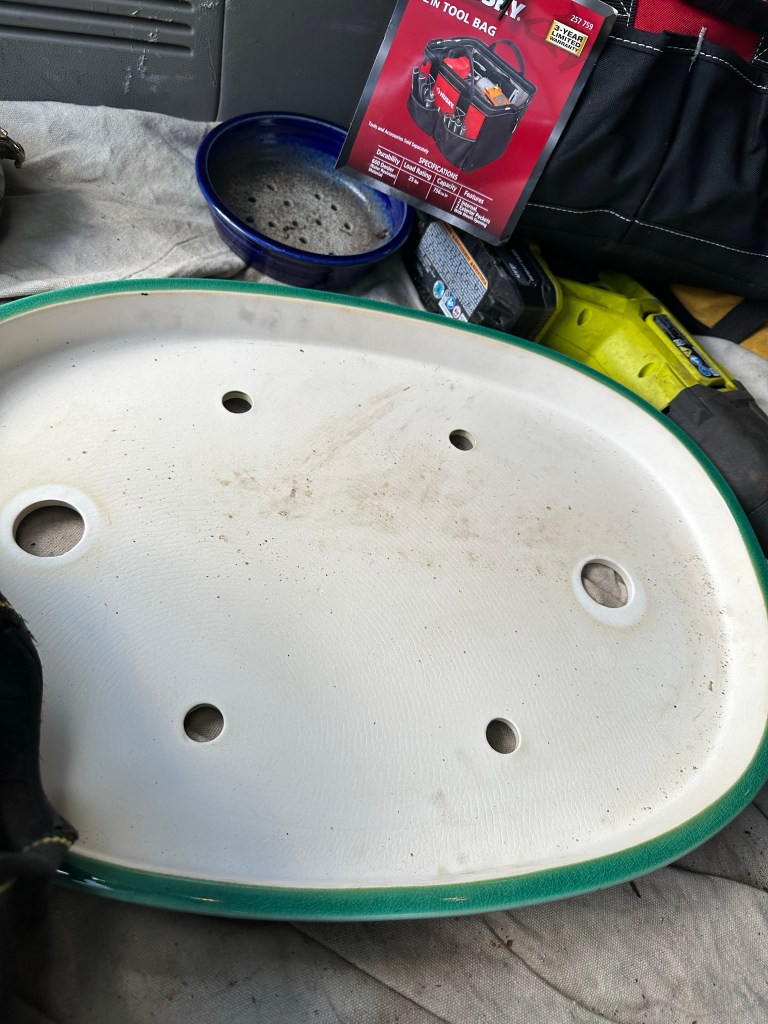
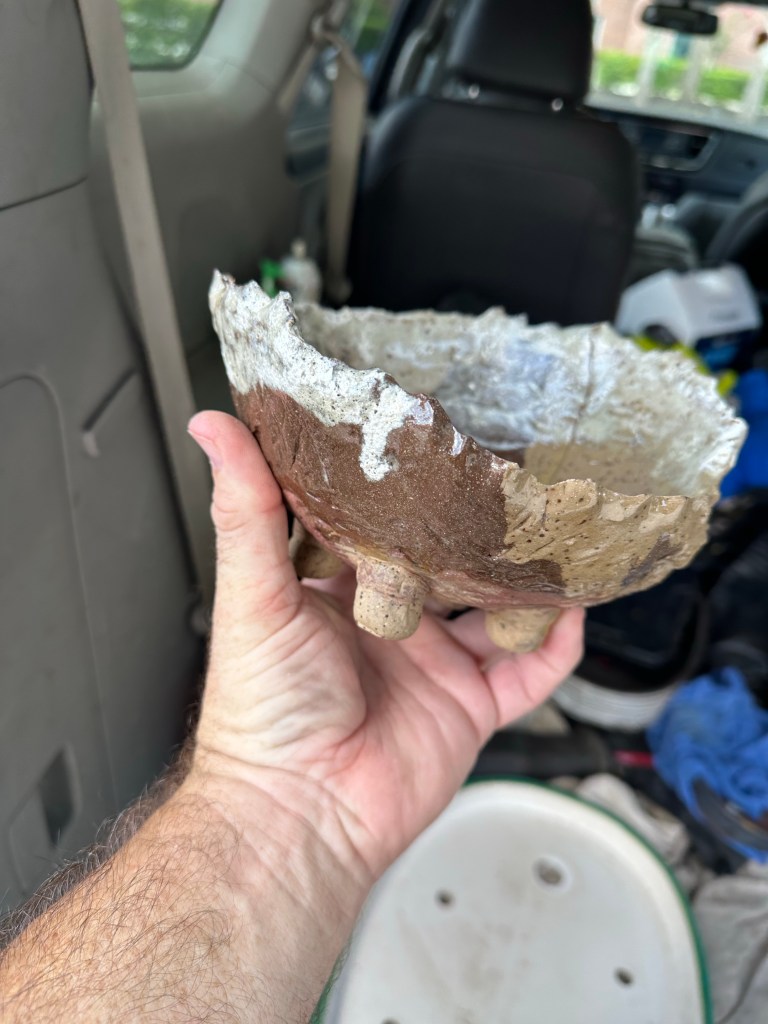
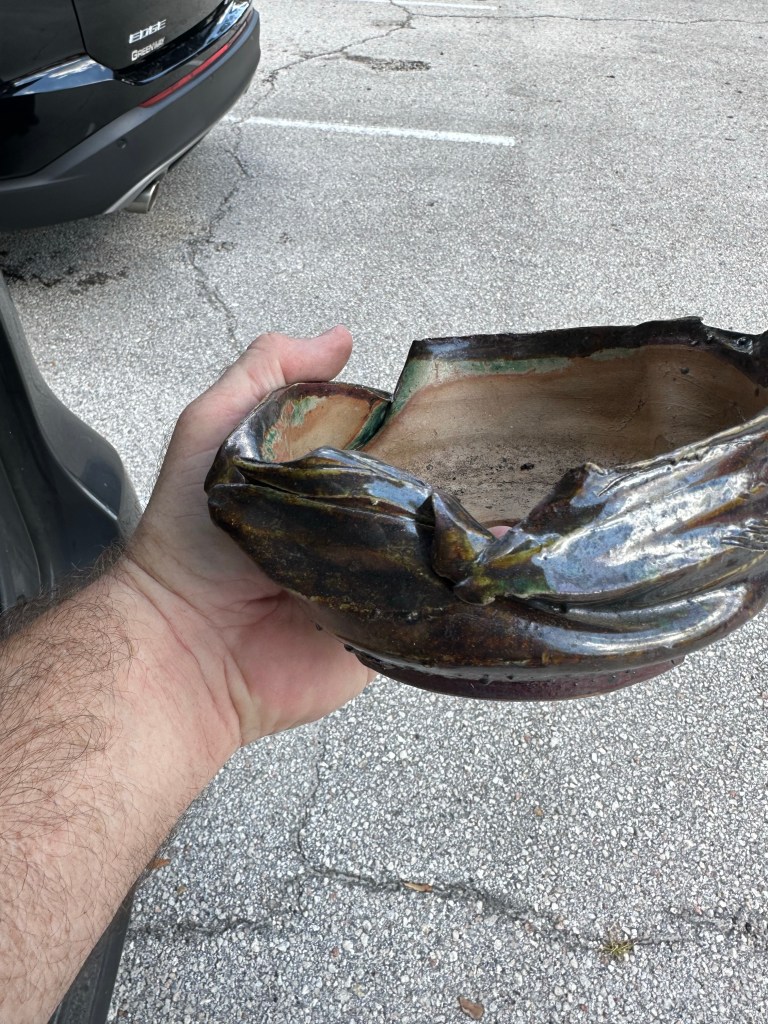
Here are some pots to choose from.
Not the big one of course.
Or that old Japanese one either.
The one below is from my student, Peter Penico. It could work.
But it’s going the wrong way. Nice pot though.
The one I’m going with is this one from Cesar Labrador, a Florida artist living in the Tampa/St. Pete area.
You’ll see his work on the Bonsai Pot Facebook auctions every once in a while.
Sweet details and shape.
It’s perfect. Let’s see about the tree now.
I think I’ll actually defoliate first.
I’ll be using the “chicken plucking” technique today.
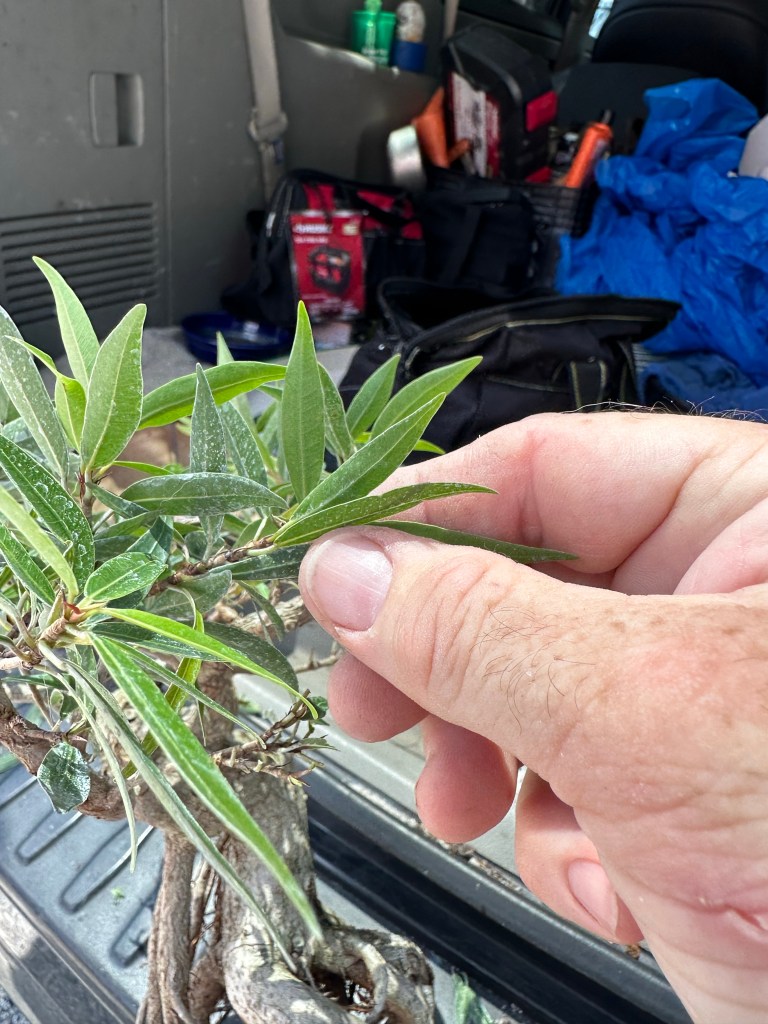
Grab the leaf, and pull forward. The leaf will break at the petiole and you’re done.
Pretty quick and easy. Doesn’t work on all species of trees though.
Next is to remove the old pot.
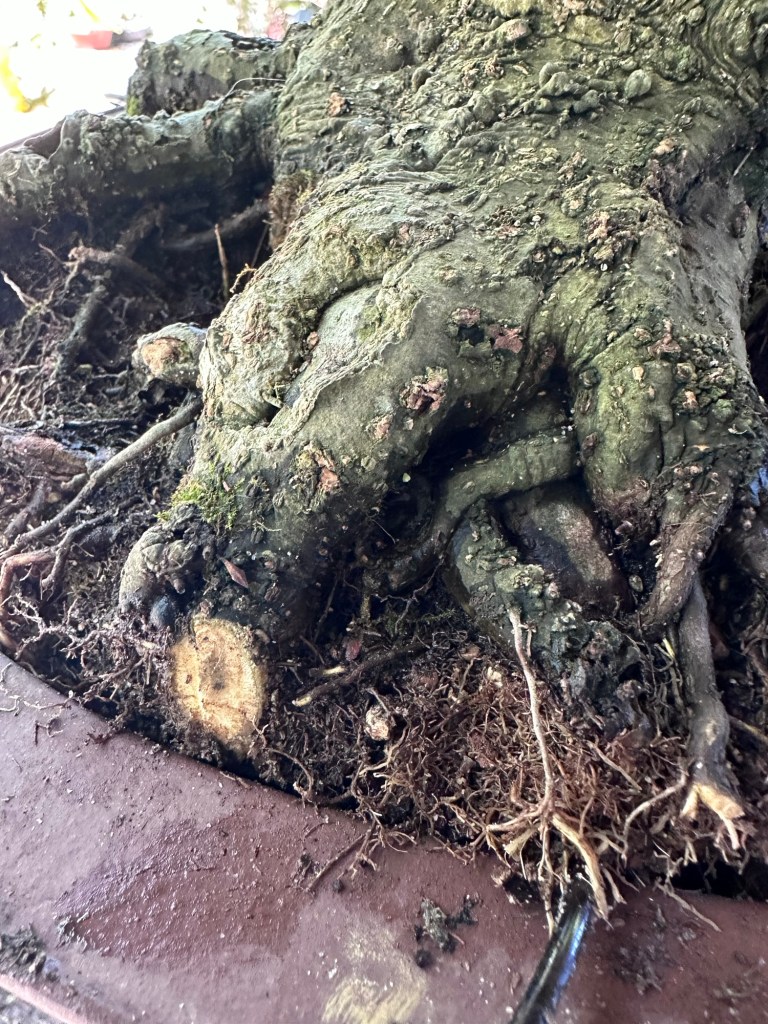
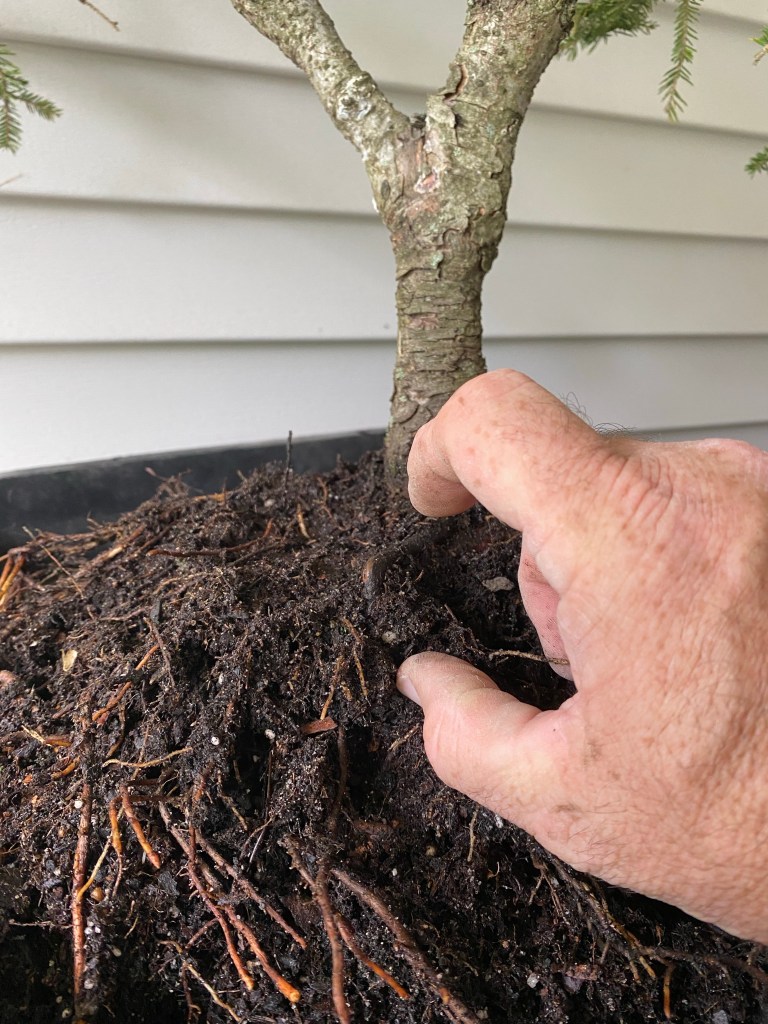
Gently massage the old soil out.
Tie the tree into the new pot, add soil.
And now for the magic. Wiring!
Here’s the before.
And…..here’s my daughters Jeep and what’s wrong with it (see what I did there? I’m going to make you wait for the after. Wait, don’t scroll down yet…..dammit!). Well, if you’re still here, she has a blown head gasket. The design of the cooling system allows for the coolant to get low and you don’t know it because the overflow reservoir stays full. So, in typical Chrysler fashion, the car overheated and blew up the gasket.
She liked the color of the Jeep. But it’s a bit too much of a job for me to fix, so its for sale, as is. If you’re interested. Call me….
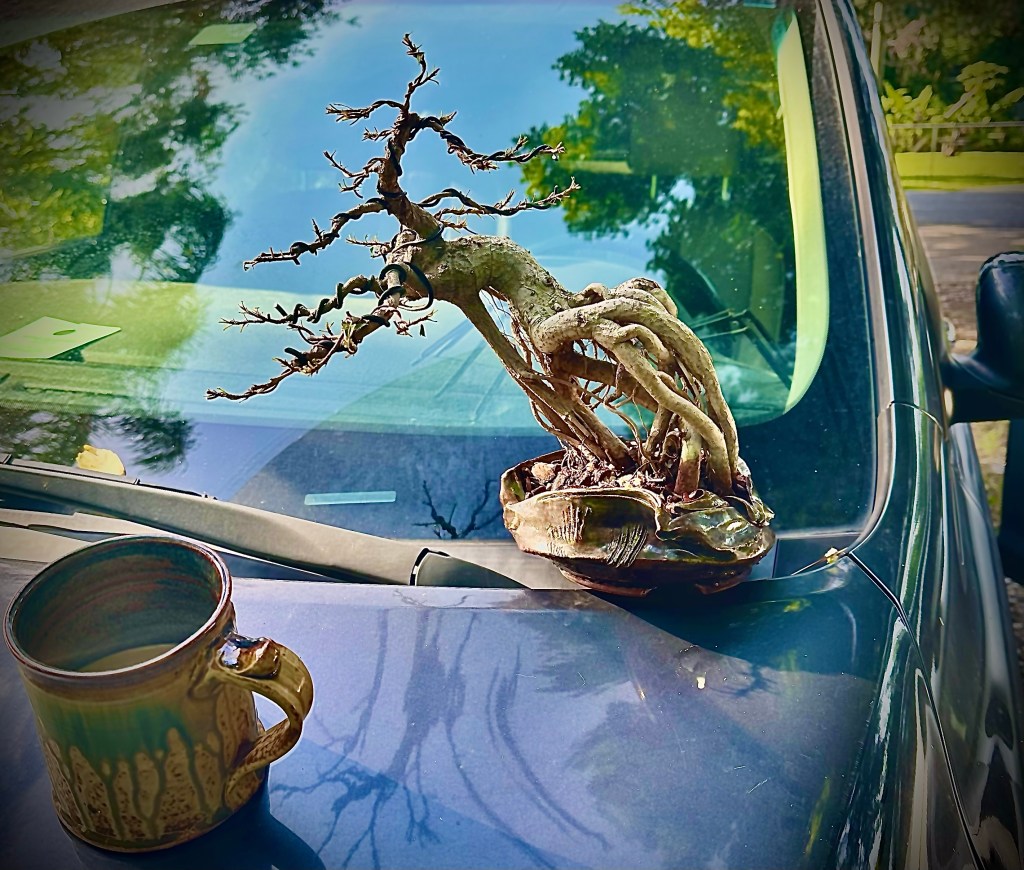
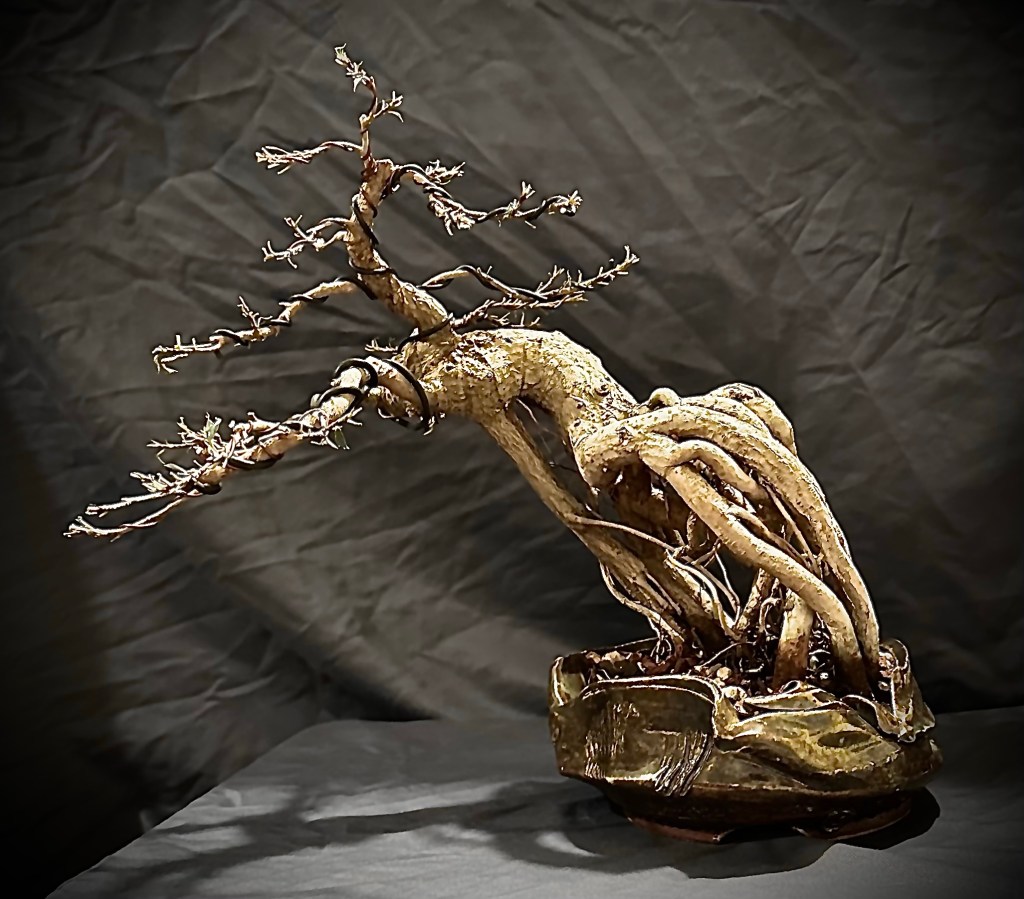
Ok, now for the after.
I think the pot goes well with the exposed root style of the tree.
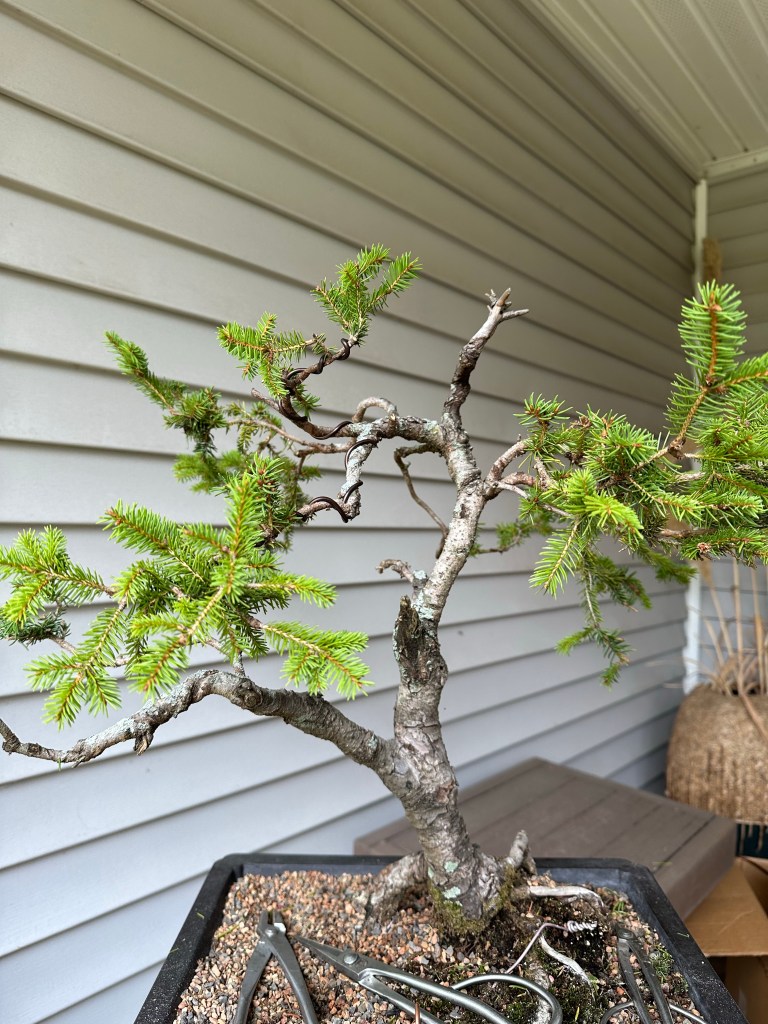
Here I am, back in Cincinnati, it’s July, 2023, two years since my last visit, and I find that a tree I had worked and, most assuredly, had killed, was still alive.
Wow…
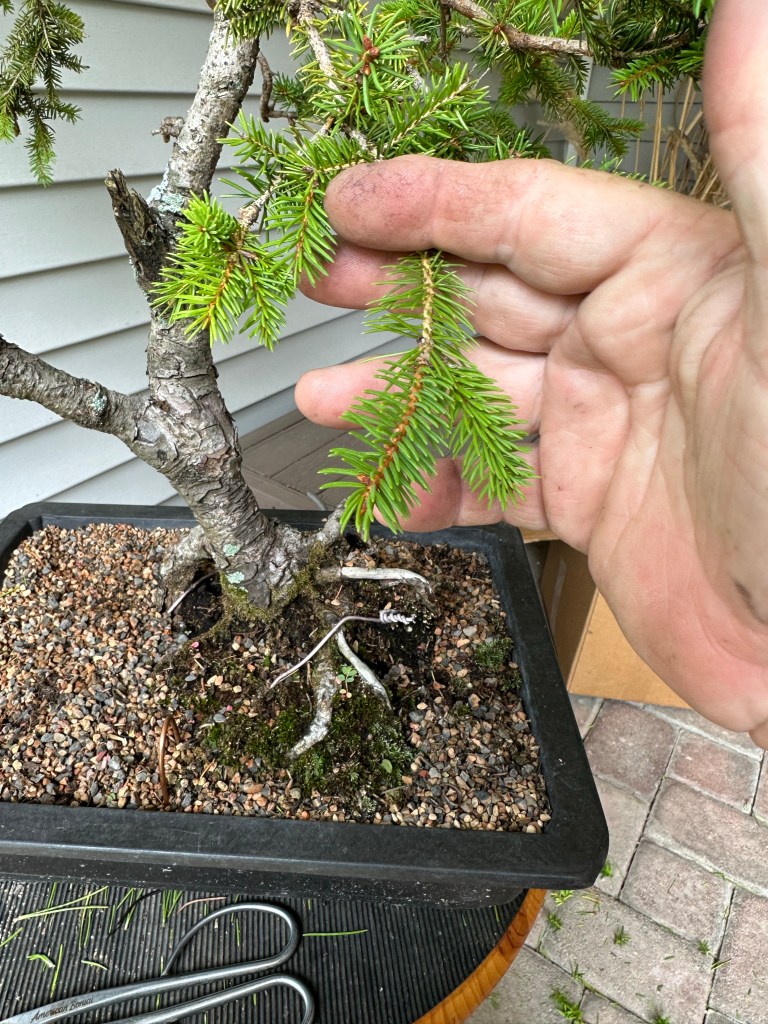
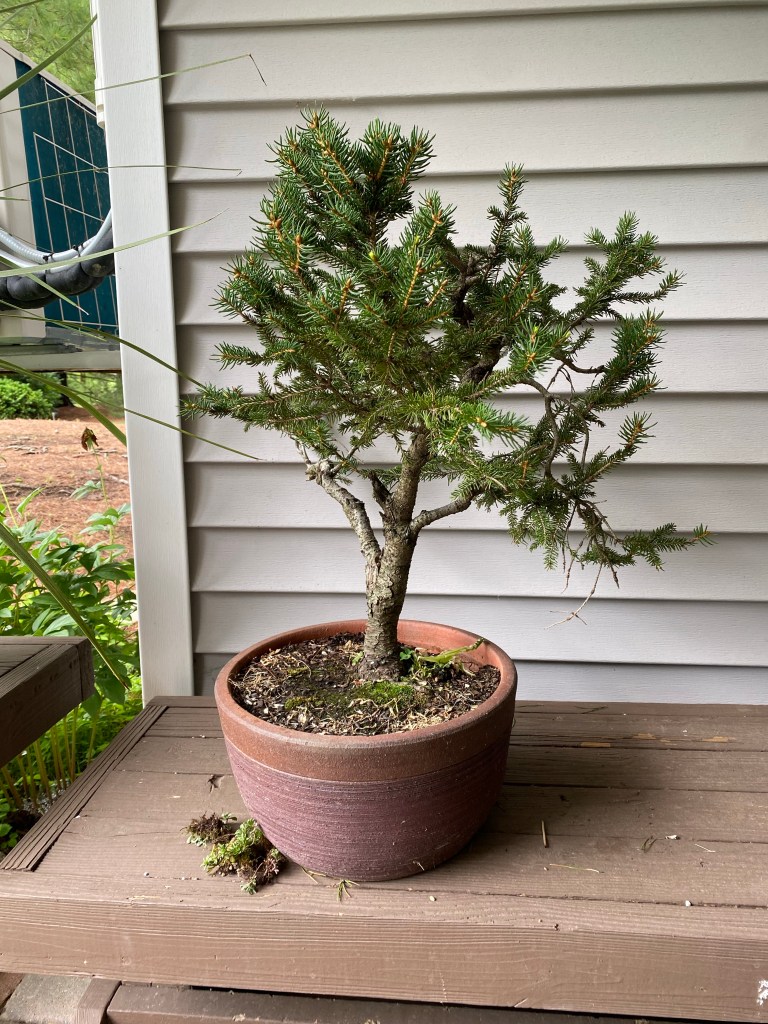
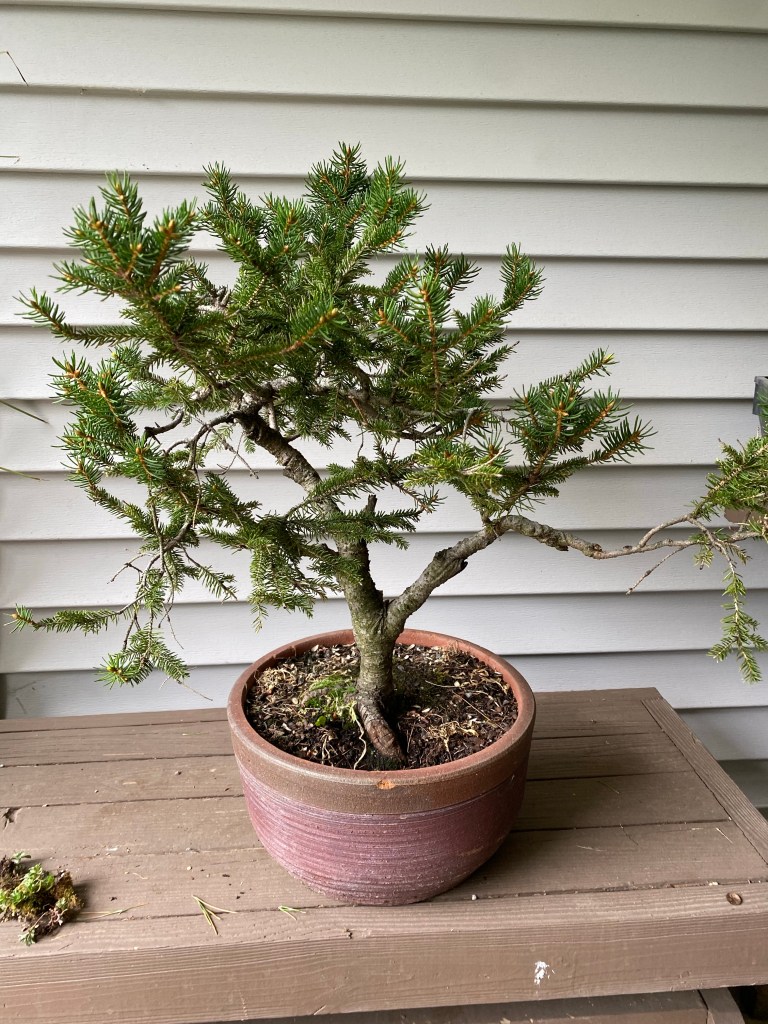
I’m not a northern conifer guy, generally (but I do work them for clients) so the only thing I can say to what it is, is that it’s some type of spruce (but it could just as easily be a fir or a hemlock). Spruces don’t grow down in Florida. They are what we call a “Christmas tree”.
As I inspect the tree, I find a few issues. Much of the US Midwest had a weird winter. It was cold near Christmas time, but didn’t get cold the rest of the winter, until one day the temps dropped 40° Fahrenheit in a matter of hours. Many bonsai were damaged. I think it stressed this tree in particular.
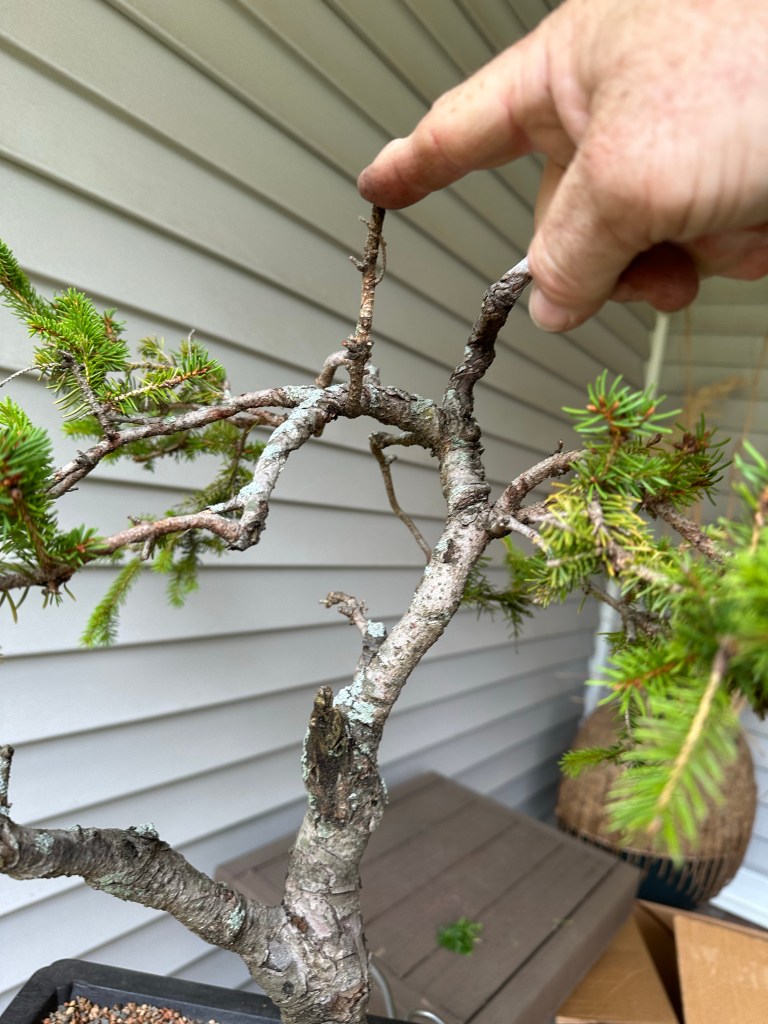
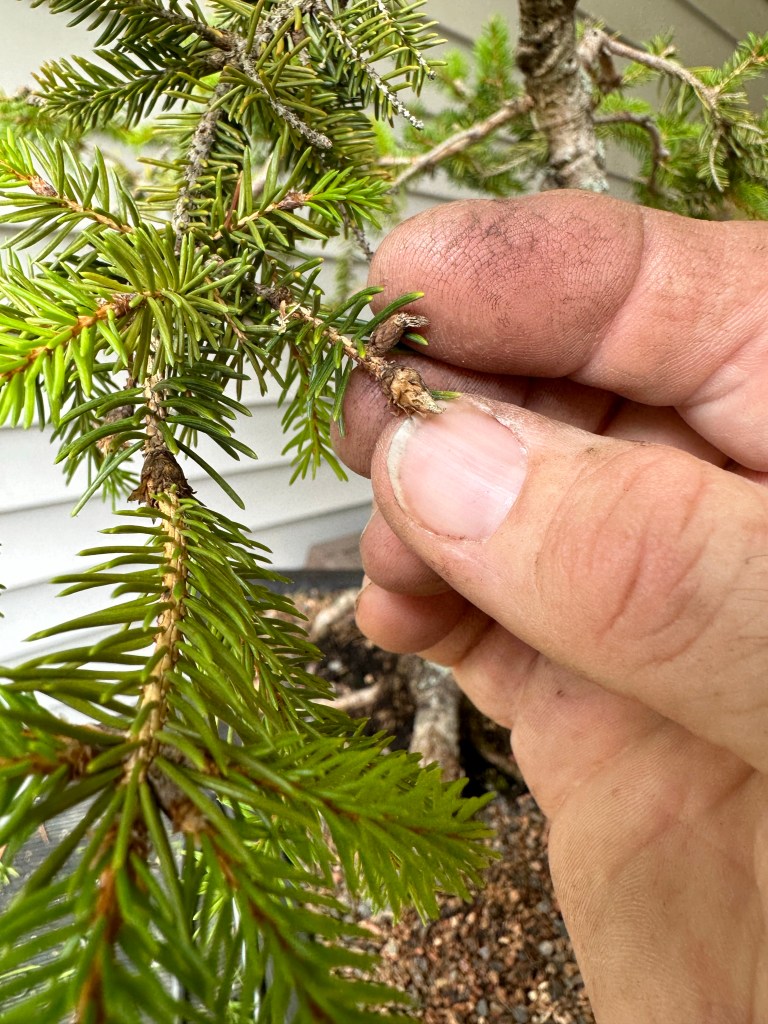
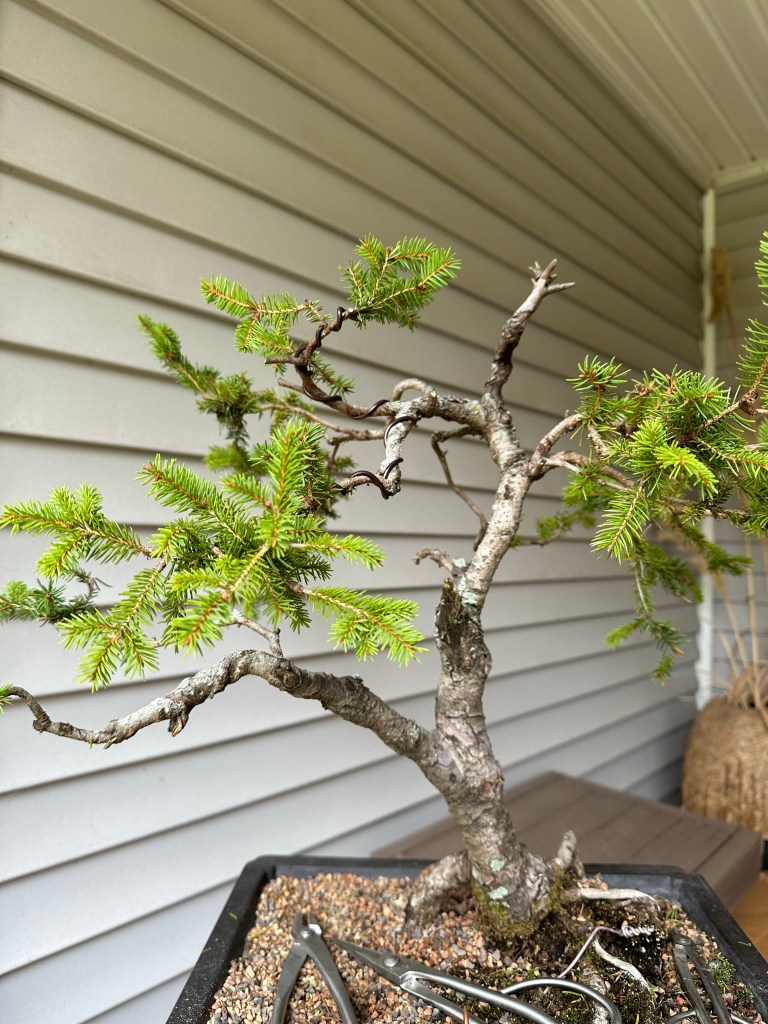
It killed off one branch (above) and some of the new buds were damaged. As you can see below.
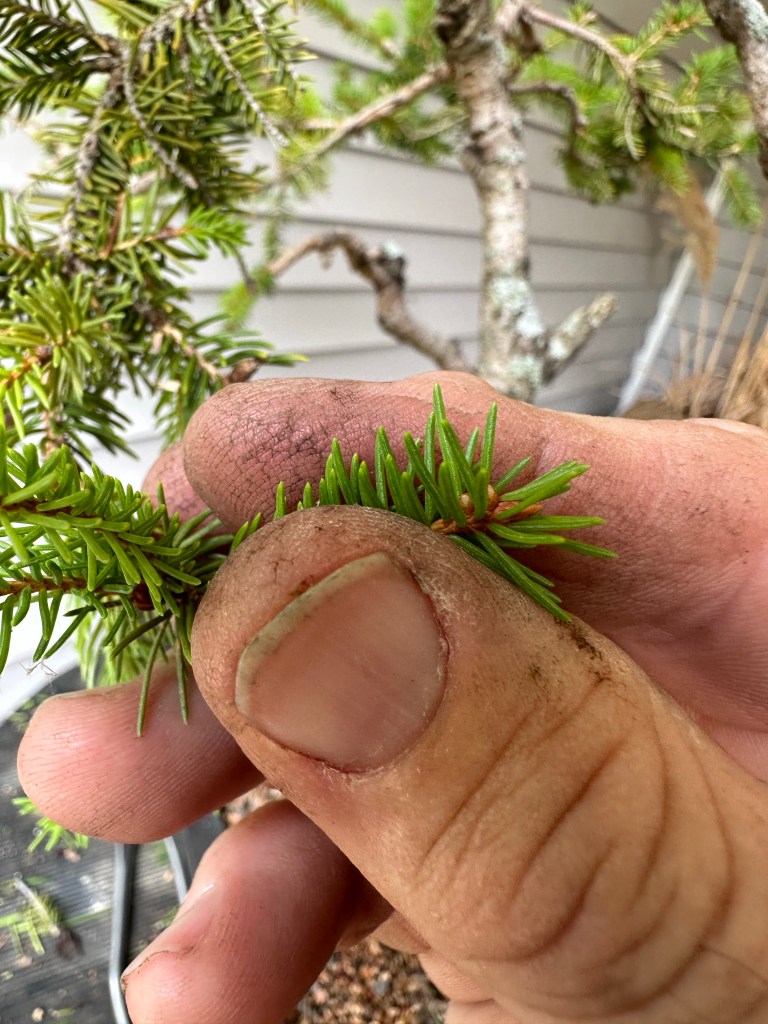
But it’s still alive and growing. Which delighted me when I got to my clients house.
Ok, that’s in the Now. Let’s go back in time and look at the tree two years ago and you can judge me for the initial insults I rained down upon the poor tree back then.
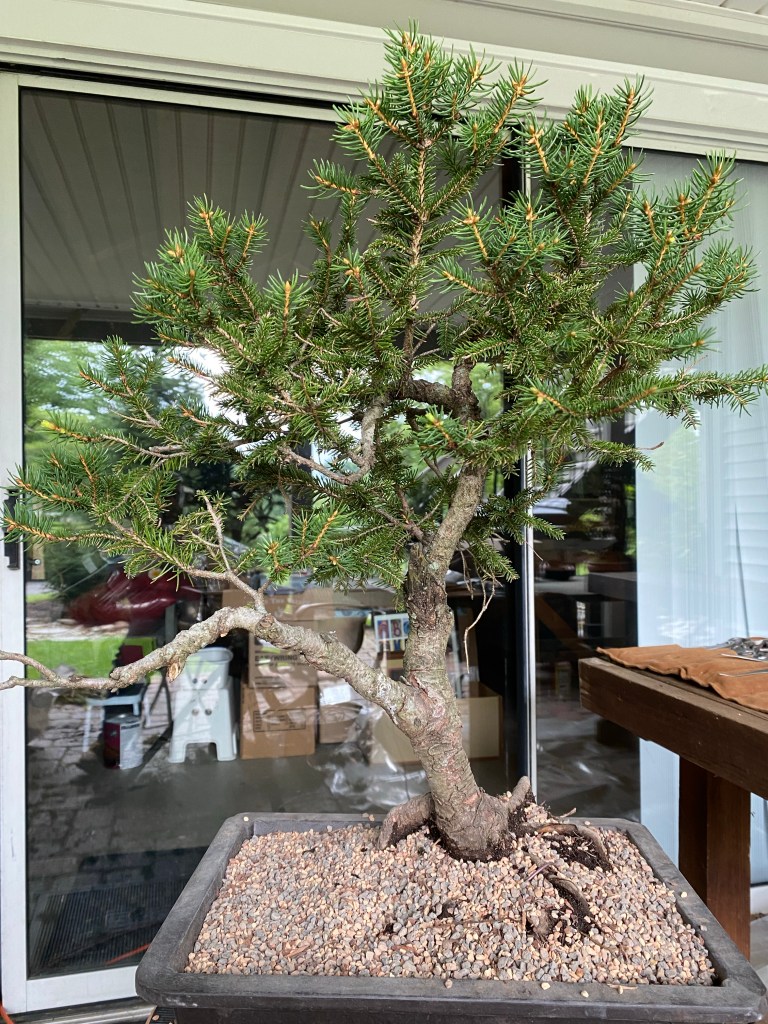
Lots of branches, good color.
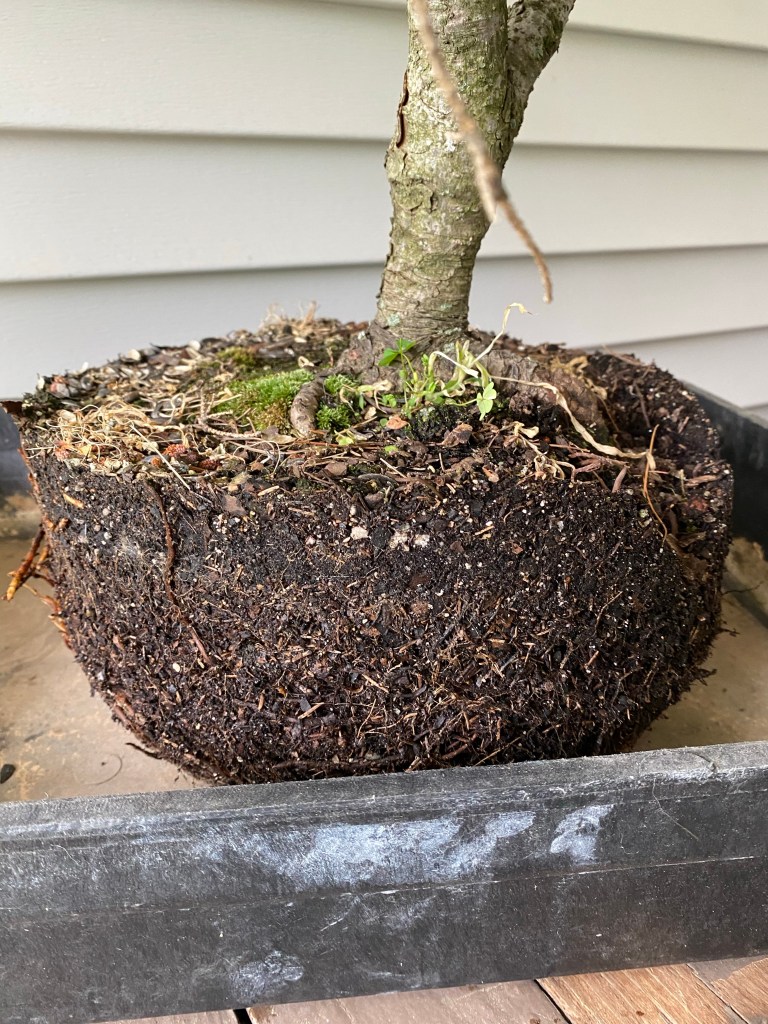
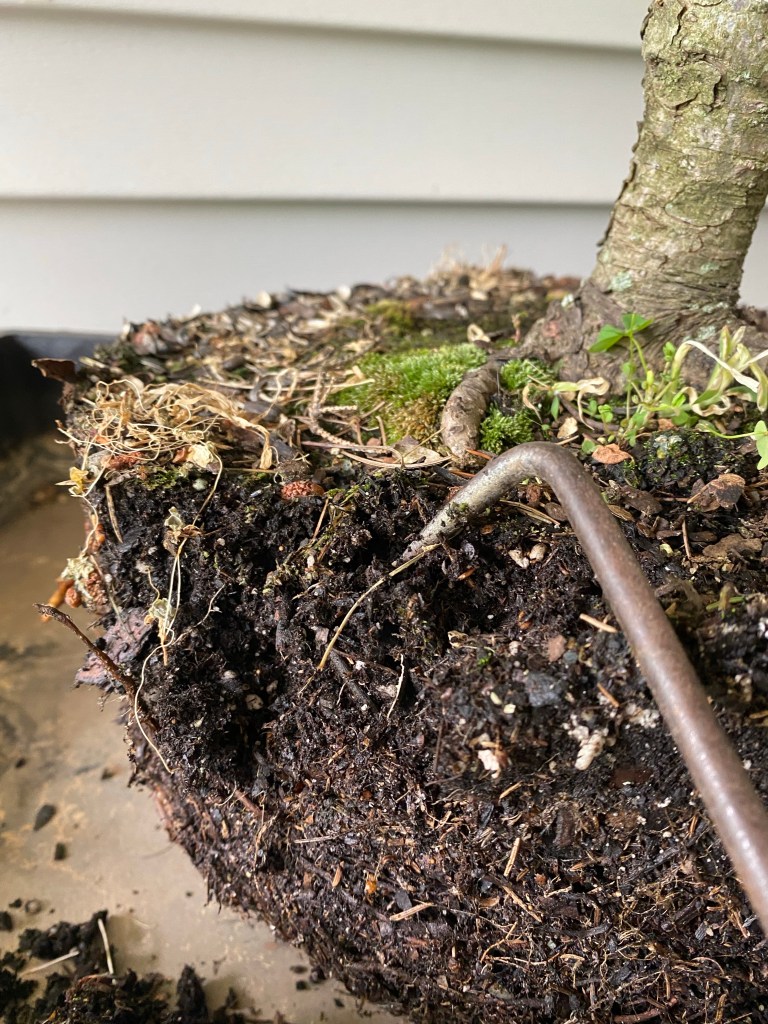
Crappy soil.
So what did I do?
I repotted it.
My client, Tom, asked me to, so I, against better judgement, did.
This was in mid June, Cincinnati, Ohio, coming into the hottest time of the year for the locale, I knew just a little of its history, but nothing about the species, and the worst insult? I’m a tropical guy (well, mostly. I am here now, aren’t I?).
Tom, who had a stroke a few years ago, doesn’t get to work his trees so much. And he’d had the tree for many years, just sitting in that pot. He’d look out the window at it from his living room.
He asked me to do something with it, so I did.
First, the repot.
The soil I had on wasn’t the best. Mostly expanded shale, or Haydite, as was the brand name back in the day.
Then I styled it.
Two years ago….
You are probably asking why I didn’t do a write up on it then? Well, to be honest, who wants to show a tree you’ve worked on that you know won’t live? I don’t like that idea, showing techniques and styling and trying to be a teacher when you know it’s not best for the tree.
But I got lucky, and sometimes, as they say, it’s better to be lucky than good.
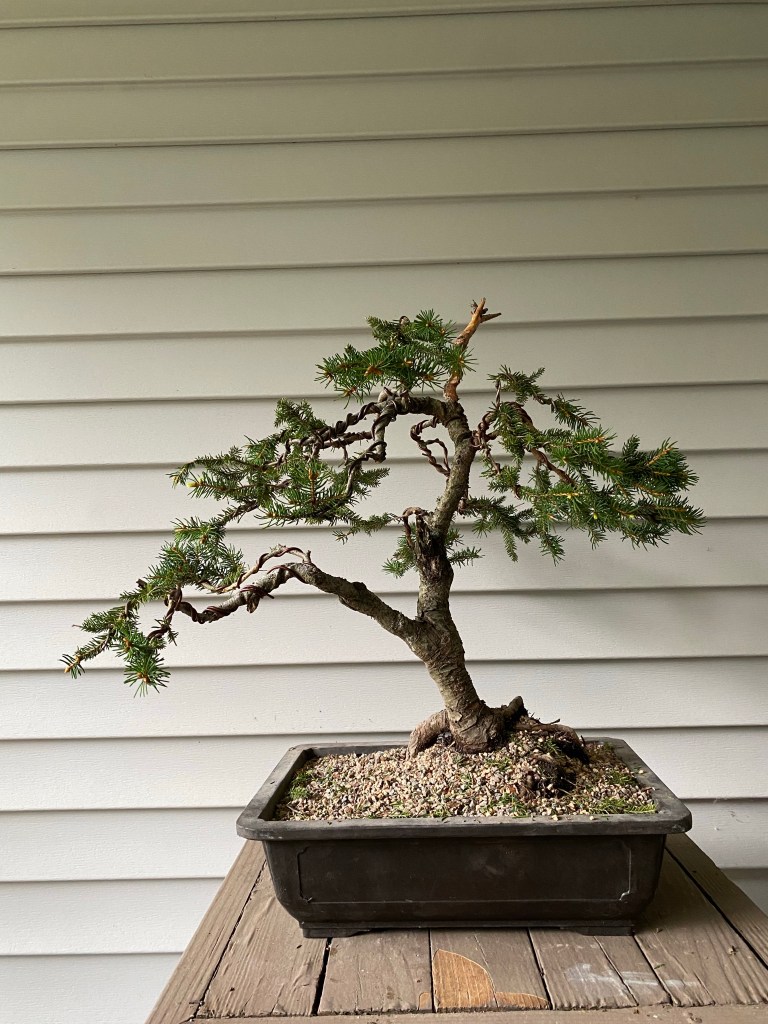
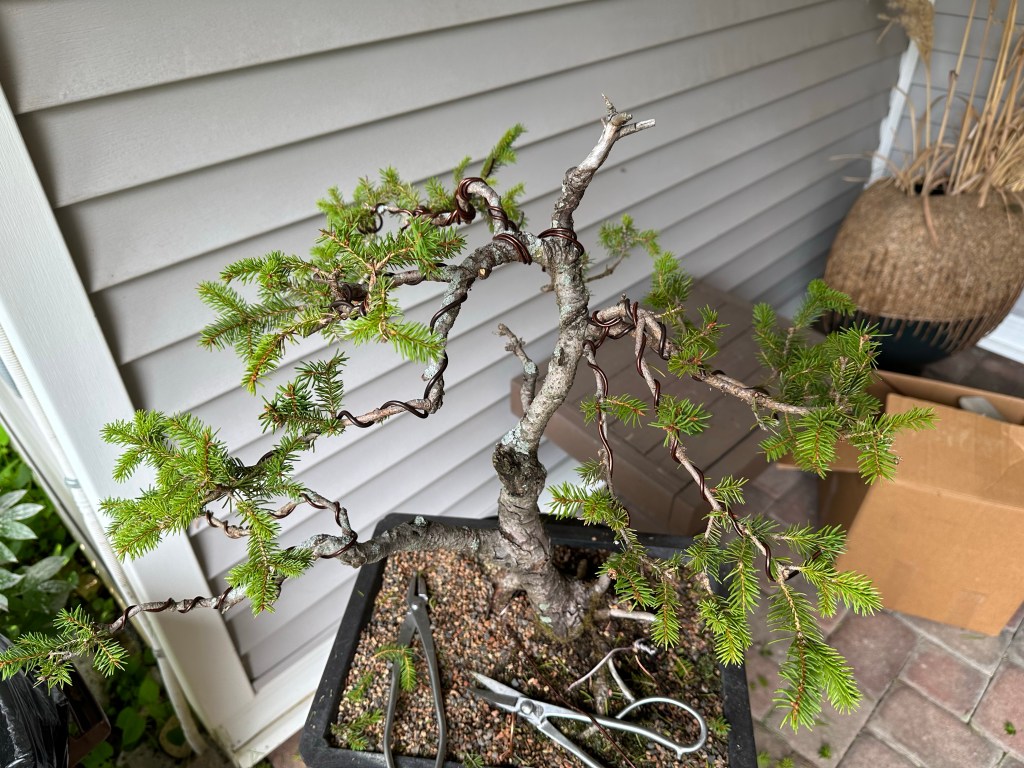
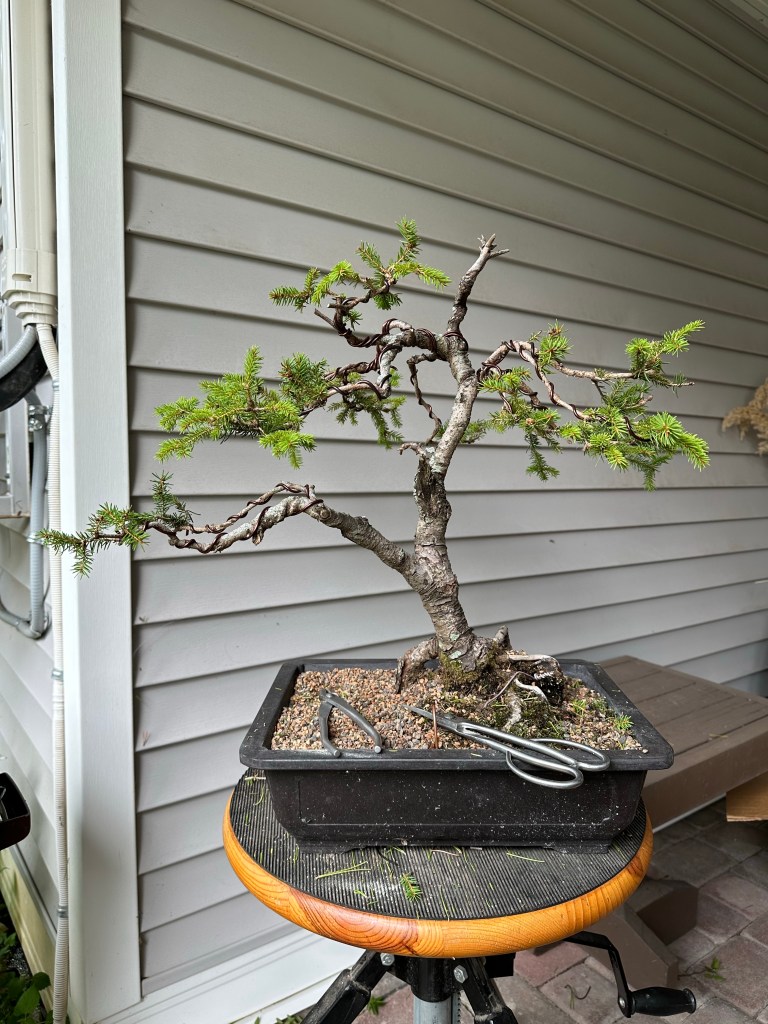
Here’s the tree after the restyle.
I left more on it this time, given that it was stressed.
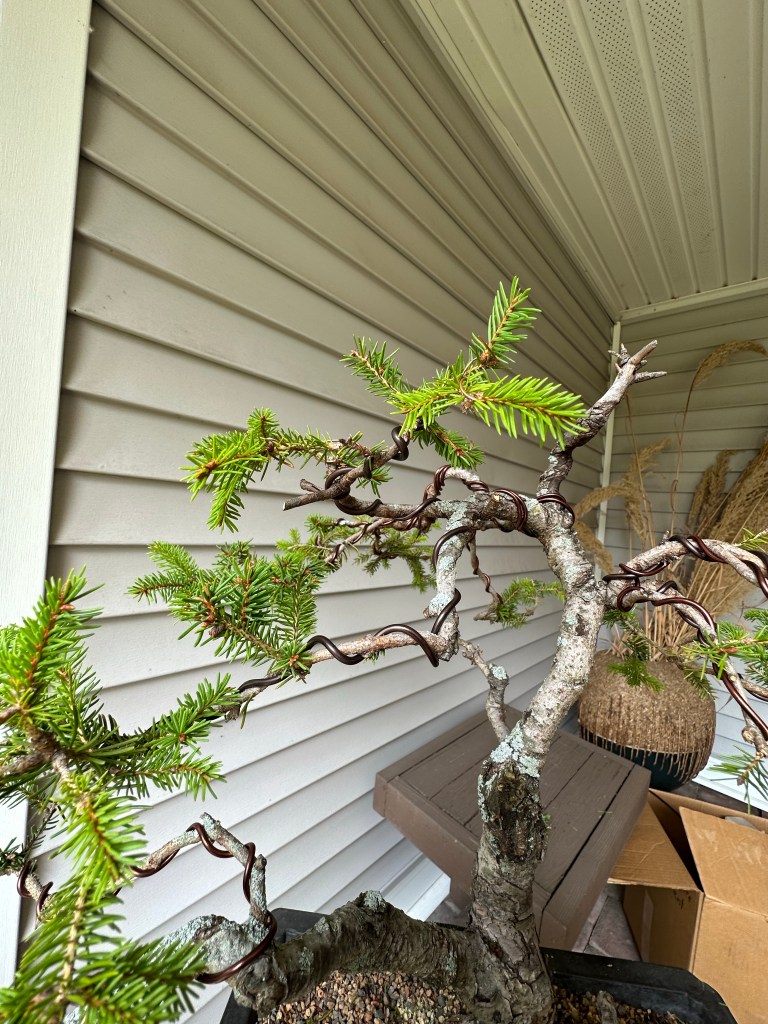
Wiring the top in a typical “conifer comb over” many bonsai artists practice.
The only tips or tricks I can give you on this particular variety and species of tree (considering I’m near ignorant as to what it specifically is) is to not cut it back too much, water and fertilize as one would with the spruce genus, and pay attention to severe, sudden drops in temps near springtime bud formation.
I didn’t fertilize this time, except with a miracle product called “Micromax”, which is full of those micronutrients usually missing in most fertilizer compositions (macro nutrients are the NPK of regular ferts: nitrogen, phosphorus, and potassium, micros would be things like molybdenum or boron or even things like chlorine or copper that you might think are detrimental to a plant).
And that’s how I left it for this year. Hopefully I’ll see it again in my future travels. I don’t get to see many trees after I work on them in my tours. So a return this year was sweet.
Thank you Tom, and thank you Ruthie. You are both the real deal.
Well now, did the story start with scotch? Or end with scotch? It’s kind of hazy looking back now. But I’ll try….wait, I remember…it started with bourbon!
It actually began in 2019, but you didn’t see the tree until 2021, 2 years ago (or, two years from the post, in case you are reading this in the year 3023. It’s now 2023, taking place in the month of July. If you don’t use the word July, it’s the seventh month of the solar year, named for Julias Caesar, the first Roman emperor (or dictator) after abolishing the Roman republic. the Terran summer solstice in the northern hemisphere occurred on June 21, 2023, and this debauchery occurred 28 days later. Terra or Earth, is the third planet from our sun, called Sol, in the Solar System, in the Milky Way Galaxy. Hopefully that’s enough for the far future readers to understand how we told time back in the ancient 21st century days of legend.)
Today , or rather, late July (don’t make me go through that again). We have a ficus microcarpa, what one might call “ginseng”. But that’s just a marketing term. Ginseng are not figs, figs aren’t ginseng. You make Newtons out of figs, and Monsters out of ginseng. The cookie and beverage, that is.
Ok, now that you’re up to speed, let’s get to the work….
I’m in Toledo, or Maumee, to be precise. It’s pronounced just like “mommy” by the locals. I feel a song should be sung. I wanna go back to my Maumee.
I’m with my two good friends, John and Julie. They take care of me when I’m there.
The tree is potted in an aluminum serving container. There were a few who said that we’d be poisoning the tree with the metal tray.
Looking below…
….I’d say, naaah! in fact, it looks good for a ficus in the north. Damn, I mean, it’s almost Canada fer crissakes. They don’t say “Holy Toledo!” for nothing.
Anyway, we did a lot of work that day. But not much on this ficus. We didn’t have a pot, you see. So we decided to get all “Muckety Mucked” up.
24 year…25 year….26 year, or, as the bottle suggests, one little piggy, two little piggies, and three little piggies.
We finished the 24 year. Made a dent in the 25 and 26. Wait, is this a bonsai blog or a drinking blog?!
It’s both. Sometimes.
And to the dead soldiers, we salute you!
The next morning, hangovers and bright lights notwithstanding, we had to get up early to go to Michigan (I know, that sounds like the first line in the “Great American Novel” we writers all would love to write. Maybe…..).
We had to get a decent pot, so we visited the Flower Market (Which has changed its name to Green Witch Gardens)
It’s a damn cool place to visit. Not only do they have bonsai, but there are cats…
…that’s cats, plural.
And pottery from amazing American artists.
The trees!
Julie hiding behind a tree.
Familiar weeds. These are what are called wandering dudes now. I feed them to the tortoises. Speaking of which….
Tortoises!
Only the best bonsai nurseries have tortoises.
We got some pots.
Then went back to Toledo.
And we got back to work.
For being in a shallow aluminum pan, it’s grown some good roots.
The “pot” has even held up well. We could use it again.
Looks solid.
Raking out the roots….
Here’s the new pot we got for the ficus.
Sweet, ain’t it?
Tree is ready
Can I mention again how good the roots are?
We had split some of the larger ones (go back and read the first post).
Hey, it even fits in the new pot.
Damn those are sexy roots. Must be the soil. The vaunted, rare and near mythic “All-American Red, White, and Blue, Adamaskwhy SuperMix” .
Just to prove we did other work, here’s some examples. A willow leaf.
A tigerbark.
An azalea.
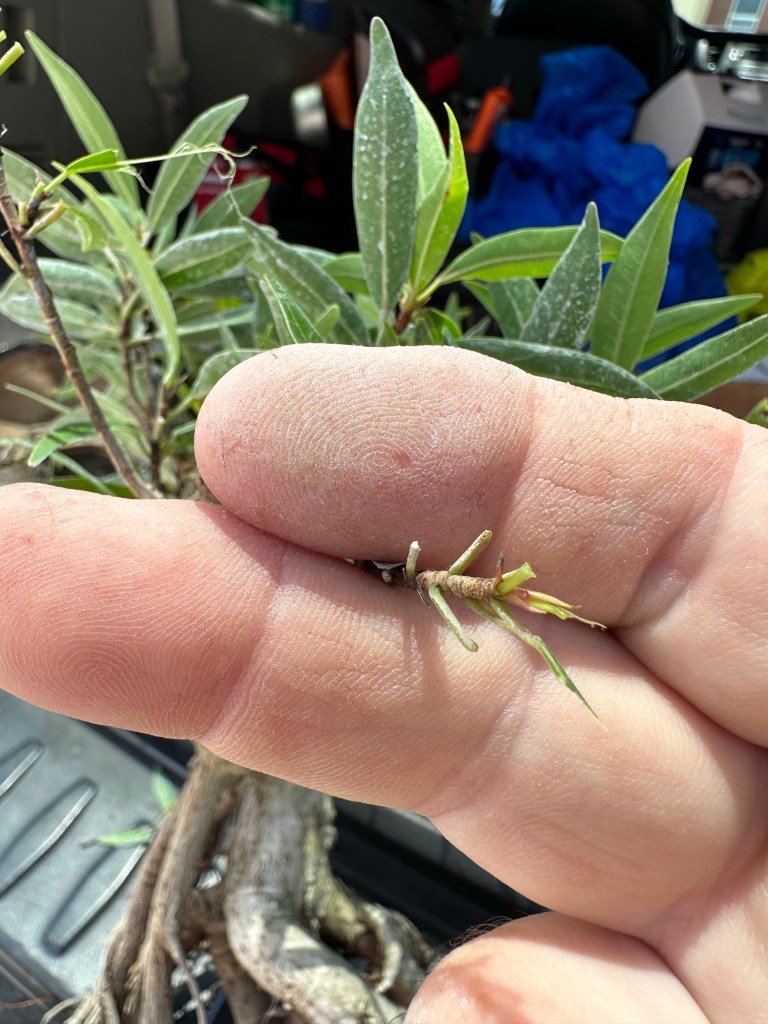
A willow leaf root cutting.
And another.
I must say, I can’t believe what an amazing two days that was.
But I had a hard day while I was writing this piece. Something that should not be happening is. And I posted to Facebook; I quoted JRR Tolkien, the part where Frodo asks of Gandalf:
“I wish it need not have happened in my time,” said Frodo. “So do I,” said Gandalf, “and so do all who live to see such times. But that is not for them to decide. All we have to decide is what to do with the time that is given us.” J.R.R. Tolkien, The Fellowship of the Ring
And John replied “and what you do happens one word at a time, one leaf at a time, one sunrise at a time.”
Here’s the tree all those years ago. We ground layered it (hence the post title).
One tree at a time. Even if it takes years to bring it to its potential.
One leaf at a time.
One branch.
One root sometimes.
The two years ago..
And now.
Bonsai is a journey. And getting there is sometimes the only reason to go somewhere. You can buy a tree, but making a tree, especially this one, that started so humbly, is way more fun.
John has done well with it. I’m honored to have helped him, and thanks to both John and Julie for letting this strange bonsai guy (me) into their home.
That’s Washington DC. I think. Lots of converging lines and paths layered on top of each other. I posted a similar insane street map last time I was up in the area and I visited the Bonsai and Penjing Exhibit at the National Arboretum .
I was too busy working this tour to get to see the Collection. That’s ok by me. I like working. To be human is to work. To find meaning in that work is the sole purpose of this life on this earth.
Anyway, there’s room for philosophy later on in the mid and last section of this essay, so, as promised in the last post, here is LeAnn’s buttonwood.
She said it was collected (as most in the USA are) by the Buttonwood Queen herself, Mary Madison.
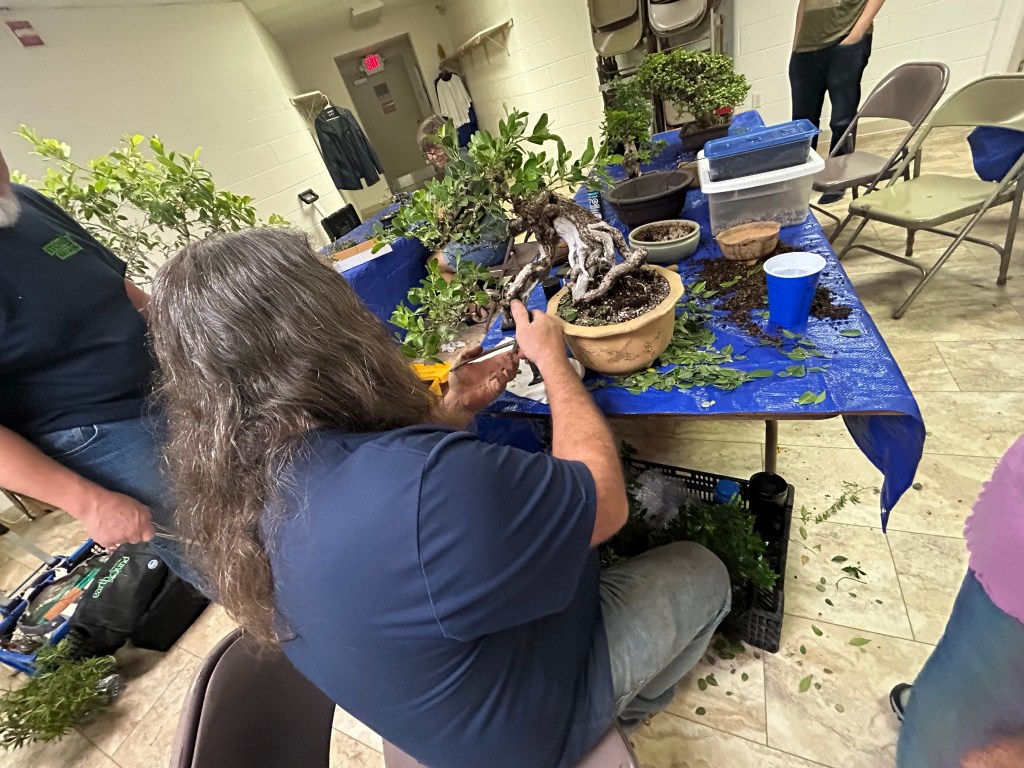
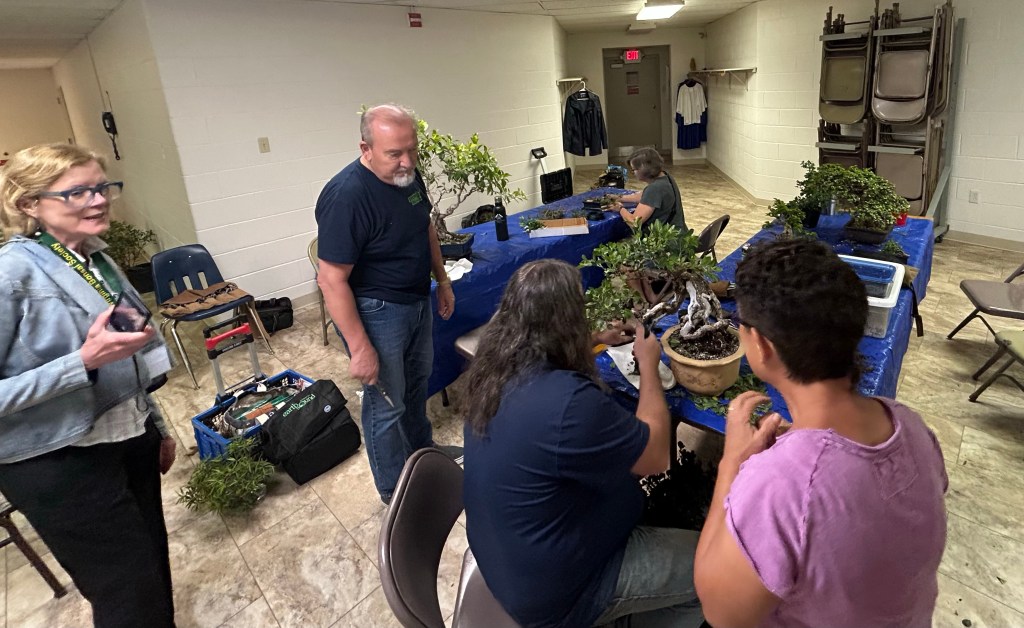
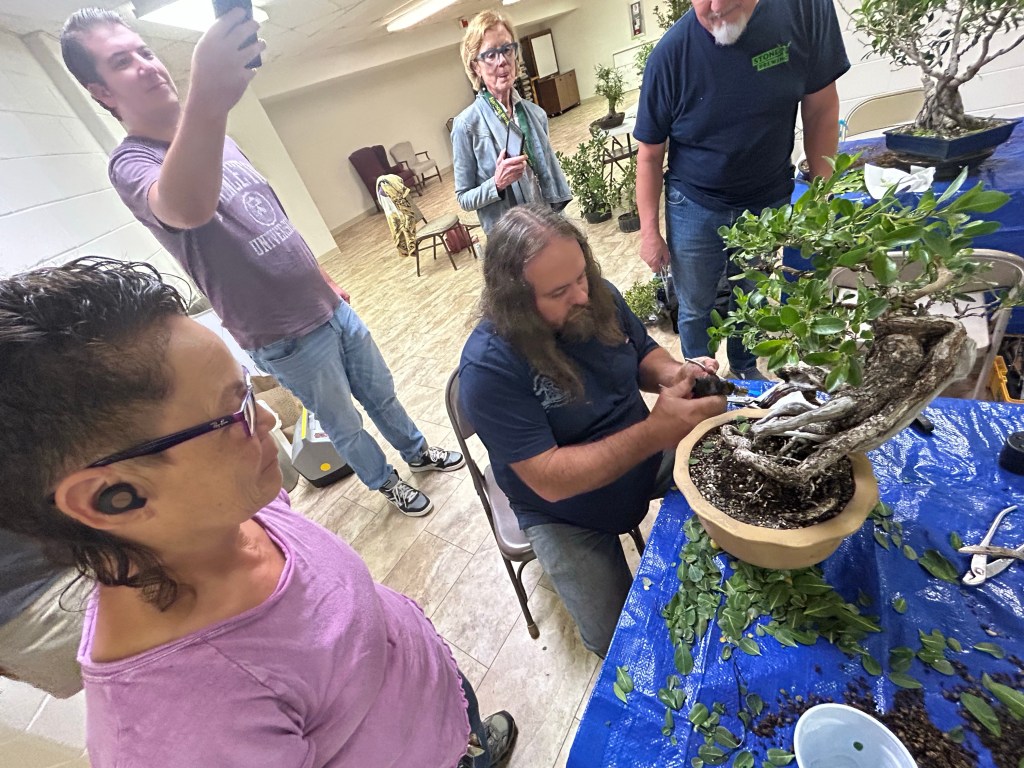
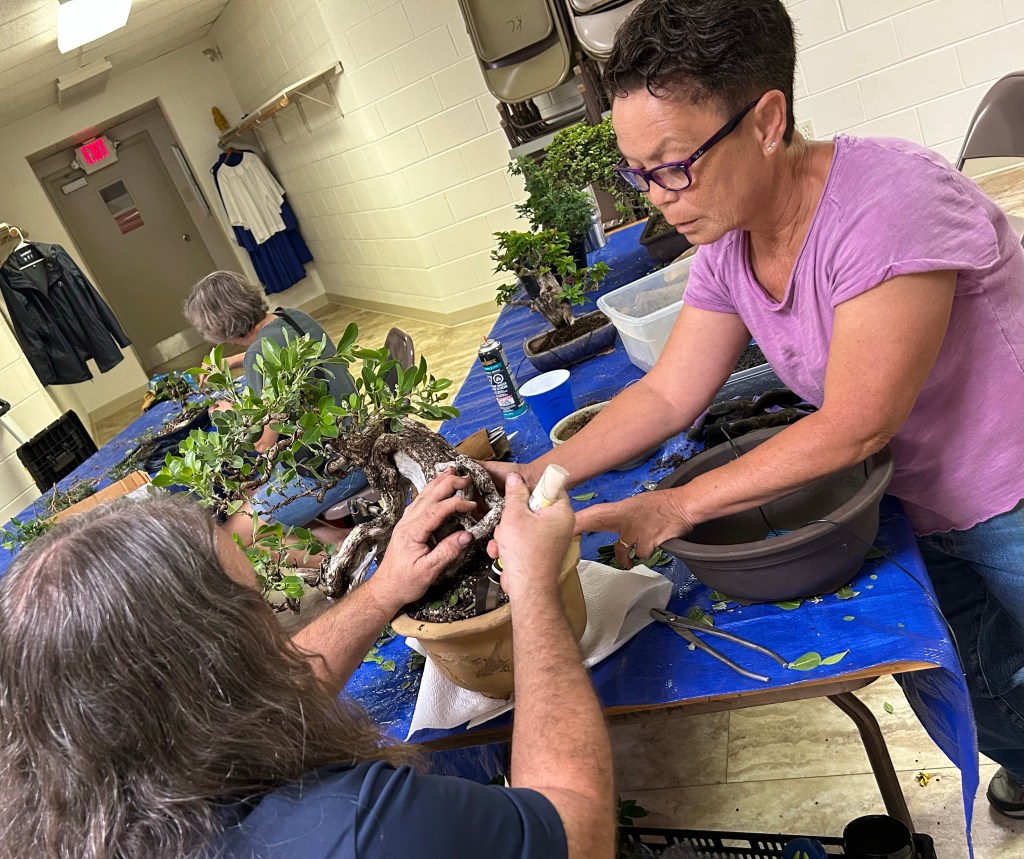
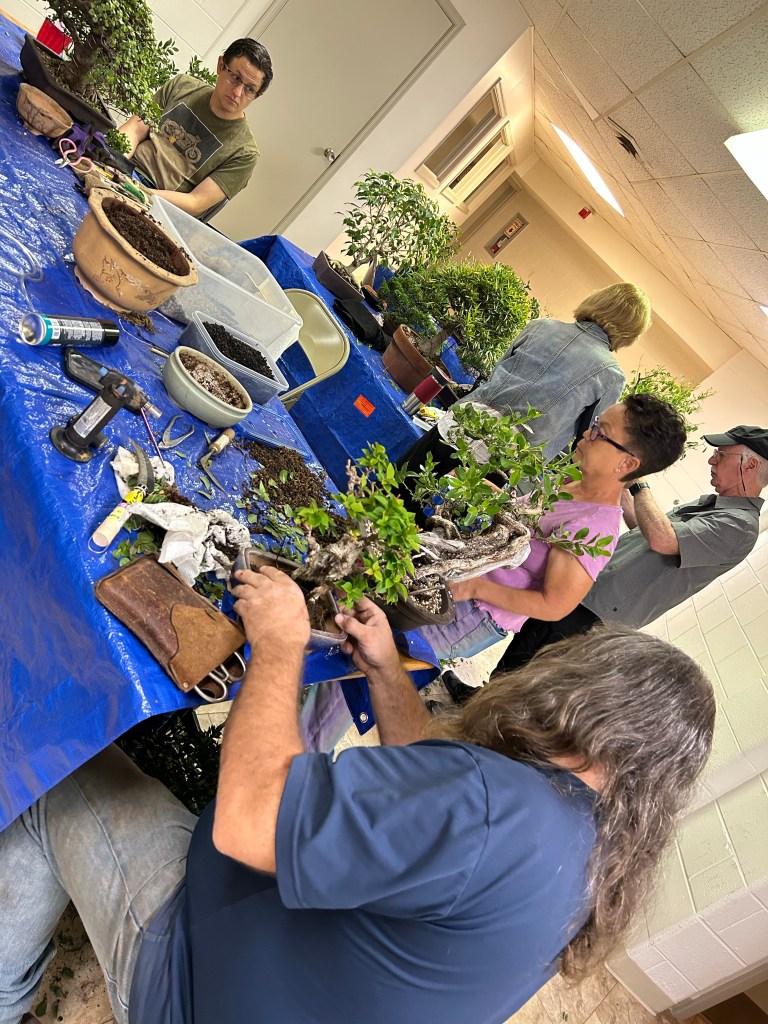
LeAnn is the lady in lavender (purple? Lilac? Not periwinkle, or plum, for sure) hovering behind me.
She waited very patiently while I worked through all the other workshop attendees trees and finally got to her tree.
It desperately needed a repot. I teach my students in Florida that buttonwoods need a repot every year. Up north, like here in Virginia, it’s not so important. Unless you use a horticultural heating pad, that is. (Wait, is Virginia “Up North”? I’m not sure. Where’s the Mason-Dixon Line?)
Ok now…..WHAT? (not the North/South thing, even I’m not getting into that). What’s a horticultural heating pad?!
Here’s a few secrets for my northern tropical bonsai growers. First: get grow lights. We are in a golden age of indoor growing of plants. Yes, due to the legalization of cannabis, mostly, but we gain from it because all kinds of grow lights, from full spectrum LEDS to metal halide, are available almost anywhere for cheap. So get yourself one. But…BUT..secondly: heating pads!!! Horticultural heating pads are the game changer for those that need to bring in their tropical trees for the winter (one should always put your trees outside for spring and summer, there’s no replacement for the sun and rain. None). Most tropical trees growth habits are dependent on temperature. But not just ambient air temps. It’s the temperature at the root zone, in the soil, during the evening, that makes tropicals grow.
Which is why we here in the Sunshine State don’t repot buttonwoods until nighttime temps are above 65°F for at least 6 weeks after the repot.
In sweet Virginy, this particular operation is taking place in the middle of July, and LeAnn has the rest of July and most of August to grow more roots. So no worries there for her. But I knew of a guy in Cincinnati that repotted his buttonwoods in January. He had a greenhouse and heating pads. That’s where I got the idea.
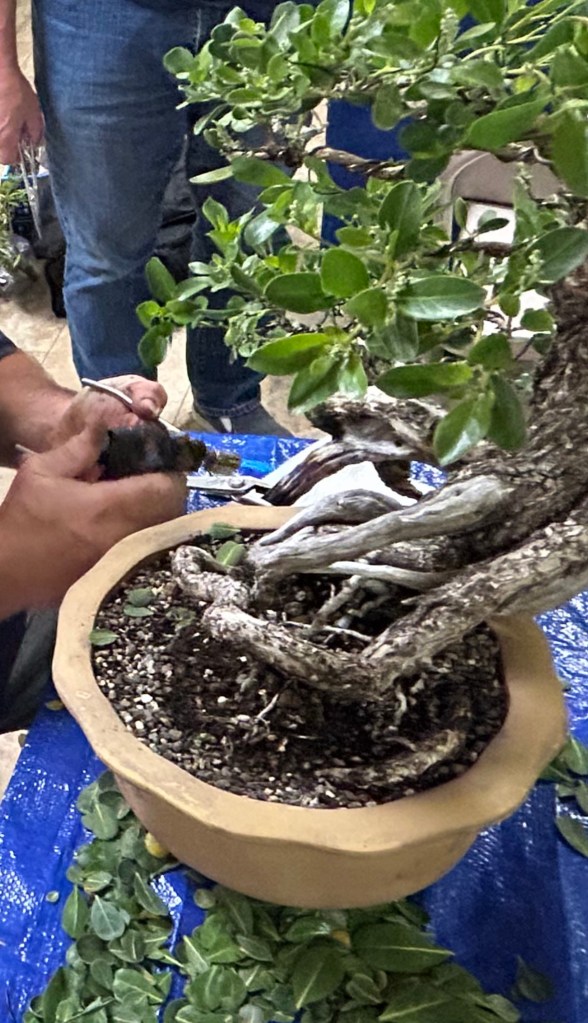
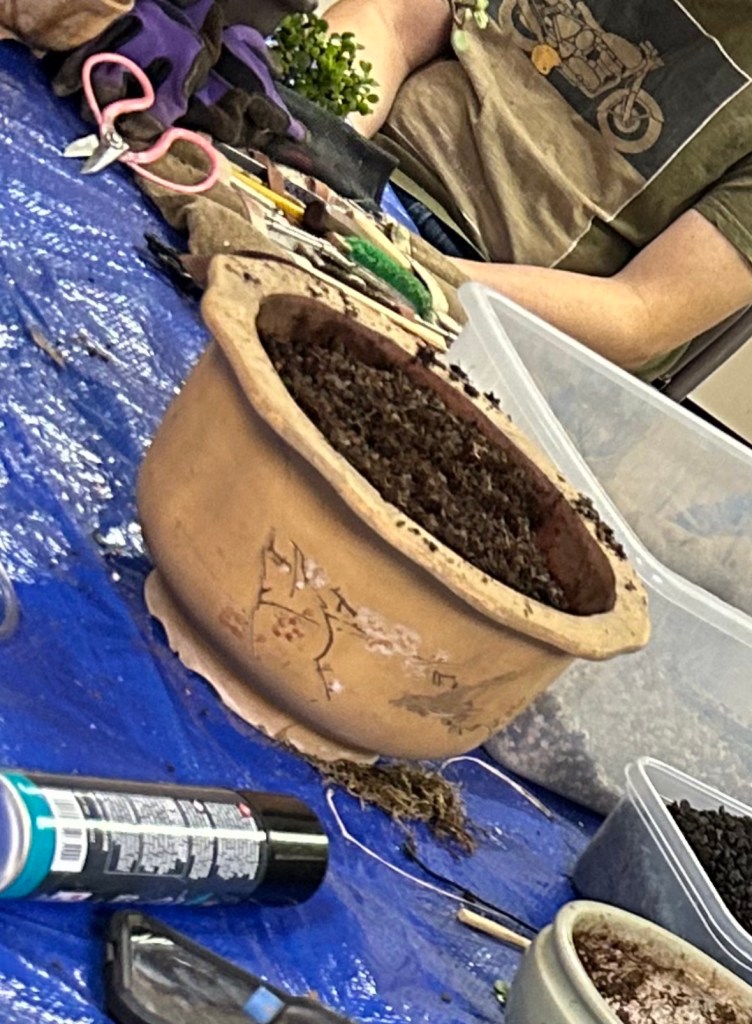
Anyway, we got the buttonwood out of this pot:
And into this pot:
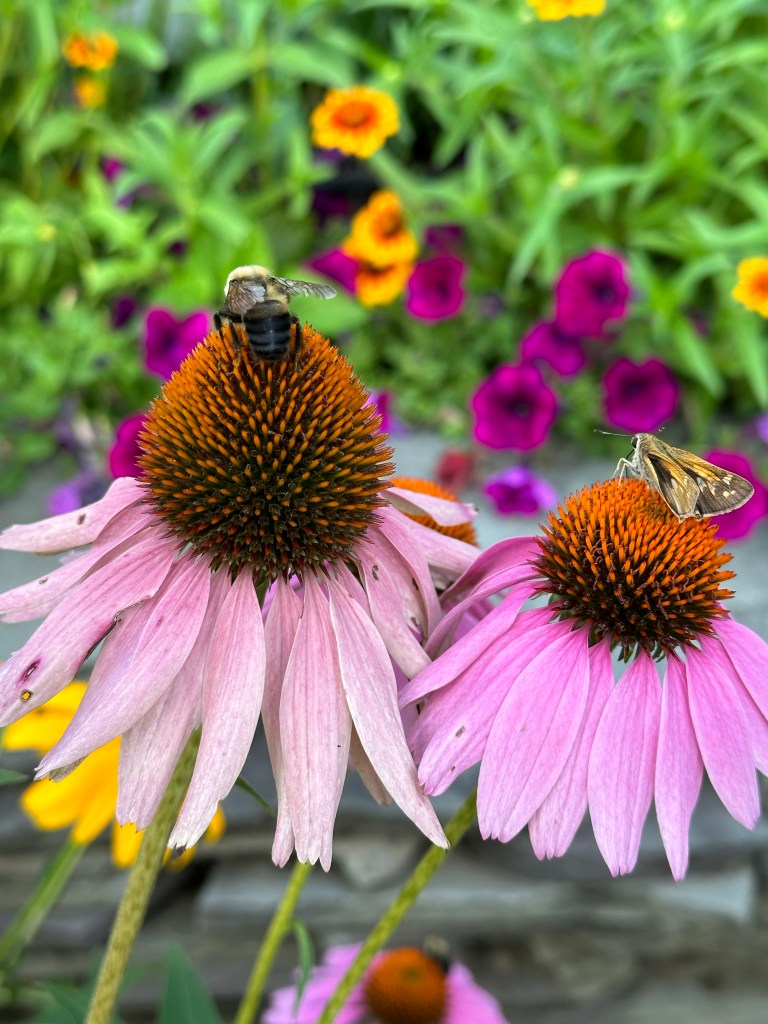
We wired it, tried to bend some deadwood with the torch and steam technique (only partly successful) and, now, just to make you wait, how about a bumble bee and a moth on a coneflower?
Awwwww, ain’t that cute?! LeAnn has an amazing garden and an even amazing collection of trees.
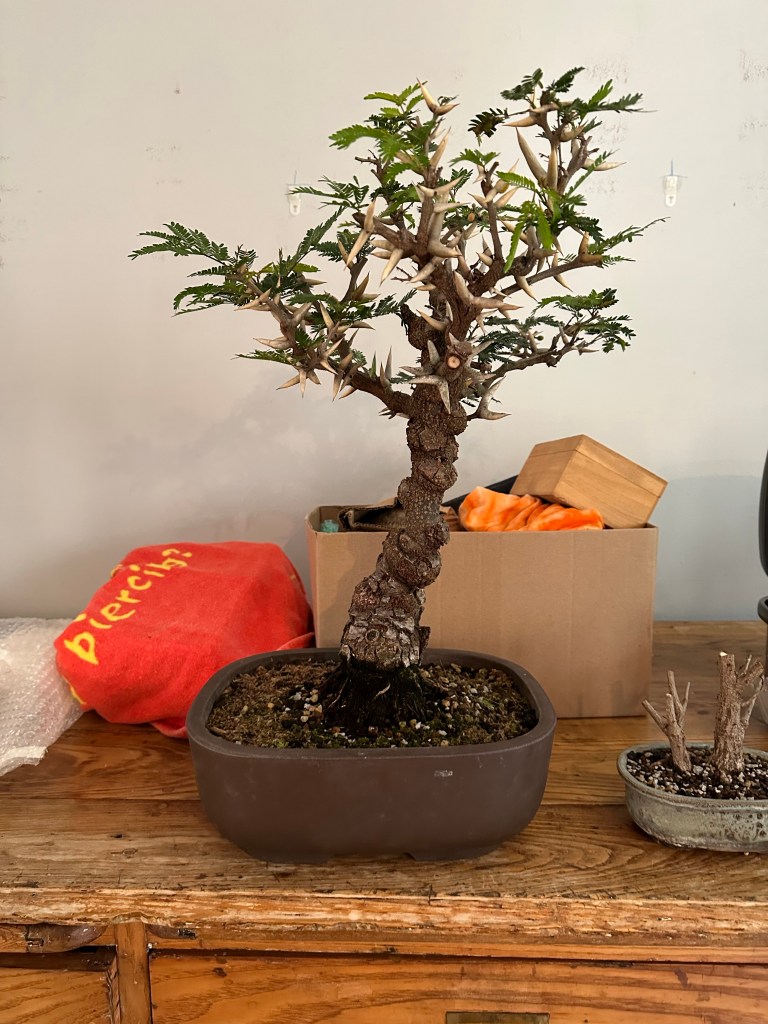
Here’s one of the more developed bullhorn acacias I’ve seen.
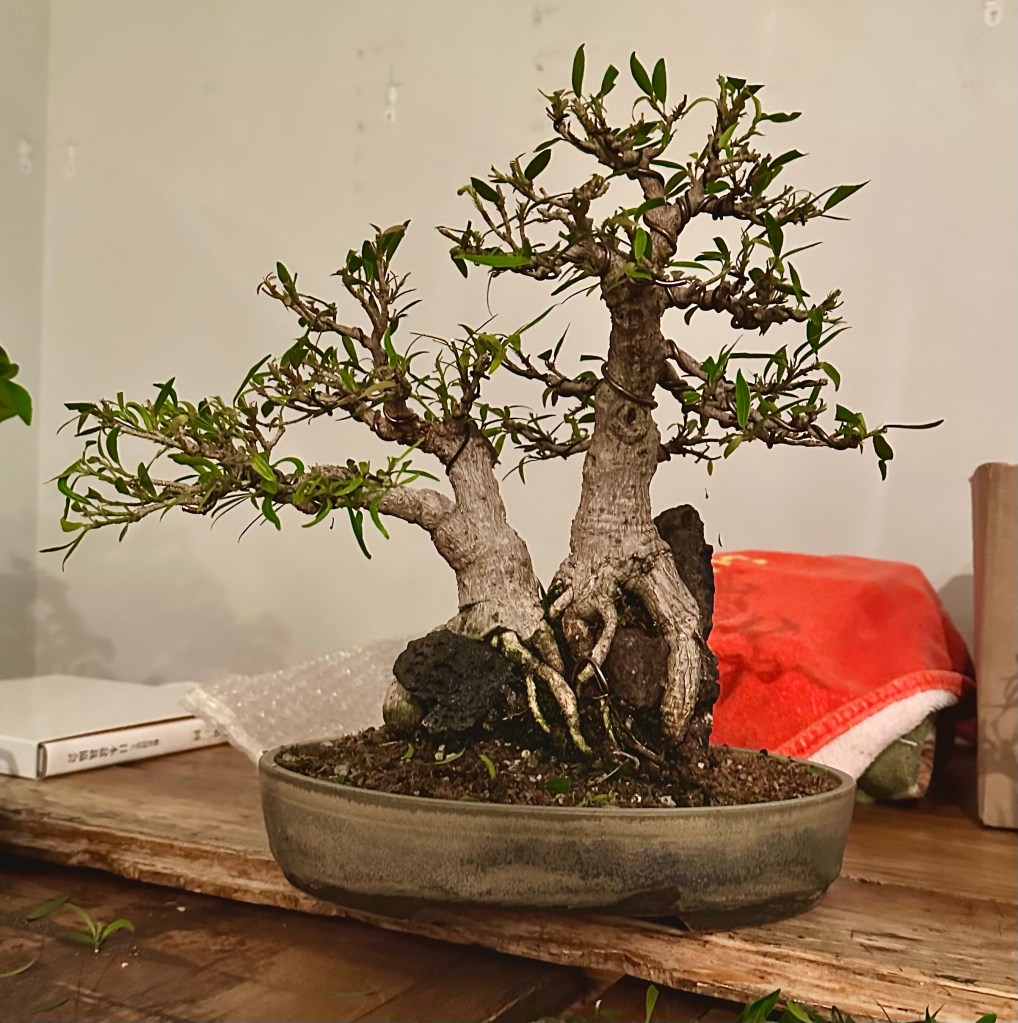
And a twin trunk willow leaf on a rock (a rock from Hawaii I believe, where LeAnn hails from).
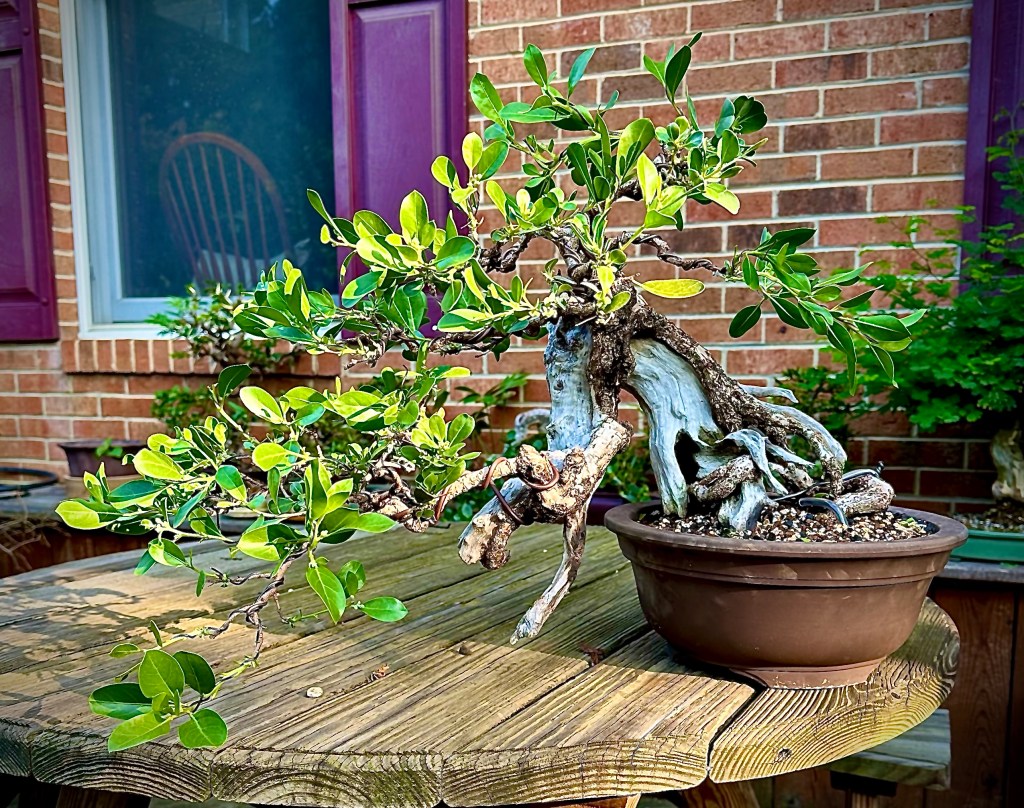
And now, the buttonwood.
It’s an impressive specimen.
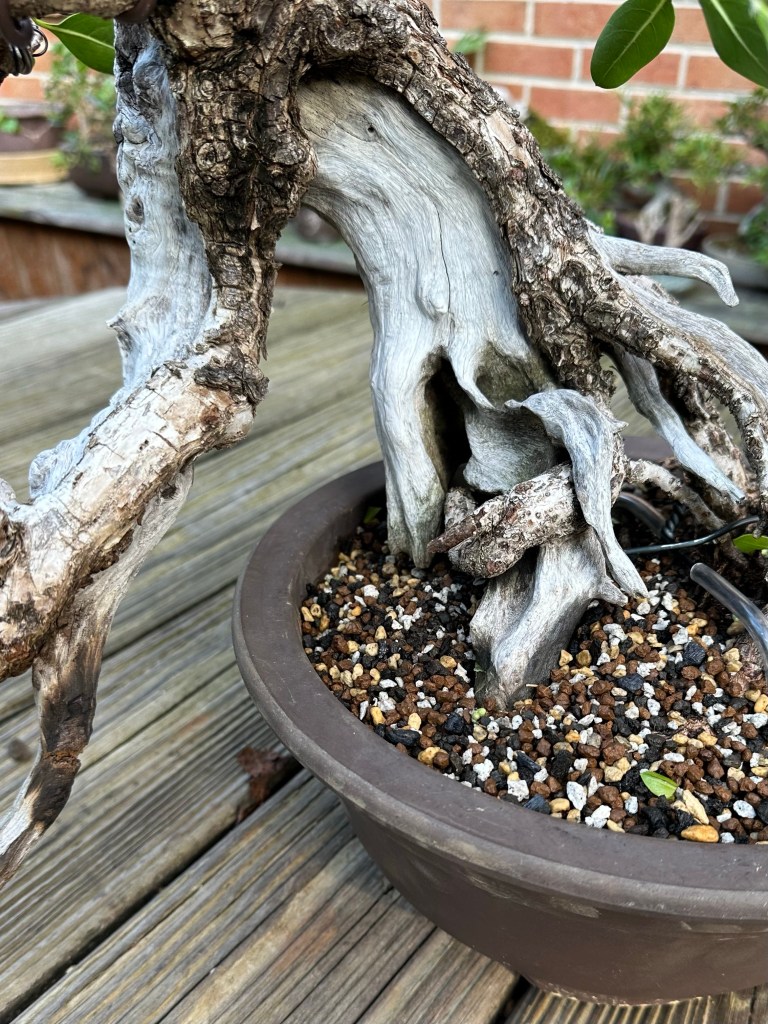
You can kinda see the burnt section where I tried to bend a straight piece of deadwood (middle of the below pic. It was ramrod straight).
View from above.
The constant reader is asking, “Why are there still leaves on it?”
Well, we are in The North, and the sun isn’t quite so strong as in La Florida, so, even though we are in full summer, I’m not comfortable totally defoliating a buttonwood up here.
And the main thing I don’t want to do is to kill this special tree. We really beat up the roots when the repot happened, and foliage is what grows new roots, so I left the foliage. Simple calculus, as they say in the movies.
And the tree was collected by Mary. Here’s the last pic I got of her before she passed away (that’s her daughter Terri, behind her).
Mary was such a force in bonsai, it’s hard to believe she’s gone. I truly miss her. There won’t ever be a woman in bonsai like her again.
And it was an honor working her tree with LeAnn. Thank you!
One last tip, and I learned it from Mary. Since we beat up the roots so much, I advised LeAnn to set the pot in a tray of water. One deep enough to cover the drainage hole. This will help the tree to grow new roots. Contrary to what I’ve said before about air being important for root growth on other trees.
A buttonwood lives in the coastal saturated zone, where mangroves grow, by the ocean, and are used to water. In fact, to make a cutting root, the easiest way is the old fashioned “Put the cutting in water” method. Oftentimes (don’t tell anyone) when we collect buttonwood, it’s really just a big cutting, with no roots at all, and we place the tree into the pot, and, as LeAnn is doing, place that pot into a tub of water.
One can, as many often do in bonsai, point out the unscientific practices of bonsai people. I do it often. But I have a saying I use religiously, and it applies to bonsai practice distinctly:
“Horticulture is a science, but the practice of horticulture is an Art”
I’ll leave you with that to mull over. Quote it to your best friend and your most divisive foe. It’ll separate the wheat from the chaff, real quick.
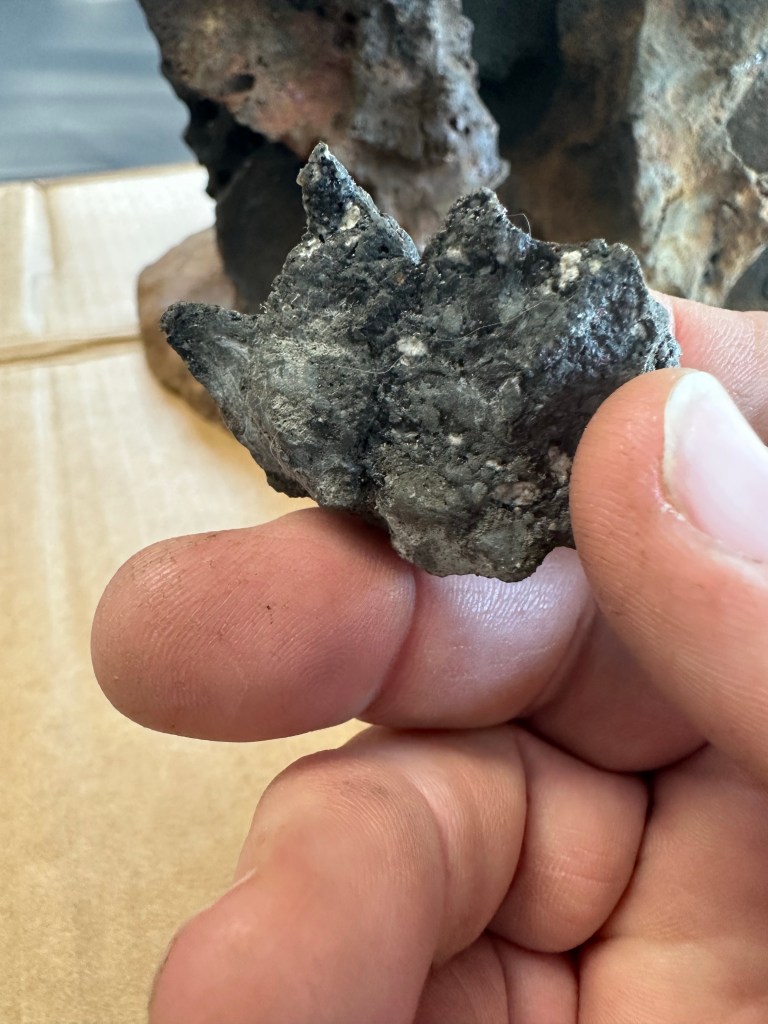
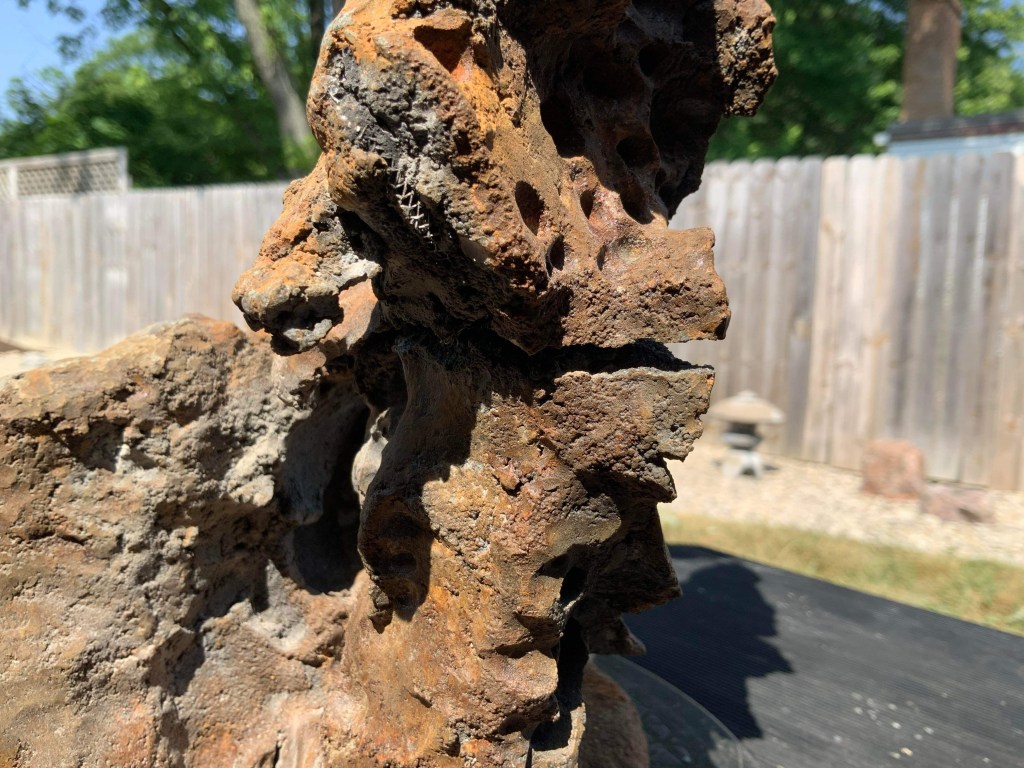
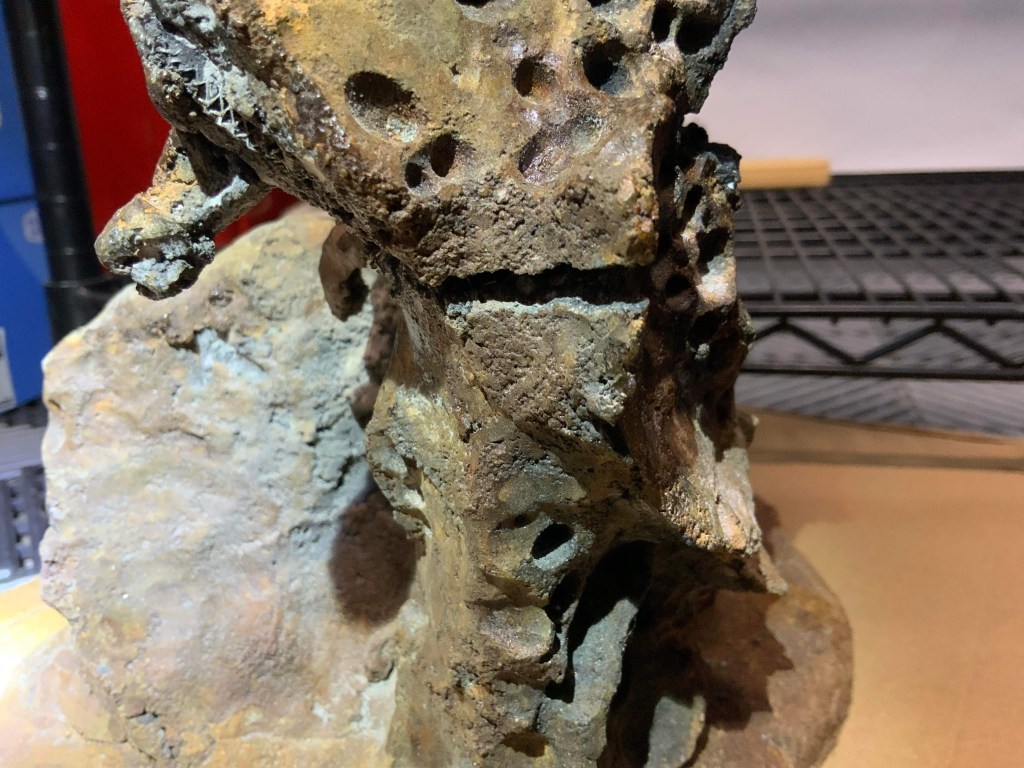
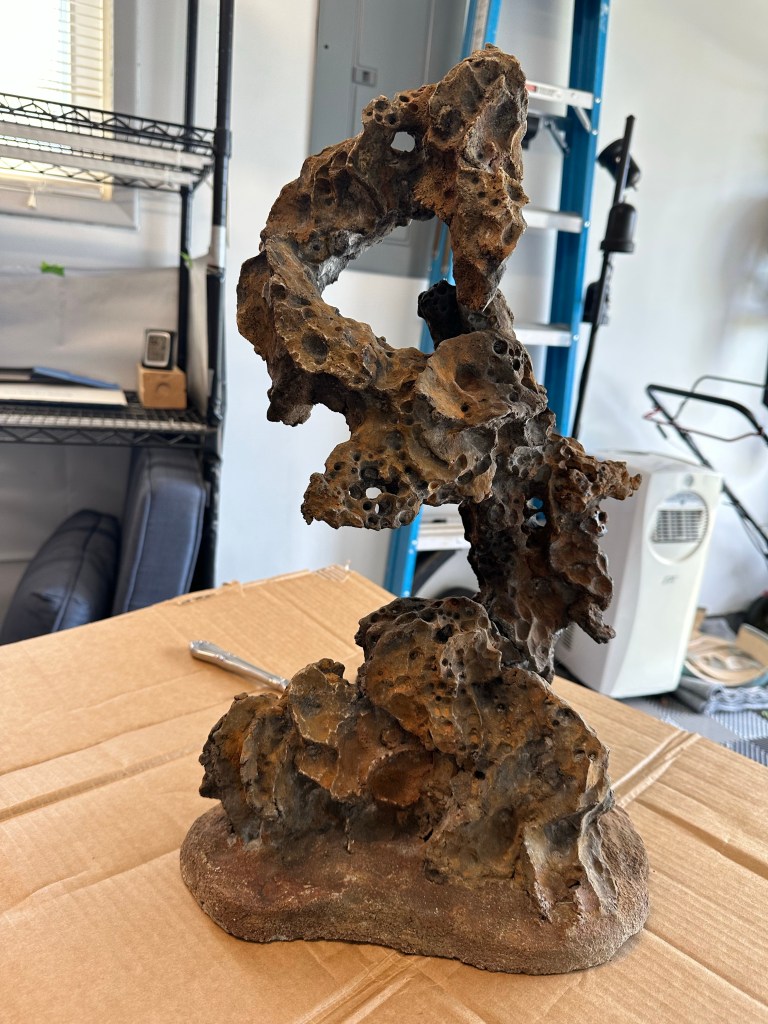
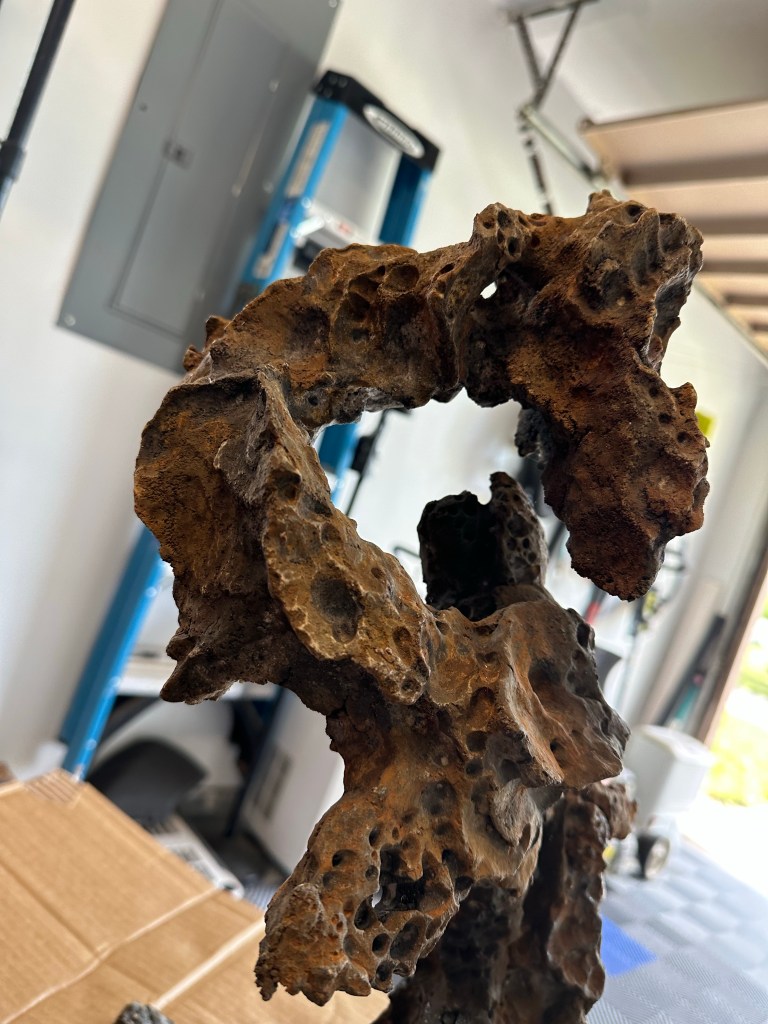
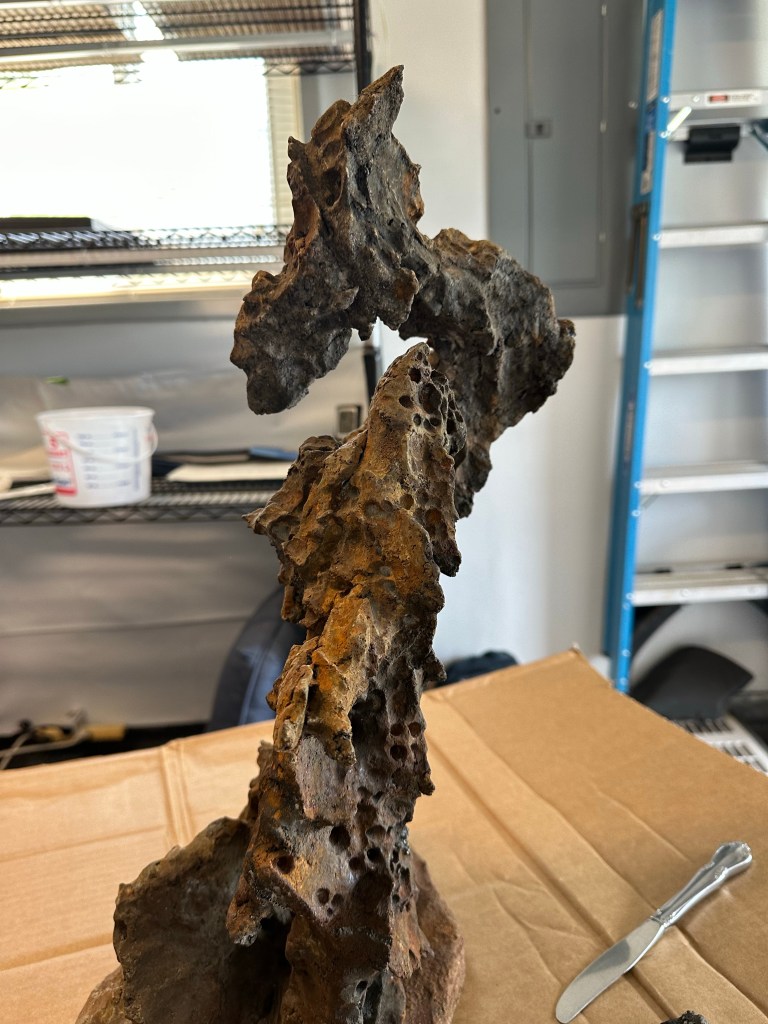
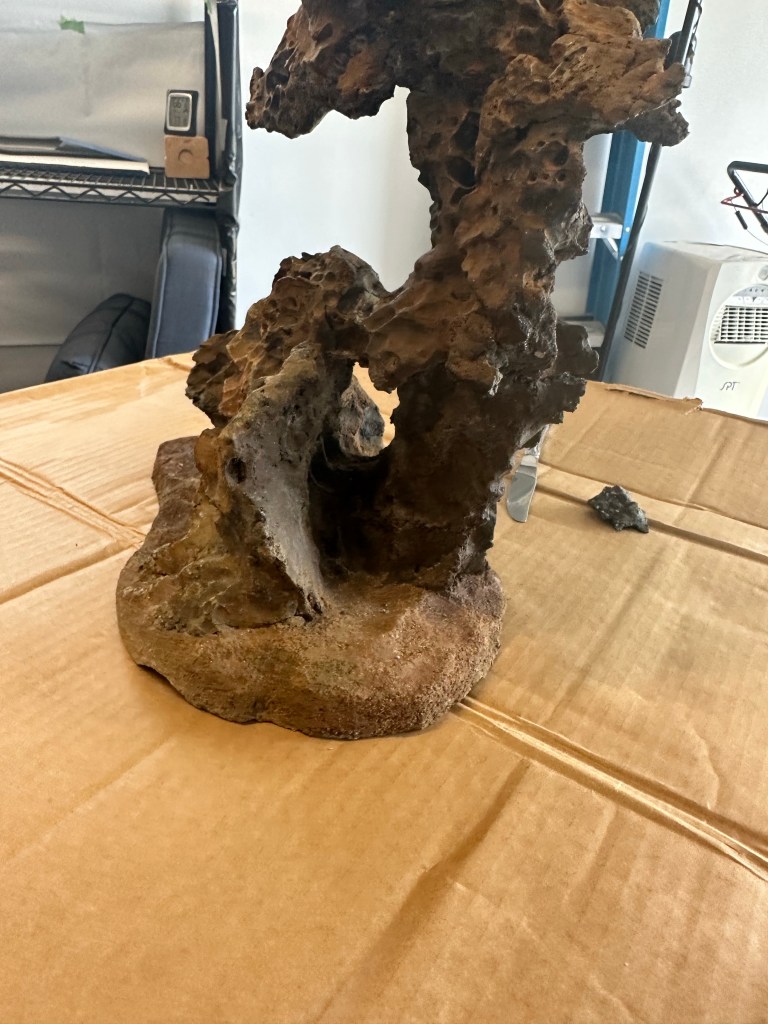
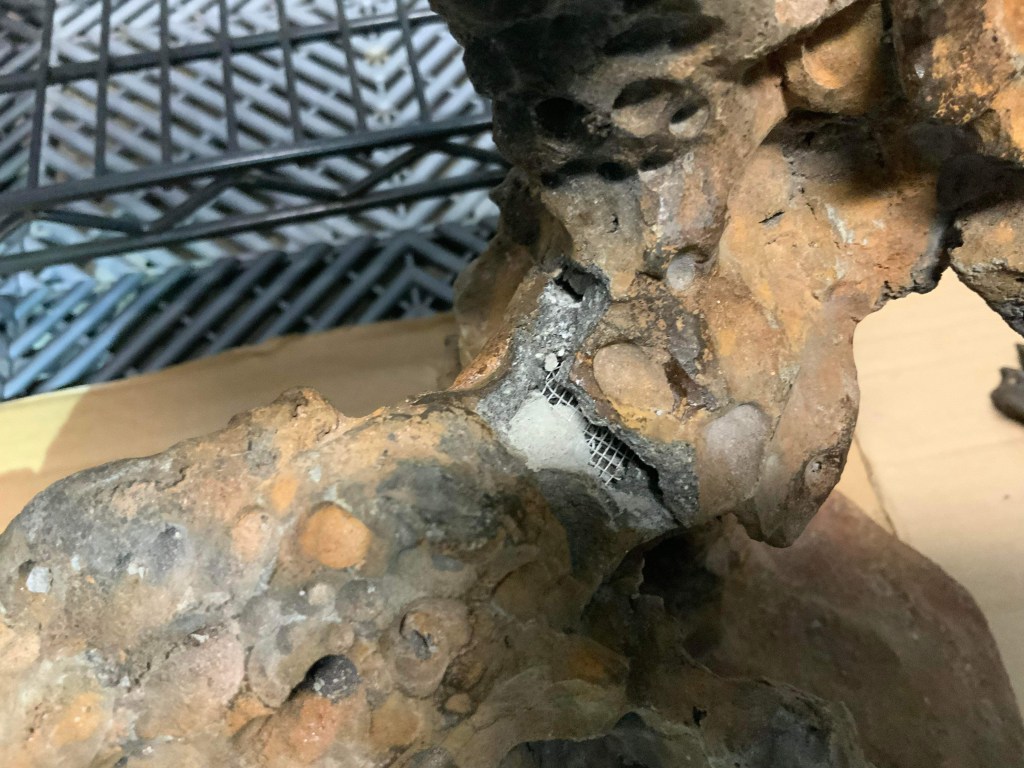
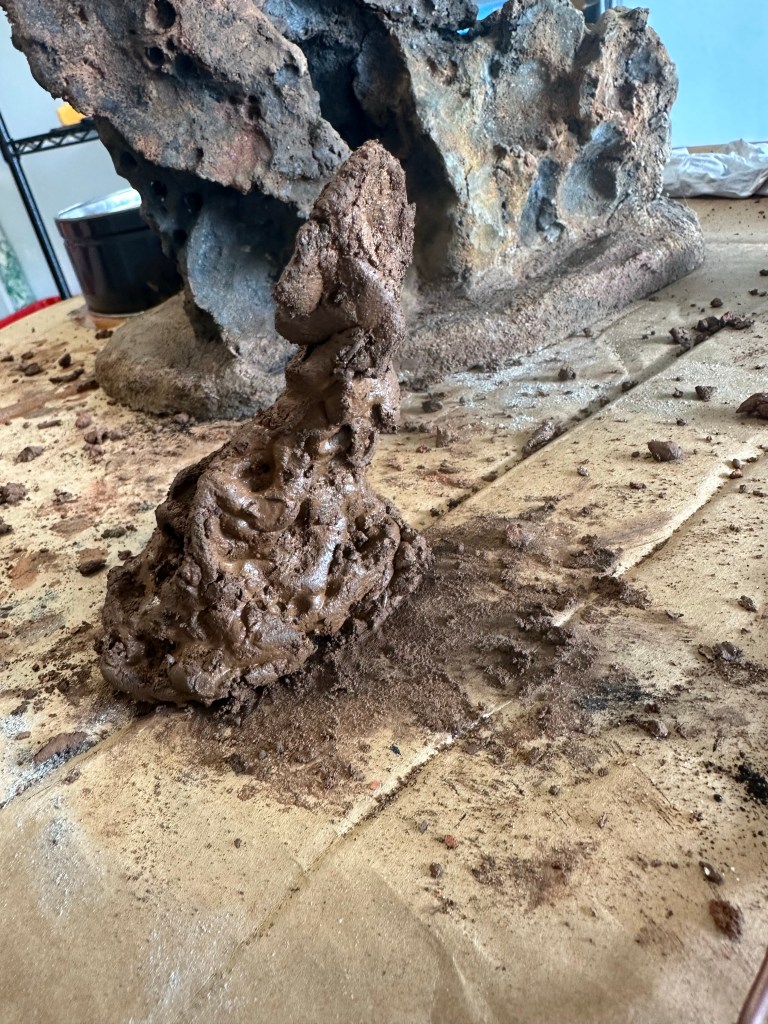
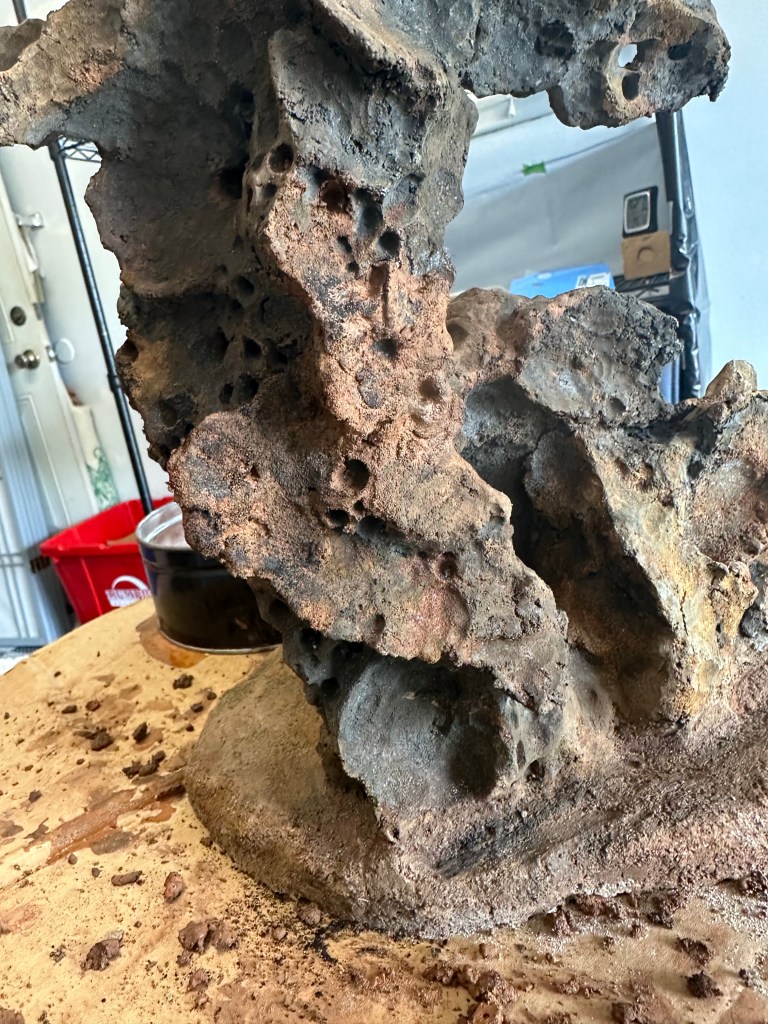
Now that’s a chunk of a block of a rock or something. Actually, it’s concrete, a manmade rock. But it’s “done broke” as they say…
It looks like a reptiles beak, below.
The story begins with a text, including some pics and videos, from Cincinnati.
The text was from Brendan. Say “Hi!” Brendan:
That’s him, my wife and me.
He got this “stone” from Poland, believe it or not. From a guy named Jacek Motyl. He makes rocks. Amazing rocks. Click on his name.
Anyway, Brendan ordered this stone and Jacek shipped it to him. In transit, it got “done broke”.
I’m not blaming the packing job. Jacek packed the rock well. I’m not blaming the Polish post office. Nor the USA postal service.
Let’s blame providence. The rock breaking gave me an opportunity to try something I’ve never done before. Sorry Brendan. Yes, this is my first attempt. I shall try my best sir.
The type of rock is technically called “tateishi”, or standing stone, used in a root over rock style called, in many modern spellings, “ishisuki”. When I was growing up in bonsai, we spelled it “ishitsuki”. Yeah, ishitsuki, I shit you not….but the modern spelling helps us to pronounce it correctly. The “T” and the “S” make a singular sound in Japanese. Kinda like an “tssss” sound.
Anyway, that’s my joke about root over rock style. It’s better in person, with the hand gestures and all.
Watch the video below to see how bad the break is.
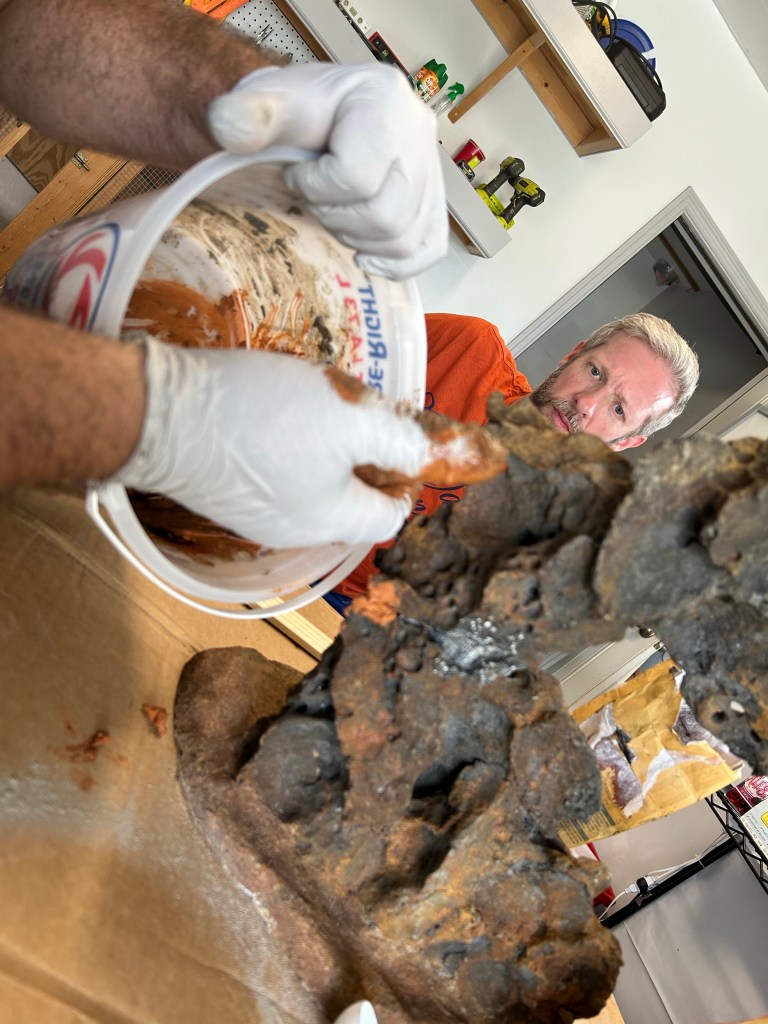
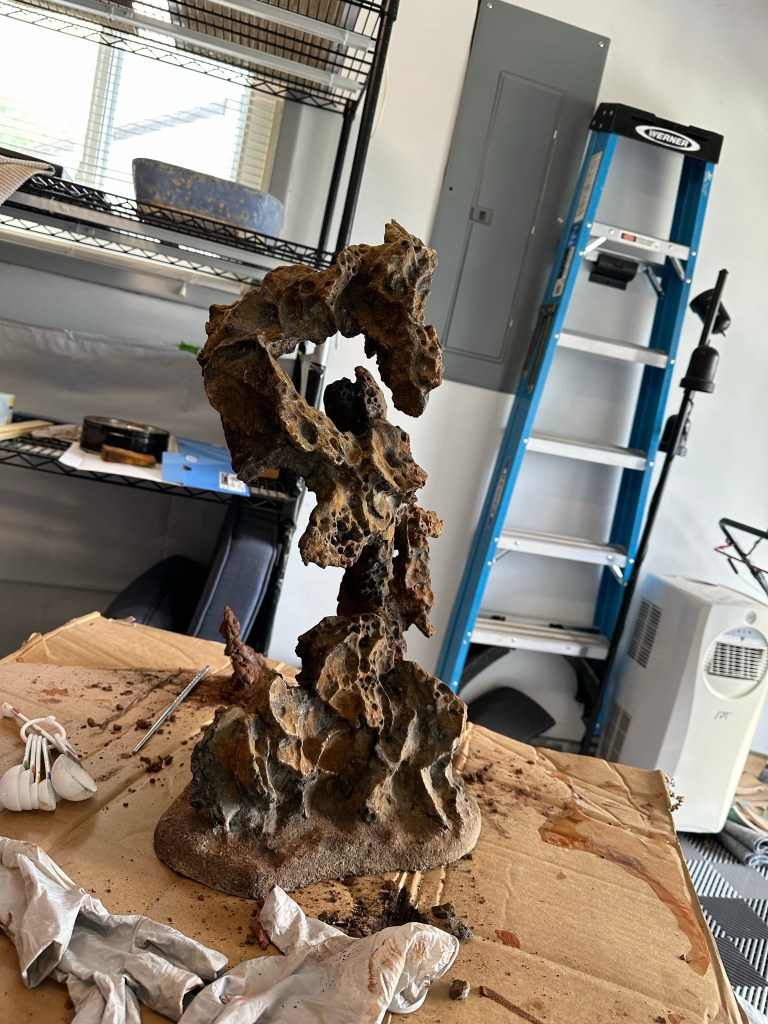
Not to give away secrets, but the shape was created by taking screen or hardware cloth and making the basic shape.
Then the screen is built up with cement. And colored, shaped, sculpted, aged, etc.
Pretty cool right?
My job is to fix the break and match the colors and texture. So I first had Brendan try to find Ciment Fondue. I had remembered reading about the stuff reading in the old books and magazines when I first started in bonsai (books and magazines are these amazing learning tools that one held in one’s hands, printed on paper. You would flip pages and read and the knowledge was amazing. I could tell you about encyclopedias but you’d zone out quickly).
Brendan couldn’t find Ciment fondue. Searching on google, I found it. What is it?
CIMENT FONDU® is a hydraulic binder with an alumina content of approximately 40%. Composed mainly of calcium aluminate.
It’s a brand name, only available in Europe, so I told him to find something similar. And he did.
Refractory mortar.
Why something similar? So it expands and contracts in similar ways to heat and cold cycles as the original sculpture. And refractory cement is waterproof. An important thing up north, as water freezes in the cold, and can explode our rock. That might sound spectacular. But that’s not conducive to stable bonsai plantings.
There’s something soothing playing with cement.
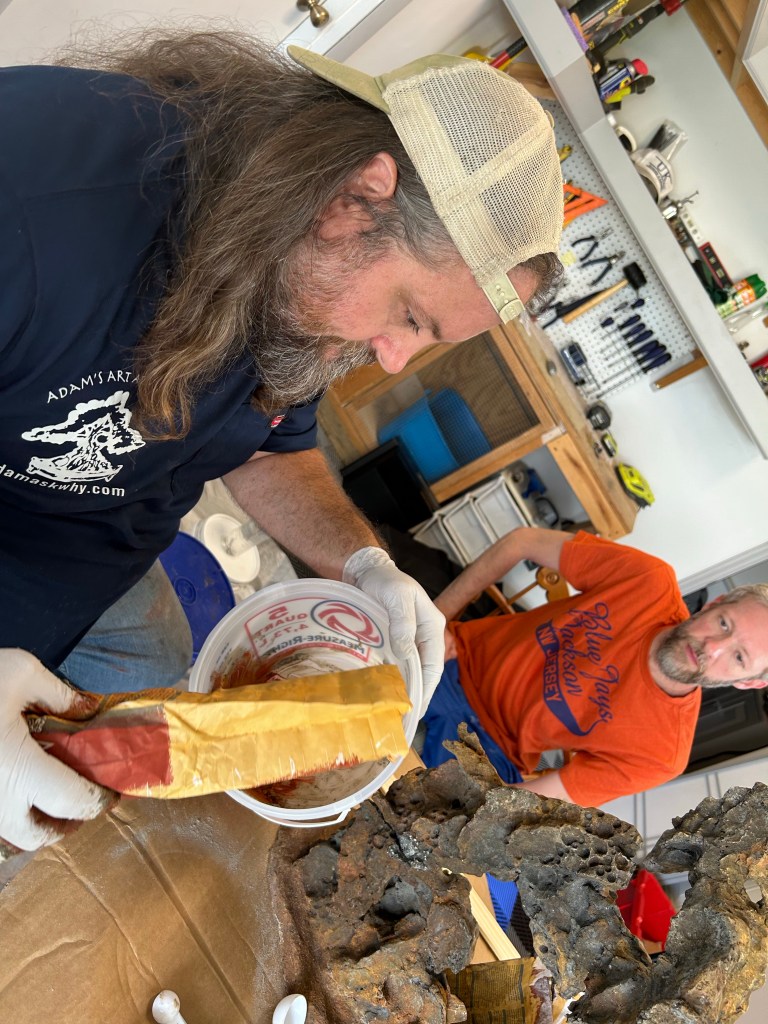
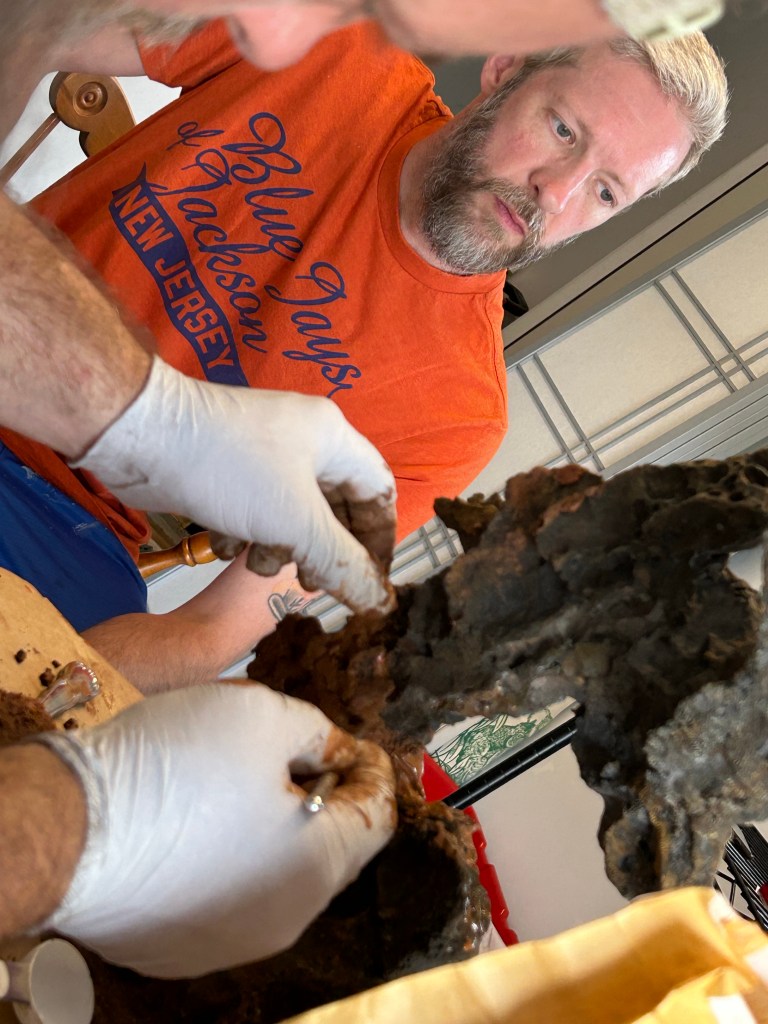
Measure out a portion….
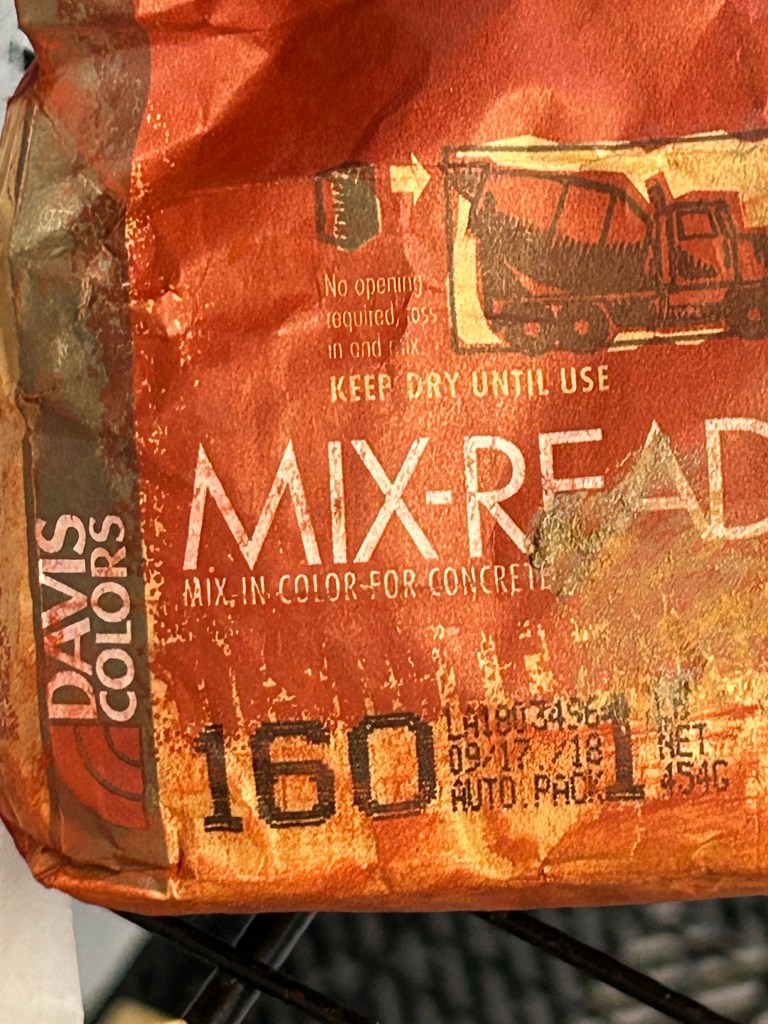
Add color (we had red, tan, called buff, and black. I eyeballed it).
And a trick, don’t mix it fully. You want variations.
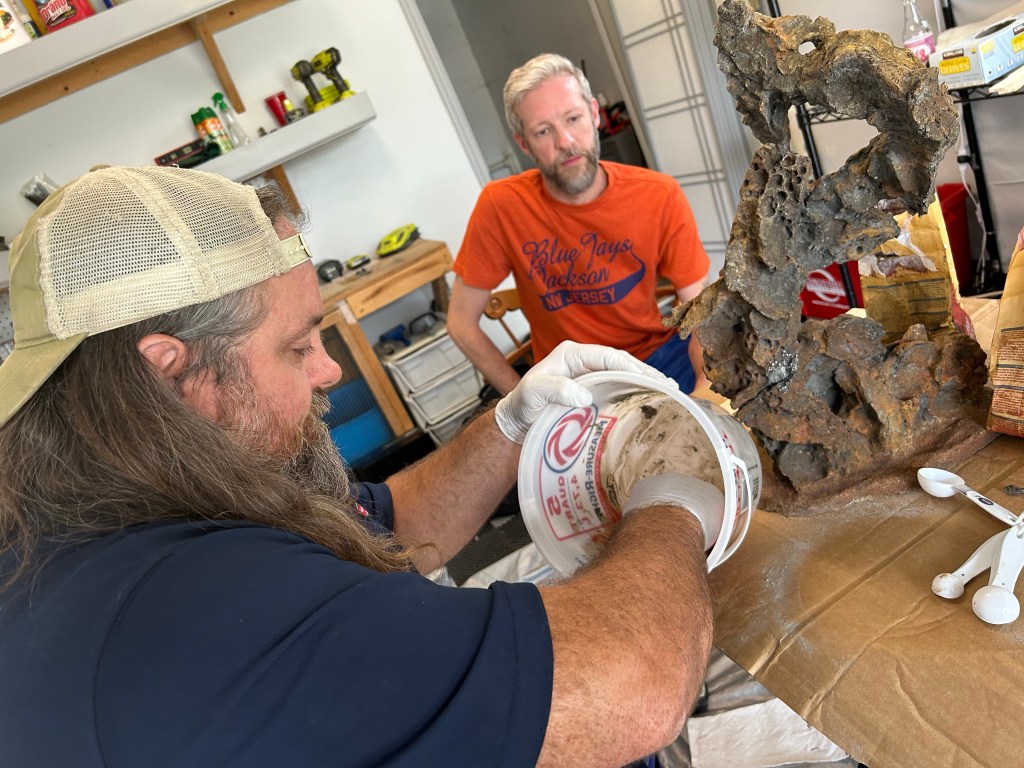
Add water.
And move fast.
Brendan was watching me closely.
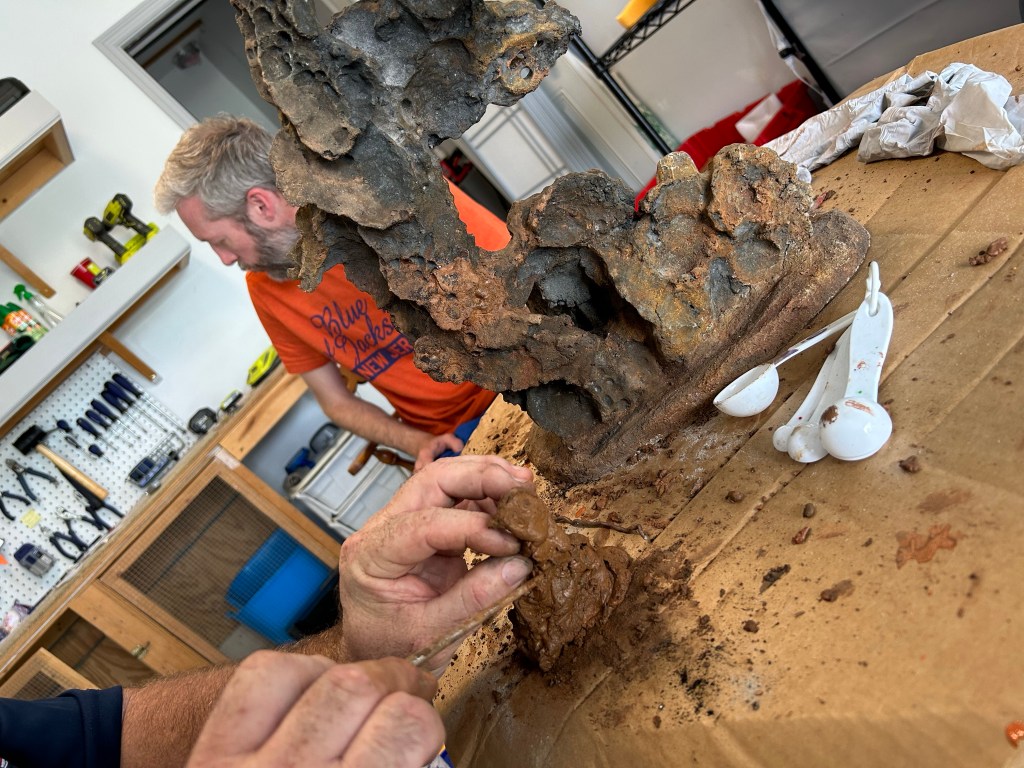
I smeared it, chopsticked it, blotted it. It’s a feeling thing.
I made sure to push the material into the cracks to ensure the repair of the rock, and not just make an aesthetic facade.
And with the leftover cement, I played around a little.
Yeah, I know what it looks like.
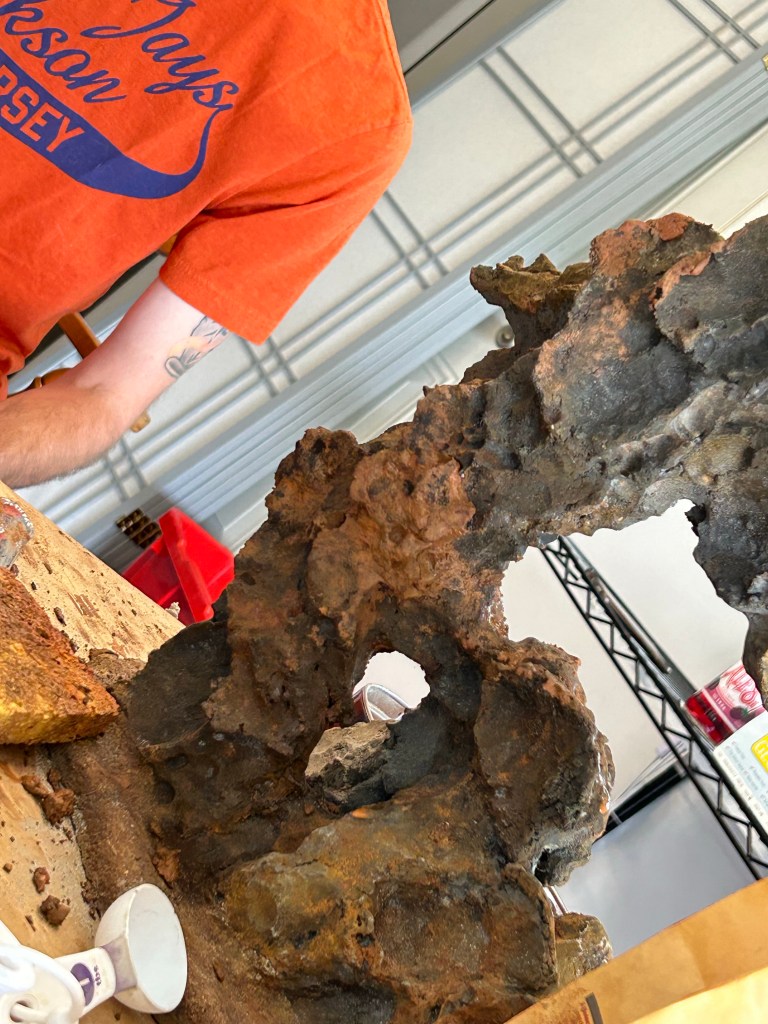
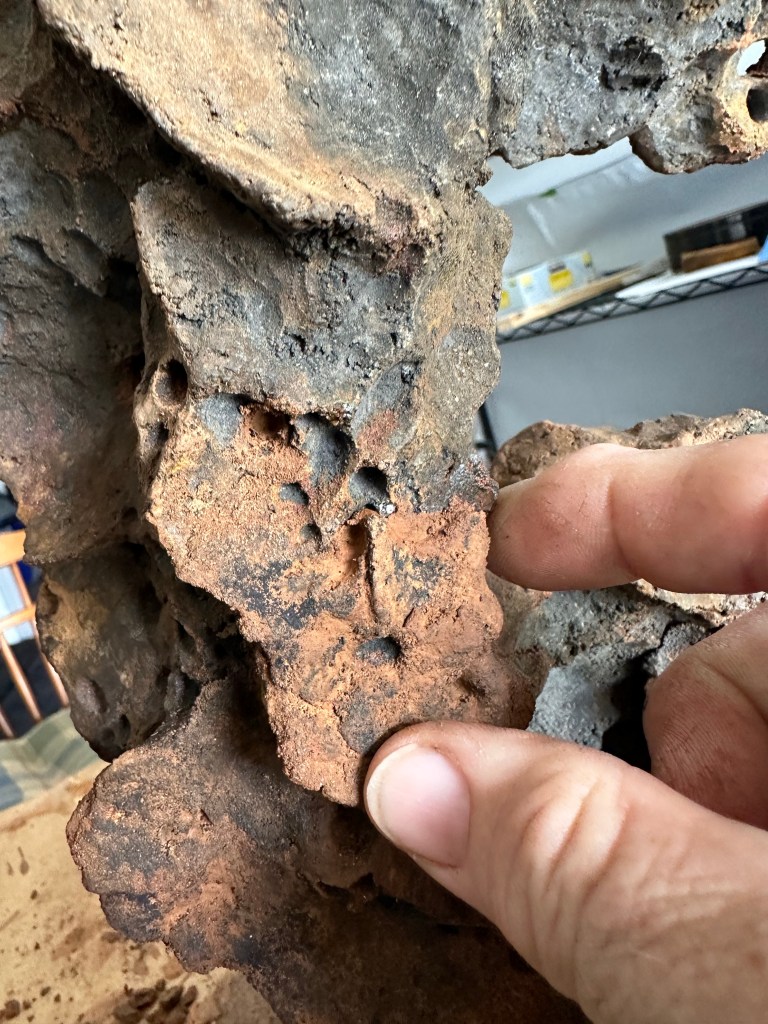
After the repair dried, I think it looks good.
I matched the texture and color. But most importantly, it’s solid.
I wouldn’t drop it, but it’s one piece again.
Below, is where I cemented that chunk back into place:
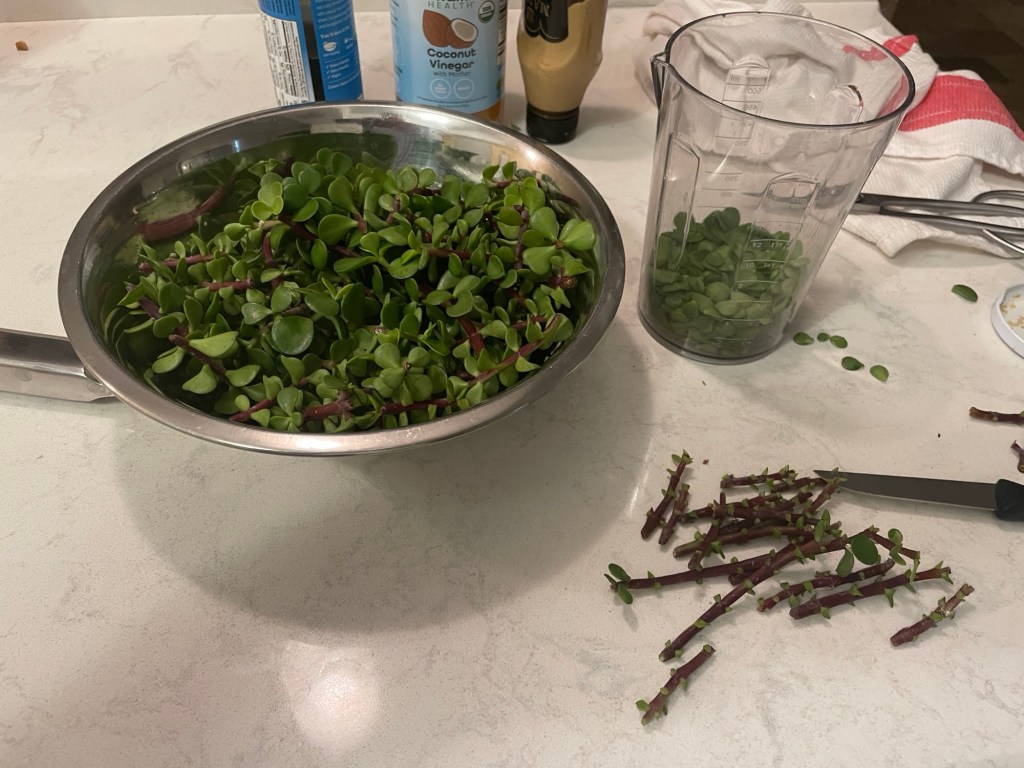
Consider the Portulacaria afra, what many call dwarf jade, or port, for short. In South Africa, where the tree is native to, it’s called “spekboom” which literally means “pork bush”. Interesting name…..
We know that it’s a favorite food of elephants (one common name is elephant bush) and rhinos. Goats love it too. What about us? Is it edible? More importantly, is it eatable? How does it taste?
My kids used to call it “apple tree” because to me (yes I tasted it. I’m a curious SOB), it tastes like a Granny Smith apple.
Here is an article I published in 2012 containing everything you ever wanted to know about Portulacaria afra. In it I talk about the habitat, the grazing practices of elephants, how a dwarf jade photosynthesizes and of course, all of the off topic rabbit holes I go down, the intemperate thoughts on life, the universe, and everything. I’m still even a little more upbeat in my writing, as I had not lived through the several long dark tea times of the soul I’ve experienced yet.
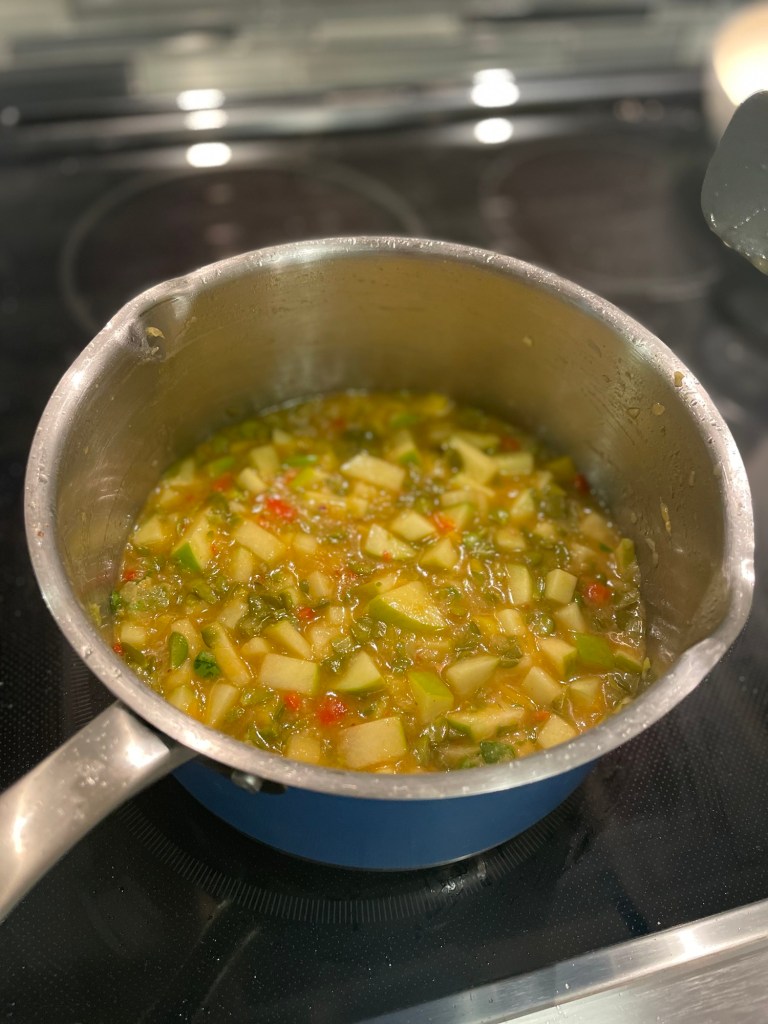
Any who (the who is Wil) I’ve been challenging my student (the aforementioned Wil) to come up with a dwarf jade chutney, like they make in the finer eating establishments (and farmhouses spattered around the wilderness) of South Africa.
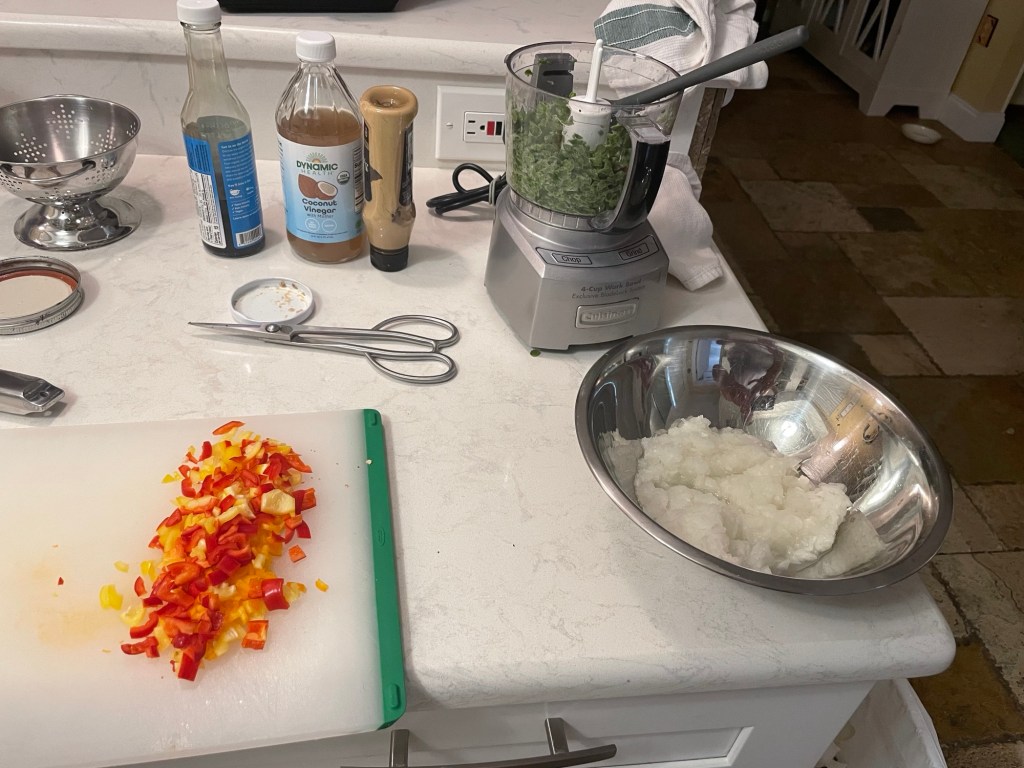
Finally, he did. First, he had to grow, harvest, and process some leaves.
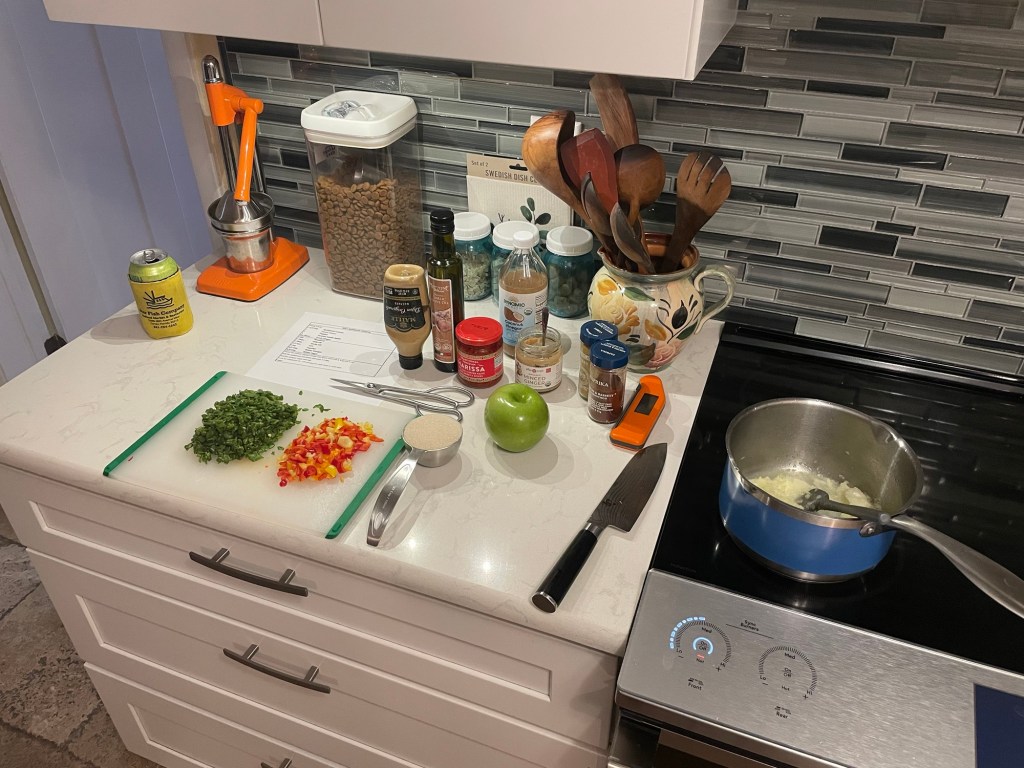
The recipe:
He had to make some changes to the ingredients as there are some products ubiquitous to South Africa that we just don’t have. Here’s the original recipe:
I mean, what’s up with a ml? And then a cm? You’d have to work at NASA to be able to convert from metric to whatever we call our units of measurements.
And what is “B-Well chilli oil? Is it chili oil or some other crazy thing called chilli oil? And who is getting well by guzzling oil? Oryx dessert salt? Is that salt from the desert but with an extra “s” or is it sweet salt?
Wil is a better chef than I. He knows when the garlic goes into the dish. And how much abuse it can take to survive the fire. Wil is the Man! And not in that negative connotated way, like “Down with the Man!” But like “Yo! Dude, you da’Man!”, though I do think he was a member of the CIA (not that one, but the Culinary institute of America).
Chopping and sorting.
Mis en place in…ah, place.
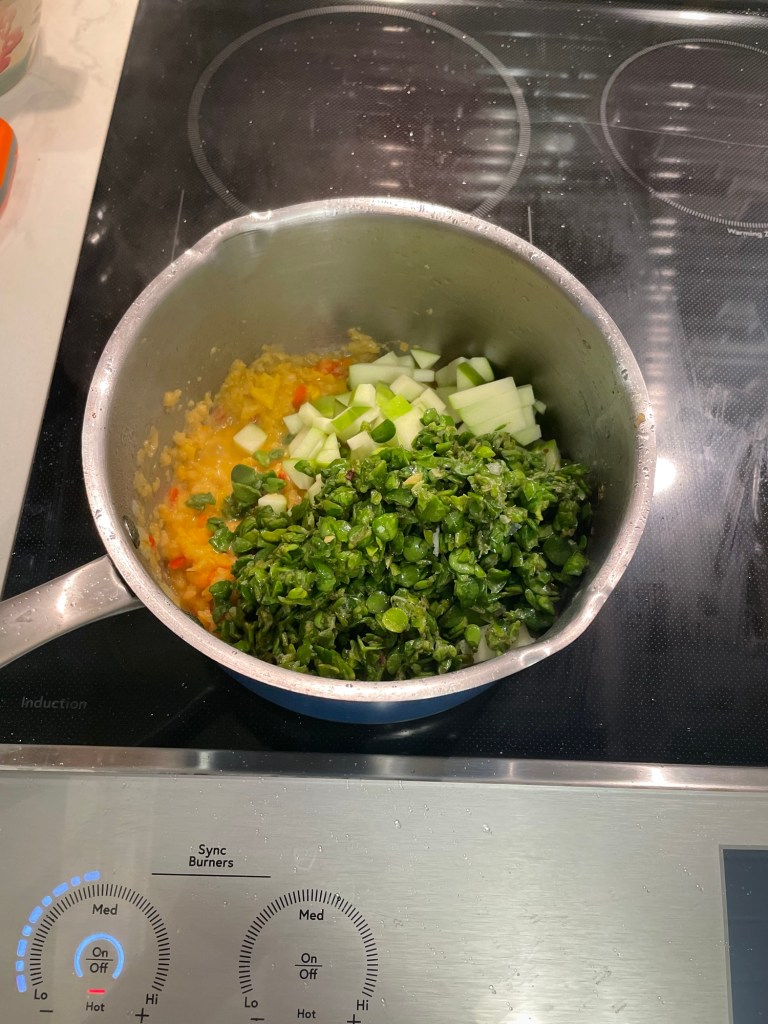
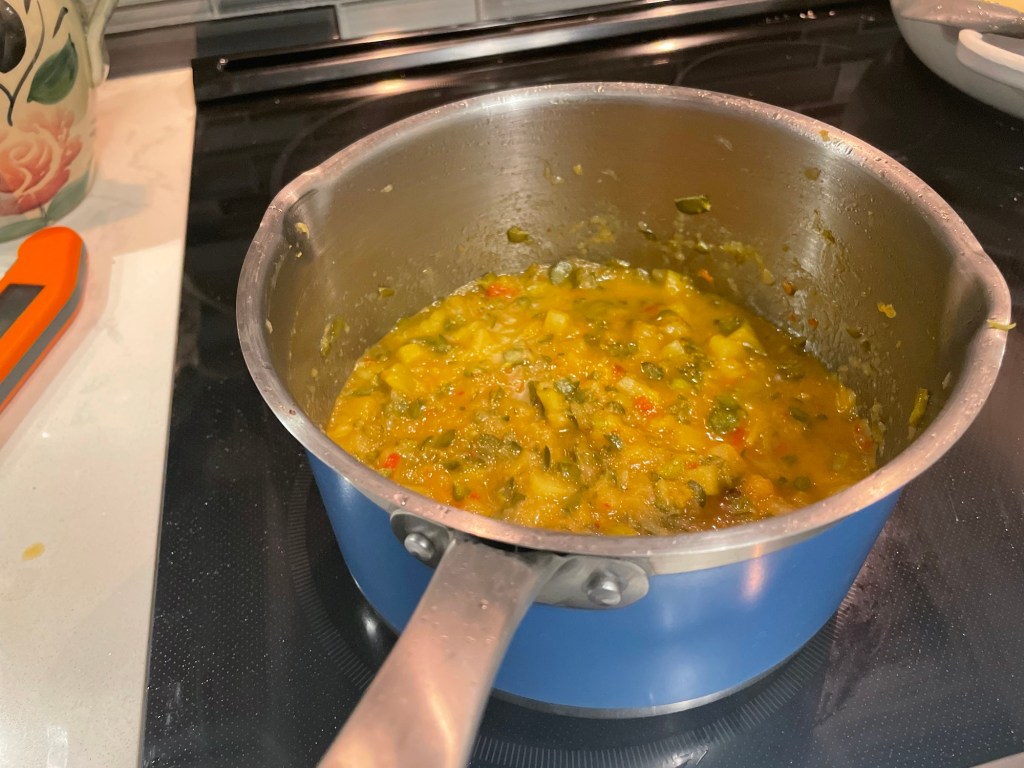
And so it begins!
I can smell it!
He kept sending me these pics as he was cooking.
It would be several days before I got to taste it.
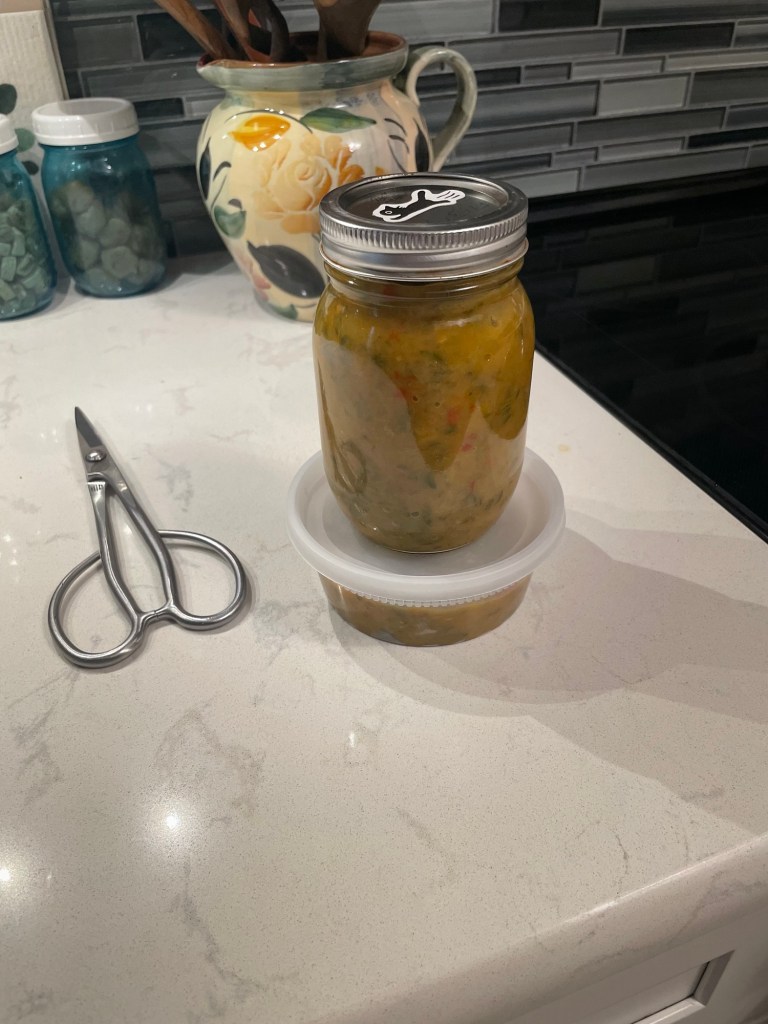
He even made it fancy with a pussy cat sticker.
And he managed to get that pair of scissors in almost every shot.
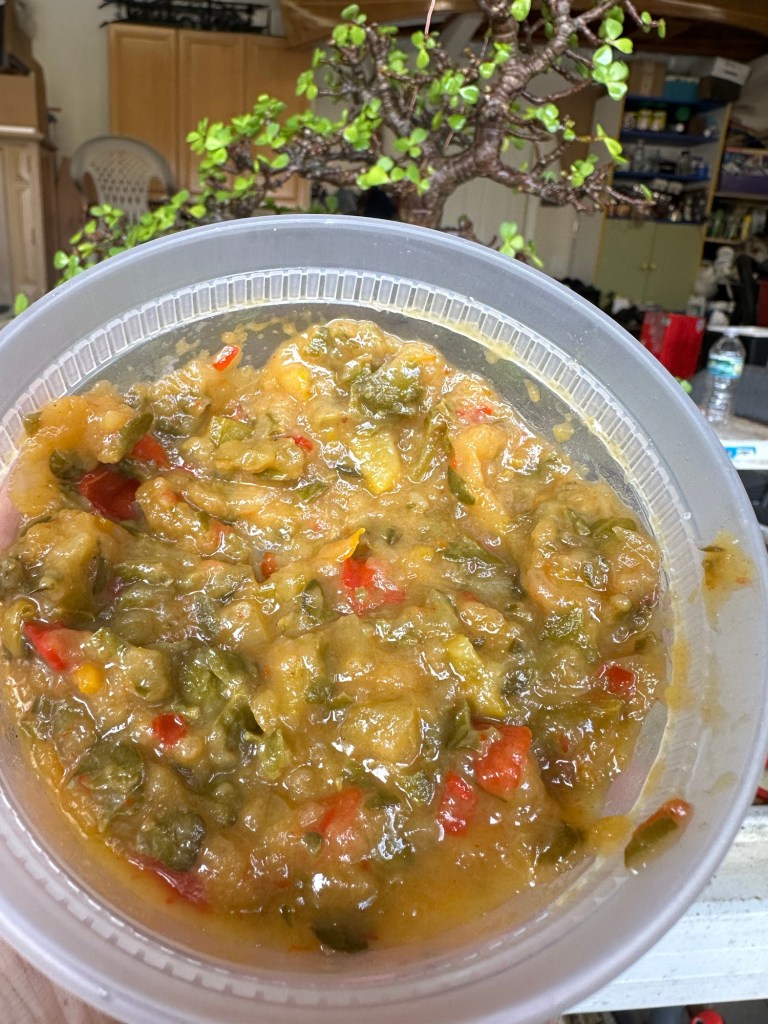
Is it good? He’ll yeah. I’ve had it on pork chops, on bread, crackers….
It’s especially good on hot dogs.
Hhhmmmmmnnnnnn……
To answer the question, “Is it edible?” Yes, and nutritious.
Is it eatable? Definitely. Sprinkle it on salads, pickle the stems, or make WIL’s SPEKBOOM CHUTNEY for your next backyard get-together.
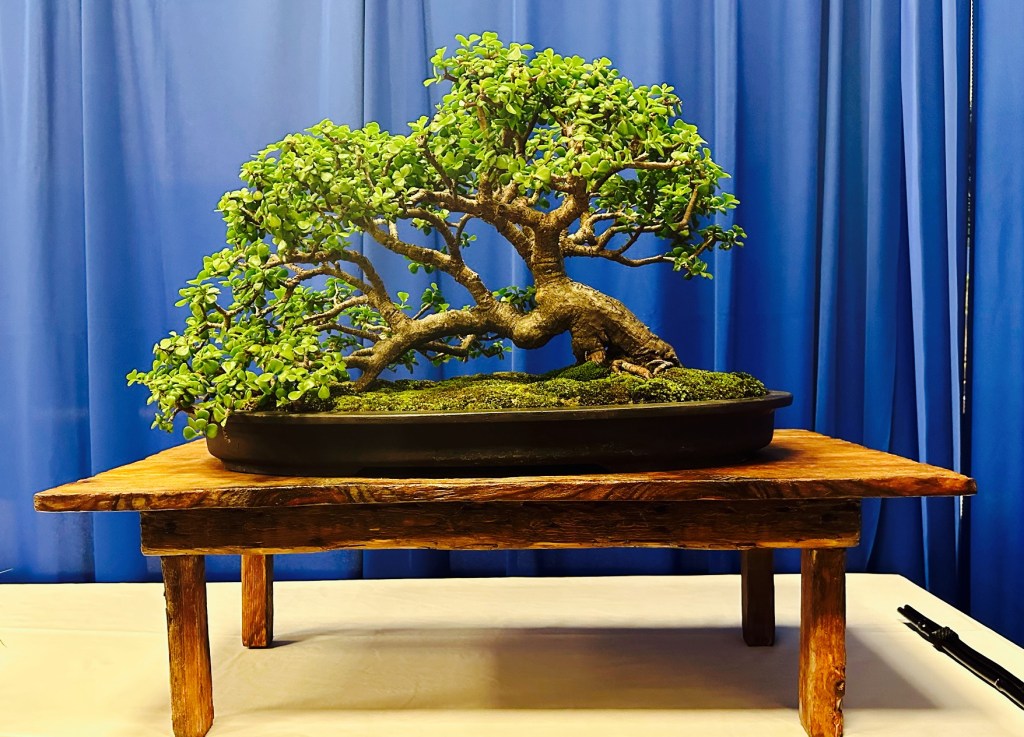
Below is Wil’s fantastic southern live oak style Portulacaria afra on display at the 2023 BSF Annual Convention in Orlando Fl.
Most of the pics are Wil’s, except for the first and last, and the food porn pics. Oh, and the screenshot. Don’t steal them.
The Shofu Bonsai Society of Sarasota has a pretty good auction every year. Granted, some years are better than others, but the year I got this one, maybe 2021, was spectacular. This tree was on the silent auction.
Yeah, not the live auction, the silent auction! I didn’t have to raise my hand or pull my earlobe to win this beauty. I just wrote a bid down on a piece of paper.
I don’t even think I went higher than $100 on it.
Since I’ve had it, it seems like only a few branches have grown.
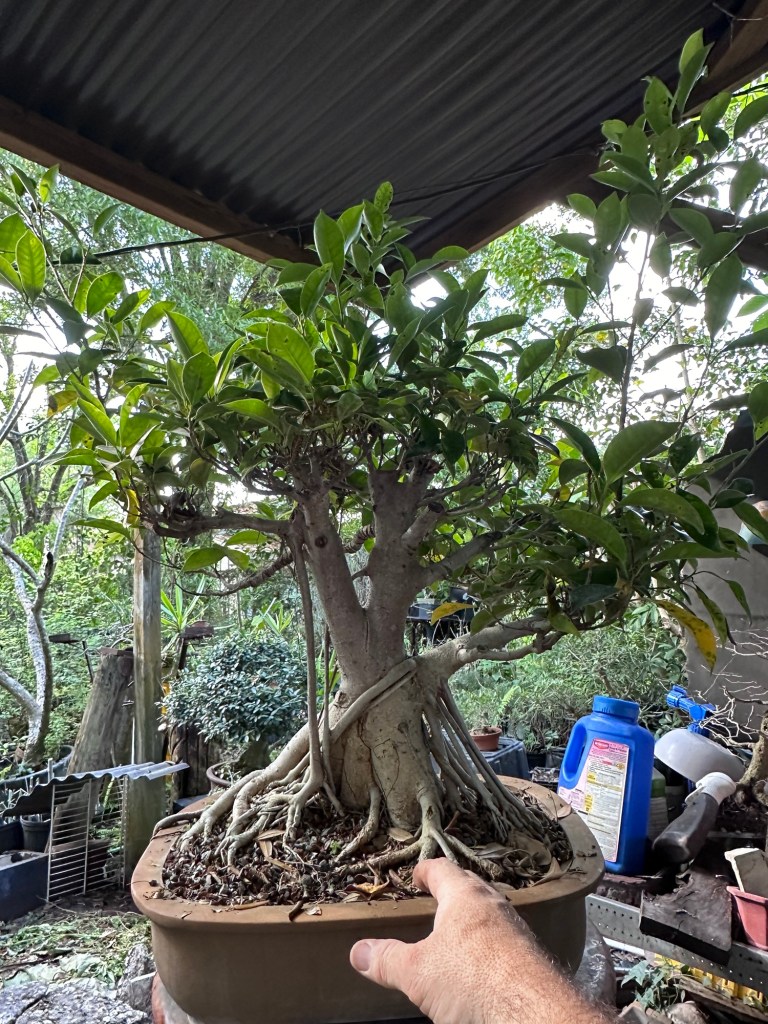
But that’s typical. I don’t do anything to it for those few years except to water it. And when you ignore this species, a Ficus microcarpa, it will pick one shoot on each branch to feed the sugars to, and, like the pic above, you get long spindly branches and the smaller, interior branches tend to die off.
The lack of sun is the impetus to tell the tree how to allocate the resources.
(Not to belabor a point, but that’s another reason for timely defoliation techniques on figs. Defoliate to let sun in, calm down the randy shoots and allow everyone to grow. )
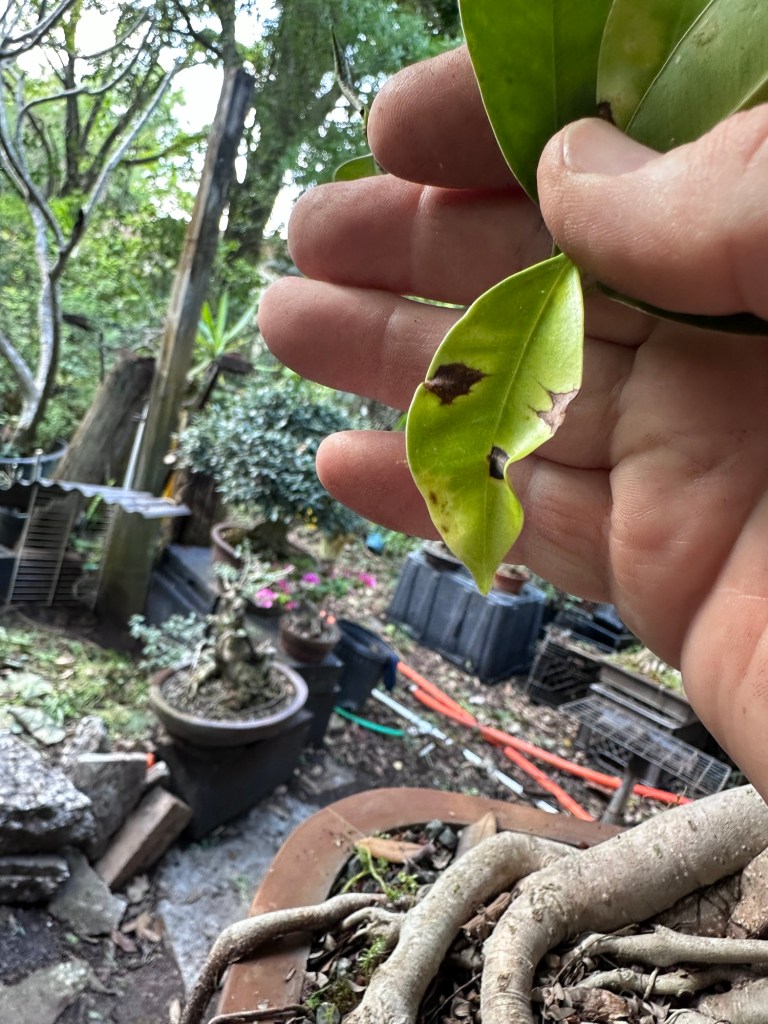
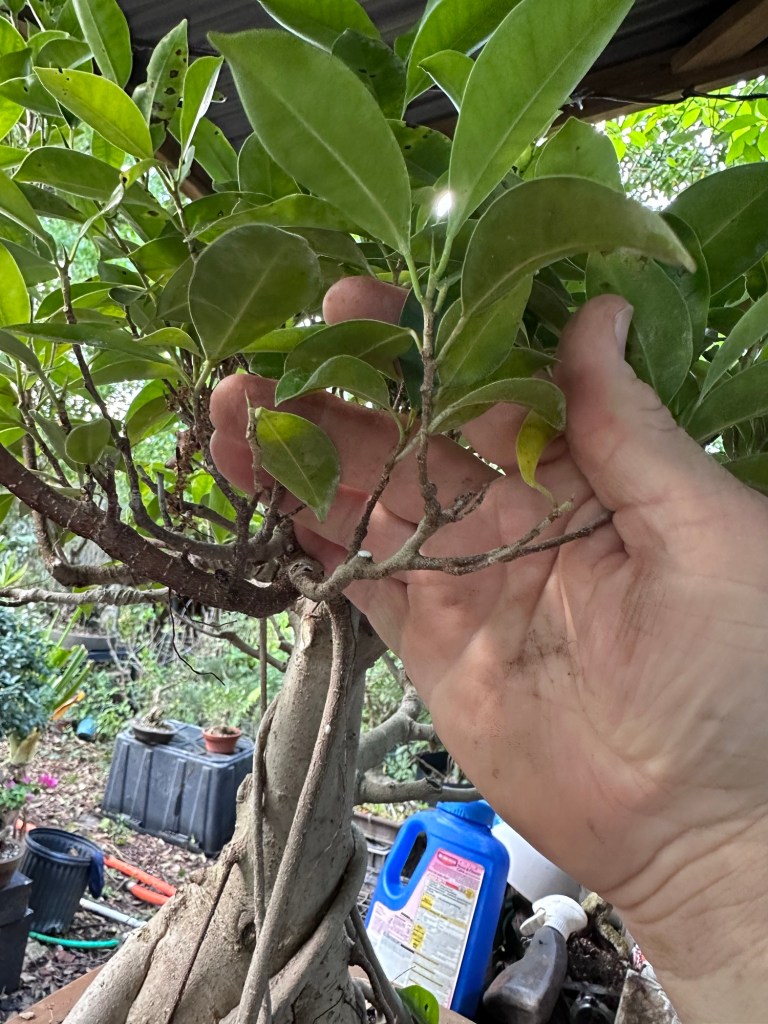
Oh! Notice the blue bottle? That is one thing I’ve kept up on for this tree. That bottle has a systemic insecticide in it called “imidacloprid”, which is a synthetic nicotine (what they call a neo-nicotinoid) that I treat all my F. microcarpa with to control thrips. An insidious insect that takes the leaf and folds it to make an incubation structure to breed more thrips.
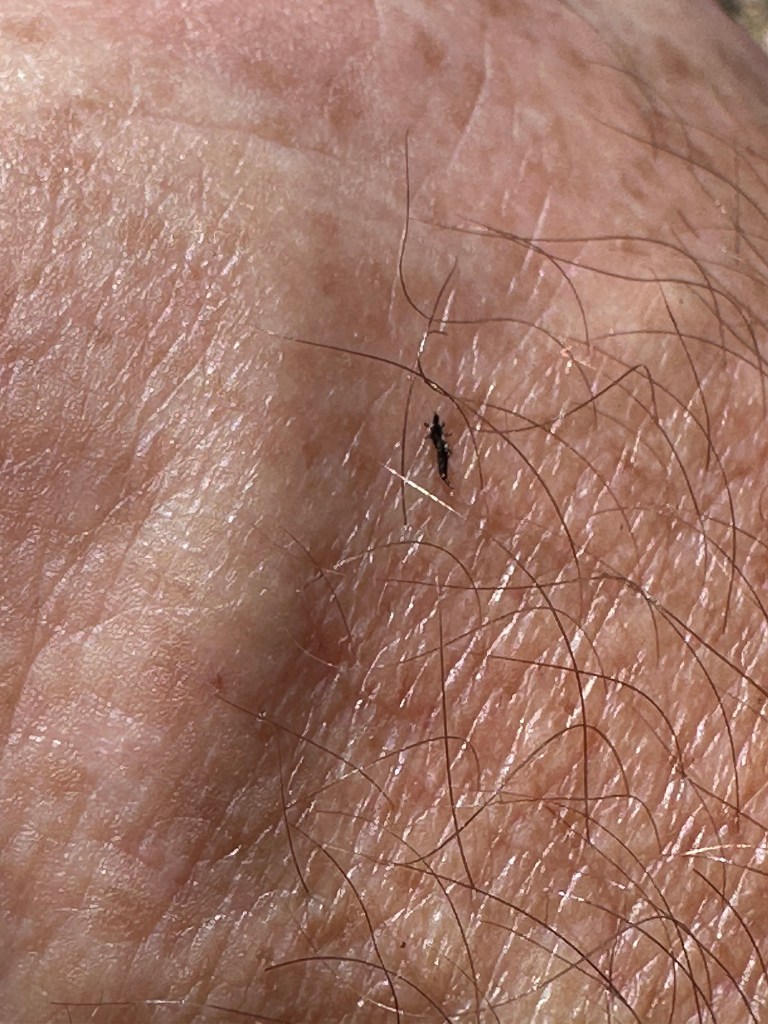
Below, there’s one on my arm. They call this one the “Cuban Laurel Thrip”, as that’s one of the common names for this ficus, Cuban laurel. I call it the “Indian laurel” as it’s more indigenous to India than Cuba, though it is endemic in the island.
The tree does have flaws, like the wire scars below.
And, as a species, the leaves are bigger than say, the “tiger bark” variety. And they are prone to branch dieback (like the Ficus benjamina) if you don’t leave strong growth on the tips when you prune.
Let’s open it up and select some branches.
Hmmmmmm….might be useful. Below?
Nah
Below, there’s that growth tip.
I’ll leave it to grow longer.
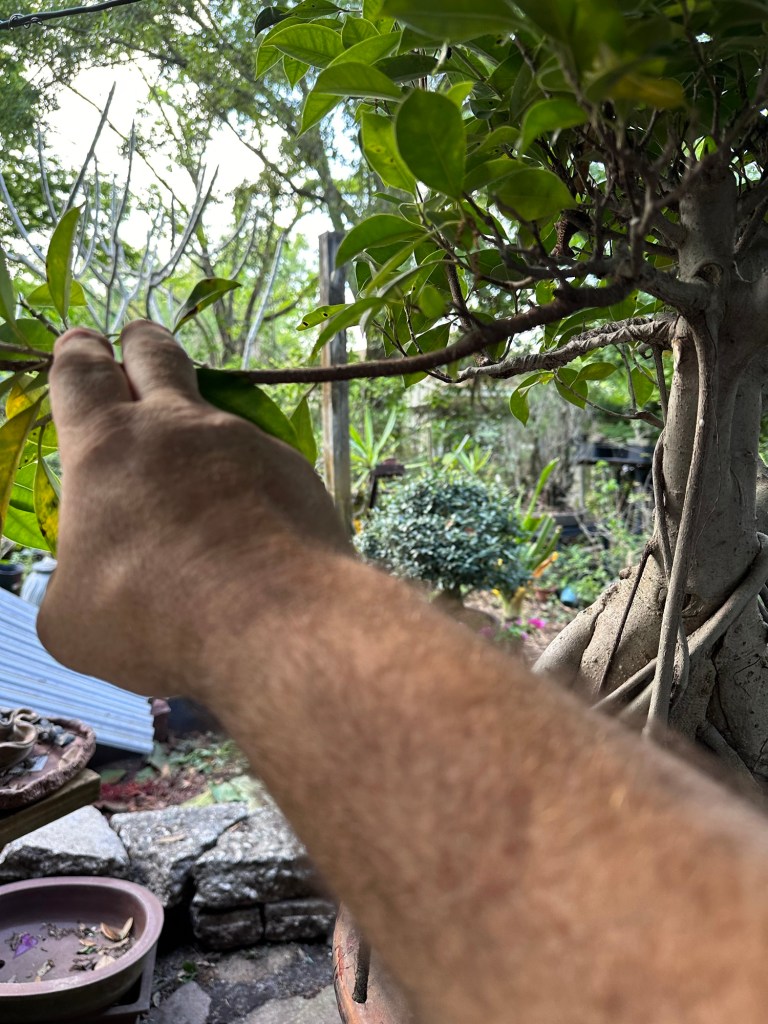
But some I’ll cut back to encourage back budding.
Clean up, clean up….everybody do your share.
Kah-chop!
There we go.
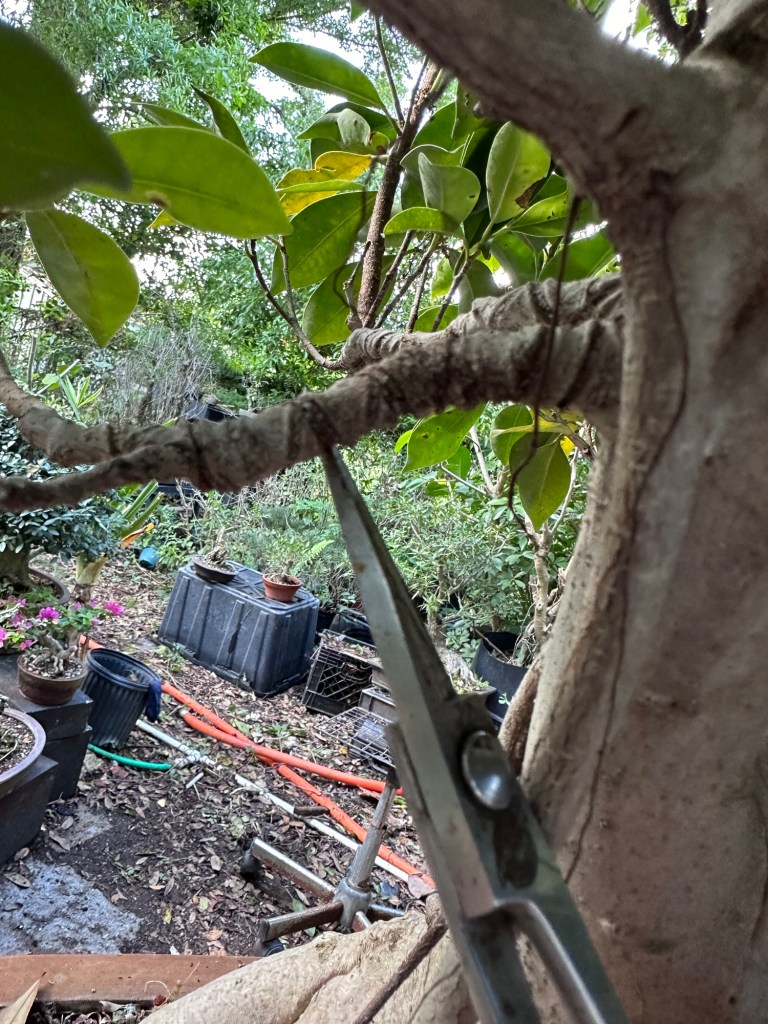
Some wire.
The result of clip and grow. Good movement.
More grow tips to preserve.
Now just let it grow.
But not willy nilly growth, directed growth.
If you ever take a class with me, and I say let it grow, you should let the things left, to grow, but get rid of growth that’s not needed.
Here’s a video
And here’s an idea of what it’ll look like. Needs a better pot.
Let’s see what happens, I promise to show the repot and updates
This work was from February or March of this year, 2024. It took me that long to figure out where the comma goes in the title. And which words to capitalize. Not really but an excuse is an excuse.
So, with that said, here you go, a little late is all…
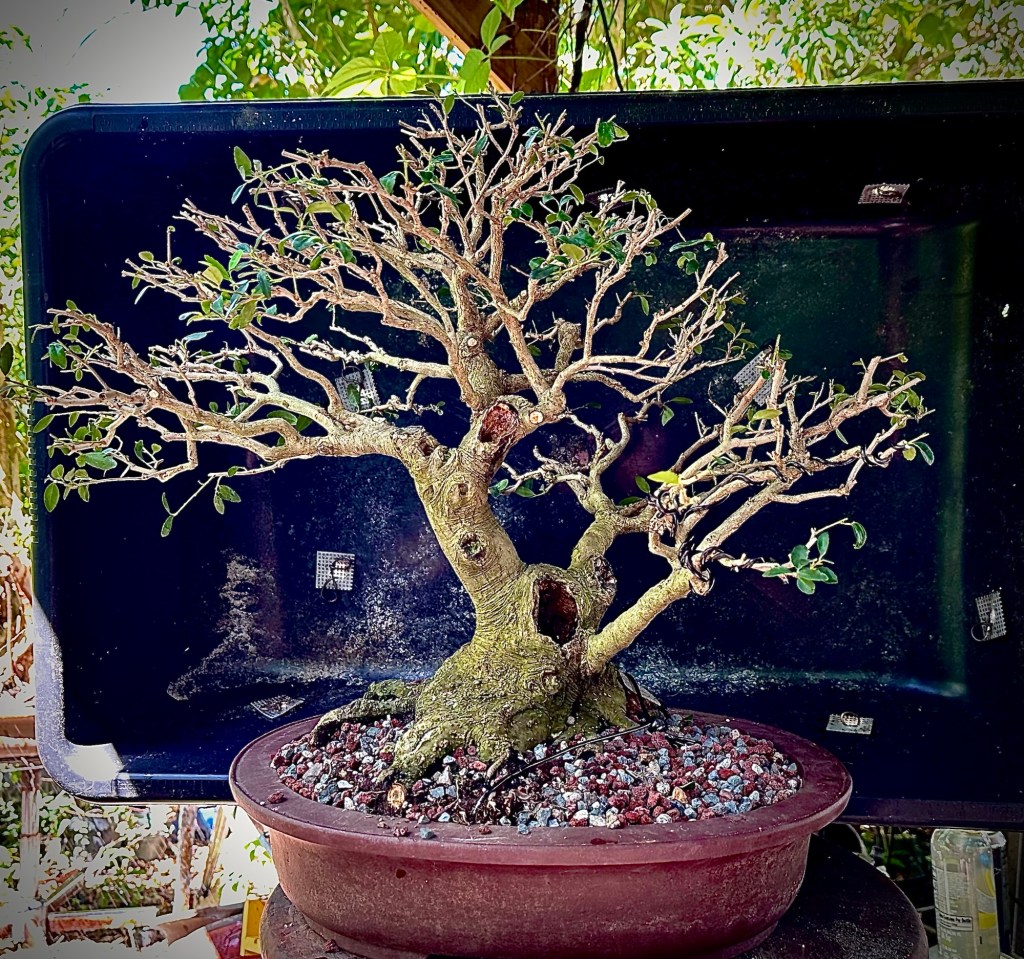
An Ilex vomitoria “schillings”. From my student, Sharon. She grows them in her landscape and has some impressive bonsai specimens as well.
But this one came from a Bonsai Societies of Florida convention workshop from several years ago. I’m not sure why she took the class, but she did, and I get to work on it. The yaupon holly is one of my favorite species and this one is fat and chunky.
I believe the trees for the workshop were collected somewhere in Brevard county. By the Bonsai SOB’s.
I know, bad joke. But clever. The Bonsai Society Of Brevard: Bonsai SOB’s.
One of the clubs that’s seat to my heart and I consider it a home away from home (I belong to the Central Florida Bonsai Club in Orlando).
For clarification purposes, Sharon lives in the Tampa/St. Pete area of Florida. Opposite coast from Brevard.
My Job, which I did late winter early spring (for y’all confused peoples out there) is to prune, style, and repot this old tree into this classic oval-shaped bonsai pot.
Damn what a sweet trunk. Like an ancient oak tree out of a story, maybe a Robin Hood and Maid Marion fairytale, enjoying a late spring, early evening stroll amongst the fireflies and sweet blooms of Nottingham Forest.
And that hollow, or, as they call it in some Japanese bonsai nurseries, an “uro”. Roll the “r” in the Japanese way.
Let’s get into it. Those concave cutters are ready, looks like.
Snip!
There are a lot of branches, which is good, more to choose from. The craft of bonsai is knowing the most amount of branches to remove from your tree and still survive. The art of bonsai is knowing what to keep so your tree still looks like a tree.
Craft, knowing the whens and hows to cut. Art, knowing the whys and becauses.
Early spring (in Florida that’s mid-February) the tree begins to push new growth. Below, that new growth has begun to harden off.
Now’s a good time to get some cutting in.
This’ll be quick, so pay attention.
Sharon has been selectively pruning for movement, as you see below.
And if I had the druthers, I’d make some warriors roasted yaupon tea with all the leaves on the ground.
There we go. Lookin’ good.
A mind puzzle for ya’ll:
I have a farm. There’s a drought, but I have a deep well.
It’s drying up, but there’s still water left to live off of to water the crops and for the animals and my family.
Maybe enough until the rainy season.
Maybe. My house, where I live, catches fire. Do I let the house burn down or do I use up my water to put out the fire.
For the smarty pants, those two options are your only choices.
What should I do?
Now that’s a root ball!
The tree is old in this pot and well established. Ilex like good drainage and this depth pot is well suited for it. But aesthetically, the art part, it’s not.
That’s a question, why do we use shallow pots when, horticulturally, a deeper pot is better.
Not many know. I’ll ask this question during demos and I’d get answers like: it helps to dwarf the tree, or, it slows the growth. The only reason is it makes the trunk look bigger.
Bigger trunks look older. And that’s what the Art of Bonsai is: making a little, young tree, look like a big and old tree.
In fact, most of all the craft of bonsai, and the soil components and composition, are there to serve the art.
Take the roots. We know that the roots are responsible for most of the water absorption and nutrient uptake. They’re also the main storage facilities for excess sugars for those lean times a tree has to endure. The only reason we use expensive aggregate as soil is to increase drainage when we put our trees into shallow containers. Bonsai soil is not magical, and it’s not really suited for deep containers, as it dries out too fast (there’s a lot to say about that, but those posts have already been written. Start at this post: Akadama, the Ideal Bonsai Soil and follow the related posts at the bottom), but it works for bonsai containers.
For this tree, and its roots, it’s been prepped for a more shallow container, but there are still a few roots to get rid of.
I’m not worried too much about chopping those big roots (they hold the sugar remember) because the species grows fast and makes tons of sugars. So just leaving the feeder roots (the small ones) is good enough for the health of the tree. Knowing that (to continue the theme) is the craft. You have to learn the craft just as much as the art part.
The tree is healthy enough to handle this rough treatment.
And I know how to sharpen my scissors, so I don’t want to hear anything about using my good scissors on the roots. But you shouldn’t. Do as I say, not as I do.
Here’s a crossing root. Kinda straight too.
Cut it off and that’s what’s below it. It’ll puff back out, but it was beginning to girdle the lower root.
And I might just need a shoe horn. Maybe I should advise American Bonsai tools to make one…….
And it fits! Bob’s yer uncle!
I’m still on the fence with that first branch on the right. I can’t bend it, so Sharon either lives with it, or we cut it off.
You read earlier that this tree lives in St. Petersburg FL. If you’ve been reading the news, you should know about the two hurricanes that have impacted the Gulf Coast of Florida. Sharon stayed for Helene, but she evacuated for Milton. I don’t have the heart to ask her how her trees have fared (her house and family are well).
This year has been trying, especially for those in the path of Helene; Florida, Georgia, Tennessee and especially North Carolina. I had very little damage, just a little debris. All I did was sweat a little cleaning it up. But there are people who’ve lost everything. The towns they live in are even gone.
All the loss of life is devastating. I have no words for it.
Well now, this tree is bigger than my head. Which is saying something, I got a big head. This is what they used to call, in the seasons of my youth, in bonsai, when I was green and learning the words of this , our Bonsai World, a Schefflera arboricola. Being that I also learned it in the southern latitudes of my country, they pronounced the last part, arbi’cola.
Now, they’ve changed it, and it’s just an unpronounceable and easy to forget name: “Heptapleurum”. Hepta- meaning seven, and pluerum-meaning side. Seven leaflets on each leaf. I feel sorry for the poor botanist, Johann Peter Ernst von Scheffler (born in 1739), who they named the genus for. He is an unknown man (in our time) but ever the hard worker I’m sure, who I can’t find hardly a biography on, but did something, either great or enduring, that made them name a whole genus of plants after; Schefflera.
I’m sorry but suddenly I’m feeling some existential pondering. Try to keep up….I’m a wandering ponderer, I’ll take lefts, rights, u-turns and switchbacks. Ready?
Can you think for just a moment about all the people who have ever lived, either important or unimportant lives, and their everyday existence, with families, friends, meals, whether they used chamber pots or outhouses or just pissed in the streets. Whether they ate with spoons (silver?) or just a knife, or a full place setting at the table. There are those that lived, struggled, and died never knowing the pleasure of biting into the juicy, sun drenched goodness of a red tomato with just a little salt, or a bowl of strawberries with fresh whipped cream. Or the caress of a lover, the slap of an enemy, or the warm embrace of a bed on a cold winters morning.
I know that’s hard to imagine, all the billions of joys and defeats, triumphs and pain. We can’t do it easily. It’s hard just to be aware of what’s happening across the street. Across the street, like my neighbor Bob, how he lost his wife from smoking induced emphysema, how he lives next to his mom and took her away for the last hurricane, Milton. His struggles with health, and pain. His life playing on the coasts of Florida, fishing and staying up all night on the beach, huddled around a bonfire, with his friends, drinking beer and smoking what used to be much more illegal, back in the 1960’s and ’70’s. His loves, and children, and his profession. He was a contractor. A builder of homes for so many others to live their lives in. Will anyone remember him? I’ll try.
How about just all the lives lived in the life of today’s tree. I’d say it’s close to 50 years old. Oh, don’t worry, you can’t really tell, it’s so bushy, but there’s a tree in there.
I got it from Dragon Tree nursery in Palm City FL. From a man who I’ll try to remember and remember to my students and fellow bonsai friends, Robert Pinder. Robert is, along with Ed Trout, one of the last gentlemen of Florida Bonsai left. That includes me. I grew up in a rough city in Massachusetts, called Brockton, as a feral child, born in 1975, out exploring the world on my own or with friends. I never learned to talk to people (my sisters tried to tame me, they mourn the failure every day). I try to be nice but I’m far from a gentleman.
I first styled the tree during one of the pandemic era meetings we had for the Central Florida Bonsai Club. We held it at my nursery, outside in the sunshine. Safe.
Here we go, halfway defoliated.
Robert sold this to me for less than I paid for my first automobile, a 1966 American Motors Rambler four-door sedan (no, not the hot rambler, it was a family car. Single barrel Holley carburetor, in-line six cylinder engine, four doors, army green. I bought it from an older lady who owned it new. I miss that car, but it became obsolete. No parts, worn out upholstery. And I’m just a poor itinerant bonsai traveler from the projects of Brockton Massachusetts. At the time I had no money to fix it, not that I could fix it now).
Now we can see what we have. There’s some wire on it. I’m thinking it’s been there since late 2020. Hmmmm….wire. Brings me back to my first Central Florida Bonsai Club meeting.
Here’s a cautionary tale. A famous (at the time) bonsai guy from Canada came down to tour the state and the club hired him to do a critique/help session.
It was my first meeting, and it was a cute couples first meeting too. They were waiting their turn, with a small schefflera held between them, like a child sitting up on the table. They looked so proud, bringing their tree in to get help from this “master”.
He was up at the front, and the tree was placed in front of him. He picked it up, holding it with his fingertips and turning it around, peering at the pot and the branches. Almost like he was examining a turd, trying to find a clean end to hold it.
He proclaims, in his best expository voice, projecting to the rear of the room,
“Well, we don’t have this in Canada, or we might, but we don’t consider them ‘bonsai'”
You could see the couple slowly deflate like those giant, blow up snowman holiday decoration on January 2nd when people start to take them down. The bonsai artist continues,
“I’m not sure you can even wire these, and I do believe that wire is necessary for bonsai…”
“In fact, I like to call these ‘Mutt Bonsai’, meaning they look like bonsai but really aren’t”
That poor couple took their tree and sat down, heads lowered and eyes averted. I never saw them again.
There’s no place in bonsai for that pomposity.
Anyway, I took all the wire off and now it’s time to prune again and rewire those branches that I’ve let grow. This is the growth tip.
In case you’re curious, when I begin a blog, and as I write it, I research. Here’s a snippet of the type of papers I read:
“Attachment of branches in Schefflera is unusual in that it involves fingerlike woody extensions that originate in the cortex and pass gradually into the woody cylinder of the parent shoot. We tested the hypothesis that these structures could be roots since Schefflera is a hemi-epiphyte with aerial roots. These branch traces originate by secondary development in the many leaf traces (LTs) of the multilacunar node together with associated accessory traces. In the primary condition, the LTs may be described as cortical bundles. Leaves are long persistent and can maintain a primary stem connection across a broad cylinder of secondary xylem. Under the stimulus of branch development, the LTs form a template for secondary vascular development. Because the LT system is broad, with many traces, the branch attachment is also broad. The fingerlike extensions are attached to the surface of the woody cylinder of the parent stem but are progressively obscured as a continuous cambium is formed. Bark tissues are included within the branch axil because of the extended cortical origin of the initial attachment. The results are discussed in the context of branch-trunk unions in tropical plants, an important component of canopy development.”
A what they call a “scholarly” publication, meaning that when you research a subject, put in whatever you’re looking for and add “scholarly” and you’ll get primary research papers, by real scientists doing real science work.
This one branch decided to grow the most of any branch. It’s fortuitous as the branch is in good proportion now, instead of a skinny shoot.
That’s what we want. You could say that the practice of bonsai is just: cut, wire, grow, unwire, cut again, rewire, let it grow. The one thing, considering all the aging techniques we have available to us, we can’t fake is the element of time, which is demonstrated by the concept we call “ramification”.
How do we get there? We cut the growth tips, which then causes back-budding, and a branch goes from one, to two, to four, to sixteen. In bonsai, those layers of ramification are called:
Primary, secondary, tertiary.
Cut, wire….
The debris after all that cutting. Thats a thirty gallon pot (what they call a “number 30” in metric system nations) easily halfway filled with schefflera.
Wired up and made pretty.
That night, I went to see my friend Jack (on the left in the red coat playing guitar) in his new band Afterglow).
He’s a great player, with great feeling. And his knowledge of music allows him to figure out a song just by hearing a few chords. Music is akin to math, notes and progressions follow certain rules and you can figure out a song if you understand this. Much like botany.
Jack has been playing professionally since he’s been a kid. He’s been in several original bands, and cover bands (he was the founder of the central Florida area band called Papa Wheely). He’s seen more faces than Bon Jovi, and has rocked them all (sorry, had to make the joke). I appreciate him and try to see him play, no matter the band or the song.
His life, though ordinary, is also exceptional. If you take all the ups and downs, he may give more weight to the one or the other, but to live at this time, in this place, is a privilege. And he has fun.
As do I. As you should too. Take pride in the small things, because it those are the things that make up the big things. Learn that b sharp minor chord, learn the bass line picking technique. Then you can play along when I play the songs too.
Carry on my wayward sons, or trees….or something like that.
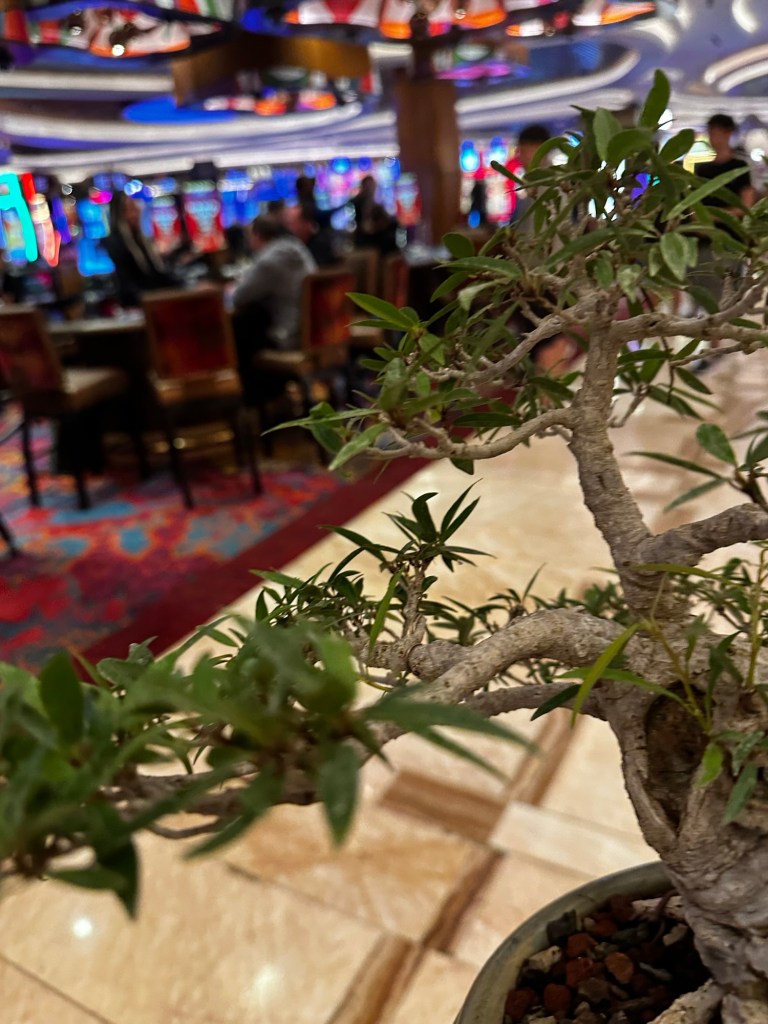
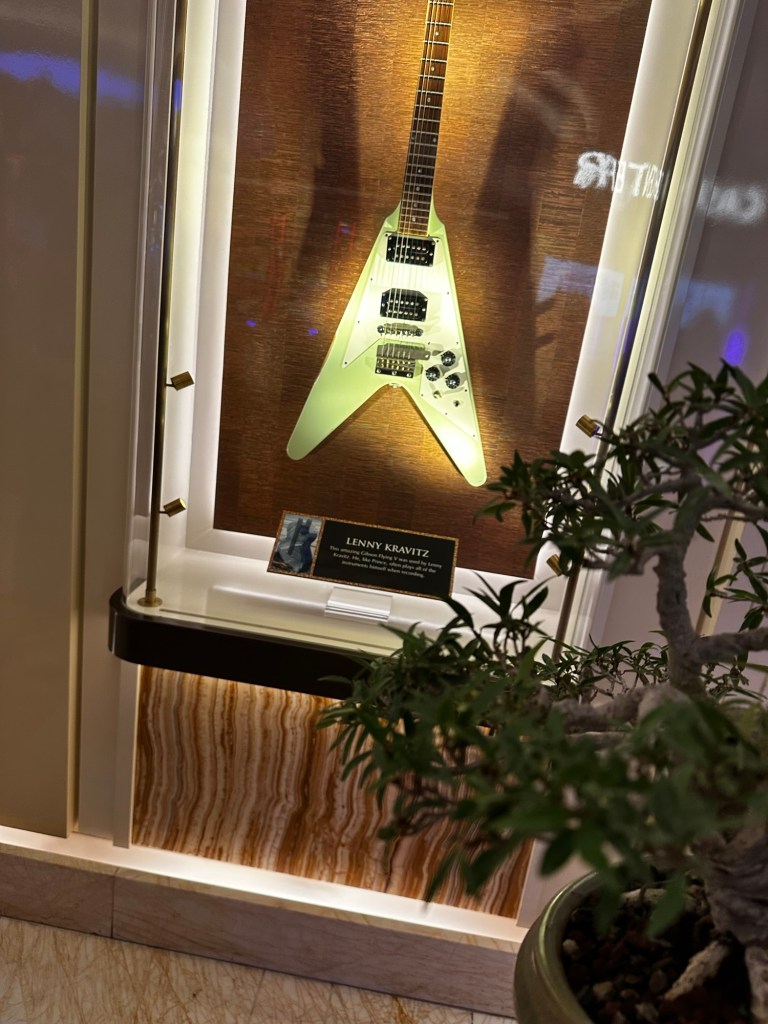
Here I find myself in a hotel in Hollywood.
Florida, not the hotel in California. Where you can’t never leave.
I’m at the Seminole Hard Rock Hotel and Casino. It seems there’s a place way down south in the Everglades, where the black water rolls and the saw grass waves. The eagles fly and the otters play in the land of the Seminole…
I could catch a show, eat a meal, go swimming, gamble and win (most likely lose). But they’re never gonna catch me cuz I have one more silver dollar.
I have some work to do. Takin’ care of business, so to say.
Or, tomorrow morning I have work to do.
Nightie night…..
Here comes the sun….
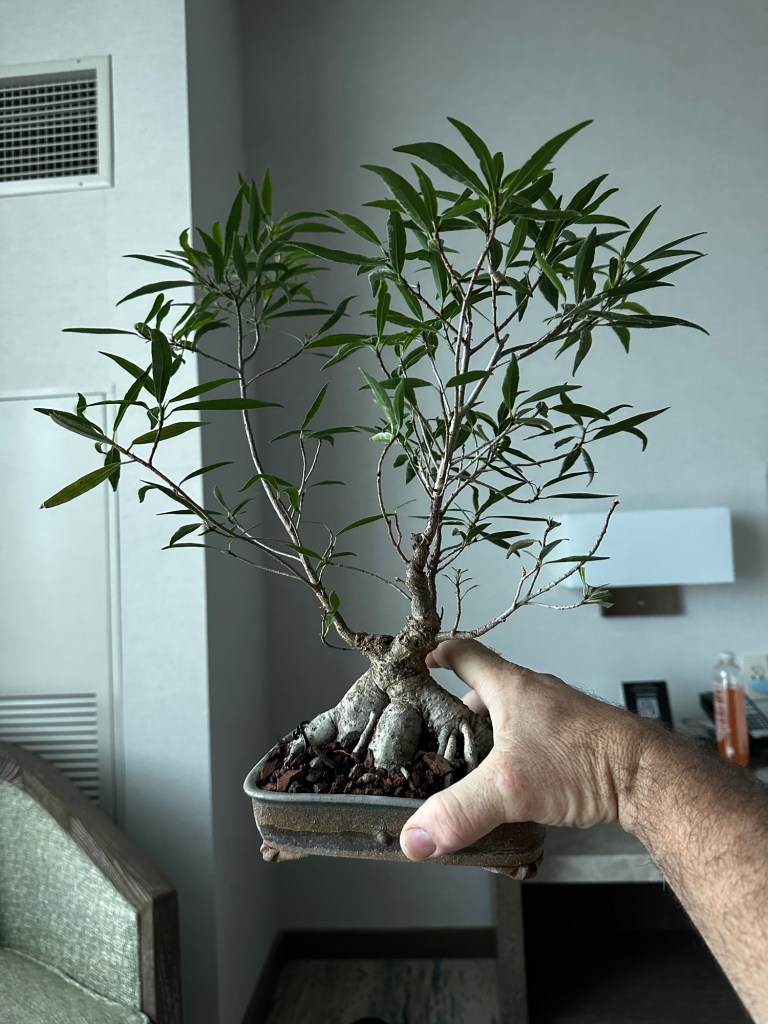
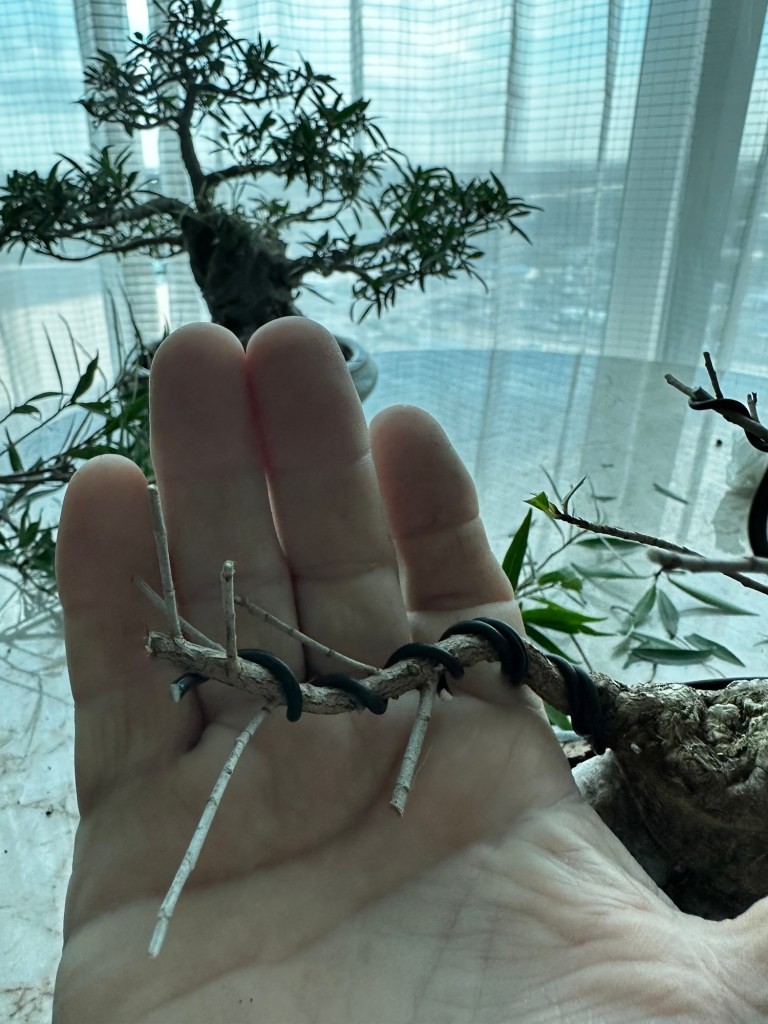
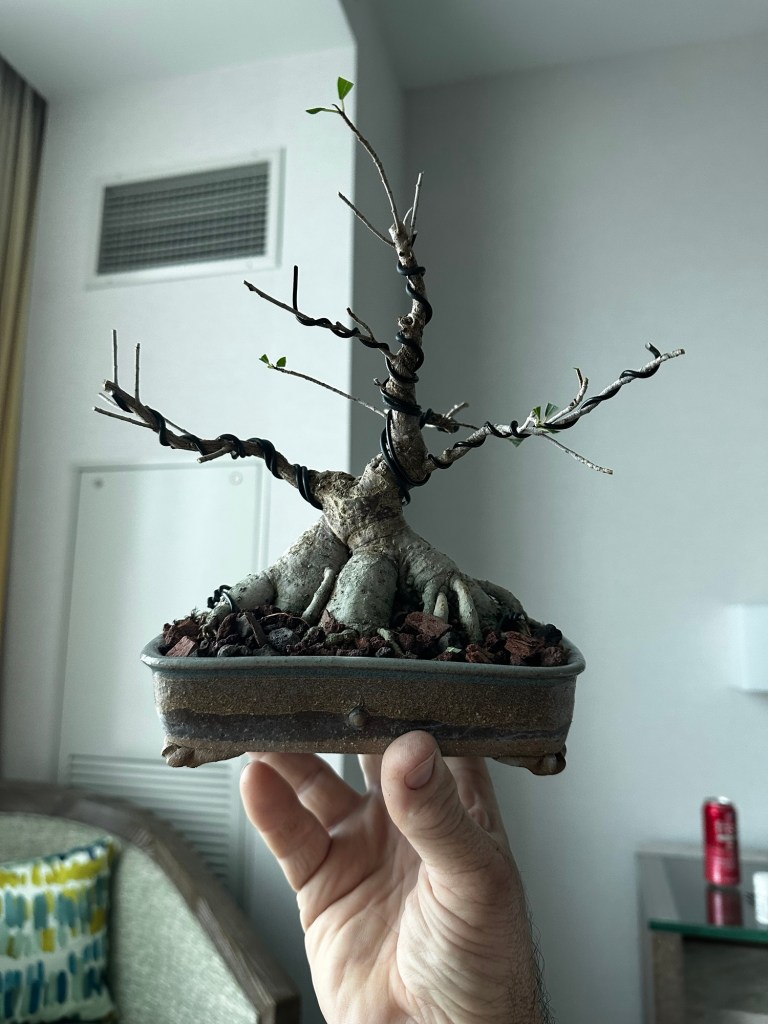
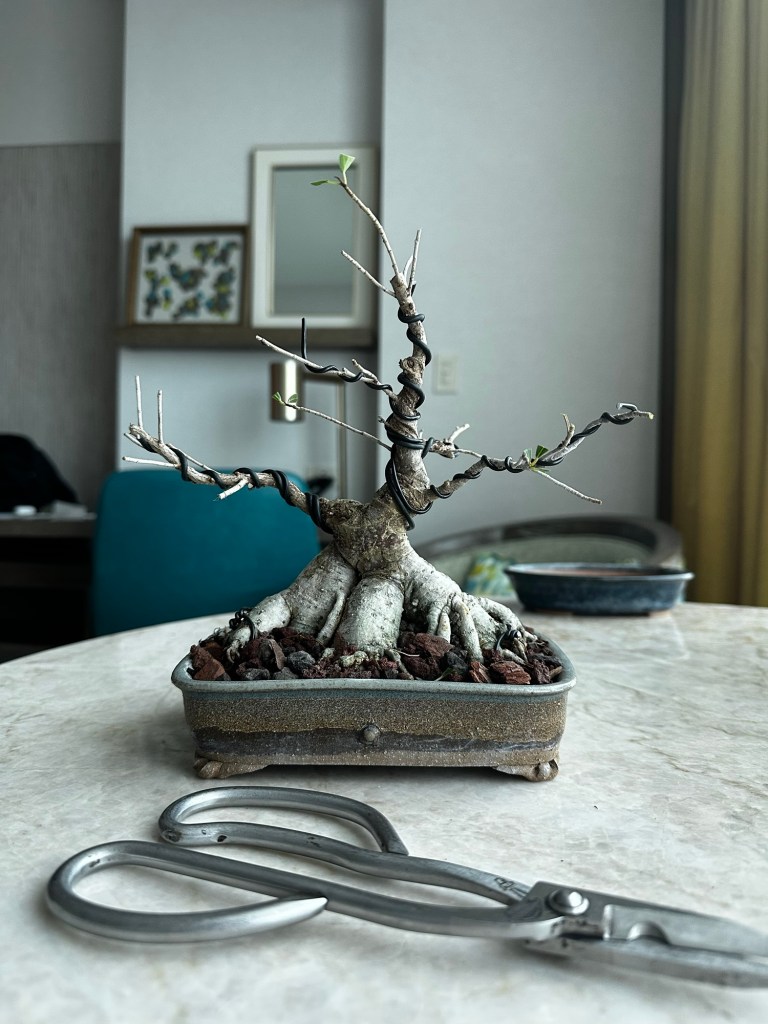
And the tree. A willow leaf fig. Ficus salicaria. What’s a more Florida tree than the one bonsai species that was first discovered here. And not too far from this place. The very first bonsai made from the willow leaf still exists and lives down on the east coast of La Florida. Very far from the Florida:Georgia line.
The tree came from Mike Blom, of Emblem Bonsai. He’s one of Florida’s best. He takes the time to develop the trunk and works to make the stock plant the best it can be. The pot is an early Taiko Earth container, by Rob Addonizio.
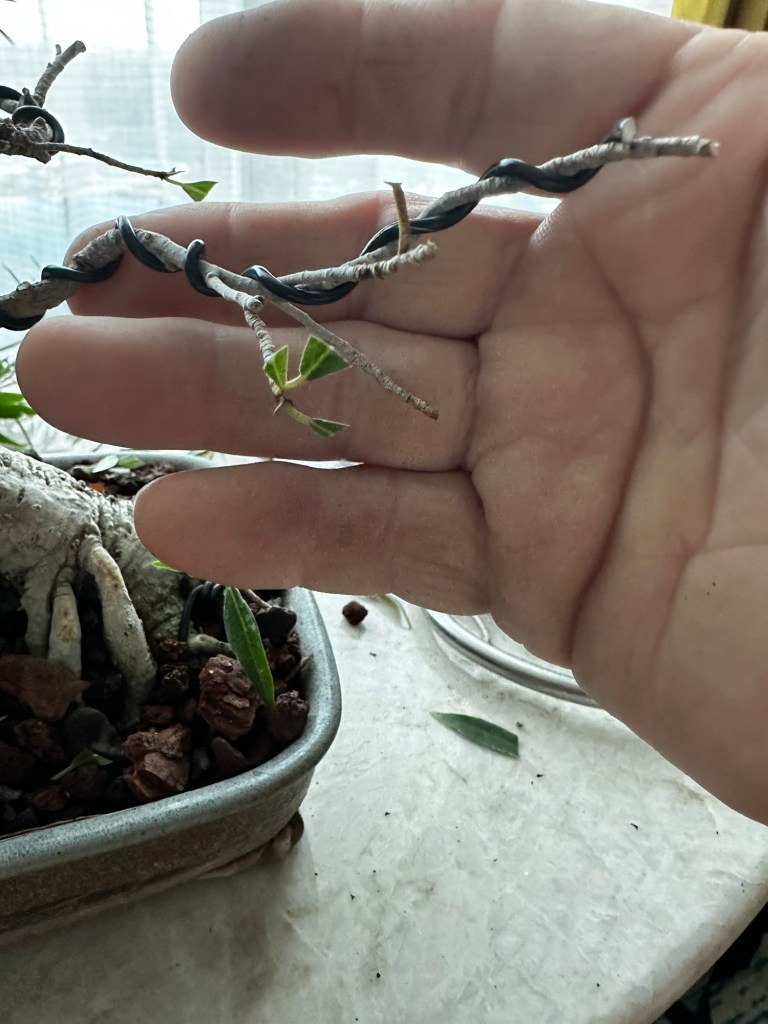
I didn’t bring any number one wire, so just the main branches will be wired.
They already have a strong upward bend so I’ll keep that movement and exaggerate it. An artistic concept we use in bonsai is the repetition of shape and line. This brings the character of the tree into a more honest representation of itself. The branches should tell a story. Say we have a mountain for or spruce in a place where winter dumps hundreds of pounds of snow on the trees and plants growing there. The branches tend to start growing down right from the trunk.
This tree, a purely tropical species, tends to want to grow up first.
I consider them one of the best species for bonsai mainly because they will, much like a juniper or Chinese elm, they can be made into almost all the styles. Cascade? Yeah. Upright formal? You bet. Windswept? If you want. Bunjin? Definitely.
And they grow and backbud like insanity in a tree. A trunk chop will result in buds right from the chop sight, usually double digit amounts. You can totally redesign one of these trees every ten years and the tree will thank you for the makeover. I’ve heard twice from returning westerners who’ve apprenticed in Japan that ficus in general just grow too fast for the Japanese masters.
Imagine that.
That’s one reason we in Florida tend to put them into bonsai pots when developing them, it slows the growth might so that we aren’t unwiring and then rewiring every week when it starts to cut in.
How’s that? I like it. It could have better taper….if it were a Hershey’s Kiss.
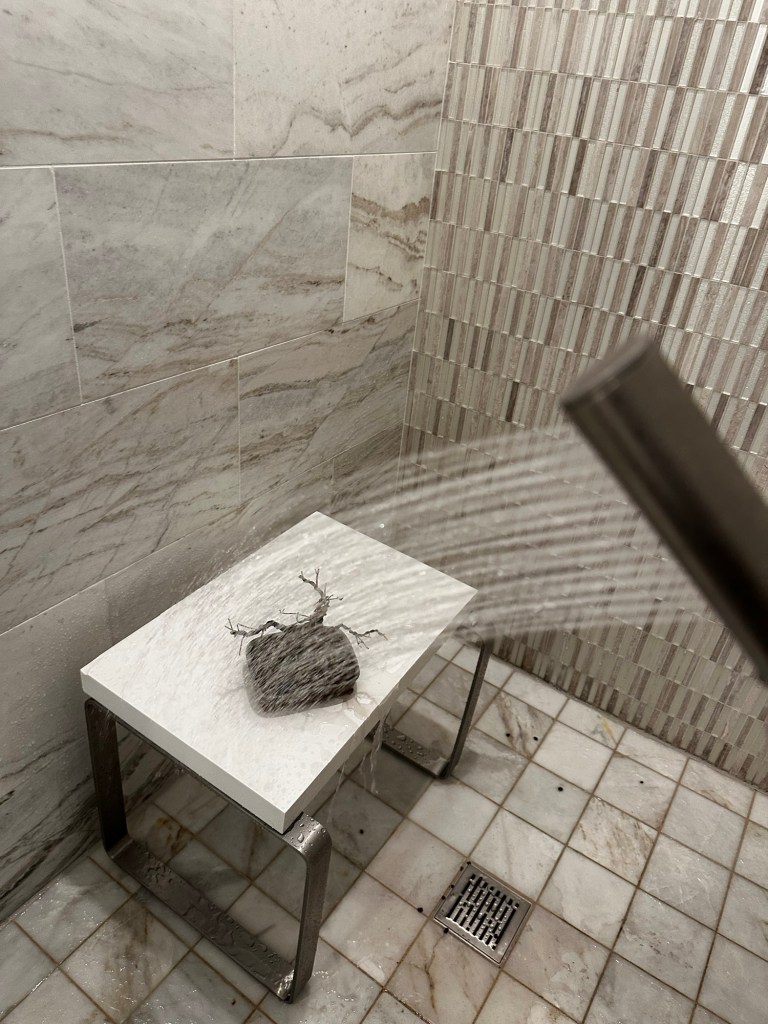
Some water…
Whoops, made a mess in the shower.
Now it just needs some sunshine. Let the sun shine….and you thought I ran out of song lyrics, didn’t you?
Now it’s breakfast time.
WAIT, WHAT? $32 dollars for two eggs and bacon….I thought casinos had cheap food?
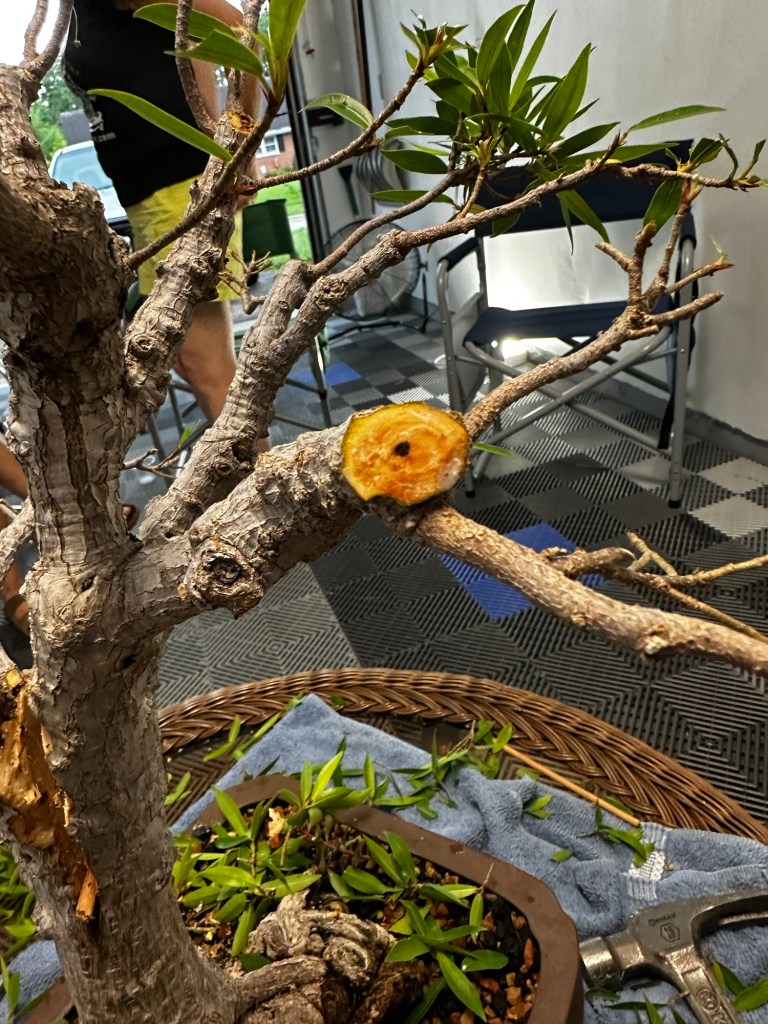
We have before us, up in the urban spires in the city of Cincinnatus, one willow leaf ficus. The tree, as is, would be good on most people’s benches. It has a biggish trunk, good branching and a full canopy. But, to quote the modern day vernacular, it’s kinda like a “helmet on a stick”.
And Brendan was bored with it. I might be able to do something about that, let’s see what we come up with, shall we?
Twirling it around, I think I like the front (below) with its nice root spread and interest. Now what?
I think you see what I saw…
…hah! I crack myself up sometimes. Let’s crack this trunk up….
Or saw it, as it were.
Maybe we (or Brendan) needs some liquid courage to steady the nerves. Or hands.
Bob Dylan has a new bourbon by the way.
But, oddly, I chose a Van Morrison song for the video, go to My Instagram to watch the sawing. It’s a good song at least.
“Are you sure the tree will survive this Adam?” my wife asks.
I sure hope so.
Using a knife, I make the saw cut a little less “saw cutty” looking.
That’s better. The willow leaf ficus almost heals like we do, from the inside out, as opposed to the bark spreading over the cut, like a maple tree. It’s an observation I’ve made in my career as a ficus bonsai guy.
That was the easy part, now I’ll go through and give the canopy some shape.
Which means, defoliation, removing unwanted and superfluous branching or budding, wiring, etc.
Without foliage (foil-age to some of those in the town of my birth), we can clean up some cuts too.
And no, Virginia, I don’t tend to use cut paste on figs. Why? A point to consider, the white latex “sap” that we see when pruning a ficus is not the real “sap” from the tree. It’s actually from a secondary, pseudo-vascular system that utilizes cells called “laticifers”. The sap flows through the xylem and phloem and it’s comprised of the water and sugars the tree uses in photosynthesis and respiration.
Laticifers are super specialized cells or a network of connected cells (often like the real vascular system, in tube-like structures) that make and hold the latex and can be found in various tissues, including the pith, the cortex, the secondary phloem, and even secondary xylem. The botanists believe that the purpose of the latex is to trap bugs and stool continued damage to the plant, and to help seal the wound for quicker healing
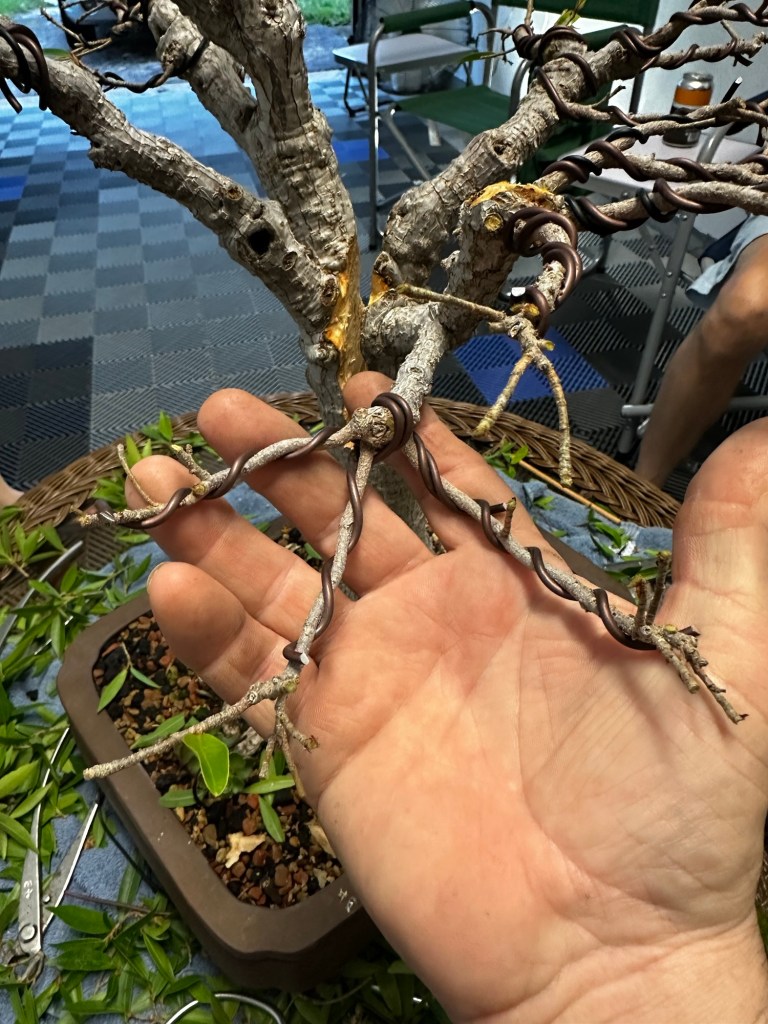
Let’s add some wire…
Look at that dude, he’s a stud.
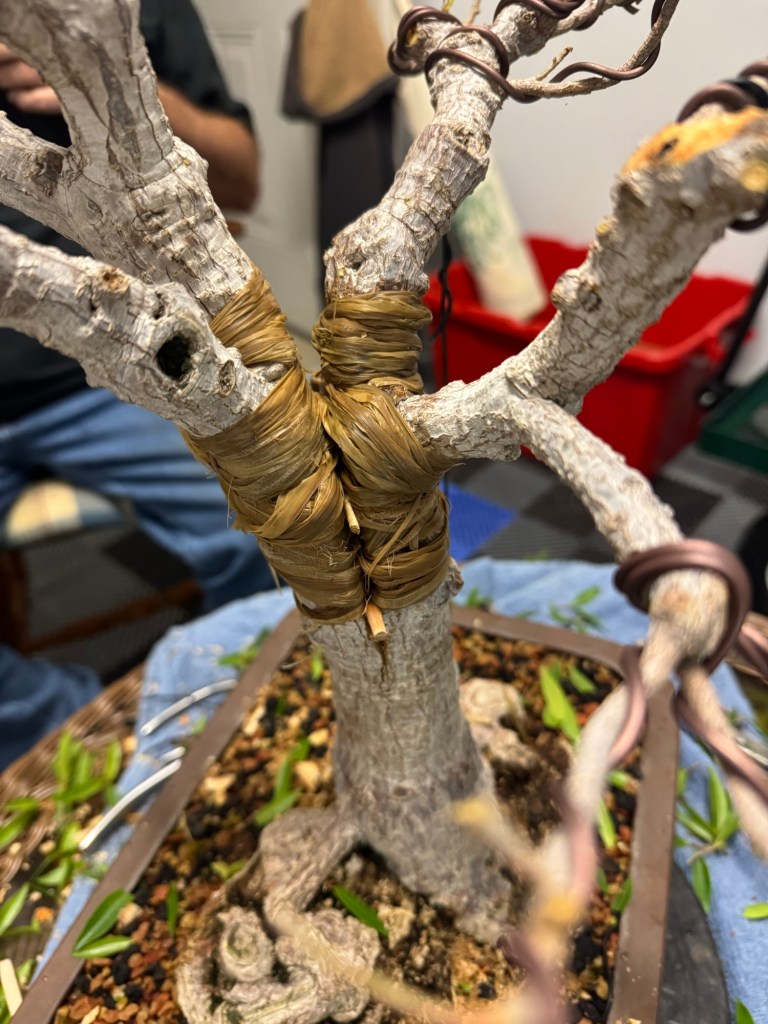
My work is done, except to have Brendan add some raffia to the sawn edges. Willow leaf figs tend to bud right on any cut or wound, which is a good trait to have, but sometimes it’s too much.
The raffle should keep new buds from forming.
And Bob’s yer uncle!
This is where you, my Constant Readers, are quoting Jurassic Park “You.. were so preoccupied with whether you could, you didn’t stop to think if you should…”
But I jumped past all that and posit the concept that I needed to do it.
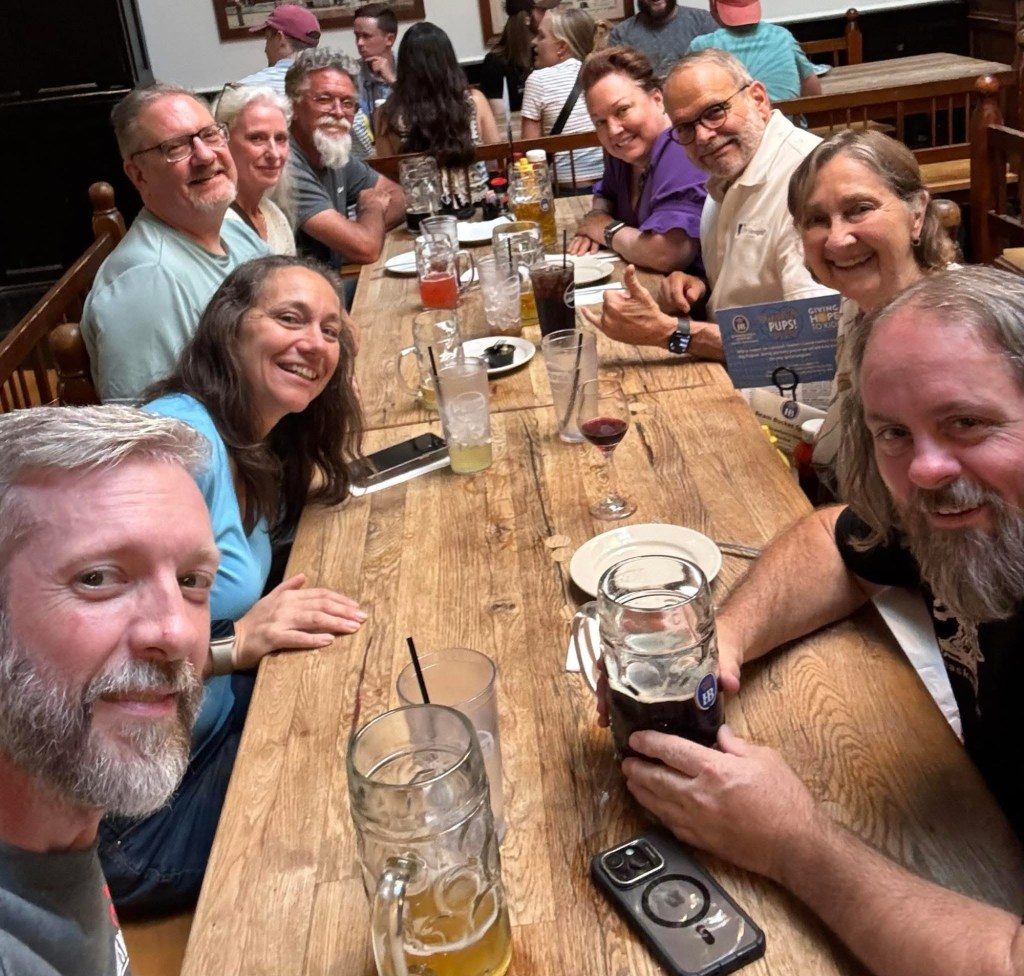
We had some reverse taper building where the branches were coming off the trunk, pretty much in the same spot, so something needed doing. Whether it was chopping them off or, this. If I chose the chop option (just as traumatic as this technique) we could have created a sweet short tree. But it too would be just a “regular” bonsai. Brendan was bored with the tree before. Now he’s excited to see what happens. And the tree will be a better one for this. That’s Brendan below, on the left in the front.
He looks happy. I do too. That’s my second or third liter of beer, so…..I’m happy.
The tree, for Brendan, was a good tree, but boring. And living up in Cincy, it was becoming a chore to go through all the labor of winter protection, including grow lights, heat mats, etc. Now, Brendan has something to look forward to as the tree responds.
The tree looks happy too.
Another video of the finished work.
And yes, you saw White Castle’s and a sparkling beverage called Bonsai, tasty and expeditious. Food and beverage of the bonsai gods we pray to.
Let me know what you think. I’ll add updates as they pop up.
Julie Trigg has been developing this tree (Ficus microcarpa “green mound” or “green island” for many years. Her goal was to create seven levels, or pads, or clouds, on the tree, to represent a personal symbolic idea.
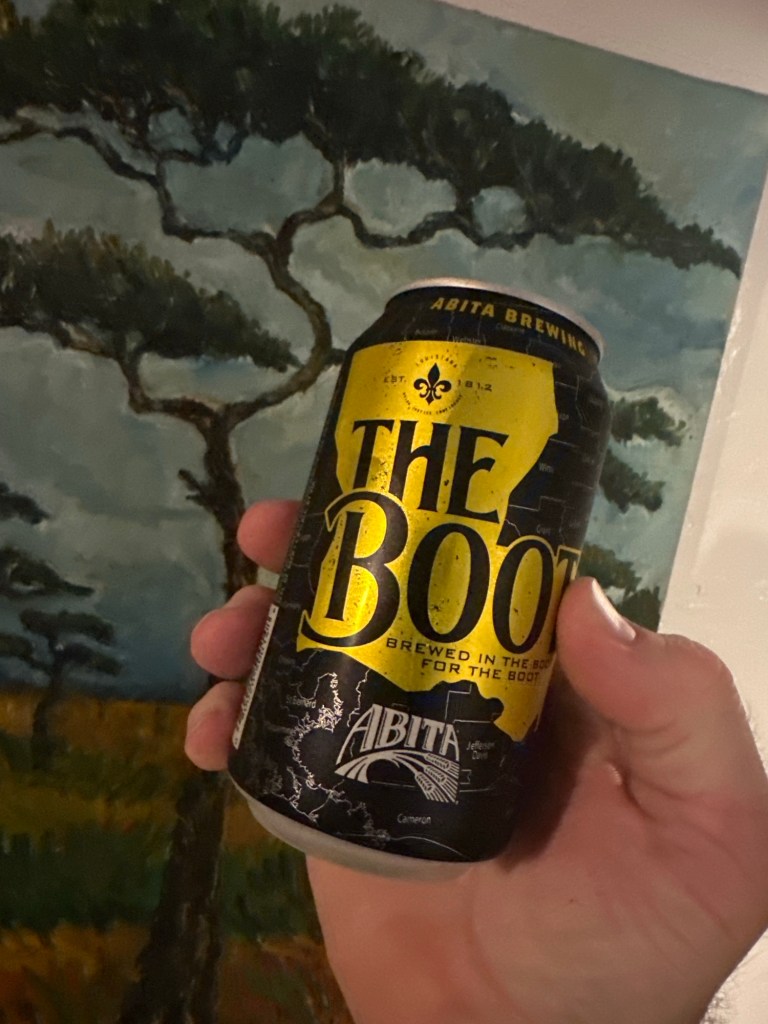
The tree in question is the one next to the beer (of course I’d show scale by beer can. I learned from the old timers of bonsai. All the old magazines showed scale by beer). And if you know anything about beer, you’ll also know that Abita Brewery’s “The Boot” beer is only sold in Louisiana.
And it is a mild felony to smuggle it out of the state. Good thing I’m not there anymore (did you know that Louisiana is still governed by napoleonic law? Meaning you are guilty until proven innocent. Well, not really, but my 7th grade civics teacher insisted it was still in effect. Good story but, you know, don’t believe everything your teachers tell you. If you can only recite the words, you haven’t learned the lessons.)
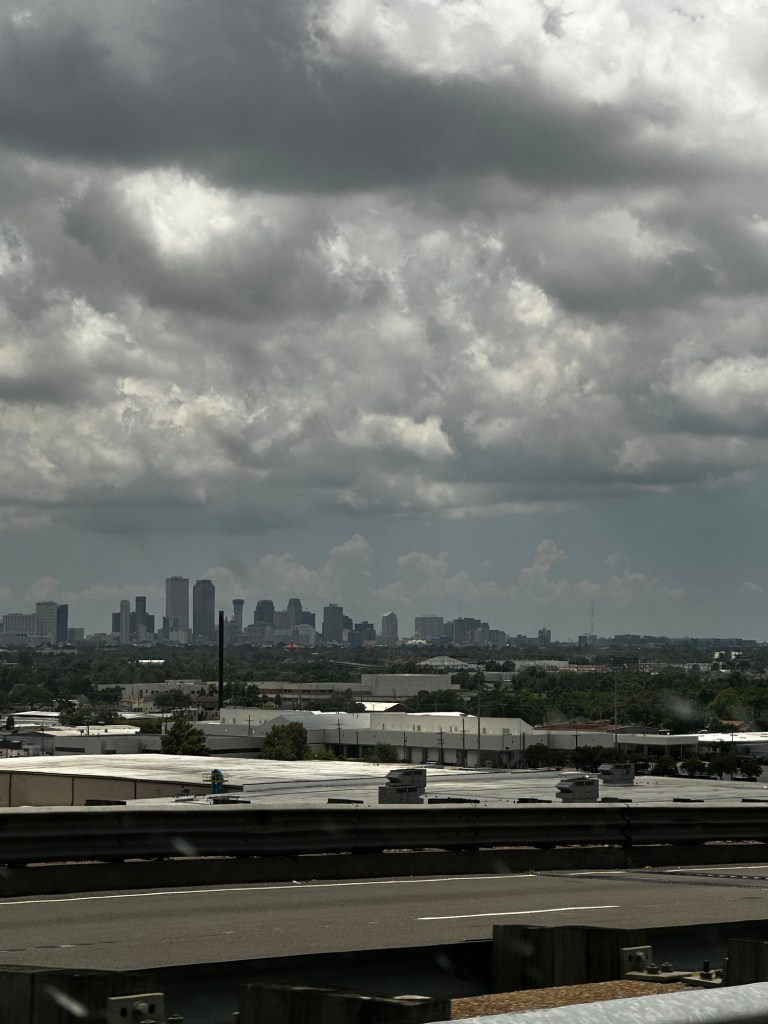
But I was there this last weekend. In New Orleans. Proof:
Better proof:
Damn these meat pies are fine cuisine. To get them shipped to Orlando I have to buy 45 individual pies (well, 45 in a box) for $129.99.
But they’re available at the Walmarts in New Orleans, in the hot food section, for like a buck fifty.
All the paintings in the backgrounds of these pics are Julie Trigg’s
In oil, acrylic, mixed media, watercolor, whatever medium you can think of, she’s one of the best. And in Bonsai too. She’s shown trees multiple times at the BSF Exhibit at Epcot’s Flower and Garden show…..
One of her trees, a Brazilian Raintree, that was on display at Epcot in 2026
…at the BSF Convention exhibit, at Bill Valavanis’ National Bonsai Exhibit, at both Komorebi shows David Camargo and I put on several years ago in Miami, and at many Shofu Bonsai Society shows, her home club when she lived in Sarasota Fl.
But why seven levels? It’s not a question I asked her. I’m a very personal person, and I feel very uncomfortable asking others personal questions. But if we do some research: seven levels could be religious (7 days of creation in Judeo-Christian religions or seven heavens/hells) spiritual (7 levels of awakening in Buddhism or the 7 energy chakras). In medieval learning, there is the sum of the trivium (grammar, rhetoric, and logic) and the quadrivium (astronomy, arithmetic, geometry, music) adding up to seven as well.
Seven colors in a prism or rainbow, seven principal notes in music. if you take any three things or entities, say A B C, you can only express them seven times (A, B, C, AB, BC, AC, ABC
Like it or not, going as far back possibly the caveman times, who were, believe it or not, more capable than we were intellectually (technology often dumbs us down), the number seven is significant.
Julie’s challenge to herself was to make a tree with seven pads, or levels. It was a challenge she conveyed to me when I worked on it.
Here we go:
First step with me is usually defoliation. Hey look, it’s me!
All defoliated and who do I find? Awww, look at that little dude!
Now for some wire:
But which side is the front I wonder?
Some more views. Then a video or two.
You can see how much work was needed to create the levels.
And if you say something silly like “You done ruint yer tree, you got wire scars”, then your slip is showing.
If your tree doesn’t have wire scars, you’re just not trying hard enough. Don’t want wire scars? Go buy a topiary.
We, as bonsai artists, use wire to shape our trees. Speaking of shaping….
One trend I’d like y’all to think about in modern bonsai is the concept of a growing a fully encompassing canopy over the tree. I’m pretty sure there is a Japanese name for it.
Is it a valid? Sure. Do I like it? Count up seven lines. That’s my answer.
I like to see the tree.
The story of a tree begins at the trunk, and (get this) branches off into ancillary chapters that tell their own stories. We may have scars (shari) or broken, dead branches (jin) that create drama, or climax.
What story does a full mushroom top tell?
How about we leave that discussion to the bonsai professionals.
Did we maintain the seven levels that Julie was going for? How about we just do some counting, sound up!
Another detail video. No sound this time. Copyright is a bitch.
Now, to go back to the question of “Which view is the front?”
Is it this one?
Or this?
They both tell different stories. They almost look like different trees. One is more massive looking, the other has more movement.
One is almost closed up, one is open.
I won’t tell you which I prefer. If I even have a preference. Julie likes the last one.

 Login
Login
 , just like the old days. Here’s the tree, a willow leaf fig (Ficus salicaria, ofttimes erroneously called Ficus nerifolia, or F. salicifolia, or whatever it was called when you grew up in bonsai).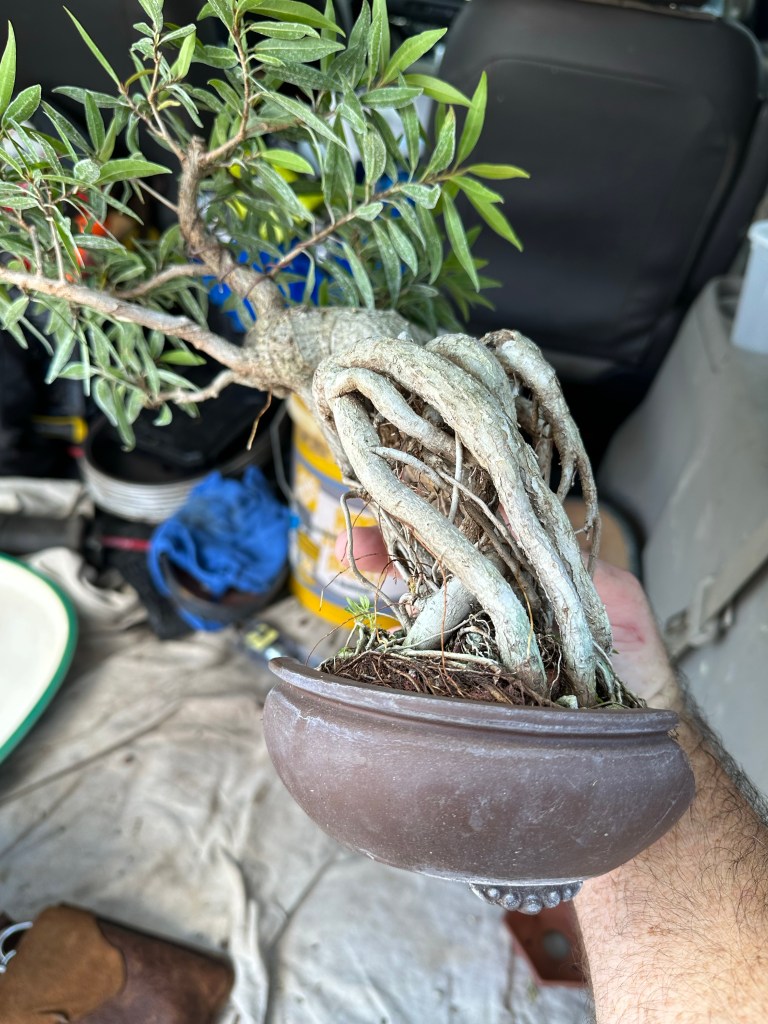






 I wanna go back to my Maumee