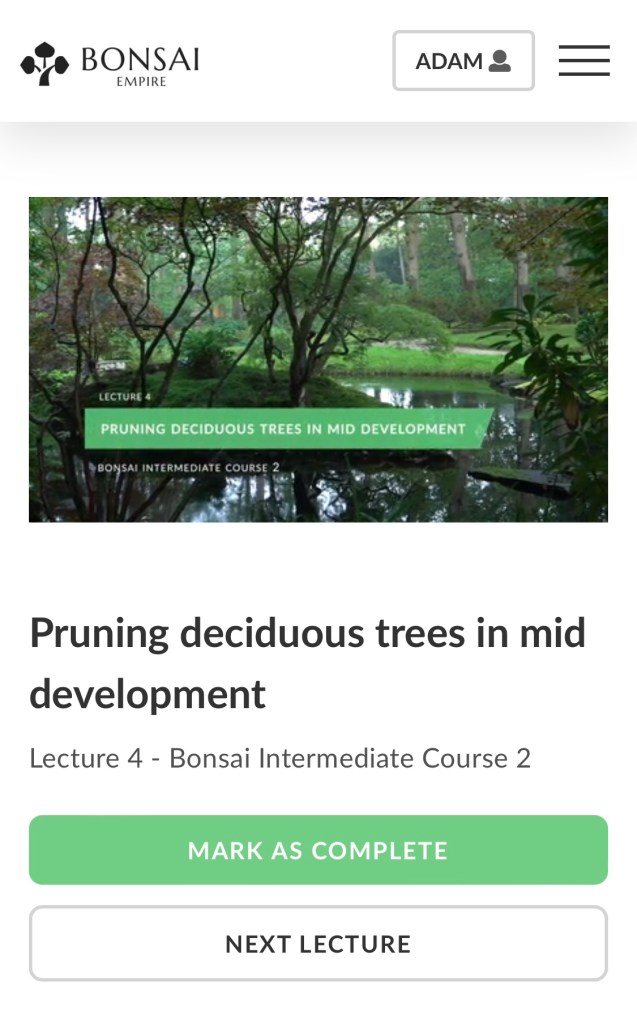
A few months ago, I got an email from Oscar Jonker, from Bonsai Empire , asking me to give an honest review of his newest online class. I’ve collaborated with Oscar in the past, providing some media, hosting livestreams, etc, so I said “sure”. Little did I know that the class was so in-depth and full of information that it would take me days to finish!
So, my friends, here is The Review…..well, after the mandatory legal statement: according to the US FTC, I have to disclose whether I’ve received any compensation from Oscar or Bonsai Empire. I have not. This is not a paid review, simply a service provided to my friend and to let the Bonsai World know about a valuable resource. I was provided access to the class though, which you see by the above pic, costs a mere $59.99.
Some of you might wonder why I, as a possible competitor, might want to promote Bonsai empire (always ask why!). Easy answer, I don’t see myself as a competitor nor do I think any Art is a competition. Down that road is where we find division and strife. My business model has me providing in-person bonsai instruction. I have done online classes and courses, and you can find those easily, but my blog (Da’ Blog) is free to anyone. Besides, the business of bonsai is not a zero-sum game. It’s not a pie to be cut up and the only way your piece gets bigger is to take from someone else’s piece. By supporting and promoting bonsai, the pie gets bigger.
Ok, with all that said, THE REVIEW!
The course is laid out with 21 video lectures, starring Bjorn Bjorholm and Michael Hagedorn, two of my favorite bonsai artists from the USA. Both trained in Japan, both with amazing content (I subscribe to Michael’s blog). And both very knowledgable.
The video quality is top notch, as expected from a Bonsai Empire production. The knowledge imparted is in plain English, and presented in a humble way. You don’t need to know what a “moyogi momji with a melting nebari in a nanban pot with an understated namako glaze” is. Very accessible. By the way, who would put a moyogi in a nanban?
One refreshing thing, Bjorn isn’t averse to trunk chopping:
The information: both artists describe what they are doing and, most importantly, why. The chop above is for taper and movement. And after care is discussed, the how and why and when. There’s one spot where Michael explains that if you do this, at this time, you’ll see this result. But if it’s at another time of the year, you’ll see this.
It’s also set out in terms of the trees various stages of development.
I followed the courses on my iPhone, and the video transitions from the different views was flawless.
You can watch like this:
With the video in the text.
Or with just the video (here in portrait mode).
Or in landscape, full screen mode (turning your phone horizontally).
There is also a closed captioned mode, for when you’re with company and don’t want the sound to bug those near you.
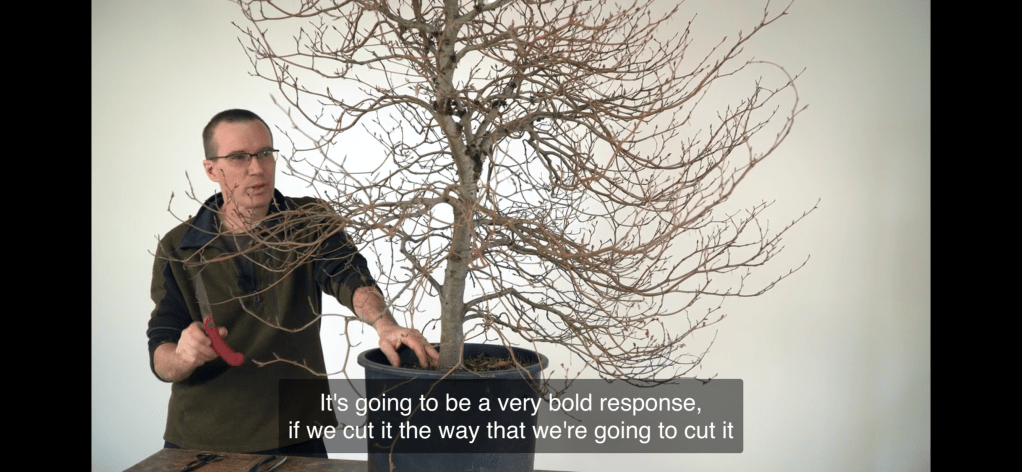
Above, Michael is tackling a huge beech.
The course covers both deciduous and coniferous trees. And styles.
The pruning strategies between the two are covered, and contrasted.
If there are any drawbacks, I might have added some still photos that one could zoom in upon. You can zoom in on the video, but you have to pause it, and it’s not a full zoom (where you can see the dirt under the fingernails). I’m not sure how you could structure the addition of still shots, that’s above my skill level, but it would be cool.
You can also ask questions and comment, and they are answered pretty well.
At the end, you get a certificate of completion, which you can print out for framing
All in all, I’d say this course (after taking the previous courses, of course) would be a good addition to your digital library (did I mention you have lifetime access to the courses you’ve taken? Meaning you can go back and review what you’ve watched any time).
Well done Bjorn, Michael, and Oscar, and all the people at Bonsai Empire.
If you’re inclined to increase your bonsai knowledge (and I recommend you learn from as many artists as you can) take a look at Bonsai Empire’s courses (the full curriculum can be found here )
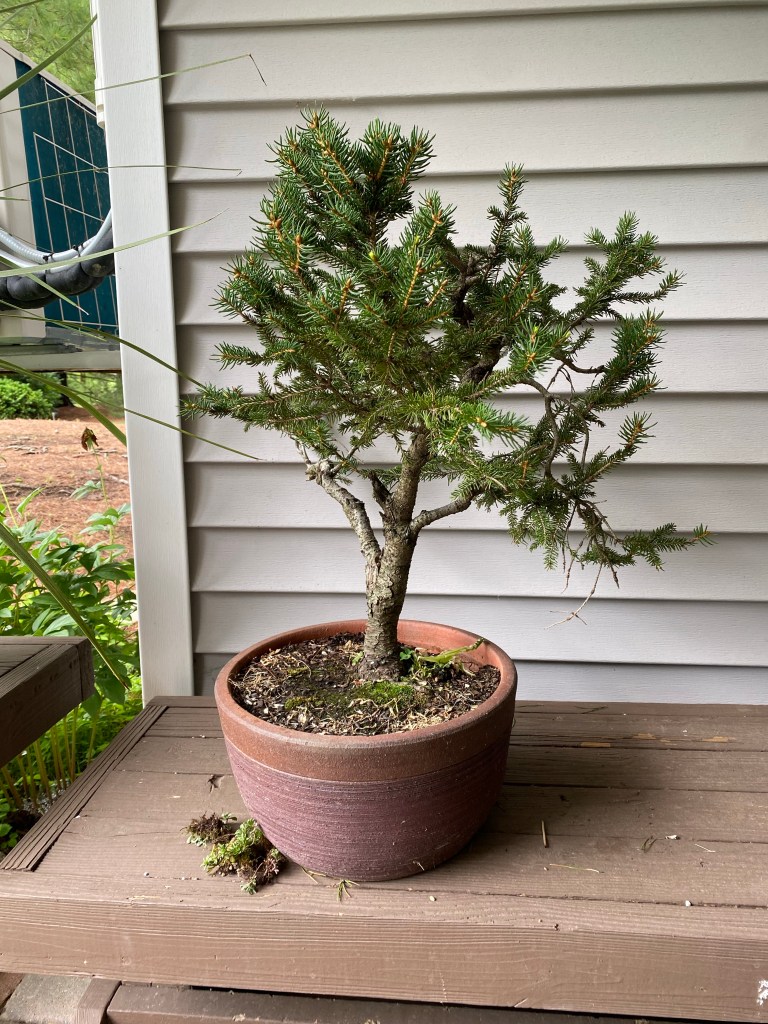
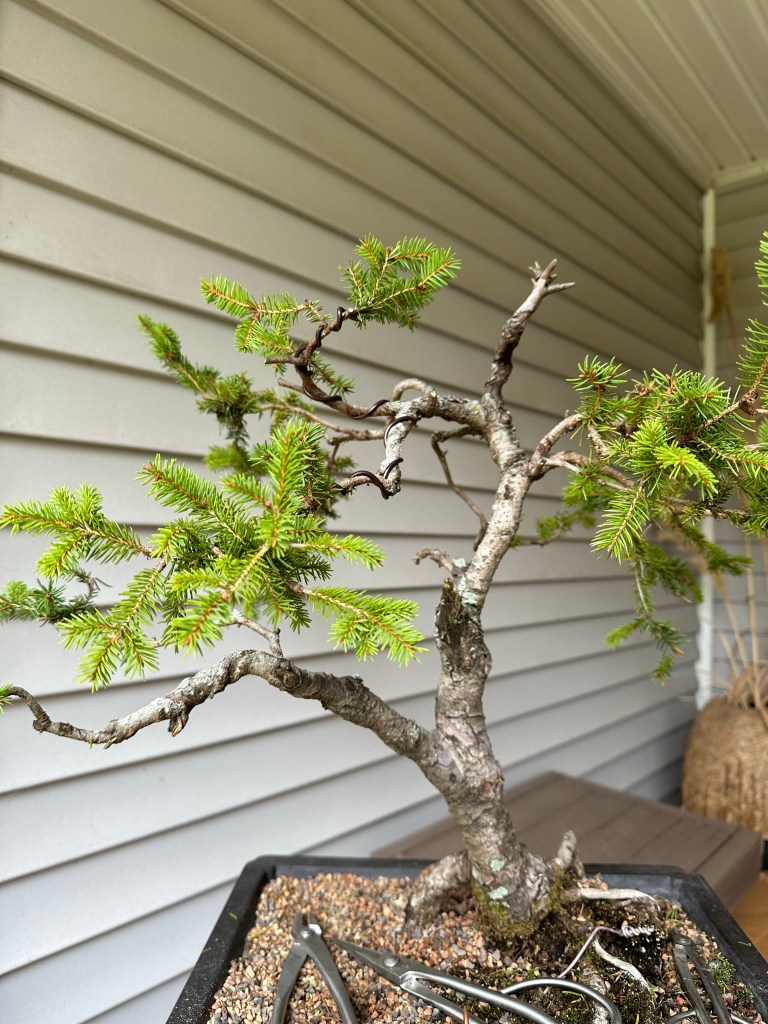
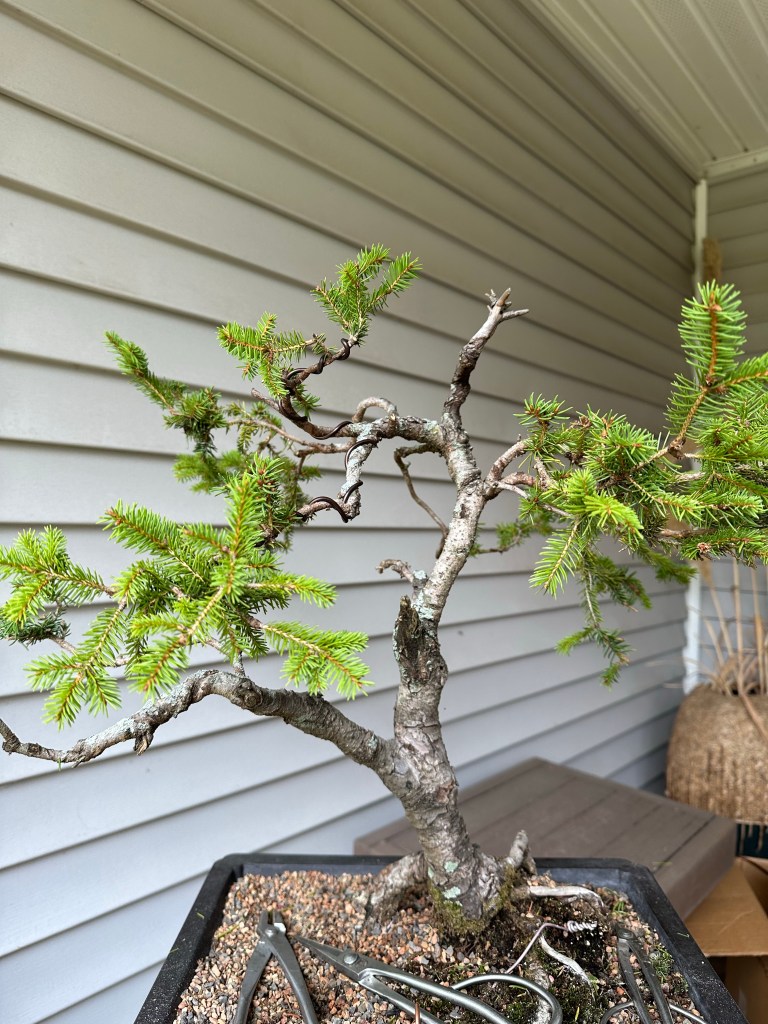
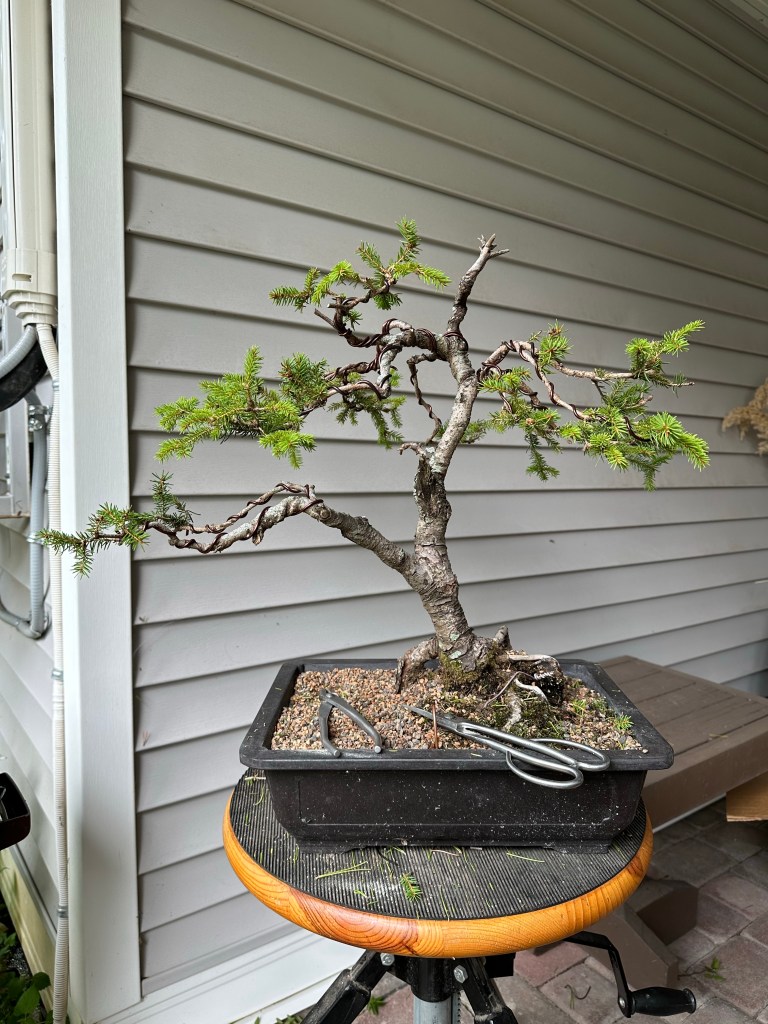
Here I am, back in Cincinnati, it’s July, 2023, two years since my last visit, and I find that a tree I had worked and, most assuredly, had killed, was still alive.
Wow…
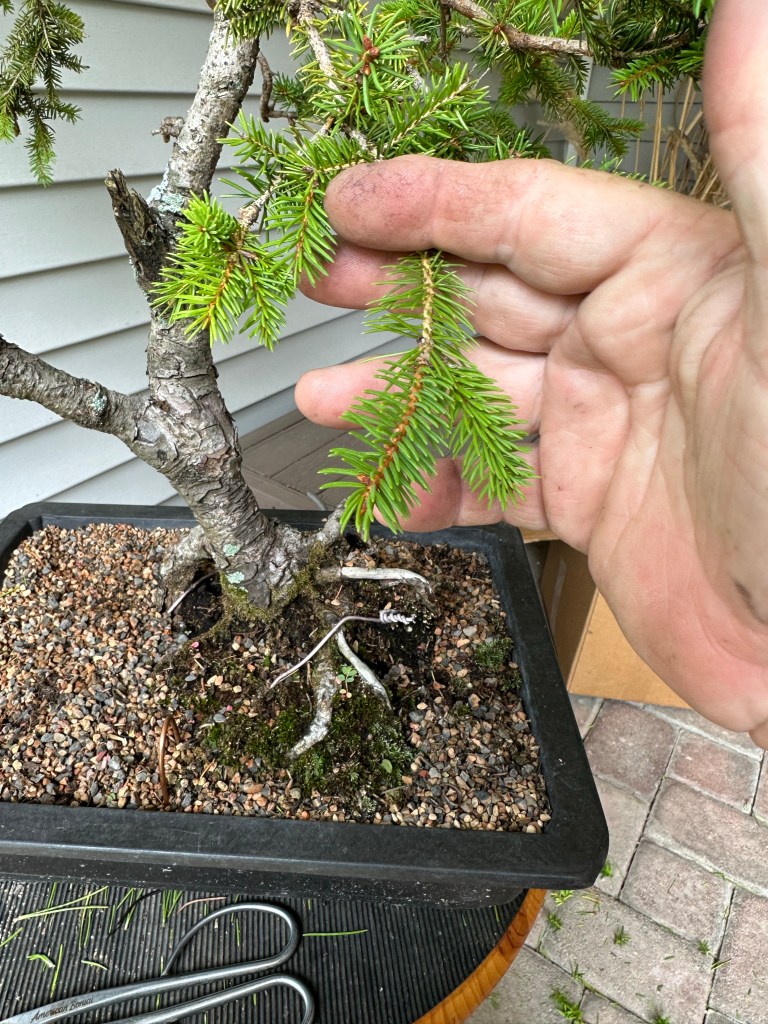
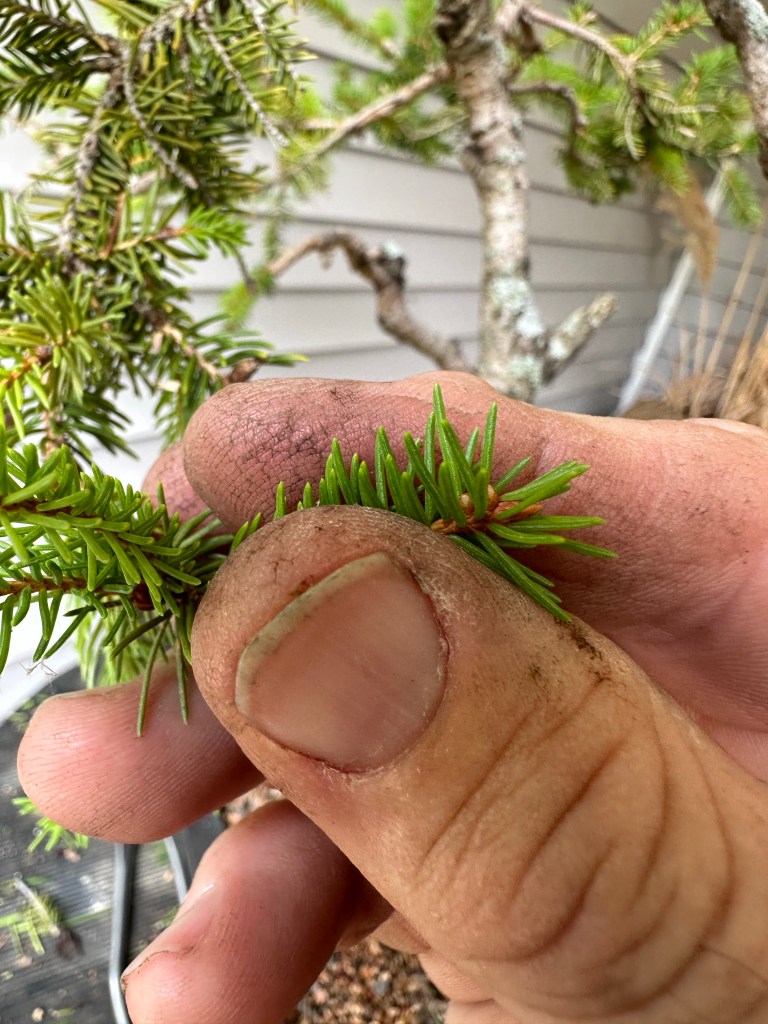
I’m not a northern conifer guy, generally (but I do work them for clients) so the only thing I can say to what it is, is that it’s some type of spruce (but it could just as easily be a fir or a hemlock). Spruces don’t grow down in Florida. They are what we call a “Christmas tree”.
As I inspect the tree, I find a few issues. Much of the US Midwest had a weird winter. It was cold near Christmas time, but didn’t get cold the rest of the winter, until one day the temps dropped 40° Fahrenheit in a matter of hours. Many bonsai were damaged. I think it stressed this tree in particular.
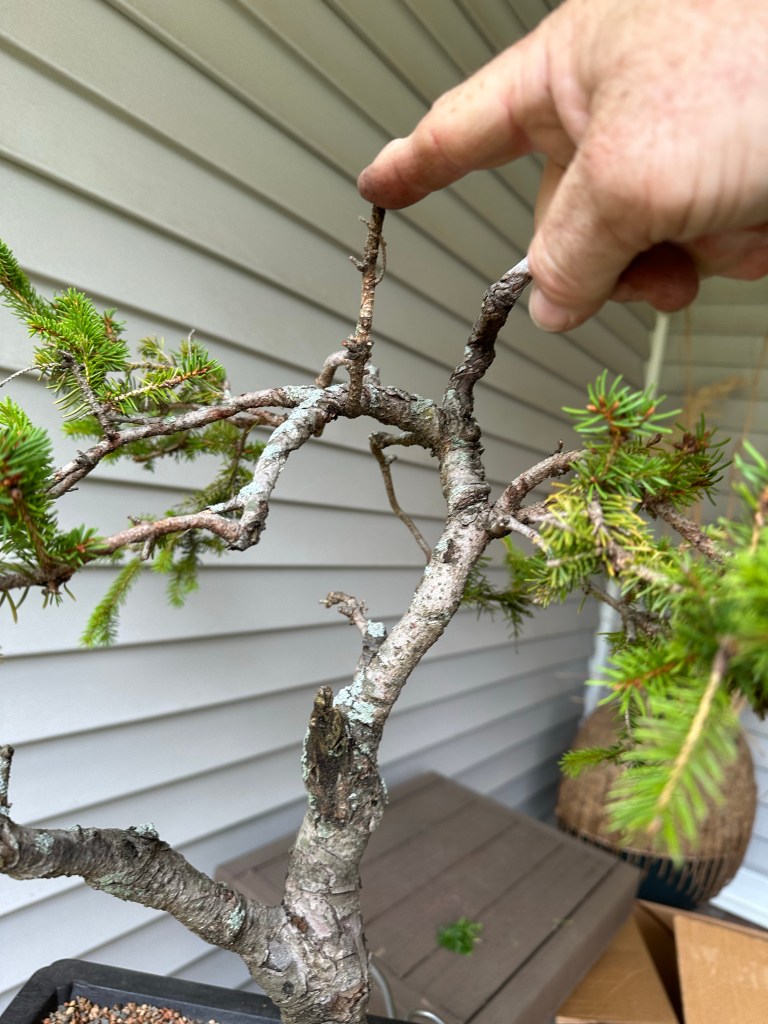
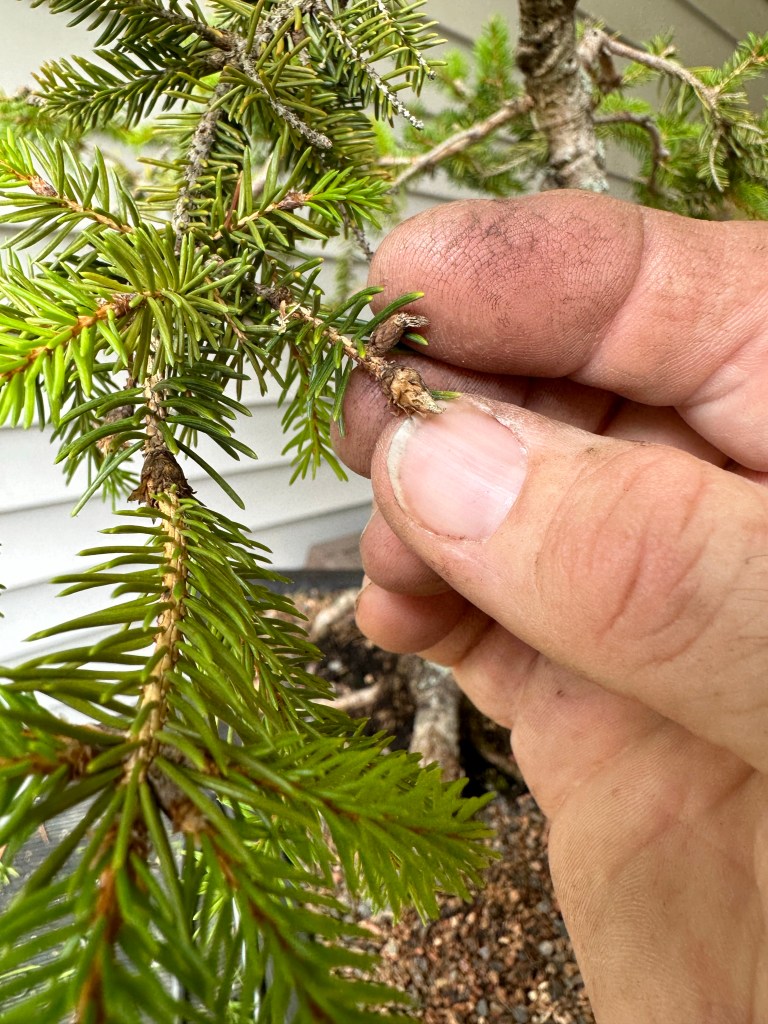
It killed off one branch (above) and some of the new buds were damaged. As you can see below.
But it’s still alive and growing. Which delighted me when I got to my clients house.
Ok, that’s in the Now. Let’s go back in time and look at the tree two years ago and you can judge me for the initial insults I rained down upon the poor tree back then.
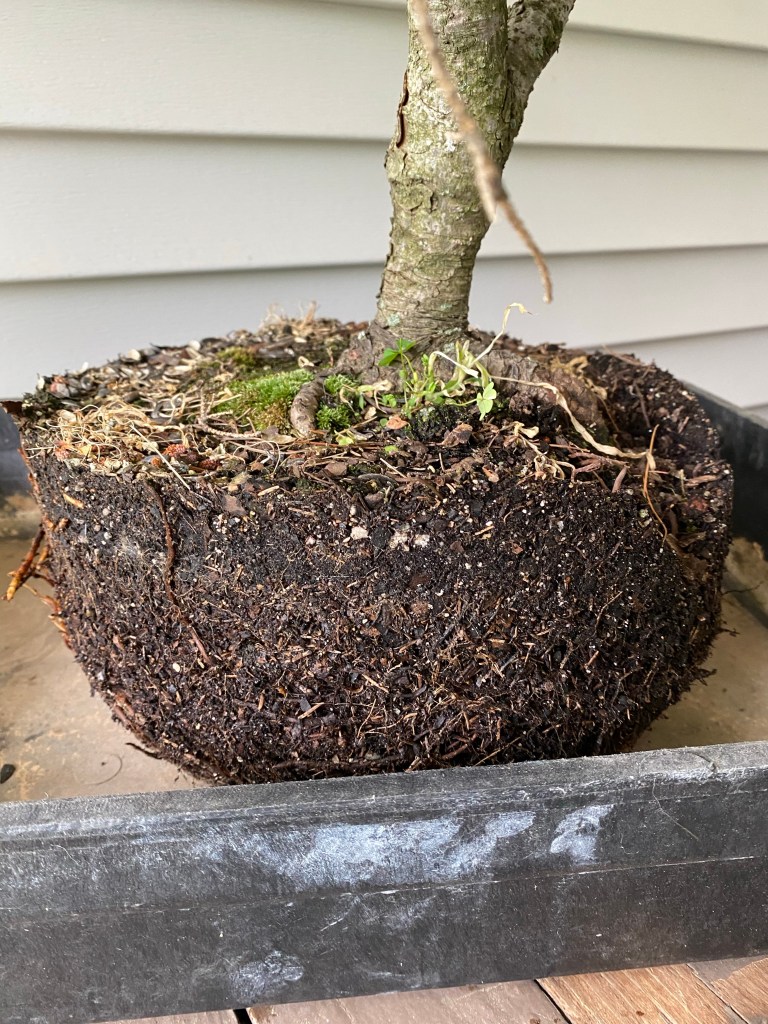
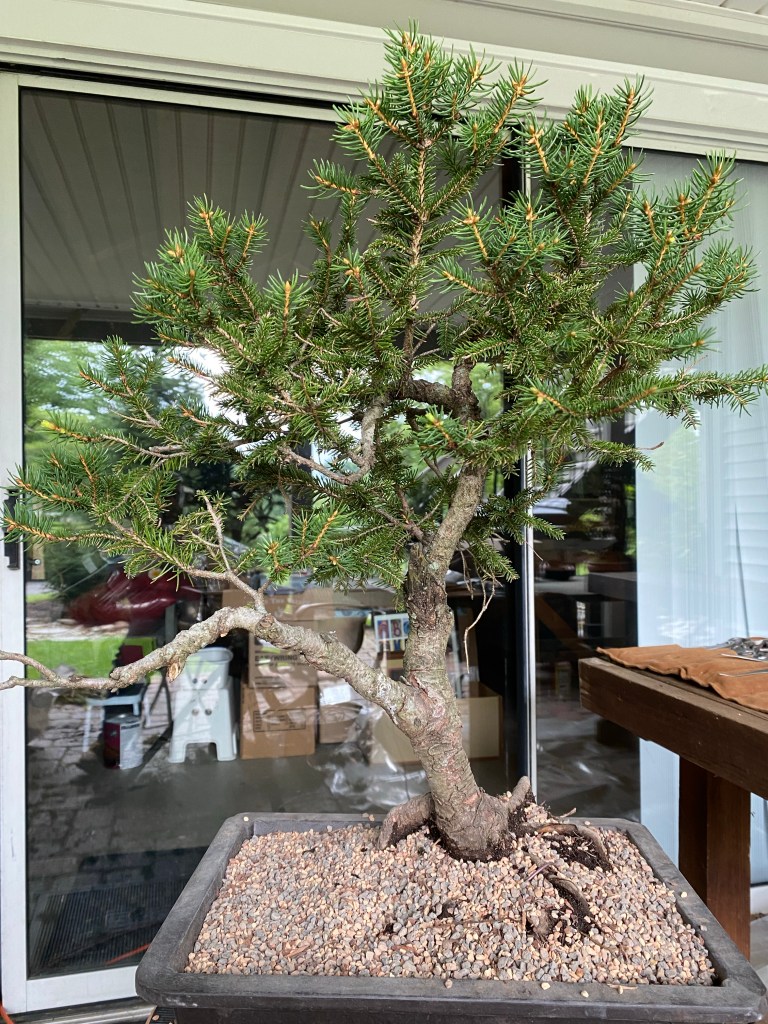
Lots of branches, good color.
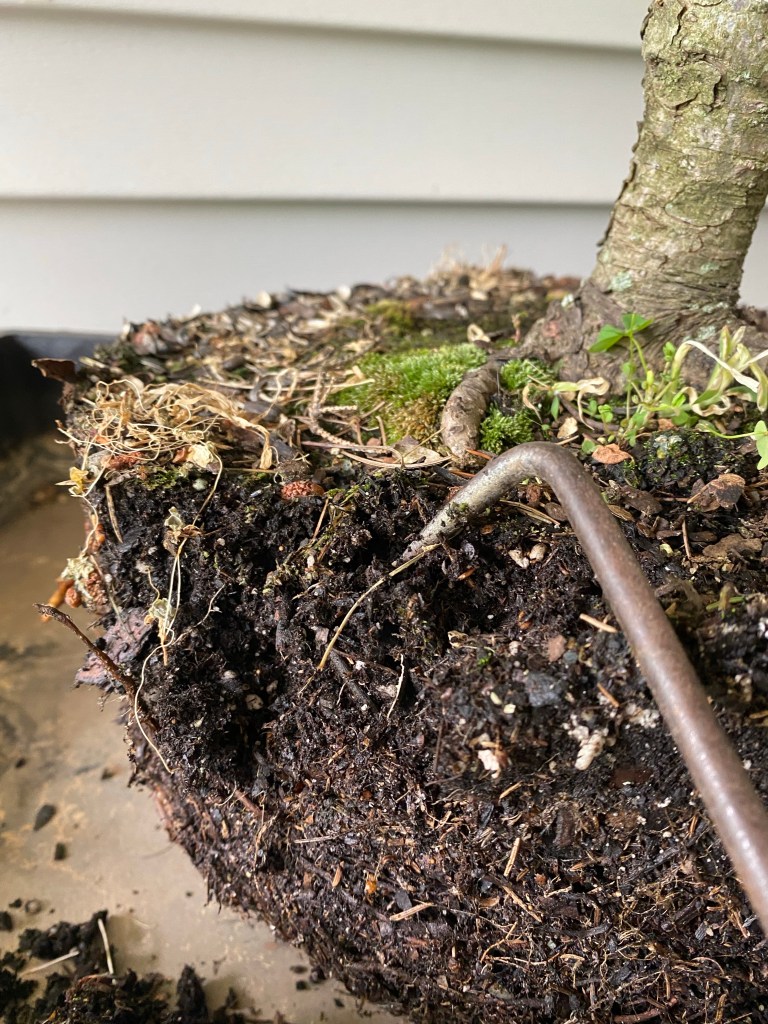
Crappy soil.
So what did I do?
I repotted it.
My client, Tom, asked me to, so I, against better judgement, did.
This was in mid June, Cincinnati, Ohio, coming into the hottest time of the year for the locale, I knew just a little of its history, but nothing about the species, and the worst insult? I’m a tropical guy (well, mostly. I am here now, aren’t I?).
Tom, who had a stroke a few years ago, doesn’t get to work his trees so much. And he’d had the tree for many years, just sitting in that pot. He’d look out the window at it from his living room.
He asked me to do something with it, so I did.
First, the repot.
The soil I had on wasn’t the best. Mostly expanded shale, or Haydite, as was the brand name back in the day.
Then I styled it.
Two years ago….
You are probably asking why I didn’t do a write up on it then? Well, to be honest, who wants to show a tree you’ve worked on that you know won’t live? I don’t like that idea, showing techniques and styling and trying to be a teacher when you know it’s not best for the tree.
But I got lucky, and sometimes, as they say, it’s better to be lucky than good.
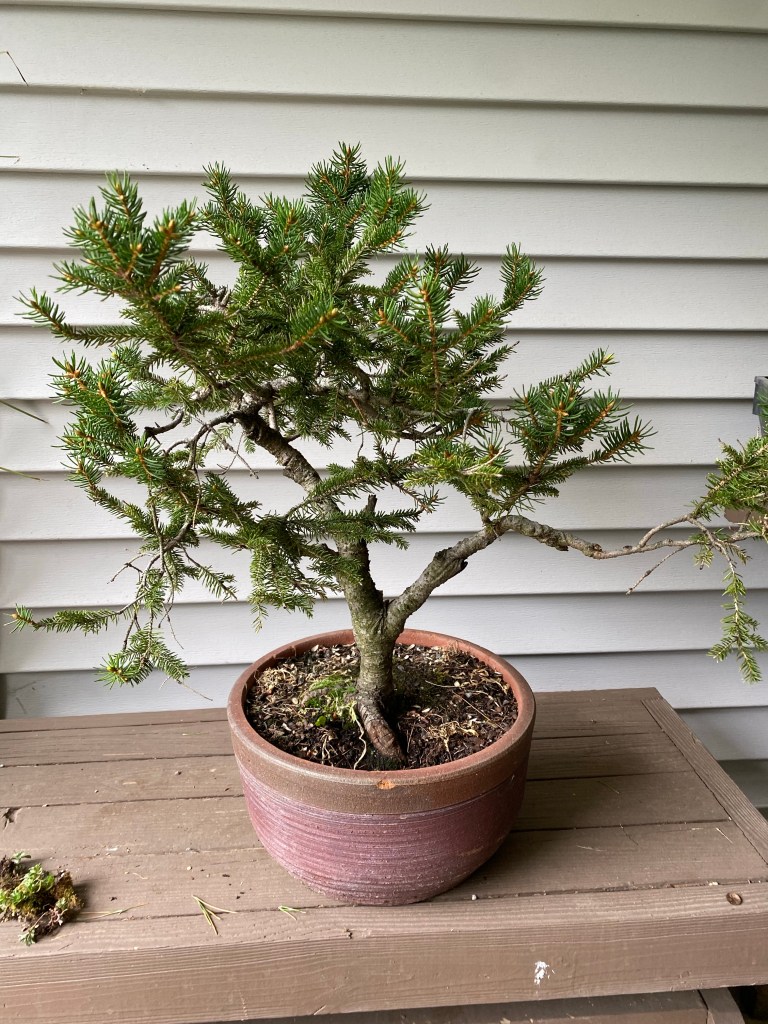
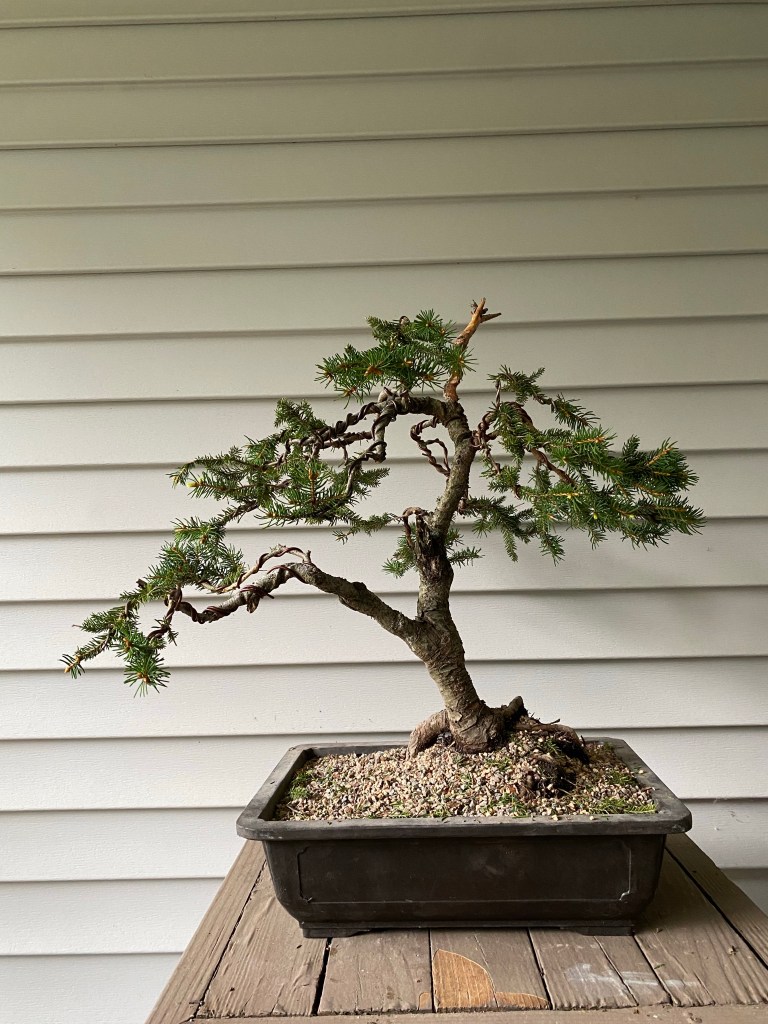
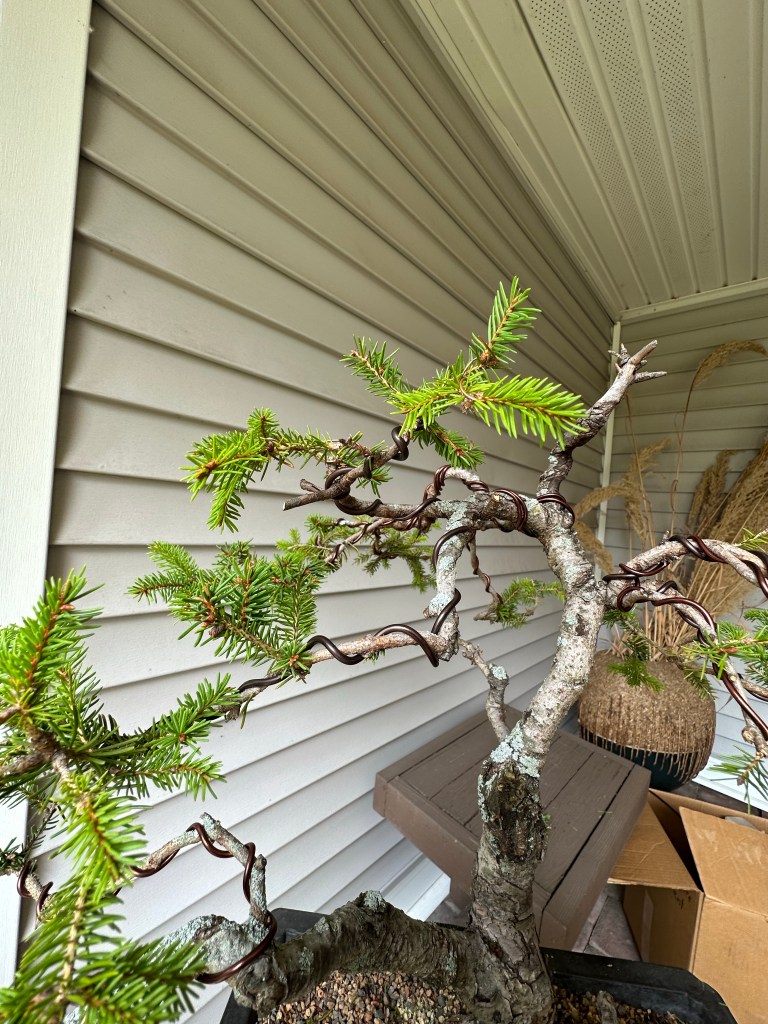
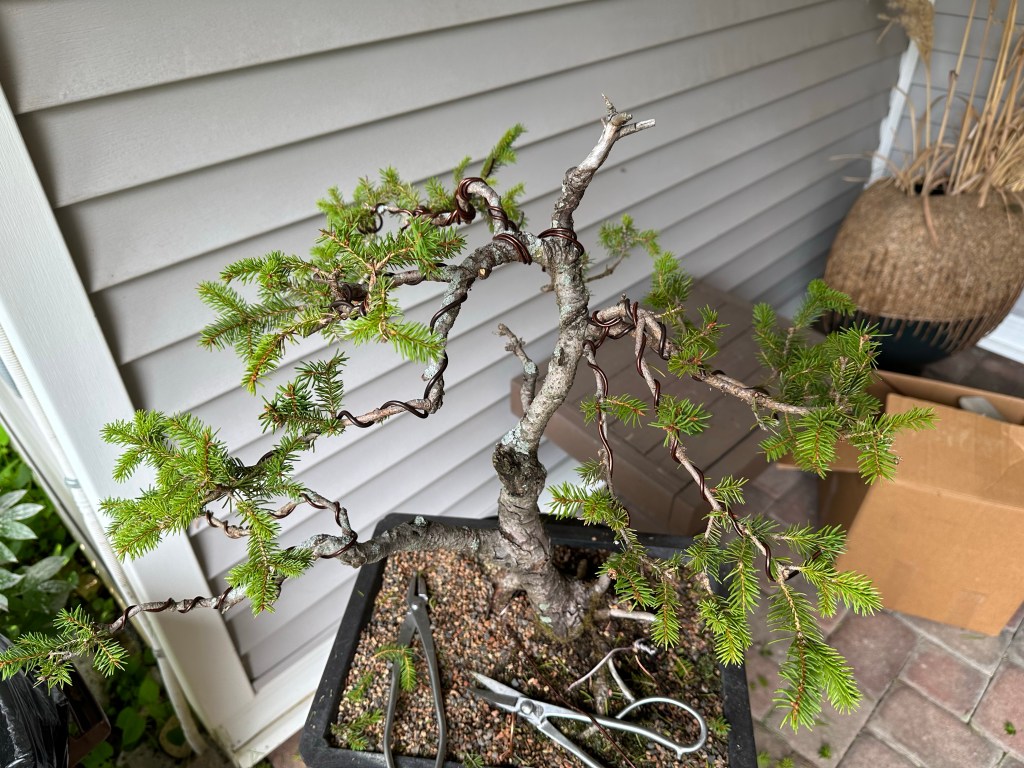
Here’s the tree after the restyle.
I left more on it this time, given that it was stressed.
Wiring the top in a typical “conifer comb over” many bonsai artists practice.
The only tips or tricks I can give you on this particular variety and species of tree (considering I’m near ignorant as to what it specifically is) is to not cut it back too much, water and fertilize as one would with the spruce genus, and pay attention to severe, sudden drops in temps near springtime bud formation.
I didn’t fertilize this time, except with a miracle product called “Micromax”, which is full of those micronutrients usually missing in most fertilizer compositions (macro nutrients are the NPK of regular ferts: nitrogen, phosphorus, and potassium, micros would be things like molybdenum or boron or even things like chlorine or copper that you might think are detrimental to a plant).
And that’s how I left it for this year. Hopefully I’ll see it again in my future travels. I don’t get to see many trees after I work on them in my tours. So a return this year was sweet.
Thank you Tom, and thank you Ruthie. You are both the real deal.
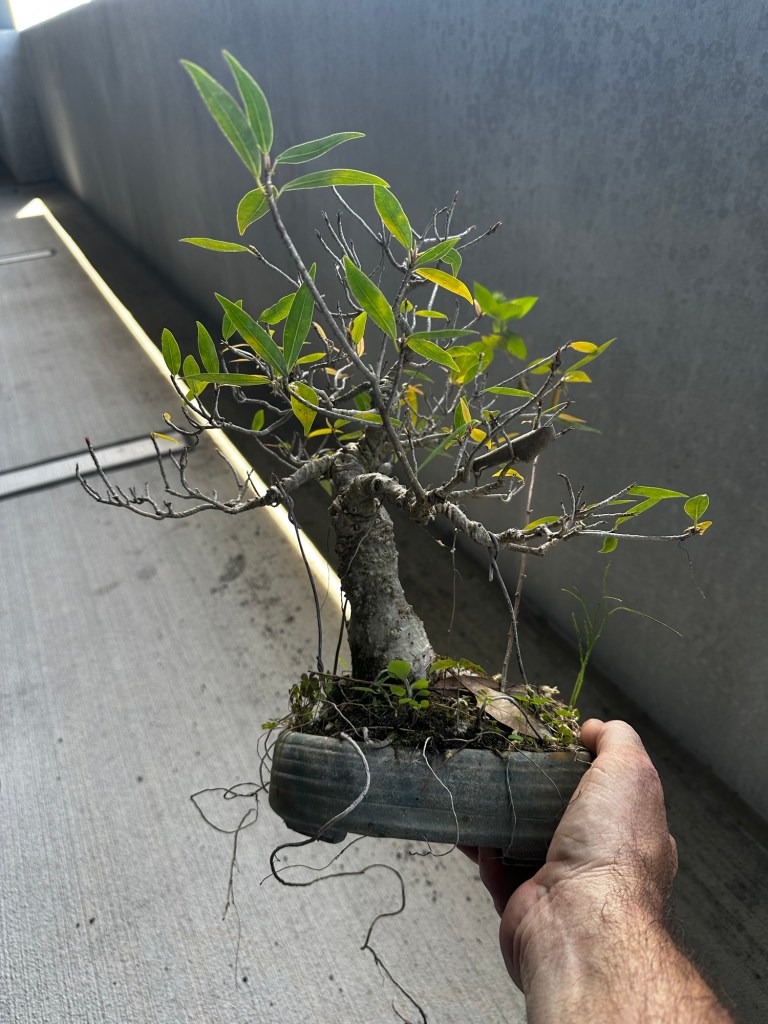
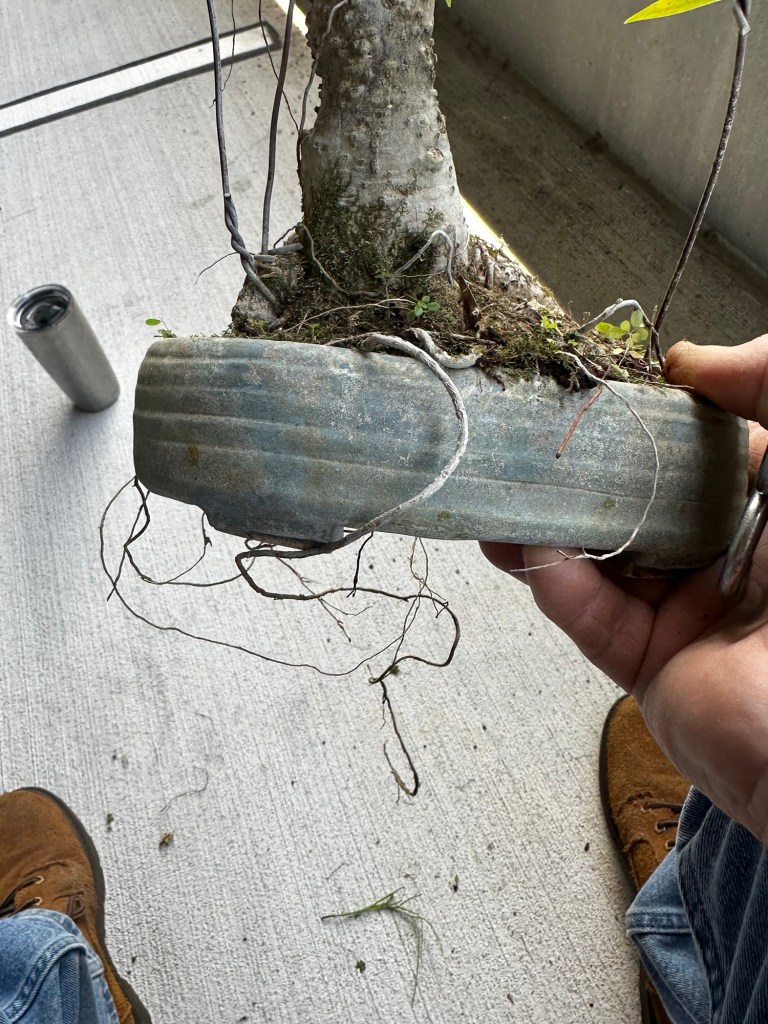
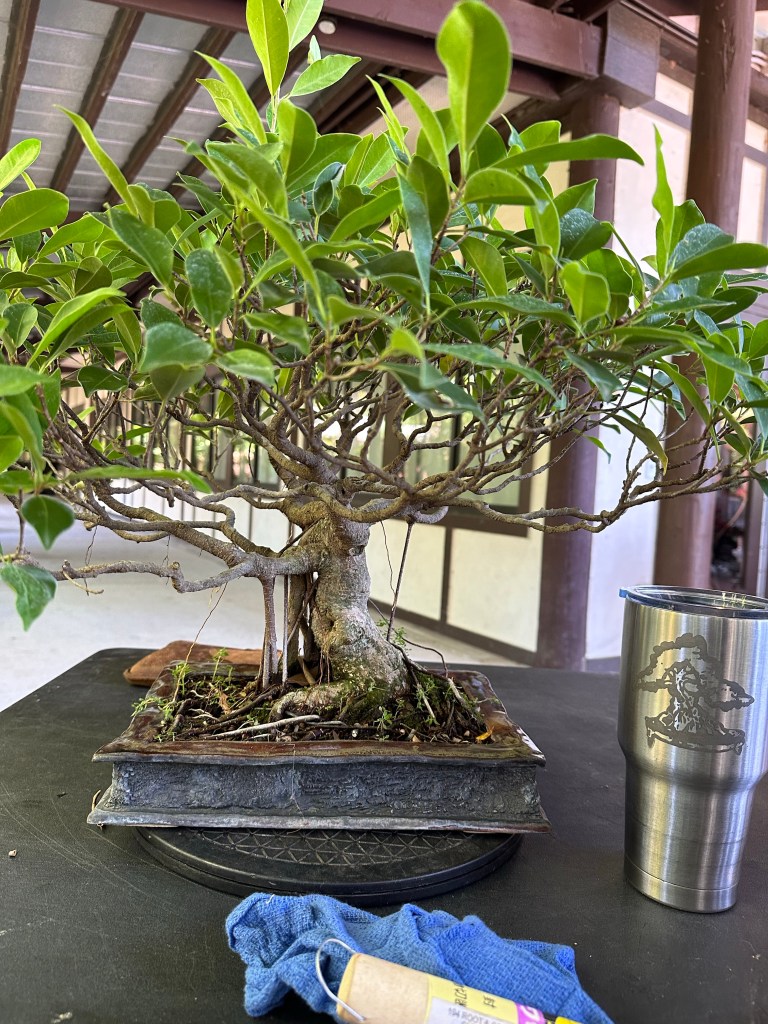
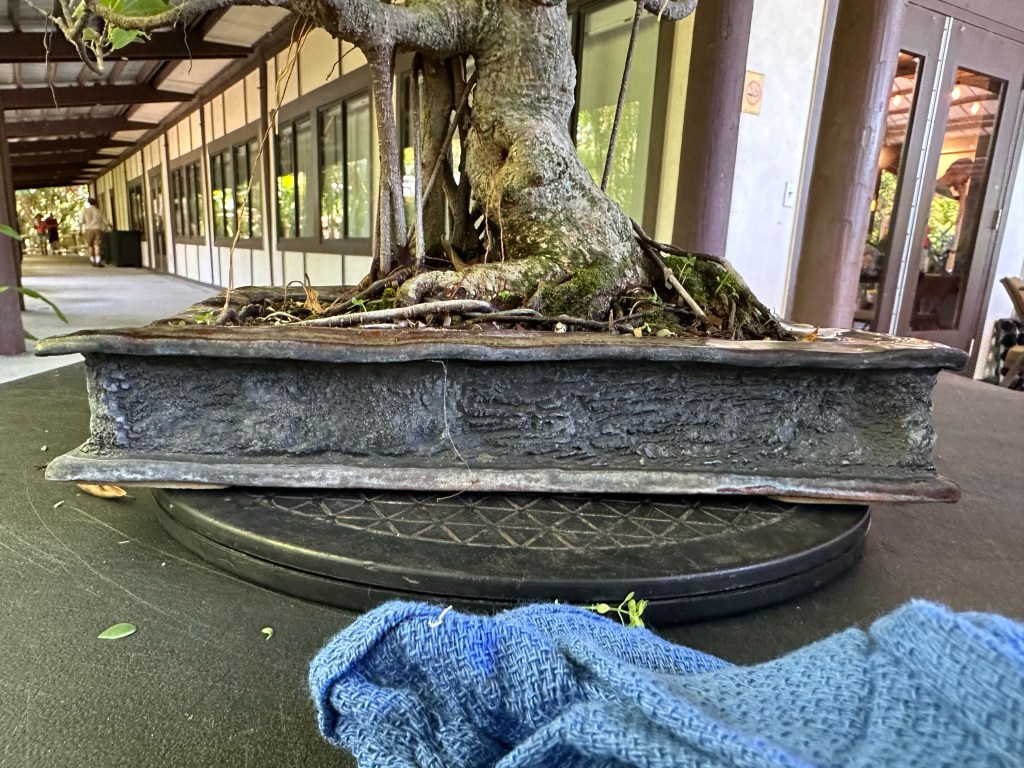
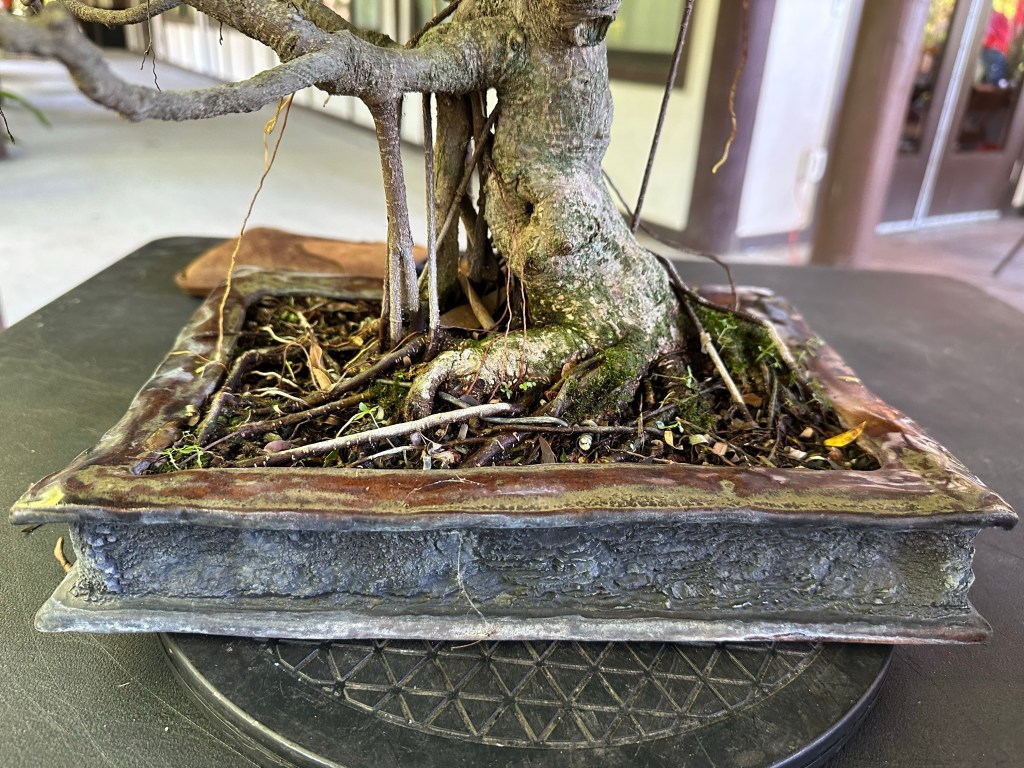
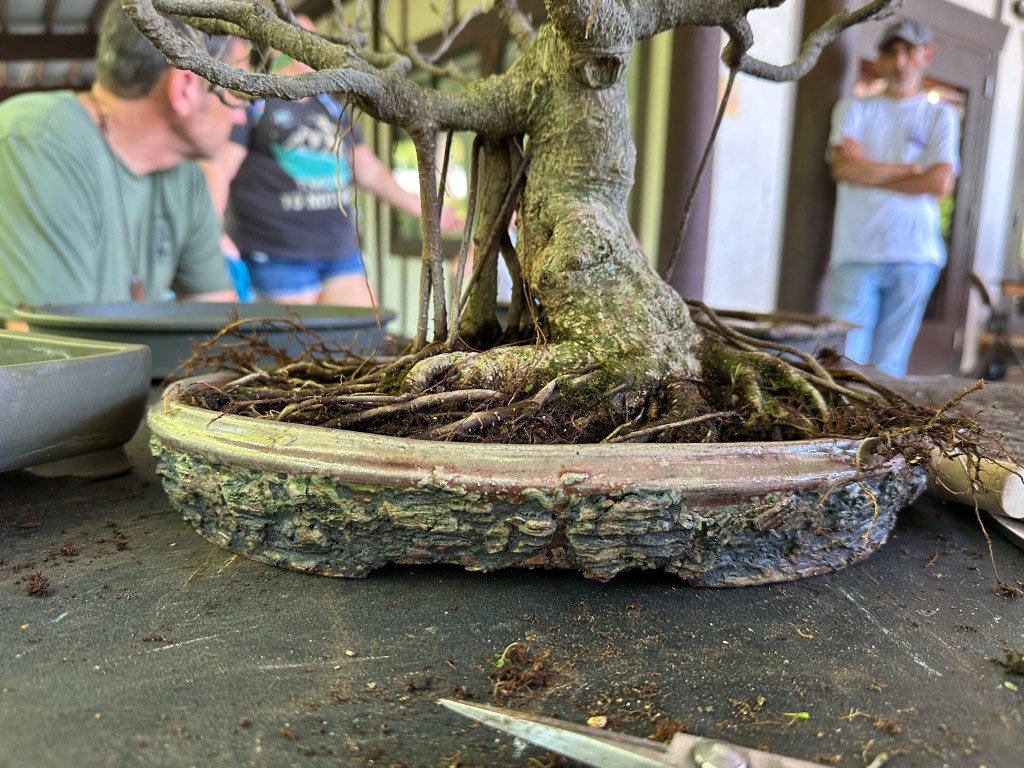
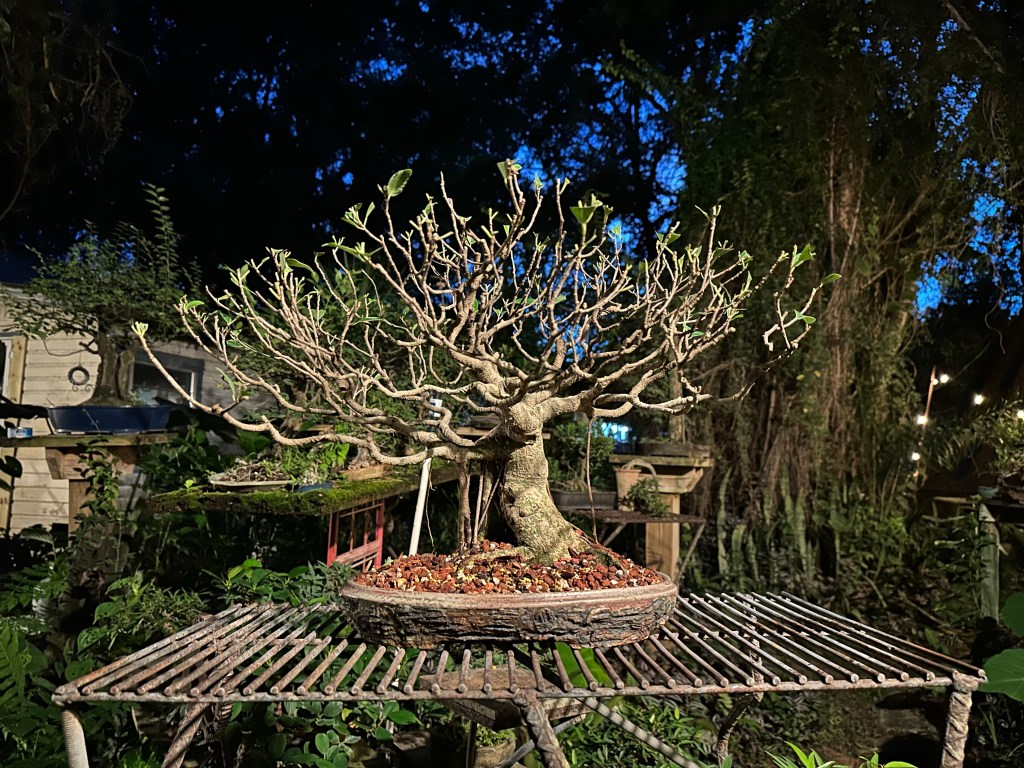
This ficus has been in this remarkable container for..ahem..four or five years, without a repot. I’m sad to say it needs a bigger pot. Sad because I love the pot and the tree combo.
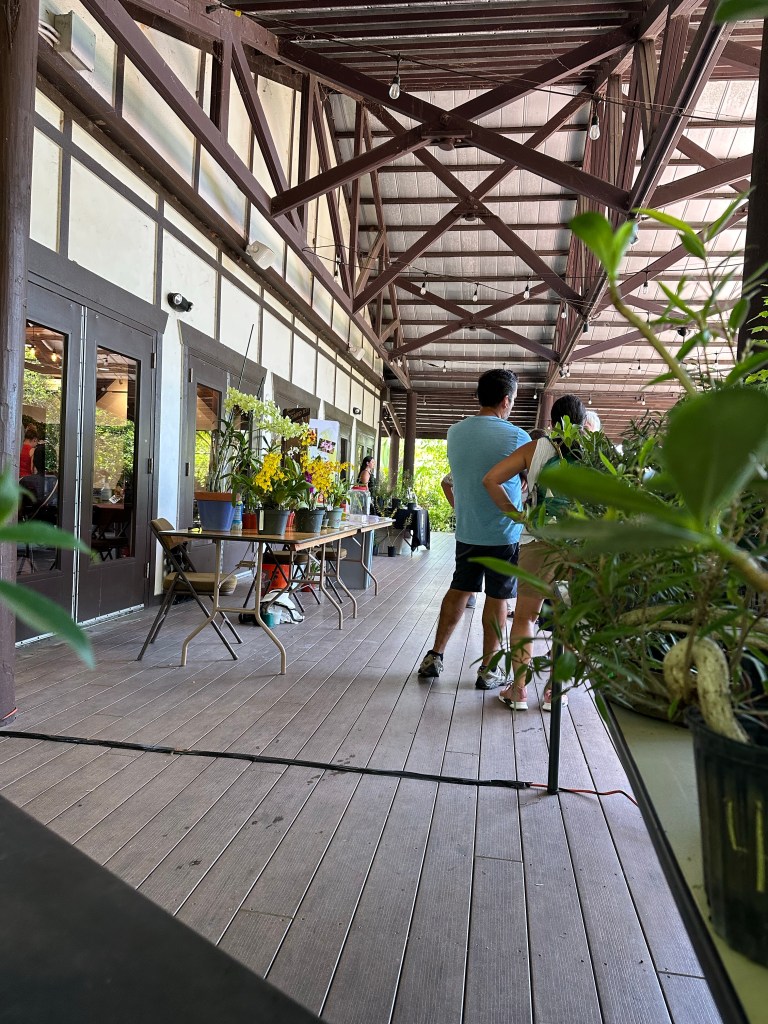
Today, I’m hanging out, selling my wares and shooting the shit (as I’m known to do) at the Brevard Zoo. No, I’m not joining the swamp ape exhibit as the first living specimen ….
…the Bonsai Society of Brevard has an annual show at the zoo, uh…every year (I guess that’s what “annual” means), and I’m here (or there. Sometime the tenses get mixed up in my wandering and rambling prose style. I think it adds flavor and character. Some people say it drives them crazy. I say to those people that their insanity was there already, and I just exacerbated it, allowing it to blossom into the full blown psychotic episode that they’ve been waiting for their whole lives. You see, some people need an excuse but we of lesser gods, we know you don’t…..).
Above, we have the local fauna, Floridanus nativitus, below, are some imported beasts, Giraffa camelopardalis.
And my wife, or, as we call her on Da’ Blog, “She Who Must Be Obeyed”; she’s from Indiana.
Now, since you know where I am, and what I’m doing, and I’ve gotten in enough trouble with the wife, let’s get back to the tree.
The job is to remove the tree from the pot.
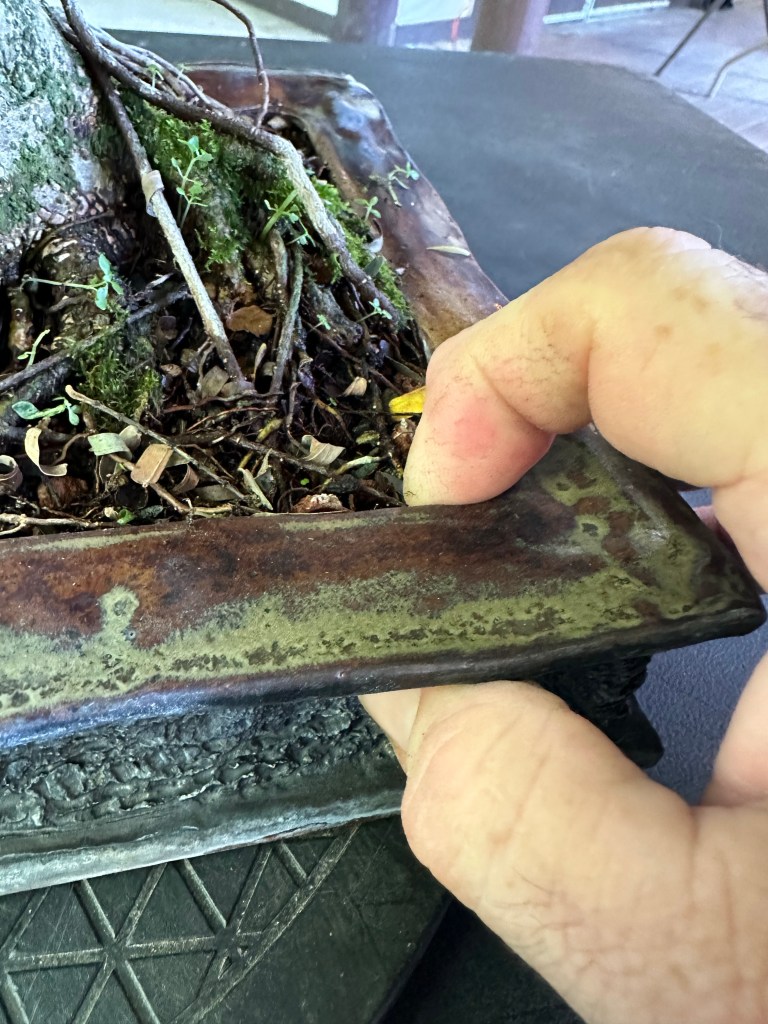
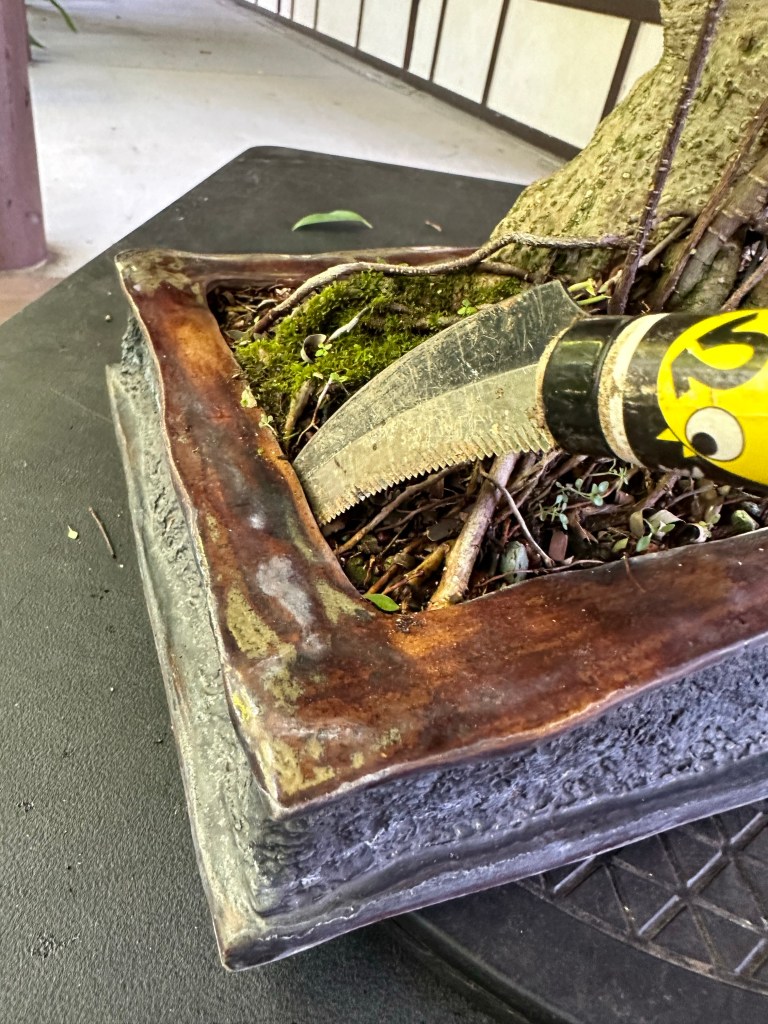
For those “in the know”, it’s really really really (really) advised against potting a ficus in a pot that has an inwardly curving lip.
Ficus (I’m going to pronounce that the British way, “Fick-us”, as I’m feeling all fancy right now), make roots. Lotsa roots.
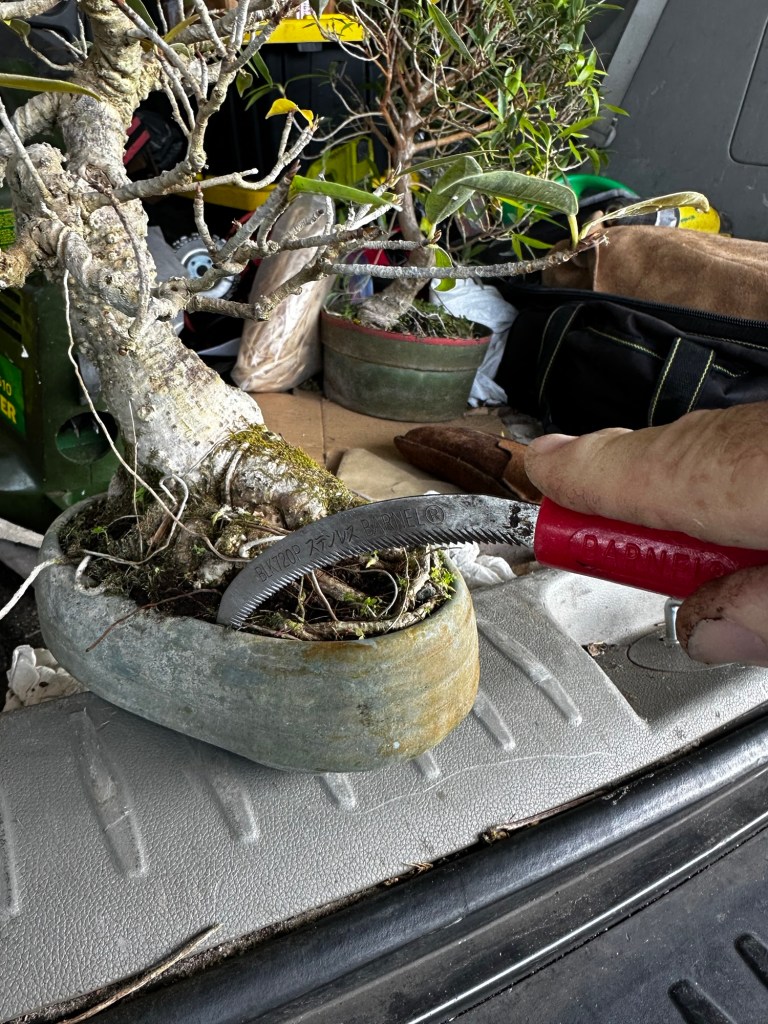
I have to bring in a highly specialized (and imported) root cutter (and sod cutter too, I guess, if you read the handle. But I just don’t see myself on my knees, my face in the grass, cutting out pieces of sod).
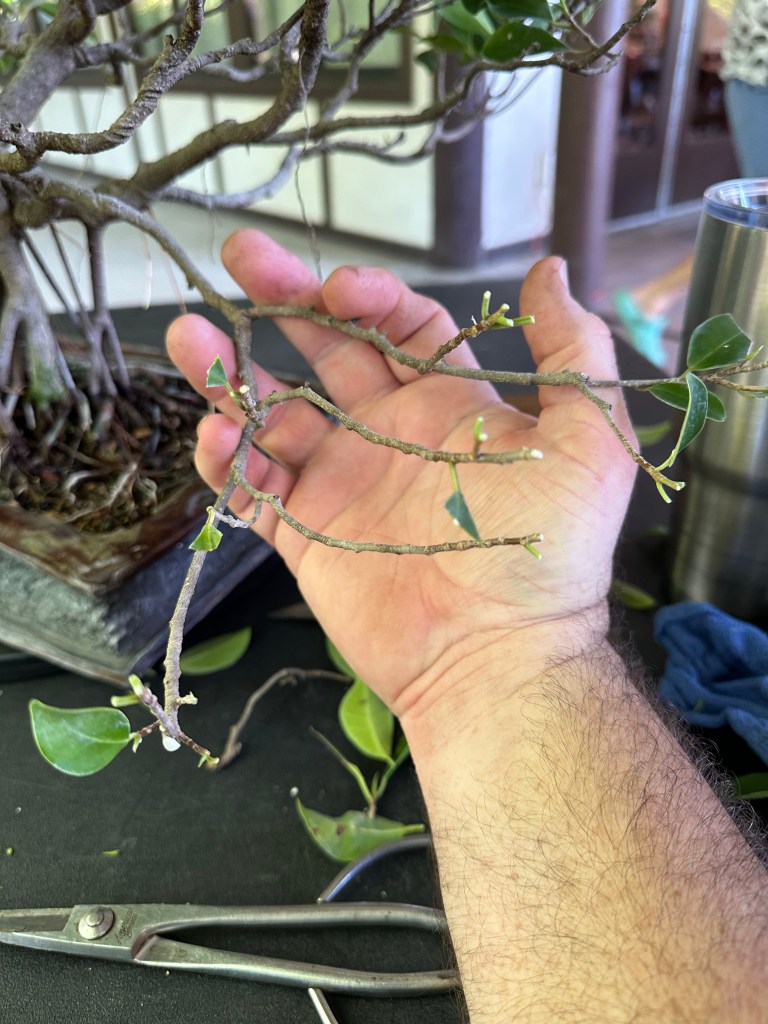
But first, the inevitable cutback and defoliation.
You don’t need to see that part, just scroll back to the hundreds of articles I’ve written and in which I’ve described the process.
I will, however, note that this tree is the species standard Ficus microcarpa. And that means I leave a little green on the tips so there won’t be dieback.
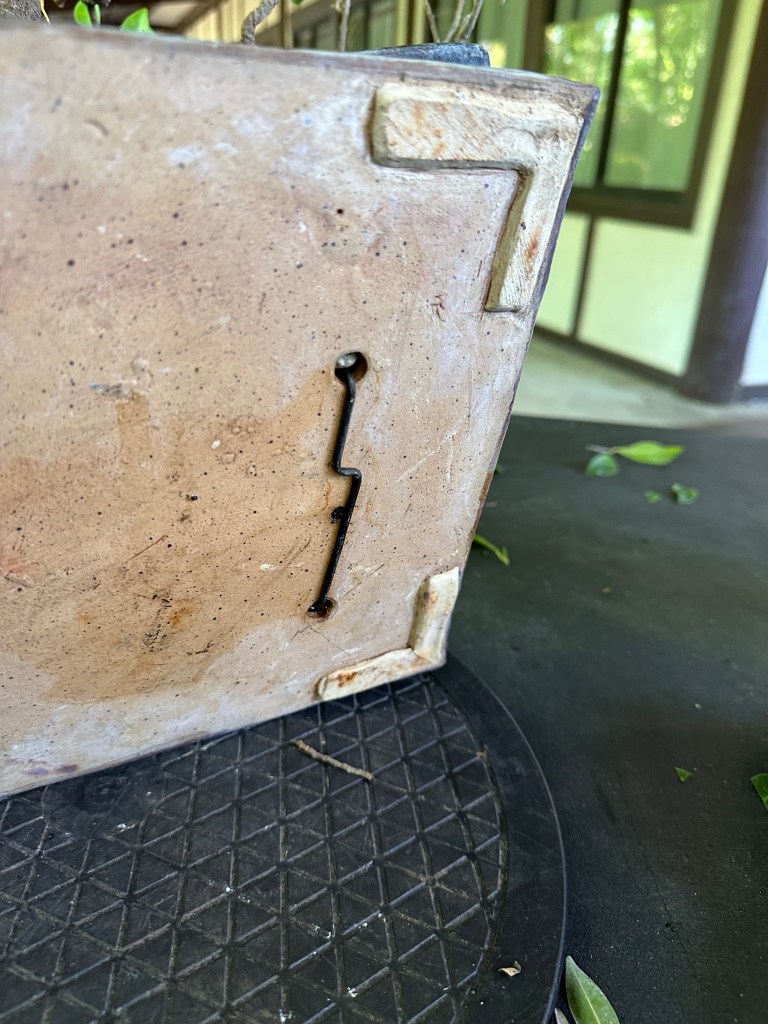
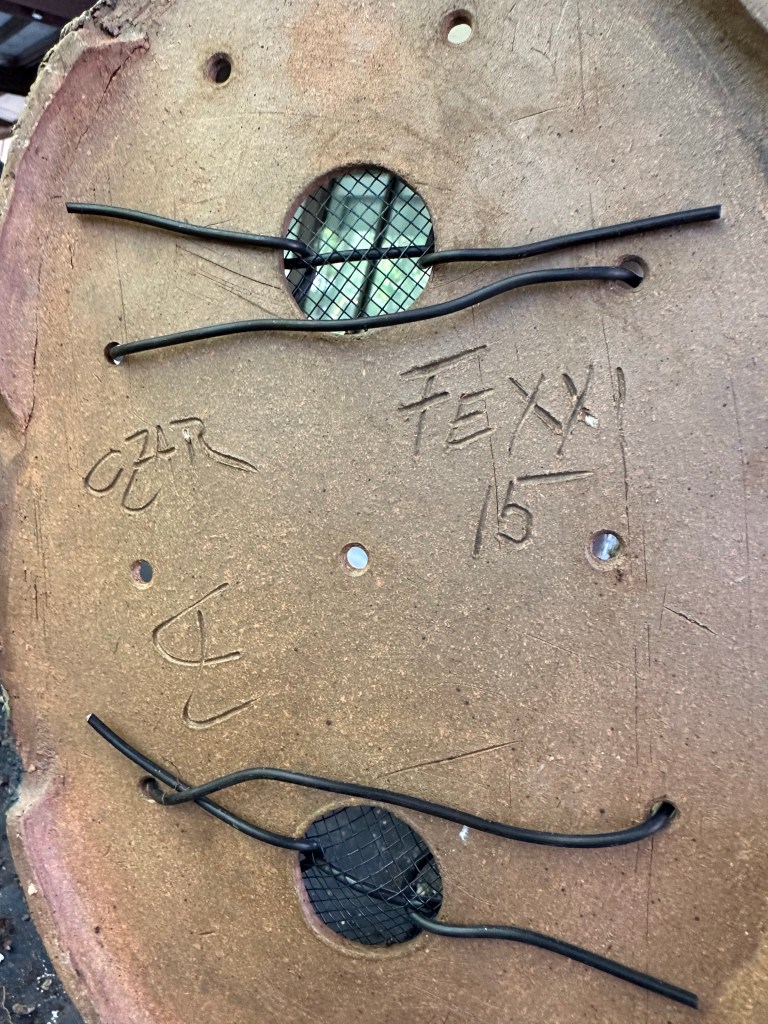
Now to the hard part, removing the tree from the pot. First, cut the tie down wires, on the bottom and top.
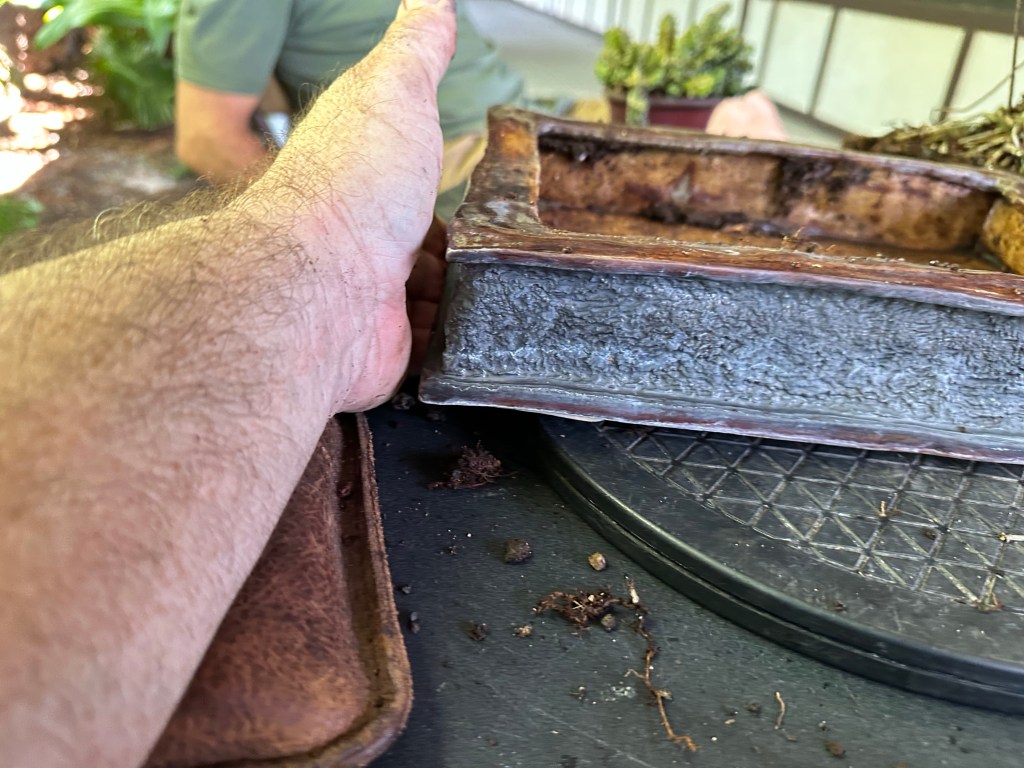
Then we start cutting around the pots perimeter.
As shown below.
Not too hard with that tool. I usually use a steak knife (which was stolen from The Sizzler Steakhouse and Buffet) but it’s at home in The Book. The gentleman I’m speaking with is Doug, The Hippie Dad.
Now to birth the tree. Another video. Yes, I’m using my scissors. They worked. I use my scissors for many things I’m not supposed to use them for.
Looks like a tortoise mouth, right? And again, that was Doug. Thanks for the muscles.
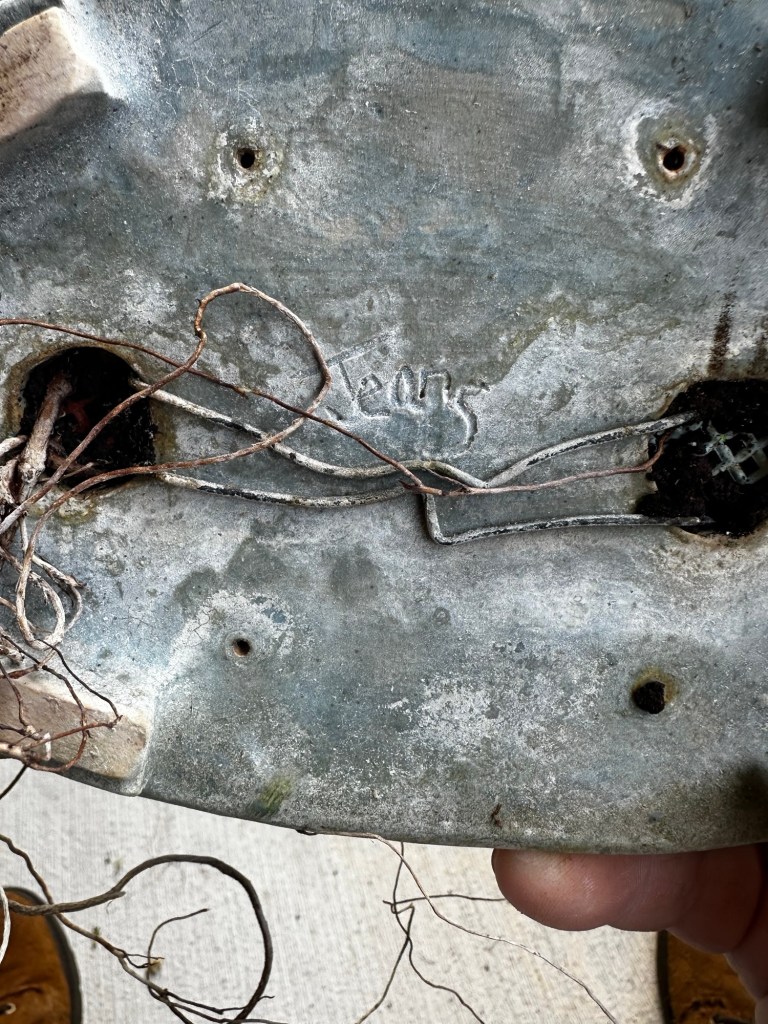
The pot was made by Daniel Holderer. He called it “Cradle for Life”.
I’ll find something else to put in in. It’s been a good container for this tree.
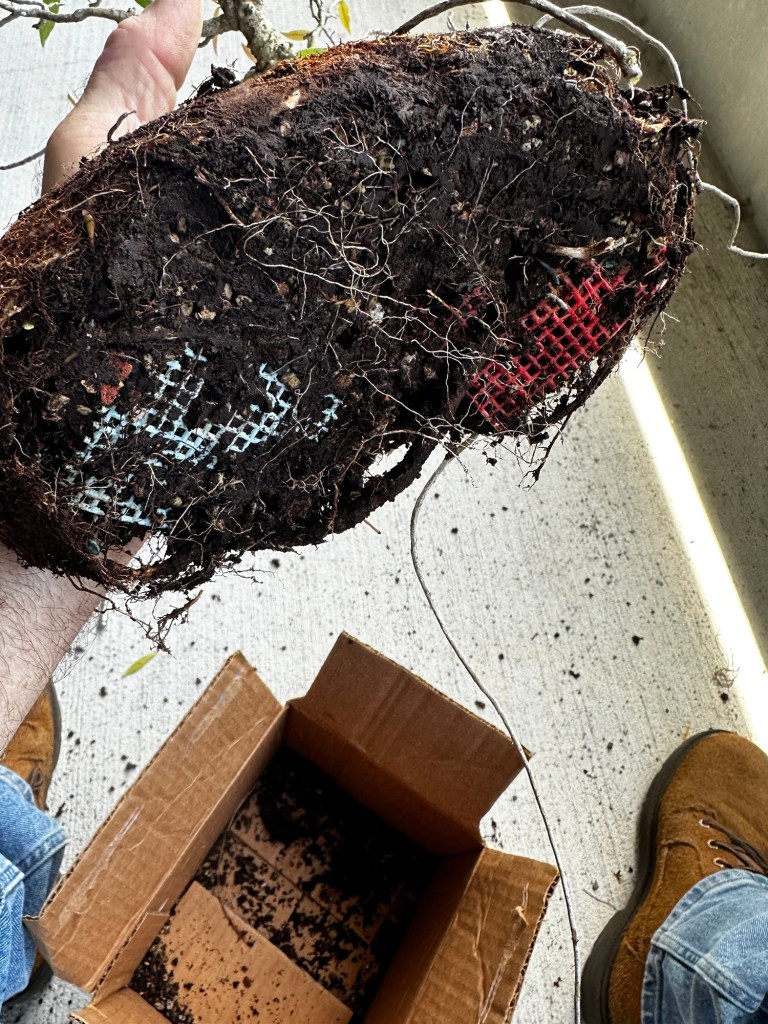
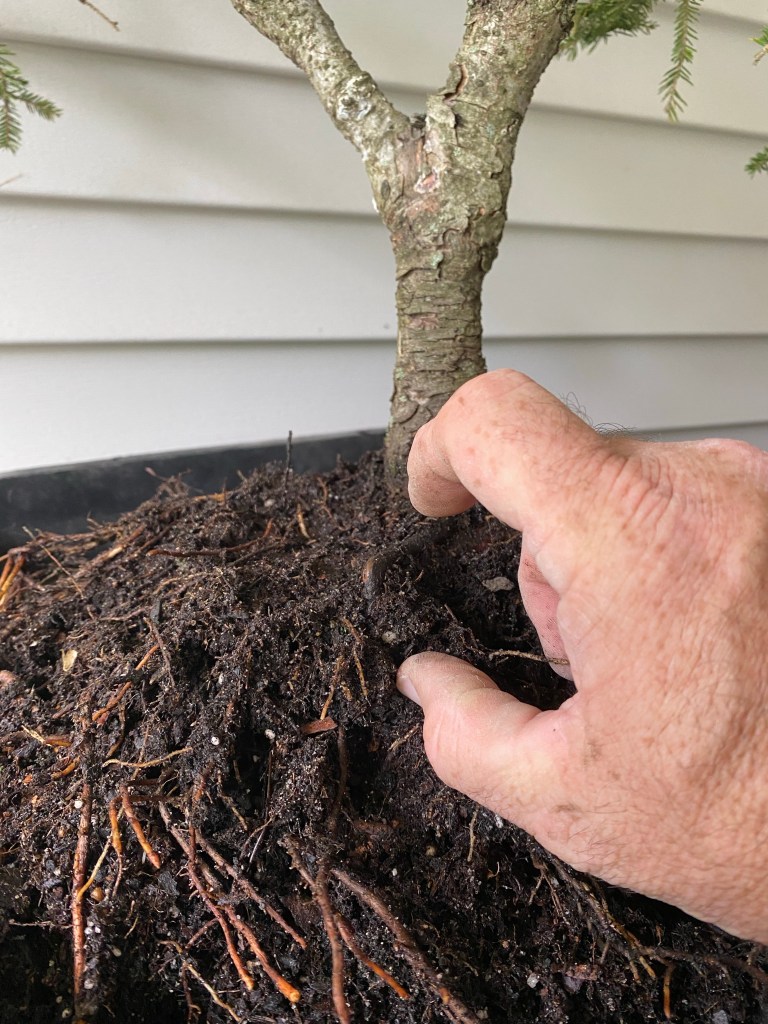
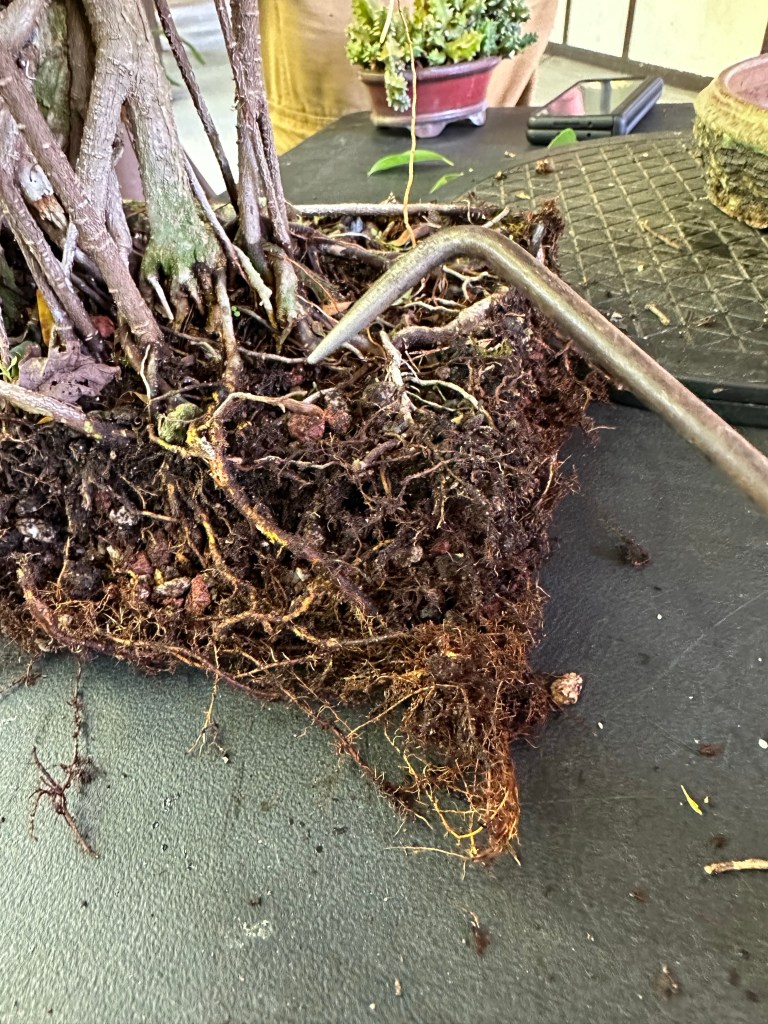
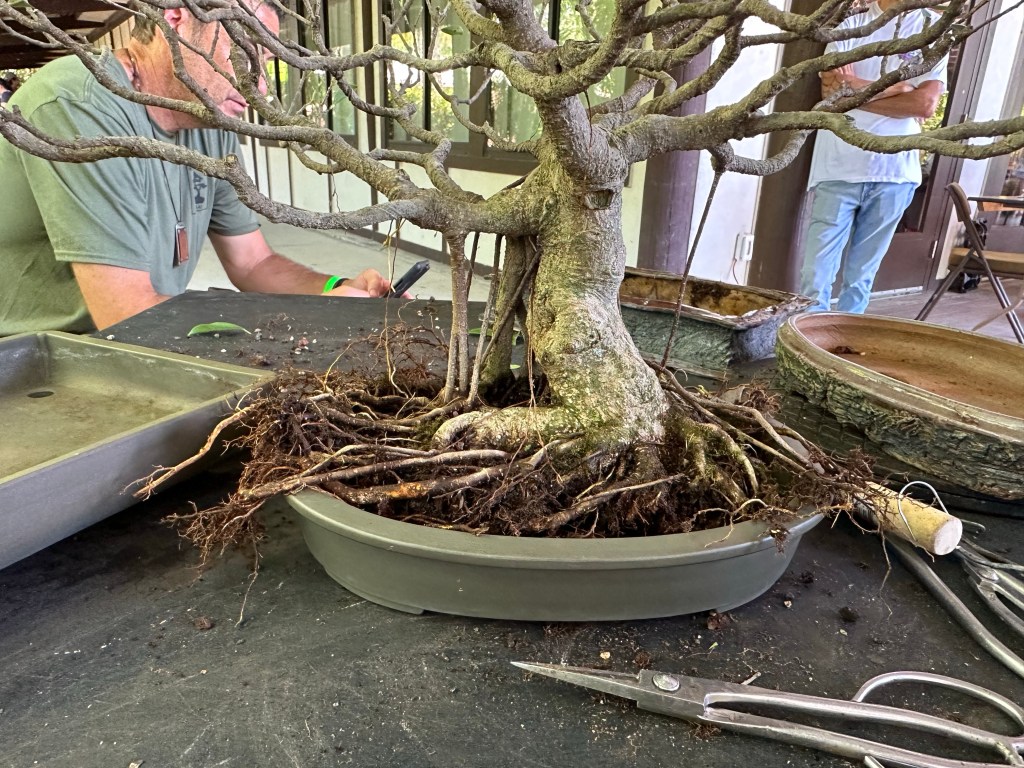
Now to rake out the roots.
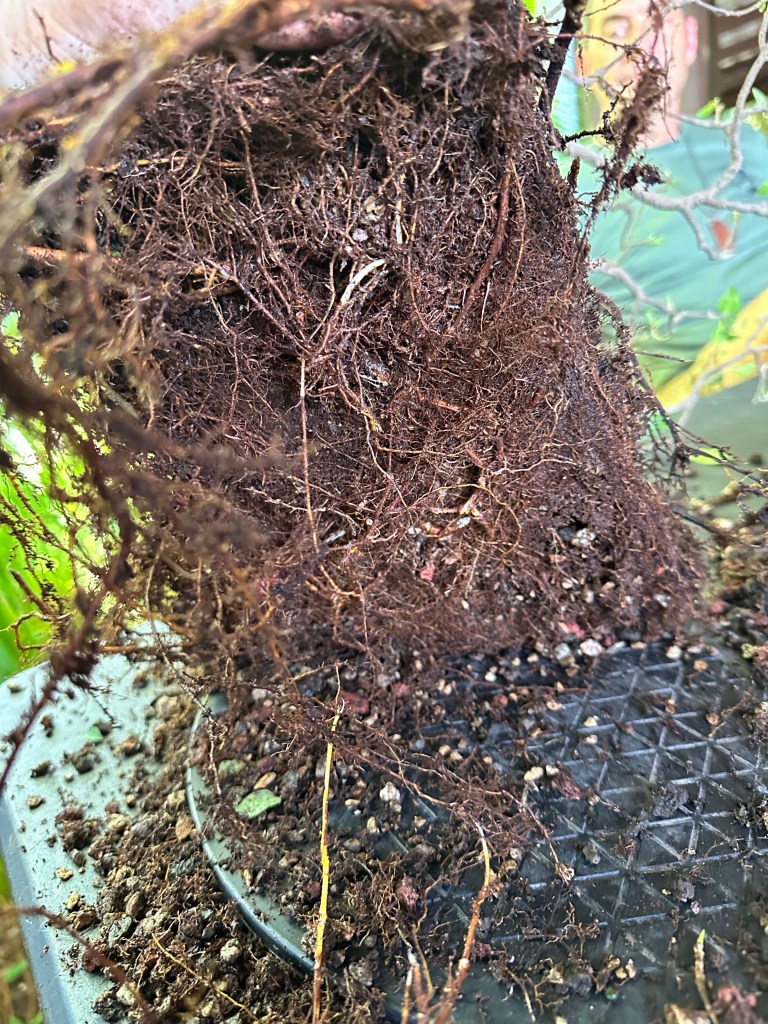
It’s just a little root bound.
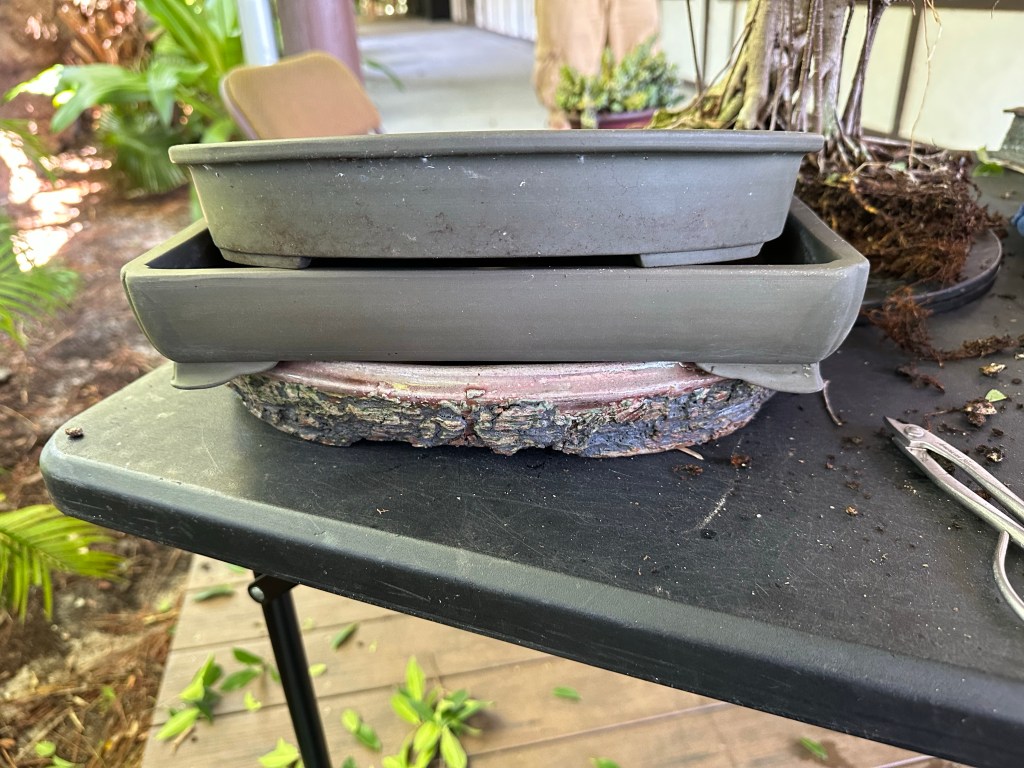
I brought three pots with me to choose from. Two of those antique Japanese pots with the weird green clay, and a beautiful oval from my friend Cesar Labrador.
The oval one’s too small…
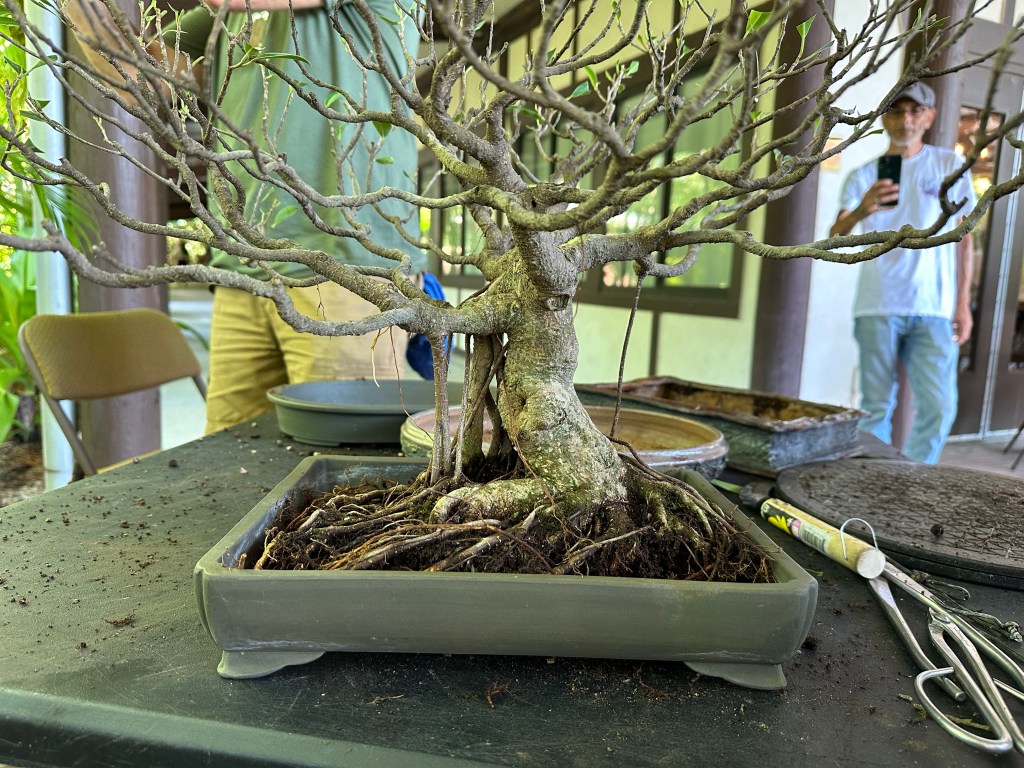
….the rectangle one’s about right, but the style is too formal for my “Tropical Broom Style” ficus….
….ahhh, this one is just right!
Some screen, tie down wire….
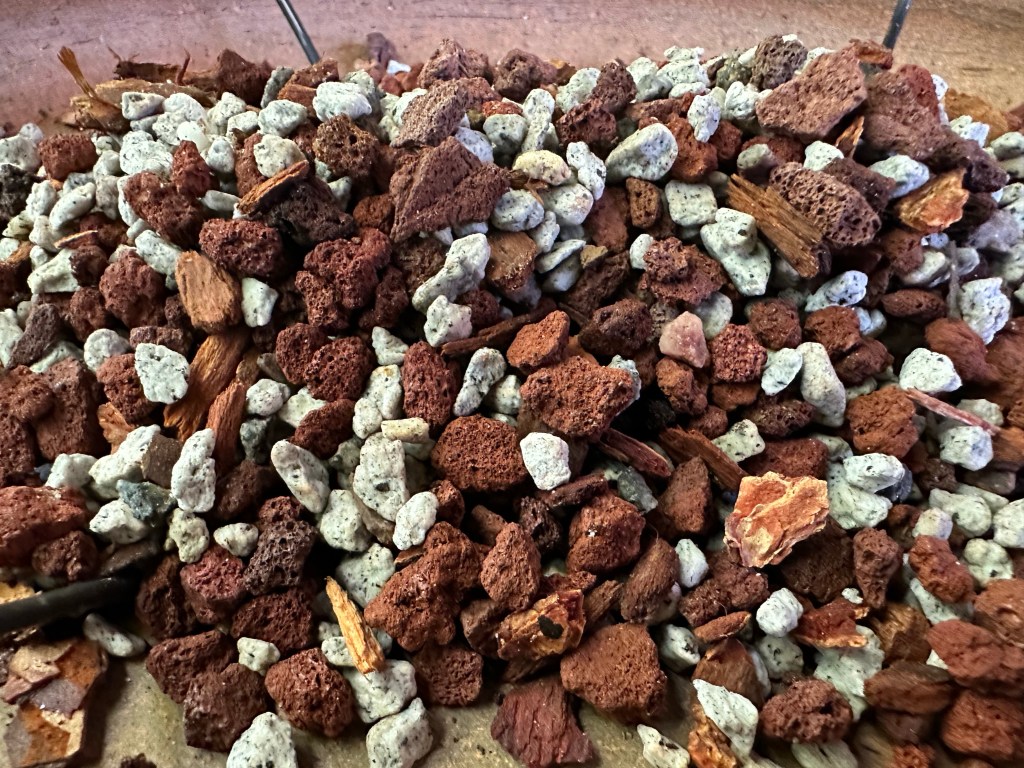
Soil….
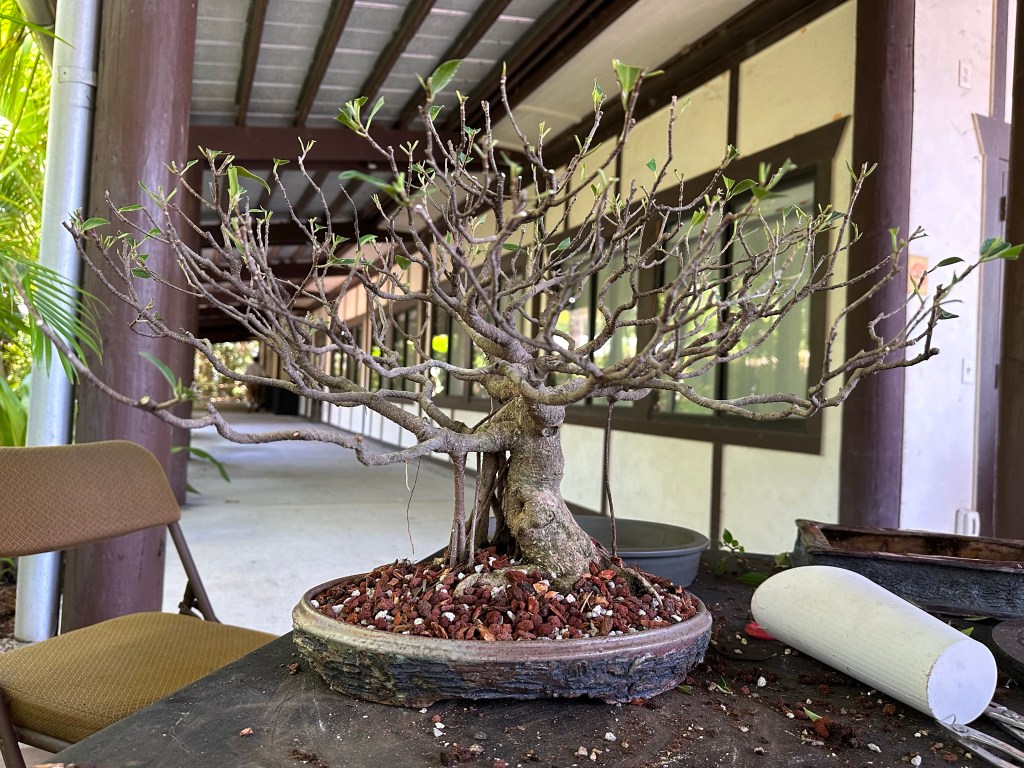
And we are done.
Looks good back on the bench at the nursery.
Tropical Broom Style. I made that up years ago but I think it’s appropriate for this ficus. And everything was made up in the beginning anyway. Whoa! Wait! Mind blown! Right? You mean you can just make up things?
Well now, did the story start with scotch? Or end with scotch? It’s kind of hazy looking back now. But I’ll try….wait, I remember…it started with bourbon!
It actually began in 2019, but you didn’t see the tree until 2021, 2 years ago (or, two years from the post, in case you are reading this in the year 3023. It’s now 2023, taking place in the month of July. If you don’t use the word July, it’s the seventh month of the solar year, named for Julias Caesar, the first Roman emperor (or dictator) after abolishing the Roman republic. the Terran summer solstice in the northern hemisphere occurred on June 21, 2023, and this debauchery occurred 28 days later. Terra or Earth, is the third planet from our sun, called Sol, in the Solar System, in the Milky Way Galaxy. Hopefully that’s enough for the far future readers to understand how we told time back in the ancient 21st century days of legend.)
Today , or rather, late July (don’t make me go through that again). We have a ficus microcarpa, what one might call “ginseng”. But that’s just a marketing term. Ginseng are not figs, figs aren’t ginseng. You make Newtons out of figs, and Monsters out of ginseng. The cookie and beverage, that is.
Ok, now that you’re up to speed, let’s get to the work….
I’m in Toledo, or Maumee, to be precise. It’s pronounced just like “mommy” by the locals. I feel a song should be sung. I wanna go back to my Maumee.
I’m with my two good friends, John and Julie. They take care of me when I’m there.
The tree is potted in an aluminum serving container. There were a few who said that we’d be poisoning the tree with the metal tray.
Looking below…
….I’d say, naaah! in fact, it looks good for a ficus in the north. Damn, I mean, it’s almost Canada fer crissakes. They don’t say “Holy Toledo!” for nothing.
Anyway, we did a lot of work that day. But not much on this ficus. We didn’t have a pot, you see. So we decided to get all “Muckety Mucked” up.
24 year…25 year….26 year, or, as the bottle suggests, one little piggy, two little piggies, and three little piggies.
We finished the 24 year. Made a dent in the 25 and 26. Wait, is this a bonsai blog or a drinking blog?!
It’s both. Sometimes.
And to the dead soldiers, we salute you!
The next morning, hangovers and bright lights notwithstanding, we had to get up early to go to Michigan (I know, that sounds like the first line in the “Great American Novel” we writers all would love to write. Maybe…..).
We had to get a decent pot, so we visited the Flower Market (Which has changed its name to Green Witch Gardens)
It’s a damn cool place to visit. Not only do they have bonsai, but there are cats…
…that’s cats, plural.
And pottery from amazing American artists.
The trees!
Julie hiding behind a tree.
Familiar weeds. These are what are called wandering dudes now. I feed them to the tortoises. Speaking of which….
Tortoises!
Only the best bonsai nurseries have tortoises.
We got some pots.
Then went back to Toledo.
And we got back to work.
For being in a shallow aluminum pan, it’s grown some good roots.
The “pot” has even held up well. We could use it again.
Looks solid.
Raking out the roots….
Here’s the new pot we got for the ficus.
Sweet, ain’t it?
Tree is ready
Can I mention again how good the roots are?
We had split some of the larger ones (go back and read the first post).
Hey, it even fits in the new pot.
Damn those are sexy roots. Must be the soil. The vaunted, rare and near mythic “All-American Red, White, and Blue, Adamaskwhy SuperMix” .
Just to prove we did other work, here’s some examples. A willow leaf.
A tigerbark.
An azalea.
A willow leaf root cutting.
And another.
I must say, I can’t believe what an amazing two days that was.
But I had a hard day while I was writing this piece. Something that should not be happening is. And I posted to Facebook; I quoted JRR Tolkien, the part where Frodo asks of Gandalf:
“I wish it need not have happened in my time,” said Frodo. “So do I,” said Gandalf, “and so do all who live to see such times. But that is not for them to decide. All we have to decide is what to do with the time that is given us.” J.R.R. Tolkien, The Fellowship of the Ring
And John replied “and what you do happens one word at a time, one leaf at a time, one sunrise at a time.”
Here’s the tree all those years ago. We ground layered it (hence the post title).
One tree at a time. Even if it takes years to bring it to its potential.
One leaf at a time.
One branch.
One root sometimes.
The two years ago..
And now.
Bonsai is a journey. And getting there is sometimes the only reason to go somewhere. You can buy a tree, but making a tree, especially this one, that started so humbly, is way more fun.
John has done well with it. I’m honored to have helped him, and thanks to both John and Julie for letting this strange bonsai guy (me) into their home.
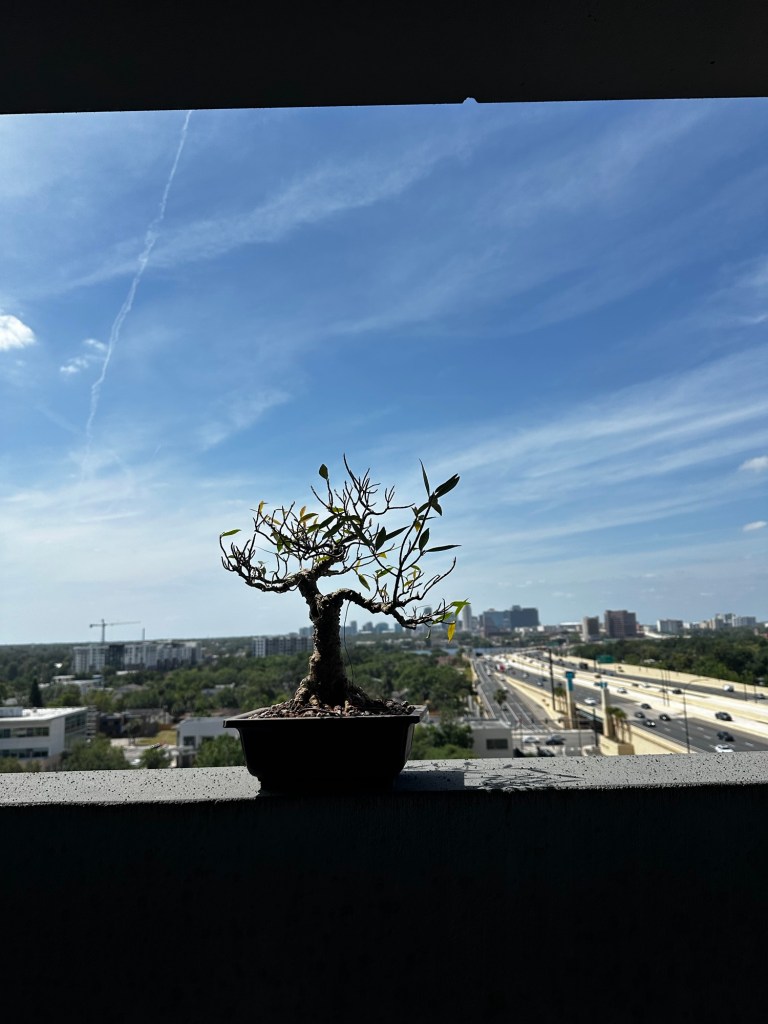
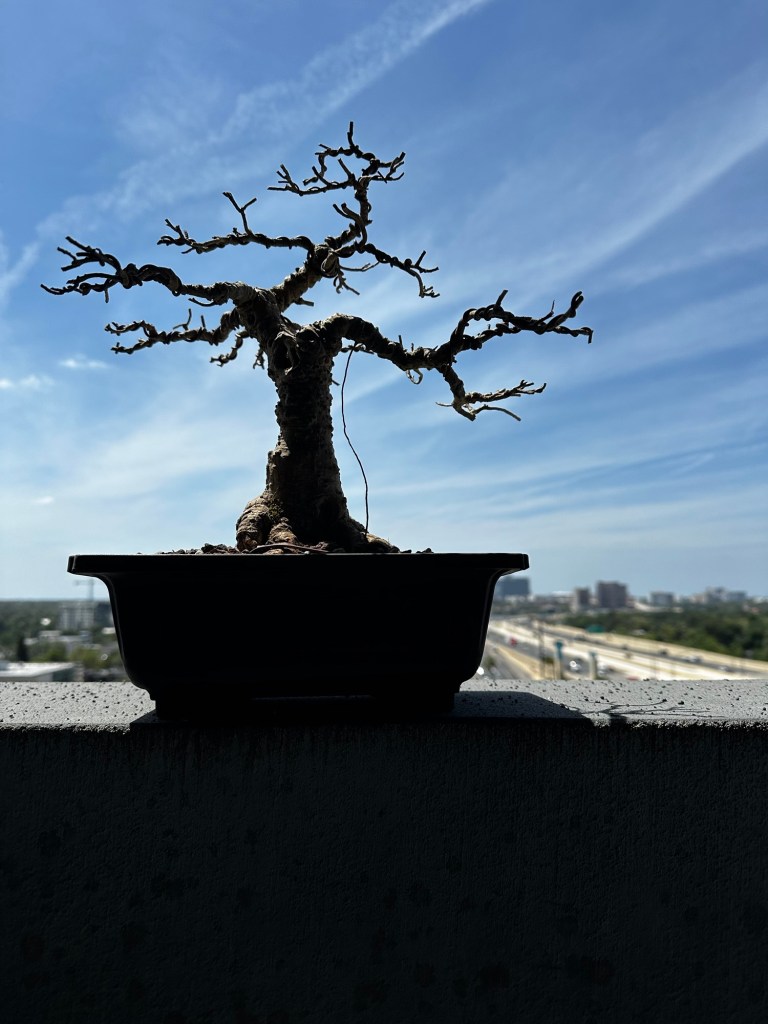
Here’s a tree. Willow leaf fig. Yeah, the one everybody says they can’t decide on a name for. Nerifolia? Salicifolia? Wilowleafyanus? But they did, about ten years ago. “They” being botanists: it’s called Ficus salicaria, which is literally -willow leaf fig. Also, I’ve been writing this post for about six months, and the work was done early spring, before the rainy season in Orlando.
Let’s start with an interesting note on growing the willow leaf ficus outside all year in Orlando. In the spring, if you’ve done no work on them since last summer, they will drop all their leaves and grow new ones within a week, much like a deciduous tree, or, more specifically, like Quercus virginiana, the southern live oak. First time it happened to me I was freaking.
Don’t worry though, the leaf drop may seem pathological (meaning caused by a pathogen or illness) but it’s natural. It quite literally drops its old, winter leaves, which are adapted to the lower light intensity and short light intervals of winter, and grows new ones that are better adapted to the heat, length, and intensity of spring and summer in Florida.
If that sounds familiar to my northern peeps, it’s this process, plus my own experience pruning and moving trees around in my nursery during the Florida Winter, that informed and enriched my own teaching. Mainly, I recommend this technique to my northern students: when moving a tropical tree from outside to inside, or versa vice, inside to outside, defoliate. A tropical tree will drop old leaves instead of trying to change them according to their new environment.
Meaning, outside leaves are not adapted to inside light. Remove them and the tree will grow new, indoor leaves, when it’s inside. And do it again when returning the tree outside.
Works for me, and those students up north who follow the advice.
The pot it’s currently in was made by a friend’s wife, Jean. But it’s too small now.
Jean is an all around artist, and has done theatrical make-up work in movies and even on some of the actors in Star Wars events. You’ve seen her work I’m sure.
She makes a good container too. But it’s time to get a bigger one for the tree.
The tree was acquired from one of the Facebook Bonsai Auction pages. From a former friend named Seth Nelson.
There’s a name that gives me a bitter taste in my mouth. There are very few of my readers and students who’ve heard the story about this kid. Or man by now, I’m thinking.
When I knew him, he was both young in temperament and age. I’m thinking that he has grown up now.
When I first met him, he was looking for a mentor. Unfortunately, that was me for a few short years. I say “unfortunately” on his behalf, not for me.
I can hear it now, “What does that even mean?” Well, this will be hard to write, and I’m not going to be pointing fingers, except back at myself, or trying to persuade you that I’m an angel, because I’m not, but at that time in my life, I was still young and stupid too. I’m not sure I’ve matured.
Let’s work on the tree and I’ll throw in my thoughts. And, Hell, if you don’t want to read it, just look at the pictures. I’m very reluctant to write it.
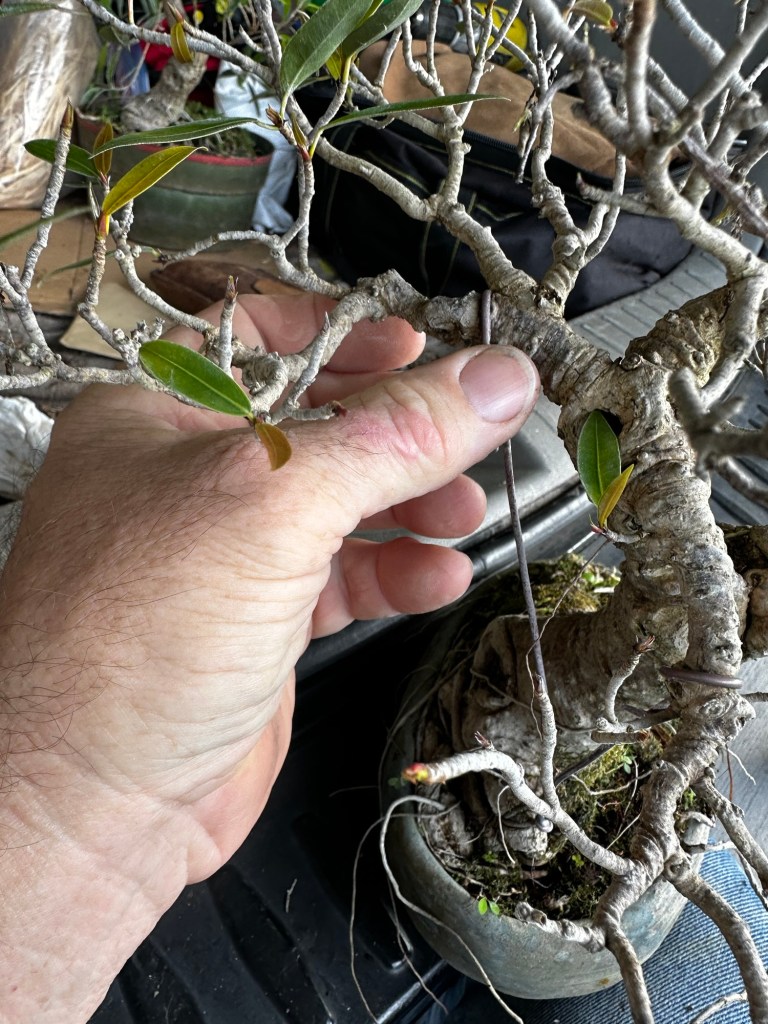
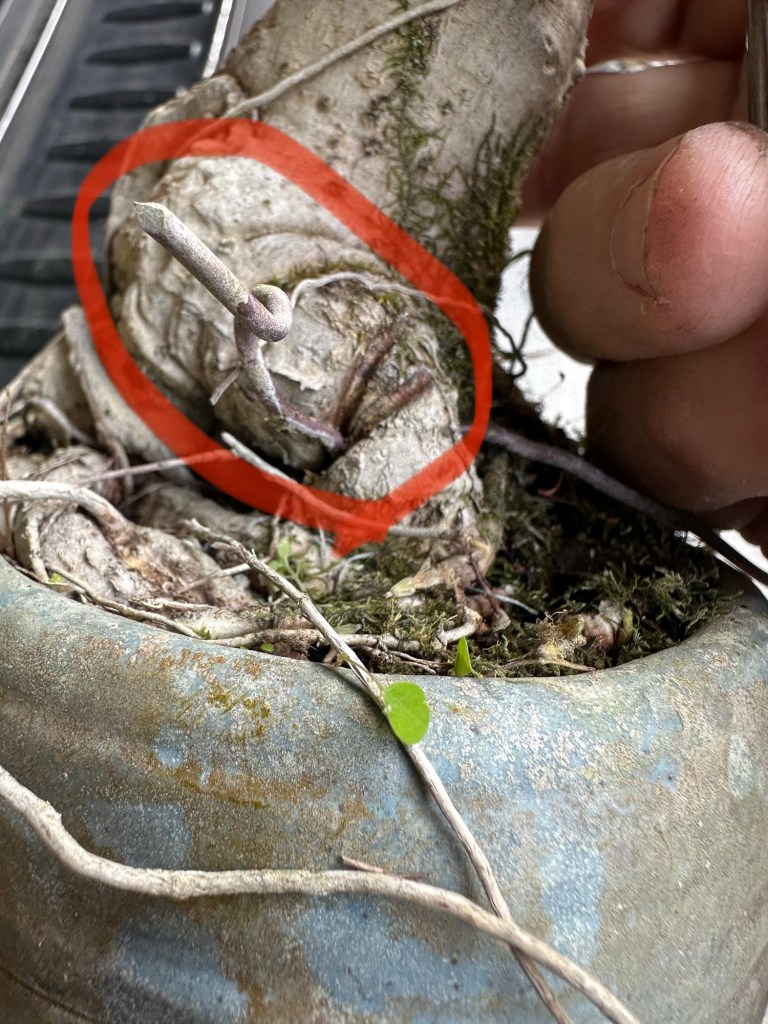
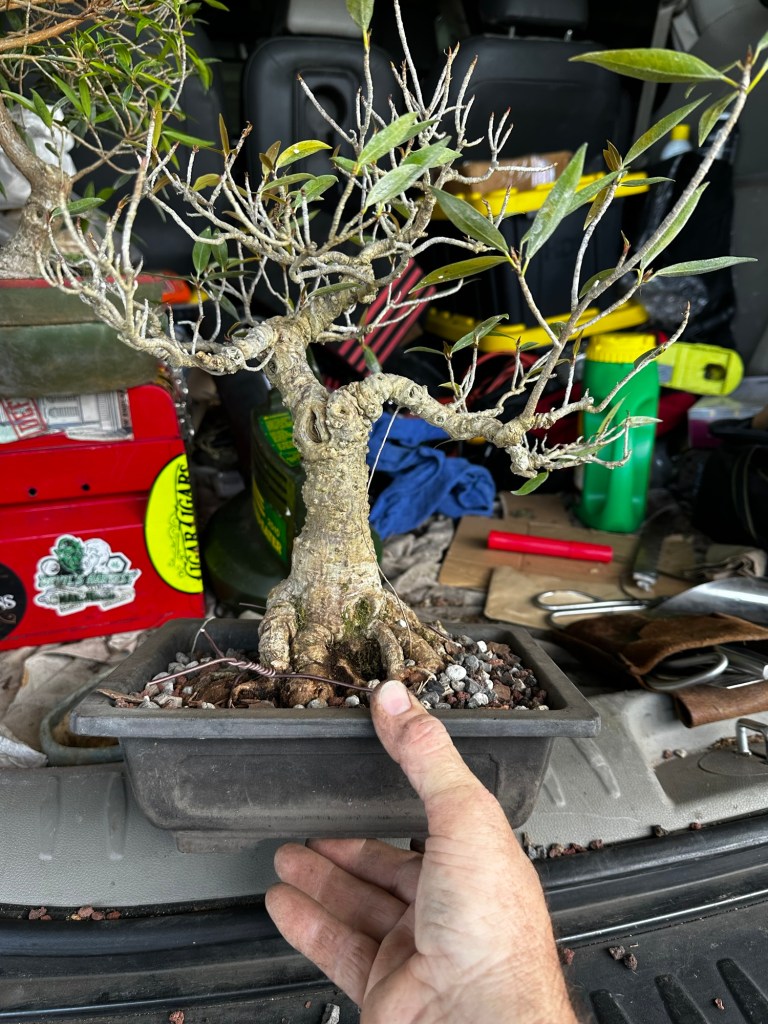
I guess the ficus has been in this pot for too long. That wire is just a bit cut in. The reality is that I have been thinking about this tree for years and ignoring it at the same time. I knew if I worked on it, I’d have to document the process and then its story had to be told.
The red circle shows the tie-down wire cuts. You gotta tie them down so they don’t get up and walk away.
Seth was selling the tree to help pay for something, I think maybe a starter for his truck. I surprised him by using the BIN option (B.I.N. means “buy it now”). And he brought it to the nursery for me.
Release the chains! The tie down wires
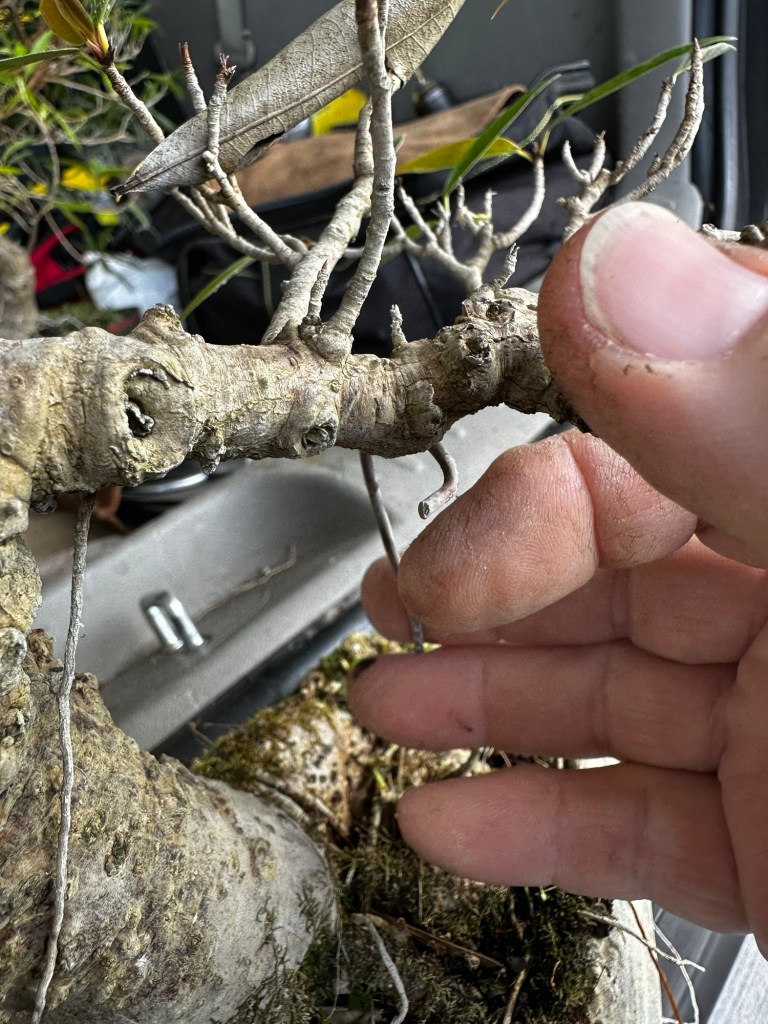
Ah! That, below, is a root. Maybe the tree doesn’t want to be repotted?
It’s in there like the second wicked stepsister’s foot crammed into the glass slipper.
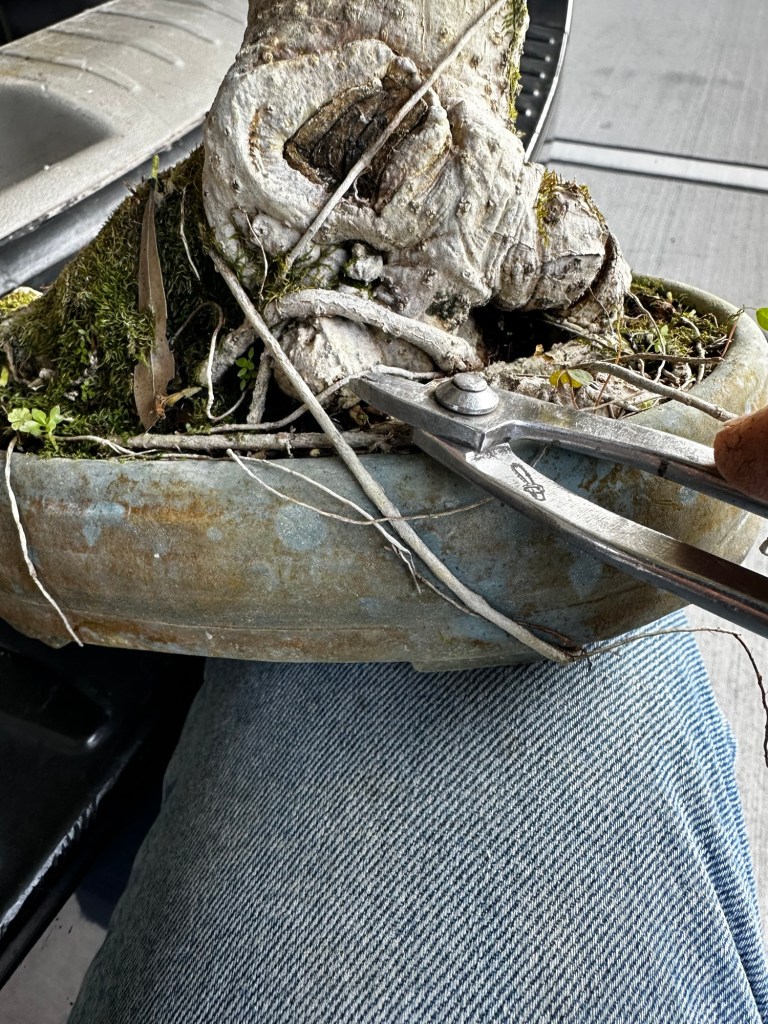
A tad bit of irony, but me having to use a repotting scythe to cut the tree out of the pot, goes with the original Brothers Grimm telling of Cinderella, where the stepsisters cut their foot so it would fit in the slippers (in the original, the slippers were gold, not glass).
Sounds like a lot to do to yourself just so you can be a part of the ruling elite, cutting off pieces of yourself so you fit in.
As you see in the video below, it’s in there tight.
Jeez. Do I have to break the pot?
There’s some ASMR for you.
I got it out, finally.
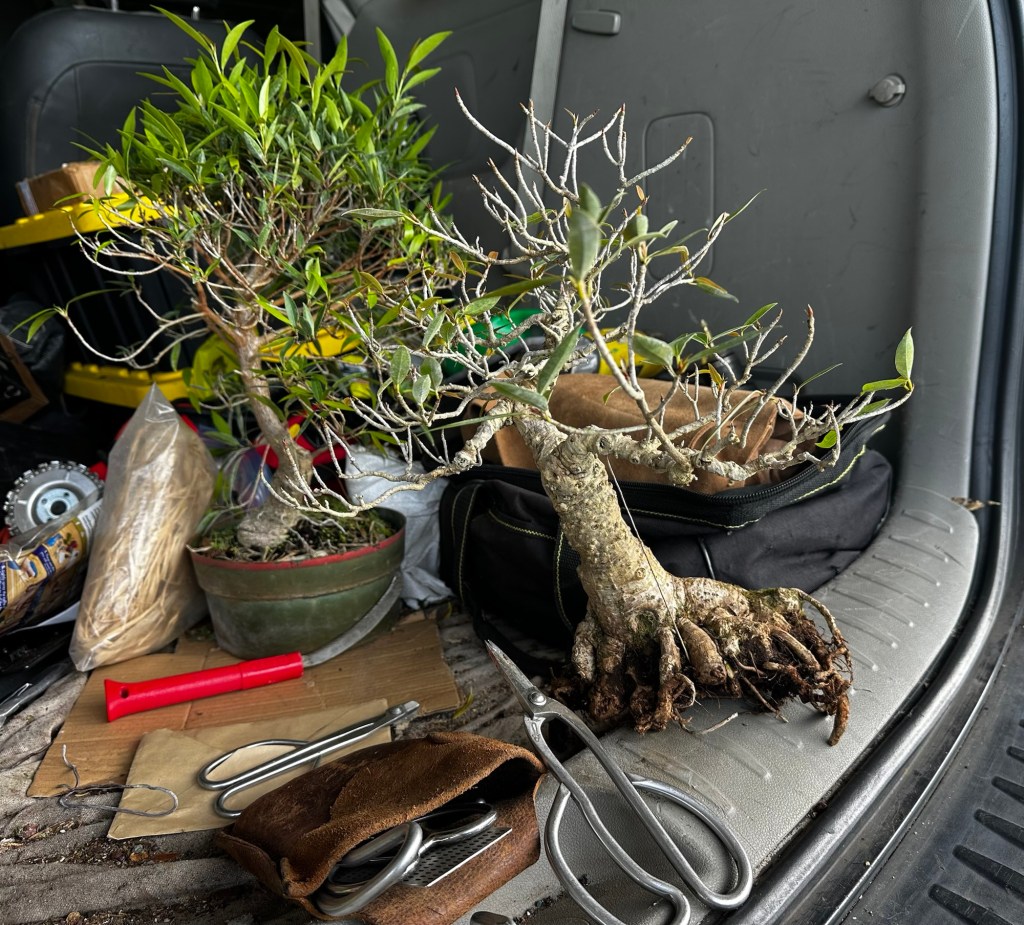
It has some roots on it alright. Ficus are very good at saving sugars in their root structures (being partially epiphytic is the reason. Most ficus are epiphytes, meaning they can live without soil, usually in a tree as strangler figs, so they’ve adapted by growing tuber-like roots to store carbohydrates and moisture for when they need it. Think of the so-called “ginseng” ficus, looking like a potato with the caudex looking roots. It isn’t a distinct species, but a trade name given to seedling Ficus microcarpa. Almost every species of ficus will do that with their roots).
Some pruning.
A few heavy root cuts.
Now to pot it up.
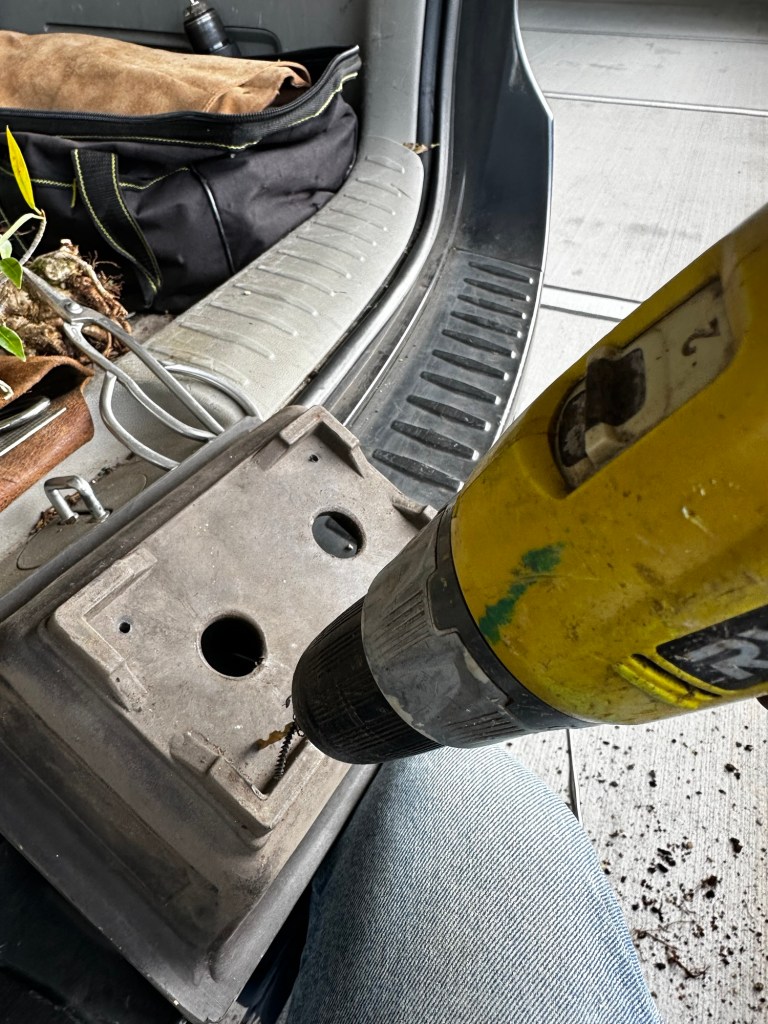
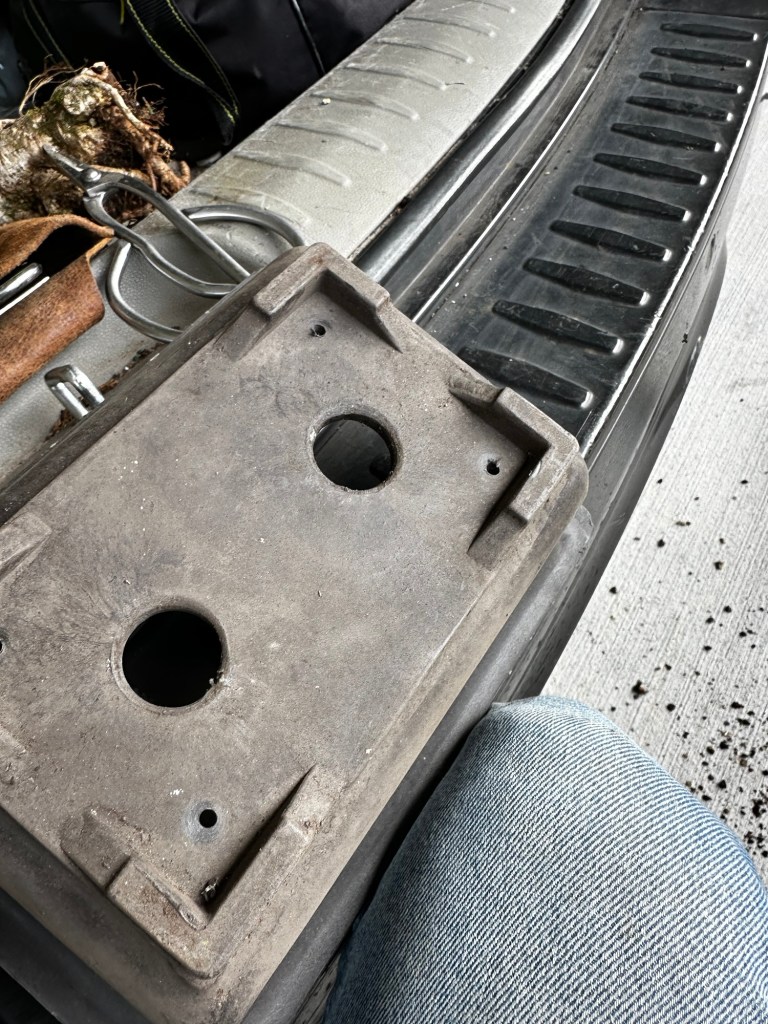
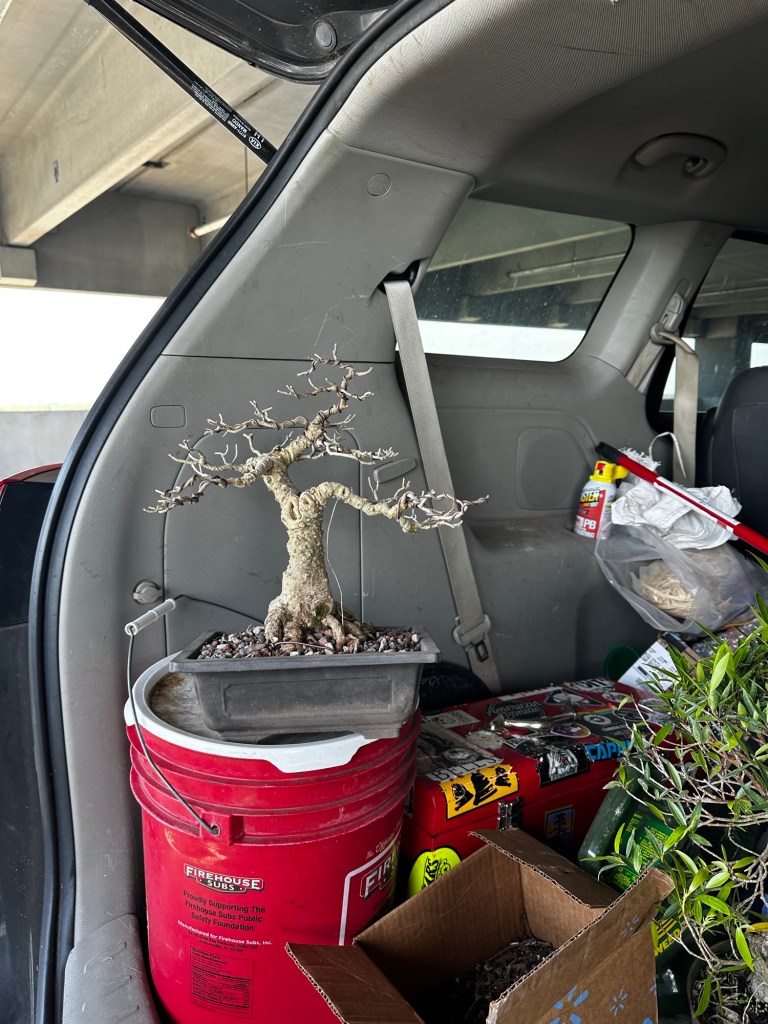
I have soil, wire, fertilizer, granular systemic insecticide, but one thing I didn’t remember to put in the van this morning was a good pot. I do have a pot made out of mica, from Korea. It’s at least bigger and will serve the purpose.
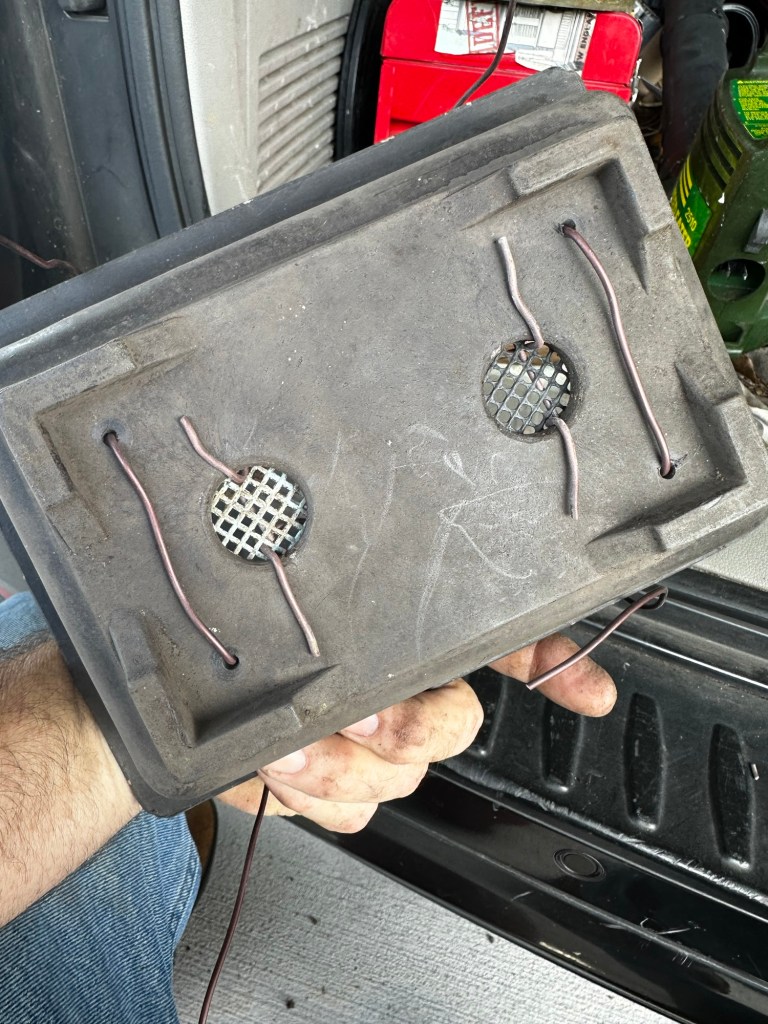
Needs some more holes for tie-down wires. That’s the great thing about mica pots, they are good containers, and they can be easily modified however you want. One of these days I’m going to carve a design into one.
Now we are cooking with gas.
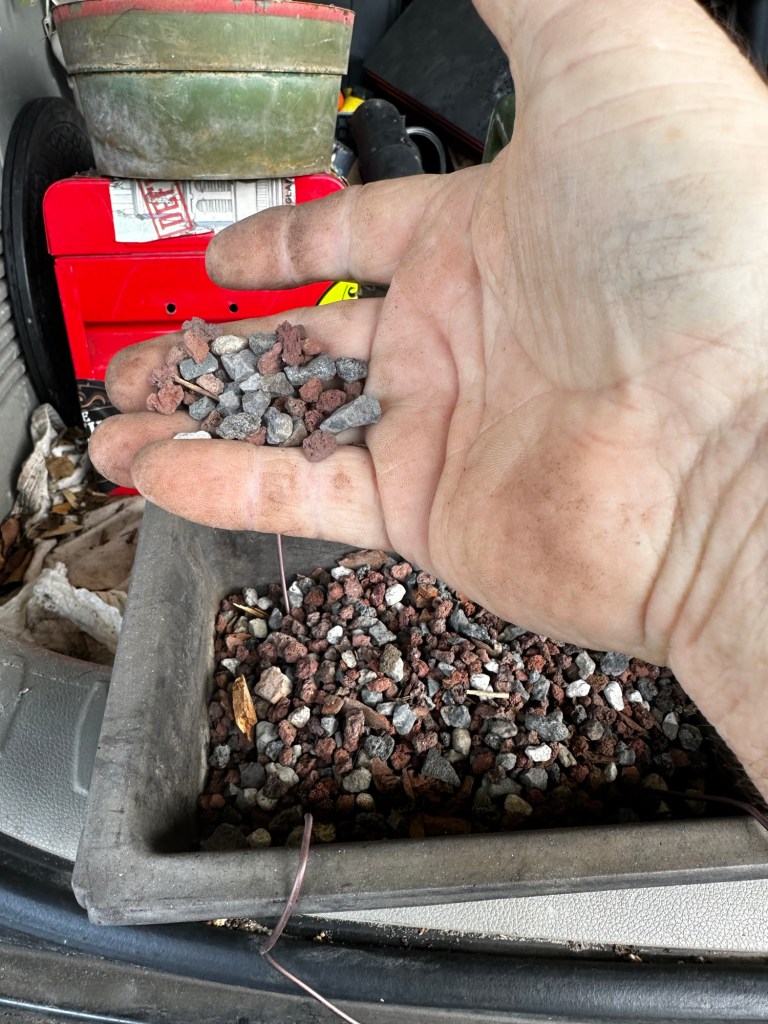
Some soil. Soil, that’s how it started; Funny story, I’d been in a casual conversation with Seth, and he saw a post of mine where I was repotting, and he asked where I got the red lava. He’d been buying the consumer grade and mulch sized red lava they sold at Home Depot, and was trying to use a hammer to crush it down to bonsai sized (about 1/4 inch size) and discovered that it just makes dust. It’s hard to crush lava with a hammer. I told him that I was going to be at a bonsai club meeting that met close to where he lived, and I’d bring him some of mine.
It was a good way to get a meeting with me. I like to help people, and Seth figured it out.
Fast forward a year or so to when I first got the tree from him, he thought I was going to do the famous Adamaskwhy trunk chop.
I didn’t, but instead decided to use all the branches to make it work. For some reason, he wanted a chop, so he was disappointed. It wasn’t the last time I disappointed him.
I said earlier I was young and stupid. When I met Seth, it was just around the time I began my journey with an ileostomy. There’s even a blog post where I go into the hospital after I visit him and he was one of the only people to come and visit me (Click here). I was angry at the world and I tend not to suffer fools gladly (I still don’t, but I’m getting better, now I just suffer them stoically). Seth had a hard time with his stepfather at home and we both would commiserate by saying bad things about people we didn’t like.
And here is where I couldn’t live up to my ideals. I have a flair for writing well, and he and I would DM each other on FB messenger. That made for some interesting screenshots. But I have come to the realization that, even though he shared private messages between he and I, two good friends, it was still my fault that I wrote those messages.
But I think I’ve grown. I question myself and my motivations often. Like Plato said, “The unexamined life is not worth living”. I also try to align my life with the idea that a meaningful life is one dedicated to beauty, truth, and virtue. And when it comes to my interactions with other people, I know that I can’t ever figure out why other people do things, only why I do things. And it could be argued that I don’t have a right to know another’s thoughts, only to deal with those actions. It’s entirely possible that how they act is really a reaction to how I am acting.
Before styling:
After styling.
Eagles-eye view.
It is a complex tree. You really have to watch the video to see the depth of the trunk movements.
It’s a good tree, and I’ll cherish it for what it represented, a friendship. One I’ll never have again with Seth. I did wrong and I’m sure I’ll never be forgiven, but that’s ok. I’m close to forgiving myself, but I’m not sure I can forget.
I’ll just keep talking to my trees, and be guarded with people. I’m not sure how else to be and not hurt or be hurt. The trees, though it’s a difficult language, still speak in plain sentences.

 Login
Login





















 I wanna go back to my Maumee


 ” .
” .