Reading view

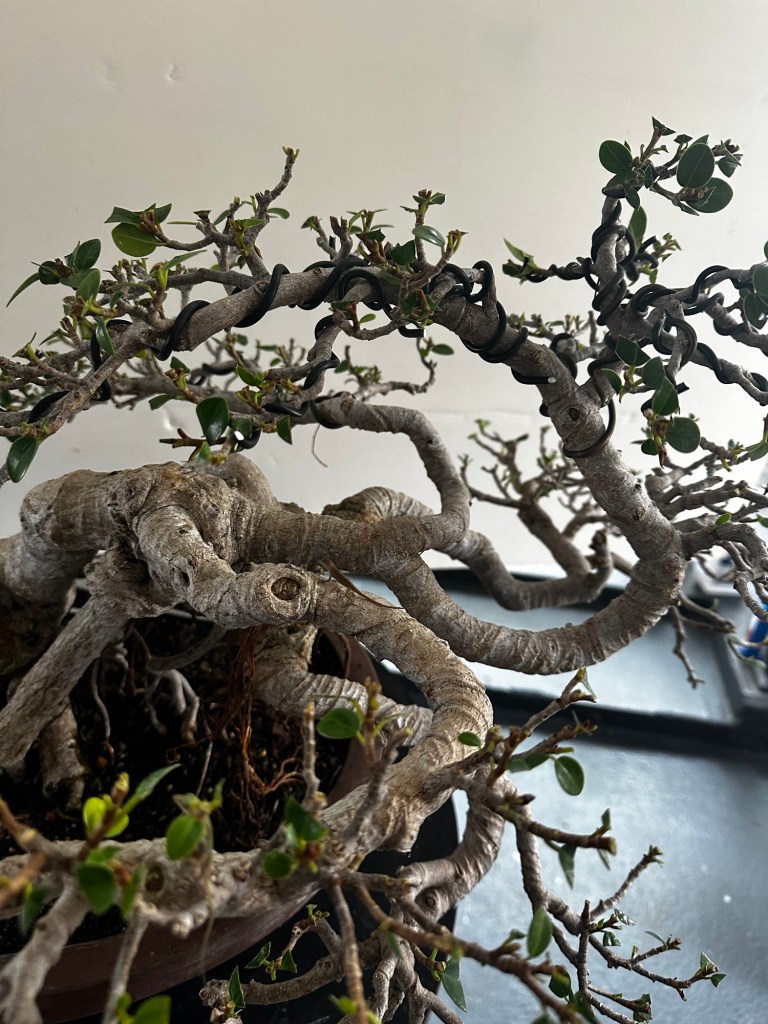
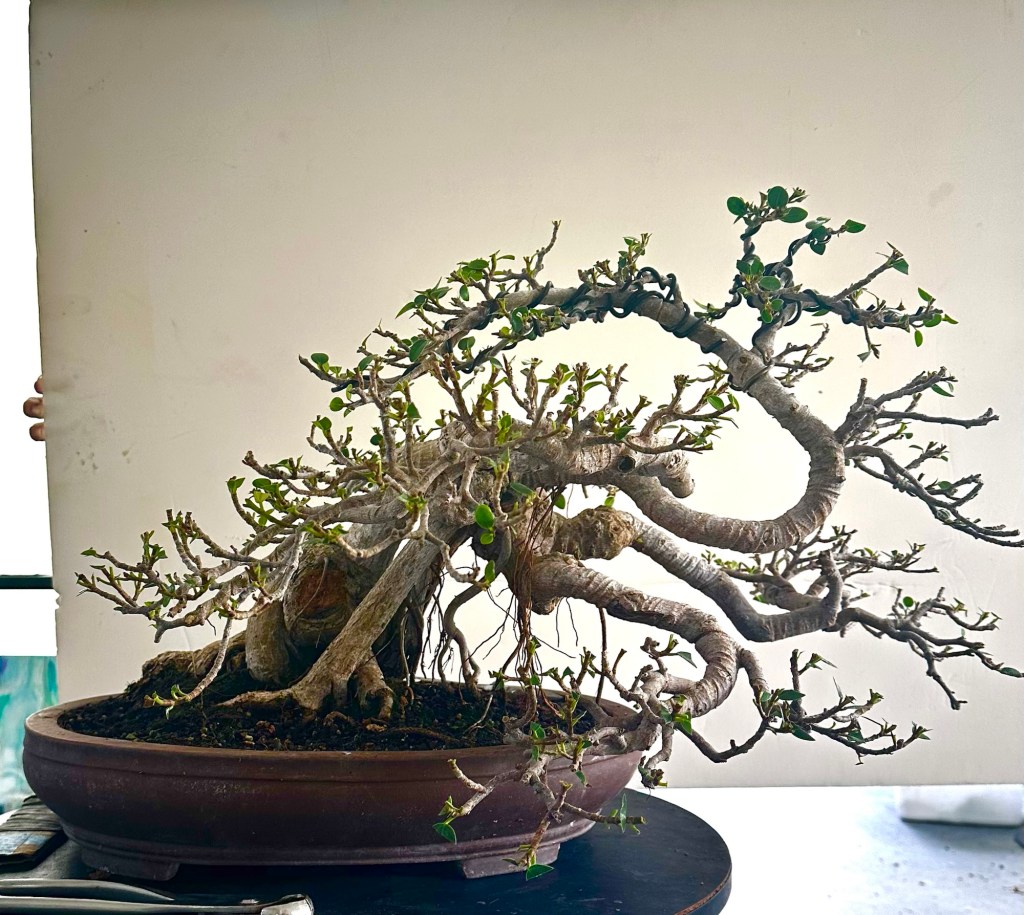
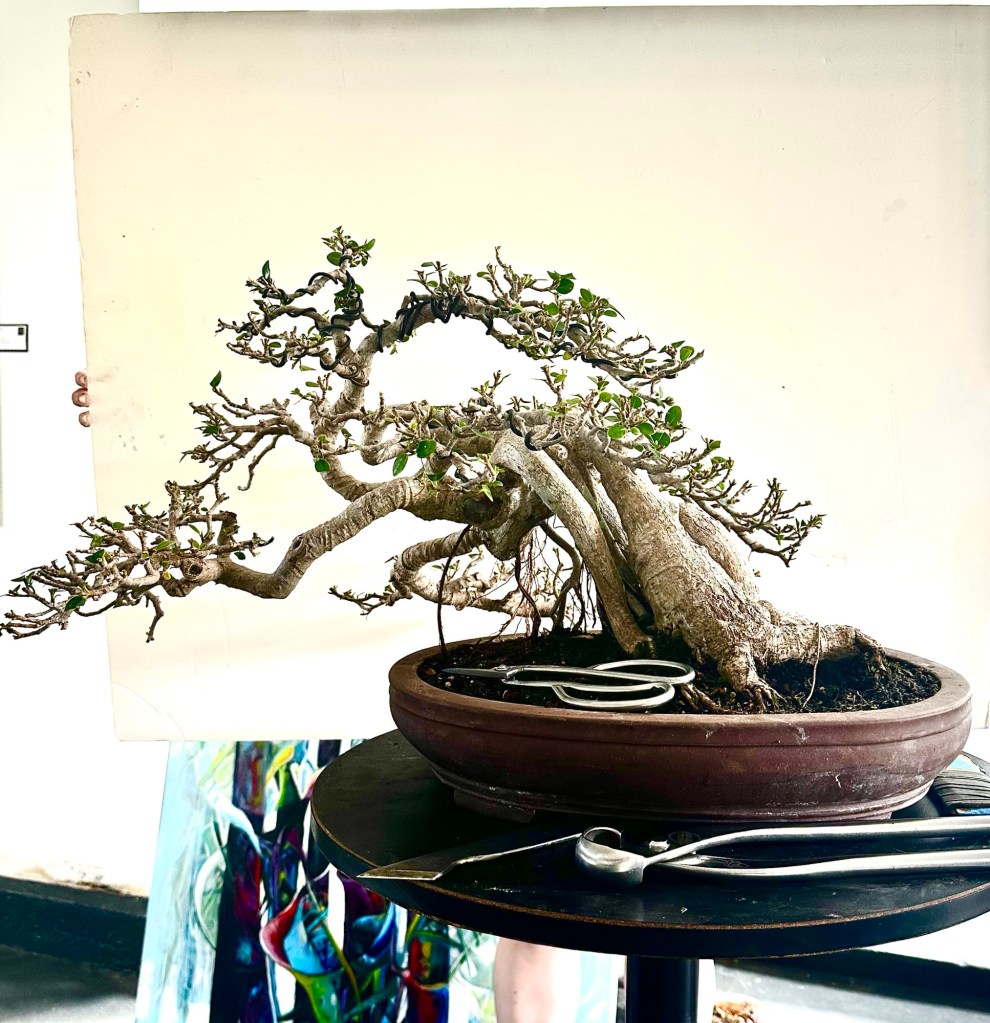
Still building a ficus

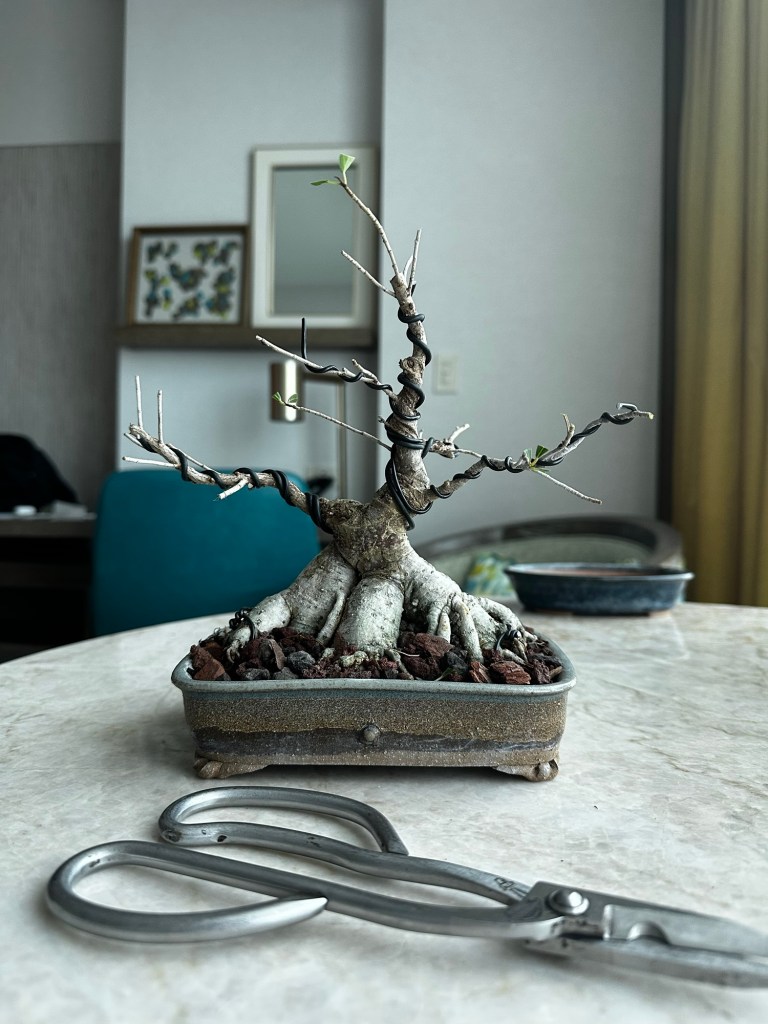
Today, we have a ficus microcarpa (for those who have searched through the posts, in the far past I’ve called this species ficus retusa, incorrectly. Instead of going back and fixing them all, just keep in mind that Ficus retusa is a totally different species of fig, and take it for the ever changing nomenclature that is being updated. My apologies for any confusion). It belongs to Kathrin. I had done a demo for the Shofu Bonsai Society of Sarasota many years ago, and she won it in the raffle. You’ve seen it before, in the link below.

I had meant to update this tree several times in the past few months, but didn’t get to it. Here it was in October 2021.

And, as it was in the original post:

https://adamaskwhy.com/2020/10/14/building-a-ficus-microcarpa-bonsai/

I’ll wait as you step into the Way-Back Machine and travel back in time.

And, still in the past, the work we did at Kathrin’s garage, in my Sarasota Studygroup in October.

Then we went, the next day, into Wil’s garage.

First, we get rid of the Corona bottle cap I was using to hold a graft in place.

It worked pretty well, and played into my gallows-type humor at the time.

The graft took well on the main trunk.

But up top, we had trouble getting that branch to stick.

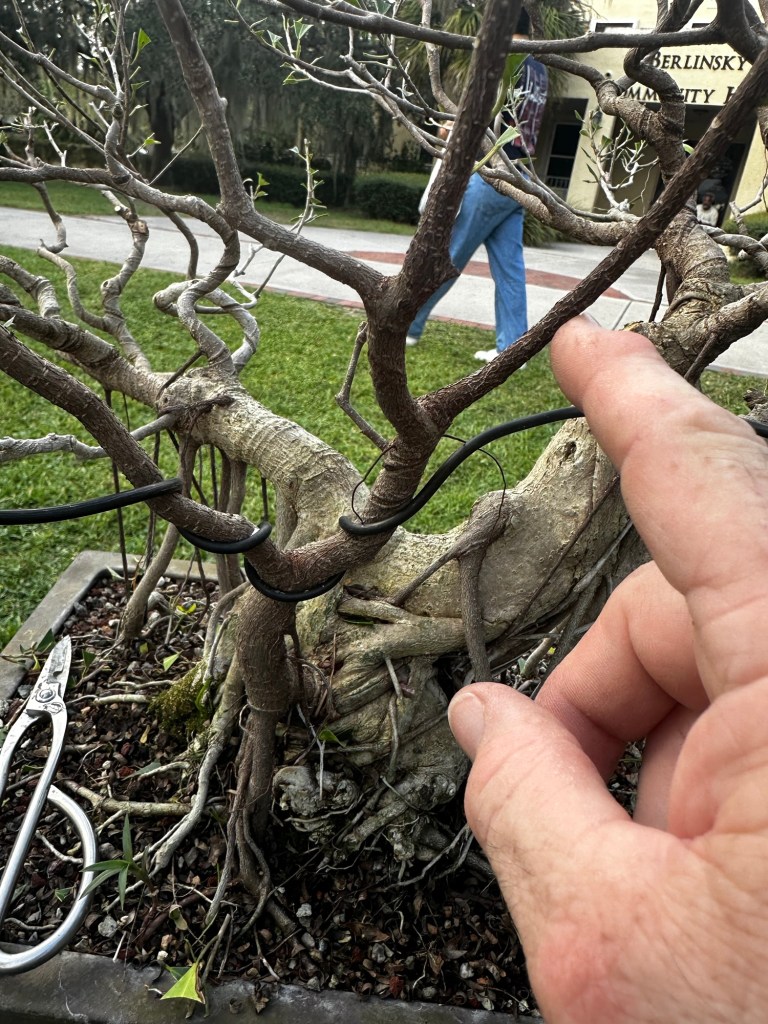
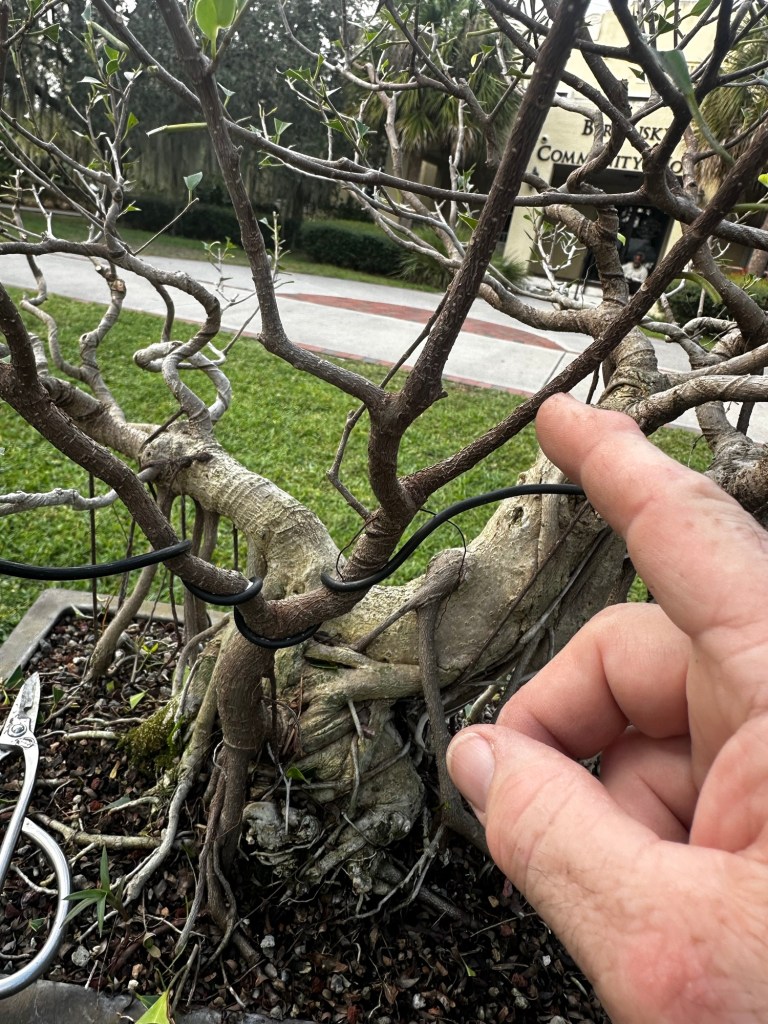
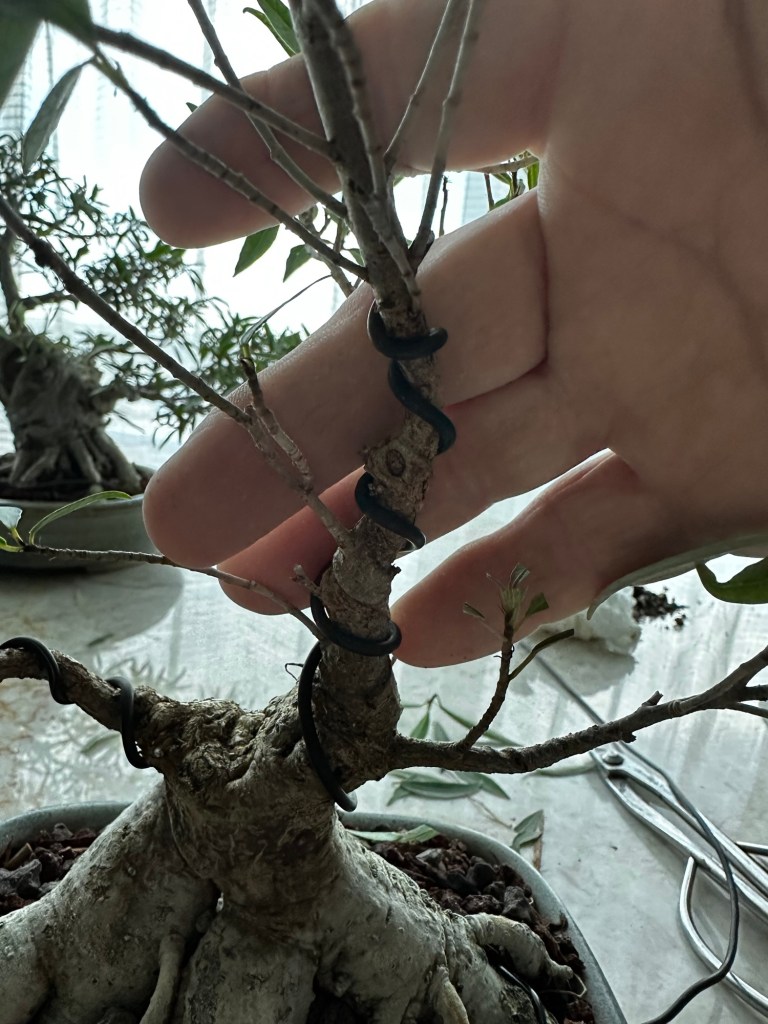
Take notice of the hole that was created from the branch, where the black wire is.

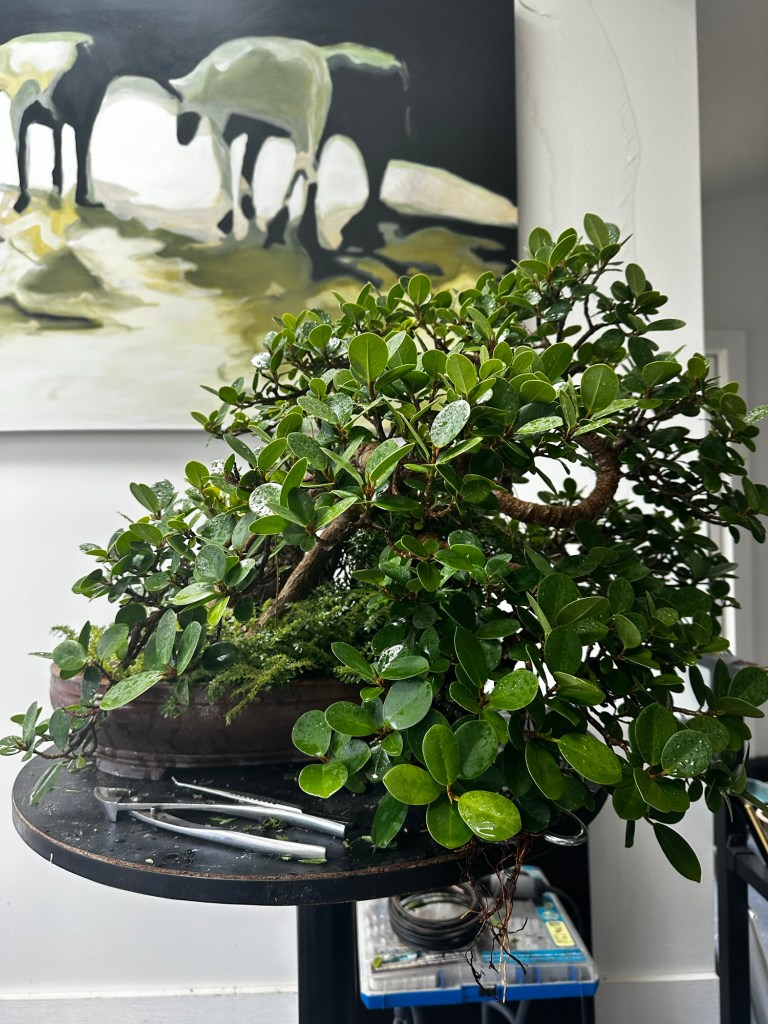
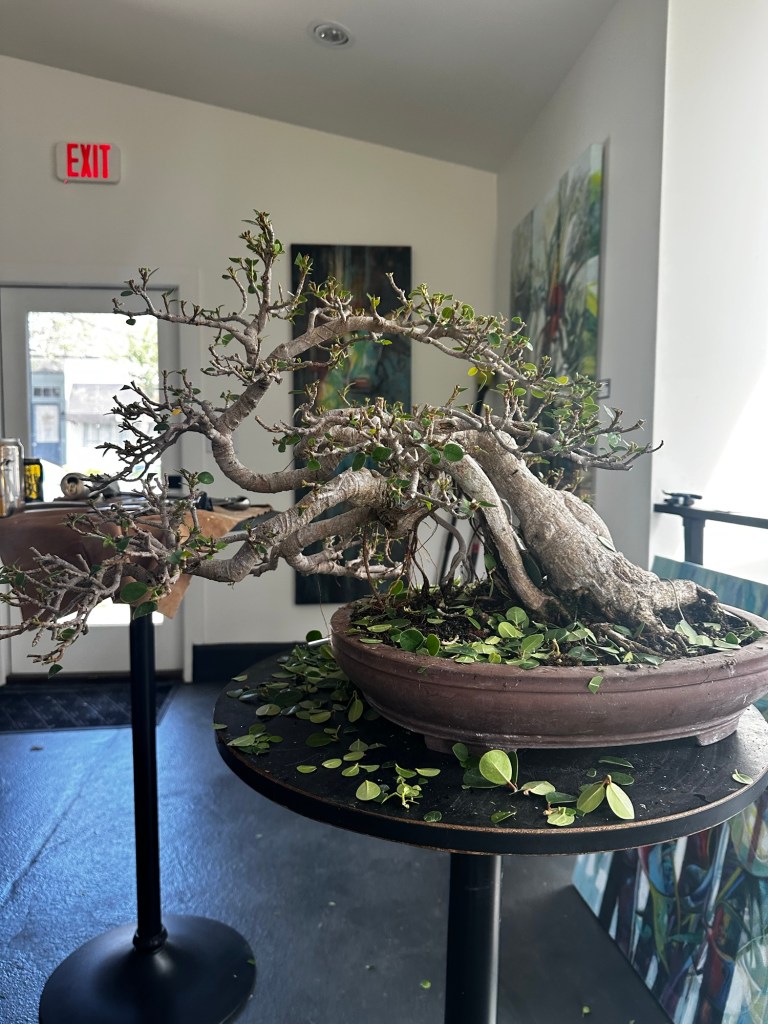
Now, back to today. Late July/early August, 2022.

I’ve had it here in Orlando for a few months. The idea was for me to bring it back the next month, but life got in the way. A few too many client’s trees to work on and a brief hospital stay made the tree sit on my bench and just grow. But sometimes that’s a good thing. It gives us something to work with. and it seems to like my yard.

The water at my nursery is good compared to Sarasota (it has to do with how we get our water in Orlando. This Post about cleaning calcium off a pot explains it a bit more)

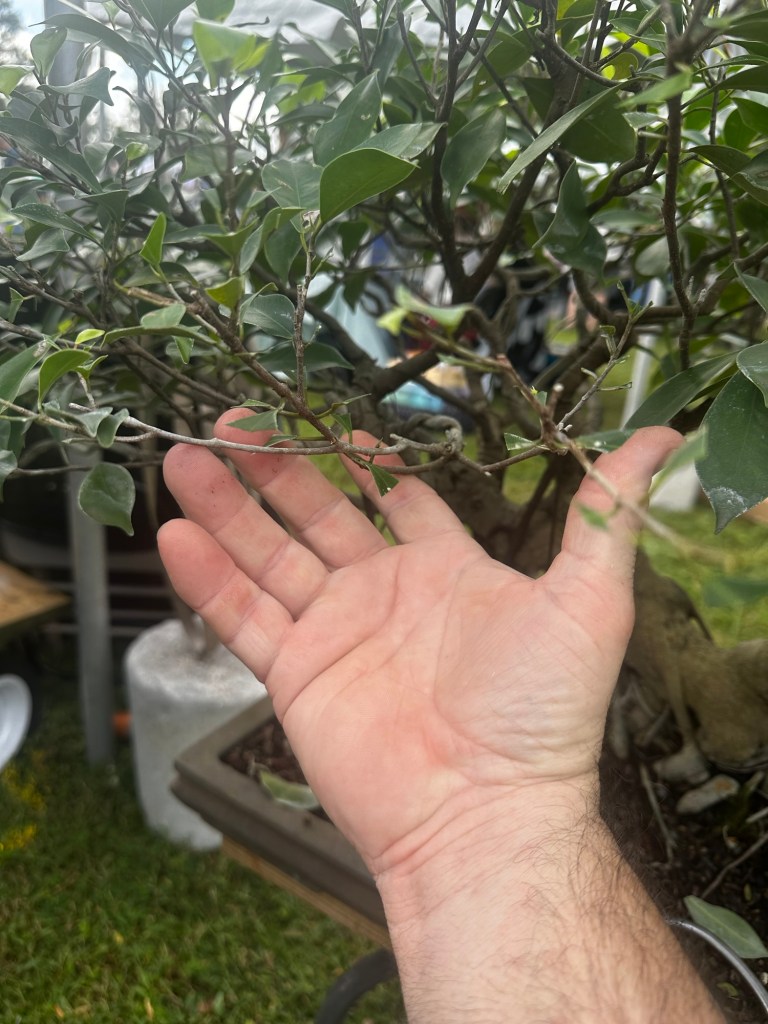
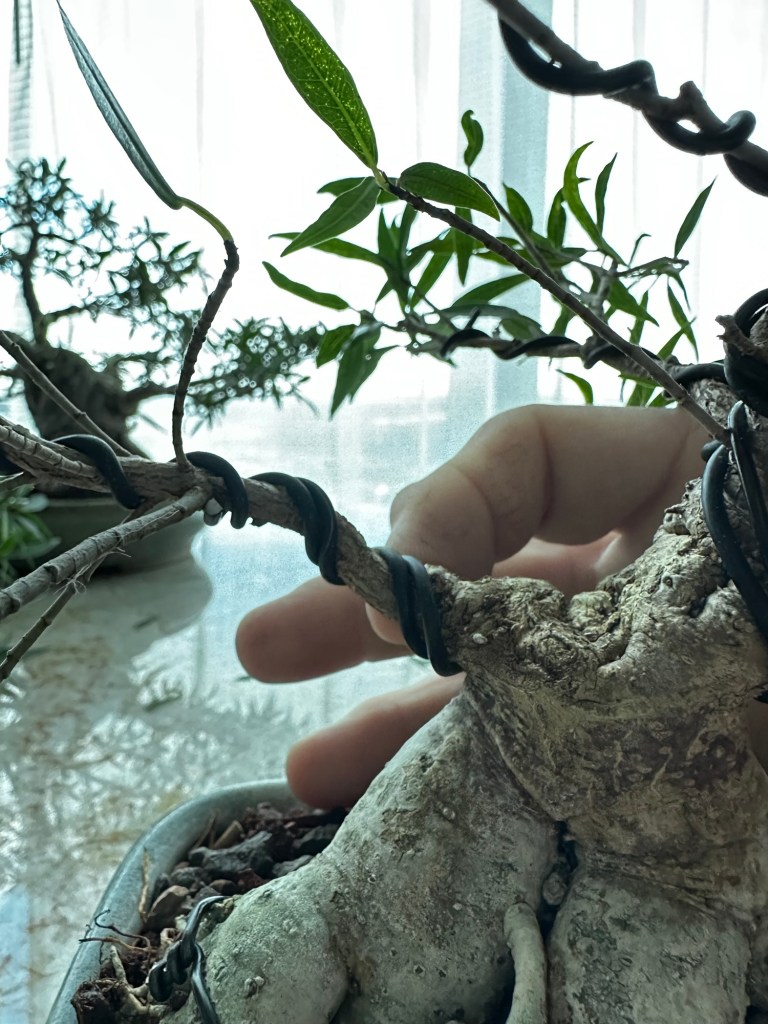
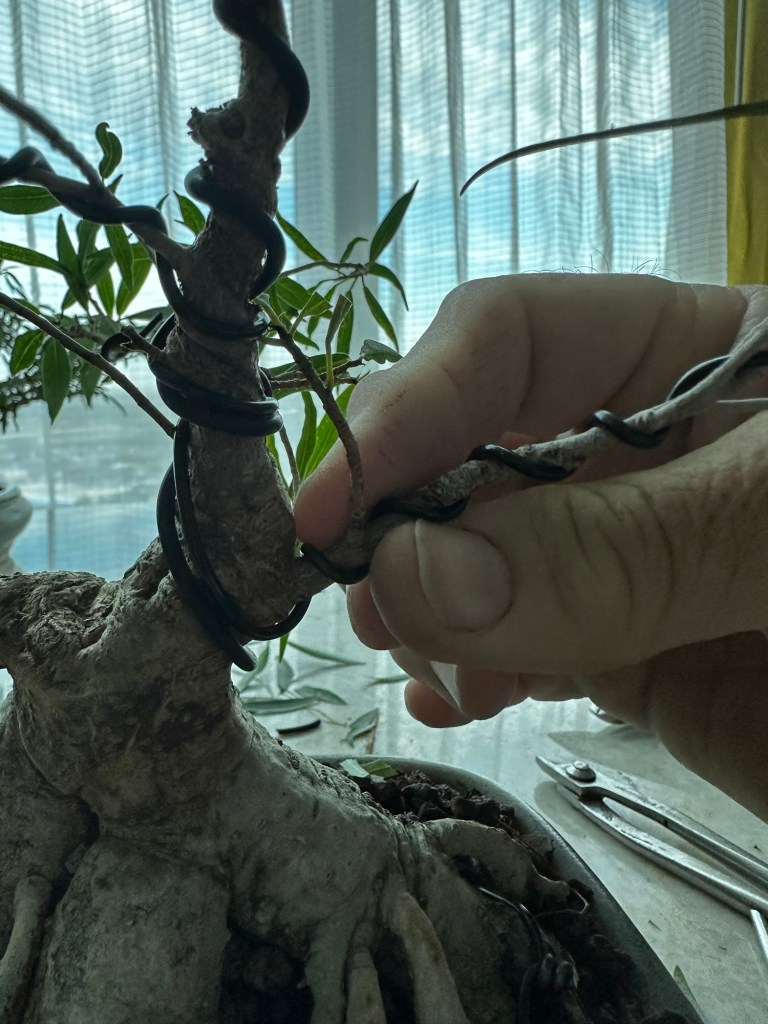
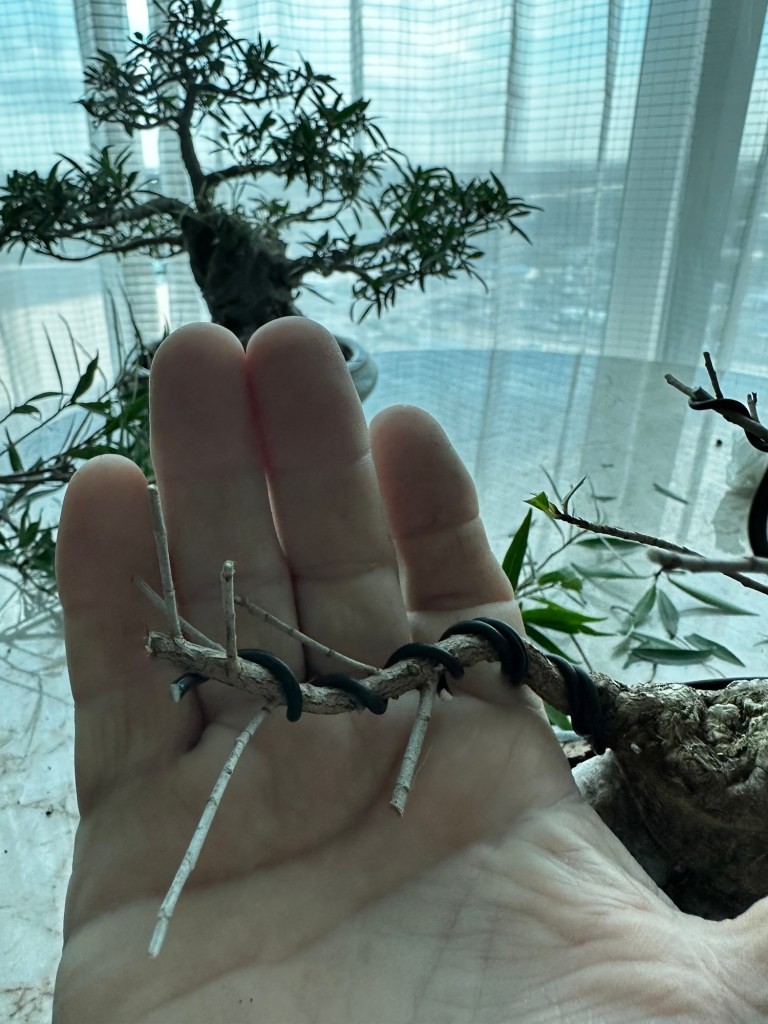
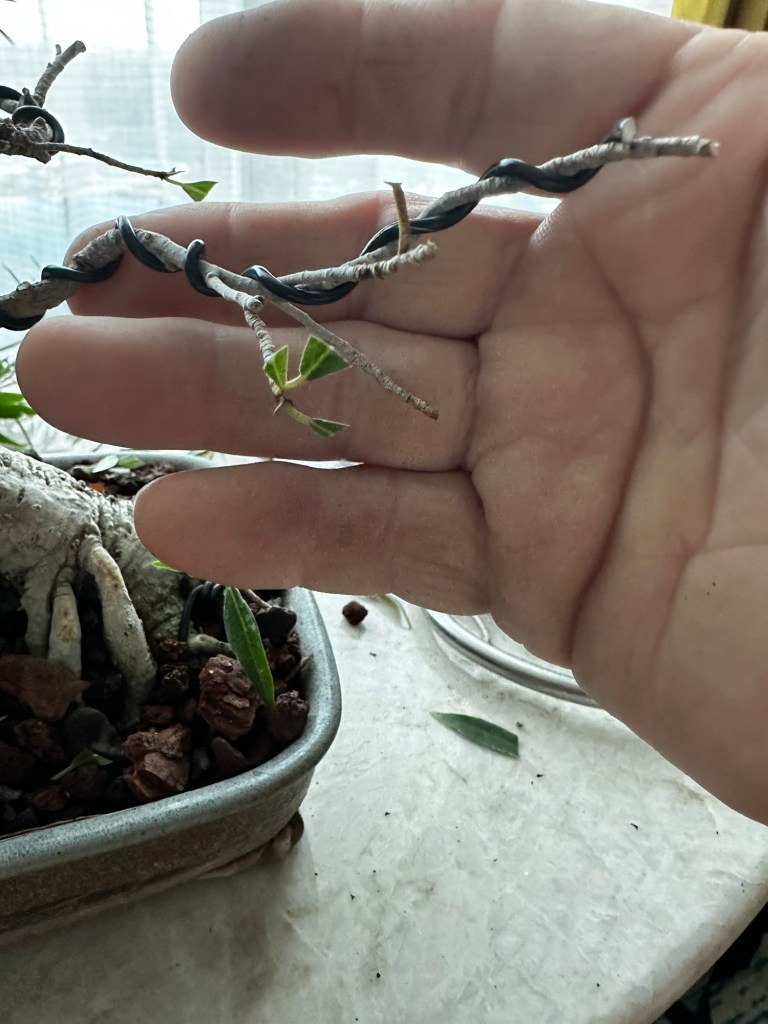
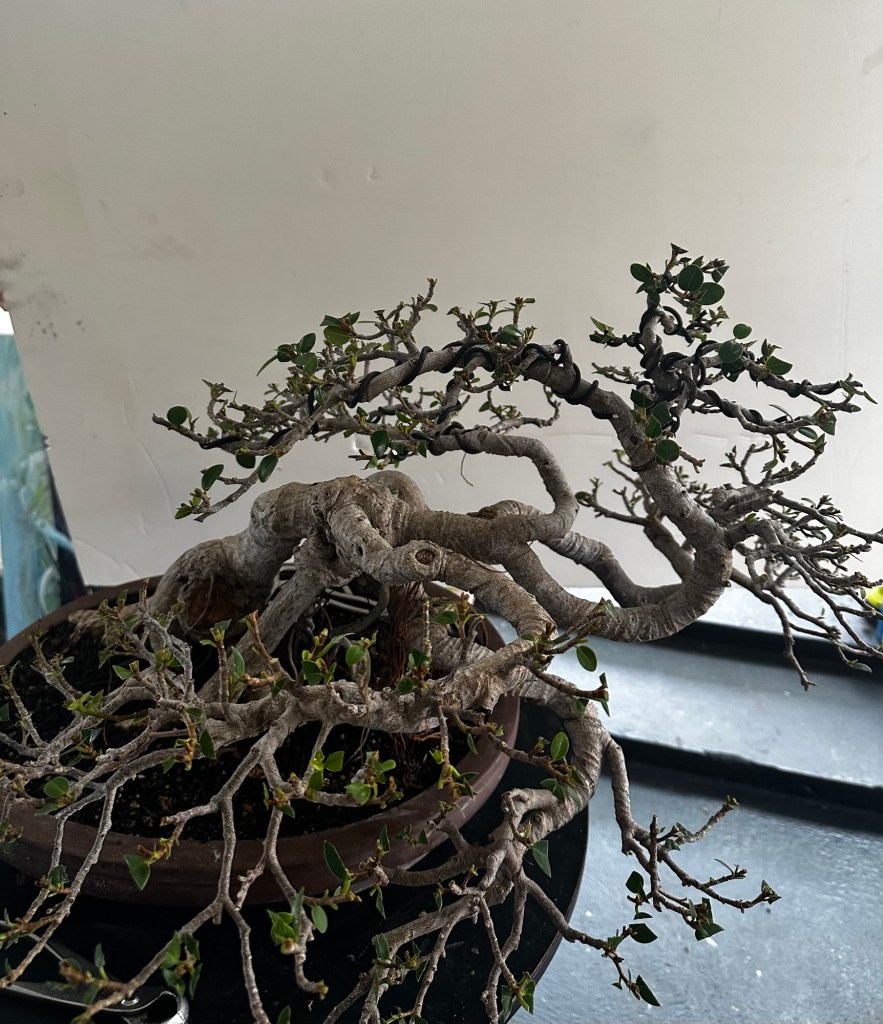
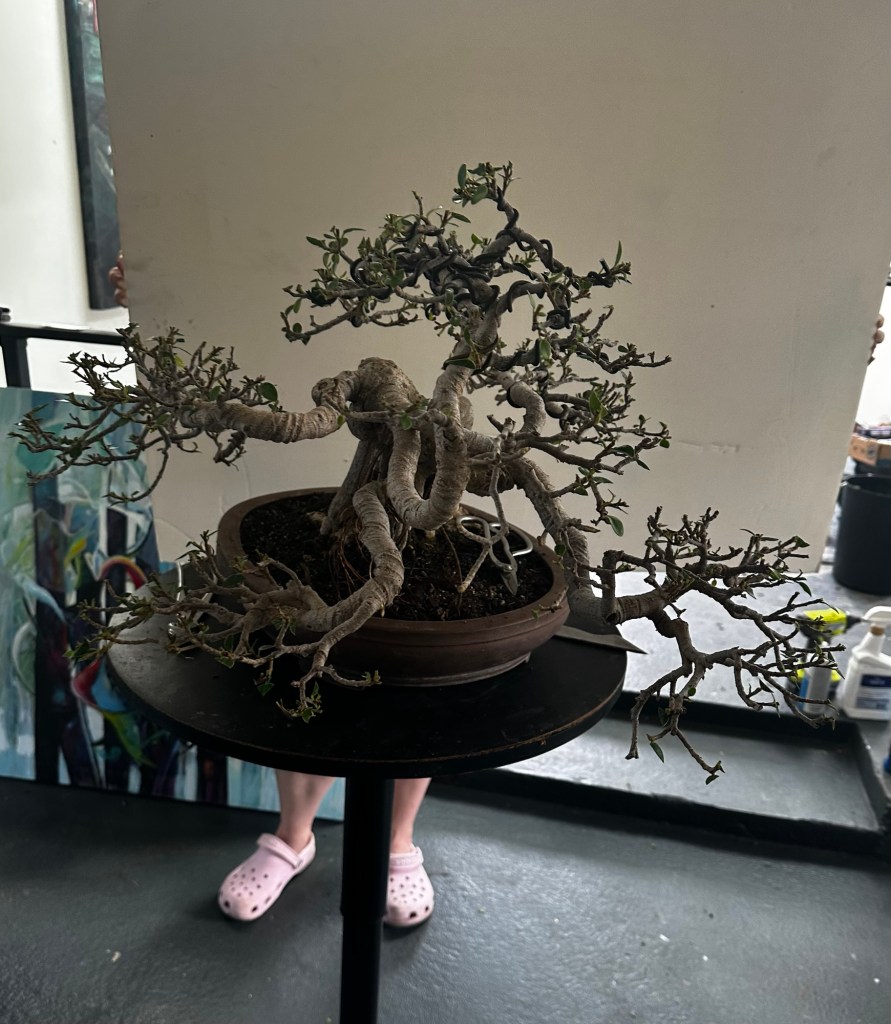
If you compare the below pics with the older ones, you can really see how much the branches have thickened, and how we tied that one branch that refused to graft in place.

It’s finally taken, so now it’s time to remove the wire.

You can definitely see where the two trees are grafted on, but that’s ok, it’ll smooth itself out in time.

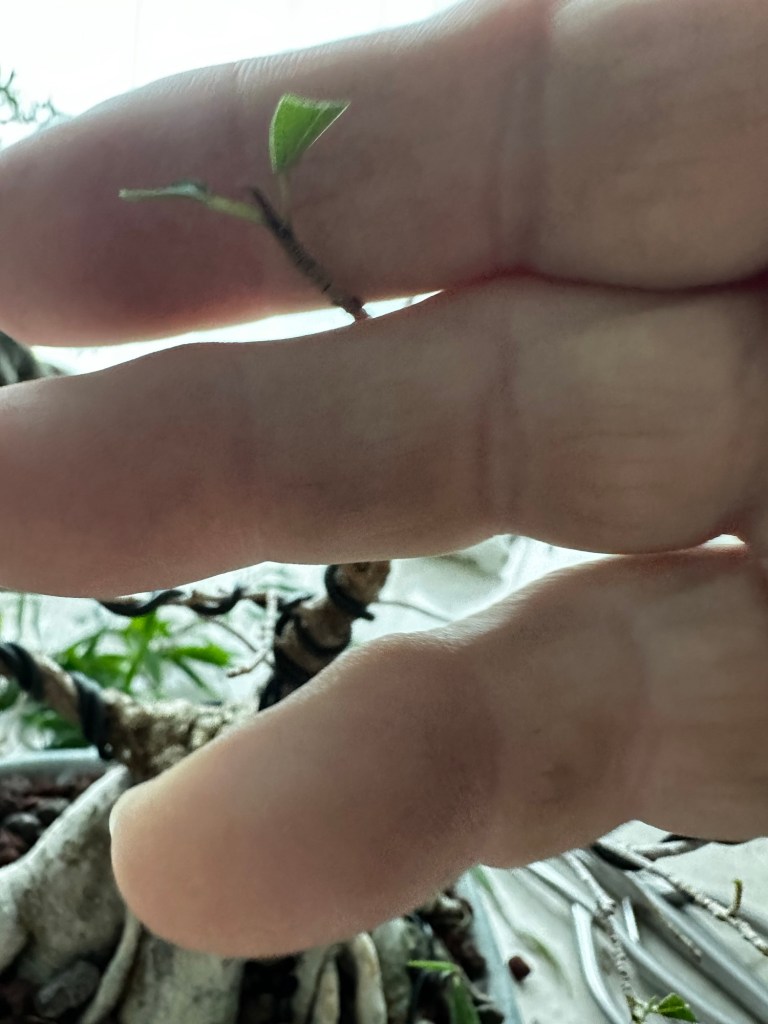
And somehow that one aerial root we pinned into the hole got pushed out.

Anyway, enough backstory, let’s get to work.

Remove the wire.

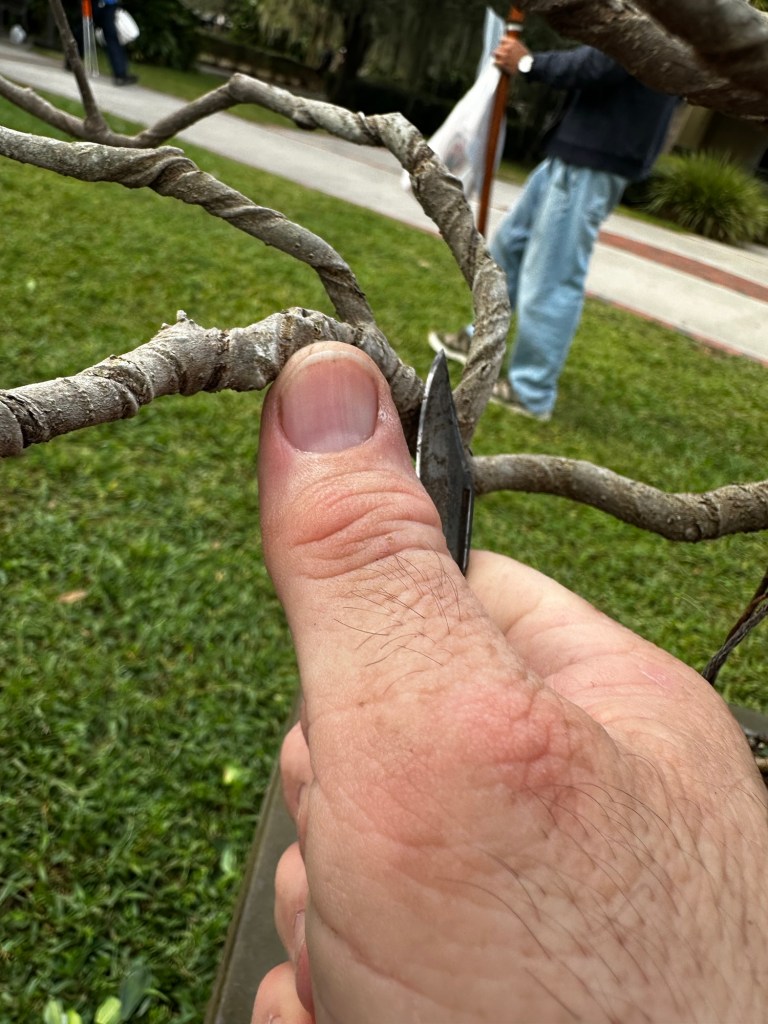
Not too badly scarred. And those wire scars on the branches are easily dealt with. You can literally shave them down and they disappear quickly.

That hole I pointed out above is just about filled in. That’s the advantage of unrestricted growth.

Now to defoliate.

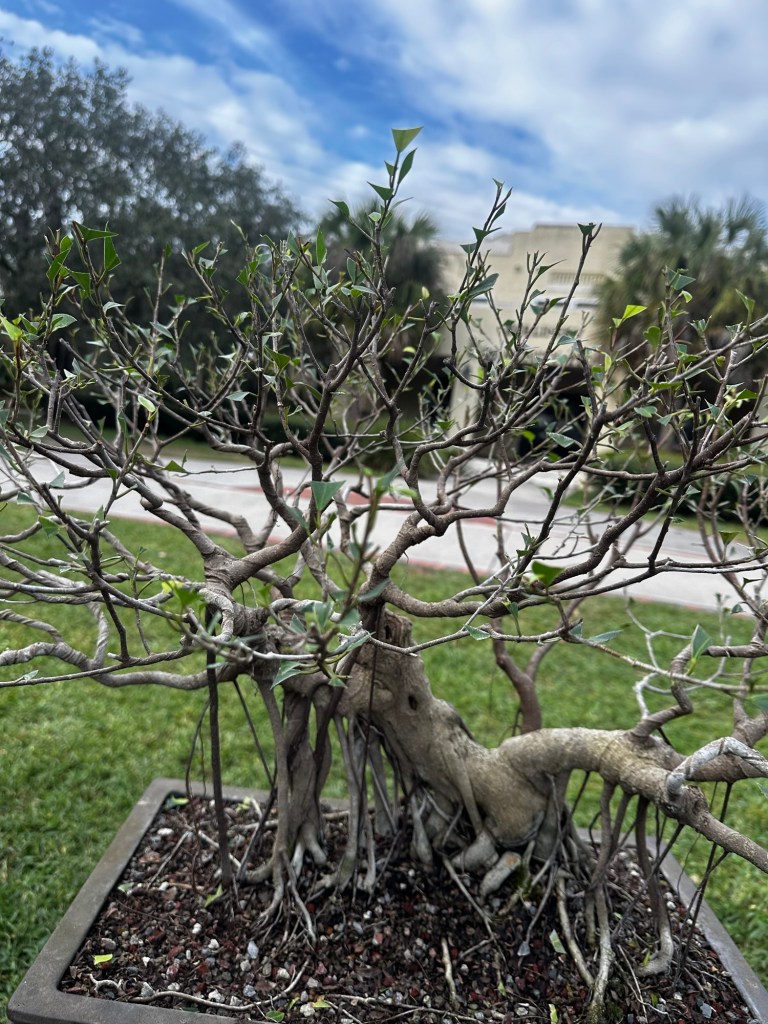
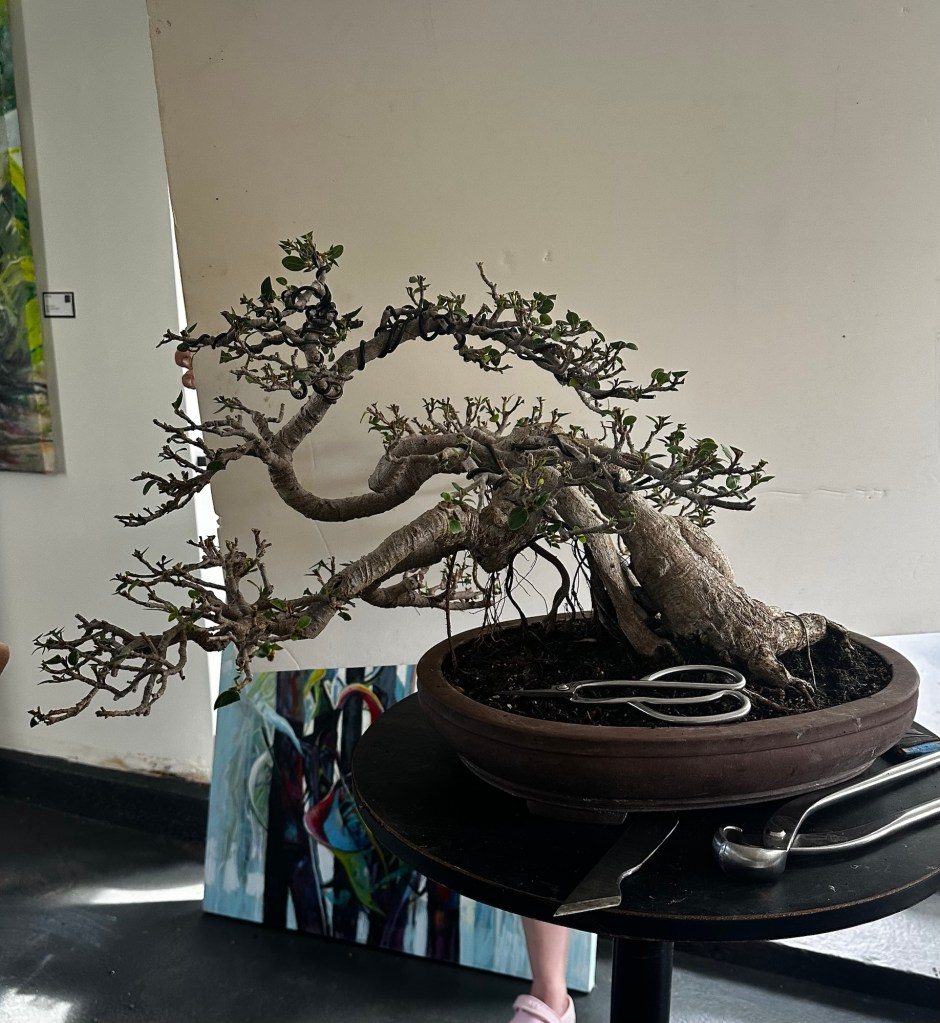
There we go, we can see what we have to work with. Which is a lot.

We got lucky with the longer branches just happening to grow just where we need them.

This one is perfect for grafting; strong growth and fresh bark.

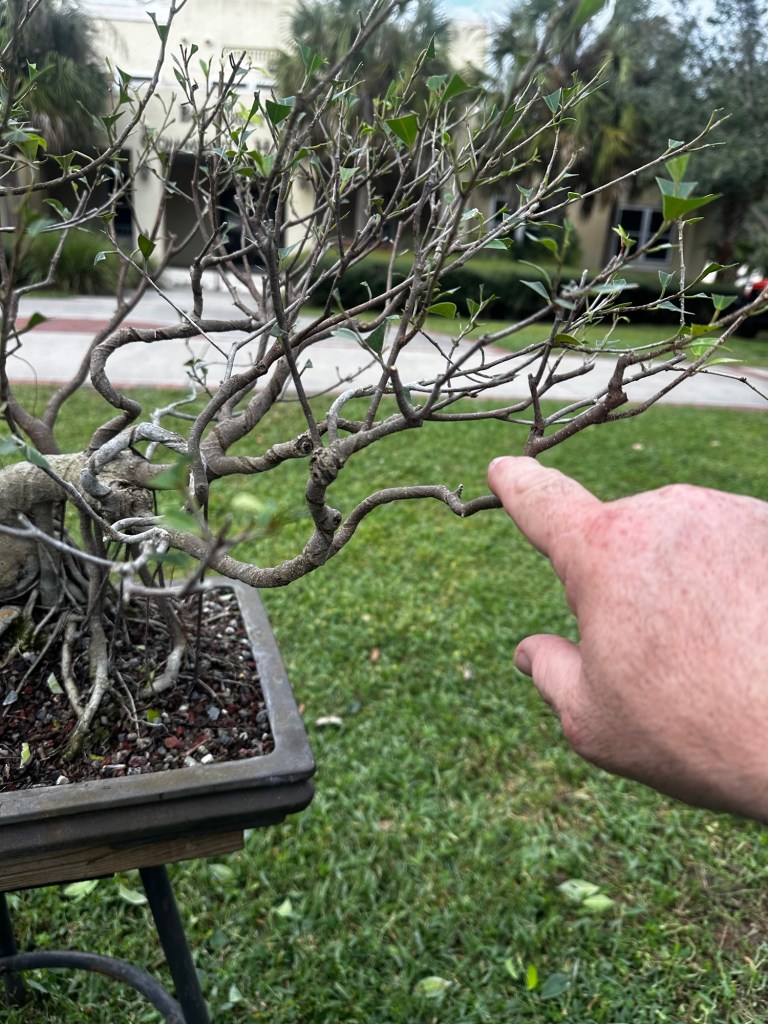
It’s gonna go about here, to fill in that empty spot. Now, to explain why we need grafting on a ficus like this: this is the plain Jane, regular old Ficus microcarpa, not one of the many cultivars. Which means that it doesn’t back bud as readily as one would like. In fact, it’s more prone to die back to the next node, or grow point.

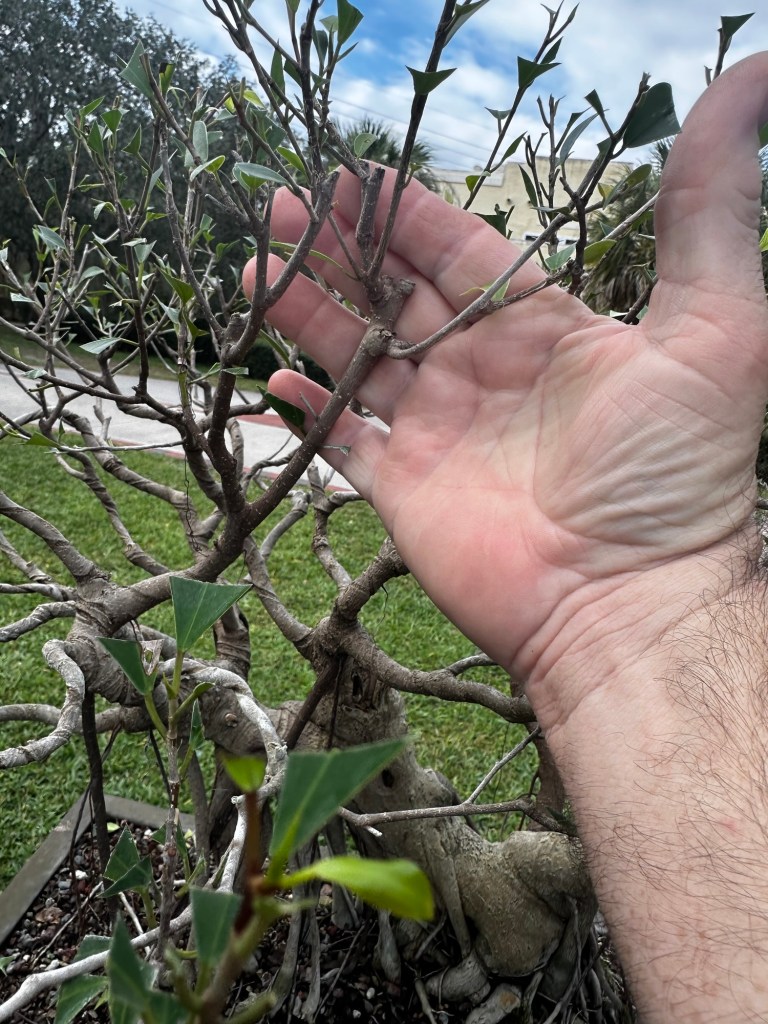
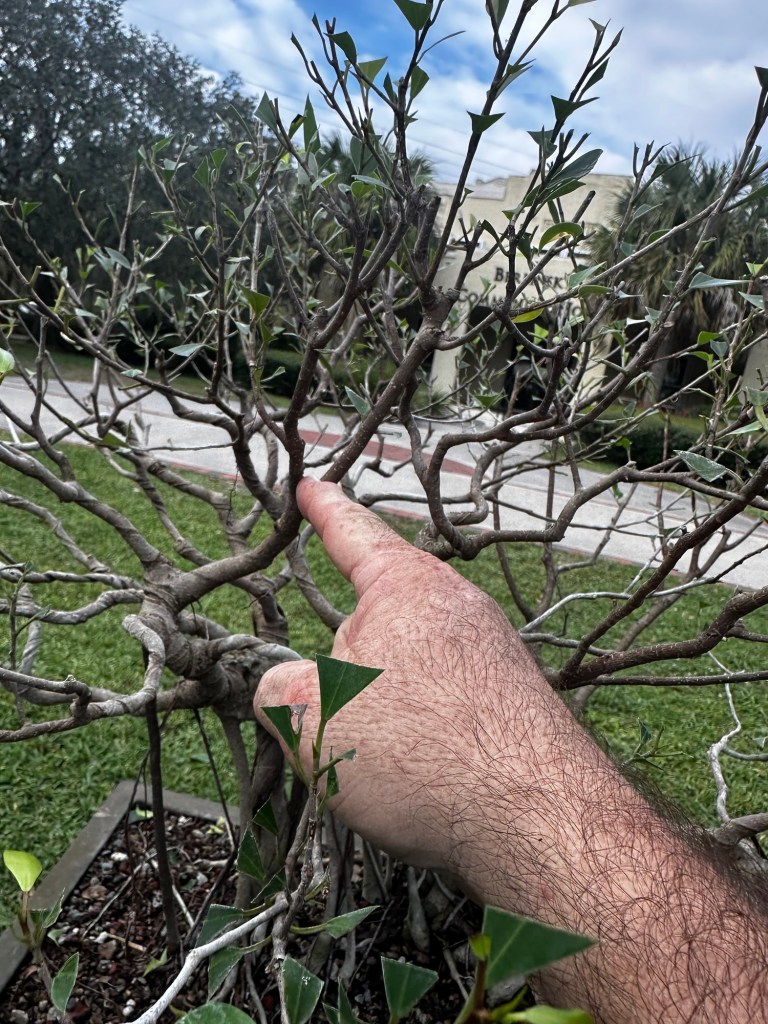
The branch just above my pointer finger has been grafted on, and the next one above it as well.

After grafting, here’s the new pot. I debated for about ten minutes whether I should repot or do the top work first. Top work won out. The debate was whether the repot would be to strenuous on the grafts. But I figure I can be gentle.

Grafting time.

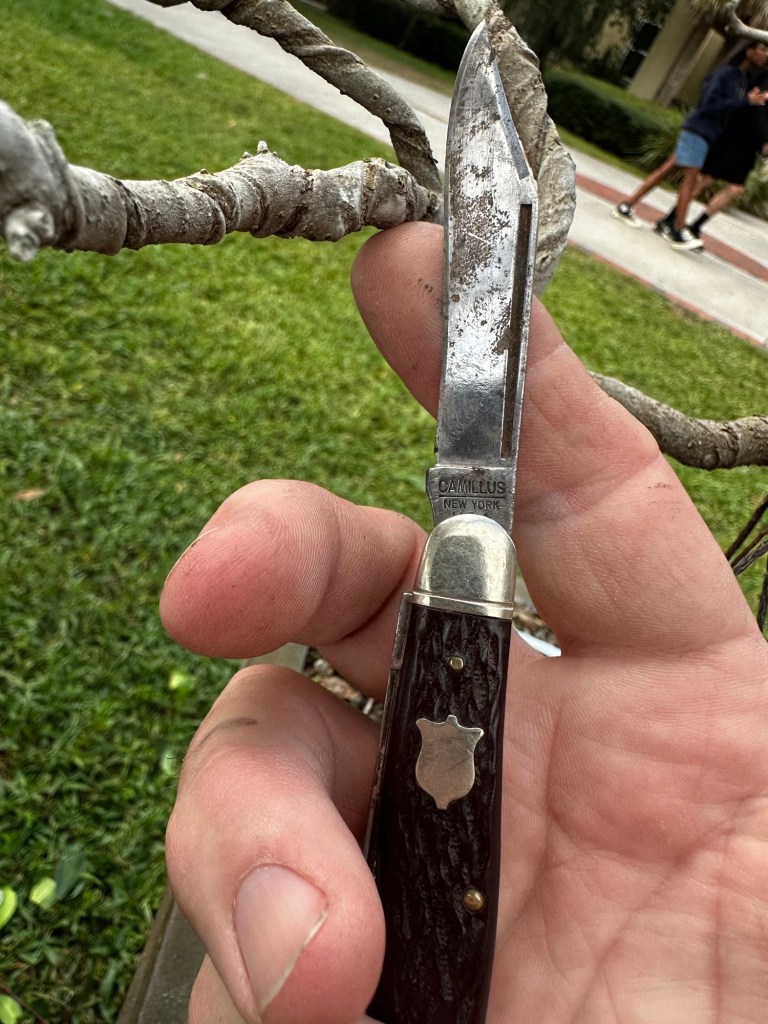
A freshly sharpened knife.

And…..here we go!

Grafting is easier than you might think. Simply cut a gouge into the the bark.

Doesn’t even need to be that big.

See?

Grab some type of grafting tape. In this case I’m using “self-amalgamating electrical tape”. I’ve come to use this because it only sticks to itself (self-amalgamating) and doesn’t damage the trees bark when you take it off. The point of the tape is to keep water out. In the past they’ve used beeswax, floral tape, vet wrap, even just cut paste.

Cut a piece..

Remove the backer piece…

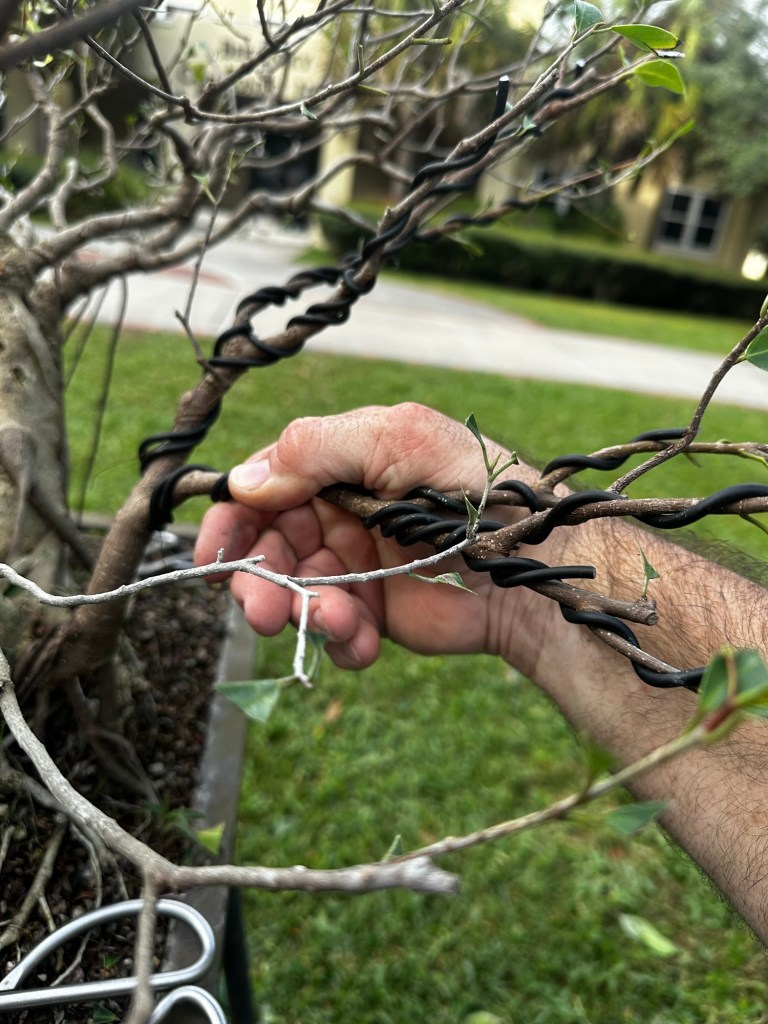
Scrape the branch you are grafting, place it, and stretch the tape (it’s rubber), and wrap it tightly. I then like to use wire to hold it down as well.

And make sure the wire is tight. That holds the two pieces together. As the cuts heal, they want to pull away, so I’ve found that wire holds it in place nicely (like we did above on that recalcitrant branch).

On the side that’s holding the graft, two loops hold it down better than one.

Now for one more graft. Same process: cut a wedge…

Scrape the bark on the branch…

Apply the tape, add the wire…

Crank it down.

I was going to wire this tree out but I think I’ll just prune for movement and taper. Making sure to leave an active node so we diminish dieback.

All done with that.

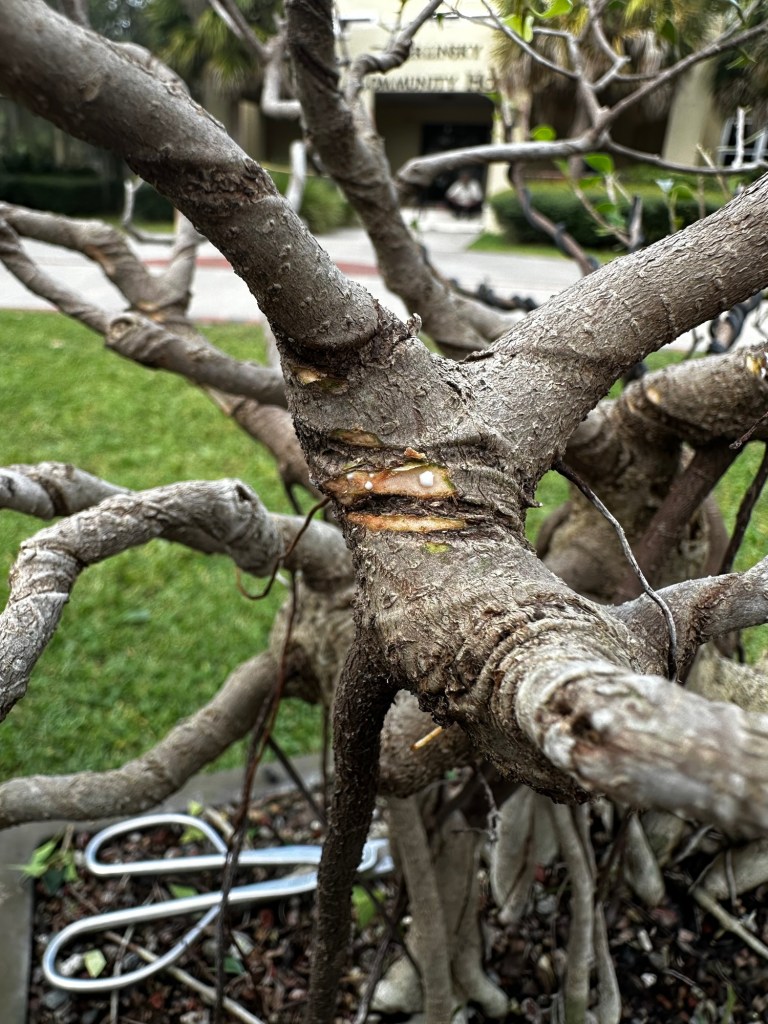
One last thing before I repot, I’m going to smooth out this scar.

I start with a knob cutter…

Then clean it with my knife.

It’ll take a bit to heal, but it should heal.

Now it’s time to repot.

It definitely needs it.

Rake it out.

Unwinding the roots. This one went around the pot twice.

Cut back the long ones…

Rearrange the new ones

And now it’s time for the pot.

The pot is, believe it or not, a high quality Italian bonsai pot. High fired and of good clay.

Of course I tie it down.

Using the wire to hold some roots in place.

And fill it back in with good, well draining soil.

In the above pic, I’m pointing at a root I’ll split like I did in that original post (did you read it? Why not?)

Then some fertilizer.

And weed preventer.

And water it all in.

It’s hard to believe this tree started out with maybe four branches and a top. Especially it being a regular Ficus microcarpa, which isn’t know for much ramification.

But you can do it. You just need to follow the basics: cut it back, wire, let it grow, fertilize, unwire, cut it back, let it grow. Just keep doing that and you slowly build the tree.

It just takes time and work. Stay tuned for updates.

  •  

Rehabbing a neglected banyan ficus

It’s been too long since I’ve attended to this poor tree. And the blog. Sorry to the tree and to my readers. I’ve been busy with client’s trees, planning the Bonsai Societies of Florida 2023 Convention (check it out Here ) and some real challenges in my life.

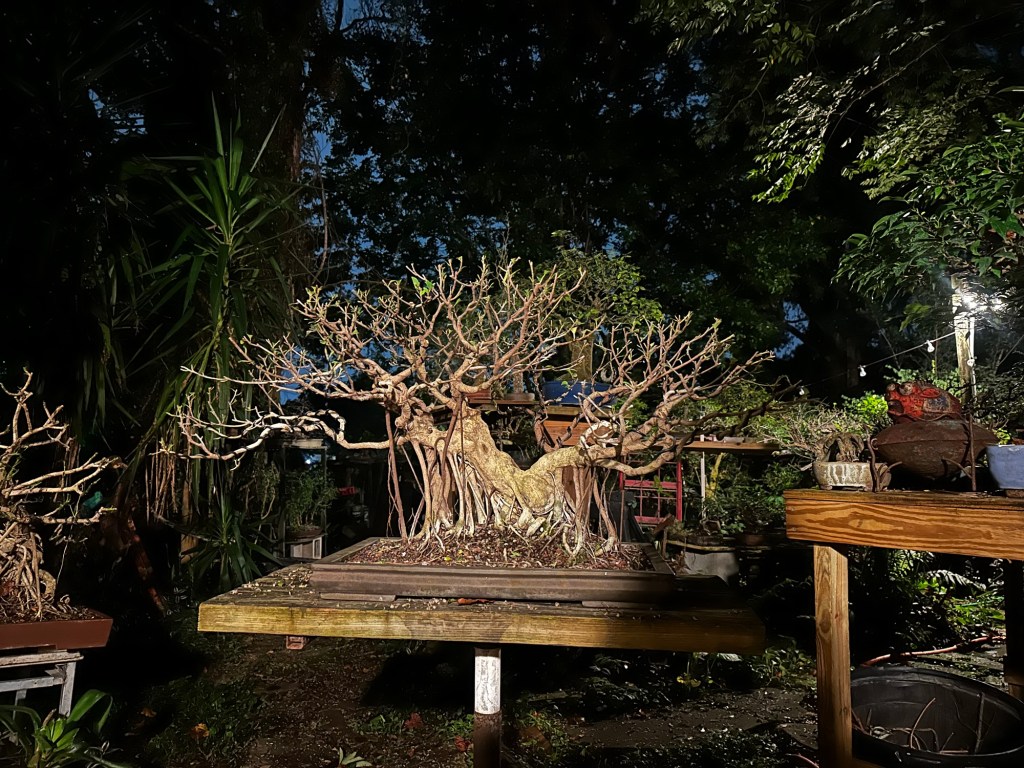
The tree is a Ficus microcarpa.

You last saw it in this blogpost What is the banyan style?, which was published way back in April 17, 2014. Here’s how it looked then:
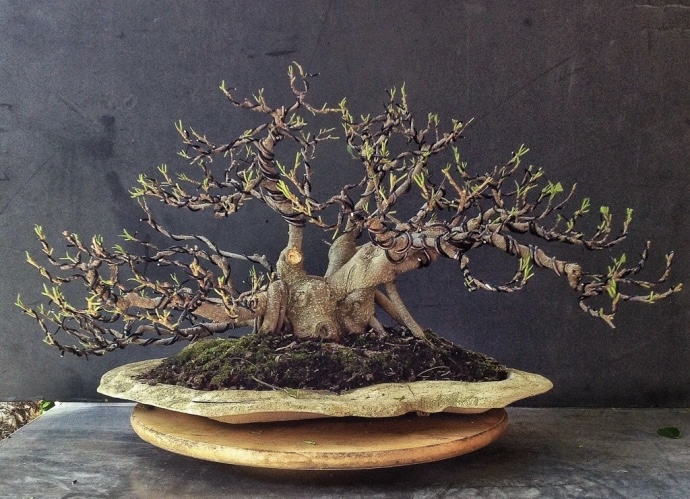
Yeah. I know, what happened? Right? I’m supposed to be a professional and all that. Neglect, unchecked growth, a couple of hurricanes and freeze warnings. Accidental uh…drought. Insects, disease, cats, children. Basically it’s survived some biblical trials and tribulations.

Speaking of disease…

I see these spots early in the spring…a lot recently. I had my nursery inspector do some checking and, though I thought it could be a fungus or a bacteria like pseudomonas, he said it’s evidence of a gall wasp. Now, as the name suggests, it’s usually an evident infestation by there being a gall on the leaf, but I haven’t seen them in my ficus. Maybe because of the systemic treatments I use (more on that later) killing the larvae. I don’t know.

The work today in rehabbing this tree will include a repot, a hard cut back, fertilizer, insecticide, and weed prevention.

Let’s get to work.

First, cut back…

I’m bringing it down quite a bit.
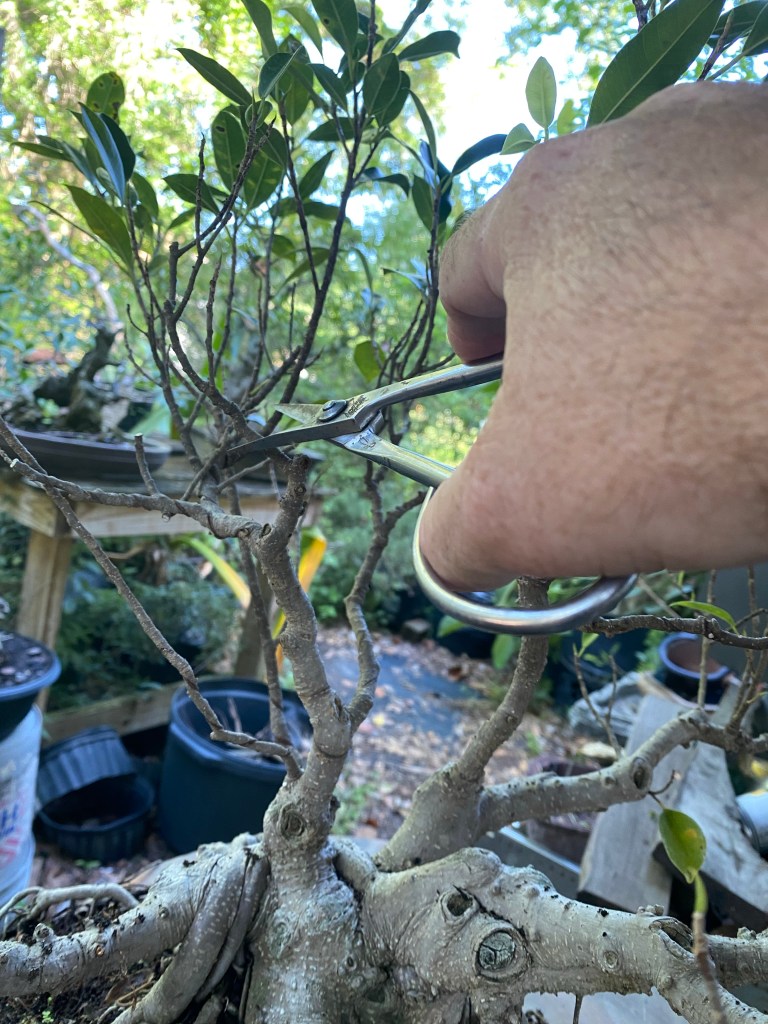
Chop chop goes the scissors!

This branch below will be the one branch I don’t cut back. You’ll see why (again) later on in the program.

Normally, I would cut this type of fig back so hard, as this is a standard Ficus microcarpa, and you can get significant dieback on it, sometimes losing whole branches. To contrast this, the Tiger bark microcarpa doesn’t do that so badly, it back buds almost anywhere. But the plain old Ficus microcarpa does. Keep that in mind. Know your tree and work accordingly.

If the branch you’re chopping is a darker brown, it’s more likely to backbud, as that’s newer growth.

Here’s the one branch I didn’t cut back. I wired it and left the grow tip.

Now to repot. I’ll be combing out the roots to get rid of all the wrapping ones. And I’m being aggressive so I can get all the weeds out.

Weeds like these. This is a corm or bulb from a weed called “cat’s claw”. A climbing vine that holds onto things with tendrils and modified appendages that are a lot like, just as the name says, a cat’s claws.

Here you can see the “claw”.

This one is called “Florida spurge”. It’s underground roots can get as big as carrots. You have to be carful to pull out those roots as it will just grow back from the bulb. If you have them it’s a good indication you may have nematodes.

Here’s the leaves of the spurge.

That done, time to cut the roots.

They were circling the pot (it’s in a different pot than the one I used years ago).

The pot it was in.

A good pot. But is it deep enough for what I need for good regrowth?

I had had thoughts of putting it into this container. It’s kind of what the trade calls an “Anderson Flat”.

It’s bigger and deeper than the ceramic one.

But using it might give me too much growth. Is there such a thing? Yeah. I need controlled growth with short internodes (remember the dieback, the branch will dieback to the next node lower on the branch). So I’m going with its current pot.

Here’s an axiom “The wetter the roots stay, the slower the growth”. You’ll hear me talk of wetter and drier soil mixes and, in this case, the more shallow a pot, the wetter the tree will stay.

To repot, first, make a mound of soil, and put the tree onto it and wiggle it down. This fills in the air gaps and gives the roots something to grow into.

It bugs me when I see people spreading an even layer around a pot. Don’t worry about the edges. That’s what chopsticks are for, getting the soil in between the roots on the margins.
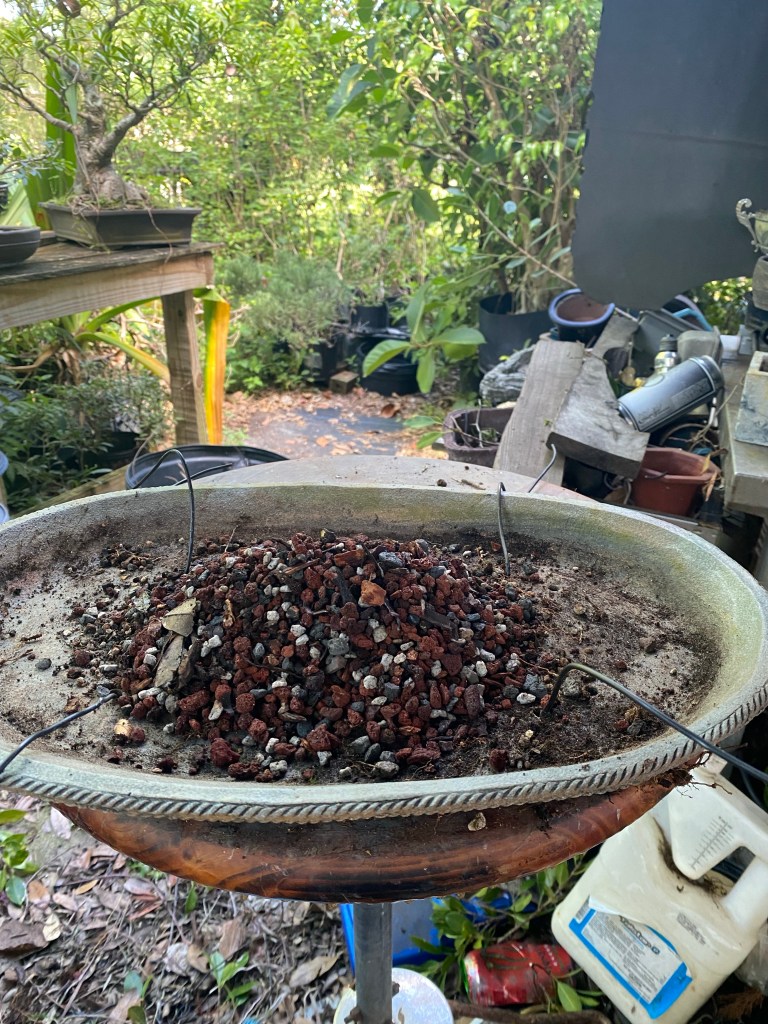
The wiggle technique:

All chopsticked in.

Some systemic insecticide next, in this case, imidacloprid. It’ll keep the thrips away. And those gall wasps.

I like to mix it into the roots well, or else you get a gooey mess.

Now, a generous portion of fertilizer. This is half synthetic time release, and half organic (I’m using Miracle Gro Skake ‘n Feed today).

And weed preventer. This is OH2 but you can find a product called “Preen” in all the stores. It’s a convenient product that inhibits seed germination, not an herbicide, so you have to get out all of the sprouted weeds first. And there will be ones you miss, so revisit it in a week or two to get those.

Do you know the difference between a weed and a plant? You want a plant, you don’t want a weed. There are places where Ficus microcarpa is a weed.

And that’s it. Let it grow.

I did rewire a back branch. It was growing up, as they are wanting to do, so I rewired the opposite direction and put it back in the place I wanted it to be. Here’s a tidbit: if you keep a branch wired too long, when you remove the wire, sometimes it pops back into its old position. The tree wants to grow up, especially newer, and smaller branches, so the tree is actually pushing against the wire, and when you unwire it, it pushes the branch up again. You can see this in bigger trees where two branches are growing against each other, and tree trimmers know this and are very cautious when they see it. As they try to chainsaw the branches, the pressure could be so great the branch will violently snap. They call it a widow maker. It happens with twin trunks the most. Imagine you’re sawing away and then “BANG” the tree splits apart at the seam.

With that, the fig has a long way to go, but by the end of the season, I’ll have secondary and tertiary branches to work with. I’ll update if I remember.

And “Bob’s yer uncle”.

Let’s see if I can get it back to its former glory.

  •  

I thought that it surely had died…

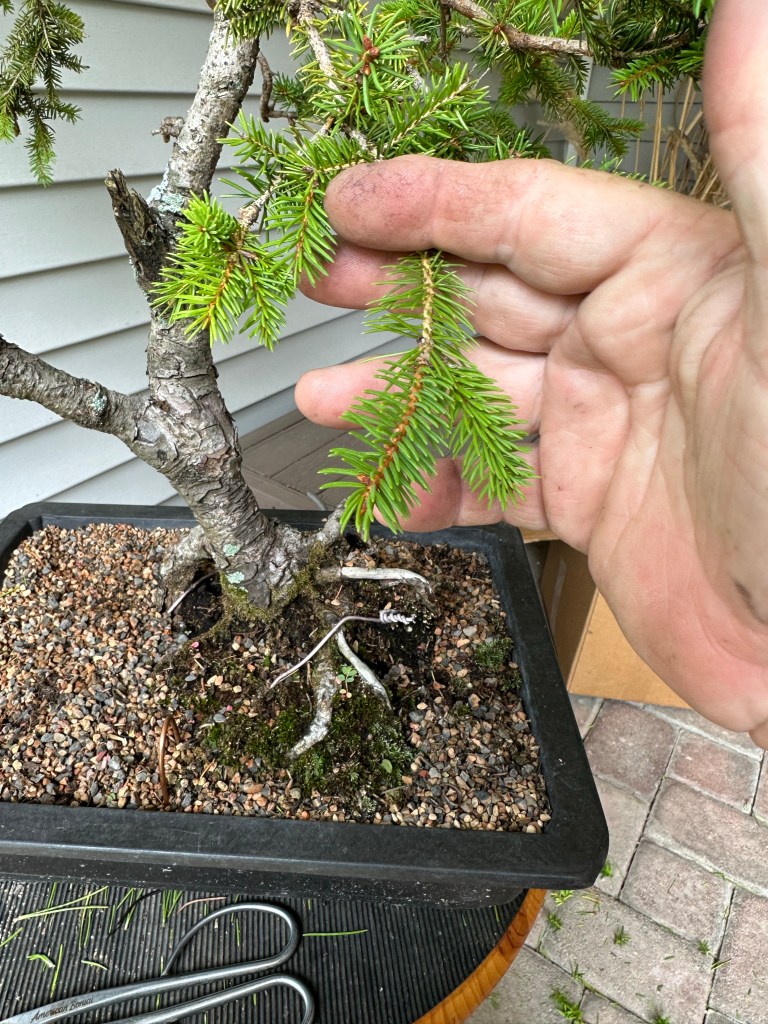
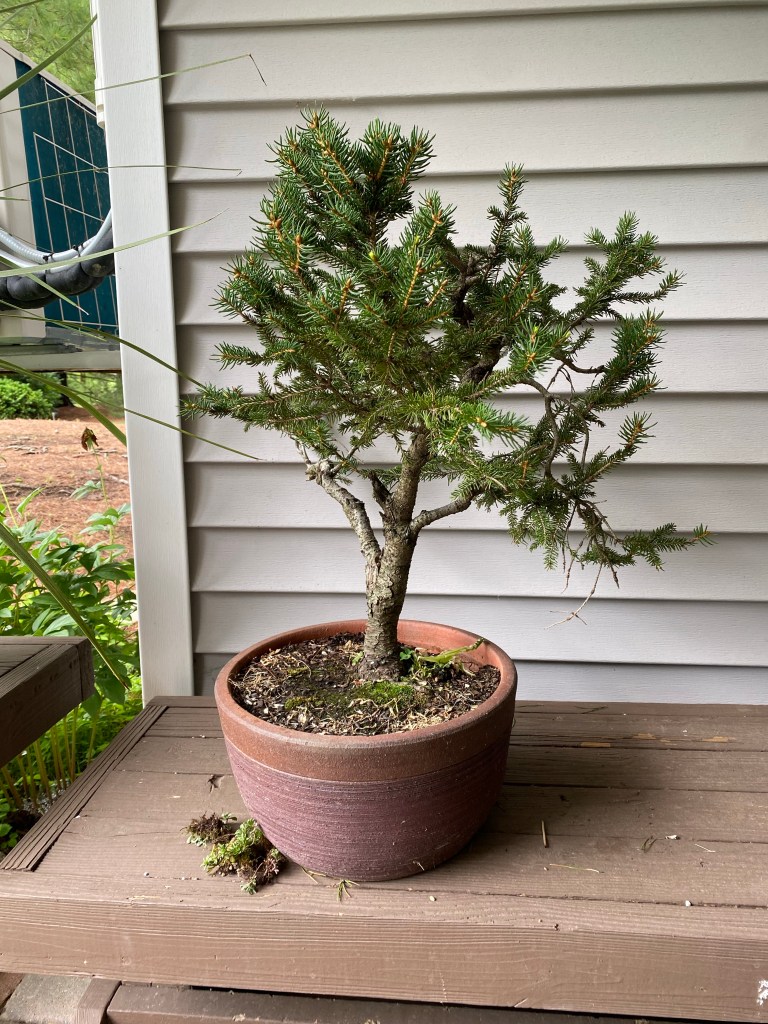
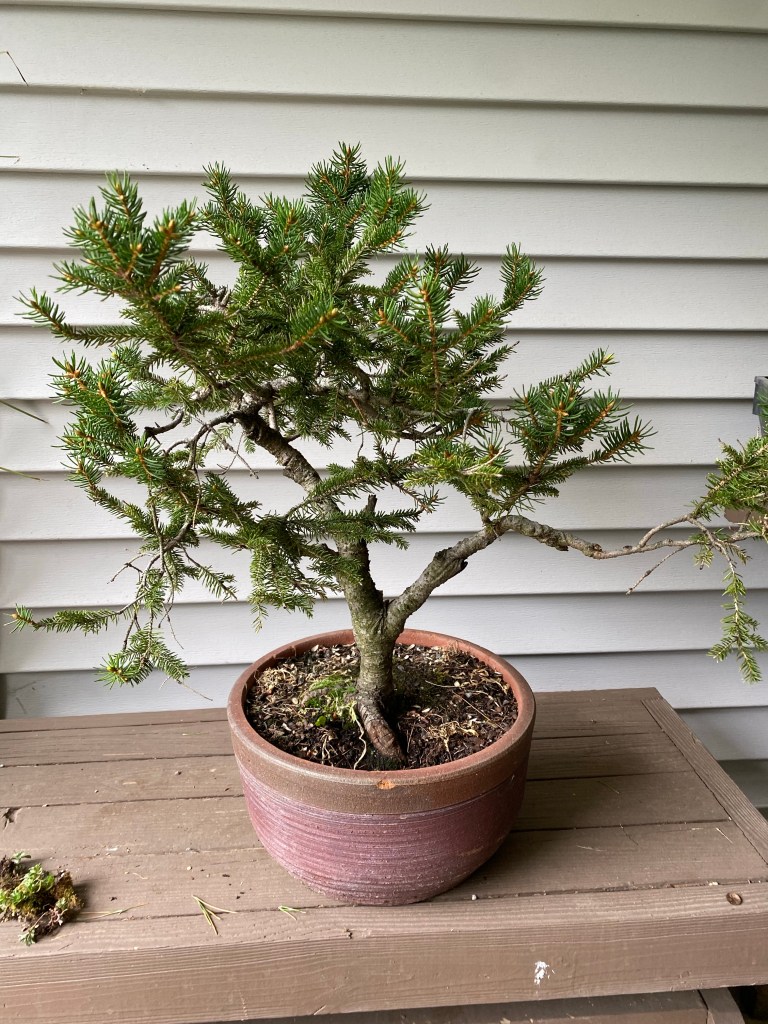
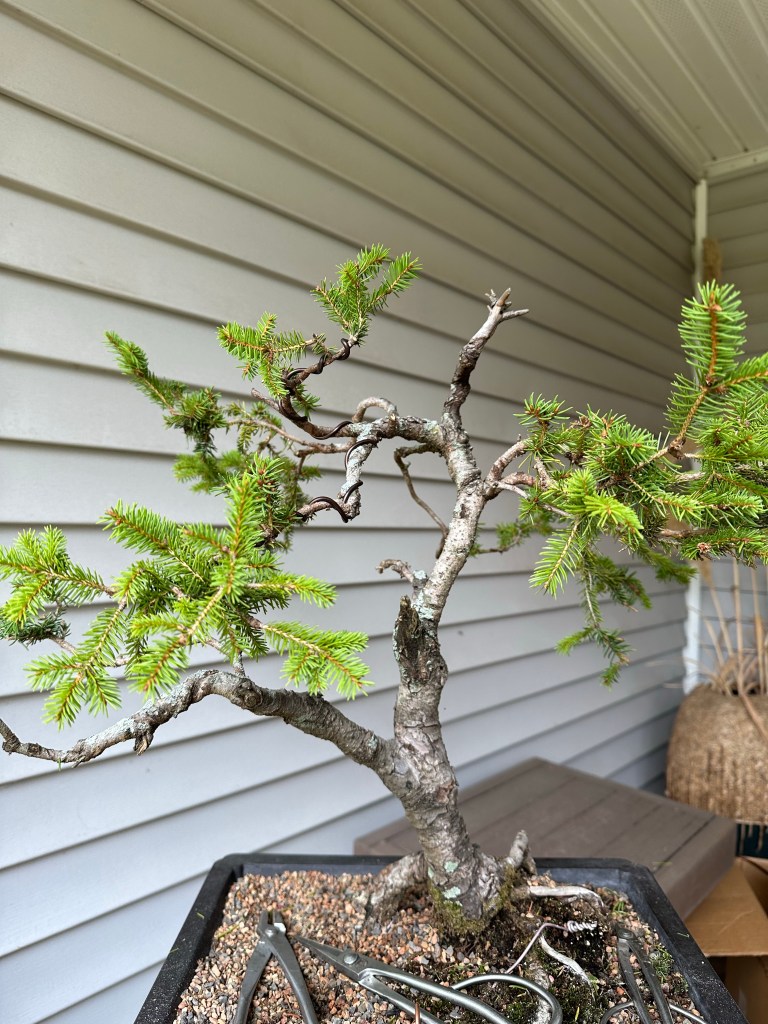
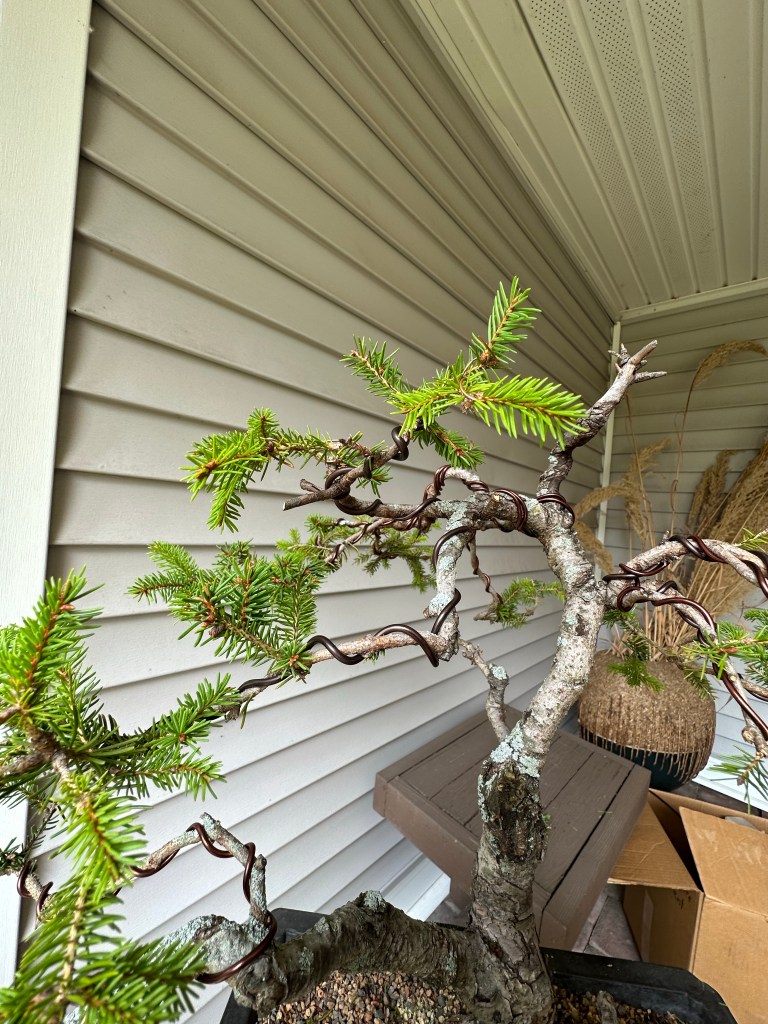
Here I am, back in Cincinnati, it’s July, 2023, two years since my last visit, and I find that a tree I had worked and, most assuredly, had killed, was still alive.

Wow…

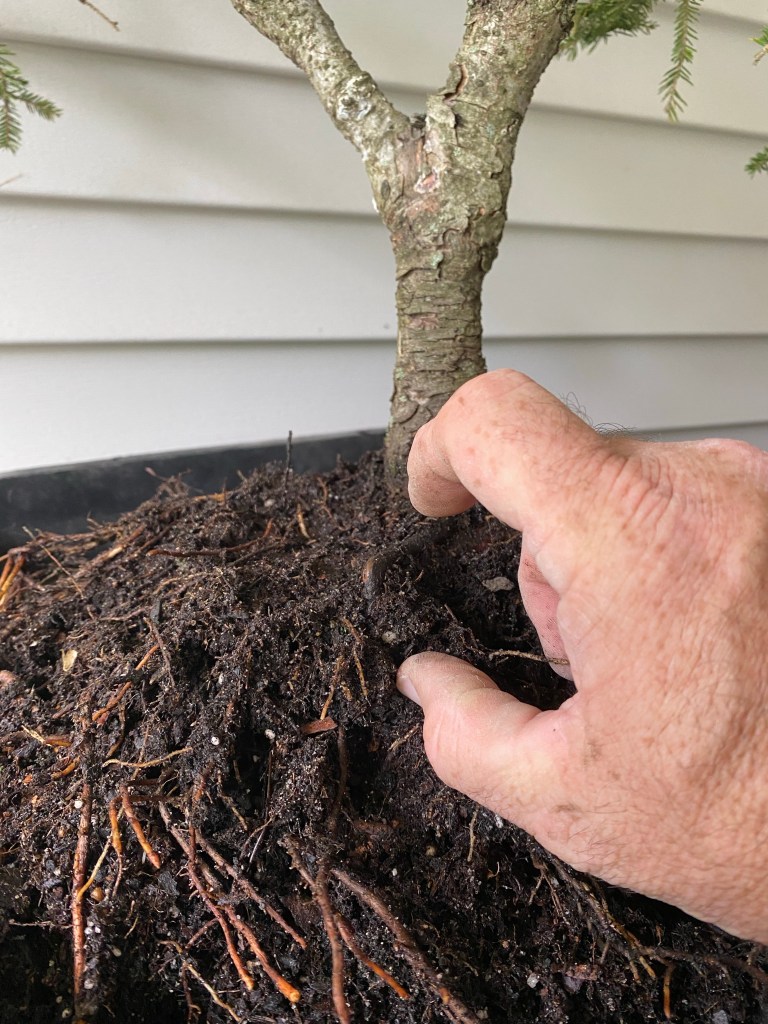
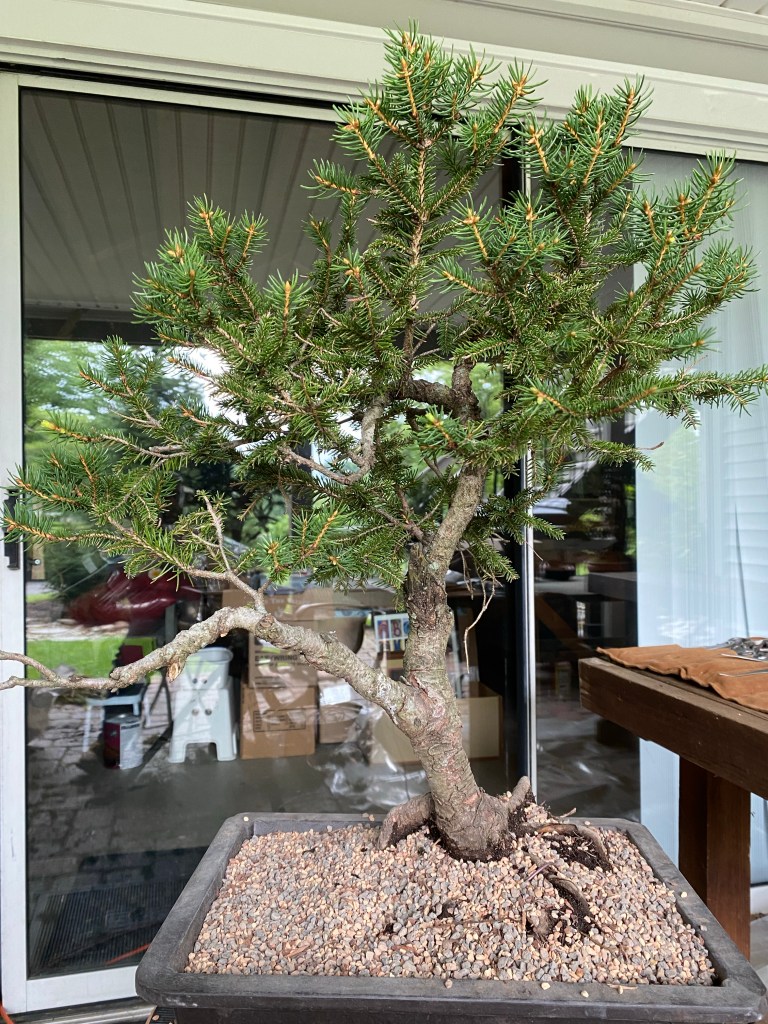
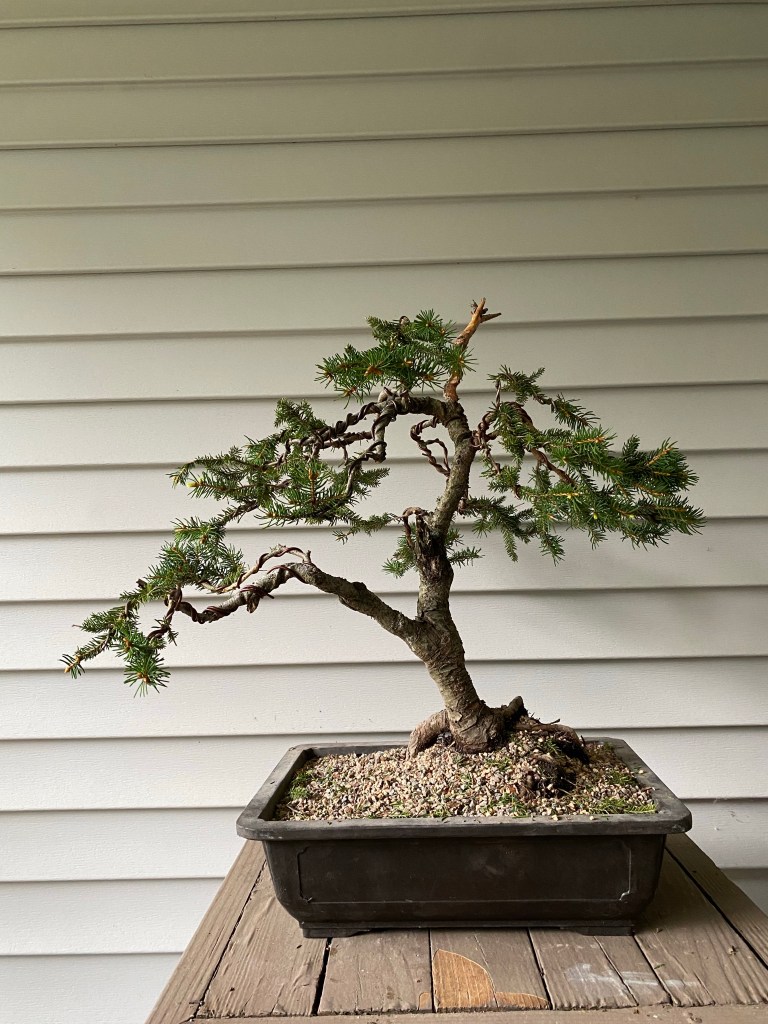
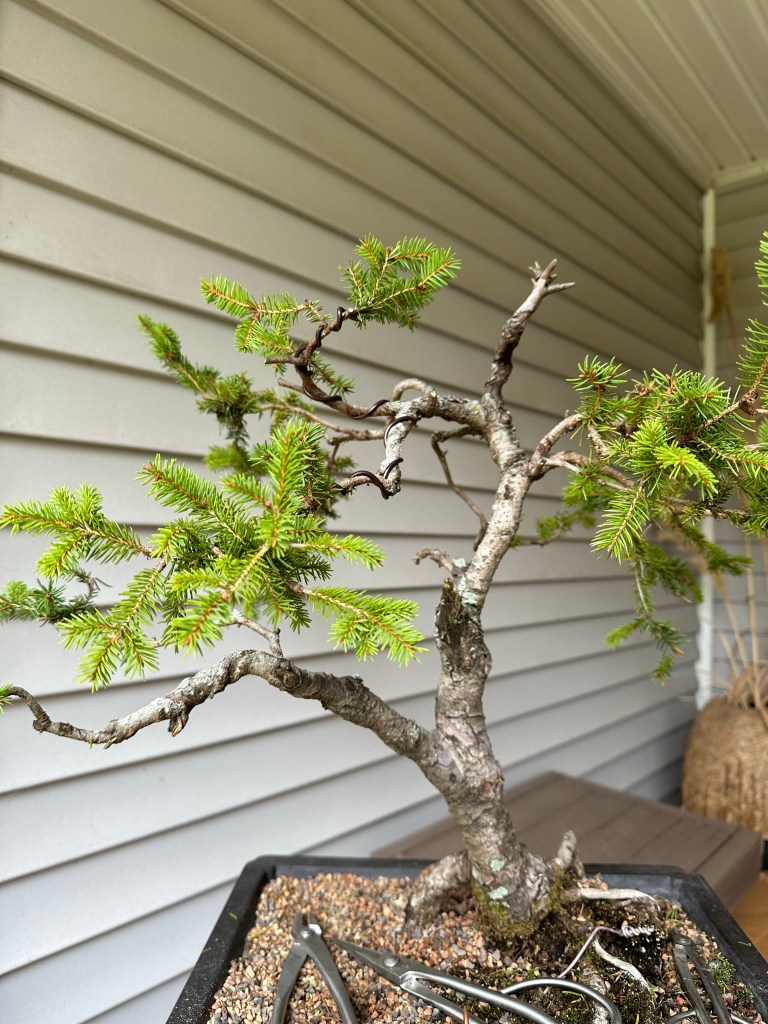
I’m not a northern conifer guy, generally (but I do work them for clients) so the only thing I can say to what it is, is that it’s some type of spruce (but it could just as easily be a fir or a hemlock). Spruces don’t grow down in Florida. They are what we call a “Christmas tree”.

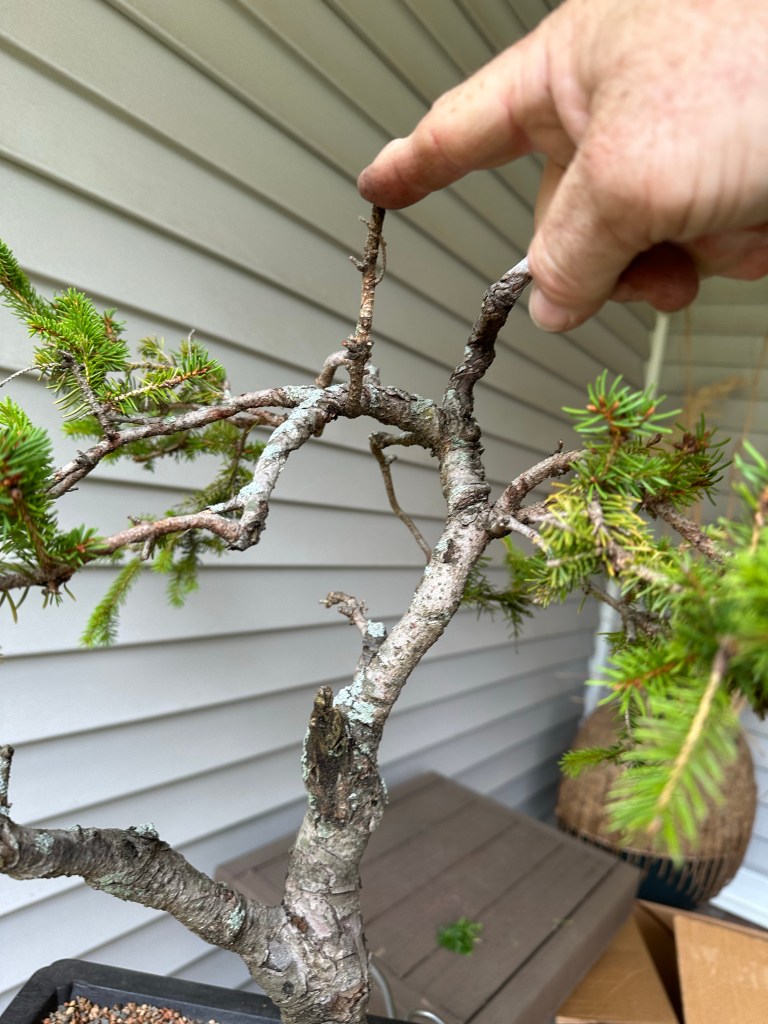
As I inspect the tree, I find a few issues. Much of the US Midwest had a weird winter. It was cold near Christmas time, but didn’t get cold the rest of the winter, until one day the temps dropped 40° Fahrenheit in a matter of hours. Many bonsai were damaged. I think it stressed this tree in particular.

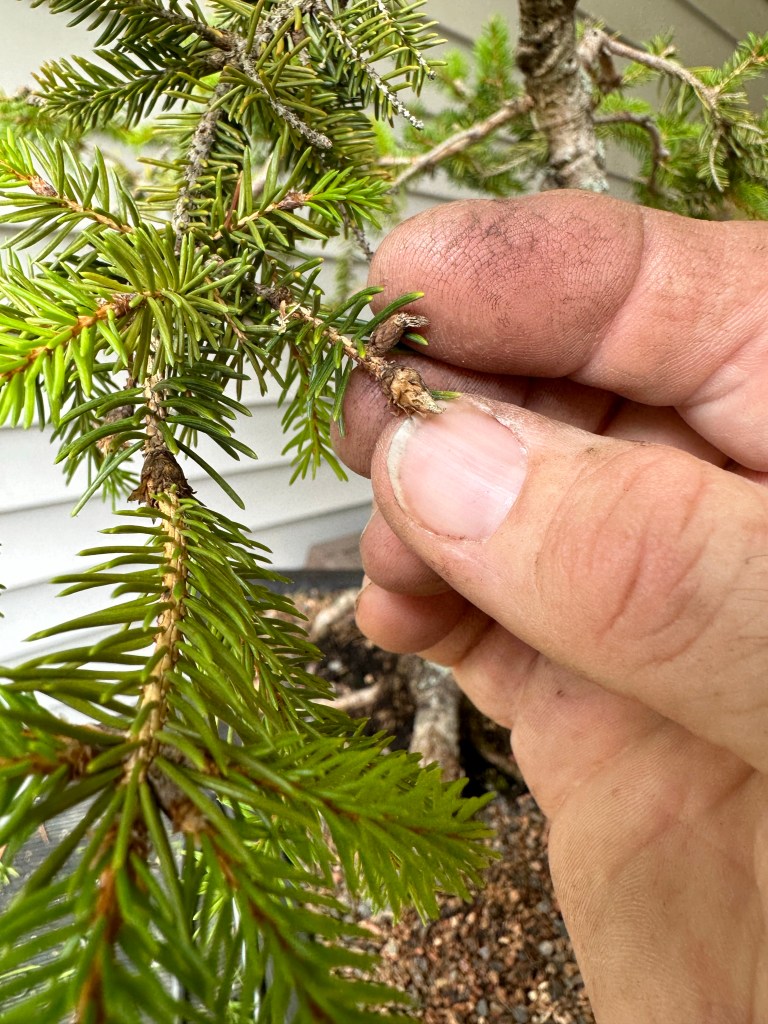
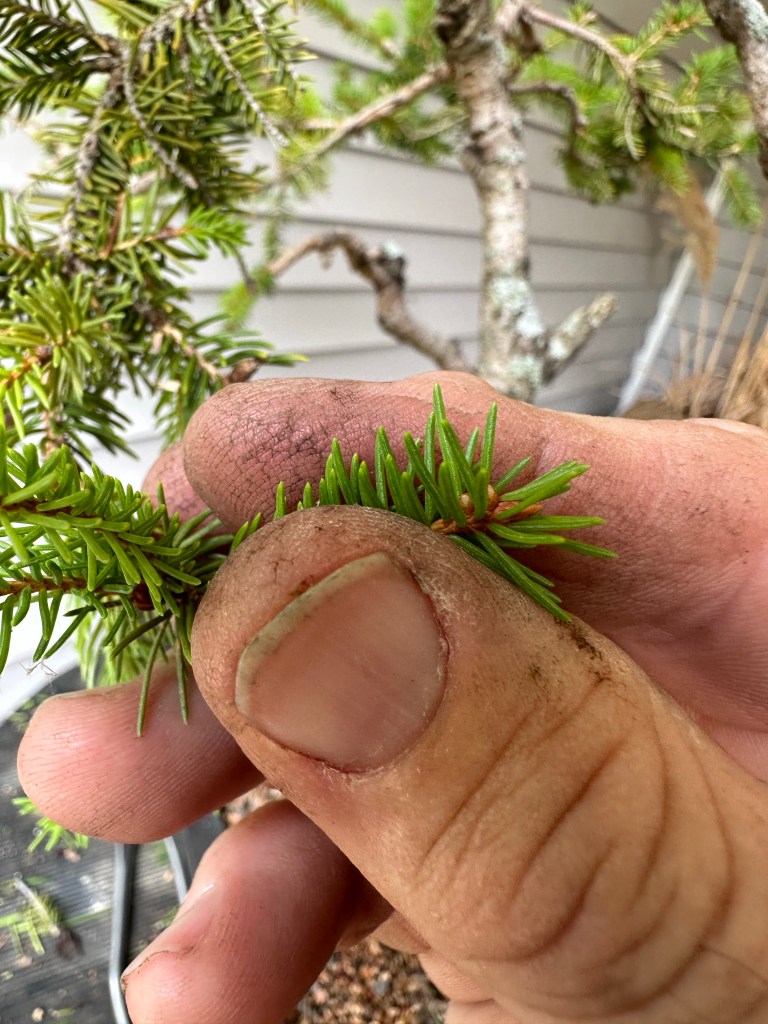
It killed off one branch (above) and some of the new buds were damaged. As you can see below.

But it’s still alive and growing. Which delighted me when I got to my clients house.

Ok, that’s in the Now. Let’s go back in time and look at the tree two years ago and you can judge me for the initial insults I rained down upon the poor tree back then.

Lots of branches, good color.

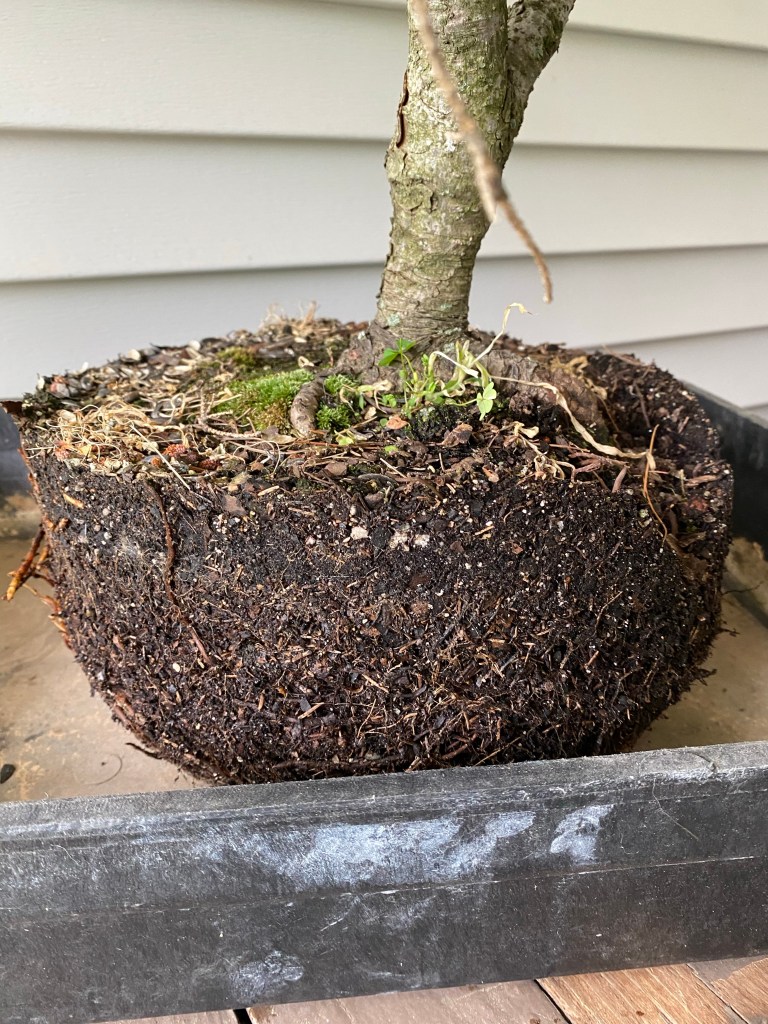
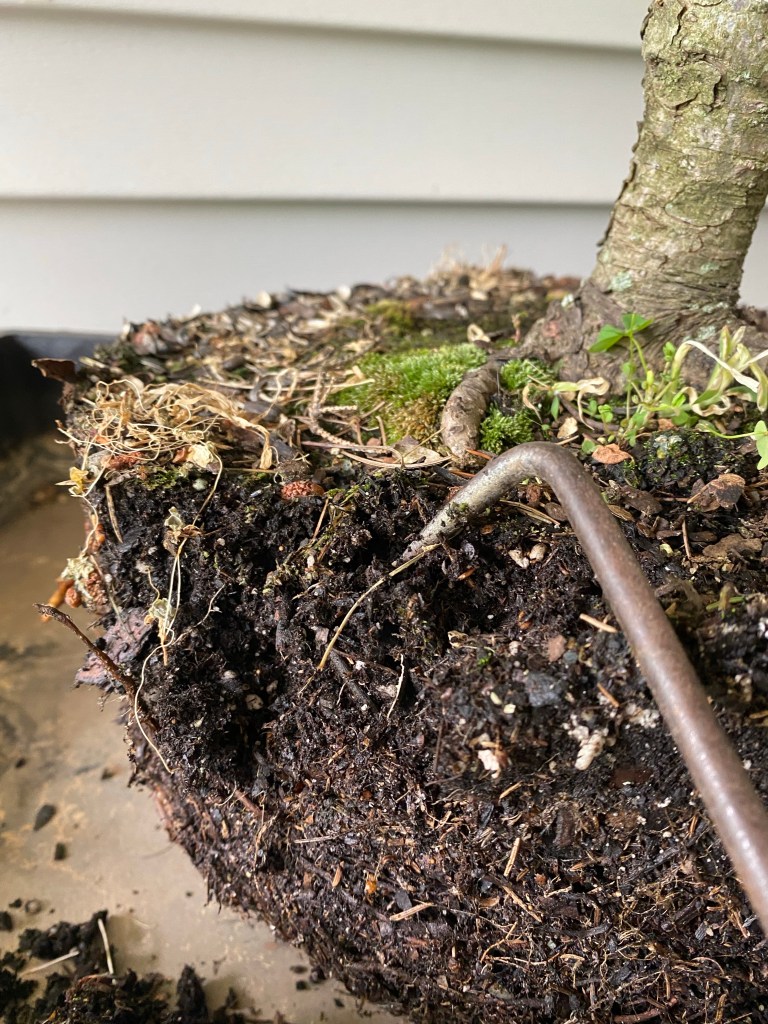
Crappy soil.

So what did I do?

I repotted it.

My client, Tom, asked me to, so I, against better judgement, did.

This was in mid June, Cincinnati, Ohio, coming into the hottest time of the year for the locale, I knew just a little of its history, but nothing about the species, and the worst insult? I’m a tropical guy (well, mostly. I am here now, aren’t I?).

Tom, who had a stroke a few years ago, doesn’t get to work his trees so much. And he’d had the tree for many years, just sitting in that pot. He’d look out the window at it from his living room.

He asked me to do something with it, so I did.

First, the repot.

The soil I had on wasn’t the best. Mostly expanded shale, or Haydite, as was the brand name back in the day.

Then I styled it.

Two years ago….

You are probably asking why I didn’t do a write up on it then? Well, to be honest, who wants to show a tree you’ve worked on that you know won’t live? I don’t like that idea, showing techniques and styling and trying to be a teacher when you know it’s not best for the tree.

But I got lucky, and sometimes, as they say, it’s better to be lucky than good.

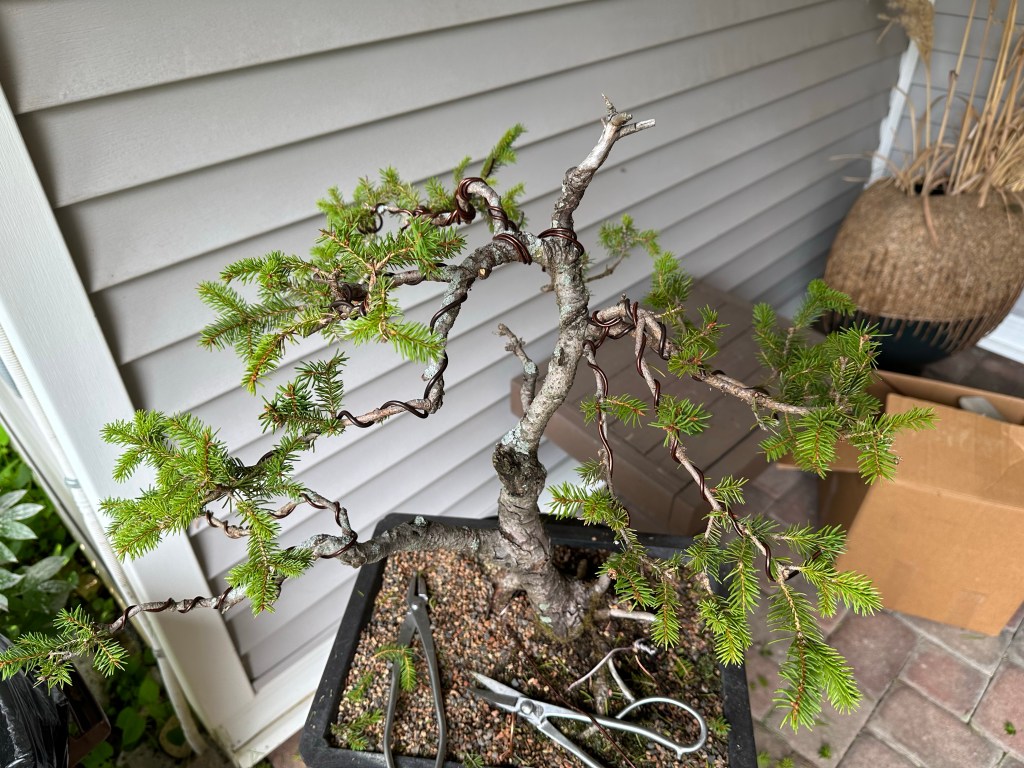
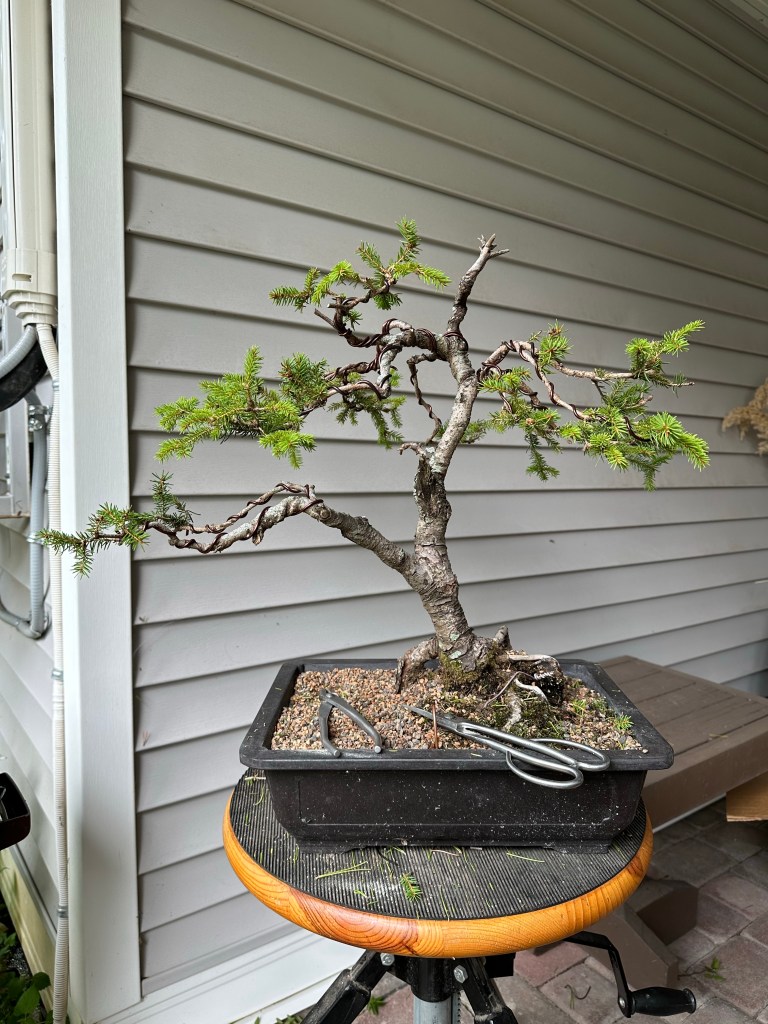
Here’s the tree after the restyle.

I left more on it this time, given that it was stressed.

Wiring the top in a typical “conifer comb over” many bonsai artists practice.

The only tips or tricks I can give you on this particular variety and species of tree (considering I’m near ignorant as to what it specifically is) is to not cut it back too much, water and fertilize as one would with the spruce genus, and pay attention to severe, sudden drops in temps near springtime bud formation.

I didn’t fertilize this time, except with a miracle product called “Micromax”, which is full of those micronutrients usually missing in most fertilizer compositions (macro nutrients are the NPK of regular ferts: nitrogen, phosphorus, and potassium, micros would be things like molybdenum or boron or even things like chlorine or copper that you might think are detrimental to a plant).

And that’s how I left it for this year. Hopefully I’ll see it again in my future travels. I don’t get to see many trees after I work on them in my tours. So a return this year was sweet.

Thank you Tom, and thank you Ruthie. You are both the real deal.

  •  

“What are you gonna do with that piece of sh….. “

It’s been about four years since I found this, and every year, looking at it and pondering the next move, I’ve missed the opportunity to work it. Why? I needed to repot it, get a look at the roots, figure out what was happening under the soil. You can only do the root thing in the late winter/early spring, before the tree sprungs, or you’ll tend to kill it. We don’t try to do no killin’ ’round here.

It’s my favorite deciduous tree, Celtis lævigata, and you need to repot it before the new leaves emerge. This year I got to it in time.

Let’s see what we can figure out.

I love odd shapes and challenging trunk lines in my personal trees. This is a root, I’m sure, off a bigger tree, and I love it.

The dead wood. The reverse (inverse, obverse, blah blah blah) taper. The species. I call it the ficus of the deciduous world. You just have to search “Hackberry ” in the search on the front page and you’ll get a bunch of hits on articles I’ve written on the tree (except that one Brazilian Raintree hit….).

Funny thing just occurred to me. When I write my blog I try to explain what’s happening, or what’s going through my head, as I work on the tree.

During a demo, I’ll often just get lost in the tree, and forget that the audience is there and I’m supposed to be performing. A bonsai demo is really a kind performance art (and I say that tongue in cheek, because many bonsai practitioners are kind of conservative when it comes to bonsai-as-Art, no matter their taste in art or politicians. Me, I can’t stand the taste that a politicians actions leave in my mouth, except I don’t mind that one bonsai guy in Virginia. You know who you are, Roberto).

When I’m asked what’s going through my head during a demo I usually say “not much”. It gets a few laughs. Or I’ll say “you don’t wanna know what lives inside my brain”. That gets some too.

Sometimes I tell the story of how the chicken came to the west.

I’ll say, ” How many of you have heard the chicken story?”

Those who have, groan. But they encourage it because, though they’ve suffered through it, they want others to know the pain of sitting through it as well.

Shared pain is lessened, after all.

Anyway, the chicken story:

What you may not know, is that the chicken originally came from Asia. Look it up, I ain’t lyin’. And in Asia, there is a strong Master/Apprentice relationship in the passing down of knowledge.

Now, anyone who’s raised chickens knows that it’s prit’near impossible to tell the difference between a male and a female chick (baby chicken). And it should be self explanatory that a female chick is more valuable than a male chick, because of, you know, eggs and all that, so there evolved a very prestigious occupation in the world of animal husbandry know as a “Master Chicken Sexer”. A real job. A dirty job you might say (you remember Mike Rowe and Dirty Jobs? There was an episode about just this thing).

So, being that chickens are from Asia, and they were imported into the West (how else do we have omelettes?), it soon became clear that the western farmers needed help trying to figure out how to distinguish between a male and female chick. Still obvious, right?

So the western farmers hired the Asian Master Chicken Sexers to teach the westerners how to do this.

The scene: we have the apprentice chicken sexers sitting at the conveyor belt, and the yellow chicks are coming down the chute, onto the belt, and the apprentice picks up the chick, tickle its butt or something, and throw the chick into either the male bin, or the female bin.

The poor male chicks are mostly made into….ah, feed for other chickens. The females were let go to make nests and lay eggs for the farmers to harvest and make their scrambled egg breakfast or quiche (if they’re French farmers).

As I mentioned before (about 100 words earlier) it is exceedingly hard to figure out the difference between the male and female chicks; they’re both yellow, the males haven’t learned to cock-a-doodle yet, the females don’t even gossip. So the apprentices are sitting there, chucking the yellow birds in whatever bin they thought they should go into. When they got it wrong, the master, who was standing behind the apprentice, would whack the poor student on the back of the head.

Slap!

Eventually, the apprentice could unfailingly tell the difference between male and female chicks.

Now, they had no idea how they knew, but they did know. That slap hurt.

Again, obviously, the point of the story isn’t about chickens or East and West or even farmers. It’s more about how to teach. Some bonsai teachers teach using the rod, telling you you’re wrong and to do it again, and again, and again, until you have it right.

That’s not me. My online name is Adamaskwhy. Most people think it’s that way so you can ask me “Why?”

And you can.

Most of the time I know the answer, or I can find it.

Or I make something up that sounds plausible.

But the real reason for my name is that, as a student, I don’t just want to know the answer. I want to know why. I was (and still am) that annoying kid in the back row that said “oh yeah, prove it!” And it angered some teachers, bothered others, and I was loved by the smallest percentage. Those were the good ones.

I’ve talked about this before, so excuse me if I’m repeating myself, but a teacher who doesn’t know why, ain’t much of a teacher.

If you can only recite your lessons, then you haven’t learned a thing.

Which brings us to the initial styling of this hackberry. You remember it? The subject of this article and all? I know, you got lost in the chicken story. It happens.

What in the hell is going through my head?

Well, you’ll have to trust me on this one, and see what happens this year.

It seems that a lot of “rules” are being thrown away with this tree.

I mean, they do say that “rules are meant to be broken”. But why do they say that?

Let me tell you another story, this time about a boy named Pablo. Pablo’s father, Ruiz, was an artist that specialized in realistic drawings and paintings of wildlife. He was an instructor and professor at several art schools. He started training Pablo at the age of seven, and insisted that Pablo learn how to draw and paint properly, in the classical and realist style that was popular at the time, and was profitable, as artists jobs back then was to paint portraits and art to be hung in wealthy patrons homes.

So Pablo learned. It came easily to him. At age thirteen, his father, Ruiz, proclaimed that Pablo had surpassed him in talent and technique, and enrolled him in a prestigious art school in Spain.

Pablo quickly understood what art school was for, and formed serious friendships that would help him later in life, all the while slacking off on his lessons. He knew them anyway.

That, by the way, would be the one lesson to take away from this parable, college is to make contacts in school, that will help you later in life. The bosses who hire you only want to know that you got the degree, not that you were a “C” student. But if they know you were in their sorority or the chess club they were in, you, my friends, are in, as they said in my youth, like Flynn.

Pablo was so good a draughtsman that, in his later years, when everyone called him Picasso, he would sit and drink his coffee at the cafés in Paris, and draw photorealistic flies and bugs on the walls. Drawings so real the waiters would rush over and try to swat the fly off the wall. Pablo, as you might think, got great pleasure in these escapades.

We are all just boys and girls, trying to smile at the tragedy that life sometimes is.

What is to be learned by this last story?

If you learn to do the work, as a craftsman should, you can then use that work to accomplish the Art that your soul requires to feel alive.

It seems I’m at the end of the work.

I would try to get a good pic, but my photography area has been battered by a hurricane or two. It’s on the list to repair.

And here’s the obligatory tortoise pic. I need to build him a proper enclosure. That’s sooner on the list than the photo spot.

This is the best I can do for now.

I’ll post updates as I make changes in the tree. Maybe. I have a long list of “To-Do’s”.

  •  

Makin’ my way in the world today

The Orlando Japanese Festival, 2024.

Held every year in Kissimmee Florida…..

The Central Florida Bonsai Club, my club in Orlando, has been representing Florida Bonsai at this festival for several years now.

I like to go for the day and work one of my bigger trees to show the public that bonsai don’t need to be, or are limited to, small hand-held trees.

This year I brought a Ficus microcarpa. Just the plain species. Not tiger bark or green island or melon seed. Here’s how it looked after I cut it to a line way back in 2013.

I got the trunk from my good friend Ronn Miller, a Florida bonsai artist of great renown.

The link below shows a previous blog post on the tree:

https://adamaskwhy.com/2013/06/26/rejuvenating-a-ficus-bonsai-part-2/

What’s on the agenda for today?

Defoliation, unwiring (I think I did that already) and pruning for shape/taper/ramificatiom, and rewiring of course. But not every branch.

Sometimes that’s needed, wiring every branch, but most times it’s not. I had a former friend who insisted on wiring every branch because that’s how he learned (he watched a video on YouTube that told him to ALWAYS wire every branch, and he was a paid subscriber to this channel, so he obviously has to do what he’s told, cuz it’s worth more to him. I wish I had a simple mind like that. I have to question everything. Just last week I was tying my boots and I wondered if they’d be tighter if I used an overhand knot instead of a sideways, underneath knot. Took me 15 minutes to tie my boots…..

If you’re looking at the leaves closely, you’ll notice the white build up on some of them.

Like above. I see this question a lot on the bonsai forums: “What is this? Is it harmful? How do I get rid of it? “

It’s usually just water spots from dissolved solids in your water. Like calcium, or lime. If it’s red or orange, it’s iron rust. it’s not harmful acutely, just ugly, but it could be a problem if it’s built up so much that it blocks the sun and restricts photosynthesis. And how do you get rid of it? You can polish the leaf, or use leaf shine, or, like I’m doing, cut them off. A ficus can hold a leaf for up to three years (it’s a tropical, broadleaf evergreen). But you can defoliate one, as long as it’s healthy, up to four, five times a year. I usually do at least twice in my normal maintenance. If I’m really pushing a tree, 3-4 times.

Anyway, I have a bunch of leaves. Let’s see if I can count….

There we are. I counted 2,713 leaves.

Actually no, but that’s a good number. It’s a prime number (only divisible by itself) and sounds good saying it out loud

“two thousand seven hundred and thirteen”.

Sounds like it belongs in the first, or last, sentence in the Great American Novel:

“In the year two thousand, seven hundred and thirteen, the hero man was born.

Or died.

It was a time of illogic and lost tales, with many great humans born or killed. Some by the hands of evil men, or by their own hands as the era was one of pain.

The world had just gone through a bloody interregnum, accented by war and famine, city and states wiped off the countryside and built up into empire. Cultures distilled out of the quirks and pathology of a leader, or group.

Our hero begins the day chopping wood, collecting water, and making tea.”

I’d read that book. Maybe I’ll even have to write it.

Let me finish this post first. The branch my hand is on has risen from its original place in the design.

So that’ll need to be wired back down.

That’s the life of a ficus bonsai owner: put the wire on, take the wire off, put the wire on, take the wire off.

Anyway, enjoy the next twenty following pics of me pointing at various parts of the tree.

Straight lines must be made curly.

Some things gotta go.

I just realized that in the background of these pics, you’ll be seeing a pretty detailed accounting of certain attendees visiting the restroom.

Now for wire..

For the sake of a good anchor, one should try to wire two branches with one wire.

Always start in the branch crotch (I just learned that “crotch” is a word first used to describe the meeting of two branches, or the trunk and branch, and not the area between your legs).

And wire one side clockwise, and the other counter clockwise.

There’s a straight line that’s offending my eye.

I know I need to wire three branches. I’ll use two wires.

This will let me put two wires on some branches, to give better holding power.

Then the bend.

I usually use two hands to bend, but that’s hard to hold a camera, and bend. Pretend my left hand is steadying the branch.

There we go, one done.

Now for the rest

Zooming in, you’ll see wire marks. One of my favorite bonsai lines comes from an English man, he said “I’f’n you ain’t got no wire mahks, yer not using enough wire”.

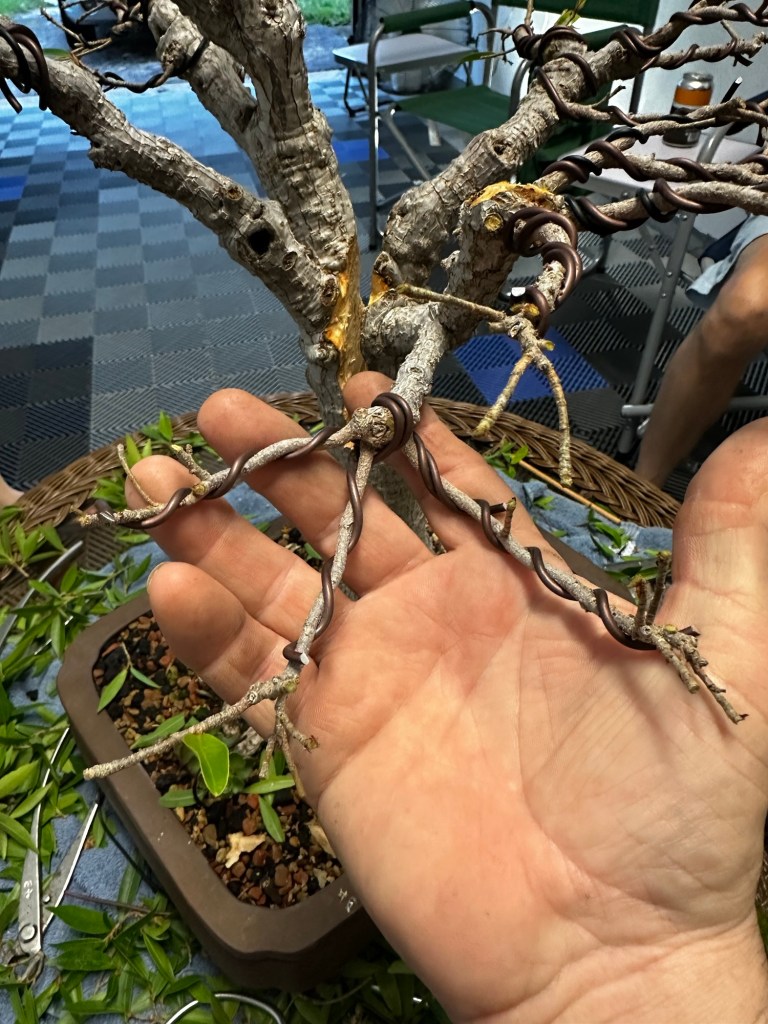
Say that in a John Lennon accent.

Should you find yourself with too many wire marks, you can scrape off the ridges with a blade.

It mitigates them and makes the branch look gnarly.

And chicks dig scars.

And that’s it.

A video from the top

There’s just something satisfying in wheeling a tree around on a garden cart.

🎶Walk this way! 🎶

We all have to walk the path we see before us. Sometimes we cross others paths at the same time they’re on it, and sometimes those paths parallel each other. Relish those times of a companionship, but realize you can’t get off your own path.

Finito!

  •  

It’s a Hard Rock life, for m’trees, it’s a Hard Rock life, for me

Carry on my wayward sons, or trees….or something like that.

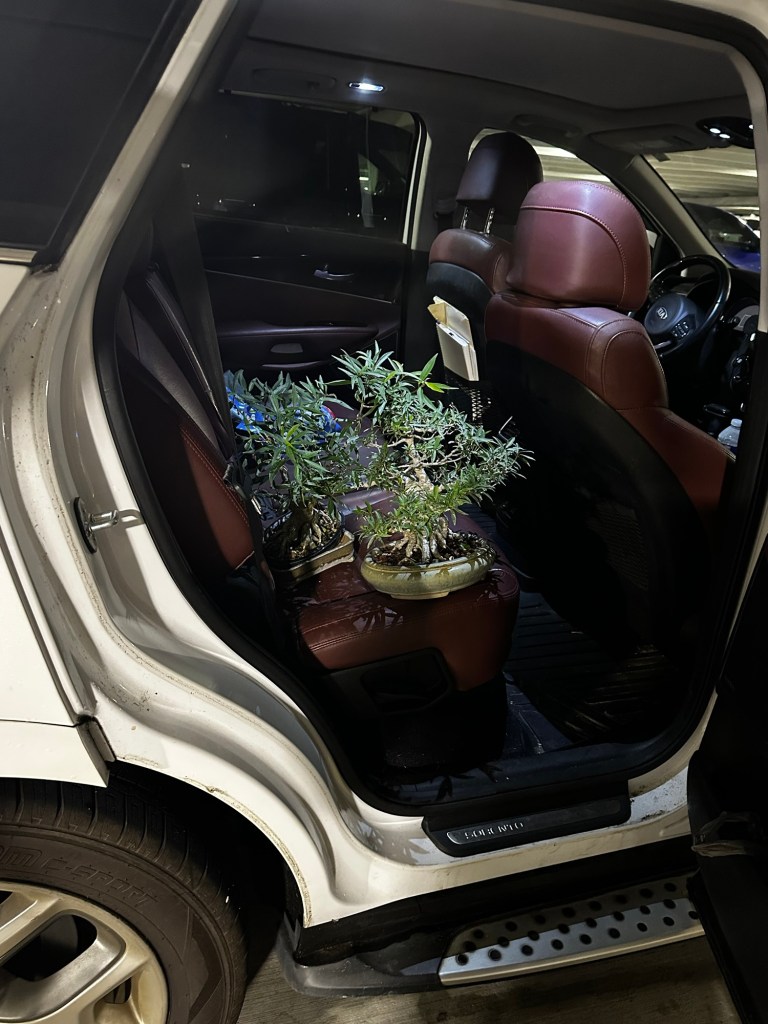
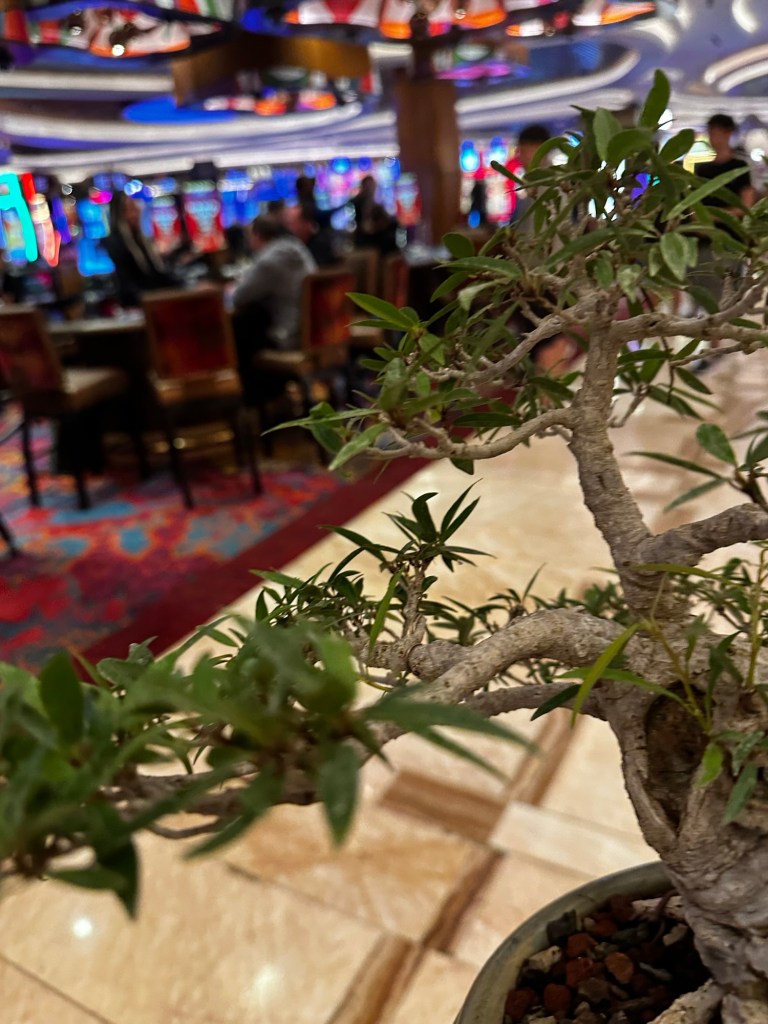
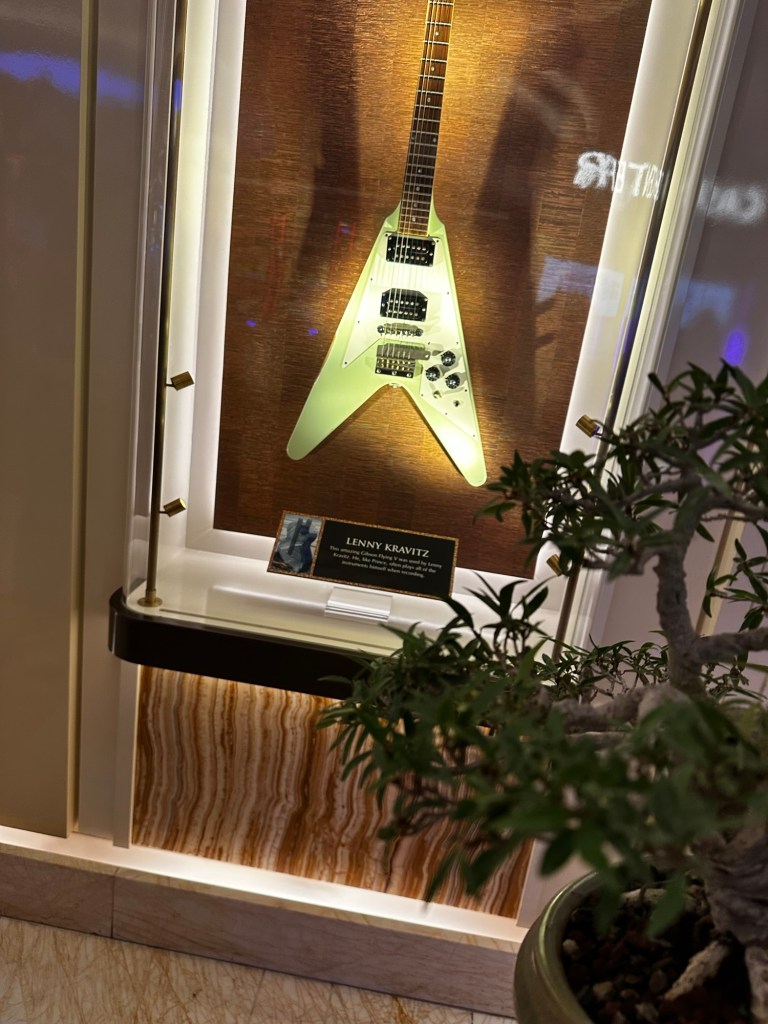
Here I find myself in a hotel in Hollywood.

Florida, not the hotel in California. Where you can’t never leave.

I’m at the Seminole Hard Rock Hotel and Casino. It seems there’s a place way down south in the Everglades, where the black water rolls and the saw grass waves.
The eagles fly and the otters play in the land of the Seminole…

I could catch a show, eat a meal, go swimming, gamble and win (most likely lose). But they’re never gonna catch me cuz I have one more silver dollar.

I have some work to do. Takin’ care of business, so to say.

Or, tomorrow morning I have work to do.

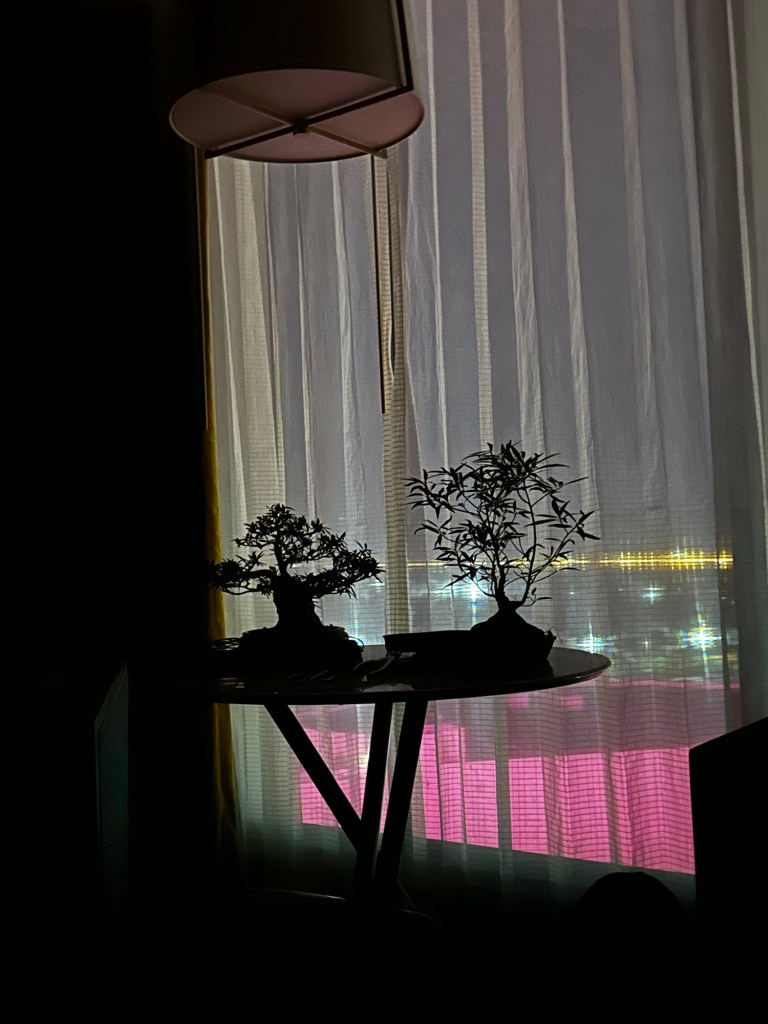
Nightie night…..

Here comes the sun….

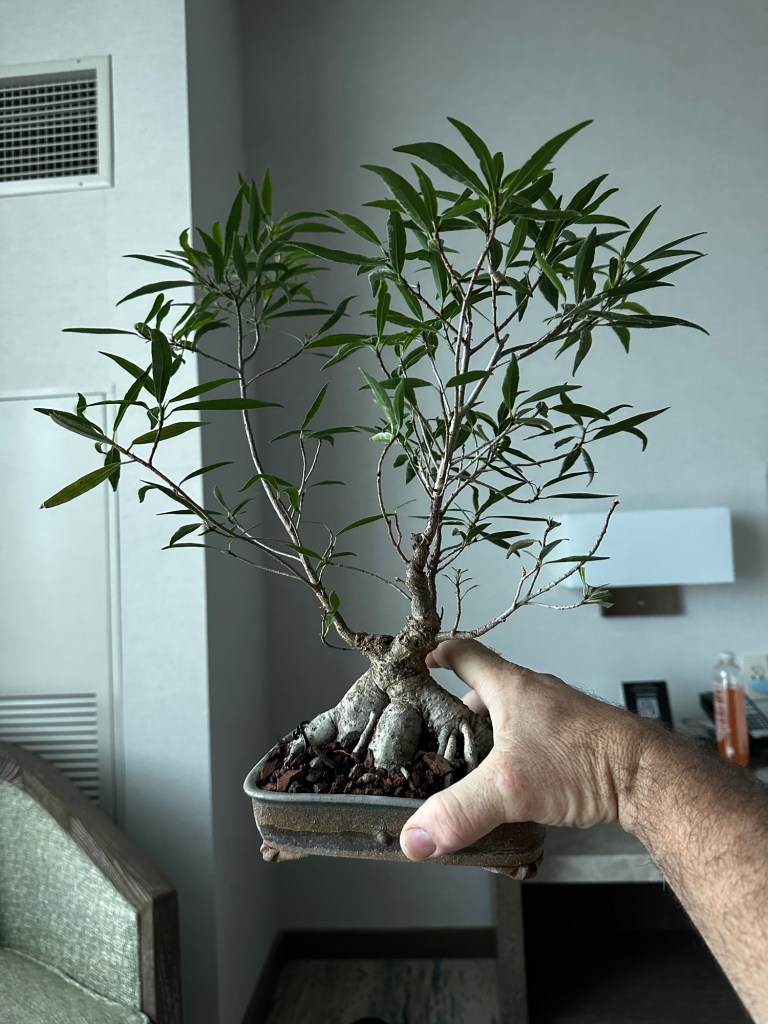
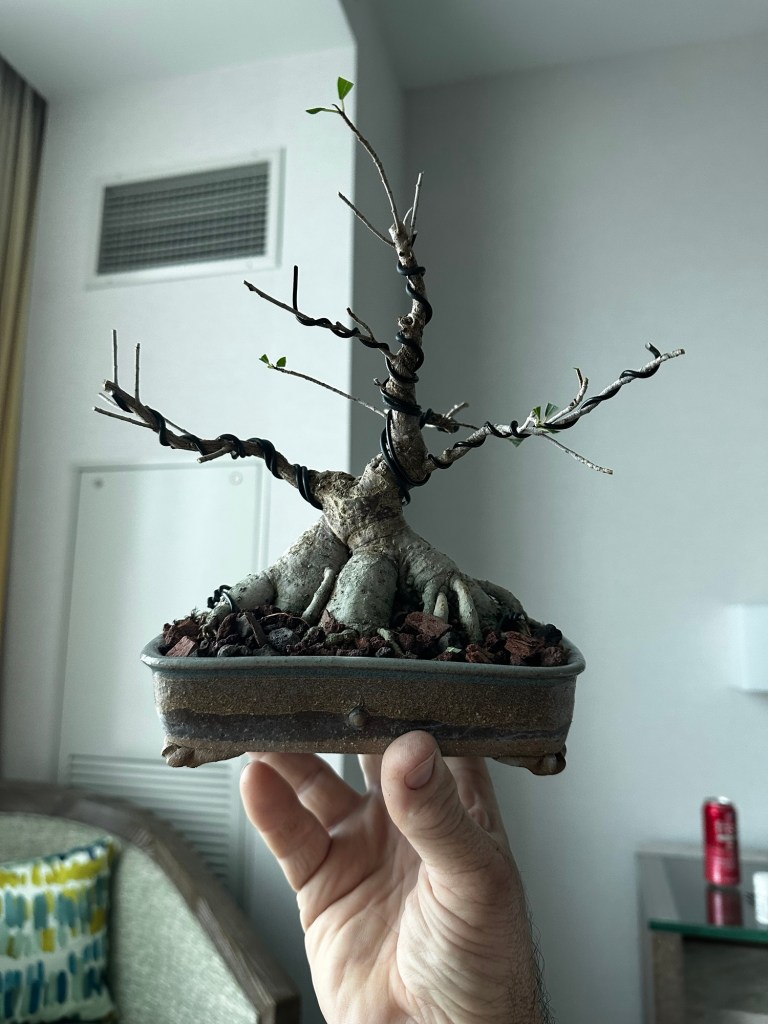
And the tree. A willow leaf fig. Ficus salicaria. What’s a more Florida tree than the one bonsai species that was first discovered here. And not too far from this place. The very first bonsai made from the willow leaf still exists and lives down on the east coast of La Florida. Very far from the Florida:Georgia line.

The tree came from Mike Blom, of Emblem Bonsai. He’s one of Florida’s best. He takes the time to develop the trunk and works to make the stock plant the best it can be. The pot is an early Taiko Earth container, by Rob Addonizio.

I didn’t bring any number one wire, so just the main branches will be wired.

They already have a strong upward bend so I’ll keep that movement and exaggerate it. An artistic concept we use in bonsai is the repetition of shape and line. This brings the character of the tree into a more honest representation of itself. The branches should tell a story. Say we have a mountain for or spruce in a place where winter dumps hundreds of pounds of snow on the trees and plants growing there. The branches tend to start growing down right from the trunk.

This tree, a purely tropical species, tends to want to grow up first.

Now, don’t get me wrong, we can style the willow leaf ficus as though they are conifers (in fact, here’s a post where I did just that: This is what happens when you leave a tree at my nursery)

I consider them one of the best species for bonsai mainly because they will, much like a juniper or Chinese elm, they can be made into almost all the styles. Cascade? Yeah. Upright formal? You bet. Windswept? If you want. Bunjin? Definitely.

And they grow and backbud like insanity in a tree. A trunk chop will result in buds right from the chop sight, usually double digit amounts. You can totally redesign one of these trees every ten years and the tree will thank you for the makeover. I’ve heard twice from returning westerners who’ve apprenticed in Japan that ficus in general just grow too fast for the Japanese masters.

Imagine that.

That’s one reason we in Florida tend to put them into bonsai pots when developing them, it slows the growth might so that we aren’t unwiring and then rewiring every week when it starts to cut in.

How’s that? I like it. It could have better taper….if it were a Hershey’s Kiss.

Some water…

Whoops, made a mess in the shower.

Now it just needs some sunshine. Let the sun shine….and you thought I ran out of song lyrics, didn’t you?

Now it’s breakfast time.

WAIT, WHAT? $32 dollars for two eggs and bacon….I thought casinos had cheap food?

  •  

The Cincinnati split

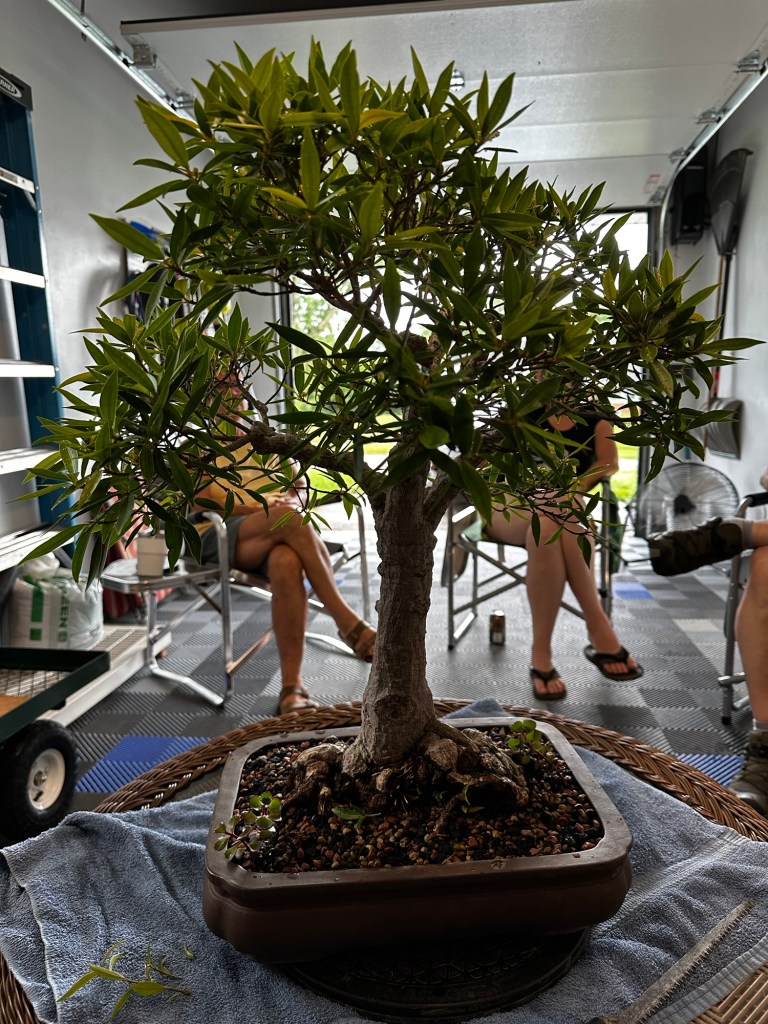
We have before us, up in the urban spires in the city of Cincinnatus, one willow leaf ficus. The tree, as is, would be good on most people’s benches. It has a biggish trunk, good branching and a full canopy. But, to quote the modern day vernacular, it’s kinda like a “helmet on a stick”.

And Brendan was bored with it. I might be able to do something about that, let’s see what we come up with, shall we?

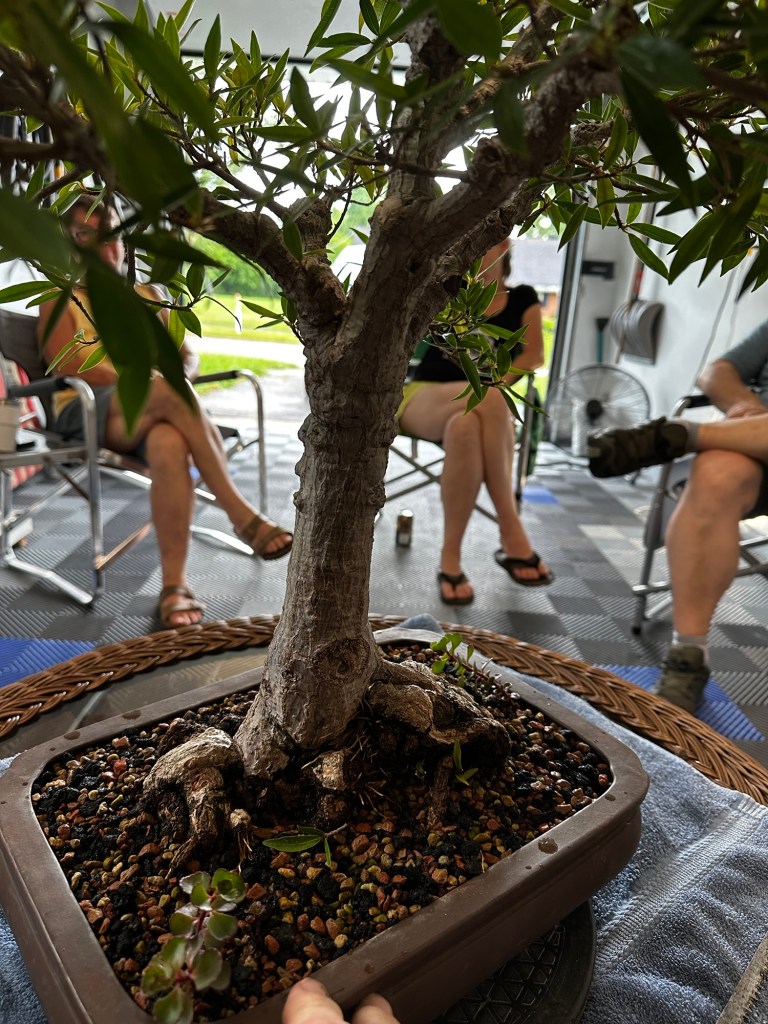
Twirling it around, I think I like the front (below) with its nice root spread and interest. Now what?

I think you see what I saw…

…hah! I crack myself up sometimes. Let’s crack this trunk up….
Or saw it, as it were.

Maybe we (or Brendan) needs some liquid courage to steady the nerves. Or hands.

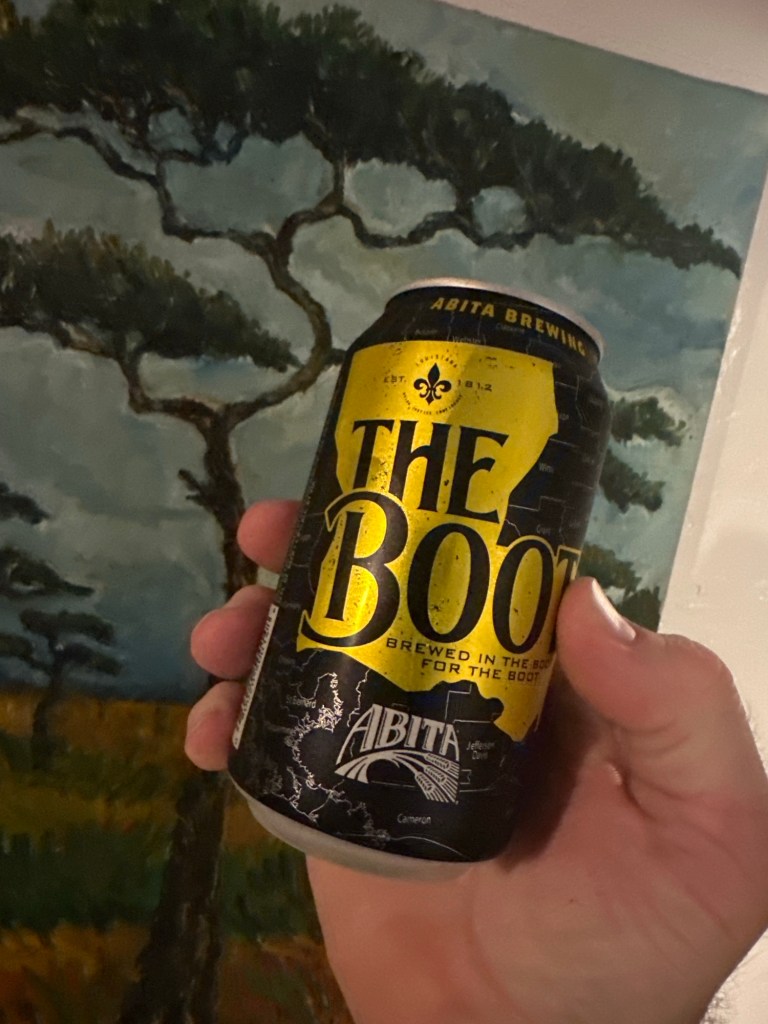
Bob Dylan has a new bourbon by the way.

But, oddly, I chose a Van Morrison song for the video, go to My Instagram to watch the sawing. It’s a good song at least.

“Are you sure the tree will survive this Adam?” my wife asks.

I sure hope so.

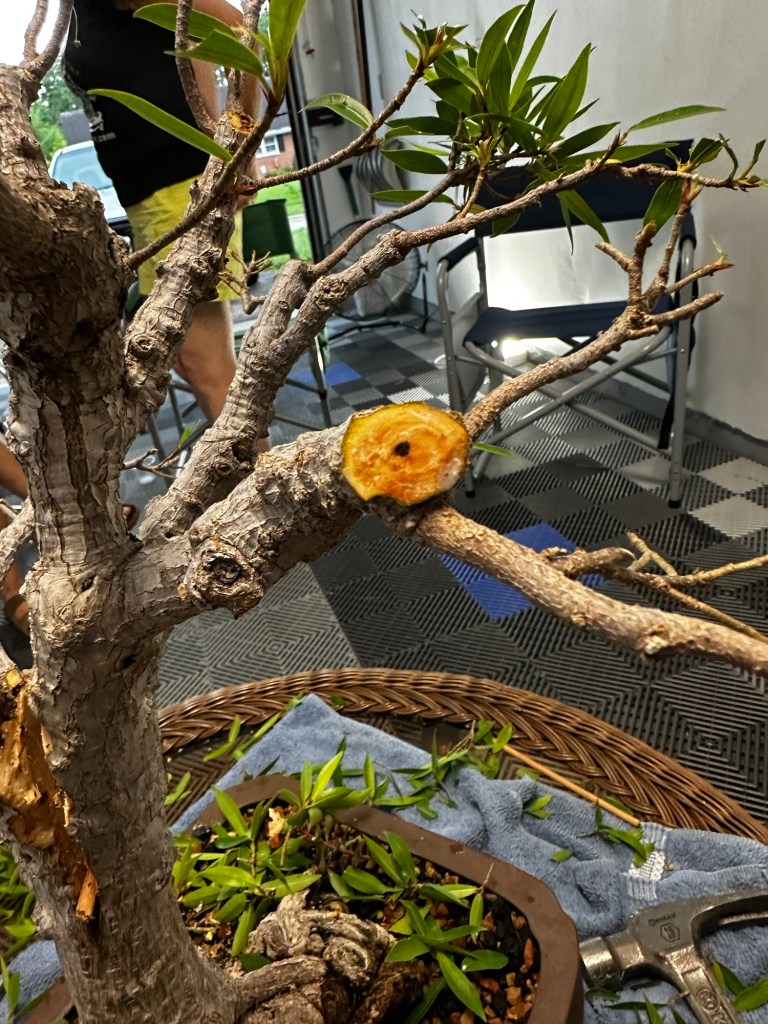
Using a knife, I make the saw cut a little less “saw cutty” looking.

That’s better. The willow leaf ficus almost heals like we do, from the inside out, as opposed to the bark spreading over the cut, like a maple tree. It’s an observation I’ve made in my career as a ficus bonsai guy.

That was the easy part, now I’ll go through and give the canopy some shape.

Which means, defoliation, removing unwanted and superfluous branching or budding, wiring, etc.

Without foliage (foil-age to some of those in the town of my birth), we can clean up some cuts too.

And no, Virginia, I don’t tend to use cut paste on figs. Why? A point to consider, the white latex “sap” that we see when pruning a ficus is not the real “sap” from the tree. It’s actually from a secondary, pseudo-vascular system that utilizes cells called “laticifers”. The sap flows through the xylem and phloem and it’s comprised of the water and sugars the tree uses in photosynthesis and respiration.

Laticifers are super specialized cells or a network of connected cells (often like the real vascular system, in tube-like structures) that make and hold the latex and can be found in various tissues, including the pith, the cortex, the secondary phloem, and even secondary xylem. The botanists believe that the purpose of the latex is to trap bugs and stool continued damage to the plant, and to help seal the wound for quicker healing

Let’s add some wire…

Look at that dude, he’s a stud.

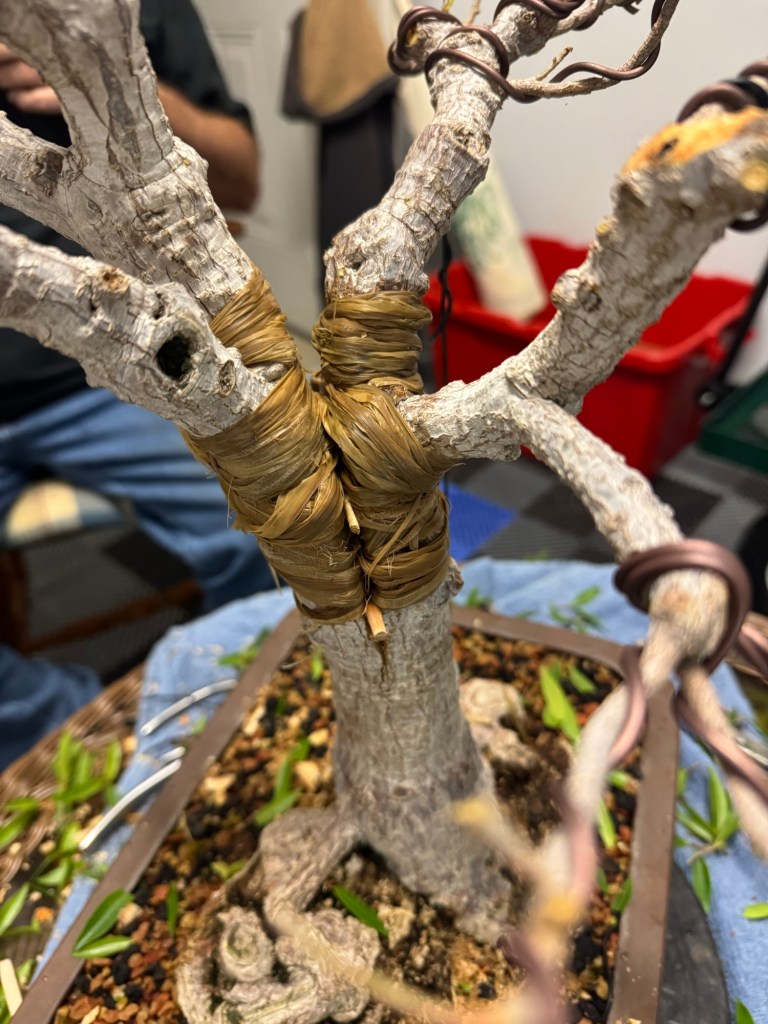
My work is done, except to have Brendan add some raffia to the sawn edges. Willow leaf figs tend to bud right on any cut or wound, which is a good trait to have, but sometimes it’s too much.

The raffle should keep new buds from forming.

And Bob’s yer uncle!

This is where you, my Constant Readers, are quoting Jurassic Park “You.. were so preoccupied with whether you could, you didn’t stop to think if you should…”

But I jumped past all that and posit the concept that I needed to do it.

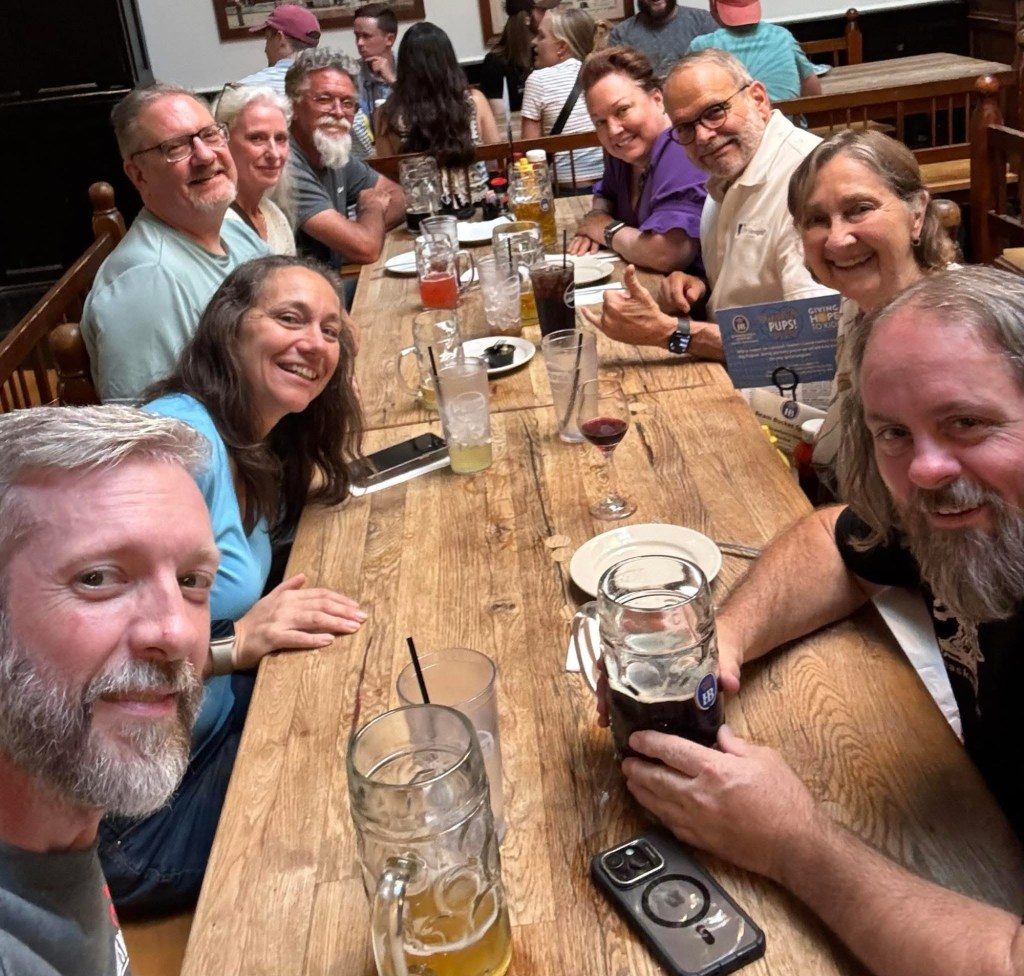
We had some reverse taper building where the branches were coming off the trunk, pretty much in the same spot, so something needed doing. Whether it was chopping them off or, this. If I chose the chop option (just as traumatic as this technique) we could have created a sweet short tree. But it too would be just a “regular” bonsai. Brendan was bored with the tree before. Now he’s excited to see what happens. And the tree will be a better one for this. That’s Brendan below, on the left in the front.

He looks happy. I do too. That’s my second or third liter of beer, so…..I’m happy.

The tree, for Brendan, was a good tree, but boring. And living up in Cincy, it was becoming a chore to go through all the labor of winter protection, including grow lights, heat mats, etc. Now, Brendan has something to look forward to as the tree responds.

The tree looks happy too.

Another video of the finished work.

And yes, you saw White Castle’s and a sparkling beverage called Bonsai, tasty and expeditious. Food and beverage of the bonsai gods we pray to.

Let me know what you think. I’ll add updates as they pop up.

  •