Reading view

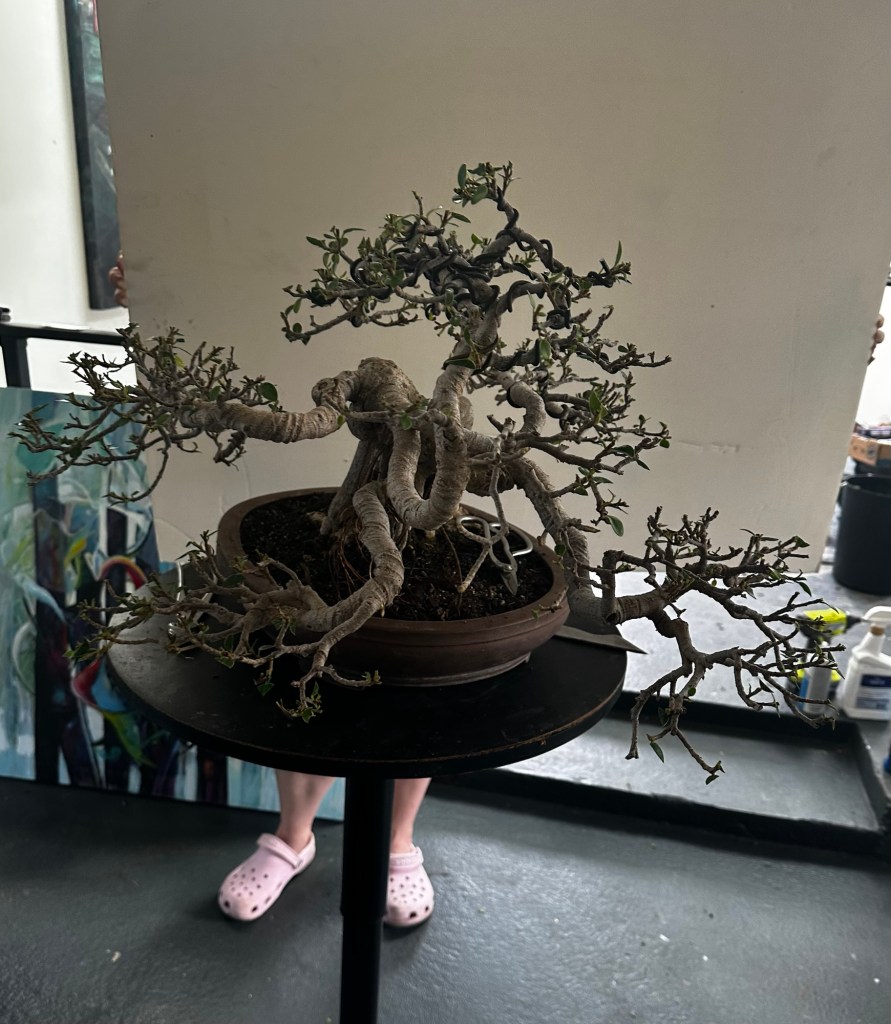
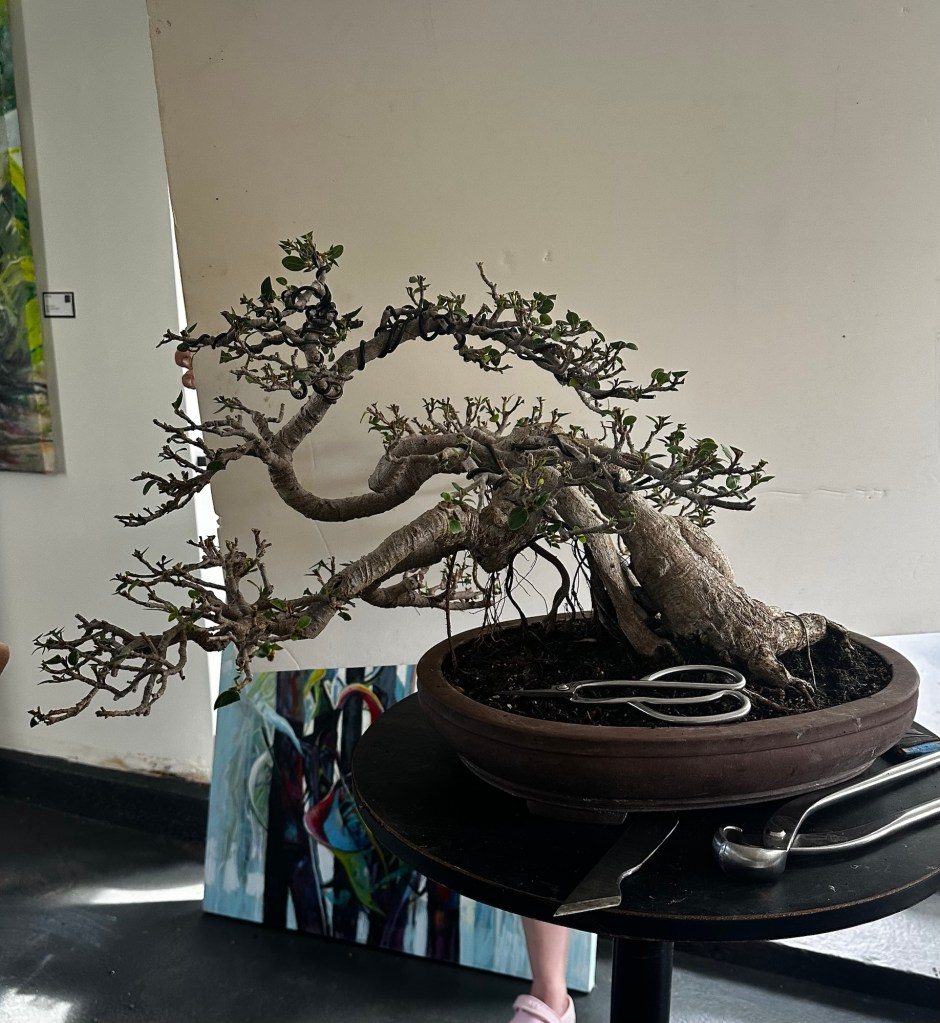
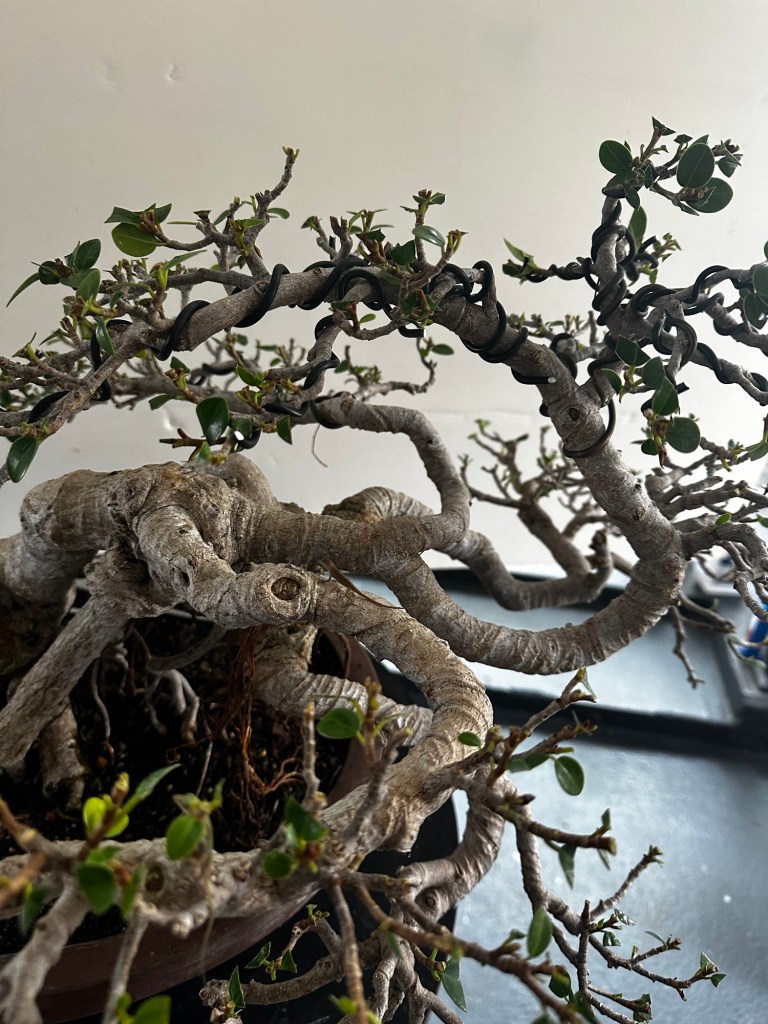
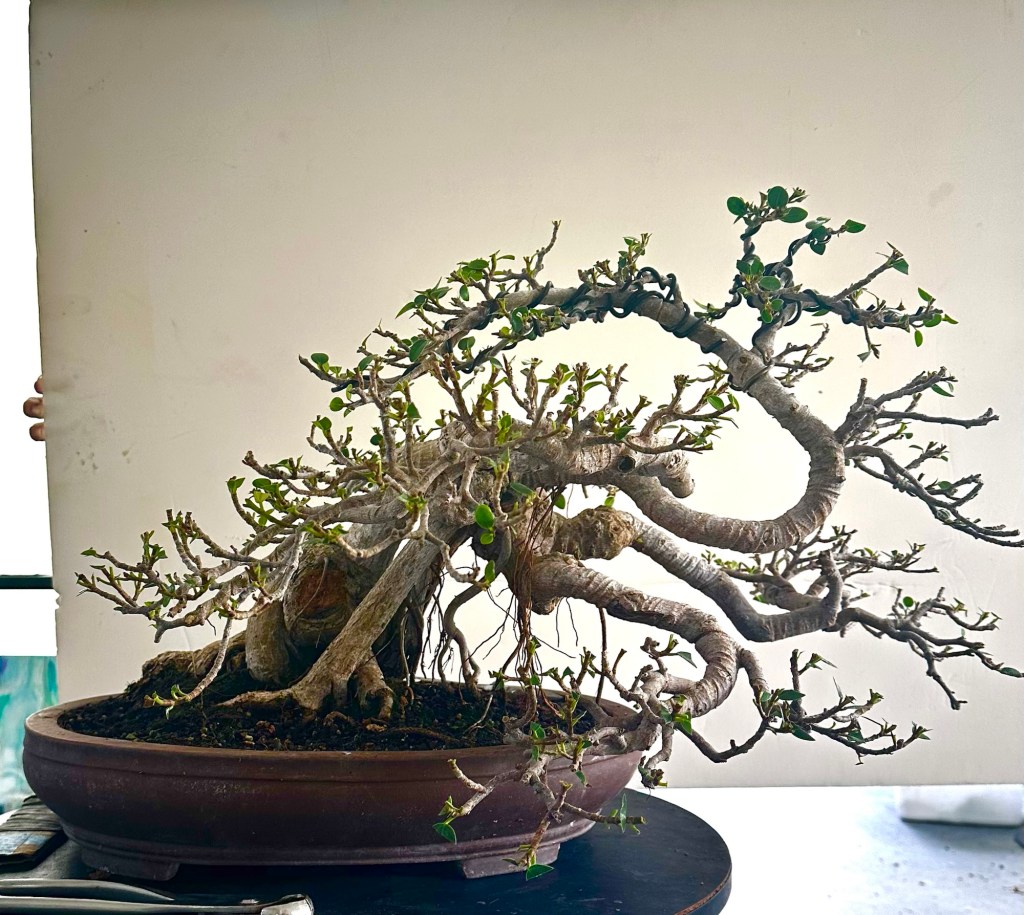
Still building a ficus

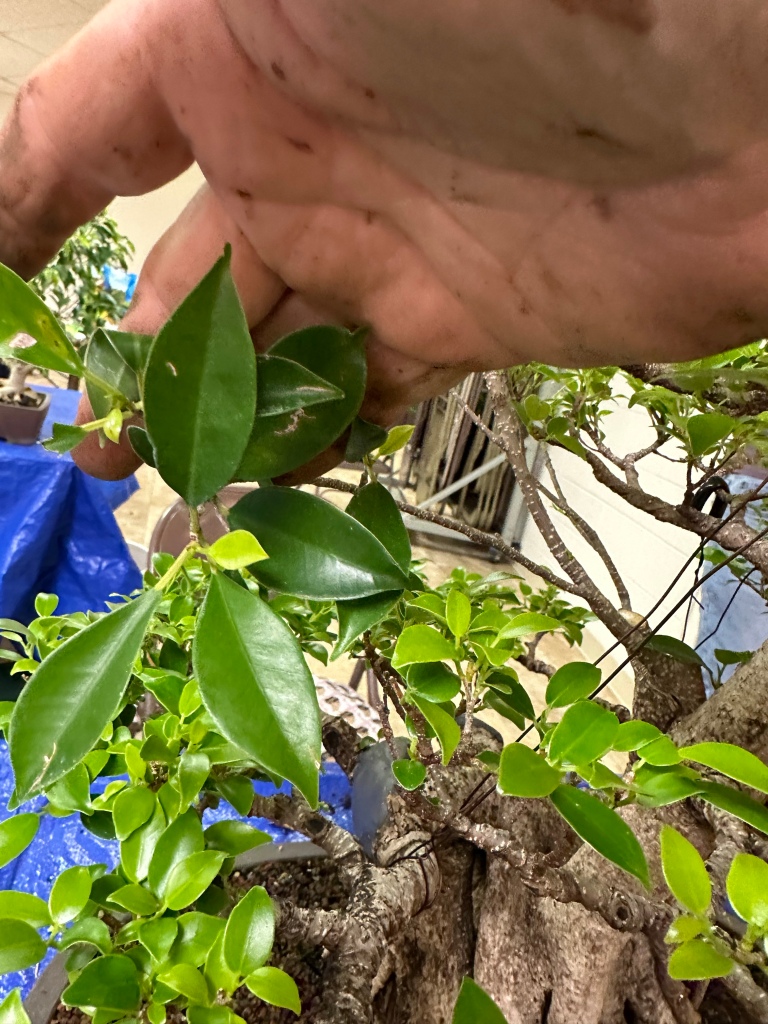
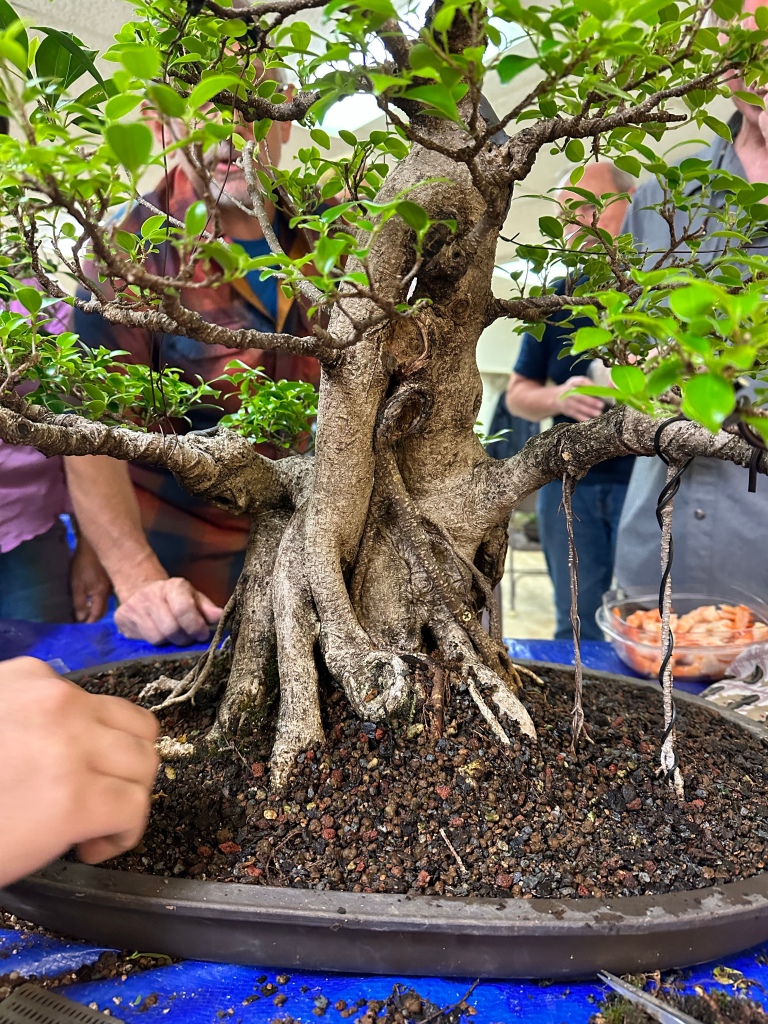
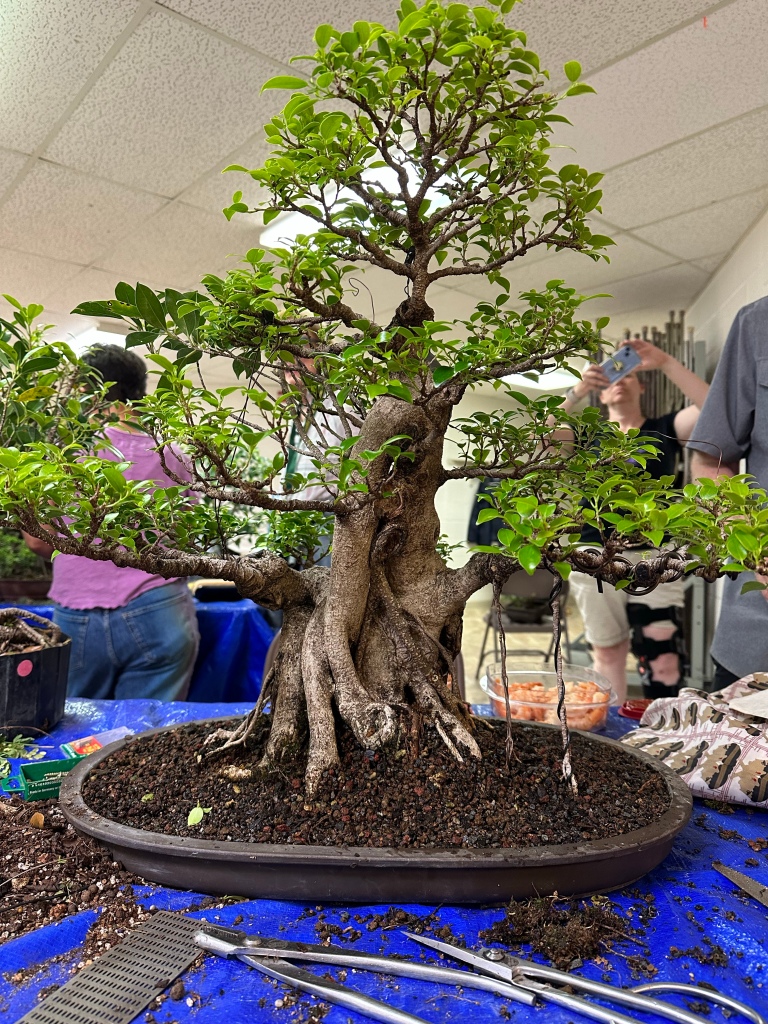
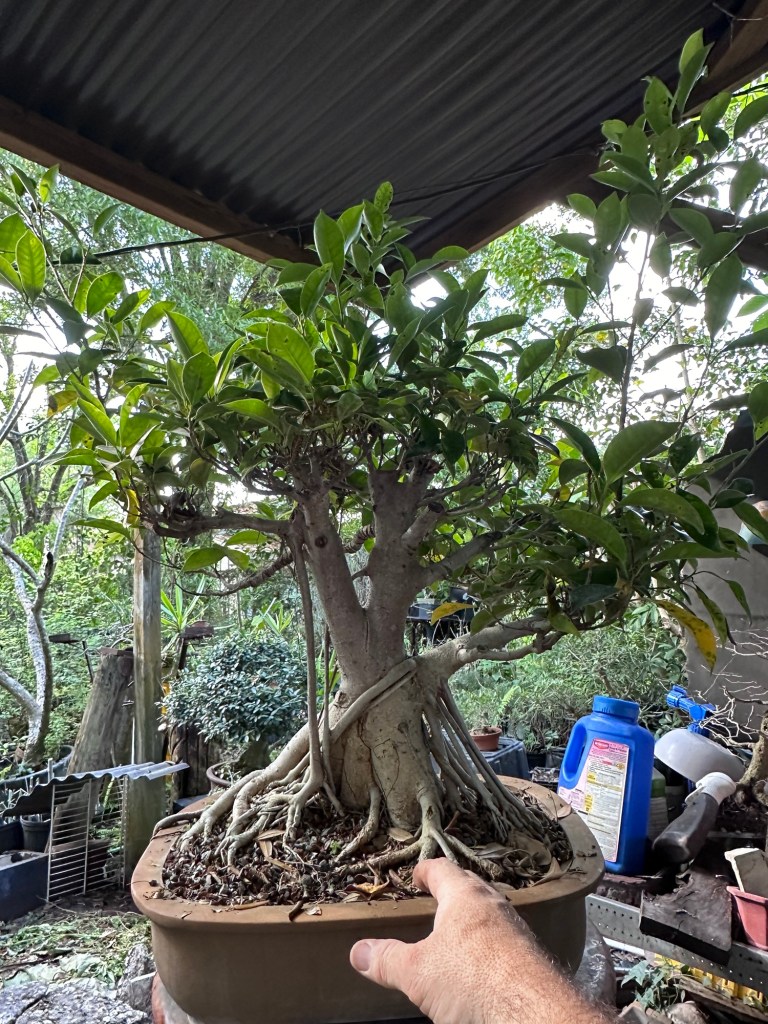
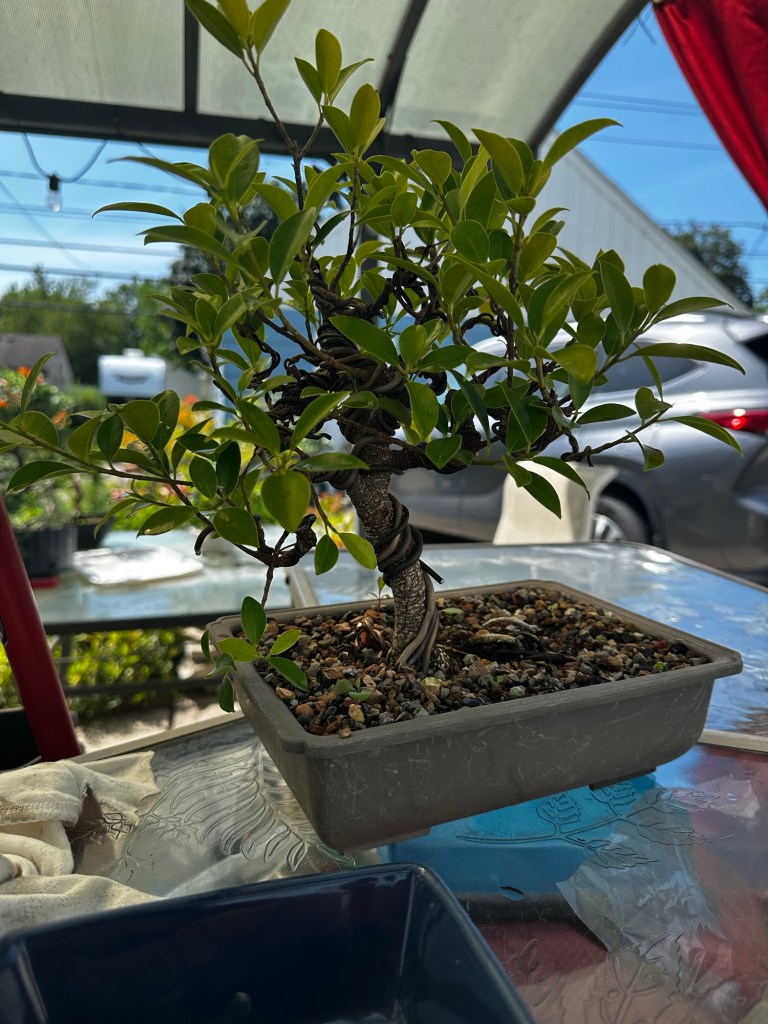
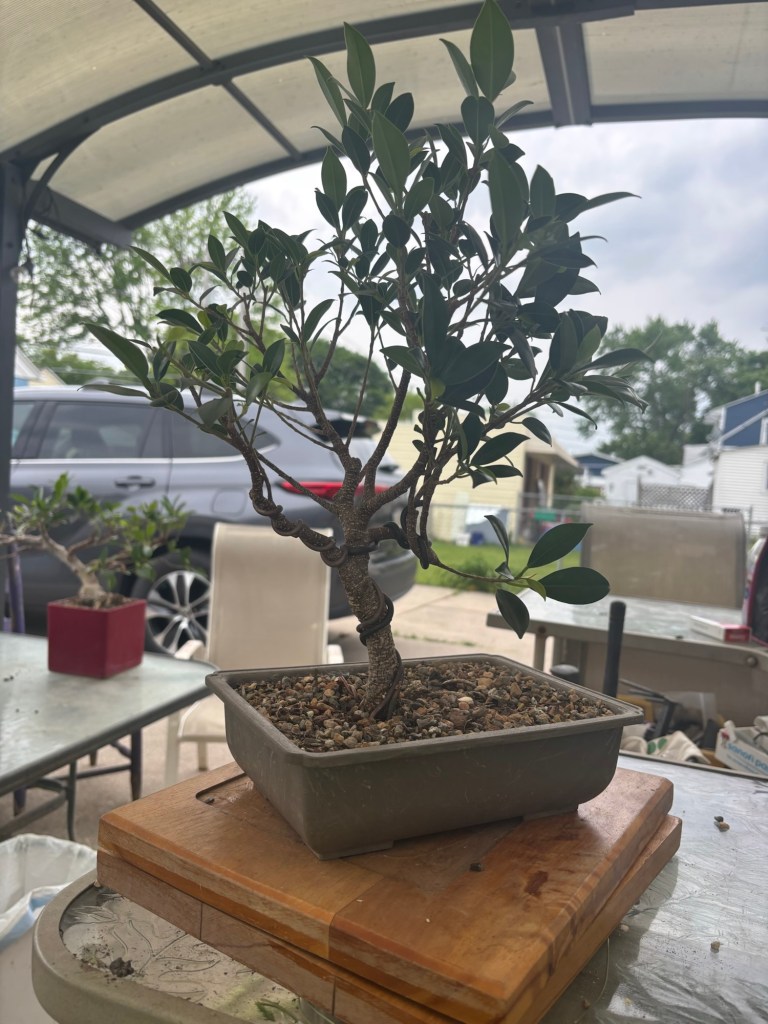
Today, we have a ficus microcarpa (for those who have searched through the posts, in the far past I’ve called this species ficus retusa, incorrectly. Instead of going back and fixing them all, just keep in mind that Ficus retusa is a totally different species of fig, and take it for the ever changing nomenclature that is being updated. My apologies for any confusion). It belongs to Kathrin. I had done a demo for the Shofu Bonsai Society of Sarasota many years ago, and she won it in the raffle. You’ve seen it before, in the link below.

I had meant to update this tree several times in the past few months, but didn’t get to it. Here it was in October 2021.

And, as it was in the original post:

https://adamaskwhy.com/2020/10/14/building-a-ficus-microcarpa-bonsai/

I’ll wait as you step into the Way-Back Machine and travel back in time.

And, still in the past, the work we did at Kathrin’s garage, in my Sarasota Studygroup in October.

Then we went, the next day, into Wil’s garage.

First, we get rid of the Corona bottle cap I was using to hold a graft in place.

It worked pretty well, and played into my gallows-type humor at the time.

The graft took well on the main trunk.

But up top, we had trouble getting that branch to stick.

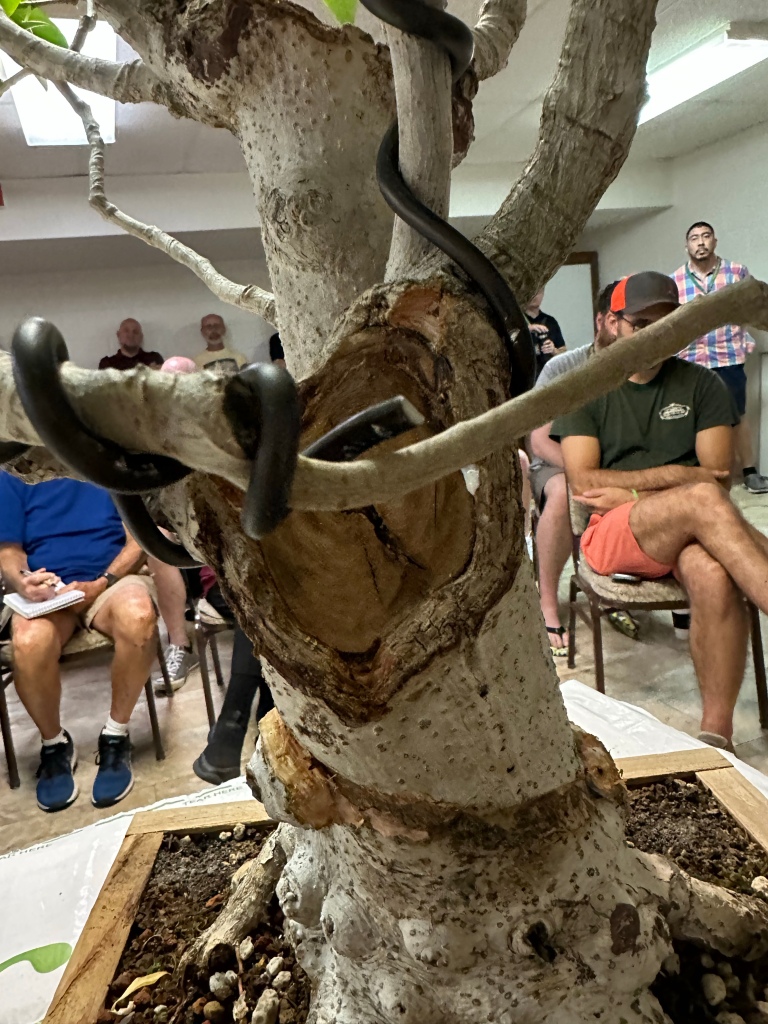
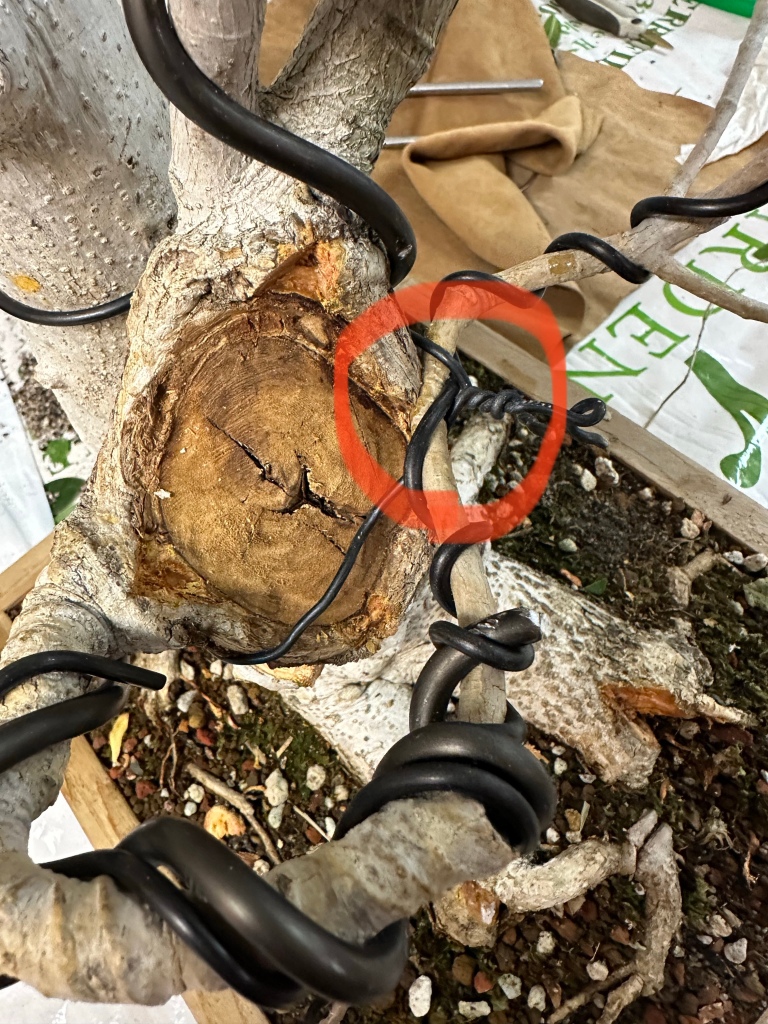
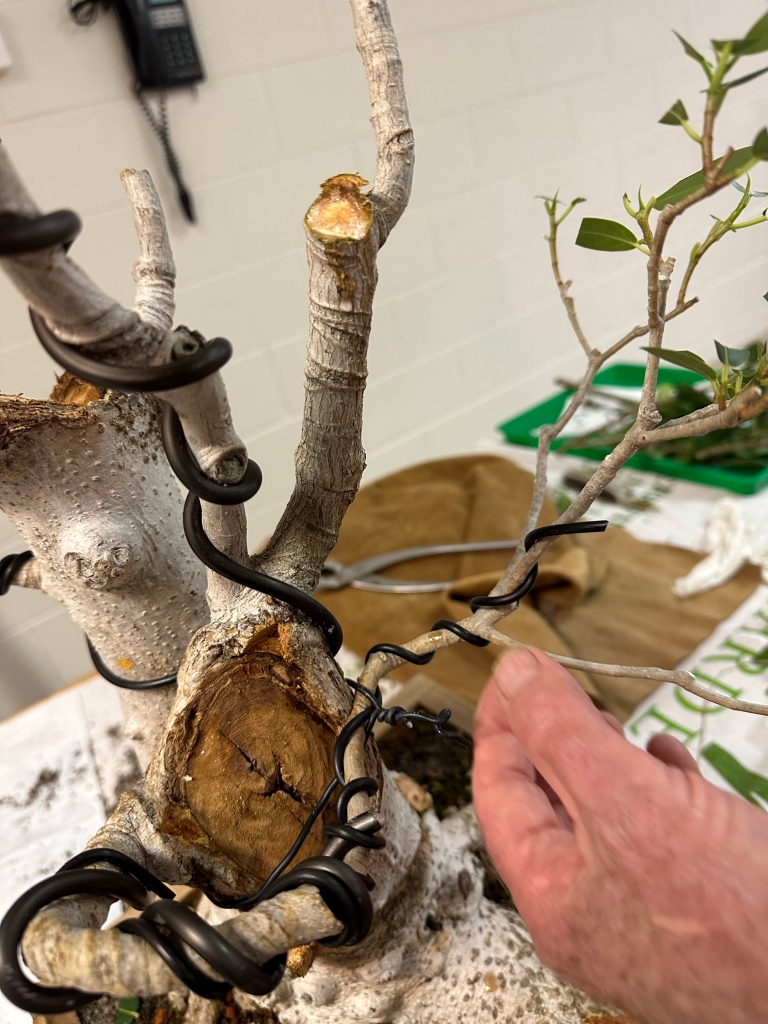
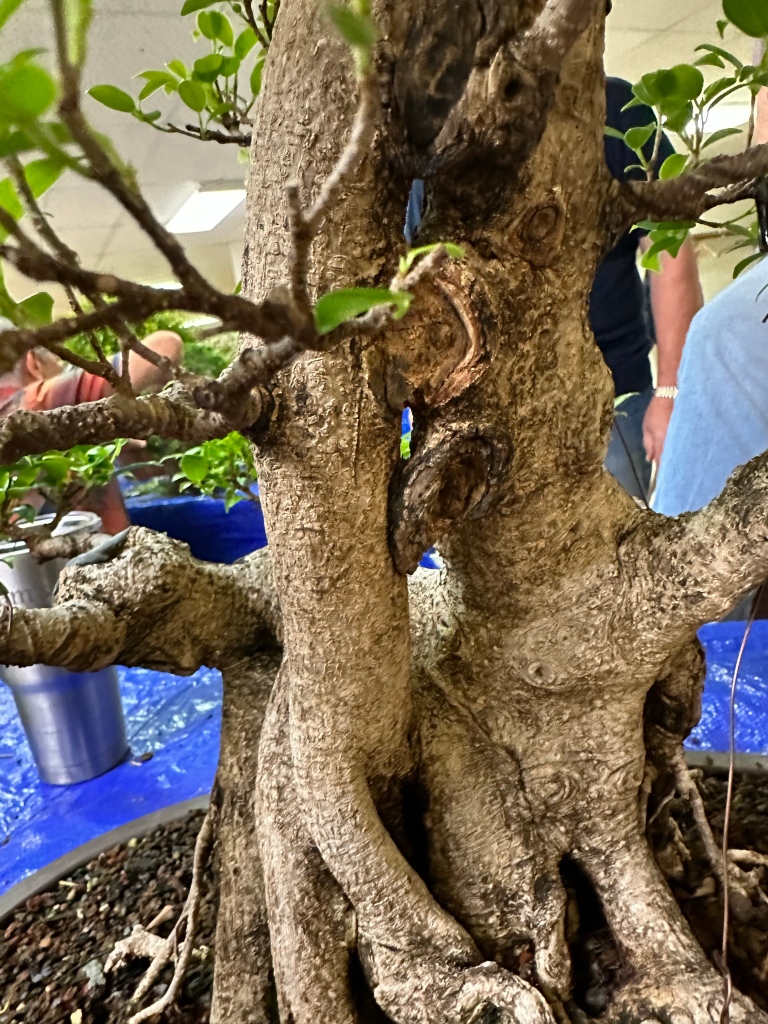
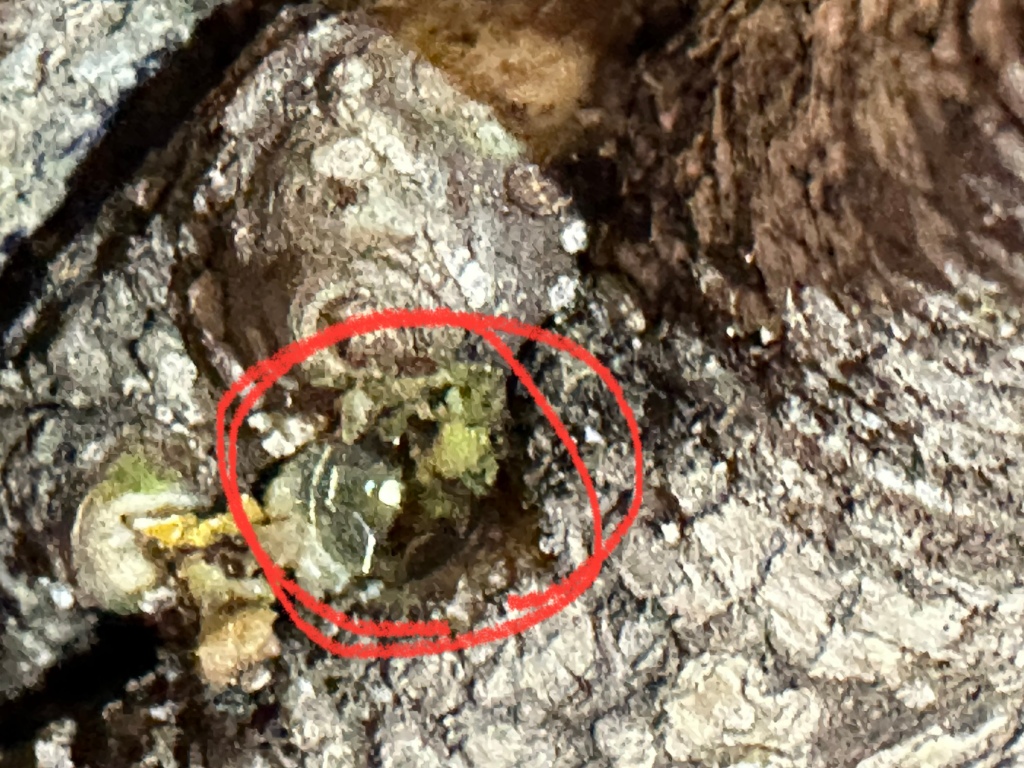
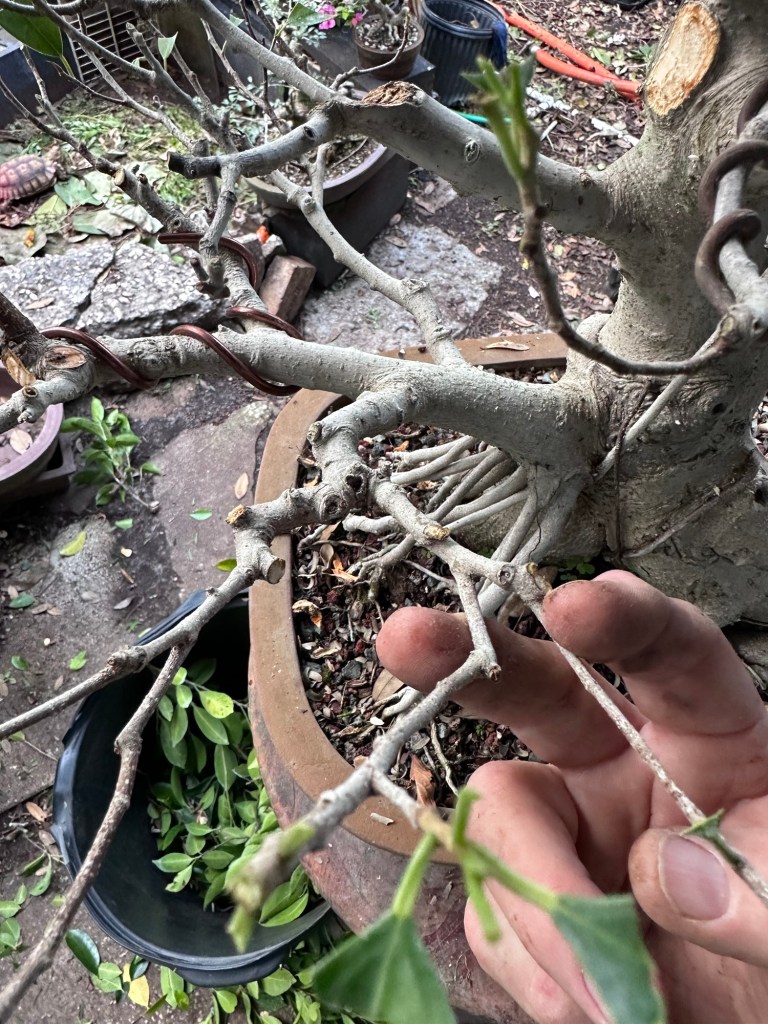
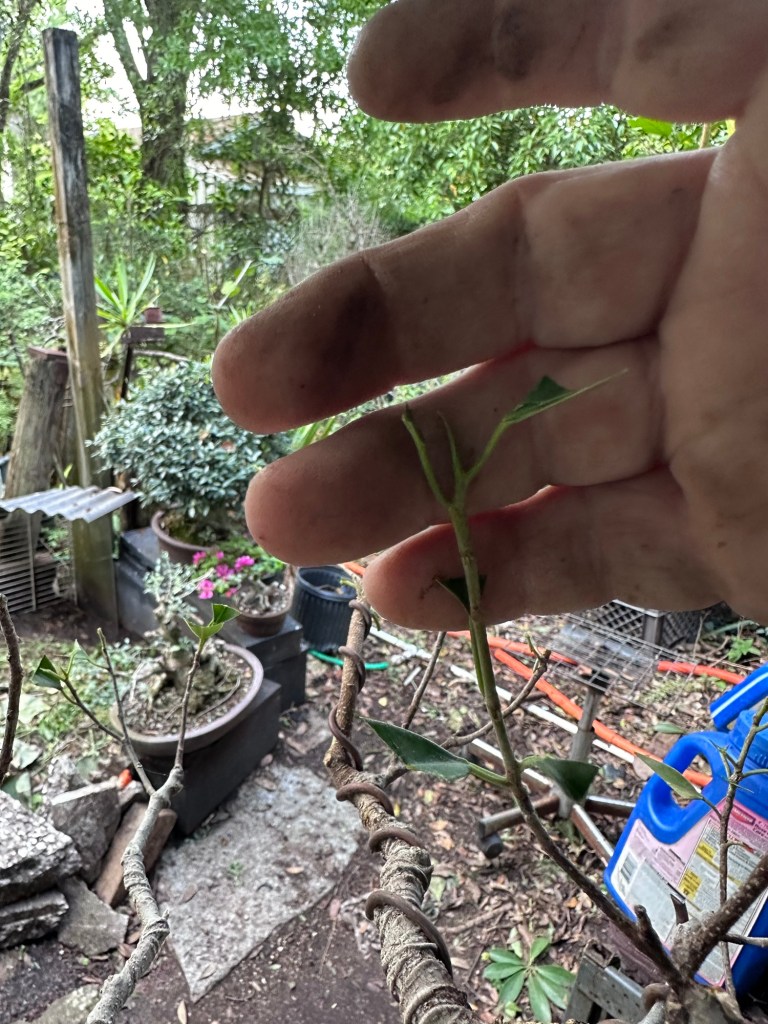
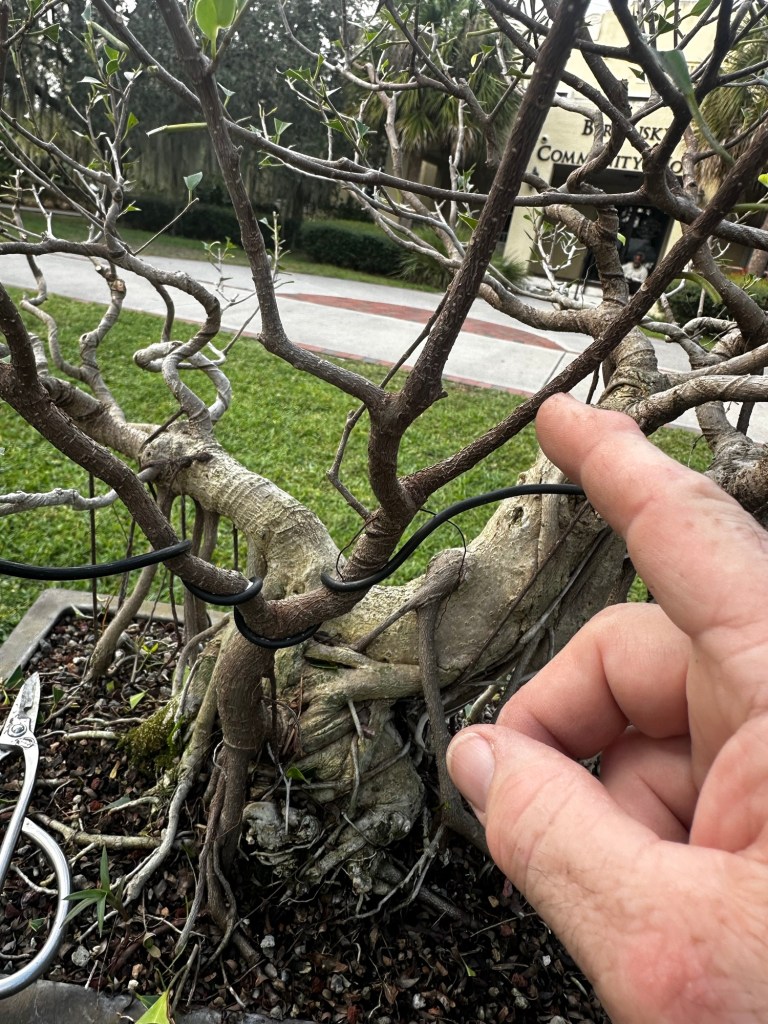
Take notice of the hole that was created from the branch, where the black wire is.

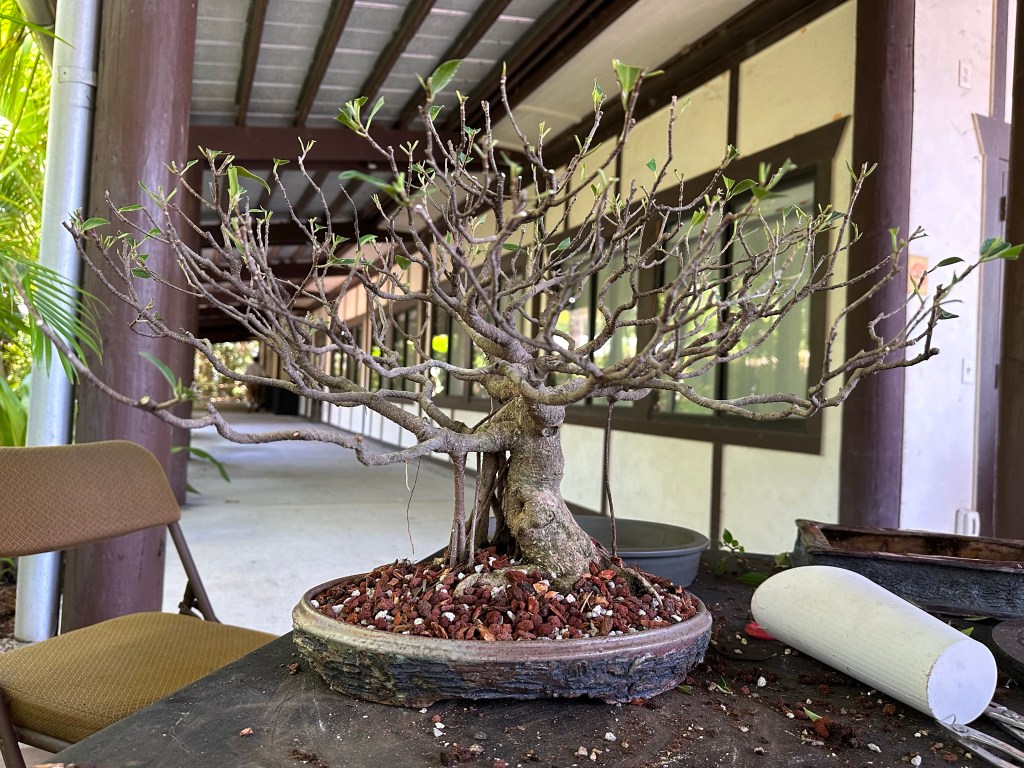
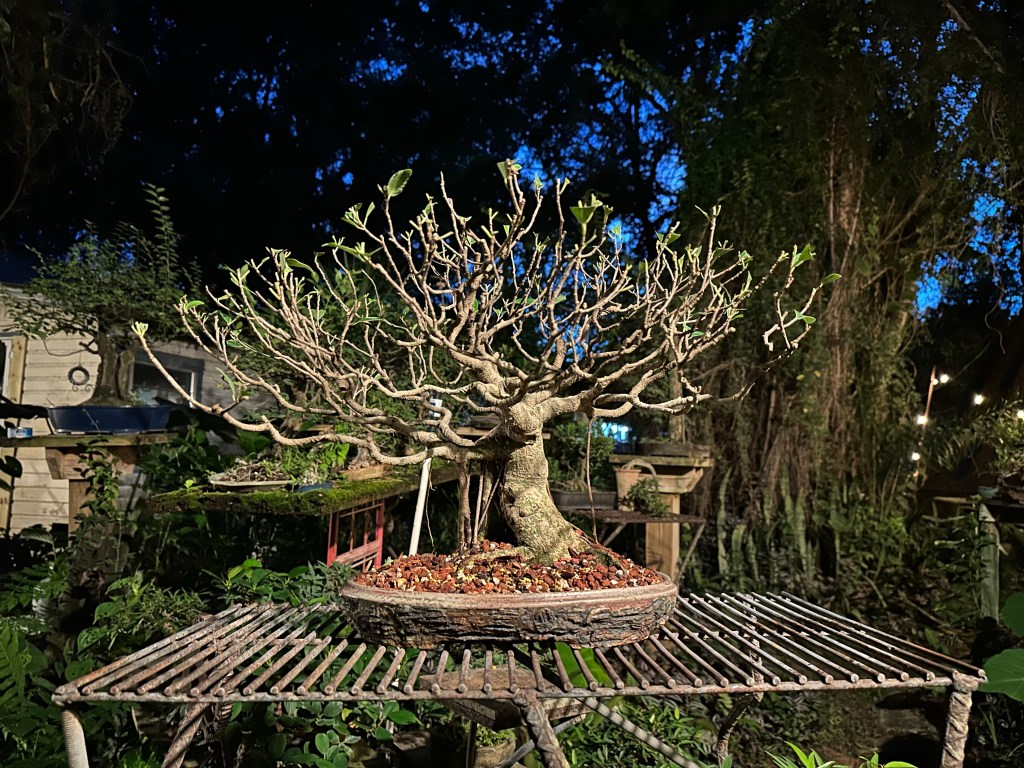
Now, back to today. Late July/early August, 2022.

I’ve had it here in Orlando for a few months. The idea was for me to bring it back the next month, but life got in the way. A few too many client’s trees to work on and a brief hospital stay made the tree sit on my bench and just grow. But sometimes that’s a good thing. It gives us something to work with. and it seems to like my yard.

The water at my nursery is good compared to Sarasota (it has to do with how we get our water in Orlando. This Post about cleaning calcium off a pot explains it a bit more)

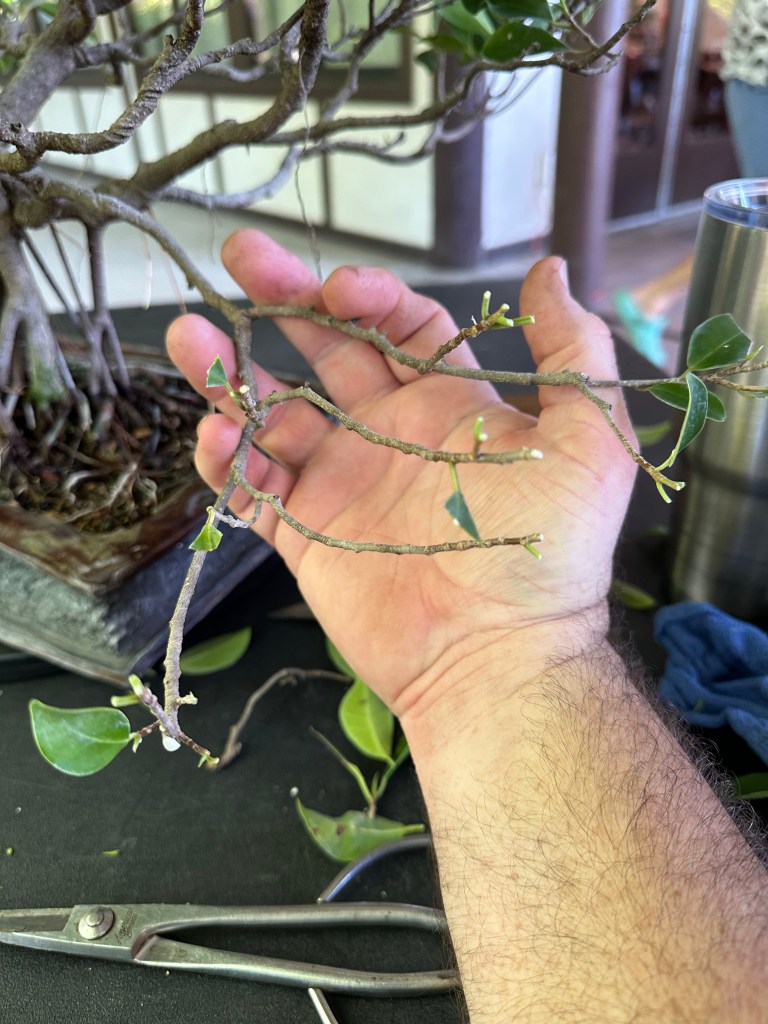
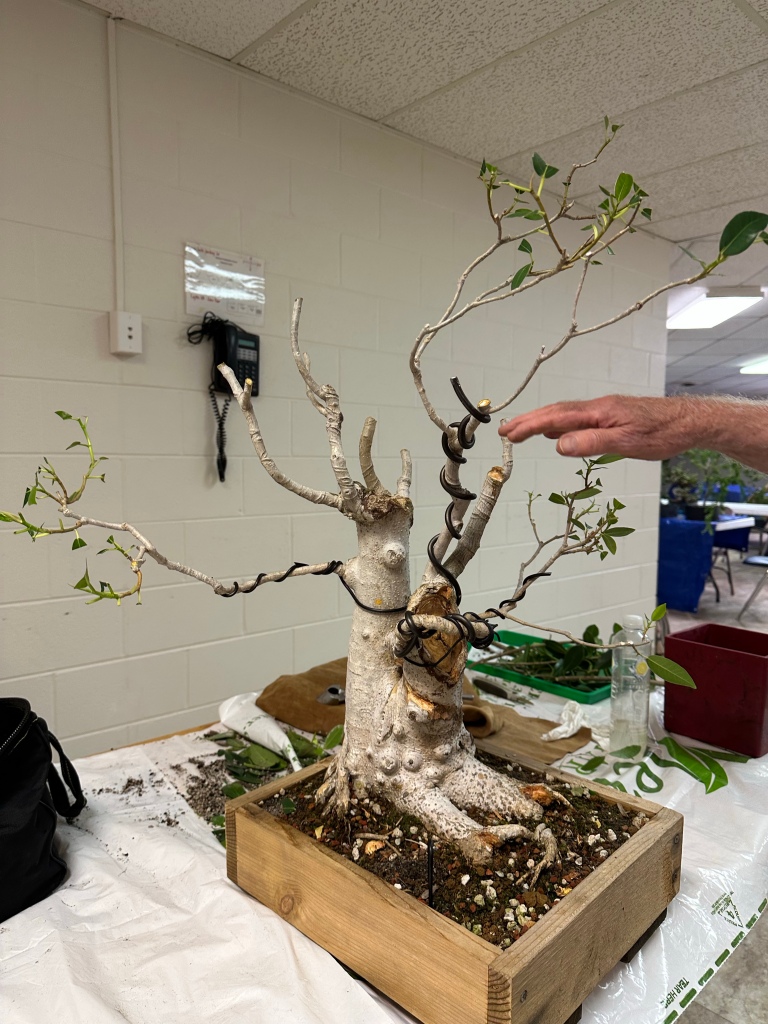
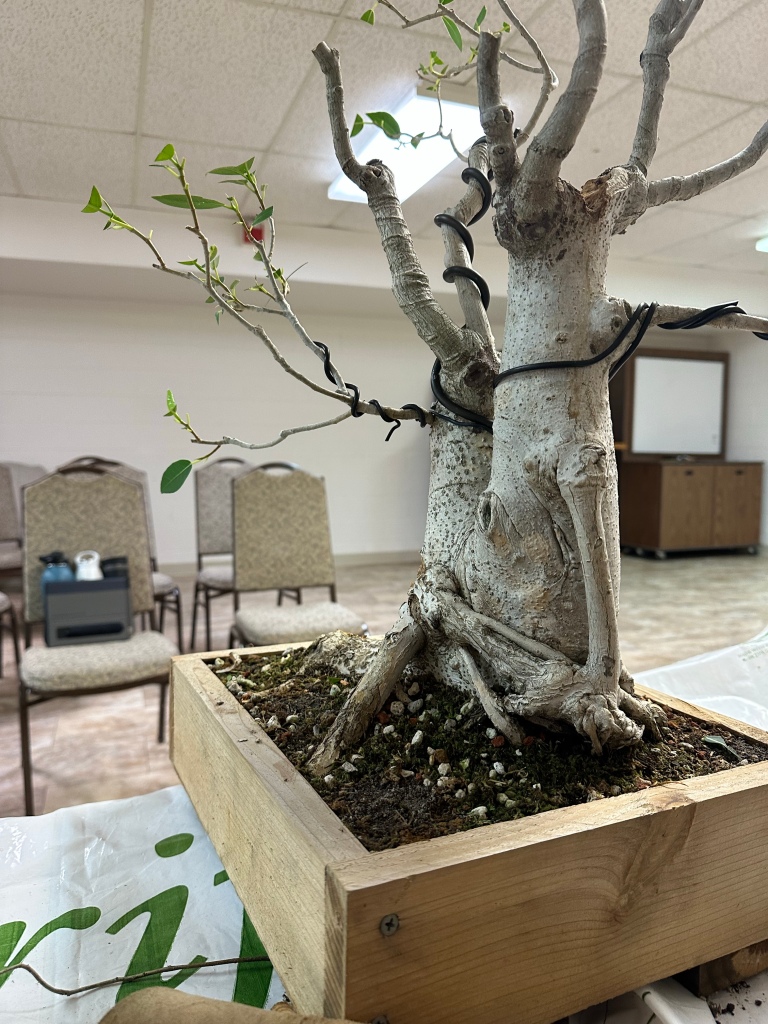
If you compare the below pics with the older ones, you can really see how much the branches have thickened, and how we tied that one branch that refused to graft in place.

It’s finally taken, so now it’s time to remove the wire.

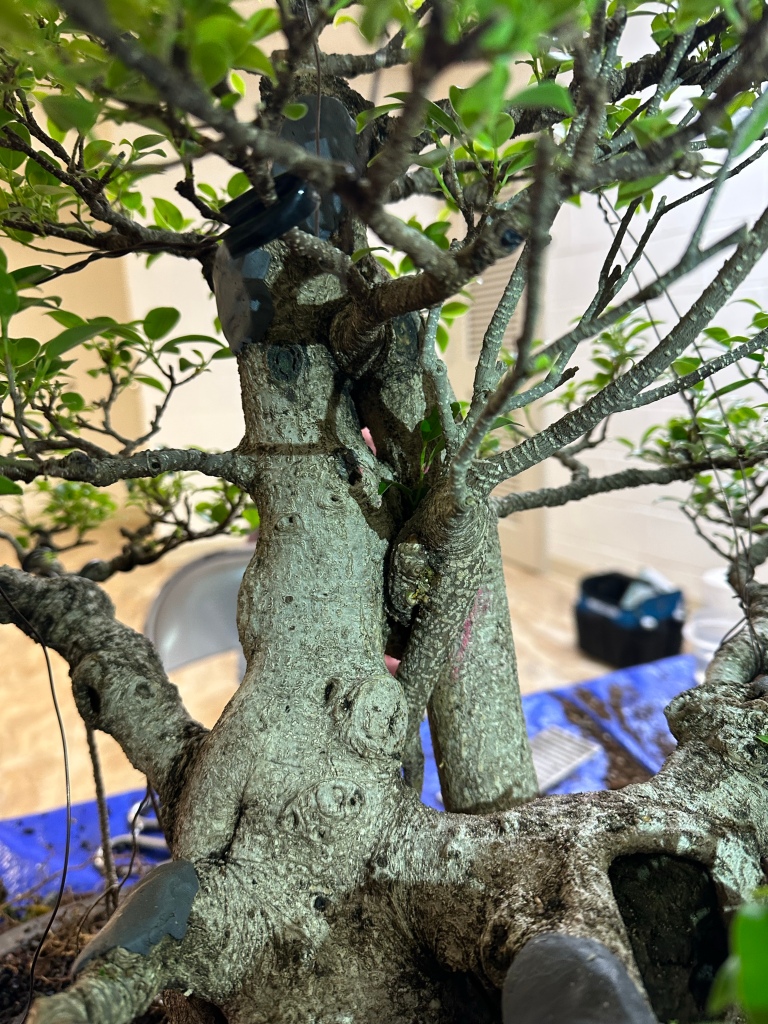
You can definitely see where the two trees are grafted on, but that’s ok, it’ll smooth itself out in time.

And somehow that one aerial root we pinned into the hole got pushed out.

Anyway, enough backstory, let’s get to work.

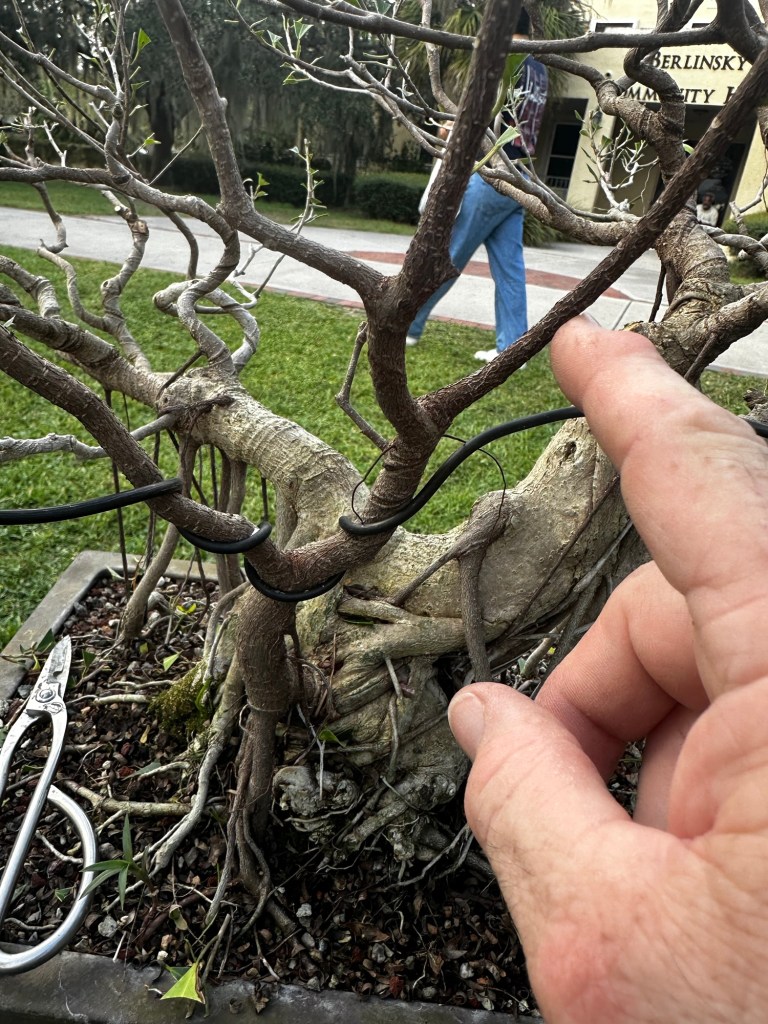
Remove the wire.

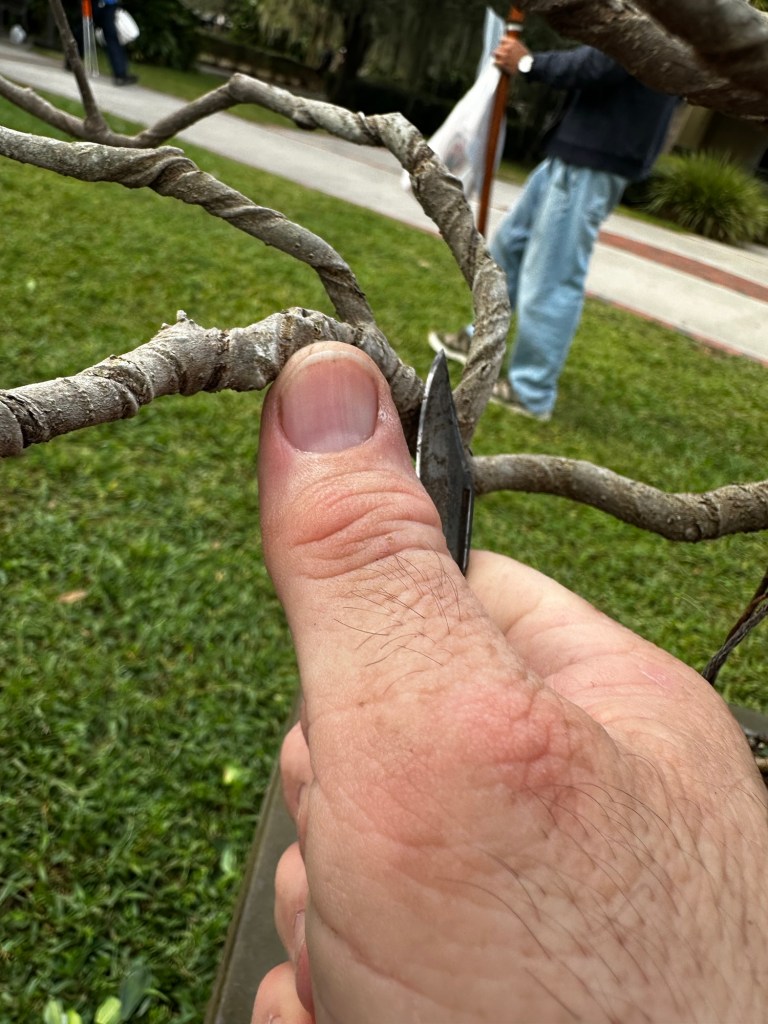
Not too badly scarred. And those wire scars on the branches are easily dealt with. You can literally shave them down and they disappear quickly.

That hole I pointed out above is just about filled in. That’s the advantage of unrestricted growth.

Now to defoliate.

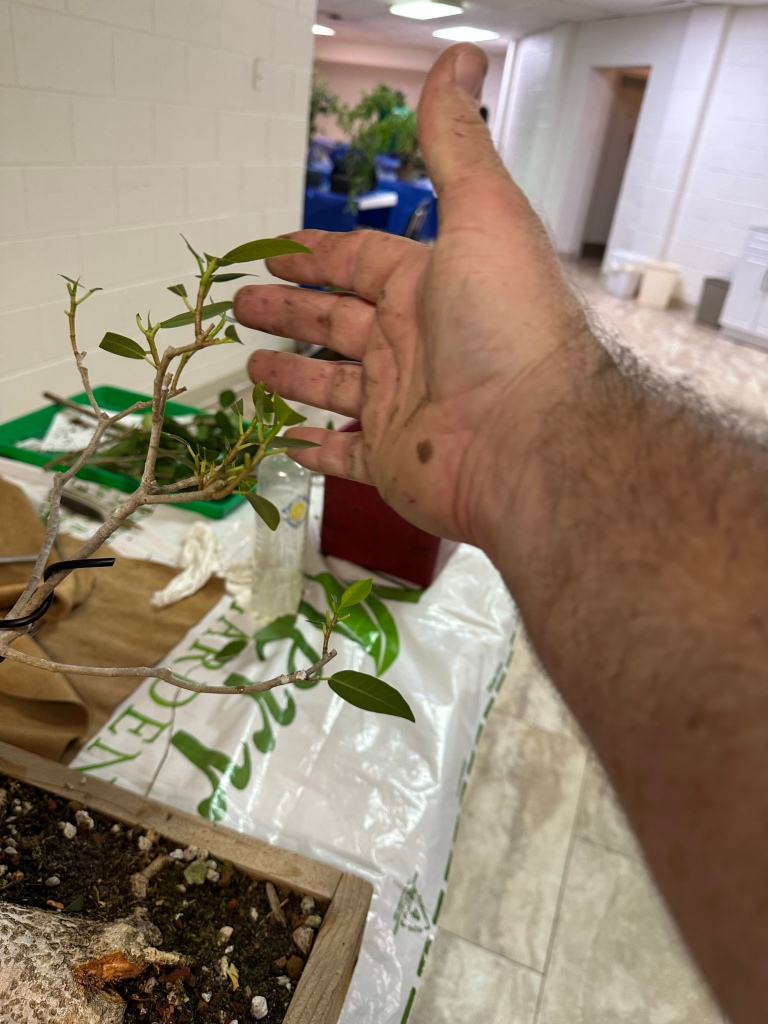
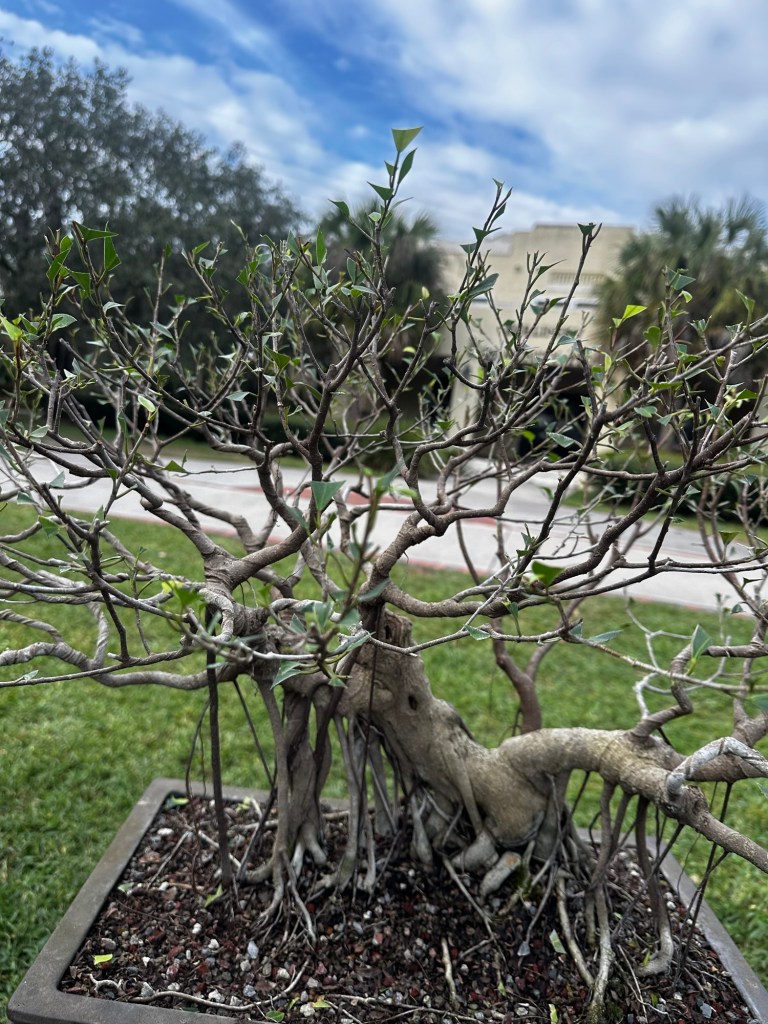
There we go, we can see what we have to work with. Which is a lot.

We got lucky with the longer branches just happening to grow just where we need them.

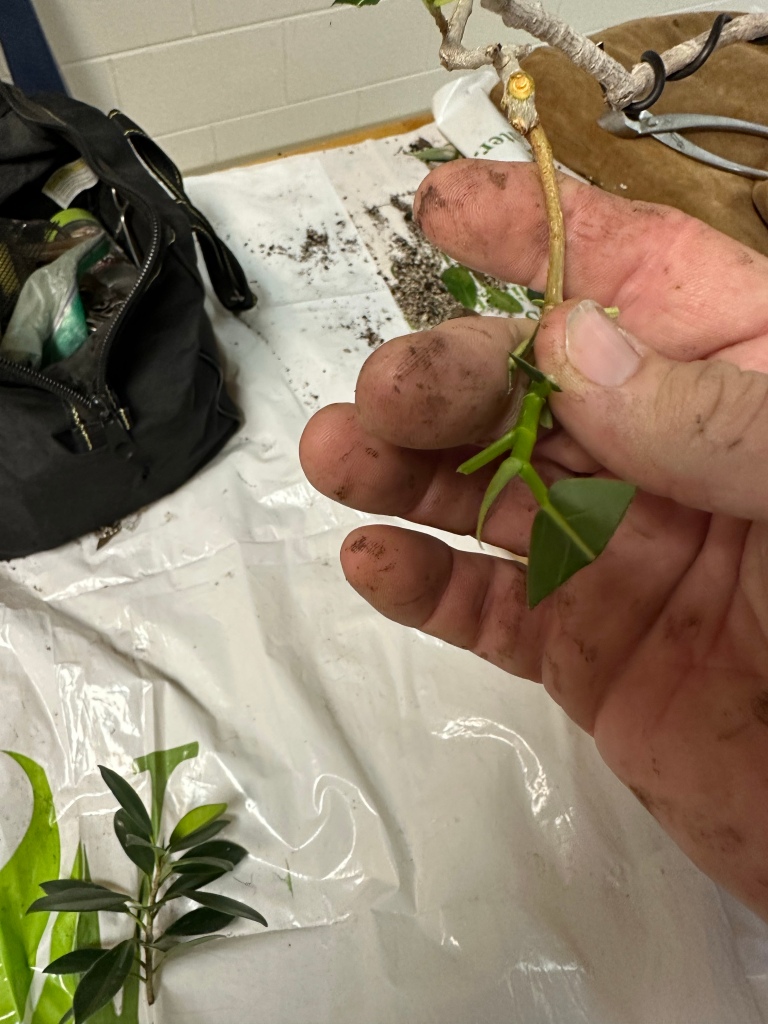
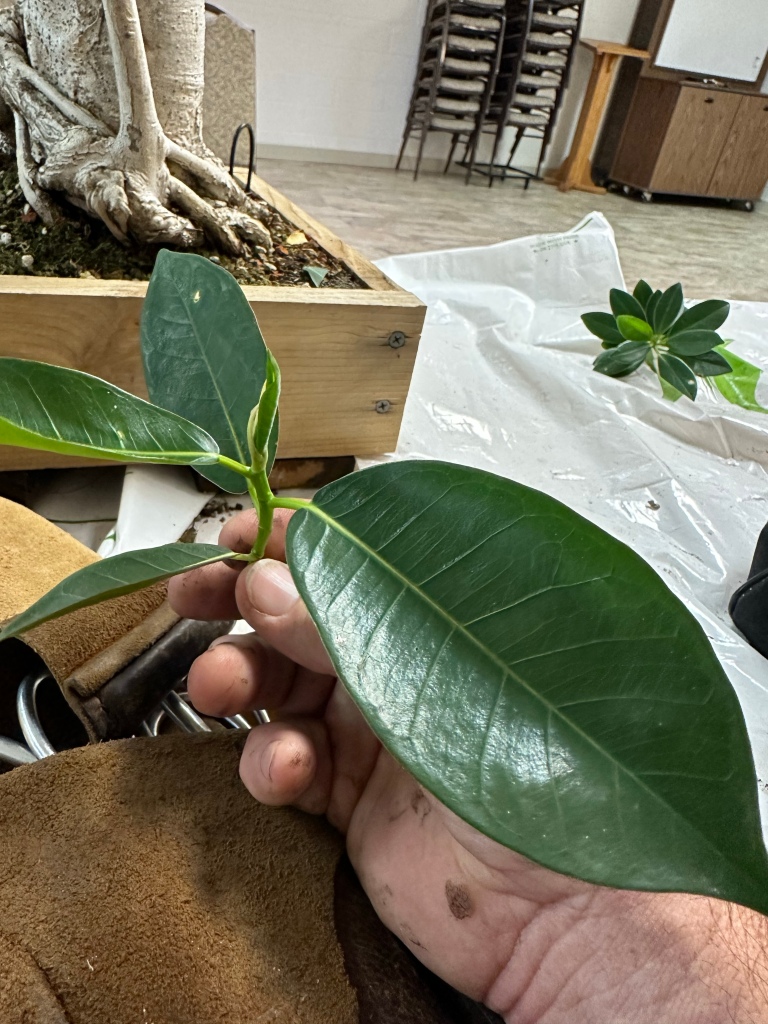
This one is perfect for grafting; strong growth and fresh bark.

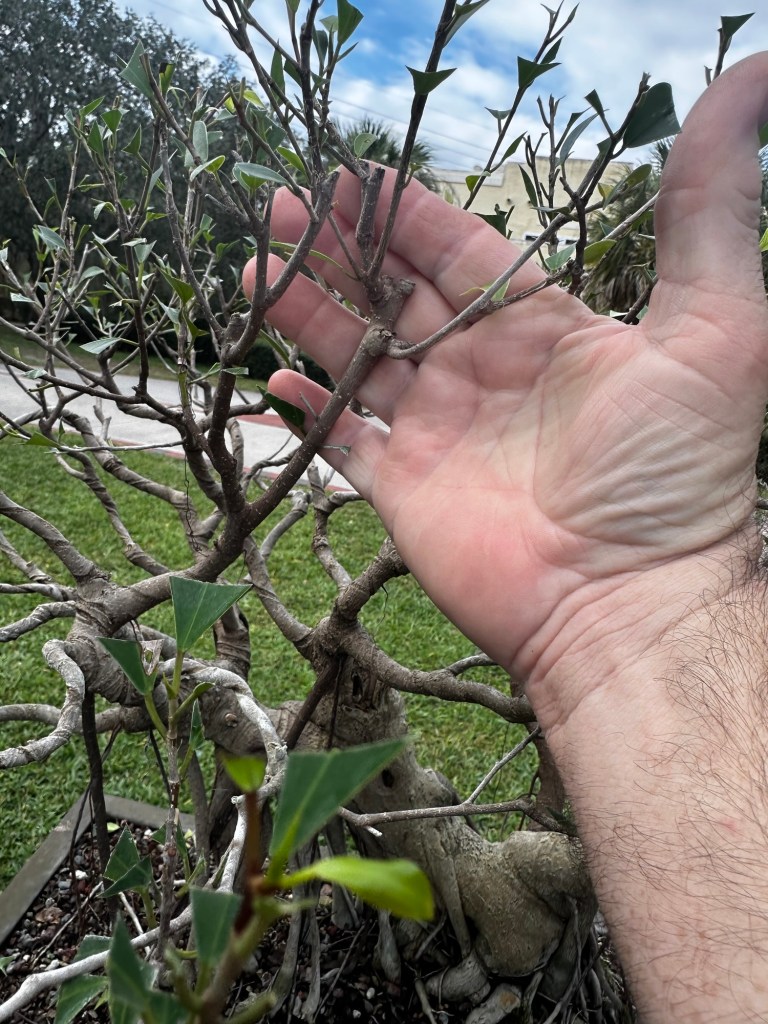
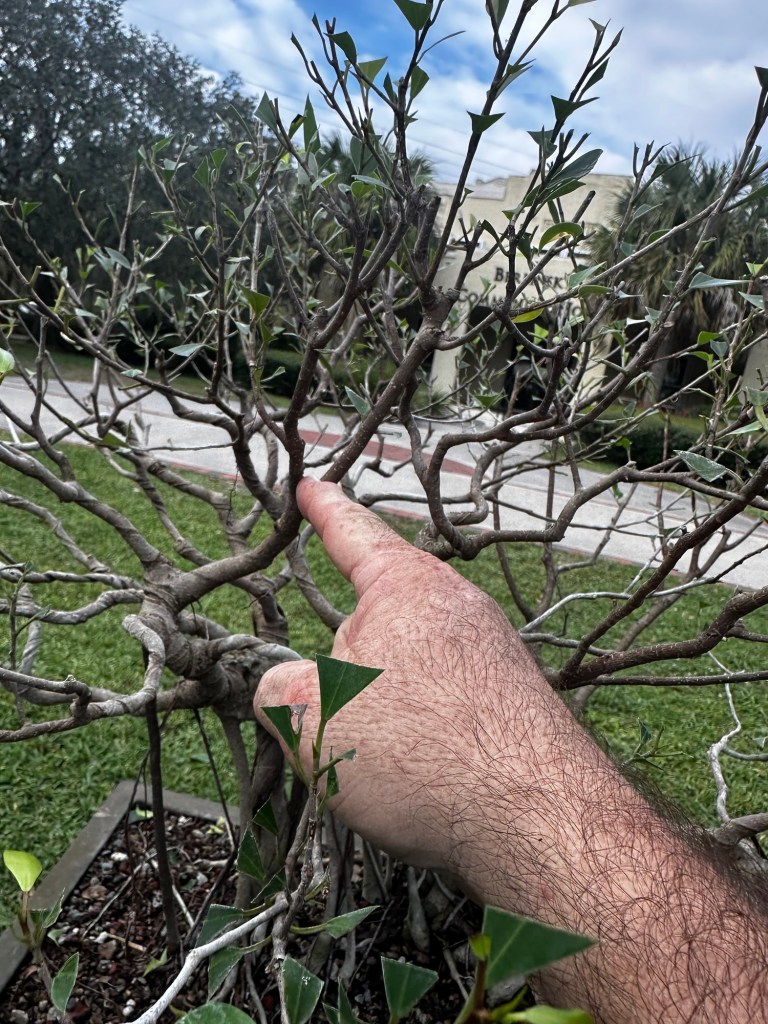
It’s gonna go about here, to fill in that empty spot. Now, to explain why we need grafting on a ficus like this: this is the plain Jane, regular old Ficus microcarpa, not one of the many cultivars. Which means that it doesn’t back bud as readily as one would like. In fact, it’s more prone to die back to the next node, or grow point.

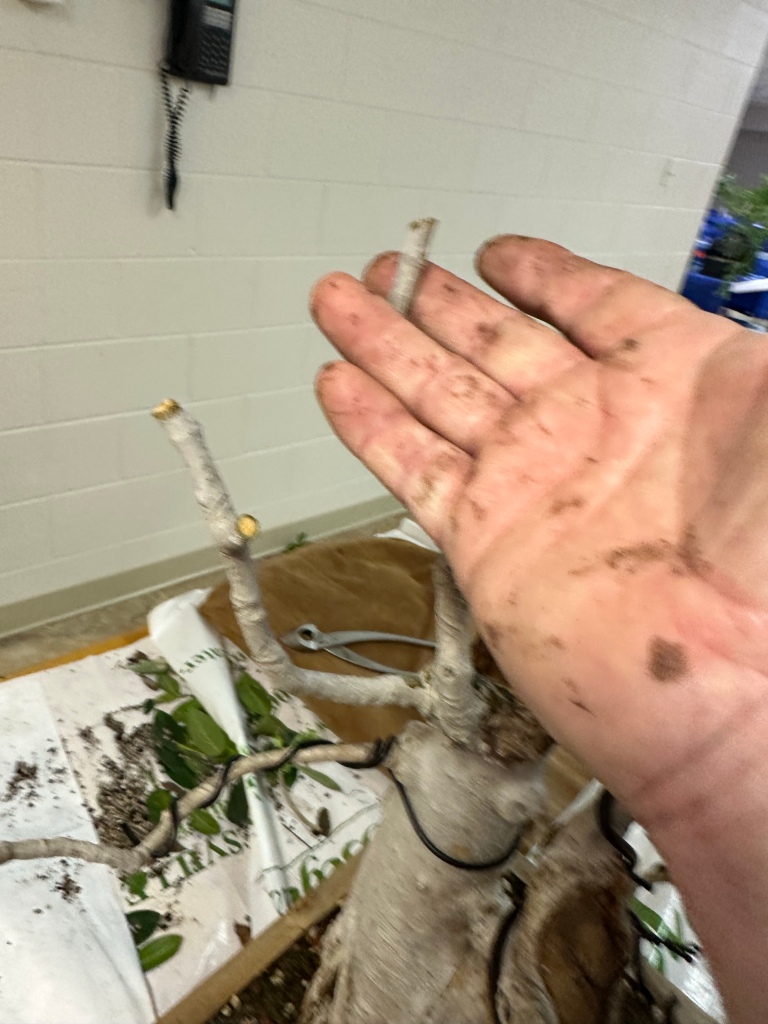
The branch just above my pointer finger has been grafted on, and the next one above it as well.

After grafting, here’s the new pot. I debated for about ten minutes whether I should repot or do the top work first. Top work won out. The debate was whether the repot would be to strenuous on the grafts. But I figure I can be gentle.

Grafting time.

A freshly sharpened knife.

And…..here we go!

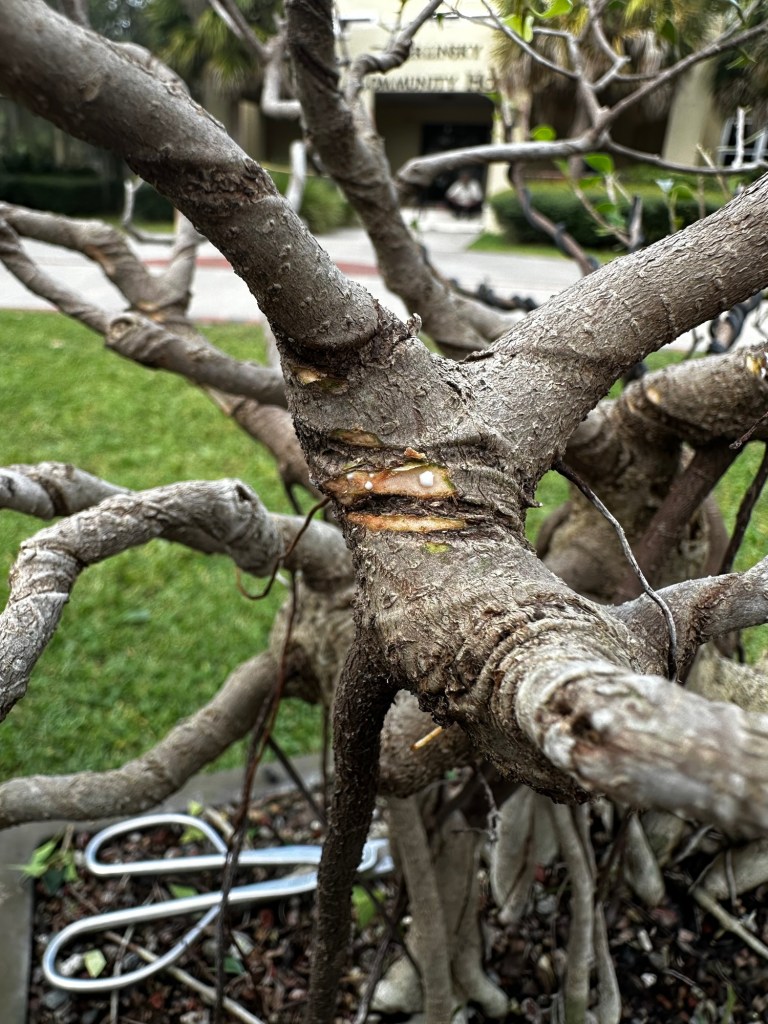
Grafting is easier than you might think. Simply cut a gouge into the the bark.

Doesn’t even need to be that big.

See?

Grab some type of grafting tape. In this case I’m using “self-amalgamating electrical tape”. I’ve come to use this because it only sticks to itself (self-amalgamating) and doesn’t damage the trees bark when you take it off. The point of the tape is to keep water out. In the past they’ve used beeswax, floral tape, vet wrap, even just cut paste.

Cut a piece..

Remove the backer piece…

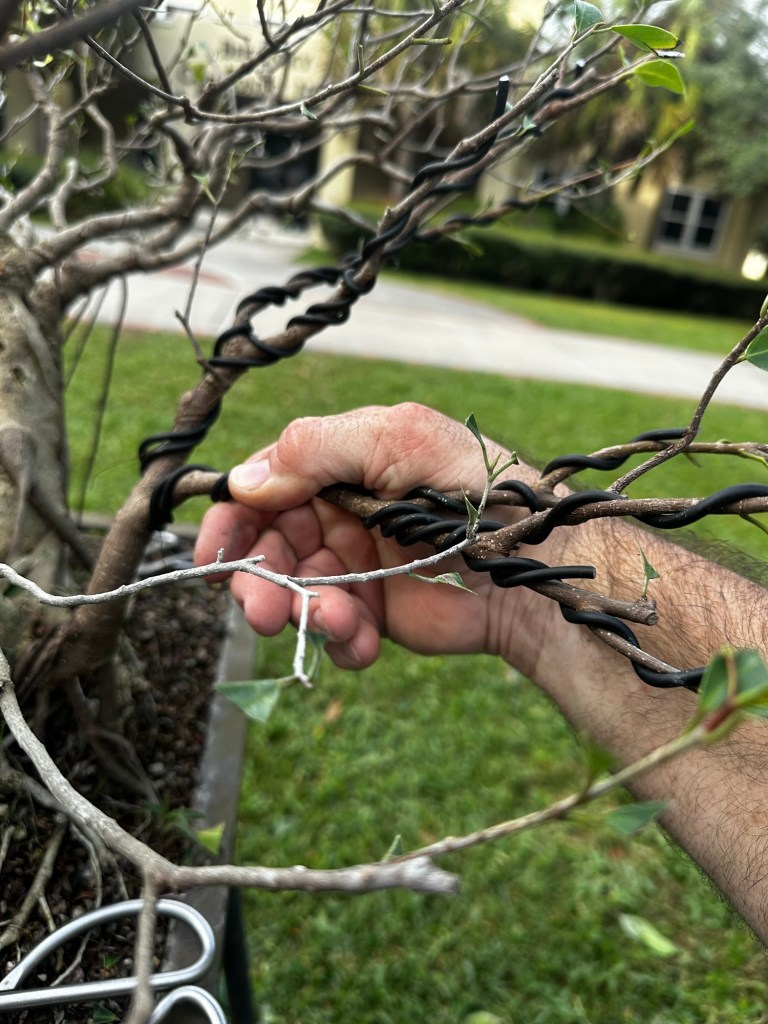
Scrape the branch you are grafting, place it, and stretch the tape (it’s rubber), and wrap it tightly. I then like to use wire to hold it down as well.

And make sure the wire is tight. That holds the two pieces together. As the cuts heal, they want to pull away, so I’ve found that wire holds it in place nicely (like we did above on that recalcitrant branch).

On the side that’s holding the graft, two loops hold it down better than one.

Now for one more graft. Same process: cut a wedge…

Scrape the bark on the branch…

Apply the tape, add the wire…

Crank it down.

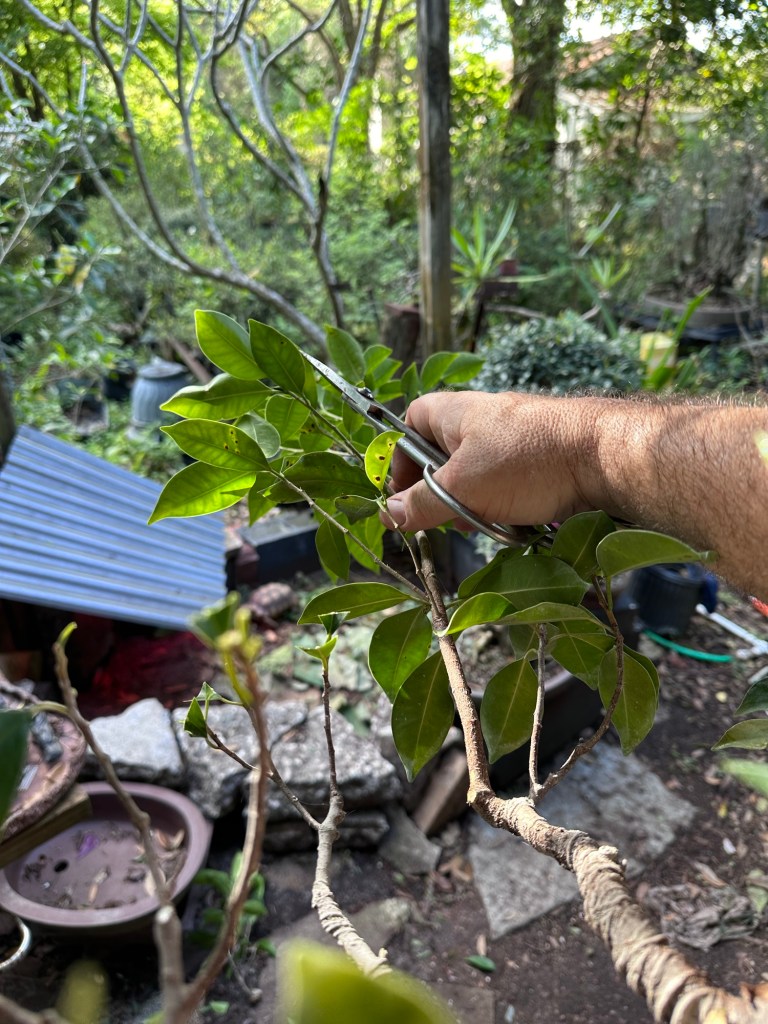
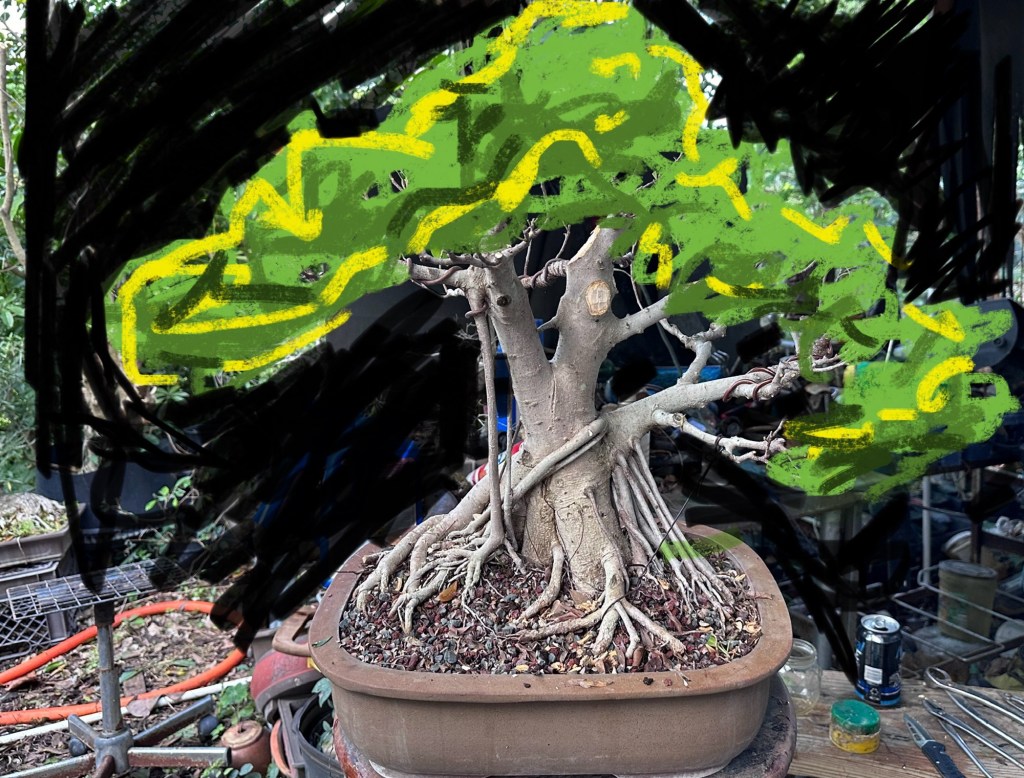
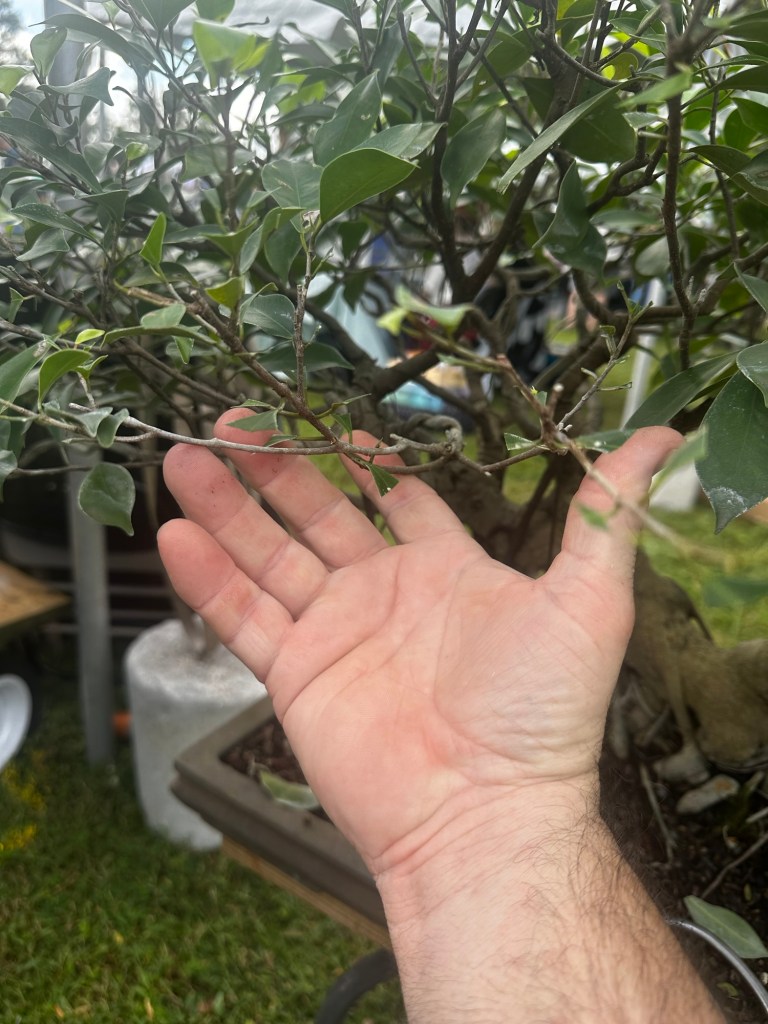
I was going to wire this tree out but I think I’ll just prune for movement and taper. Making sure to leave an active node so we diminish dieback.

All done with that.

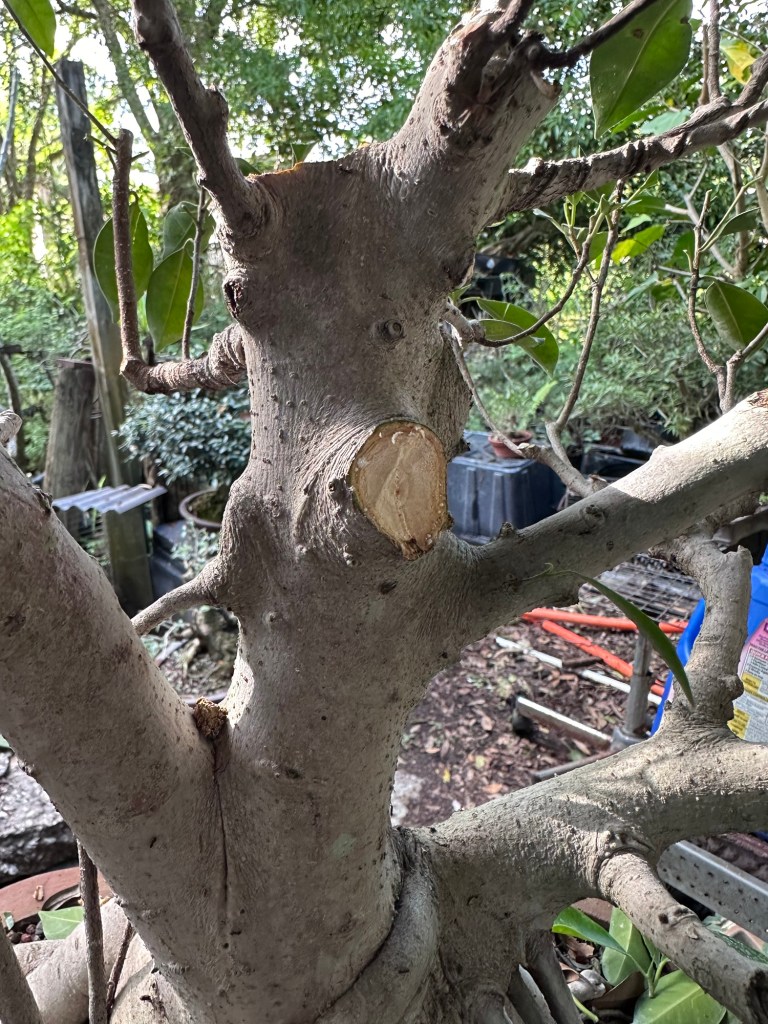
One last thing before I repot, I’m going to smooth out this scar.

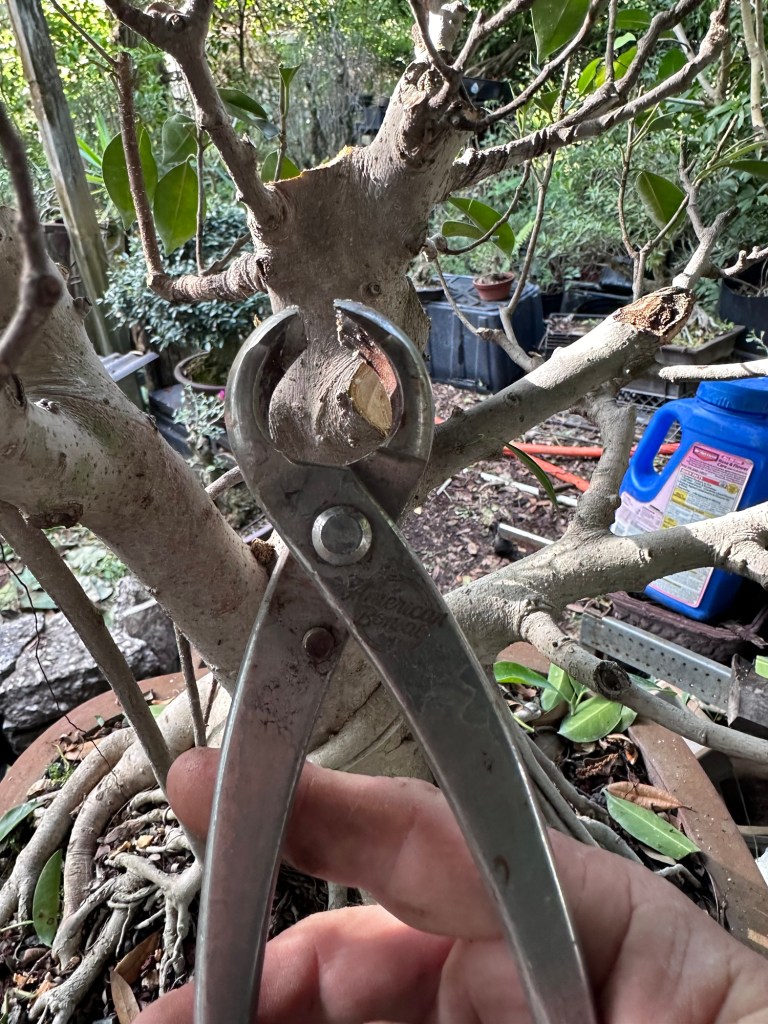
I start with a knob cutter…

Then clean it with my knife.

It’ll take a bit to heal, but it should heal.

Now it’s time to repot.

It definitely needs it.

Rake it out.

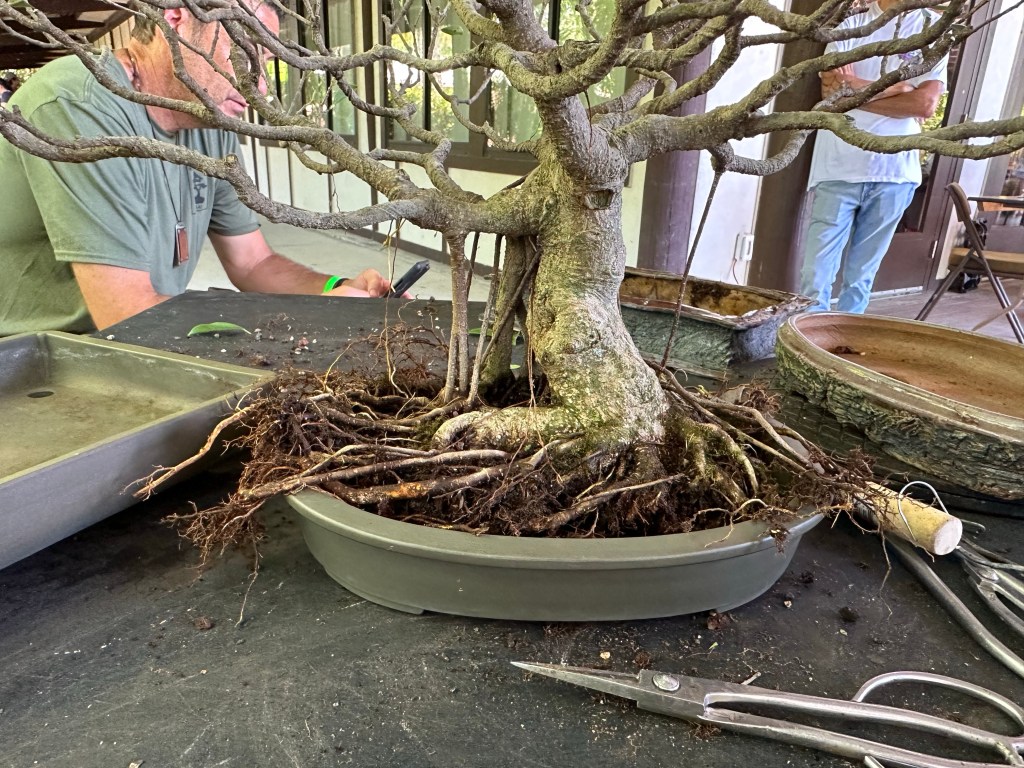
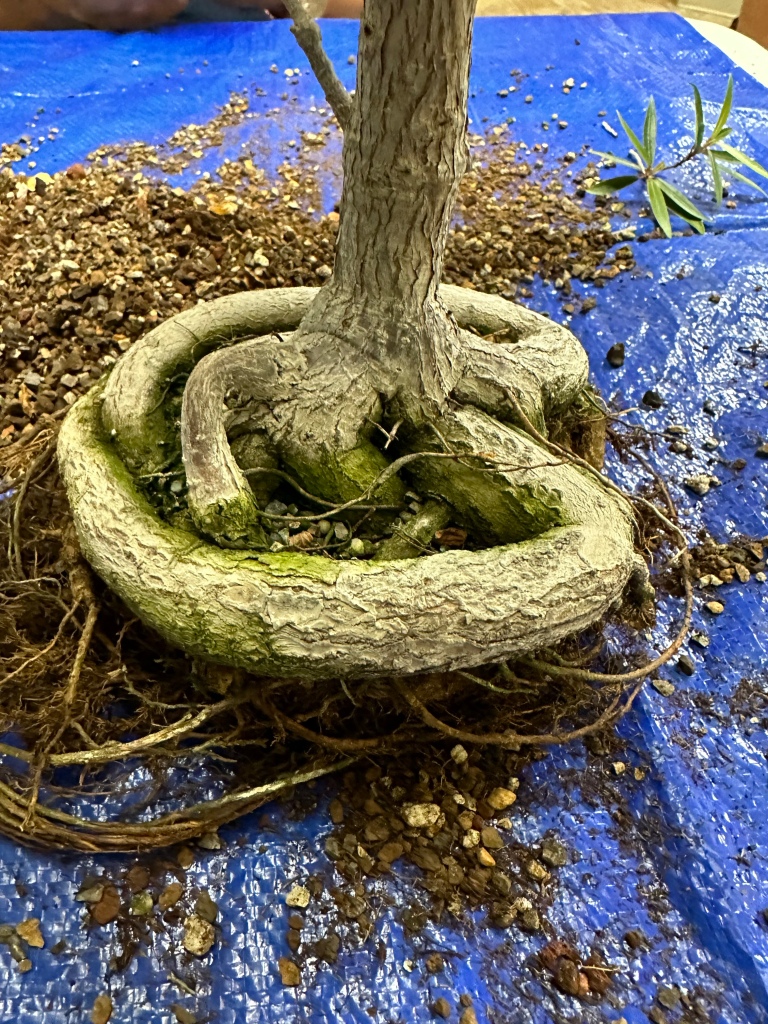
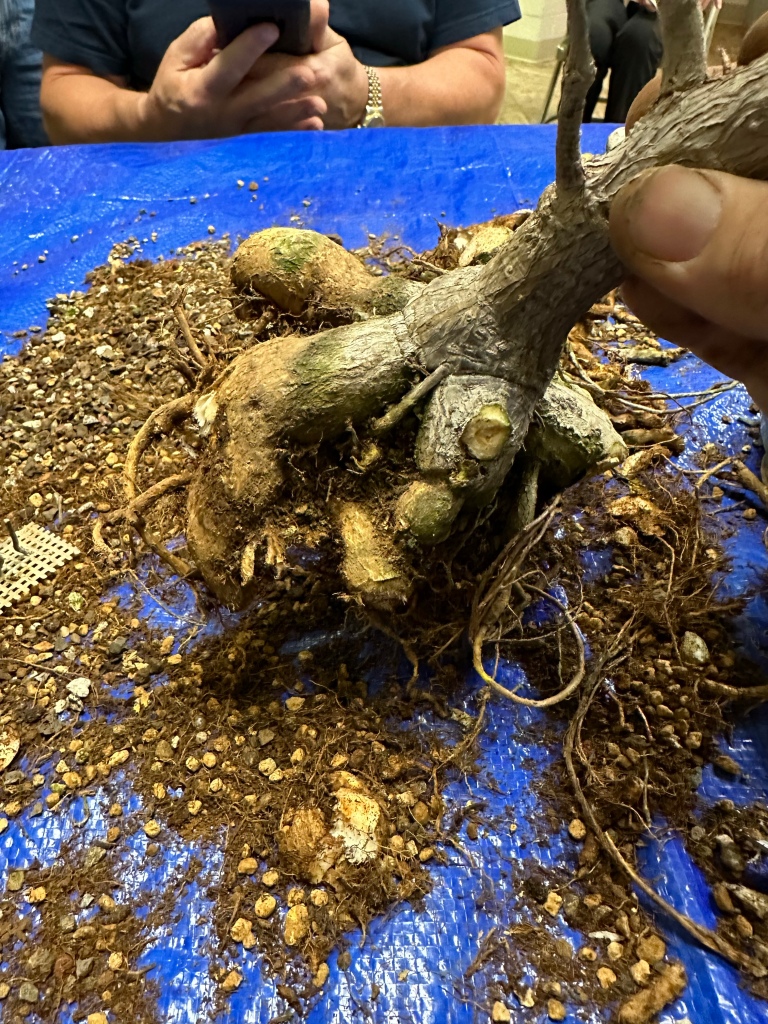
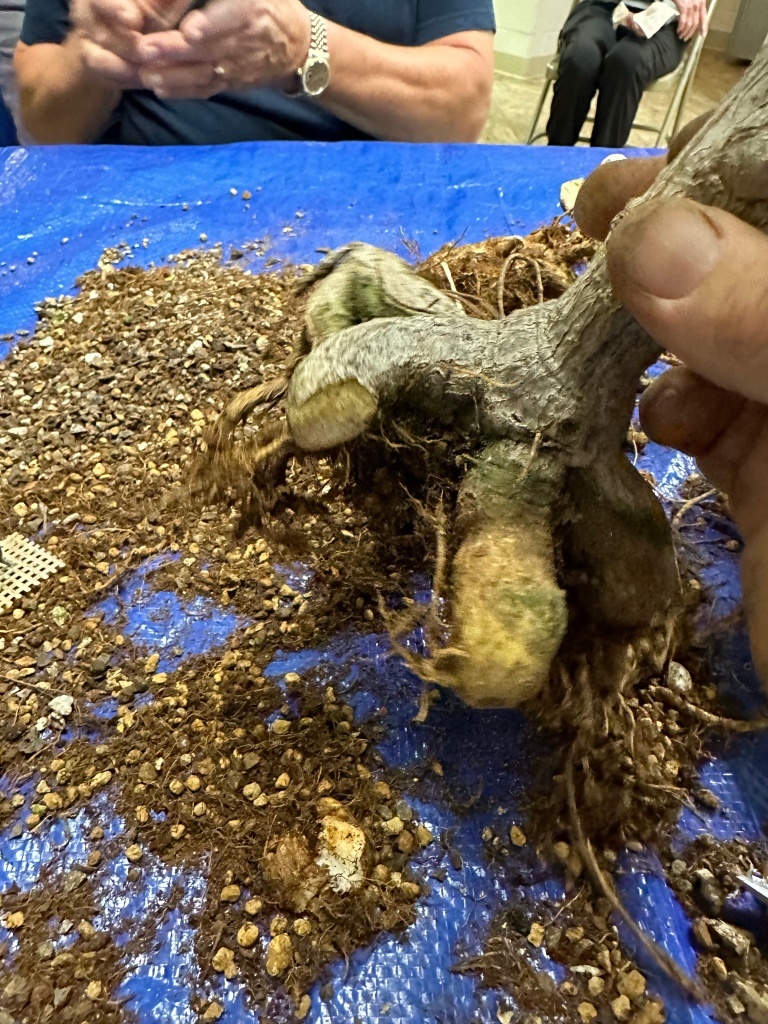
Unwinding the roots. This one went around the pot twice.

Cut back the long ones…

Rearrange the new ones

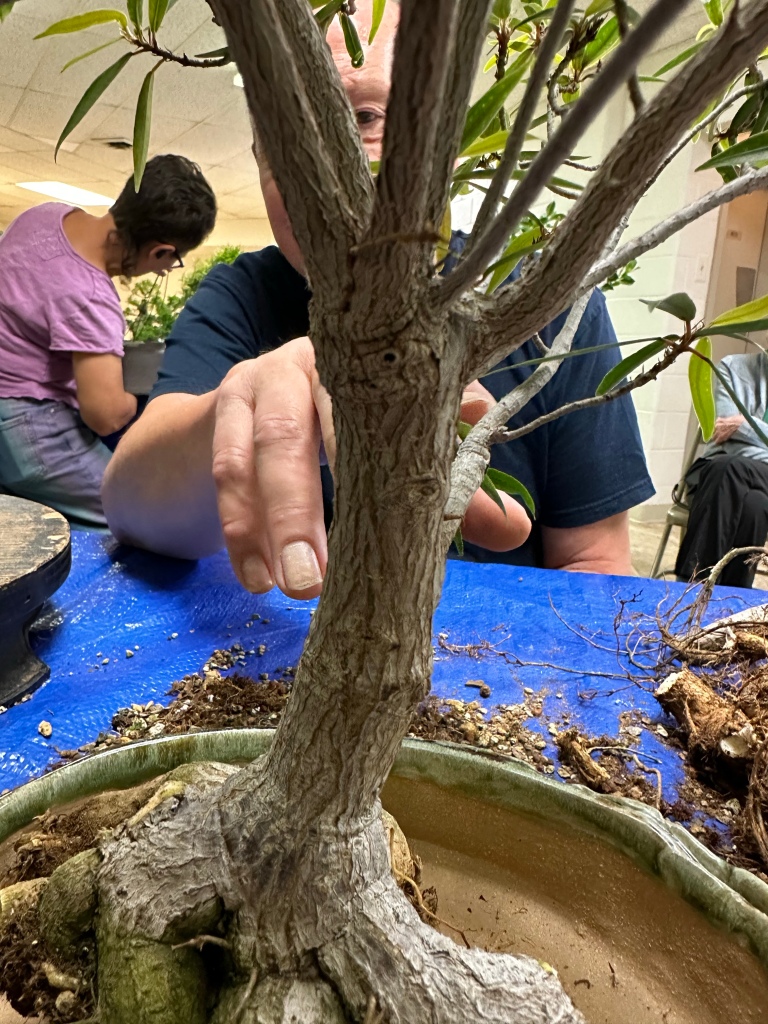
And now it’s time for the pot.

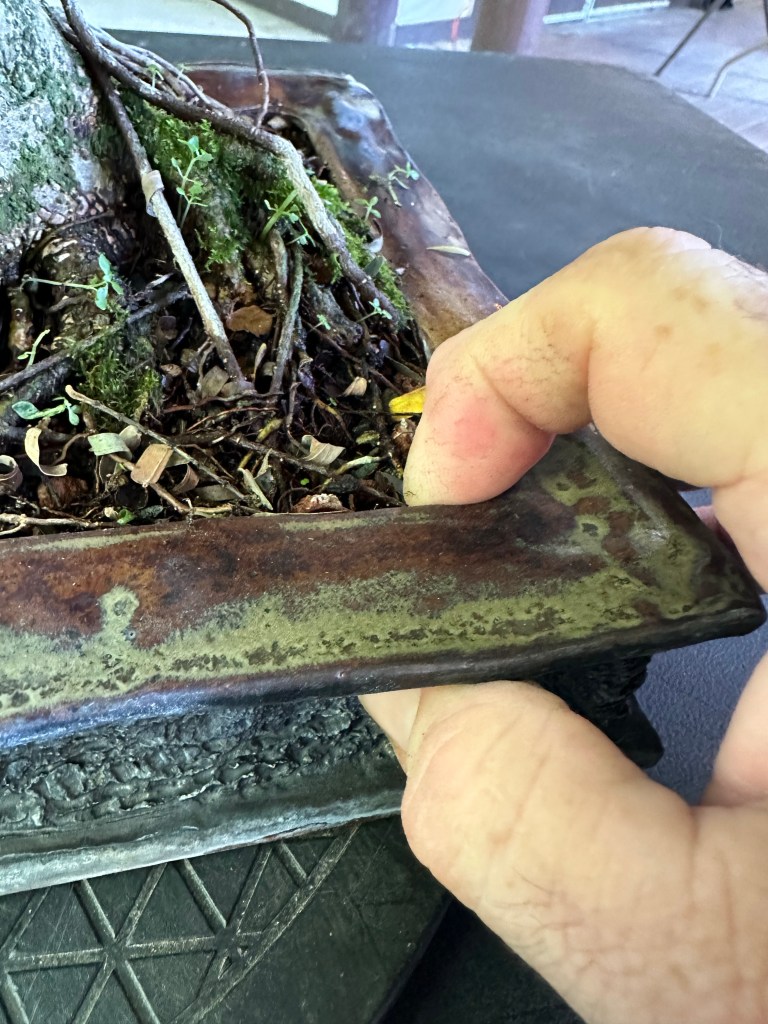
The pot is, believe it or not, a high quality Italian bonsai pot. High fired and of good clay.

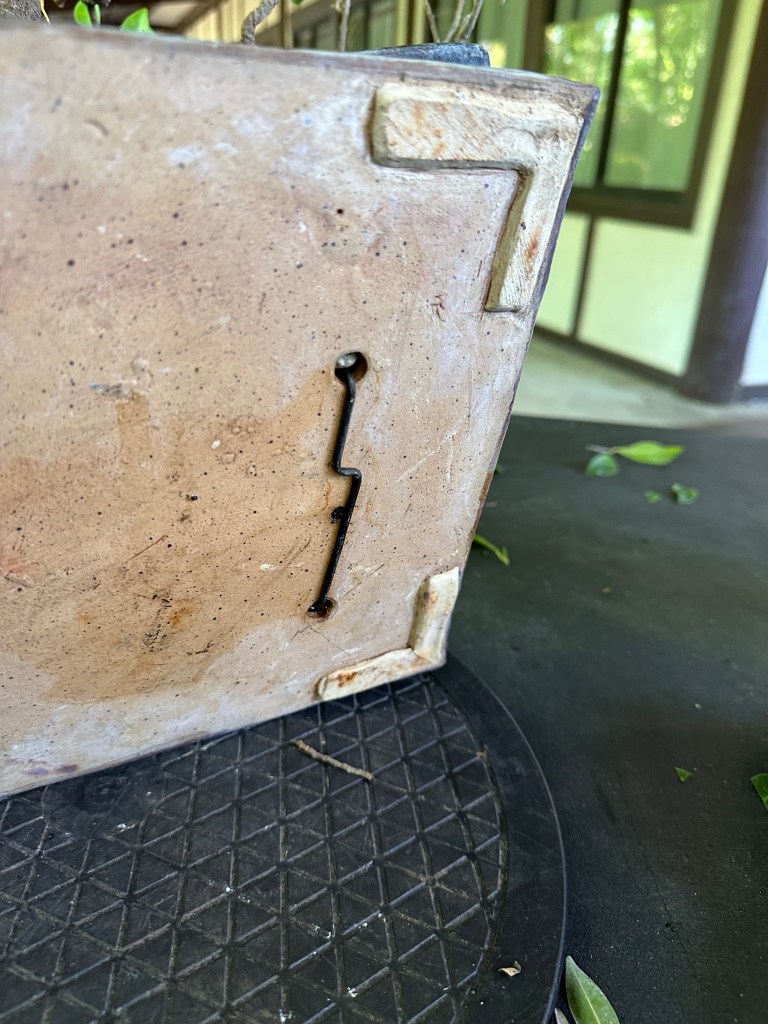
Of course I tie it down.

Using the wire to hold some roots in place.

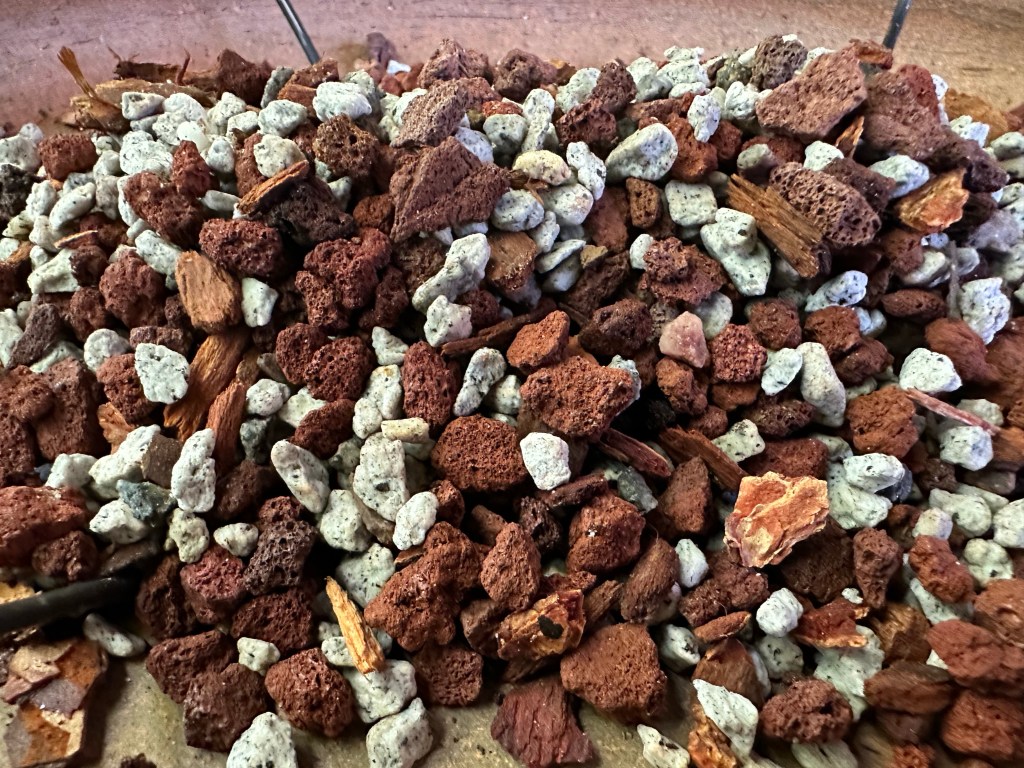
And fill it back in with good, well draining soil.

In the above pic, I’m pointing at a root I’ll split like I did in that original post (did you read it? Why not?)

Then some fertilizer.

And weed preventer.

And water it all in.

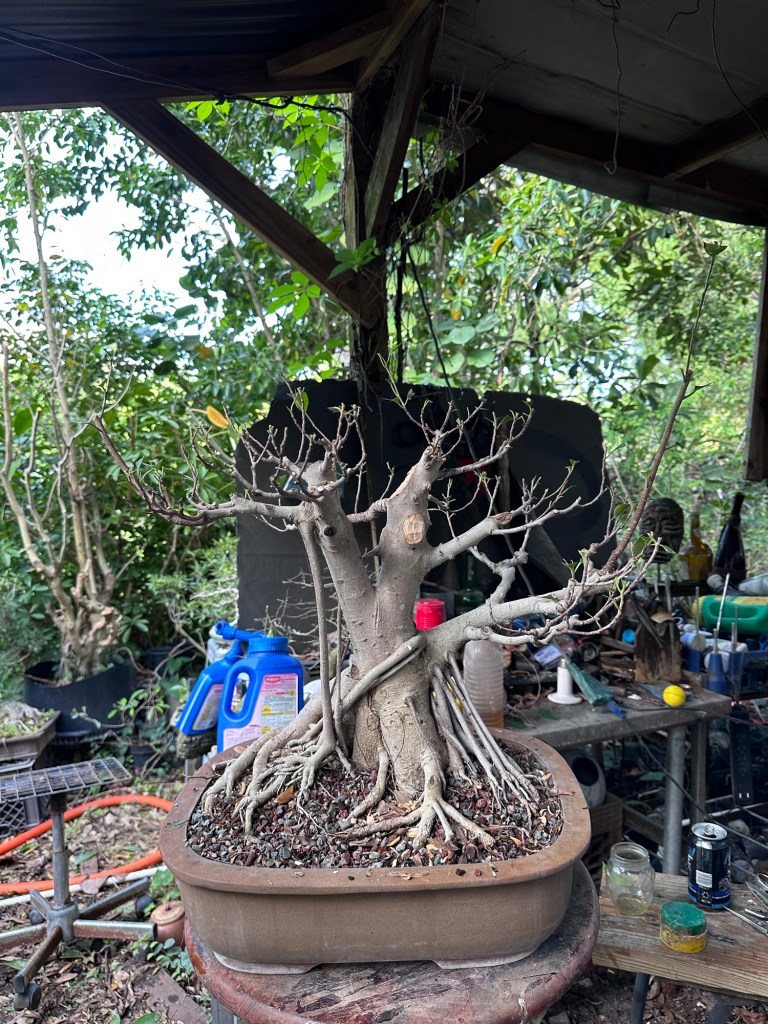
It’s hard to believe this tree started out with maybe four branches and a top. Especially it being a regular Ficus microcarpa, which isn’t know for much ramification.

But you can do it. You just need to follow the basics: cut it back, wire, let it grow, fertilize, unwire, cut it back, let it grow. Just keep doing that and you slowly build the tree.

It just takes time and work. Stay tuned for updates.

  •  

Art is a lie that makes us see the Truth

That quote, in all its incarnations, has been attributed to artists, writers, poets, philosophers, actors.

Like this Ficus microcarpa, the quote comes in many varieties. This tre was once called “nitida”. Kinda like a tiger bark but without the bark.

Get out the saw, add a little wire. Do you know what the purpose of wire is? It’s two-fold. The first is obvious, to hold the branch while we bend it. The second is to protect the branch from breaking, as we bend it. Kinda like when we are under stress, sometimes a blanket or a hug takes the stress off of us and makes the change easier.

But……

……it can only protect where it touches. Let your friends into your life.

….that’s what life is, spending moments and remembering those moments when, perhaps a shared joke, or a drink, or meal, make the loneliness that is the true reality of man, go away for a little while. And it’s those moments one should cherish.

Brazilian raintrees were brought into this country (the USA) by a man named Jim Moody. I never met him, I don’t believe, but I was good friends with his grandson, Allen Carver. He left us recently. I never got to say goodbye. But every time I work on a Raintree, I think of him.

Gnarly.

This one came from Jim, to Michael Cartrett, to Javier Cortez, it was an air layer off a big tree that grew in Mike’s yard. And it went to another friend who went his own way, Jose Perez. He had to sell it after a divorce, and now it’s Doug’s. I get to work on it from time to time.

The story of trees are often as compelling as the trees themselves.

I’m glad I get a part in the story. A small part.

Tuning a guitar. Trying to get the spaces between the strings just right. So that the song sounds good. That’s Jack, a good friend I don’t get to spend too much time with.

Life is not the counting of numbers, it’s the space between those numbers.

How much can you fit into an hour, a minute, a second? How much should you? Can the appreciation on that infinitely divisible moment of time between the seconds in your life be enough, or do you need to fill up those moments with importance?

How many beats per minute does your heart count? Are we promised only so many beats per lifetime? Is it written in our genetic code? Or do we just time of the calculation and stop counting? How many leaves on this buttonwood? Does it matter?

It’s like the space between the branches. The air around the tree. This gives meaning to the tree.

And some things you just gotta see in person. Go to a bonsai exhibit, or all you’re seeing is the blast of pixels in an image against your retina. We “see” with all our senses.

The best story will never be written because it’s your story and you’re making it up as you go along with your life.

The story has truth and lies. And even the most honest of us have all these things we tell ourselves to help us get through the day. But we believe them.

Kurt Vonnegut said “We are what we pretend to be, so we must be careful about what we pretend to be.” in the novel Mother Night, in 1962. Harsh and cruel. You should read it.

Another buttonwood. Let’s help it along. It needs stress and pressure to forge it into what it wants to be.

It needs that blanket so the branches don’t snap and break, as we bend it. This time there’s wire and a secondary wrapping of self amalgamating, rubber, electrical wrap.

How about this pot? Made by an auto mechanic that builds transmissions. Lynn Baker, goes by the name Herr Lynn. A local potter from the west coast of Florida.

I think it adds to the story.

But the story is false. This buttonwood may have started out on a beach in Florida, but it’s nature wants it to grow straight. Like the branches in the first pic

That’s why it’s species as designated as “erectus”. Like the hominid Homo erectus, an ape that walks upright, Conocarpus erectus will grow straight, but if it’s in the environment like the southern Florida coast, with the hurricanes, the sun, the surf, alligators and crocodiles, and the land developers and tourists, all causing stress and beating down and torturing the tree, it will be transformed into the twisted trees we so love.

We have to tell a story, a true one, but not true in this case, of all the struggles a buttonwood can go through and live.

To get back to our initial pondering in the title of this article, it was Picasso who was first quoted saying that art is a lie, in 1923. Here’s the full quote, translated from Spanish:

“We all know that art is not truth. Art is a lie that makes us realize truth, at least the truth that is given us to understand. The artist must know the manner whereby to convince others of the truthfulness of his lies. If he only shows in his work that he has searched, and re-searched, for the way to put over his lies, he would never accomplish any thing.”

  •  

Why Adam? Just why?

As I go through my day, working on trees or just making soup, there’s an ever present question on my mind. That question is: “Why?” Especially of late, but that’s a rabbit hole I won’t go down today.

It’s a tough question to answer,”Why?”. Most people mistake my online moniker “Adamaskwhy” as meaning that you can ask me “why?” and I’ll tend to answer. And that’s ok. I usually know the answer, or if I don’t, I can find it (and if I can’t find it I just might make something up).

But the real meaning behind “Adamaskwhy” stems from my propensity to ask my teachers, when I was a young and inquisitive lad, “Why?”.

For example, my teacher might expound “When drafting an exclamatory sentence, one should use simple, declaratory prose.” and I might ask, innocently, “Why?”. Now, the best teachers knew the answer. The competent ones knew where to find the answer. The average would just quote what they’ve been taught. The worst would say “just because”.

Obviously, from the preceding paragraph, I didn’t take the lesson of short declarative sentences to heart. Mainly because, sometimes, obfuscation and evasion is the quickest path to The Truth. But, more importantly, I don’t want my style to sound like The Old Man and the Sea (“….here is a bonsai. It curves to the left, then to the right.” I’m more of a “.. The blue sky paints the cream glazed pot with streaks of azure. The sun silhouettes the canopy like an umbrella, shading the mossy soil. The old, sun-browned man, wizened eyes staring at the green foliage, raises his shears and snips at a dry branch…..”).

Needless to say, many of my past teachers did not appreciate the question “Why?”. Truth be told, many teachers can’t answer the question. They feel that, just because they are the teacher, their teaching is inviolate, sacred, and not to be questioned. And the more narrow the focus of the lesson, the more pedantic and authoritarian the teacher becomes. As an example, let’s say the lesson is on bonsai soil, (just to bring bonsai into this essay, since this is a bonsai blog after all), the reasoning style usually used by bonsai professionals is Reasoning from Authority. They’ll say “so and so uses such and such, and they are so and so, therefore it’s correct. Or, depending on the particular pedant flailing his hands around whilst lecturing, the verbiage becomes a word salad of technical jargon with one needing a degree in soil mechanics to understand just what they are saying.

Anywho, why (heh) am I “why-ing” now? Well, dear reader, I recently posted a video in the social media webosphere concerning a certain willow leaf ficus, and what I did to the poor thing. This one to be precise:

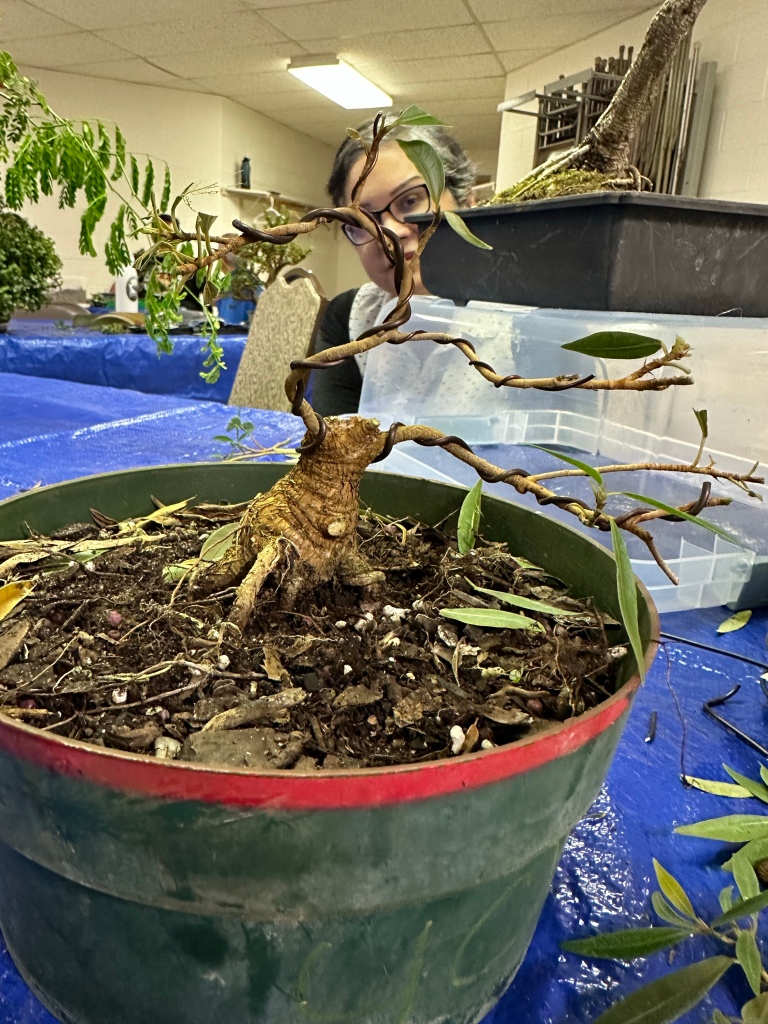
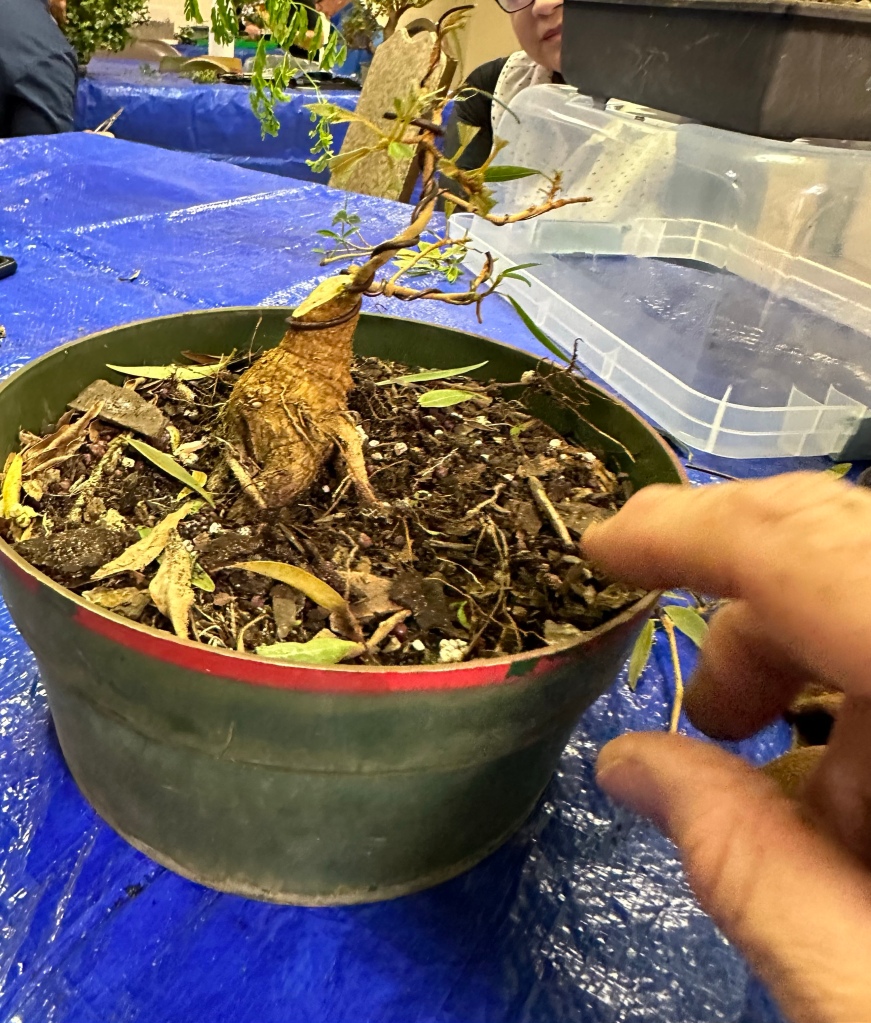
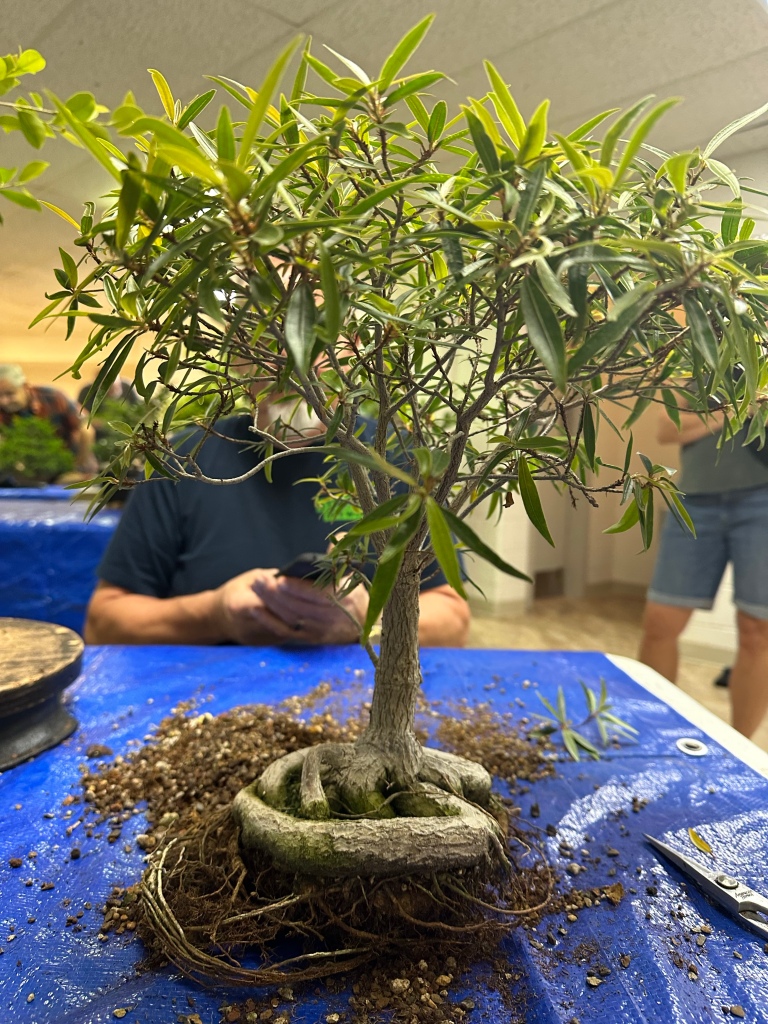
Now, with such a raw piece of stock, I could’ve done all kinds of things to it. The scene: Ikebana Club international, Orlando Florida. This is my fourth visit to this Ikebana club. My visit usually consists of me bringing starter trees (in todays case, willow leaf ficus) a few different choices of containers, soil, wire etc., and potting, styling those trees, or re-potting members trees from past sessions. Irene, who’s been to all of them, decided to get two willow leaf this time. The first one we wired up and made into an informal-upright. The second one….well, you can see below what happened to it….

As you might have noticed, we chopped it. And Irene was right there with me on the decision to do it. It was actually her idea. It’s a drastic technique, for sure, somewhat controversial, as dramatic as my teenage boys trying to get through a Fortnight Battle, and, in my case, it makes me look badass for how casual I can do it, with just a pair of scissors.

You see, many people may misunderstand the decision to do a trunk chop. Let’s go through another willow leaf (below) and the decision tree (no pun intended) used to decide when and if to trunk-chop a tree.

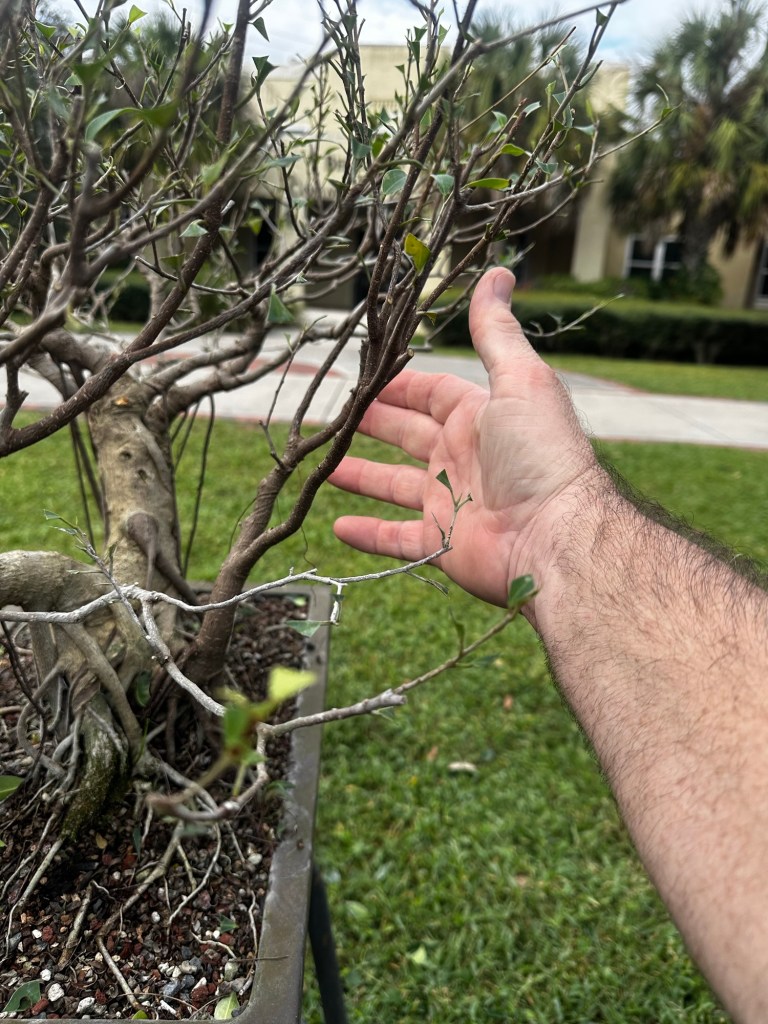
Below: Hand for scale. Ficus salicaria, the willow leaf fig. It belongs to Mike, who’s visiting from the Naples area. The tree is a stock tree from Wigert’s Nursery in North Ft Myers. It has a fair sized base (nebari) and a good sized trunk. But it has little taper, the branches are way high, and it kinda looks like a slingshot. Just need a rubber band and a good rock, and we can go squirrel hunting.

Ok now, you ready? As one should, let’s begin at the beginning. You can probably guess the ending to this post, a trunk chop, but the question, the one in the title, is “Why?” Why a trunk chop?

The beginning begins with the first interrogative “What?” What is Bonsai?

Bonsai is the Art of taking a relatively small, and relatively young tree and, using various techniques and principles of art, trying to make it look like a big and old tree.

One of those principles is the one we call “Taper”. The concept of taper means that, starting at the bottom, we should start with a wide base and, as we go up the trunk, it should taper, or get skinnier, coming to a point at the top.

The tree below has some taper. It could be used to describe (style) a tree as seen from a distance. Throughout most of the history of bonsai, most trees were styled from a distant view perspective. Think of observing a tree on a mountain. But, as tastes and visions change, so has the idea of perspective. In the real world, trees have a trunk-width to tree-height of 1(trunk width) to 12-14 (trunk height). If you read the old books, it was taught that the ideal ratio was about 1-8 or 10. Today they teach 1-6. But there are extreme examples of 1-4 or even 1-1 (the so called “sumo style”). Now, I have been known to style a sumo style in the past, and, if a tree could support it, I still do. But let’s get back to Mike’s tree.

Here’s the slingshot I was talking about.

It’s not generally a good design choice to keep that. Why? Well, horticulturally, a tree in nature tends not to grow that way. Or, if it does, when a good wind storm comes along, the tree will break at the “V”. It’s physics. Artistically, a v acts as a visual stop for the viewer. Bonsai being an art, that wide V will stop your eye as it moves up and down the tree. Your eye is drawn to open spaces and you’ll be looking at what’s behind the tree and not at the tree. Your eye moving around the piece of art, as designed by the artist, is called “composition”. I could get really into it, and talk about line, form, focal point, and negative space, but I think you get the idea.

For Mike’s tree, I could remove the bigger branch, like below.

And I’d still have good taper.

I could remove the smaller branch and have a more natural taper. That’s Doug hiding between the “V” btw.

Proportion (how the limbs are arraigned as you move up a tree) would satisfy a natural looking design.

The thickness of the trunk should decrease, in shorter lengths, as you go up the tree (main trunk is longer than the next level, the middle part by about 1/2-1/3, the third part, even shorter and thinner, until you get to the top, which should be your fine twigs. This makes the tree appear as though it’s taller).

I could not cut anything and use that first branch as, well, the first branch, and wire it down. We could make a good natural style.

To give an example of keeping most of the tree, let’s go on a tangent. Here’s a tree from a club member, George

We cut out the middle and wired that slingshot.

And it’ll make a good tree, in time, as well.

Getting back to Mike’s tree, we could start over, and chop the whole thing and make an exaggerated tree with quick taper.

You can guess what we did.

We didn’t cut here

Or here.

We cut even lower. Doug had to close his eyes, the horror was so extreme.

The reason why? Proportion. The first third is where the chop is. The tree now needs to grow up to have believable taper. Ultimately, we wanted (and it was a collaboration with Mike, I don’t go willy nilly chopping another person’s tree without a full discussion of what can be done with everything. Even on my trees I keep asking myself “why?”. Why cut here, why wire there, etc. )

And the real answer to the question “Why?” is that Mike wanted a smaller tree. And, with a willow leaf, we can chop it and regrow the top in short time.

Something like this is the final vision.

Here’s Mike. He took a pic, for posterity,

Here’s another of Mike’s trees we worked on that day. A Ficus Microcarpa.

It had been chopped already, and we just had to move the branches a bit.

Styling a tree is all about asking questions. “What happens if I do this?” “Will this improve or destroy the tree?” And ultimately, “Why am I doing this?”

Those questions are answered by experience, experimentation, and by people who’ve done whatever you want to do to the tree. And feel free to ask those who’ve come before. Just make sure you ask “Why?”

To finish out this essay, let me quote this (my wife is a third Dan backbeat in taekwondo, for background) it’s from a part of the taekwondo Black Belt Oath:
“…….I am a student yesterday, I am a student today, I am a student always……”


If only we all lived by just that part…..

  •  

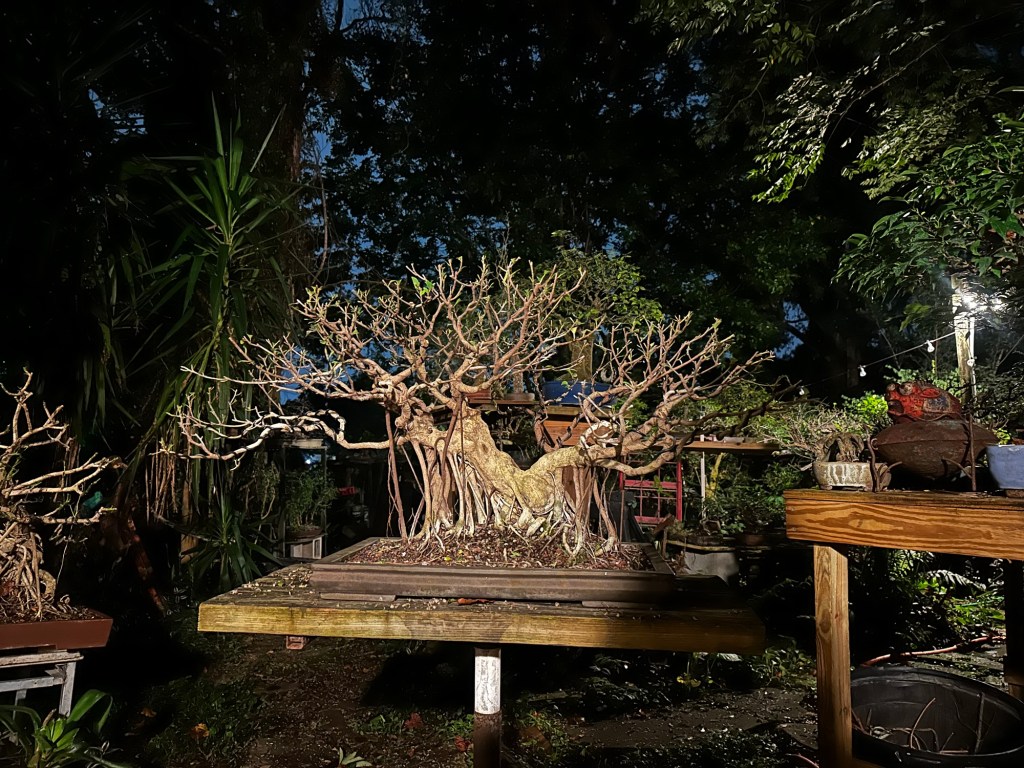
Rehabbing a neglected banyan ficus

It’s been too long since I’ve attended to this poor tree. And the blog. Sorry to the tree and to my readers. I’ve been busy with client’s trees, planning the Bonsai Societies of Florida 2023 Convention (check it out Here ) and some real challenges in my life.

The tree is a Ficus microcarpa.

You last saw it in this blogpost What is the banyan style?, which was published way back in April 17, 2014. Here’s how it looked then:

Yeah. I know, what happened? Right? I’m supposed to be a professional and all that. Neglect, unchecked growth, a couple of hurricanes and freeze warnings. Accidental uh…drought. Insects, disease, cats, children. Basically it’s survived some biblical trials and tribulations.

Speaking of disease…

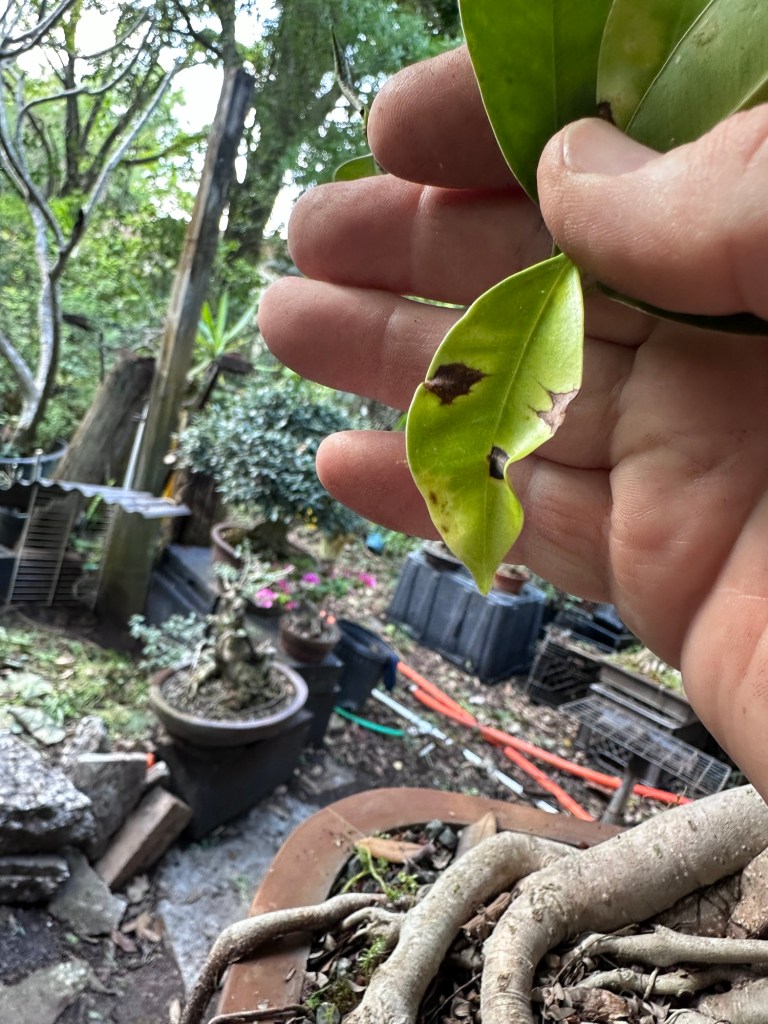
I see these spots early in the spring…a lot recently. I had my nursery inspector do some checking and, though I thought it could be a fungus or a bacteria like pseudomonas, he said it’s evidence of a gall wasp. Now, as the name suggests, it’s usually an evident infestation by there being a gall on the leaf, but I haven’t seen them in my ficus. Maybe because of the systemic treatments I use (more on that later) killing the larvae. I don’t know.

The work today in rehabbing this tree will include a repot, a hard cut back, fertilizer, insecticide, and weed prevention.

Let’s get to work.

First, cut back…

I’m bringing it down quite a bit.

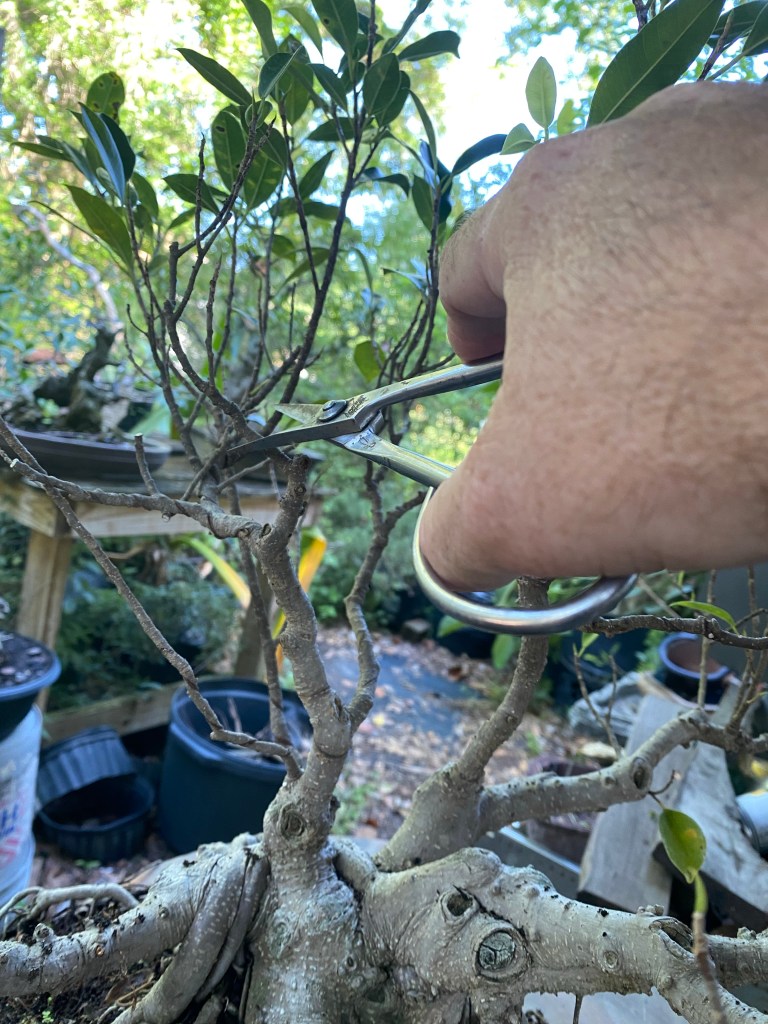
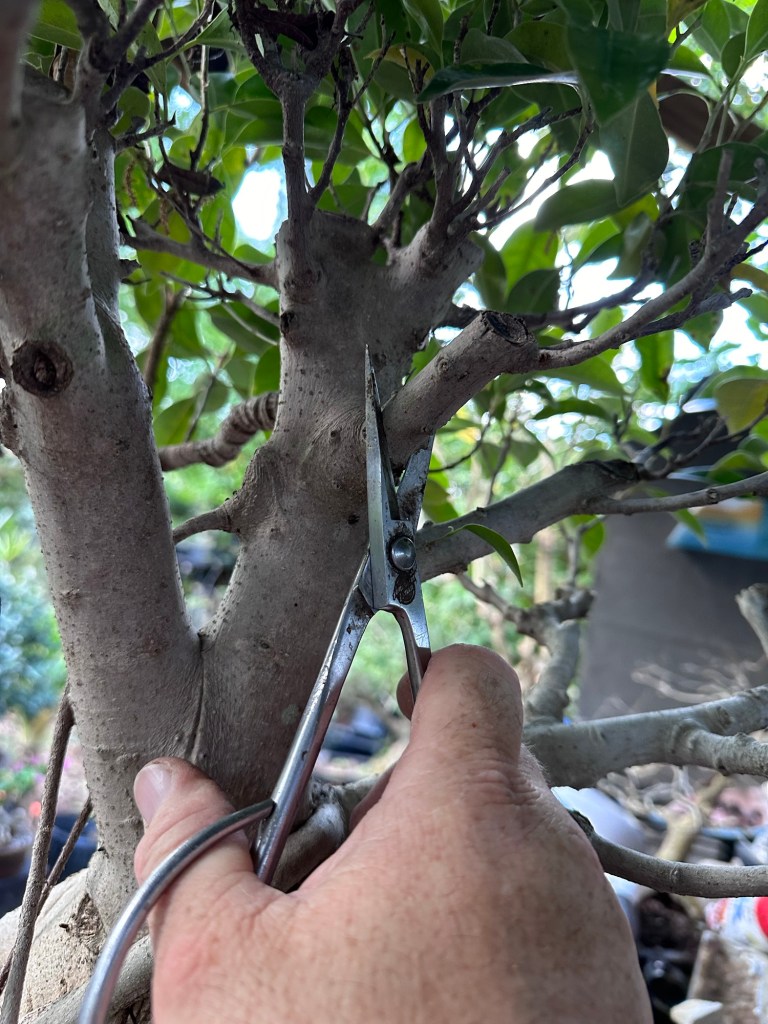
Chop chop goes the scissors!

This branch below will be the one branch I don’t cut back. You’ll see why (again) later on in the program.

Normally, I would cut this type of fig back so hard, as this is a standard Ficus microcarpa, and you can get significant dieback on it, sometimes losing whole branches. To contrast this, the Tiger bark microcarpa doesn’t do that so badly, it back buds almost anywhere. But the plain old Ficus microcarpa does. Keep that in mind. Know your tree and work accordingly.

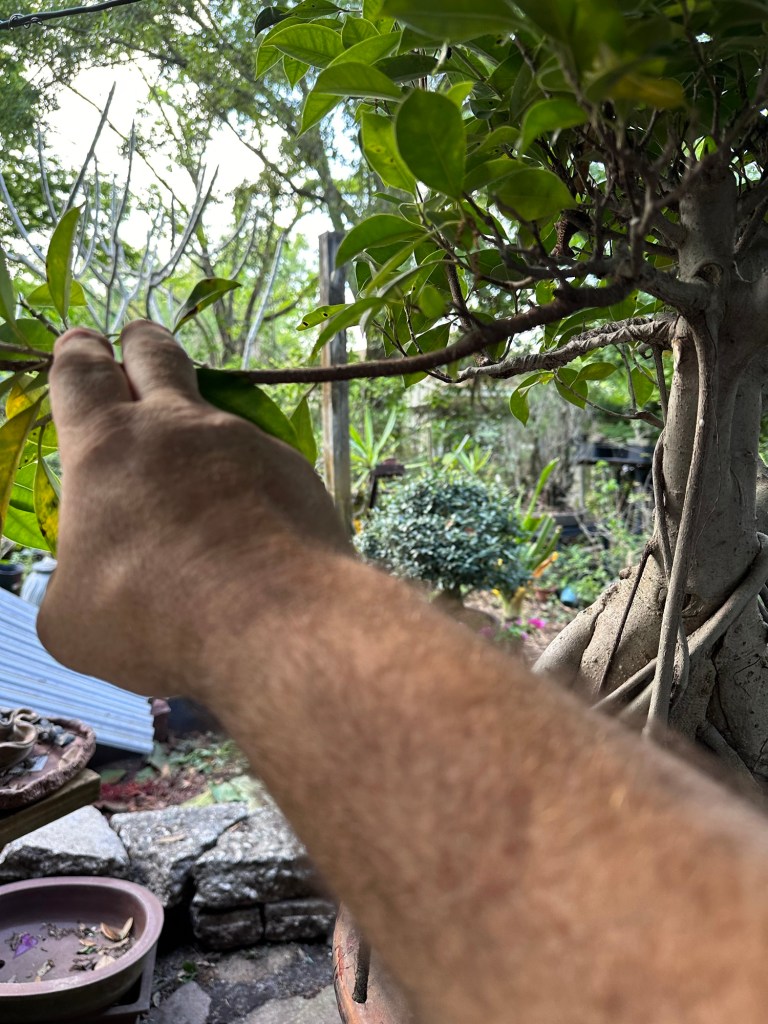
If the branch you’re chopping is a darker brown, it’s more likely to backbud, as that’s newer growth.

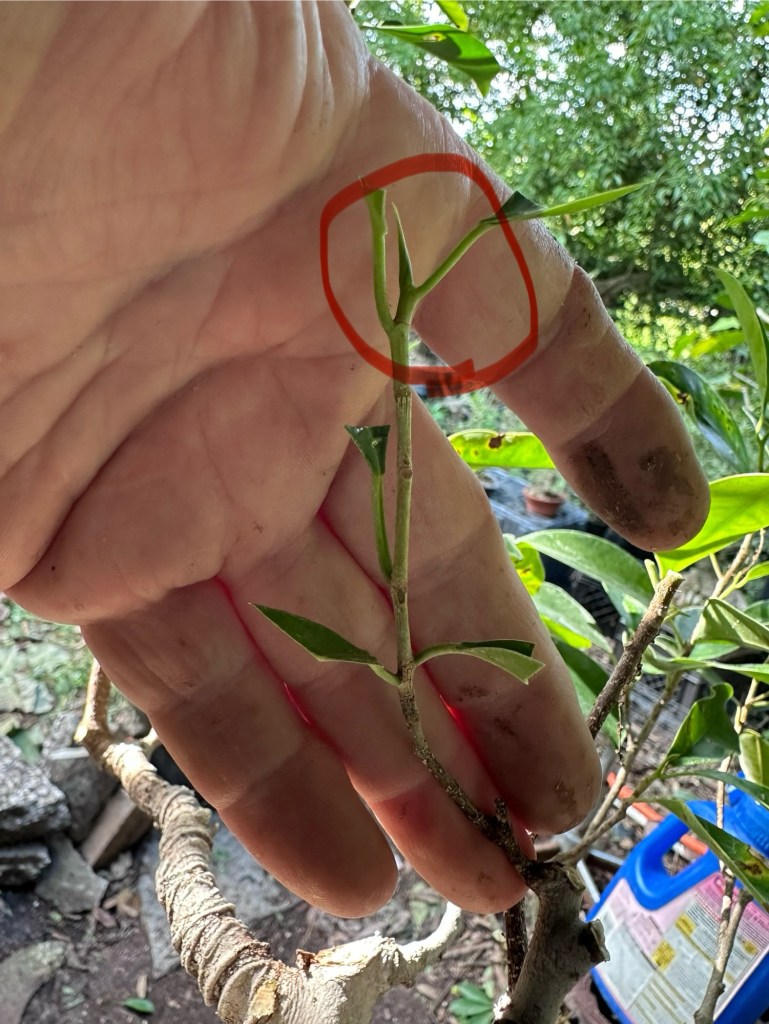
Here’s the one branch I didn’t cut back. I wired it and left the grow tip.

Now to repot. I’ll be combing out the roots to get rid of all the wrapping ones. And I’m being aggressive so I can get all the weeds out.

Weeds like these. This is a corm or bulb from a weed called “cat’s claw”. A climbing vine that holds onto things with tendrils and modified appendages that are a lot like, just as the name says, a cat’s claws.

Here you can see the “claw”.

This one is called “Florida spurge”. It’s underground roots can get as big as carrots. You have to be carful to pull out those roots as it will just grow back from the bulb. If you have them it’s a good indication you may have nematodes.

Here’s the leaves of the spurge.

That done, time to cut the roots.

They were circling the pot (it’s in a different pot than the one I used years ago).

The pot it was in.

A good pot. But is it deep enough for what I need for good regrowth?

I had had thoughts of putting it into this container. It’s kind of what the trade calls an “Anderson Flat”.

It’s bigger and deeper than the ceramic one.

But using it might give me too much growth. Is there such a thing? Yeah. I need controlled growth with short internodes (remember the dieback, the branch will dieback to the next node lower on the branch). So I’m going with its current pot.

Here’s an axiom “The wetter the roots stay, the slower the growth”. You’ll hear me talk of wetter and drier soil mixes and, in this case, the more shallow a pot, the wetter the tree will stay.

To repot, first, make a mound of soil, and put the tree onto it and wiggle it down. This fills in the air gaps and gives the roots something to grow into.

It bugs me when I see people spreading an even layer around a pot. Don’t worry about the edges. That’s what chopsticks are for, getting the soil in between the roots on the margins.

The wiggle technique:

All chopsticked in.

Some systemic insecticide next, in this case, imidacloprid. It’ll keep the thrips away. And those gall wasps.

I like to mix it into the roots well, or else you get a gooey mess.

Now, a generous portion of fertilizer. This is half synthetic time release, and half organic (I’m using Miracle Gro Skake ‘n Feed today).

And weed preventer. This is OH2 but you can find a product called “Preen” in all the stores. It’s a convenient product that inhibits seed germination, not an herbicide, so you have to get out all of the sprouted weeds first. And there will be ones you miss, so revisit it in a week or two to get those.

Do you know the difference between a weed and a plant? You want a plant, you don’t want a weed. There are places where Ficus microcarpa is a weed.

And that’s it. Let it grow.

I did rewire a back branch. It was growing up, as they are wanting to do, so I rewired the opposite direction and put it back in the place I wanted it to be. Here’s a tidbit: if you keep a branch wired too long, when you remove the wire, sometimes it pops back into its old position. The tree wants to grow up, especially newer, and smaller branches, so the tree is actually pushing against the wire, and when you unwire it, it pushes the branch up again. You can see this in bigger trees where two branches are growing against each other, and tree trimmers know this and are very cautious when they see it. As they try to chainsaw the branches, the pressure could be so great the branch will violently snap. They call it a widow maker. It happens with twin trunks the most. Imagine you’re sawing away and then “BANG” the tree splits apart at the seam.

With that, the fig has a long way to go, but by the end of the season, I’ll have secondary and tertiary branches to work with. I’ll update if I remember.

And “Bob’s yer uncle”.

Let’s see if I can get it back to its former glory.

  •  

Time for a change

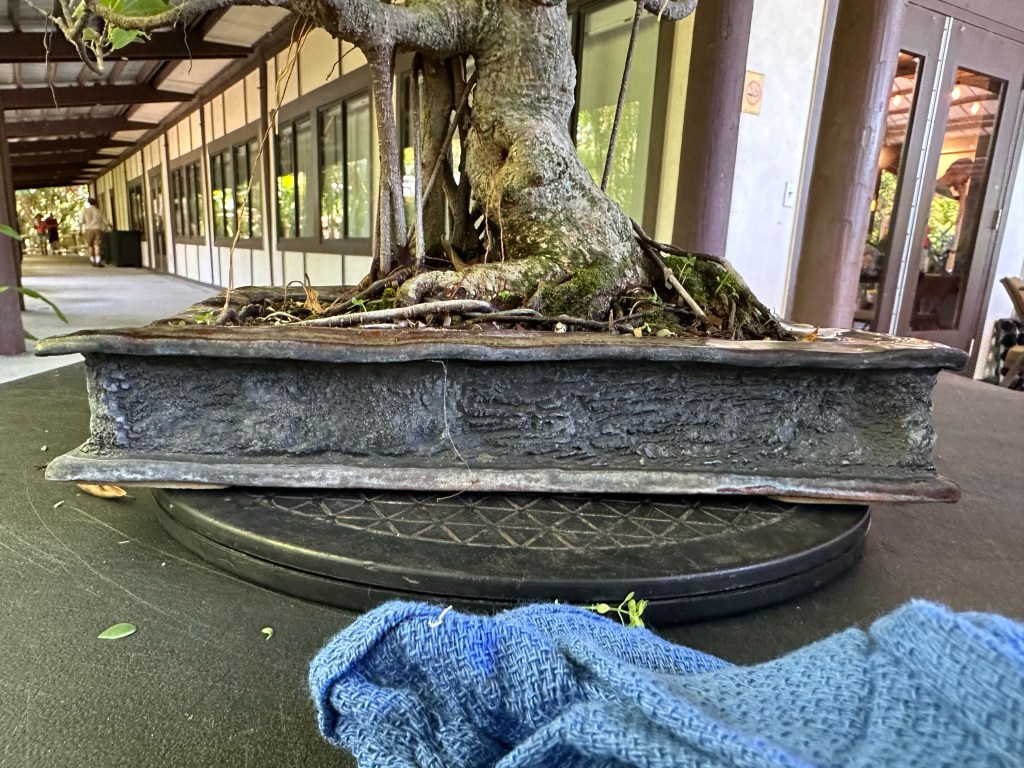
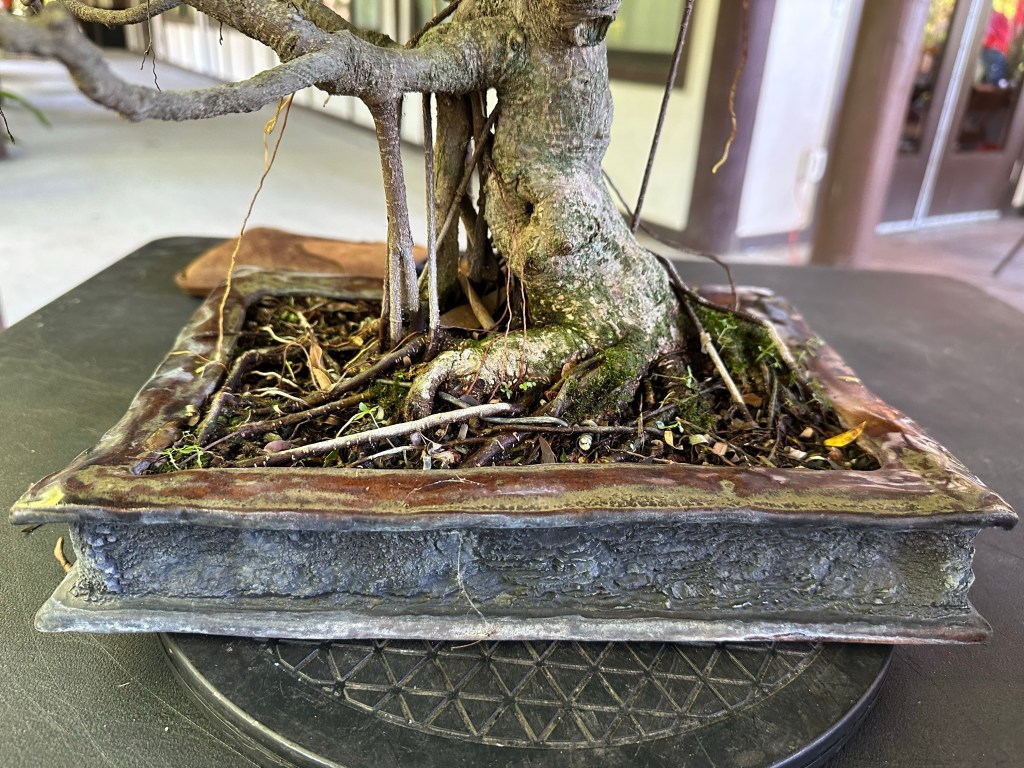
This ficus has been in this remarkable container for..ahem..four or five years, without a repot. I’m sad to say it needs a bigger pot. Sad because I love the pot and the tree combo.

Today, I’m hanging out, selling my wares and shooting the shit (as I’m known to do) at the Brevard Zoo. No, I’m not joining the swamp ape exhibit as the first living specimen ….

…the Bonsai Society of Brevard has an annual show at the zoo, uh…every year (I guess that’s what “annual” means), and I’m here (or there. Sometime the tenses get mixed up in my wandering and rambling prose style. I think it adds flavor and character. Some people say it drives them crazy. I say to those people that their insanity was there already, and I just exacerbated it, allowing it to blossom into the full blown psychotic episode that they’ve been waiting for their whole lives. You see, some people need an excuse but we of lesser gods, we know you don’t…..).

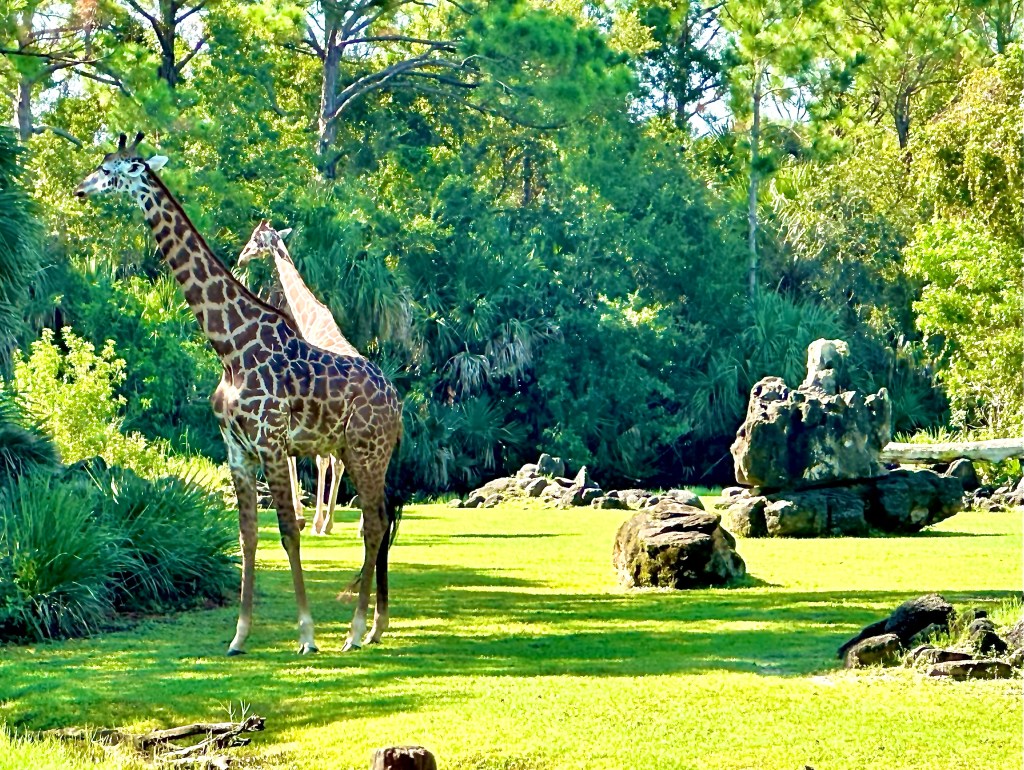
Above, we have the local fauna, Floridanus nativitus, below, are some imported beasts, Giraffa camelopardalis.

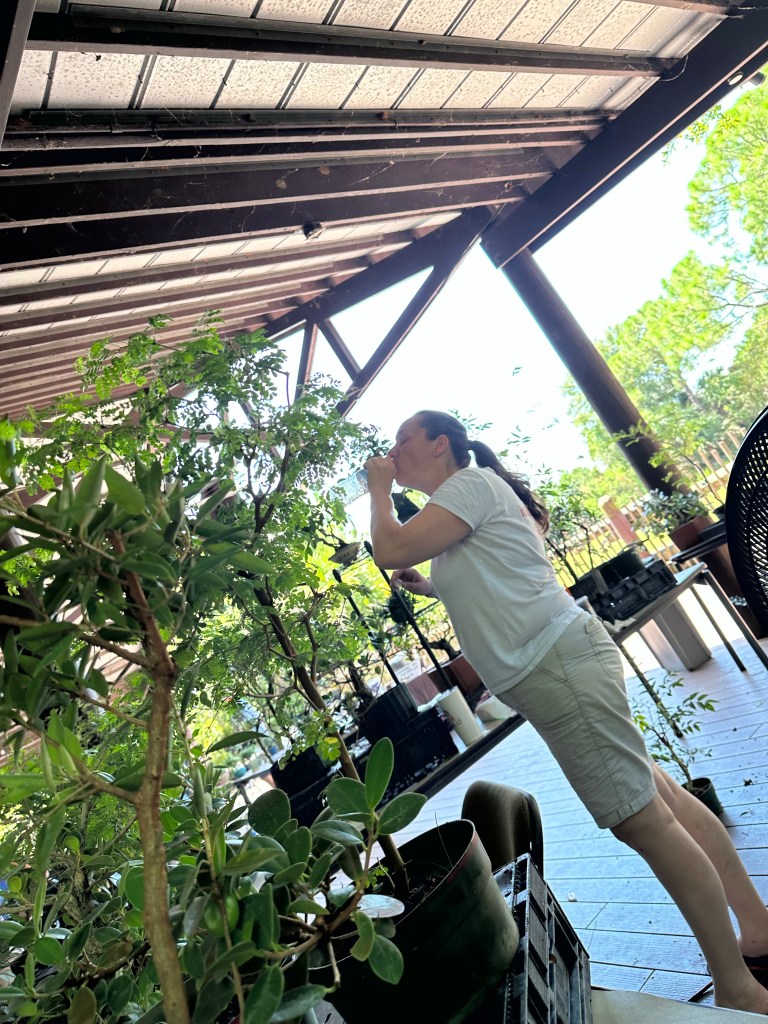
And my wife, or, as we call her on Da’ Blog, “She Who Must Be Obeyed”; she’s from Indiana.

Now, since you know where I am, and what I’m doing, and I’ve gotten in enough trouble with the wife, let’s get back to the tree.

The job is to remove the tree from the pot.

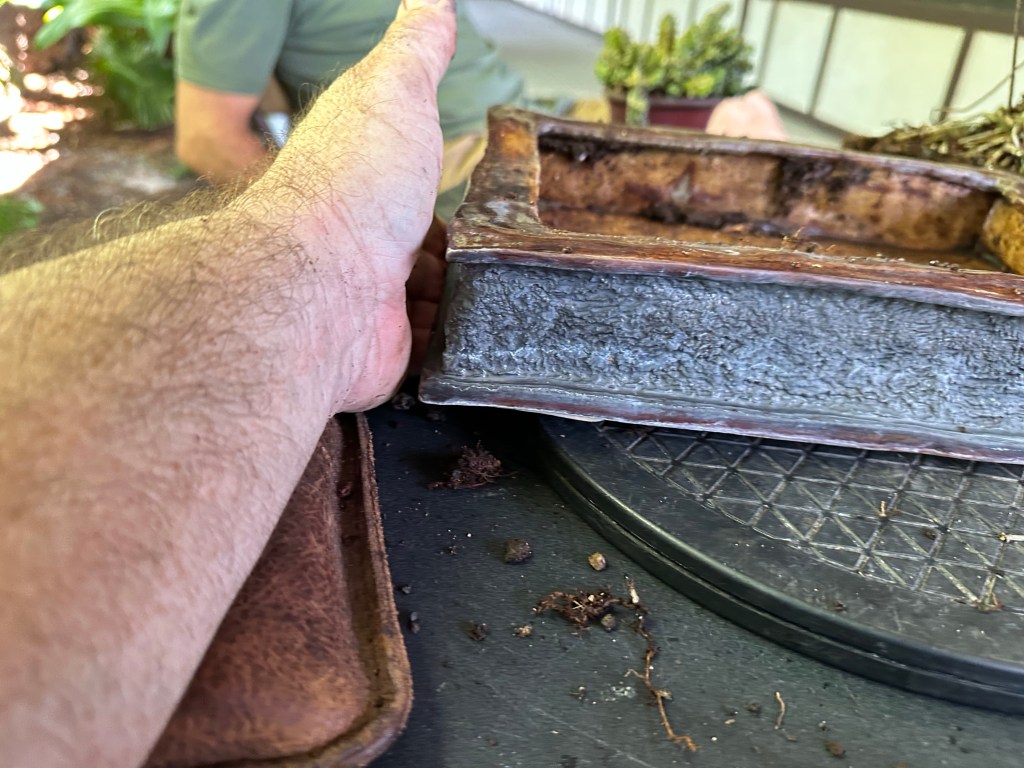
For those “in the know”, it’s really really really (really) advised against potting a ficus in a pot that has an inwardly curving lip.

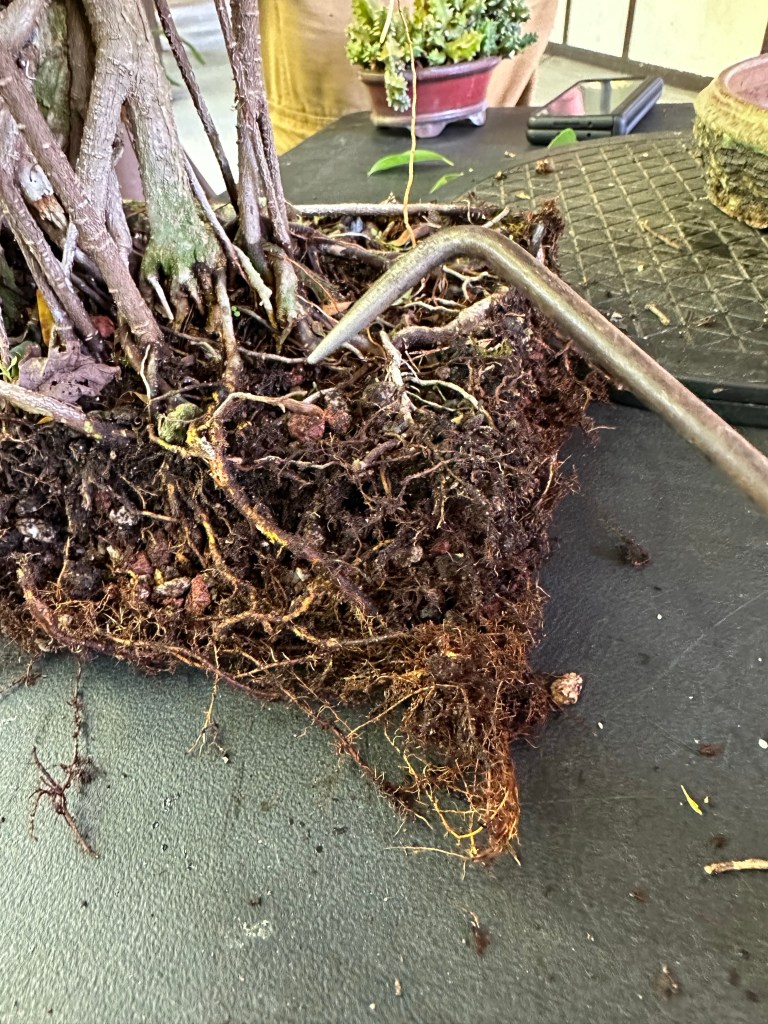
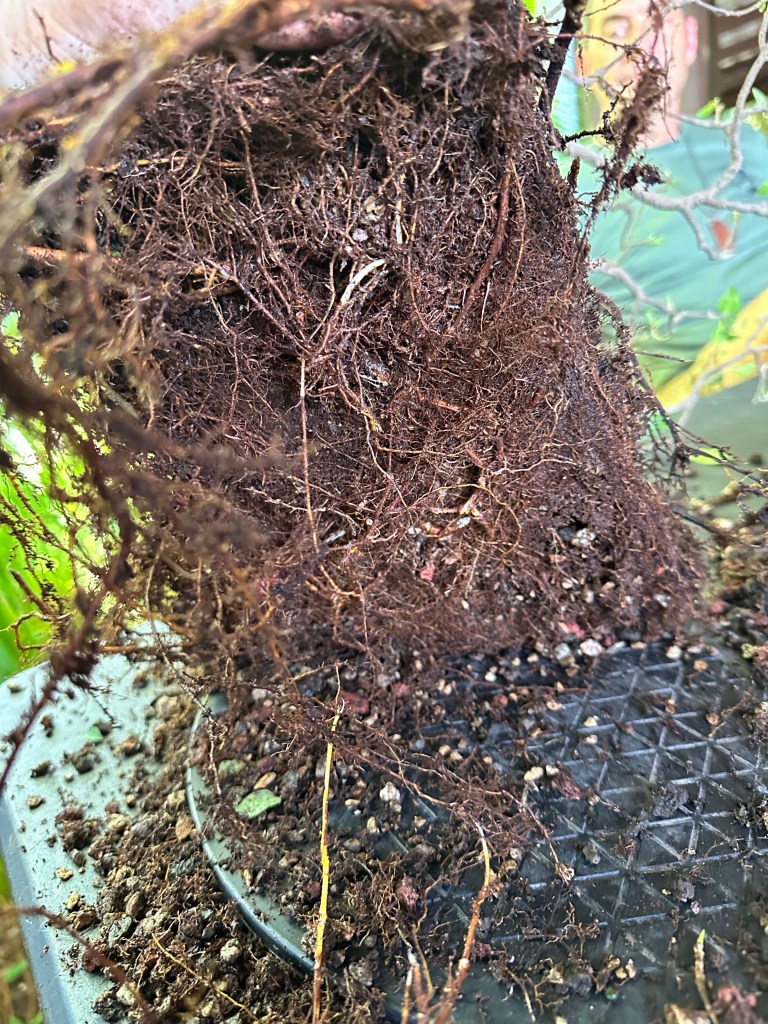
Ficus (I’m going to pronounce that the British way, “Fick-us”, as I’m feeling all fancy right now), make roots. Lotsa roots.

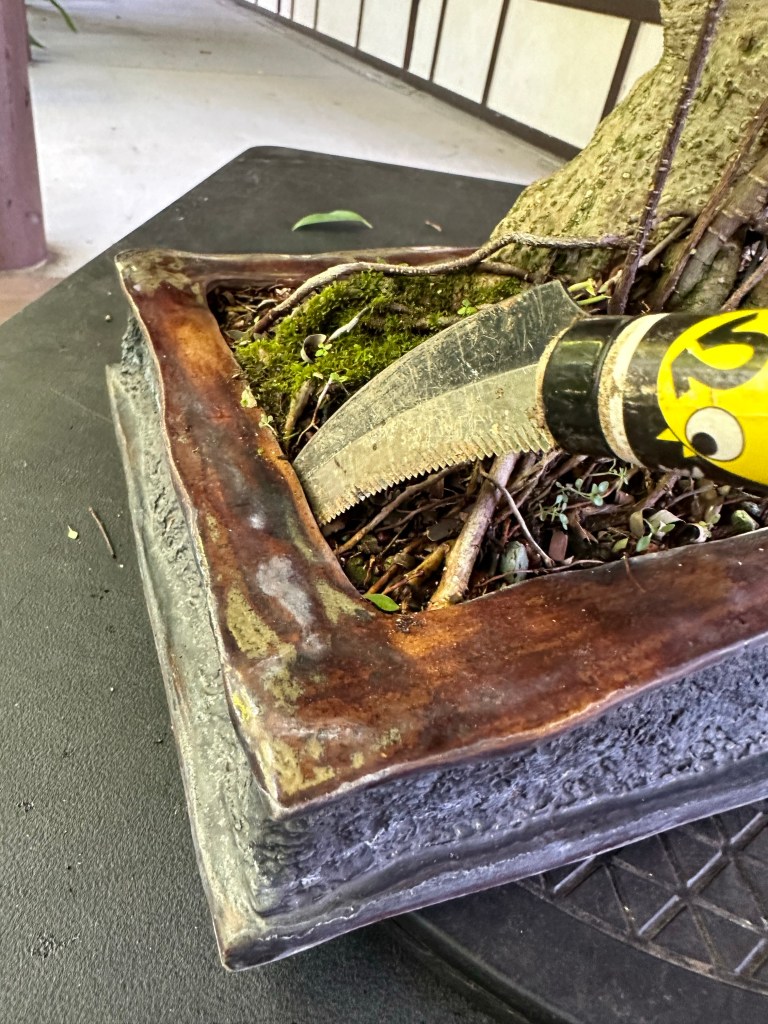
I have to bring in a highly specialized (and imported) root cutter (and sod cutter too, I guess, if you read the handle. But I just don’t see myself on my knees, my face in the grass, cutting out pieces of sod).

But first, the inevitable cutback and defoliation.

You don’t need to see that part, just scroll back to the hundreds of articles I’ve written and in which I’ve described the process.

I will, however, note that this tree is the species standard Ficus microcarpa. And that means I leave a little green on the tips so there won’t be dieback.

Now to the hard part, removing the tree from the pot. First, cut the tie down wires, on the bottom and top.

Then we start cutting around the pots perimeter.

As shown below.

Not too hard with that tool. I usually use a steak knife (which was stolen from The Sizzler Steakhouse and Buffet) but it’s at home in The Book. The gentleman I’m speaking with is Doug, The Hippie Dad.

Now to birth the tree. Another video. Yes, I’m using my scissors. They worked. I use my scissors for many things I’m not supposed to use them for.

Looks like a tortoise mouth, right? And again, that was Doug. Thanks for the muscles.

The pot was made by Daniel Holderer. He called it “Cradle for Life”.

I’ll find something else to put in in. It’s been a good container for this tree.

Now to rake out the roots.

It’s just a little root bound.

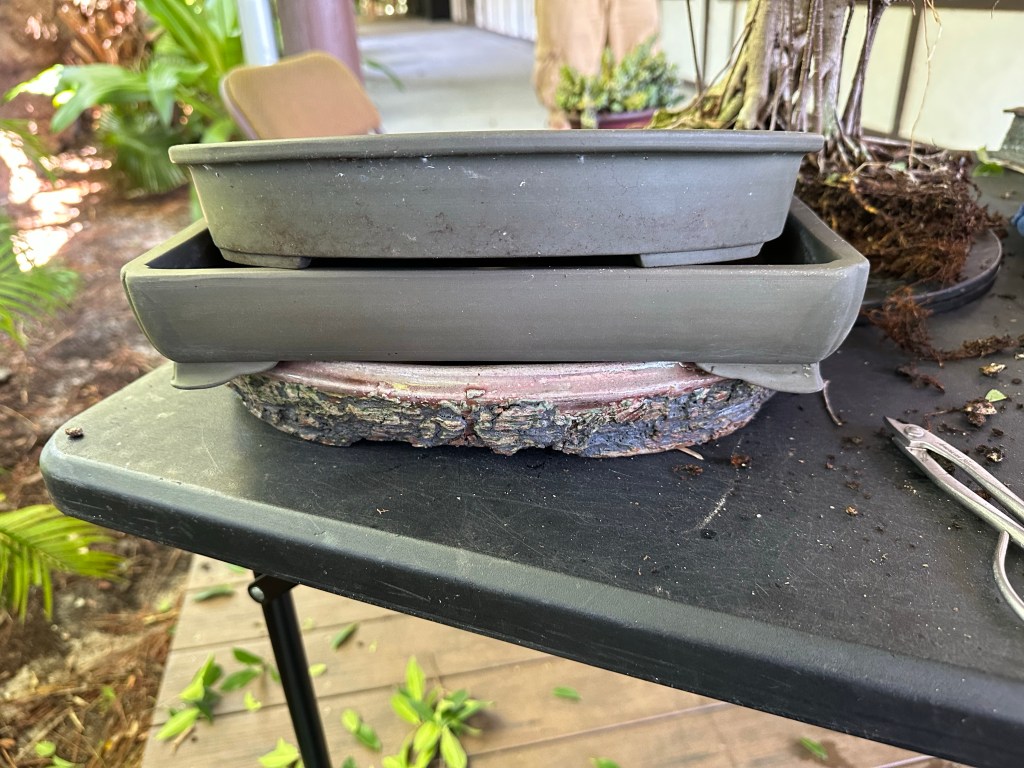
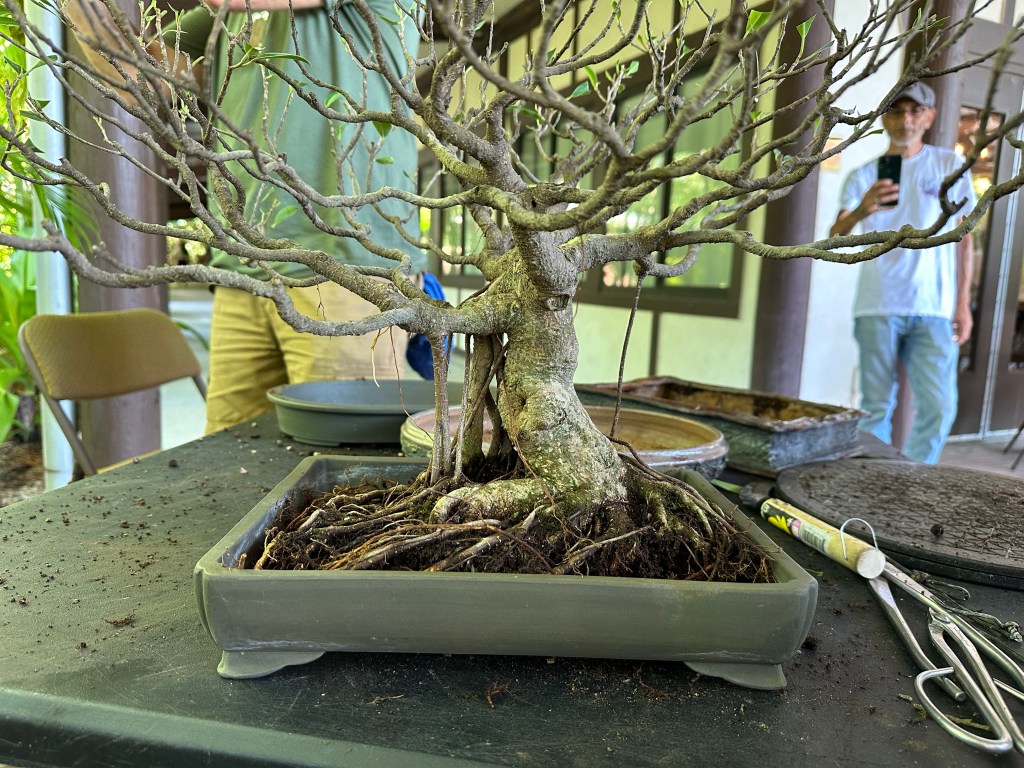
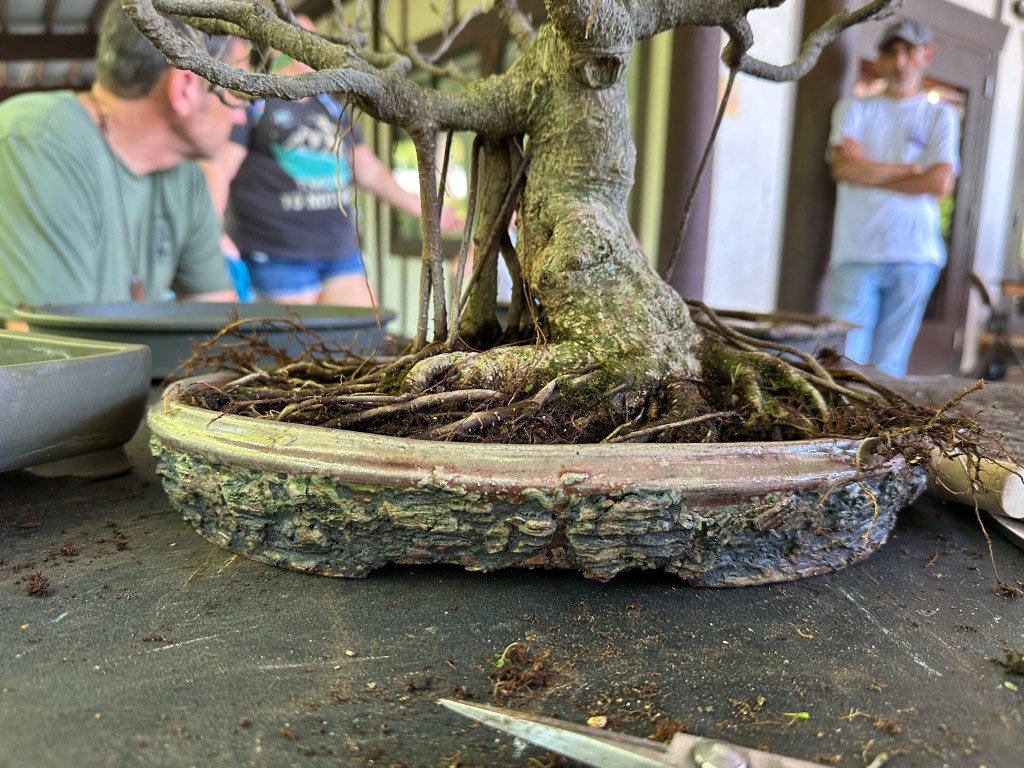
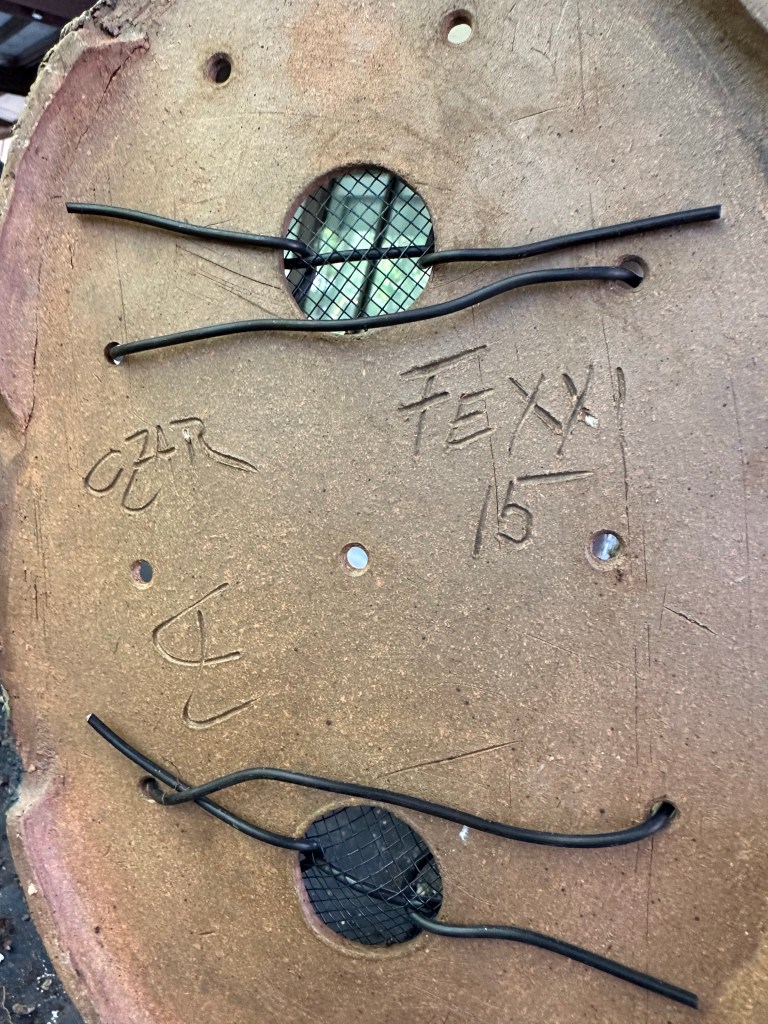
I brought three pots with me to choose from. Two of those antique Japanese pots with the weird green clay, and a beautiful oval from my friend Cesar Labrador.

The oval one’s too small…

….the rectangle one’s about right, but the style is too formal for my “Tropical Broom Style” ficus….

….ahhh, this one is just right!

Some screen, tie down wire….

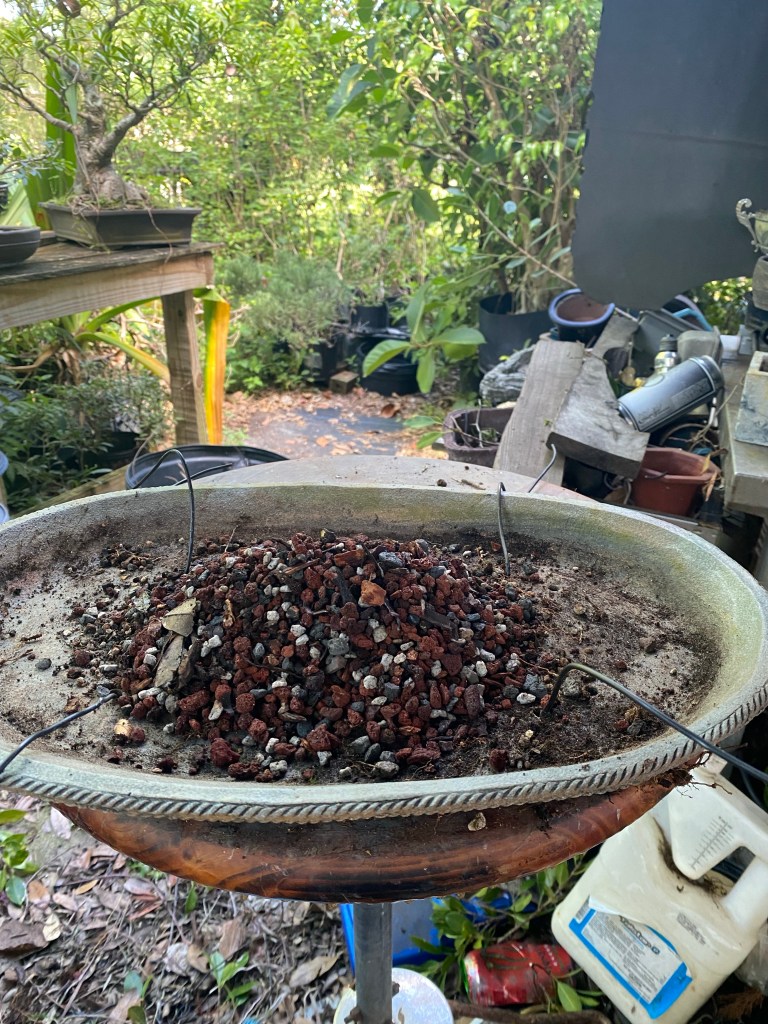
Soil….

And we are done.

Looks good back on the bench at the nursery.

Tropical Broom Style. I made that up years ago but I think it’s appropriate for this ficus. And everything was made up in the beginning anyway. Whoa! Wait! Mind blown! Right? You mean you can just make up things?

Indeed you can, indeed you can….

  •  

Ground Layered Fig Dip

Well now, did the story start with scotch? Or end with scotch? It’s kind of hazy looking back now. But I’ll try….wait, I remember…it started with bourbon!

It actually began in 2019, but you didn’t see the tree until 2021, 2 years ago (or, two years from the post, in case you are reading this in the year 3023. It’s now 2023, taking place in the month of July. If you don’t use the word July, it’s the seventh month of the solar year, named for Julias Caesar, the first Roman emperor (or dictator) after abolishing the Roman republic. the Terran summer solstice in the northern hemisphere occurred on June 21, 2023, and this debauchery occurred 28 days later. Terra or Earth, is the third planet from our sun, called Sol, in the Solar System, in the Milky Way Galaxy. Hopefully that’s enough for the far future readers to understand how we told time back in the ancient 21st century days of legend.)

Today , or rather, late July (don’t make me go through that again). We have a ficus microcarpa, what one might call “ginseng”. But that’s just a marketing term. Ginseng are not figs, figs aren’t ginseng. You make Newtons out of figs, and Monsters out of ginseng. The cookie and beverage, that is.

The article this tree first made its debut in was this one, What can you do with a ginseng ficus, Northern edition, a rather wittily written post I might add. Go ahead, peruse it, I’ll wait. I have scotch.

Ok, now that you’re up to speed, let’s get to the work….

I’m in Toledo, or Maumee, to be precise. It’s pronounced just like “mommy” by the locals. I feel a song should be sung. 🎶I wanna go back to my Maumee🎶.

I’m with my two good friends, John and Julie. They take care of me when I’m there.

The tree is potted in an aluminum serving container. There were a few who said that we’d be poisoning the tree with the metal tray.

Looking below…

….I’d say, naaah! in fact, it looks good for a ficus in the north. Damn, I mean, it’s almost Canada fer crissakes. They don’t say “Holy Toledo!” for nothing.

Anyway, we did a lot of work that day. But not much on this ficus. We didn’t have a pot, you see. So we decided to get all “Muckety Mucked” up.

24 year…25 year….26 year, or, as the bottle suggests, one little piggy, two little piggies, and three little piggies.

We finished the 24 year. Made a dent in the 25 and 26. Wait, is this a bonsai blog or a drinking blog?!

It’s both. Sometimes.

And to the dead soldiers, we salute you!

The next morning, hangovers and bright lights notwithstanding, we had to get up early to go to Michigan (I know, that sounds like the first line in the “Great American Novel” we writers all would love to write. Maybe…..).

We had to get a decent pot, so we visited the Flower Market (Which has changed its name to Green Witch Gardens)

It’s a damn cool place to visit. Not only do they have bonsai, but there are cats…

…that’s cats, plural.

And pottery from amazing American artists.

The trees!

Julie hiding behind a tree.

Familiar weeds. These are what are called wandering dudes now. I feed them to the tortoises. Speaking of which….

Tortoises!

Only the best bonsai nurseries have tortoises.

We got some pots.

Then went back to Toledo.

And we got back to work.

For being in a shallow aluminum pan, it’s grown some good roots.

The “pot” has even held up well. We could use it again.

Looks solid.

Raking out the roots….

Here’s the new pot we got for the ficus.

Sweet, ain’t it?

Tree is ready

Can I mention again how good the roots are?

We had split some of the larger ones (go back and read the first post).

Hey, it even fits in the new pot.

Damn those are sexy roots. Must be the soil. The vaunted, rare and near mythic “All-American Red, White, and Blue, Adamaskwhy SuperMix™” .

Just to prove we did other work, here’s some examples. A willow leaf.

A tigerbark.

An azalea.

A willow leaf root cutting.

And another.

I must say, I can’t believe what an amazing two days that was.

But I had a hard day while I was writing this piece. Something that should not be happening is. And I posted to Facebook; I quoted JRR Tolkien, the part where Frodo asks of Gandalf:

“I wish it need not have happened in my time,” said Frodo.
“So do I,” said Gandalf, “and so do all who live to see such times. But that is not for them to decide. All we have to decide is what to do with the time that is given us.”
J.R.R. Tolkien, The Fellowship of the Ring

And John replied “and what you do happens one word at a time, one leaf at a time, one sunrise at a time.”

Here’s the tree all those years ago. We ground layered it (hence the post title).

One tree at a time. Even if it takes years to bring it to its potential.

One leaf at a time.

One branch.

One root sometimes.

The two years ago..

And now.

Bonsai is a journey. And getting there is sometimes the only reason to go somewhere. You can buy a tree, but making a tree, especially this one, that started so humbly, is way more fun.

John has done well with it. I’m honored to have helped him, and thanks to both John and Julie for letting this strange bonsai guy (me) into their home.

  •  

Welcome to Tropical Northern….Virginia???

I promise, I wasn’t hanging out with any rich men in Northern Virginia. It was all cool bonsai peoples. See?

Not a single politician (I don’t consider Roberto a politician, and he was in Peru anyway).

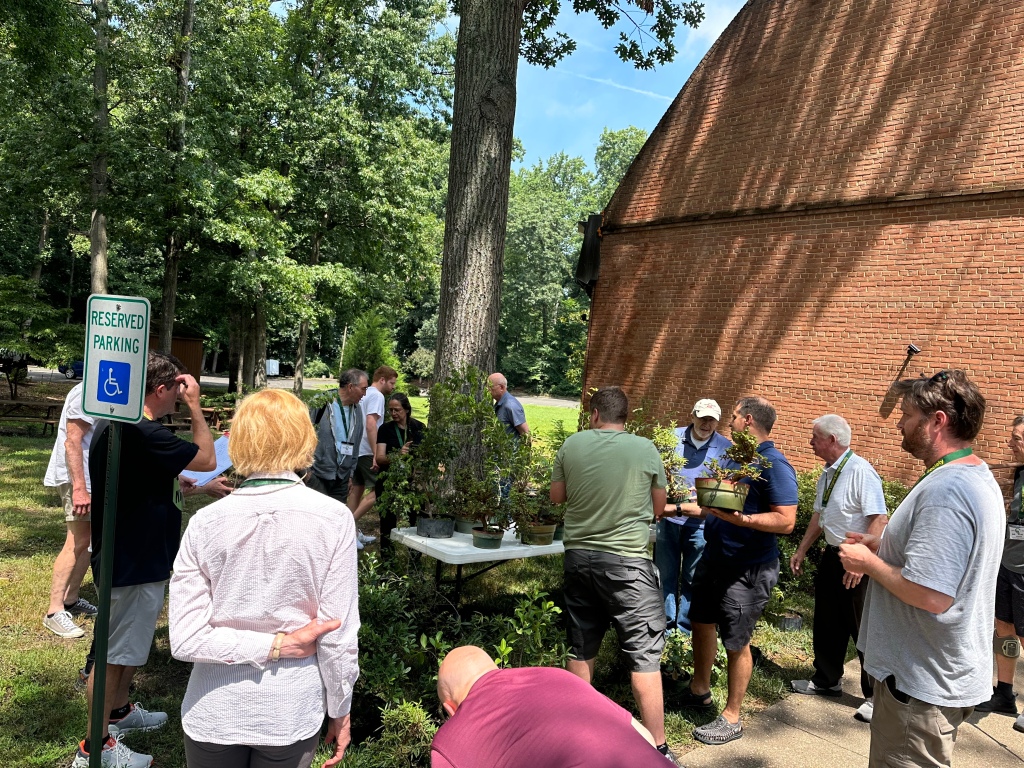
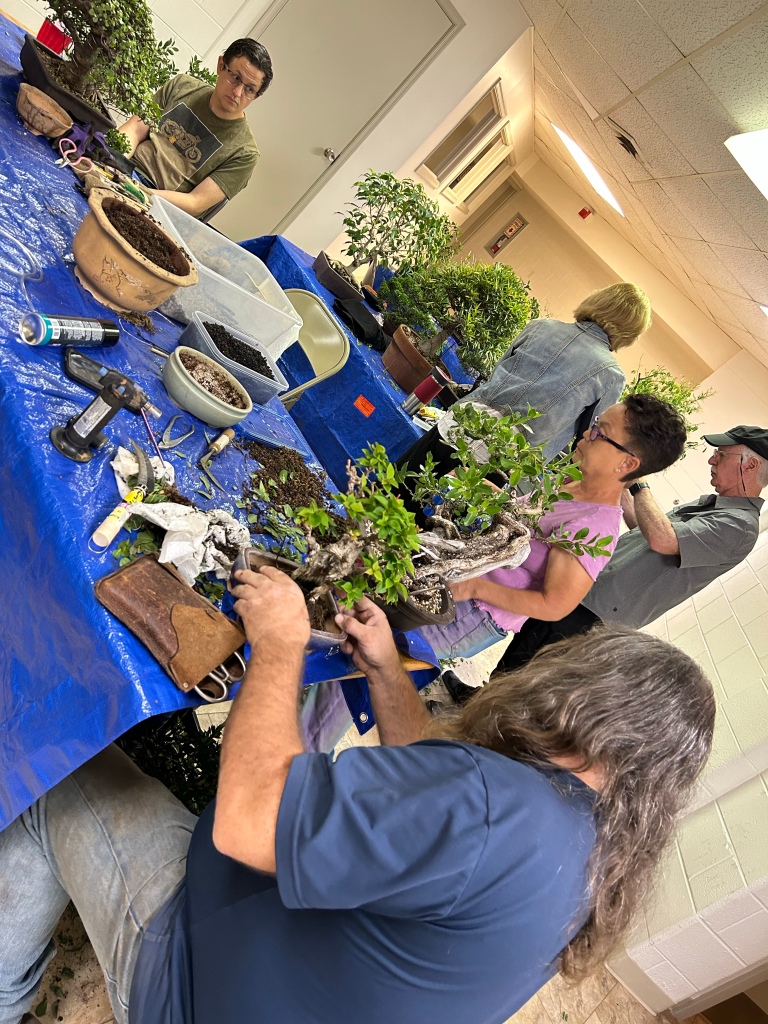
I was at the beginning of my summer tour, making a triumphant return to the Northern Virginia Bonsai Society. I brought a lot of trees for the workshops.

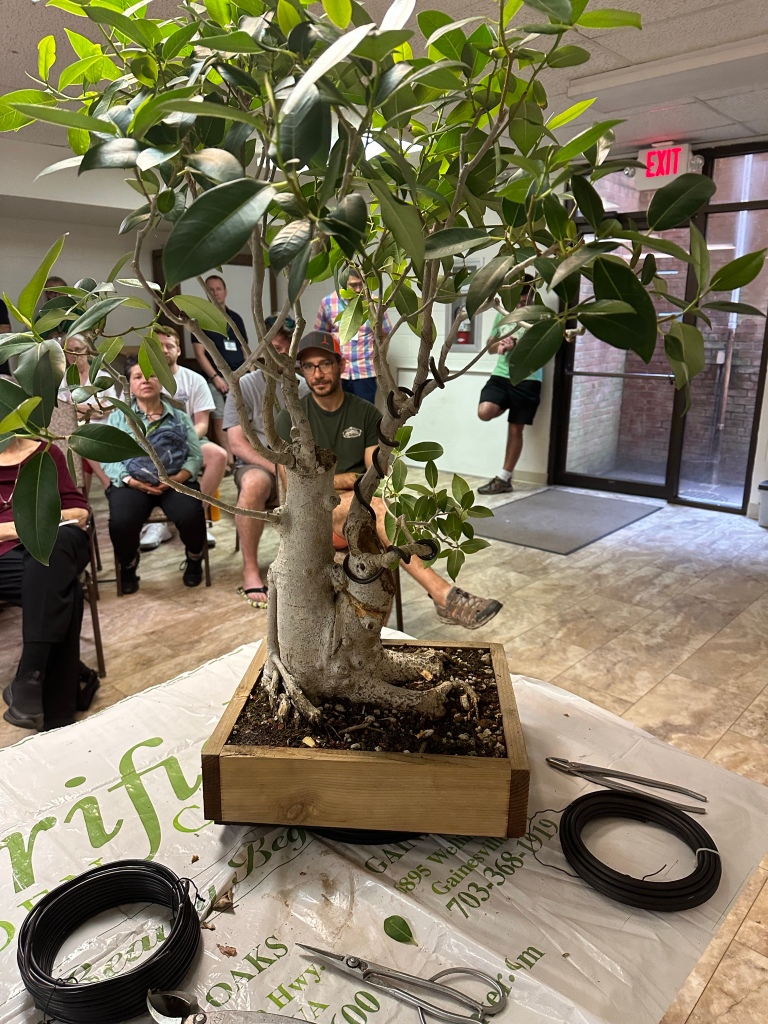
They gave me a tree, what I believe is a Ficus macrophylla (or the Moreton Bay fig, a ficus from Australia) as the demo tree. . This particular specimen has been passed around in the club a few times, with no one really doing much with it. Maybe a trunk chop or two. I liked it and the challenge.

I kinda like an underdog, so I tried my best, using my tropical tree bonsai superpowers to bring out the most I could from the tree.

We start with an approach graft.

Cut it back in places, let it grow in others.

The graft….

The growth….

The cut back.

And below, my hand in an anticipatory gesture of the “Let it grow!” number, along with choreography and three part harmony.

This was the demo. Along with the work, I told the chicken sexter story (I’ll have to tell you, the readers, that story sometime), I explained what different plant growth growth hormones do (see this post: I use some fancy words to justify my defoliation habit, go figure ). I talk about my childhood trauma and how I use it in the styling and care of tropical trees in the sunshine state (not really, my trauma is manifested in less healthy ways, as it should be).

I told the story of my youth in bonsai, trying to find as much about bonsai as I could, and happening upon a website from a guy that not only grew tropical bonsai in the Great White North (coincidentally, in Massachusetts, about four miles from where I grew up), but developed spectacular tropical bonsai, better than most bonsai artists from Florida. His name is Suthin Sukosolvisit. One of the only true Masters in American Bonsai.

Anyway, I had some fun making a fool of myself on stage and hopefully imparting some knowledge.

I’d love to have the tree for myself. Maybe there will be some altruistic NVBS member who bids on it and sends it down to the FLA as a gift.

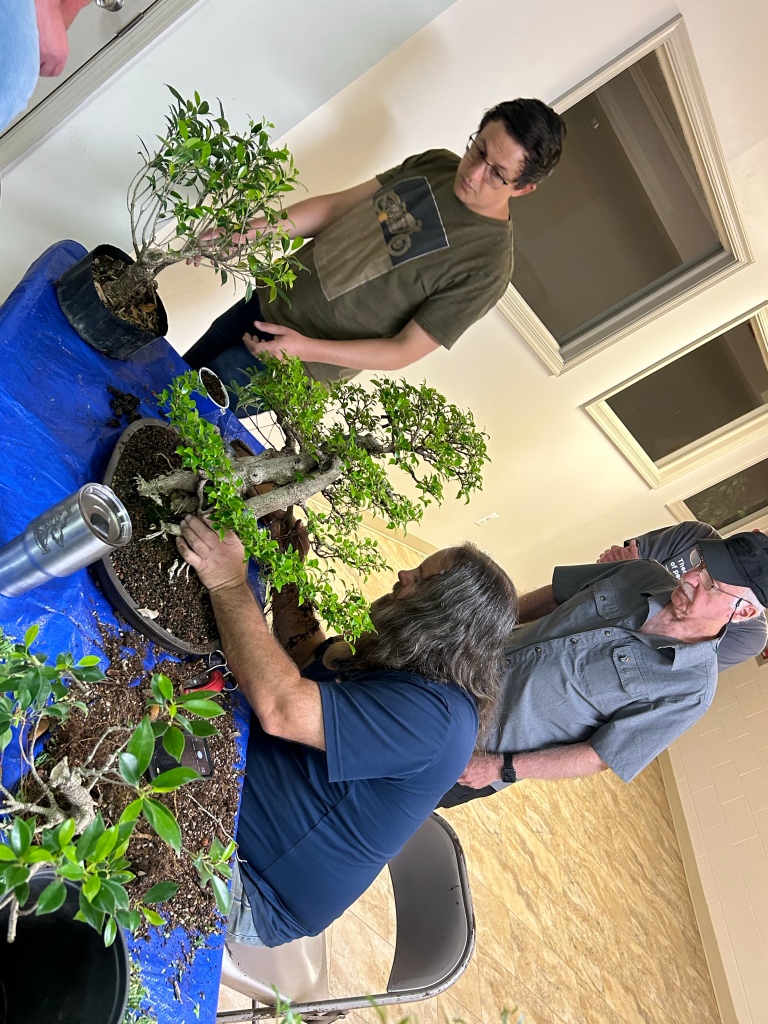
After the demo, and some lunch, we had a workshop. My wife took the pics with me in them. I think she’s biased, but she likes them.

In my element, surrounded by trees and students.

The trees got smaller as my ego got bigger.

Love a good trunk chop. It’s like the smell of napalm in the morning.

Here’s a link for the ficus trunk chop, above https://www.instagram.com/reel/CuwgSarMCtD/?igshid=MzRlODBiNWFlZA==

And below, a willow leaf that needed some courage….

Like a pretzel. We just needed some cheese.

Doh!

Where did the pretzel go?

Yea, of course it’s a reel. Here’s the link from Instagram: https://www.instagram.com/reel/CuyRox2g05X/?igshid=MzRlODBiNWFlZA==

And just the video. For those that don’t like Led Zepplin.

My wife channeling her inner Jack Kirby with the wacky camera angle.

Now, we get to a cool tree. It’s a tree originally from Ed Trout, one of the last true gentlemen of bonsai. Ed had sold it to a man named Jonah Hill.

I know. Adam lavigne helping Jonah Hill work on a bonsai tree. The joke writes itself.

Study the pic just above. You’ll notice a hole in the middle of the trunk.

Below, I have a tree that no one wanted. So we are going to graft that into the hole.

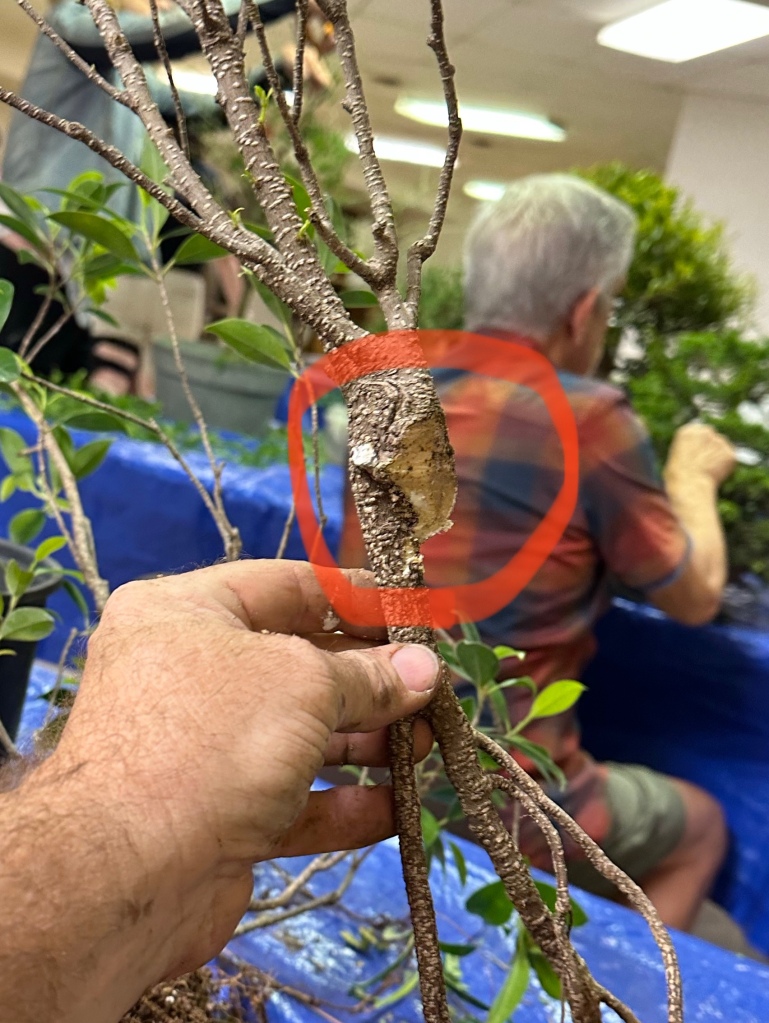
I cut off a piece of the tree, a piece with a good aerial root. The red circle is where I cut it and the graft will occur.

This, below….

….needs to fit into here. that’s the front of the tree, to keep you correctly oriented.

There’s Jonah, at the top of the pic. I’m about to stick the graft through the hole. Yup. Through it. That’s Jack behind me.

This is the back of the tree. The leaf end of the graft will act as a new back branch.

We use a brass screw (use a non reactive metal) to attach the graft.

Here’s the front of the tree. I arrange the roots, artistically, so that they compliment the tree. Notice the screw in the bottom left. And my wife giving me the “Look”

To get the graft to grow faster, I remove all the leaves except the last few, and I leave the grow tip.

There is still a hole, but as the graft grows, it’ll fill it up. That’s LeAnn, on the left, who was my host, giving me the same look my wife gave me. Both of them want me to work on her buttonwood. don’t worry ladies, it’s next.

Some more pics to give you some detail.

Jonah has done well reducing the leaf size.

Just about done. We tied some aerial in place (bottom left).

And, finito!

For the next tree, and the next post, we get to meet LeAnn’s buttonwood. An amazing tree, also from Florida (like Jonah’s tigerbark), and originally from none other than Mary Madison, the Buttonwood Queen.

Excited?

  •  

Ficus microcarpa from an auction…..3 years later..

The Shofu Bonsai Society of Sarasota has a pretty good auction every year. Granted, some years are better than others, but the year I got this one, maybe 2021, was spectacular. This tree was on the silent auction.

Yeah, not the live auction, the silent auction! I didn’t have to raise my hand or pull my earlobe to win this beauty. I just wrote a bid down on a piece of paper.

I don’t even think I went higher than $100 on it.

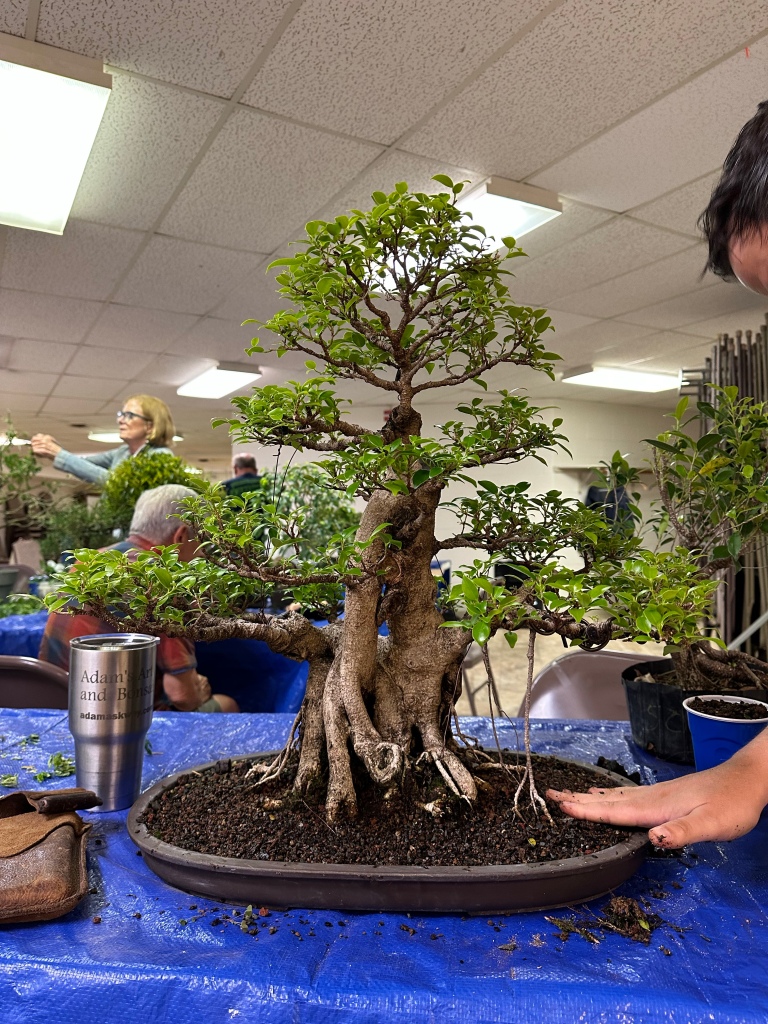
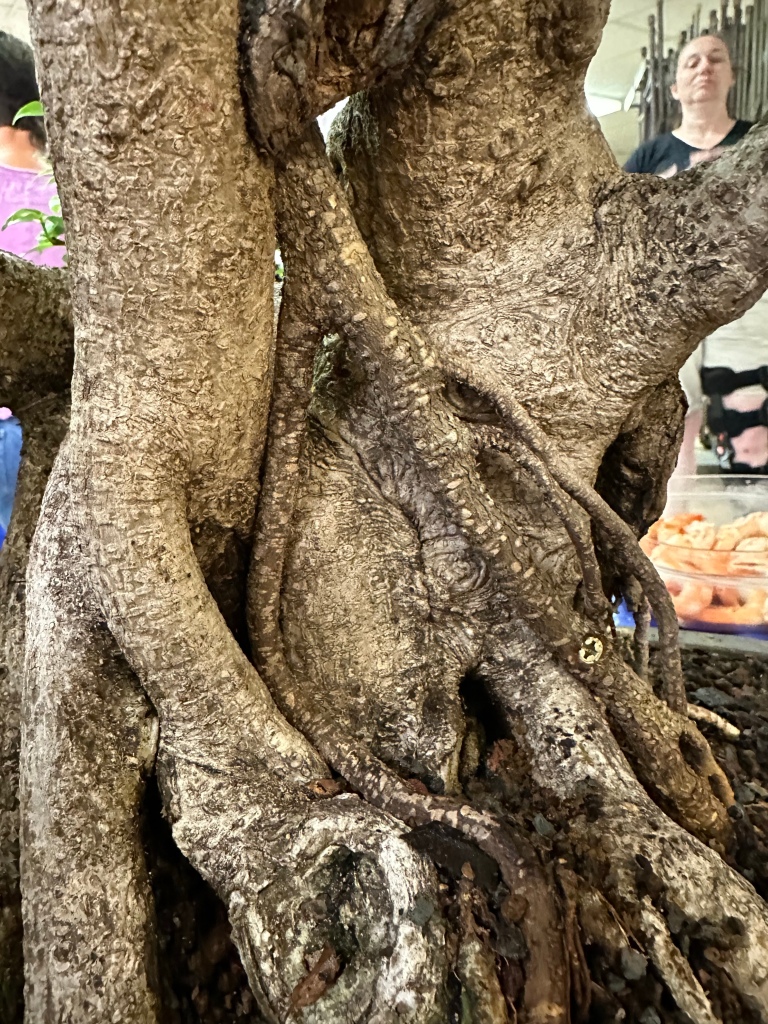
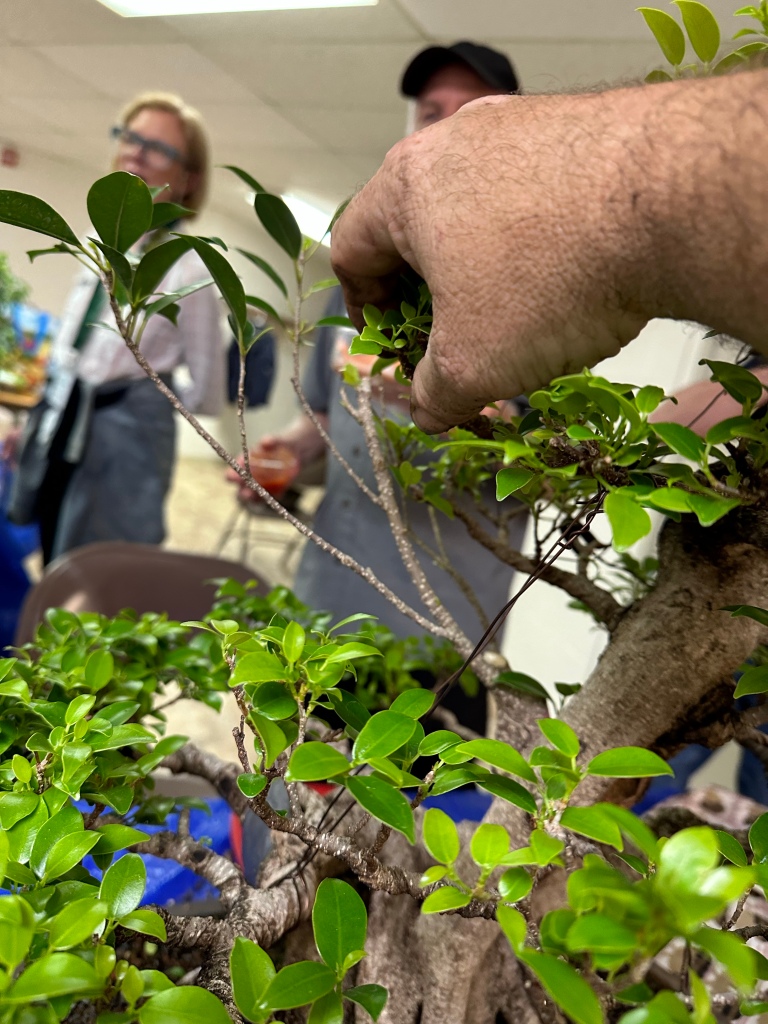
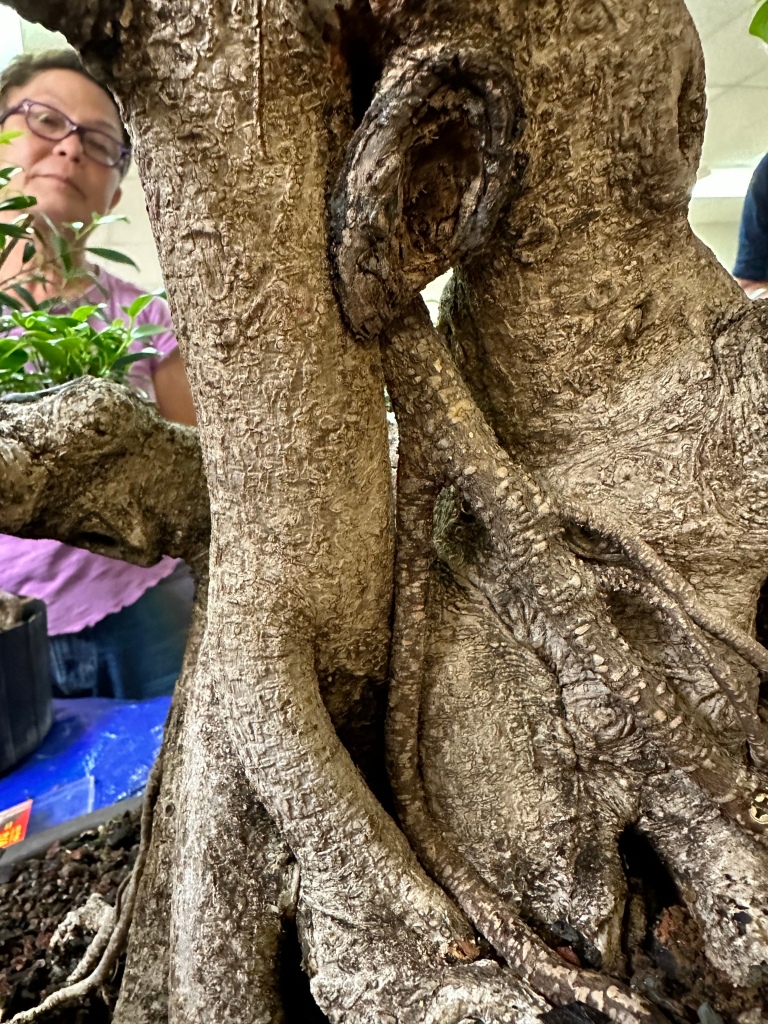
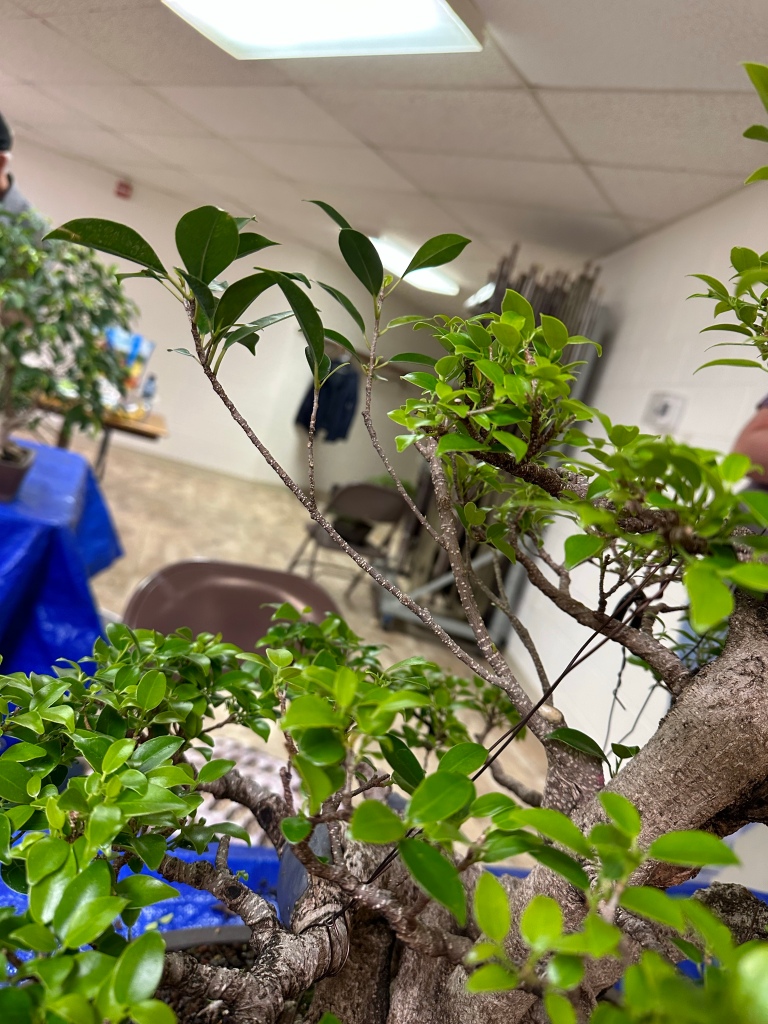
Since I’ve had it, it seems like only a few branches have grown.

But that’s typical. I don’t do anything to it for those few years except to water it. And when you ignore this species, a Ficus microcarpa, it will pick one shoot on each branch to feed the sugars to, and, like the pic above, you get long spindly branches and the smaller, interior branches tend to die off.

The lack of sun is the impetus to tell the tree how to allocate the resources.

(Not to belabor a point, but that’s another reason for timely defoliation techniques on figs. Defoliate to let sun in, calm down the randy shoots and allow everyone to grow. )

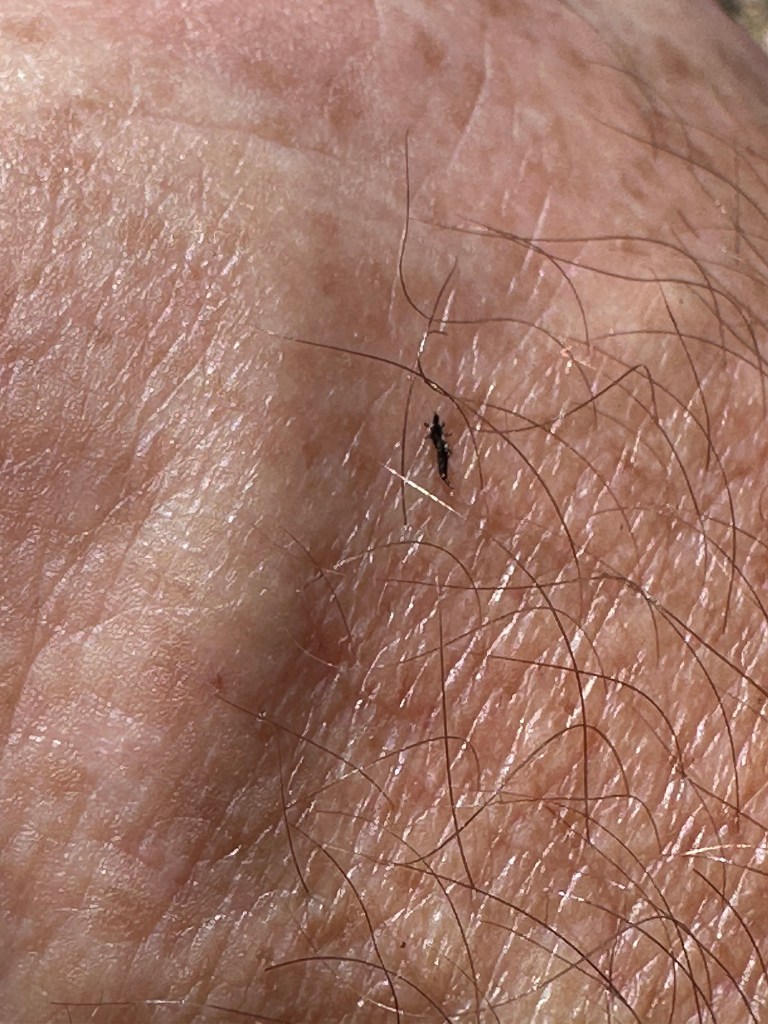
Oh! Notice the blue bottle? That is one thing I’ve kept up on for this tree. That bottle has a systemic insecticide in it called “imidacloprid”, which is a synthetic nicotine (what they call a neo-nicotinoid) that I treat all my F. microcarpa with to control thrips. An insidious insect that takes the leaf and folds it to make an incubation structure to breed more thrips.

Below, there’s one on my arm. They call this one the “Cuban Laurel Thrip”, as that’s one of the common names for this ficus, Cuban laurel. I call it the “Indian laurel” as it’s more indigenous to India than Cuba, though it is endemic in the island.

The tree does have flaws, like the wire scars below.

And, as a species, the leaves are bigger than say, the “tiger bark” variety. And they are prone to branch dieback (like the Ficus benjamina) if you don’t leave strong growth on the tips when you prune.

Let’s open it up and select some branches.

Hmmmmmm….might be useful. Below?

Nah

Below, there’s that growth tip.

I’ll leave it to grow longer.

But some I’ll cut back to encourage back budding.

Clean up, clean up….everybody do your share.

Kah-chop!

There we go.

Some wire.

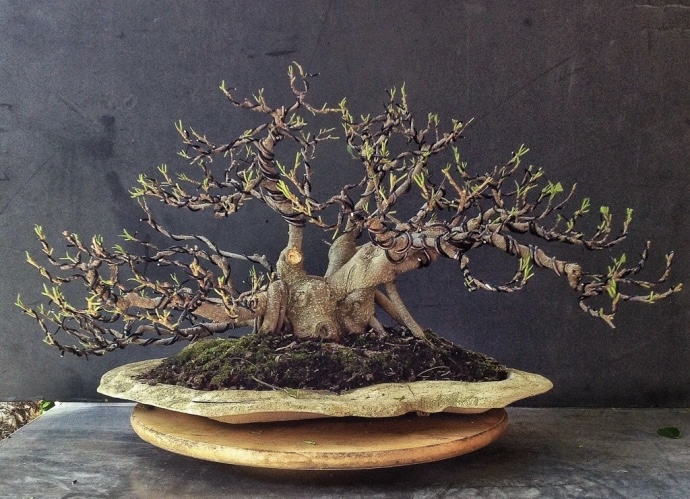
The result of clip and grow. Good movement.

More grow tips to preserve.

Now just let it grow.

But not willy nilly growth, directed growth.

If you ever take a class with me, and I say let it grow, you should let the things left, to grow, but get rid of growth that’s not needed.

Here’s a video

And here’s an idea of what it’ll look like. Needs a better pot.

Let’s see what happens, I promise to show the repot and updates

  •  

Makin’ my way in the world today

The Orlando Japanese Festival, 2024.

Held every year in Kissimmee Florida…..

The Central Florida Bonsai Club, my club in Orlando, has been representing Florida Bonsai at this festival for several years now.

I like to go for the day and work one of my bigger trees to show the public that bonsai don’t need to be, or are limited to, small hand-held trees.

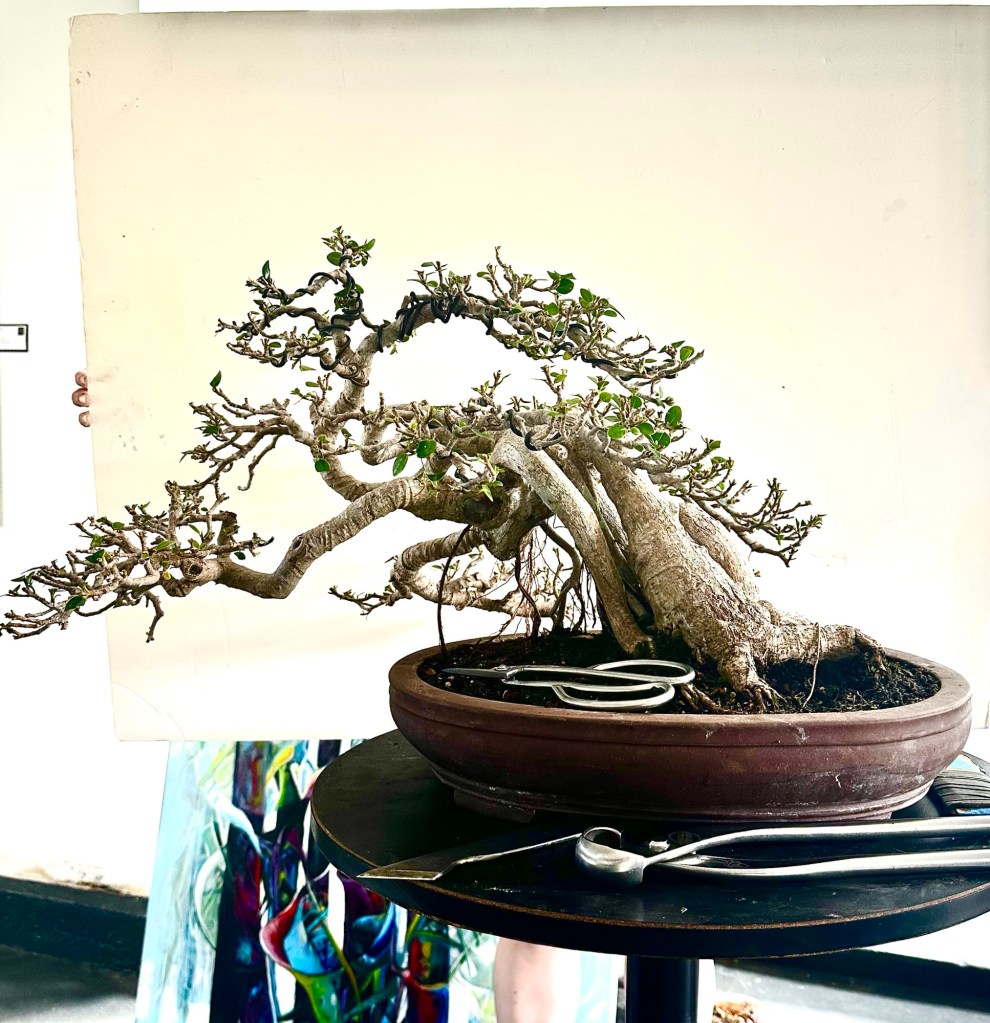
This year I brought a Ficus microcarpa. Just the plain species. Not tiger bark or green island or melon seed. Here’s how it looked after I cut it to a line way back in 2013.

I got the trunk from my good friend Ronn Miller, a Florida bonsai artist of great renown.

The link below shows a previous blog post on the tree:

https://adamaskwhy.com/2013/06/26/rejuvenating-a-ficus-bonsai-part-2/

What’s on the agenda for today?

Defoliation, unwiring (I think I did that already) and pruning for shape/taper/ramificatiom, and rewiring of course. But not every branch.

Sometimes that’s needed, wiring every branch, but most times it’s not. I had a former friend who insisted on wiring every branch because that’s how he learned (he watched a video on YouTube that told him to ALWAYS wire every branch, and he was a paid subscriber to this channel, so he obviously has to do what he’s told, cuz it’s worth more to him. I wish I had a simple mind like that. I have to question everything. Just last week I was tying my boots and I wondered if they’d be tighter if I used an overhand knot instead of a sideways, underneath knot. Took me 15 minutes to tie my boots…..

If you’re looking at the leaves closely, you’ll notice the white build up on some of them.
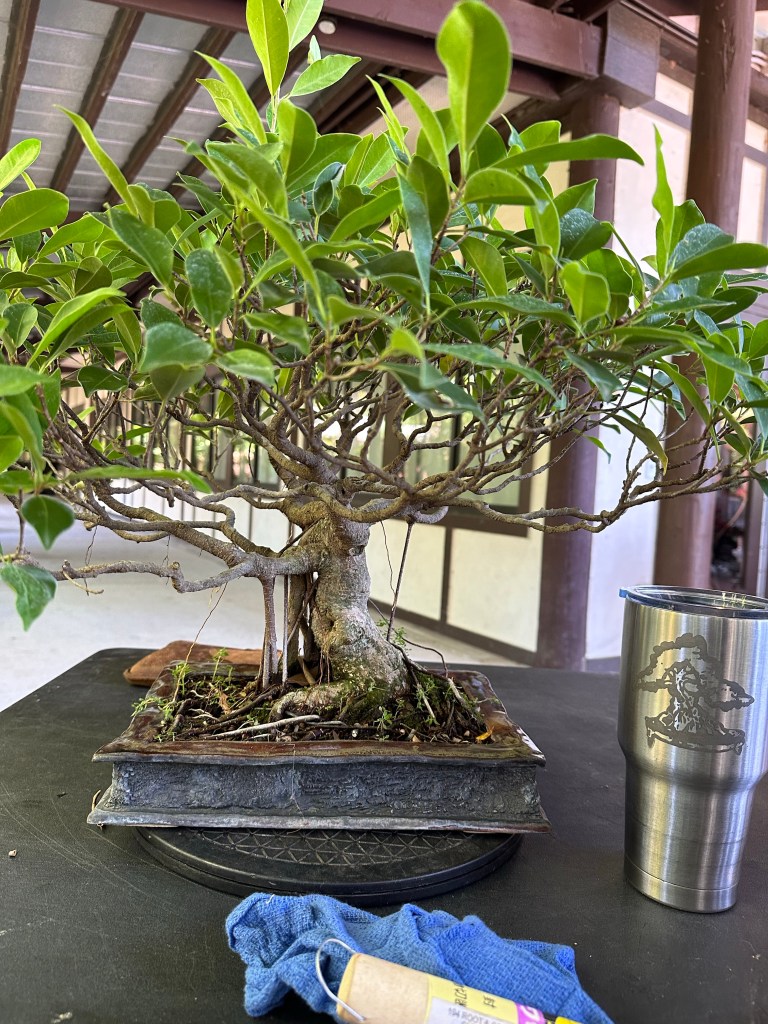
Like above. I see this question a lot on the bonsai forums: “What is this? Is it harmful? How do I get rid of it? “
It’s usually just water spots from dissolved solids in your water. Like calcium, or lime. If it’s red or orange, it’s iron rust. it’s not harmful acutely, just ugly, but it could be a problem if it’s built up so much that it blocks the sun and restricts photosynthesis. And how do you get rid of it? You can polish the leaf, or use leaf shine, or, like I’m doing, cut them off. A ficus can hold a leaf for up to three years (it’s a tropical, broadleaf evergreen). But you can defoliate one, as long as it’s healthy, up to four, five times a year. I usually do at least twice in my normal maintenance. If I’m really pushing a tree, 3-4 times.

Anyway, I have a bunch of leaves. Let’s see if I can count….

There we are. I counted 2,713 leaves.

Actually no, but that’s a good number. It’s a prime number (only divisible by itself) and sounds good saying it out loud

“two thousand seven hundred and thirteen”.

Sounds like it belongs in the first, or last, sentence in the Great American Novel:

“In the year two thousand, seven hundred and thirteen, the hero man was born.

Or died.

It was a time of illogic and lost tales, with many great humans born or killed. Some by the hands of evil men, or by their own hands as the era was one of pain.

The world had just gone through a bloody interregnum, accented by war and famine, city and states wiped off the countryside and built up into empire. Cultures distilled out of the quirks and pathology of a leader, or group.

Our hero begins the day chopping wood, collecting water, and making tea.”

I’d read that book. Maybe I’ll even have to write it.

Let me finish this post first. The branch my hand is on has risen from its original place in the design.

So that’ll need to be wired back down.

That’s the life of a ficus bonsai owner: put the wire on, take the wire off, put the wire on, take the wire off.

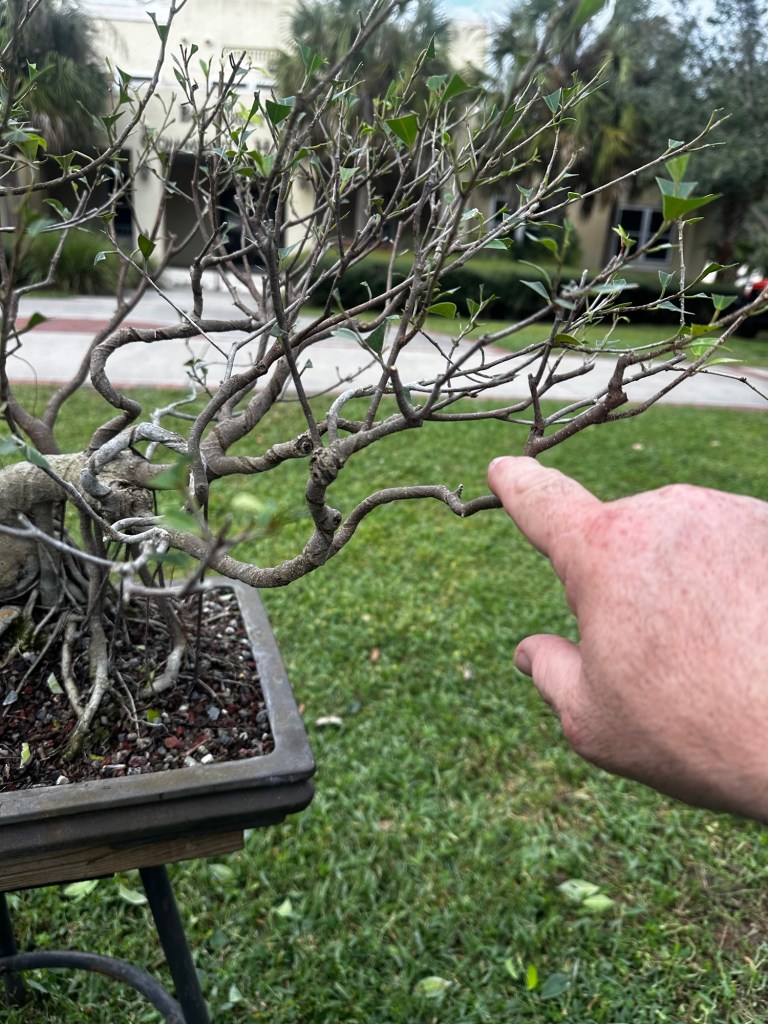
Anyway, enjoy the next twenty following pics of me pointing at various parts of the tree.

Straight lines must be made curly.

Some things gotta go.

I just realized that in the background of these pics, you’ll be seeing a pretty detailed accounting of certain attendees visiting the restroom.

Now for wire..

For the sake of a good anchor, one should try to wire two branches with one wire.

Always start in the branch crotch (I just learned that “crotch” is a word first used to describe the meeting of two branches, or the trunk and branch, and not the area between your legs).

And wire one side clockwise, and the other counter clockwise.

There’s a straight line that’s offending my eye.

I know I need to wire three branches. I’ll use two wires.

This will let me put two wires on some branches, to give better holding power.

Then the bend.

I usually use two hands to bend, but that’s hard to hold a camera, and bend. Pretend my left hand is steadying the branch.

There we go, one done.

Now for the rest

Zooming in, you’ll see wire marks. One of my favorite bonsai lines comes from an English man, he said “I’f’n you ain’t got no wire mahks, yer not using enough wire”.

Say that in a John Lennon accent.

Should you find yourself with too many wire marks, you can scrape off the ridges with a blade.

It mitigates them and makes the branch look gnarly.

And chicks dig scars.

And that’s it.

A video from the top

There’s just something satisfying in wheeling a tree around on a garden cart.

🎶Walk this way! 🎶

We all have to walk the path we see before us. Sometimes we cross others paths at the same time they’re on it, and sometimes those paths parallel each other. Relish those times of a companionship, but realize you can’t get off your own path.

Finito!

  •  

Holy Toledo, this tree is outta this world

Hmmm. Cosmic Bonsai in the Great White North? I’m in Ohio, and I guess they like outer space a lot; it’s a fact that more U.S. astronauts have been from Ohio than any other state.

John, from Toledo, one of my friends for a long time, has been going to the convention for the Bonsai Societies of Florida for two years now. He got to see Walter Pall, Mauro Stemberger, and many others in years past.

This year he got to meet and take workshops with Laurent Darrieux from France, the creator of the Cosmic Bonsai approach to styling trees.

Some people see it as blasphemy, some see it as a narcissistic offense, some see it as silly. But what it really is, in imaginative terms, is a question “what if we travel to another world, with, maybe, higher gravity, or two suns, or a long rotational period, what would those trees grow like?”

Artistically, it is a valid question. Artistically, it works too. When it is practiced well (just like any style, any idea, or even traditional bonsai) it works as Art. There are those that may say it isn’t bonsai, but some of those same people say that the flat top style of trees, whether the American bald cypress flat top, or the South African style Pierneef flat top, aren’t bonsai either. Uh huh.

I’m sorry, but bonsai is not a Japanese art. It is a Japanese word, and it is very Japanese traditionally (but it’s dying in the country) but that’s just because, when we modern practitioners of bonsai decided to give it a universal name, a certain Chairman in the east was intent on destroying traditional arts with his Cultural Revolution. so it was named “Bonsai”.

When I was learning bonsai, I read all the old books, and took to heart the challenge that the early Japanese bonsai masters gave us when they started to travel and teach bonsai throughout the world.

They told us not to mimic Japanese bonsai, but to find new species of trees, and new forms of design, and expression, to celebrate not only the character of our countries, but also the natural world we saw around us.

Here’s my question to you: What if our imaginations also let us see the world differently too? Say another world? That’s Cosmic Bonsai.

To categorically discard the concept because it’s not how you learned it is everything that people accuse Laurent of: arrogance.

He’s an artist. He has to create. And to show others his vision. He’s not being allowed to do it. Well, except in Florida, my backyard.

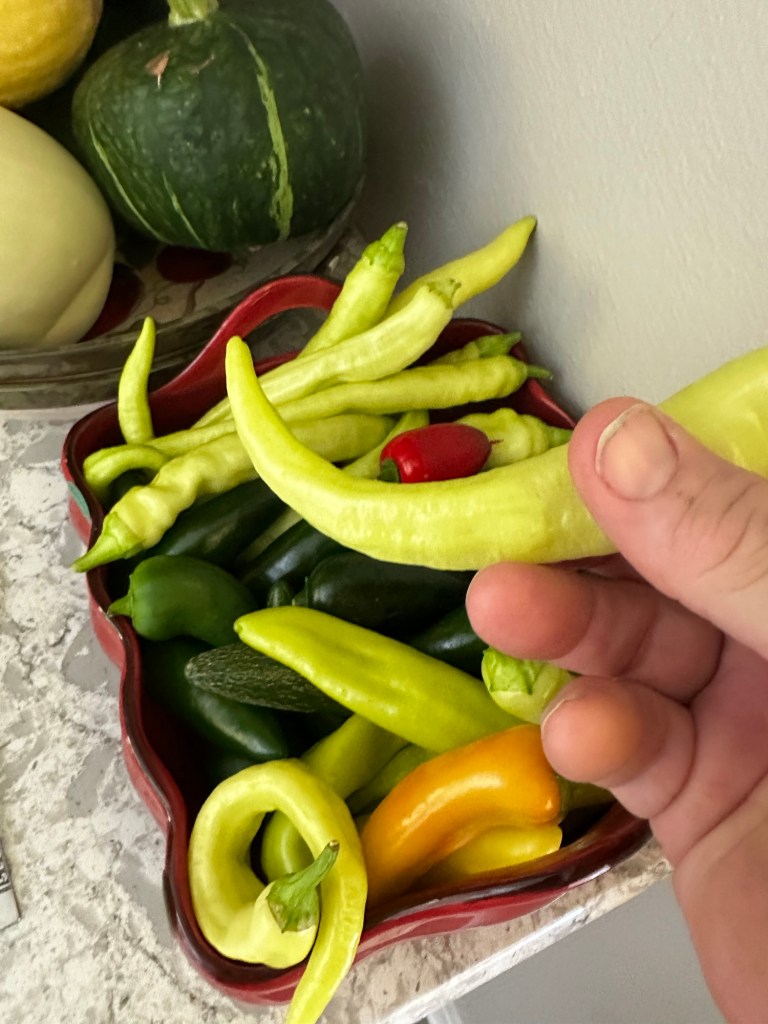
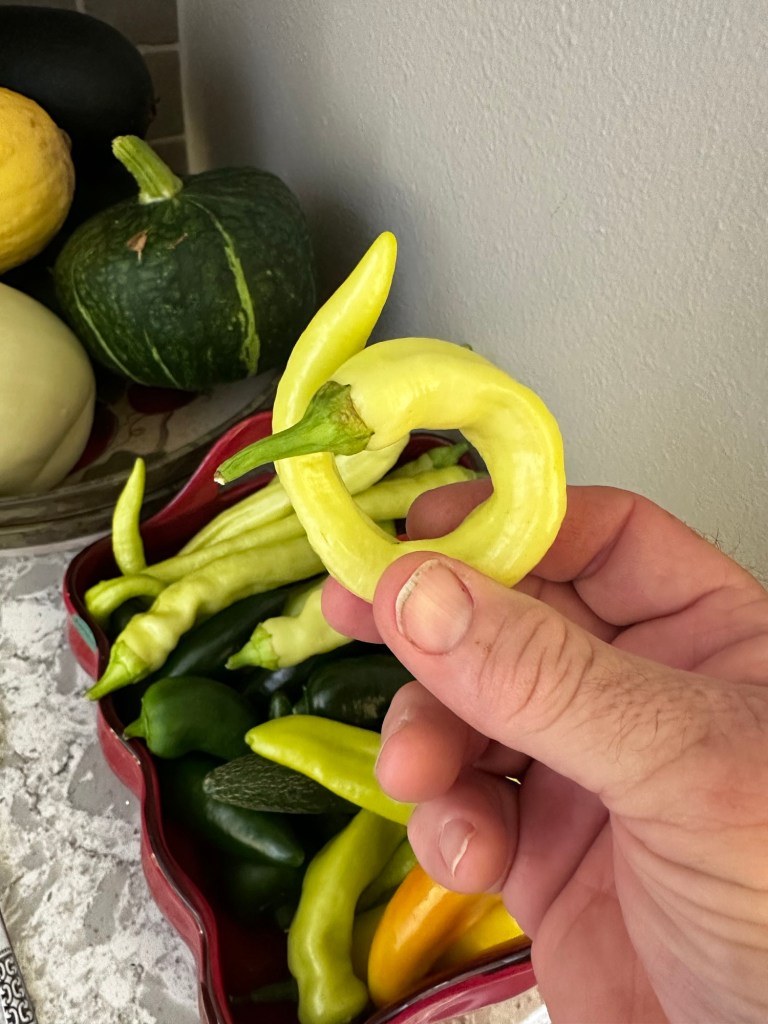
Phew, that’s some heady stuff. Anyway…Here’s a banana pepper in the traditional style.

Here it is in the Cosmic Style:

They both go well in an omelette (French word btw).

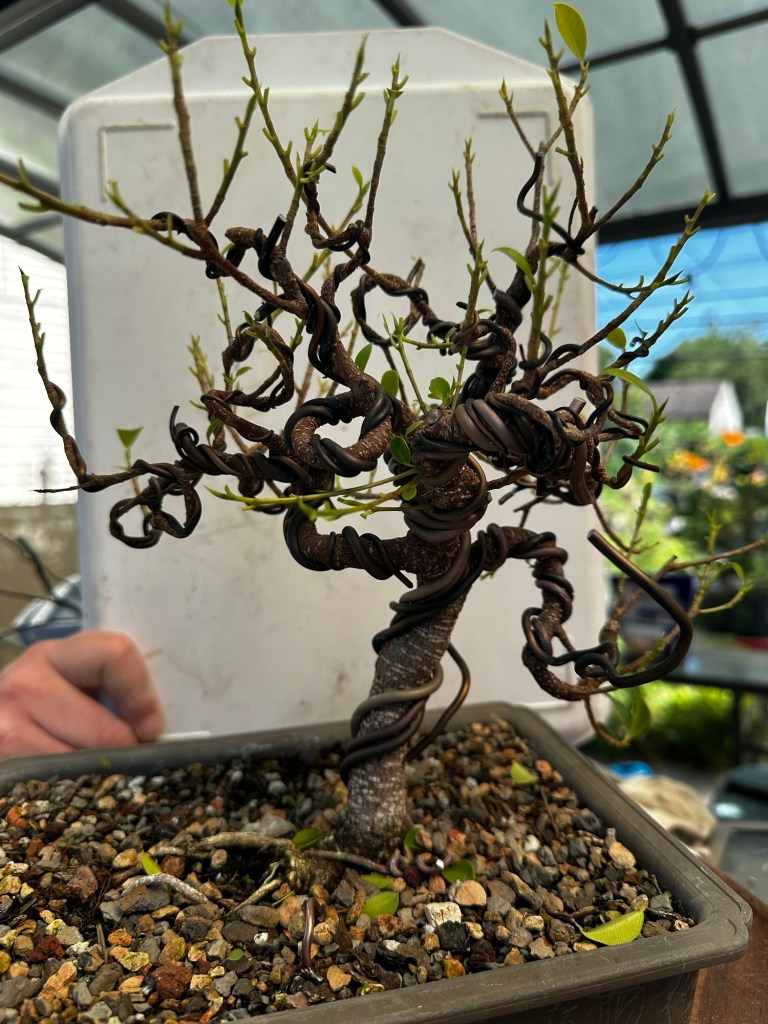
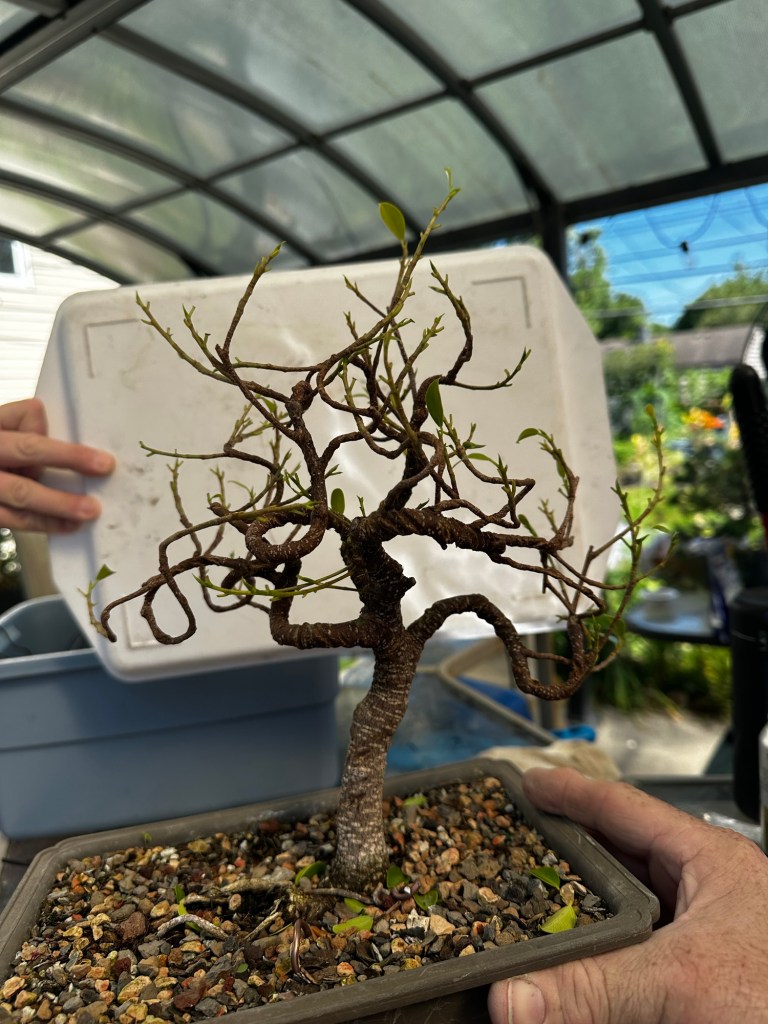
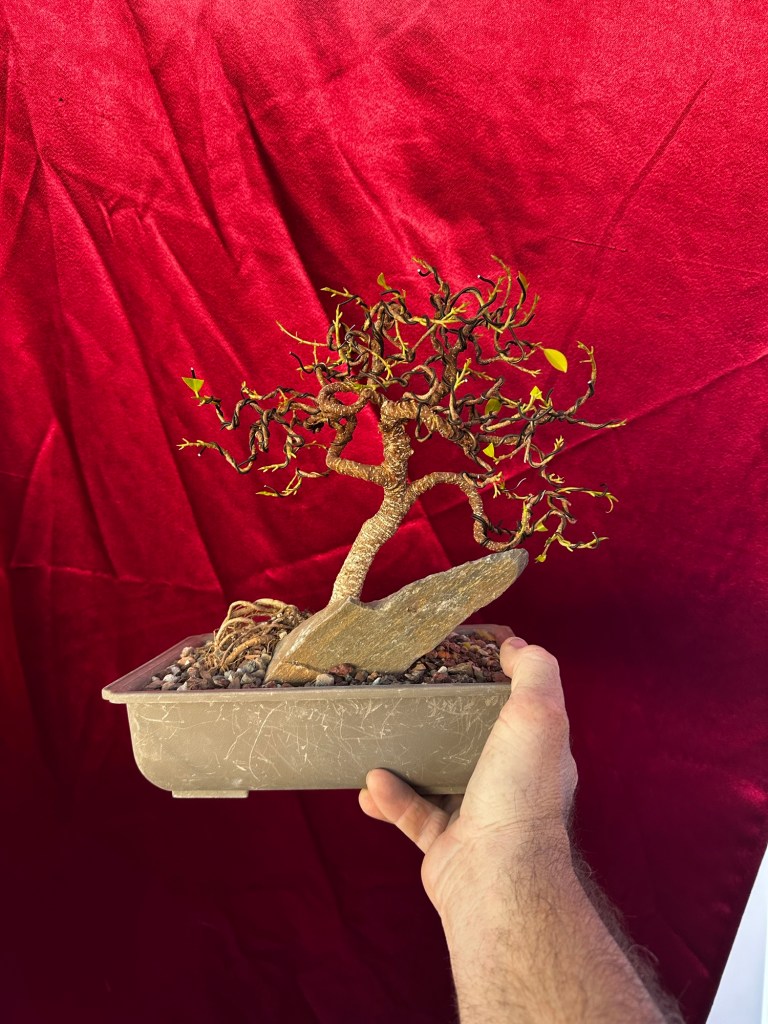
Below (and some pics above) is a tiger bark ficus (or Golden Gate, or kinman, or kemang, or whatever you want to call it) that John made in Toledo after he got back from the Orlando convention.

I took the wire off and…

….the branches stayed put. Surprisingly. It was a mere two months or less.

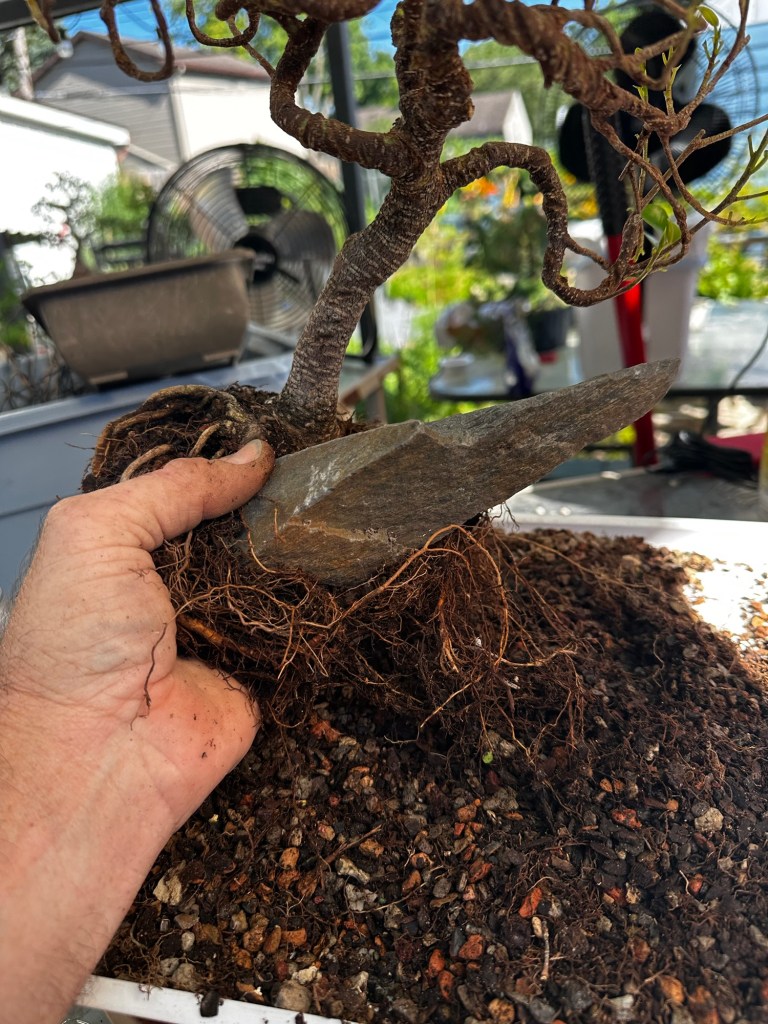
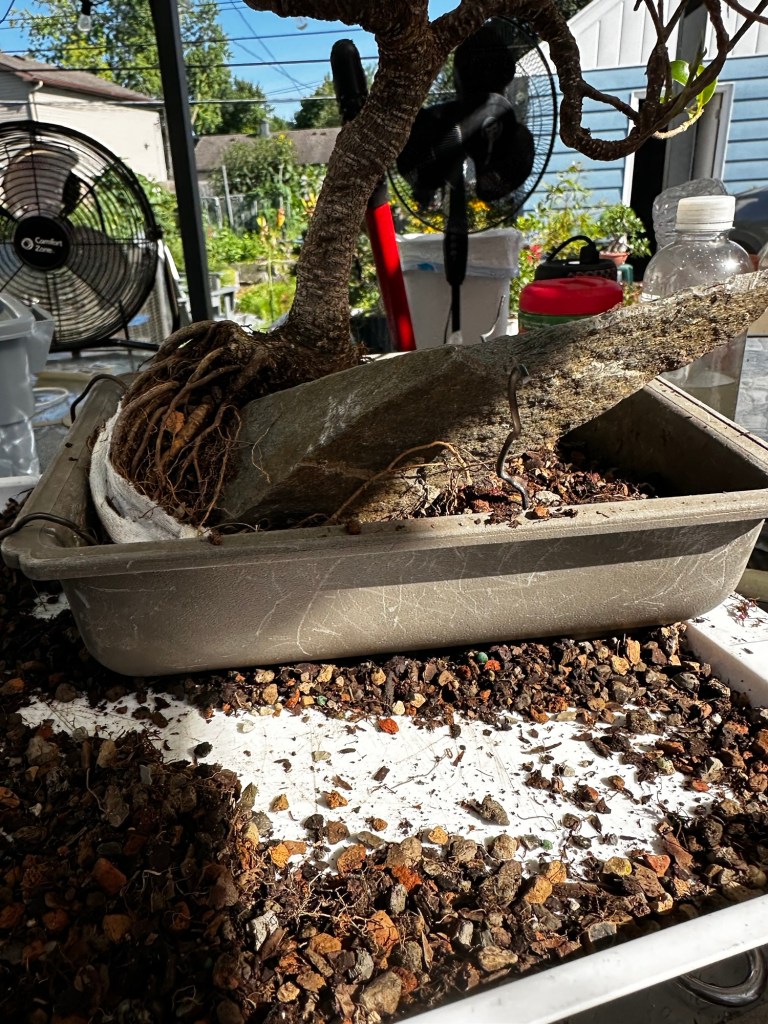
I think we need a rock outcropping to give the base some drama. and to expose the roots and give some repetition of movement to the composition.

John had the idea to add some fossil looking carvings to the rock (maybe next year).

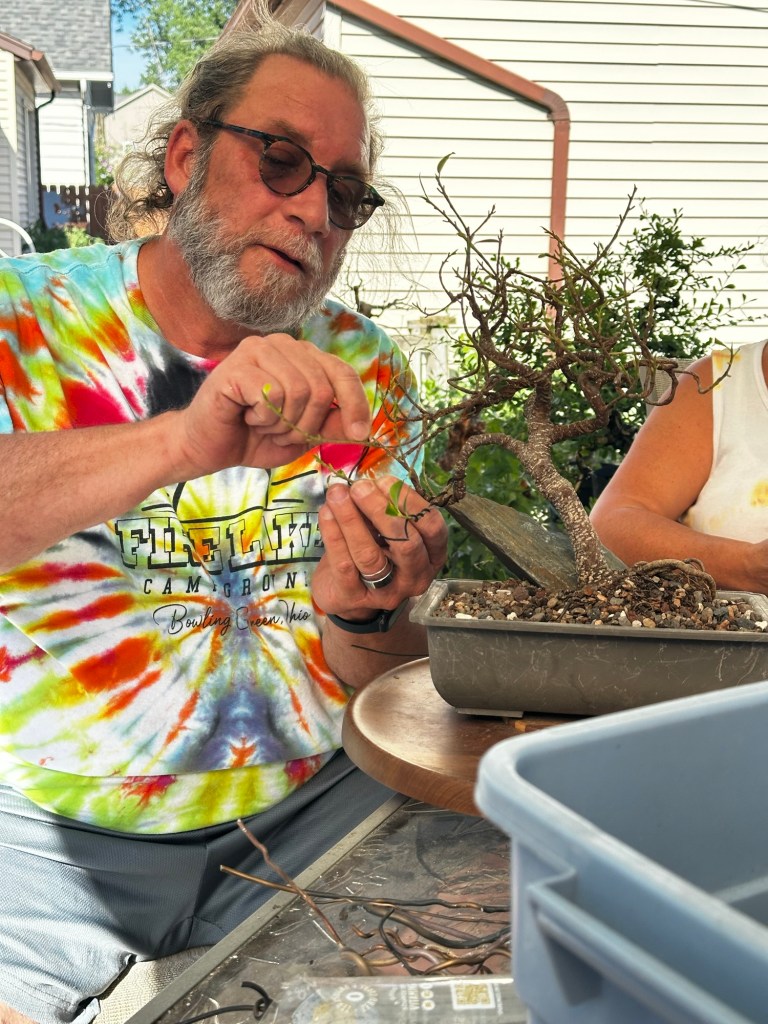
Hi John. I made him rewire it.

While I enjoyed some….

….coffee?

And that’s it for now. I’ll add updates as I get them.

Let me know how you think, feel, or not, about the Cosmic style.

I won’t censor them. I’m not about that, I believe in freedom of expression.

BYEEEEEEEE!

  •