Reading view

The Entrepreneur’s Blueprint : 31 Resolutions for Small Business Success

After years of talking about it, my husband Eric and I finally started a business in late 2019. We crafted a mission and business plan, conducted audience and market research, connected with a designer and web developer, and began developing our product. We debated seeking investors vs. bootstrapping and decided that we would bootstrap, ensuring that we would retain full creative, operational, and fiduciary control. Our website launched in 2020, and we’ve spent the past two years slowly growing a beautiful business together. We’ve made plenty of mistakes, had quite a few happy accidents, and ultimately have learned so much about entrepreneurship and starting a business. I wanted to welcome 2022 by sharing our experiences with anyone considering starting their own small business this year. While our specific business may be very different from yours, the lessons we’ve learned will definitely apply to you at some point in your entrepreneurial journey.

1: START TODAY!

Have you ever heard this proverb, attributed to ancient China? “The best time to plant a tree was 20 years ago. The second best time is now.” It’s generally interpreted to mean that if you want to succeed at something in the future, the best time to act is now, in the present. Eric shared his business ideas with me years before we finally decided to start Bonsaify. While we may have gained experience and wisdom in the intervening years between ideation and actualization, I wish we had stopped waiting and taken the leap into entrepreneurship sooner. Looking back, the only thing that really held us back, was our own FUD — fear, uncertainty, and doubt. What’s holding you back, other than yourself?

2: WRITE IT DOWN

Ideas come when you least expect them — while on a run or walk, laying on the yoga mat, prepping a meal, sipping coffee, taking a shower. Don’t judge your ideas immediately and toss them aside; give them space to ruminate and develop by writing them down!

3: GET A WHITEBOARD

Quickly followed by, “Use a Whiteboard”! This is a great tool for quickly getting your ideas out, and making changes rapidly, without committing too much time to technology, template, or format. We have two whiteboards set up, one in our operations (office) space, and a second in our production space. This enables us to ideate and prioritize the most important to-dos and plans for separate parts of the business.

4: GO TECH-FREE

Does it ever feel like there are an overwhelming number of digital tools available to entrepreneurs? It’s because there are: project management tools; work organization tools; website tools; email communication tools; customer relationship management tools; and accounting tools (to name a few broad categories). Hubspot has shared that marketers alone use on average more than 12 different tools, and some are using more than 31 tools to manage campaigns and data!

Every start-up or small business will have a different set of digital tools and software that make up its tech stack. These tools make a difference, and we’re not suggesting that you drop any of them. The point of today’s resolution is to consciously take stock and look for opportunities to simplify for a few hours or a few days. Can going tech-free for a few hours or days really help an entrepreneur build a successful business? Yes, it can. Take your thoughts, plans, dreams, and goals offline — on a walk or to a journal (or whiteboard).

5: RESEARCH

Market Research…can you ever really do too much? When we began planning for Bonsaify’s launch, I spent a lot of time looking at our competitor’s websites and social media accounts. I divided the competition into different categories; reviewed their voice, design, and product descriptions; analyzed their search and promotion strategies. Eric and I agreed on which part of the market we were going to focus on, and we built out content, product, and marketing plans from there. If I hadn’t already known it before we launched Bonsaify, the past few years have taught me you can never do too much research to understand your customers, your competition, and your market.

6: IDENTIFY YOUR STRENGTHS

Is anyone great at everything? Is each of us great at one thing [at the least]? When we first began Bonsaify, Eric and I thought about what type of work brought us joy and motivation; areas where colleagues and friends had praised us in the past; and tasks that made us cringe. We divided up the “must do’s” between us based on the strengths we identified…and had space to add a few “want to do’s” on top. One example: I knew I was good with wordplay and could establish an authentic voice for our brand that would connect with our customers. I took charge of all communications. I wanted to learn more about SEO and building audiences organically, so I took that on as an additional area of focus. I’m still learning, and I’m loving it! Although my full-time job doesn’t require me to have these skills, I do feel that I can bring extra passion and experience to my “day job” that benefits my colleagues. A true win-win!
7: OUTSOURCE

“Outsource is the secret sauce.” — Dory Schrader

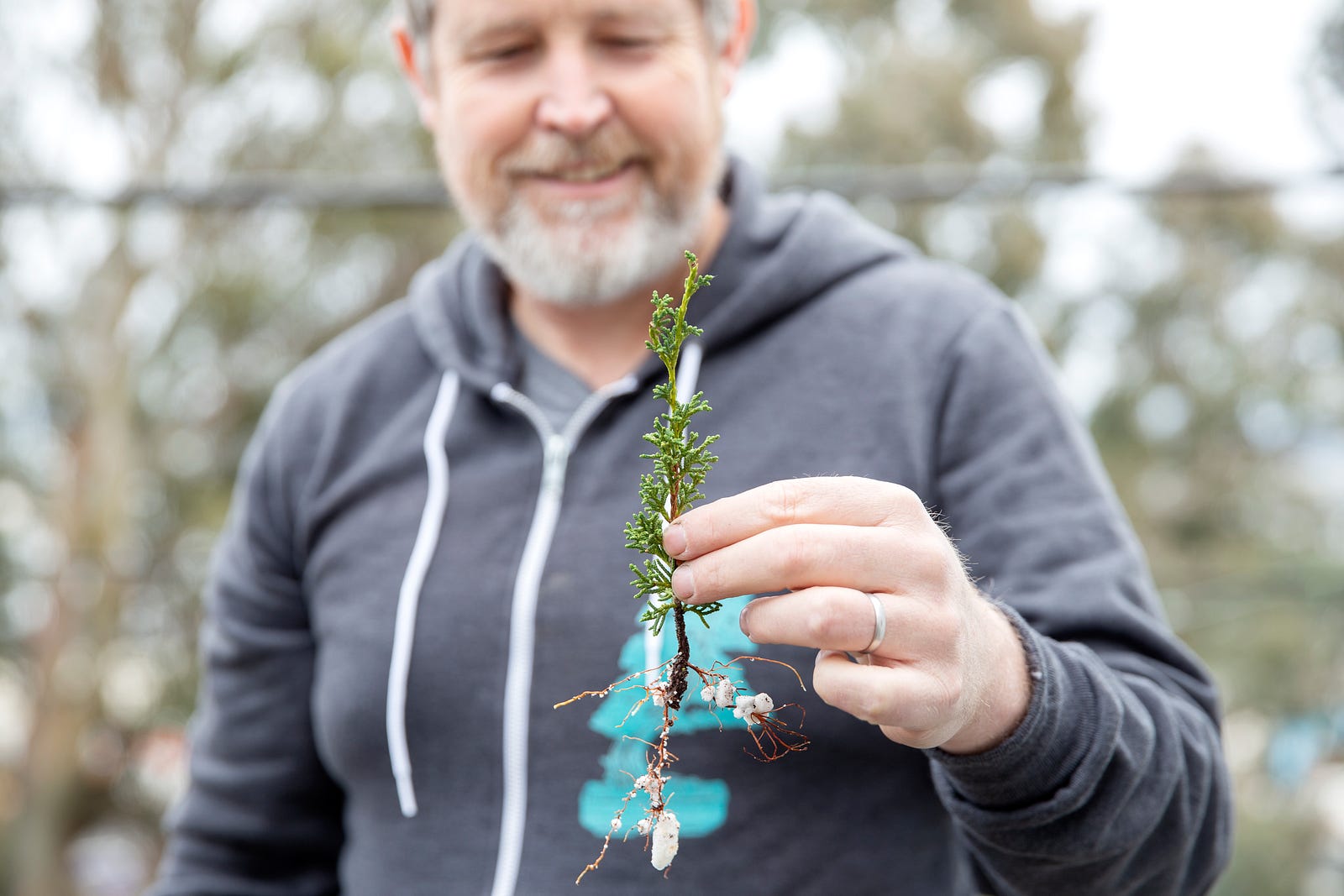
Eric and I realized early on that even though our business is small (Eric plus whatever few hours I can provide outside my full-time gig), bootstrapped (e.g. our budget is tiiight), and early stage, we wouldn’t be able to do everything ourselves. After organizing around our individual strengths and time availability, we highlighted a few key areas where we needed to outsource. Those included accounting, legal (LegalZoom thank you!), greenhouse management, parts of product development (e.g. 3D modeling for concrete pots), and brand design. Any financial investments in these areas have been returned exponentially, either through time back, piece of mind, or trackable ROI $$. OUTSOURCE when you need to!

8: BOOTSTRAP

Is this controversial? Remember, these are our reflections and learnings from the start of our small, family-owned and operated business. We started Bonsaify from our own personal finances in the Fall of 2019, which meant we started small and slow. Our first few investments were very basic — before even renting a greenhouse space, we ordered seeds and the flats/trays/containers we’d need for seedlings and cuttings; handled the legal and regulatory aspect of our business, and asked a designer we met through a friend to help us with our brand and logo design. We purchased a URL…and not much beyond that. We planned what we’d need to spend each month to nurture the business and grow, and brainstormed ways to earn some revenue to counter costs. There’s much more to our bootstrapping story, which I intend to share someday. For now, I’ll leave off by sharing that we ended 2021 with a full quarter of monthly sales covering monthly costs. The business is moving in the right direction, and bootstrapping continues to be our preference, to retain full control of our goals, our customers’ experience, and our destiny.

9: FOCUS

Even in our niche industry — bonsai in the U.S. — there was no limit to the potential paths we could take when we began Bonsaify. Grow big trees or small; sell starters and pre-bonsai or only trained bonsai; focus on species best for indoors, outdoors, or both; ceramic or concrete pots, mass-produced or locally made; offer virtual workshops and seminars; how much related and peripheral merchandise to offer; and more decisions that were focused just on product development and offerings!

We also had to think about which social channels to invest in; where to focus on building community, audience, and engagement; which infrastructure tools to subscribe (e.g. Shopify, Klaviyo, Trello, LegalZoom). It was easy to feel overwhelmed, and we learned that we needed to FOCUS on one decision at a time to keep making progress and to move the business forward. As a marketer, I read “Traction” by Gabriel Weinberg and Justin Mares, and overall, I recommend it. The Bullseye framework works, and it helped me determine the three traction channels I needed to focus on in 2021 to drive our intended growth.

10: CUSTOMER EXPERIENCE

Building our business has been all about customer experience. We’re not just focused on the quality of our products, but on how we communicate with our customers, building authentic relationships; on how we pack and ship our products, throwing in a sweet little extra to bring a smile to our customers face as they open their box; and on speed and detail in responding to customer questions, concerns, and ideas. We are hyper-focused on our customers. They know it; they love us for it and they’re loyal because of it.

Comment posted on YouTube: “Today just got my root over rock black pine and small juniper..let me tell you that was the healthiest most well packed set of trees I have ever got shipped exp in winter in Michigan…tysm I’ll def be a repeat customer…”

Email received: “Everything I’ve ordered from you has been outstanding. The way you pack the plants for shipping and the quality is way better than anything I’ve purchased online. I never question if the roots are damaged, trunks are split, etc. I can tell that you care about your plants just by the way they look. Never going to order from anyone else. Thank you.”

Message sent via Instagram: “Glad to see your business is thriving. Great products, excellent service, and quality educational videos. Wishing you great success going forward…”

11: THINK POSITIVE

I’m not typically associated with the “half glass full” mentality, and even I have to admit that working with Eric on Bonsaify has helped me see the value of positive thinking. We’ve had been plenty of frustrating, zero dollars, plans falling through, fallback to Plan D, days since we launched Bonsaify. It would have been easy to fall into catastrophizing, planning to fail, and all that bad juju. Perhaps being a wife & husband team (with a little help from our sons and good family friends) helped us to focus on the good things, the opportunities; to trust that we were the right people to be successful in this particular business and that if we continued to focus and push forward, we would be [more than] fine. We hold tight to humor and laughs especially in the face of setbacks. We find excitement and joy in each customer engagement — emails, phone calls, likes/comments/shares on social media, and of course, orders — and that translates easily into gratitude. Finding and holding on to this positive energy makes it easier to deal with the inevitable problems we face. Being a blindly optimistic Pollyanna still isn’t a good strategy IMO, but I have learned that focusing on each little win and joy in the day-to-day of starting a business definitely helps me push through the tough stuff without complaint. I definitely believe that if you can hold to positive thinking, you can persevere as you launch a new business.

12: MANIFEST

Eric had a vision for Bonsaify long before we had a name, a logo, or a website for the business. He manifested this business, sharing his vision with me, bringing me along, until I could clearly see it and could help him draft a mission, and ultimately, a business plan. We take time every week to review how our business is growing, and continue to manifest our vision, mapping out short- and long-term goals, and picturing where we want Bonsaify to be in 2022 and beyond. You CAN manifest your ideas, dreams, and goals into a whole new business. Eric did it, and I’m so happy to be along for the journey.

13: EXERCISE

There are nights when Eric crashes into bed before 8:00 pm because starting and running a new business is #sodamnhard. I’m sure he’s not the only entrepreneur pushing himself to exhaustion. For me, the antidote to exhaustion is exercise; actually, it’s mindful movement. Whether it’s yoga (Yoga with Adriene is my jam), a walk, run, or bike ride, or an Orangetheory Fitness class, I take at least 20 minutes each day for my body and mind to connect. It offers me a break, helps me rebalance between professional and personal stressors, and provides a daily refresh/reset. I cannot advocate enough for the power of exercise!

14: SLEEP

Forbes published an article in July 2021, “Entrepreneur Sleep Deprivation: A Work Trend That Needs To Be Put To Bed”. Sleep isn’t a sign of weakness, and keeping a 10:00 pm — 6:00 am (or 9–5, 11–7) schedule doesn’t mean you lack passion, drive, or motivation. Sleep is essential to life. Do you want to have the energy and stamina to continue producing innovative and market-changing products and services? Your brain and your body need sleep.

I have a very difficult time falling asleep, and an even worse time staying asleep. I am a light sleeper (until I’m not, something that only the insomniac → truly exhausted can understand) and I am easily awoken by any noise, light, or even my own thoughts. They break through and BAM I’m awake at 2:00 am. I can feel and see a difference in my productivity, creativity, and physical wellness on those days when I didn’t get enough sleep the night before.

I envy Eric, who has a metronomic internal clock that generally guarantees him 7–8 hours of sleep. But even he can fall prey to his Trello task list entering a REM sleep cycle and jolting him awake at 4:00 am. He’s taught me one way to overcome this is getting into a habit of laying down ahead of when you want to fall asleep, actually giving your mind and body enough time to relax and for sleep to come. That way, even on those stressful mornings when we wake up “too early” we’ve at least gotten some good hours of sleep the night before.

How many people do you know, who wear their exhaustion like a ribbon or medal? As the Forbes article author Jonathan Prichard wrote, “Sleep deprivation shouldn’t be something people brag about like it’s a badge of honor for others to admire, yet that is exactly the culture entrepreneurs live in today.” I agree, and I wish this mentality would change; so many entrepreneurs would be happier and healthier.

15: EAT

I LOVE COFFEE. It can be so easy to fill my mug in the morning with a steaming cuppa, and refill it a few times, telling myself that if I want to get some pre-workday Bonsaify work done, then I don’t have time to make breakfast. But I know that I’m not at my best when I feel jittery and yes a little nauseous, from a body full of caffeine and empty of carbs, proteins, and fats. A simple resolution with simple advice: take time to eat! Our business can only thrive so much as we are thriving.

16: RELAX

I know I’m starting to sound more like the owner of a Zen meditation retreat than an entrepreneur with a young D2C e-commerce business, but don’t give up on these resolutions yet! The only way to move forward is to sit back and RELAX. Take just five minutes to stand up and walk around, lift your shoulders up to your ears and release them a few times, or roll your head around to loosen the muscles in your neck. Or give yourself more time and actually meditate, full-body stretch, or read a chapter of a book — just for fun. I prefer yoga, a massage, or float therapy. There’s science behind this — practicing relaxation techniques such as yoga, deep breathing, massage, or meditation reduces the stress hormones adrenaline and cortisol. And that in turn, can help you focus — which is something we entrepreneurs need! You know what? I think I’m going to pause writing this, shut down my computer, and go do some yoga.

17: ANALYZE

Over the past few years, as we conceived and began our business, we’ve had to become Jill and Jack of all trades. Here are just two examples: Eric had to learn how to operate a greenhouse and manage propagation at scale, and I had to move from a broad conceptual understanding of SEO, SEM, and Google Analytics to actually creating content and doing the optimization for organic search, designing search ads, and using the GA dashboard to inform decisions. It’s this last learning that I believe is the most important — entrepreneurs must take the time to study and understand how their business is performing, to inform strategy, planning, and execution. I am still not an analytics expert, but I am looking at numbers daily (email CTR, GA for search terms, time on page, bounce rates, etc) and using the information available to inform how Eric and I prioritize key aspects of the business such as our content plant, product listings, search ads, email flows, and more.

18: TEST

We didn’t have any budget to test product offerings or marketing decisions when we first began Bonsaify. Even now, we have very little money available to do anything other than create products, support operations and infrastructure, and ship. Fortunately, I’ve learned that you don’t need a big budget to TEST and discover what makes your audience happy. Here is one easy example: initially, I sent one monthly newsletter to our entire email list which included links to new articles, videos, and products. I analyzed the open rate, click-throughs, site activity, and conversion value for each monthly email, and I noticed that certain segments engaged much more with the content, and others with the products. I tested splitting the newsletter into multiple sends — one for VIP customers (those who had made more than 5 purchases); one for winbacks (those who ordered at least once, but not in the last 180 days); and one for newsletter only sign-ups. I made minor changes to the subject and preview lines and tailored the body of the email to each audience. The results speak for themselves — as strong as a 73% open rate, 32% click rate, and 32% active on-site for our VIPs! You can test without a large budget; you just need patience, ideas, and access to data.

19: ITERATE

To maintain a successful business in our niche, we need bonsai pots. Lots and lots of bonsai pots. Mediocre ceramic pots are easy to find; great ones nearly impossible because demand outstrips supply exponentially. So Eric decided to try his hand at making our own bespoke line of pots, using specially treated concrete. He first needed to partner with CAD experts to create the models. This took multiple conversations and versions before he had working models that met his standards. He then needed to have the models 3D printed. The first round of models we had printed were too low resolution; so we had to go back to another printer. Then he had to actually create the molds. You better believe it took more than a few rounds until the molds were “just right”. Next, Eric needed a cement mix that work for the particulars of growing bonsai trees. He researched, formulated, mixed, and poured — it took a few rounds before the consistency, texture, etc. was acceptable for our needs. We also wanted to offer color options — the same process of formulating, mixing, etc. And even after the colors were “golden” he realized that some of the molds weren’t quite right, because the pots would get damaged as he released them from the molds. So back to the drawing board with mold production! More than 9 months after kicking off concrete bonsai container development, we finally had a useable and saleable product that we’re proud of.

For us to successfully develop a line of modern cement bonsai pots, iteration was necessary. Eric had to refine his concept, idea, and process many, many times before he created pots that we both felt represented our brand and our standards. If repetition — “doing the same thing over and over and expecting different results” is insanity, then iteration — “a change made to an existing product, idea, or field” is innovation. That’s why entrepreneurs need to iterate!

20: SMALL, FAST MOVES

A small boat is more nimble and easier to maneuver than a large boat, right? Our small business is similar — Eric and I can change course pretty quickly and easily, without much fuss or worry about the fallout. We learn something new in the morning, and by that night, our website is updated, I’ve changed ad copy, or Eric’s filmed a new YouTube video. One of the advantages to bootstrapping our new business with just one full-time and one part-time employee is that we can make a lot of small changes, quickly. We see this as an advantage — a customer asks if we have a specific product or can help them answer a specific question, and we can have a quick confab before replying with a yes or no. Here’s a specific example. We planned initially to source ceramic pots from a large wholesale producer. We were able to quickly change to partnering with a few local/regional smaller production potters and offer a wider array of pot styles with a more personal approach, plus move toward producing our own cement pots.

21: TAKE BREAKS

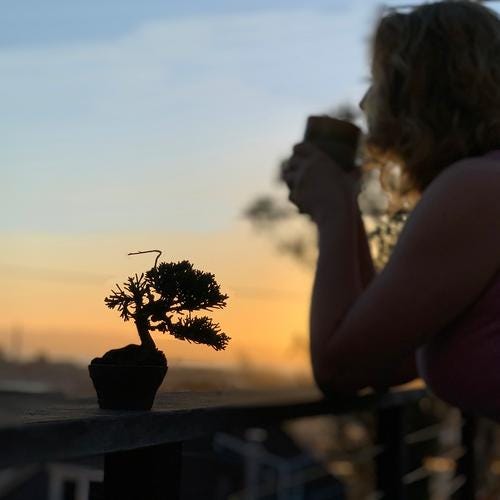
When I was in my first year of university, I took a Psych 101 course with Professor James Maas, who coined the term “power nap”. I’ve given the old 20-minute power nap a try many times over the years since taking that class, and it has never worked for me. I agree with the concept of quick revitalization, especially now as a mom, employee, and entrepreneur. So while laying down for a fast nap doesn’t work for me, I do lean on other types of breaks — I’ll sip a cup of steaming hot coffee outside on my back porch, sit on the family room floor and work on a jigsaw puzzle, or I’ll go to my bedroom and do a quick yoga session. None of these need to take longer than 15 minutes, and each provides me with just enough of a buzz to bring me back into high productivity mode. I also try to take a longer and more complete break once a week; on a recent Saturday I enjoyed a physically strenuous and emotionally uplifting 3+ hour hike.
22: CREATE VALUABLE CONTENT

By valuable, I mean content that is interesting and engaging to your customer base, to give them a reason to come back and spend time on your site. Our weekly content plan includes two YouTube videos, one article (either something more advanced for active bonsai enthusiasts or something more basic for our general interest audience), and one educational social post. I fill in the rest of our publishing calendar with product posts or bonsai tree pictures that I know bonsai enthusiasts love! Our focus has been on building engaged audiences through YouTube, a newsletter email list, Instagram, and Facebook. And we’re doing it all through great content. Do you consider this guide valuable? I know the content is relevant to the audience I am targeting (hello, entrepreneurs looking to bootstrap their own business!) but it’s up to you to tell me if the content is relevant and valuable.

23: ALWAYS BE LEARNING

“I WILL ALWAYS KEEP LEARNING.” It’s written in the “About” section of my Linkedin profile, and I mean it. in 2021 I completed the Google Analytics for beginners certification because I need to understand GA to help Bonsaify grow. I’m always researching, reading, and adopting new approaches to supporting our business, based on what I’ve learned. The lifelong learning mindset is essential for an entrepreneur, small business owner, or frankly, anyone who wants to make an impact. For example, I look at our content strategy and execution as an opportunity to learn what our audience finds valuable, what type of information they’re looking for, and how they prefer to consume that content. I believe that the moment I stop listening and learning our content will become stale, and our audience will disengage.

24: OPTIMIZE

We don’t have any special software or tools to help us optimize. Here’s how we’ve made the best use of our time, experience, and budget. Eric is the bonsai expert: he focuses on the trees, including planting seeds and propagation, development, care, and design; and the pots, whether it’s creating bespoke cement containers or partnering with local ceramicists. I am the marketer: I focus on content, audience development, and engagement.

Eric leads the operational business: he focuses on legal, regulatory, and financial requirements. I lead the creative business: I focus on partnerships, wordplay, and new product ideas. Eric uses real-time feedback on tree health and development to optimize our growing operations, while I use data to help us optimize our marketing and sales funnel.

25: CELEBRATE

Eric and I have a secret phrase we use whenever we get a new order. Each time we say it or text it, it makes us smile. We take the time to celebrate every small win. And not just orders; we celebrate our customers by sharing their feedback, comments, and photos of the beautiful bonsai they’ve created with our products.
26: BUDGET

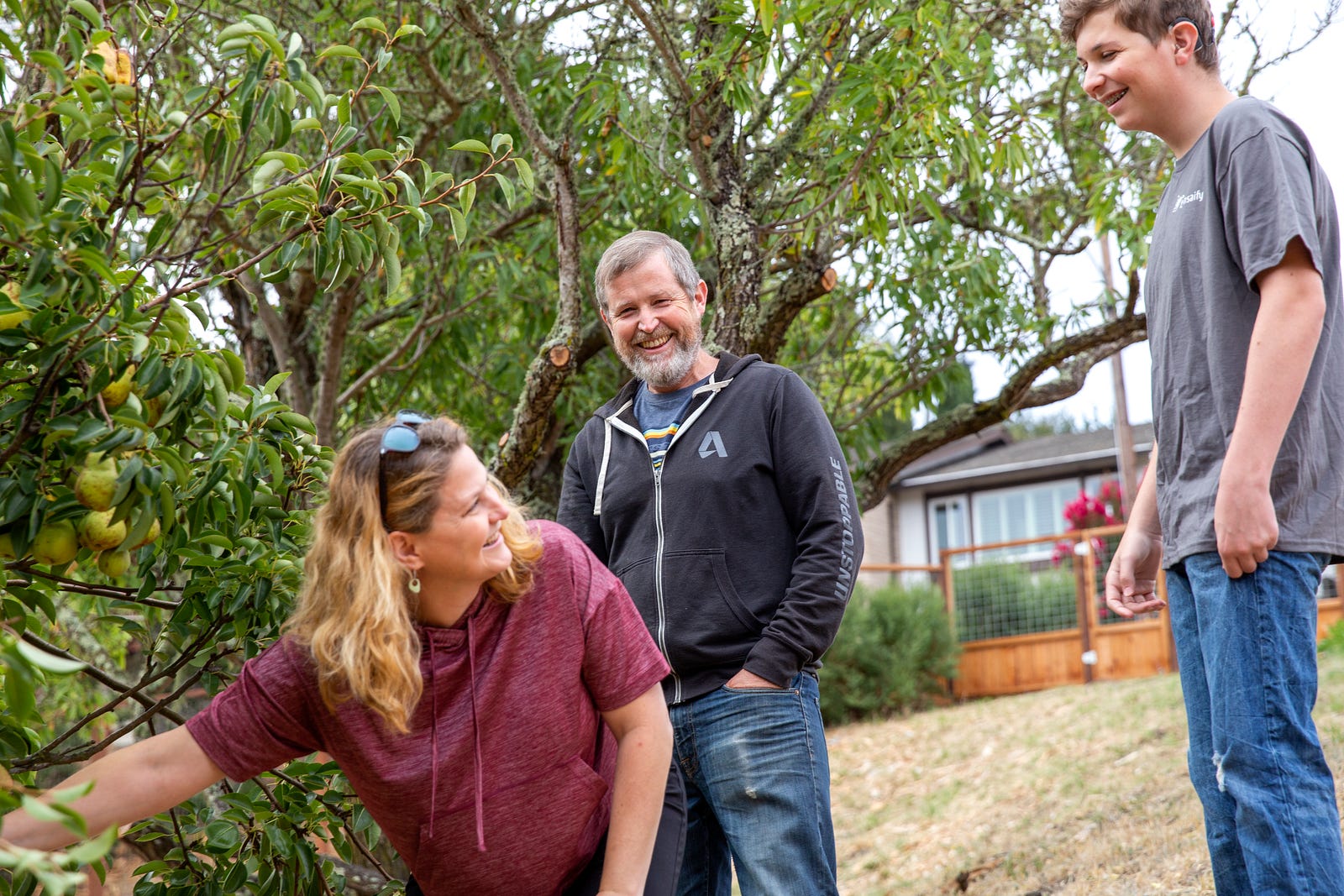
Am I for or against budgeting? Yes. There are many scenarios that call for building a solid budget. I’ve learned that launching our business was NOT one of those. Throughout the fall of 2019 and most of 2020, I kept trying to set a monthly budget for our little bootstrapped operation. Eric kept pushing back, convinced that we needed to focus on building our business. He’s a big fan of Jen Sincero and kept asking me to read her work, as he believed my fixation on budgeting was coming from a restrictive mindset that could limit our future success. At the end of 2021, I finally took his advice and listened to Jen’s best-selling books, “You Are a Badass” and “You Are a Badass at Making Money” and I GOT IT. I understood the importance of focusing on our goals and what we wanted to achieve, and not limiting ourselves to a monthly spend amount. Instead, we discuss weekly what we need to accomplish that week, decide together that we’ll be paying for it, and look at our options for making each investment bring us closer to our long-term goals.

27: PLAN

A few years ago, I started a food blog just for fun and called it “Planful Cook”. I created and shared weekly meal plans and completed grocery lists, advice for prepping in advance, and suggestions for scheduling meals “out”. My goal was to take the daily thinking out of cooking and eating, and it worked amazingly well for me and my family, and I received positive reinforcement from folks engaging with my content. After a year, the pressure of that level of planning got to be too much for me, causing me anxiety if our schedule changed, or I couldn’t find an ingredient. I realized that I had lost track of my goal, in my focus on executing the plan. With Bonsaify, we took a different approach. Our goal is our North Star, and we create loose and flexible plans to help us achieve milestones toward our goals. That’s my advice — plan for purpose, to support goals and outcomes. You rule your plan; don’t let your plan rule you.

28: BE BRAVE

It takes courage to quit a steady job that provides a steady paycheck and start something new from the ground up with your own savings. Entrepreneurship, especially bootstrapping, is intrinsically risky and takes a strong belief in oneself. When we first agreed to start Bonsaify, Eric had a full-time corporate job. He held on to it for more than 18 months and fit Bonsaify in around it, waking before sunrise every day to focus on the operational aspect of the business, and working long into the evenings to plant seedlings and take cuttings (the fieldwork). I kept trying to convince him, push him, and barter with him, hoping he would quit the safe route and devote himself full-time to Bonsaify. He kept calculating how long he could hold on to a salary and succeed in both worlds. Yes, our personal finances played a role in his timeline; but doubt and fear held him back as well. When he finally made the decision to cut his corporate ties and dive fully into Bonsaify, he immediately experienced joy and felt inspired to move forward. Be Brave.

29: ADMIT MISTAKES

“The biggest mistake you can make is being afraid to make one.” — Elbert Hubbard. One of my ongoing projects is to grow our inventory of bonsai-related merchandise. So far I’ve had a few hits (bespoke tool bags) but more misses. I still think a branded yoga mat is a good idea because there is a distinct link between the art of bonsai and the zen of yoga, but I can readily admit that ordering a quantity of indoor grow light stands before testing that they would work, was a mistake. I’ve spent hundreds of dollars bringing in products that we may never sell, and while I berated myself for “wasting” money, Eric wisely reminded me to not focus on the losses, but instead on the learnings. With each miss, I’m learning more about our customers and our brand. So I’m choosing to not be afraid of mistakes, to readily admit them, and to see them as opportunities to grow.

30: PERSEVERE

“Tis a lesson you should heed, try, try again. If at first you don’t succeed, try, try again.” -Thomas H. Palmer. Having our kids work with us has definitely been a highlight of starting a small business. In 2020, our younger son negotiated with Eric and agreed to count out piles of 50 seeds and package them for a 50% share of profits from selling the seed packets online. He was super-excited and engaged and asked every day for weeks if we’d had a seed sale. Our older son accepted a part-time summer job with Bonsaify in 2021, “Cement bonsai pot maker”. He had to learn how to make the specific cement mix for our pots, pour wet cement into our molds, unmold the pots, and do the finish smoothing work. It took him many tries before he was able to create a useable pot. Each time he made a mistake or had a failed attempt, Eric worked with him to take the learning process in stride, and start again. He persevered and helped us create hundreds of quality cement pots to support our business!
31: BUILD HABITS

Since our launch, I’ve created a few new habits that help me balance supporting Eric and Bonsaify, and maintaining focus on my core job. I spend 10 minutes each morning thinking about Bonsaify and determining one area I will focus on for the day. In addition, I devote up to 30 minutes daily on our social media posts, and another 10 minutes reviewing performance analytics (this is the fun part to me, seeing how my efforts translate into audience engagement and action). I believe that building productive habits is necessary to building a successful business. Did you make it through all 31 resolutions? I’m hoping that this guide helps you build at least one new habit — focusing on your entrepreneurial spirit for a few minutes every day!

Thank you for joining me on this journey. I hope this guide (originally published January 2022 as a series of 31 short posts on LinkedIn) offers you a needed nudge or idea to support your entrepreneurial goals!

Dory Schrader is co-founder of Bonsaify, whose mission is to increase human connection to nature through making beautiful bonsai accessible to everyone; to educate and facilitate the enjoyment of bonsai as a hobby; and to do so sustainably, with a carbon-neutral impact to the planet. Learn more at bonsaify.com.


  •  

Is Bonsai a Good Hobby for Children?

Sports, musical instruments, art, cooking, dance, gardening - there are so many potential hobbies for kids! Our older son is firmly entrenched in tennis and video games, while our younger son loves rock climbing, taking care of his guinea pigs, cooking, and gardening. When I look back on their younger years, it seems that they came to some of these hobbies completely on their own, such as tennis, rock climbing, and guinea pig parenting, and some stemmed from watching us, such as gardening and cooking. 

I’d love to see bonsai gain popularity as a youthful hobby in the United States. I understand first-hand how challenging it can be to try to actively direct kids into an activity versus letting them discover their passions independently. I did a little research to understand more about how children select hobbies and how parents can offer support.

Hobbies are Important for Children

I love this statement from Families magazine, “The best hobbies for kids are ones that help them to learn about the world…kids' hobbies and interests are born from a spark of passion.” There are proven benefits of hobbies for children, including eliminating boredom, making friends with similar interests, learning new skills, helping relieve stress, nurturing creativity and new ideas, and boosting self-esteem and confidence. 

How Parents can Help Their Kids Find Hobbies

My own experience was validated through my research - sometimes children pick hobbies by replicating what they see their parents doing, and other times, hobbies are discovered through self-direction. Parents can help their children find hobbies by first observing their interests, skills, and strengths, and the activities that bring them joy. Next, create a list together of the things they like or might like, and discuss together what sounds the most interesting. Then, provide opportunities for exploration of those hobbies! It’s important as a parent to keep an open mind, and not try to push children down any particular path. 

Why Bonsai May be a Good Hobby for Your Child

Published research demonstrates that interacting with nature helps children develop resilience and promotes social-emotional well being. It also provides a practice learning experience. Gardening - digging, potting, and watering - promotes physical and mental development, and can help children gain confidence, responsibility, and self-reliance. Everything Mom reinforces this with practical advice, “Gardening is a lifelong hobby [that] will be useful forever.” Bonsai is a very specific form of gardening, but offers the same benefits - children will get to see the fruits of their labor as the trees grow, just like when they pick vegetables!

Types of Bonsai Work Children Can Do

Children’s Health of Orange County provides an outstanding list of behaviors parents can expect of their children at various ages between 6 and 12 years old. Here is a breakdown, as applied to bonsai:

6 to 7 year olds:

  • Practice basic skills like watering
  • Draw pictures of their tree with new shapes and designs
  • Learn the names of popular bonsai tree species

8 to 9 year olds:

  • Use tools like tweezers and scissors to trim
  • Fertilize (with adult supervision)
  • Enjoy starting a collection

10 to 12 year olds:

  • Wire and bend branches to shape bonsai
  • Visit bonsai gardens and appreciate older more refined trees
  • Watch YouTube videos to improve their skills

How can you help your child start a bonsai hobby? Bring them to a local bonsai garden or shop, or go online and order them a small starter tree. Make sure that instructions are offered specifically for children. If their interest grows, children will find ways to upskill themselves - YouTube videos, local clubs, and maybe even introduce bonsai to friends and family. We actually created a video, "Making Bonsai Fun and Accessible for Kids!" that is free to watch on Youtube. Offer support, guidance, and motivation, and then allow your child’s imagination and interest to take over! 

  •  

Yaupon Holly Teacup Bonsai: An Intersection of Two Cultural Practices

Recently, Eric showed me a dozen or so Yaupon Holly mini-bonsai, some of which he'd planted into teacup-style containers. I thought they were pretty and would make nice additions to any bonsai collection, but I didn't really think about them in any deeper way. Then Eric mentioned that there was a special connection between the plants and the containers, and he sent me on a research expedition. It didn't take me long to see how Eric had connected the history of two cultures across hundreds of years to create these mini-bonsai. 

Chadō and Chawan: The Way of Tea and the Tea Bowl, Japan

Like bonsai, Japan’s introduction to tea originated from China. As early as the 8th century, traders, diplomats, and visiting monks from China brought tea to Japan. Once in Japan, drinking tea evolved over the next five centuries from a simple habit into a broad cultural experience, and became known as chadō "The Way of Tea". There are different types of tea ceremonies, with generally consistent elements (e.g. dedicated room, hanging scroll, flower arrangement originating from ikebana, customary clothing, and meal) and equipment (tea scoop, whisk, caddy, bowl, and cleaning linen).

For many chadō practitioners, the tea bowl, or chawan, is a treasured item. Any bowl can be a chawan - the only thing that makes a bowl a chawan is the act of preparing and drinking tea from it! The history of chawan includes the formal Chinese tenmoku style, the more rustic Korean Ido, and the handbuilt Japanese Raku and playful Oribe styles (more information).


Raku Chawan Style

Oribe Chawan Style

Cassina: Energy, Strength, and Focus, North America

Yaupon Holly (Ilex Vomitoria) is a species native to southeastern North America. It’s found only from Texas to Florida, and north through Virginia. It’s the only naturally caffeinated plant species that grows in the United States. Yaupon has been used as an important food, medicine, and ceremonial item by Indigenous communities for thousands of years. The Timucua people (who lived in what is today Florida and Georgia) called Yaupon cassina, and believed that it purified the mind and body of those who drank it. For sure, the leaf's natural caffeine and powerful antioxidants also gave Timucua warriors strength and energy. The leaves were roasted, infused in boiling water, and drank hot from elaborately carved whelk shells. (Yaupon Brothers Tea)

Yaupon Holly are typically used as ornamental shrubs in landscaping. Bonsai enthusiasts appreciate the small shiny evergreen leaves, numerous red berries (on female plants) and small white spring flowers, and pale gray bark marked with white patches. This established tree is part of Jonas Dupuich’s collection; you can learn more about it here.

A Decidedly Eclectic Bonsai 

Now whenever I look at these beautiful Yaupon Holly in little teacup-style bonsai containers, I can't help but imagine picking a few leaves off [during regular bonsai maintenance], roasting them and infusing them in boiling water, to drink from my favorite chawan! Drawing from traditional Japanese influences and indigenous North American cultural practices has created a a truly eclectic and unique bonsai.

  •  

Growing Bonsai Trees: How Big Do They Get?

The art of bonsai began in China over 1,000 years ago and gained popularity as a craft in Japan over the centuries. Bonsai are not a special variety of plant and there is no "bonsai species"; instead, they are normal trees. A bonsai is simply an ornamental tree in a pot, grown and styled to create a miniaturized and sometimes stylized representation of a tree in nature. Although in some cases dwarf trees are used for bonsai, if a bonsai is planted in the ground it will eventually grow into a full-size tree or plant. There are landscape style bonsai; they are generally called Penjing (which is also the Chinese term for bonsai).
 
Some of the most popular deciduous trees include Japanese Maples, Chinese Elm, Japanese Elm, Oak, and Wisteria. These shed their leaves in the fall. Ficus, Dwarf Jade, and Cotoneaster are popular broadleaf evergreen trees. Of all the conifer trees Juniper, Japanese Black Pine and Japanese White Pine, Cedar, Fir, Hinoki Cypress, and Redwood are favorites. Whether a bonsai lives indoors or outside depends on the species. Indoor bonsai trees should generally be tropical and have access to direct sunlight for a large part of the day. One reason Ficus trees are so popular with bonsai beginners is because they can live indoors.


Just as there are many different bonsai tree species, bonsai can grow to different sizes. The size class implies the height and weight of the tree in its container, and it's based on the number of people required to move the tree and pot. The very largest size, named Imperial bonsai, is named after the enormous potted trees of Japan's Imperial Palace.

Bonsai Tree Size Classification

The Large Bonsai sizes require the most sets of hands:

  • Imperial which is an Eight-handed bonsai, 60-80″ (152-203 cm)
  • Hachi-uye which is a Six-handed bonsai, 40-60″ (102-152 cm)
  • Dai or Omono, which are each Four-handed bonsai, 30-48″ (76-122 cm)

The Medium-size Bonsai are two-handed:

  • Chiu or Chumono or Ōgata, 16-36″ (41-91 cm)
  • Katade-mochi or Chuhin, 10-18″ (25-46 cm)

A miniature Bonsai is a small tree that won't take up more than one hand:

  • Kumono or Kifu is a One-handed bonsai, 6-10″ (15-25 cm)
  • Shohin or Chohin is also a One-handed bonsai, 5-8″ (13-20 cm)
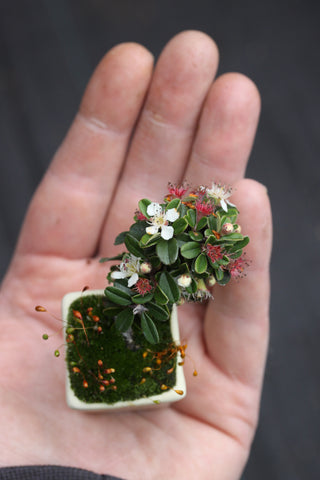
  • Mame fit in the palm of your hand, 2-6″ (5-15 cm)
  • Shito are Fingertip size, 2-4″ (5-10 cm)
  • Keshitsubo are tiny trees, poppy seed size, 1-3″ (3-8 cm)

The shape of a bonsai is created through regular pruning and careful maintenance of the growth of the roots and the leaves or needles. Any species of tree with a permanent wood-like structure, a vine, or a shrub, is a candidate for bonsai. Some cacti, succulents, and pachycaul (like desert rose) can also be used to make bonsai plants. Bonsai is a natural, organic art form that provides joy to bonsai enthusiasts and hobbyists.

Bonsai trees can be planted in ceramic or concrete pots, on stones, or in unique containers. Bonsai containers come in many styles and sizes and must have drainage holes. There are conventions to selecting the proper bonsai pot, depending on the type of tree. One general rule is that the pot’s height should match the trunk’s width above the nebari (roots visible above the soil). The depth of the pot is mostly determined by the girth of the trunk. The size of the pot is determined by the visual weight of the combination of the foliage and trunk. The style of the pot is chosen to match the style of the tree, which is open to interpretation.

The pot is an important component for the overall health and root growth. Using a shallow pot helps to constrict the tree’s roots and prevents the tree from growing too quickly. With a shallow container, the root system is restricted from spreading and expanding. A tree is often repotted from a larger pot into a small pot for similar reasons. As a young tree ages, it might move from a small container into an even smaller bonsai pot! Regardless of the rules, if the combination of a pot and tree brings its owner joy, then the pot selected works with the tree!

Important aspects of proper care that impact a tree's health and growth rate include how much water the tree receives, whether it needs and receives access to full sun, weather during the prime growing season, fertilization, and proper bonsai soil. With good care and the right conditions, a bonsai tree can be expected to experience multiple rounds of new growth each year.

A Few Fun Bonsai Records

  • The smallest bonsai in the world (pending, Guinness World Record listing) is a Japanese Maple. It is truly a miniature tree!

  • The largest bonsai in the world is believed to be a red pine located at the Akao Herb & Rose Garden in Atami, Japan. It is also one of the oldest bonsai trees. The tree is at least 16 feet tall and 30 feet wide. It qualifies as a bonsai because it’s contained in a pot.  (photo from Akao Herb & Rose Garden)

  • One of the oldest bonsai trees in the world is the Ficus retusa Linn (in the fig family). It’s estimated to be at least 1,000 years old and it grows in the oldest bonsai pot. This tree was taken care of by Chinese bonsai masters for a long time before moving to Italy, where it now resides at the Crespi Bonsai Museum.

To learn more about bonsai, visit a public bonsai collection and get an up-close look at high quality trees; join a local bonsai club to connect with other bonsai hobbyists, or sign up for workshops with a bonsai professional. Popular collections include The Bonsai and Penjing Museum at the National Arboretum (Washington, D.C.); The Chicago Botanical Garden (Chicago, IL); Clark Center Bonsai Collection at the Shinzan Friendship Gardens (Fresno, CA); The Bonsai Garden at Lake Merritt (Oakland, CA); The Pacific Bonsai Museum (Federal Way, Washington); the Huntington Botanical Gardens (San Marino, CA); and the James J. Smith Gallery (tropical species) at Heathcote Botanical Gardens (Fort Pierce, FL). The American Bonsai Society has compiled a complete list.

So how big do bonsai trees get? It really is up to the patience, temperament, and preference of the bonsai artist to decide!

  •  

Should You Give a Bonsai Tree as a Gift?

What do you get for the friend, colleague, or family member who has everything? You can find many lists of unique gifts online in response to Googling that question. A bonsai tree is very likely on one (or many) of those lists. Bonsai can be a most wonderful gift if given to the right person, but how can you know if your person is the right person? Here are a few clues to help you decide if a bonsai tree is that perfect gift you've been looking to give that very hard-to-gift person!

Who Would Love a Bonsai Tree as a Gift

Someone with a proclivity for gardening and houseplants, and a track record of learning how to properly care for them (aka a "green thumb"), is a great candidate to receive a bonsai tree as a gift. Your cousin who loves houseplants; has a beautiful garden; is always looking for some new bit of greenery or flowers to add to her home would make a great bonsai gift recipient. 

If your BFF has a flare for art and design, with a beautiful mix of eclectic art pieces, furniture, and fabrics in his home, he has the eye to appreciate a bonsai tree. Especially if he has a few carefully placed specialty plants such as an orchid, croton, or pothos that are always healthy, he is more likely to take the time to learn how to care for a bonsai. He will understand that an indoor bonsai requires access to natural sunlight; water and fertilizer; a humid environment; and regular check for pests.

Someone with a strong interest in, connection to, or respect for Asian culture, history, and art forms, may value a bonsai tree for many reasons. The practice of bonsai began in China almost a thousand years ago, and after centuries it also gained popularity as a craft in Japan. Bonsai is the Japanese term for a tree in a tray; the Chinese term for bonsai is Penjing. Your colleague at the office who spent a few years living in the Asia Pacific region or who chose to study Chinese or Japanese as their second language in school, may really enjoy the art of bonsai!

Anyone who appreciates eastern philosophies and practices is likely open to experiencing bonsai, because bonsai symbolizes harmony, peace, order of thoughts, balance, and a connection to nature. Practitioners of Feng Shui (the practice of arranging pieces in living spaces to create balance with the nature world), meditation (the practice of focusing your mind for a period of time, noticing but not engaging with thoughts), yoga (a group of physical, mental, and spiritual practices that aim to control and still your mind), shinrin-yoku or forest bathing (spending time in nature, hiking or walking amongst trees), or origami (the art of folding paper into decorative shapes and figures).

A few other likely recipients of a bonsai tree include: the outdoorsy friend who loves to hike and spend time amongst trees; a ceramicist who appreciates beautiful pottery; a woodworker who digs bark and other cool features of wood; your most patient colleague who understands that good things take time. 

What Type of Bonsai to Give as a Gift 

You've decided that a bonsai tree would be the ideal gift for your special someone; now what? There are a few ways to give the gift of bonsai (hint: they don't all involve actually selecting a tree!)

Buy a tree from a business that specializes in bonsai. These tend to be small or mid-size companies owned and staffed by people who know about bonsai and can give you sound advice. If you don't live near a local bonsai shop or garden, look online for bonsai businesses that are run by real people - like ours! When you email [email protected], you are emailing me and Eric, so you know you'll get a personal response from folks who know what they're talking about. 

Buy a bonsai tree PLUS a way for the recipient to learn how to take care of it. You can add a basics or introductory class; 1-1 time with a qualified instructor (online or in-person); or purchase a great beginners book along with the tree. When we sell a tree as a gift, we often recommend a basic indoor and outdoor bonsai gift package that includes a small bonsai tree with a species ideal for indoors or outdoors, along with our favorite book, "The Little Book of Bonsai" by Jonas Dupuich, and two essential basic tools (bonsai scissors and tweezers). Eric offers regular bonsai workshops as well as 1-1 sessions either in-person or online.  

Select a tree species that's appropriate for where the recipient is most likely to keep the bonsai. If they have no outdoor space you should look for an indoor species (e.g. tropicals): Dwarf Jade, Standard and Willow-leaf Ficus, and Jasmine Star Flower are great options. If they have outdoor space like a deck or garden, go with a Japanese Black Pine, Zelkova, Junipers (both Kishu and Itoigawa are popular varieties), Yaupon Holly, Maples, Elms, Cypress, Washington Hawthorn, or Cotoneaster.

How Not to Give a Bonsai Tree as a Gift

I highly recommend this Reddit thread for tips on how NOT to give a bonsai tree as a gift, with one caveat: there's no reason to avoid buying a bonsai tree as a gift during winter IF you're following my advice above. If you're purchasing the tree from a bonsai specialist, that person will know how to pack it properly to stay healthy during transit. 

Don't purchase a bonsai tree from a big-box store or online retailer like Amazon or 1-800-Flowers. They generally sell poor approximations of bonsai in cheap pots and use species that are meant to be kept outdoors but show them in indoor settings. It's a recipe for tree death and recipient disappointment.

I also recommend staying away from "bonsai in a box" or bonsai seed kits. For a beginner, start them off with an actual bonsai tree in a nice pot. Give them a chance to enjoy the art of bonsai, and work with a tree that is healthy. Propagation is no easy feat, and it takes years (and sometimes decades!) to design and style a seedling into a beautiful bonsai tree.  

Are you thinking of gifting a bonsai to someone this holiday season? Let us know if you need any advice or support; our mission is to make the art and craft of bonsai accessible to everyone. Of course, you can always give a gift card for the current or soon-to-be bonsai lover in your life!  

  •  

Why Should You Shop Small?

Every holiday season, we’re reminded how much our shopping choices matter — not just to our gift recipients, but to the people and businesses behind every product. At Bonsaify, we feel this deeply. Shopping small isn’t a trend; it’s a meaningful way to support art, craft, community, and the people who pour their hearts into what they do.

What Is Small Business Saturday?

Small Business Saturday began in 2010 as a marketing effort by American Express, but over time it’s become something much bigger. Today, the Saturday after Thanksgiving is an officially recognized holiday dedicated to supporting small, local, and independent businesses.

According to the U.S. Small Business Administration (SBA), small businesses are defined by industry type, average annual revenue, and number of employees. Using all three criteria, Bonsaify fits squarely — proudly — into the very small business category.

Why Shopping Small Matters

For business owners like Eric and me, Bonsaify isn’t “just” a business. It’s an extension of who we are — Eric as an artist and grower, and both of us as dreamers, builders, and  family-first entrepreneurs raising two kids who now understand what it means to run a real business.

When you shop small, you’re supporting:

  • Local economies. For every dollar spent at a small business, 67¢ stays local.

  • Families, not corporations. You’re supporting real people with real dreams.

  • Connection. We’ve built friendships with our USPS carrier who stops by daily, our workshop students, and the Bay Area community.

  • Sustainability. At Bonsaify, we donate 1% of all revenue to One Tree Planted to support reforestation.

Your support allows us to keep creating, keep teaching, and keep offering bonsai that bring joy, calm, and presence into people’s lives.


How Small Business Benefits Communities

Every small business has a ripple effect. For Bonsaify, your purchases help us:

  • Hire locally

  • Host workshops and classes, and meet new neighbors each month

  • Contribute to local and ecological sustainability

  • Keep the art and tradition of bonsai accessible and joyful

It's never “just a purchase.” It’s fuel for everything we do.

Four Simple Ways to Support Small Businesses

Supporting a small business doesn’t require grand gestures. Here are four easy ways to make a big difference:

1. Look Around When You’re Out and About

Next time you’re picking up your morning coffee, take a second to notice what’s around you. There may be a local bookstore, boutique, or specialty shop you’ve never stepped into — now’s the time.

2. Ask for Recommendations

Your friends, neighbors, and online communities are full of great suggestions. And when you do find a small business you love, sharing it is one of the most powerful ways to support them. Post it on Nextdoor or to a local Facebook group.

3. Gift Cards Are Small-Business Superpowers

They introduce someone new to the business, provide immediate support to the owner, and make wonderful gifts. (And yes — we offer Bonsaify gift cards!)

4. Make Every Day Small Business Day

Small Business Saturday is one day out of the year, but small businesses depend on everyday support. Whenever you can, choose a small business first — whether online or in your own neighborhood.

From Our Family to Yours

Thank you for supporting Bonsaify — whether you’ve bought a tree, attended a class, subscribed on YouTube, or simply sent us a photo of your bonsai thriving in your garden. Your support helps keep a very meaningful dream alive for our family and brings more beauty into the world through the patient and joyful art of bonsai.

  •  

Why Moss is Used for Bonsai Trees

Mosses have been an intentional part of landscape design in the form of moss carpets and gardens for nearly one thousand years, since Japan's feudal era began in the 1100's. Japan is famous for "moss gardens", and arguably the most famous moss garden of all is at the Saiho-ji Temple in Kyoto, Japan. It was created in the early 14th century by a Zen Buddhist monk and esteemed garden designer Muso Soseki. Today tourists from around the world plan months in advance to visit Saiho-ji (by reservation only). The experience of witnessing vibrant green moss carpets is certainly soothing; in fact, the guided tour of Saiho-ji includes a meditation service!

Bonsai enthusiasts share the monks' appreciation for mosses, and moss is incorporated into many bonsai compositions. A layer of thick green moss surrounding a tree in a bonsai container ignites the imagination, adding depth and texture. A bonsai tree nestled upon a moss bed can complete the look of a miniature landscape, called a Saikei in Japanese. Live moss is a wonderful addition to a bonsai tree as its prepared for showing, but it's use is far more than just aesthetic. Moss greatly benefits bonsai trees. It holds in heat during the winter, and helps keep the soil cool during summer, which helps protect the trees' roots throughout the year. It also prevents erosion or soil loss from watering when it grows on the surface of the soil, as it will adhere to the top layer of bonsai soil and keep it where it belongs during watering.

What is Moss and How do Mosses Grow?

Moss (division Bryophyta) is a rootless plant that grows in a mat of fine threads. Mosses are categorized as bryophytes, or non-vascular plants. They don't have roots, they have rhizoids; wispy root-like extensions of the stem. Since mosses don't have roots or a vascular system, they transport water and soil nutrients osmotically, from cell to cell. Some mosses prefer hanging out in damp, shady areas; others do well in partial shade or even full sun.

Moss spreads in different ways, including dispersal of moss spores through wind and insects; fragmentation; and shoot growth. Moss doesn't have flowers. Mosses reproduce by spores that travel on air or water currents. With fragmentation, a tiny part of moss develops into a larger plant and spreads over time to cover a large area. Moss can also spread by sending out shoots; moss stems can multiply and become a colony.

Types of Moss

There are both different species of moss and different types of moss; wherever you live, the mosses and plants you see growing naturally (e.g. natives) are the best use to use with your bonsai and in your garden. Here are a few common mosses:

  • Sphagnum moss: There are more than 350 species of sphagnum mosses. It's long-stranded, and a thick layer of sphagnum moss is often used between the bonsai soil and the top dressing moss. Peat moss is actually from the same plant except it's dead and decayed, and usually dried and sterilized after harvest.
  • Silver moss*: Bryum argenteum is a type of carpet moss so expect more horizontal growth than vertical. 
  • Sheet moss*: Hypnum cupressiforme is typically seen on the ground in forests; if you're an avid hiker, you've definitely crossed paths with sheet moss!
  • Common Fern moss: Thuidium delicatulum produces tall leaves up to 3.5 inches in height. Don't use if for bonsai unless you have a large bonsai (30 inches or taller) because it could cover over a third of a smaller tree trunk and make the composition look overgrown. 
  • Atrichum Moss*: Two popular options are Big Star moss (Atrichum Undulatum) is taller, growing up to 3 inches; and the miniature Starburst moss (Atrichum Angustatum), that grows only to an inch in height. Both of these options are best for trees that prefer partial shade.

*these are the best options for creating a moss layer on the soil surface of a tree in a bonsai pot.

Where to Find Suitable Moss for Bonsai

Fortunately, it's not hard to find fresh moss at the appropriate times of the year, whether in urban areas or outside city limits. Fresh moss grows all around after a rain; in sidewalk cracks or along freeway or highway underpasses (be careful when collecting moss near moving vehicles!) Jonas Dupuich of Bonsai Tonight takes note of all the patches of attractive moss he finds growing on public property. In January (ideal collecting time in Northern California), Jonas knows exactly where to go moss collecting! Moss can also readily be found in a nearby forest or park.  Note that Irish and Scotch moss, sold as groundcover commonly, are not true mosses, they are vascular plants that will compete with your tree for nutrients. They are difficult to eradicate once they become established. (pictured below is Irish Moss) 

Not Moss!  This is Scotch moss, which is a vascular plant and competes with trees for nutrients.

How to Collect Moss and Transplant Moss for Bonsai

The best time to collect moss is when there is the most rainfall. That could be spring or fall, depending on locale; in Northern California, January is often a great time to collect moss. Collect the moss by using a putty-knife, spatula, paring knife, or a similar flat, wide-bladed knife and try to collect relatively large patches. Keep the moss moist and transplant it quickly, laying a patch of moss in the location you would like for it to grow; ideally on top of a thin layer of nutrient-rich, water-retaining bonsai soil. To cover a large area you, use a plug method such as is used with grass. Place small pieces of moss at regular intervals over the area, and the moss will eventually grow together. After planting new moss, water it thoroughly. Keep the area damp with regular watering for the next year or so to help the moss establish well. Once established, transplanted moss should be watered at the same interval as the tree it's growing alongside. Watch this video "How to Put Moss on Your Bonsai for Show Preparation," to see this process in action! 


In his book "Moss Gardening," (Timber Press, 1997) author George Schenk introduced an example of moss container gardening tied to bonsai that he called mame mosses. A mame moss is "one small enough to fit comfortably into a mame pot" and can serve as a playful and imaginative accent plant in a bonsai display.

Caring for Moss: Sunlight, Water, Soil

Moss needs water; how much water moss needs when growing in a bonsai container depends on a number of factors, including the climate and quantity and frequency of rain. During a wet or rainy season, moss will receive plenty of water from Mother Nature. In a warm climate or during a draught, moss requires regular watering, from a light mist to a more thorough showering. Also similar to bonsai plants, moss is not a "set a weekly watering reminder and forget it" type of plant. Moss does not need direct sunlight; some mosses can survive in full sun, but most prefer shade. There is an ideal soil pH for moss; about 5.5 which is acidic. Moss can grow in standard potting soil, but generally prefers compacted soil (especially clay soil).
The forest is blanketed by the greenest ferns and moss and bonsai-like trees, a wild majesty that beckons hobbits and pixies and elves and dreamers.” - author Shannon M. Mullen

References:

"Moss Gardening, Including Lichens, Liverworts and Other Miniatures" by George Schenk, Timber Press, 1997.  ISBN: 9780881923704

https://www.mosskillers.co.uk/knowledge-hub/how-to-guides/how-does-moss-spread-and-reproduce

https://www.gardeningknowhow.com/ornamental/foliage/moss/growing-moss-gardens.htm

https://www.bonsaioutlet.com/bonsai-articles/few-things-accompany-a-bonsai-better-than-moss

https://www.bonsaiempire.com/blog/bonsai-moss

https://www.lovemybonsai.com/blogs/bonsai/how-important-is-moss-for-your-bonsai

https://bonsaitonight.com/2010/02/16/moss-technique/

https://plantophiles.com/plant-care/the-best-moss-for-bonsai/

https://www.gardeningknowhow.com/garden-how-to/soil-fertilizers/sphagnum-moss-vs-sphagnum-peat-moss.htm

  •  

Monterey Cypress: Making Bonsai of Hesperocyparis macrocarpa

The Monterey cypress (Cupressus macrocarpa or Hesperocyparis macrocarpa) is an iconic coniferous tree. It's one of several species of cypress trees endemic to California. Not only is it magnificent to witness, it also smells magnificent - crush a handful of leaves in your hand and breathe in their fresh lemony smell. If you plan to visit the central coast of California, take time to appreciate the beauty of the native stands of Monterey Pine (a coniferous evergreen), Coast Live Oaks, and above all, the native stands of Monterey Cypress. They grow along the coast in town and at Point Lobos State Natural Reserve. 

If you want to see numerous examples of the natural beauty of the pattern of Monterey Cypress growth, add the drive south of Monterey along the ocean to your must-do list. “The Lone Cypress” has been the subject of countless photos as it stands alone on a rock between 17-Mile Drive and the Pacific Ocean. It recently lost a large limb but remains as picturesque as ever. The “Old Veteran” tree at Point Lobos State Natural Reserve also recently succumbed to a storm and gravity and was reduced in grandeur when the northern half of the tree fell into the ocean. Nevertheless, it's still well worth a trip to Point Lobos to traverse the Cypress Grove trail.

Here is a gallery of images of full-size Monterey Cypress.


It can be challenging to create a bonsai that faithfully replicates the windswept features found naturally in the Monterey Cypress along the central coast. It's worth it though, just look at these examples!

Monterey Cypress bonsai by Katsumi Kinoshita, started around 1950; gallery of cypress bonsai from Eric.

Outside it’s natural habitat, the Monterey cypress has been planted widely in California with an abundance of trees along the San Francisco, Santa Cruz, Marin, Sonoma, and Mendocino coastlines. Many of the coastal trails in San Francisco are abundant with beautiful Cypress examples. The deep lemony aroma is abundant as you walk along these trails!

  •  

Recommended Products from The Bonsaify Team

Below is a list of the products that are used or recommended by Eric.  Please consider using the links below to make your purchase. Thank you!

Fertilizer

Fertilizer For Bonsai in Refinement and Maintenance

Slow release fertilizer is the name of the game when your bonsai is mature. If you want faster growth you can use more. Japanese Black Pines, for example like a lot of fertilizer in spring prior to decandling.  Some species are salt-sensitive and better fertilized with organics. For these scenarios we recommend Bio-Gold Original.

Buy from Bonsaify  

Fertilizer for People who forget to Fertilize

Fertilizer is important in a container!  If you find you don't stay on top of fertilization, use a time-release dose to keep your plant growing strong.  Supplement with other fertilizers in rotation to speed up growth further.

Bonsai All-Purpose Fertilizer by The Bonsai Supply (Time release!)

2lb bag

3lb (organic)

The classic fertilizers:

Miracle Grow alternating with Fish emulsion on a weekly basis is a tried-and-true fertilizer regimen. 

Bonsai Soil

For young plants in growing containers: 60:20:20 Perlite:Lava:Coco Coir or Bark

Perlite 

We recommend coarse perlite. Perlite sizing is inconsistent across brands - we use #4 from NorCal Perlite.  #3&#4 from Mother earth are too large and porous. Size should be about 1/4"+/-

4 CU. Ft.

Coco Coir

Coco Coir comes either in compressed bricks or hydrated bags.  The bricks are cheaper but a pain to work with.  Bags are bulky, but ready-to-use.

Bricks

Bagged

Akadama and Japanese Mixes - For older and more refined trees.

We use soil imported by Bonsai Tonight for our refined and older trees. Because Akadama is mined in Japan, it is more costly, but it is the gold standard for bonsai growth! Keep in mind it's not necessarily a better soil for rapid growth, in refinement we want steady moderate growth.

Bonsai Tonight Shohin size 

Bonsai Tonight Banzai blend - great for pines!

Domestic Mixes - Bonsai Soil by The Bonsai Supply 

Domestic pre-blended soils are a great lower-cost substitute for imported Akadama mixtures.  

4 Quart

20 Quart

2 Quart micro/Shohin

Premium New Zealand Sphagnum Moss

Sphagnum moss can be applied to the top of the soil to retain moisture near the surface, particularly right after repotting. Shredding it with a sifter and mixing in shredded live moss is a common practice for re-populating the surface with moss. 

500g (40L when hydrated) 

Soil Handling

Scoops

Aluminum ice scoops are great soil scoops and they come in many sizes:

1 & 2oz scoops are great for mame

24 and 32 oz scoops are good for normal soil handling

Soil Storage

Rubbermaid Tough Tubs for storing soil and/or mixing. Note: these are best for indoor storage as the lids collect rainwater which is annoying. For outdoor storage, use the 'Action Packer' series.

Soil Sifting

Bonsai Soil sieves are not particularly expensive and have mesh sized correctly: Bonsai Tonight sieves

Gold sifting pans are more expensive, but they're stackable and the mesh is built in.

Watering Supplies

Geometric Watering Can - Bonsaify

No Hose?

Get a small watering can for a small collection. 

Hose Valves:

Eley Brass Hose valve with or without a swivel. Feels like butter in your hand. Definitely our new favorite.

Dramm Solid Brass valve - slightly stiffer than the Eley valve, but durable and tough. Over-tightening it will cause the valve lever to be hard to use. Adding an extra hose washer can mitigate this, but the nylon valve assembly is slightly too close to the threads.

Watering Wands:

We recommend you use a short watering wand to make it easier to rotate the stream and reach the plants while watering.  We DO NOT recommend wands that have integrated valves as the valves normally wear out quickly and begin leaking from the assembly and can't be repaired. 

16" Dramm Wand (comes with a plastic valve which is fine but annoying to use, I normally discard it.) We use these in the nursery and greenhouse.

The Joshua Roth wand is what we use in our small city yard, substituting the Eley valve (see above) for the provided one. The included breaker is very soft and good for refined bonsai.

Japanese wands

These typically do not have a threaded connection, so you must cut the fitting off your hose to use them and/or add an extra small section from an old hose. Jam the tapered end into the rubber and you get a surprisingly good connection.

Stub Hose

Japanese Wands: Bonsai Tonight.

Dramm Water Breaker Nozzle with 1000 Tiny Holes 

This is just the nozzle/breaker.  If you purchase a Dramm wand it will have a smaller hole-count (and larger holes) in the breaker head. This is the softest one we use but it's still a high-volume water supply. It fits standard American hose thread so you can also just screw it straight onto the end of a hose or add a valve  without a wand, but the watering pattern is a bit more even with a wand in the middle.

We've been using these since 2016

Hoses

As a bonsai hobbyist you'll get a PhD in hose wrangling. These are our favorite hoses because they work well when hot or cold, and kinks either don't happen or unkink themselves:

Small yards

Larger Yards

Also Great:  https://www.eleyhosereels.com/collections/garden-hoses/products/5-8-polyurethane-garden-hose


DOSATRON

D14MZ2: Buy on Amazon

An Inline system powered by water to add precise levels of fertilizer, or other liquids and soluble products to your water. The unit will draw from a reservoir (e.g. a 5-gallon bucket.)  You can plumb it from your hose bib with adaptors (threads on it are 3/4" IPT) or use standard PVC inlets and outlets. In the nursery we use this for soluble fertilizer, adjusting pH with acid injection and pesticide drench applications.  More useful for those with larger collections. 

Low-Tech Venturi injection systems can work, but are less accurate and require some practice to use effectively. Keep in mind that the amount of concentrate injected may vary with the speed of water flow. We haven't used them successfully so we don't have a particular one to recommend.

Water Treatment and Analysis (See our Article Here for more info.)

TDS (Total Dissolved Solids) Meters.

If you live in an area where water is typically "hard" you should monitor your water quality. You can also use TDS meters to effectively avoid fertilizer dilutions that would otherwise burn plants.

Cheap and good enough for occasional use, get the water as close to 75F as possible when doing the reading for consistency

Temperature compensating TDS meter with higher accuracy

Temp/TDS/pH meter all-in-one

Acid Treatment?

If you have high pH water (7.0 or above) and high TDS (300 or above), acid treatment can help with nutrient uptake.  Optimal pH for plants is 5.5-6.5.

Mixing 1/4 tsp of Citric acid to 5 gallons of water is a good way to purge Chloramine and chlorine from water while lowering the pH. This is also generally safer than using liquid acid, see below.

If you use a Dosatron or other injection method and want a larger and more stable solution you can use pH Down, but it is VERY concentrated, so use caution wear PPE and measure carefully.

pH Meters are generally accurate enough for adjusting acidity in your water.

Reverse Osmosis Systems

For a complete solution to poor water quality use an RO system, which strips out all the salts from the water - then supplement with a nutrient solution to avoid micronutrient deficiencies.

HydroLogic RO system

You'll need a couple barrels, a float valve on the end of the RO outlet (in case you forget to turn it off!) and a small pump if you want to be able to water with a hose.

To add micronutrients, use DynaGro "Grow" or a similar fertilizer that contains the right ratio and all the micronutrients. Bring the TDS reading back up to ~100 to avoid nutrient deficiency. 

Micronutrient solution

Propagation Supplies

Hormex #8 is the standard rooting hormone we use.

We use Anderson Flats filled with perlite/coco and fir bark to stick cuttings.


  •  

Introducing the Pacific Bonsai Expo

In just under twelve months from today, the doors will open for the first Pacific Bonsai Expo, "An Exhibition of Extraordinary Bonsai". We are proud and excited to be co-creators and sponsors of this event with Jonas Dupuich of Bonsai Tonight. The Pacific Bonsai Expo is a juried exhibition featuring outstanding bonsai displays and a selection of the community's top vendors. 

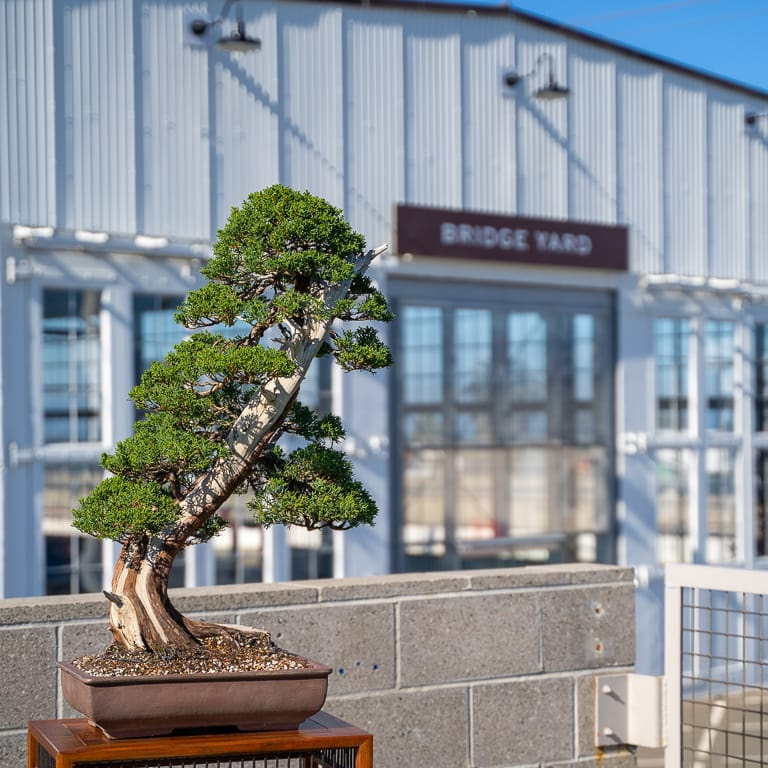
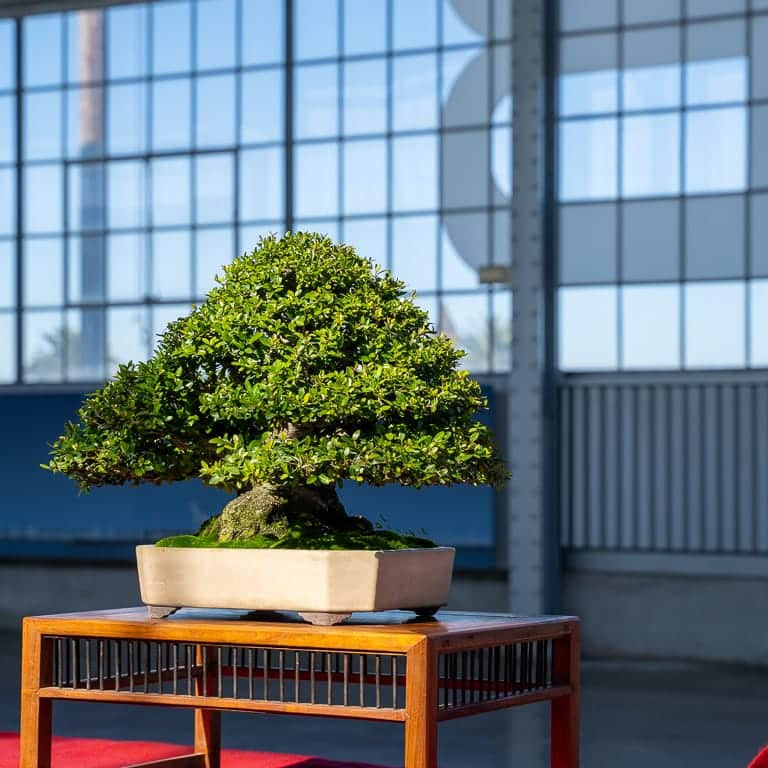
We wanted to give you a sneak peek into what the event venue looks like. The Pacific Bonsai Expo will be held in the San Francisco Bay Area at the Bridge Yard, an East Bay Regional Park District Facility in the Judge John Sutter Regional Shoreline Park. 

Juniper

Eric's Shimpaku juniper in front of the Bridge Yard

Holly

Yaupon holly inside the Bridge Yard

Thinking ahead of to November 12-13, 2022 makes today a great day to look at your garden and see what your trees look like at this time of year. Why? Because preparing bonsai for exhibits often starts one or more years ahead of the event. Checking your trees twelve months (or more) out can give you a good idea of what a tree will look like at the time of the event. If you're considering entering a tree to be considered for the Pacific Bonsai Expo, check out this have basic information on the event website. The submission period opens in February and runs through April 2022. Bookmark the site and check back periodically, as we'll be updating it with more information ahead of the submission period. 

In the meantime, watch Eric and Jonas introduce the Pacific Bonsai Expo and discuss the basics of the jurying process. Please leave us any questions you have in the video's comments!

  •  

Four Ways to Get Closer to Nature Every Day

If you live in an urban environment, maintaining a connection to the natural world may not be as simple as walking out your front door. While city apartments and lofts are a great place to live, giving ready access to numerous urban amenities, they can also leave you short of space to satisfy your aspirations for a green thumb. Ingenious Instagramer's have taken to the task and excelled in the creation of indoor greenery that rivals or even beats the best-tended suburban gardens. Here are four simple ways you can stay connected to nature on the daily.

Use scents to evoke memories

Smell, whether indoors or outdoors can really bring you back to places, or improve your mood. When you're home, take off your mask and breath in the aromas from items like lavender- or botanical-scented candles to remind you of a visit to a lavender farm. 

Taking a friend for a Sunday morning hike

Hiking is a great way to experience nature, and whether you're on a back-alley mural tour or a forest hike, getting outdoors will bring you closer to nature. Bring along a friend for conversation and to help you spot things you may have missed otherwise, make it a regular day of the week to keep each other accountable and get high-quality personal interaction. 

Cultivate your relationship with plants - like Bonsai!

In a London study researchers found that proximity to trees was associated with reduced rates of anti-depressant prescriptions; in other words, more trees = less depression. Bonsai are small and easier to control than street trees; think about how to create a relationship with trees through a few small potted specimens in your yard, on your balcony, or near a bright window indoors. 

Create a space full of greenery

Who doesn't like those photos of apartments filled with plants? Or maybe you already have a space filled with greenery and just need some more variety in size and shapes. 

  •  

When a Bonsai Tree Dies

It’s an emotional blow to lose a bonsai. Even seasoned growers will experience tree death. It's reality; everyone loses bonsai trees. I've had rough experiences, and the thing that helps me recover whenever I lose a tree is trying to analyze the cause so that I can learn and not repeat the conditions that lead to the trees' untimely demise.

In "The Tipping Point", author Malcolm Gladwell discusses the circumstances that normally surround airplane accidents. He summarized from numerous investigations into accidents that in almost all cases there was no single factor that lead to the accident. Instead it was a series of mis-steps, each unto themselves relatively harmless, that when combined lead to airplanes hitting runways and plunging into oceans.

This is a good analogy for the cause of bonsai death. While it’s possible that you can go on vacation and your tree dies because your neighbor forgot to water it, it’s also possible that your tree can die after a series of decisions to either do something or do nothing in an attempt to help the tree. There are numerous factors that can lead to the death of a tree - watering, fertilizer, pest control, and sun protection are among the things that if not executed properly will lead to problems.


Lesson learned from this Douglas Fir – don’t do work before a tree has shown you it is ready. This collected tree should have been left alone for another couple years before work.

A few years ago I experienced one of my most painful series of tree deaths. I surmised that the following series of steps, events, and mis-steps lead to the trees' demise:

  1. Summer application of a strong dilution of chemical fertilizer caused some damage to the root structure and needles. This was apparent on the foliage where some browned tips showed. (definitely a mistake!)
  2. During repotting the trees appeared to be weak, so light repotting was done to refresh the soil and allow for new room for growth (seems like the right step…but maybe not, maybe would have been better to leave them alone!)
  3. Trees budded out weakly – perhaps due to repotting or due to burn in prior summer or both (cautious optimism…)
  4. Light fertilizer and careful watering to try to nurse the trees back to health (continued optimism…)
  5. Heat wave in September – no protection provided for the all-time record temperature in San Francisco (Uh oh!)
  6. Tree is unable to cope in weakened condition and browns a few weeks later (😭)

I've learned a lot since this experience, and from many other tree-death and near-tree-death experiences. These learnings and many others have been incorporated into our mindful bonsai practice, which we've documented in our Establishing a Mindful Bonsai Practice series. Give it a read. And give yourself grace next time a tree dies; analyze what went wrong; and commit to doing things differently going forward.

  •  

What Is Forest Bathing? A Gentle Guide to Shinrin-Yoku

A quieter way of being in nature

There is a particular quiet that exists in forests. The air often feels different, and the pace of attention begins to shift. Many people notice themselves breathing more slowly without quite realizing why.

This change can happen quickly. After a few minutes among trees, the sounds of daily life fade and other details begin to appear. Wind moving through branches, birds calling across distance, light filtering through leaves.

In Japan, this experience became the foundation of a practice known as shinrin-yoku, often translated as forest bathing.

Forest bathing is not about exercise or reaching a destination. It is simply the practice of spending time among trees with gentle attention, noticing the atmosphere of the forest and allowing the body and mind to settle into a quieter rhythm.

Over the past several decades, researchers have begun studying this experience more closely. The state-of-the-art review of forest bathing research suggests that time spent in forest environments may support both mental and physical well-being.

The meaning of shinrin-yoku

The Japanese phrase shinrin-yoku roughly translates to “taking in the forest atmosphere.”

The term was introduced in the early 1980s by the Japanese Ministry of Agriculture, Forestry and Fisheries as part of a public health initiative encouraging people to spend more time in forests. At the time, rapid urbanization had changed daily life for many people in Japan, and policymakers were looking for simple ways to support well-being.

Rather than promoting hiking or outdoor recreation, shinrin-yoku emphasized slowing down and engaging the senses.

Participants were encouraged to notice things that might normally be overlooked, such as the sound of wind in the canopy, the scent of leaves and soil, the shifting patterns of light across the forest floor.

The practice invited people to experience the forest with presence rather than moving quickly through it.

Over time, this idea developed into what is now often called forest therapy, and guided forest walks began appearing in different regions of Japan. Today the practice has spread widely and is explored in many cultures as a way of reconnecting with nature.

A shift in attention

At first, a forest may seem quiet. But if you remain still for a few minutes, more begins to appear. Birds move through branches overhead, wind travels across the canopy, and subtle patterns of light and shadow change as clouds pass.

The longer someone remains in the forest, the more these small details become visible. Anyone who has spent time observing trees closely knows how much structure and variation is present once attention slows. Even in bonsai, where trees are studied carefully in miniature, subtle changes in branch structure or seasonal growth reveal themselves gradually.

Forests invite the same kind of observation, simply on a larger scale.

Why forests help us slow down

Modern life places constant demands on attention. Many people spend much of their day moving quickly from one task to another, often focusing on screens, messages, and deadlines.

Forests offer a very different kind of environment.

The atmosphere of the forest contains rich but gentle sensory patterns. Moving leaves, distant bird calls, shifting light. These elements hold attention without requiring effortful concentration.

Psychologists Rachel and Stephen Kaplan described this process as Attention Restoration Theory, suggesting that natural environments help the mind recover from mental fatigue (The Experience of Nature).

When people spend time in forests, attention gradually shifts from focused effort toward quiet observation. This shift may help explain why time in nature often feels restorative.

What research suggests about forest environments

Scientific research on shinrin-yoku has expanded steadily over the past several decades. Researchers studying forest environments have explored how time spent among trees influences several systems in the body, including the stress response, cardiovascular health, and immune function.

Studies have observed associations between forest exposure and:

  • reduced levels of the stress hormone cortisol
  • improved mood and emotional balance
  • lower blood pressure
  • increased activity of natural killer cells in the immune system (Li, 2010)

While research continues to develop, many people recognize the effects of forest environments without needing scientific explanation. The slower pace, quieter atmosphere, and presence of trees naturally create conditions where the body can begin to relax.

Forest bathing does not require wilderness

A common assumption is that forest bathing must take place in remote forests. In practice, the experience is often much more accessible.

Forest bathing can take place anywhere trees are present, in a neighborhood park, along a wooded trail, or in a quiet botanical garden. Even small green spaces can provide opportunities to slow down and reconnect with nature.

Research on urban green spaces suggests that time spent in natural environments, even in cities, can support mental restoration and stress reduction.

What matters most is not the size of the forest, but our willingness to pause and notice the natural world.

Beginning the practice

Forest bathing does not require special training.

For many people, the practice begins simply by spending time in a place where trees are present and allowing their pace to slow. Walking more slowly, pausing occasionally, and noticing sensory details in the environment often leads naturally to a more attentive experience.

Some people find themselves listening more closely to birds or wind in the branches. Others pause beside a tree long enough to notice its shape, texture, or patterns of growth.

These small observations are often the beginning of a deeper relationship with the natural world.

Returning to a slower rhythm

At its heart, forest bathing is a practice of reconnection.

Spending time among trees reminds us that the natural world moves at a different pace than modern life. Branches grow slowly. Seasons change gradually. When people spend time in these environments, even briefly, they often find it easier to follow that slower rhythm. In that quiet attention, many people discover a sense of calm that is increasingly rare in everyday life.


About the author

Dory Schrader is a Certified Forest Therapy Guide, bonsai practitioner, and co-founder of Bonsaify. Her work is rooted in the belief that trees have much to teach us about patience, attention, and connection. Through bonsai, guided experiences, and writing, she explores ways people can build deeper relationships with the natural world.


photos by She Buckley
  •  

Caring for Maple Bonsai: Fine Ramification, Pinching, and Bud Selection

Maple bonsai are prized for their fine terminal ramification—the delicate network of tiny twigs that creates a natural winter silhouette. To achieve that fine texture, growers must work with the tree’s natural vigor. Japanese maples (A. palmatum) and trident maples (A. buergerianum) flush strongly in spring, producing long internodes (the space between the adjacent leaf bases on a shoot) if left unchecked. Their growth habit means that a single forgotten shoot can quickly become as thick as the tree’s larger branches. Pinching buds as they emerge and selectively defoliating are how we harness that vigor and direct it toward the development of fine twigs.


Spring pinching: working with new buds

In spring, check maples daily, pinching new buds before they elongate and keeping an eye on weak branches so they don’t get shaded out. As soon as new buds begin to swell you’ll notice that some branches produce shoots earlier than others. Maples have rapid, uneven budding and the most vigorous shoots can overpower others unless you intervene. Pinching is the practice of removing the central bud before it elongates so that energy is redirected into the side buds. When you see three tiny leaves peeking from a bud, use tweezers or your fingers to pinch out the center. This keeps the internodes short and encourages side shoots to develop on at each cut.

  • Strong branches: On a strong primary or secondary branch, pinch the terminal bud the moment the three leaves appear. If a branch is much stronger than its neighbors you can also defoliate that branch once the spring flush has hardened to slow it down.
  • Weak branches: When a weak branch buds, pinch the center bud, but allow the two side shoots to grow for a while. Don’t defoliate weak branches during the first flush; instead, let them capture light and build strength. 
  • Vigorous shoots at the apex: If new buds at the top of the tree start to elongate, pinch them repeatedly. Healthy maples will keep pushing new buds, so monitor the apex daily until growth slows.

The photo below shows how we pinch a bud just as the leaves emerge. Removing the center bud encourages side growth and keeps internodes short.

Defoliation and branch control

Defoliation is a powerful technique for maples because it allows you to balance energy between strong and weak branches and to stimulate a second flush of smaller leaves. Partial defoliation is key. Don't remove all the leaves at once, or you’ll weaken the tree. Instead:

  1. Defoliate strong branches: Once the first flush hardens, remove the largest leaves from overly vigorous branches. This slows their growth and allows light to reach weaker interior shoots. Defoliate only the strong branches; leave leaves on weak branches intact.
  2. Stimulate a second flush: Partial defoliation prompts new buds that create finer ramification. Because each flush shortens internodes, a second flush after defoliation results in shorter growth.
  3. Don’t defoliate branches that need to thicken: If you want a branch to gain girth, leave its leaves intact. Defoliation will slow thickening and may even divert energy to other parts of the tree.

After defoliation, it’s a good time to wire and prune. Strong branches are thinned back more heavily; weak branches receive lighter cuts. Treat large wounds with wound sealant to prevent dieback of adjacent tissue. 

Protect newly defoliated trees from intense sun - this can cause burn on the trunk and subsequent cambial dieback and scarring.

Bud selection: choosing the right buds to keep

Maples produce buds freely along their branches, sometimes three or four at the same node. Once the spring flush has hardened you’ll see a proliferation of dormant buds popping out all over the tree. Each of those buds can become a branch; some are useful, others must be removed. Carefully choosing which buds to keep ensures that new growth emerges in desirable positions and prevents swelling in unwanted areas.

Below is a guide to the most common bud positions and what to do with each.

  1. Side bud on a primary branch: Keep this bud to create a new secondary branch. Defoliate the primary branch to slow it down and allow the new secondary to develop.
  2. Bud under a branch: Remove this bud; it will grow downward beneath a branch and create an undesirable hanging shoot.
  3. Bud growing up and inward: Remove it. Any bud pointing toward the trunk or straight upward will create crossing branches or reverse taper.
  4. Opposing buds–one up and one down: Neither is useful. Cut both before they extend.
  5. Bud on the inside of a curve: Eliminate it. Growth on the inside of curves produces awkward angles and must be removed.
  6. Bud on the outside of a curve: Keep this bud; it will become the branch needed on that side.
  7. Bud where there is already ramification: Remove it. Extra buds in areas with fine branching will cause thickening and knots.
  8. Cluster of buds at a node: The most hazardous case. Remove all of them to avoid a bulging knuckle; no more than two buds should remain at any node.
  9. Bud next to an overly thick branch: Consider cutting back the thick branch and letting the bud take its place. This is a good technique for correcting taper.

Putting it all together

Caring for maple bonsai is an ongoing conversation with your tree. In spring, you’re pinching almost every day; after the first flush you defoliate selectively; through summer you continue choosing which buds to keep and which to remove. By following these steps you channel the tree’s vigor into a fine network of twigs, creating the elegant winter silhouette that makes maples so compelling.

Watch the video below for Eric's take on pinching his maples in spring.

  •  

Caring for Maple Bonsai: Fine Ramification, Pinching, and Bud Selection

Maple bonsai are prized for their fine terminal ramification—the delicate network of tiny twigs that creates a natural winter silhouette. To achieve that fine texture, growers must work with the tree’s natural vigor. Japanese maples (A. palmatum) and trident maples (A. buergerianum) flush strongly in spring, producing long internodes (the space between the adjacent leaf bases on a shoot) if left unchecked. Their growth habit means that a single forgotten shoot can quickly become as thick as the tree’s larger branches. Pinching buds as they emerge and selectively defoliating are how we harness that vigor and direct it toward the development of fine twigs.


Spring pinching: working with new buds

In spring, check maples daily, pinching new buds before they elongate and keeping an eye on weak branches so they don’t get shaded out. As soon as new buds begin to swell you’ll notice that some branches produce shoots earlier than others. Maples have rapid, uneven budding and the most vigorous shoots can overpower others unless you intervene. Pinching is the practice of removing the central bud before it elongates so that energy is redirected into the side buds. When you see three tiny leaves peeking from a bud, use tweezers or your fingers to pinch out the center. This keeps the internodes short and encourages side shoots to develop at each cut.

  • Strong branches: On a strong primary or secondary branch, pinch the terminal bud the moment the three leaves appear. If a branch is much stronger than its neighbors you can also defoliate that branch once the spring flush has hardened to slow it down.
  • Weak branches: When a weak branch buds, pinch the center bud, but allow the two side shoots to grow for a while. Don’t defoliate weak branches during the first flush; instead, let them capture light and build strength. 
  • Vigorous shoots at the apex: If new buds at the top of the tree start to elongate, pinch them repeatedly. Healthy maples will keep pushing new buds, so monitor the apex daily until growth slows.

The photo below shows how we pinch a bud just as the leaves emerge. Removing the center bud encourages side growth and keeps internodes short.

Defoliation is a powerful technique for maples because it allows you to balance energy between strong and weak branches and to stimulate a second flush of smaller leaves. Partial defoliation is key. Don't remove all the leaves at once, or you’ll weaken the tree. Instead:

  1. Defoliate strong branches: Once the first flush hardens, remove the largest leaves from overly vigorous branches. This slows their growth and allows light to reach weaker interior shoots. Defoliate only the strong branches; leave leaves on weak branches intact.
  2. Stimulate a second flush: Partial defoliation prompts new buds that create finer ramification. Because each flush shortens internodes, a second flush after defoliation results in shorter growth.
  3. Don’t defoliate branches that need to thicken: If you want a branch to gain girth, leave its leaves intact. Defoliation will slow thickening and may even divert energy to other parts of the tree.

After defoliation, it’s a good time to wire and prune. Strong branches are thinned back more heavily; weak branches receive lighter cuts. Treat large wounds with wound sealant to prevent dieback of adjacent tissue.

Protect newly defoliated trees from intense sun - this can cause burn on the trunk and subsequent cambial dieback and scarring.

Bud selection: choosing the right buds to keep

Maples produce buds freely along their branches, sometimes three or four at the same node. Once the spring flush has hardened you’ll see a proliferation of dormant buds popping out all over the tree. Each of those buds can become a branch; some are useful, others must be removed. Carefully choosing which buds to keep ensures that new growth emerges in desirable positions and prevents swelling in unwanted areas.

Below is a guide to the most common bud positions and what to do with each.

  1. Side bud on a primary branch: Keep this bud to create a new secondary branch. Defoliate the primary branch to slow it down and allow the new secondary to develop.
  2. Bud under a branch: Remove this bud; it will grow downward beneath a branch and create an undesirable hanging shoot.
  3. Bud growing up and inward: Remove it. Any bud pointing toward the trunk or straight upward will create crossing branches or reverse taper.
  4. Opposing buds–one up and one down: Neither is useful. Cut both before they extend.
  5. Bud on the inside of a curve: Eliminate it. Growth on the inside of curves produces awkward angles and must be removed.
  6. Bud on the outside of a curve: Keep this bud; it will become the branch needed on that side.
  7. Bud where there is already ramification: Remove it. Extra buds in areas with fine branching will cause thickening and knots.
  8. Cluster of buds at a node: The most hazardous case. Remove all of them to avoid a bulging knuckle; no more than two buds should remain at any node.
  9. Bud next to an overly thick branch: Consider cutting back the thick branch and letting the bud take its place. This is a good technique for correcting taper.

Putting it all together

Caring for maple bonsai is an ongoing conversation with your tree. In spring, you’re pinching almost every day; after the first flush you defoliate selectively; through summer you continue choosing which buds to keep and which to remove. By following these steps you channel the tree’s vigor into a fine network of twigs, creating the elegant winter silhouette that makes maples so compelling.

Watch the video below for Eric's take on pinching his maples in spring.

  •  

Can Bonsai Trees Live Indoors? The Truth About Indoor Bonsai

One of the most common questions we hear is, Can bonsai trees live indoors?

The answer is yes—but only if you choose the right species.

One of the biggest misconceptions about bonsai is that bonsai is a type of tree. It isn't. Bonsai is the art of growing and training trees in containers. Whether a bonsai can live indoors depends entirely on the species.

Some species adapt well to life indoors, while others should be grown outdoors year-round. Understanding the difference is one of the most important steps toward keeping your bonsai healthy.

Just as importantly, bonsai that can live indoors don't necessarily prefer to live indoors. Whenever the weather is appropriate, nearly every bonsai tree benefits from spending time outside. More sunlight, fresh air, natural humidity, and changing temperatures all contribute to stronger, healthier growth.

The goal isn't to find an "indoor bonsai." It's to choose the right species for your environment and give it the best growing conditions possible.

Bonsai Is an Art Form, Not a Type of Tree

Many people are surprised to learn that there isn't a species called a "bonsai tree." Almost any tree or shrub can become a bonsai through careful pruning, wiring, root work, and years of patient cultivation.

That means a Juniper, Japanese Maple, Ficus, Olive, or Coast Live Oak can all become beautiful bonsai, even though they have very different growing requirements. Those natural requirements don't disappear simply because the tree is growing in a pot.

Understanding how your species grows in nature is the first step toward knowing how to care for it as a bonsai.

Why Most Bonsai Grow Better Outdoors

Many of the species traditionally used for bonsai are temperate trees. Japanese Maples, Trident Maples, Japanese Black Pines, Junipers, Elms, Hornbeams, and many others evolved outdoors where they experience changing seasons, abundant sunlight, fresh air, and winter dormancy.

Those conditions are difficult to recreate inside a home. Even a bright window cannot fully replace:

  • Full-spectrum sunlight
  • Natural air movement
  • Seasonal temperature changes
  • Winter dormancy for temperate species

That's why these trees are happiest outdoors. If you own one of these species, think of your garden, patio, or balcony as its permanent home.

Indoor Doesn't Mean Indoor Only

This is where many beginners get confused. People often assume that if a bonsai can live indoors, it should stay indoors all the time. In reality, many species that adapt well to indoor growing will appreciate spending time outdoors whenever temperatures are suitable.

A Willow Leaf Ficus placed outside during warm summer weather grows more vigorously than one kept indoors year-round. Dwarf Jade responds similarly, producing stronger growth with increased direct sunlight and airflow.

If your climate allows it, moving these trees outdoors during spring, summer, and fall can be one of the best things you do for their long-term health. Think of indoor growing as something these species tolerate, not the environment where they'll grow their fastest.

Bonsai Species That Adapt Well Indoors

If you plan to keep a bonsai in your home or office, choosing the right species makes all the difference. These are some of the species we most often recommend.

Willow Leaf Ficus (Ficus nerifolia)

Willow Leaf Ficus develops beautiful fine branching, responds well to pruning, and rewards consistent care. It adapts well to indoor environments while benefiting from time outdoors during warm weather. For many enthusiasts, it's one of the finest indoor bonsai available.

Willow-Leaf Ficus Bonsai Starters - Bonsaify

Standard Ficus (Ficus benjamina)

Standard Ficus is widely available as a bonsai. Its larger glossy leaves give it a different appearance than Willow Leaf Ficus, but it tolerates lower light levels and is forgiving for beginners.

Dwarf Jade (Portulacaria afra)

Although commonly called Dwarf Jade, this South African species is actually a succulent. Its thick leaves store water, making it more forgiving if you occasionally forget to water. Dwarf Jade responds well to pruning, develops attractive bark with age, and enjoys spending time outdoors during warm weather.


Lavender Star Flower (aka Crossberry) or Grewia (Grewia occidentalis)

Grewia is another excellent choice for indoor growing. Its naturally small leaves and delicate branching make it particularly well suited to bonsai. Given enough light, it also produces beautiful pale pink flowers throughout the growing season.

Lavender Star Flower Bonsai #271 - Bonsaify

Creating the Best Indoor Environment

Bonsai generally do best when they receive:

  • Bright sunlight
  • Consistent watering
  • Good air circulation
  • Regular fertilizing
  • Stable temperatures

Avoid placing your tree next to heating vents, fireplaces, or air conditioners where hot or cold air can dry the foliage. If your home doesn't receive enough natural light, you can try a quality grow light with mixed results.

Can You Keep a Bonsai on Your Office Desk?

Yes, but... A bright office with large windows can be an excellent home for several bonsai species. A dark cubicle with fluorescent lighting may not provide enough light for long-term health. If you're planning to keep a bonsai at work, choose one of the species we recommend for indoor growing and place it as close to natural light as possible.

For more advice, including our favorite office-friendly species, read Bonsai Trees That Can Live on Your Office Desk.

Common Indoor Bonsai Mistakes

Choosing the Wrong Species

The biggest mistake isn't watering or fertilizing. It's choosing a tree that naturally belongs outdoors and expecting it to thrive inside.

Not Enough Light

Most indoor bonsai problems begin with insufficient sunlight. If your tree begins producing weak, elongated growth or stops growing altogether, increasing available sunlight is often the first solution.

Overwatering

Indoor bonsai usually dry more slowly than outdoor trees. Water thoroughly, but only when the soil begins to dry.

Forgetting to Rotate the Tree

Light usually comes from one direction indoors. Rotate your bonsai every week or two to encourage balanced growth.

Keeping It Indoors Year-Round

Whenever your climate allows, giving appropriate species time outdoors can dramatically improve their health and vigor. Fresh air and natural sunlight are difficult to duplicate indoors.

Frequently Asked Questions

Can Juniper bonsai live indoors?

Not permanently. Junipers are outdoor trees that require full sun and winter dormancy. They may be displayed indoors briefly but should spend the vast majority of their lives outside.

Can Japanese Maple bonsai live indoors?

No. Japanese Maples are temperate trees that need seasonal changes and winter dormancy.

What's the easiest indoor bonsai?

We generally recommend Willow Leaf Ficus, Standard Ficus, Dwarf Jade, and Lavender Star Flower for beginners planning to grow bonsai indoors.

Should I move my indoor bonsai outside?

If the species is suited to your local climate and temperatures are appropriate, yes. Most bonsai benefit from additional sunlight, fresh air, and natural growing conditions whenever possible.

The Bottom Line

The question to really ask is, Which bonsai trees can adapt to indoor growing, and how can I give them the best possible conditions?

Some species are much better suited to homes and offices than others. Choosing one of those species is the first step toward success. And remember: whenever the weather is appropriate, nearly every bonsai tree grows better outdoors. If you can safely give your bonsai time outside during the growing season, it will usually reward you with stronger growth, better health, and greater long-term vigor.

Choose the right species, learn how it naturally grows, and enjoy the journey. That's what bonsai is all about.

  •