Reading view

How Did Tiger Bark, Kinmen, Golden Gate Ficus Get Their Names?

Ficus microcarpa, commonly called the Chinese Banyan or Indian Laurel, is the most used ficus species for bonsai.  Although it has many cultivars and varieties, Tiger Bark, aka Golden Gate, Kinmen, Kingman, Kimeng, Kin Men etc. is perhaps the most popular because it is easy to grow, has a beautiful bark, and their leaves reduced easily.  Where do these names come from?

IMG_6695 tiger bark us nationals
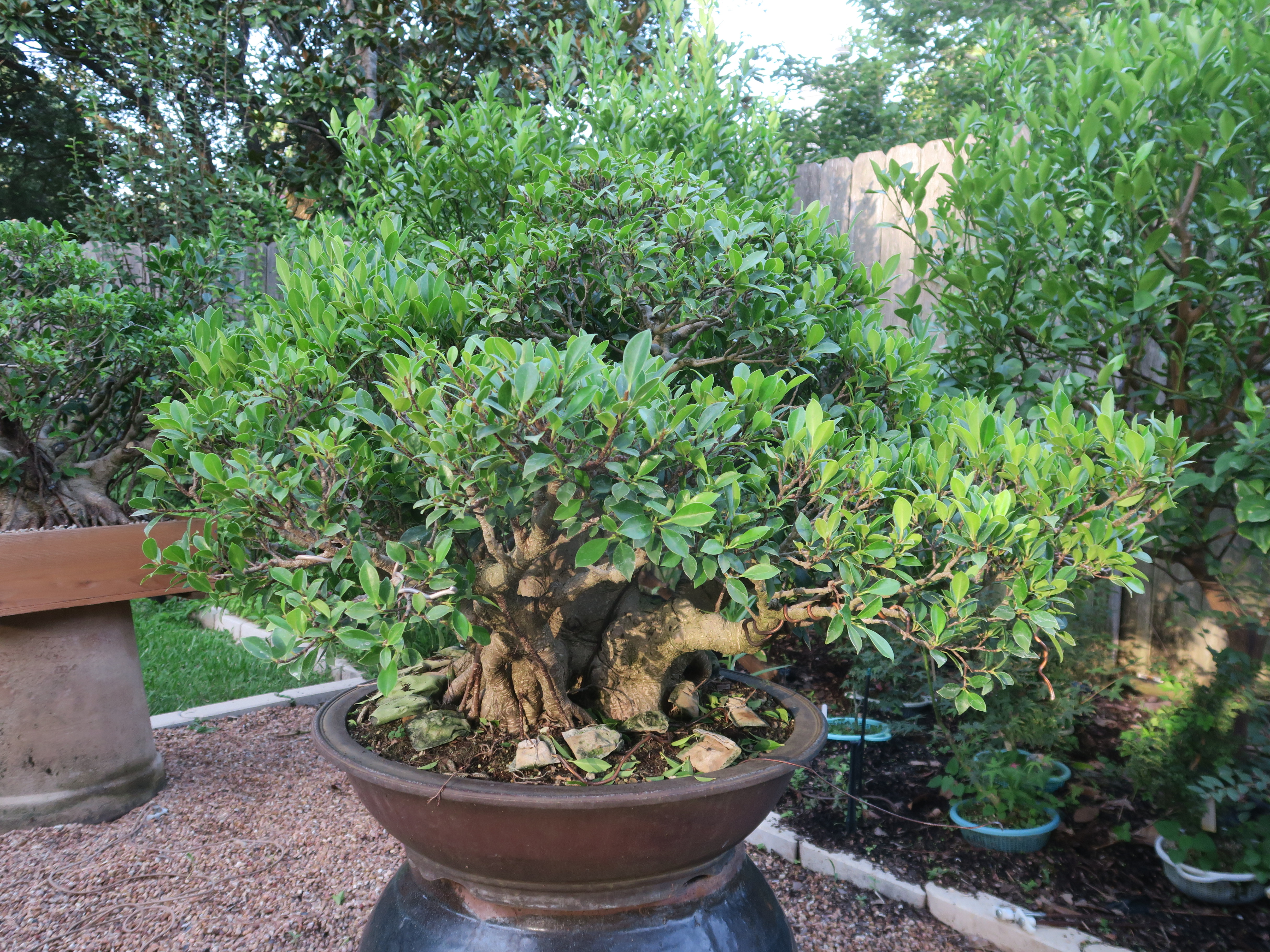
My ‘Tiger Bark’ ficus which won the Best Tropical Bonsai in the 2016 US National Bonsai Exhibitions.  The history of its training from a pre-bonsai was described in an older blog.

Min Hsuan Lo gave a short description on the discovery and naming of Kinmen (Tiger Bark) ficus in his book, “Bonsai Journey”.  Since it was written in Chinese and not many ficus enthusiasts in the West read Chinese, I will retell the story with explanations on related Taiwan history and background.

re'si'zebonsai-journey-min-hsuan-lo-cover

This cultivar was discovered in the 1970s by a grower in southern part of Taiwan, and was named after the grower’s nickname, “Kim M’ng”, which means blond or golden hair in Taiwanese dialect for his blond hair.  I do not know whether he is a natural blond or not; the Dutch colonized southern Taiwan from 1622 to 1644 until they were driven out by the Ming General, Chen Cheng Kong.  To this day, blond hair occasionally show up in family members of mixed Dutch and local descendents.

When the Communists took over mainland China in 1949, the Nationalists retreated to Taiwan; military confrontations continued for many years especially in the Nationalist controlled group of small islands, called Kinmen in the Taiwan Strait.  As Kinmen is literally across from the City of Xiamen of mainland China, it became military important and was heavily fortified.  Three battles were fought over Kinmen between 1949 and 1958, but ended in stalemates.  Both sides settled upon a routine of bombarding each other every other day, i.e. I fired on you on odd days and you fired on me on even days.  This ended in 1979 after the US established diplomatic relationship with the Peoples Republic of China.  Today the underground tunnels, bunkers and other military facilities are tourist attractions from both side of the Taiwan Strait.

Inkedkinmen map_LI with arrow

The island, pronounced, Kinmen (which means Golden Gate) in Mandarin Chinese, has always been called “Kim M’ng” by the local Taiwanese and Fujian people in the mainland, who speak the same dialect.  In Taiwanese, “Golden Gate” Kim M’ng sounds the same as “Kim M’ng” for blond or golden hair; the written Chinese name of “Kim M’ng” ficus thus became 门榕, Kinmen (official Mandarin Chinese name written in English) ficus.  I guess it would be awkard to write the new cultivar name as 金毛榕, blond or golden hair ficus.  To the Taiwanese speakers (note: not everyone in Taiwan speak the local dialect because the Nationalist government enforced the Mandarin Language Policy; students had to learn and speak Mandarin Chinese only, and were forbidden to speak local dialect in schools until 1987) ‘Kim M’ng” will always have the dual meanings, golden gate or golden hair, but the etymology might be lost over time. 

Now we know the origin and how Kinmen (Kim M’ng) ficus got its name, it is apparent Golden Gate (a direct translation of Kinmen, and it has nothing to do with the San Francisco Golden Gate Bridge), and the spelling variations of Kingman, Kimeng etc. refer to the same cultivar. 

What about the name Tiger Bark?  Since the newly discovered cultivar has conspicous white blotches and stripes in the bark of young trees, which look like tiger stripes, the name “Tiger Bark” ficus (虎皮榕) became a popular alternate name in Taiwan nursery trades.  The whitish stripes would fade in old tree.

Do ficus grow in Kinmen Island?  Of course, F. microcarpa grows all over Taiwan and Fujian Province.  There are many old F. microcarpa in Kinmen.  This travel blog has several photos of old ficus; they were cataloged with estimated age by the local Forestry Department.  Interestingly, the tattered name tag in the blog reads F. retusa, which, of course is wrong.  F. retusa grows in the Malay Archipelago, the name has long been misapplied to F. microcarpa and caused considerable confusions among bonsai enthusiasts.

Kinmen Island also has a Ficus Park, interestingly the outdoor war museum is right there too displaying tanks, big guns and aircrafts!

banyan and tank in kinmen 2
The stone behind a tank from the 1958 bombardments reads “Ficus Park” !

Unlike scientific name which follows rules set by the International Code of Nomenclature for algae, fungi, and plants (ICN), the meanings of cultivar and variety are often blurred and are used interchangeably in nursery trades and among hobbyists.  Strictly, they mean different things.  Plants grown from cultivar seeds are not true to type, whereas a geographically different variety can.

So among the many names of Tiger Bark, Kinmen, Golden Gate etc., which should we use?  If we were to follow the rule of priority, I think it should be called cv. ‘Kinmen’ or ‘Kim M’ng’ when the cultivar was discovered.  But as hobbyists, we call them by any name we choose to but just be aware that they all refer to the same cultivar.  This name variations occur only in the West but not in Taiwan because they are called either 金门榕 (Kinmen ficus) or 虎皮榕 (tiger bark ficus).

  •  

Two “Root-On-Wall” Ficus Penjing – How I Create This New Style

This article was written by Mr. Xuenian Han (韩学年), a well-known Lingnan penjing master. It was published in Mr. Shaohong Liu’s (刘少红) “The World of Penjing(盆景世界), the most widely read online penjing magazine in China with over 135,000 subscribed readers. Both Mr. Han and Mr. Liu gave me permissions to translate this article and share it with English readers on how this new style was developed.

IMG_0011
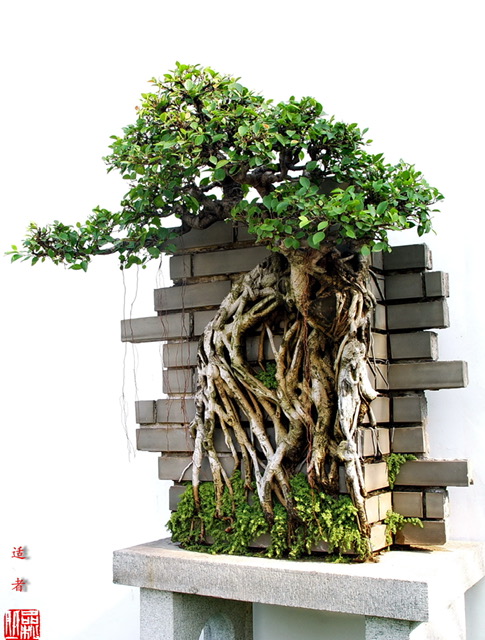
“The Fittest”, a “root-on-wall” ficus created by Mr. Xuenian Han. 韩学年作品《适者》(附壁榕)

Ficus microcarpa is a native tree species in the Lingnan region. As a fast growing tree and an ability to grow in a broad range of habitats, it is widely cultivated in urban and rural areas. In the Pearl River Delta, especially in villages and towns along the river, banyan trees with broad canopies provide shades and are popular with villagers, where they could gather and cool themselves during the hot summer days.

Ficus has large, powerful tree trunk and wide spreading, old gnarly roots. Since Lingnan penjing practitioners often model their trees based on close-range observations of how trees grow in nature, thus, the Banyan style was born. Ficus is a popular species for Lingnan penjing, whether the material is field grown or collected, key banyan features are artistically recreated and portrayed in a grow pot. There are many excellent examples of banyan style penjing.

IMG_0005
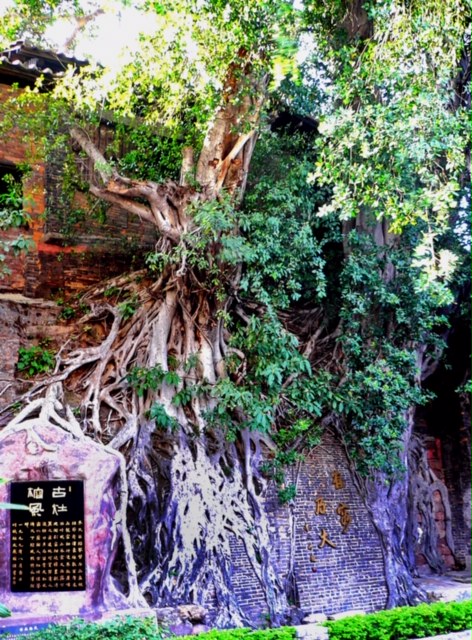
Ficus growing on the old Nanfeng kiln wall in Foshan city, Guangdong. 佛山市“南风古灶”古榕

Ficus have aerial roots, when these roots touch and anchor themselves onto the ground the tree would continue to grow outwards, creating a forest-like image even though it is just a single tree; and this is the familiar banyan image.  Since ficus is a strong survivor and adapts to myriads of environments, there is another tree form from which these two “root-on-wall” penjing were based upon, and I will discuss how I created them.

IMG_0006
An old ficus growing along a river in Shunde, Guandong. 本地(顺德)一河边古榕

Figs are eaten by birds, and their seeds are scattered via bird droppings. If such a dropping were to fall into rock crevices or cracks in walls, they would root and grow when the surrounding humidity is high, and aided by rainfalls and fogs. They take roots in buildings and houses. These roots are very destructive and are usually removed. However, in some out of sight or abandoned corners and crevices, their presence is tolerated or ignored, and they eventually grow into trees that look different from the typical banyan.

IMG_0007
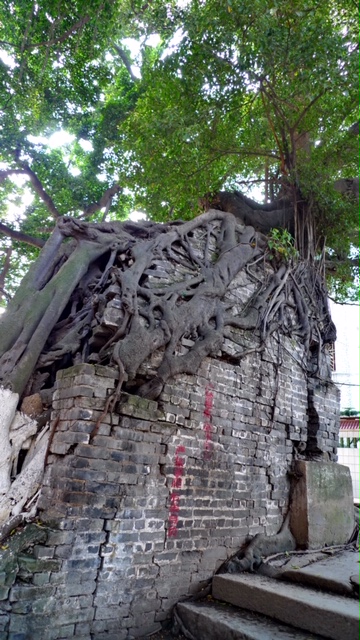
An old ficus on the wall of the old Shajiao fort ruin, Dongguan city. 东莞市沙角古炮台古榕

Under these adverse conditions, such ficus does not grow into a large tree as its priority is to send out roots seeking for nutrients and to anchor itself onto the surface it is growing on. These roots criss-cross each other, sometimes bulging out from the wall, sometimes burrowing deep into the crevices. This creates a tree form which the locals called, feirong, 飞榕, literally means a Flown-in or Flying Ficus.  (Translator’s note: It is so called because the seeds were dispersed by birds. In this translation the local description, feirong, is used to retain the vernacular flair of its Cantonese origin).

With the passage of time and as the substrate deteriorates, feirong continues to thrive, a testament to its tenacity to survive. It is a natural selection at works, survival of the fittest. Feirong can be found in several prominent tourist spots, such as the ancient ruin of the Hujiao Shajiao Fort; the Qing dynasty city wall ruin in Lianhua, Guangzhou; the 500-year old Nanfeng Ancient Kiln in Foshan, etc.

IMG_0008
A “root-on-wall” ficus on the Lianhua City wall in Guangzhou.

Sights of feirong clinging onto walls are quite common in our region. In the long history of Lingnan penjing, there is never a penjing created based on a feirong image. In my penjing pursuit, I often put on thinking hat and sometimes come up with crazy ideas like: “Can I recreate this unique and beautiful image of a feirong in a penjing?”

My inspiration came in 1987 when I saw a Chinese ink brush painting in a “Guangzhou Literature and Art” magazine; it depicted a group of old, gnarly but vigorous growing ficus clinging firmly onto a dilapidated wall. This black and white painting captured the survival spirit of a ficus,  a stark contrast between a broken wall and the powerful roots, a familiar and ubiquitous scene in our region.

IMG_0009
A 1993 photo of my “root-on-wall” ficus, the “Survivor”. Five years after it was created.

This painting inspired me. Although there is already a root-attaching-to-rock style penjing (translator’s note: this is not a root-over-rock style frequently seen in bonsai, this penjing style has either one or a few long, thick roots growing along a tall stone, plunging from the top of the stone to the bottom of the pot), none captured a feirong. I thought it would be a break-through if I could create such a scene in penjing. However, I was not sure how to proceed with it, whether it would be possible or not, and sometimes doubts if I could succeed? Those thoughts swirled in my head. There was no physical penjing model I could copy from, I just kept on thinking.

IMG_0013
A top view of the “wall-pot”.

What is penjing? It is a visual art of growing artistic looking tree in a pot which primary function is to serve as a carrier for the tree. Without a pot (pen), would I be able to call it a penjing, a “potted scene”? Feirong has to be on a wall, not in a conventional pot. But I needed a wall which could also function as a pot. It had to look natural and aged, able to bring out the spirit of a feirong and at the same time allowed it to grow. The design required out-of-the box thinking and creativity.

Traditionally we think of “tree, pot and stand” as integral parts of penjing, and in that relative order of importance. In this case, I reversed the order, putting pot (container) first, then the tree, and lastly the stand. My priority was to make a functional “pot”; if I could do that half of the battle was won, I only had to find a suitable ficus to grow on it.

IMG_0004
Exhibited for the first time in the 1997 Guilin Penjing Show.

I was building my house in early 1987, and was decorating the walls with reproduction antique ceramic tiles. Suddenly it donned on me I could use these tiles to make the “wall”! I went ahead and made a cement wall with a trough at the back according to dimensions of the tiles. After plastering the tiles onto the cement wall, a jagged “wall” was completed. This was the first but important step in this creation process.

IMG_0012
The roots on wall showed prominently after defoliation, 2007.

After the completion of the wall-basin, I found a ficus tree I had, reduced its height to just above the lower section, made a hole in the wall and planted the ficus. A year later, the planting took shape but far from what I envisioned. Although more growing years were needed, it was, nevertheless, my second milestone in creating a feirong penjing. Although exposed roots is the most important part of a feirong penjing every trunk and branches have to be carefully grown in proportions. The “root-on-wall” feirong took shape 10 years later, I named it the “Survivor”, and exhibited it for the first time in the 1997 “Hong Kong Cup” Bonsai Exhibition held in Guilin, Guangxi.

IMG_0014
The “Survivor” root-on-wall ficus. 韩学年作品《生存》(附壁榕)

In the “Survivor”, I used a tree that was originally trained for other purposes. Although it developed exposed roots, they were not as powerful and tenacious like those seen in a naturally occurring  feirong. Therefore, the “Survivor” can only be said to have a feirong look, but lacked its struggling, tenacious life force.

IMG_0015
1998, Year 2 of my second “root-on-wall” ficus, named “The Fittest”. 《适者》附植的第二年(1998年)

In 1997, a penjing friend told me he saw a feirong that might be suitable for a “root-on-wall” penjing. He brought me to where the tree was growing. It was a dormitory building marked for demolition. This ficus grew close to a ditch and was lush green; the wall was covered with roots running in whichever directions they chose. By coincidence, a resident of this dormitory was my former colleague, and whe told me this ficus had been growing there for more than 20 years.

CC274B4F-F9C1-4BE4-9268-BE6123E24268
In 2000.

I studied and committed this material in memory, a new design began to congeal to feature the root base prominently. I then built a wall specifically for this tree. In the “Survivor,” I built a wall-pot first, found an ordinary ficus and force-fitted it onto the wall; looking back the result was barely satisfactory. This time, I found a feirong tree, and built a taller wall-pot to accommodate and show off wits spreading root system. My second attempt of a “root-on-wall” ficus was done in reversed order.

IMG_0017
In 2002.
971953E7-650C-42CF-8D7D-ED01189E466C
Exhibited at the 2006 Chinese Penjing Exhibition at Quanzhou, Fujian. 参加泉州第六届中国盆景展览(2004年)

After about seven years of cultivation, I succeeded in creating my second feirong “root-on-wall” penjing. It was a step forward, it was a much better looking penjing, meeting my expectations more than the first “Survivor”. I called this second creation, “The Fittest”, and submitted it to the 2004 6th National Penjing Exhibition held in Quanzhou, Fujian.

These two works, the “Survivor” and “The Fittest” were inspired by a natural occurring landscape.  The processes in creating these two feirong fulfilled my dream during my long penjing journey.

IMG_0011
“The Fittest”, a “root-on-wall” penjing by Mr. Xuenian Han. 韩学年作品《适者》(附壁榕)

  •  

Why Do I Repot a Big Ficus From a Ceramic Pot into a Wooden Box?

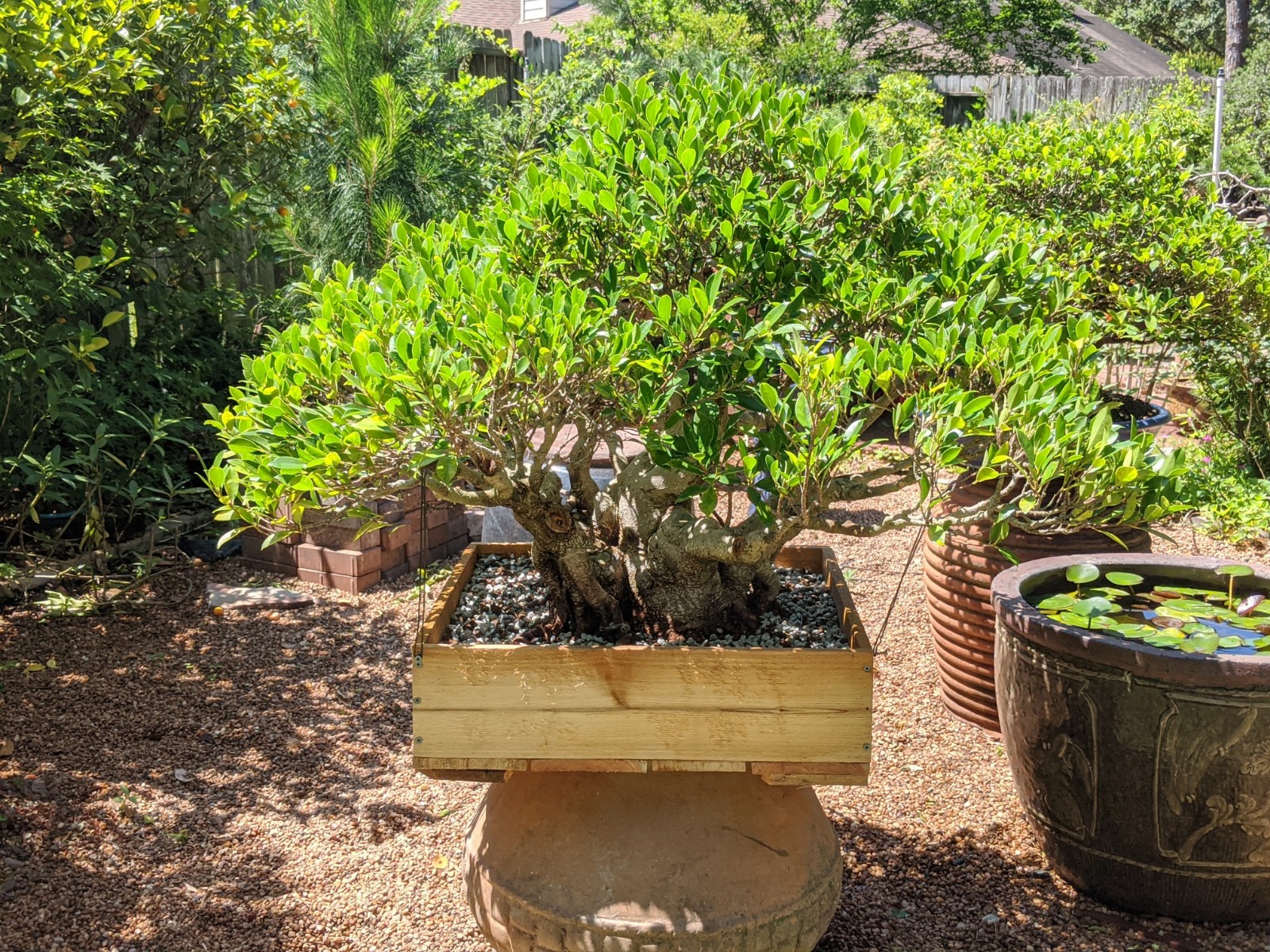
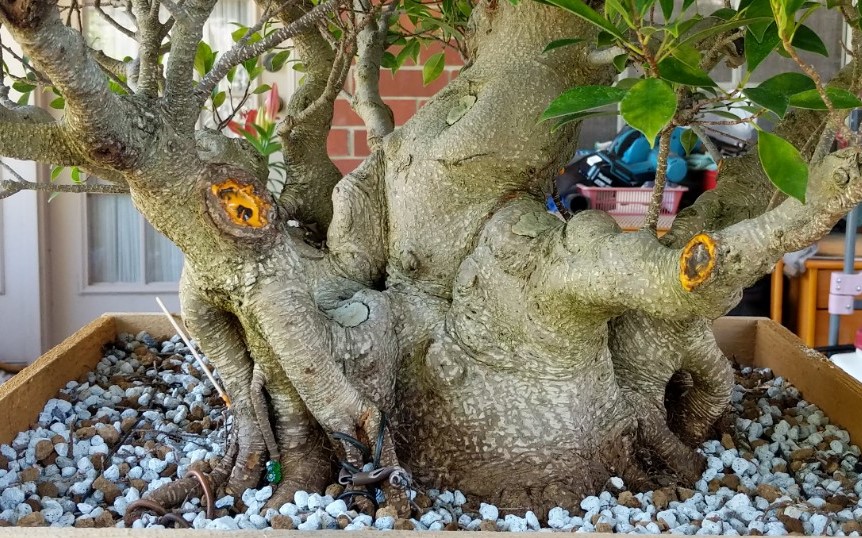
This Ficus microcarpa was potted into a 24″ round ceramic pot in 2015. By 2018, it needed repotting again but I procrastinated and did not do it in 2019 either. I finally repotted it a few days ago, but into a wooden box.  I jokingly said it was because I needed to reduce the overall weight. That is true but there are more important horticultural reasons repotting it into a wooden box, like rejuvenating the roots, regaining the tree’s health, and working on the overgrown aerial roots and nebari.

20150504_195613
Potted into a 24″ round ceramic pot, May 2015.
IMG_8165
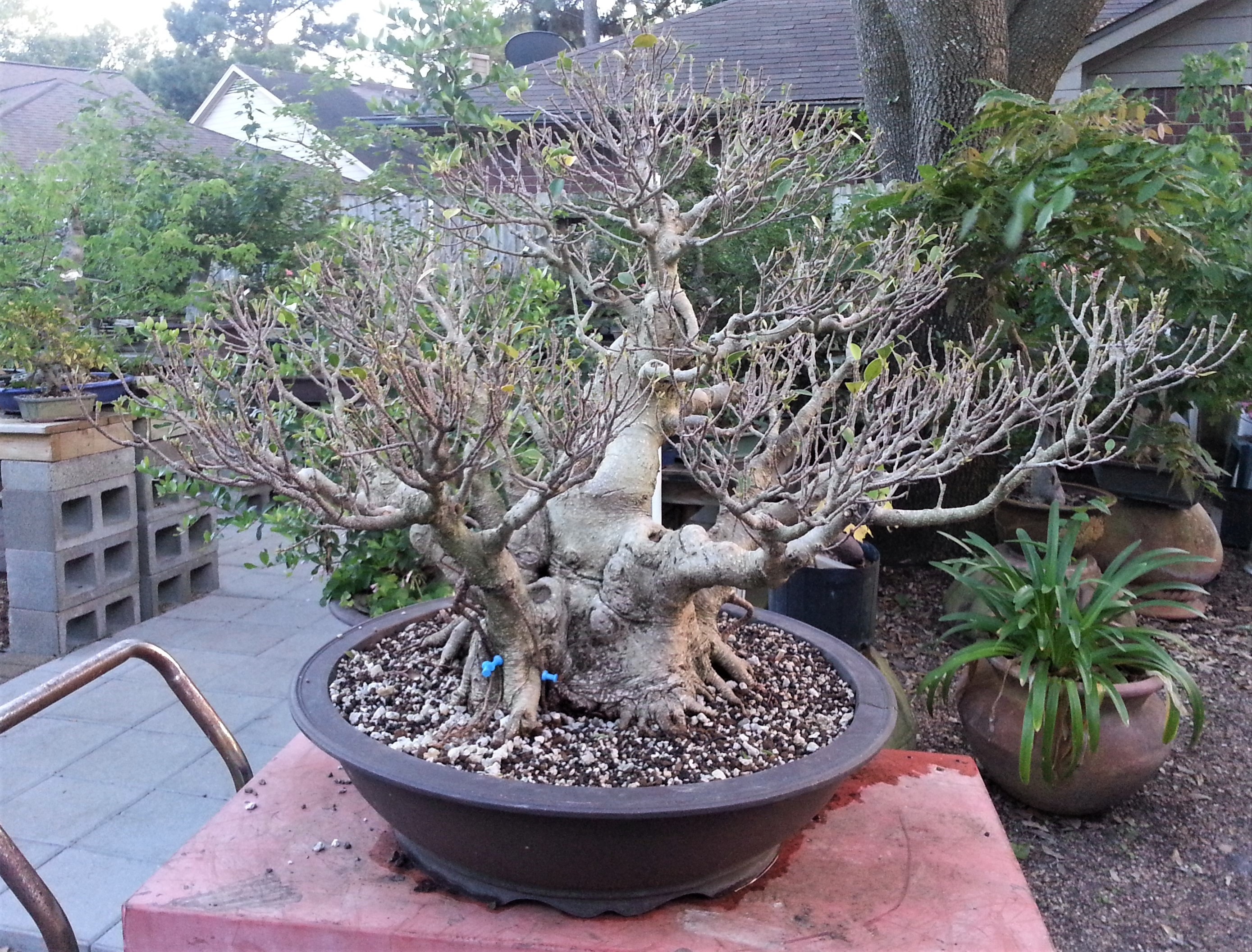
July, 2018. Ready for a repot but did not do it.

Why Use a Wooden Box?

To restore a bonsai’s health, it is a good idea to repot the tree into a slightly larger container, preferably in a terra cotta pot, a wooden box or a Styrofoam box.  A slightly larger container provides more soil volume and extra rooms for the roots to rejuvenate, increased surface areas between soil aggregates also allow the roots to breath better and grow more fibrous roots.  A cedar picket fence wooden box is an obvious choice since I cannot find a larger terra cotta pot or a big Styrofoam box. Although the latter can protect the roots from over heating during our intense summer heat, it is too glaring and stands out too much among the other trees, unless I could paint it.

00000IMG_00000_BURST20200511113952392_COVER (1)

As for weight, the 24″ ceramic pot weighed 32 lb., a comparable wooden box weighed about 5 lb.  I made a rough calculation, this round pot with tapered wall has a volume of about 1,100 cubic inches (about 18 L.), a square box holds almost twice the amount of soil.  Your tree will thank you for the extra room while in recovery.

Reworking Overgrown or Thickened roots

Aerial roots are great for improving the tree’s nebari, but they can become too big, crisscrossed or grew in unintended direction if one is not diligent in controlling and incorporating them to the intended design.

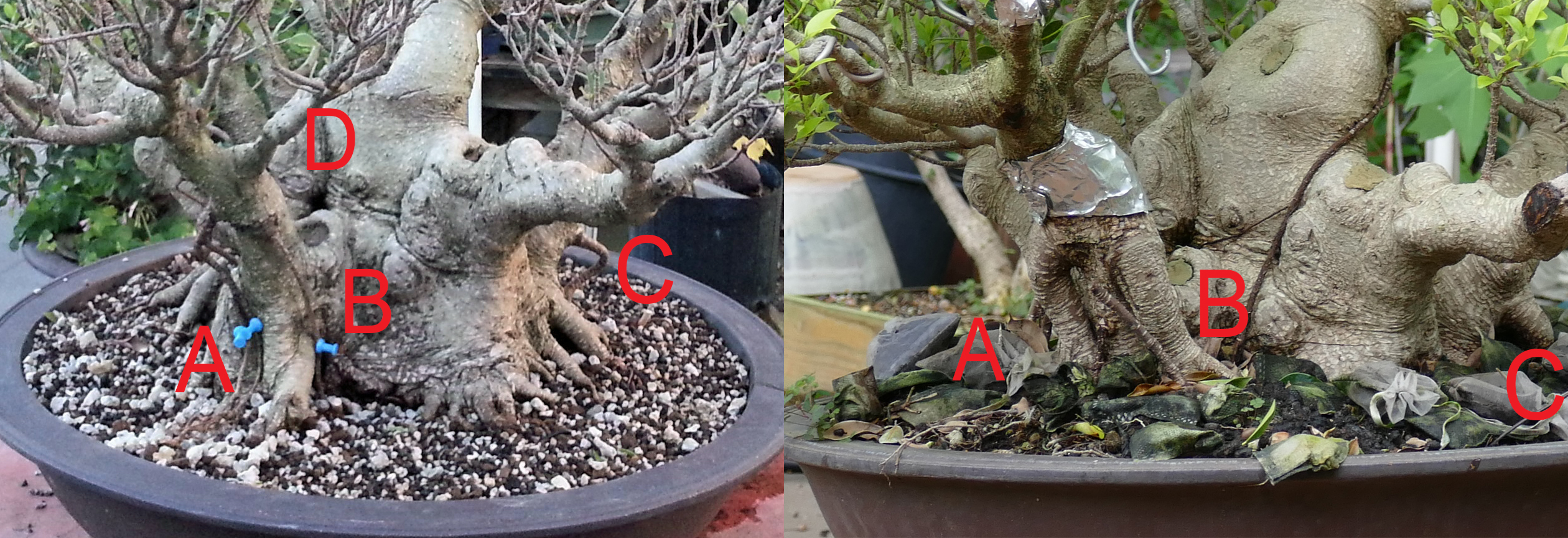
These two photos show how the skinny grafted aerial roots grew in 4 years without repotting in between:

Ficus composite 2
Grafted aerial roots A, B and C in 2015 and 2019. Branch D was removed as it was sticking too much towards the front.

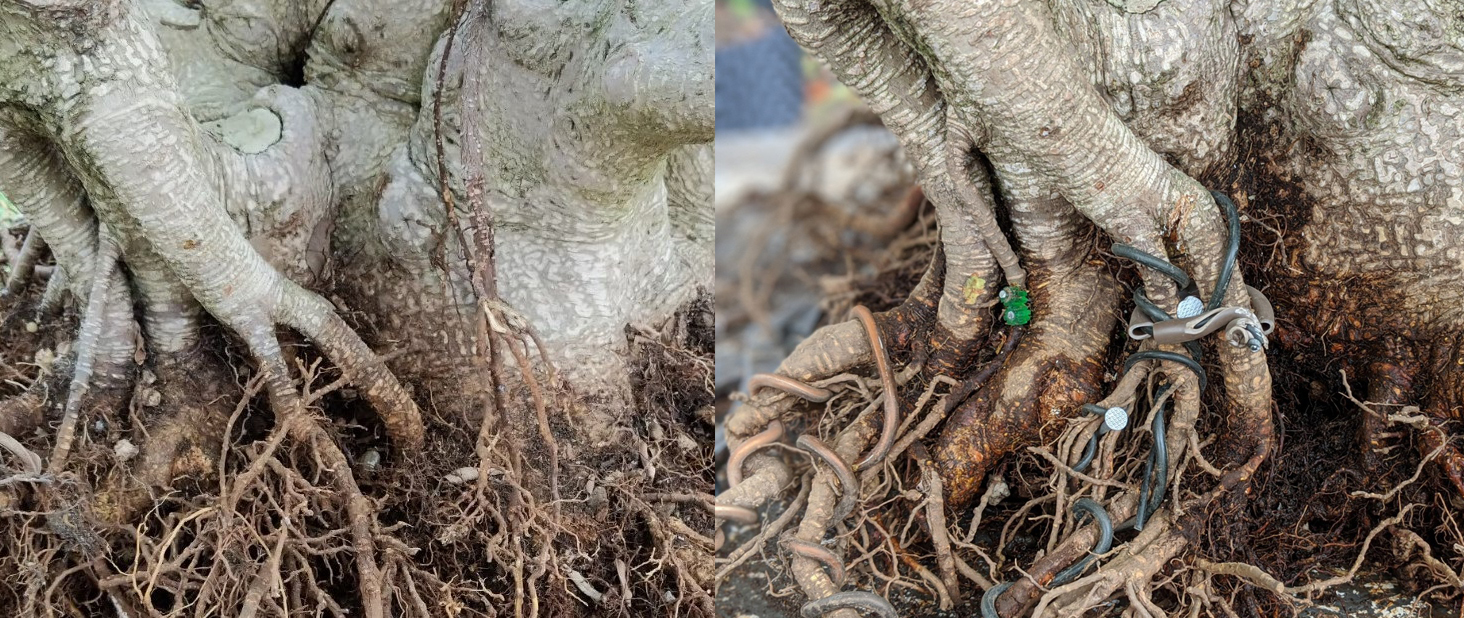
These grafted roots needed repositioning and incorporating into the nebari:

Ficus root work IMG_20200508_183513 copy
Repositioning thicker roots using aluminum wires and tourniquet.
Ficus cross root IMG_20200509_133046
Crossed roots repositioned, once fused, the top sections will be cut off.

Exposing More of the Nebari

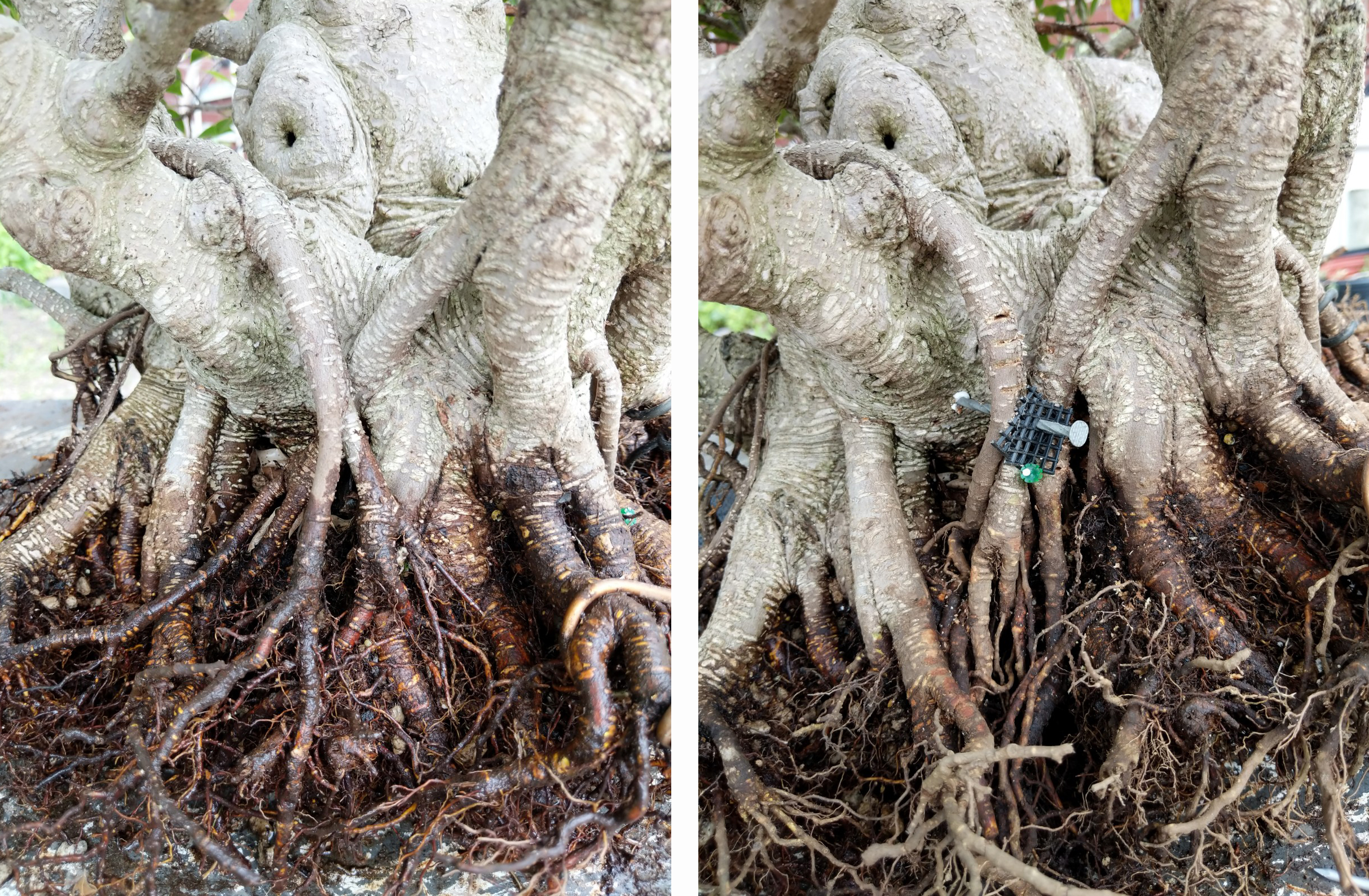
Every time I repotted, I raised and exposed the nebari by about 1/2”. This time I raised it by about an inch. Exposing it gave the tree a larger nebari in each repot.

Ficus raised nebari IMG_20200510_144855 (2)
Root base raised by about an inch, shown by differences in tree bark colors.

Another advantage of using a wooden box is I could easily put in a few screws on the box to attach guy wires to bring down branches.

  •