My job has, over the years, developed into something more of a lifestyle than just being what I do to pay the bills. Part of that job these days entails putting myself into the public domain. For a socially retarded carrot cruncher from deepest Norfolk with a bit of an attitude and an old school opinion on everything that’s definitely not a comfortable place to be. I get a lot of emails and telephone calls asking for advice on the cultivation of bonsai and many of those leave me dazed, confused, baffled and even angry. The level of ignorance often leaves me shouting at my screen though I do my utmost to help where I can.
“Open your eyes!“
Professionals everywhere, it appears, are often exasperated at the ignorance of their customers. I spend most Saturday afternoons loitering around my mates motorcycle workshop where the endless topic of conversation revolves around events of the proceeding week including great long and detailed recounting of, to us, hilarious tales of ignorance and stupidity. Sadly these days few folk understand the intricate workings of a motorcycle and as a result endanger themselves and those around them. When they come into the workshop for help my very experienced mate can tell instantly wether he is dealing with an experienced and knowledgeable rider bestowed with mechanical integrity or a total numpty. He and I both have an intolerance of fools.
Now before you go off on one let me say, we were all ignorant once and that’s okay. When I was little I wore nappies because I didn’t have sense not to crap myself. However in time I learned what to do, jettisoned the plastic pants and so these days I rarely crap myself. There’s no shame in ignorance, but to remain ignorant is largely unforgivable. These days there’s absolutely no reason to be in ignorance regarding much of anything at all. The internet places almost the entire canon of human knowledge and experience at our finger tips so how can anyone be in the dark about anything?
Of course the issue, as I have said many times before, is that we allow literally any WAF* to publish stuff online. Nobody has to prove their qualification, experience or understanding on a subject before they go posting their two penn’orth. Allow me the bandwidth to recount a tale I read once on a Jaguar (car) forum. The guy concerned had purchased a repossessed Jaguar from an auction. However he could not get it to run in anything other that limp home mode. This was a nice car in good nick, not an old beater. Having tried the obvious he started posting questions online and a whole host of what turned out to be WAF chipped in with their opinions.
This was, as much as it does not sound it, a fascinating example of my point and I sat here and read pages and pages of posts. Over time and at the behest of many armchair mechanics the guy started spending money on things like plugs, coil packs, sensors, fuel pumps, filters and an array of ‘black boxes’. This being a V8 there were a lot of parts and soon the bill reached several thousand pounds. Because nothing worked folk then started to question the quality of his replacement parts. After a year (yes seriously) he still had a limp home Jag’. Eventually he took it to the authorised Jaguar dealership in trepidation, expecting a bowel loosening bill at the end. An hour later the dealer called him and said it was all fixed. The bill was under a hundred quid. Simple fix, a new transponder in the key just needed matching to the cars security system. A moments job with a laptop. Because the car had been repossessed the bailiffs had towed the car without keys, they got new ones but never programmed the car to recognise them.
This illustrates the importance of two things……
Ask the right questions. (Spare us you opinions)
Ask the right people. ( Sizzle or sausage?)
Of course in our relative ignorance of a situation it’s not easy to hit these points. A little knowledge informs us that perhaps things just ain’t right but who to ask? Is a self proclaimed expert really an expert or just someone who talks a lot? Go into my mates bike shop and ask the wrong question and he might throw you out the door on your ear. A few weeks back a youngster came in on his little 125 and asked for a new tyre. When asked what size he said “ I don’t know, you got a tape measure, I’ll go measure it.” He got chucked out right there, no tyre and no explanation. That just proves ‘the customer’s always right‘ to be a crock of shite. My own approach to customer service and education is perhaps a little more generous…. sometimes.
Trying to keep your end up. Sounding smart, intelligent, informed, knowledgeable or experienced in front of a genuine expert is a fools errand and best avoided. My own approach is always to plead ignorance and ask for help. I then listen hard, accept and act accordingly. In many things I have a little experience but with the exception of bonsai and motorcycles i’m no expert, and even then I have more to learn than I currently know. In general experts are happy to share what they know when approached with respect. However phone a guy at 10pm when he’s half cut and start spouting off about what you know and who you know and how brilliant you are or waste an hour of a guys time right when he’s insanely busy and you can justifiably expect a metaphorical bleeding earhole.
I could go on about this ALL day. These things ARE important but sadly ‘social’ media has given a lot of folk a sense of entitlement when approaching knowledgeable folk. Seeing as it takes a minimum of 10,000 hours relentless practice to master even a simple discipline we should respect folk who have put in the hours and be very grateful for any help. Keep questions short and to the point, refrain from trying to ingratiate oneself into favour and listen to the answer. Then offer sincere thanks, be polite and finally offer to send lots of free money. Experts have spent a lot of their lives learning through great effort and sacrifice and it’s the height of disrespect to simply expect to receive the benefit of their hard earned wisdom just because you feel entitled and that’s all I have to say about that.
So in relation to helping folk ask the right question of their chosen expert, and this relates to most things……
Open Your Eyes!
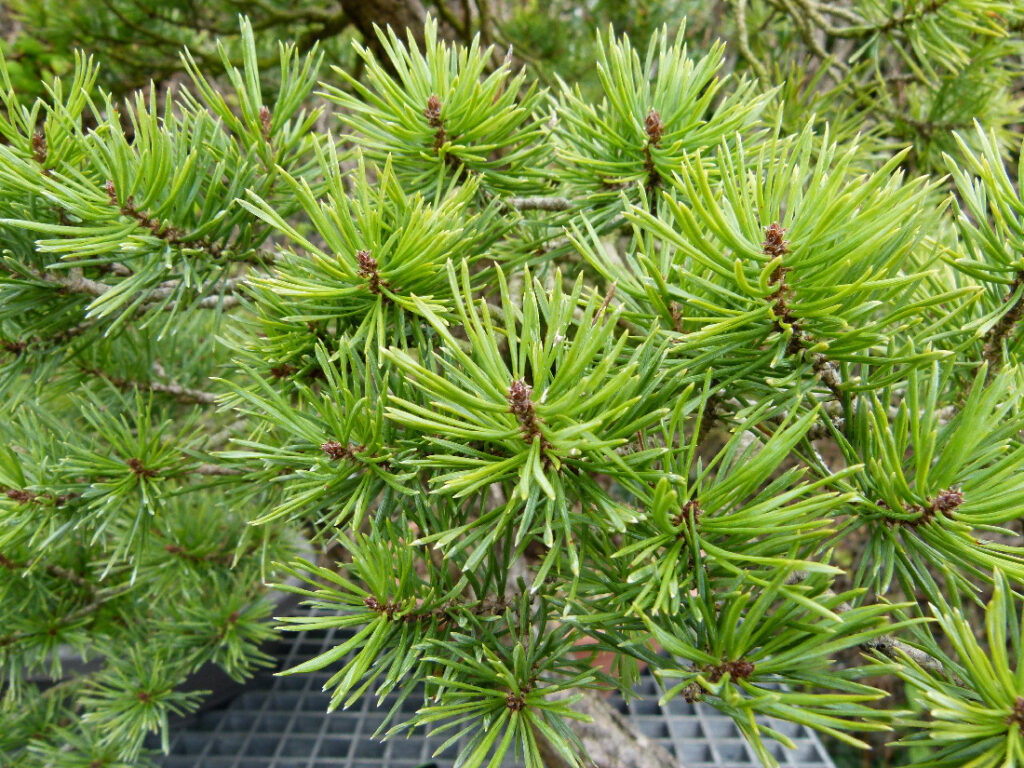
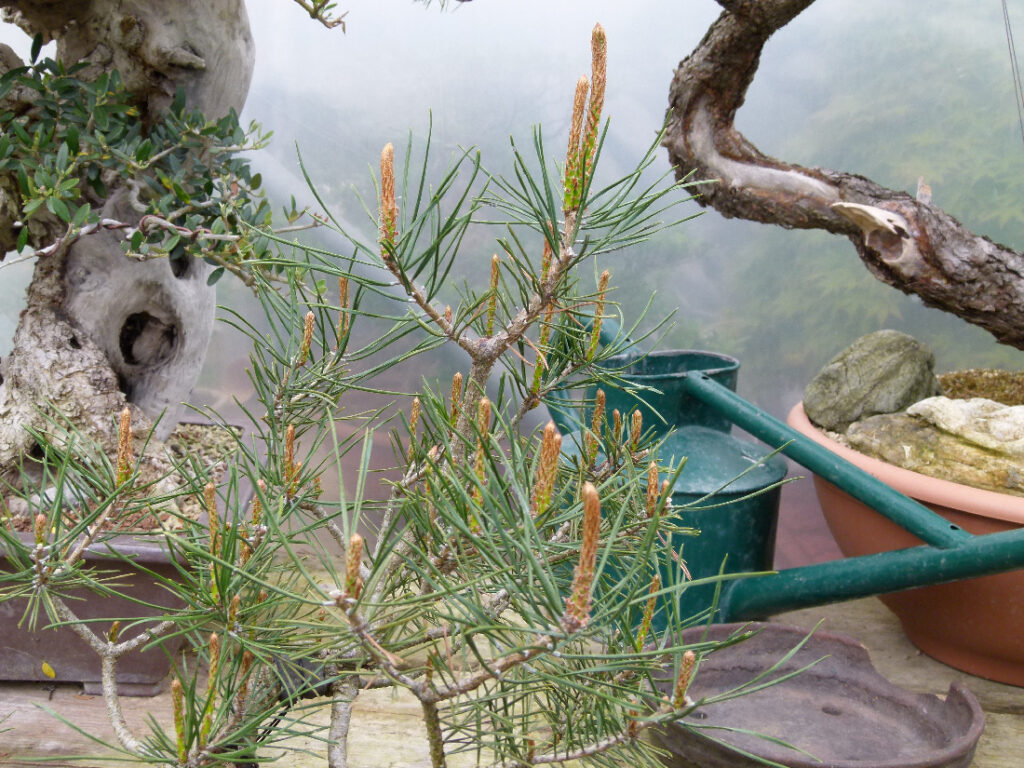
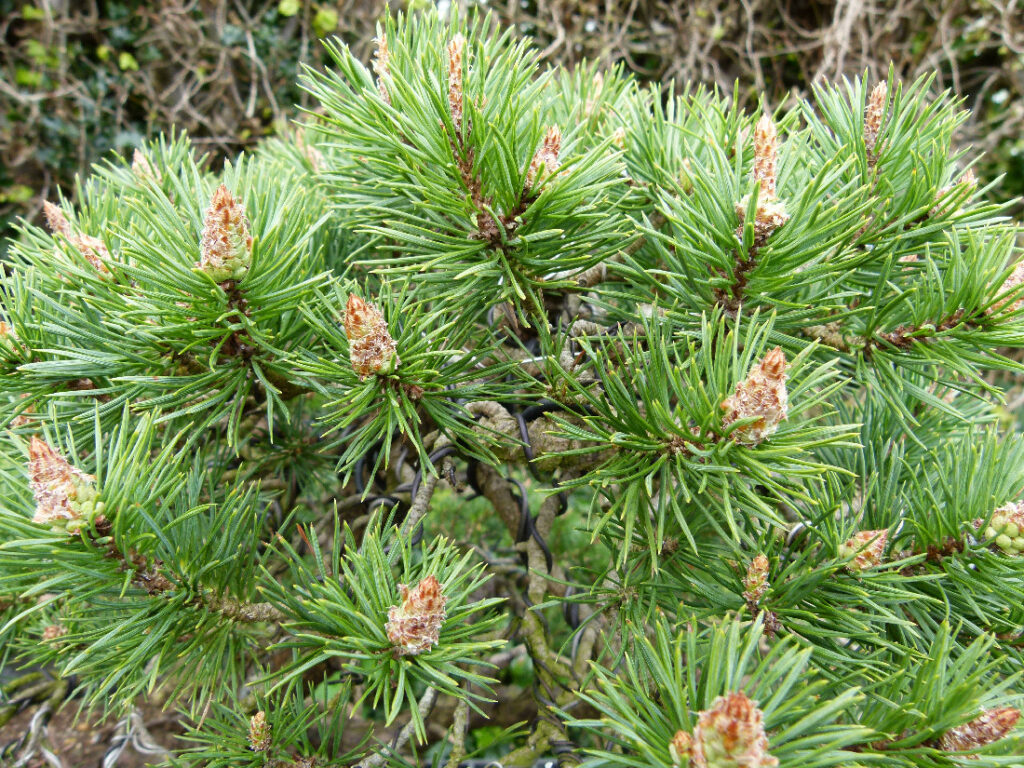
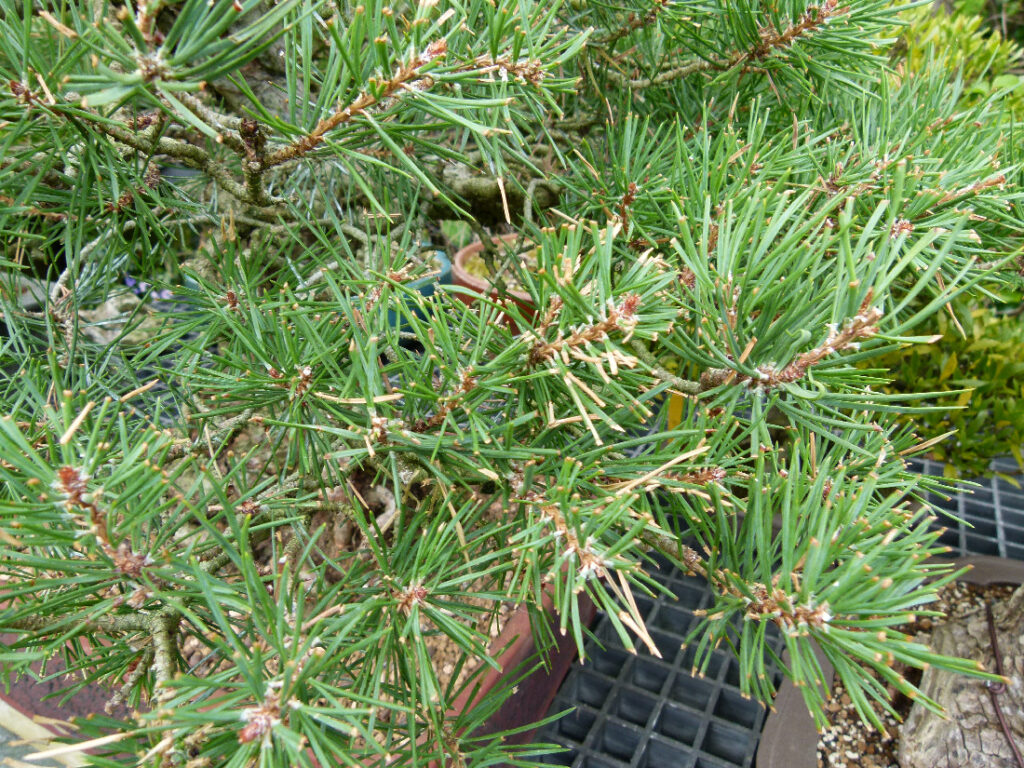
Let me offer the following example. It’s early spring and today is sunny and warm, the first day of the year to be so. Walking amongst my trees at first light today I noticed something about all the scots pines (pinus sylvestris). Some are still asleep, some are waking up and some are romping away. Thankfully none are dead! So why are the trees all at different stages considering they are all outside in the same yard? Overall the answer is VIGOUR. A strong tree will be raring to go in spring and with all it’s ducks in a row will begin growth early but the old tired sad sack of a tree that’s been neglected or abused will not.
My advice has always been do not go to the internet for answers before you Open Your Eyes! See what you are looking at and think it through. For this you need some peace and quiet both externally and internally. That’s why I was outside at 5am and that’s why I smoke stogies. Some significant skills lacking in a few folk I speak to are focus and an ability to shut up. Put simply there is just too much noise out there. To make great bonsai we need focus, focus, focus, quiet, quiet and more quiet. A lot of the time we instinctively know the answers we seek but learning to extricate what we need is, yet again, something we have to learn by working at it.
So here are a series of photographs, all taken this morning, of scots pines in my garden. I have put a few notes alongside each to explain what’s to see. Notice these go from absolutely no movement whatsoever to displaying significant early season growth.
Enjoy!
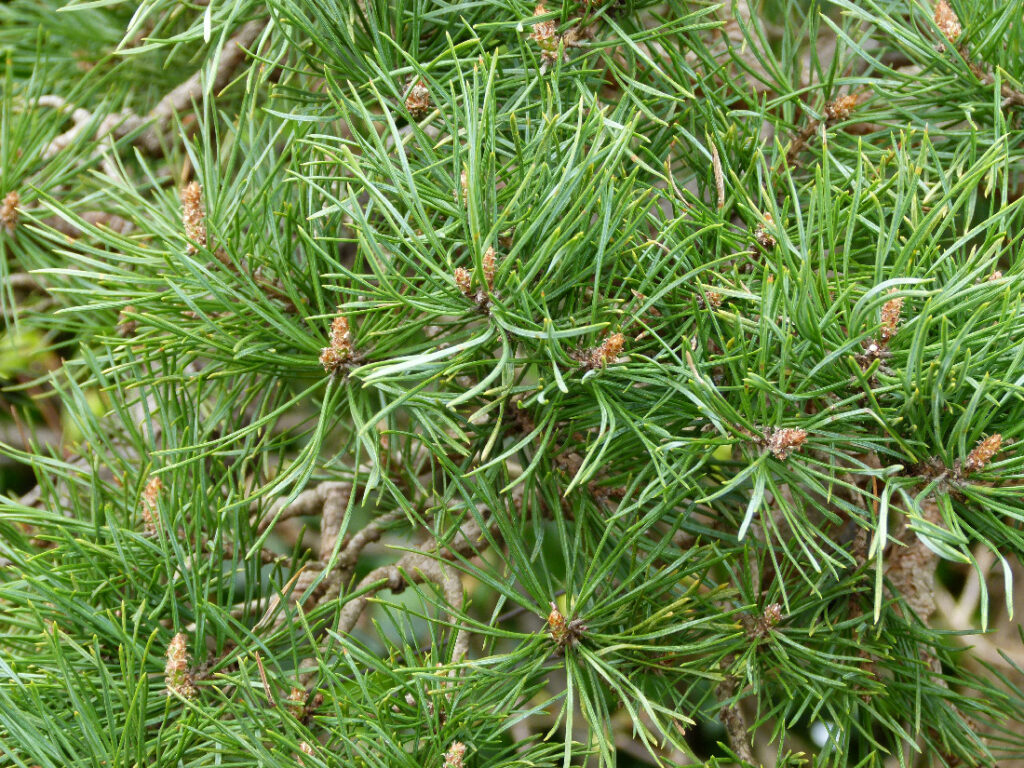
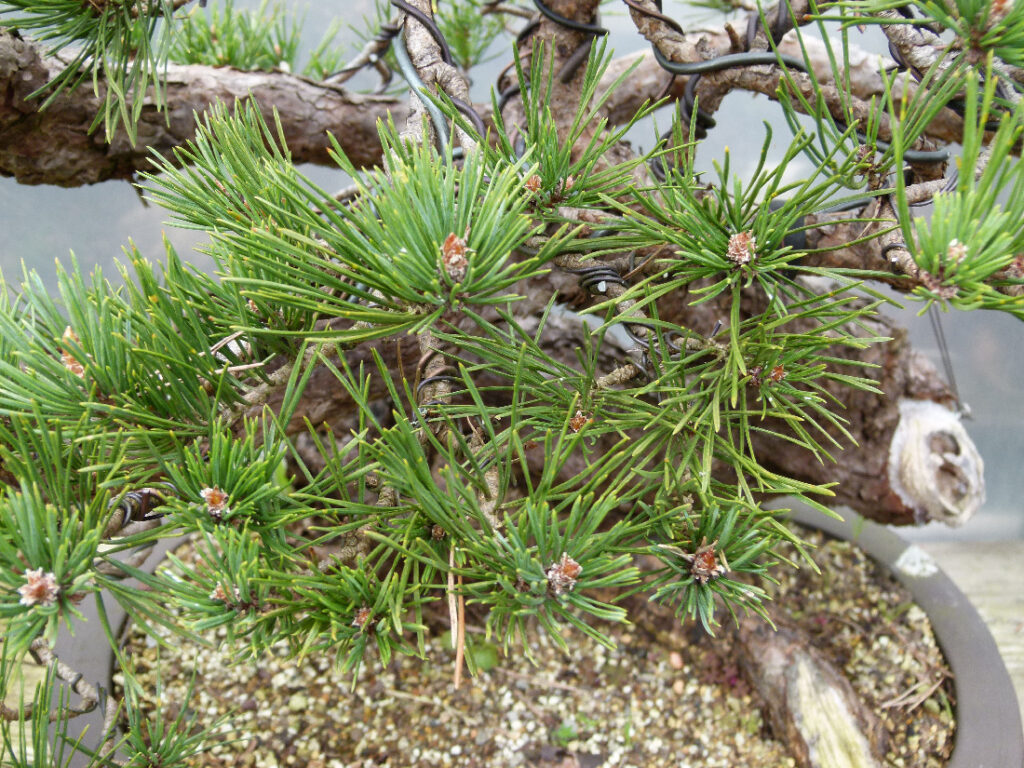
No movement whatsoever, small buds and poor colour. Long neglected tree in dire need of repotting and good cultivation to restore vigour over the coming years. Too early to repot. Unresolved this tree will become even more leggy and begin dropping branches. It’s a customers tree 😉
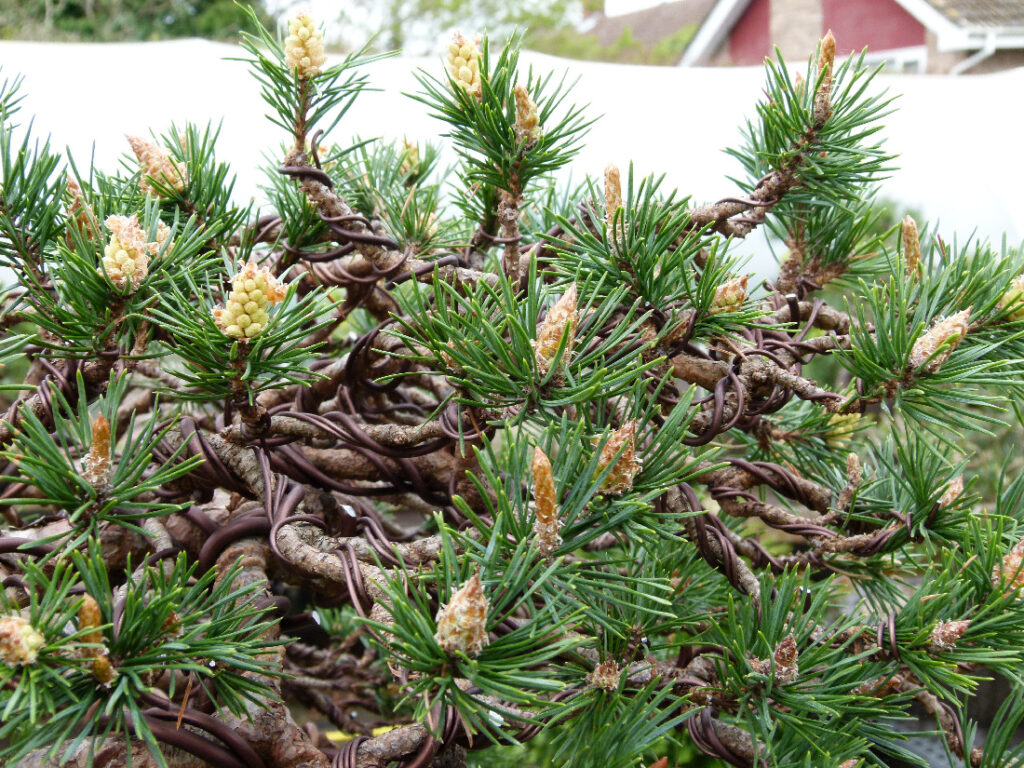
Strong early candle extension and significant back budding. This tree was previously weak following excess pruning and the use of a shallow bonsai pot years too early. Following work to restore vigour this tree is on an upward trajectory.
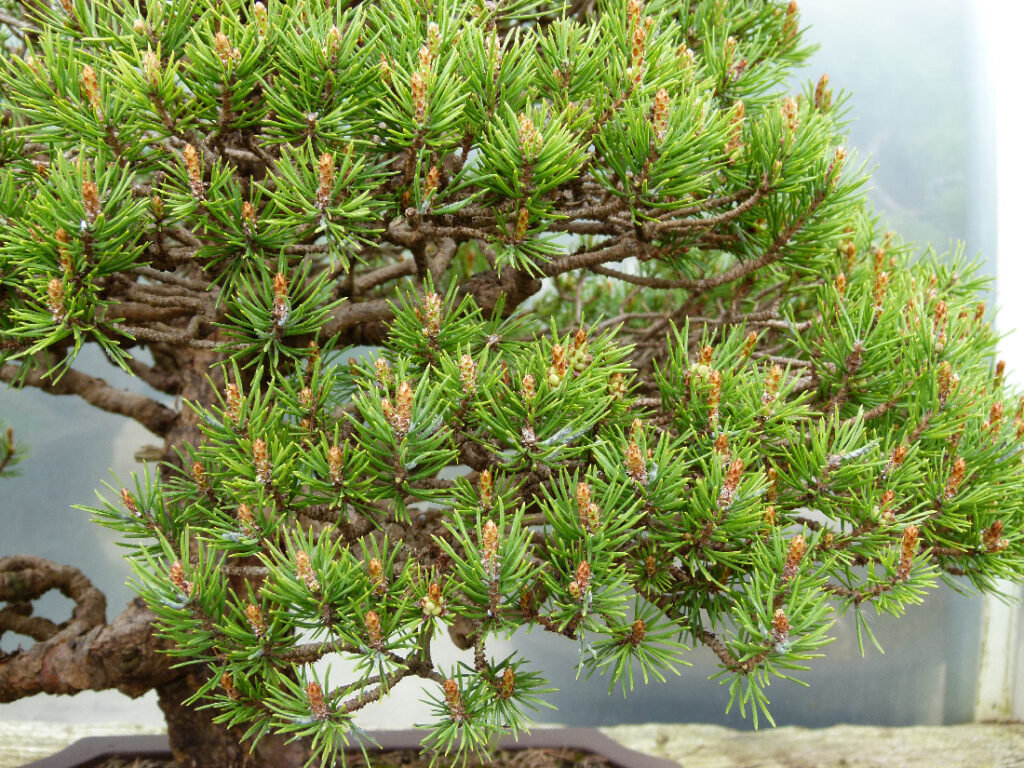
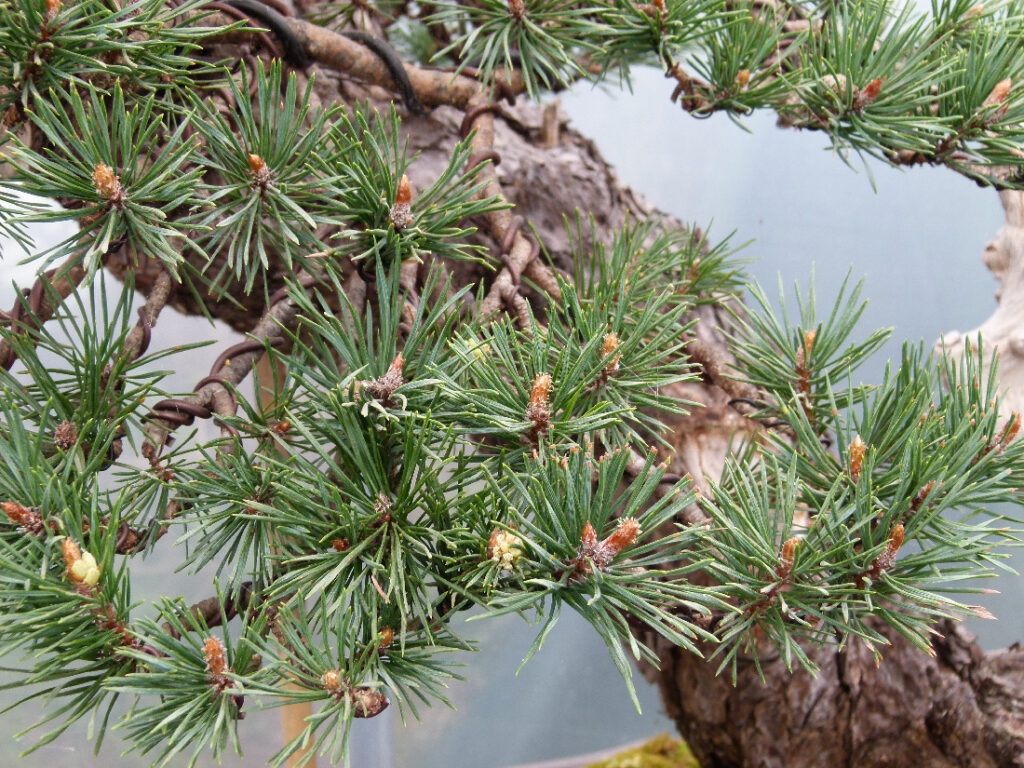
Nice even growth of good colour. Good consistent needles that are not too small, early season activity and lots of flowers show this tree is strong which is just as well as it has a good way to go yet. Top to bottom the growth is the same indicating good balance. Lots of back budding thanks to high vigour and correct pruning.
Incorrect pruning has weakened this tree and resulted in overly large needles that have been cut further weakening it. ‘Work’ has been done to reduce needle size but that’s inappropriate for this tree which still needs significant development of it’s secondary branch density.
Recently weak but recovering. Nice even growth and bud formation. This years needles will be much better than last. This will need a re-pot next year to keep progress moving forward.
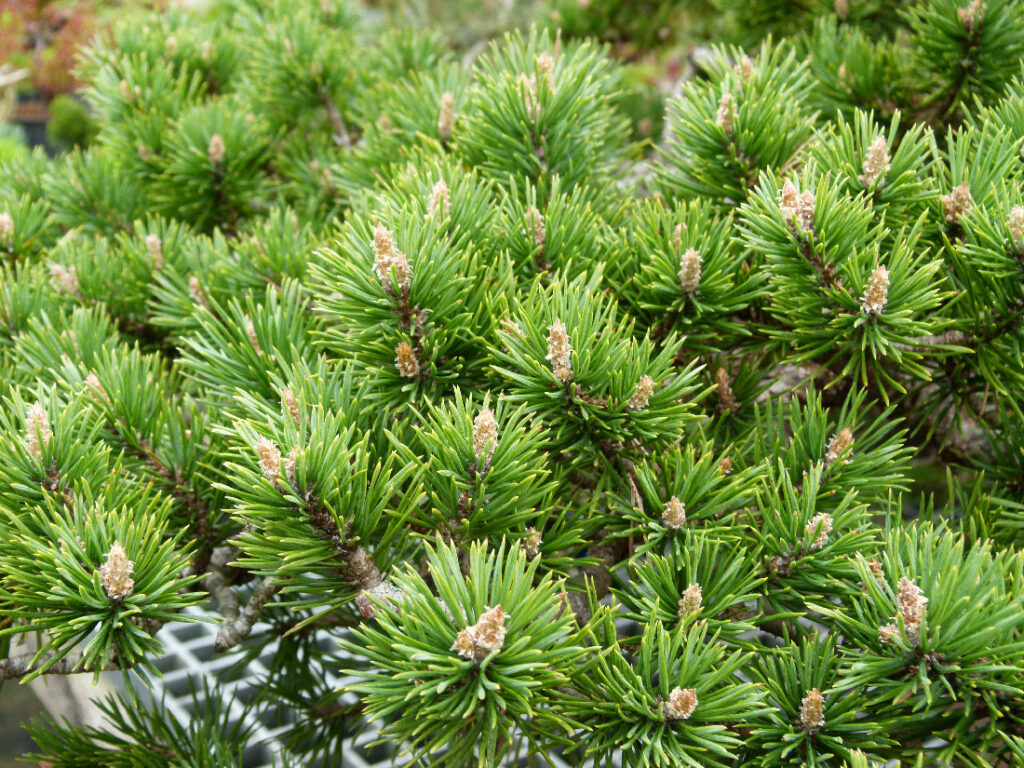
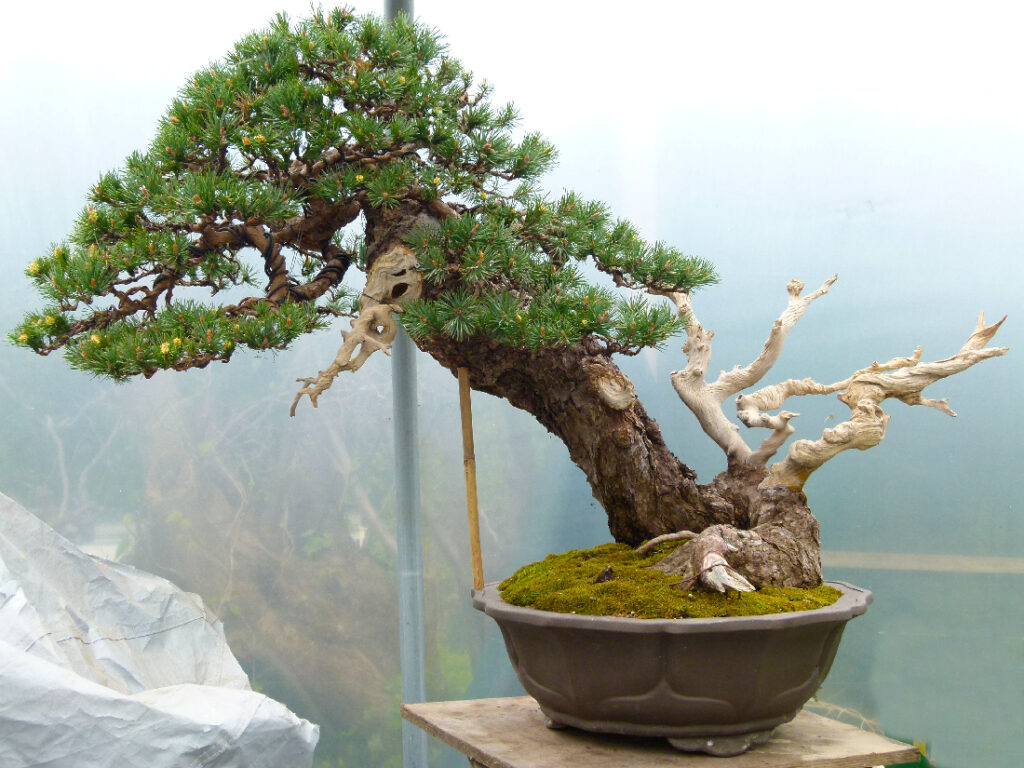
Beautiful even dense growth on a ramified tree in good balanced condition with strong early activity. Just right!
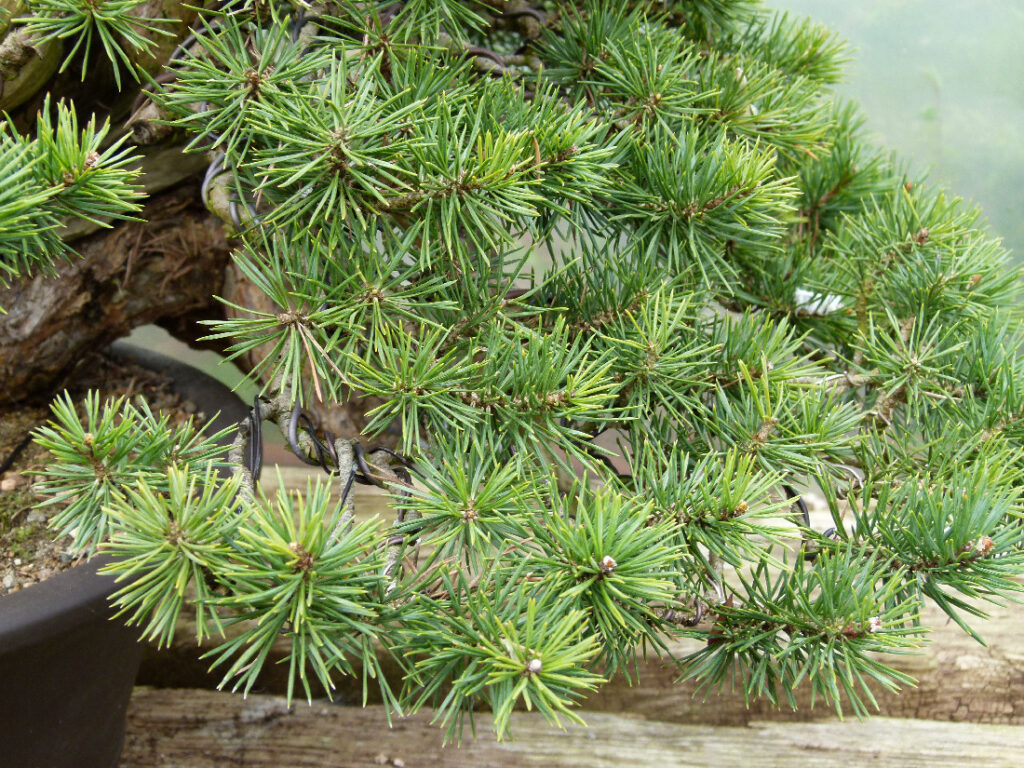
Neglect papered over with inappropriate wiring makes this tree appear something it’s not. No signs of life and very poor colour in places hint at bad pruning practice and long overdue a repot. A pig wearing lipstick is still a pig.
Even top to bottom, early growth, perfect colour and masses of back buds. No wire and holding itself in place. A mature scots achieved following decades of correct pruning and cultivation, the tree was never wired, this is purely scissor work and patience over the better part of 50 years.
Low vigour, poor needle growth last year and scrappy uneven buds late starting. This tree has minimal density and foliage so will struggle to develop the foliage mass required to build real vigour. Careful considerate cultivation and patience should see this improve year on year.
Overworked but this tree is SOOOO strong it’s a Pitbull. This summer back buds will appear everywhere, growth will be huge but needles will be small as the density is coming along very fast. There’s an incredible pot of roots on this one. Sometimes, if a tree is strong we can take a liberty or two.
A strong tree but under developed. Early days but everything is in place for the right things to happen. Hopefully this years needles will be big and lead to ever more vigour.
A gratuitous update of this monster scots worked in conjunction with Kevin Willson. We didn’t loose a single needle and growth is really early showing exceptional vigour considering how little time this has been under bonsai cultivation. SEE THE VIDEO
Not a phrase I bet you were expecting to hear from me right? My mum always called me Tommy Opposite because I was such a belligerent and awkward little bastard incapable of doing what I was told. Every school report had words scrawled across it that amounted to “Graham can do this shit standing on his head but the awkward little cuss just WONT!” I might have mentioned that before.
Now, I’m a working class lad. My dad dug holes and put gas mains in them for a living, my grandparents owned a village shop and butchers (Open All Hours style) whilst the Potter elders were respectively in the merchant navy and nan was a scullery maid at a big country house. My mum worked in the library which made her a bit posh, having attended a grammar school she could actually read. Back in the late 1950s my dad was thrilled to be marrying up the ladder, Grandad owned a TV, a car AND….. a bathroom whilst dad grew up without indoor plumbing and rode a bike.
When I was 11 going on 12 I lied to the man who owned the local newsagents telling him I was 13 and got my first job delivering papers. I had a dirty grey canvas bag with about forty papers in it that weighed nearly as much as I did and went wobbling down the road at 7am every day on me bike. We didn’t have health and safety back then, or minimum wage, I was getting £1.50 odd a week. Saturday I had to collect the money from my customers, with a little red accounting book and stubby pencil. I did that round every single day except Christmas, NO MATTER what the weather and never lost a penny or missed a single delivery.
Imagine giving a job like that to some of todays affected teenagers never mind twelve year olds. It made me! I have worked every single day since unless I was sick, broken or in hospital and loved every minute of it. The only time I am not happy in life is when I am not working, or stuck in front of a screen.
I like to work and I think work is important. Where I come from a man is what he does, the men in my life have always been defined by what they do. There’s honour in real work and it brings both respect and fulfilment. There are people who walk the walk and then there are those who talk the walk but actually are full of you know what. It seems to me we have a lot of those second kind’a folk these days and sadly too many of them are in charge. Working folk can no longer function properly but today i’m going to leave that particular subject.
The problem, it seems to me, is we have too many folk telling us all how it is done but very few actually doing the work. Starmer’s dad may well have owned a company that made stuff but, and I’m guessing here, I very much doubt the old fella could take a little bar of high speed steel and turn out a functioning tool…….. but then again……… i’m sure you can fill in the blanks here right? *
Unfortunately being Tommy Opposite I don’t cope well with being told what to do, particularly when ignorant folk are doing the telling. The reason I thought school was such a pointless exercise, for me, was simply not a single person could convince me it was particularly important to my own prospects. Once I got past the basics the rest seemed like self perpetuating claptrap. Growing up I knew quite a few very successful local characters who made a lot of money and most couldn’t even read. So age 15 I ducked out of school for good. I may well be wrong here, this may be a stupid approach but at age 15 I set my journey in motion much like the little bonsai tree we’ll get onto later.
Now years later I can say, with a single exception I got every job I was ever interviewed for. In fact I turned down more job offers than I accepted and now in my advanced years I can hand on heart say I have never once been asked for my exam results. I know it’s different today, it’s difficult for a bright hard working lad to get on but that’s only because we put toolmakers (tools) in charge for far too long now. Folk educated beyond their intellectual capacity with cookie cutter brains trying to form all of us into their image. These days one needs a degree just to shovel shit or mop up. I’m SO glad I’m on this end of life and not starting out again. Maybe one day I’ll expand on this particular modern scourge but that’s not today y’all be glad to know.
I have said here, multiple times, plough you own furrow, go your own way, follow your heart. Seems to me the folk who get the most done in life are often mavericks by which I mean folk who follow their own rules. Think, study, meditate and learn every aspect relating to what you are doing whilst drowning oneself in activity, remember everything and learn from then, given sufficient time, experience will lead to confidence and understanding which I believe is what we call success. Success is obviously relative but that depends upon what metric we apply. Accumulation of money is not always a great indicator of success. History is full of people who acquired great wealth before going off the rails or turning into despots.
Now i’m 60 I have a lot of shit. House ✔️ Business ✔️ Family ✔️ Grandkids ✔️ Cars ✔️ Bonsai Trees ✔️ A stable of bikes ✔️ Koi ✔️ Good knives ✔️ A big garden✔️ and so on. Does that make me successful? I don’t think so, it makes me comfortable but being comfortable is only really important when I need to sleep, not something I do much of. To me the only marker of success I care about is doing a good job. That does not mean I do the best job ever or to use a Trump-ism ‘the best anyone has ever seen… ever’. It’s about doing the best that I can. Nobody but me knows if, after applying myself to a particular task, I left anything on the table.
Back when I was a teenager I didn’t know how to get a job. School’s careers adviser had nothing for me. The job centre didn’t have any in 1980 and so I bought a printing press, as you do, a big heavy lumbering metal machine from the 1960s. I installed it in my Dad’s shed and armed with nothing more that a 20 page Quarto (8″x10″) instruction manual I proceeded to screw up paper and get ink in all the wrong places until I mastered the bastard thing. About eighteen months later I got my first full time job as a press minder before going on to teach myself every single machine in the place. That put food on the table for the next 21 years. Everyone else had to do a six year apprenticeship on piss-poor money. Not me I went right in on full pay. All I had to do was show the boss what I could do and they locked me in.
This is what I purchased aged 16. An AM Multilith 1250 A4 single colour press capable of about 7000 impression an hour.
I figure we all start life at zero with a pack of seeds, some cultivate the little ones, others the yellow ones, some the big ones etc’. How that goes depends upon many factors, often beyond our control. Some folk have better seeds, some have better growing conditions, more help or greater opportunity and we all need a little luck and a fair wind. Overall our own degree of success tends to pivot upon the amount of effort we put in, what we are prepared to sacrifice, and how readily we retain and use learnt information whilst simultaneously using experience to dispose of irrelevant or erroneous thinking.
I don’t suppose I will ever get an MBE for services to bonsai but then other than you and I few folk give shit about little trees, so long as I do the best I can i’ll go to my grave happy. Besides I don’t give a crap what those folk think. If Charles called me up to tell me “come get your gong” my retort would be along the lines of… not going into Khan town, pop it in the post mate!
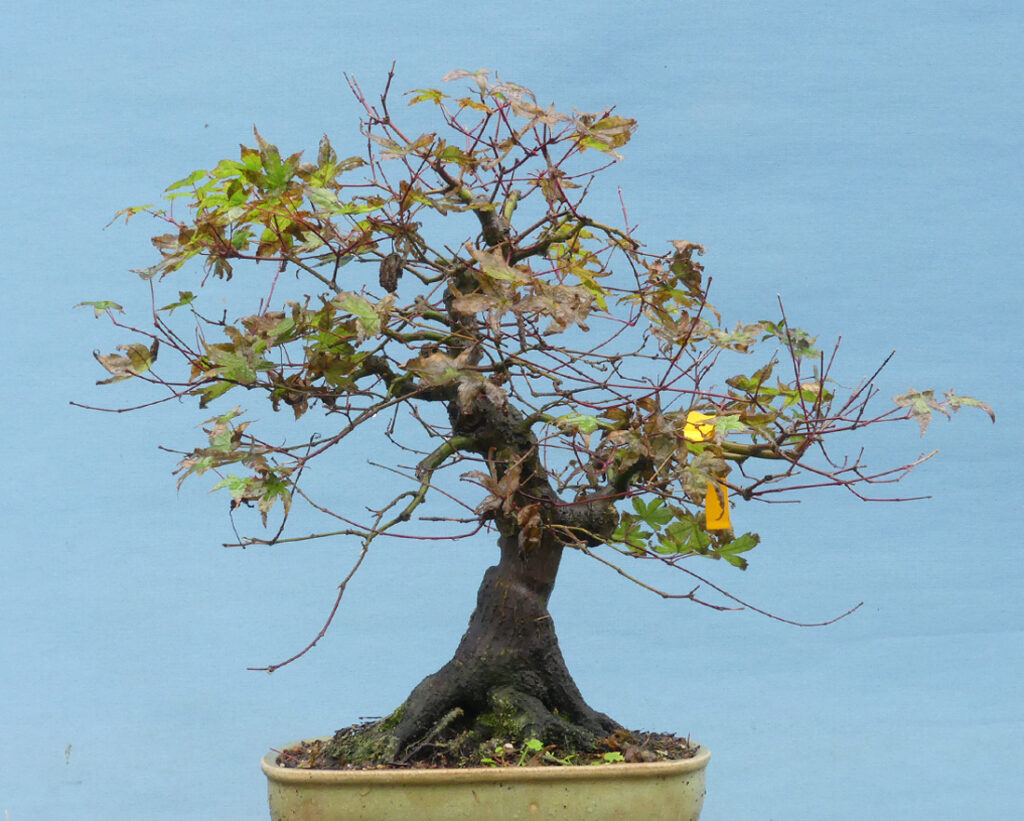
So what ‘nearth’s this got to do with bonsai, and in particular this sorry looking little Acer deshojo?
Autumn 2018. Acer palmatum deshojo.
Stop ‘Doing’ Bonsai!
This little Japanese import came my way as part of a messy deal including a bunch of swops back in 2018. It has always seemed to me some trees are destined to be passed around endlessly. In my experience this seems to happen with folk who are basically ambitious but have a high degree of fecklessness. The trees usually come in with good basic bones, the start of a nebari, some half decent bark and hastily grown branches. This allows them to be pretty cheap for what you get but they are, in reality a very long way from being bonsai. With leaves on they do a passable job of fooling the uninitiated (being a triangle on a stick) and of course this variety always wows folk with it’s crazy colour leaves in spring.
Over the years I have bought a lot of trees in this category. The trouble is our ambitious owner probably bought it because it was what ‘looked’ like a nice bonsai, the right variety and a bargain price. However once our mates see it or it goes on socials it’ll get torn apart for all it’s ugly faults and coarseness. Therefor our owner starts chopping, bending and battering the tree until it’s, frankly, much worse. But, because it’s a popular variety folk lower down the food chain are forever keen to purchase it for their collection. So the owner, by now realises the tree was not such a bargain after all, given how long the development’s going to take, and passes it on to another ham-fister and so it goes on until, mysteriously it ‘just died’ one winter. Truth be known it’s little light was snuffed out by, excuse me…. fuckwits following many years of abuse and battery.
So what’s to do? First up I have to ask, why on earth would you put this in a Bryan Albright pot? This tree needs a decade of development, that tiny pot and UK weather pretty much guarantees no real progress at best. My rule is never mess with a tree until you have owned it for a full calendar year. This gives time to determine what you’re dealing with. The picture above shows the tree after a full summers growth. Pretty poor right? So, I sold the pot which recovered most of my outlay. The following spring I bare rooted it, cut back really hard top and bottom then put it in a big pot twice as deep and four time the size of this one.
Result? A year after the picture (2019) it had 18″ of growth all over. That was pruned in autumn and then the following summer (2020) it was defoliated and wired completely. Subsequent growth was stopped at one or two nodes and that’s all I do now. Deshojo are notoriously slow to grow, develop, ramify or bulk up in Blighty. A green leaf maple might well develop at twice the pace here. So here’s the tree right after leaf drop a few days ago.
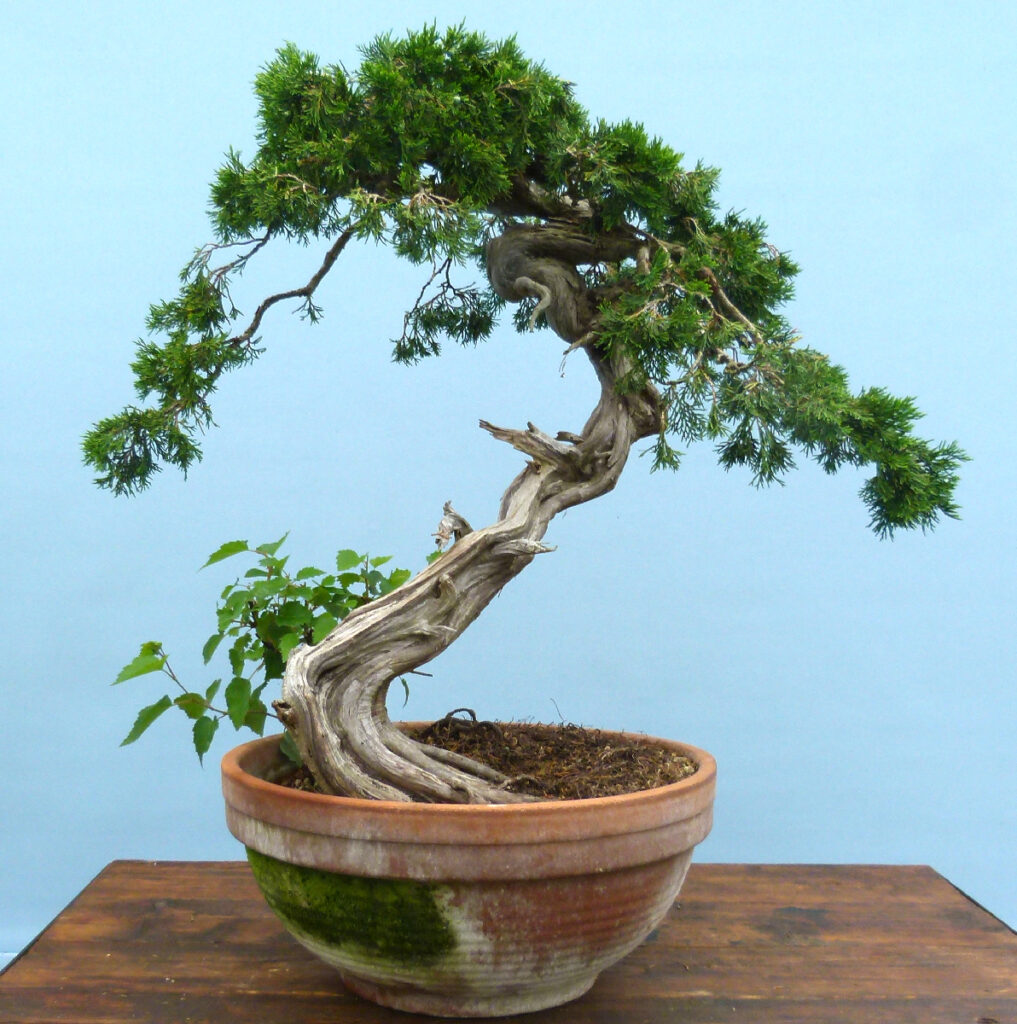
Autumn 2024. Acer palmatum deshojo.
Ultimately two factors have resulted in this improvement. First up has to be a plan. I know what these trees are capable of (not a great deal) and so i plan to make the most progress I can each year. Second factor and relevant to my earlier diatribe is the ability to do nothing. Not easy for me, I like to work, I like to be busy, hands on. Trouble is often in bonsai we have to know when to walk away, when to stop and when to just leave alone. Every time I hear about folk ‘doing‘ bonsai I cringe. For sure at some point we have to take charge but I see some very heavy handed work performed far too often.
When I got this maple it was obviously not happy. Right there I made a simple plan. That was to improve the vigour which ensures a strong response to later works. Once that was done I set the bones in place for it’s future. After that all I have to do is let nature take it’s course and keep it healthy. I recon bonsai’s not about you, it’s not about me, it’s certainly not about impressing others, it’s not about making us popular or prosperous. Bonsai is all about the tree, it’s about working with nature and the nature of the tree to allow them to thrive and flourish. Once that happens likely the tree will be it’s own unique shade of beautiful. In this case my ten year plan included several years of doing virtually nothing. Sure we’re still building structure and refinement but since I got this, all told it owes me less that about three hours. Where I come from that’s me doing nothing.
If you are ‘doing’ bonsai make sure what you are doing is part of a long term plan to help the tree flourish and be beautiful in it’s own unique way. Accentuate the trees strengths and best features and for the lesser parts dilute those that cant be fixed into a natural and harmonious whole. Work for it’s own sake, ticking boxes or hitting our bullet points makes no sense. For instance this tree has had no ‘autumn pruning’. It got a piece of wire and I have a cut to do in spring, anything more is pointless. Like everyone around me keeps saying I need to learn to stop, take it a bit easy, smell the flowers etc’. Trust me I know that’s not easy but here we have the highest form of bonsai. That’s when a tree teaches us how to achieve and enjoy a better life. Man and bonsai in harmony. What’s wrong with that?
We’ll come back to this little maple in the future but for now thanks for you attention. Remember to like, subscribe and share etc’
I’m off to not do some bonsai, thought I might try my had at making some tools;-) Sweet dreams folks!
Graham Potter
November 2024
*Just for the record here is the definition of a tool maker courtesy of Wikipedia.
Tool and die makers are highly skilled crafters working in the manufacturing industries. Tool and die makers work primarily in toolroom environments—sometimes literally in one room but more often in an environment with flexible, semipermeable boundaries from production work. They are skilled artisans (craftspeople) who typically learn their trade through a combination of academic coursework and with substantial period of on-the-job training that is functionally an apprenticeship. They make jigs, fixtures, dies, molds, machine tools, cutting tools, gauges, and other tools used in manufacturing processes.
Working from engineering drawings developed by the toolmaker, engineers or technologists, tool makers lay out the design on the raw material (usually metal), then cut it to size and shape using manually controlled machine tools (such as lathes, milling machines, grinding machines, and jig grinders), power tools (such as die grinders and rotary tools), and hand tools (such as files and honing stones).
Art and science (specifically, applied science) are thoroughly intermixed in their work, since they’re also in engineering. Manufacturing engineers and tool and die makers often work in close consultation as part of a manufacturing engineering team.
So, despite the fact we are absolutely inundated with orders from all you lovely folk I managed to find a few hours to do a slap up job on my field maple. We are currently shifting about 3/4 of a ton of goods every single day and both Richard and myself are suffering under the weight of it all but, the show must go on. I would rather drop dead of exhaustion than boredom.
My oldest and best mate Stu’ was on hand to lend a hand which made for a very pleasant few hours and a nice break. Here’s a quick video of the work. I know a great many of our customers love deciduous bonsai. Getting a good foundation laid early on is so important, I thought ya’ll might like to Take a Sneaky Peek at This!
“I know less now than when I started” – Sabina Juniper Bonsai
Having cultivated, what I like to call bonsai, for close on forty years now I feel to some extent I know less now than when I started (so here it is written down). As a result I am increasingly reticent to share my thoughts. There’s just soooooo much information available right at our finger tips I figure the last thing the world needs is another knobhead spouting sage wisdom and I am really not interested in taking cheap shots from keyboard warriors. However it helps me a lot to get this stuff down and organise it in my head so please join me on a glorious summer ramble…..
I often spend significant chunks of my day on the telephone in deep discussion with folk who are often literally dazed and confused having spent copious time online trying to get answers to a seemingly innocent and simple question. In one case I literally had a lady on the phone crying in frustration. With everyone telling the poor girl something different she was in despair. Sadly this happens all the time because when you do not know something it’s hard to sort out what’s what. Just last week a lad was on the phone asking for soil because he had to do an ‘emergency repot’ what the feck ever that is.
His little bonsai was too wet and some knob advised him to repot pronto. I asked why the soil was to wet and he was sure it was because of a lack of drainage. Turns out he was watering by dunking every day and spraying the foliage too because that’s what he had been told one had to do with bonsai. My advice was if you don’t put so much water in there so often it won’t get so wet will it. Only water when dry, soak well when watering and then don’t do it again until it’s dry. Happy tree, happy fella and no sale for me. Dohh!
As an unrelated but illustrative example I remember a few years ago I had the misfortune to be in possession of a late 1990s V8 Jaguar. I love Jag’s and got my first XJ6 at age 19. However this late model X308 whilst not a bad example in itself was a good example of a car and in particular an engine built to a price. The last proper Jaguar cars, built by engineers and not bean counters rolled off the line in 1996 with the end of the AJ6/AJ16 platform and 1997 with the demise of the V12. I will never buy another Jag’ unless it’s an old one. Someone will argue with that opinion but this is my blog, my opinion, my experience and I don’t really care, i was just on my way to saying that, during my ownership of that beautiful but flawed vehicle I spent a lot of time on all sorts of websites and forums trying to get to the bottom of mostly infuriating electrical and mechanical problems.
I remember vividly one post that ended up running for seven very long pages. It was like a soap opera and wasted most of my Saturday morning reading it. Basically a guy bought a cheap XJ8, a repossession via an auction but could not get it to operate in anything other than limp home mode. Over months and at the behest of many random contributors the guy replaced everything on the car from simple electrical items to an eye-wateringly expensive ECU, coil packs, wiring, fuel system parts, the list just went on and on to no avail. Having spent several thousand pounds with no result whatsoever and in abject desperation he had the local Jaguar dealership pick up the car. It was a delight to read what happened next. He got a call 30 minutes after the car entered the workshop, all fixed! The bill was £40 plus the pickup (this was a while back). The fault? The repo guys picked it up off the owners driveway and took it away without the owner being present and had sent it to auction with a new key that had not been synched with the security system which took the dealer minutes to rectify.
The moral of the story? Be careful from whom you seek advice. Well meaning, helpful and nice people will try to assist but there really is no substitute for experience. I follow a vintage tools group on FB. Every day somebody posts an image of some obscure and unidentifiable object whilst everyone posts what they ‘think’ it might be. That’s as much use as a ventilated rain hat. If you really think a vintage mouse trap could in fact be some form of early Zippo just keep that to yourself along with your emergency repots. Bonsai is much the same although I don’t personally follow any of it online as it frustrates me too much so I stay away.
Assuming you are still with me this far I am going to set out a few lessons I have learned over ten or so years on the cultivation of Spanish yamadori sabina junipers. This information is entirely about Spanish examples that grow in my own garden here on the east coast of the UK. If you have other junipers, from different places and NOT grown in my precise conditions treat this as a general guide for your own work because every singe tree and every single garden will be unique. Much like the Jaguar above, the fix was simple but figuring out the issue to begin with was where the value of genuine hands on experience paid off. NEVER underestimate the ability of well meaning people to over-complicate a situation having got the wrong end of the stick, it’s just our nature.
Not everyone is keen on junipers. Personally I love them but have struggled sometimes. I believe a lot of my troubles are because I was mis-informed decades ago and unlearning that has been a task. My first contact with sabina juniper was over 25 years ago when I purchased a very poor, poorly and hideously overpriced example from an Italian collector. The tree was so weak and poorly even my best efforts over five years resulted in less than an inch growth and less foliage than when I started. After several years I took it out of the bucket, cleaned away every speck of soil only to find barely a literal teaspoon full of live root. I was subsequently reticent to get involved with any form of Sabina.<
Several years later I was introduced to Spanish sabina which were just too good not to take home. In the end we imported several thousand examples, some of which I still own. Most are now doing really well, a couple are still pissing me about and some I have killed. That’s not because I enjoy killing trees and I certainly don’t like warming my house with the carcasses of very expensive yamadori in winter but, in the words of a legendary Klondike gold miner, “Lessons cost money. Good lessons cost lots of money.”
Having spent two days this year fudging around the excellent Bonsai-Fest I was a bit upset to see several of the junipers that passed through our hands out there for sale. Not itself a bad thing but every one I saw was hanging by a thread. In fact every sabina juniper I could find was in a poor state even though that was not reflected in the prices. So why so poorly? With so much information available why are these magnificent trees suffering and failing so badly? Perhaps most are actually doing well and are back home but, what about these poorly ones?
Any discussion on the cultivation and development of bonsai has to be put into context. There is rarely a simple one line answer to an issue because everything in bonsai cultivation is connected. It’s not just about what soil mix you use, how often we re-pot, water, fertilise or what latest fashionable elixir we use. It’s about all of those things and a whole host besides. For instance recently I had a little issue with a sabina juniper raft growing on a nice Bryan Albright slab. Nothing has been done for a couple of years and last season it made great progress though that stalled this year. The answer? I pushed it backwards eight inches into the middle of the bench and stood some little shohin trees in front of it and within a couple of weeks it picked up incredibly well. The exposed soil was getting way too hot in the late afternoon and evening sun. Simple, and was about to do an emergency repot!
In my experience on the east coast with our very arid, cool and dry summers few juniper varieties do well. Soft foliage Japanese varieties do not so much grow as swell imperceptibly. Spiky foliage varieties obviously do better. If a juniper of any type arrives here in a poorly condition I know it’s going to take at least five careful years just to get it pumping again. I always feel juniper are a bit of a fish out of water over here but over the years I have learned a few lessons that have helped me get by.
First up let’s consider the homeland of the now ubiquitous sabina juniper from Spain, native of the Pyrenees these trees live at altitude so the weather they experience is typically much cooler that one might think. I have seen junipers buried deep in snow well into our spring time so just assuming that because a tree comes from a typically warm country it would be a mistake to assume that’s what it likes. Details matter.
Difference in conditions have to be allowed for, especially where old yamadori are involved. Often this type of tree can be extremely old, just leaving it a couple of years to ‘recover’ can be nonsense, that can take years or even decades for a collected tree to recover it’s equilibrium. Once this stage has been achieved we might, just, be in a place to consider where we take the plant in the future.
Sadly there is a notion in bonsai, certainly here in the UK, that a collected tree will be good to go in a couple of years. Well, if you pulled out a little elm whilst walking your dog that might be the case but with actual Yamadori a couple of years may or may not cut it. Sabina grow slowly at 3000 to 10,000 feet elevation, most examples extracted for bonsai are from decades to hundreds of years old. Ripping them from their home, dragging them 15 hours north and stuffing them in a little pot with unfamiliar weather, seasons, water and their support network, for a plant that’s probably not moved an inch in a hundred years is a big ask.
Sabina juniper is tough because most DO survive this ordeal. However in the hands of us inexperienced and impatient bonsai folk many will suffer badly and end up hanging by the proverbial thread. By far the most significant obstacle preventing a sabina juniper from becoming bonsai is the knucklehead trying to make that happen.
Let me get one important fact out of the way. Broadly speaking there are two types of juniper commonly used in bonsai and these are categorised as either mounding or running junipers. Many Japanese varieties with which we are familiar are mounding types, in their natural habitat they tend to make dense domes of foliage and their growth is tight, compact and typically even. Sabina however is an example of a running juniper, these tend towards flat ground covering growth spearheaded by vigorous points that grow long low and fast. Making allowances for this growth habit determines how these varieties should be approached. They are not the same.
One of the hardest lessons to learn in bonsai is that of patience. I struggled with this enormously when I was a bonsai youngster and still have the paper photos to prove it, i lost a lot of trees. As an ornery old git I may have swung a bit too far the other way, my garden is currently littered with yamadori that’s been resting for years on end. Truth is I have been too busy until recently to deal with what I have, sound familiar? However in that there is a valuable lesson. The fastest way to develop bonsai is to take one’s time and plenty of it.
Yamadori sabina junipers need time to establish, that’s the single most important fact I have learned in the process of turning these beautiful trees into bonsai. Even though a particular tree might look lush and green with plenty of foliage and ramification and even though it may be very well rooted over some time it is often a significant mistake to dive in too early. Now I know I did more than a few videos of doing just that and mostly I did get away with it but in retrospect and with the advantage of a lot more growing seasons under my belt I now do things differently.
Wether you have a recently collected sabina or one that has been in a pot for a long time but is not doing well the first step is to deal with the roots. A juniper coming from Japan will have had this work completed in it’s past and as a result it will have a completely different root structure compared with a collected example. We are looking to create a dense fibrous mat of root right out of the trunk with little or no long wooden ‘tap’ roots. Collected trees don’t have this and so it needs to be developed. First order of the day is to entirely remove all the old mountain soil. Don’t be temped to wash it out, these days I never wash bonsai roots especially yamadori. Just allow the soil to dry out a little and then work through it all slowly loosening up the roots and gradually the old soil will come out. It’s then a case of cutting back overly long, thick and tangled roots, deadwood and the like.
It will certainly take two repots to get this job done right and so within 3-6 years a significant bonsai root system can be created. My preferred timing for this repotting work is from Mid-July until mid-October. Sabina make new root in the second half of the year and repotting in spring when the tree is dormant can significantly upset the apple cart. Sabina grow on a slightly different timescale from what we might think.
Come spring time the first order of business for ALL plants is to get flowering done and get the seasons seeds going. In my garden that will begin around March time when juniper buds begin swelling, flowers form and male plants produce pollen. I would not entirely call this early season activity ‘growth‘ as it’s normaly and mostly coming off stored energy. That’s typically all finished by May when growth buds begin to swell and summer extension proper begins. This is almost always heralded by a massive shed of old and weak inner foliage. Think of it like a beech or oak tree that holds leaves all winter. Just before buds open the old leaves are pushed off, normally in just a day or two. That yellowing dropping foliage tells us the tree is awake and ready to go. By the middle of July extension growth will just begin to become apparent. However it’s not until at least the second half of the month that root growth gets under way hence repotting much later than might be conventional wisdom.
When we root prune we are removing a significant amount of a trees energy reserves. That’s why sometimes yamadori needs to be repotted without root pruning in order to change soil but not weaken a compromised tree. Repotting a sabina when dormant in early spring weakens the plant and it will struggle for weeks to recover. Doing it when it active growth means healing and recovery in days not months. I’m sure I have at least a couple of juniper repotting videos that cover this more or less.
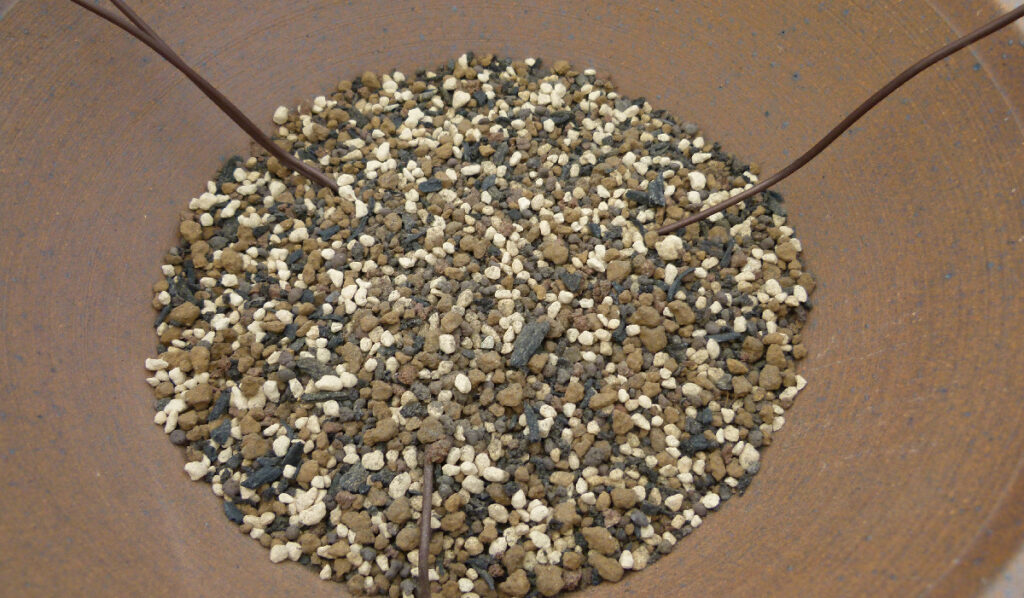
At this point everyone will ask what soil mix I use. As always my response is it depends….. it depends upon many factors but for simplicity my base mix would be 6 Akadama, 3 Kanuma & 1 biochar + a handful of Green Dream Soil Source with the particle size relative to the pot. Smaller pot smaller grain, large pot larger grain. If you are not putting it into a bonsai pot the mix matters little so long as it’s the same all the way through.
Repotted trees are watered until the draining water runs clear and then placed in good bright sun out of the wind. Within 3-5 weeks the tree will be simultaneously growing new foliage and shedding old weak and spindly stuff. Remove weak and discoloured foliage as soon as it’s obvious. After this I recommend leaving well alone for the rest of the season and the following one too. A little pruning and thinning might be appropriate at some point but i’ll get to that.
On repotting junipers previously treated as above I have found that after 5 years without disturbance sabina can loose vigour again. In general it’s my preference to repot at 3-4 year intervals dependent upon pot size and a trees growth rate. How easily, or not, you are able to water is irrelevant. When repotting healthy trees with good root structure I still prefer to remove pretty much all the old soil. I find sabina do best with an identical soil structure throughout the entire root mass.
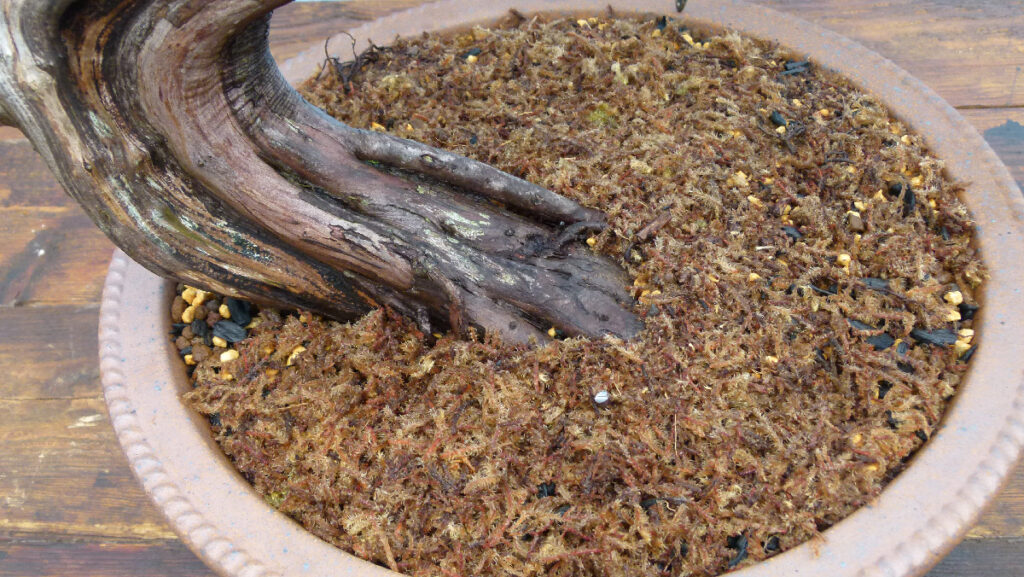
Just one little trick I learned along the way. After repotting I cover the soil surface in a light covering of chopped moss. This is dried, cut really fine and almost rubbed into the new soil surface. I then cover the soil with jute hessian scrim before watering the whole shebang. This helps keep the top 1/2” of soil nice and moist, uncovered in the summer sun it will dry this top layer fast and prevent root development in the dry soil. Also seeing the overly dry soil surface can lead to overwatering, not something a sabina will tolerate for long. The scrim also keeps birds at bay and in time it will rot into the soil and encourage moss. It also keeps that top soil surface from moving about when watering or getting too hot with the sun on it. Combined this will lead to a significant increase in root mass.
Once this root preparation work is complete there’s not a lot to do but wait. My experience here suggests after any significant operation, as above, sabina need a minimum of a full calendar year to begin to settle down, often more. In the second year growth should be much stronger than previously seen, if not just wait. Bear in mind that new foliage feeds new roots and new roots support more foliage, give the process time and resist jumping in with scissors at the first sign of a shoot, Sabina juniper are running junipers and they need to RUN.
Treating sabina juniper in the same way as Japanese varieties generally ends badly. However I have found that after about ten years of careful management a sabina will grow just as fast as any familiar variety and often stronger. Most of the failures of sabina I have seen are down to premature working ie: wiring and styling followed by repotting and all in quick succession. I have done that many times with Japanese varieties but actually never seen it be successful with sabina.
When it comes to styling sabina these days I will not even begin to get involved until my tree is pushing out significant (3” plus) fresh green shoots from the ends of most branches. I also like to see good strong back buds growing from the inner branch forks. I prefer minimal wiring on the larger branches only. Long thin and floppy growth is normally not worth wiring and turning upwards as it tends to fade away within a season or two. That new running growth is beautiful to work with. Lay in place a strong framework and within a few short seasons the bulk of work will be nothing more than scissoring.
It’s simply amazing how fast and strong a sabina juniper bonsai is when treated this way, also the foliage becomes much more sturdy and dense. As the tree matures the tips can be cut back from time to time in favour of already visible running points further back. Running shoots bring the vigour so don’t be tempted to shorten them too early. Where foliage or twigs are weak I prefer to remove them and replace with new growth, it’s pretty rare to see a weak twig or branch recover but once weak material is removed from a well prepared tree the strong growth will be invigorated.
Regarding fertiliser do bear in mind these trees typically grow on high impoverished hillsides in shallow clay. Heavy feeding should be avoided. Overwatering is an absolute no-no! Always allow the soil to just dry out prior to watering. Winter wet is not a significant problem for a healthy tree though a little overhead cover can help. Freezing is good too. My feeding regimen for healthy well growing trees begins towards the end of May. I use a base load of Green Dream Original spread across the soil surface, replaced every few weeks once the previous application begins to disappear. Weekly I give an evening application of Ex-Fish or Green Dream Liquid. Once a month I apply a mixture of Crystal Mono Iron and Lime Sulphur, the latter at 10ml per litre. From June to September I foliar feed once or twice a week when time allows with alternately Green Dream Wrackweed or Bonsai Invigorator, Bug Killer and Fungicide which is a great and underrated product, it’s not just a bug killer!
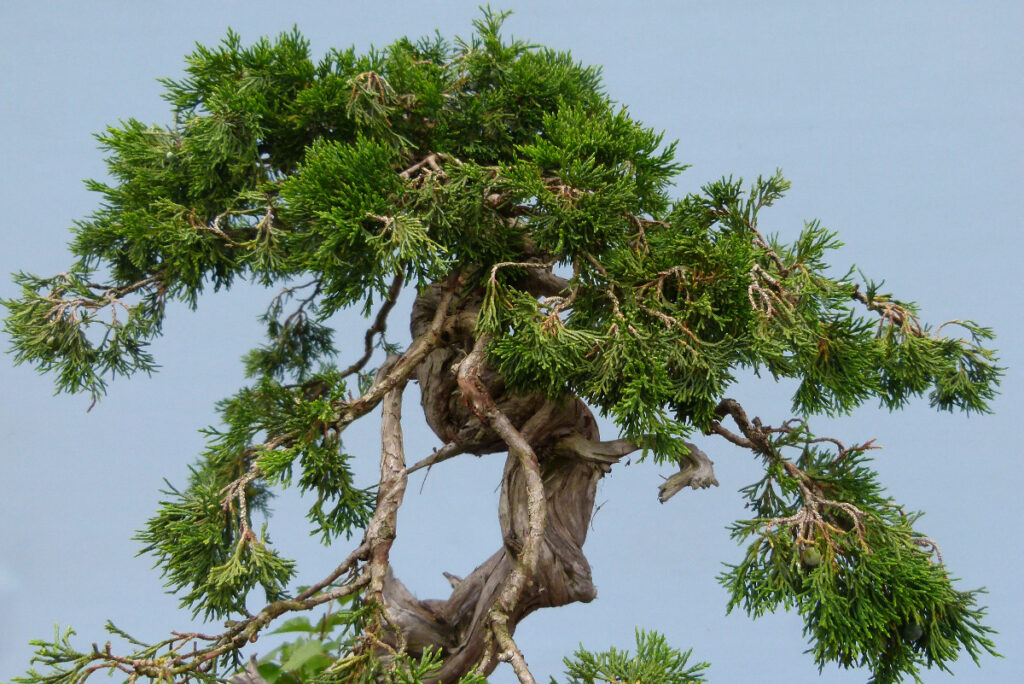
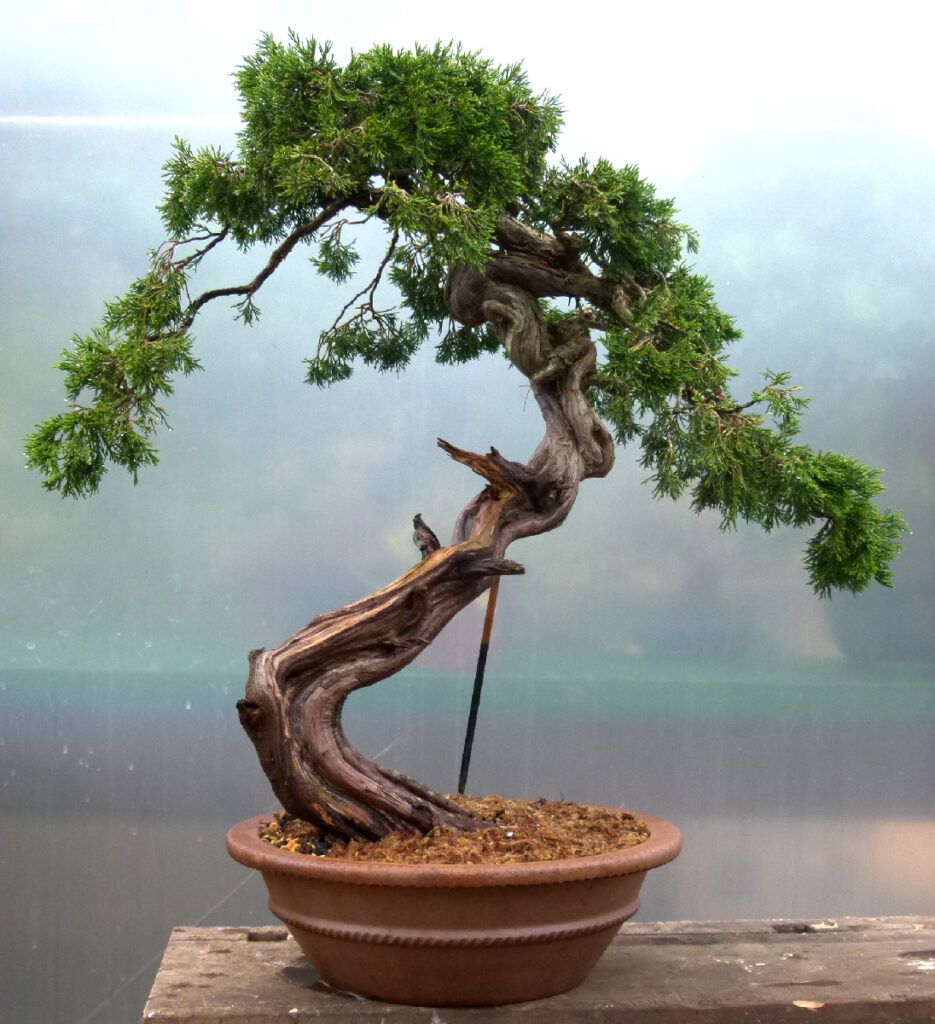
That sounds a bit involved but the old idiom, “Little and often” will pay significant dividends over time as hopefully some of the images below demonstrate.
So to summarise. If you want to do well with sabina juniper regardless of it’s condition and level of development following a plan and being guided by the trees response whilst holding back the urge to see a styled and finished tree will pay off. Wiring and styling followed by a rushed repot will end badly most times. Sabina, it turns out, is a tough and fast growing variety that does amazingly well in our naff climate with it’s short growing season but it needs time to adjust and get itself cranked up. All we have to do is provide the ideal conditions and the appropriate support whilst restraining our own cravings and therein is the essence of bonsai my friends.
Graham Potter – July 2026
This sabina was never repotted correctly and has been wired way too early. I already removed the wire and a huge amount of dead material, now for the root work.
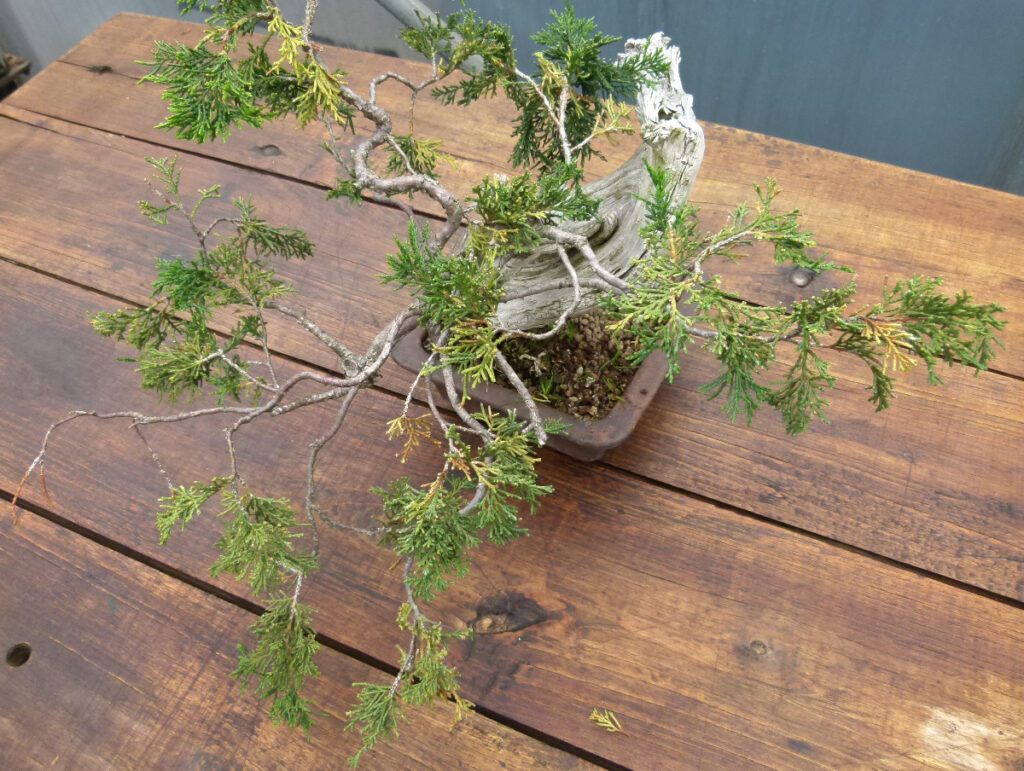
Here we can see some recovering growth and still a lot of weak floppy stuff and weak branches. Clearly there’s a way to go.
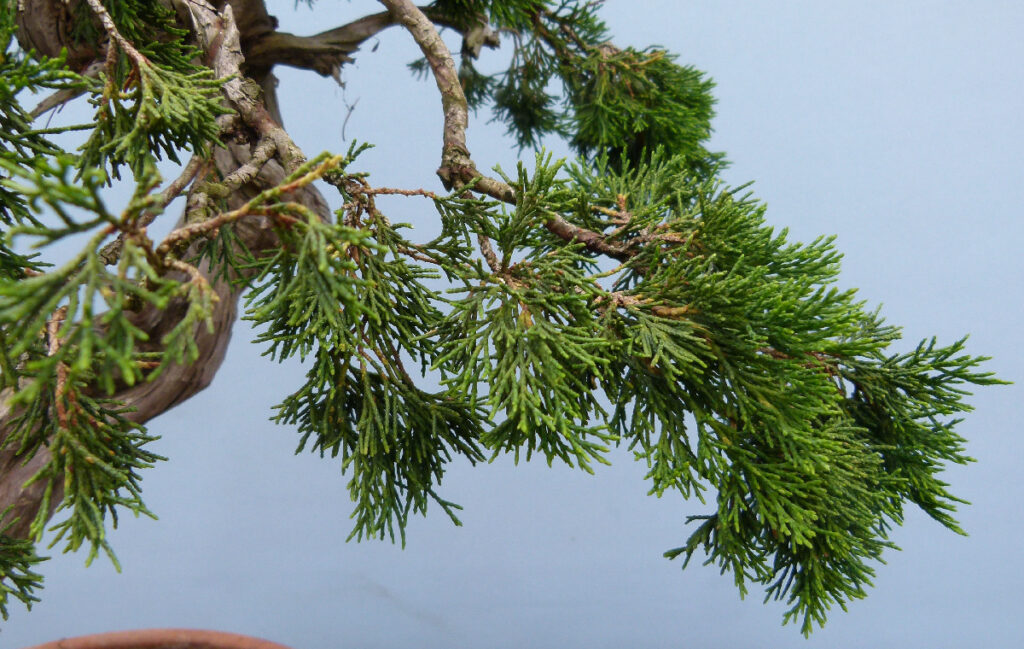
Here we can see strong foliage though it’s still not ‘running’ so more time required.
This branch is typical of overworked sabina. Long, floppy and pretty weak. Wiring this will NOT help in any meaningful way.
This cute little shonin size sabina juniper has been prematurely worked and has taken 3 years to recover to this extent. Clearly this is NOT the way to go.
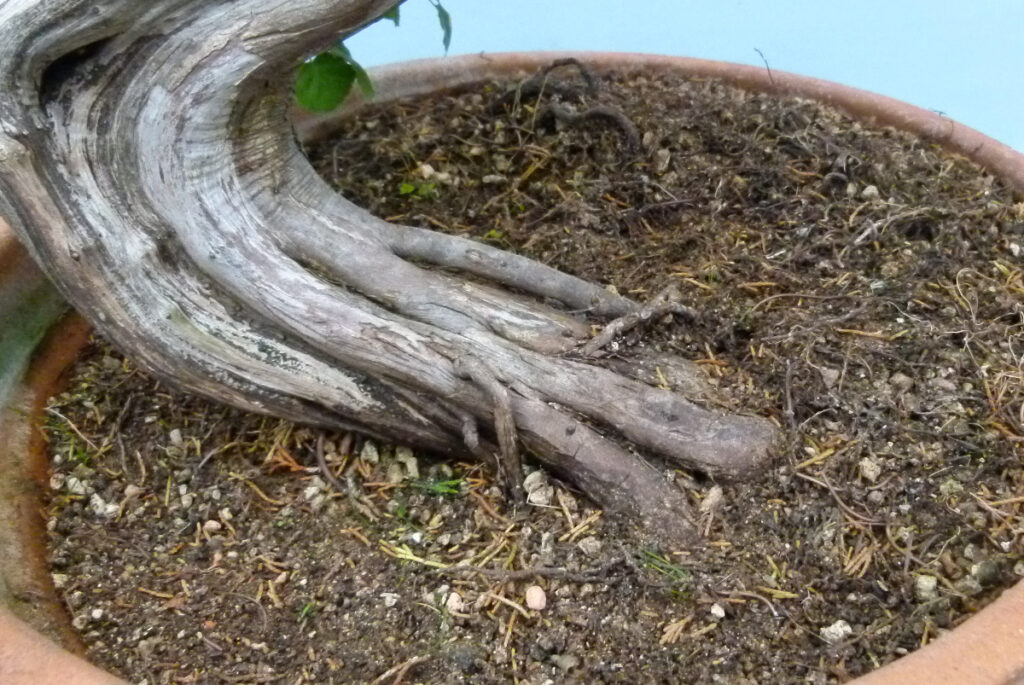
This juniper has been about 6 years in this pot but was never prepared properly and has consequently been very slow to grow.
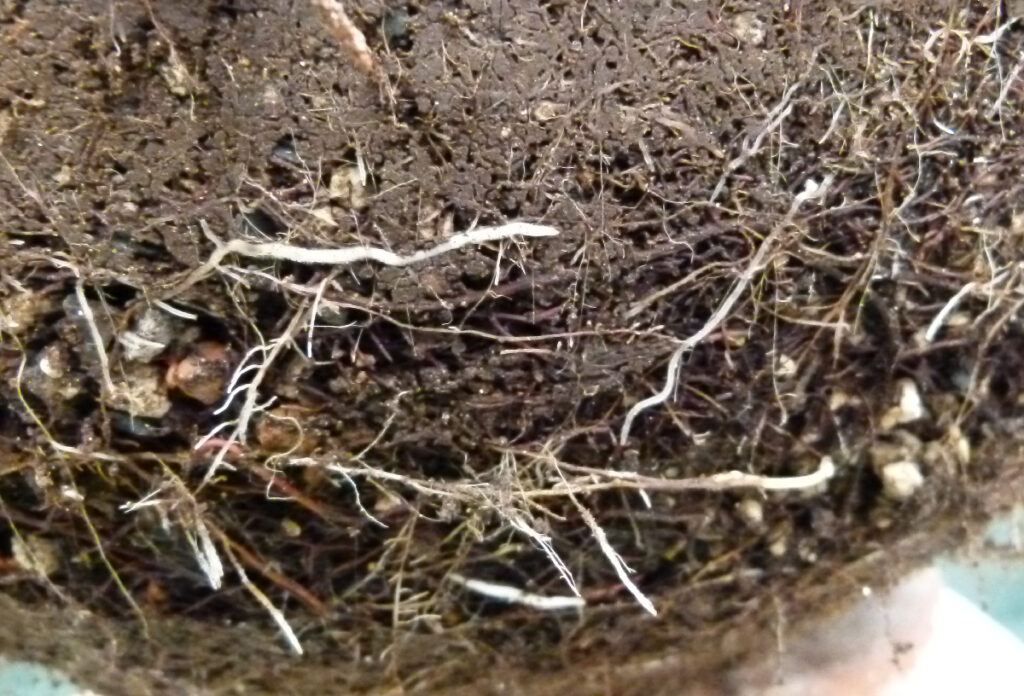
Fresh white root tips indicate root development has begun and so now is a good time to repot. (Uk. Mid-July)
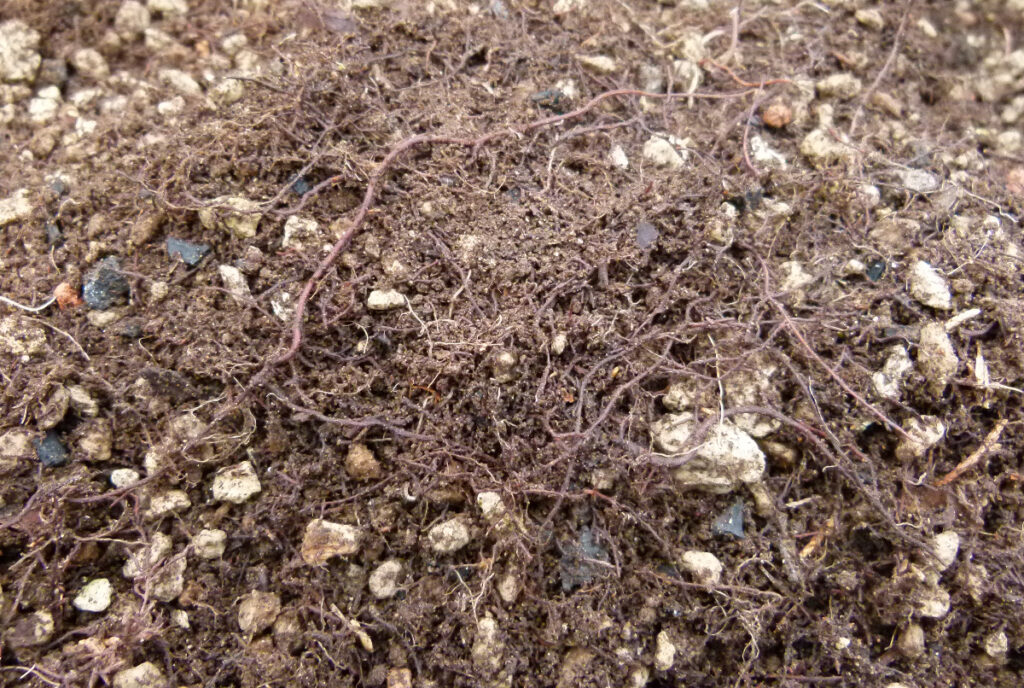
After cleaning out it’s clear there was a lot of crap in the rootball. The original mountain clay does not support much root development in a pot.
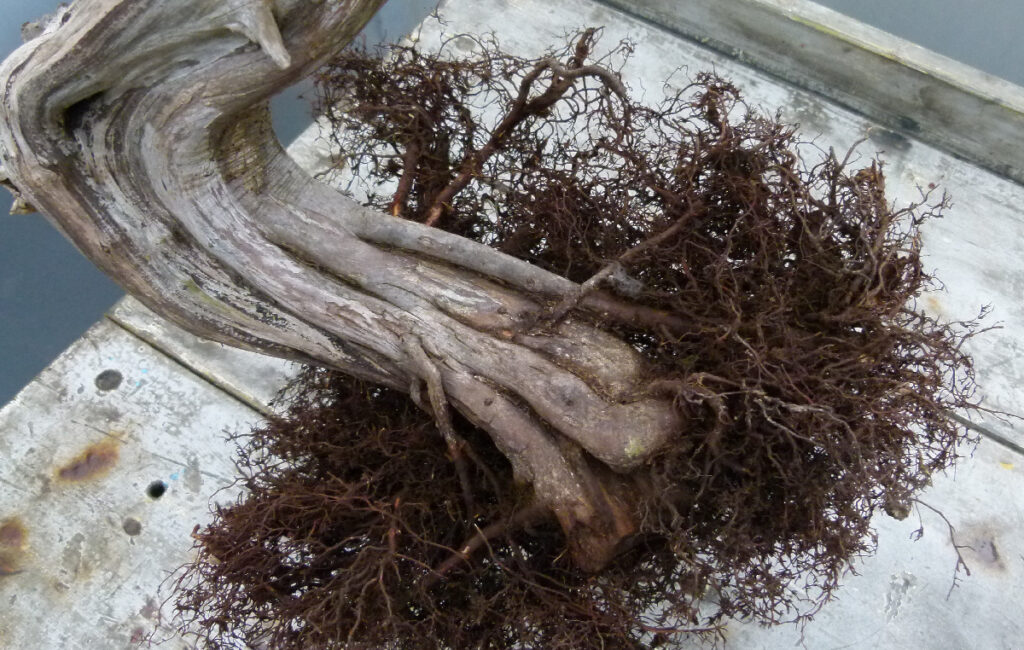
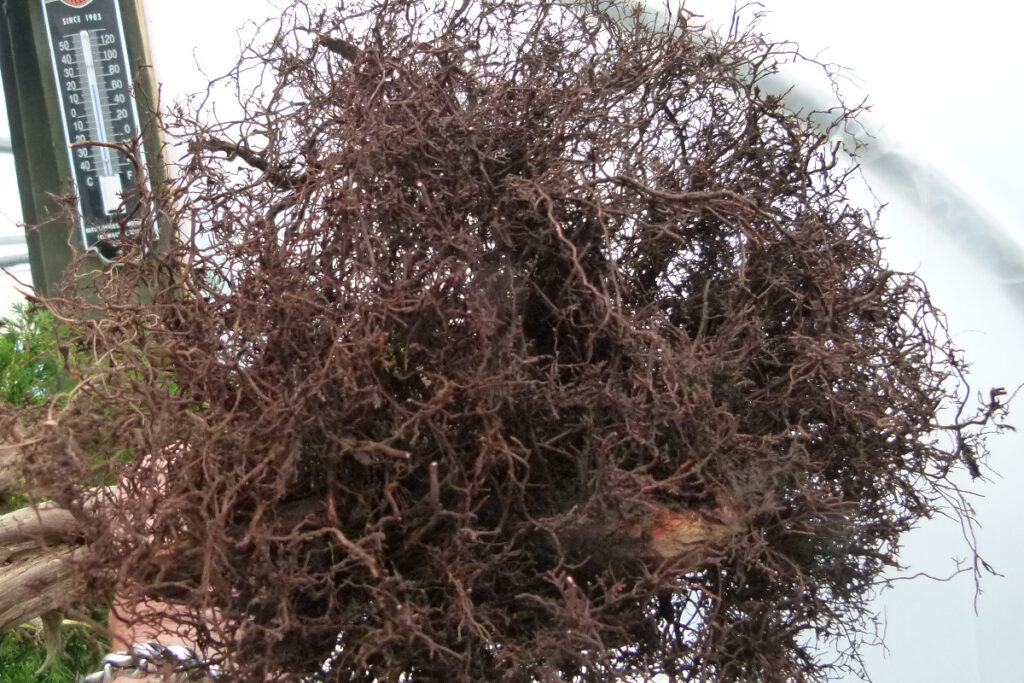
After gently cleaning we have nothing left except sabina juniper. Don’t wash!
With the root system cleaned and pruned it’s time to go back into a pot.
This mix represents a good starting point for sabina in bonsai pots.
Chopped moss surface dressing helps retain moisture in the open soil surface.
Work complete. The small pot is possible because all the space within it is available for new root development. Chopped moss on the soil surface prevents premature drying out in warm weather.
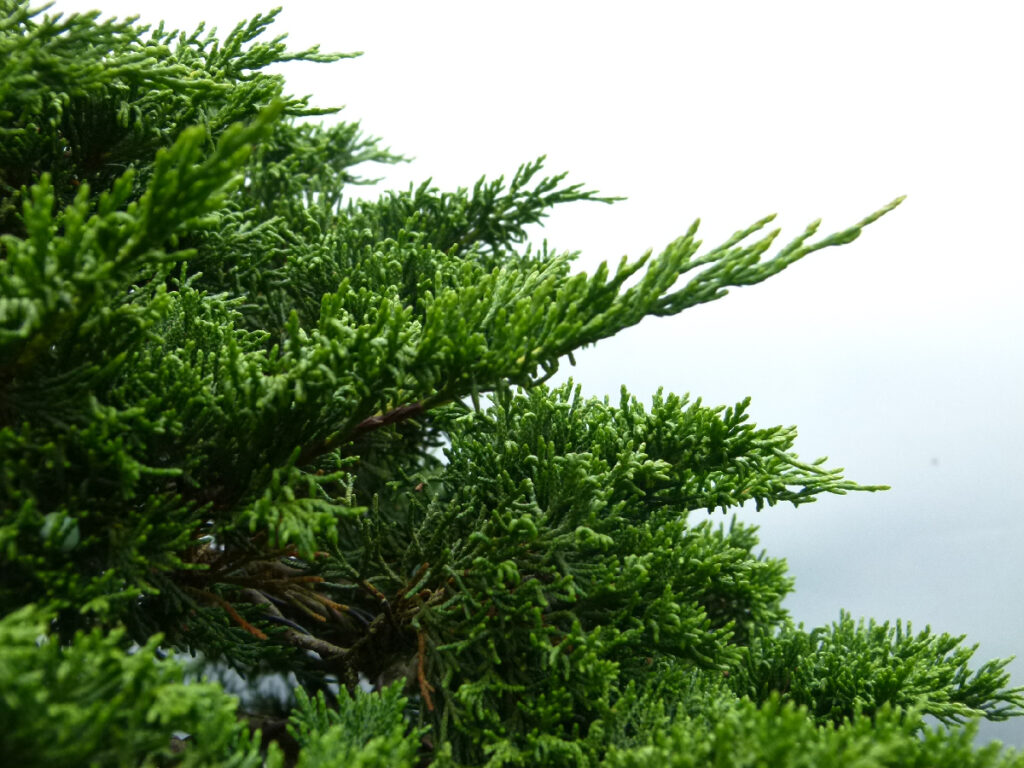
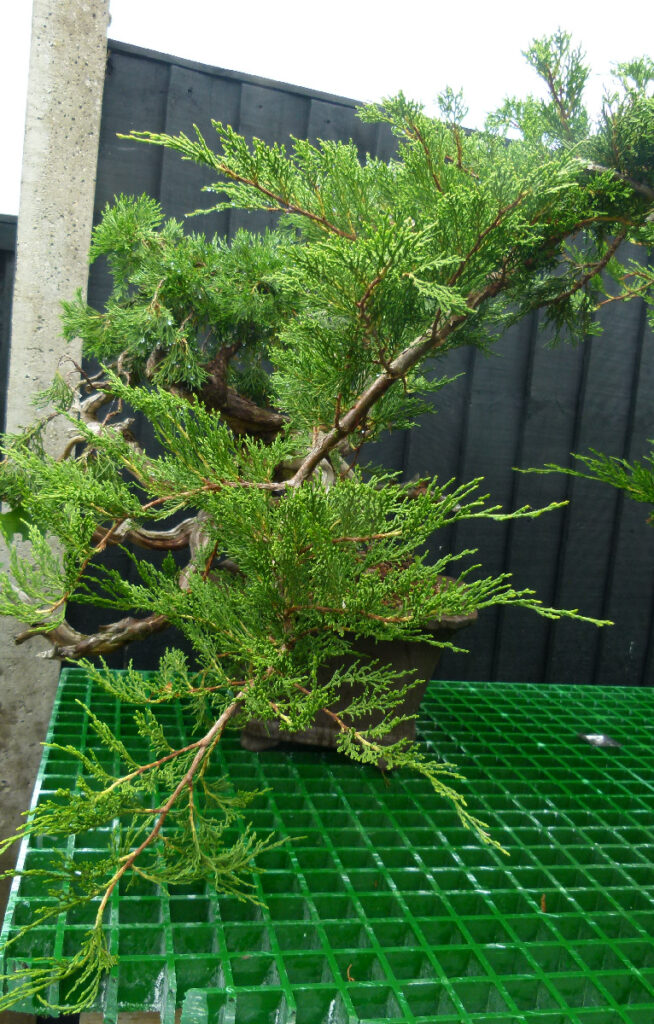
A different example showing running shoots. These are pushing from every branch on the tree.
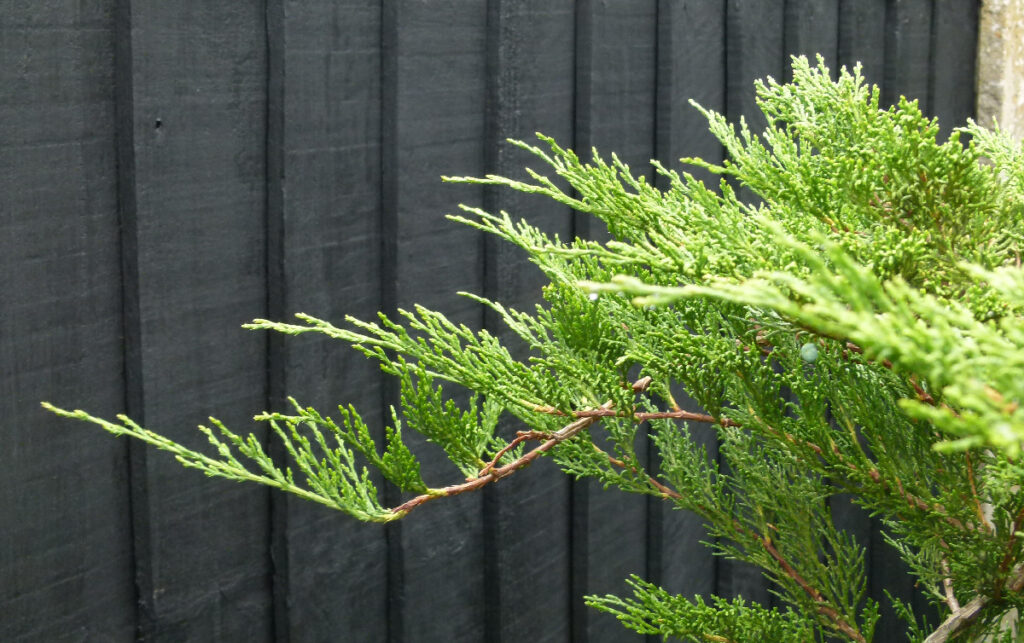
Strong growth just beginning to ‘run’. Just leave it alone!
Another tree. This running shoot is nearly a meter long and grew, in a bonsai pot following a correct repot, in just a single season.
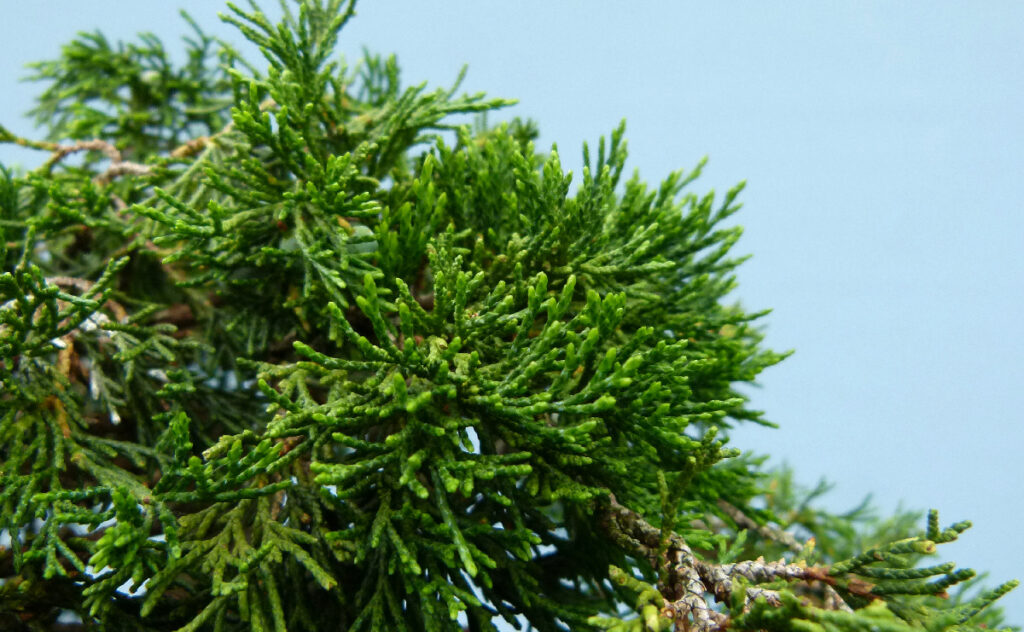
Here we can see what strong running shoots look like. Strong, vigorous and self supporting. This is what we want to be working with. If a juniper does not look like this it’s not ready.
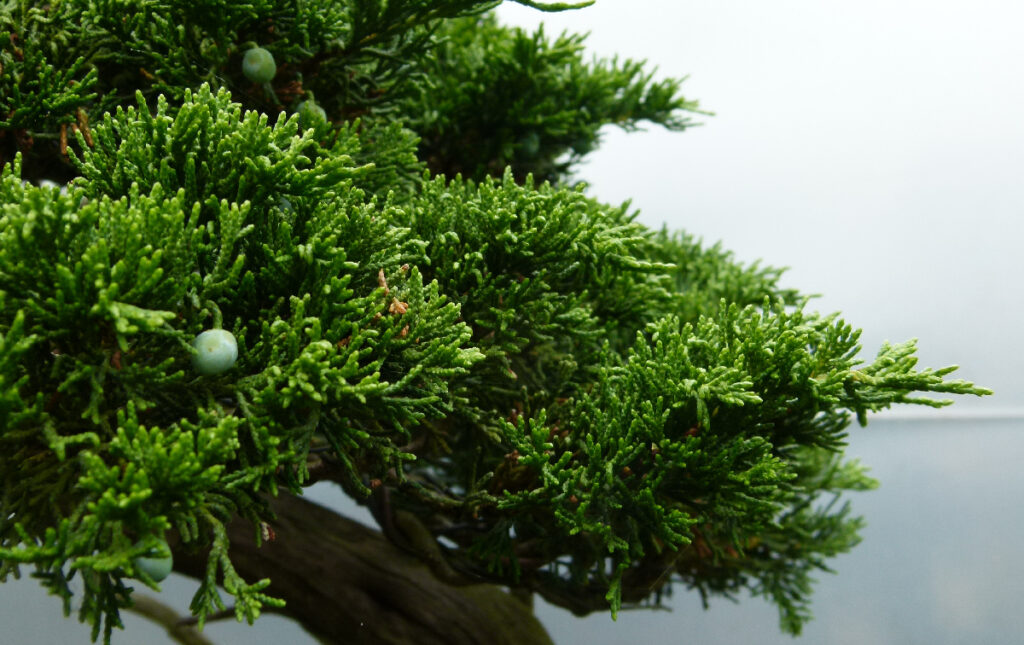
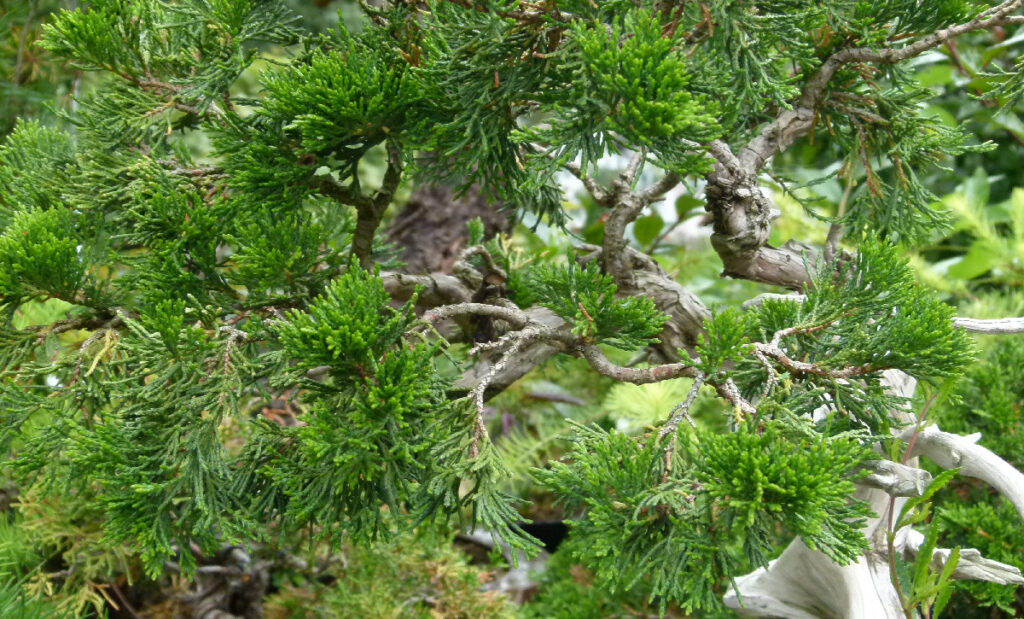
Here we can see back budding from the forks of branches. These are the future of the bonsai and in time can be used to replace long, weak or leggy material.

 Login
Login