Normal view

Received before yesterday Adam's Art and Bonsai Blog

Why Adam? Just why?

17 October 2022 at 18:06

As I go through my day, working on trees or just making soup, there’s an ever present question on my mind. That question is: “Why?” Especially of late, but that’s a rabbit hole I won’t go down today.

It’s a tough question to answer,”Why?”. Most people mistake my online moniker “Adamaskwhy” as meaning that you can ask me “why?” and I’ll tend to answer. And that’s ok. I usually know the answer, or if I don’t, I can find it (and if I can’t find it I just might make something up).

But the real meaning behind “Adamaskwhy” stems from my propensity to ask my teachers, when I was a young and inquisitive lad, “Why?”.

For example, my teacher might expound “When drafting an exclamatory sentence, one should use simple, declaratory prose.” and I might ask, innocently, “Why?”. Now, the best teachers knew the answer. The competent ones knew where to find the answer. The average would just quote what they’ve been taught. The worst would say “just because”.

Obviously, from the preceding paragraph, I didn’t take the lesson of short declarative sentences to heart. Mainly because, sometimes, obfuscation and evasion is the quickest path to The Truth. But, more importantly, I don’t want my style to sound like The Old Man and the Sea (“….here is a bonsai. It curves to the left, then to the right.” I’m more of a “.. The blue sky paints the cream glazed pot with streaks of azure. The sun silhouettes the canopy like an umbrella, shading the mossy soil. The old, sun-browned man, wizened eyes staring at the green foliage, raises his shears and snips at a dry branch…..”).

Needless to say, many of my past teachers did not appreciate the question “Why?”. Truth be told, many teachers can’t answer the question. They feel that, just because they are the teacher, their teaching is inviolate, sacred, and not to be questioned. And the more narrow the focus of the lesson, the more pedantic and authoritarian the teacher becomes. As an example, let’s say the lesson is on bonsai soil, (just to bring bonsai into this essay, since this is a bonsai blog after all), the reasoning style usually used by bonsai professionals is Reasoning from Authority. They’ll say “so and so uses such and such, and they are so and so, therefore it’s correct. Or, depending on the particular pedant flailing his hands around whilst lecturing, the verbiage becomes a word salad of technical jargon with one needing a degree in soil mechanics to understand just what they are saying.

Anywho, why (heh) am I “why-ing” now? Well, dear reader, I recently posted a video in the social media webosphere concerning a certain willow leaf ficus, and what I did to the poor thing. This one to be precise:

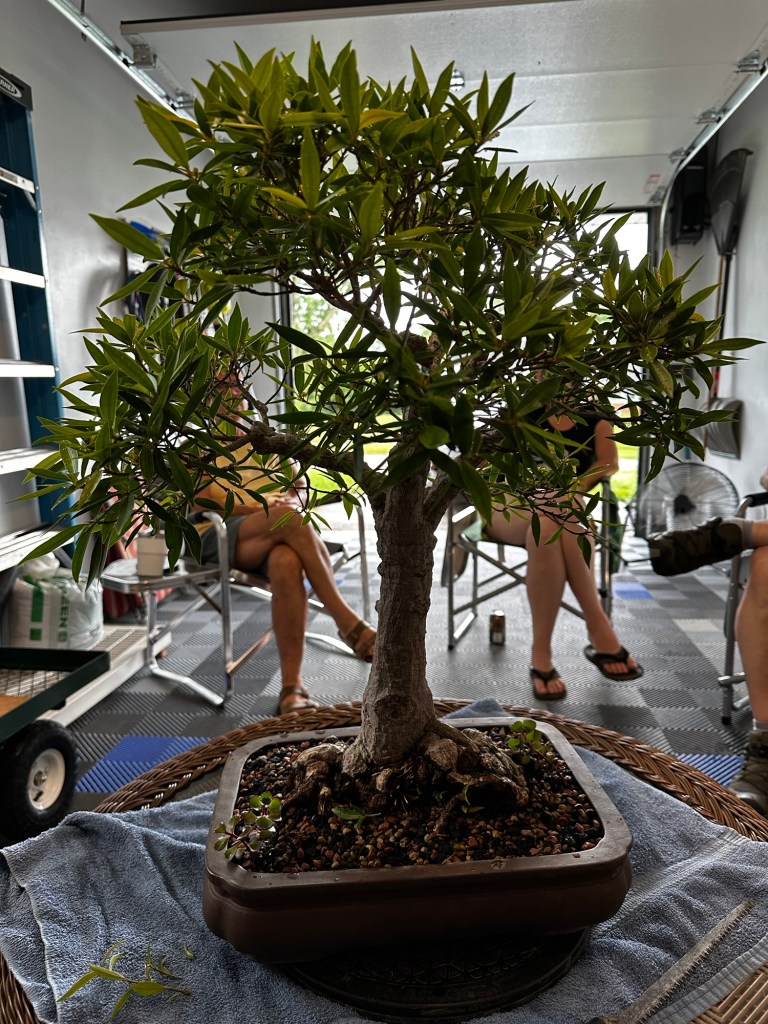
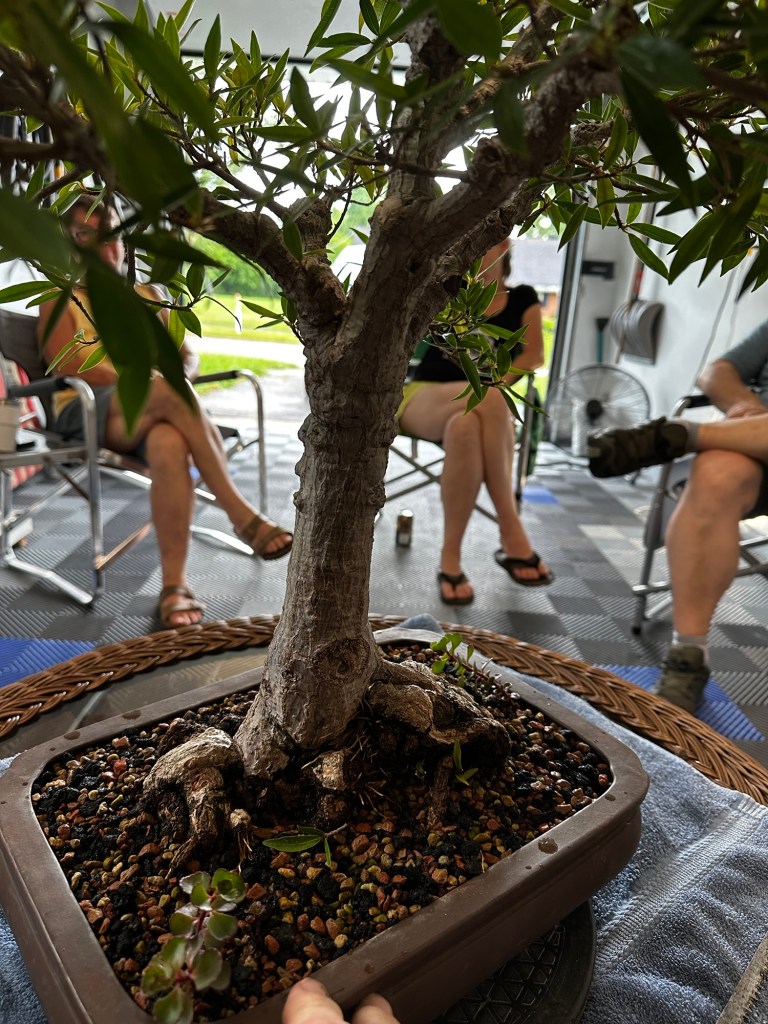
Now, with such a raw piece of stock, I could’ve done all kinds of things to it. The scene: Ikebana Club international, Orlando Florida. This is my fourth visit to this Ikebana club. My visit usually consists of me bringing starter trees (in todays case, willow leaf ficus) a few different choices of containers, soil, wire etc., and potting, styling those trees, or re-potting members trees from past sessions. Irene, who’s been to all of them, decided to get two willow leaf this time. The first one we wired up and made into an informal-upright. The second one….well, you can see below what happened to it….

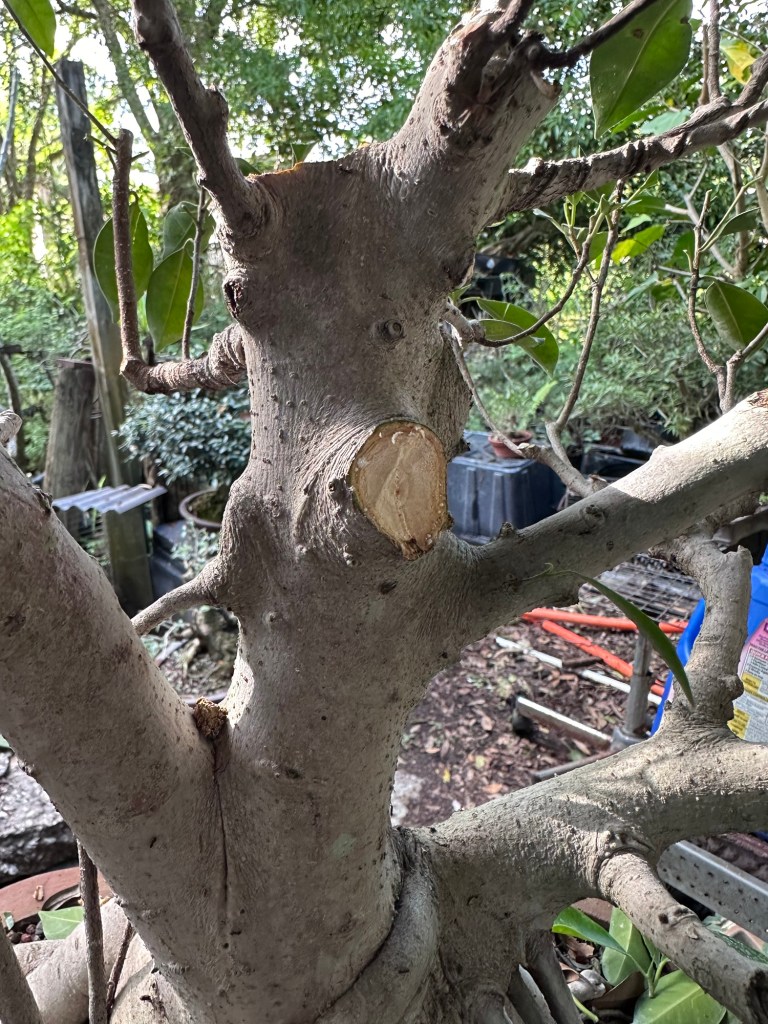
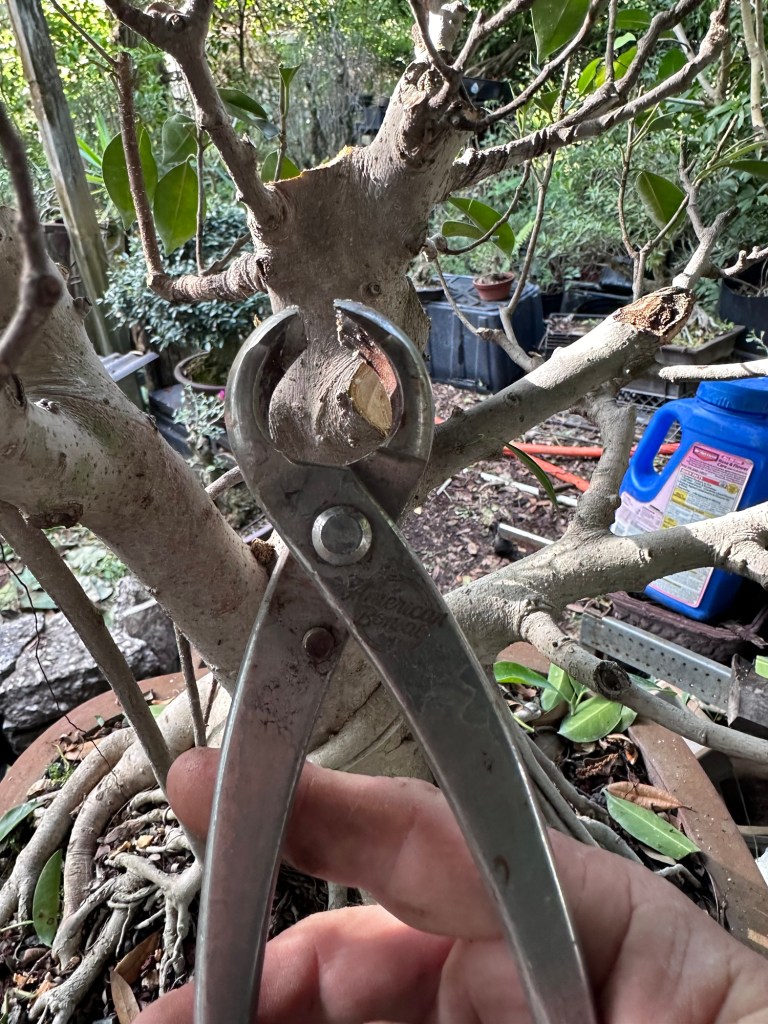
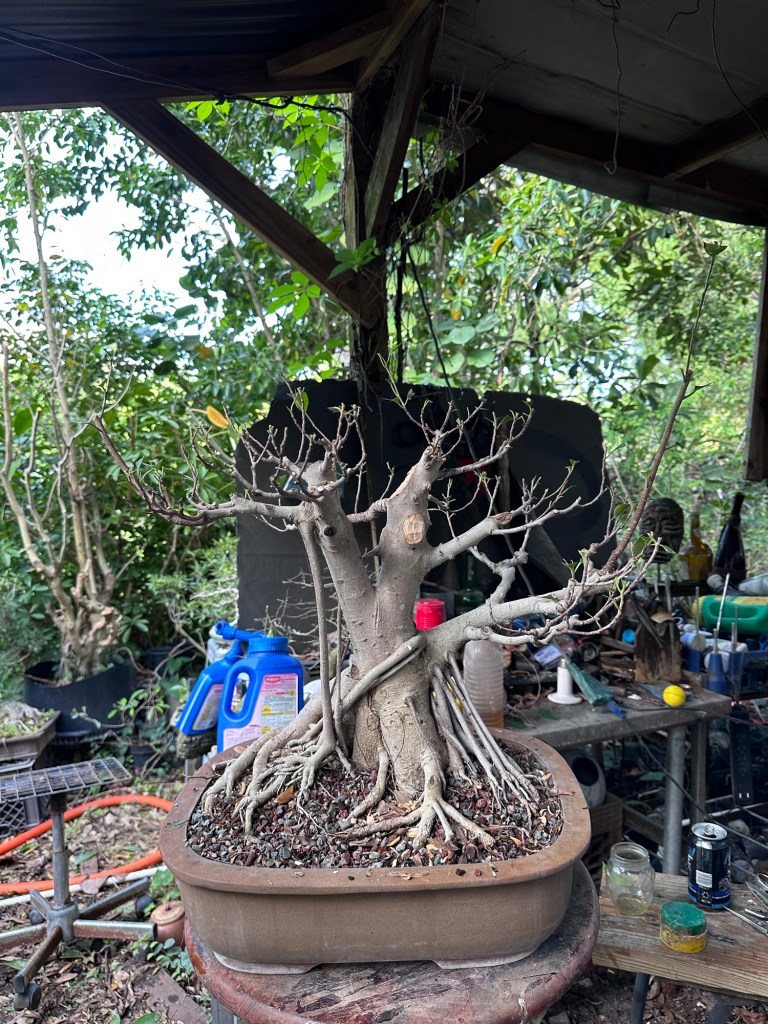
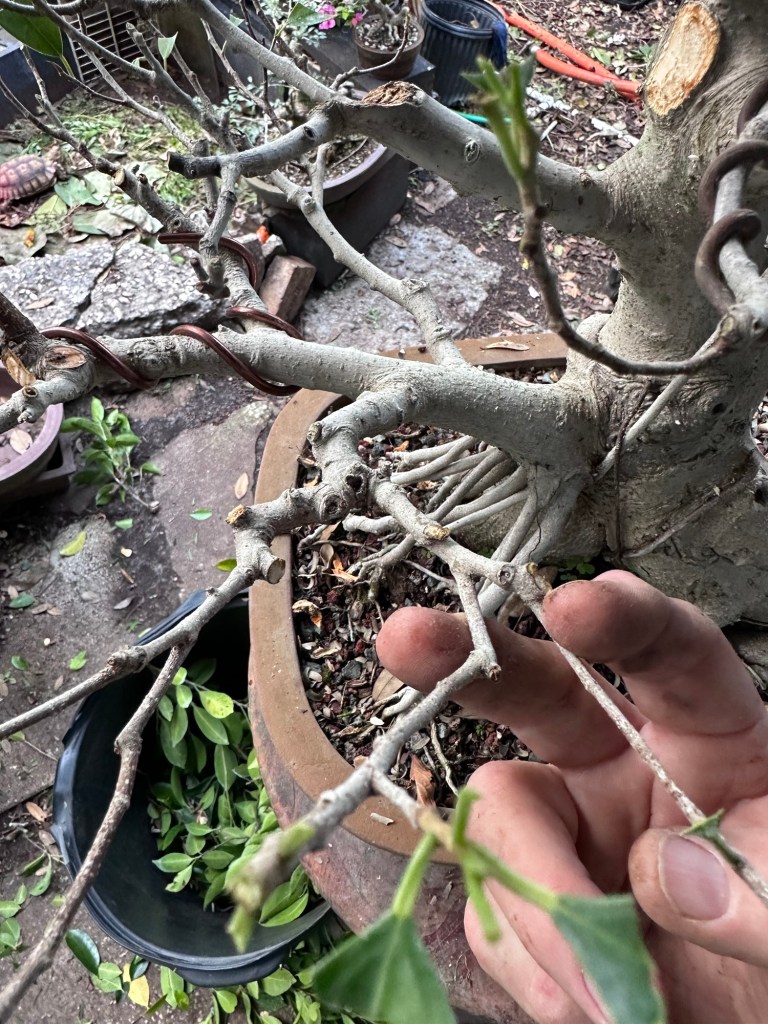
As you might have noticed, we chopped it. And Irene was right there with me on the decision to do it. It was actually her idea. It’s a drastic technique, for sure, somewhat controversial, as dramatic as my teenage boys trying to get through a Fortnight Battle, and, in my case, it makes me look badass for how casual I can do it, with just a pair of scissors.

You see, many people may misunderstand the decision to do a trunk chop. Let’s go through another willow leaf (below) and the decision tree (no pun intended) used to decide when and if to trunk-chop a tree.

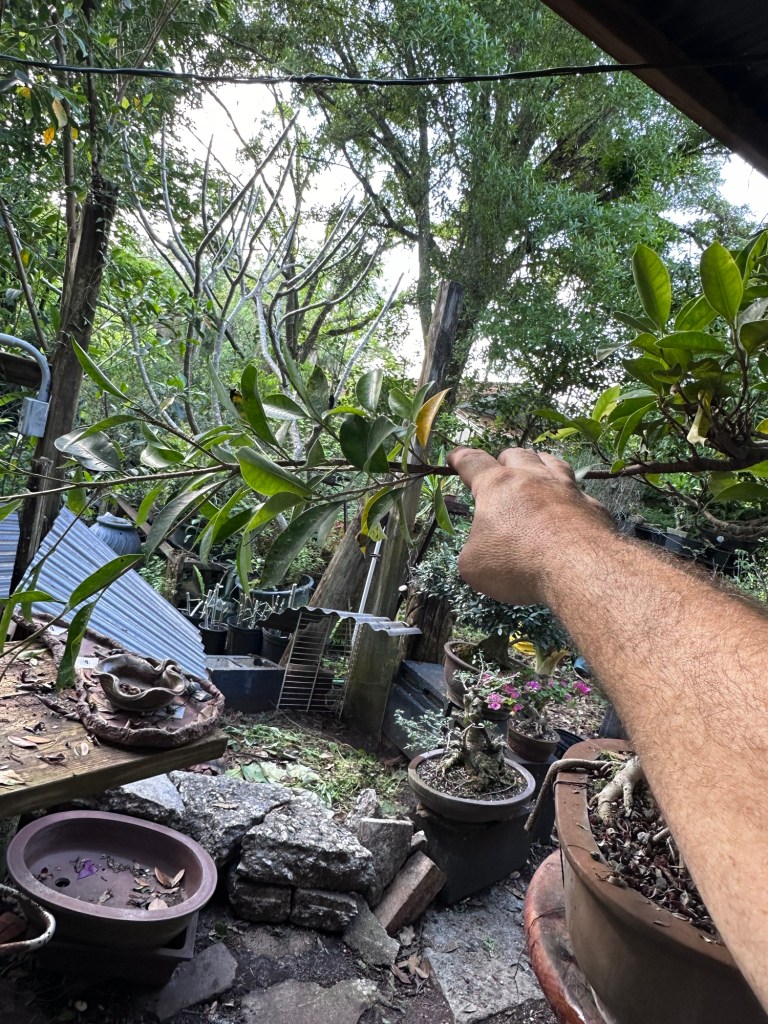
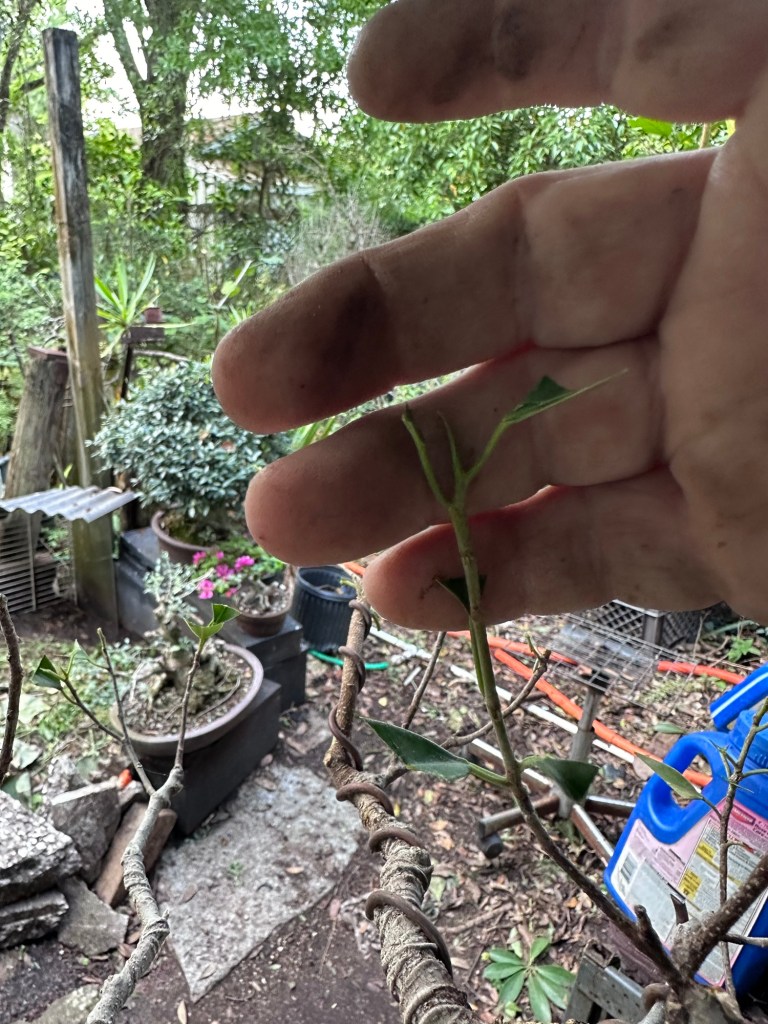
Below: Hand for scale. Ficus salicaria, the willow leaf fig. It belongs to Mike, who’s visiting from the Naples area. The tree is a stock tree from Wigert’s Nursery in North Ft Myers. It has a fair sized base (nebari) and a good sized trunk. But it has little taper, the branches are way high, and it kinda looks like a slingshot. Just need a rubber band and a good rock, and we can go squirrel hunting.

Ok now, you ready? As one should, let’s begin at the beginning. You can probably guess the ending to this post, a trunk chop, but the question, the one in the title, is “Why?” Why a trunk chop?

The beginning begins with the first interrogative “What?” What is Bonsai?

Bonsai is the Art of taking a relatively small, and relatively young tree and, using various techniques and principles of art, trying to make it look like a big and old tree.

One of those principles is the one we call “Taper”. The concept of taper means that, starting at the bottom, we should start with a wide base and, as we go up the trunk, it should taper, or get skinnier, coming to a point at the top.

The tree below has some taper. It could be used to describe (style) a tree as seen from a distance. Throughout most of the history of bonsai, most trees were styled from a distant view perspective. Think of observing a tree on a mountain. But, as tastes and visions change, so has the idea of perspective. In the real world, trees have a trunk-width to tree-height of 1(trunk width) to 12-14 (trunk height). If you read the old books, it was taught that the ideal ratio was about 1-8 or 10. Today they teach 1-6. But there are extreme examples of 1-4 or even 1-1 (the so called “sumo style”). Now, I have been known to style a sumo style in the past, and, if a tree could support it, I still do. But let’s get back to Mike’s tree.

Here’s the slingshot I was talking about.

It’s not generally a good design choice to keep that. Why? Well, horticulturally, a tree in nature tends not to grow that way. Or, if it does, when a good wind storm comes along, the tree will break at the “V”. It’s physics. Artistically, a v acts as a visual stop for the viewer. Bonsai being an art, that wide V will stop your eye as it moves up and down the tree. Your eye is drawn to open spaces and you’ll be looking at what’s behind the tree and not at the tree. Your eye moving around the piece of art, as designed by the artist, is called “composition”. I could get really into it, and talk about line, form, focal point, and negative space, but I think you get the idea.

For Mike’s tree, I could remove the bigger branch, like below.

And I’d still have good taper.

I could remove the smaller branch and have a more natural taper. That’s Doug hiding between the “V” btw.

Proportion (how the limbs are arraigned as you move up a tree) would satisfy a natural looking design.

The thickness of the trunk should decrease, in shorter lengths, as you go up the tree (main trunk is longer than the next level, the middle part by about 1/2-1/3, the third part, even shorter and thinner, until you get to the top, which should be your fine twigs. This makes the tree appear as though it’s taller).

I could not cut anything and use that first branch as, well, the first branch, and wire it down. We could make a good natural style.

To give an example of keeping most of the tree, let’s go on a tangent. Here’s a tree from a club member, George

We cut out the middle and wired that slingshot.

And it’ll make a good tree, in time, as well.

Getting back to Mike’s tree, we could start over, and chop the whole thing and make an exaggerated tree with quick taper.

You can guess what we did.

We didn’t cut here

Or here.

We cut even lower. Doug had to close his eyes, the horror was so extreme.

The reason why? Proportion. The first third is where the chop is. The tree now needs to grow up to have believable taper. Ultimately, we wanted (and it was a collaboration with Mike, I don’t go willy nilly chopping another person’s tree without a full discussion of what can be done with everything. Even on my trees I keep asking myself “why?”. Why cut here, why wire there, etc. )

And the real answer to the question “Why?” is that Mike wanted a smaller tree. And, with a willow leaf, we can chop it and regrow the top in short time.

Something like this is the final vision.

Here’s Mike. He took a pic, for posterity,

Here’s another of Mike’s trees we worked on that day. A Ficus Microcarpa.

It had been chopped already, and we just had to move the branches a bit.

Styling a tree is all about asking questions. “What happens if I do this?” “Will this improve or destroy the tree?” And ultimately, “Why am I doing this?”

Those questions are answered by experience, experimentation, and by people who’ve done whatever you want to do to the tree. And feel free to ask those who’ve come before. Just make sure you ask “Why?”

To finish out this essay, let me quote this (my wife is a third Dan backbeat in taekwondo, for background) it’s from a part of the taekwondo Black Belt Oath:
“…….I am a student yesterday, I am a student today, I am a student always……”


If only we all lived by just that part…..

Rehabbing a neglected banyan ficus

20 April 2023 at 22:15

It’s been too long since I’ve attended to this poor tree. And the blog. Sorry to the tree and to my readers. I’ve been busy with client’s trees, planning the Bonsai Societies of Florida 2023 Convention (check it out Here ) and some real challenges in my life.

The tree is a Ficus microcarpa.

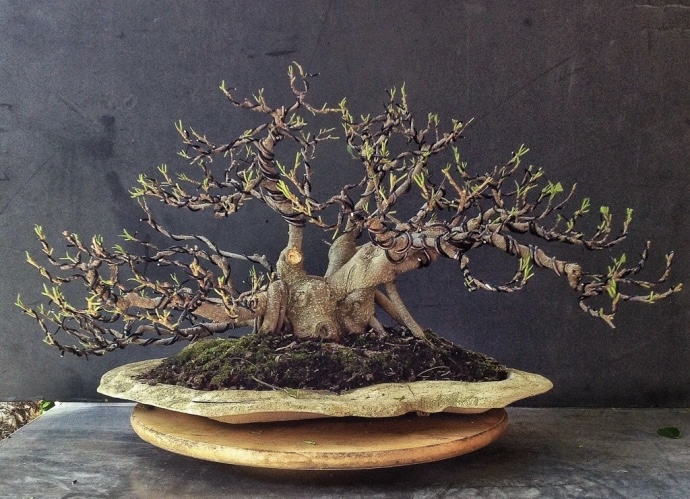
You last saw it in this blogpost What is the banyan style?, which was published way back in April 17, 2014. Here’s how it looked then:

Yeah. I know, what happened? Right? I’m supposed to be a professional and all that. Neglect, unchecked growth, a couple of hurricanes and freeze warnings. Accidental uh…drought. Insects, disease, cats, children. Basically it’s survived some biblical trials and tribulations.

Speaking of disease…

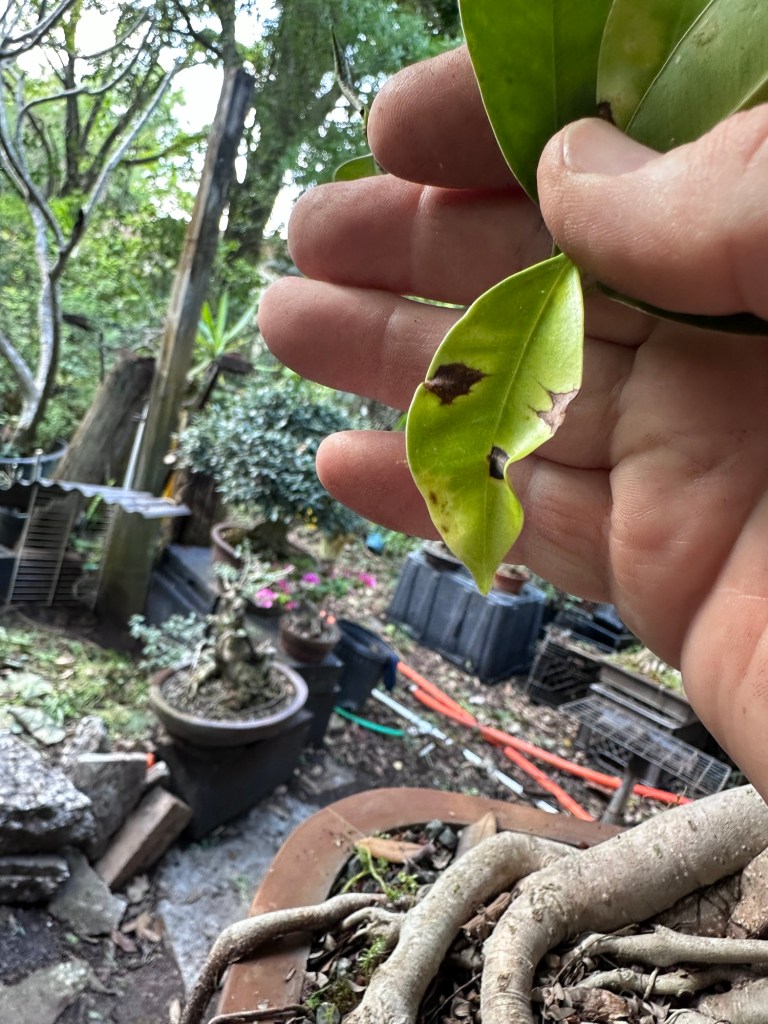
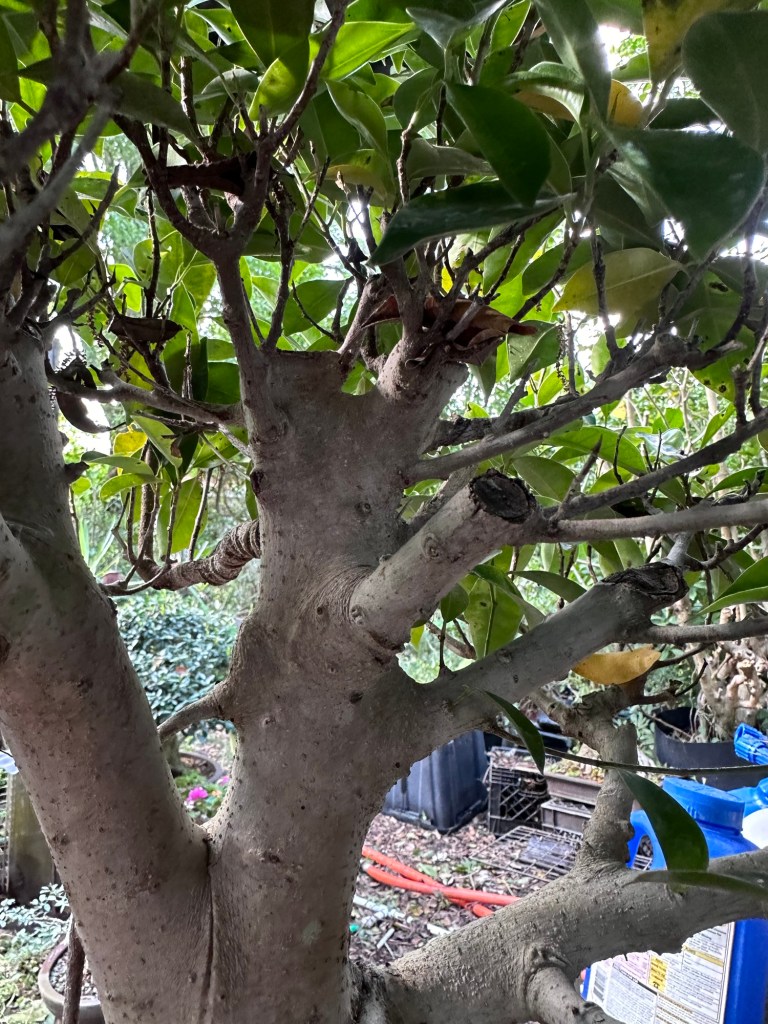
I see these spots early in the spring…a lot recently. I had my nursery inspector do some checking and, though I thought it could be a fungus or a bacteria like pseudomonas, he said it’s evidence of a gall wasp. Now, as the name suggests, it’s usually an evident infestation by there being a gall on the leaf, but I haven’t seen them in my ficus. Maybe because of the systemic treatments I use (more on that later) killing the larvae. I don’t know.

The work today in rehabbing this tree will include a repot, a hard cut back, fertilizer, insecticide, and weed prevention.

Let’s get to work.

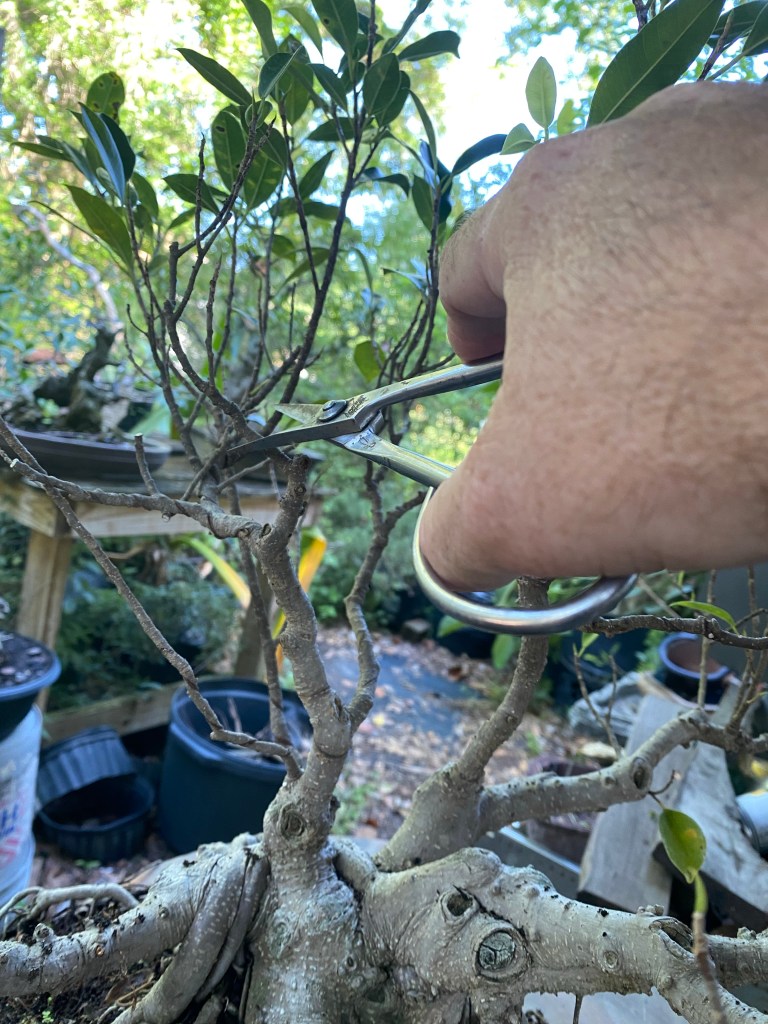
First, cut back…

I’m bringing it down quite a bit.

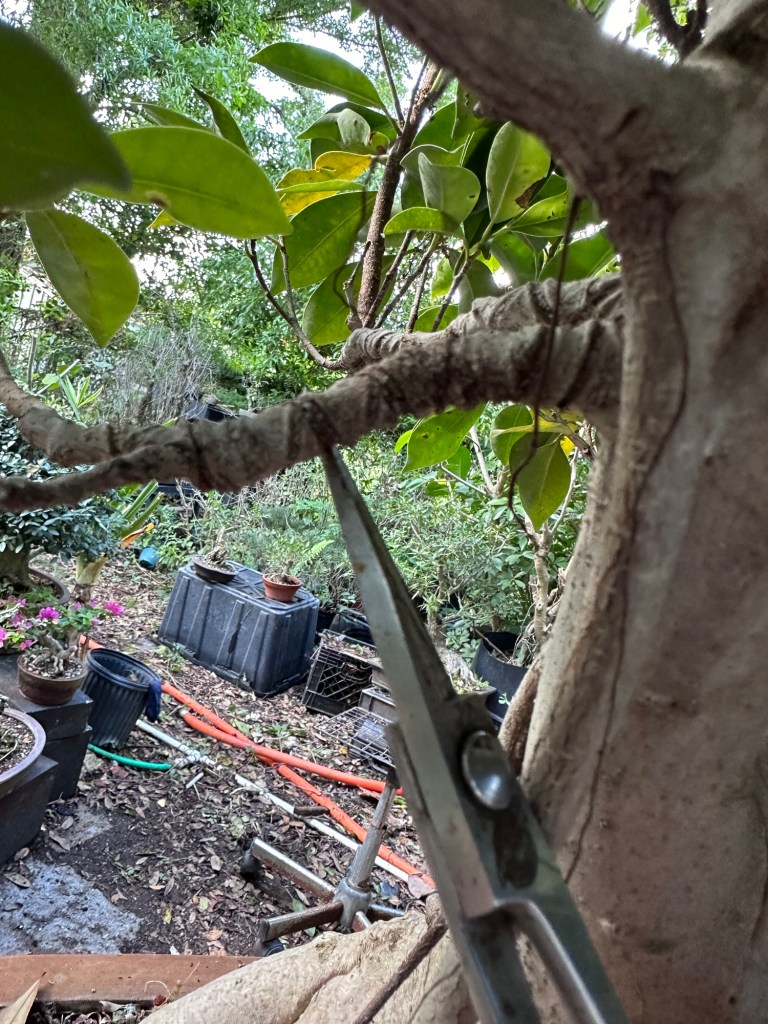
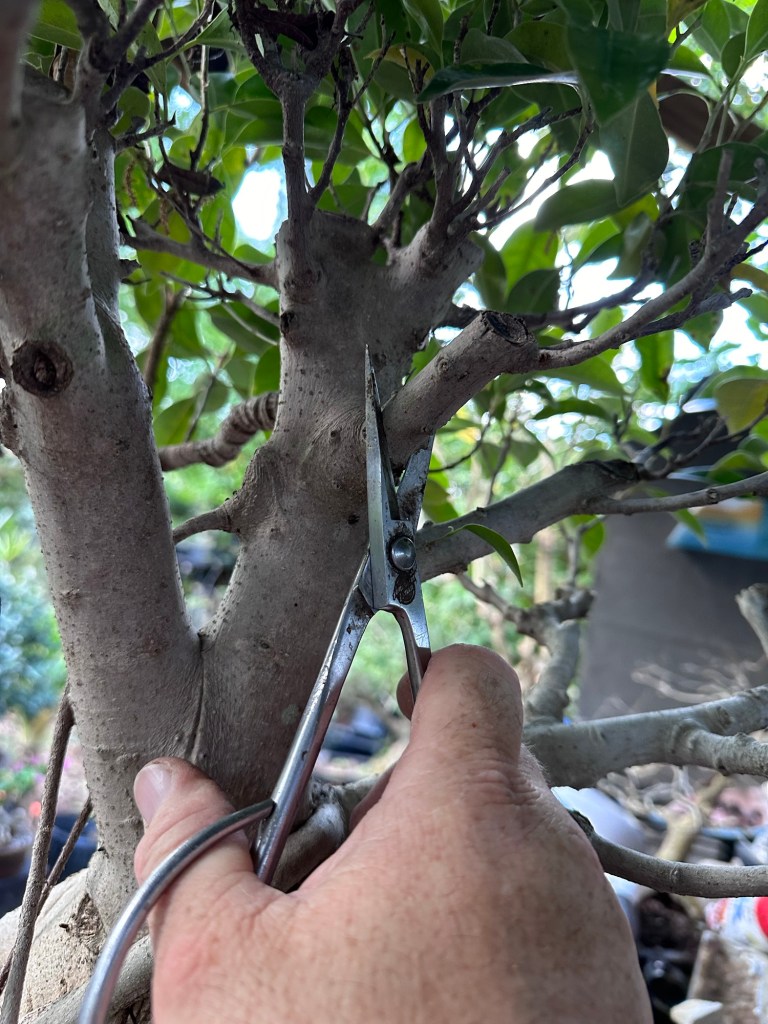
Chop chop goes the scissors!

This branch below will be the one branch I don’t cut back. You’ll see why (again) later on in the program.

Normally, I would cut this type of fig back so hard, as this is a standard Ficus microcarpa, and you can get significant dieback on it, sometimes losing whole branches. To contrast this, the Tiger bark microcarpa doesn’t do that so badly, it back buds almost anywhere. But the plain old Ficus microcarpa does. Keep that in mind. Know your tree and work accordingly.

If the branch you’re chopping is a darker brown, it’s more likely to backbud, as that’s newer growth.

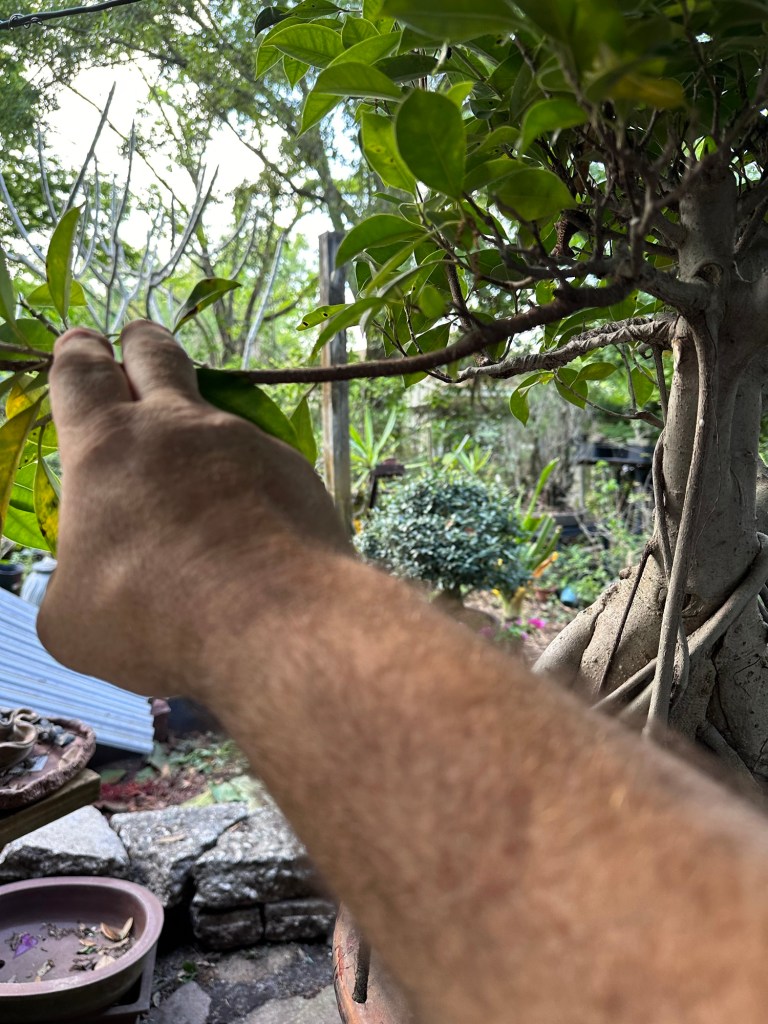
Here’s the one branch I didn’t cut back. I wired it and left the grow tip.

Now to repot. I’ll be combing out the roots to get rid of all the wrapping ones. And I’m being aggressive so I can get all the weeds out.

Weeds like these. This is a corm or bulb from a weed called “cat’s claw”. A climbing vine that holds onto things with tendrils and modified appendages that are a lot like, just as the name says, a cat’s claws.

Here you can see the “claw”.

This one is called “Florida spurge”. It’s underground roots can get as big as carrots. You have to be carful to pull out those roots as it will just grow back from the bulb. If you have them it’s a good indication you may have nematodes.

Here’s the leaves of the spurge.

That done, time to cut the roots.

They were circling the pot (it’s in a different pot than the one I used years ago).

The pot it was in.

A good pot. But is it deep enough for what I need for good regrowth?

I had had thoughts of putting it into this container. It’s kind of what the trade calls an “Anderson Flat”.

It’s bigger and deeper than the ceramic one.

But using it might give me too much growth. Is there such a thing? Yeah. I need controlled growth with short internodes (remember the dieback, the branch will dieback to the next node lower on the branch). So I’m going with its current pot.

Here’s an axiom “The wetter the roots stay, the slower the growth”. You’ll hear me talk of wetter and drier soil mixes and, in this case, the more shallow a pot, the wetter the tree will stay.

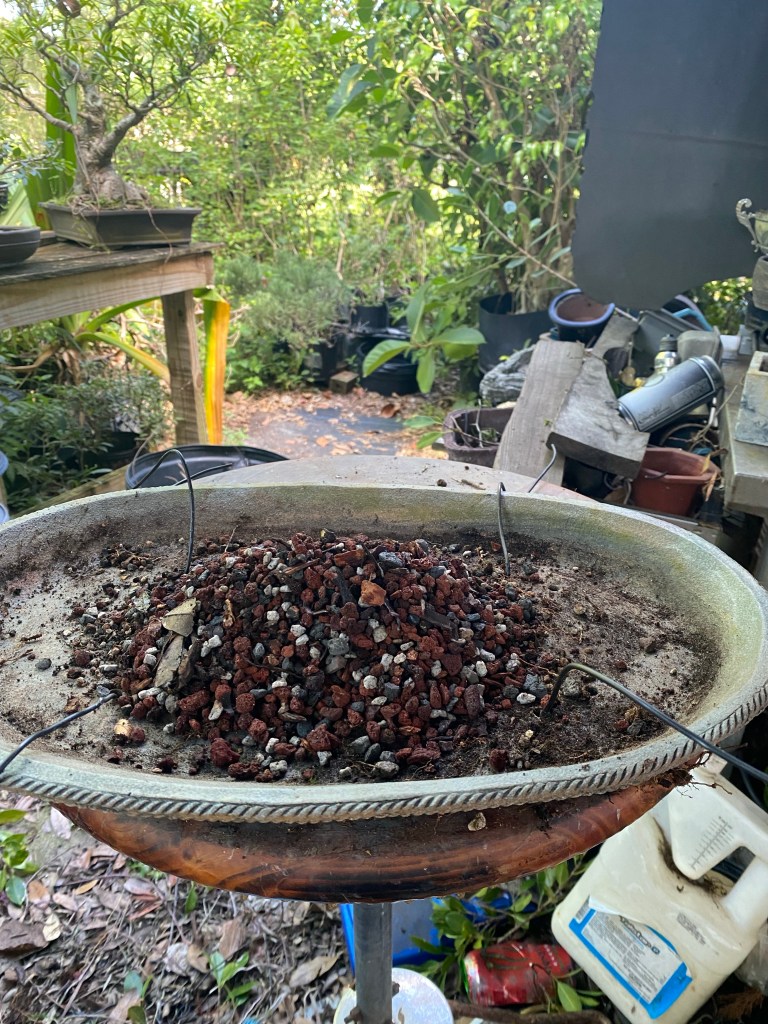
To repot, first, make a mound of soil, and put the tree onto it and wiggle it down. This fills in the air gaps and gives the roots something to grow into.

It bugs me when I see people spreading an even layer around a pot. Don’t worry about the edges. That’s what chopsticks are for, getting the soil in between the roots on the margins.

The wiggle technique:

All chopsticked in.

Some systemic insecticide next, in this case, imidacloprid. It’ll keep the thrips away. And those gall wasps.

I like to mix it into the roots well, or else you get a gooey mess.

Now, a generous portion of fertilizer. This is half synthetic time release, and half organic (I’m using Miracle Gro Skake ‘n Feed today).

And weed preventer. This is OH2 but you can find a product called “Preen” in all the stores. It’s a convenient product that inhibits seed germination, not an herbicide, so you have to get out all of the sprouted weeds first. And there will be ones you miss, so revisit it in a week or two to get those.

Do you know the difference between a weed and a plant? You want a plant, you don’t want a weed. There are places where Ficus microcarpa is a weed.

And that’s it. Let it grow.

I did rewire a back branch. It was growing up, as they are wanting to do, so I rewired the opposite direction and put it back in the place I wanted it to be. Here’s a tidbit: if you keep a branch wired too long, when you remove the wire, sometimes it pops back into its old position. The tree wants to grow up, especially newer, and smaller branches, so the tree is actually pushing against the wire, and when you unwire it, it pushes the branch up again. You can see this in bigger trees where two branches are growing against each other, and tree trimmers know this and are very cautious when they see it. As they try to chainsaw the branches, the pressure could be so great the branch will violently snap. They call it a widow maker. It happens with twin trunks the most. Imagine you’re sawing away and then “BANG” the tree splits apart at the seam.

With that, the fig has a long way to go, but by the end of the season, I’ll have secondary and tertiary branches to work with. I’ll update if I remember.

And “Bob’s yer uncle”.

Let’s see if I can get it back to its former glory.

Ficus microcarpa from an auction…..3 years later..

18 October 2024 at 23:34

The Shofu Bonsai Society of Sarasota has a pretty good auction every year. Granted, some years are better than others, but the year I got this one, maybe 2021, was spectacular. This tree was on the silent auction.
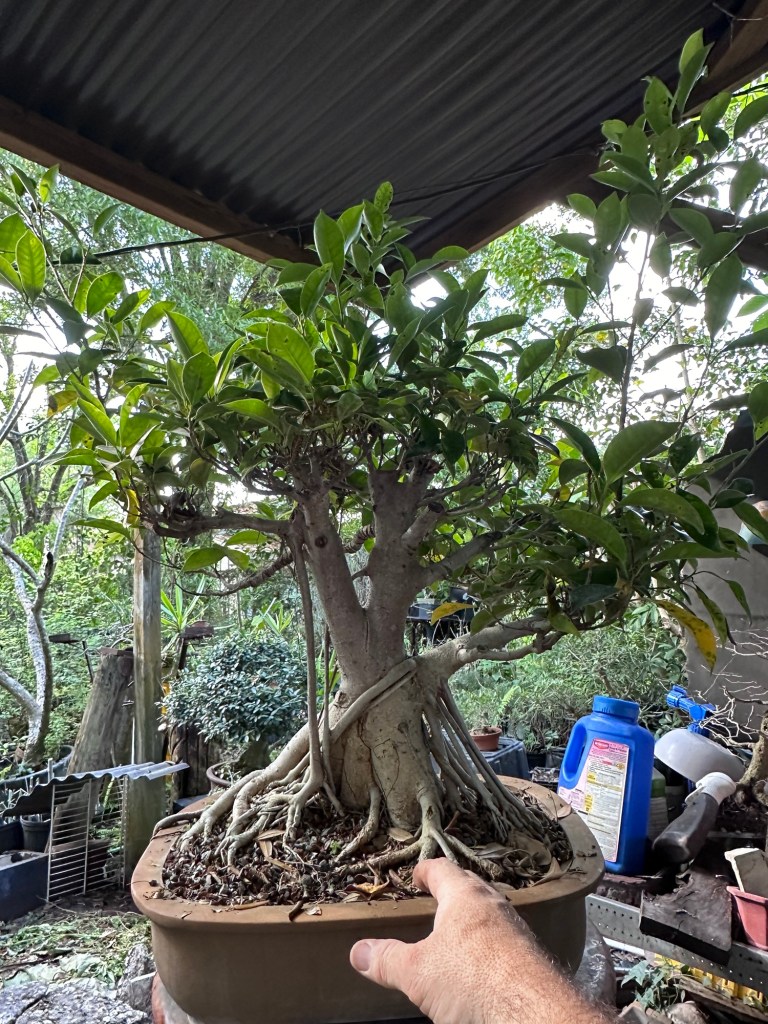
Yeah, not the live auction, the silent auction! I didn’t have to raise my hand or pull my earlobe to win this beauty. I just wrote a bid down on a piece of paper.

I don’t even think I went higher than $100 on it.

Since I’ve had it, it seems like only a few branches have grown.

But that’s typical. I don’t do anything to it for those few years except to water it. And when you ignore this species, a Ficus microcarpa, it will pick one shoot on each branch to feed the sugars to, and, like the pic above, you get long spindly branches and the smaller, interior branches tend to die off.

The lack of sun is the impetus to tell the tree how to allocate the resources.

(Not to belabor a point, but that’s another reason for timely defoliation techniques on figs. Defoliate to let sun in, calm down the randy shoots and allow everyone to grow. )

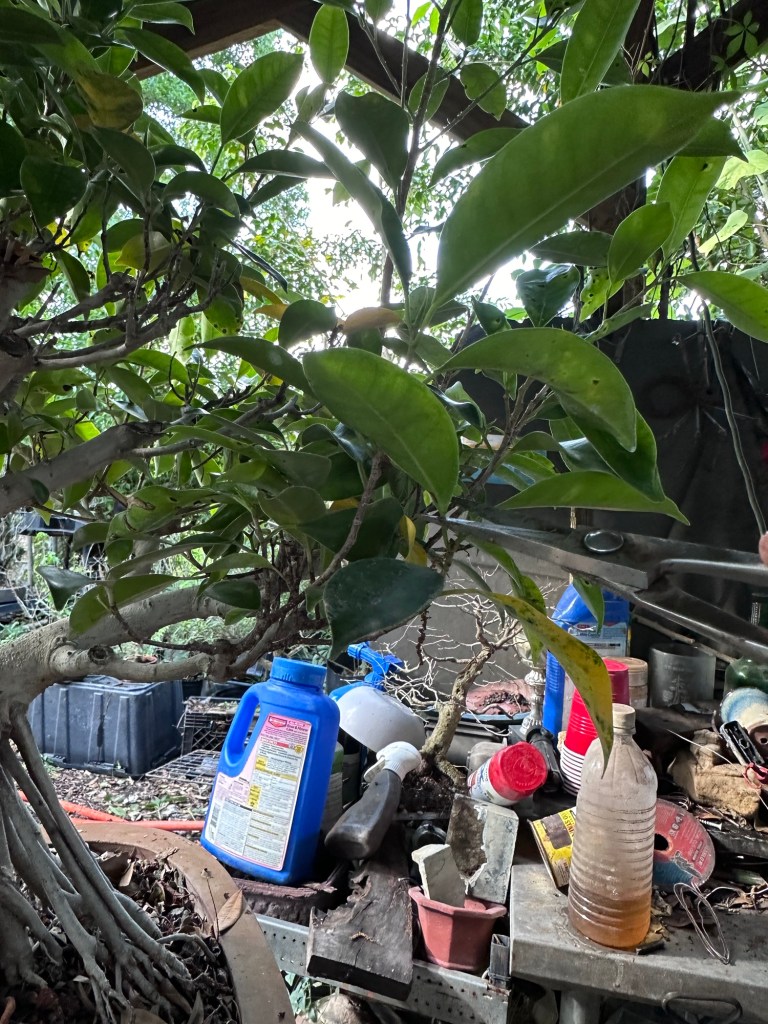
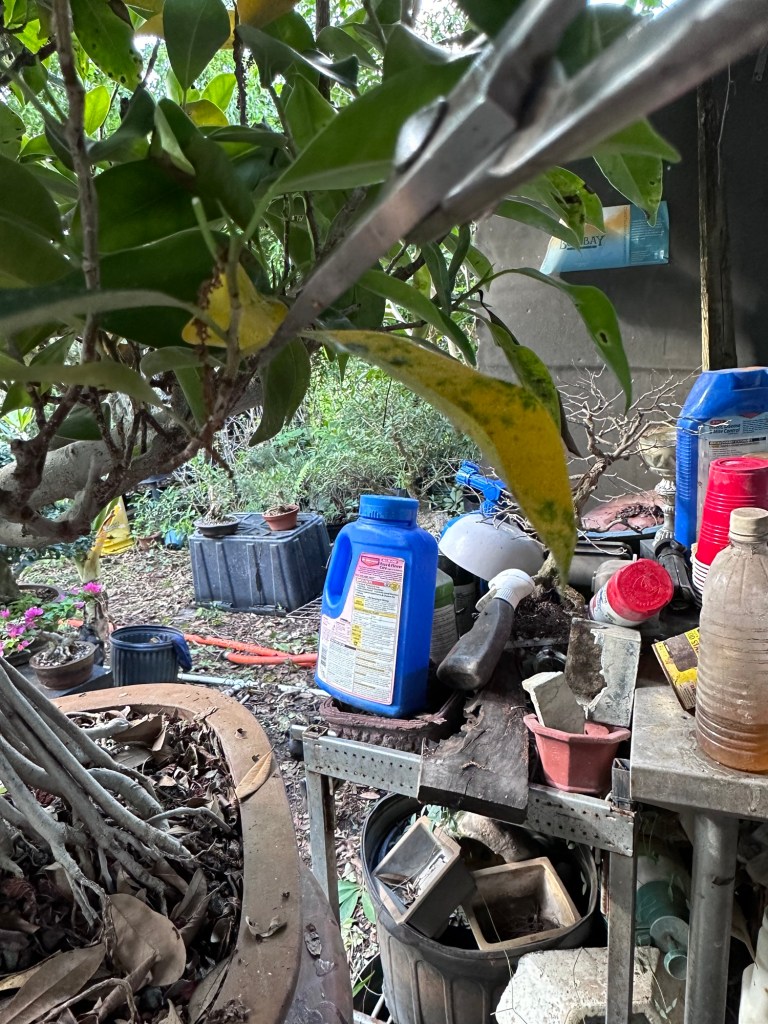
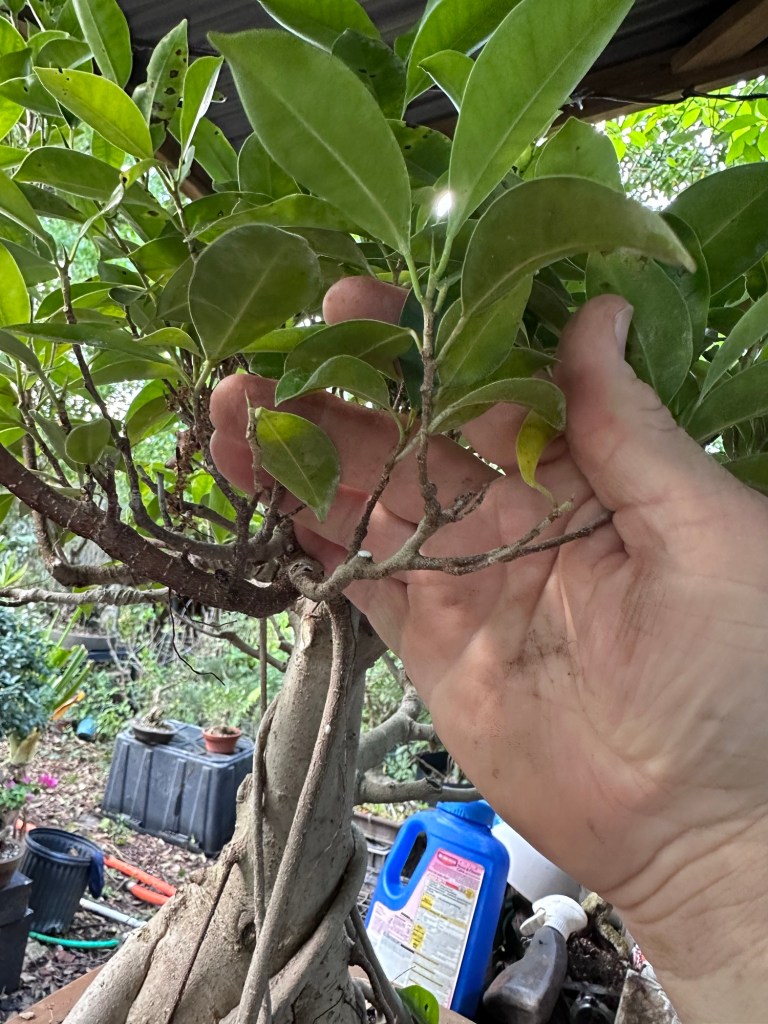
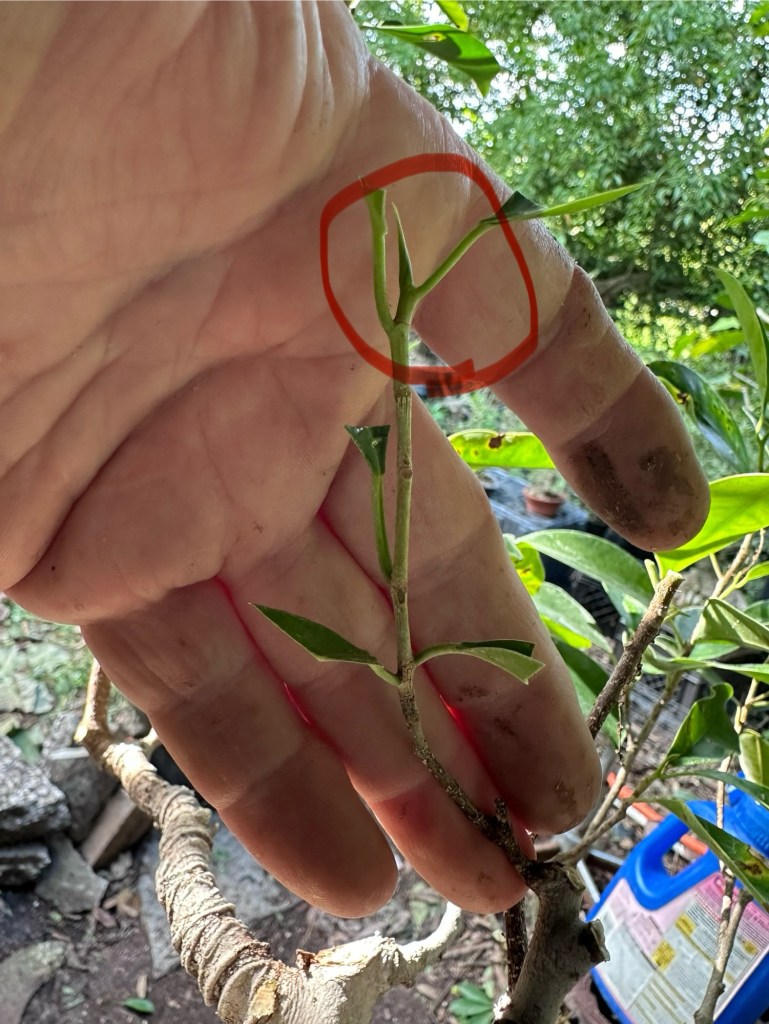
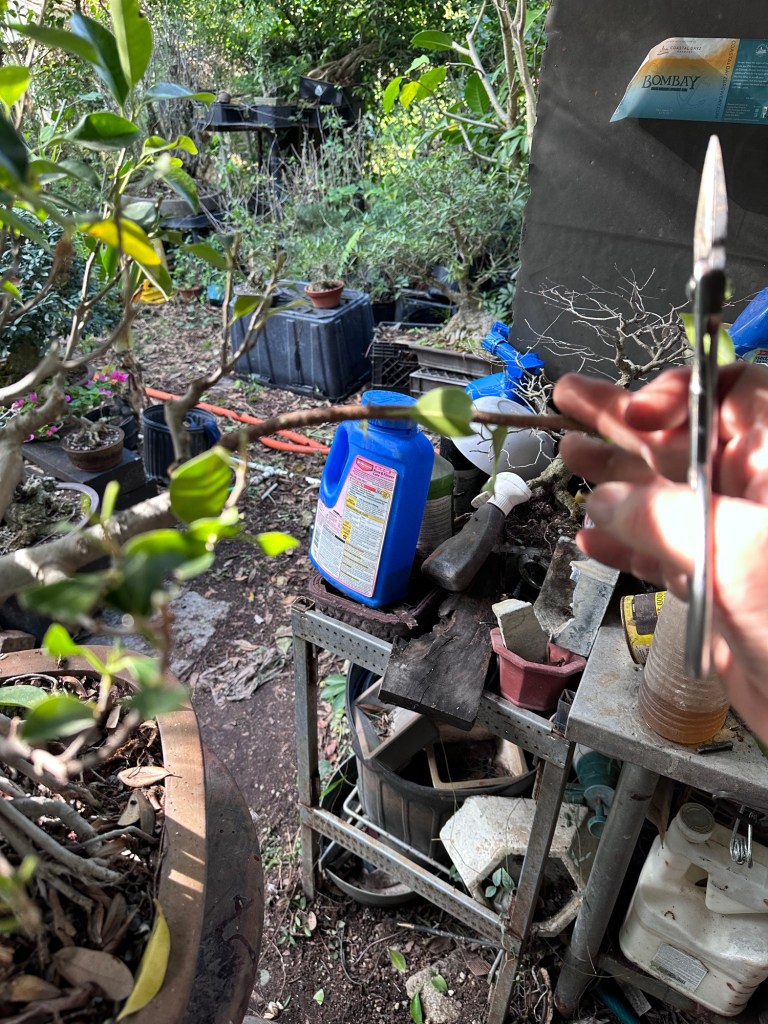
Oh! Notice the blue bottle? That is one thing I’ve kept up on for this tree. That bottle has a systemic insecticide in it called “imidacloprid”, which is a synthetic nicotine (what they call a neo-nicotinoid) that I treat all my F. microcarpa with to control thrips. An insidious insect that takes the leaf and folds it to make an incubation structure to breed more thrips.

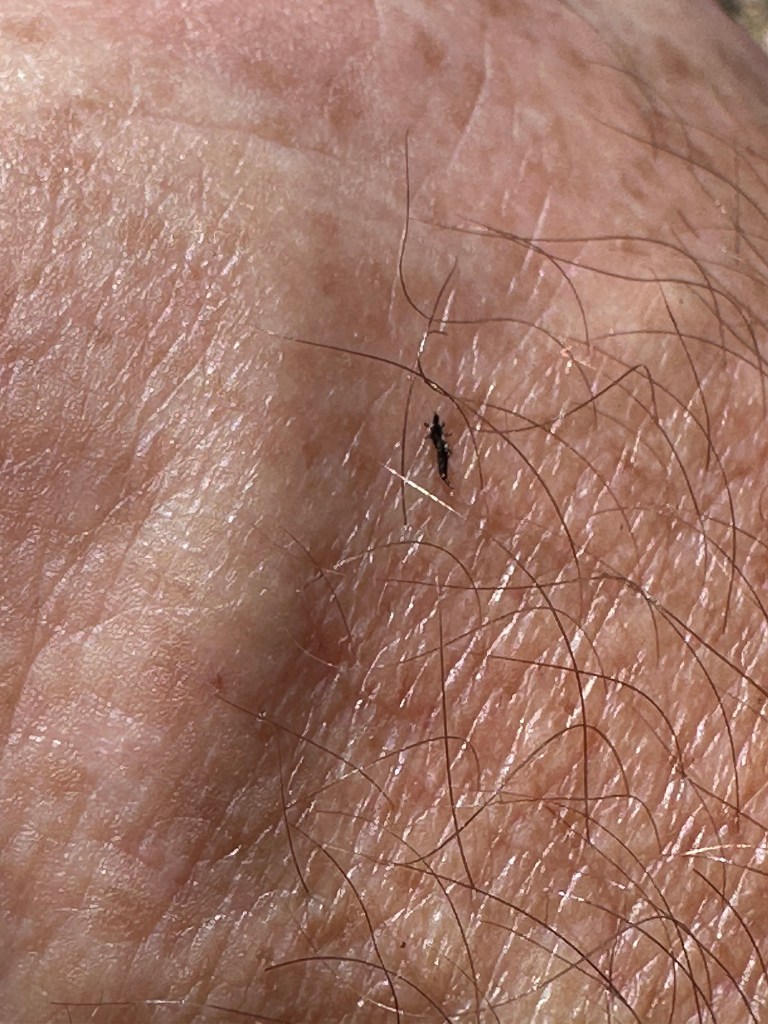
Below, there’s one on my arm. They call this one the “Cuban Laurel Thrip”, as that’s one of the common names for this ficus, Cuban laurel. I call it the “Indian laurel” as it’s more indigenous to India than Cuba, though it is endemic in the island.

The tree does have flaws, like the wire scars below.

And, as a species, the leaves are bigger than say, the “tiger bark” variety. And they are prone to branch dieback (like the Ficus benjamina) if you don’t leave strong growth on the tips when you prune.

Let’s open it up and select some branches.

Hmmmmmm….might be useful. Below?

Nah

Below, there’s that growth tip.

I’ll leave it to grow longer.

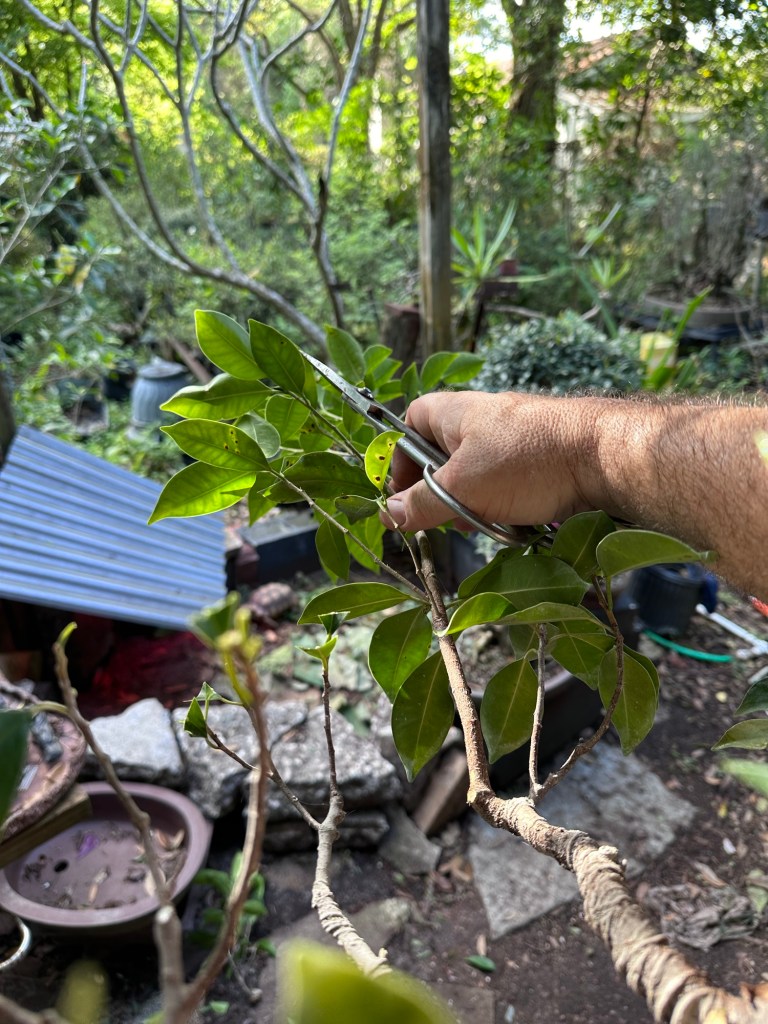
But some I’ll cut back to encourage back budding.

Clean up, clean up….everybody do your share.

Kah-chop!

There we go.

Some wire.

The result of clip and grow. Good movement.

More grow tips to preserve.

Now just let it grow.

But not willy nilly growth, directed growth.

If you ever take a class with me, and I say let it grow, you should let the things left, to grow, but get rid of growth that’s not needed.

Here’s a video

And here’s an idea of what it’ll look like. Needs a better pot.

Let’s see what happens, I promise to show the repot and updates

The Cincinnati split

18 August 2025 at 18:42

We have before us, up in the urban spires in the city of Cincinnatus, one willow leaf ficus. The tree, as is, would be good on most people’s benches. It has a biggish trunk, good branching and a full canopy. But, to quote the modern day vernacular, it’s kinda like a “helmet on a stick”.

And Brendan was bored with it. I might be able to do something about that, let’s see what we come up with, shall we?

Twirling it around, I think I like the front (below) with its nice root spread and interest. Now what?

I think you see what I saw…

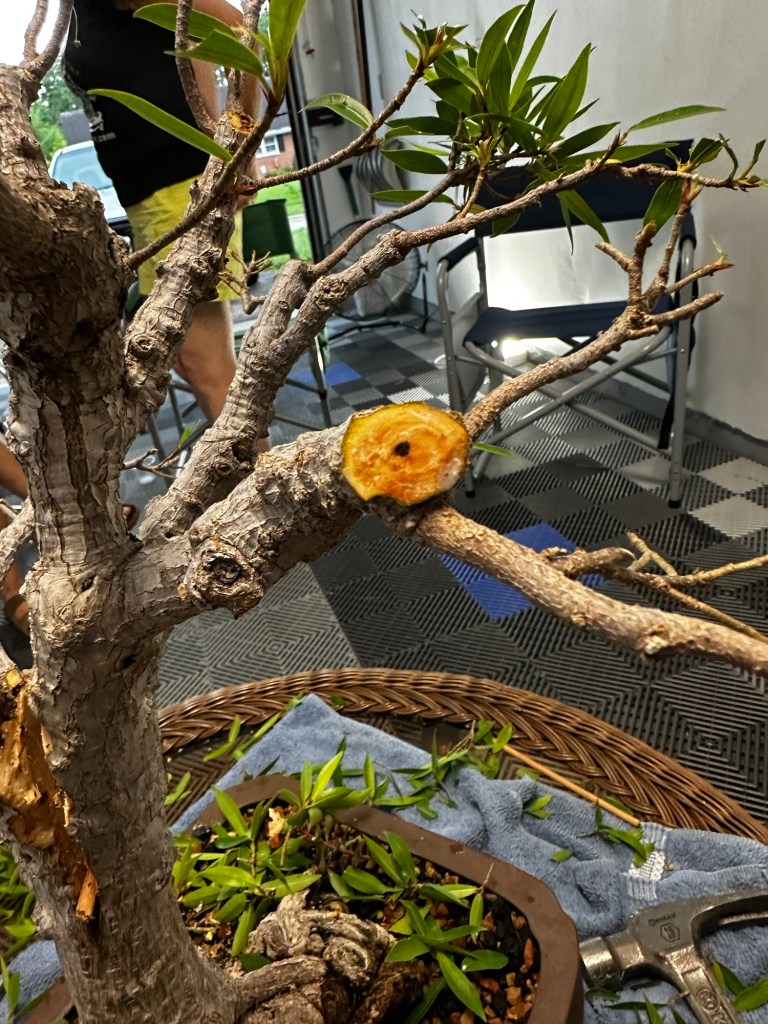
…hah! I crack myself up sometimes. Let’s crack this trunk up….

Or saw it, as it were.

Maybe we (or Brendan) needs some liquid courage to steady the nerves. Or hands.

Bob Dylan has a new bourbon by the way.

But, oddly, I chose a Van Morrison song for the video, go to My Instagram to watch the sawing. It’s a good song at least.

“Are you sure the tree will survive this Adam?” my wife asks.

I sure hope so.

Using a knife, I make the saw cut a little less “saw cutty” looking.

That’s better. The willow leaf ficus almost heals like we do, from the inside out, as opposed to the bark spreading over the cut, like a maple tree. It’s an observation I’ve made in my career as a ficus bonsai guy.

That was the easy part, now I’ll go through and give the canopy some shape.

Which means, defoliation, removing unwanted and superfluous branching or budding, wiring, etc.

Without foliage (foil-age to some of those in the town of my birth), we can clean up some cuts too.

And no, Virginia, I don’t tend to use cut paste on figs. Why? A point to consider, the white latex “sap” that we see when pruning a ficus is not the real “sap” from the tree. It’s actually from a secondary, pseudo-vascular system that utilizes cells called “laticifers”. The sap flows through the xylem and phloem and it’s comprised of the water and sugars the tree uses in photosynthesis and respiration.

Laticifers are super specialized cells or a network of connected cells (often like the real vascular system, in tube-like structures) that make and hold the latex and can be found in various tissues, including the pith, the cortex, the secondary phloem, and even secondary xylem. The botanists believe that the purpose of the latex is to trap bugs and stool continued damage to the plant, and to help seal the wound for quicker healing

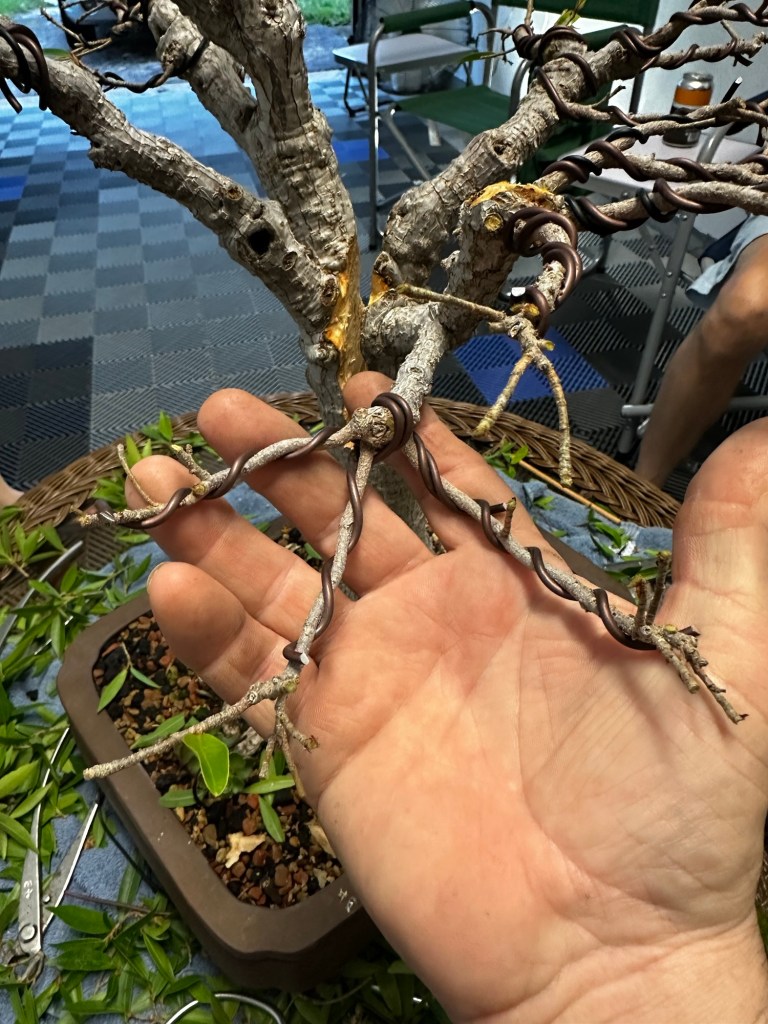
Let’s add some wire…

Look at that dude, he’s a stud.

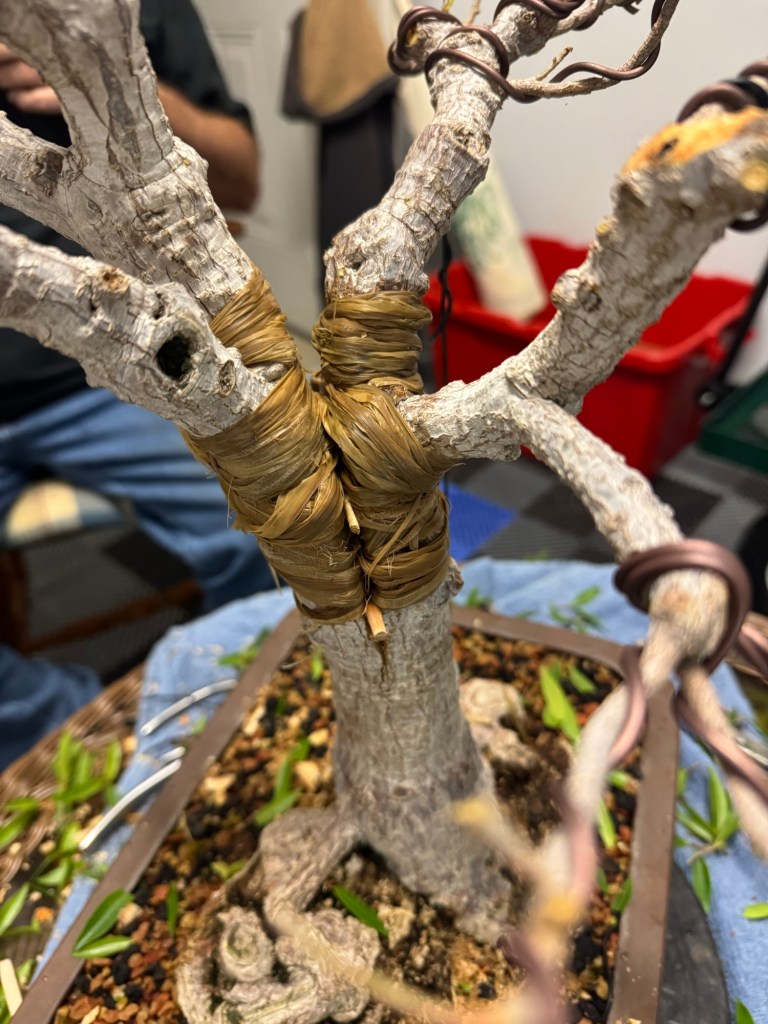
My work is done, except to have Brendan add some raffia to the sawn edges. Willow leaf figs tend to bud right on any cut or wound, which is a good trait to have, but sometimes it’s too much.

The raffle should keep new buds from forming.

And Bob’s yer uncle!

This is where you, my Constant Readers, are quoting Jurassic Park “You.. were so preoccupied with whether you could, you didn’t stop to think if you should…”

But I jumped past all that and posit the concept that I needed to do it.

We had some reverse taper building where the branches were coming off the trunk, pretty much in the same spot, so something needed doing. Whether it was chopping them off or, this. If I chose the chop option (just as traumatic as this technique) we could have created a sweet short tree. But it too would be just a “regular” bonsai. Brendan was bored with the tree before. Now he’s excited to see what happens. And the tree will be a better one for this. That’s Brendan below, on the left in the front.

He looks happy. I do too. That’s my second or third liter of beer, so…..I’m happy.

The tree, for Brendan, was a good tree, but boring. And living up in Cincy, it was becoming a chore to go through all the labor of winter protection, including grow lights, heat mats, etc. Now, Brendan has something to look forward to as the tree responds.

The tree looks happy too.

Another video of the finished work.

And yes, you saw White Castle’s and a sparkling beverage called Bonsai, tasty and expeditious. Food and beverage of the bonsai gods we pray to.

Let me know what you think. I’ll add updates as they pop up.

❌