Normal view

Received before yesterday Adam's Art and Bonsai Blog

Janice’s Buttonwood

27 July 2022 at 00:59

This is Janice’s buttonwood. You’ve seen it before in the post Who doesn’t have a buttonwood in Florida from a few years ago. Since then, it was shown in the 2021 Bonsai Societies of Florida annual convention, and its just gotten better. Janice found a new pot for it at this year’s BSF convention (2022) and that’ll be the main work today.

Here it is now, in The Nook.

To begin the story, here are some progression pics.

Here it was in 2018.

Here it was in 2019 (at the end of this blogpost)

At the 2021 BSF Convention.

And, finally, back to today.

The tree was originally scheduled for the 2020 exhibit but, you know what happened that year. As a result, we didn’t repot it in 2020 or 2021, and this year I’ve been working on letting it gather sugars so I can do some work on it. Hence the big leaves.

It had a mild chili thrip infestation at the end of last year as well, and we treated it with imidacloprid, a systemic insecticide.

But the tree is strong now, and ready for some work.

I’ll also be cleaning and applying lime sulfur to the deadwood, which is, as you’ll see, sometimes easier when the tree is in the middle of a repot.

First step, defoliation. I know, oooooooohhhhh, controversial. It astounds me that so many professionals not only poo poo defoliation as a valid technique, but try to vilify those who use it. One of my catchphrases I use all the time is “horticulture is a science, but the practice of horticulture is an art”. That’s why two people can use two seemingly different techniques and still achieve success. Most of bonsai technique has more to do with the timing and seasonality of the technique and less to do with doing it. Here’s an example: there aren’t any arborists that suggest that removing a pine trees candles is ever a good idea. Yet, if one does it at the right time, the way we bonsai practitioners do, the tree responds with increased vigor and better growth.

There are prerequisites to de-candling a pine tree, one of them being the tree should be in good health, but the science of horticulture says “don’t do it”. Yet we do. Why? Because, the practice and timing of the technique works. As it does with defoliation.

Anyway, here’s my quick method for defoliating a buttonwood. They tend to grow like little rosettes, as below.

Take the branch…

…..move your hand to the end of the branch, holding the leaves…

…..take a sharp pair of scissors….

…..SNIP…..now, depending on whether you want to keep the grow tip intact, to continue the elongation of the branch, or you want to encourage backbudding, is what determines how close you snip the leaves off. I left the grow tip intact in this case, as you can see below.

On some, I’ll keep the tip, on others, I cut it.

Here’s something you don’t see everyday, flowers on a buttonwood. Yes they flower, everything flowers, but it’s only when you let it grow and it’s healthy do you see it.

You may notice some black sooty mold on some of the leaves.

Whenever you see it, always check for aphids or scale.

In this case, its not this tree that’s infested, it’s from a tree that was above it on the bench.

Snip, snip…

Snip, snip….

No, I didn’t count how many leaves. Ain’t nobody got time for that.

Now it’s time to repot. I would normally repot a buttonwood, in Florida, every year. It’s been my observation that the tree can weather the winter weather better if you repot yearly.

But this tree had been selected for the 2020 BSF Convention exhibit. Unfortunately, that was the year of Covid lockdowns, so the convention was cancelled, and I lost several months due to my own health problems, so that year was skipped. And the tree was shown the next year, 2021. So I skipped that year too. Sometimes getting a tree ready for exhibition can really stress a tree out.

This year is the year though. And I’m not looking forward to it. It’s potted in a container with sides that bow outward (they call it a “bag pot”). It’s a pretty design, but the roots will fill up that space, making removal a bit difficult.

But, no worries, I have my “1980’s era” repotting tool, the ubiquitous black handled, serrated, steak knife.

Before I begin sawing the tree out, I’m going to save the moss. Janice loves moss, so I’ll put it back on the soil surface when I’m done.

I got a little.

Now, let’s see how difficult it’ll be getting the tree out.

Simply saw around the perimeter, and pry the tree up every few inches.

It’s actually going kinda easy.

Ta-Da!

Now we gently rake out the roots. For a buttonwood I prefer a single tined rake or just a chopstick. The American Bonsai Tools repotting tool works well here.

It definitely needed a repot.

Before we finish, let’s look at, and get ready, the new container Janice chose.

It was created by Doug Marcum, from Hippie Dad Bonsai.

I think it’ll be perfect for the style tree, and, most importantly, Janice loves it too. It is her tree, ultimately.

The details are amazing.

He even has bent over nails made from clay, to make it look like a wooden box thrown together.

I rake out the roots and trim some back, and check to see if it fits in the new pot (you can see the process better in the post Jorge’s Buttonwood, from a few articles back).

Before I put it into the new pot, I’m going to use a wire brush to clean the deadwood (“Wire brush?” You ask, because it works. You’ll have to say that part out loud to get the joke). It’s also easier to clean the deadwood while it’s out of the pot, better to get at all the surfaces if you can turn the tree upside down.

Scrub scrub scrub.

Brush it down to bare wood, really removing all the dirt, grime, and old lime sulfur.

Then put it into the pot. I fertilized, then placed some imidacloprid to keep the chili thrips at bay, and then added that saved moss.

Then, since I’m going to lime sulfur it, I water and make sure to get the deadwood wet.

Lime sulfur needs to go on wet wood to help it penetrate deeper.

I’ve had this bottle for a while. I don’t think it’s available from the Hi-Yield company anymore, but you can get a similar sized bottle for very little money from veterinary supply companies (here’s a link, and no, I don’t do any affiliate marketing links, so I’m not getting paid to promote it: Click here you’ll notice that a big bottle, in this case 16oz, costs about the same as a 4oz bottle from bonsai sources. And it’s the same chemical, that’s your tip of the day. You’re welcome)

Get yourself a glass or ceramic, non reactive vessel, a cheap paintbrush, and paint it on.

Yes, it goes on orange, but, don’t worry, it bleaches white.

It won’t hurt the soil but it could damage the glaze on the pot, so I cover them both with a towel or newspaper.

Then I paint. Since it will flow down, being as it’s a liquid and we live in the gravity well known as “the earth” I usually start at the top and work my way down.

This is the cool part, I coat the whole surface of the deadwood, full strength btw, and it’ll look like this:

And about a half hour later, it bleaches white, quite nicely.

Now, before I finish with some wiring, I’ll speak to those that don’t like the bleached white look. First, it’s important to use lime sulfur. It is technically a fungicide, and it slows the decay. If you don’t like the white, you can add a darkening pigment, like India ink or acrylic paint, but, in a few months, the color will fade anyway, so there’s no real need to add the color unless you are showing the tree soon. Me, I don’t mind it. I think it works artistically, and Janice likes the bleached look too. But you do you, it’s your tree.

Now for a little wire and some minor pruning….

And Bob’s yer uncle.

The tree is really developing well. The branches are thickening, and developing strong ramification.

I am liking it more and more.

LeAnn’s buttonwood

6 September 2023 at 23:02

That’s Washington DC. I think. Lots of converging lines and paths layered on top of each other. I posted a similar insane street map last time I was up in the area and I visited the Bonsai and Penjing Exhibit at the National Arboretum .

I was too busy working this tour to get to see the Collection. That’s ok by me. I like working. To be human is to work. To find meaning in that work is the sole purpose of this life on this earth.
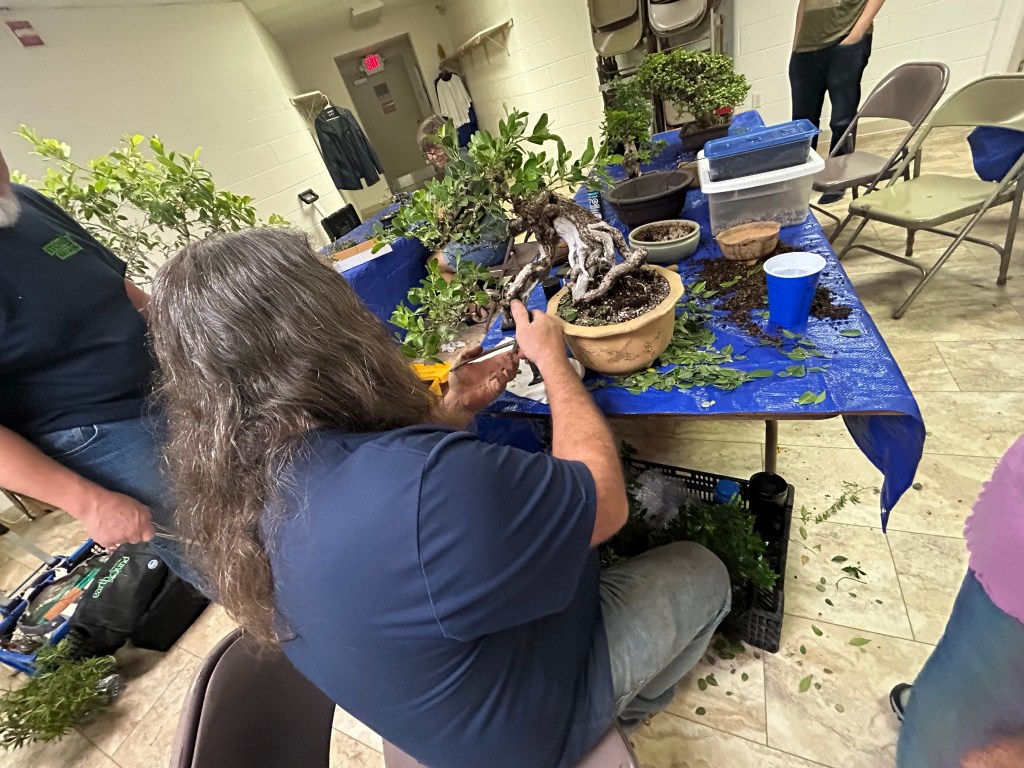
Anyway, there’s room for philosophy later on in the mid and last section of this essay, so, as promised in the last post, here is LeAnn’s buttonwood.
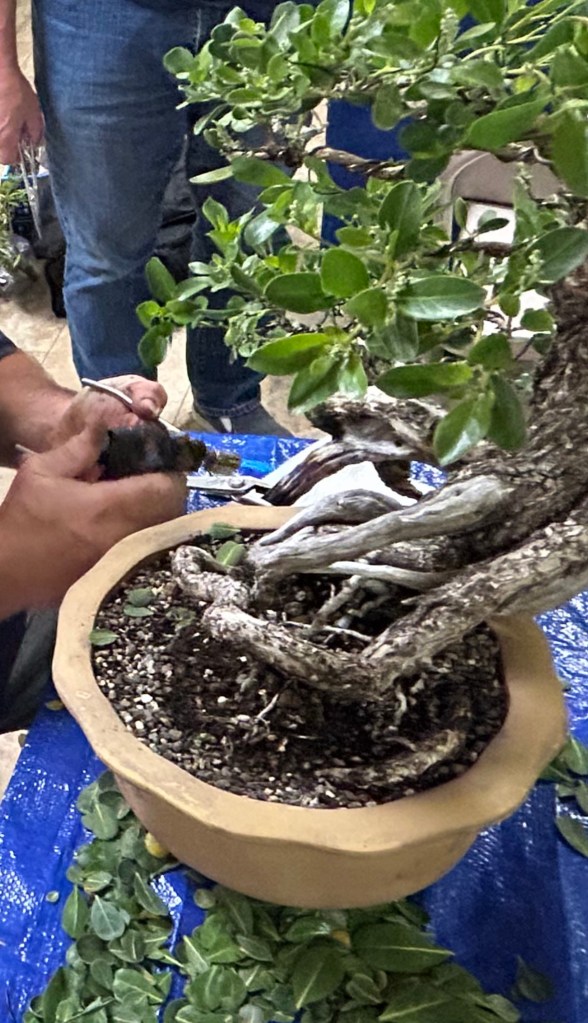
She said it was collected (as most in the USA are) by the Buttonwood Queen herself, Mary Madison.
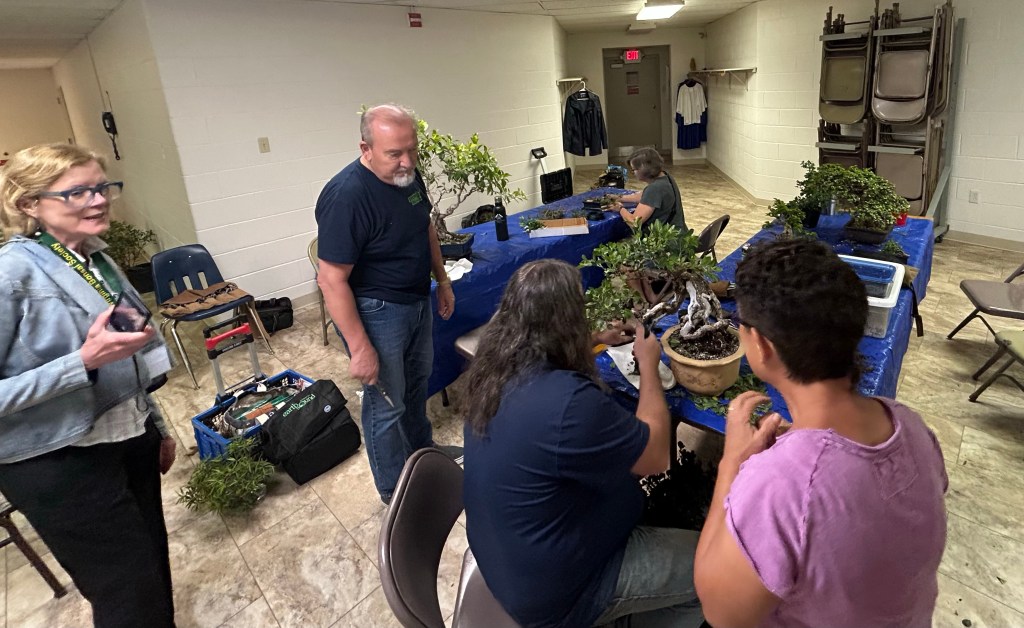
LeAnn is the lady in lavender (purple? Lilac? Not periwinkle, or plum, for sure) hovering behind me.
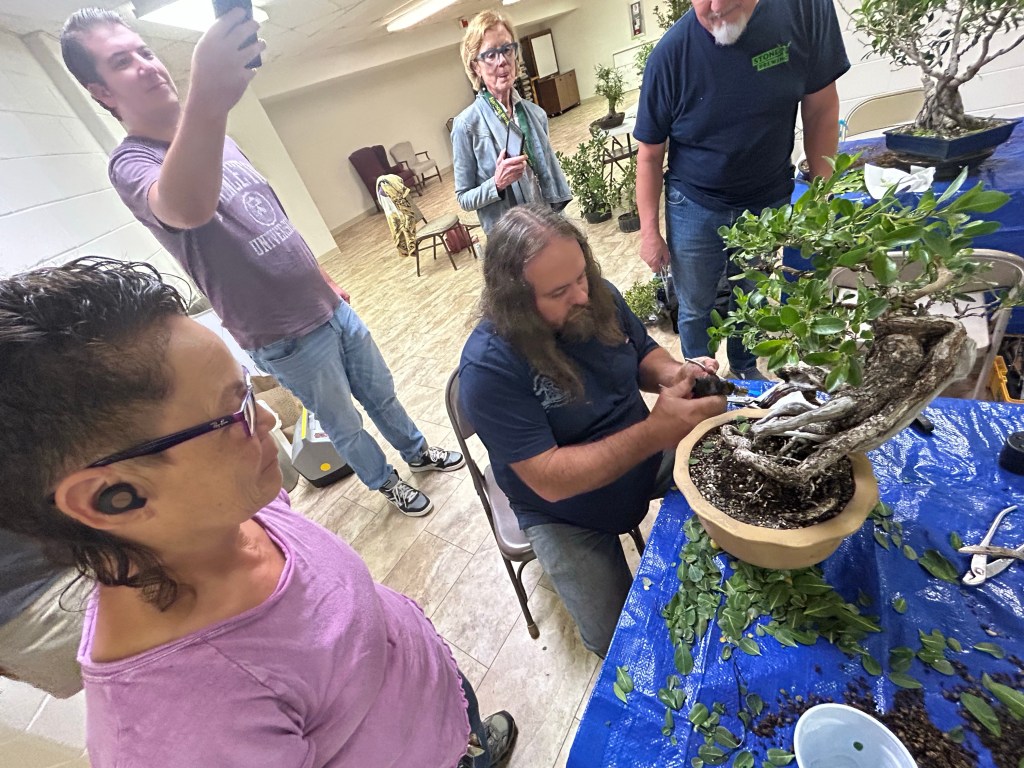
She waited very patiently while I worked through all the other workshop attendees trees and finally got to her tree.
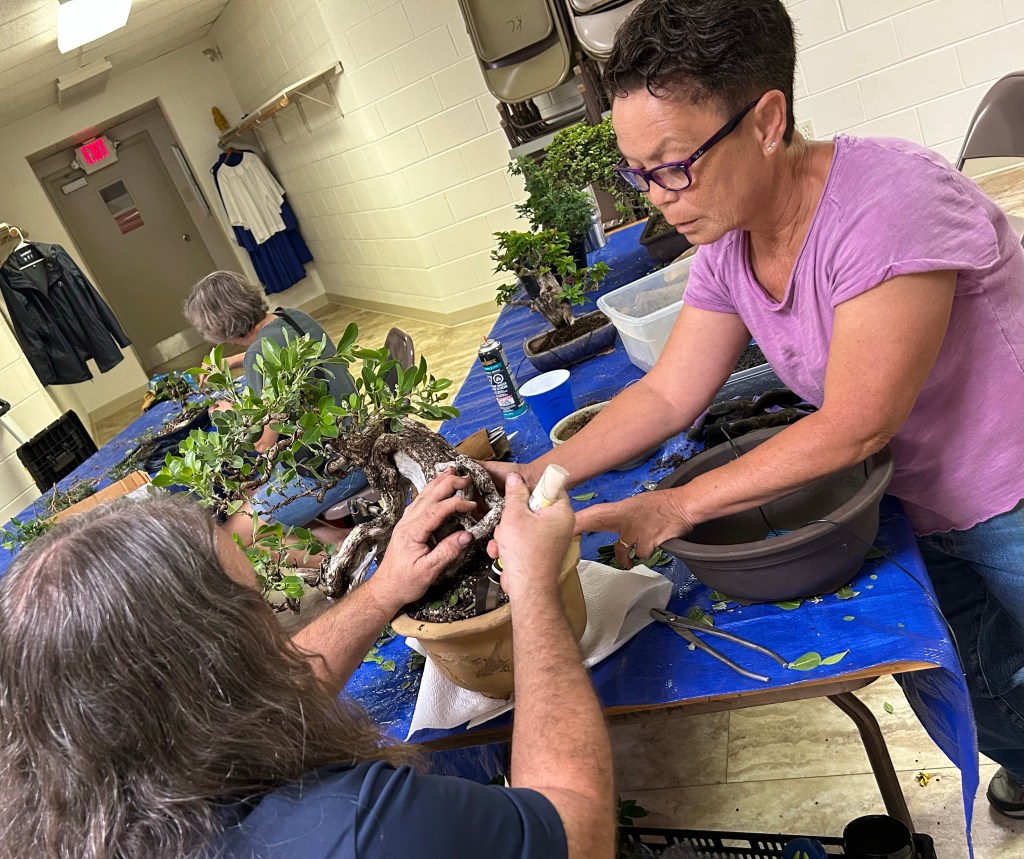
It desperately needed a repot. I teach my students in Florida that buttonwoods need a repot every year. Up north, like here in Virginia, it’s not so important. Unless you use a horticultural heating pad, that is. (Wait, is Virginia “Up North”? I’m not sure. Where’s the Mason-Dixon Line?)

Ok now…..WHAT? (not the North/South thing, even I’m not getting into that). What’s a horticultural heating pad?!

Here’s a few secrets for my northern tropical bonsai growers. First: get grow lights. We are in a golden age of indoor growing of plants. Yes, due to the legalization of cannabis, mostly, but we gain from it because all kinds of grow lights, from full spectrum LEDS to metal halide, are available almost anywhere for cheap. So get yourself one. But…BUT..secondly: heating pads!!! Horticultural heating pads are the game changer for those that need to bring in their tropical trees for the winter (one should always put your trees outside for spring and summer, there’s no replacement for the sun and rain. None). Most tropical trees growth habits are dependent on temperature. But not just ambient air temps. It’s the temperature at the root zone, in the soil, during the evening, that makes tropicals grow.

Which is why we here in the Sunshine State don’t repot buttonwoods until nighttime temps are above 65°F for at least 6 weeks after the repot.

In sweet Virginy, this particular operation is taking place in the middle of July, and LeAnn has the rest of July and most of August to grow more roots. So no worries there for her. But I knew of a guy in Cincinnati that repotted his buttonwoods in January. He had a greenhouse and heating pads. That’s where I got the idea.
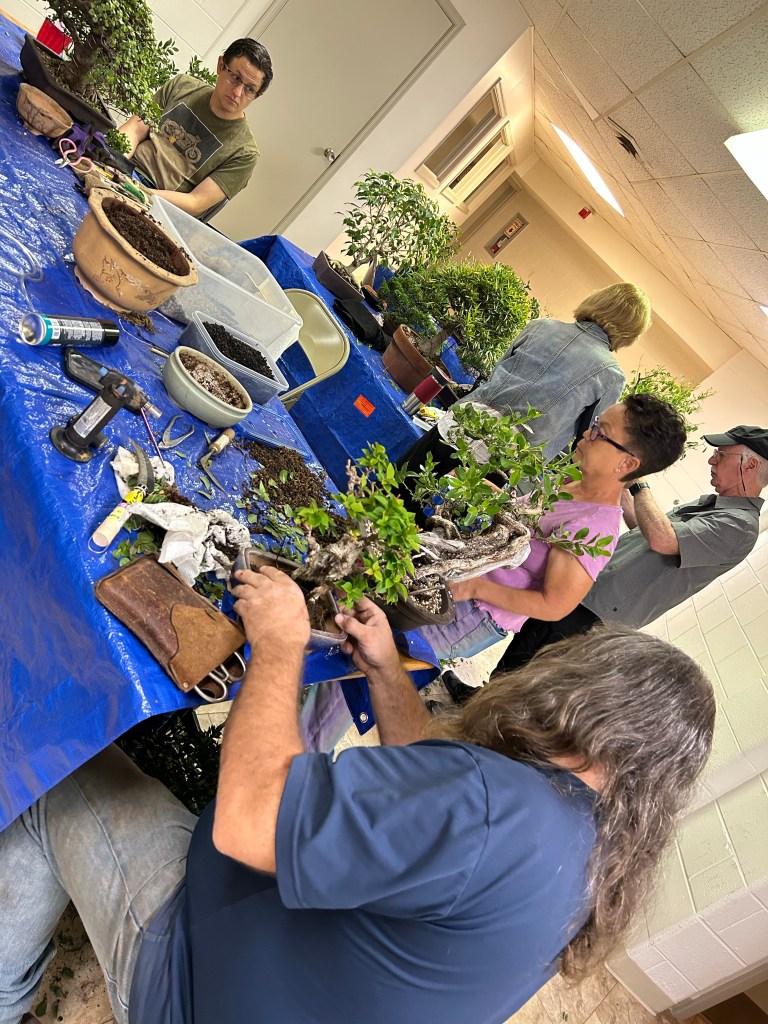
Anyway, we got the buttonwood out of this pot:
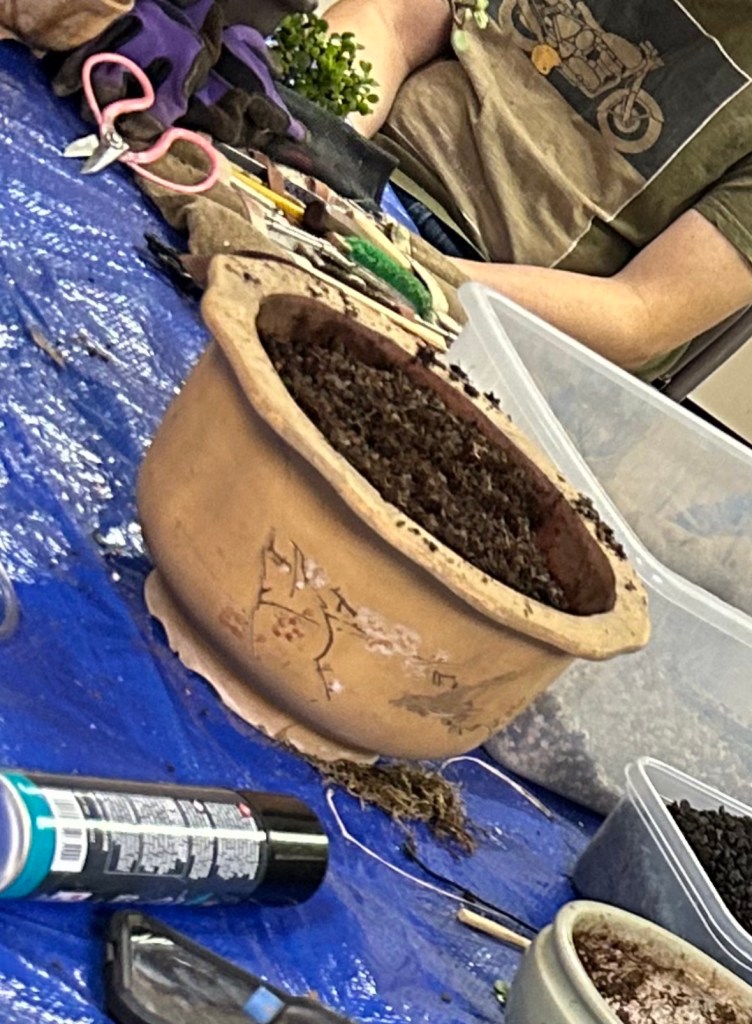
And into this pot:
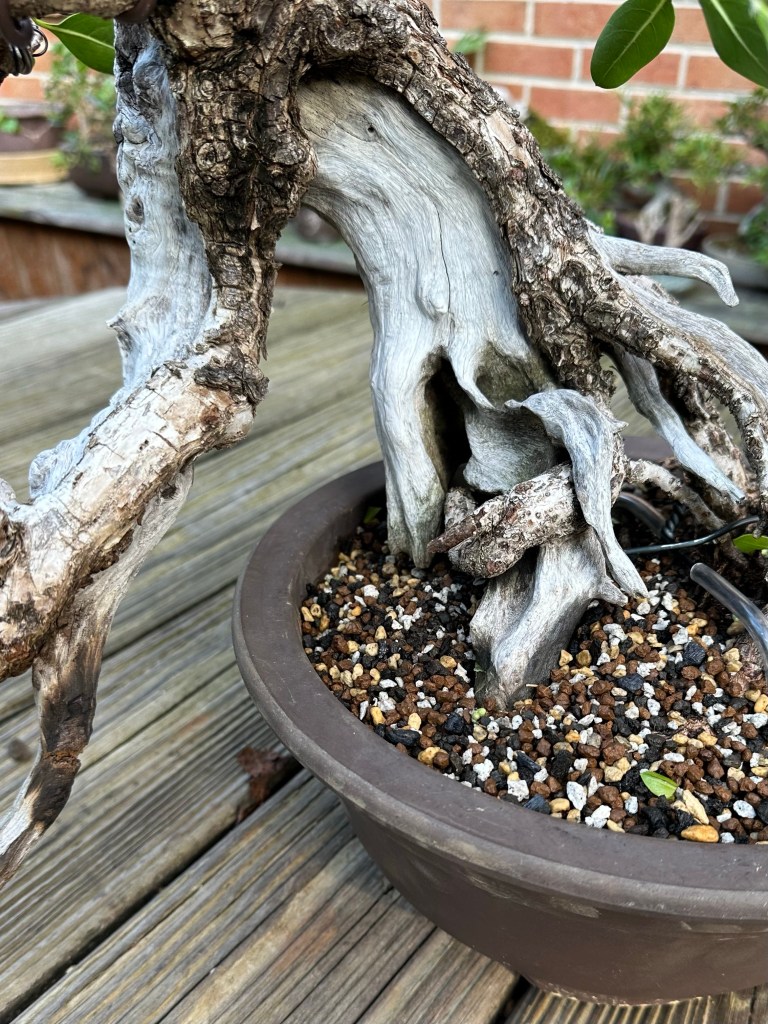
We wired it, tried to bend some deadwood with the torch and steam technique (only partly successful) and, now, just to make you wait, how about a bumble bee and a moth on a coneflower?
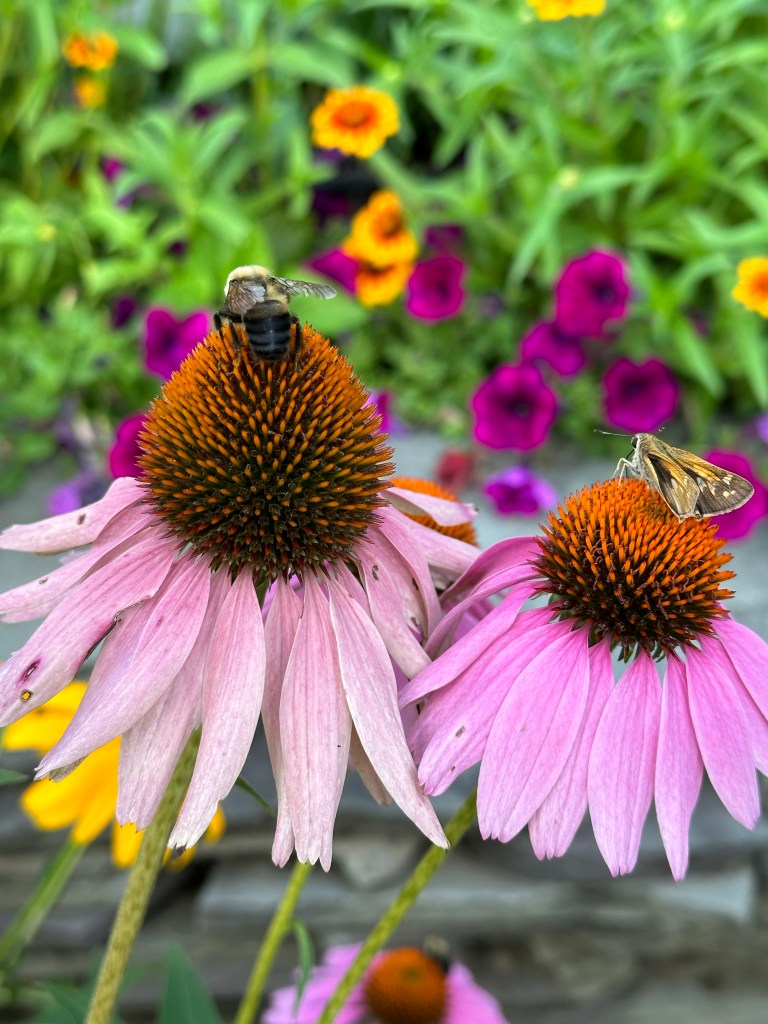
Awwwww, ain’t that cute?! LeAnn has an amazing garden and an even amazing collection of trees.

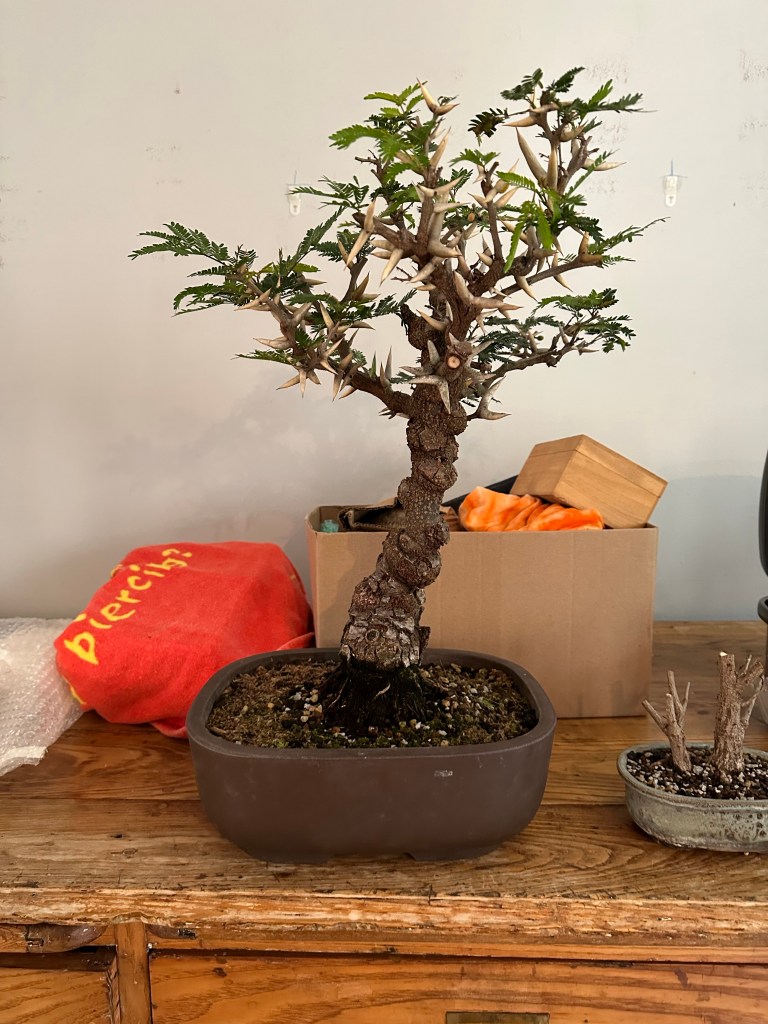
Here’s one of the more developed bullhorn acacias I’ve seen.
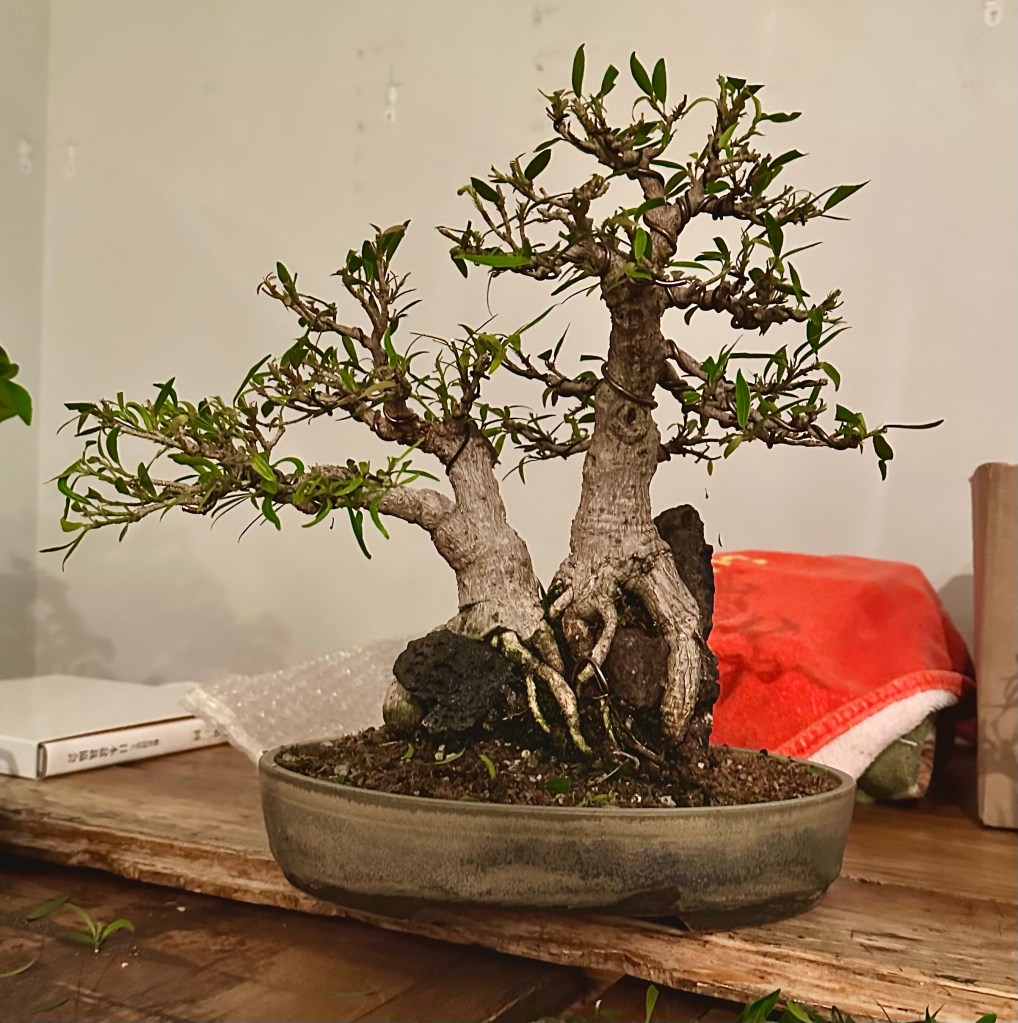
And a twin trunk willow leaf on a rock (a rock from Hawaii I believe, where LeAnn hails from).
And now, the buttonwood.
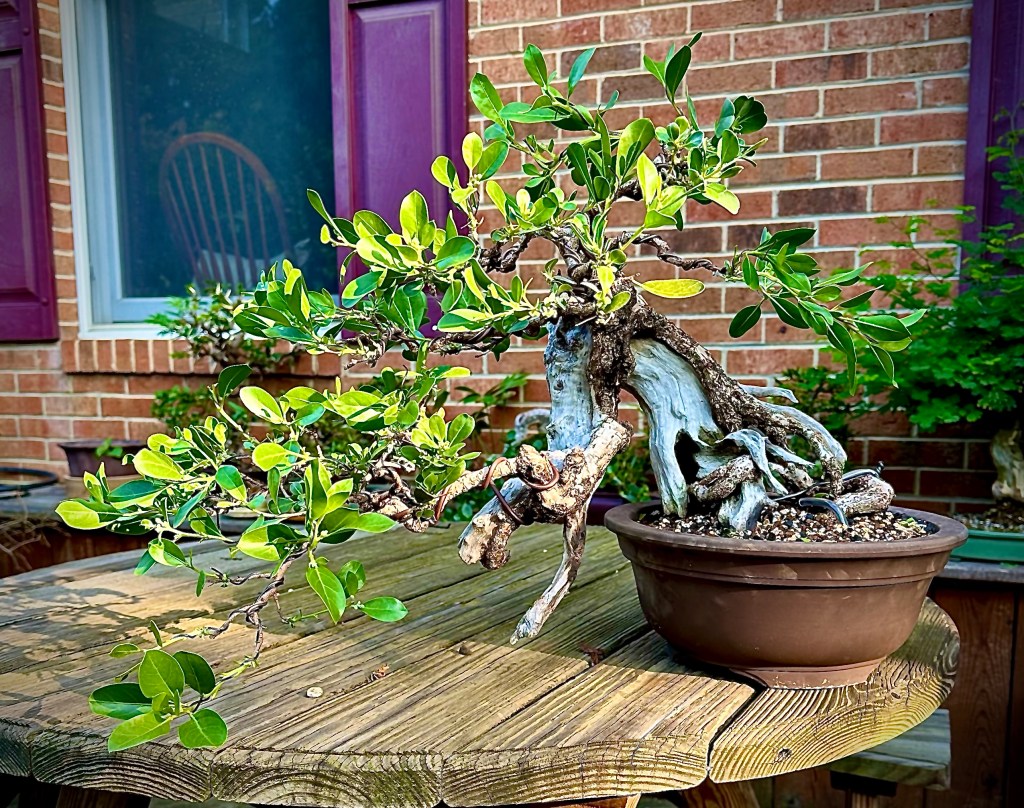
It’s an impressive specimen.
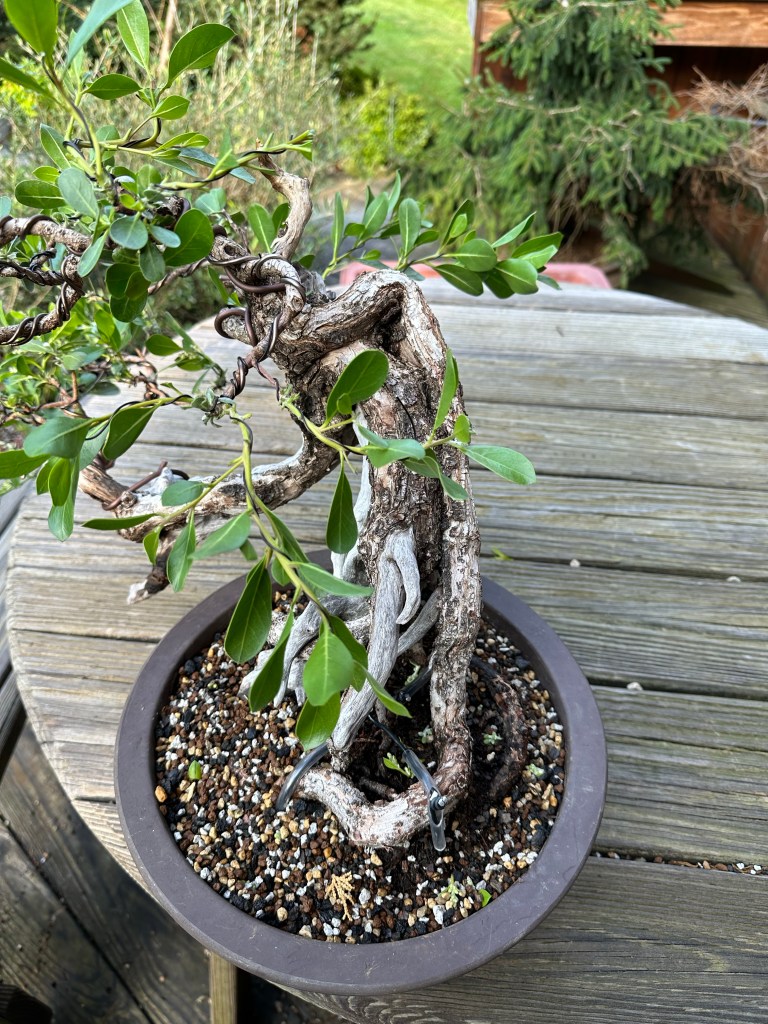
You can kinda see the burnt section where I tried to bend a straight piece of deadwood (middle of the below pic. It was ramrod straight).
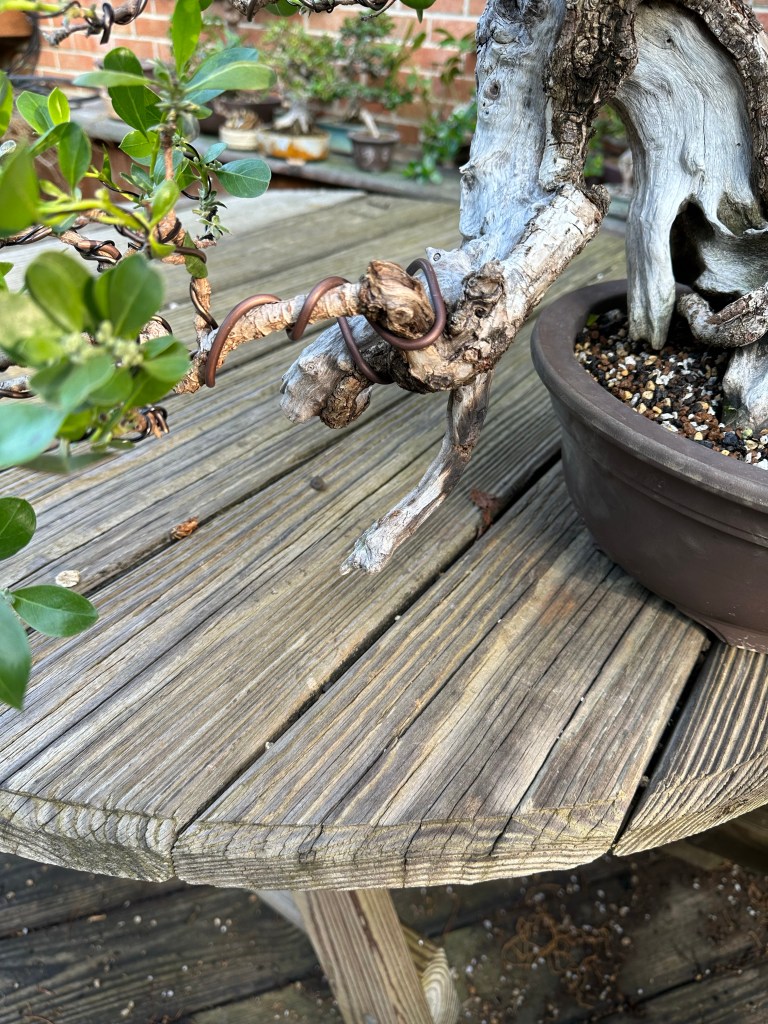
View from above.
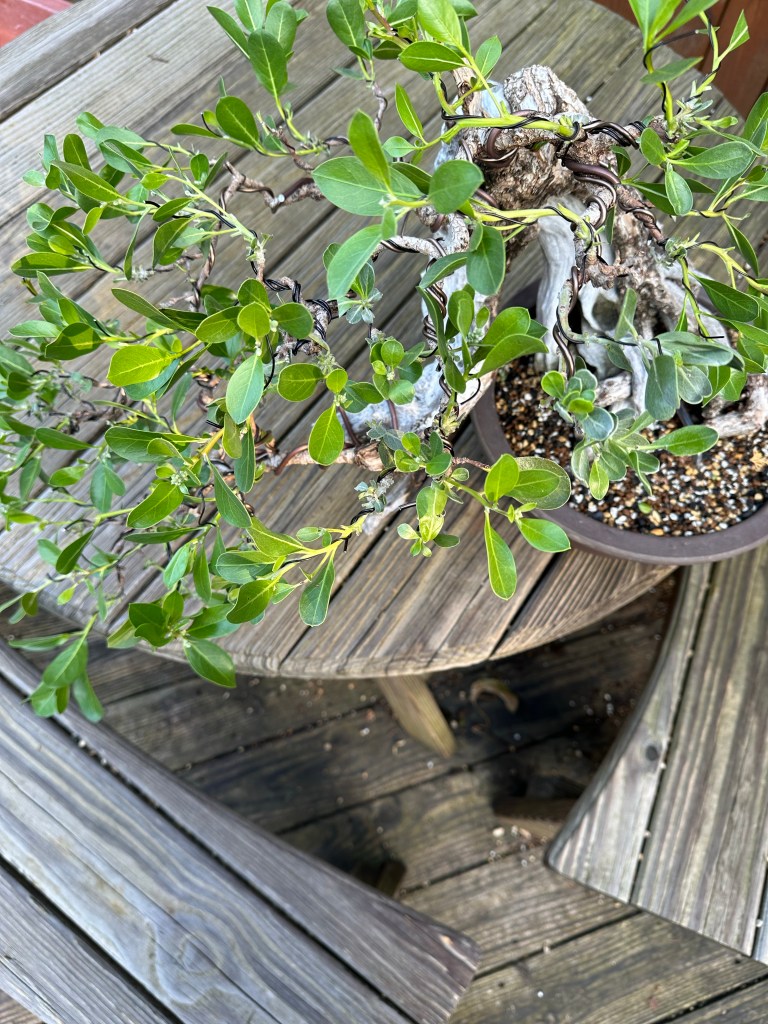
The constant reader is asking, “Why are there still leaves on it?”

Well, we are in The North, and the sun isn’t quite so strong as in La Florida, so, even though we are in full summer, I’m not comfortable totally defoliating a buttonwood up here.
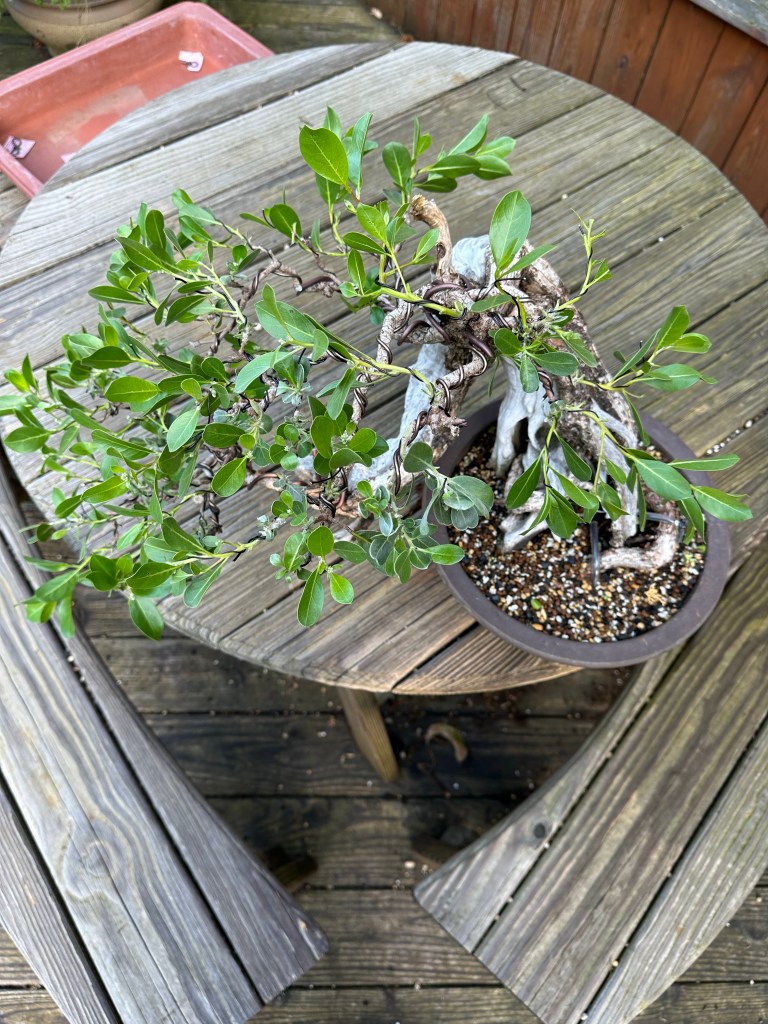
And the main thing I don’t want to do is to kill this special tree. We really beat up the roots when the repot happened, and foliage is what grows new roots, so I left the foliage. Simple calculus, as they say in the movies.

And the tree was collected by Mary. Here’s the last pic I got of her before she passed away (that’s her daughter Terri, behind her).
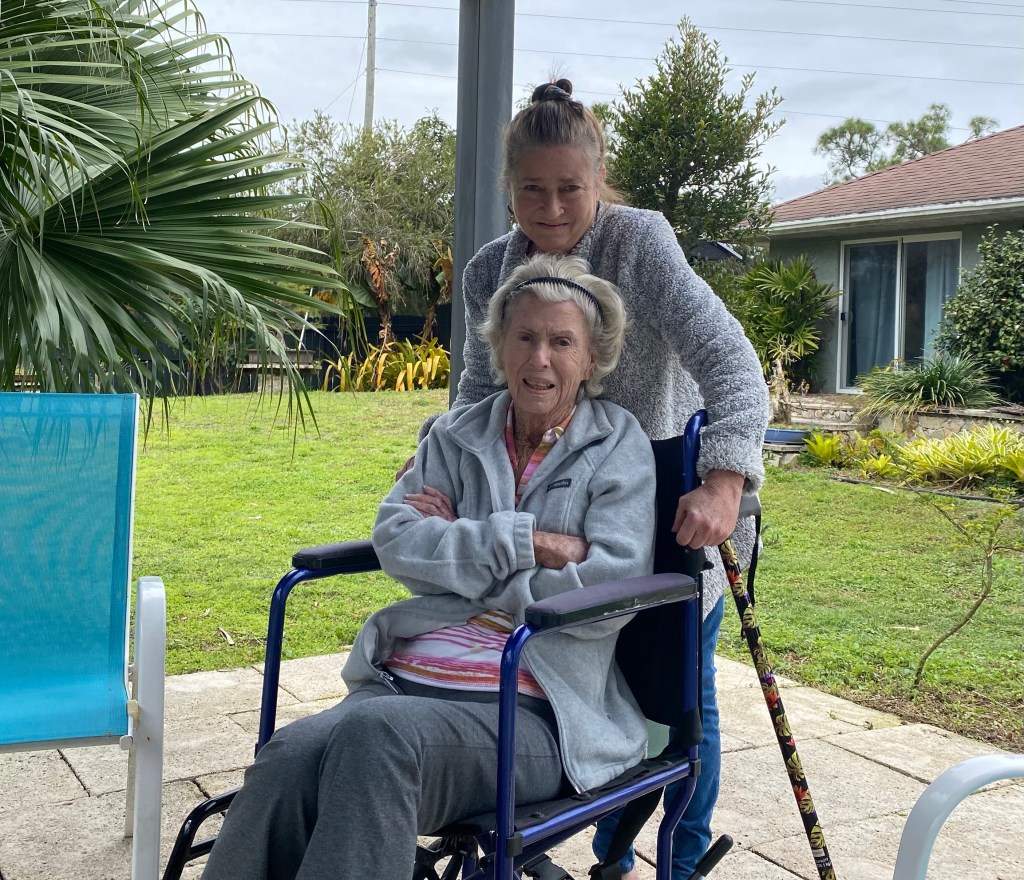
Mary was such a force in bonsai, it’s hard to believe she’s gone. I truly miss her. There won’t ever be a woman in bonsai like her again.

And it was an honor working her tree with LeAnn. Thank you!
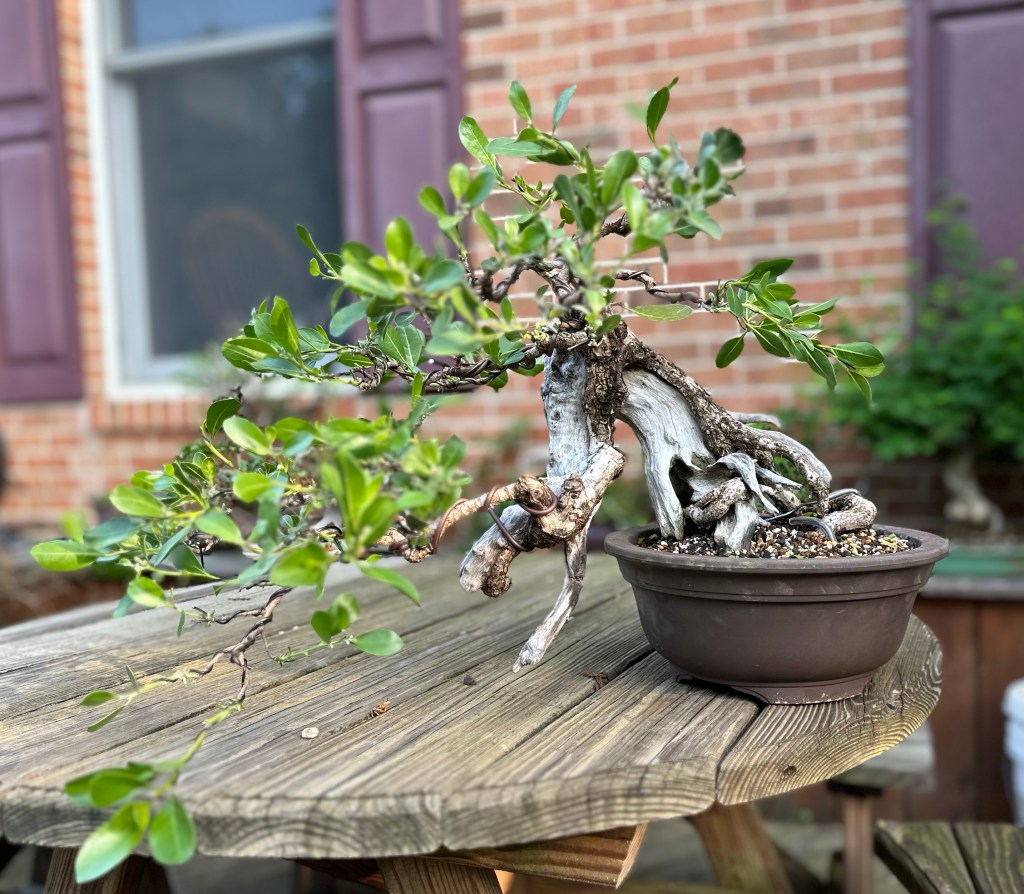
One last tip, and I learned it from Mary. Since we beat up the roots so much, I advised LeAnn to set the pot in a tray of water. One deep enough to cover the drainage hole. This will help the tree to grow new roots. Contrary to what I’ve said before about air being important for root growth on other trees.

A buttonwood lives in the coastal saturated zone, where mangroves grow, by the ocean, and are used to water. In fact, to make a cutting root, the easiest way is the old fashioned “Put the cutting in water” method. Oftentimes (don’t tell anyone) when we collect buttonwood, it’s really just a big cutting, with no roots at all, and we place the tree into the pot, and, as LeAnn is doing, place that pot into a tub of water.

One can, as many often do in bonsai, point out the unscientific practices of bonsai people. I do it often. But I have a saying I use religiously, and it applies to bonsai practice distinctly:

“Horticulture is a science, but the practice of horticulture is an Art”

I’ll leave you with that to mull over. Quote it to your best friend and your most divisive foe. It’ll separate the wheat from the chaff, real quick.

❌