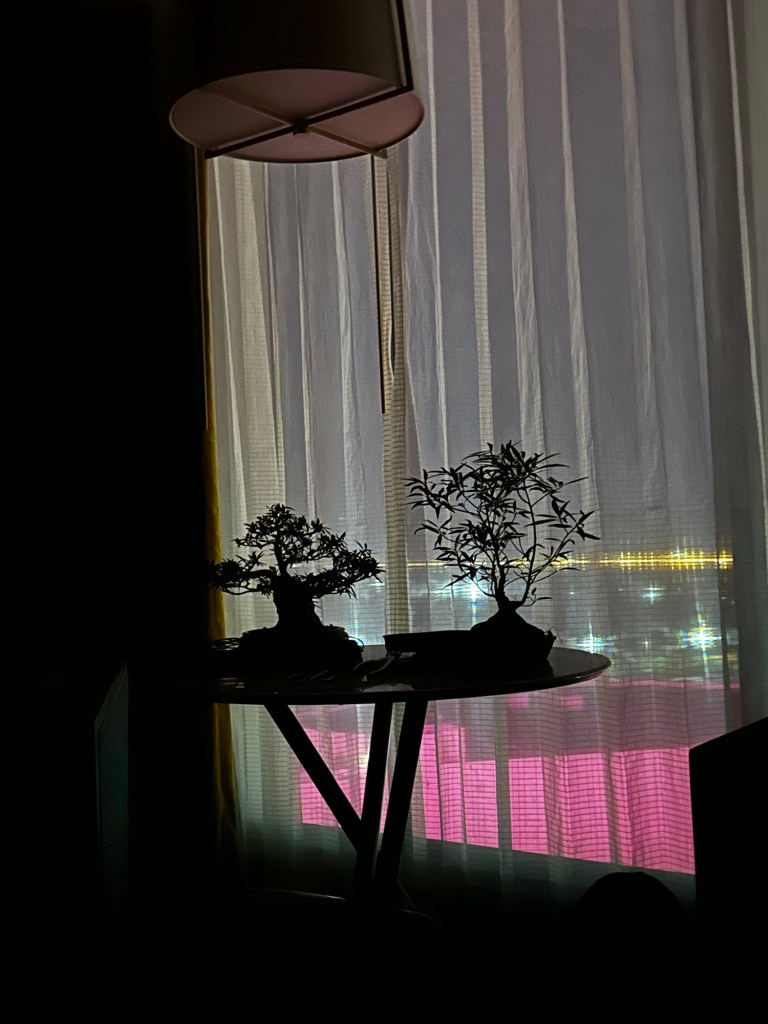
Today, I got to diagnose what’s wrong with a 2012 Jeep Compass, take my daughter to PT, and go and take a dog outside to poop.
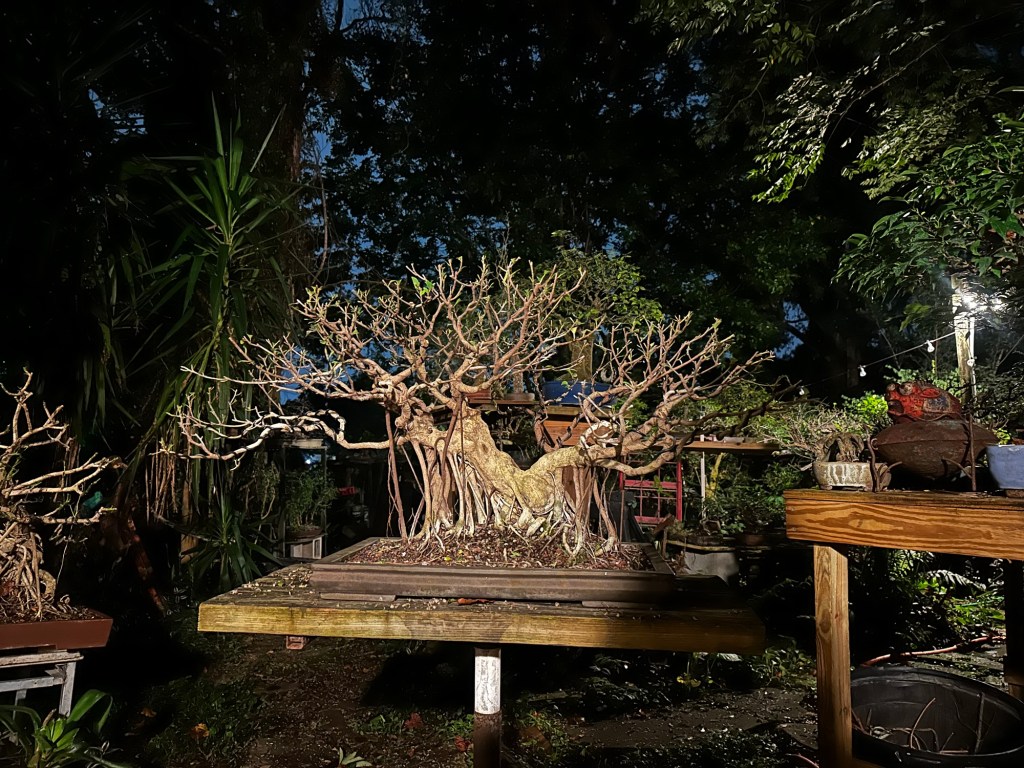
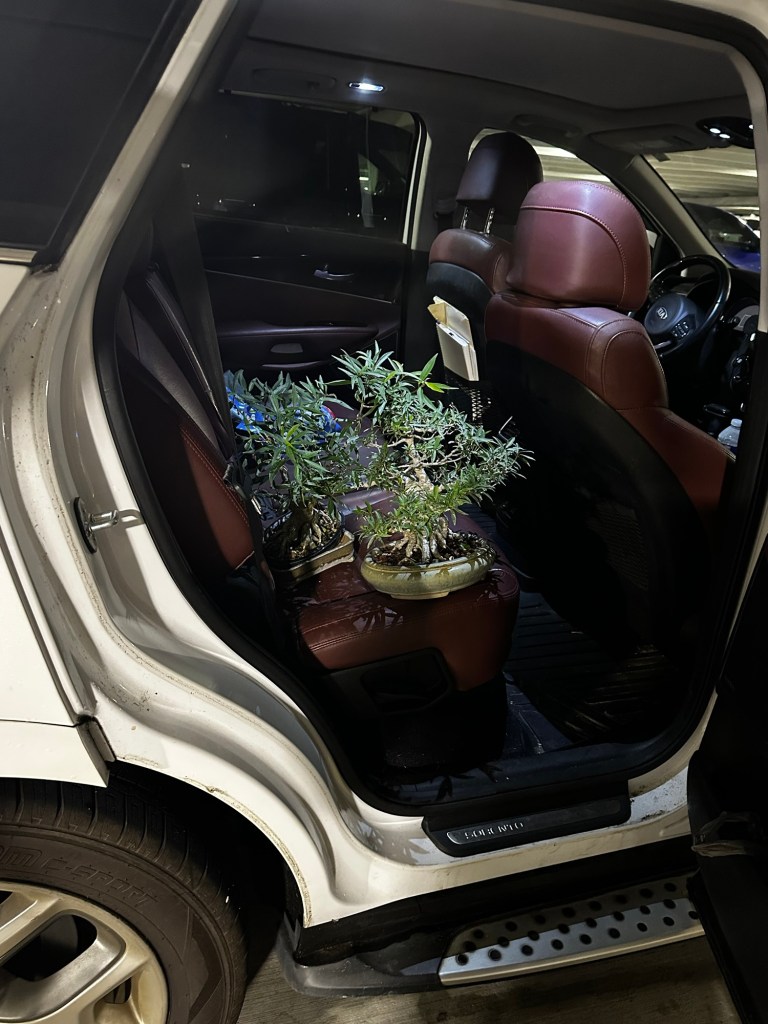
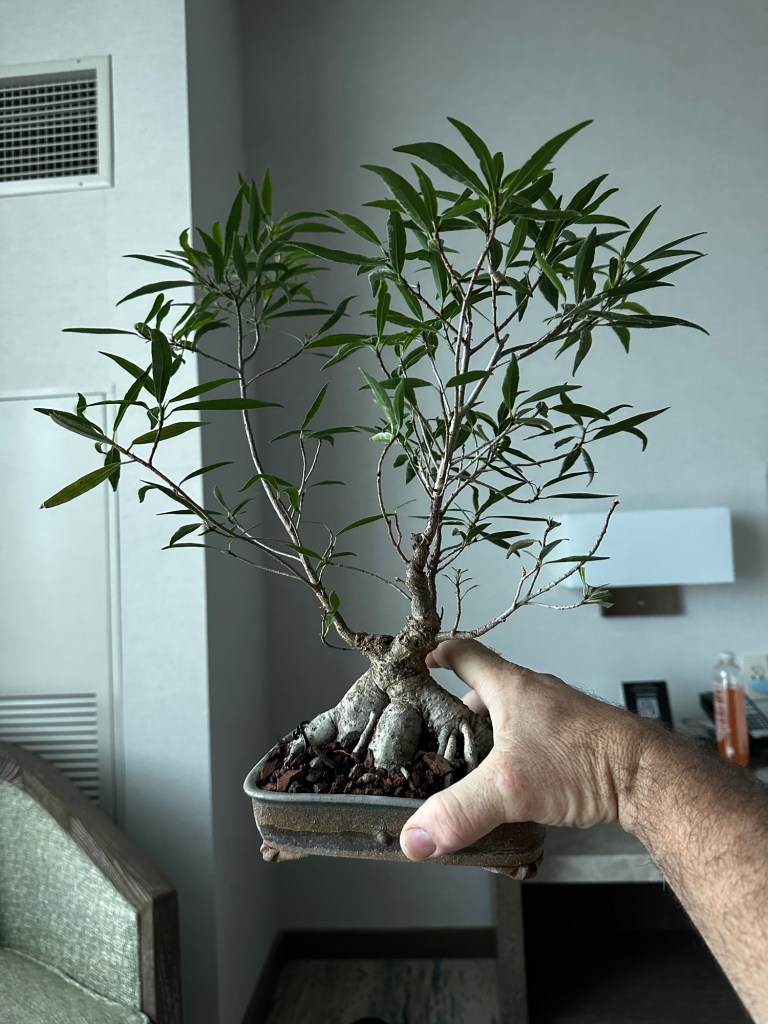
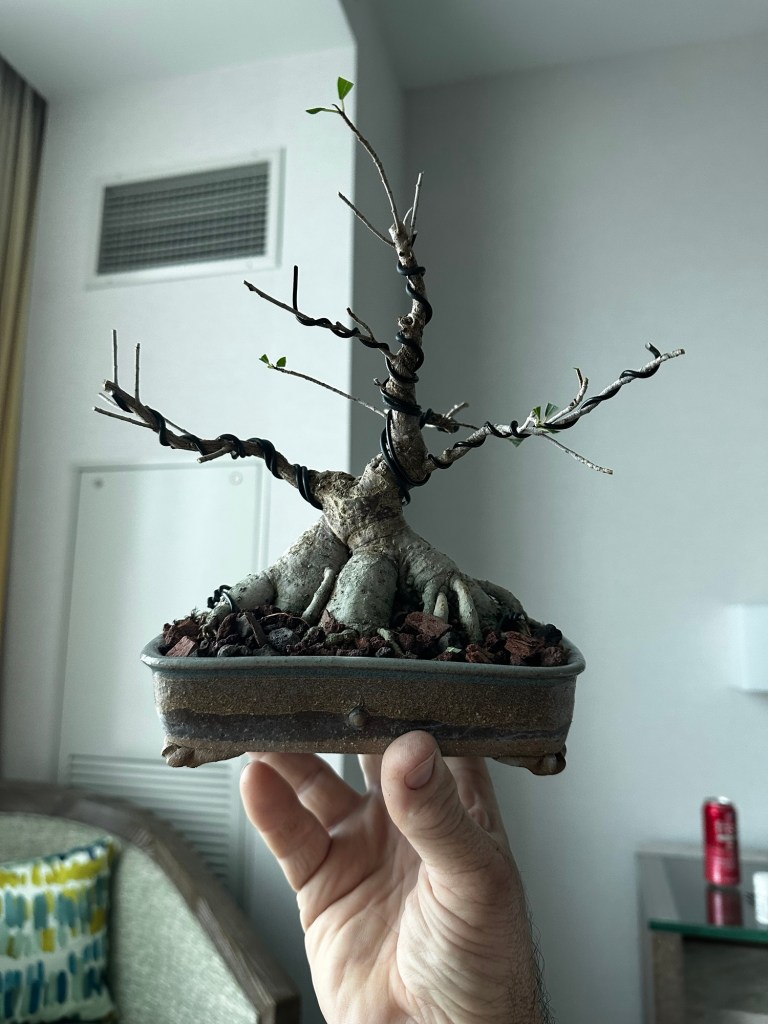
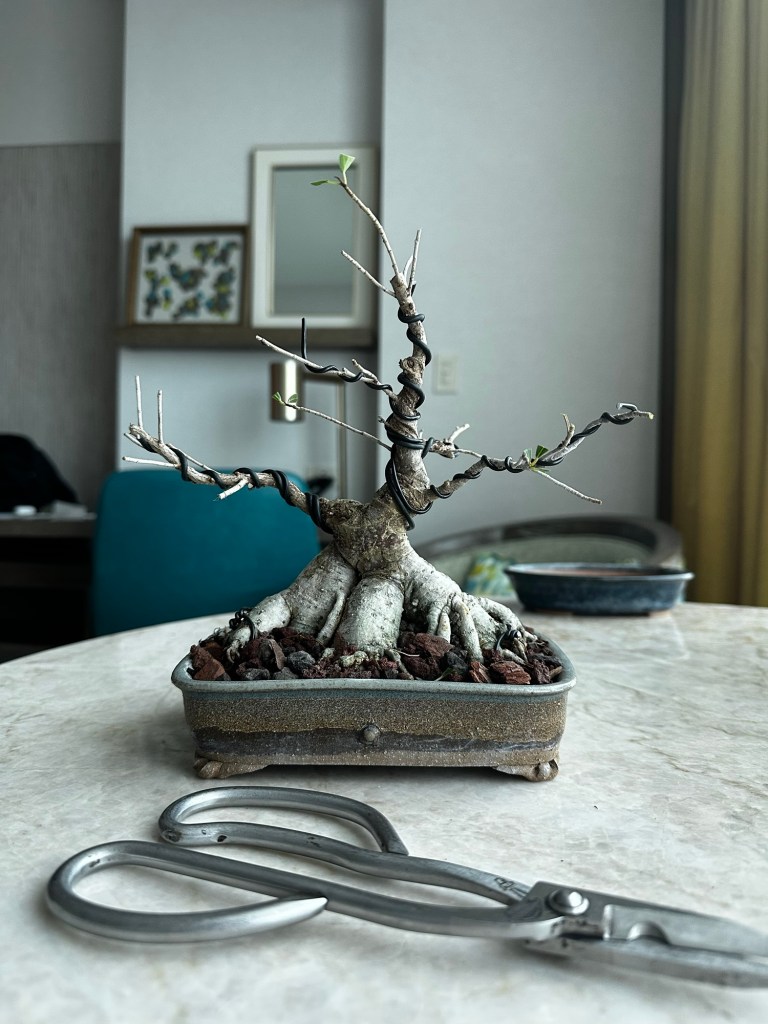
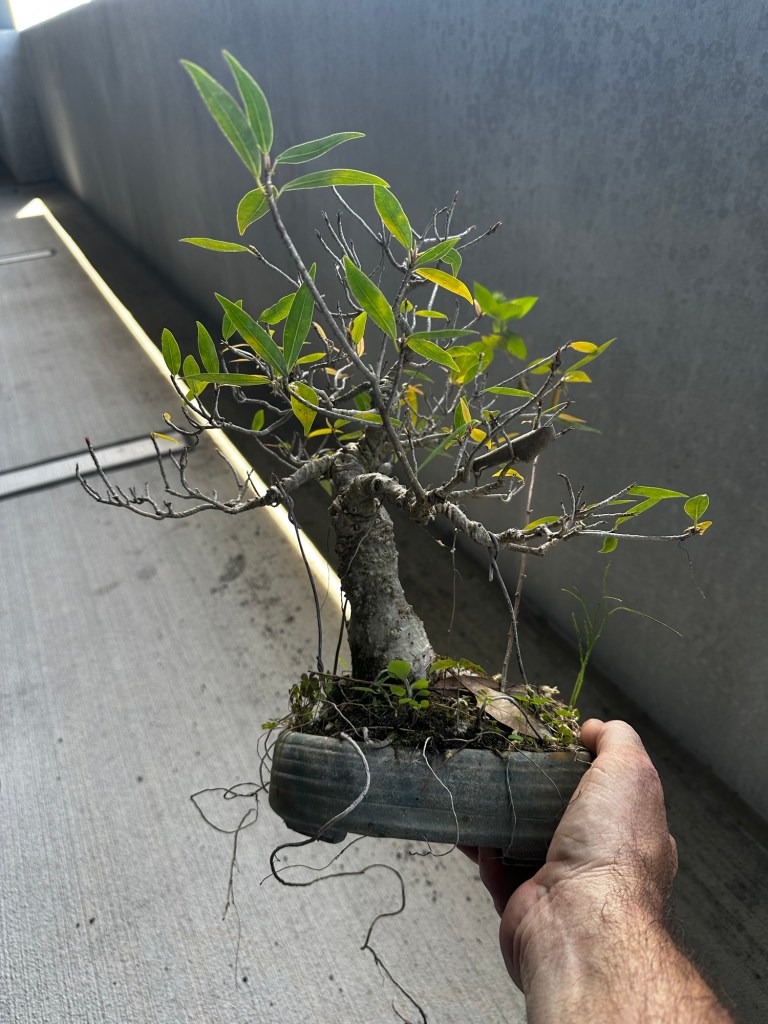
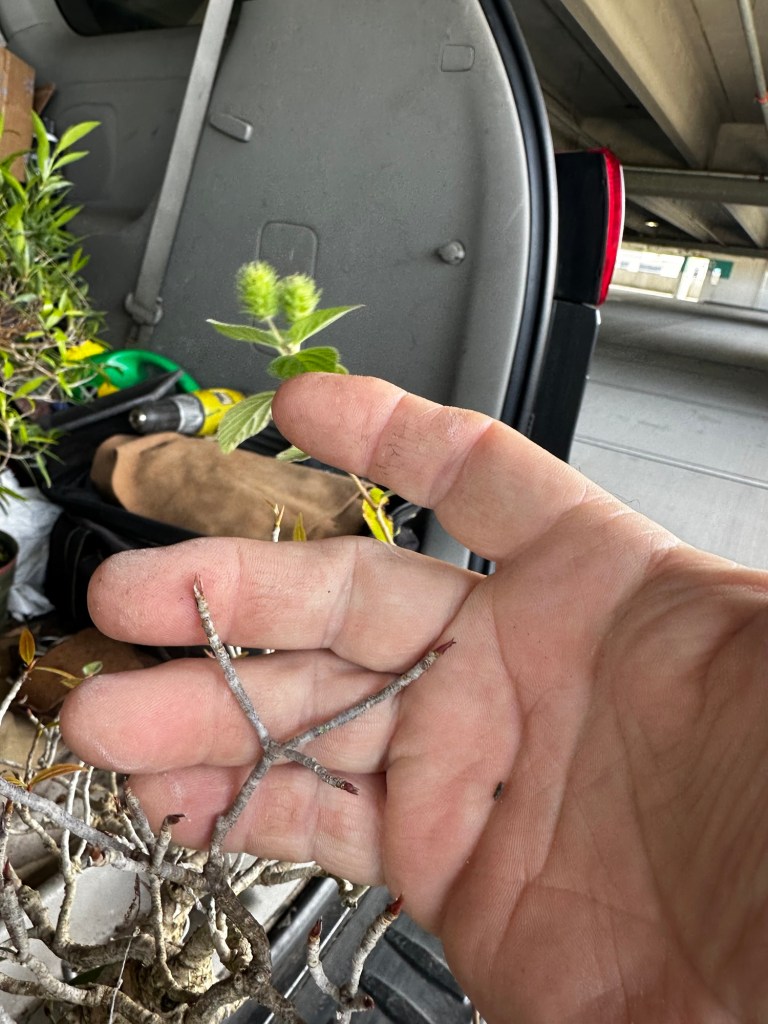
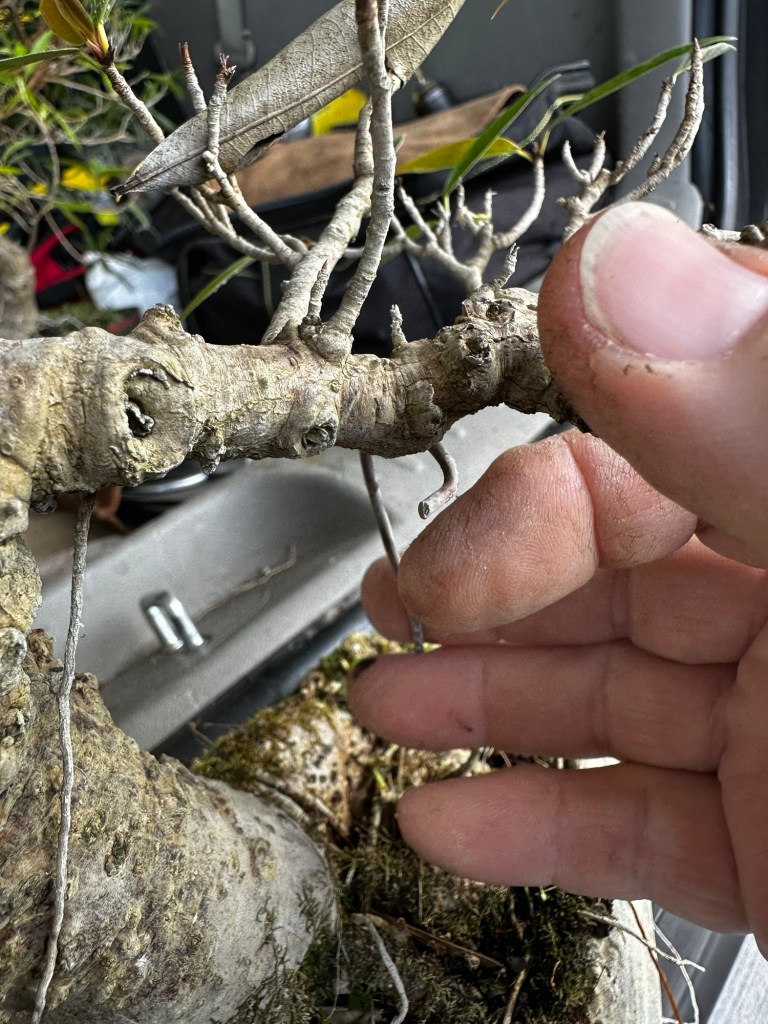
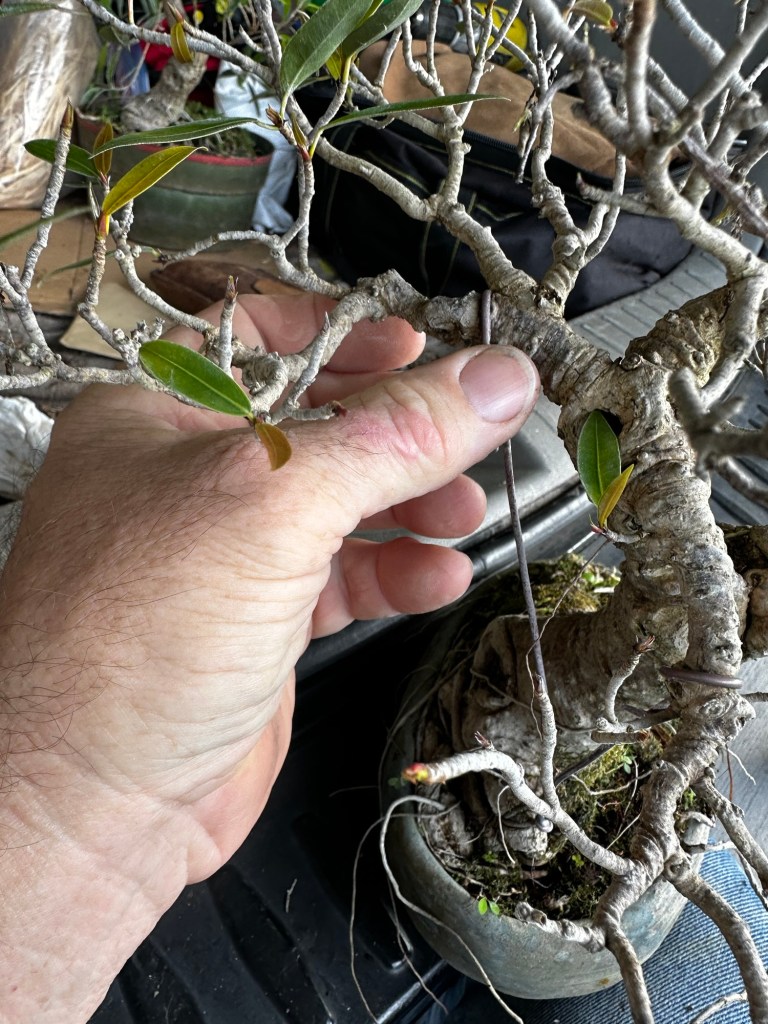
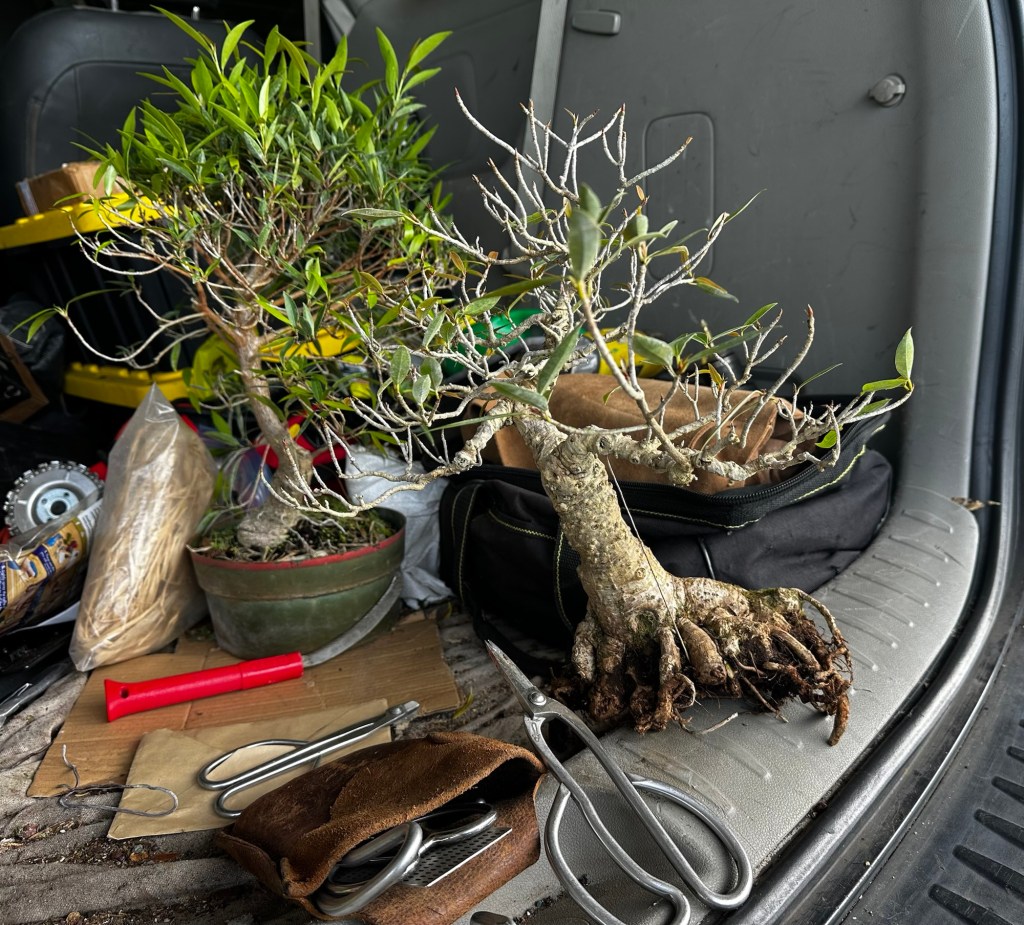
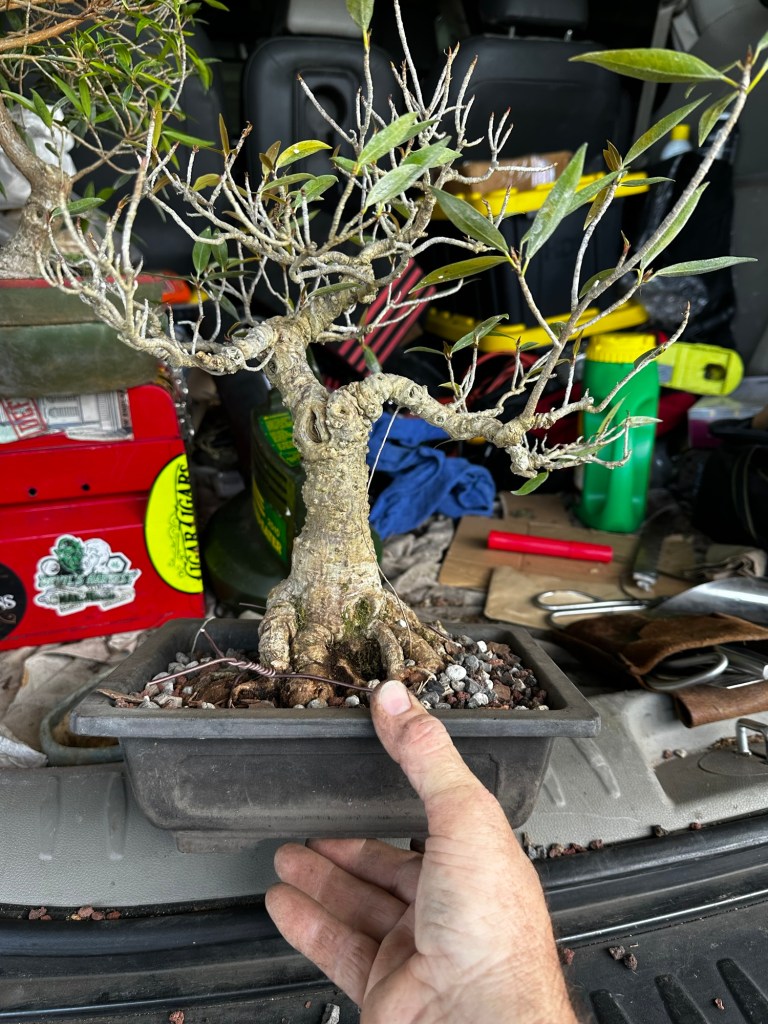
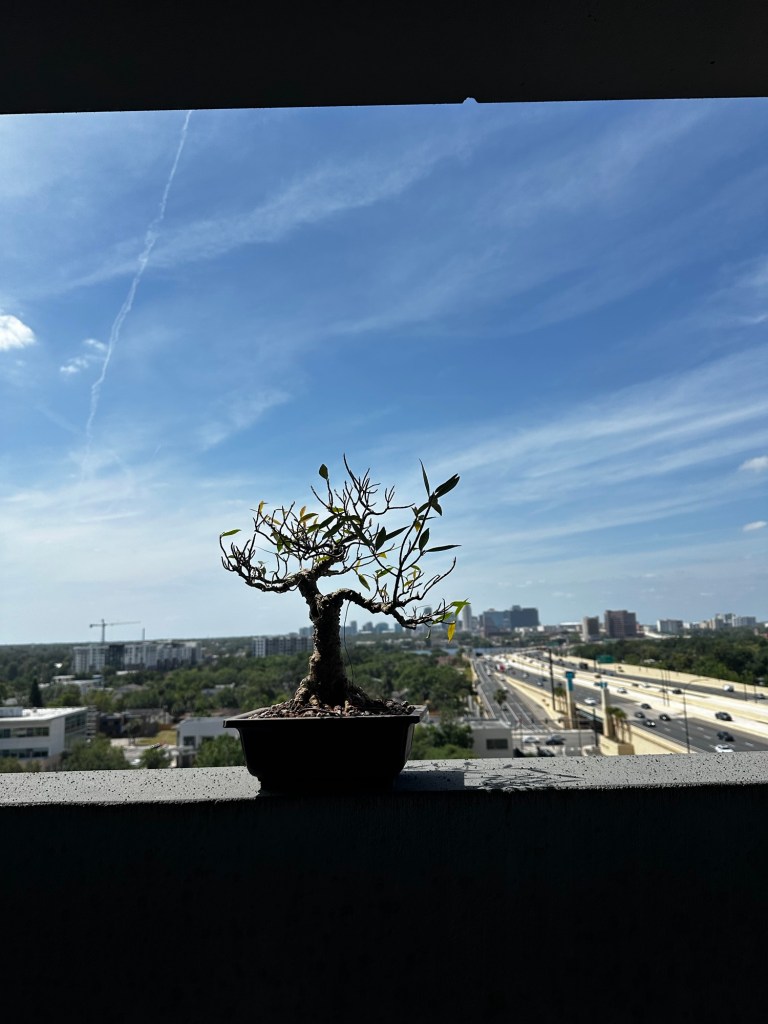
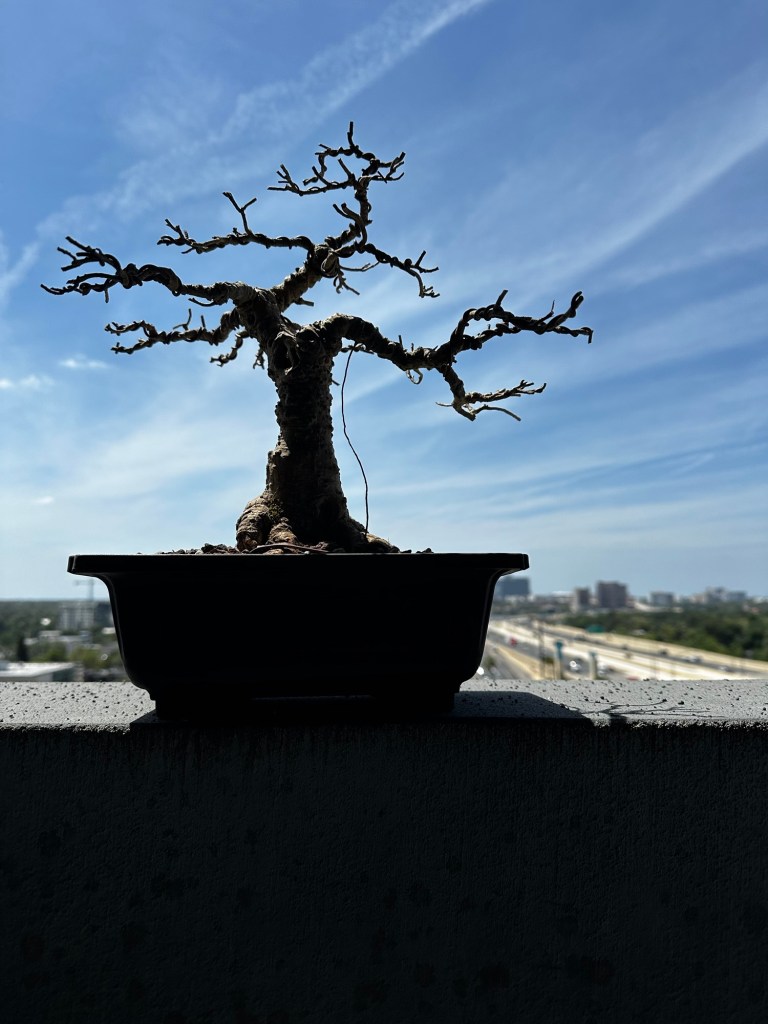
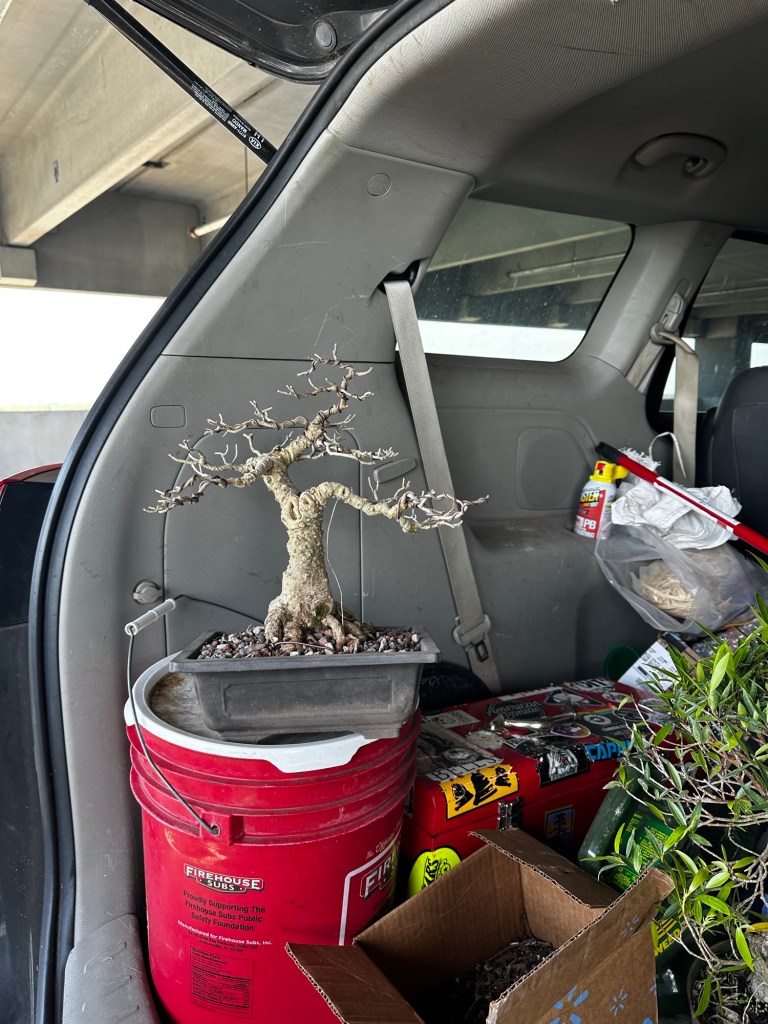
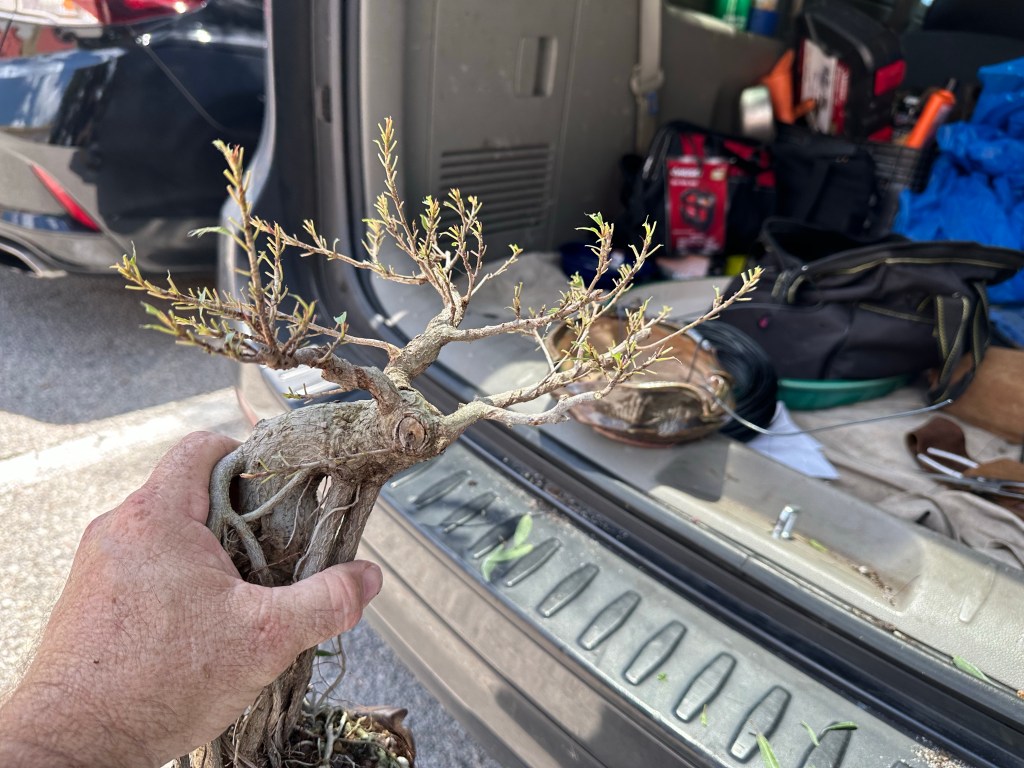
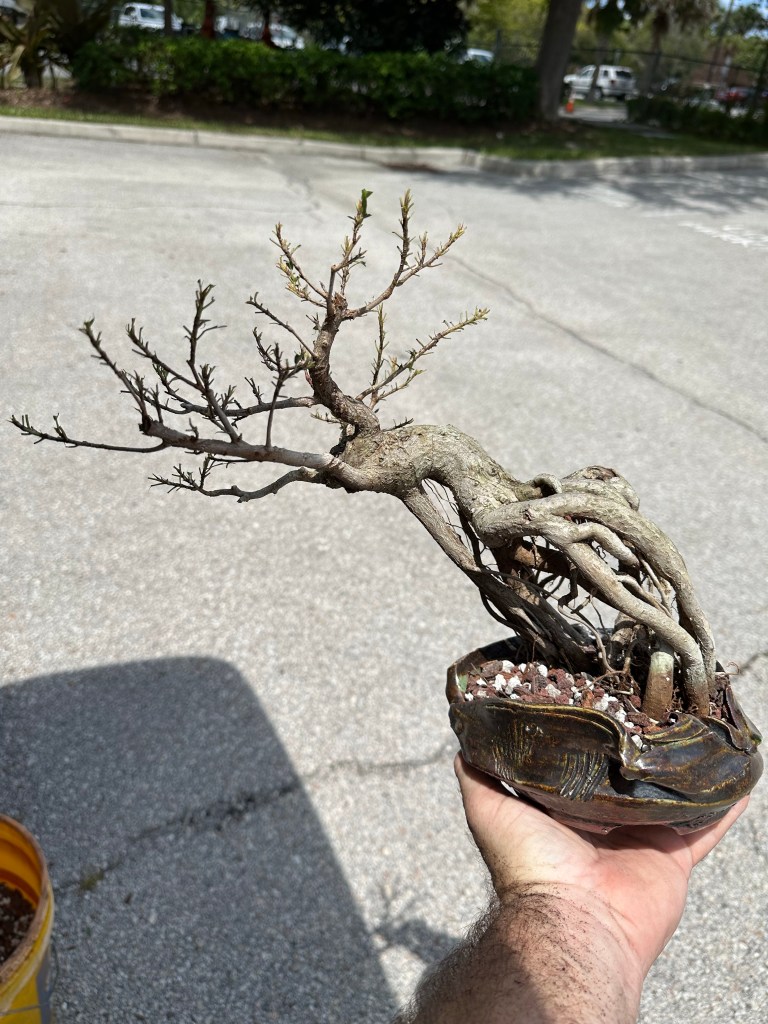
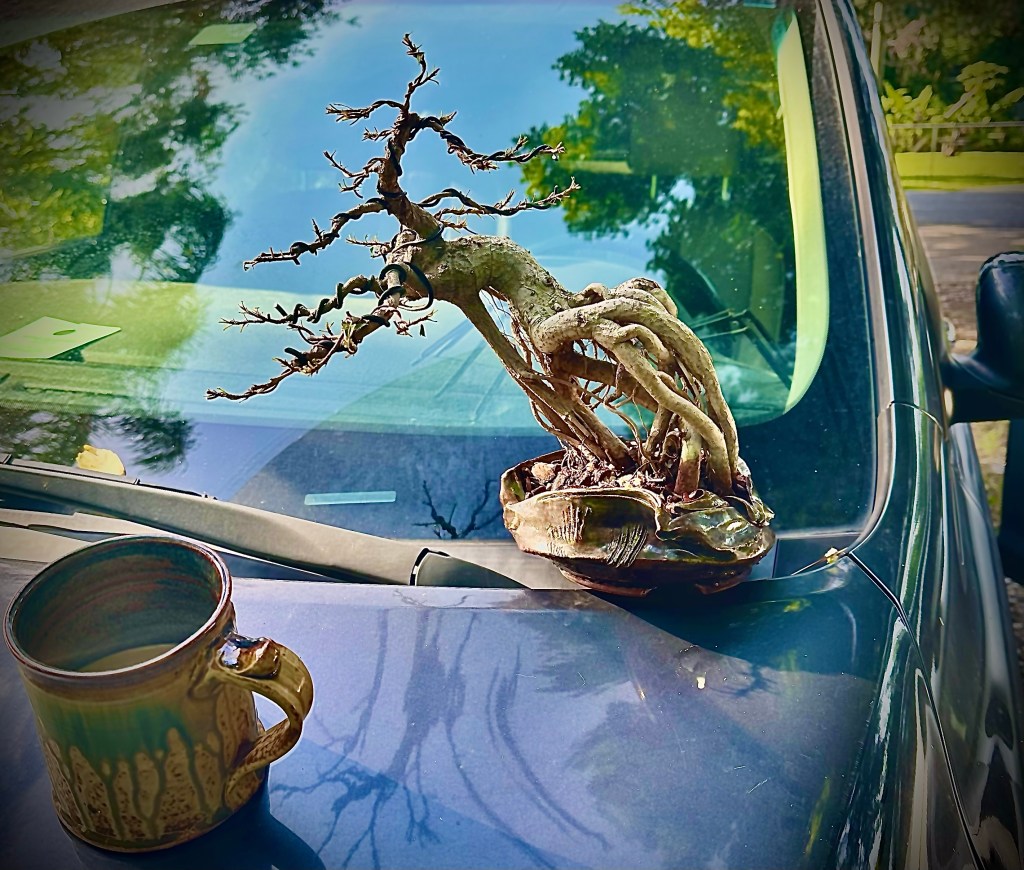
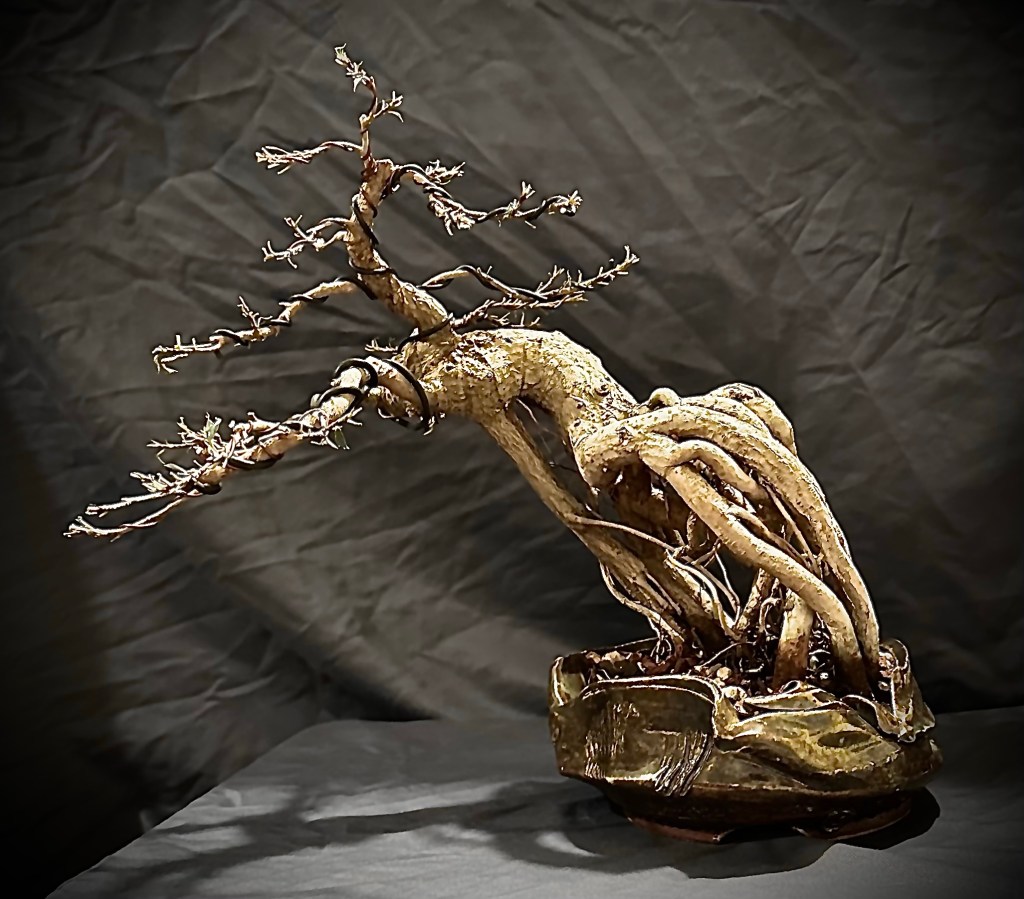
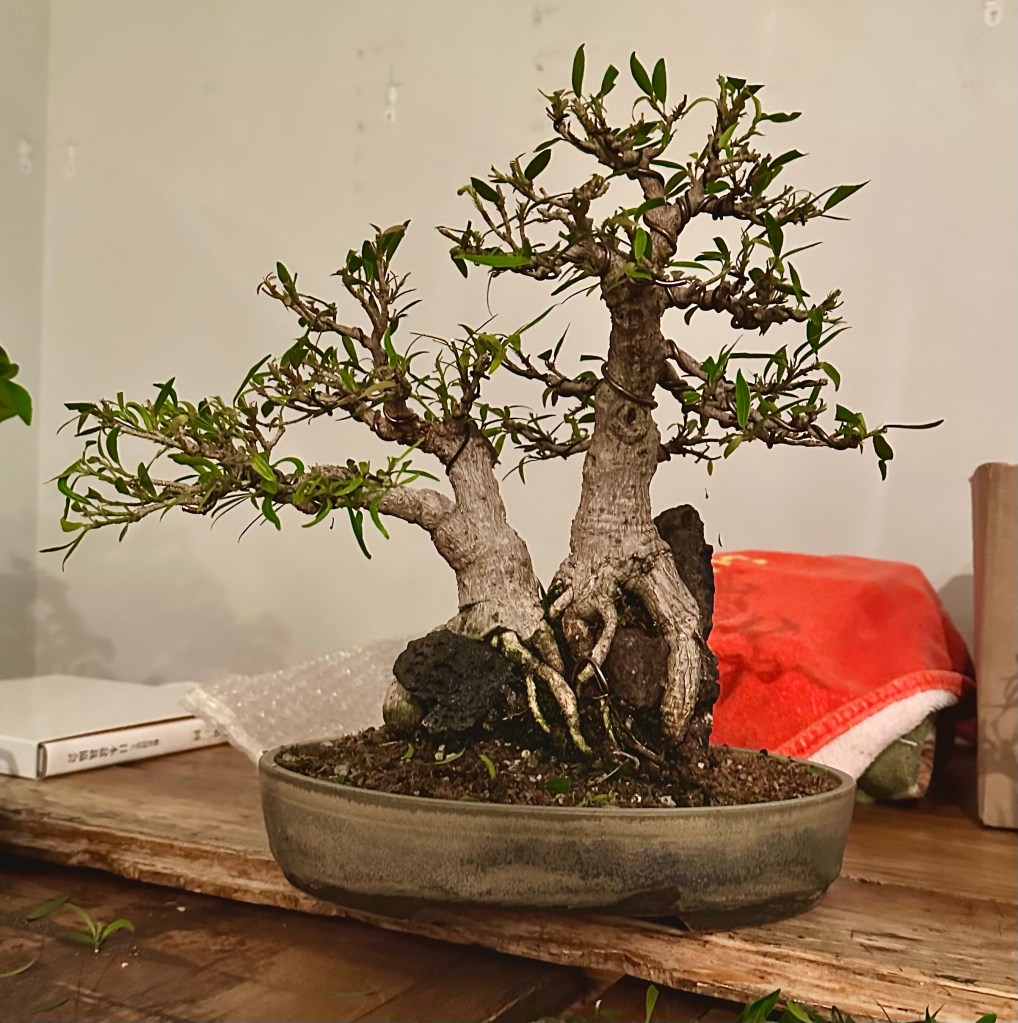
In between the PT and the Dog poop, I practiced a little Back Bumper Bonsai, just like the old days. Here’s the tree, a willow leaf fig (Ficus salicaria, ofttimes erroneously called Ficus nerifolia, or F. salicifolia, or whatever it was called when you grew up in bonsai).
Here’s the facility my daughter is getting tortured at.
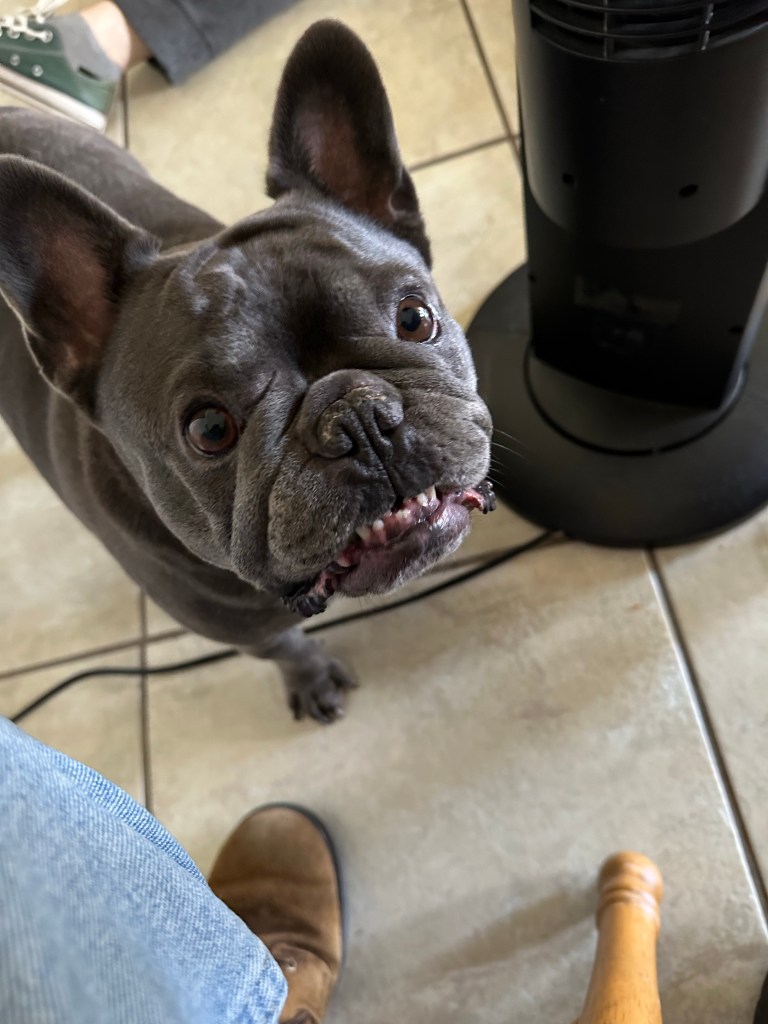
Here’s the dog. Ugly thing, ain’t it? Lily. Stupid dog. It has no tail, so when it poops, you have to wipe its ass. Not me, no way, no how, not ever. My sister does though.
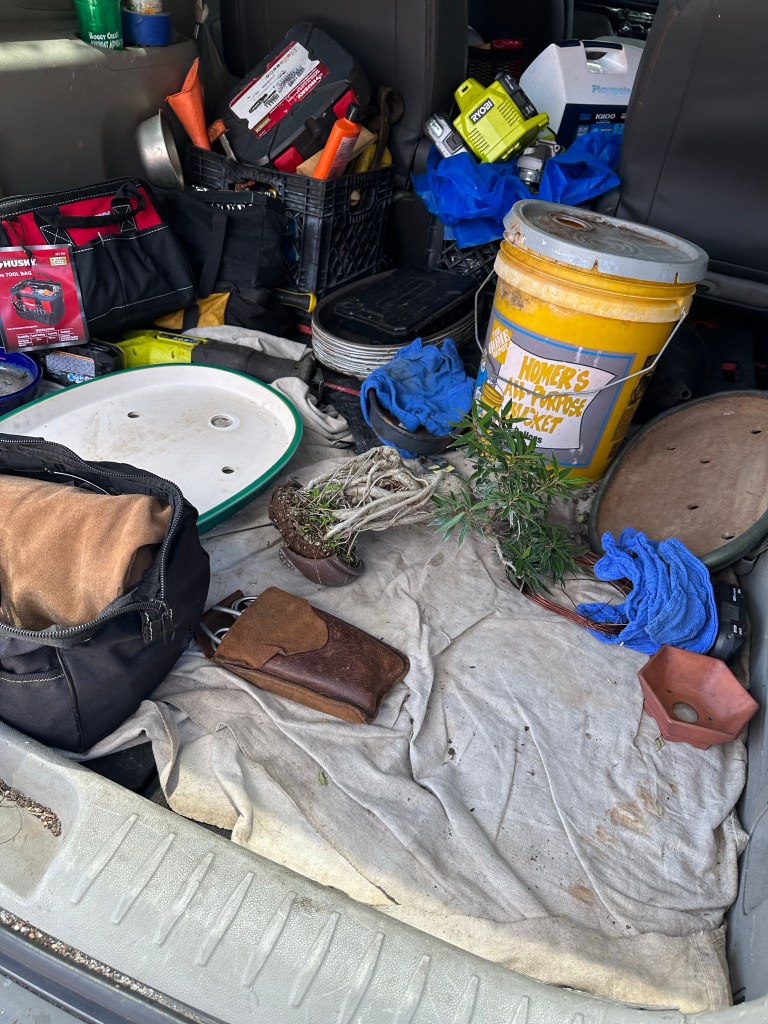
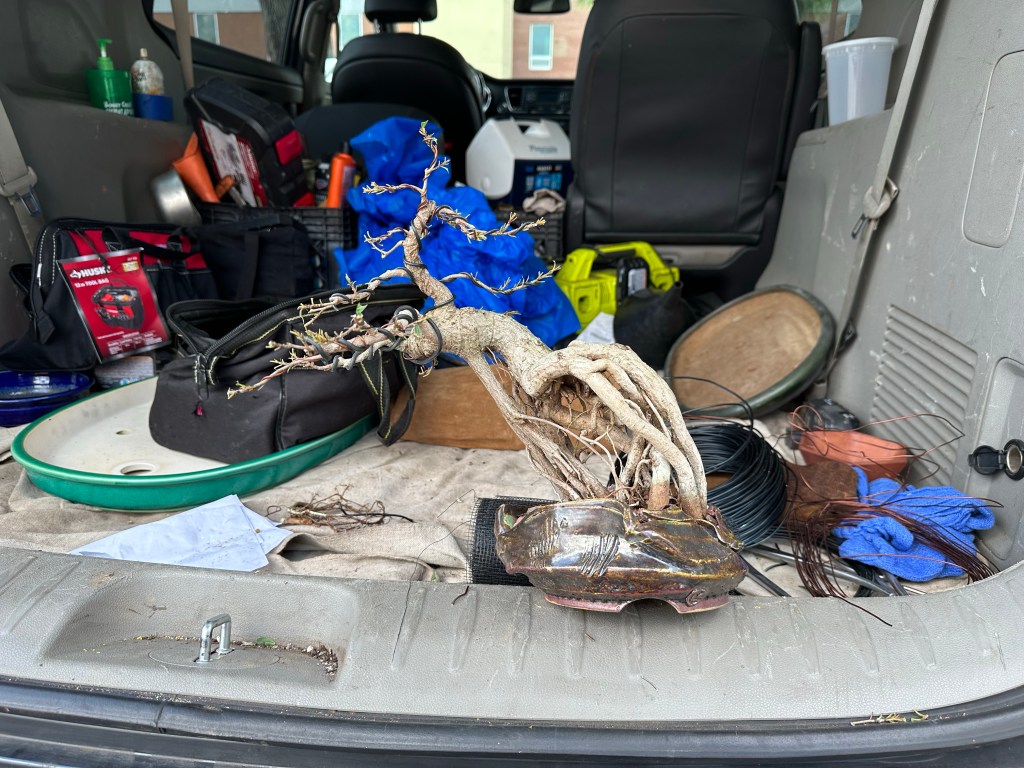
And here’s the Back Bumper bonsai studio.
A Kia minivan. For those that remember the old days, I graduated the PT Loser to the junkyard years ago.
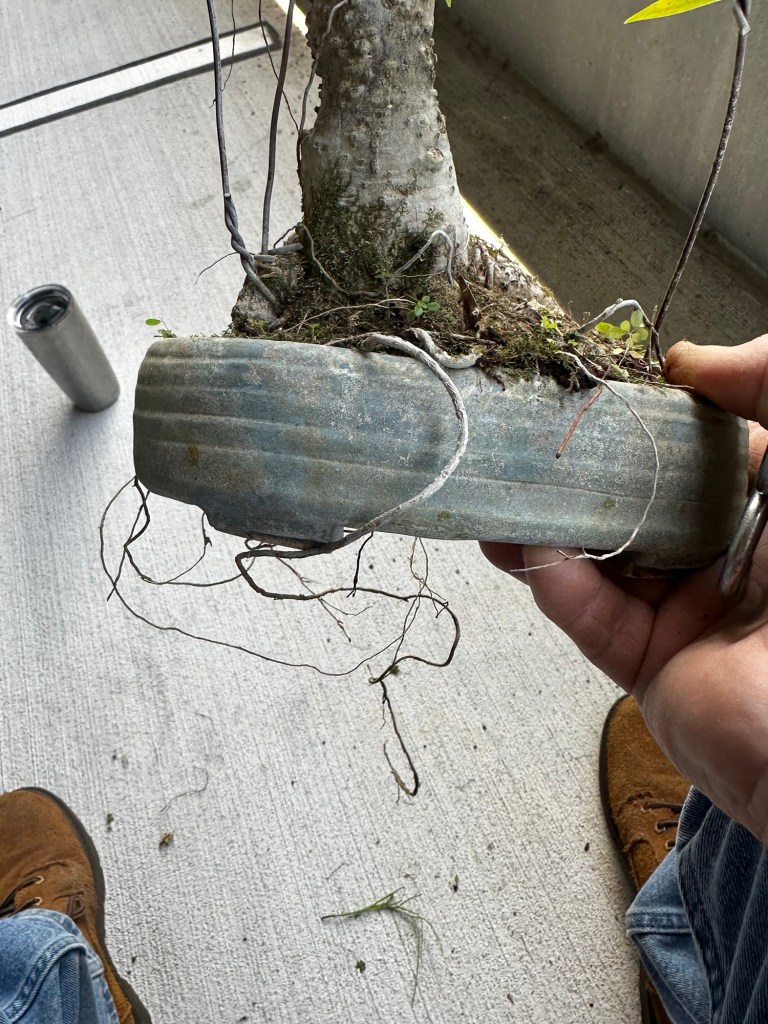
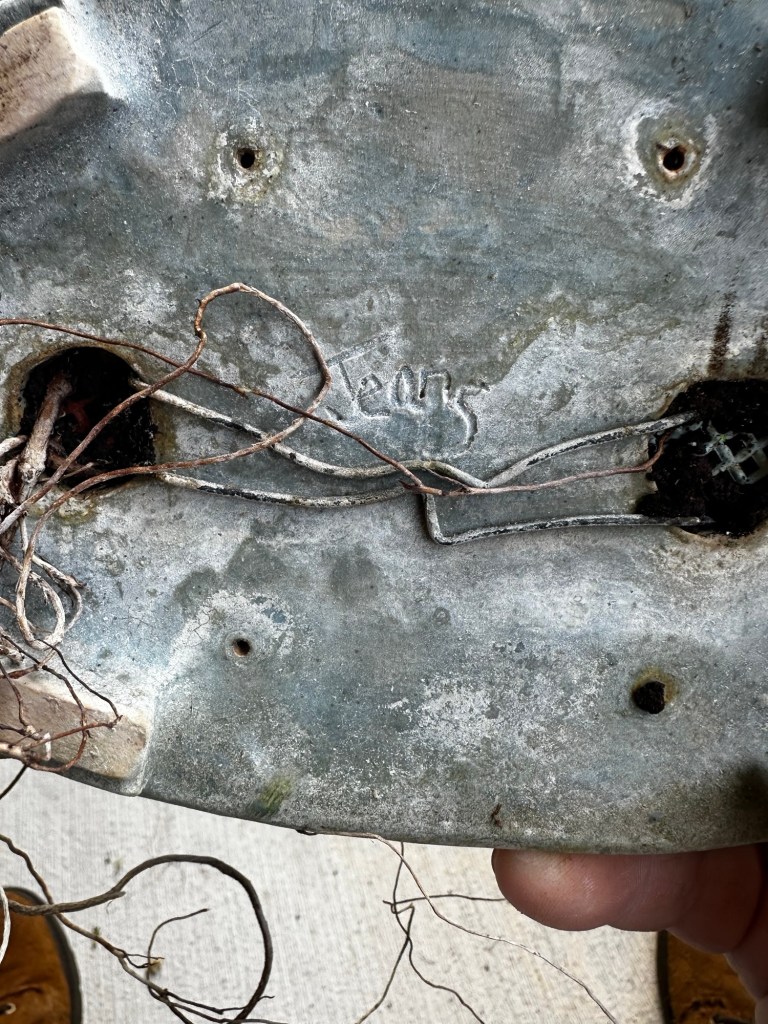
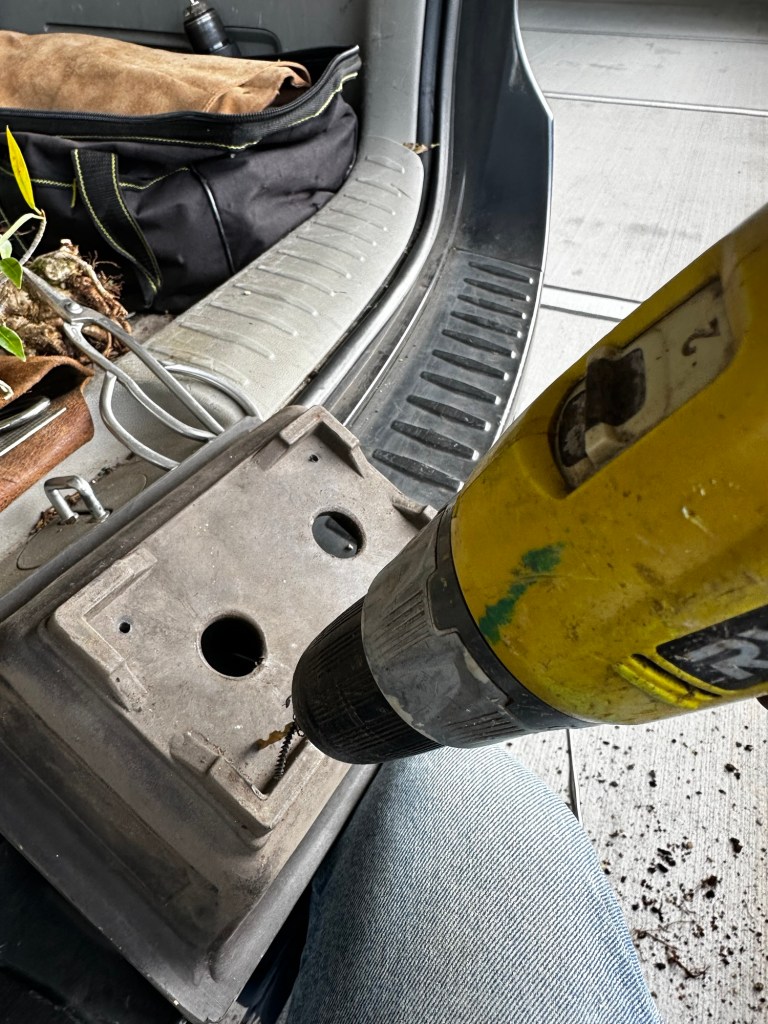
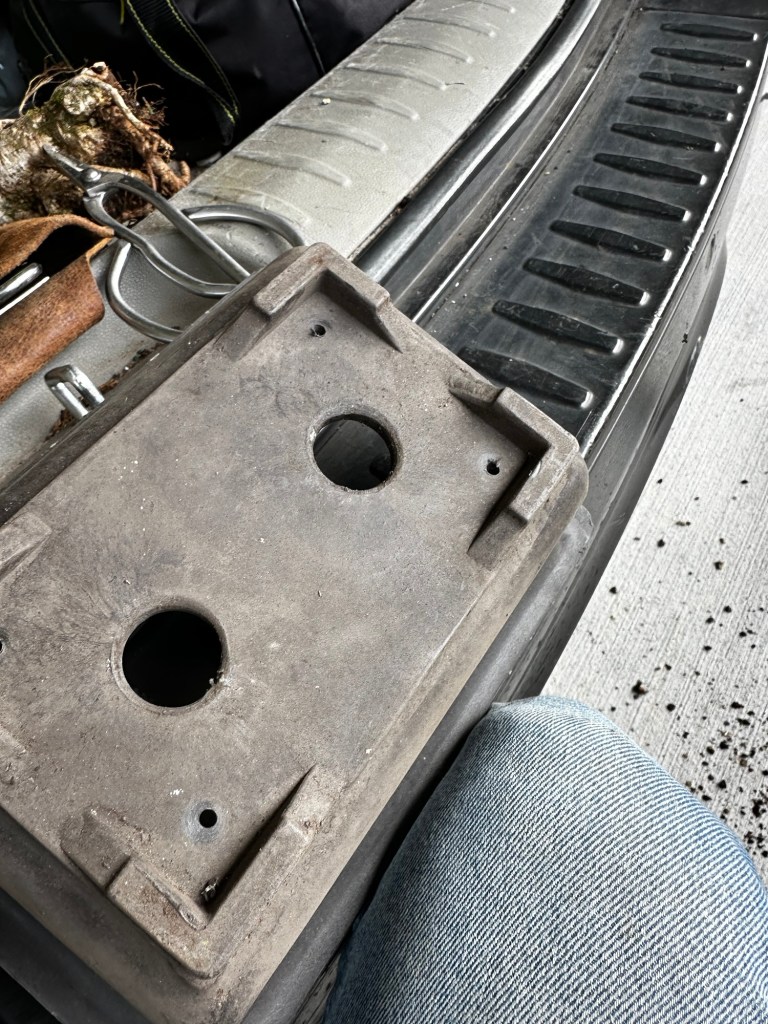
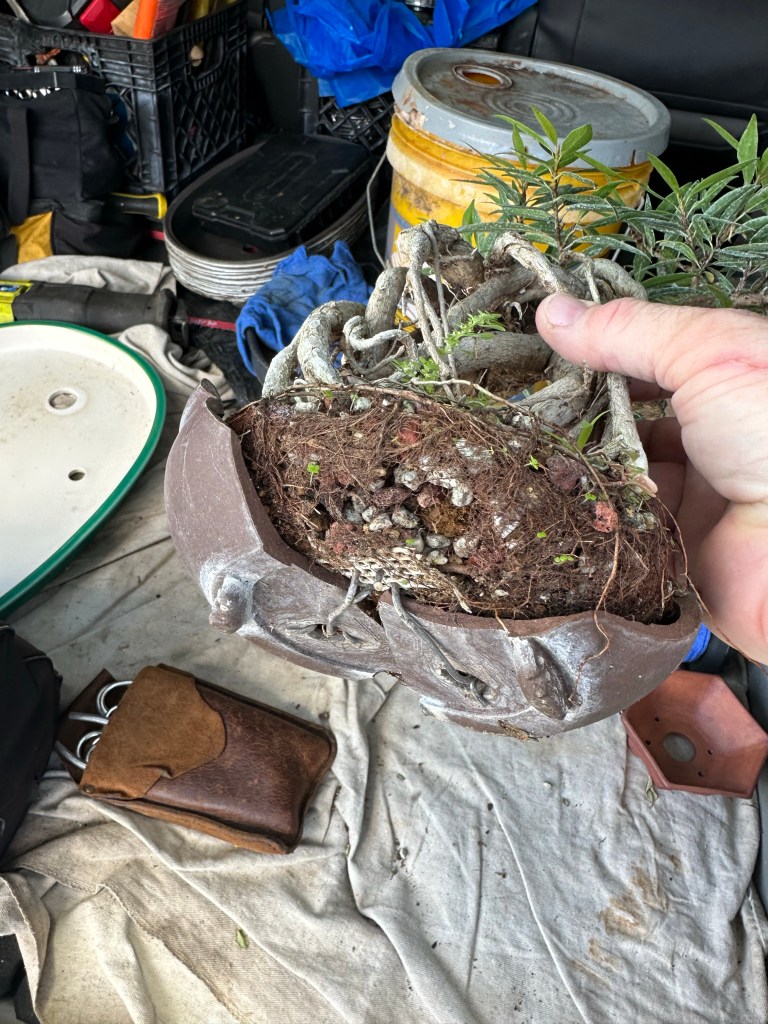
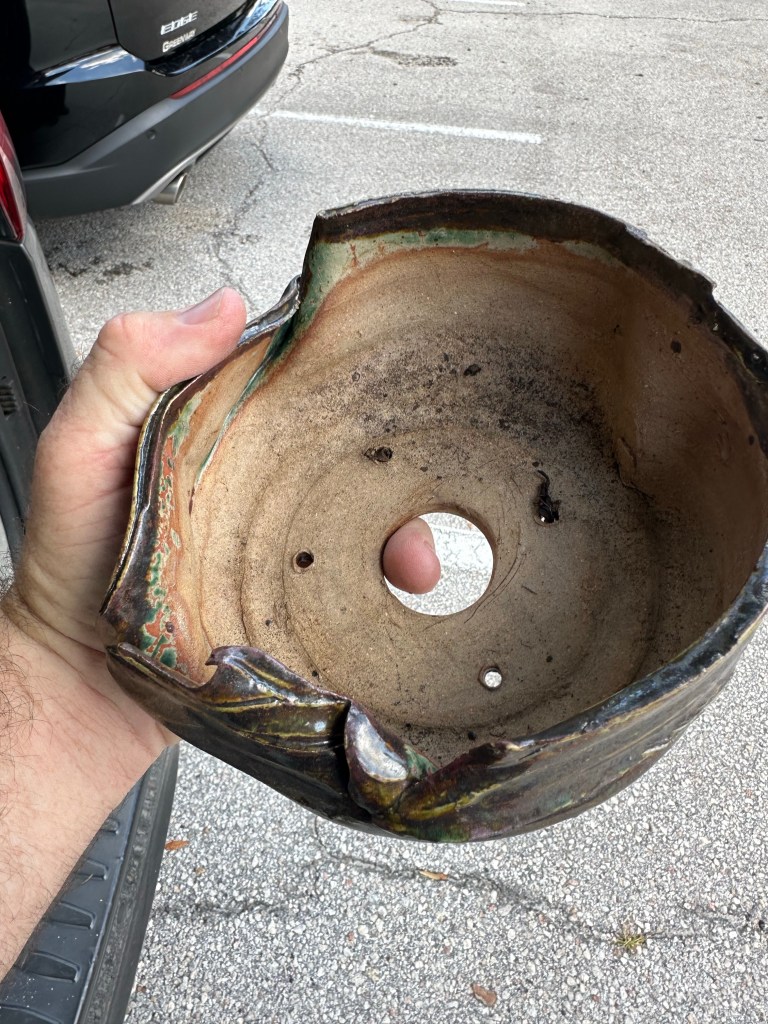
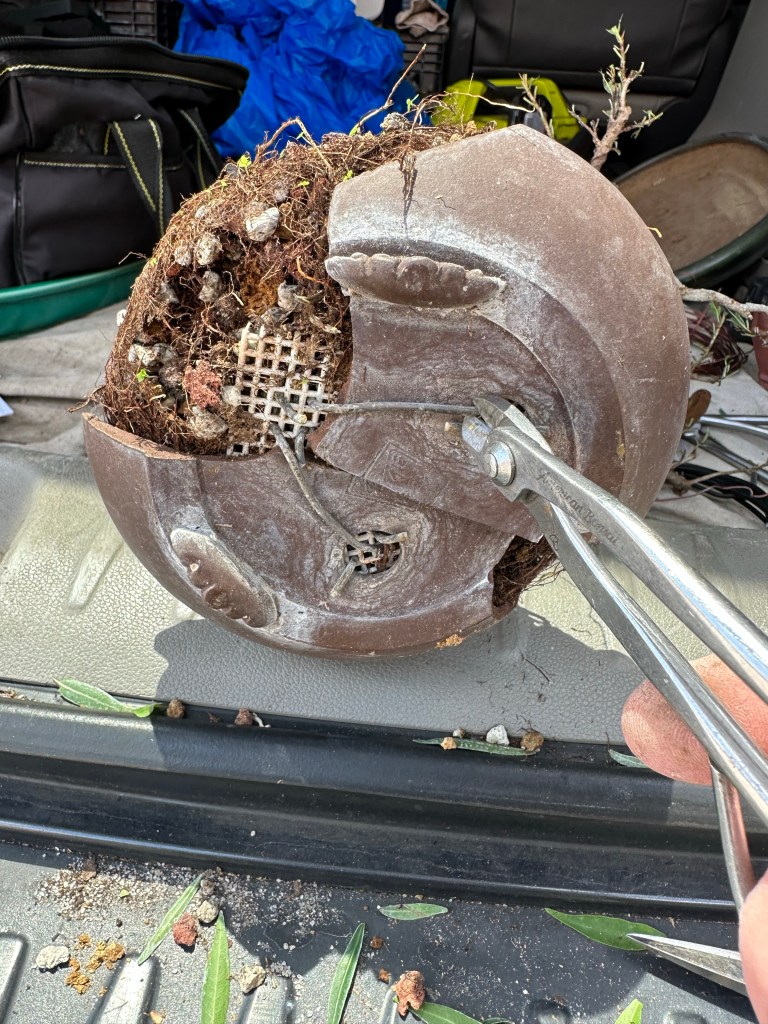
The willow leaf has a, uh, structural problem with the pot.
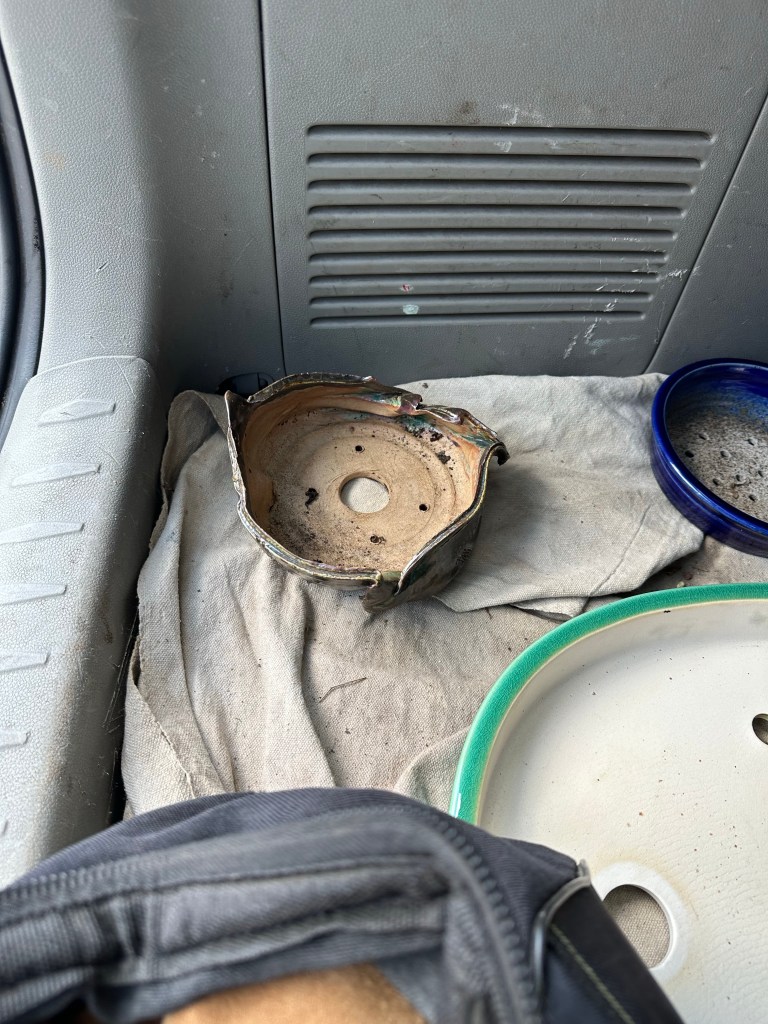
It done broke.
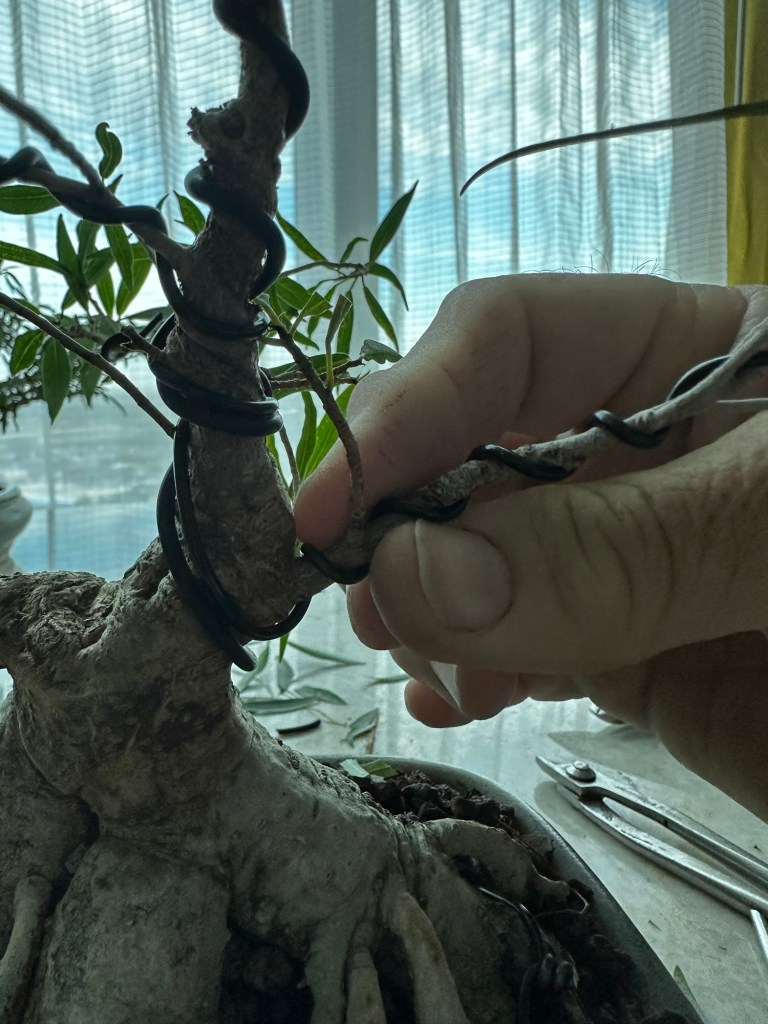
So today, I’m going to repot it, cut it back, defoliate, and wire. In that general order I guess.
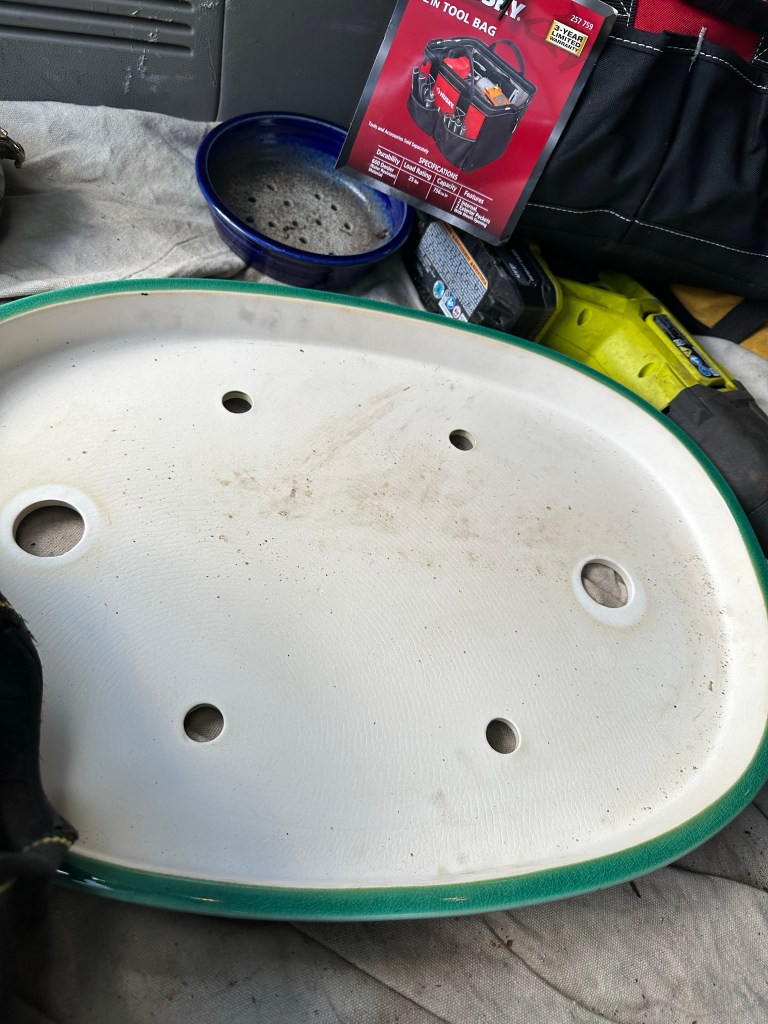
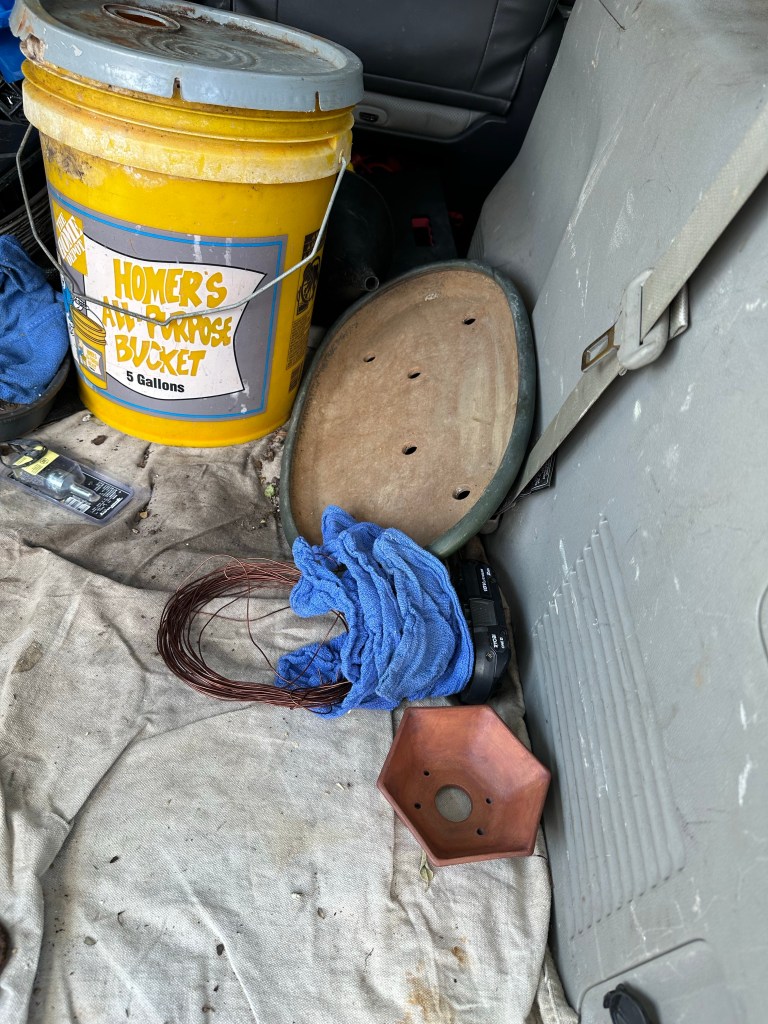
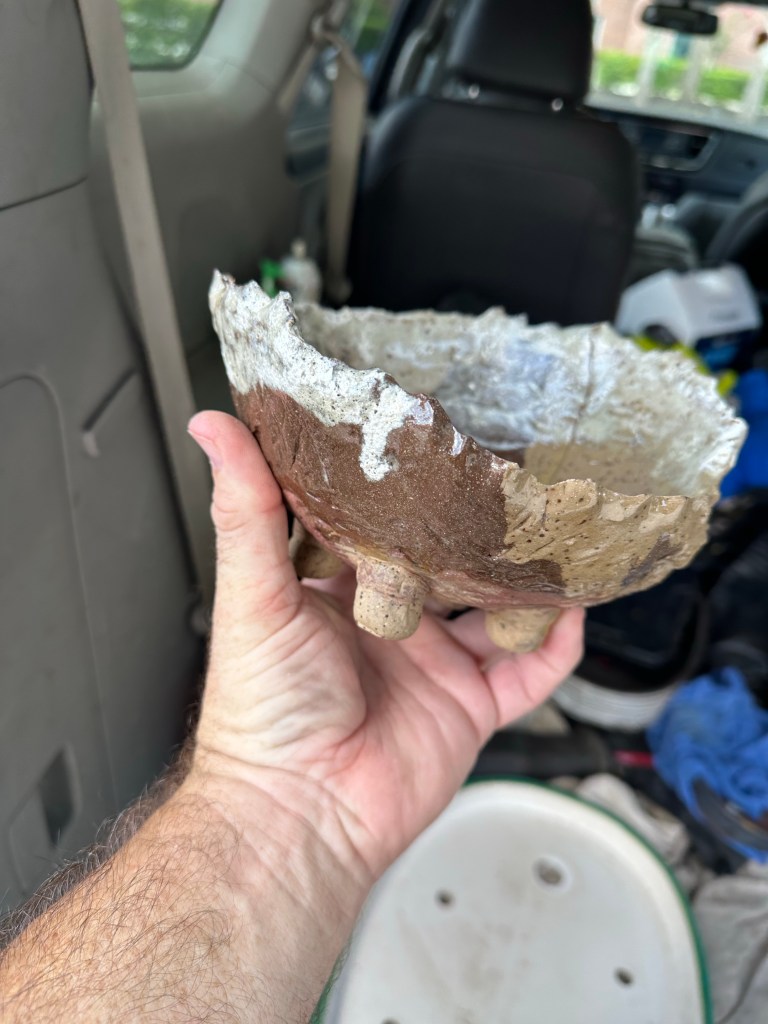
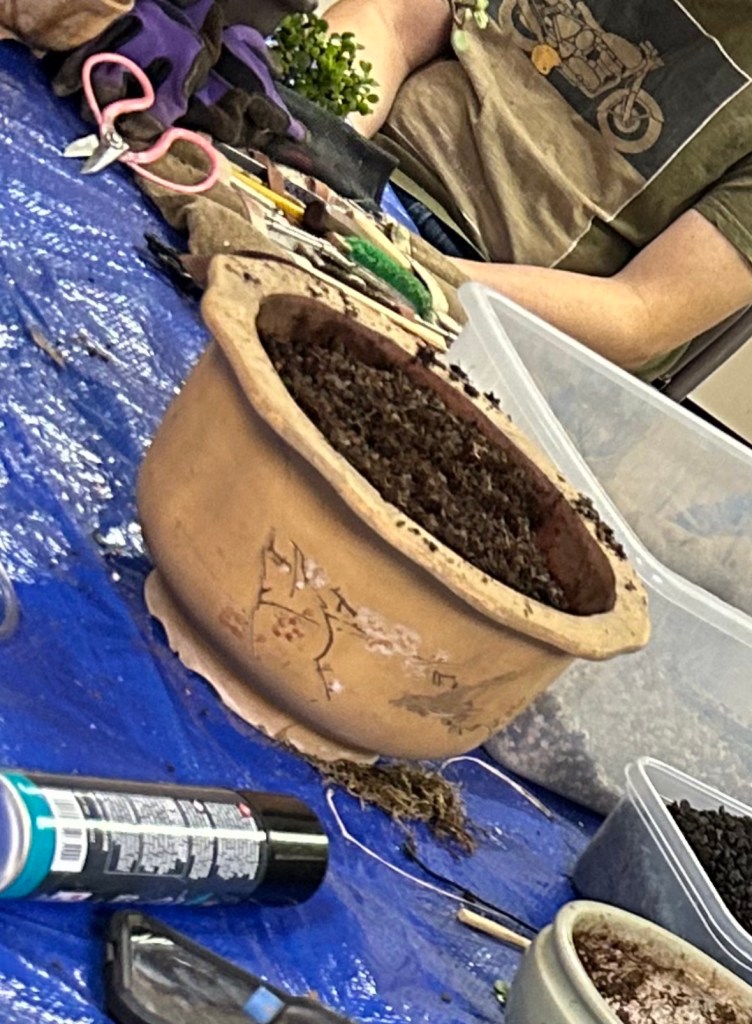
Here are some pots to choose from.
Not the big one of course.
Or that old Japanese one either.
The one below is from my student, Peter Penico. It could work.
But it’s going the wrong way. Nice pot though.
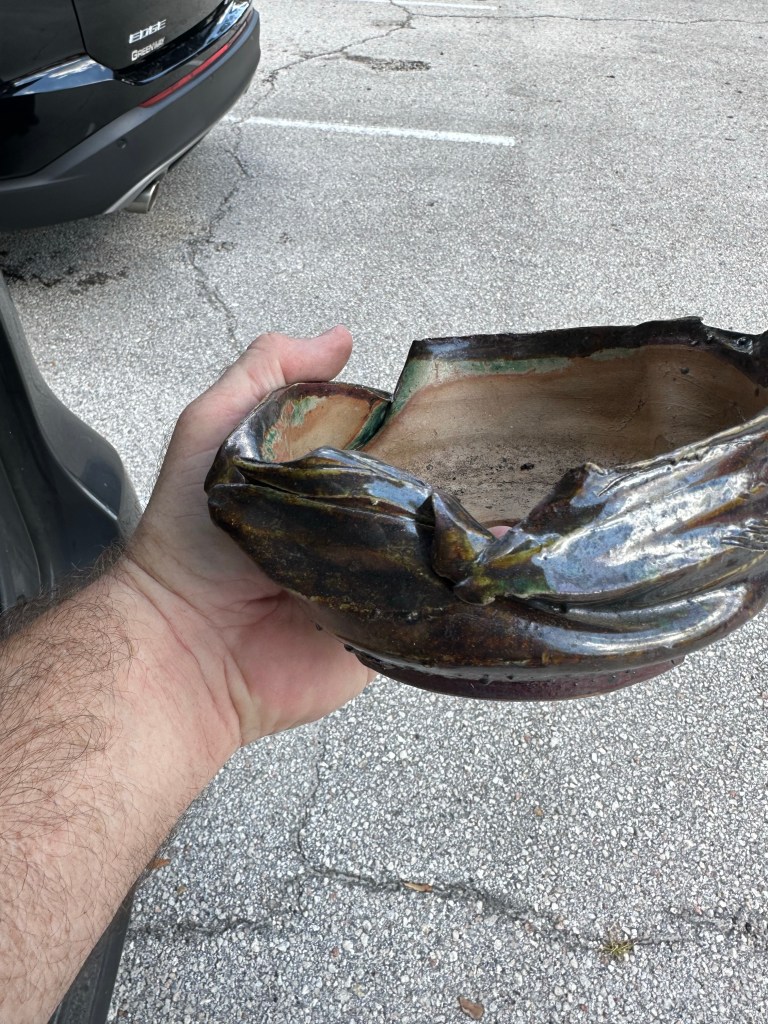
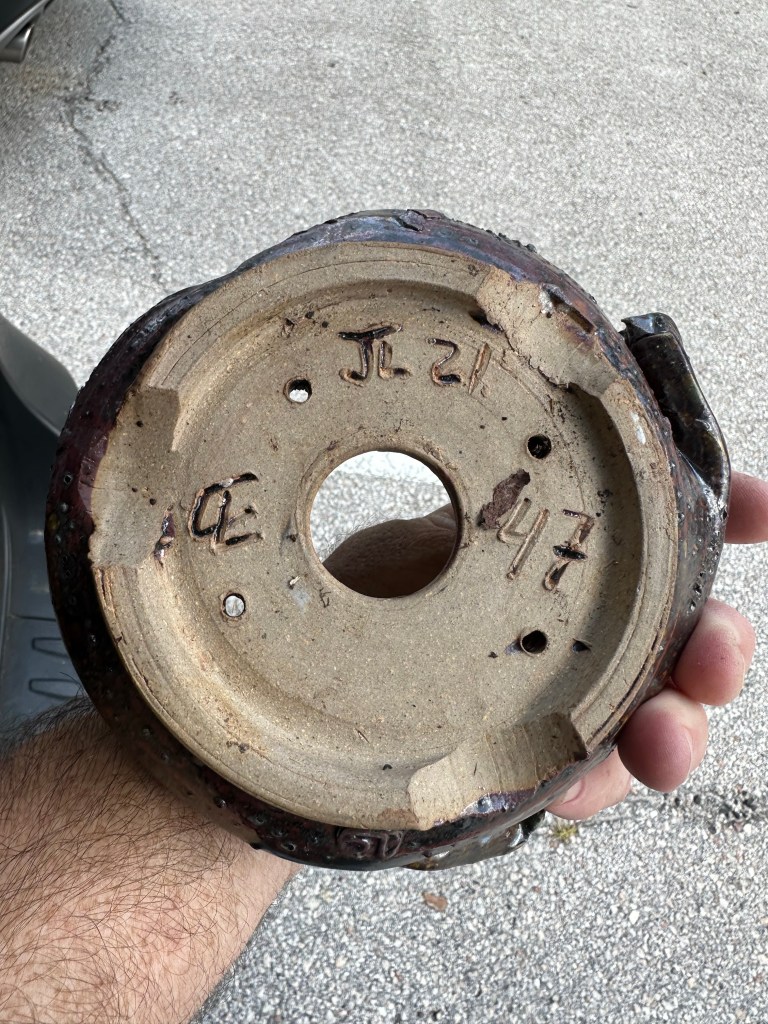
The one I’m going with is this one from Cesar Labrador, a Florida artist living in the Tampa/St. Pete area.
You’ll see his work on the Bonsai Pot Facebook auctions every once in a while.
Sweet details and shape.
It’s perfect. Let’s see about the tree now.
I think I’ll actually defoliate first.
I’ll be using the “chicken plucking” technique today.
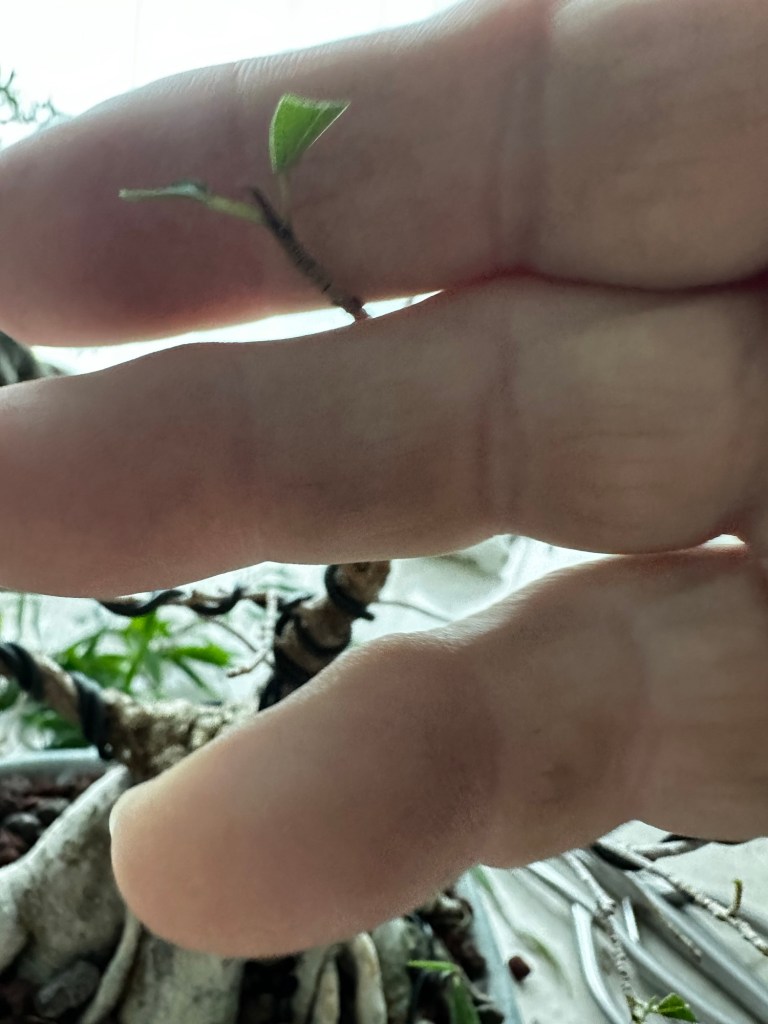
Grab the leaf, and pull forward. The leaf will break at the petiole and you’re done.
Pretty quick and easy. Doesn’t work on all species of trees though.
Next is to remove the old pot.
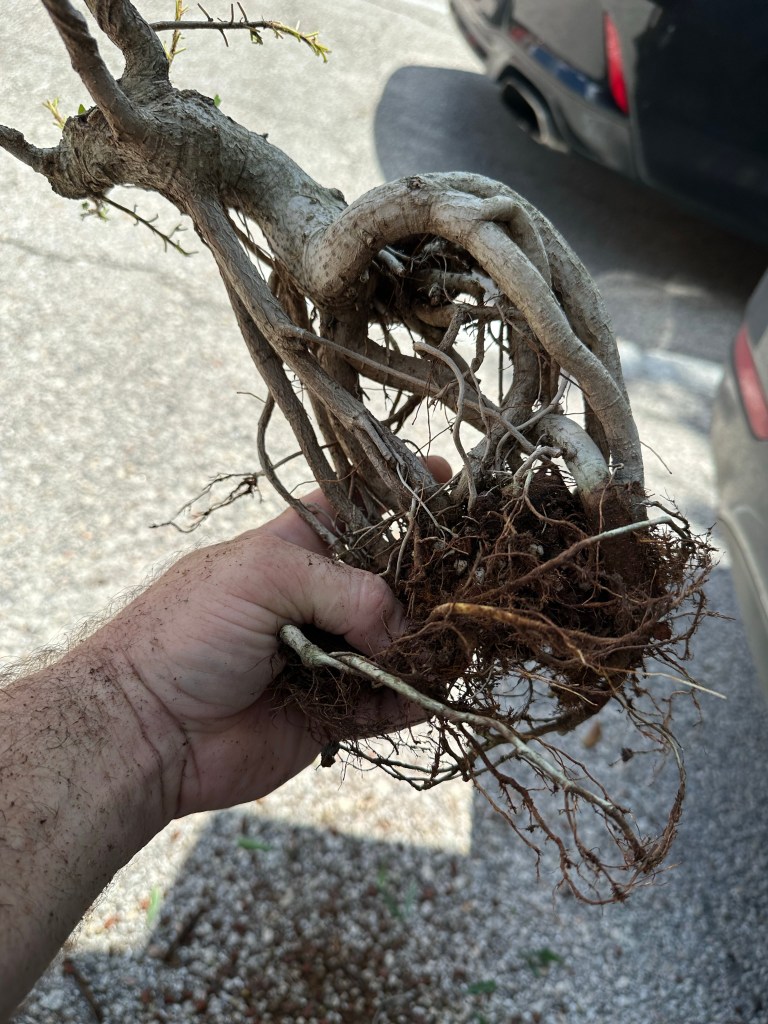
Gently massage the old soil out.
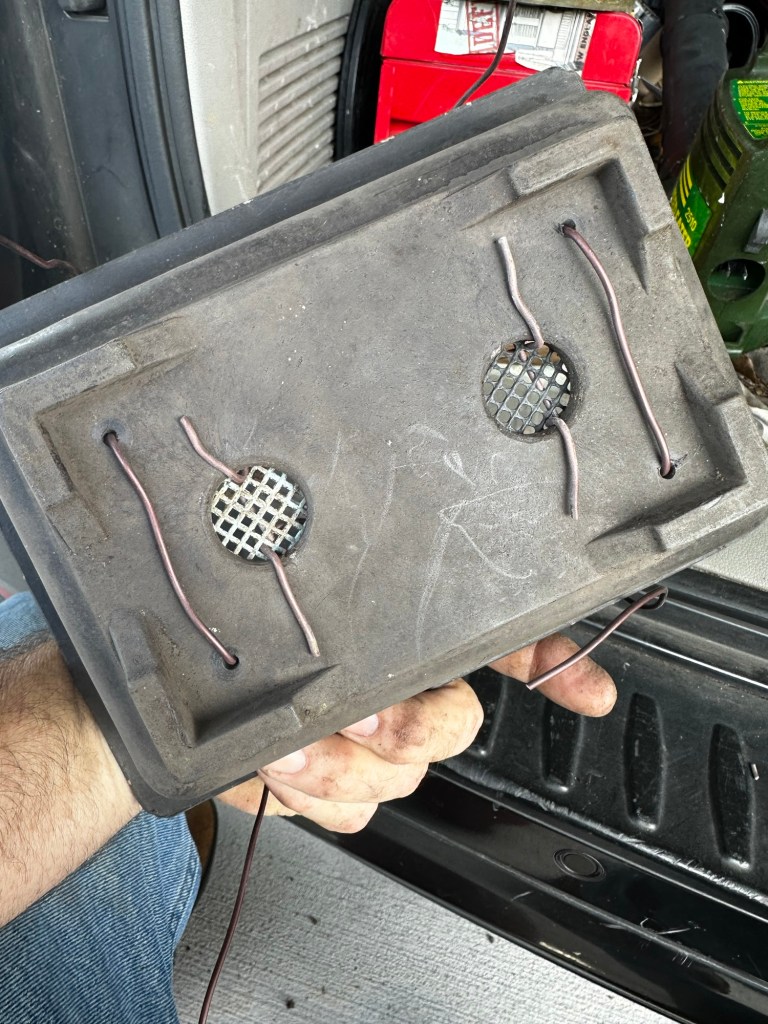
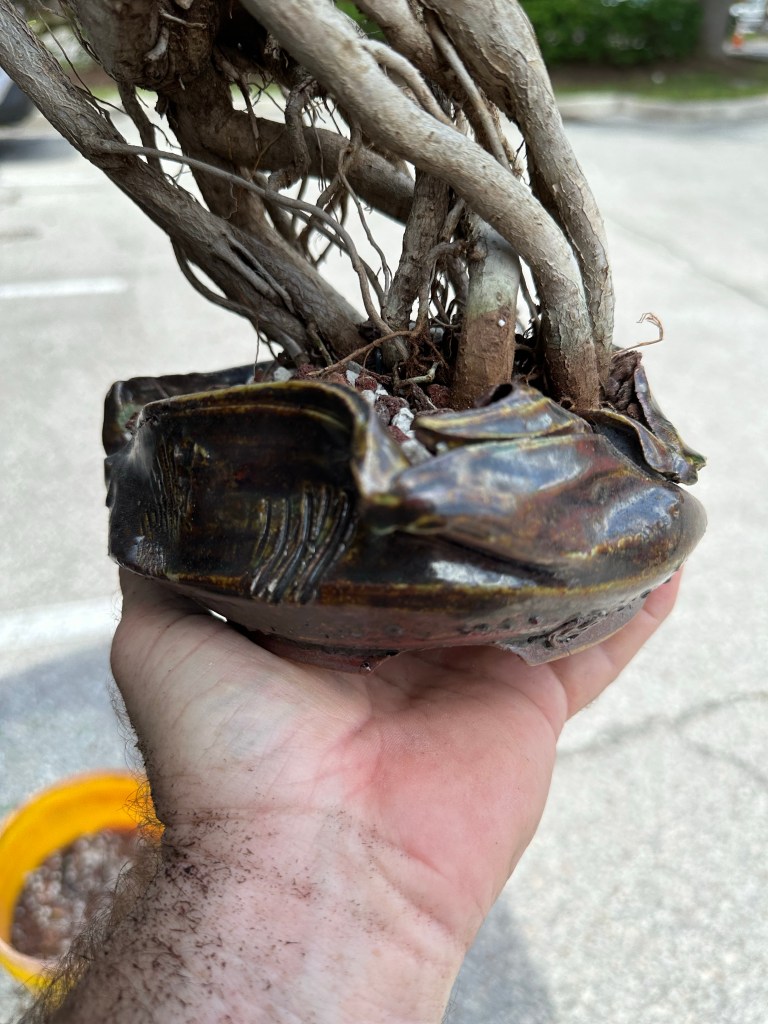
Tie the tree into the new pot, add soil.
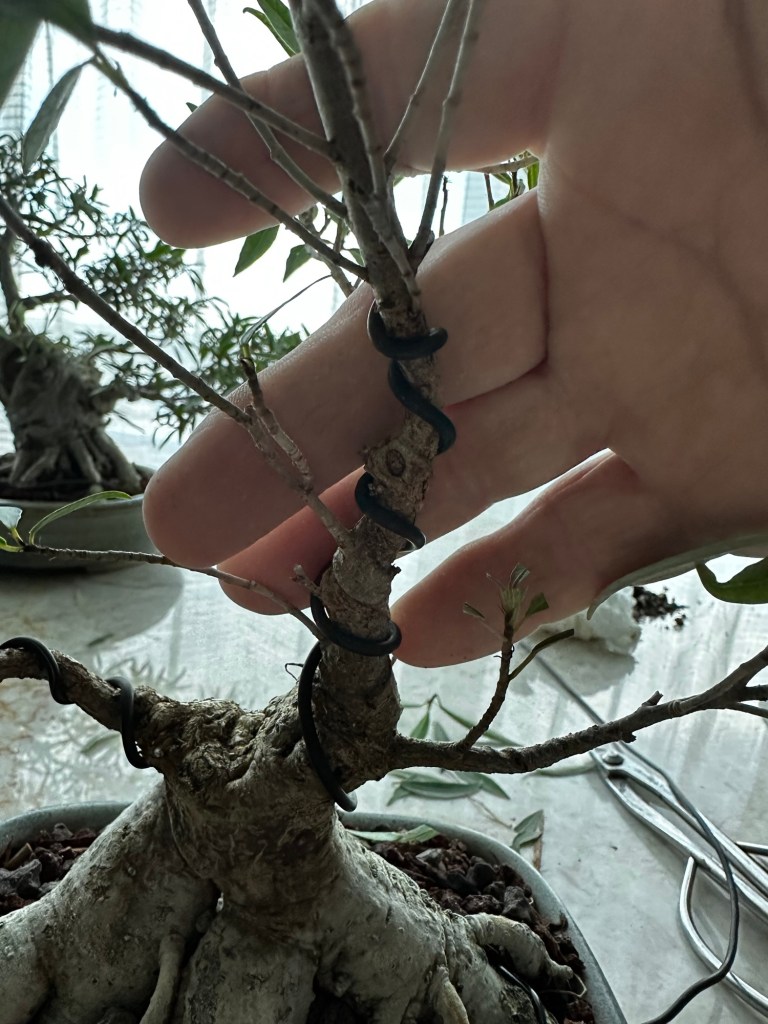
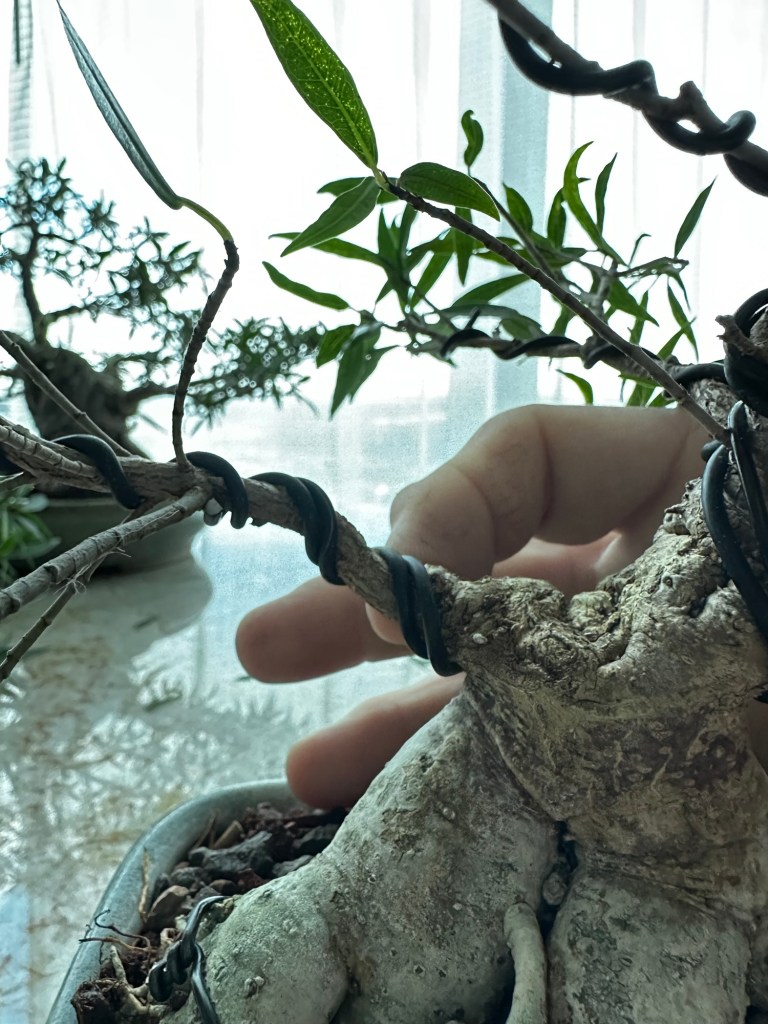
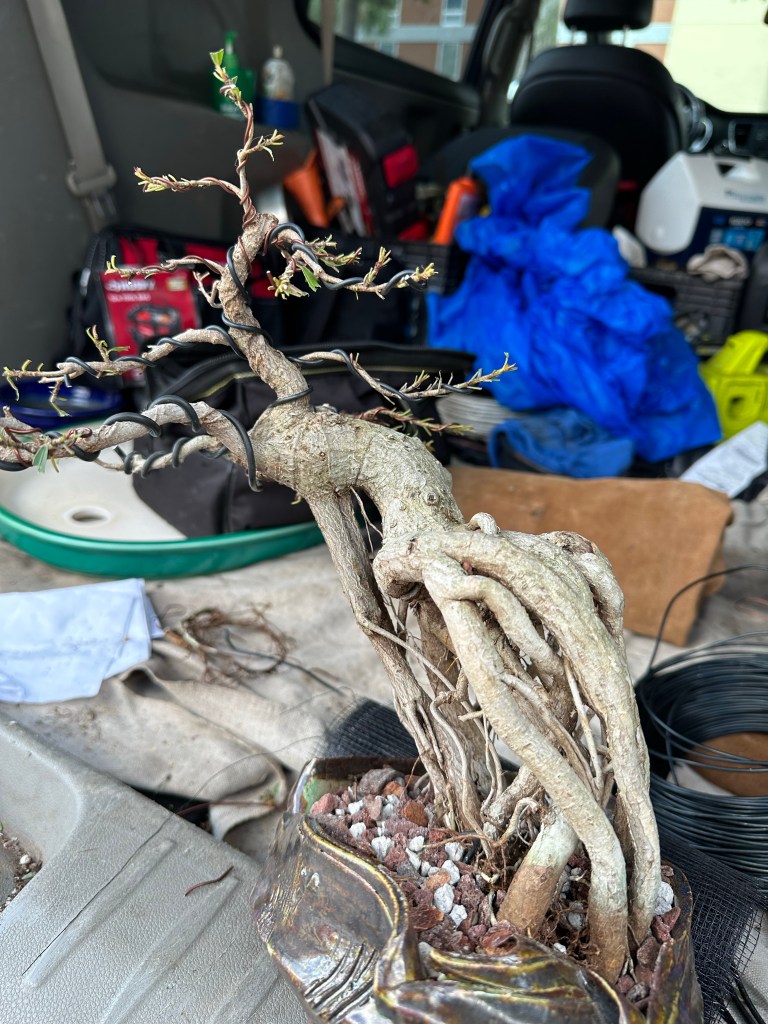
And now for the magic. Wiring!
Here’s the before.
And…..here’s my daughters Jeep and what’s wrong with it (see what I did there? I’m going to make you wait for the after. Wait, don’t scroll down yet…..dammit!). Well, if you’re still here, she has a blown head gasket. The design of the cooling system allows for the coolant to get low and you don’t know it because the overflow reservoir stays full. So, in typical Chrysler fashion, the car overheated and blew up the gasket.
She liked the color of the Jeep. But it’s a bit too much of a job for me to fix, so its for sale, as is. If you’re interested. Call me….
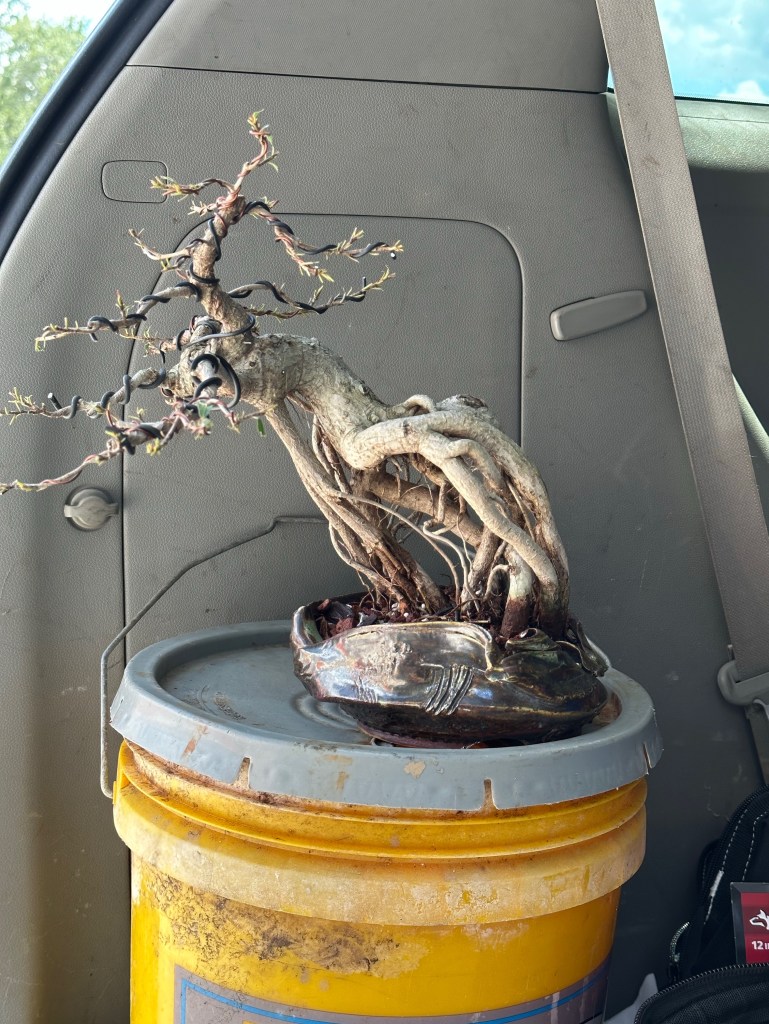
Ok, now for the after.
I think the pot goes well with the exposed root style of the tree.
That’s Washington DC. I think. Lots of converging lines and paths layered on top of each other. I posted a similar insane street map last time I was up in the area and I visited the Bonsai and Penjing Exhibit at the National Arboretum .
I was too busy working this tour to get to see the Collection. That’s ok by me. I like working. To be human is to work. To find meaning in that work is the sole purpose of this life on this earth.
Anyway, there’s room for philosophy later on in the mid and last section of this essay, so, as promised in the last post, here is LeAnn’s buttonwood.
She said it was collected (as most in the USA are) by the Buttonwood Queen herself, Mary Madison.
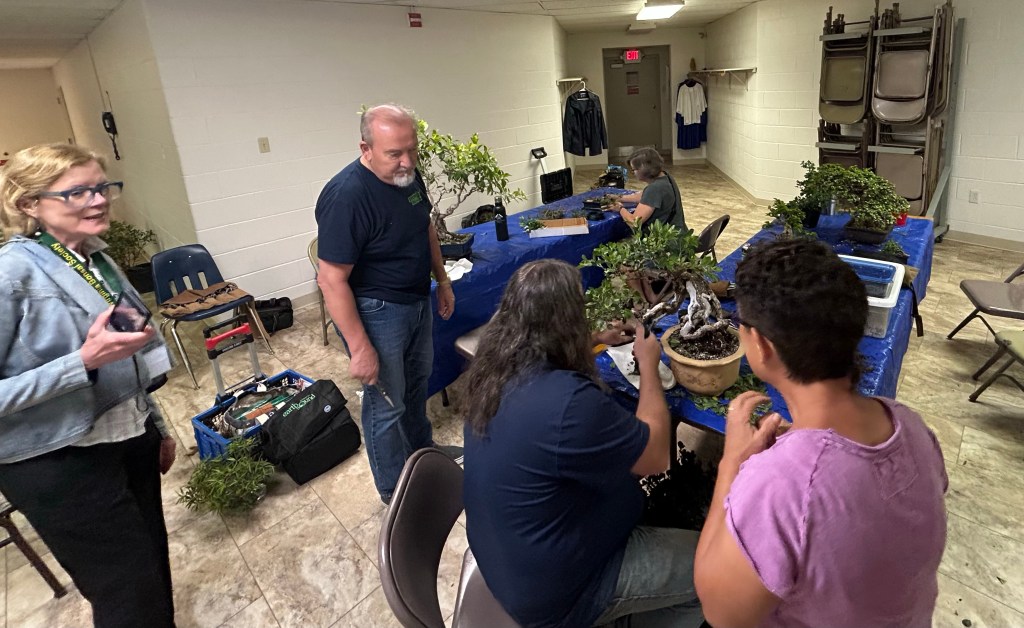
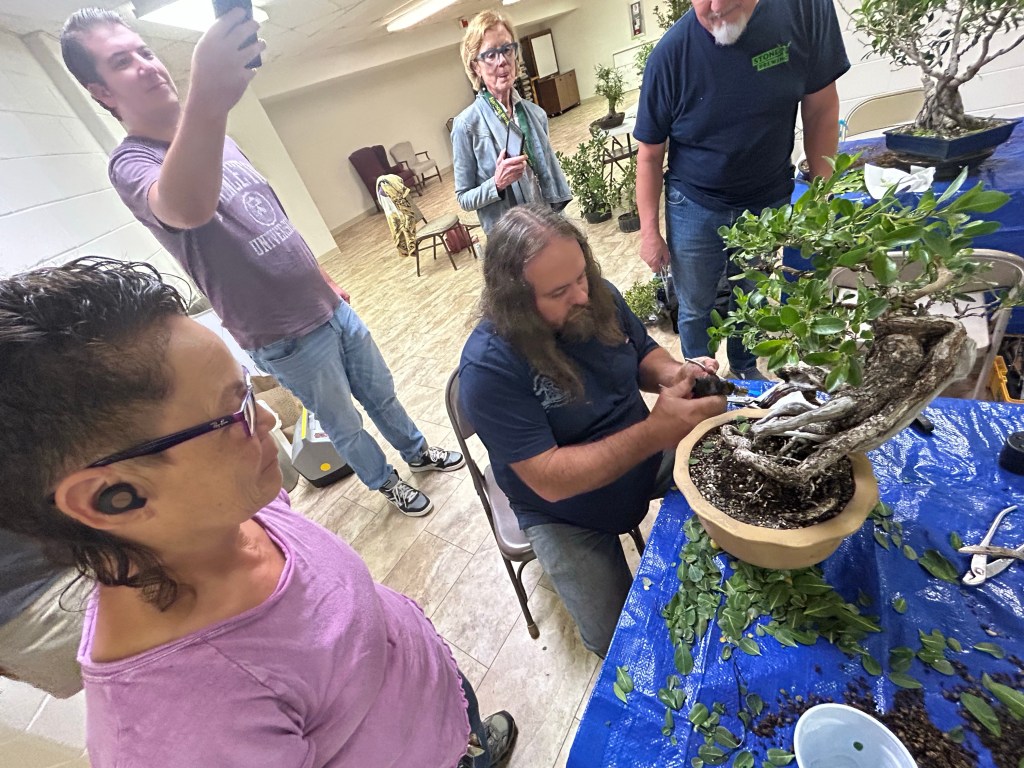
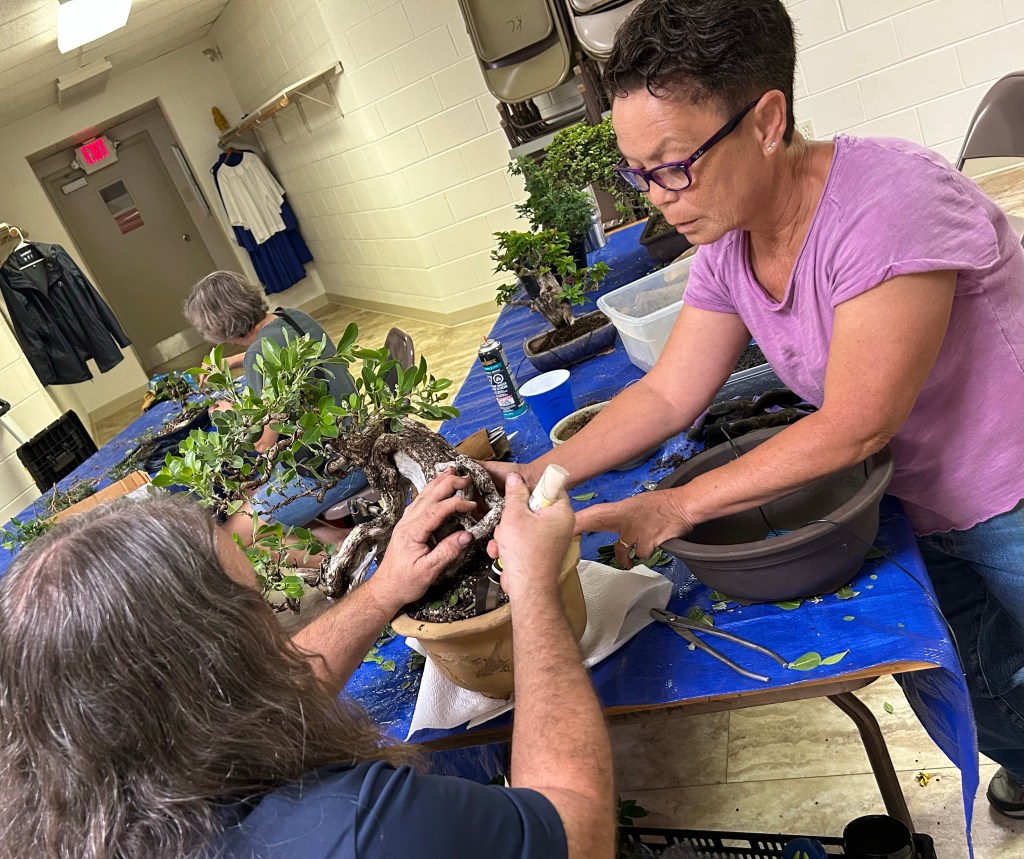
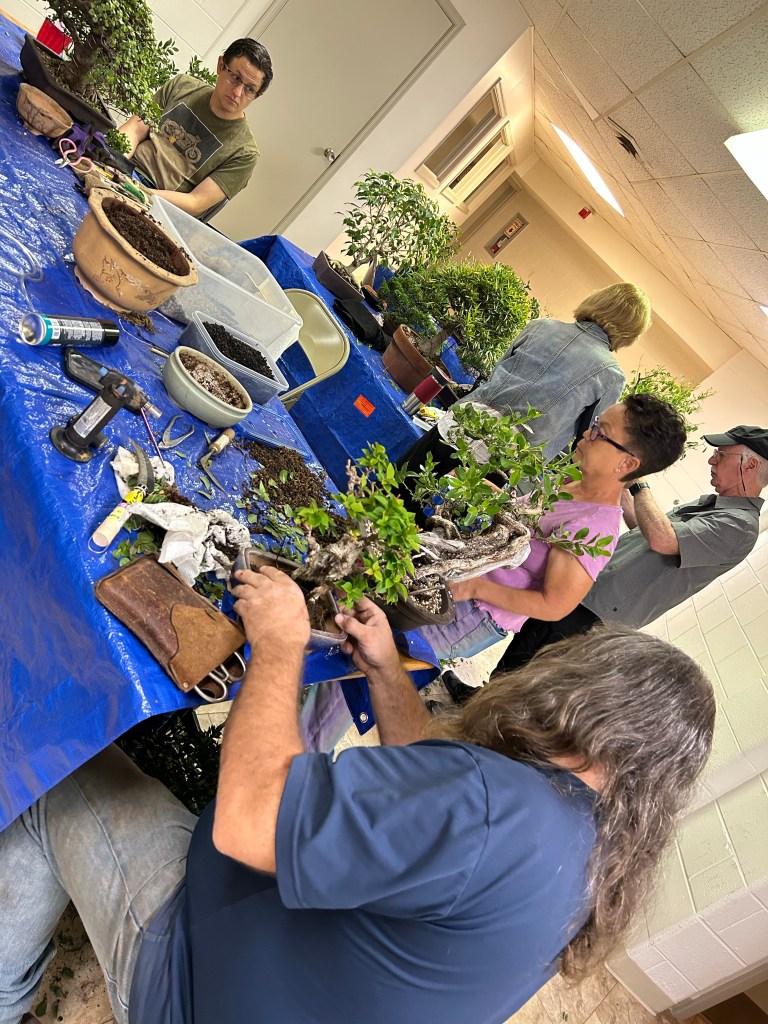
LeAnn is the lady in lavender (purple? Lilac? Not periwinkle, or plum, for sure) hovering behind me.
She waited very patiently while I worked through all the other workshop attendees trees and finally got to her tree.
It desperately needed a repot. I teach my students in Florida that buttonwoods need a repot every year. Up north, like here in Virginia, it’s not so important. Unless you use a horticultural heating pad, that is. (Wait, is Virginia “Up North”? I’m not sure. Where’s the Mason-Dixon Line?)
Ok now…..WHAT? (not the North/South thing, even I’m not getting into that). What’s a horticultural heating pad?!
Here’s a few secrets for my northern tropical bonsai growers. First: get grow lights. We are in a golden age of indoor growing of plants. Yes, due to the legalization of cannabis, mostly, but we gain from it because all kinds of grow lights, from full spectrum LEDS to metal halide, are available almost anywhere for cheap. So get yourself one. But…BUT..secondly: heating pads!!! Horticultural heating pads are the game changer for those that need to bring in their tropical trees for the winter (one should always put your trees outside for spring and summer, there’s no replacement for the sun and rain. None). Most tropical trees growth habits are dependent on temperature. But not just ambient air temps. It’s the temperature at the root zone, in the soil, during the evening, that makes tropicals grow.
Which is why we here in the Sunshine State don’t repot buttonwoods until nighttime temps are above 65°F for at least 6 weeks after the repot.
In sweet Virginy, this particular operation is taking place in the middle of July, and LeAnn has the rest of July and most of August to grow more roots. So no worries there for her. But I knew of a guy in Cincinnati that repotted his buttonwoods in January. He had a greenhouse and heating pads. That’s where I got the idea.
Anyway, we got the buttonwood out of this pot:
And into this pot:
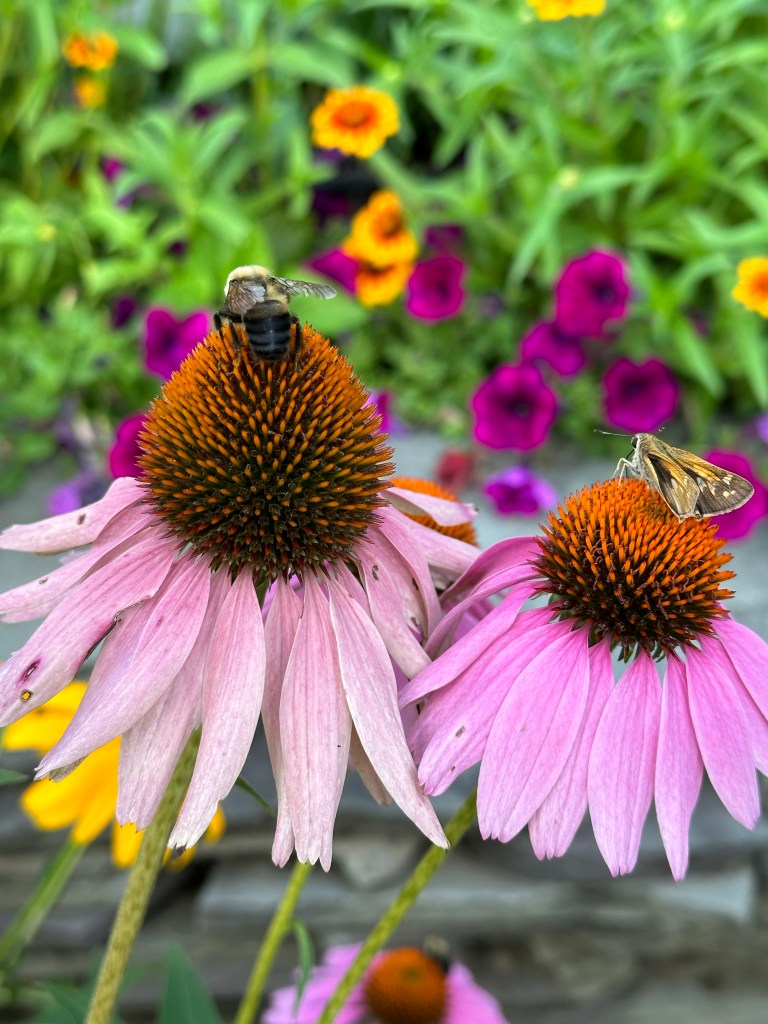
We wired it, tried to bend some deadwood with the torch and steam technique (only partly successful) and, now, just to make you wait, how about a bumble bee and a moth on a coneflower?
Awwwww, ain’t that cute?! LeAnn has an amazing garden and an even amazing collection of trees.
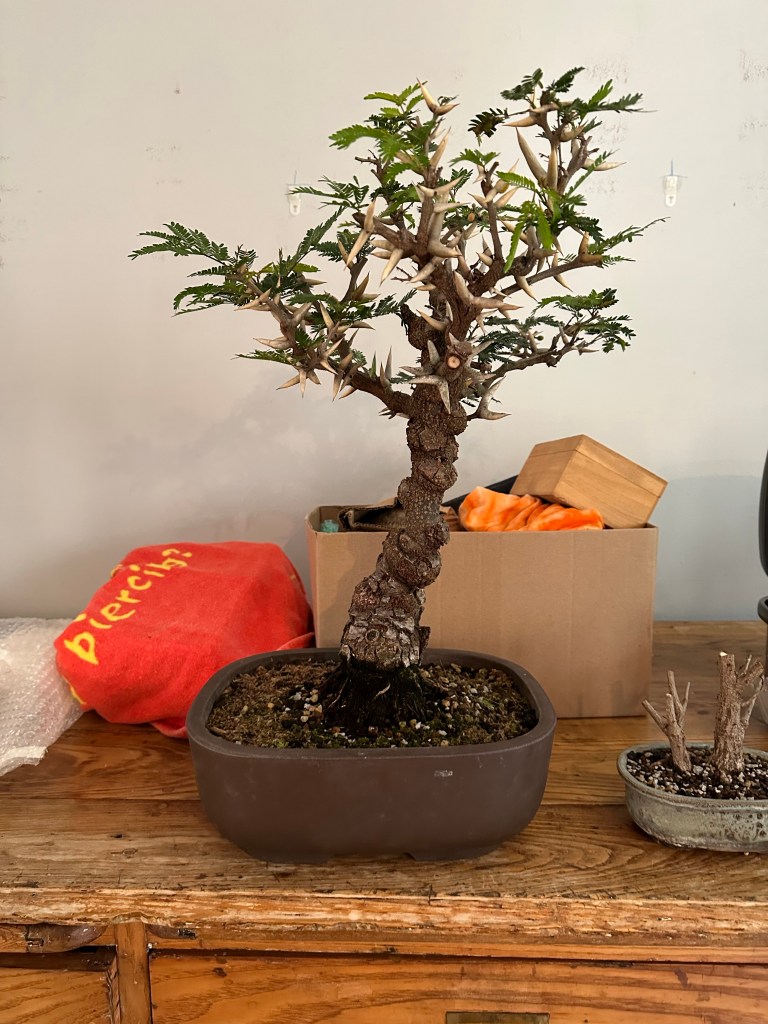
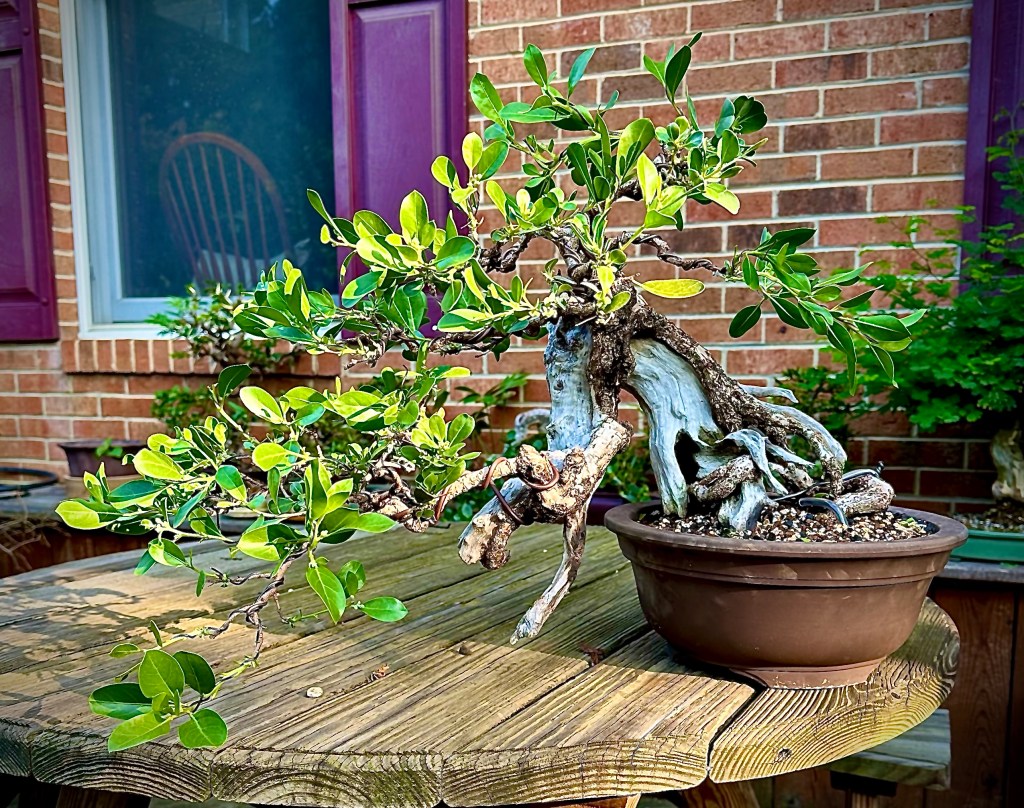
Here’s one of the more developed bullhorn acacias I’ve seen.
And a twin trunk willow leaf on a rock (a rock from Hawaii I believe, where LeAnn hails from).
And now, the buttonwood.
It’s an impressive specimen.
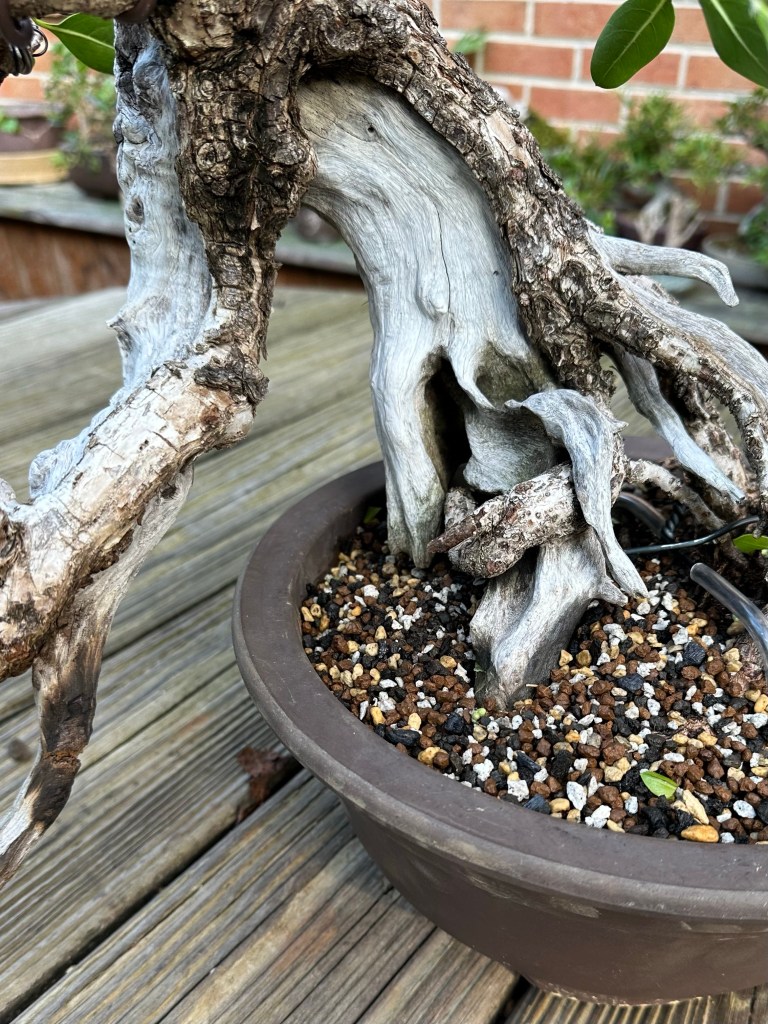
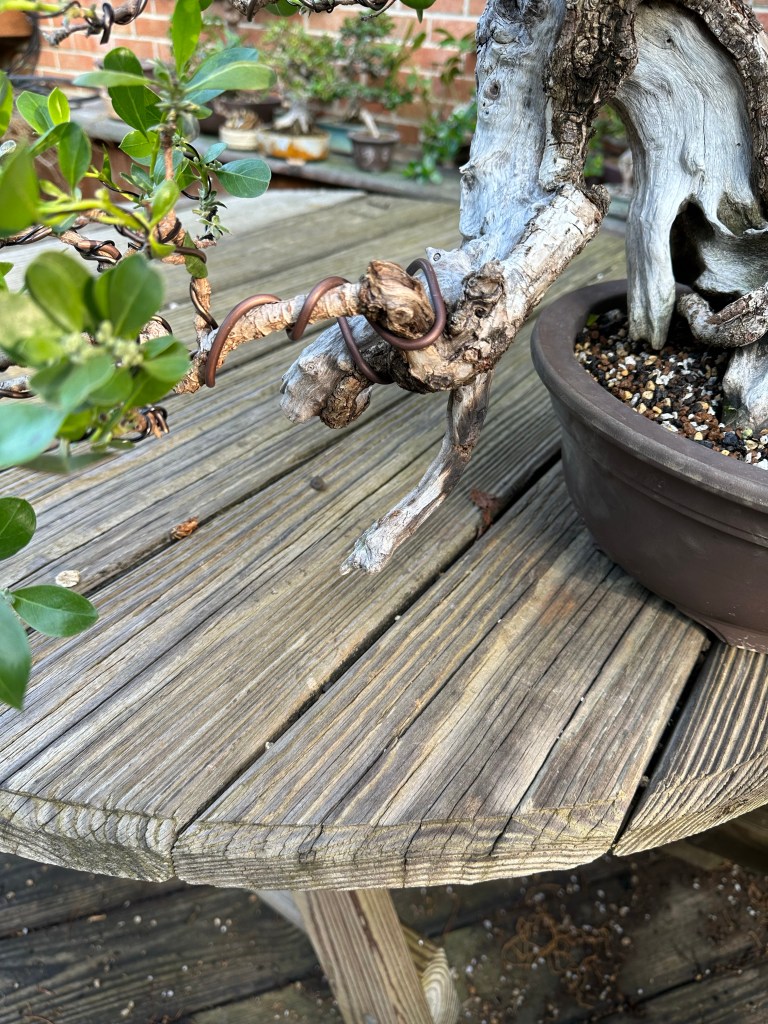
You can kinda see the burnt section where I tried to bend a straight piece of deadwood (middle of the below pic. It was ramrod straight).
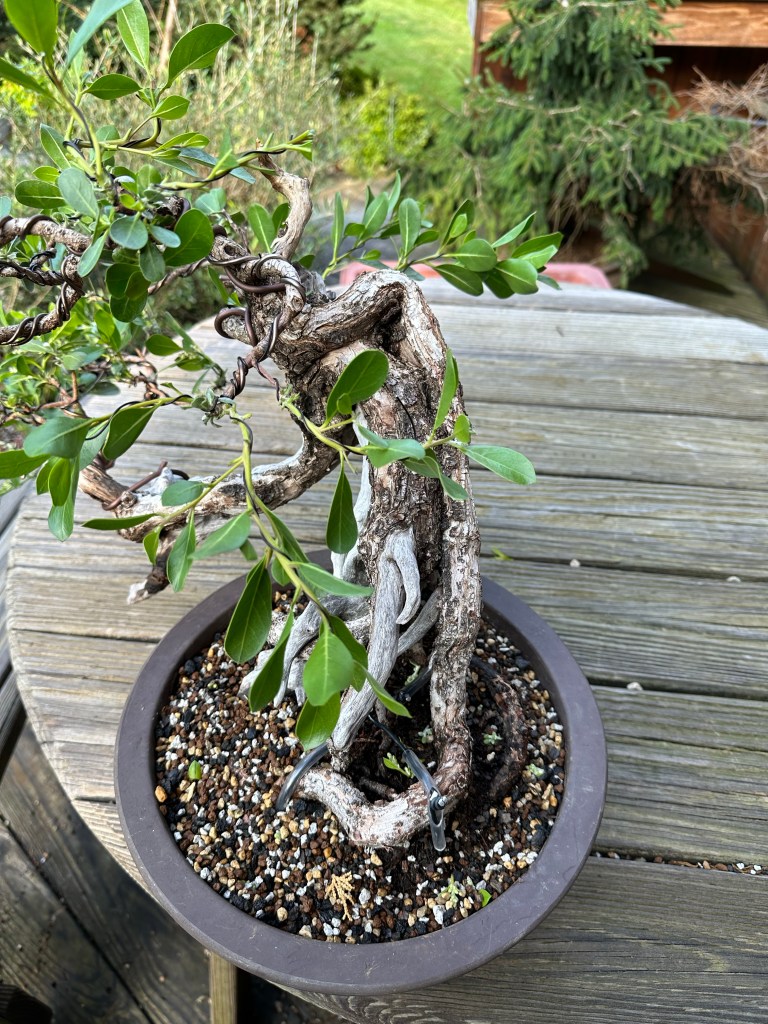
View from above.
The constant reader is asking, “Why are there still leaves on it?”
Well, we are in The North, and the sun isn’t quite so strong as in La Florida, so, even though we are in full summer, I’m not comfortable totally defoliating a buttonwood up here.
And the main thing I don’t want to do is to kill this special tree. We really beat up the roots when the repot happened, and foliage is what grows new roots, so I left the foliage. Simple calculus, as they say in the movies.
And the tree was collected by Mary. Here’s the last pic I got of her before she passed away (that’s her daughter Terri, behind her).
Mary was such a force in bonsai, it’s hard to believe she’s gone. I truly miss her. There won’t ever be a woman in bonsai like her again.
And it was an honor working her tree with LeAnn. Thank you!
One last tip, and I learned it from Mary. Since we beat up the roots so much, I advised LeAnn to set the pot in a tray of water. One deep enough to cover the drainage hole. This will help the tree to grow new roots. Contrary to what I’ve said before about air being important for root growth on other trees.
A buttonwood lives in the coastal saturated zone, where mangroves grow, by the ocean, and are used to water. In fact, to make a cutting root, the easiest way is the old fashioned “Put the cutting in water” method. Oftentimes (don’t tell anyone) when we collect buttonwood, it’s really just a big cutting, with no roots at all, and we place the tree into the pot, and, as LeAnn is doing, place that pot into a tub of water.
One can, as many often do in bonsai, point out the unscientific practices of bonsai people. I do it often. But I have a saying I use religiously, and it applies to bonsai practice distinctly:
“Horticulture is a science, but the practice of horticulture is an Art”
I’ll leave you with that to mull over. Quote it to your best friend and your most divisive foe. It’ll separate the wheat from the chaff, real quick.
Consider the Portulacaria afra, what many call dwarf jade, or port, for short. In South Africa, where the tree is native to, it’s called “spekboom” which literally means “pork bush”. Interesting name…..
We know that it’s a favorite food of elephants (one common name is elephant bush) and rhinos. Goats love it too. What about us? Is it edible? More importantly, is it eatable? How does it taste?
My kids used to call it “apple tree” because to me (yes I tasted it. I’m a curious SOB), it tastes like a Granny Smith apple.
Here is an article I published in 2012 containing everything you ever wanted to know about Portulacaria afra. In it I talk about the habitat, the grazing practices of elephants, how a dwarf jade photosynthesizes and of course, all of the off topic rabbit holes I go down, the intemperate thoughts on life, the universe, and everything. I’m still even a little more upbeat in my writing, as I had not lived through the several long dark tea times of the soul I’ve experienced yet.
Any who (the who is Wil) I’ve been challenging my student (the aforementioned Wil) to come up with a dwarf jade chutney, like they make in the finer eating establishments (and farmhouses spattered around the wilderness) of South Africa.
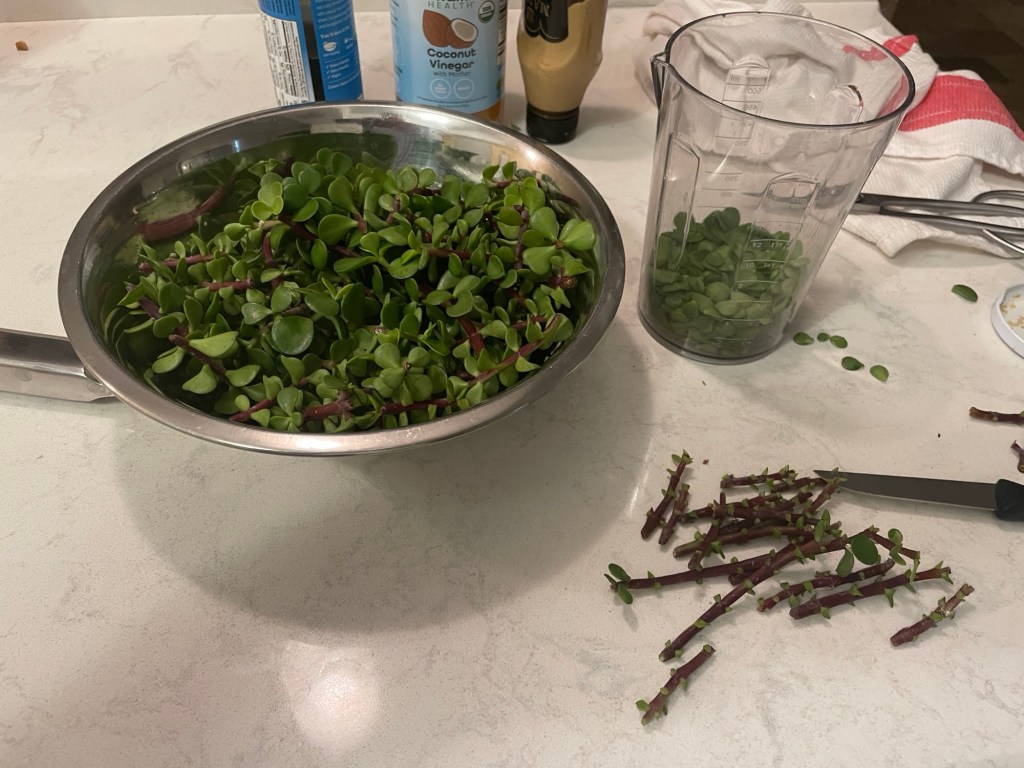
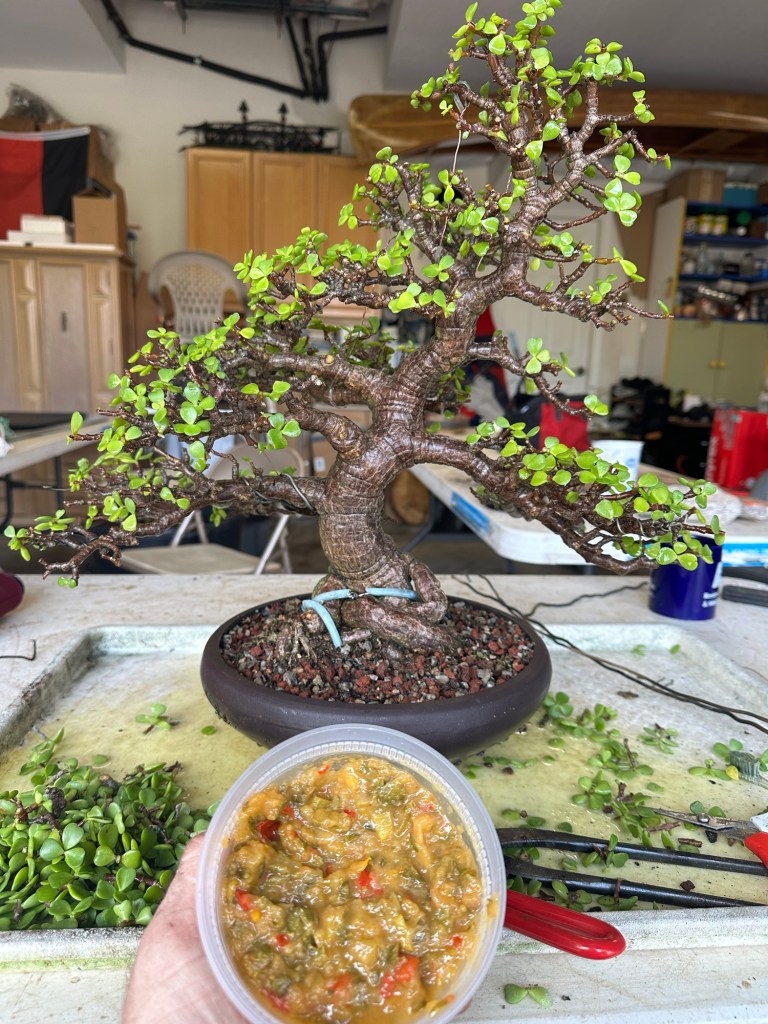
Finally, he did. First, he had to grow, harvest, and process some leaves.
The recipe:
He had to make some changes to the ingredients as there are some products ubiquitous to South Africa that we just don’t have. Here’s the original recipe:
I mean, what’s up with a ml? And then a cm? You’d have to work at NASA to be able to convert from metric to whatever we call our units of measurements.
And what is “B-Well chilli oil? Is it chili oil or some other crazy thing called chilli oil? And who is getting well by guzzling oil? Oryx dessert salt? Is that salt from the desert but with an extra “s” or is it sweet salt?
Wil is a better chef than I. He knows when the garlic goes into the dish. And how much abuse it can take to survive the fire. Wil is the Man! And not in that negative connotated way, like “Down with the Man!” But like “Yo! Dude, you da’Man!”, though I do think he was a member of the CIA (not that one, but the Culinary institute of America).
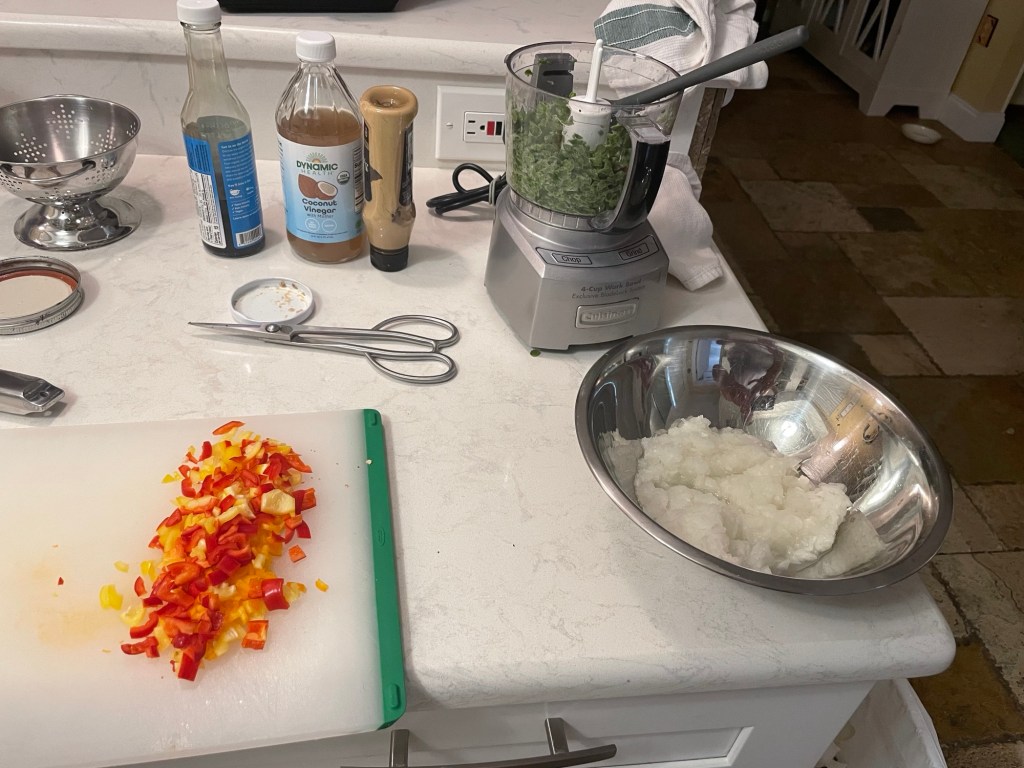
Chopping and sorting.
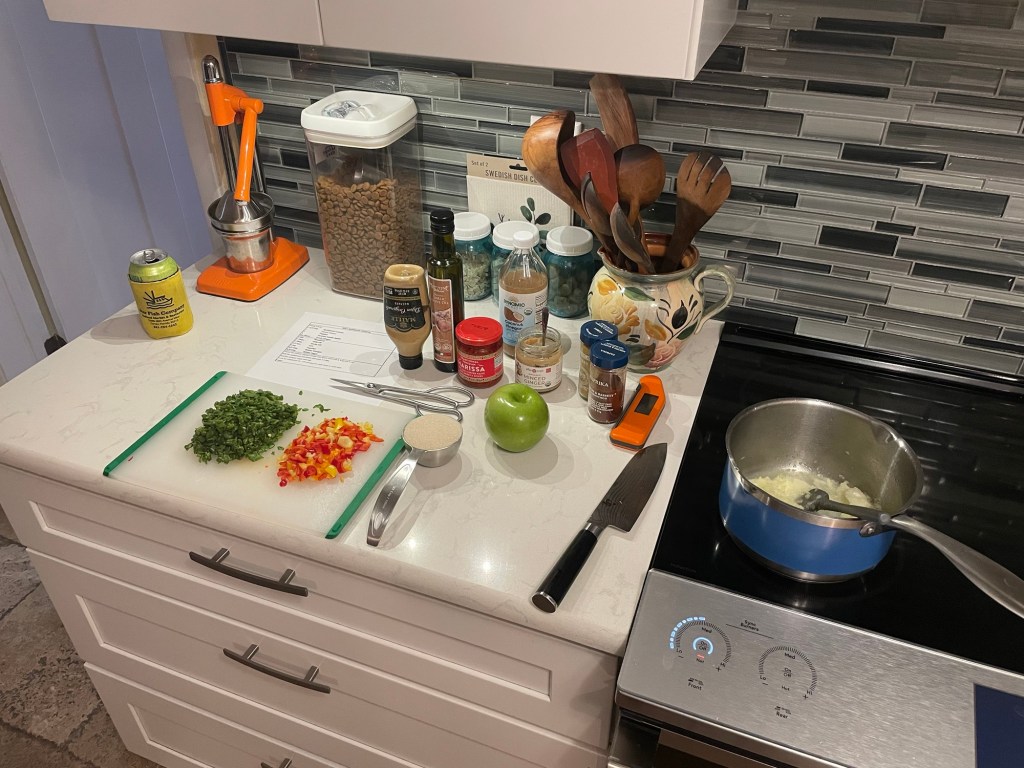
Mis en place in…ah, place.
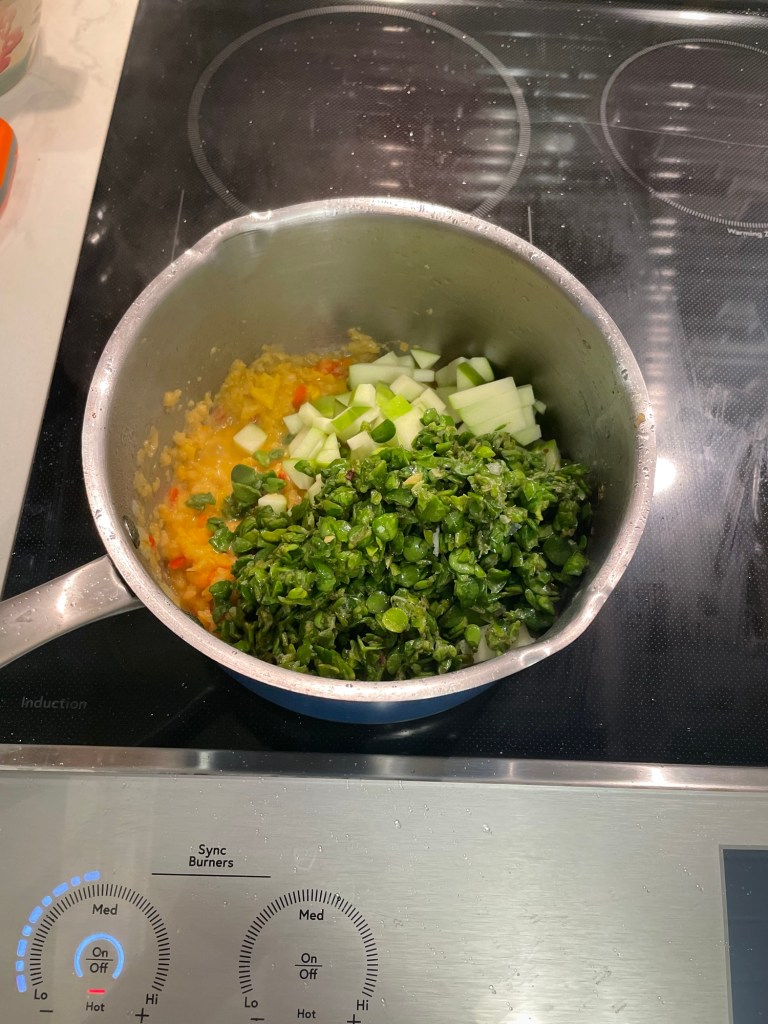
And so it begins!
I can smell it!
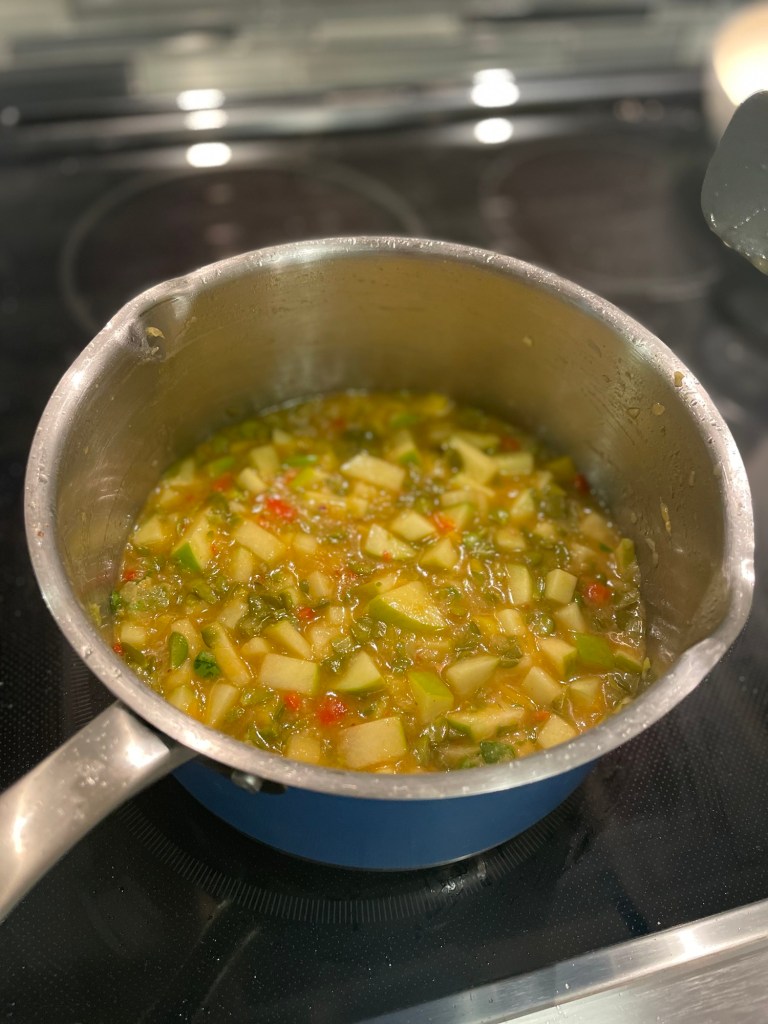
He kept sending me these pics as he was cooking.
It would be several days before I got to taste it.
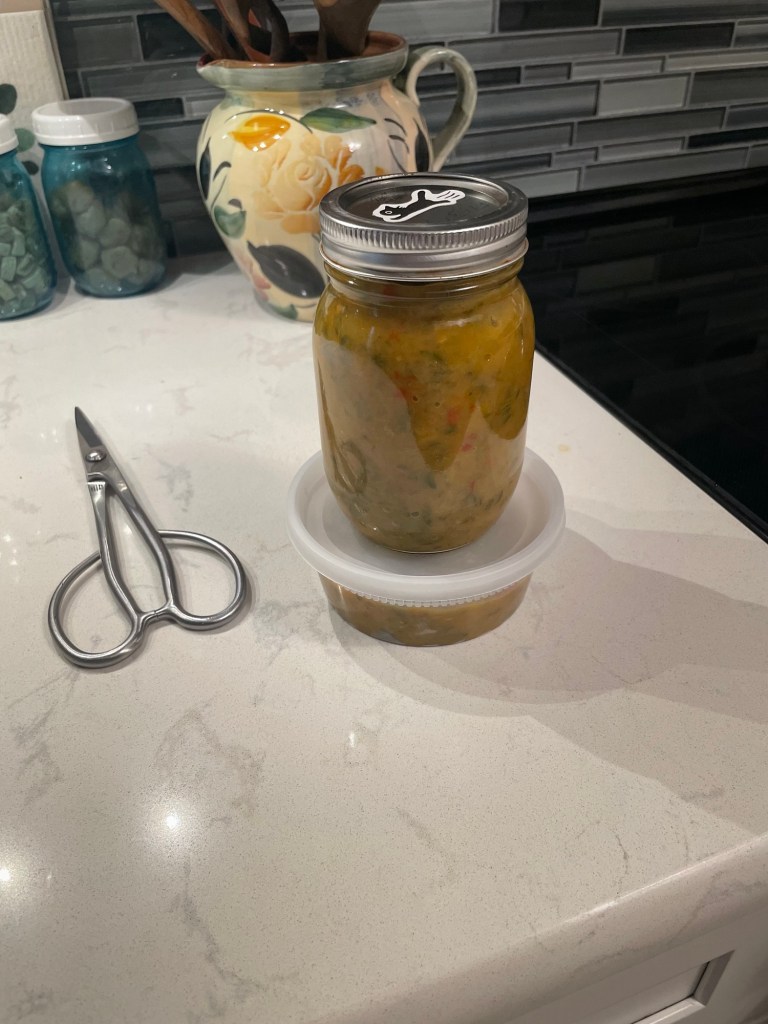
He even made it fancy with a pussy cat sticker.
And he managed to get that pair of scissors in almost every shot.
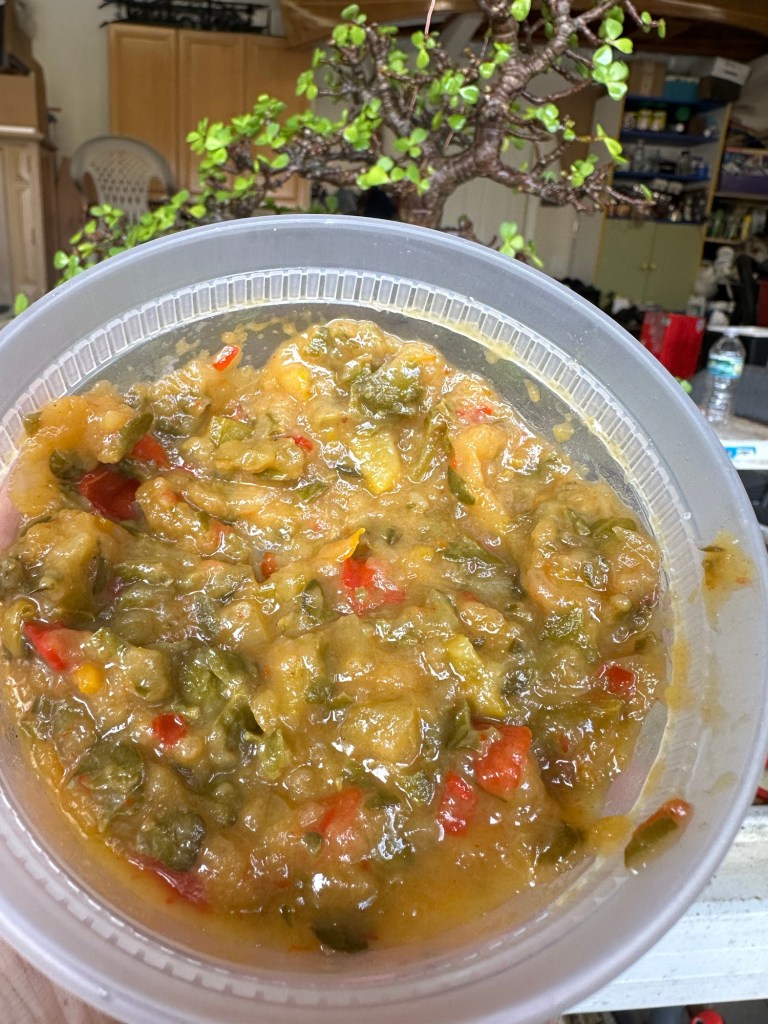
Is it good? He’ll yeah. I’ve had it on pork chops, on bread, crackers….
It’s especially good on hot dogs.
Hhhmmmmmnnnnnn……
To answer the question, “Is it edible?” Yes, and nutritious.
Is it eatable? Definitely. Sprinkle it on salads, pickle the stems, or make WIL’s SPEKBOOM CHUTNEY for your next backyard get-together.
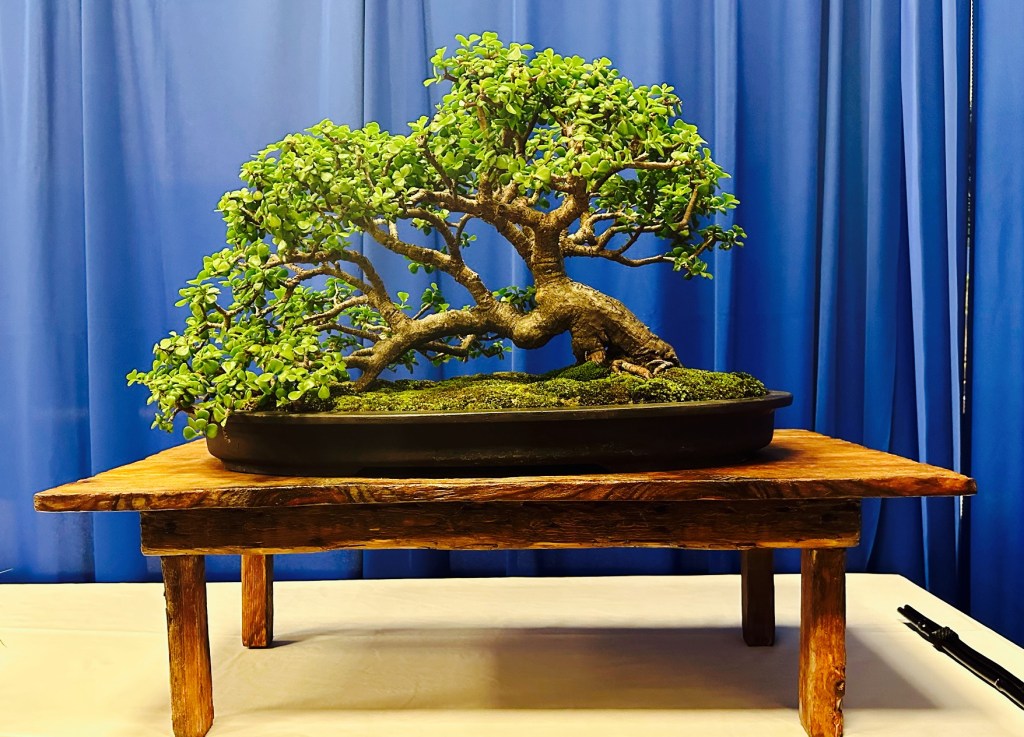
Below is Wil’s fantastic southern live oak style Portulacaria afra on display at the 2023 BSF Annual Convention in Orlando Fl.
Most of the pics are Wil’s, except for the first and last, and the food porn pics. Oh, and the screenshot. Don’t steal them.
It’s been about four years since I found this, and every year, looking at it and pondering the next move, I’ve missed the opportunity to work it. Why? I needed to repot it, get a look at the roots, figure out what was happening under the soil. You can only do the root thing in the late winter/early spring, before the tree sprungs, or you’ll tend to kill it. We don’t try to do no killin’ ’round here.
It’s my favorite deciduous tree, Celtis lævigata, and you need to repot it before the new leaves emerge. This year I got to it in time.
Let’s see what we can figure out.
I love odd shapes and challenging trunk lines in my personal trees. This is a root, I’m sure, off a bigger tree, and I love it.
The dead wood. The reverse (inverse, obverse, blah blah blah) taper. The species. I call it the ficus of the deciduous world. You just have to search “Hackberry ” in the search on the front page and you’ll get a bunch of hits on articles I’ve written on the tree (except that one Brazilian Raintree hit….).
Funny thing just occurred to me. When I write my blog I try to explain what’s happening, or what’s going through my head, as I work on the tree.
During a demo, I’ll often just get lost in the tree, and forget that the audience is there and I’m supposed to be performing. A bonsai demo is really a kind performance art (and I say that tongue in cheek, because many bonsai practitioners are kind of conservative when it comes to bonsai-as-Art, no matter their taste in art or politicians. Me, I can’t stand the taste that a politicians actions leave in my mouth, except I don’t mind that one bonsai guy in Virginia. You know who you are, Roberto).
When I’m asked what’s going through my head during a demo I usually say “not much”. It gets a few laughs. Or I’ll say “you don’t wanna know what lives inside my brain”. That gets some too.
Sometimes I tell the story of how the chicken came to the west.
I’ll say, ” How many of you have heard the chicken story?”
Those who have, groan. But they encourage it because, though they’ve suffered through it, they want others to know the pain of sitting through it as well.
Shared pain is lessened, after all.
Anyway, the chicken story:
What you may not know, is that the chicken originally came from Asia. Look it up, I ain’t lyin’. And in Asia, there is a strong Master/Apprentice relationship in the passing down of knowledge.
Now, anyone who’s raised chickens knows that it’s prit’near impossible to tell the difference between a male and a female chick (baby chicken). And it should be self explanatory that a female chick is more valuable than a male chick, because of, you know, eggs and all that, so there evolved a very prestigious occupation in the world of animal husbandry know as a “Master Chicken Sexer”. A real job. A dirty job you might say (you remember Mike Rowe and Dirty Jobs? There was an episode about just this thing).
So, being that chickens are from Asia, and they were imported into the West (how else do we have omelettes?), it soon became clear that the western farmers needed help trying to figure out how to distinguish between a male and female chick. Still obvious, right?
So the western farmers hired the Asian Master Chicken Sexers to teach the westerners how to do this.
The scene: we have the apprentice chicken sexers sitting at the conveyor belt, and the yellow chicks are coming down the chute, onto the belt, and the apprentice picks up the chick, tickle its butt or something, and throw the chick into either the male bin, or the female bin.
The poor male chicks are mostly made into….ah, feed for other chickens. The females were let go to make nests and lay eggs for the farmers to harvest and make their scrambled egg breakfast or quiche (if they’re French farmers).
As I mentioned before (about 100 words earlier) it is exceedingly hard to figure out the difference between the male and female chicks; they’re both yellow, the males haven’t learned to cock-a-doodle yet, the females don’t even gossip. So the apprentices are sitting there, chucking the yellow birds in whatever bin they thought they should go into. When they got it wrong, the master, who was standing behind the apprentice, would whack the poor student on the back of the head.
Slap!
Eventually, the apprentice could unfailingly tell the difference between male and female chicks.
Now, they had no idea how they knew, but they did know. That slap hurt.
Again, obviously, the point of the story isn’t about chickens or East and West or even farmers. It’s more about how to teach. Some bonsai teachers teach using the rod, telling you you’re wrong and to do it again, and again, and again, until you have it right.
That’s not me. My online name is Adamaskwhy. Most people think it’s that way so you can ask me “Why?”
And you can.
Most of the time I know the answer, or I can find it.
Or I make something up that sounds plausible.
But the real reason for my name is that, as a student, I don’t just want to know the answer. I want to know why. I was (and still am) that annoying kid in the back row that said “oh yeah, prove it!” And it angered some teachers, bothered others, and I was loved by the smallest percentage. Those were the good ones.
I’ve talked about this before, so excuse me if I’m repeating myself, but a teacher who doesn’t know why, ain’t much of a teacher.
If you can only recite your lessons, then you haven’t learned a thing.
Which brings us to the initial styling of this hackberry. You remember it? The subject of this article and all? I know, you got lost in the chicken story. It happens.
What in the hell is going through my head?
Well, you’ll have to trust me on this one, and see what happens this year.
It seems that a lot of “rules” are being thrown away with this tree.
I mean, they do say that “rules are meant to be broken”. But why do they say that?
Let me tell you another story, this time about a boy named Pablo. Pablo’s father, Ruiz, was an artist that specialized in realistic drawings and paintings of wildlife. He was an instructor and professor at several art schools. He started training Pablo at the age of seven, and insisted that Pablo learn how to draw and paint properly, in the classical and realist style that was popular at the time, and was profitable, as artists jobs back then was to paint portraits and art to be hung in wealthy patrons homes.
So Pablo learned. It came easily to him. At age thirteen, his father, Ruiz, proclaimed that Pablo had surpassed him in talent and technique, and enrolled him in a prestigious art school in Spain.
Pablo quickly understood what art school was for, and formed serious friendships that would help him later in life, all the while slacking off on his lessons. He knew them anyway.
That, by the way, would be the one lesson to take away from this parable, college is to make contacts in school, that will help you later in life. The bosses who hire you only want to know that you got the degree, not that you were a “C” student. But if they know you were in their sorority or the chess club they were in, you, my friends, are in, as they said in my youth, like Flynn.
Pablo was so good a draughtsman that, in his later years, when everyone called him Picasso, he would sit and drink his coffee at the cafés in Paris, and draw photorealistic flies and bugs on the walls. Drawings so real the waiters would rush over and try to swat the fly off the wall. Pablo, as you might think, got great pleasure in these escapades.
We are all just boys and girls, trying to smile at the tragedy that life sometimes is.
What is to be learned by this last story?
If you learn to do the work, as a craftsman should, you can then use that work to accomplish the Art that your soul requires to feel alive.
It seems I’m at the end of the work.
I would try to get a good pic, but my photography area has been battered by a hurricane or two. It’s on the list to repair.
And here’s the obligatory tortoise pic. I need to build him a proper enclosure. That’s sooner on the list than the photo spot.
This is the best I can do for now.
I’ll post updates as I make changes in the tree. Maybe. I have a long list of “To-Do’s”.
The Shofu Bonsai Society of Sarasota has a pretty good auction every year. Granted, some years are better than others, but the year I got this one, maybe 2021, was spectacular. This tree was on the silent auction.
Yeah, not the live auction, the silent auction! I didn’t have to raise my hand or pull my earlobe to win this beauty. I just wrote a bid down on a piece of paper.
I don’t even think I went higher than $100 on it.
Since I’ve had it, it seems like only a few branches have grown.
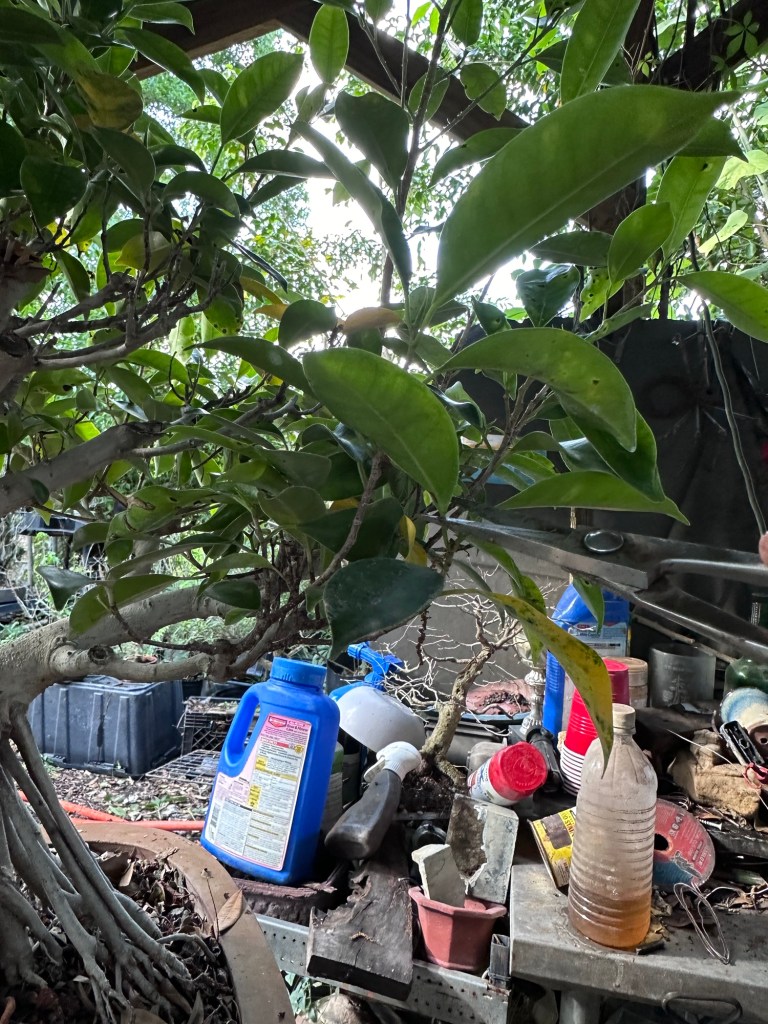
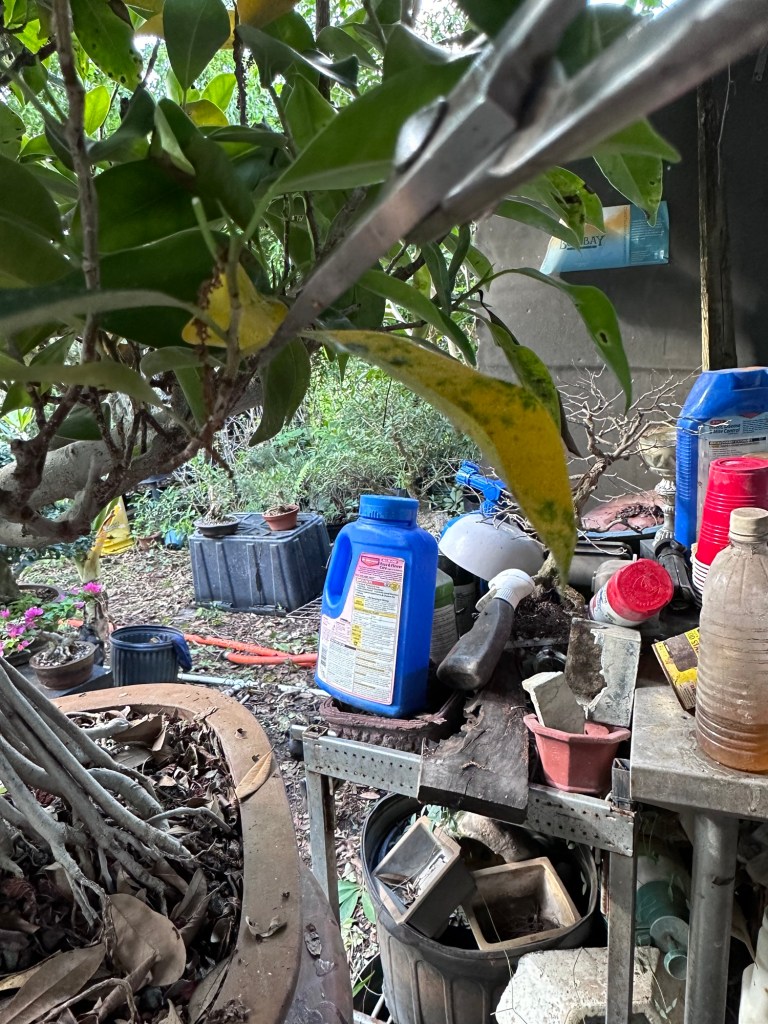
But that’s typical. I don’t do anything to it for those few years except to water it. And when you ignore this species, a Ficus microcarpa, it will pick one shoot on each branch to feed the sugars to, and, like the pic above, you get long spindly branches and the smaller, interior branches tend to die off.
The lack of sun is the impetus to tell the tree how to allocate the resources.
(Not to belabor a point, but that’s another reason for timely defoliation techniques on figs. Defoliate to let sun in, calm down the randy shoots and allow everyone to grow. )
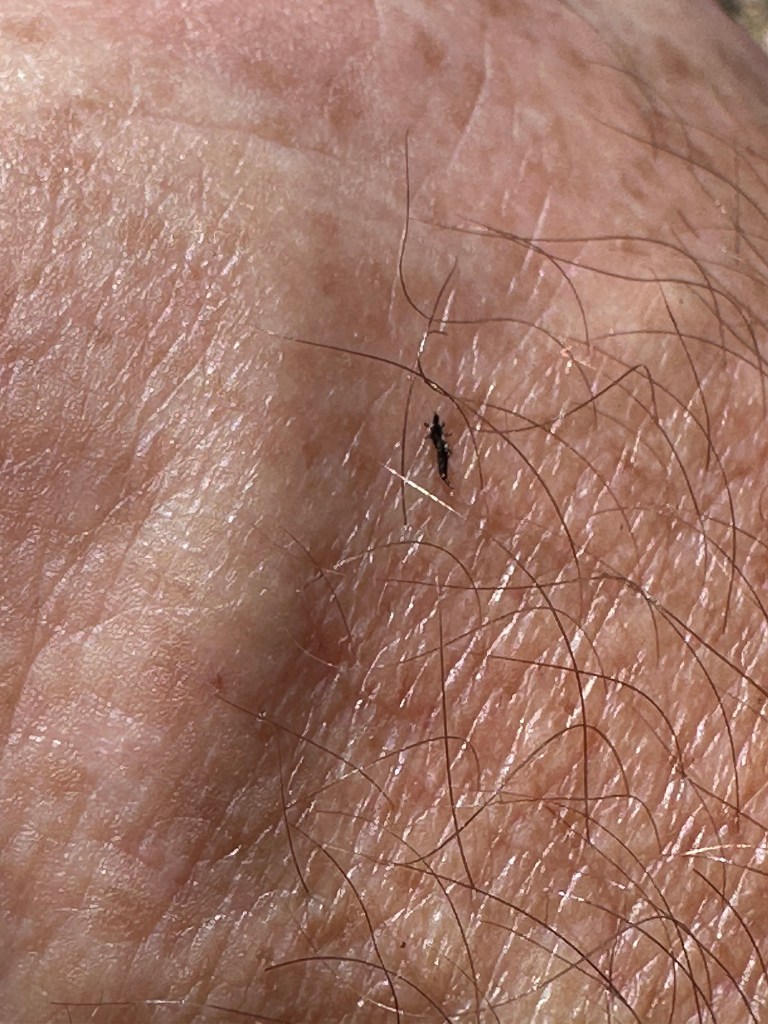
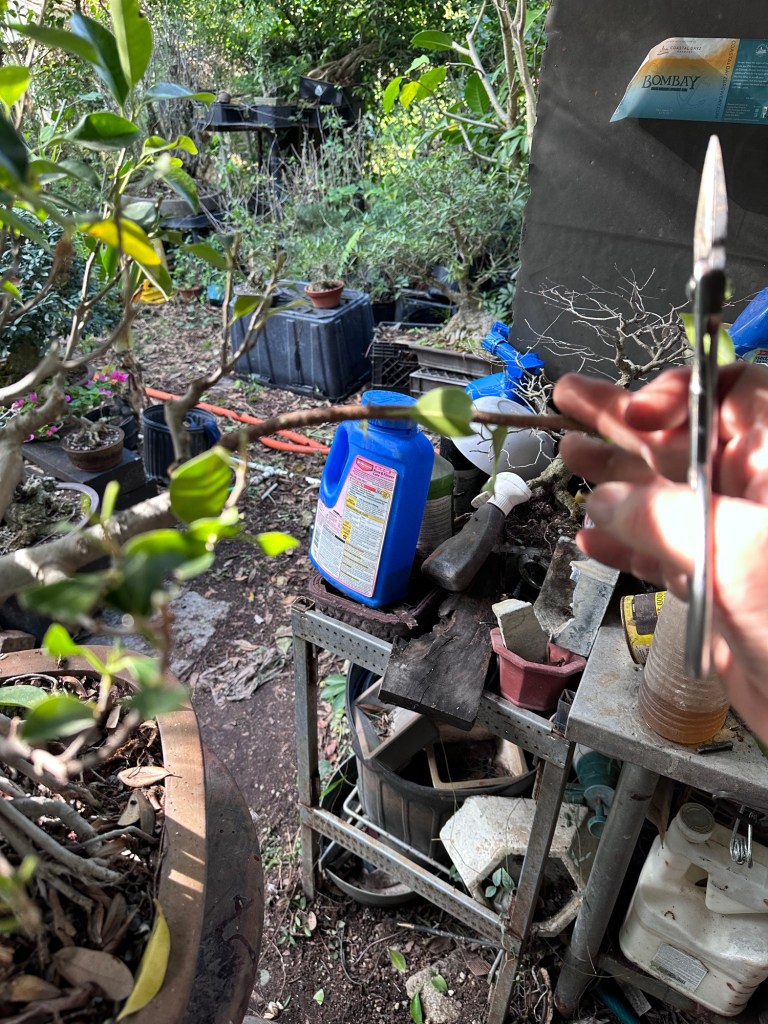
Oh! Notice the blue bottle? That is one thing I’ve kept up on for this tree. That bottle has a systemic insecticide in it called “imidacloprid”, which is a synthetic nicotine (what they call a neo-nicotinoid) that I treat all my F. microcarpa with to control thrips. An insidious insect that takes the leaf and folds it to make an incubation structure to breed more thrips.
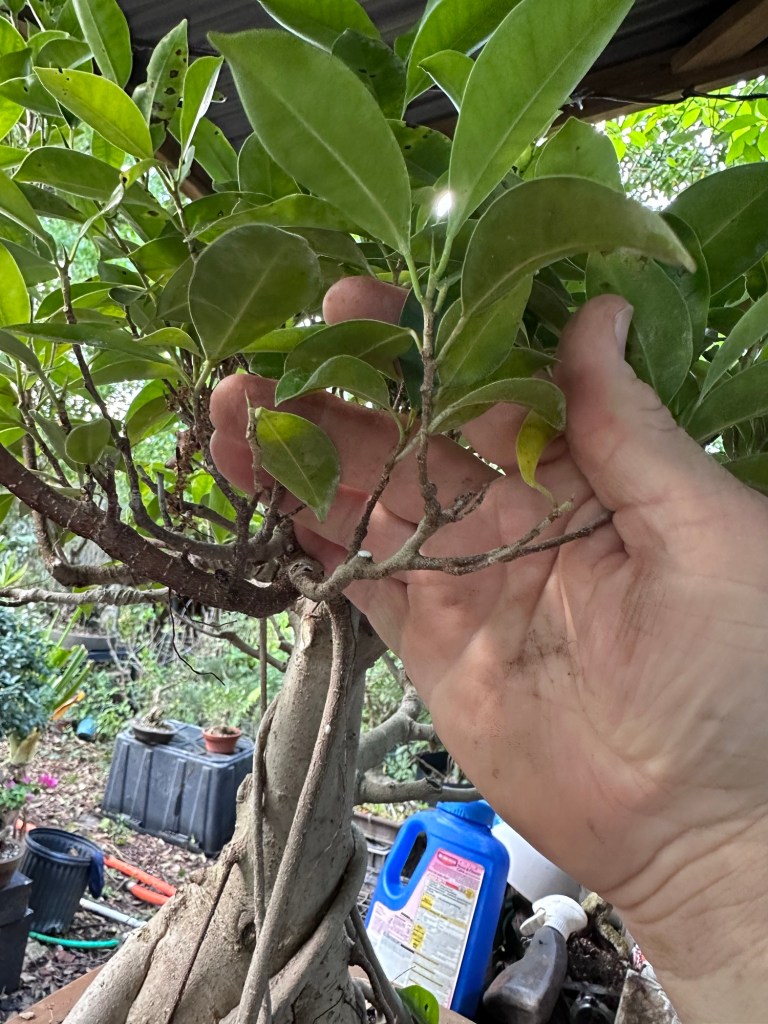
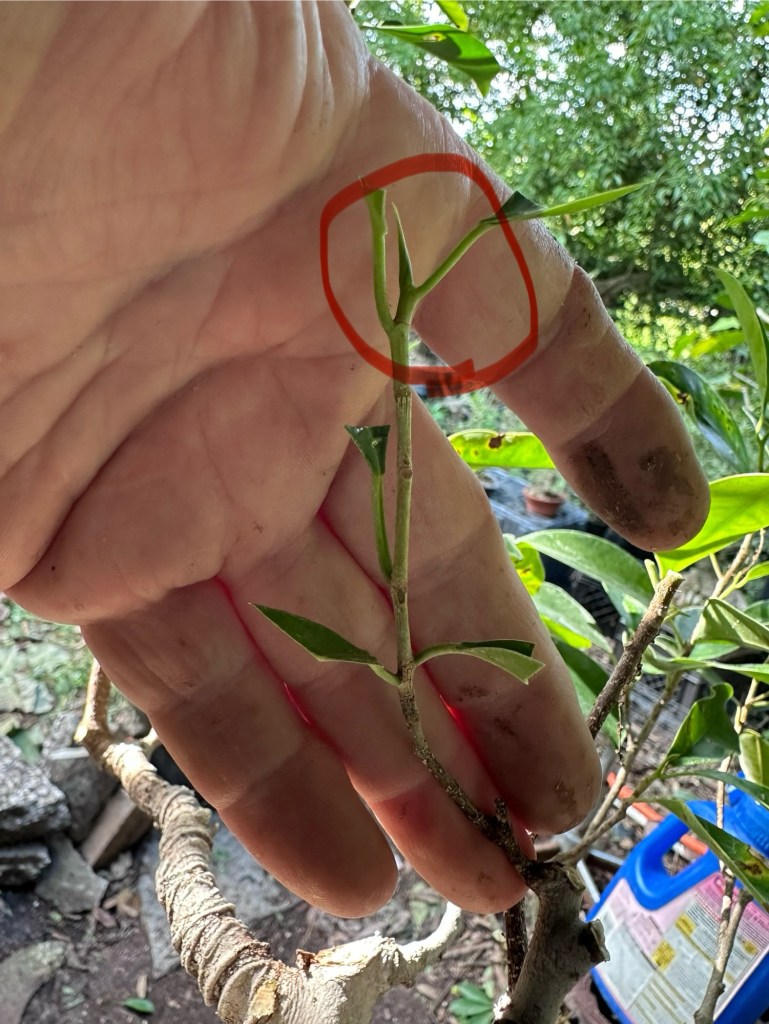
Below, there’s one on my arm. They call this one the “Cuban Laurel Thrip”, as that’s one of the common names for this ficus, Cuban laurel. I call it the “Indian laurel” as it’s more indigenous to India than Cuba, though it is endemic in the island.
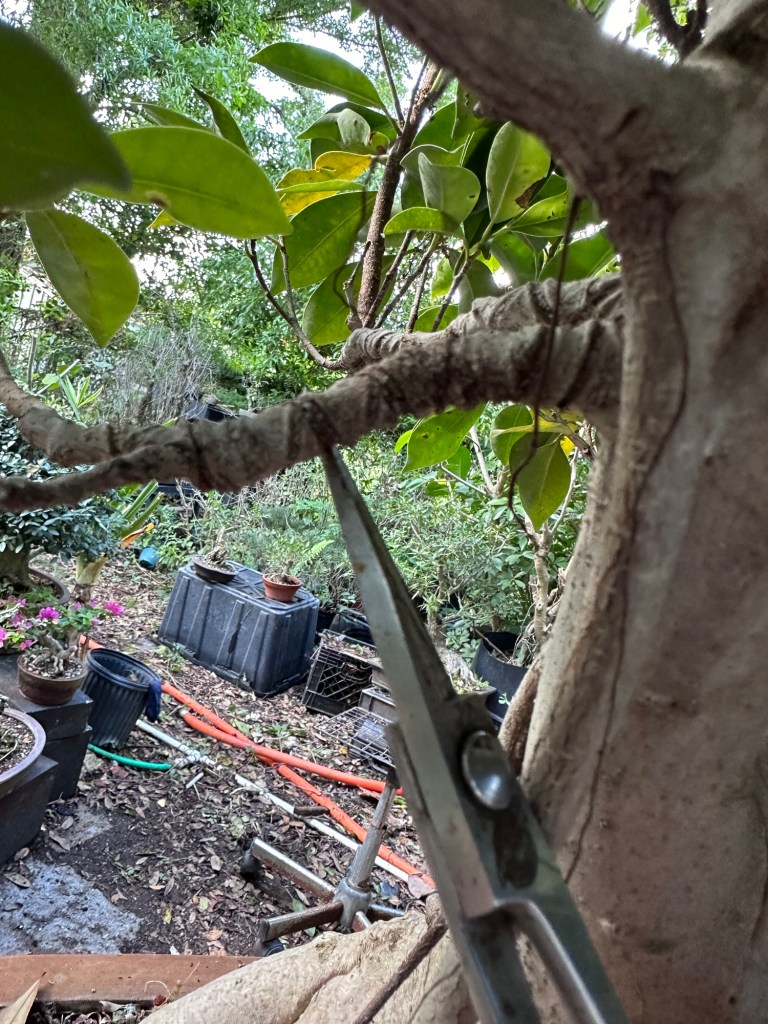
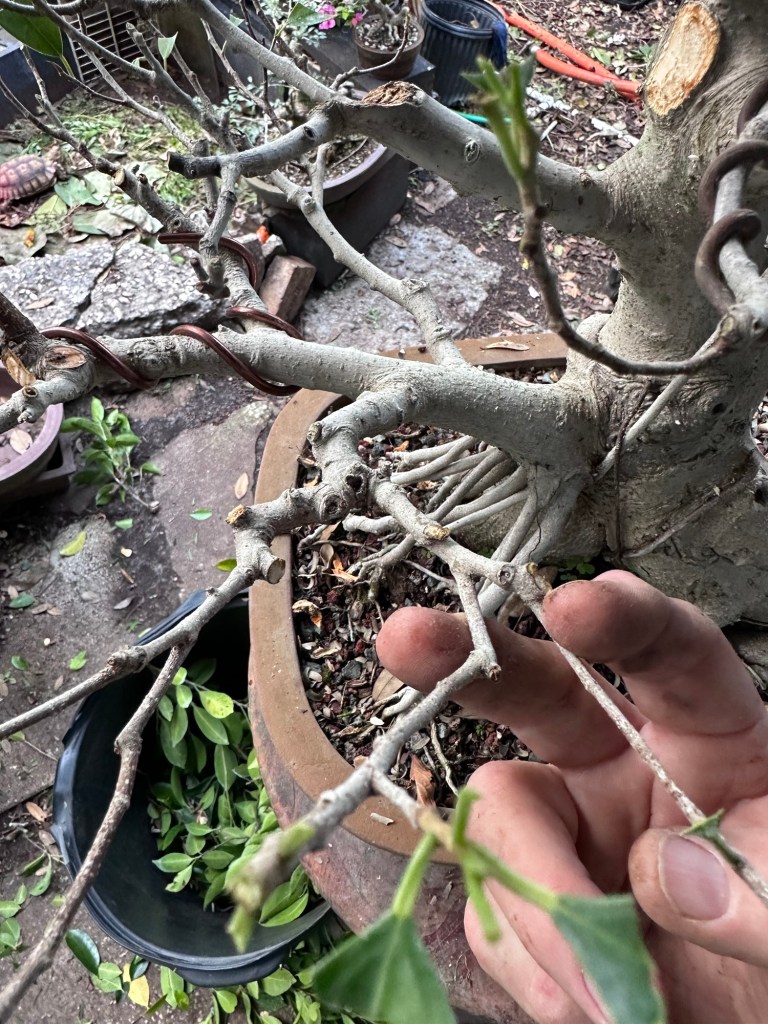
The tree does have flaws, like the wire scars below.
And, as a species, the leaves are bigger than say, the “tiger bark” variety. And they are prone to branch dieback (like the Ficus benjamina) if you don’t leave strong growth on the tips when you prune.
Let’s open it up and select some branches.
Hmmmmmm….might be useful. Below?
Nah
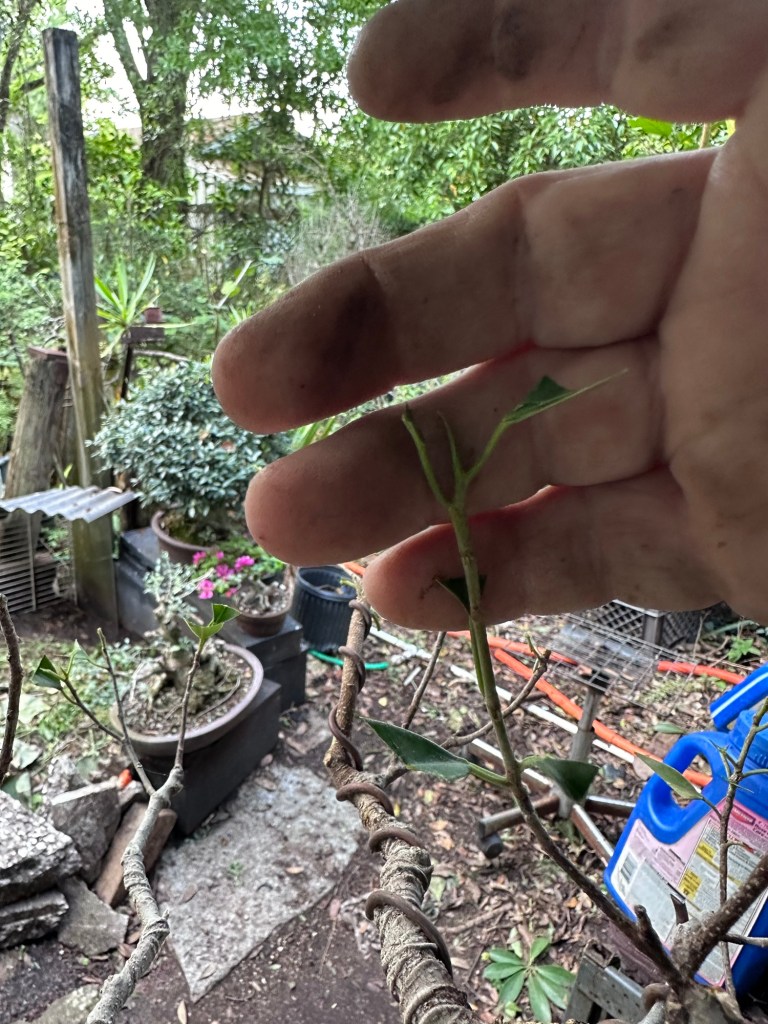
Below, there’s that growth tip.
I’ll leave it to grow longer.
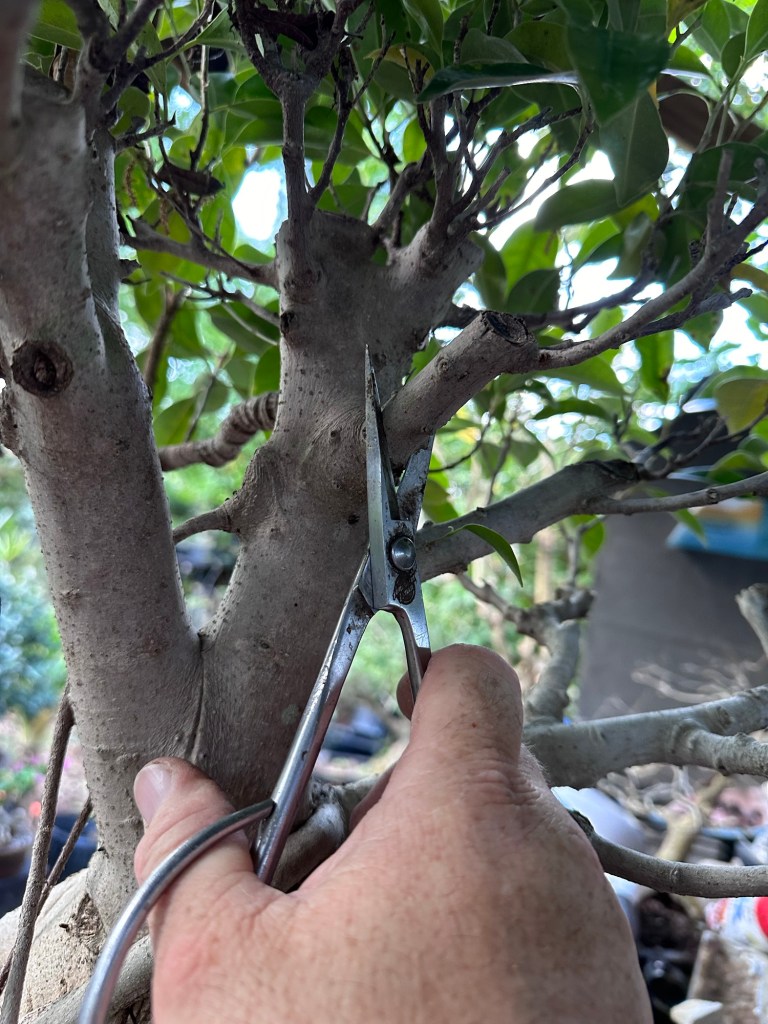
But some I’ll cut back to encourage back budding.
Clean up, clean up….everybody do your share.
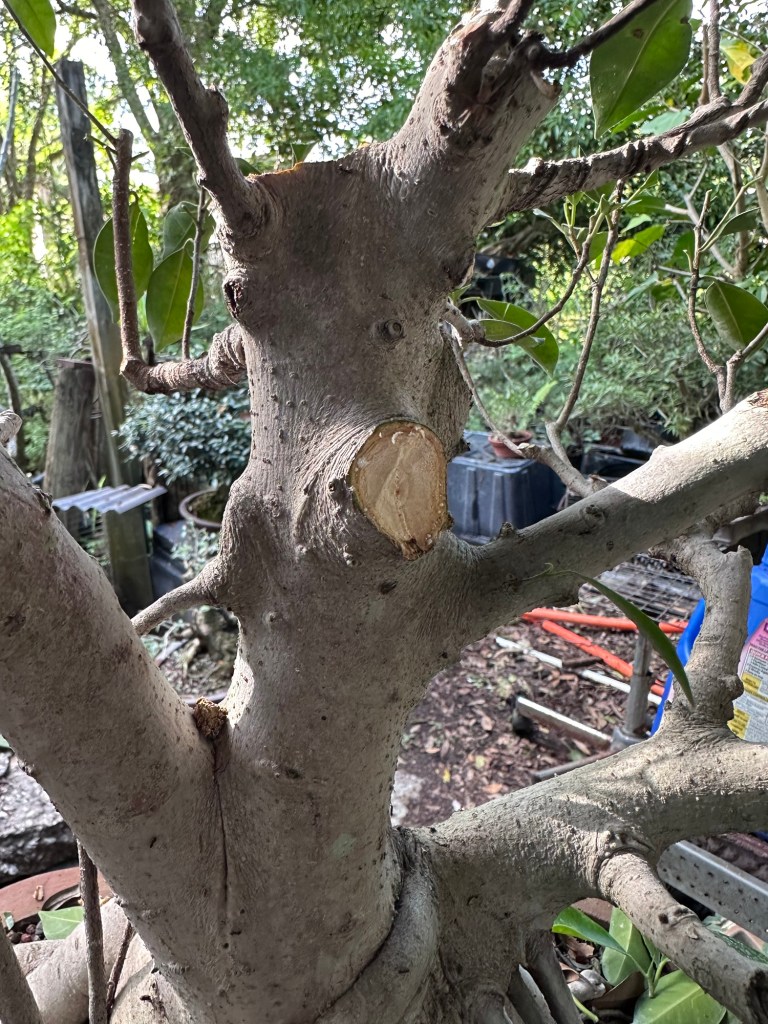
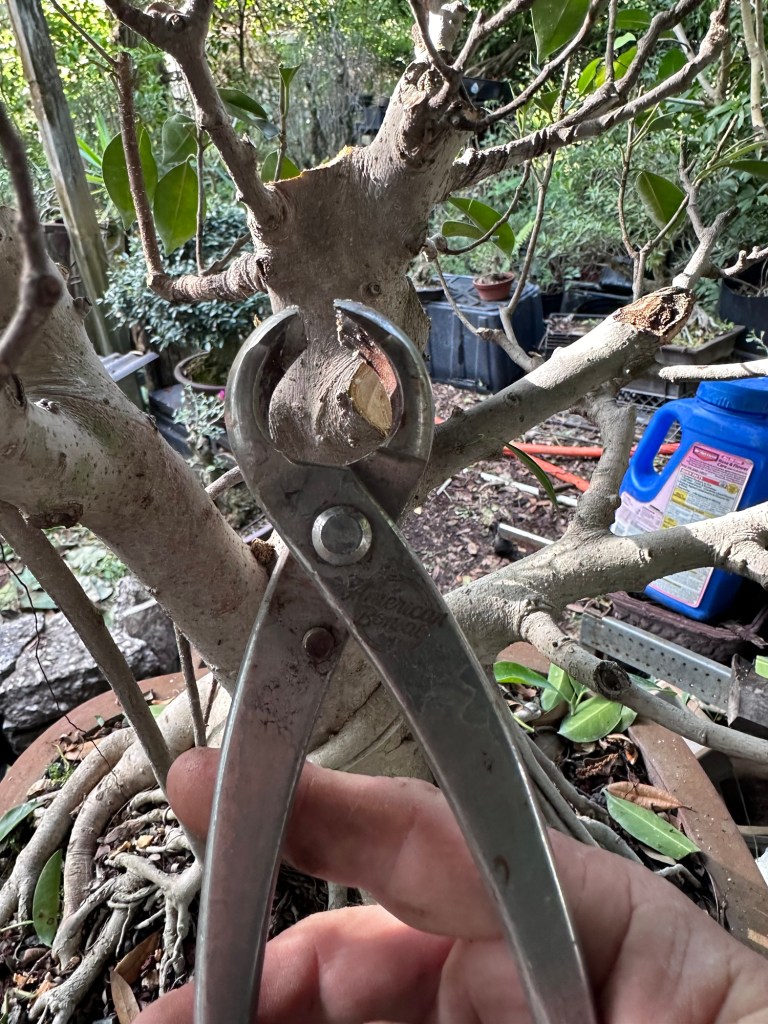
Kah-chop!
There we go.
Some wire.
The result of clip and grow. Good movement.
More grow tips to preserve.
Now just let it grow.
But not willy nilly growth, directed growth.
If you ever take a class with me, and I say let it grow, you should let the things left, to grow, but get rid of growth that’s not needed.
Here’s a video
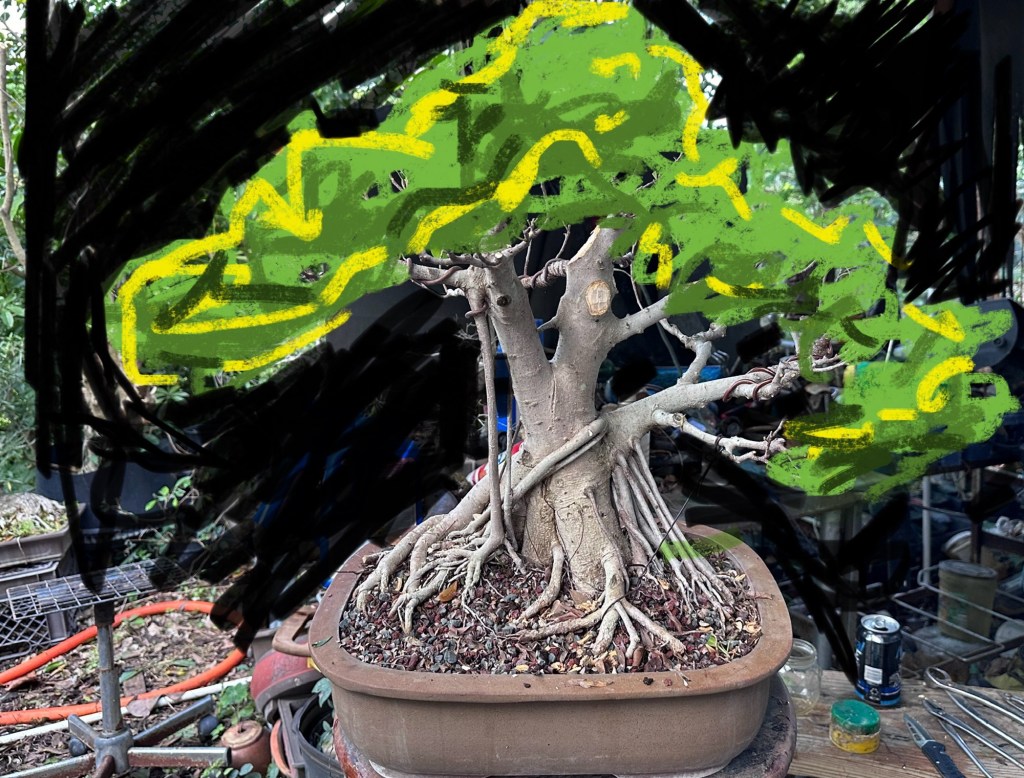
And here’s an idea of what it’ll look like. Needs a better pot.
Let’s see what happens, I promise to show the repot and updates
The Central Florida Bonsai Club, my club in Orlando, has been representing Florida Bonsai at this festival for several years now.
I like to go for the day and work one of my bigger trees to show the public that bonsai don’t need to be, or are limited to, small hand-held trees.
This year I brought a Ficus microcarpa. Just the plain species. Not tiger bark or green island or melon seed. Here’s how it looked after I cut it to a line way back in 2013.
I got the trunk from my good friend Ronn Miller, a Florida bonsai artist of great renown.
The link below shows a previous blog post on the tree:
Defoliation, unwiring (I think I did that already) and pruning for shape/taper/ramificatiom, and rewiring of course. But not every branch.
Sometimes that’s needed, wiring every branch, but most times it’s not. I had a former friend who insisted on wiring every branch because that’s how he learned (he watched a video on YouTube that told him to ALWAYS wire every branch, and he was a paid subscriber to this channel, so he obviously has to do what he’s told, cuz it’s worth more to him. I wish I had a simple mind like that. I have to question everything. Just last week I was tying my boots and I wondered if they’d be tighter if I used an overhand knot instead of a sideways, underneath knot. Took me 15 minutes to tie my boots…..
If you’re looking at the leaves closely, you’ll notice the white build up on some of them.
Like above. I see this question a lot on the bonsai forums: “What is this? Is it harmful? How do I get rid of it? “
It’s usually just water spots from dissolved solids in your water. Like calcium, or lime. If it’s red or orange, it’s iron rust. it’s not harmful acutely, just ugly, but it could be a problem if it’s built up so much that it blocks the sun and restricts photosynthesis. And how do you get rid of it? You can polish the leaf, or use leaf shine, or, like I’m doing, cut them off. A ficus can hold a leaf for up to three years (it’s a tropical, broadleaf evergreen). But you can defoliate one, as long as it’s healthy, up to four, five times a year. I usually do at least twice in my normal maintenance. If I’m really pushing a tree, 3-4 times.
Anyway, I have a bunch of leaves. Let’s see if I can count….
There we are. I counted 2,713 leaves.
Actually no, but that’s a good number. It’s a prime number (only divisible by itself) and sounds good saying it out loud
“two thousand seven hundred and thirteen”.
Sounds like it belongs in the first, or last, sentence in the Great American Novel:
“In the year two thousand, seven hundred and thirteen, the hero man was born.
Or died.
It was a time of illogic and lost tales, with many great humans born or killed. Some by the hands of evil men, or by their own hands as the era was one of pain.
The world had just gone through a bloody interregnum, accented by war and famine, city and states wiped off the countryside and built up into empire. Cultures distilled out of the quirks and pathology of a leader, or group.
Our hero begins the day chopping wood, collecting water, and making tea.”
I’d read that book. Maybe I’ll even have to write it.
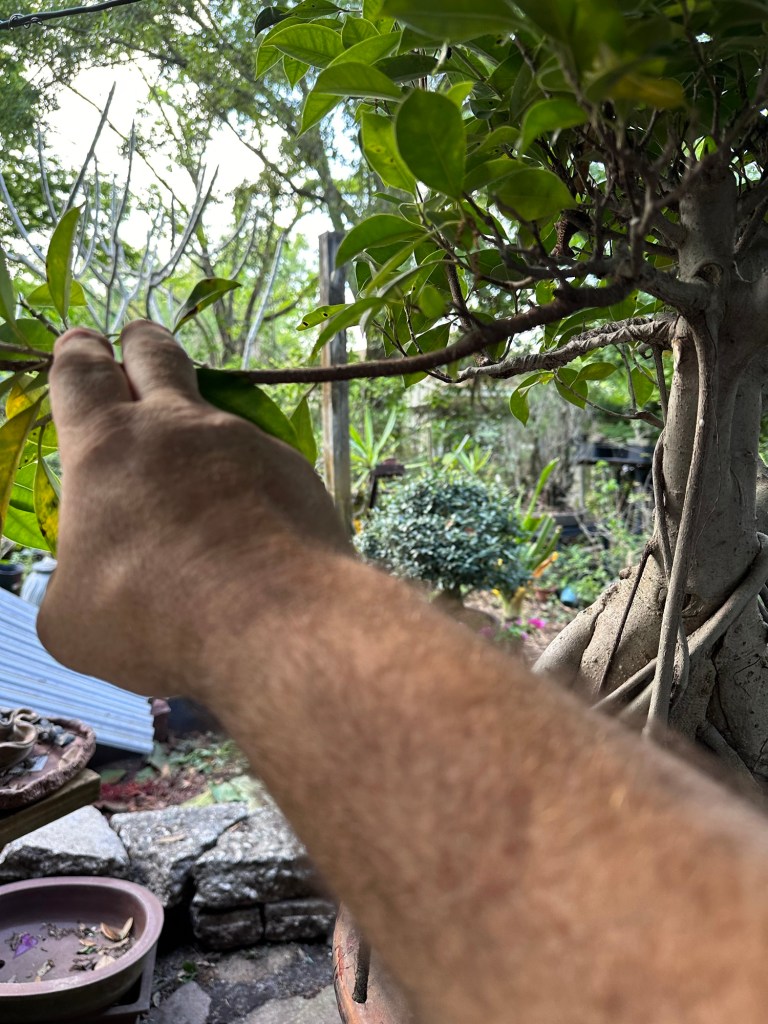
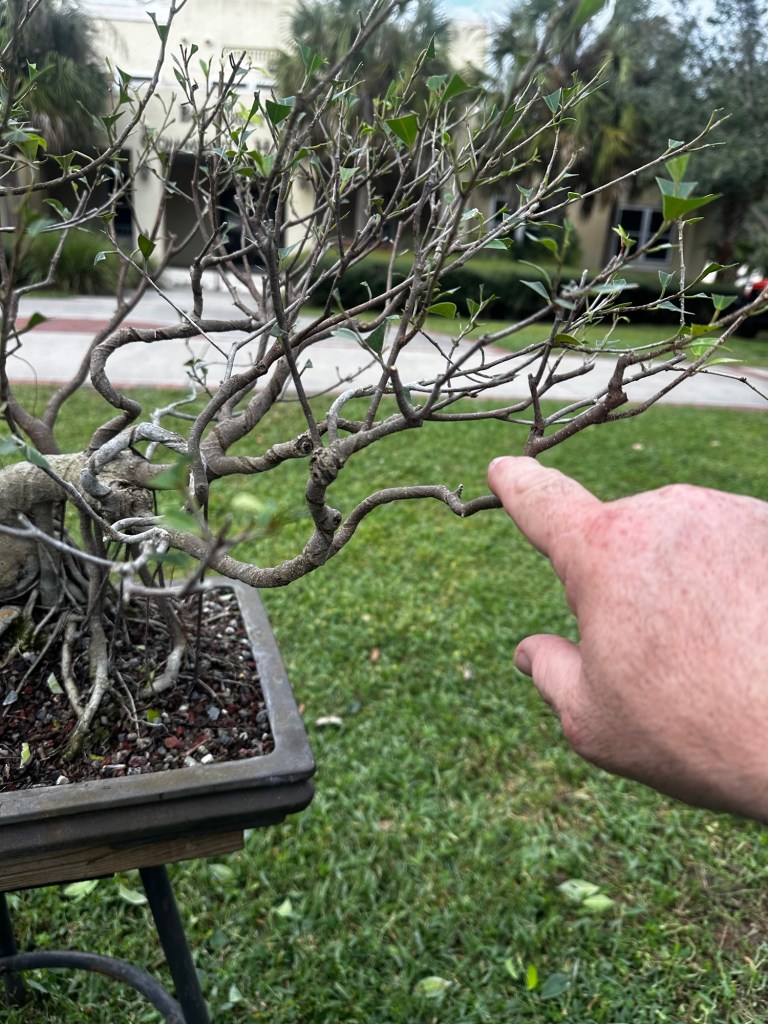
Let me finish this post first. The branch my hand is on has risen from its original place in the design.
So that’ll need to be wired back down.
That’s the life of a ficus bonsai owner: put the wire on, take the wire off, put the wire on, take the wire off.
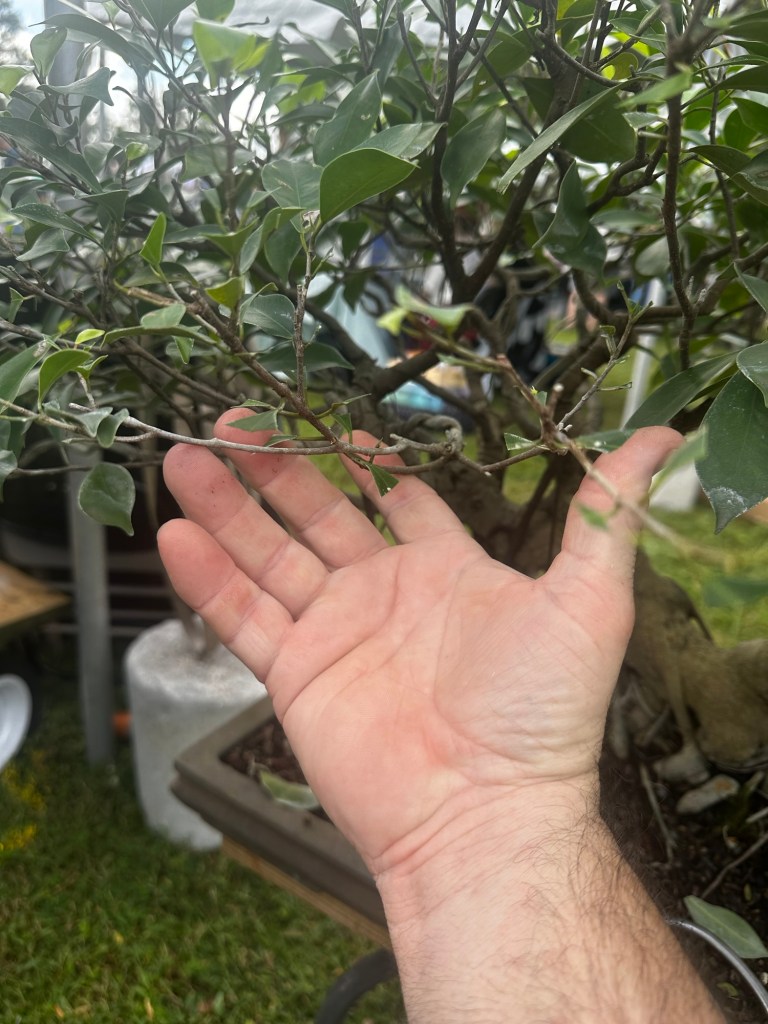
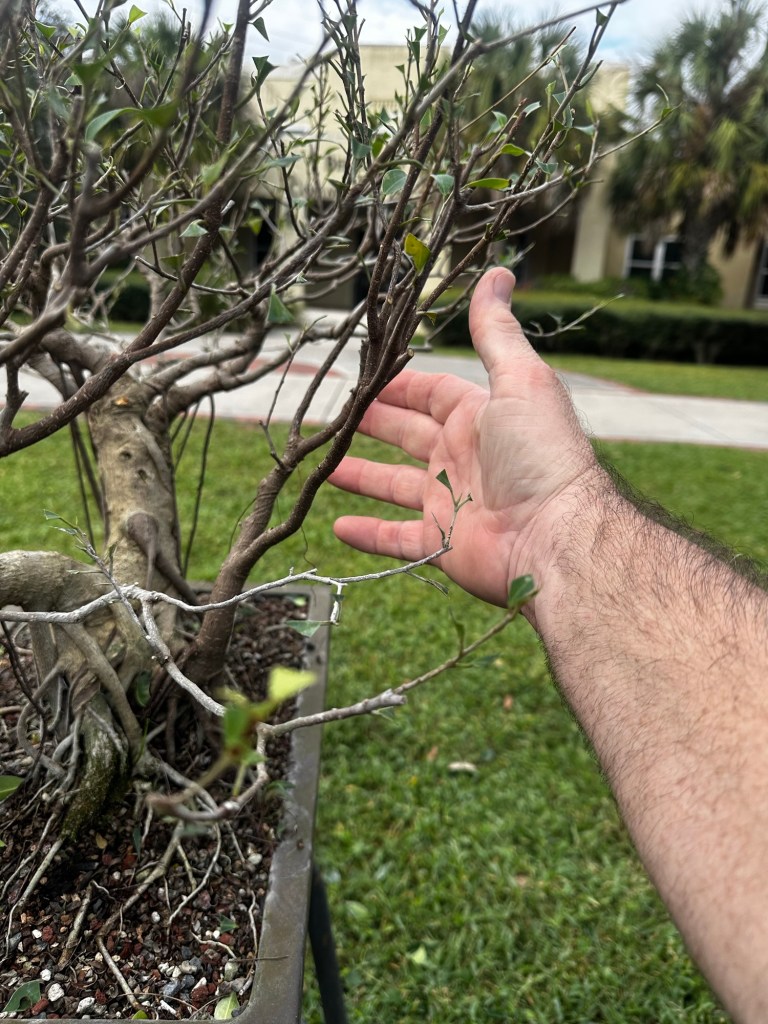
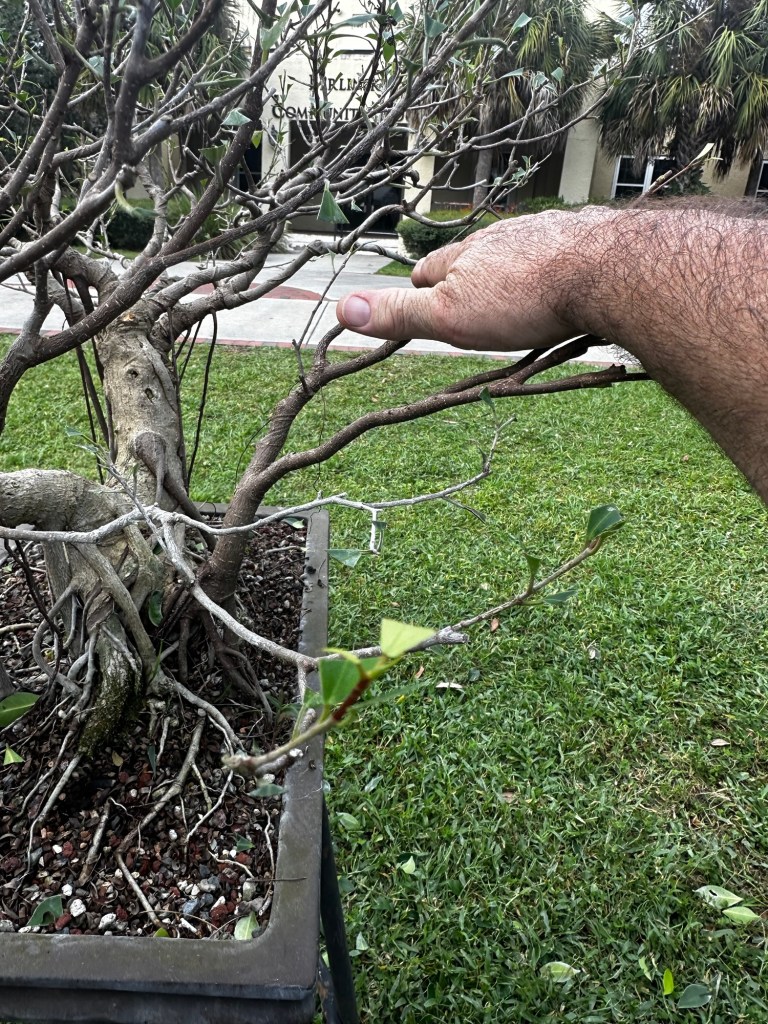
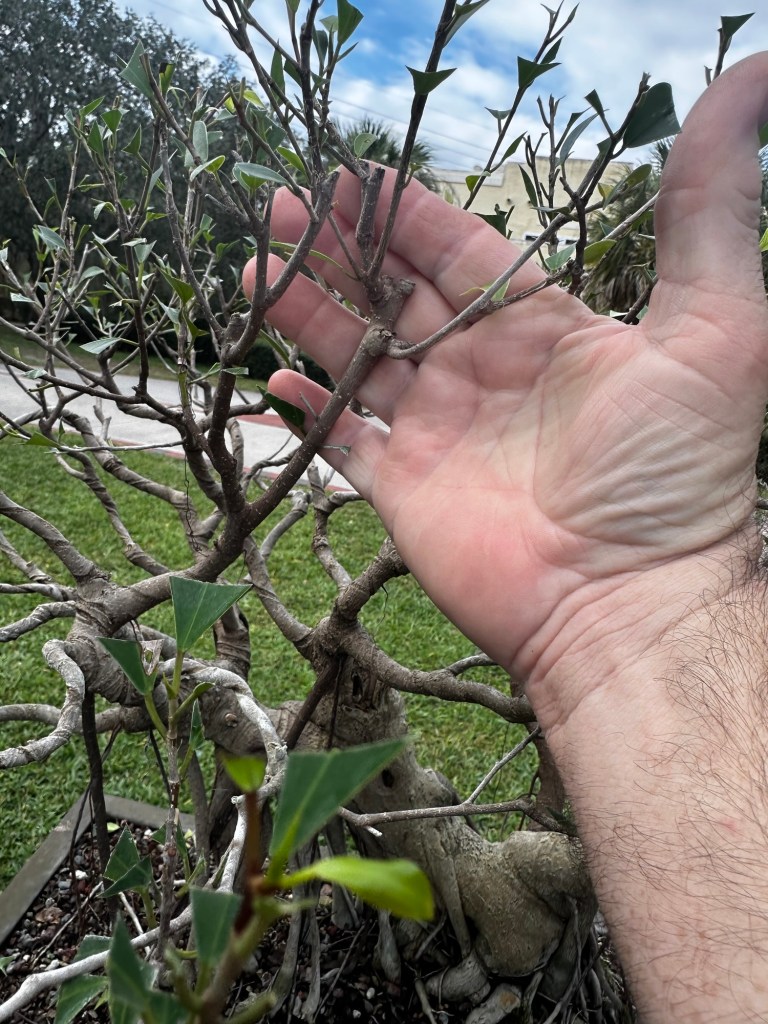
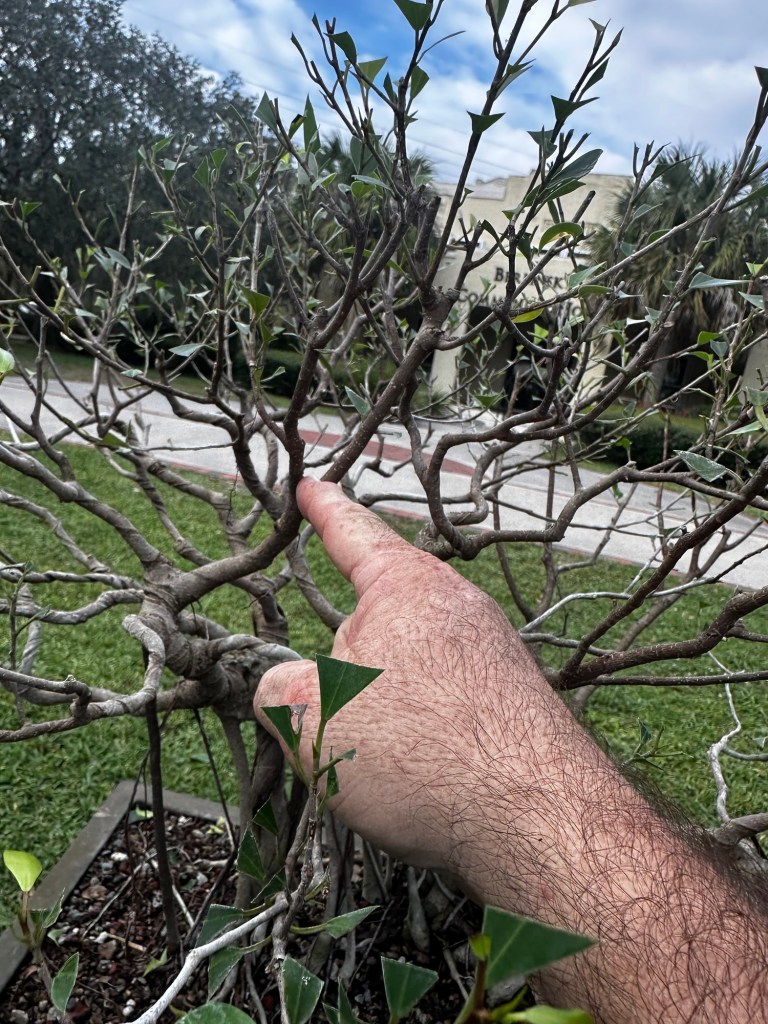
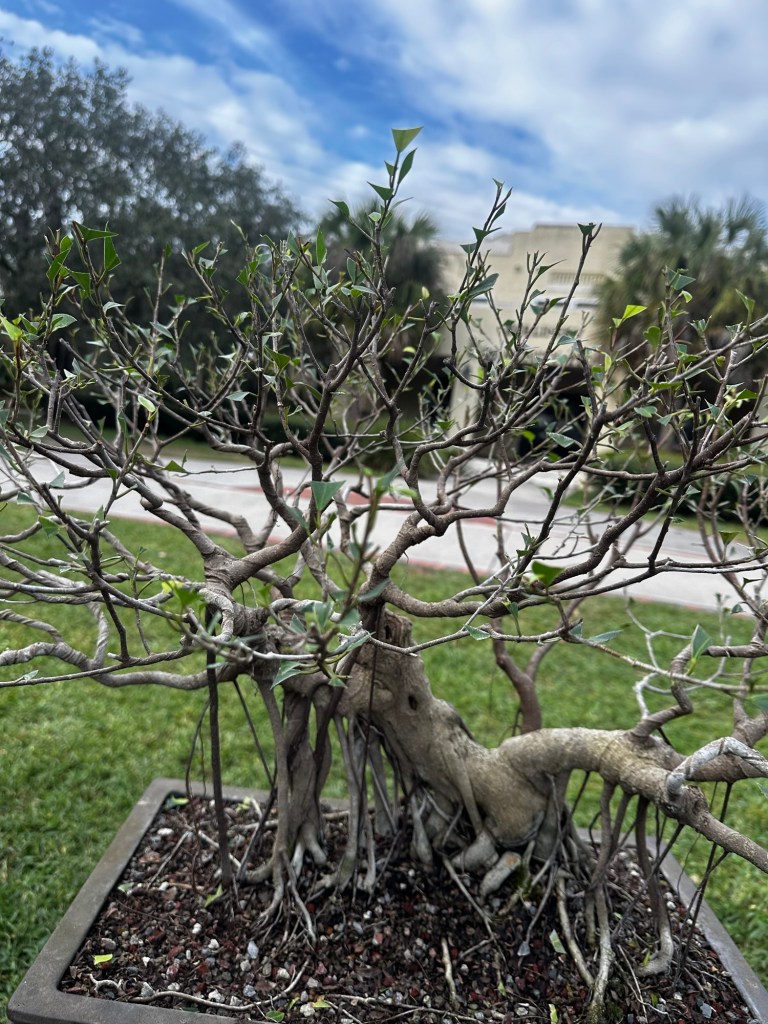
Anyway, enjoy the next twenty following pics of me pointing at various parts of the tree.
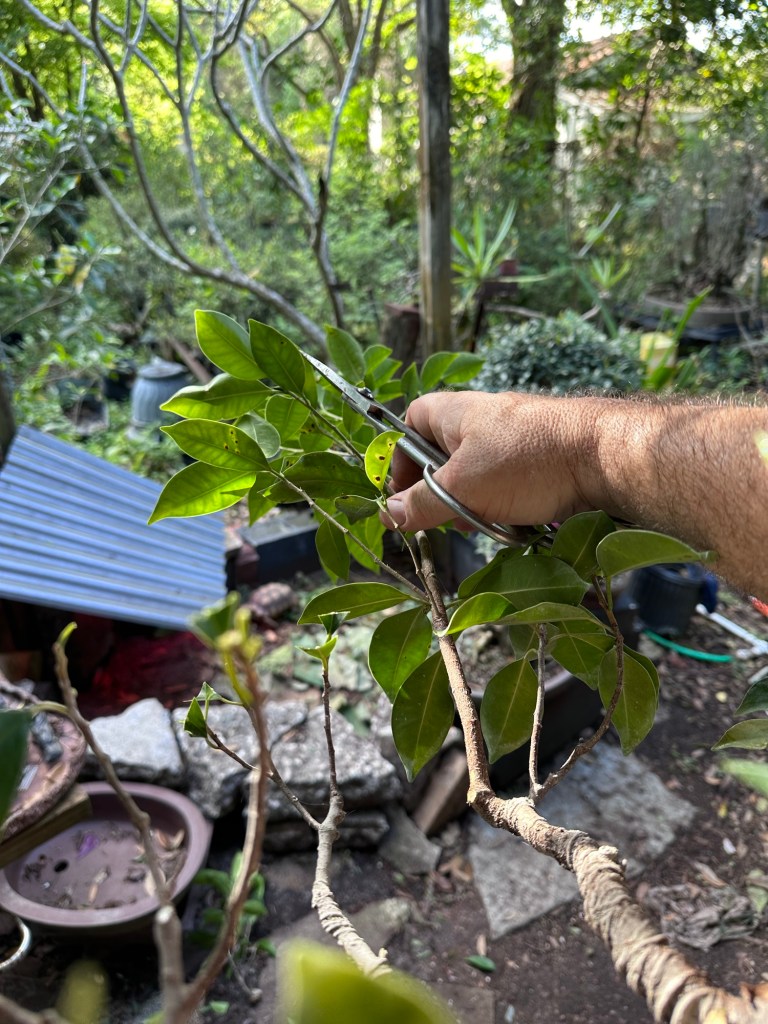
Straight lines must be made curly.
Some things gotta go.
I just realized that in the background of these pics, you’ll be seeing a pretty detailed accounting of certain attendees visiting the restroom.
Now for wire..
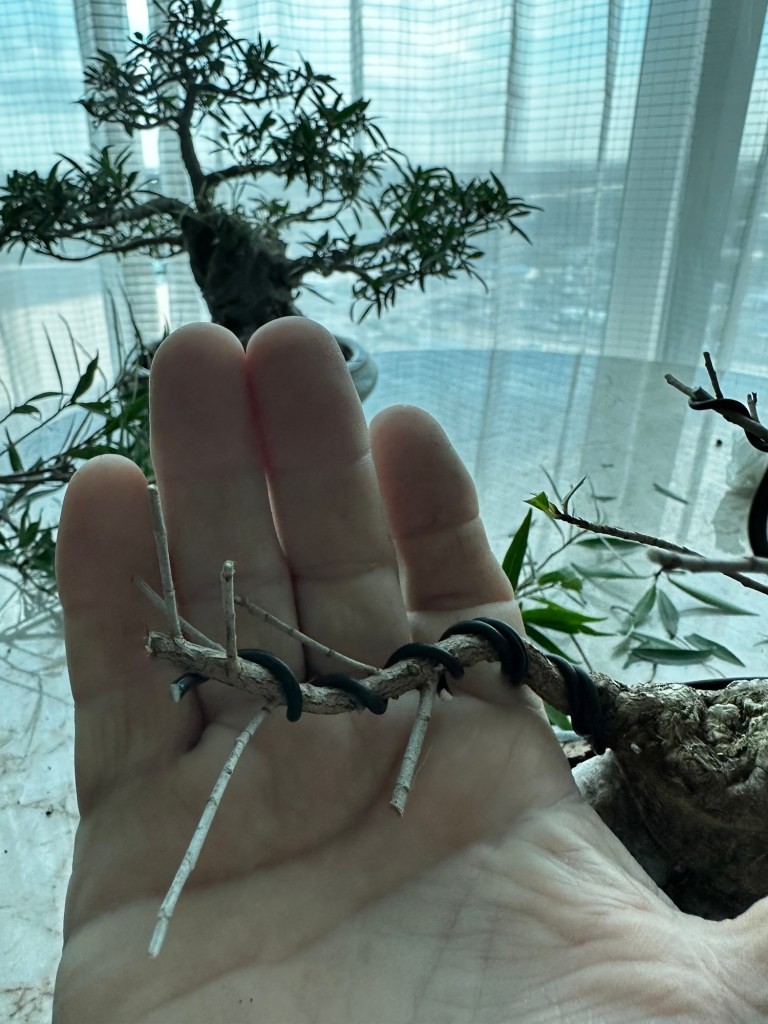
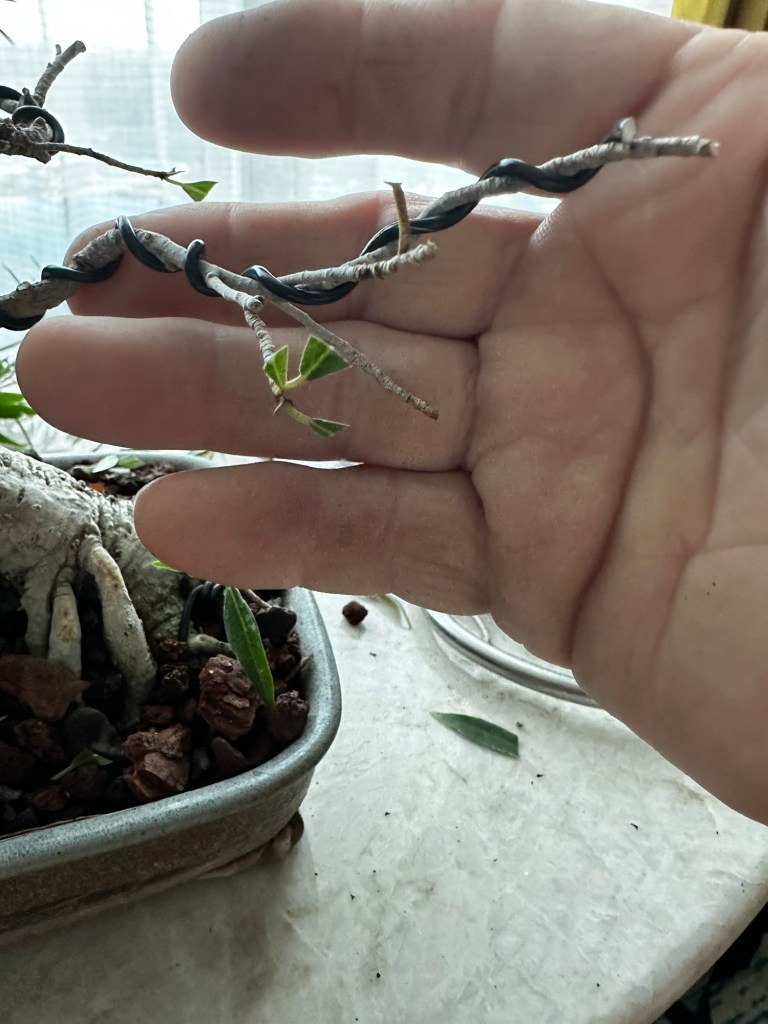
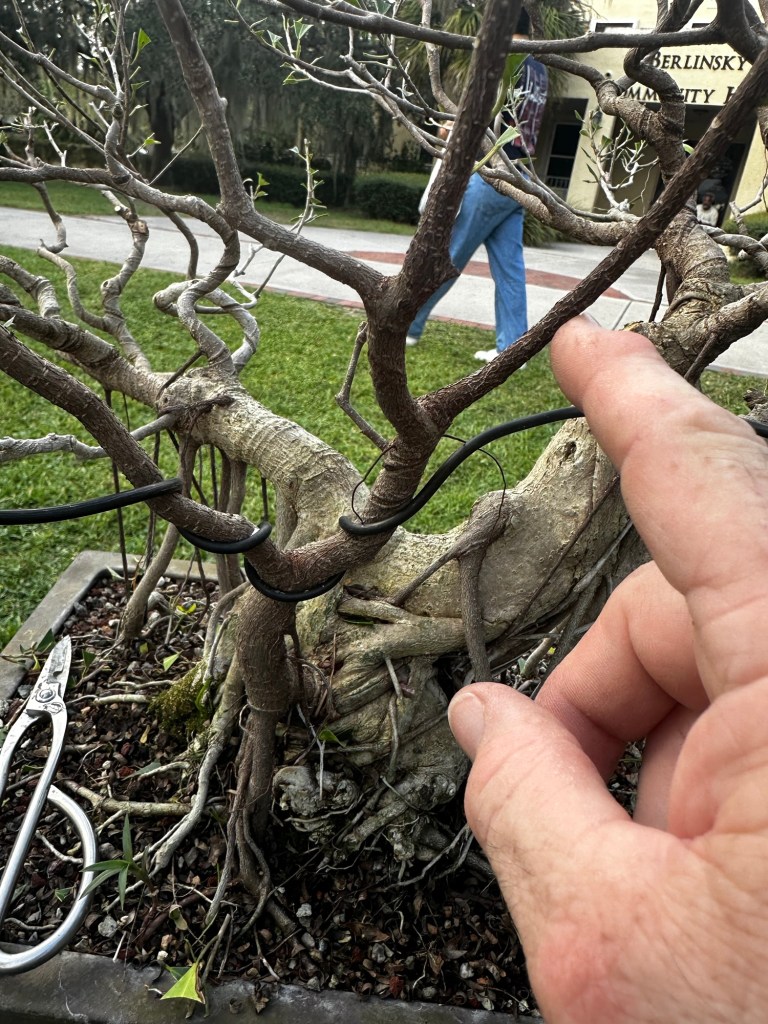
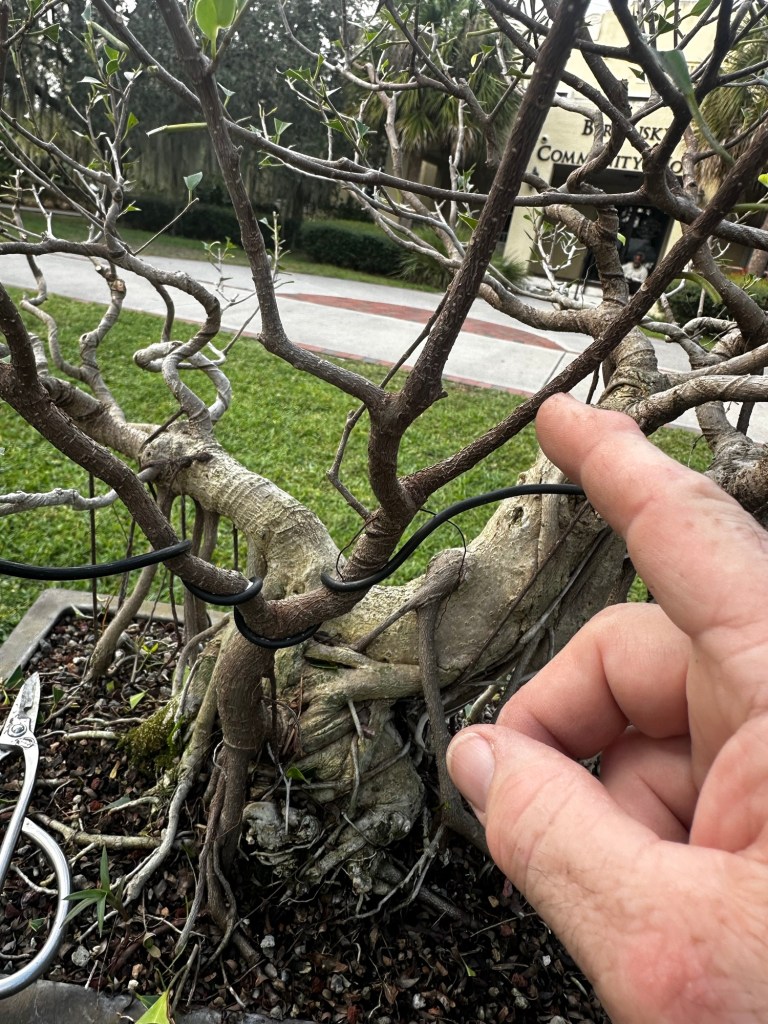
For the sake of a good anchor, one should try to wire two branches with one wire.
Always start in the branch crotch (I just learned that “crotch” is a word first used to describe the meeting of two branches, or the trunk and branch, and not the area between your legs).
And wire one side clockwise, and the other counter clockwise.
There’s a straight line that’s offending my eye.
I know I need to wire three branches. I’ll use two wires.
This will let me put two wires on some branches, to give better holding power.
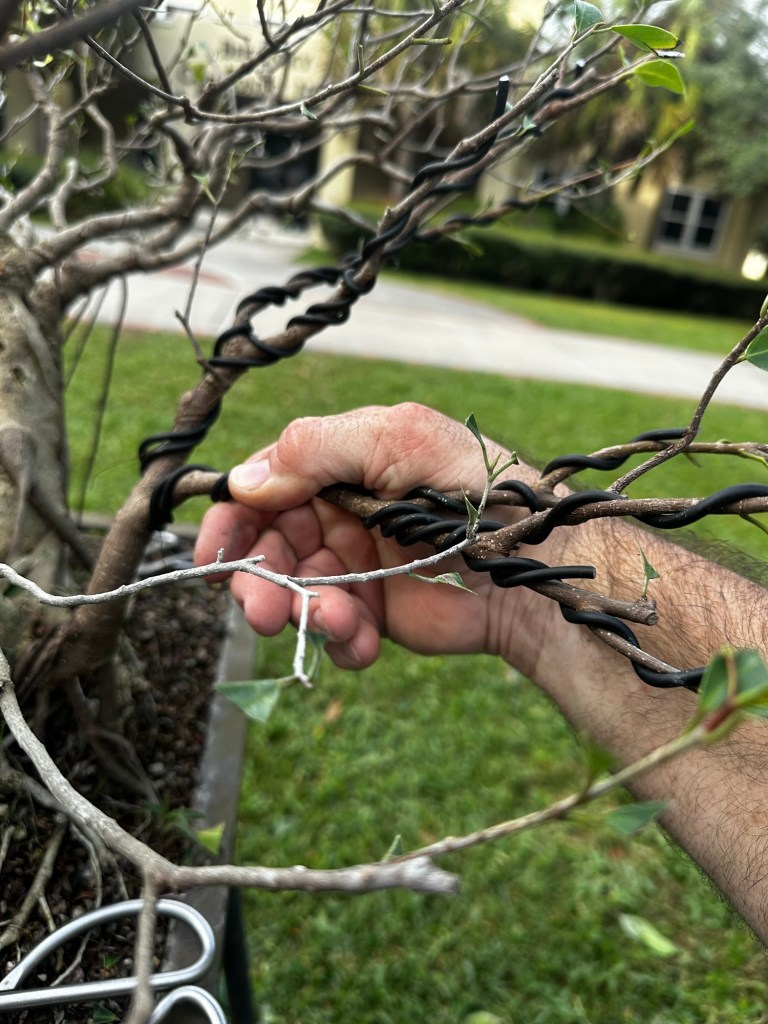
Then the bend.
I usually use two hands to bend, but that’s hard to hold a camera, and bend. Pretend my left hand is steadying the branch.
There we go, one done.
Now for the rest
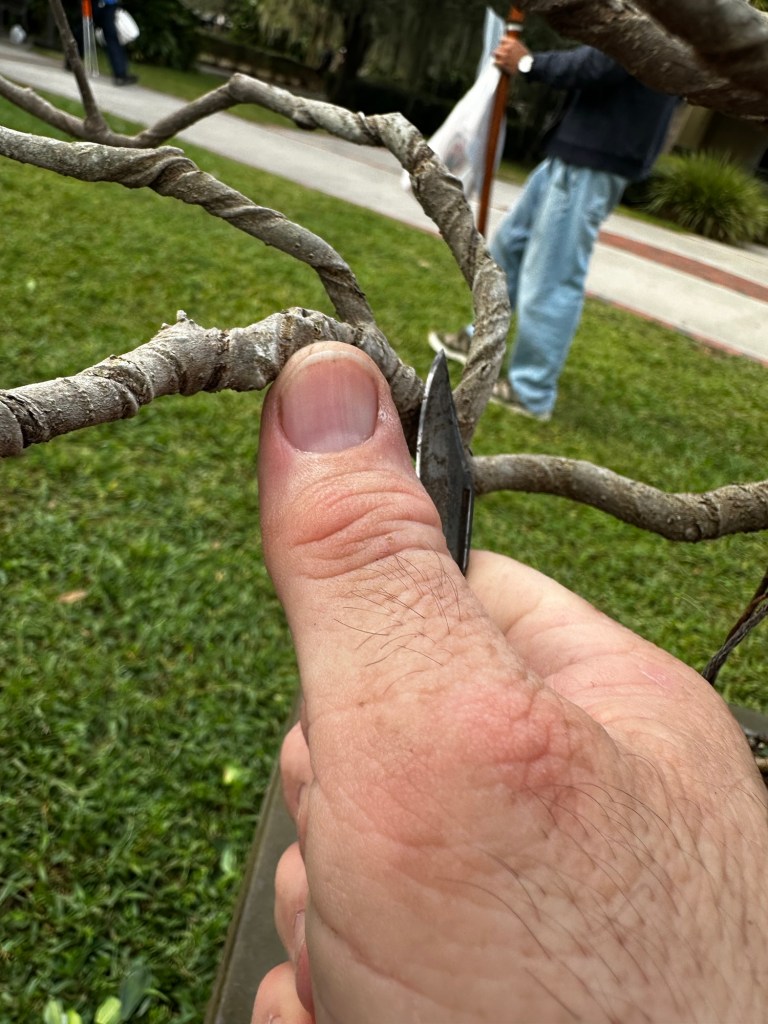
Zooming in, you’ll see wire marks. One of my favorite bonsai lines comes from an English man, he said “I’f’n you ain’t got no wire mahks, yer not using enough wire”.
Say that in a John Lennon accent.
Should you find yourself with too many wire marks, you can scrape off the ridges with a blade.
It mitigates them and makes the branch look gnarly.
And chicks dig scars.
And that’s it.
A video from the top
There’s just something satisfying in wheeling a tree around on a garden cart.
Walk this way!
We all have to walk the path we see before us. Sometimes we cross others paths at the same time they’re on it, and sometimes those paths parallel each other. Relish those times of a companionship, but realize you can’t get off your own path.
Carry on my wayward sons, or trees….or something like that.
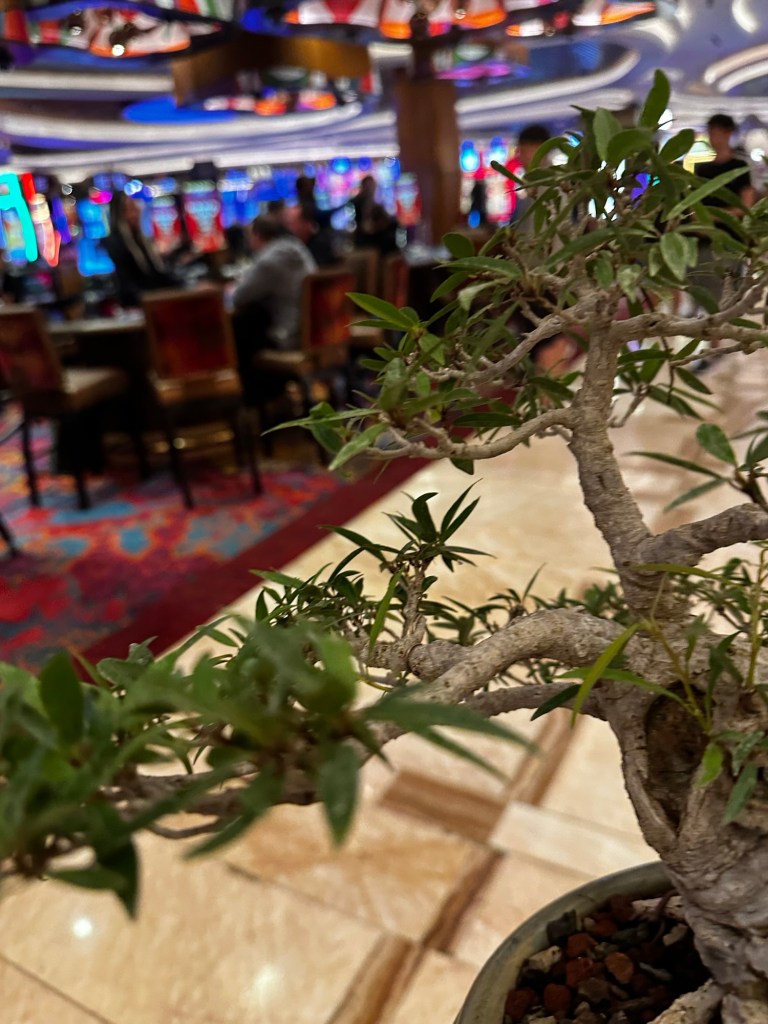
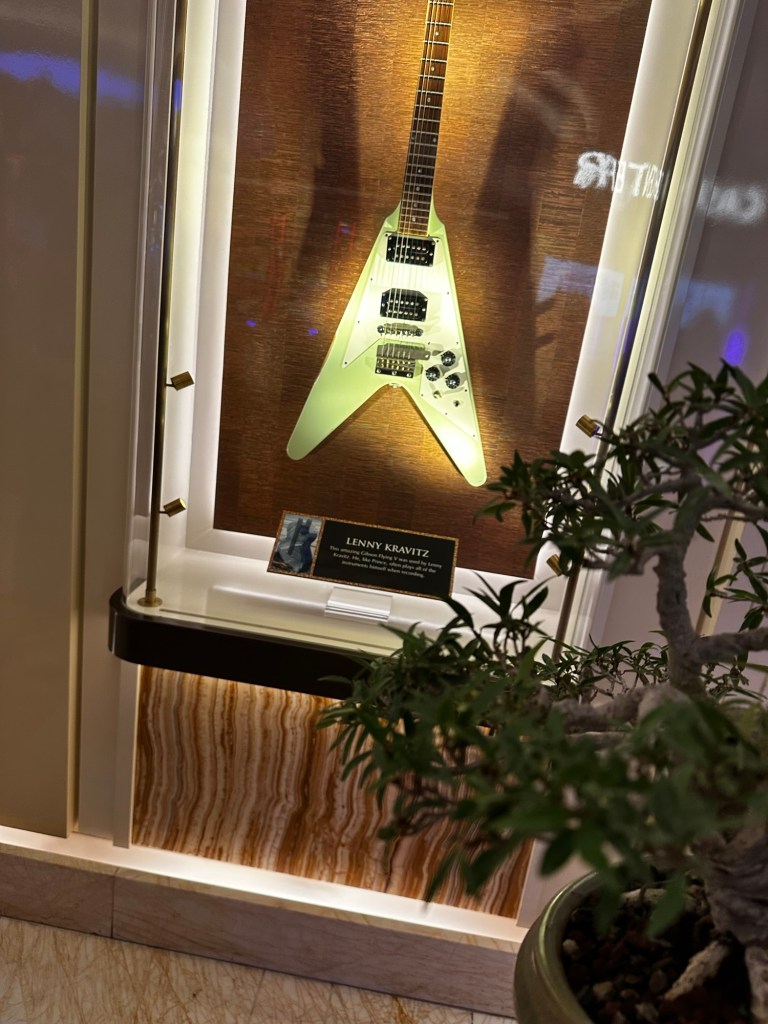
Here I find myself in a hotel in Hollywood.
Florida, not the hotel in California. Where you can’t never leave.
I’m at the Seminole Hard Rock Hotel and Casino. It seems there’s a place way down south in the Everglades, where the black water rolls and the saw grass waves. The eagles fly and the otters play in the land of the Seminole…
I could catch a show, eat a meal, go swimming, gamble and win (most likely lose). But they’re never gonna catch me cuz I have one more silver dollar.
I have some work to do. Takin’ care of business, so to say.
Or, tomorrow morning I have work to do.
Nightie night…..
Here comes the sun….
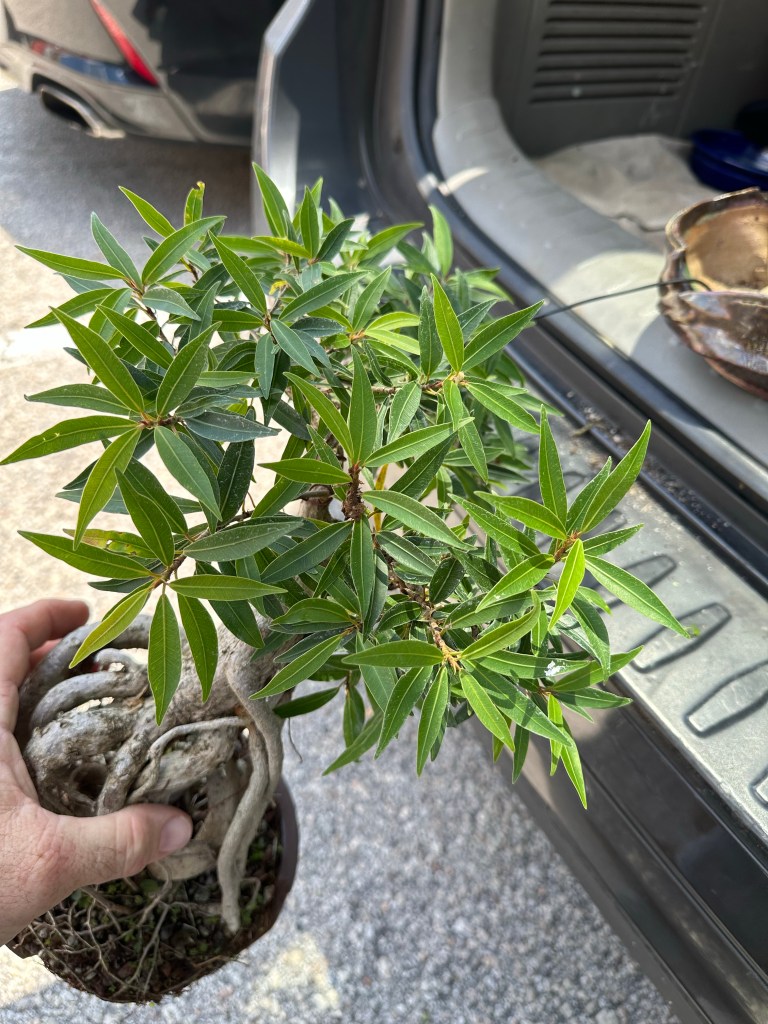
And the tree. A willow leaf fig. Ficus salicaria. What’s a more Florida tree than the one bonsai species that was first discovered here. And not too far from this place. The very first bonsai made from the willow leaf still exists and lives down on the east coast of La Florida. Very far from the Florida:Georgia line.
The tree came from Mike Blom, of Emblem Bonsai. He’s one of Florida’s best. He takes the time to develop the trunk and works to make the stock plant the best it can be. The pot is an early Taiko Earth container, by Rob Addonizio.
I didn’t bring any number one wire, so just the main branches will be wired.
They already have a strong upward bend so I’ll keep that movement and exaggerate it. An artistic concept we use in bonsai is the repetition of shape and line. This brings the character of the tree into a more honest representation of itself. The branches should tell a story. Say we have a mountain for or spruce in a place where winter dumps hundreds of pounds of snow on the trees and plants growing there. The branches tend to start growing down right from the trunk.
This tree, a purely tropical species, tends to want to grow up first.
I consider them one of the best species for bonsai mainly because they will, much like a juniper or Chinese elm, they can be made into almost all the styles. Cascade? Yeah. Upright formal? You bet. Windswept? If you want. Bunjin? Definitely.
And they grow and backbud like insanity in a tree. A trunk chop will result in buds right from the chop sight, usually double digit amounts. You can totally redesign one of these trees every ten years and the tree will thank you for the makeover. I’ve heard twice from returning westerners who’ve apprenticed in Japan that ficus in general just grow too fast for the Japanese masters.
Imagine that.
That’s one reason we in Florida tend to put them into bonsai pots when developing them, it slows the growth might so that we aren’t unwiring and then rewiring every week when it starts to cut in.
How’s that? I like it. It could have better taper….if it were a Hershey’s Kiss.
Some water…
Whoops, made a mess in the shower.
Now it just needs some sunshine. Let the sun shine….and you thought I ran out of song lyrics, didn’t you?
Now it’s breakfast time.
WAIT, WHAT? $32 dollars for two eggs and bacon….I thought casinos had cheap food?
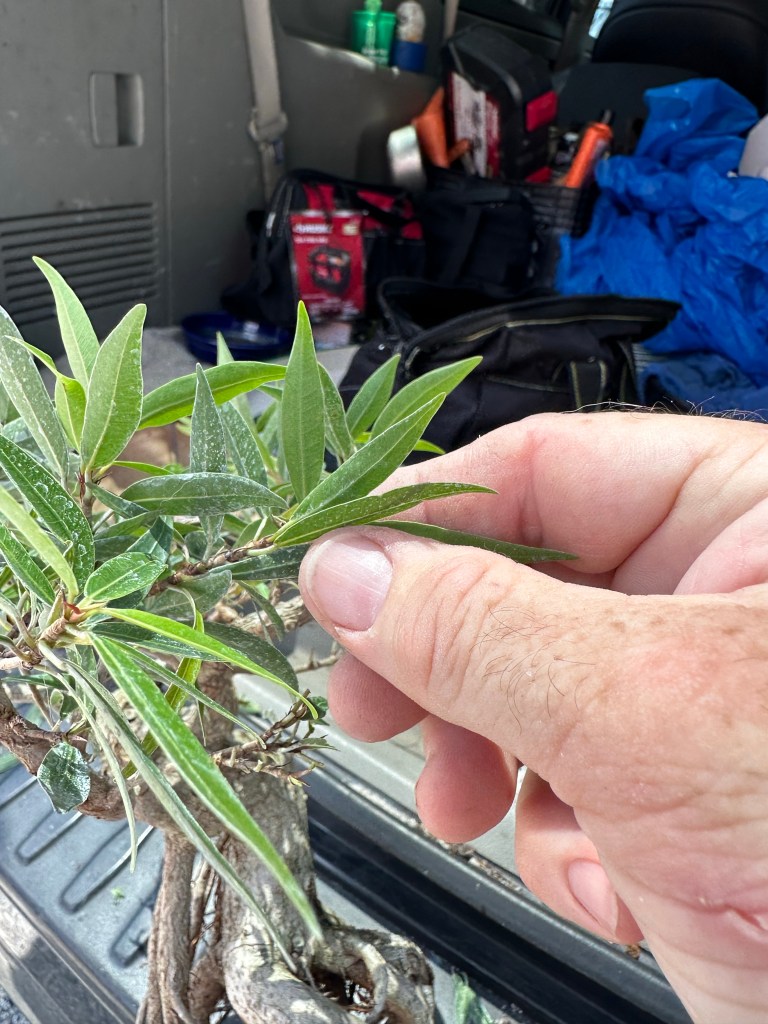
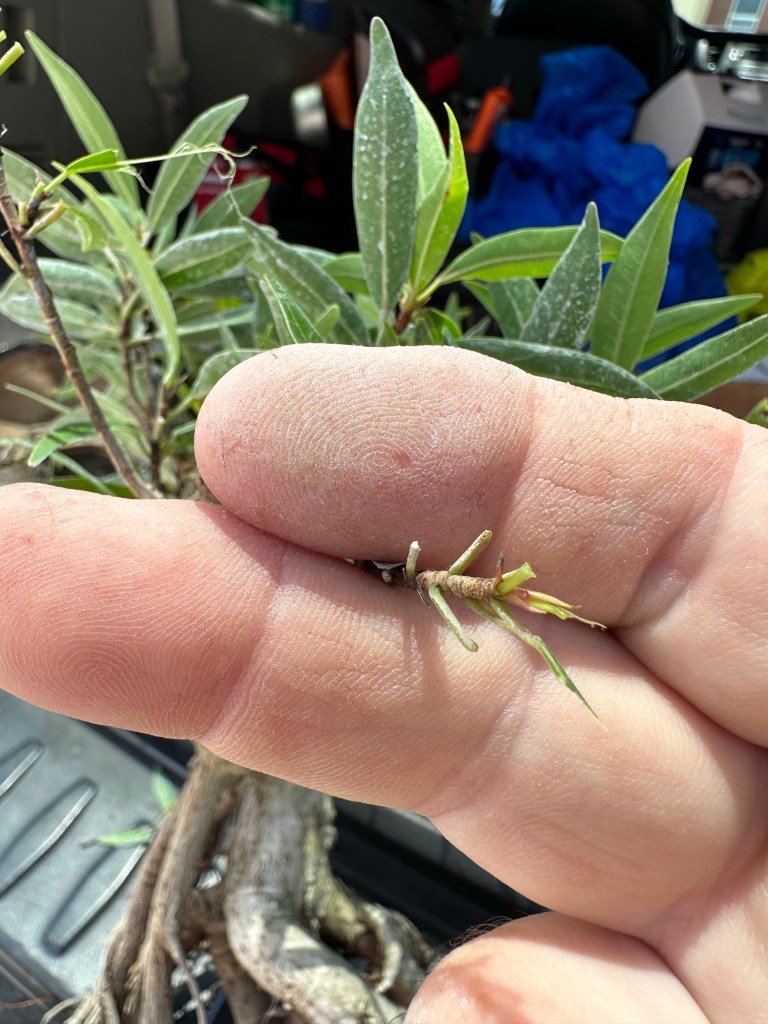
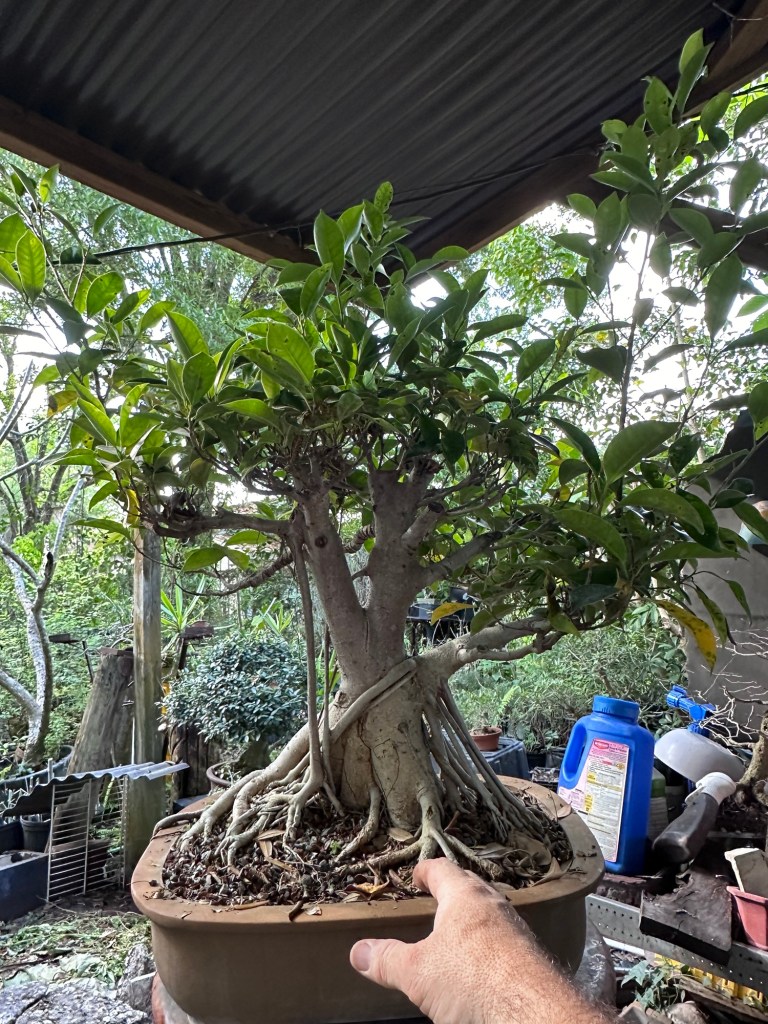
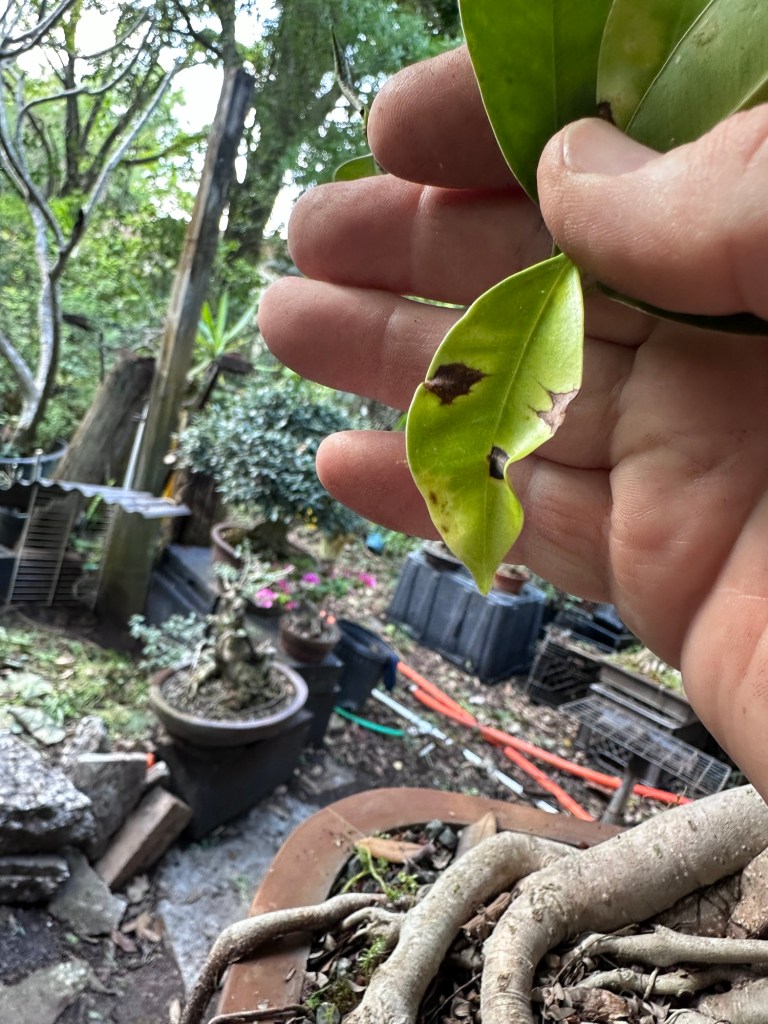
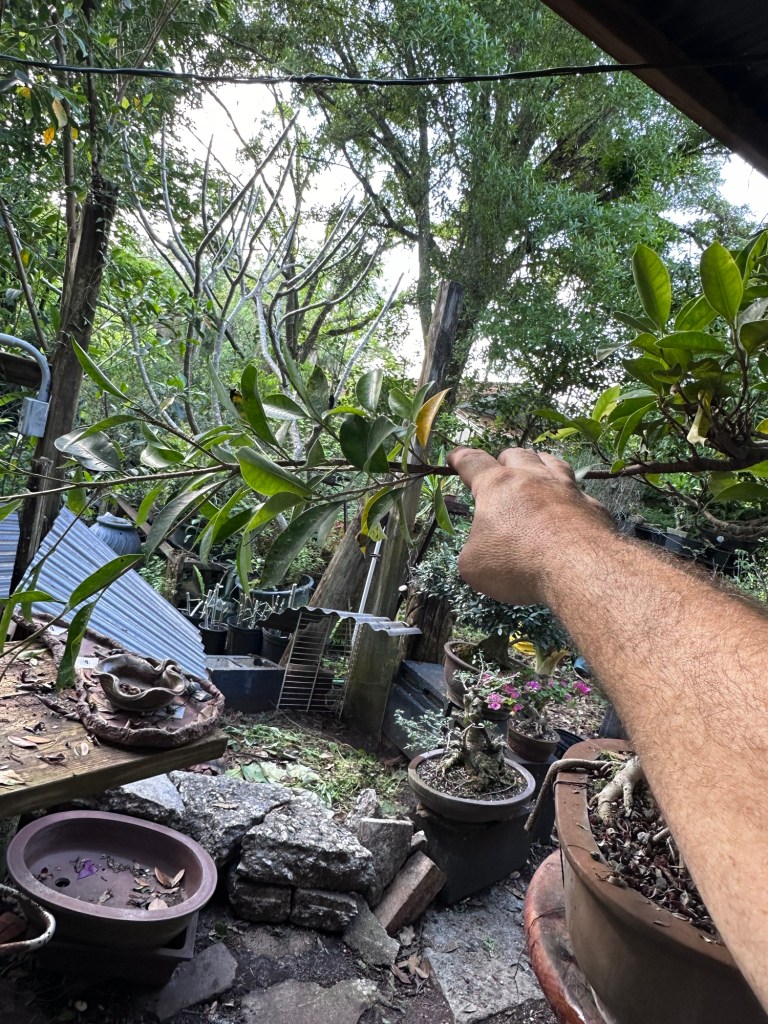
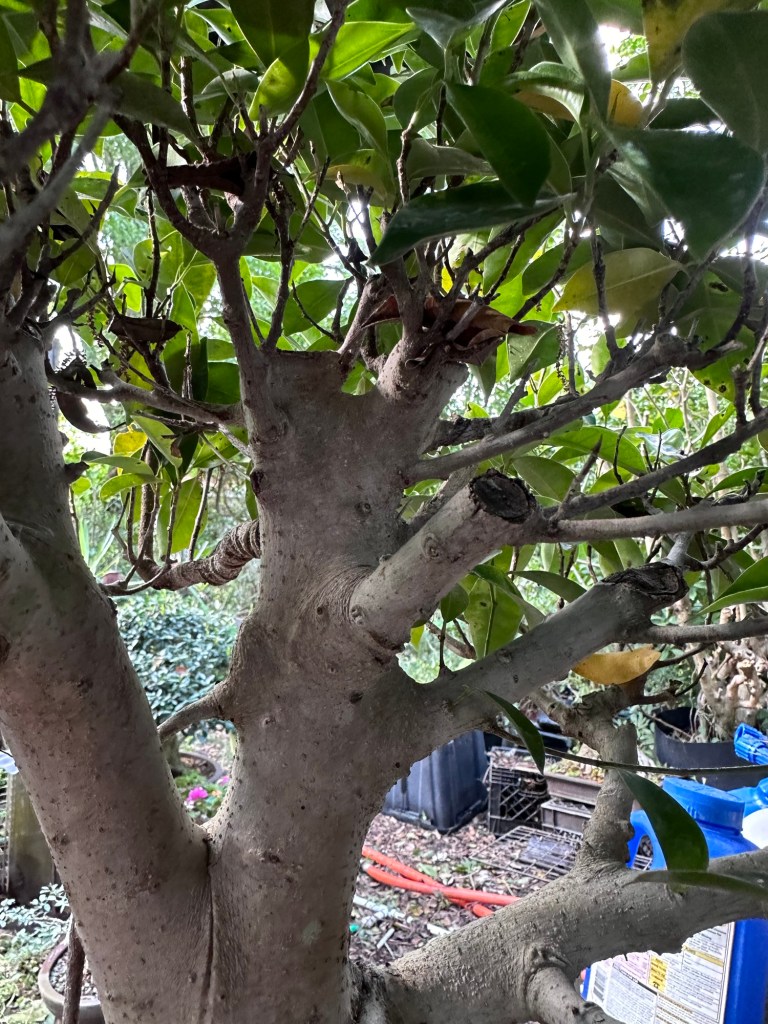
Here’s a tree. Willow leaf fig. Yeah, the one everybody says they can’t decide on a name for. Nerifolia? Salicifolia? Wilowleafyanus? But they did, about ten years ago. “They” being botanists: it’s called Ficus salicaria, which is literally -willow leaf fig. Also, I’ve been writing this post for about six months, and the work was done early spring, before the rainy season in Orlando.
Let’s start with an interesting note on growing the willow leaf ficus outside all year in Orlando. In the spring, if you’ve done no work on them since last summer, they will drop all their leaves and grow new ones within a week, much like a deciduous tree, or, more specifically, like Quercus virginiana, the southern live oak. First time it happened to me I was freaking.
Don’t worry though, the leaf drop may seem pathological (meaning caused by a pathogen or illness) but it’s natural. It quite literally drops its old, winter leaves, which are adapted to the lower light intensity and short light intervals of winter, and grows new ones that are better adapted to the heat, length, and intensity of spring and summer in Florida.
If that sounds familiar to my northern peeps, it’s this process, plus my own experience pruning and moving trees around in my nursery during the Florida Winter, that informed and enriched my own teaching. Mainly, I recommend this technique to my northern students: when moving a tropical tree from outside to inside, or versa vice, inside to outside, defoliate. A tropical tree will drop old leaves instead of trying to change them according to their new environment.
Meaning, outside leaves are not adapted to inside light. Remove them and the tree will grow new, indoor leaves, when it’s inside. And do it again when returning the tree outside.
Works for me, and those students up north who follow the advice.
The pot it’s currently in was made by a friend’s wife, Jean. But it’s too small now.
Jean is an all around artist, and has done theatrical make-up work in movies and even on some of the actors in Star Wars events. You’ve seen her work I’m sure.
She makes a good container too. But it’s time to get a bigger one for the tree.
The tree was acquired from one of the Facebook Bonsai Auction pages. From a former friend named Seth Nelson.
There’s a name that gives me a bitter taste in my mouth. There are very few of my readers and students who’ve heard the story about this kid. Or man by now, I’m thinking.
When I knew him, he was both young in temperament and age. I’m thinking that he has grown up now.
When I first met him, he was looking for a mentor. Unfortunately, that was me for a few short years. I say “unfortunately” on his behalf, not for me.
I can hear it now, “What does that even mean?” Well, this will be hard to write, and I’m not going to be pointing fingers, except back at myself, or trying to persuade you that I’m an angel, because I’m not, but at that time in my life, I was still young and stupid too. I’m not sure I’ve matured.
Let’s work on the tree and I’ll throw in my thoughts. And, Hell, if you don’t want to read it, just look at the pictures. I’m very reluctant to write it.
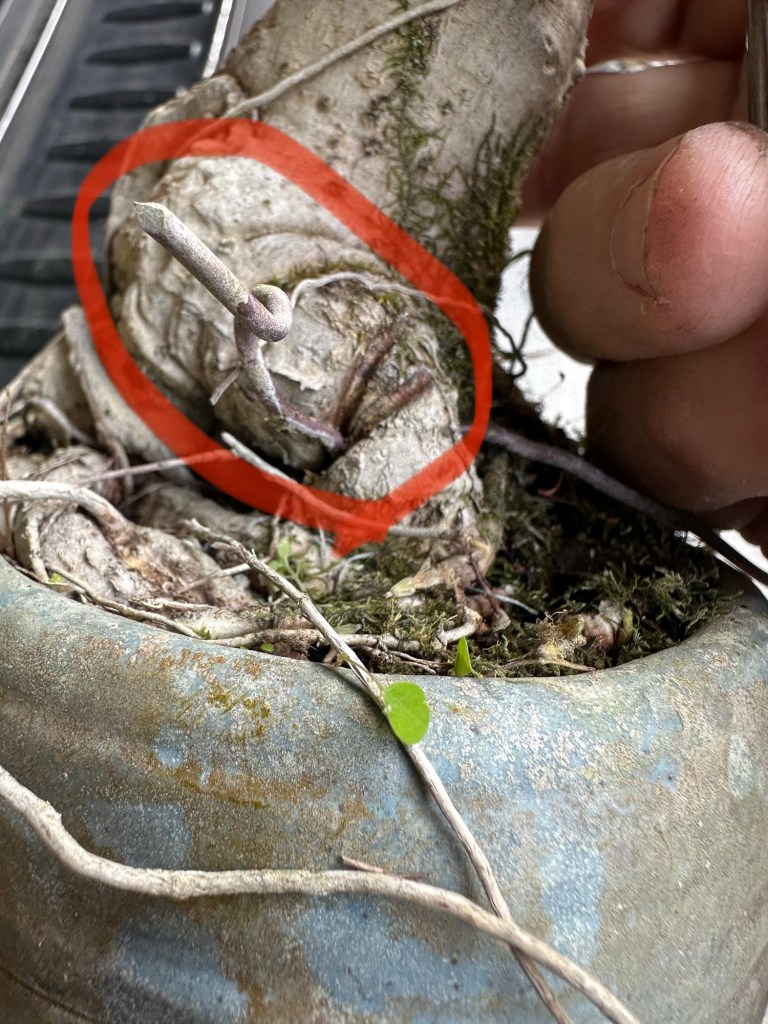
I guess the ficus has been in this pot for too long. That wire is just a bit cut in. The reality is that I have been thinking about this tree for years and ignoring it at the same time. I knew if I worked on it, I’d have to document the process and then its story had to be told.
The red circle shows the tie-down wire cuts. You gotta tie them down so they don’t get up and walk away.
Seth was selling the tree to help pay for something, I think maybe a starter for his truck. I surprised him by using the BIN option (B.I.N. means “buy it now”). And he brought it to the nursery for me.
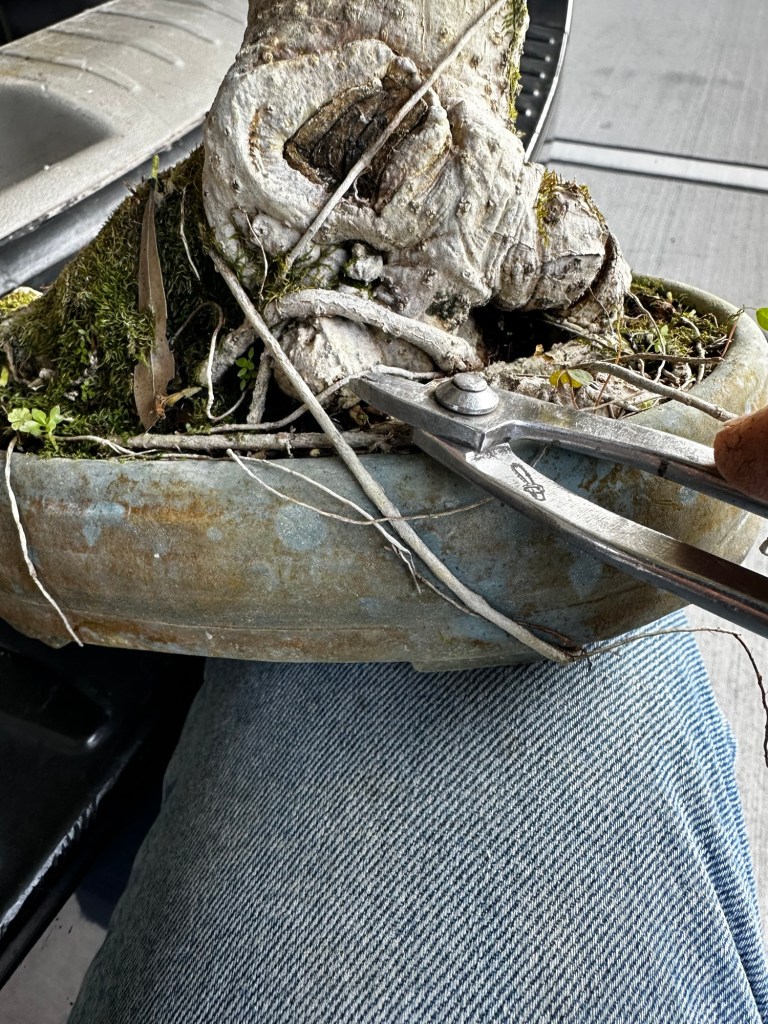
Release the chains! The tie down wires
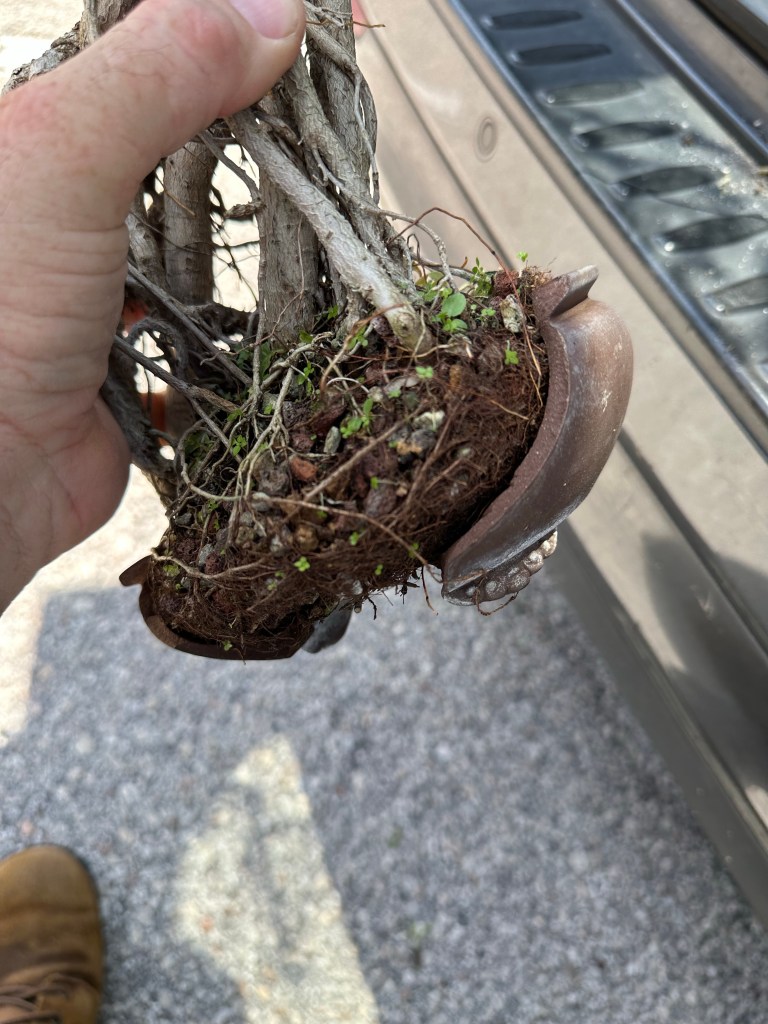
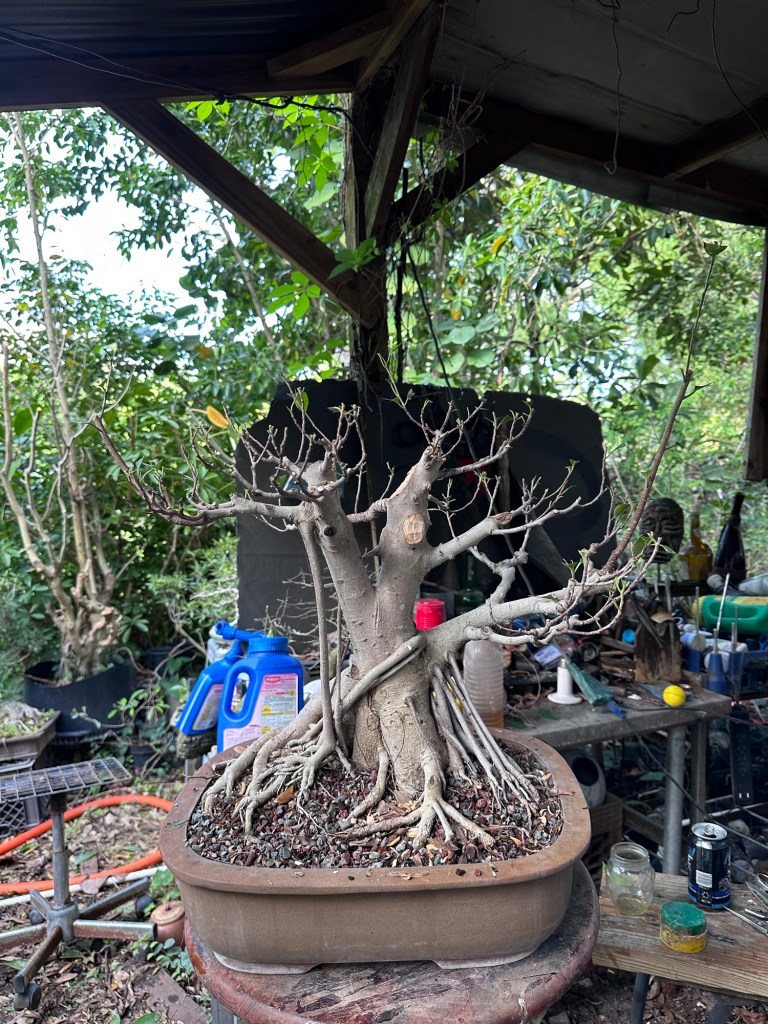
Ah! That, below, is a root. Maybe the tree doesn’t want to be repotted?
It’s in there like the second wicked stepsister’s foot crammed into the glass slipper.
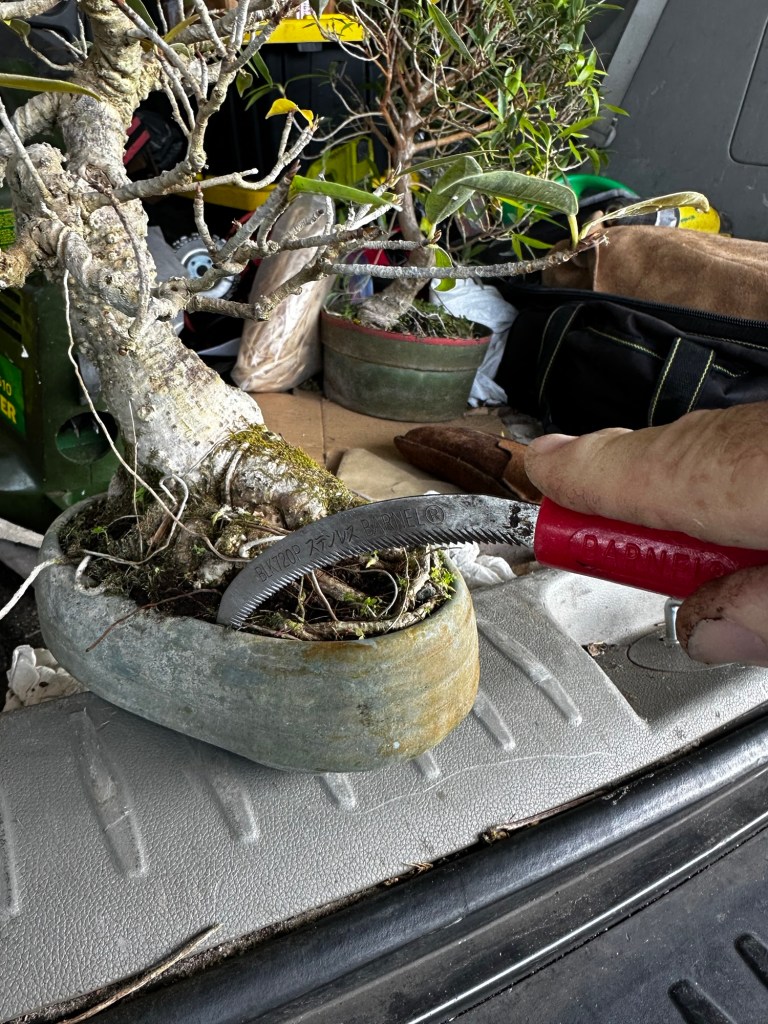
A tad bit of irony, but me having to use a repotting scythe to cut the tree out of the pot, goes with the original Brothers Grimm telling of Cinderella, where the stepsisters cut their foot so it would fit in the slippers (in the original, the slippers were gold, not glass).
Sounds like a lot to do to yourself just so you can be a part of the ruling elite, cutting off pieces of yourself so you fit in.
As you see in the video below, it’s in there tight.
Jeez. Do I have to break the pot?
There’s some ASMR for you.
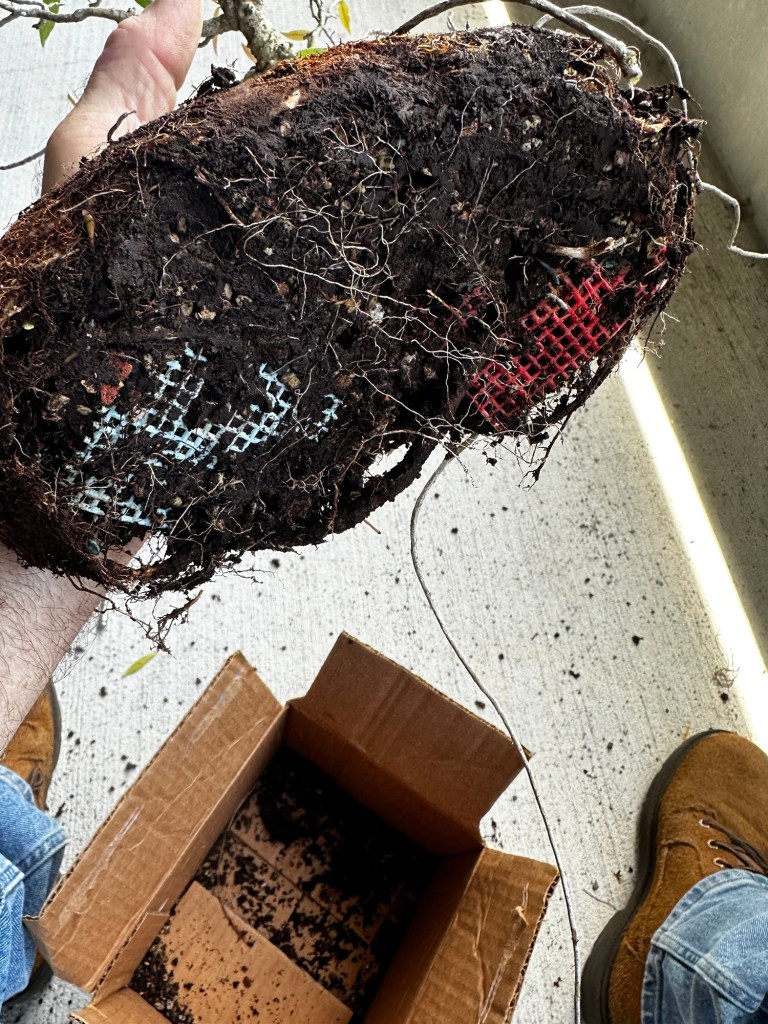
I got it out, finally.
It has some roots on it alright. Ficus are very good at saving sugars in their root structures (being partially epiphytic is the reason. Most ficus are epiphytes, meaning they can live without soil, usually in a tree as strangler figs, so they’ve adapted by growing tuber-like roots to store carbohydrates and moisture for when they need it. Think of the so-called “ginseng” ficus, looking like a potato with the caudex looking roots. It isn’t a distinct species, but a trade name given to seedling Ficus microcarpa. Almost every species of ficus will do that with their roots).
Some pruning.
A few heavy root cuts.
Now to pot it up.
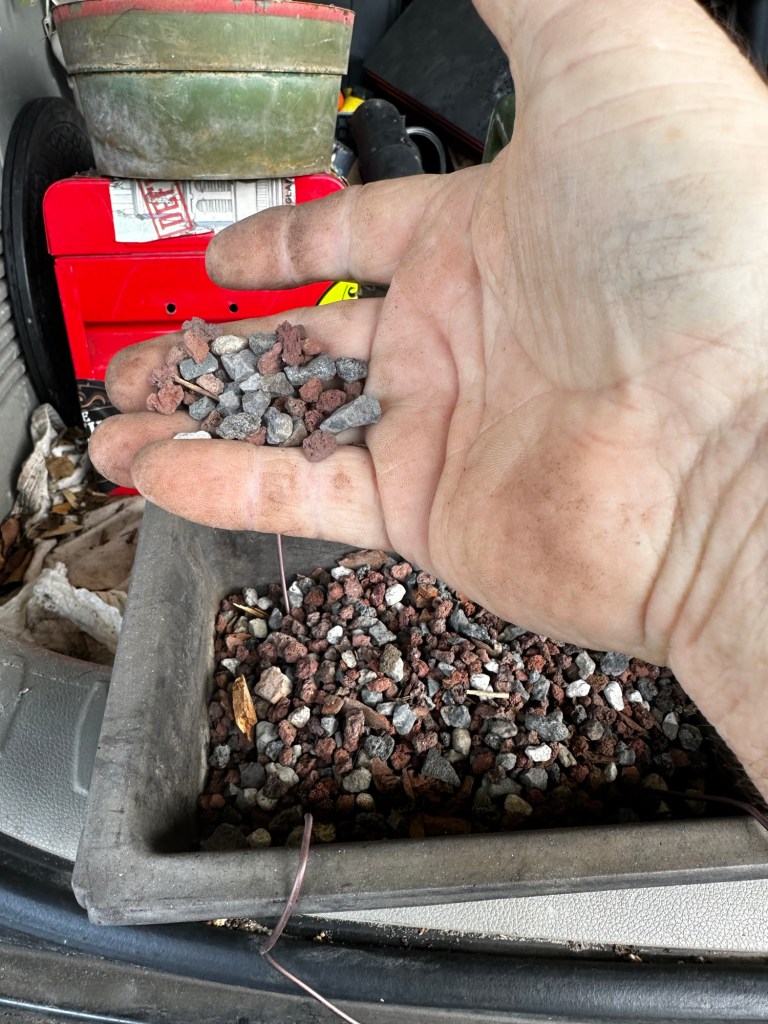
I have soil, wire, fertilizer, granular systemic insecticide, but one thing I didn’t remember to put in the van this morning was a good pot. I do have a pot made out of mica, from Korea. It’s at least bigger and will serve the purpose.
Needs some more holes for tie-down wires. That’s the great thing about mica pots, they are good containers, and they can be easily modified however you want. One of these days I’m going to carve a design into one.
Now we are cooking with gas.
Some soil. Soil, that’s how it started; Funny story, I’d been in a casual conversation with Seth, and he saw a post of mine where I was repotting, and he asked where I got the red lava. He’d been buying the consumer grade and mulch sized red lava they sold at Home Depot, and was trying to use a hammer to crush it down to bonsai sized (about 1/4 inch size) and discovered that it just makes dust. It’s hard to crush lava with a hammer. I told him that I was going to be at a bonsai club meeting that met close to where he lived, and I’d bring him some of mine.
It was a good way to get a meeting with me. I like to help people, and Seth figured it out.
Fast forward a year or so to when I first got the tree from him, he thought I was going to do the famous Adamaskwhy trunk chop.
I didn’t, but instead decided to use all the branches to make it work. For some reason, he wanted a chop, so he was disappointed. It wasn’t the last time I disappointed him.
I said earlier I was young and stupid. When I met Seth, it was just around the time I began my journey with an ileostomy. There’s even a blog post where I go into the hospital after I visit him and he was one of the only people to come and visit me (Click here). I was angry at the world and I tend not to suffer fools gladly (I still don’t, but I’m getting better, now I just suffer them stoically). Seth had a hard time with his stepfather at home and we both would commiserate by saying bad things about people we didn’t like.
And here is where I couldn’t live up to my ideals. I have a flair for writing well, and he and I would DM each other on FB messenger. That made for some interesting screenshots. But I have come to the realization that, even though he shared private messages between he and I, two good friends, it was still my fault that I wrote those messages.
But I think I’ve grown. I question myself and my motivations often. Like Plato said, “The unexamined life is not worth living”. I also try to align my life with the idea that a meaningful life is one dedicated to beauty, truth, and virtue. And when it comes to my interactions with other people, I know that I can’t ever figure out why other people do things, only why I do things. And it could be argued that I don’t have a right to know another’s thoughts, only to deal with those actions. It’s entirely possible that how they act is really a reaction to how I am acting.
Before styling:
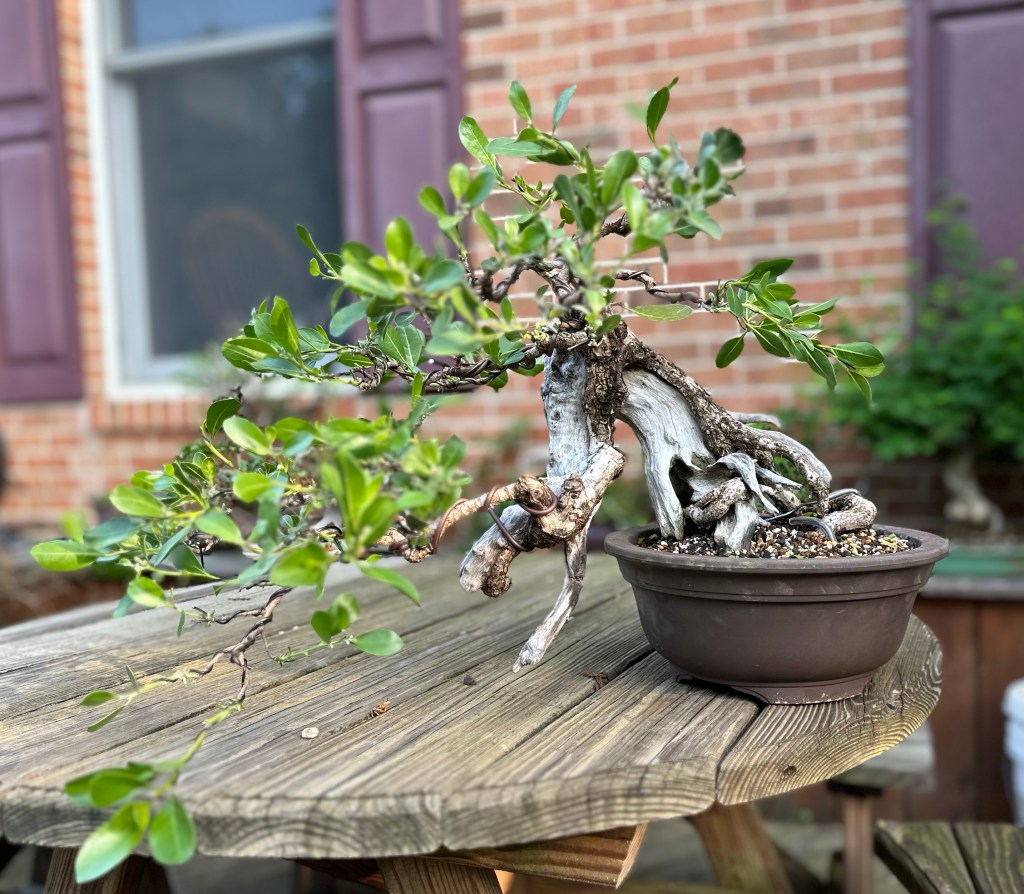
After styling.
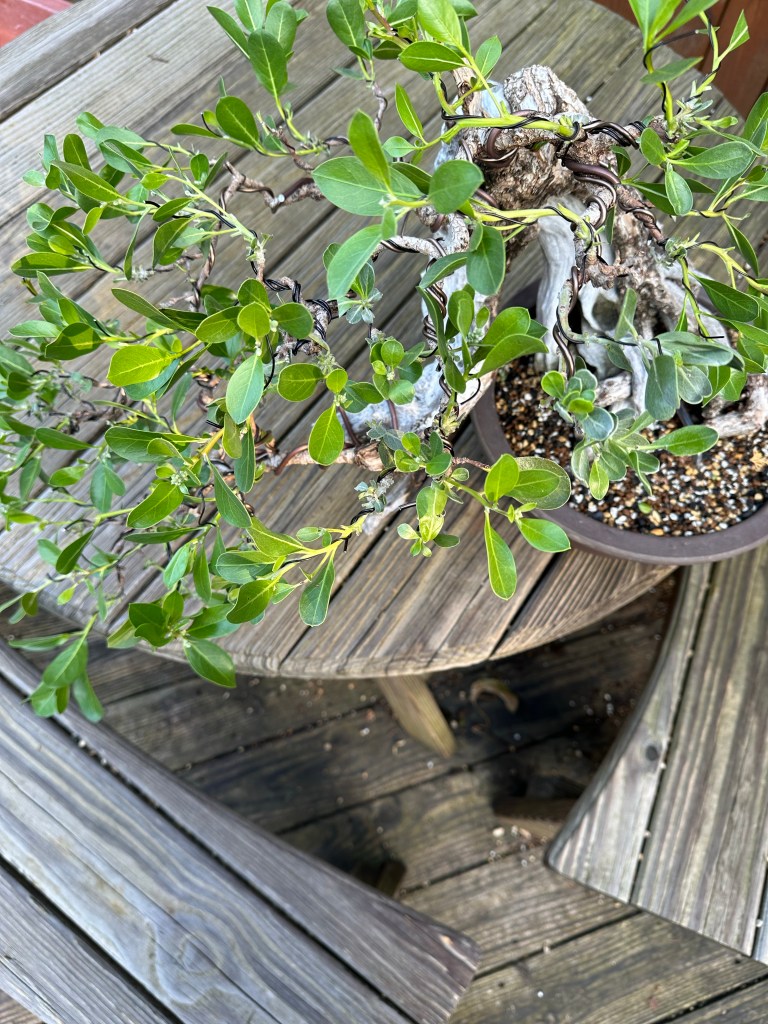
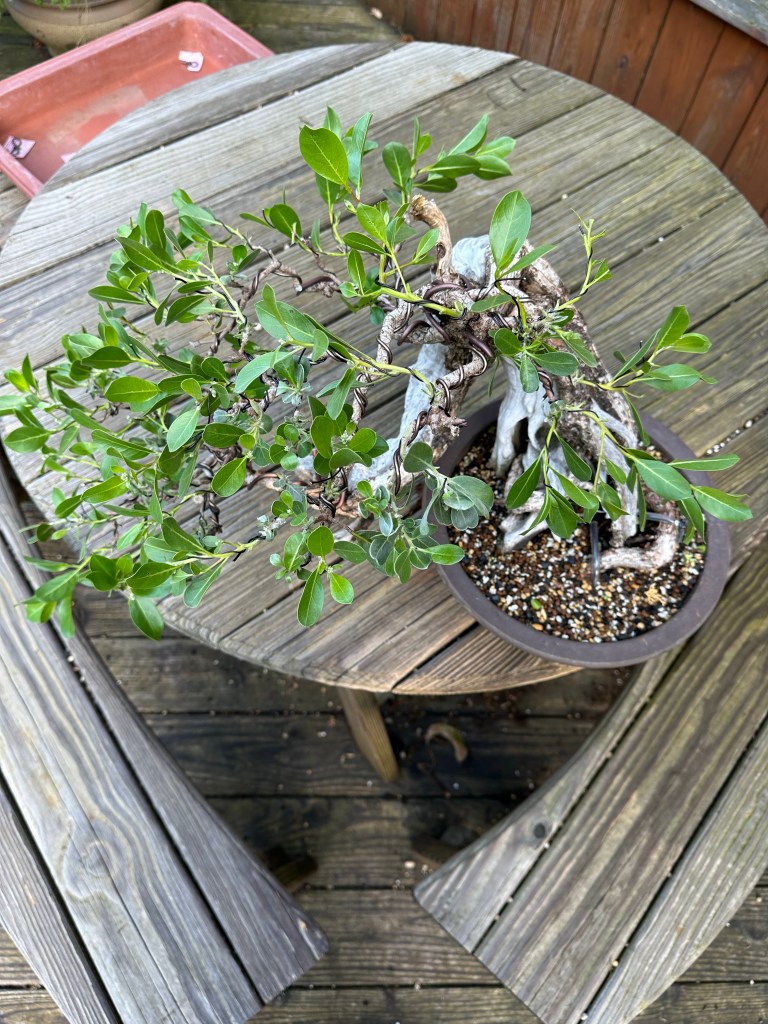
Eagles-eye view.
It is a complex tree. You really have to watch the video to see the depth of the trunk movements.
It’s a good tree, and I’ll cherish it for what it represented, a friendship. One I’ll never have again with Seth. I did wrong and I’m sure I’ll never be forgiven, but that’s ok. I’m close to forgiving myself, but I’m not sure I can forget.
I’ll just keep talking to my trees, and be guarded with people. I’m not sure how else to be and not hurt or be hurt. The trees, though it’s a difficult language, still speak in plain sentences.

 Login
Login

 , just like the old days. Here’s the tree, a willow leaf fig (Ficus salicaria, ofttimes erroneously called Ficus nerifolia, or F. salicifolia, or whatever it was called when you grew up in bonsai).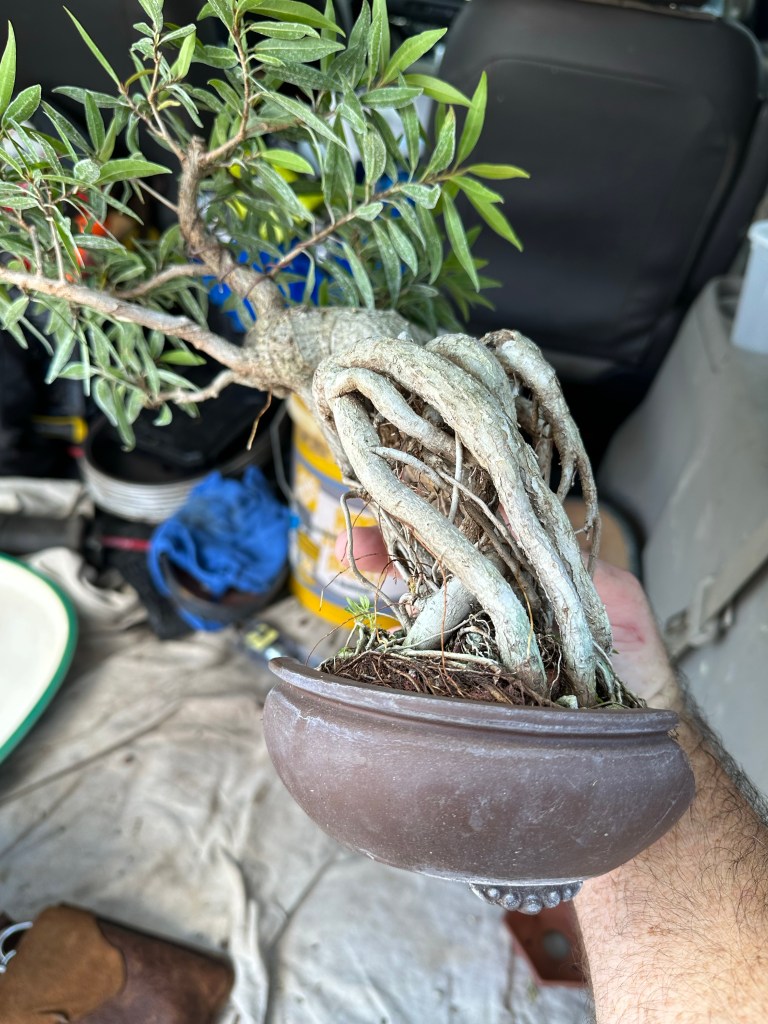




































 Walk this way!