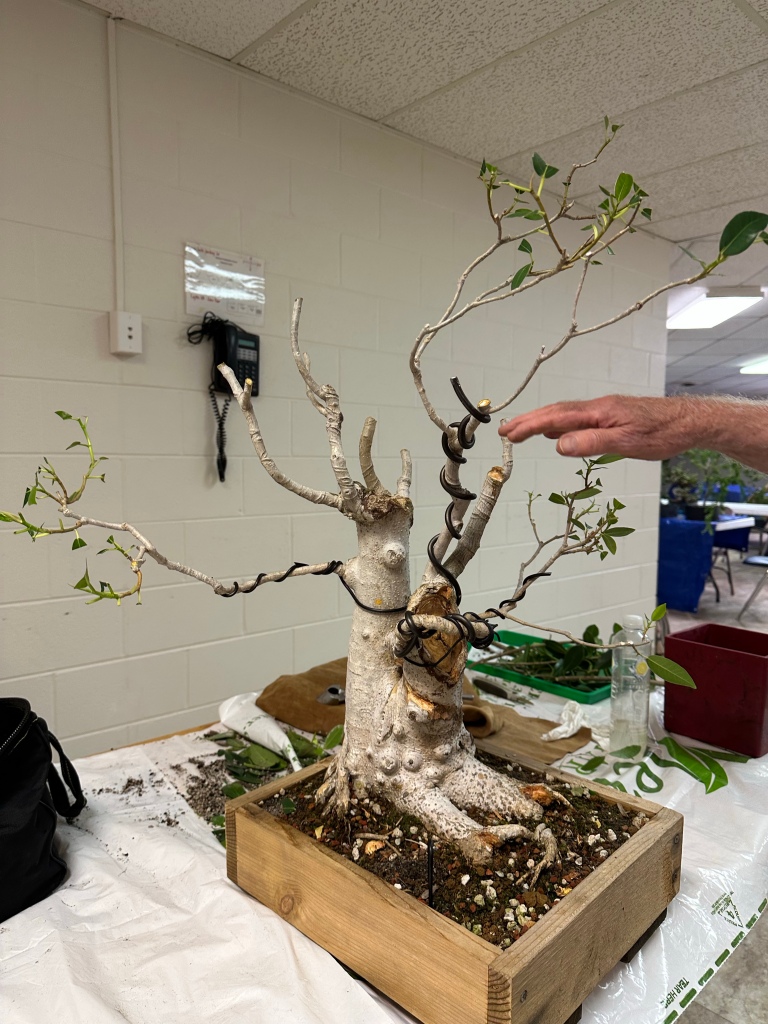
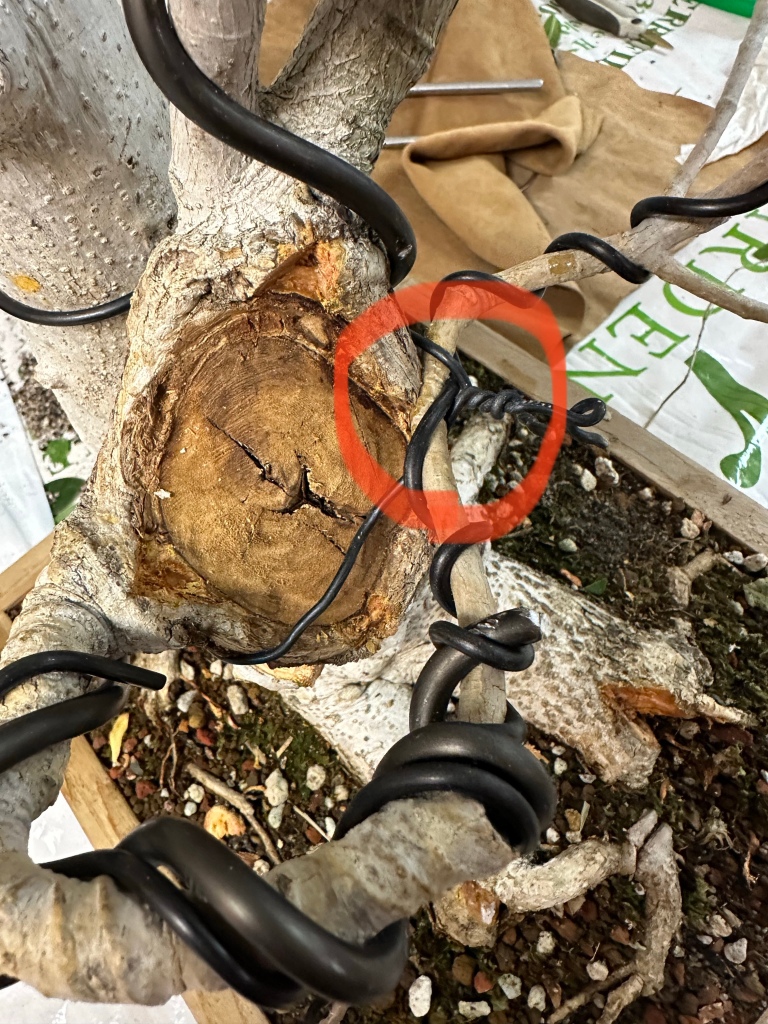
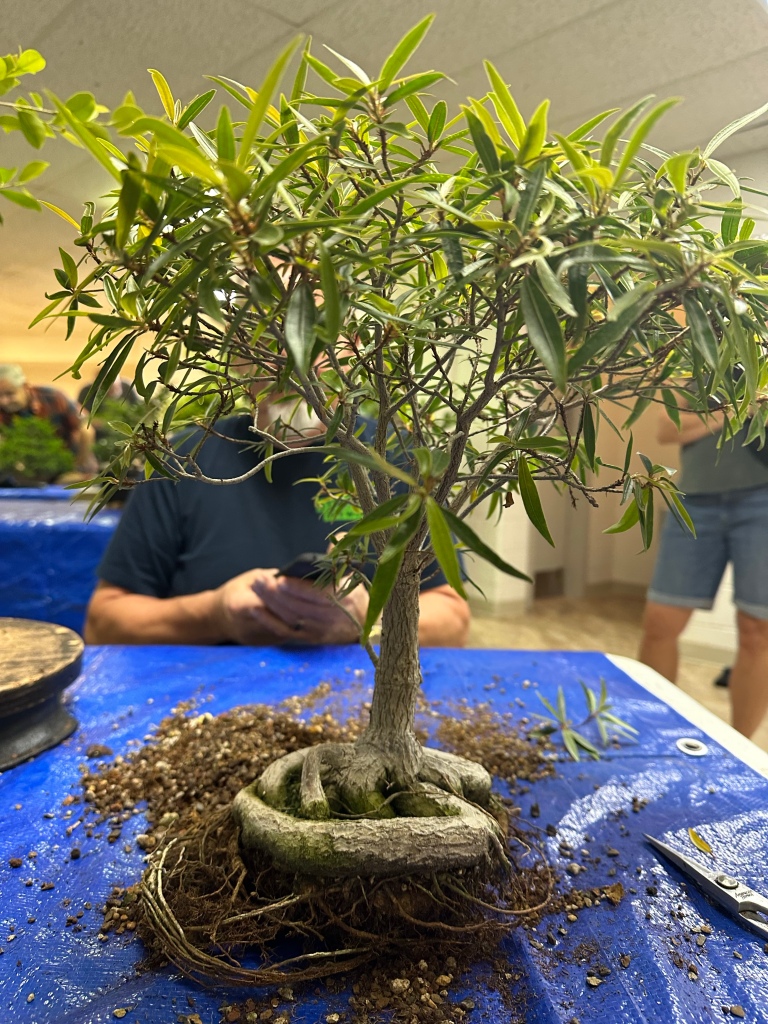
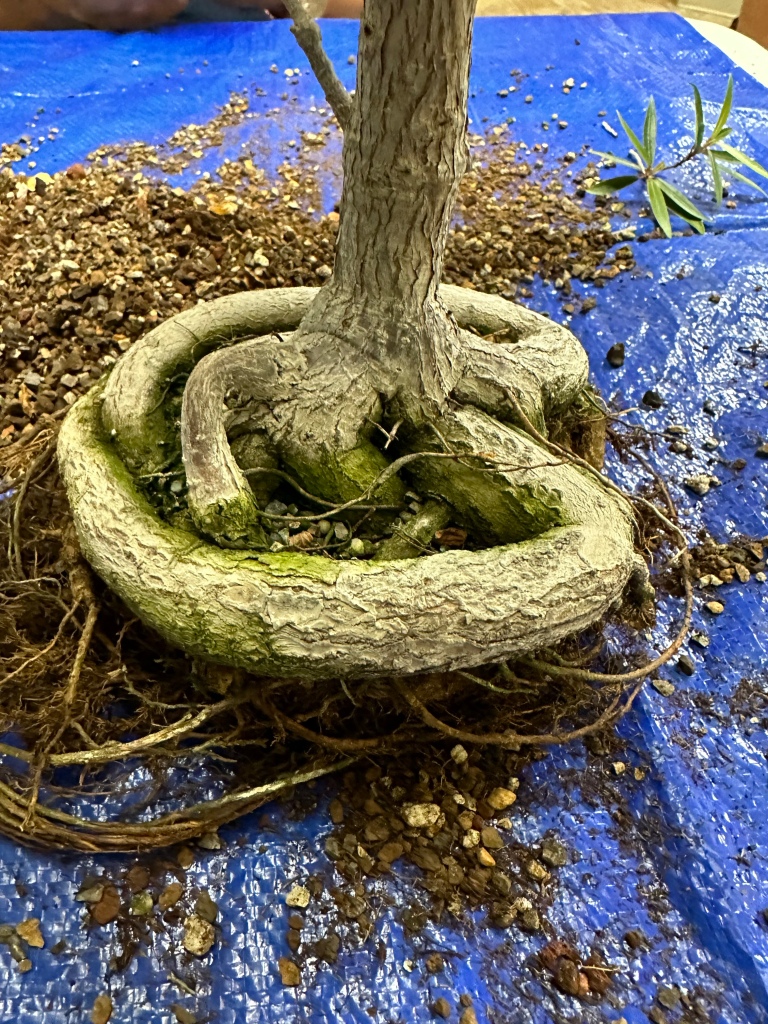
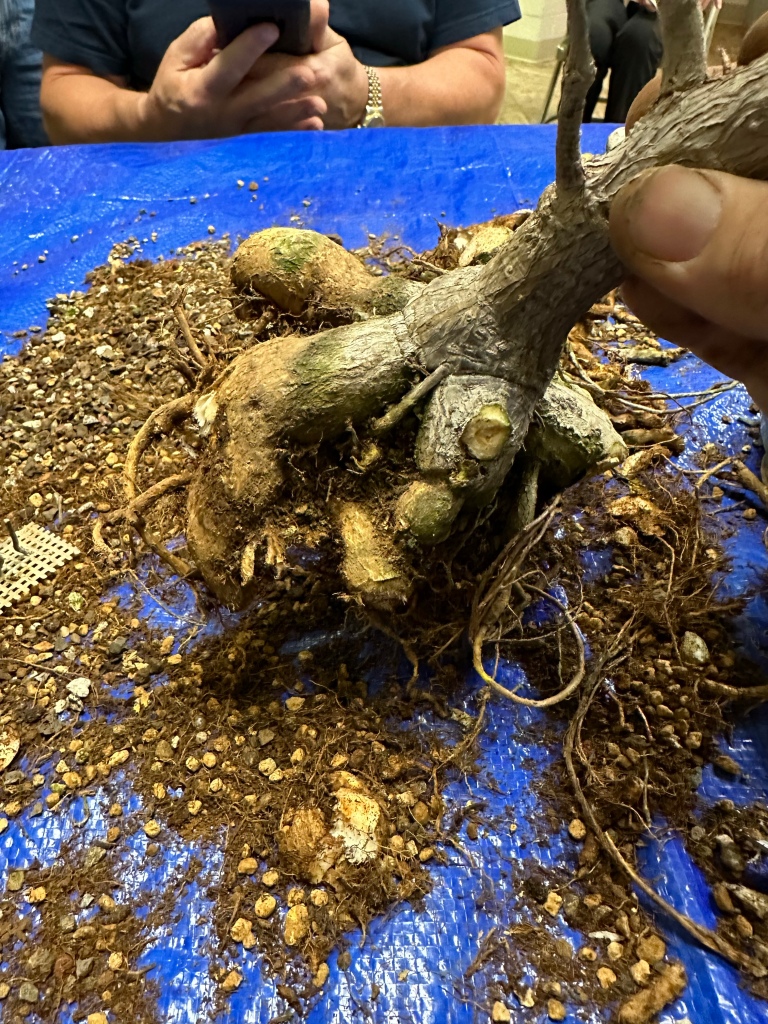
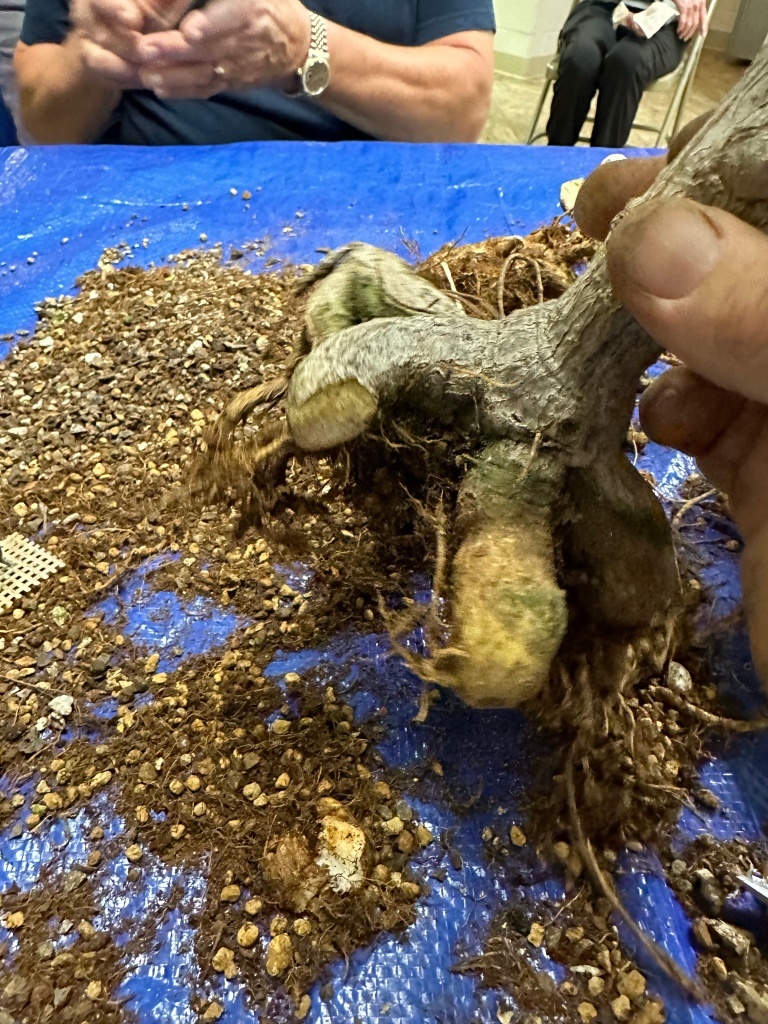
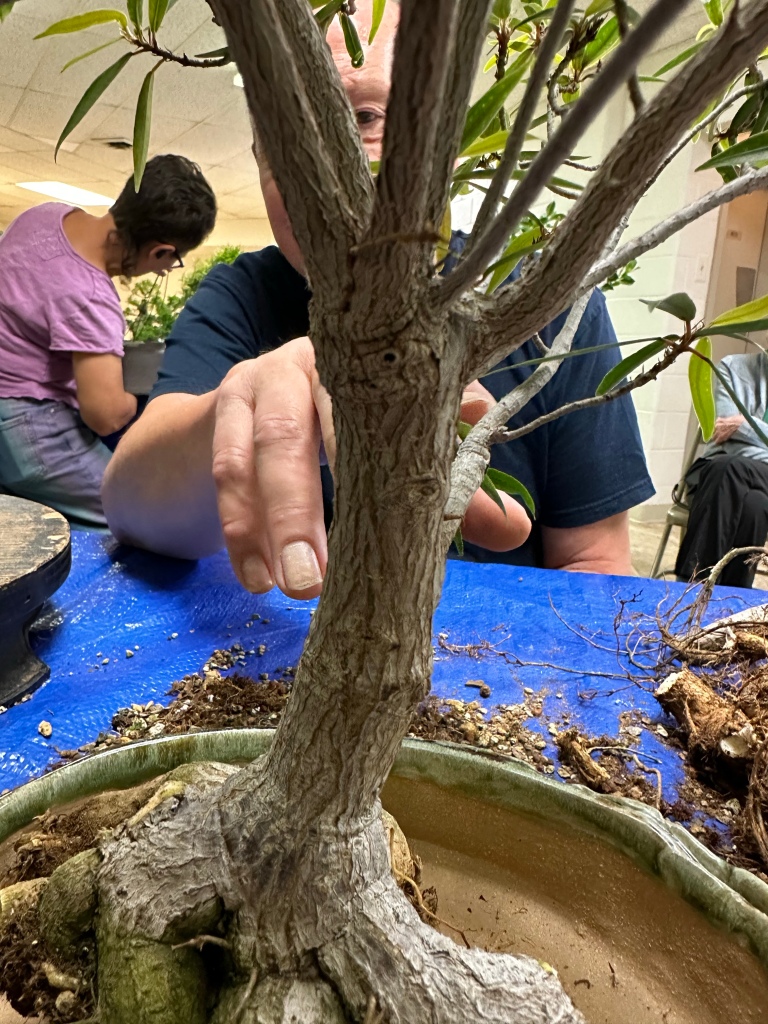
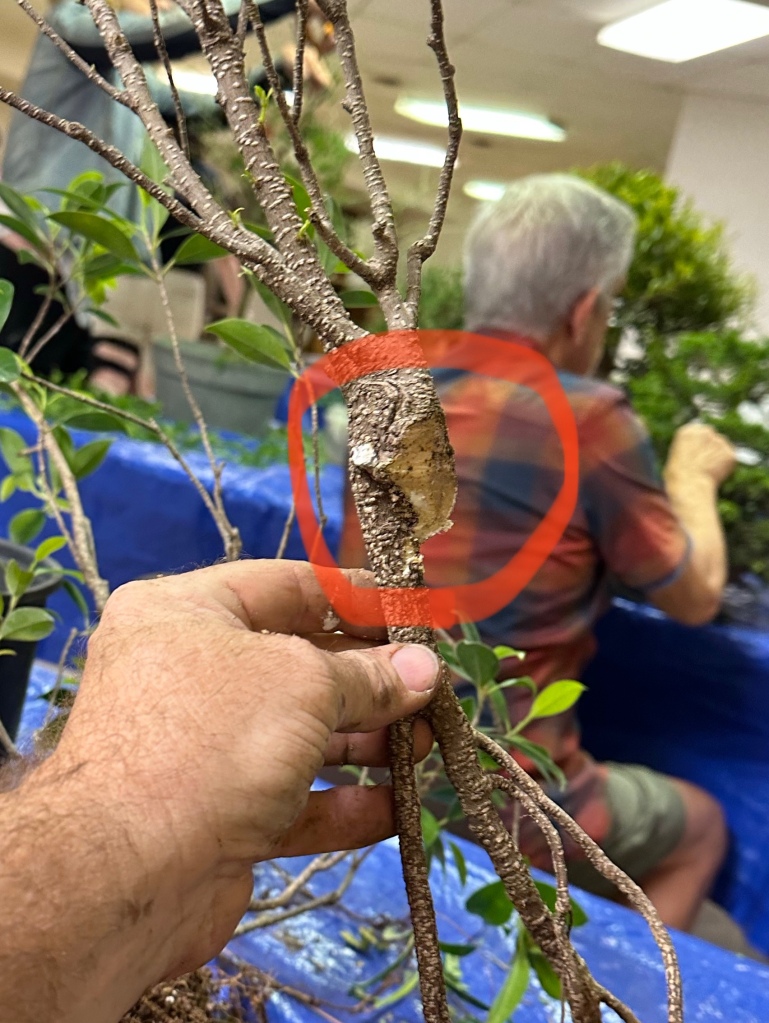
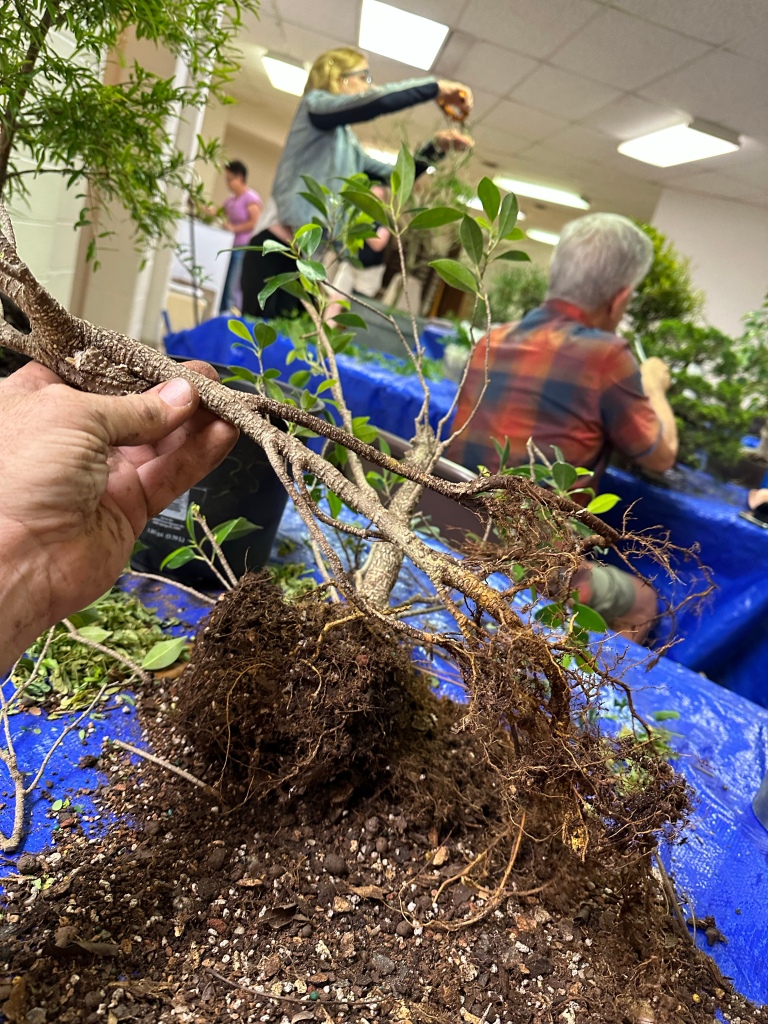
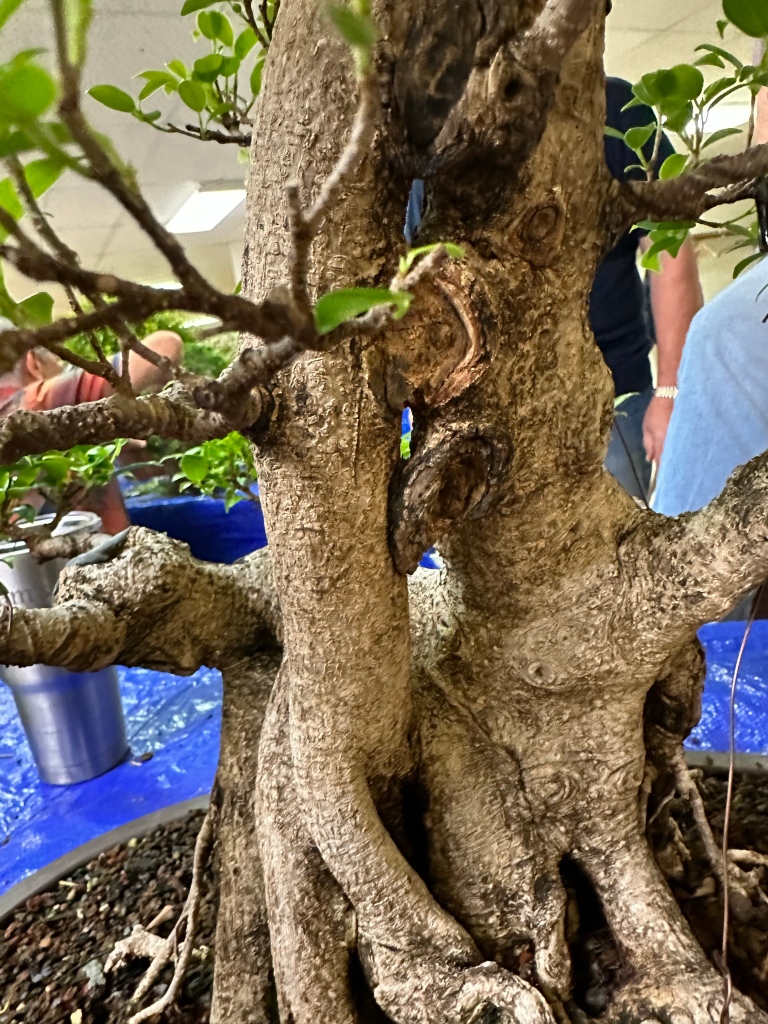
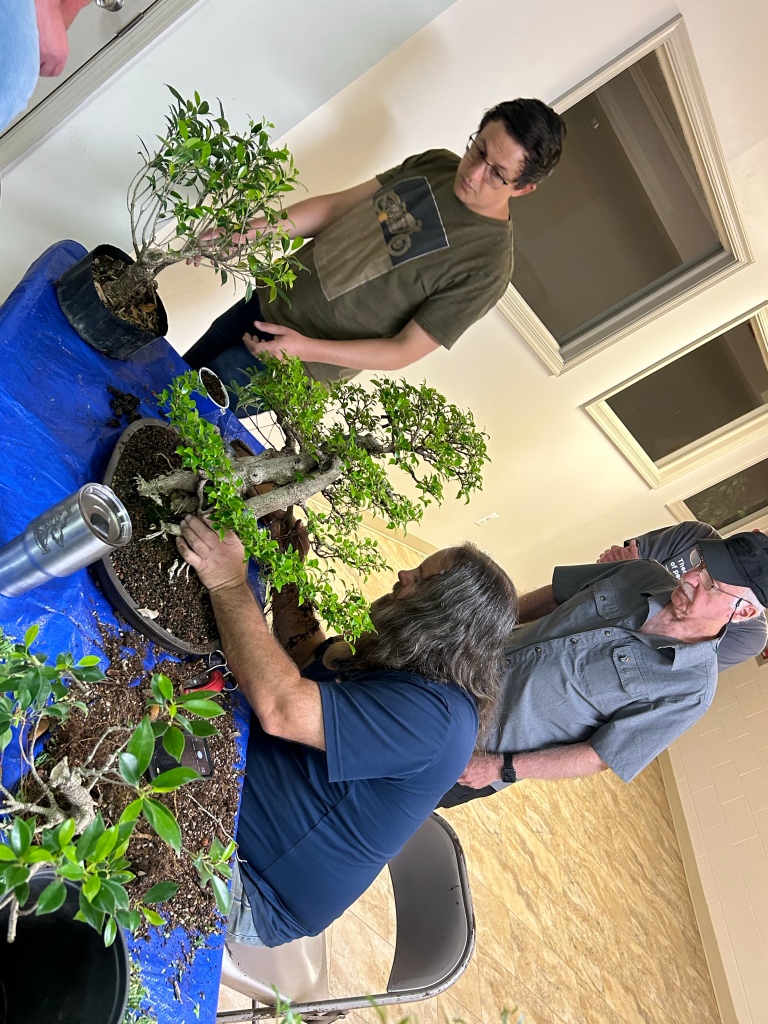
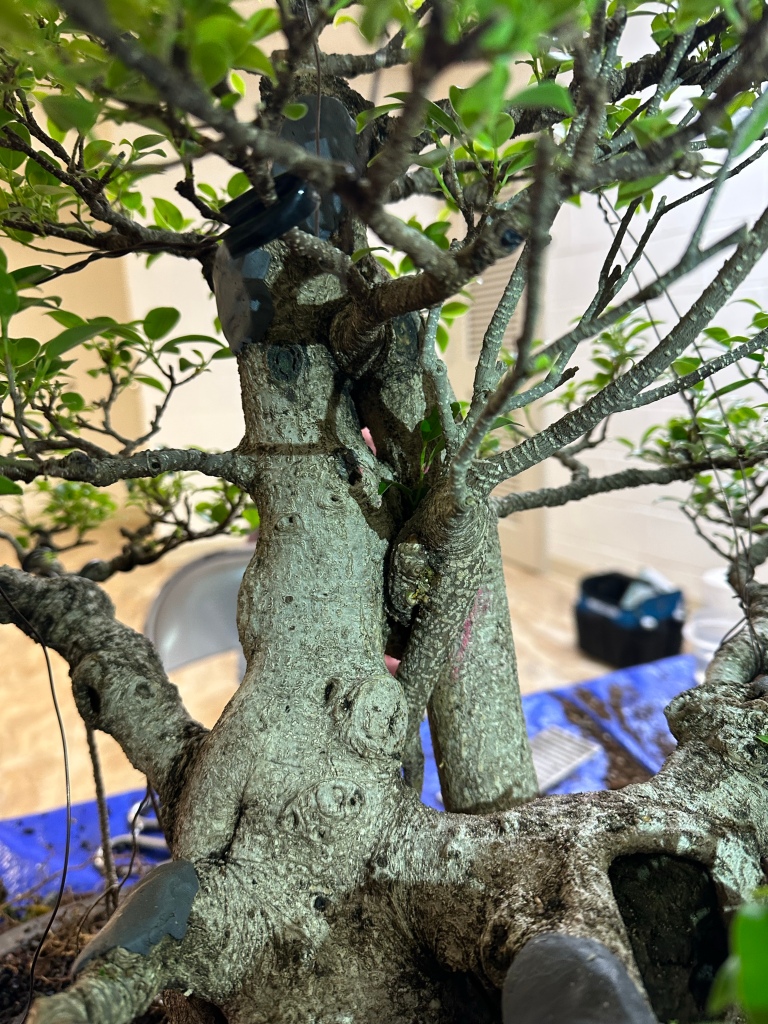
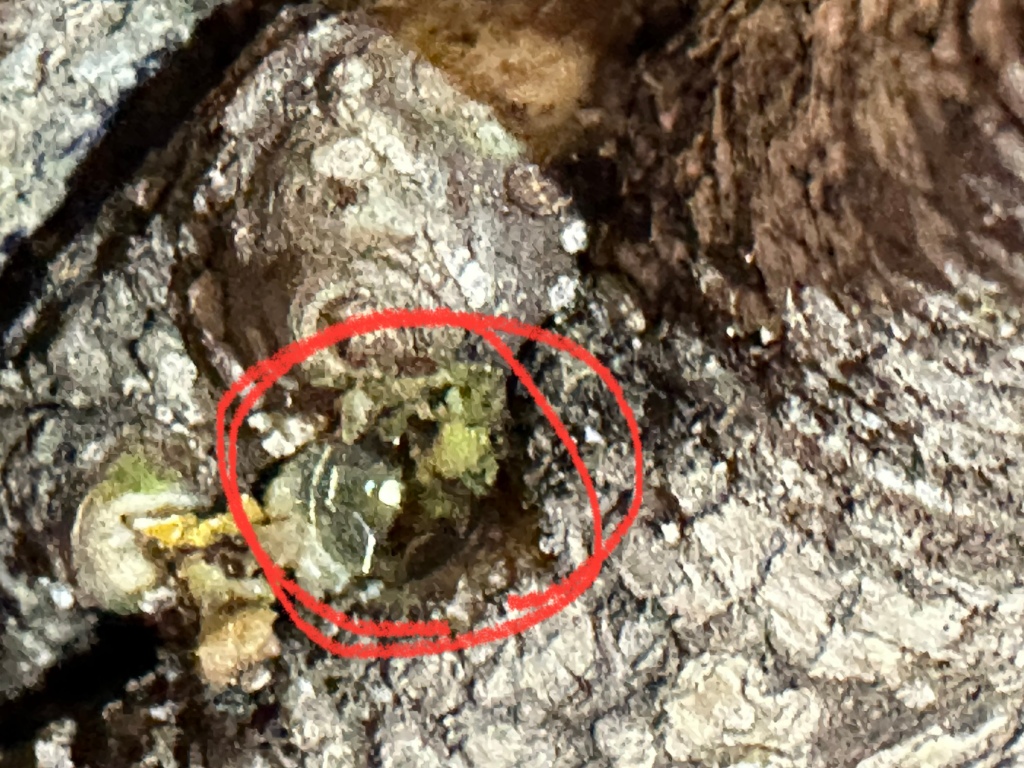
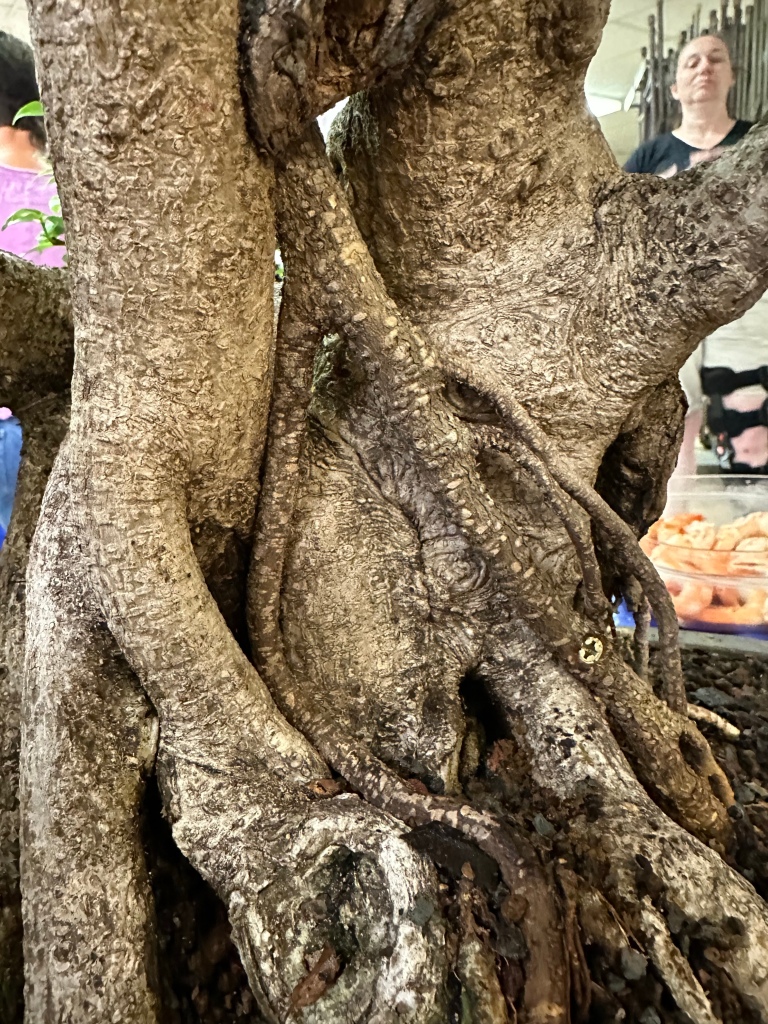
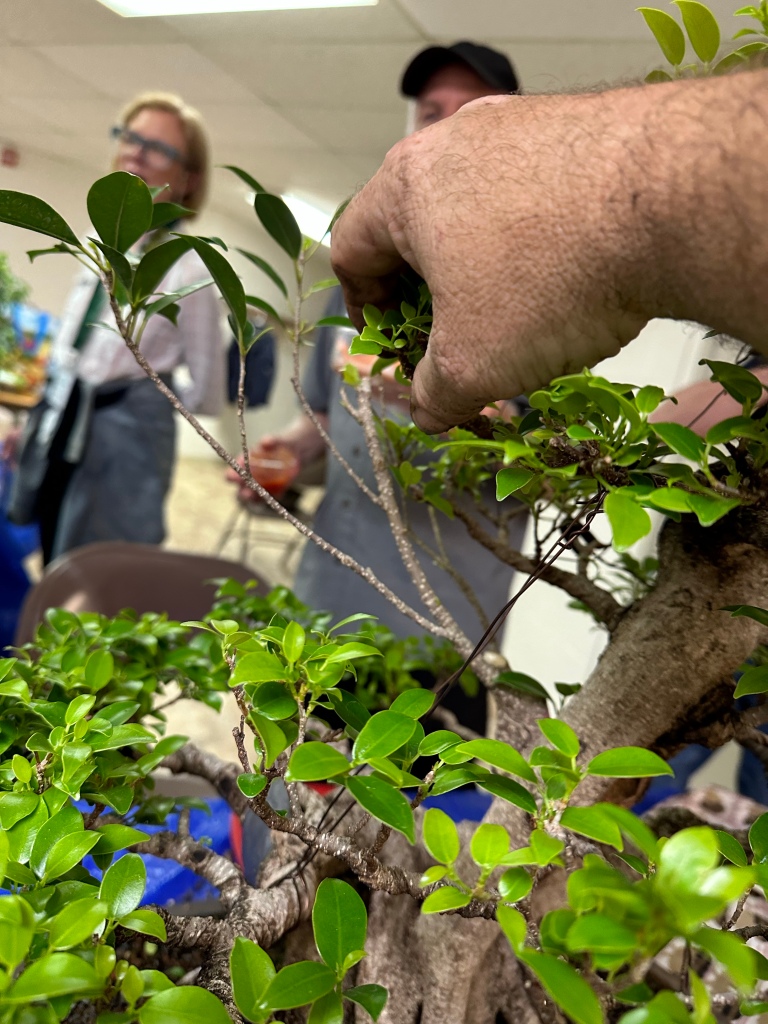
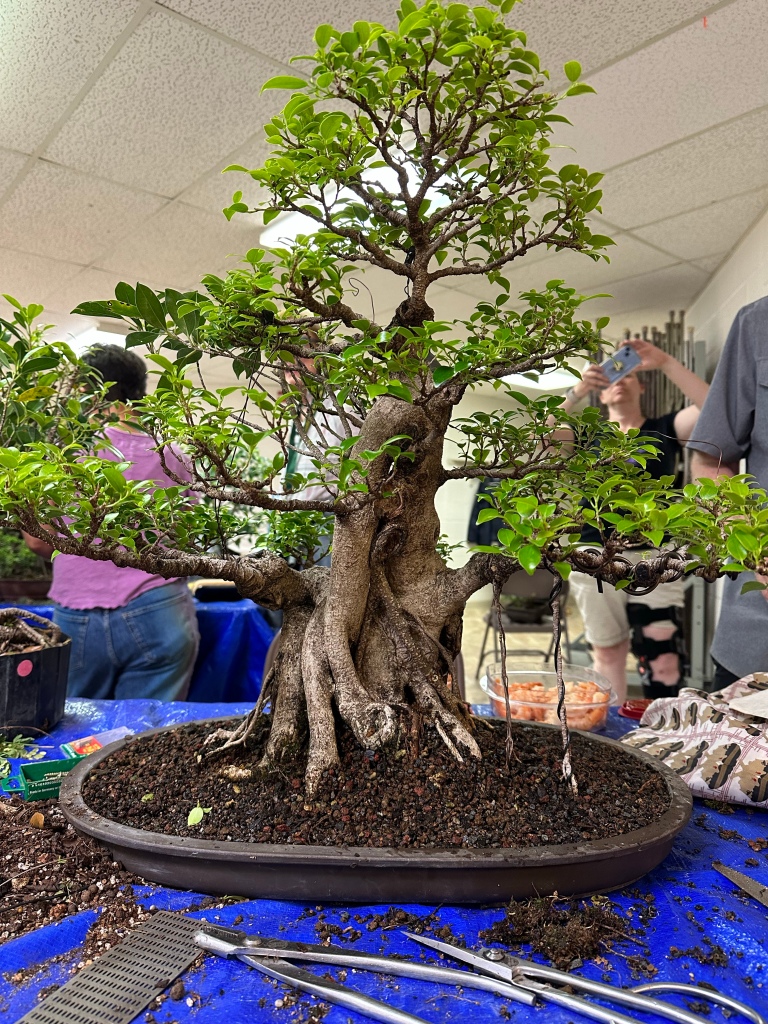
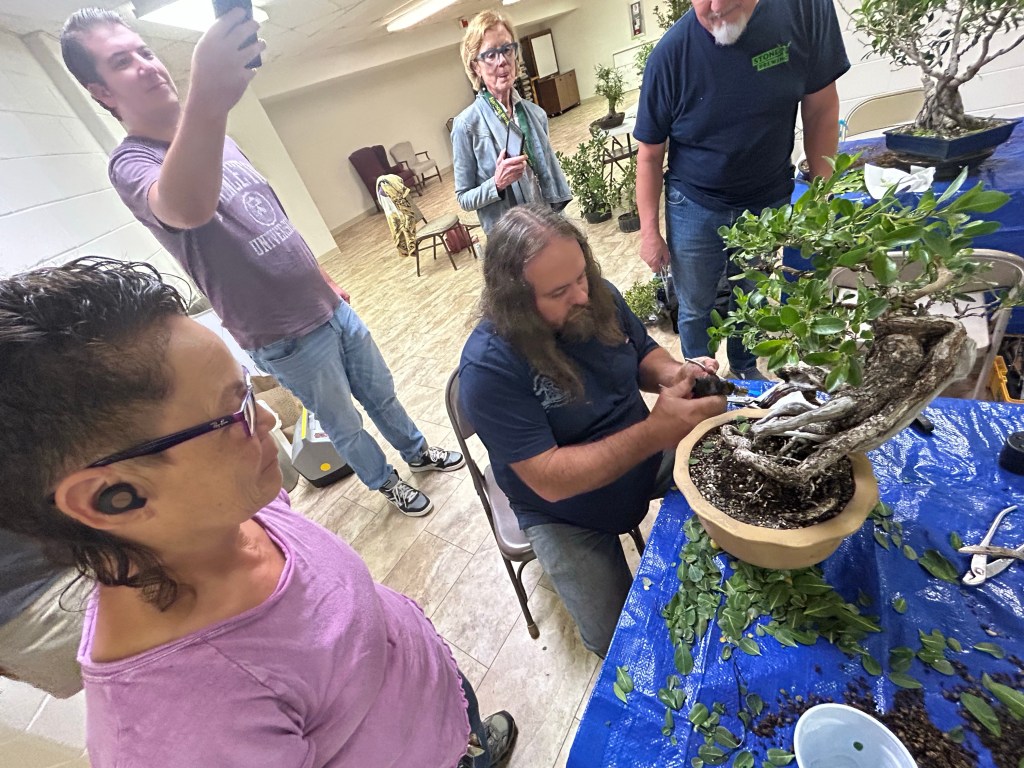
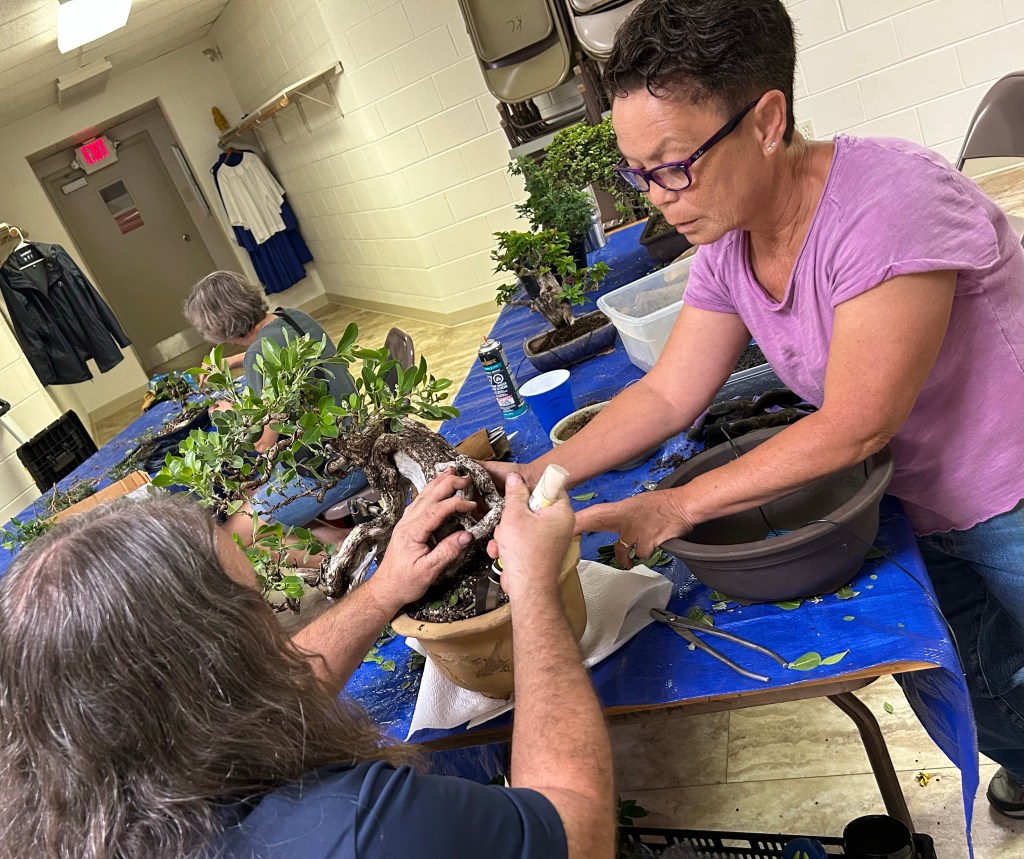
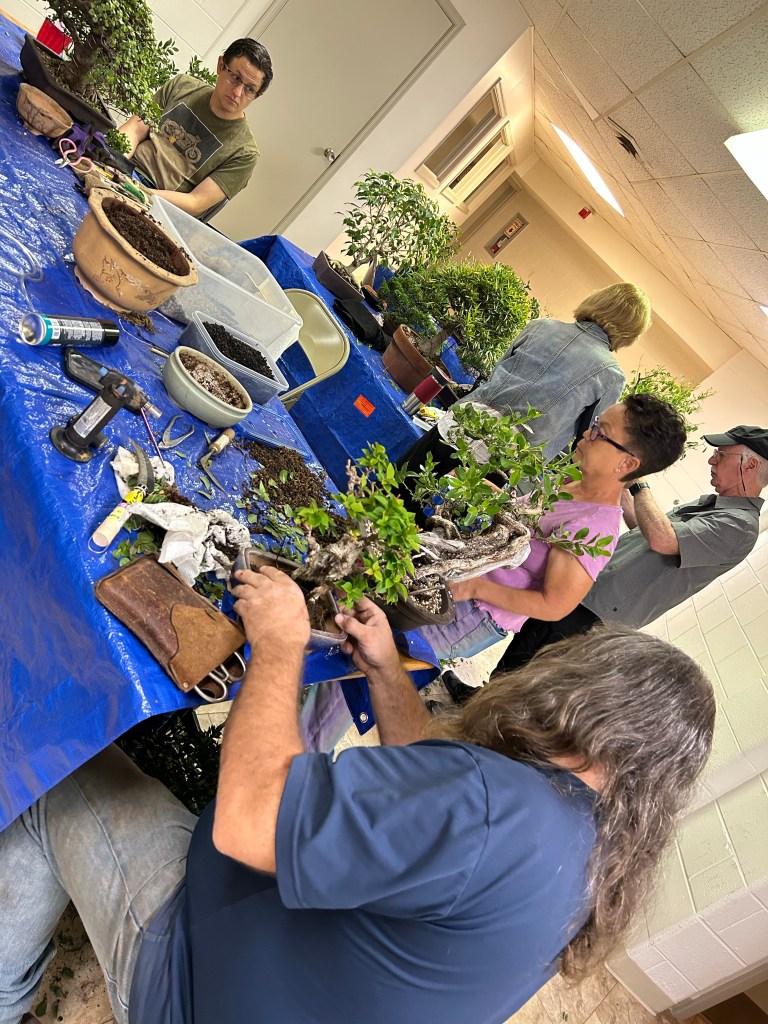
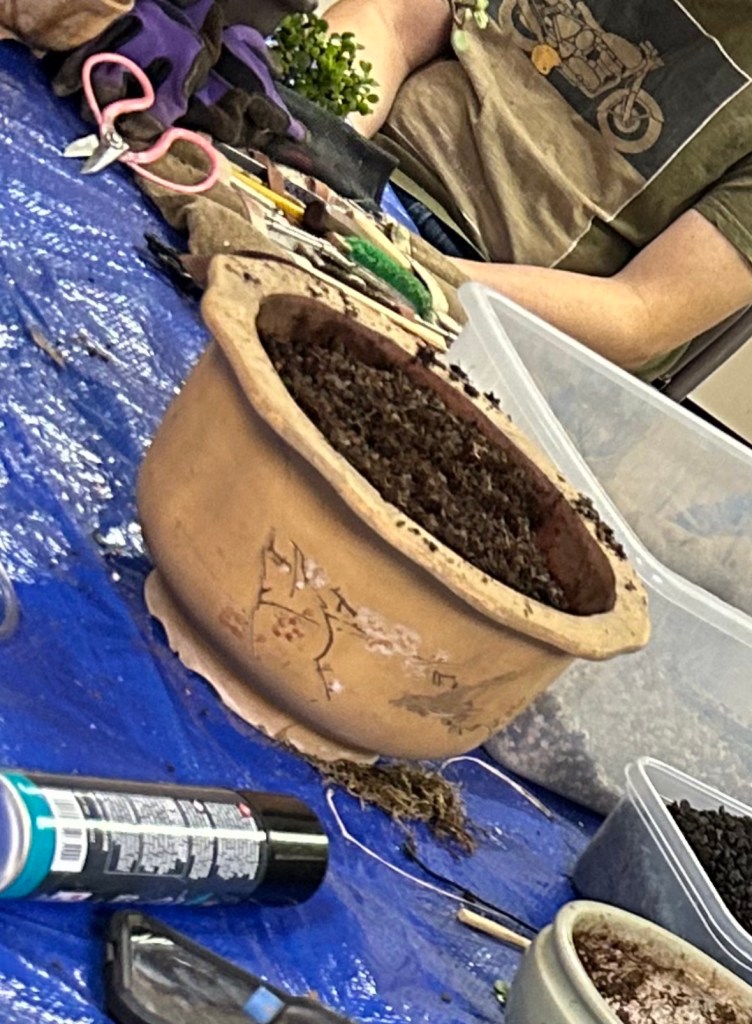
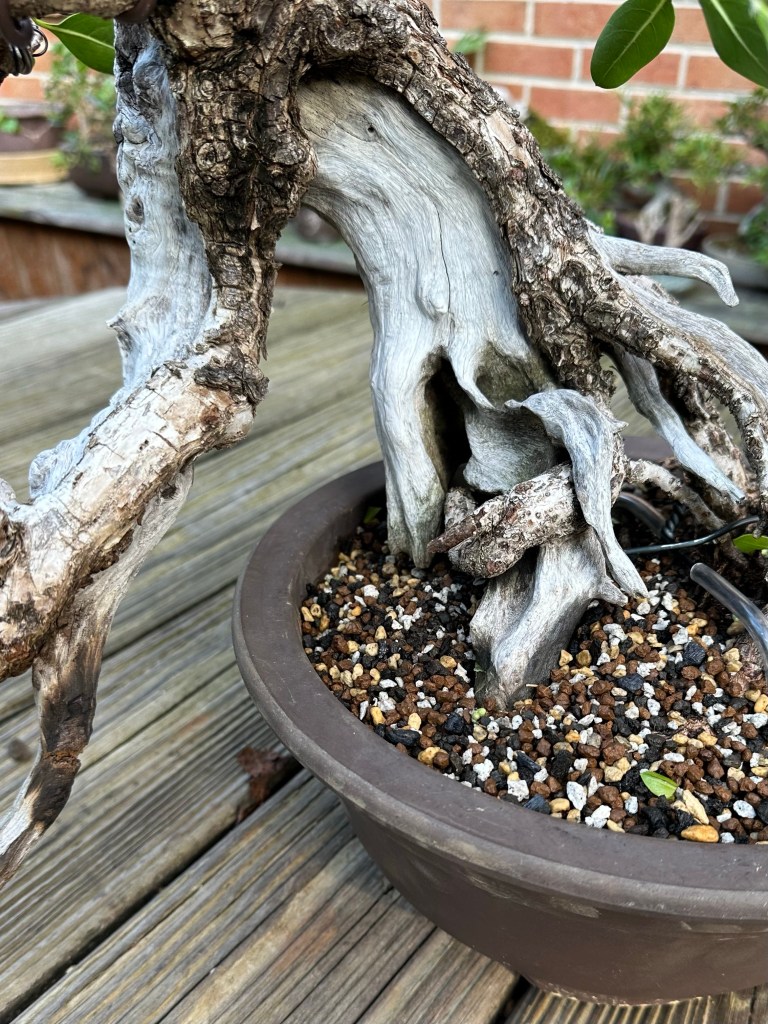
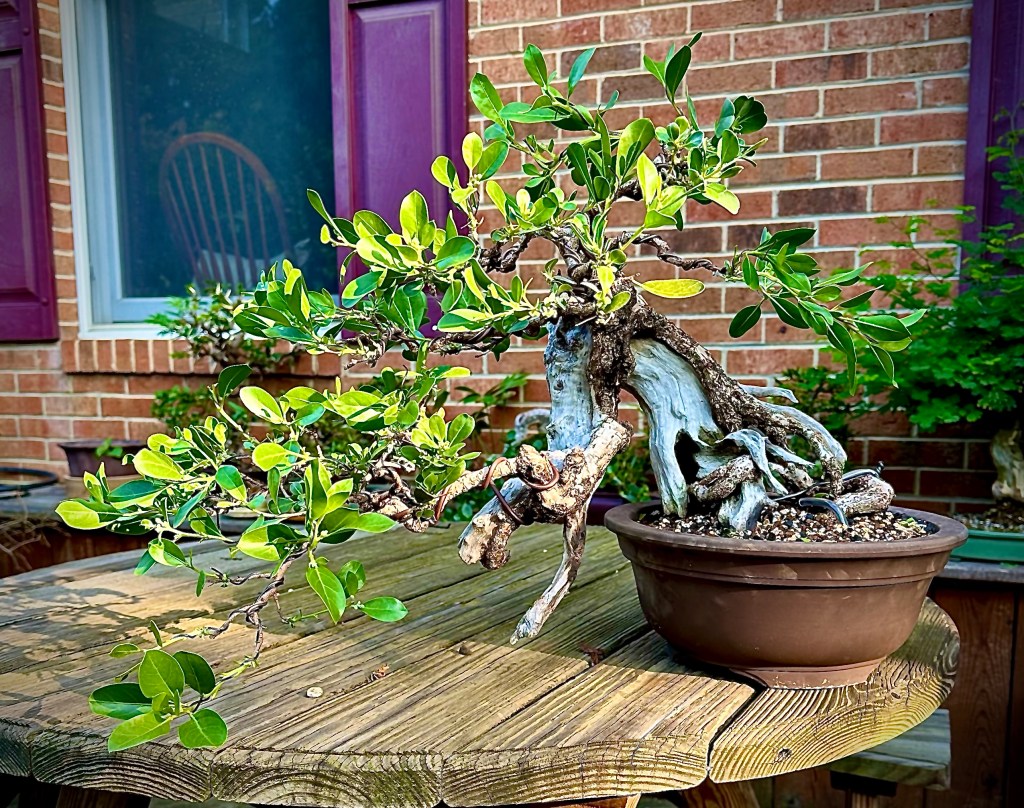
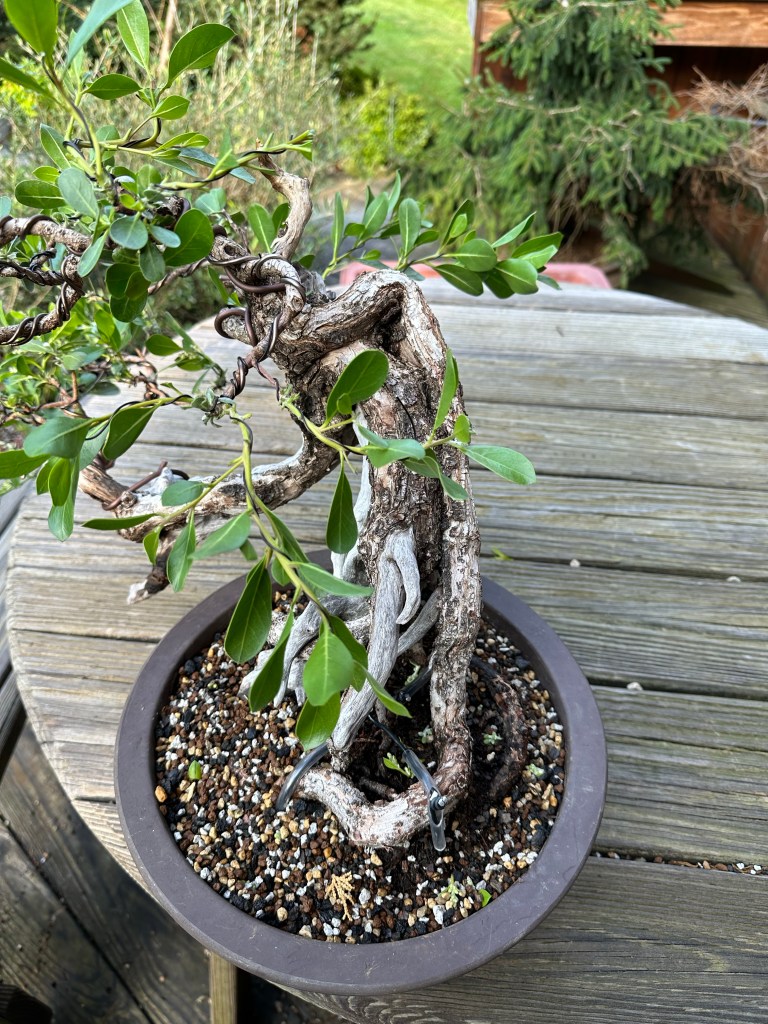
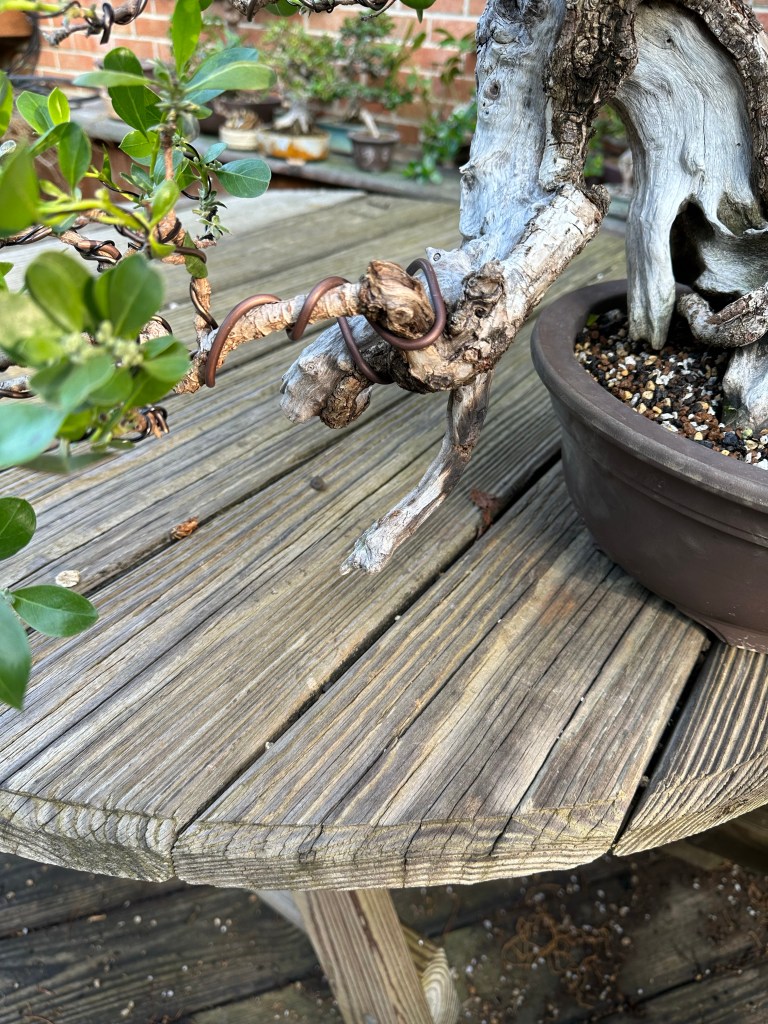
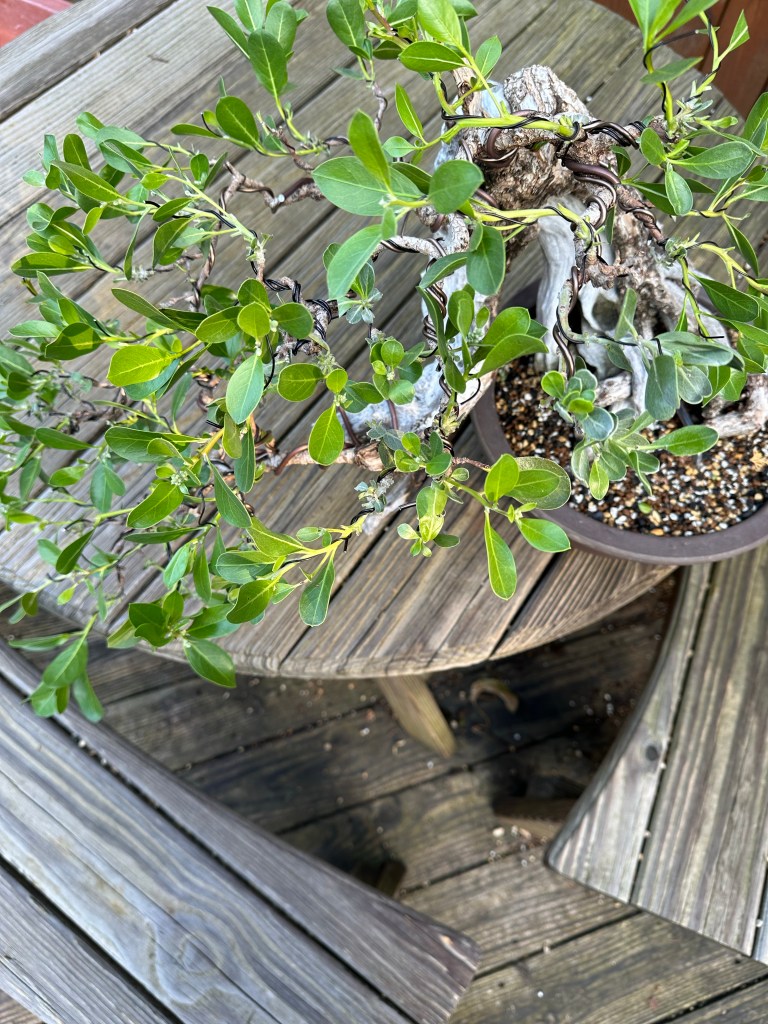
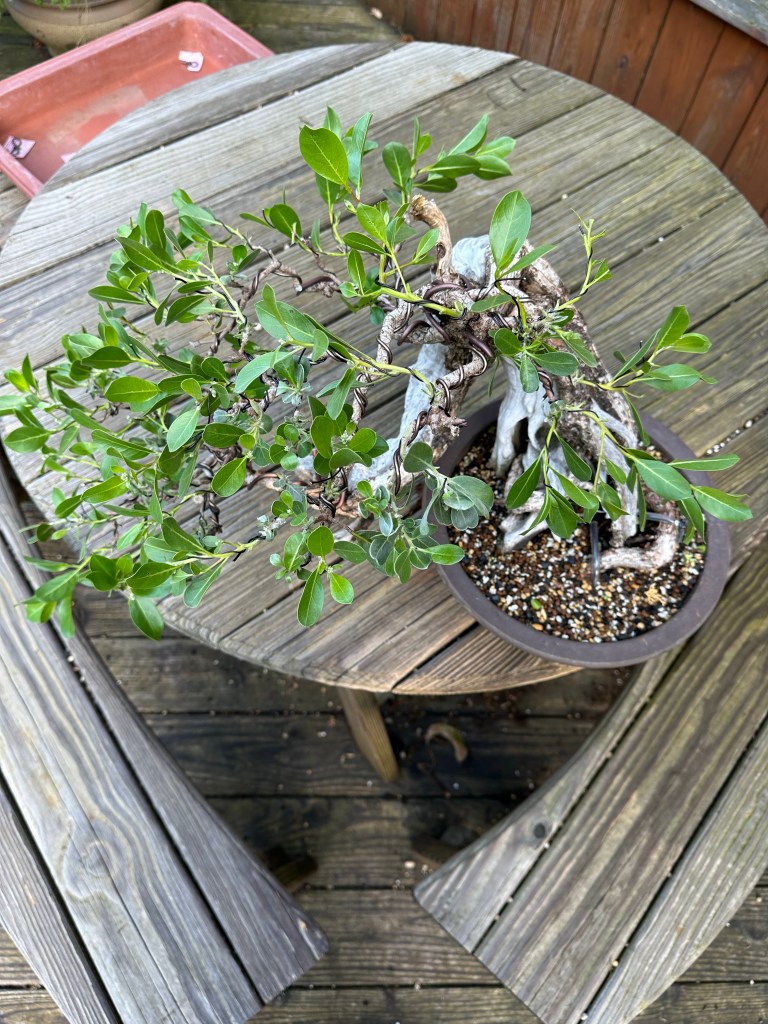
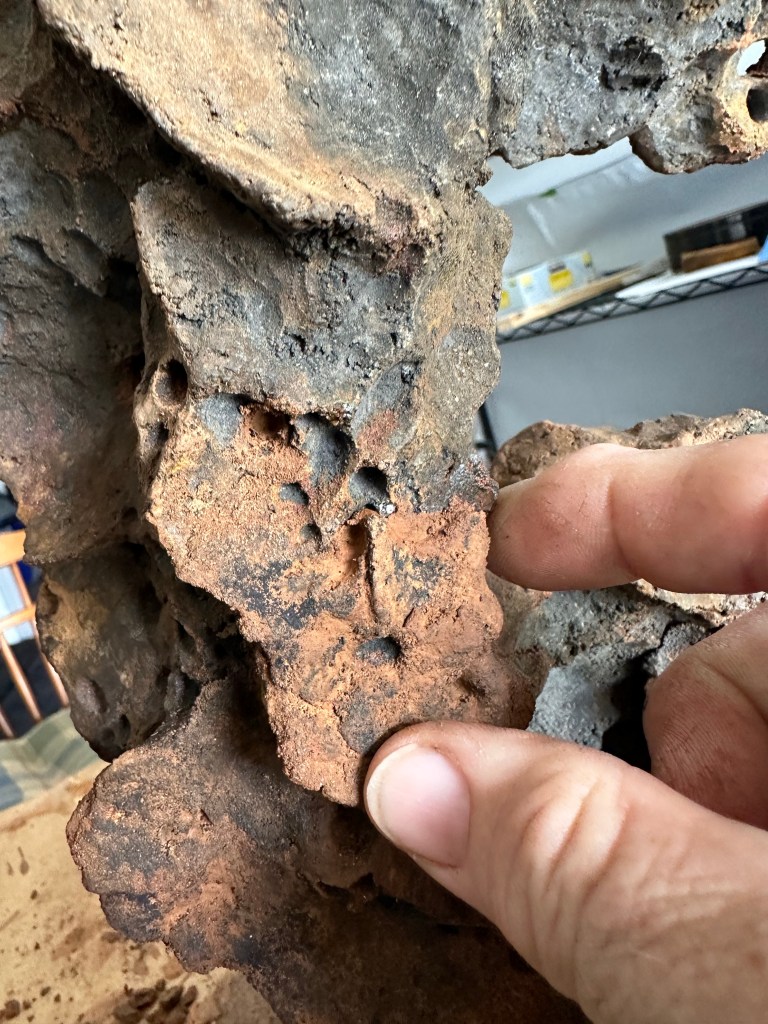
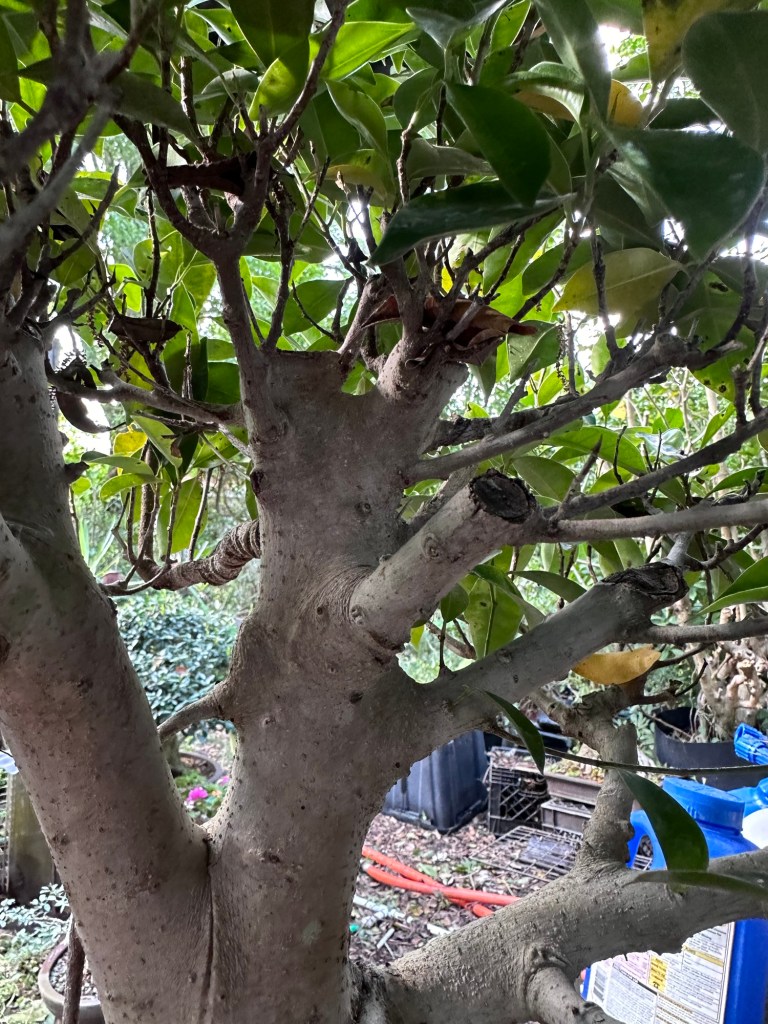
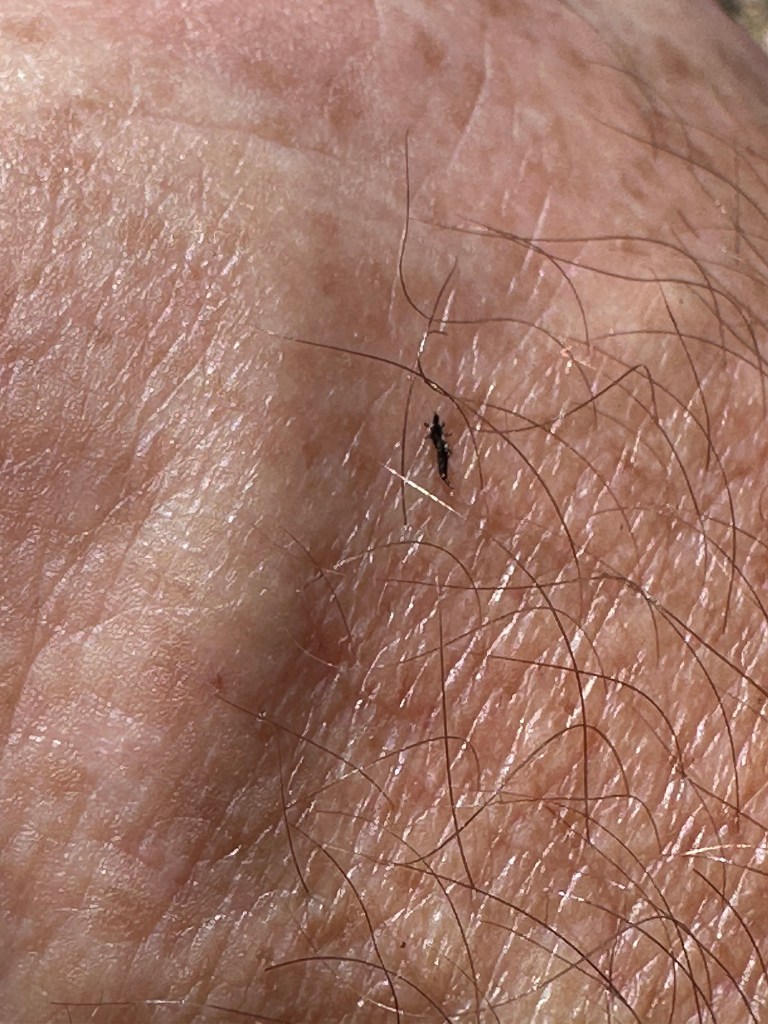
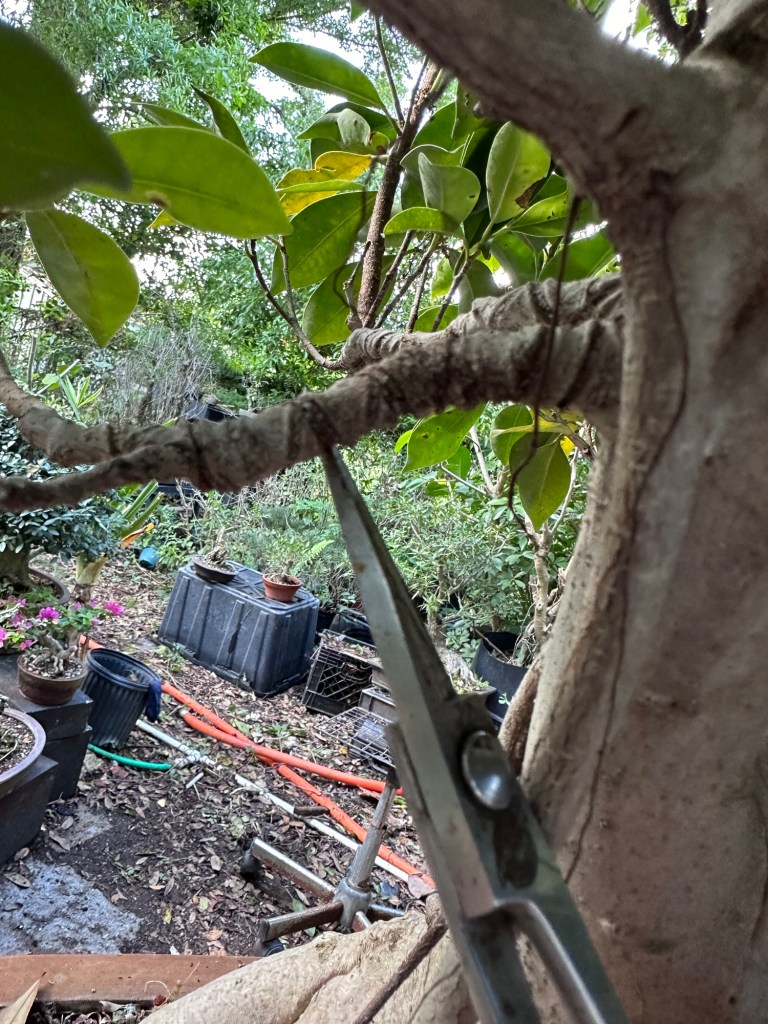
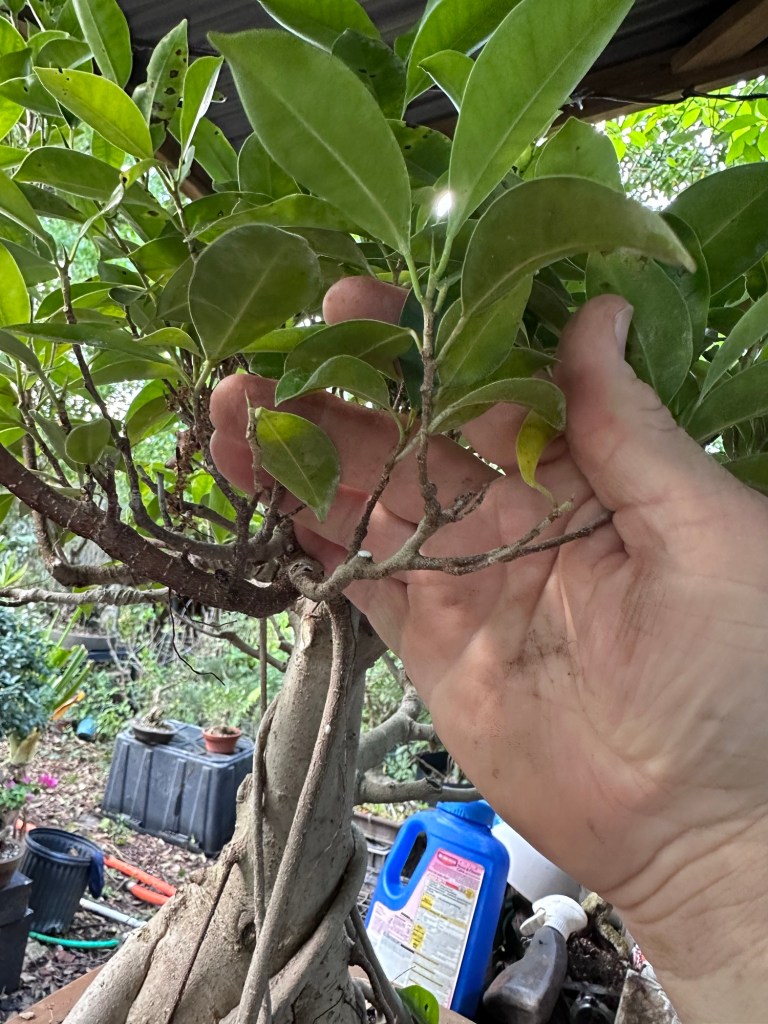
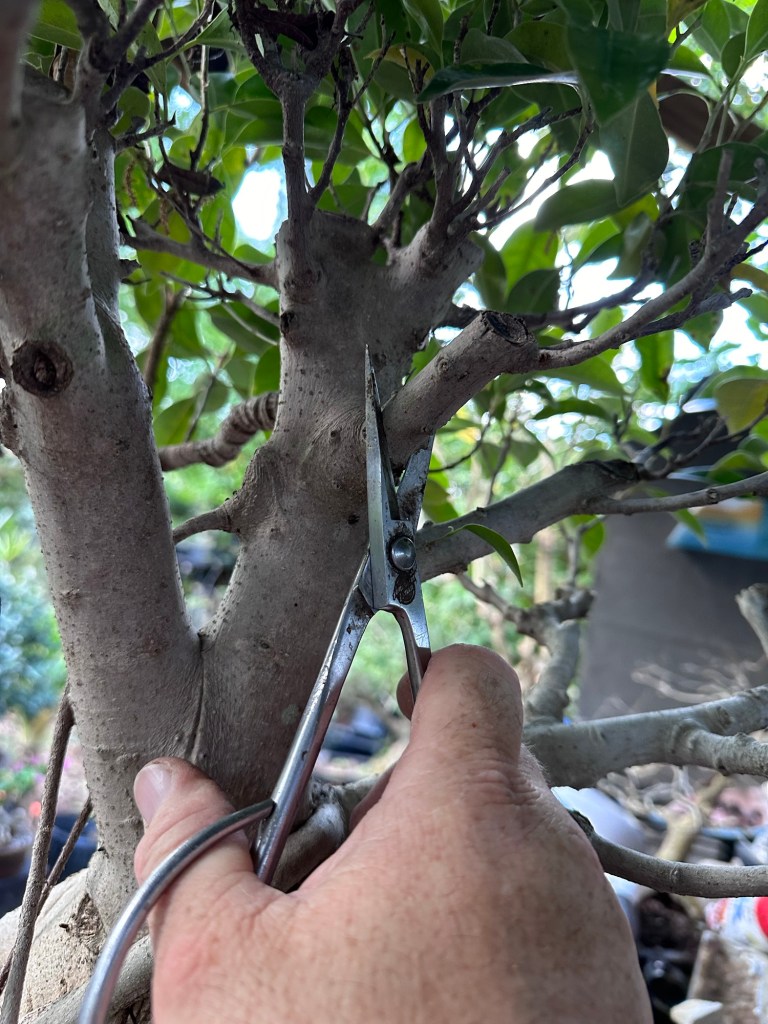
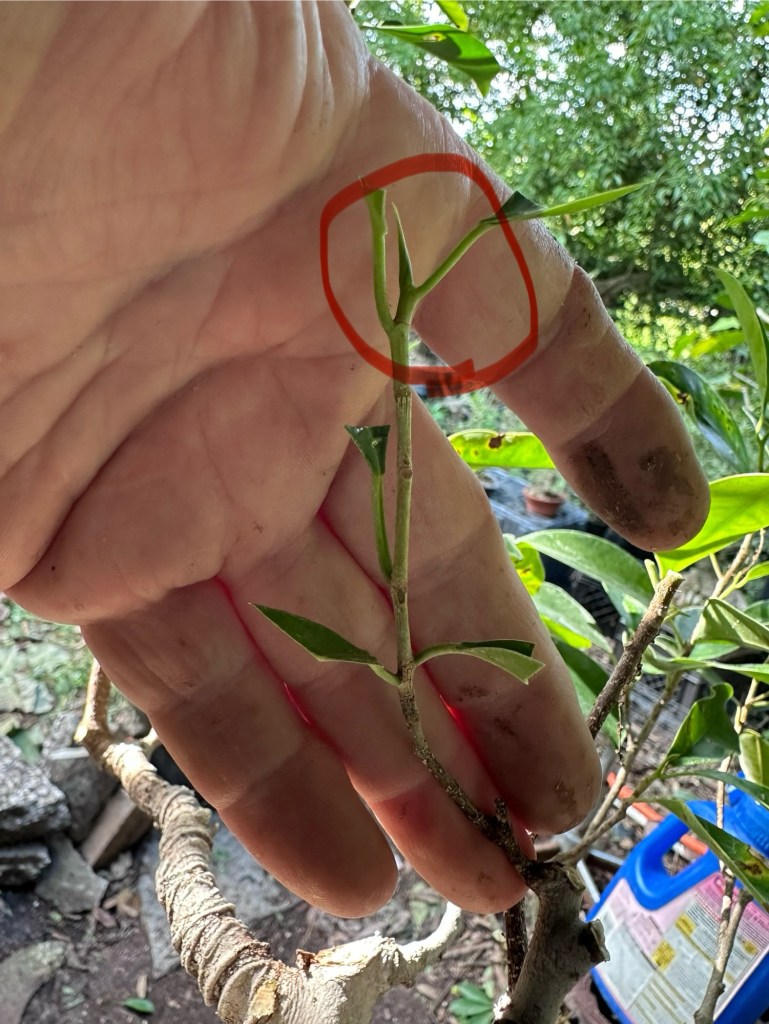
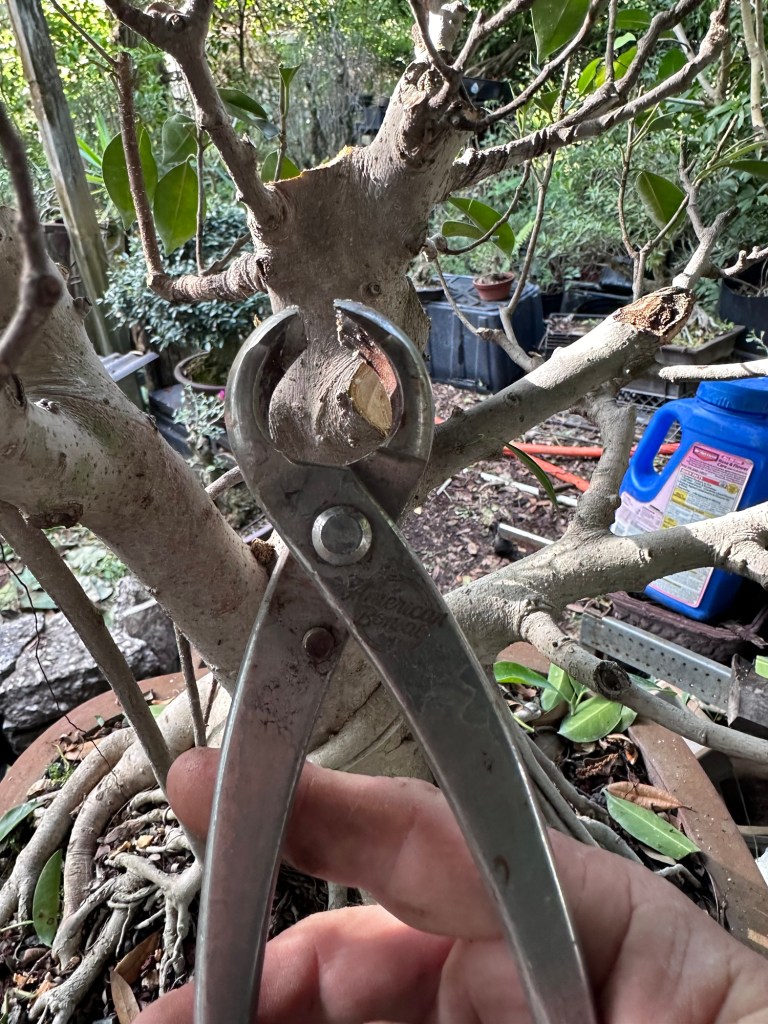
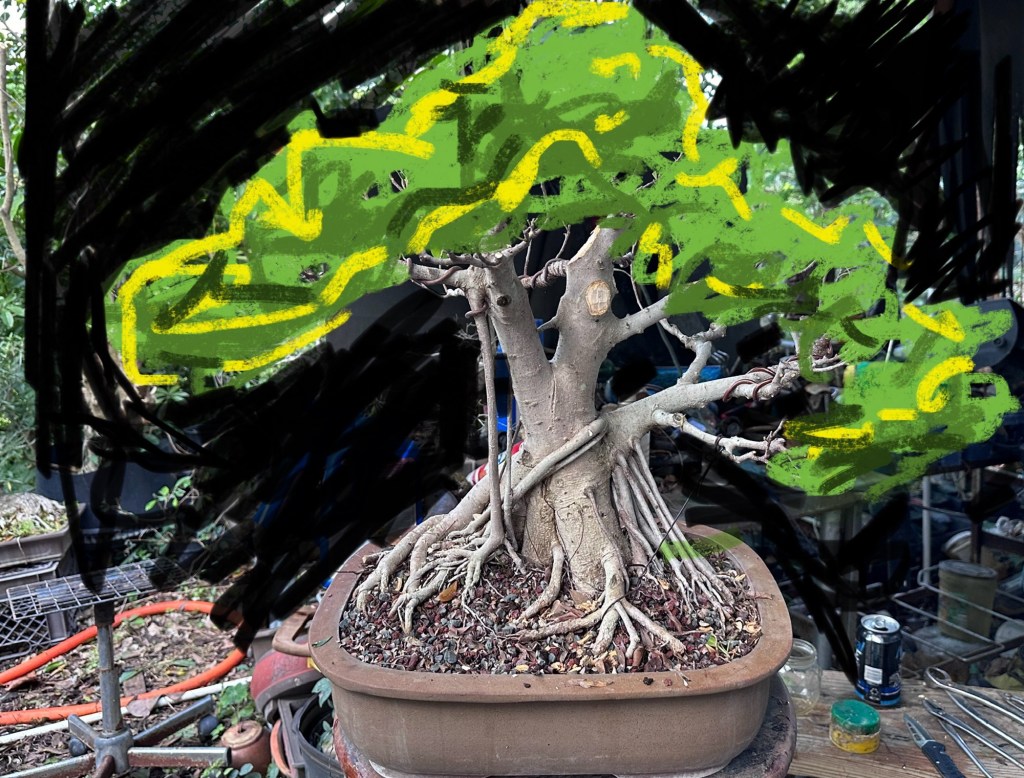
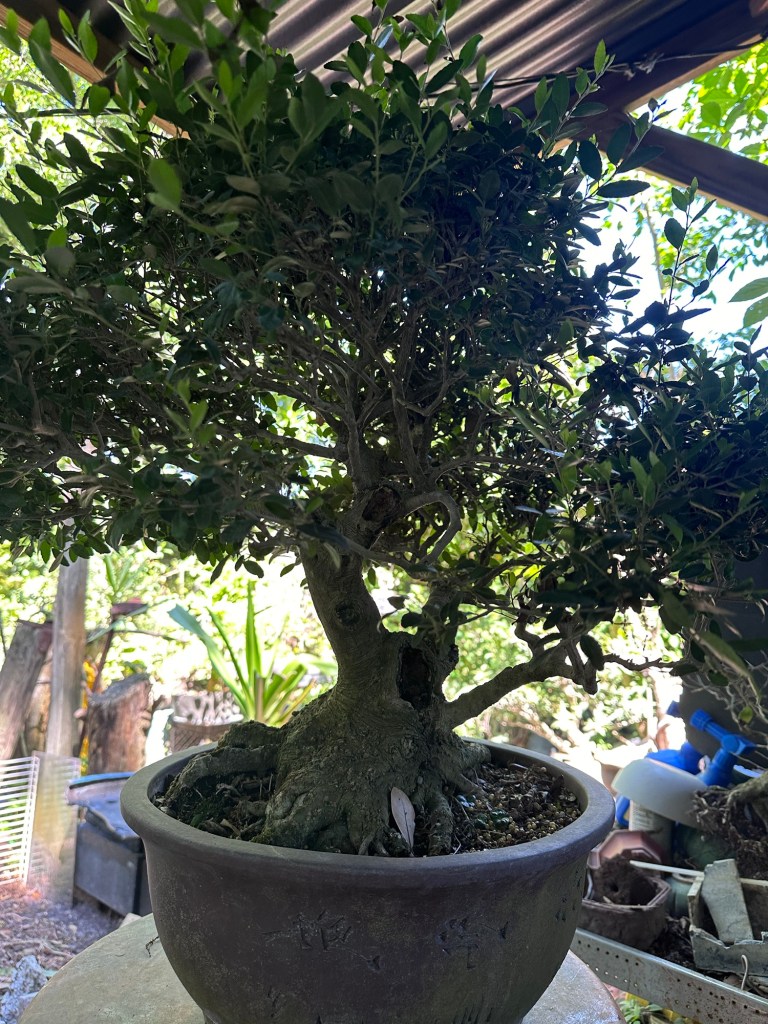
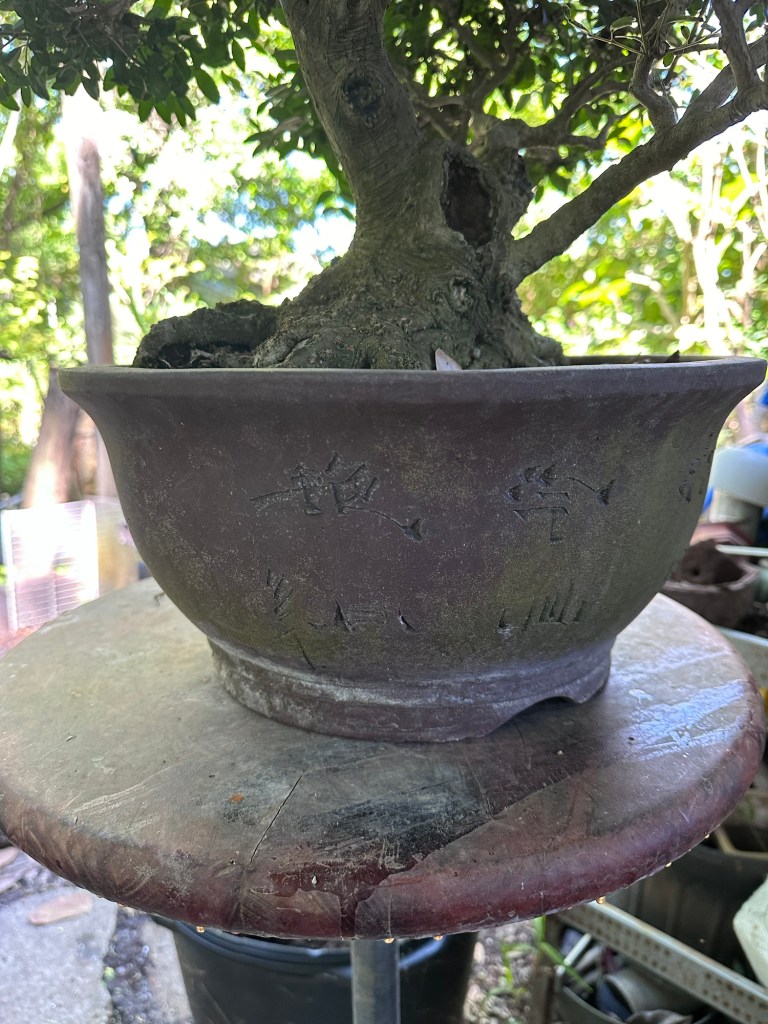
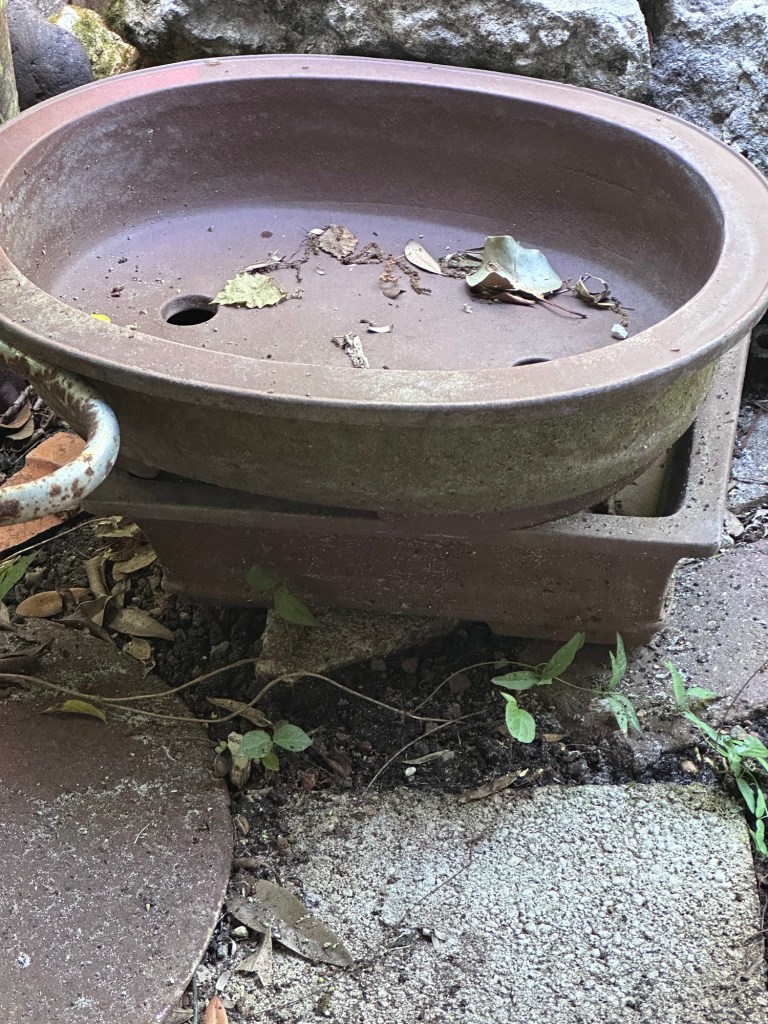
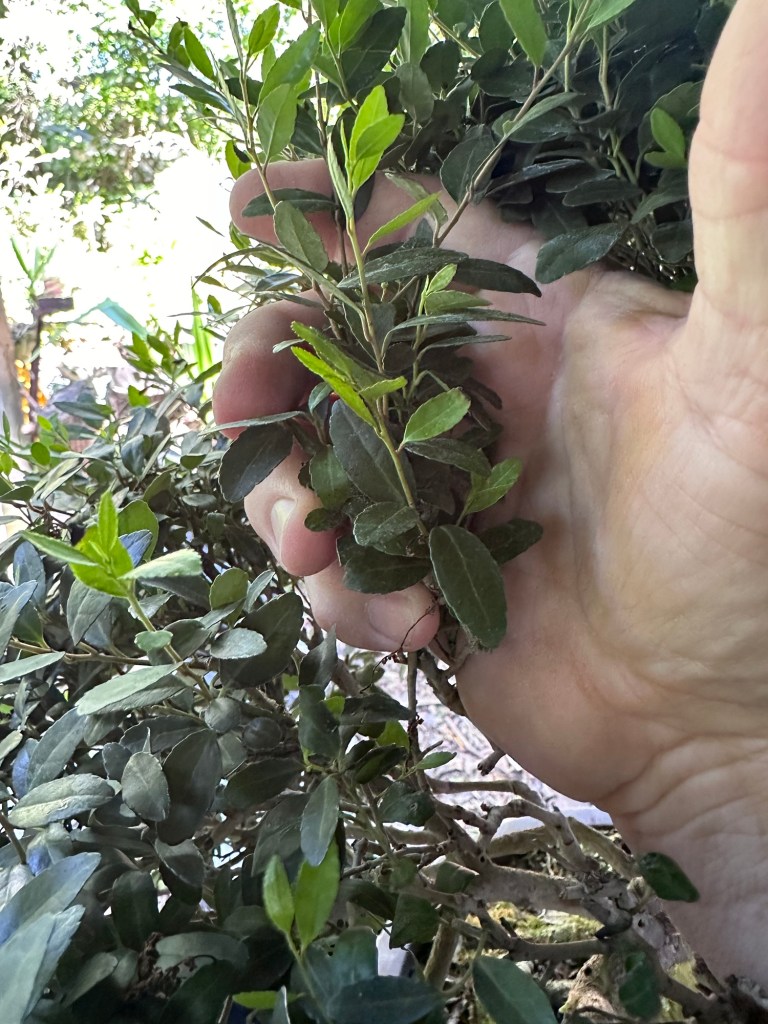
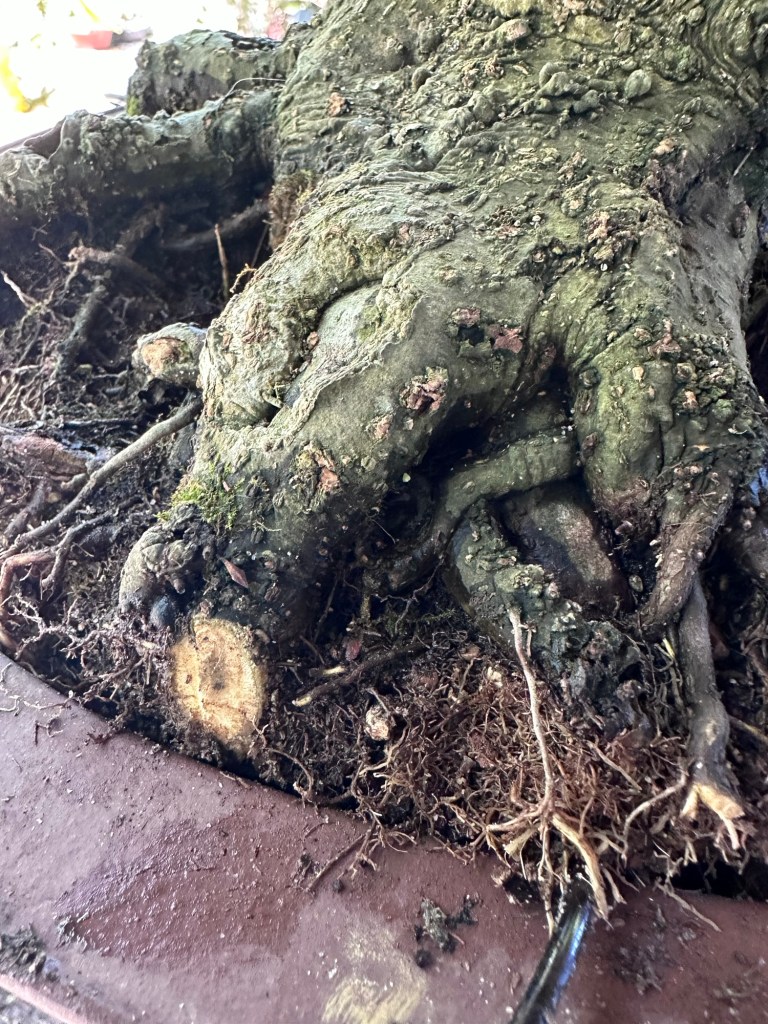
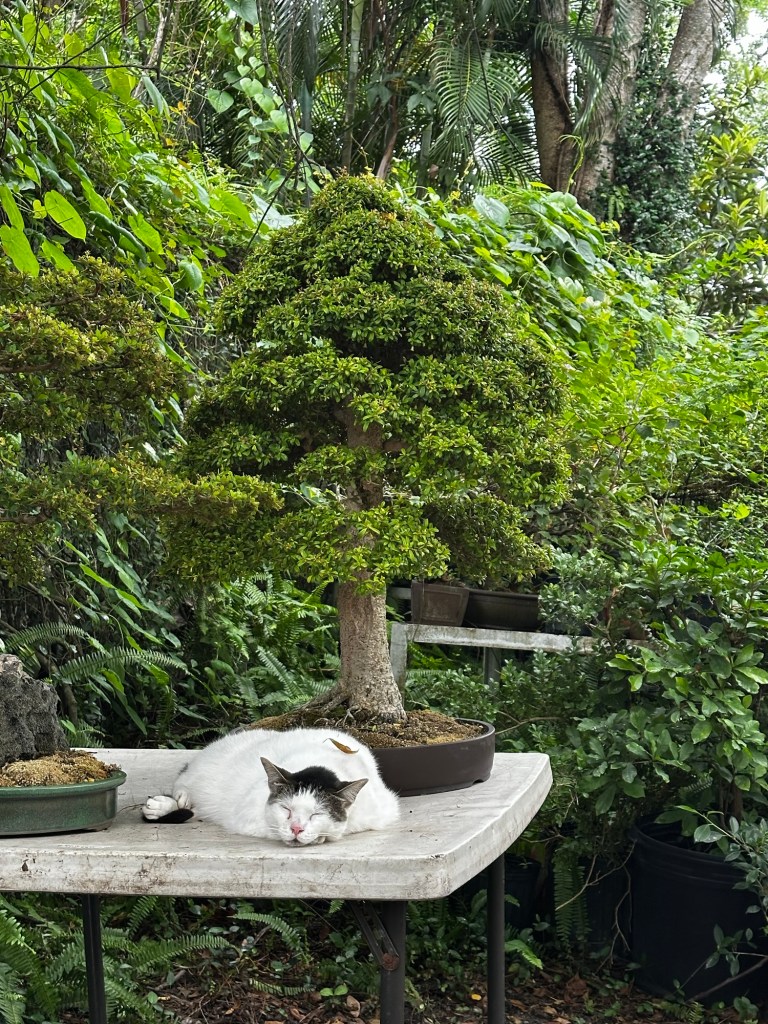
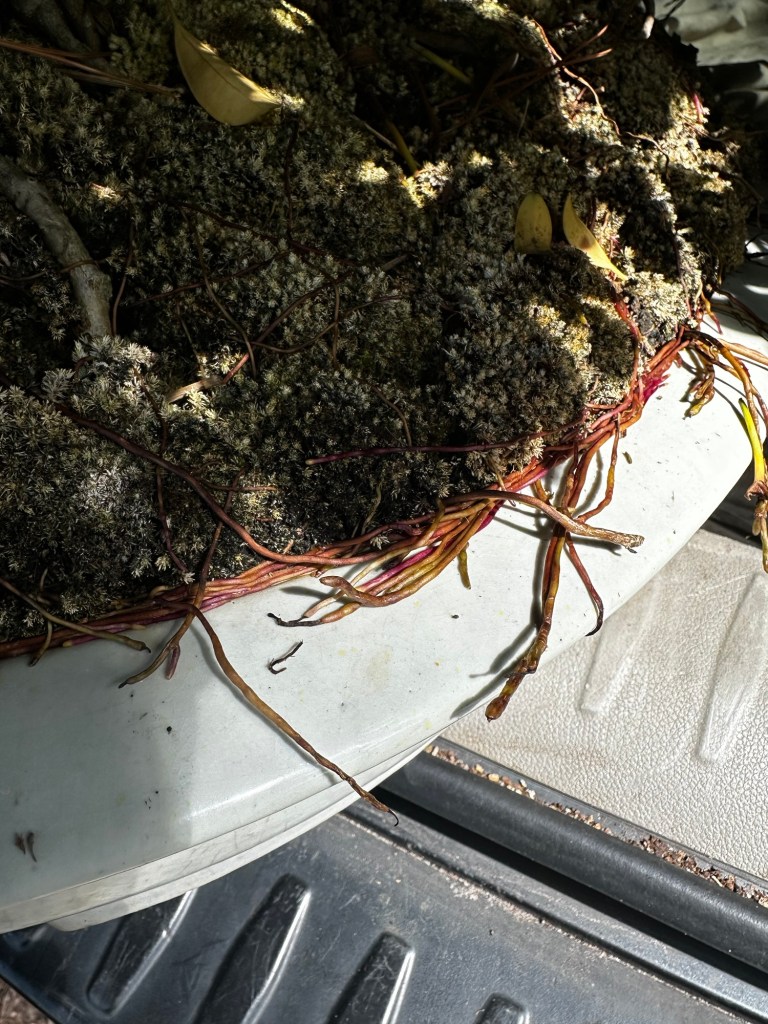
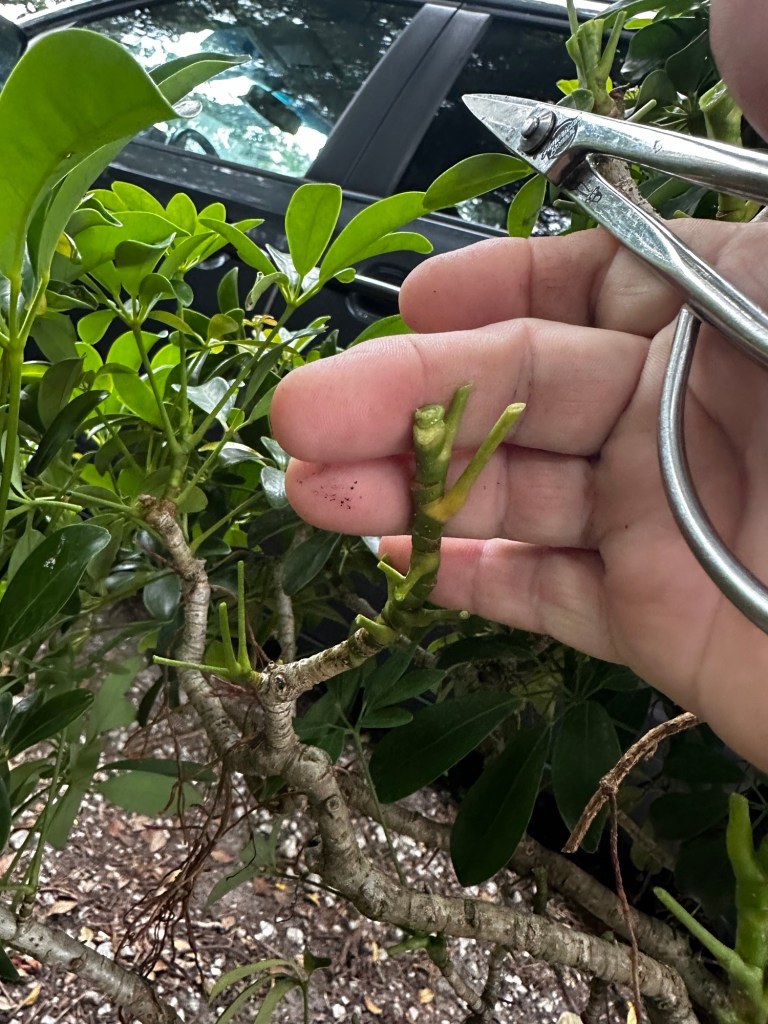
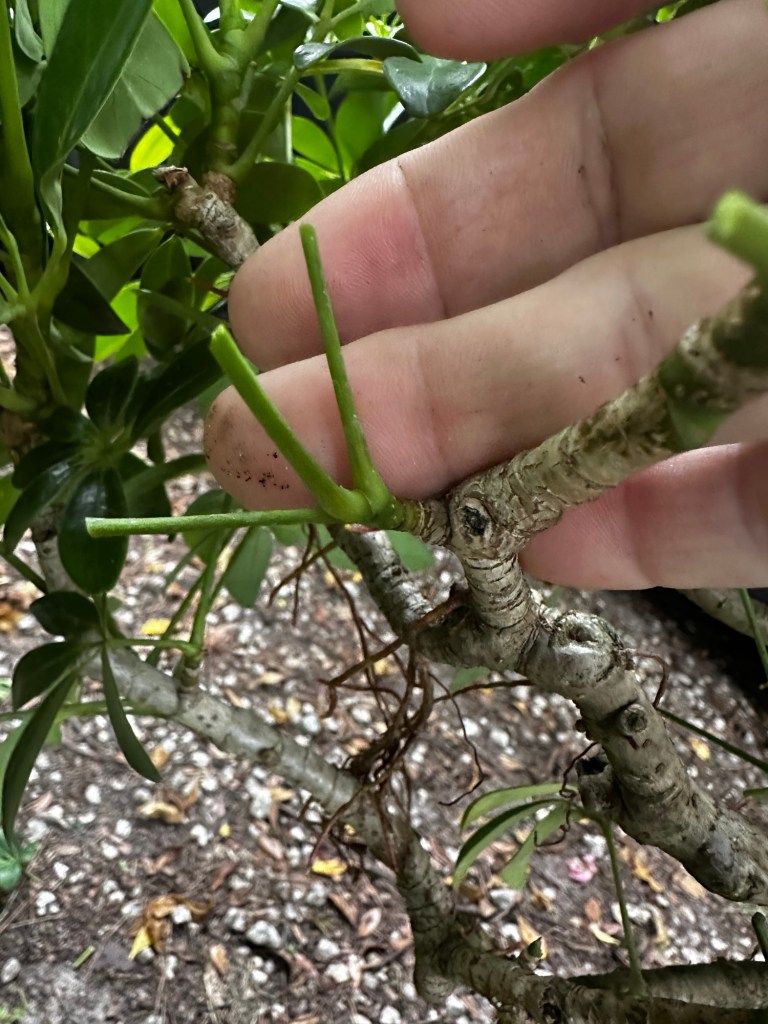
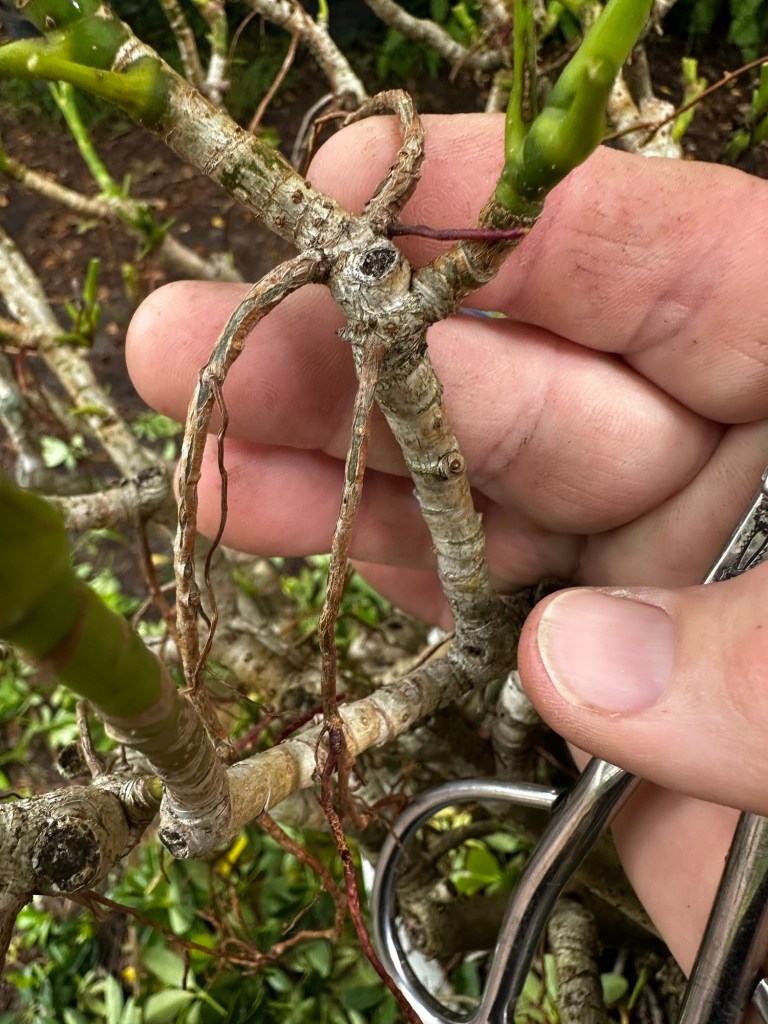
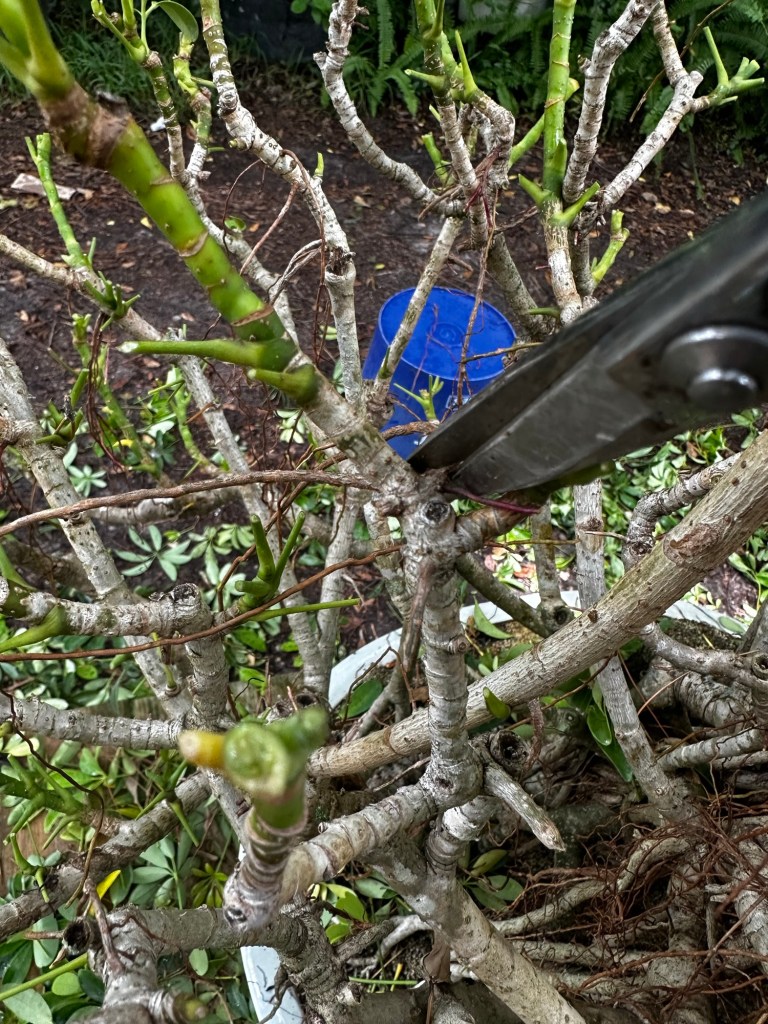
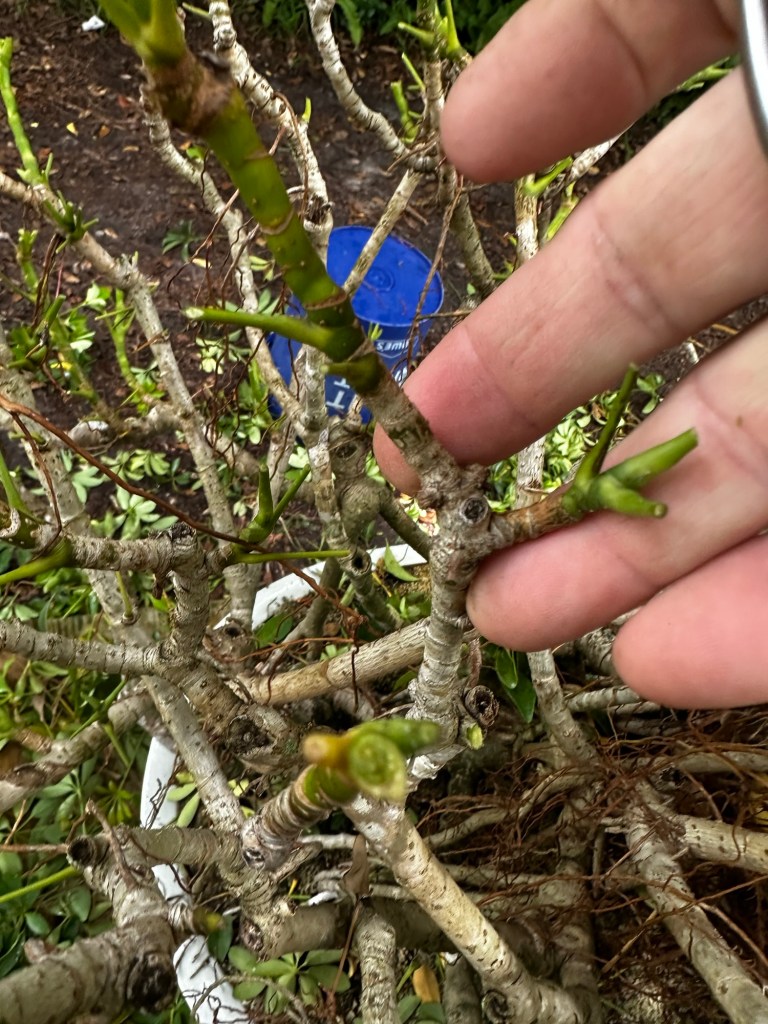
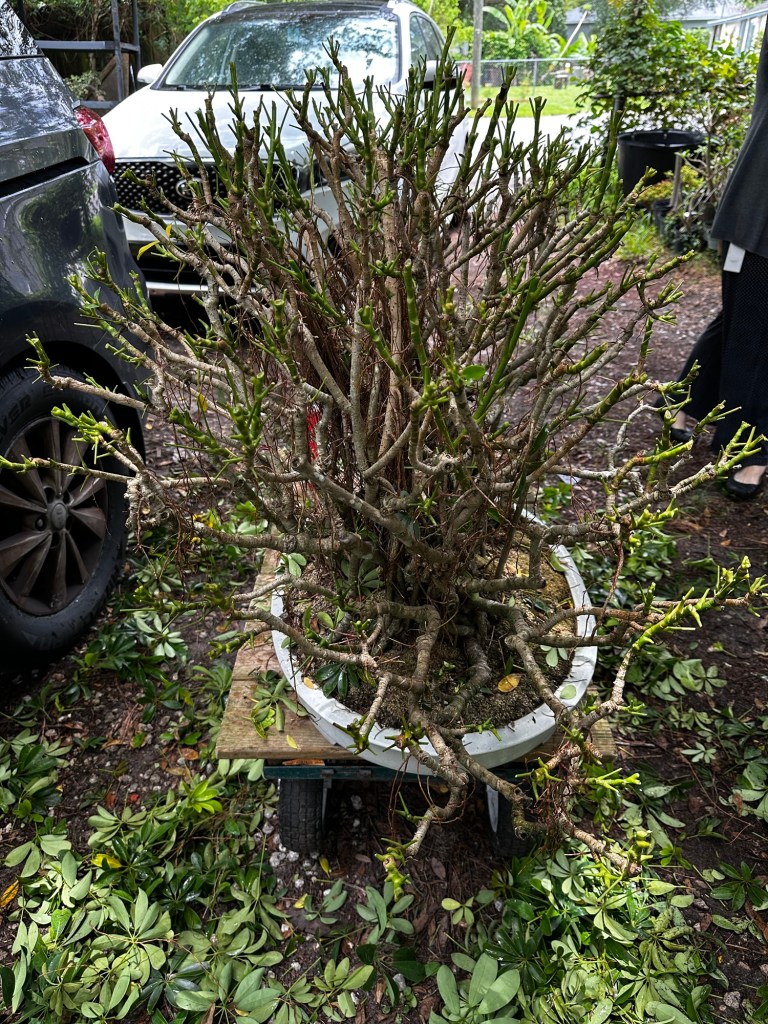
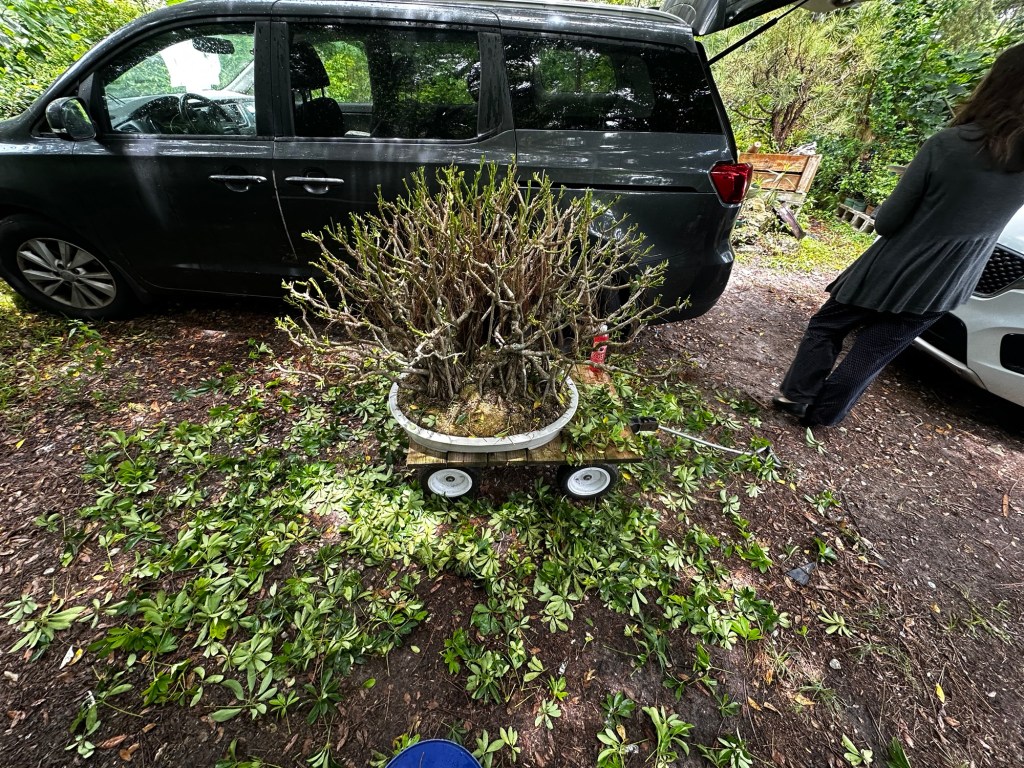
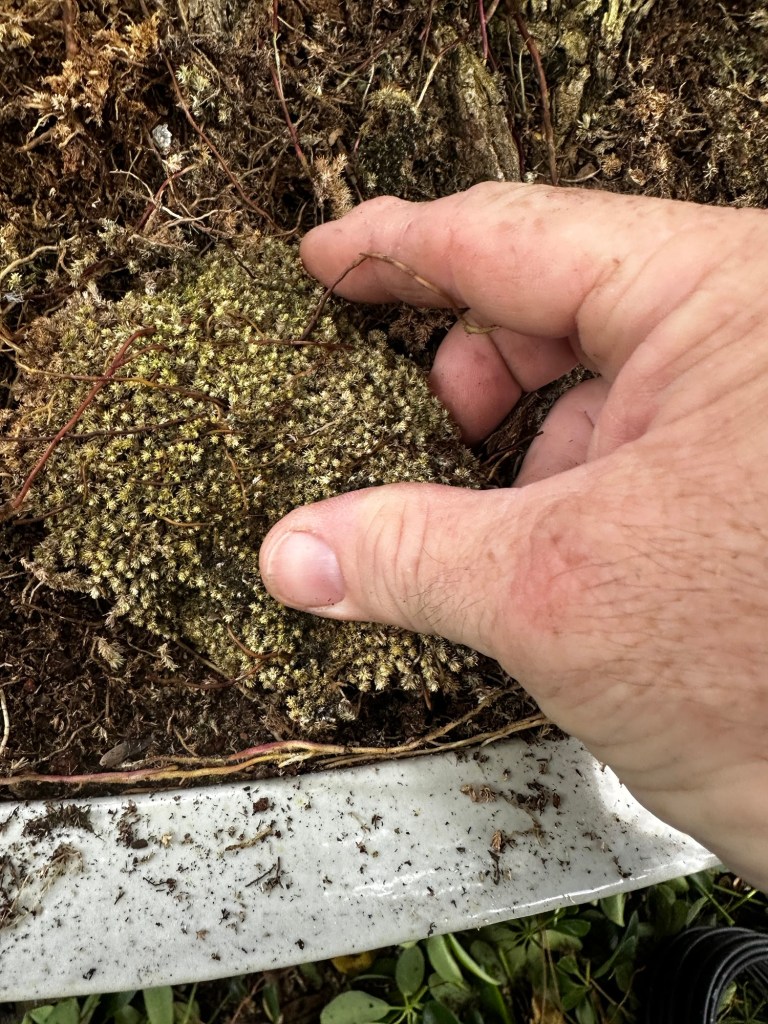
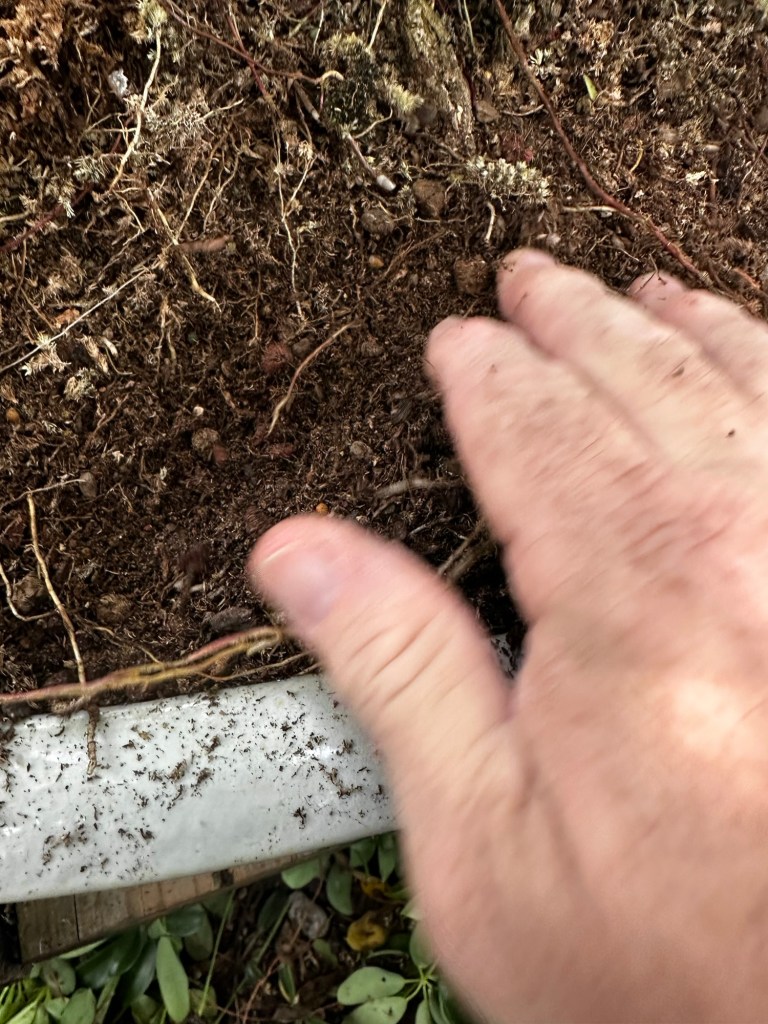
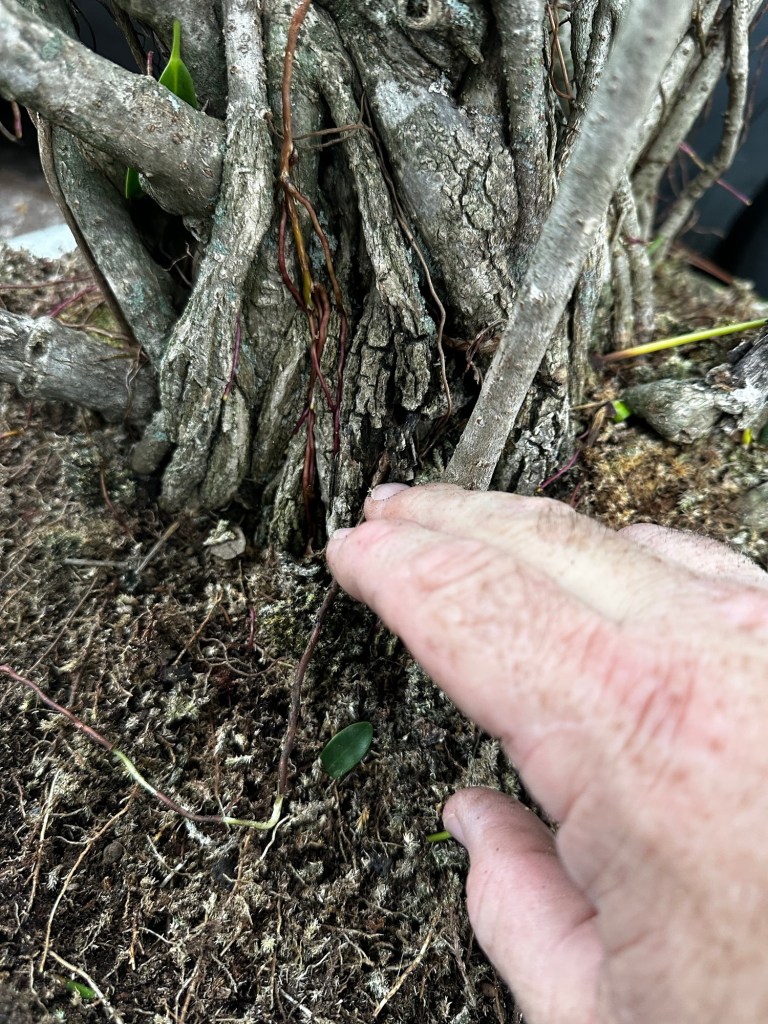
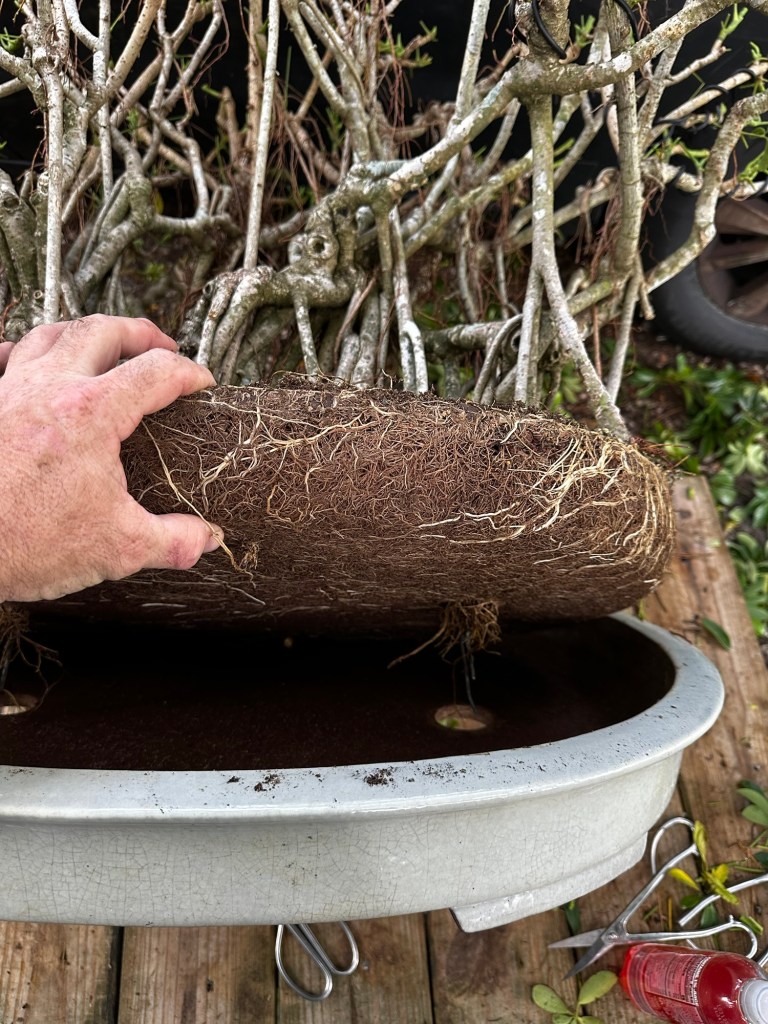
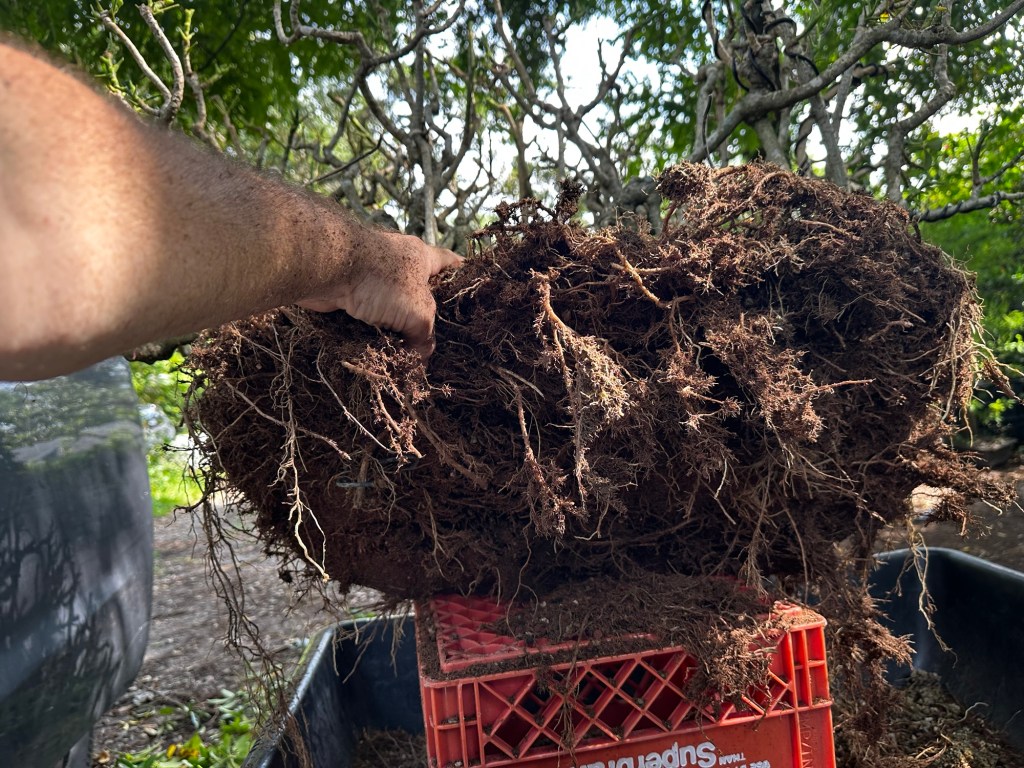
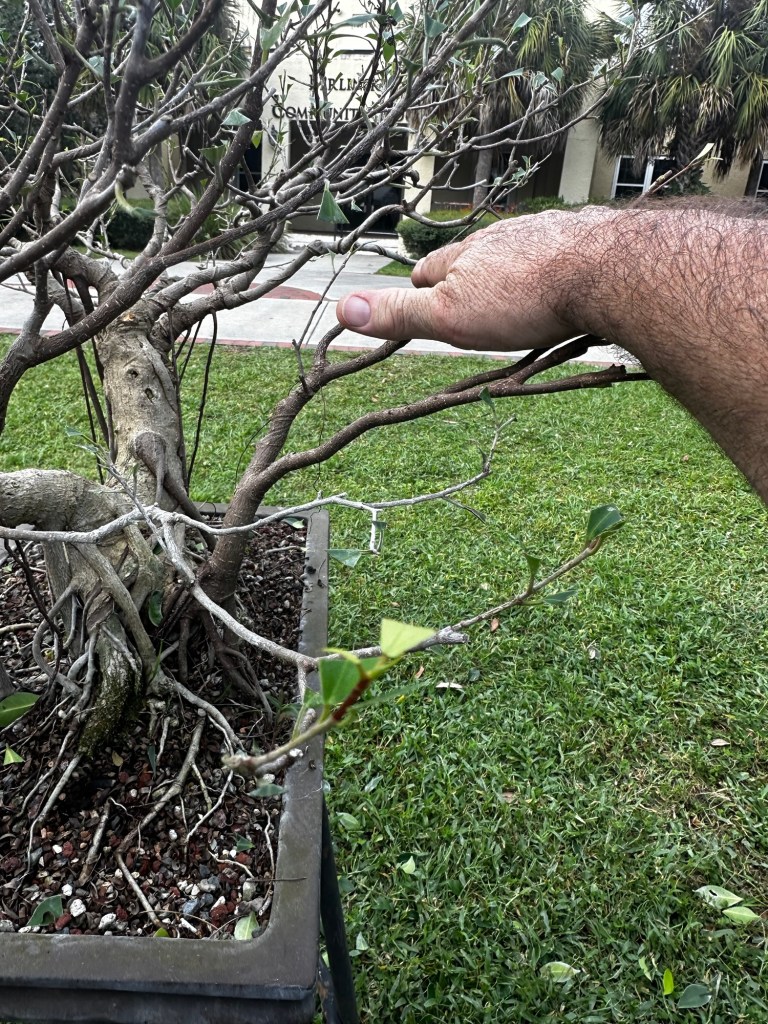
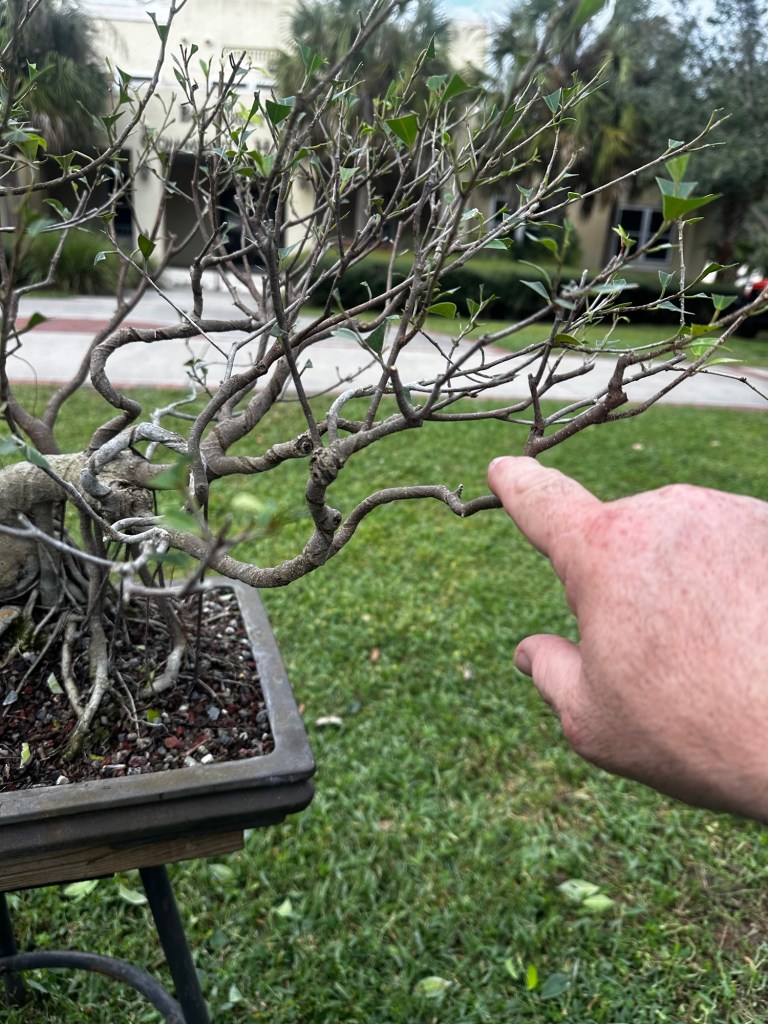
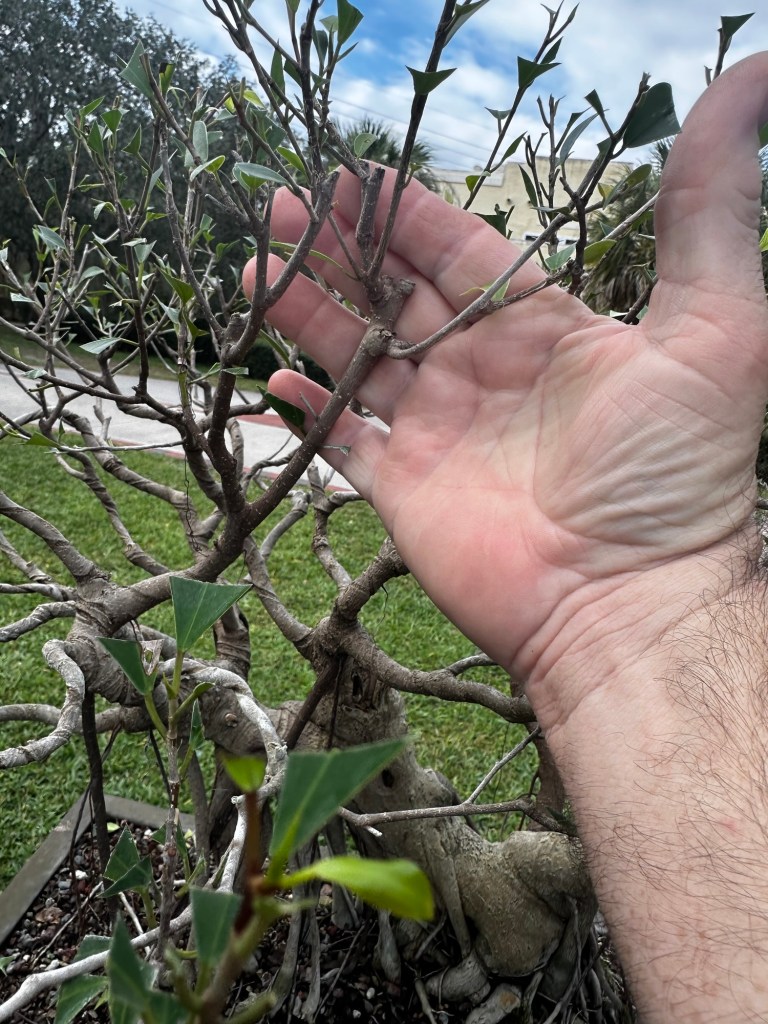
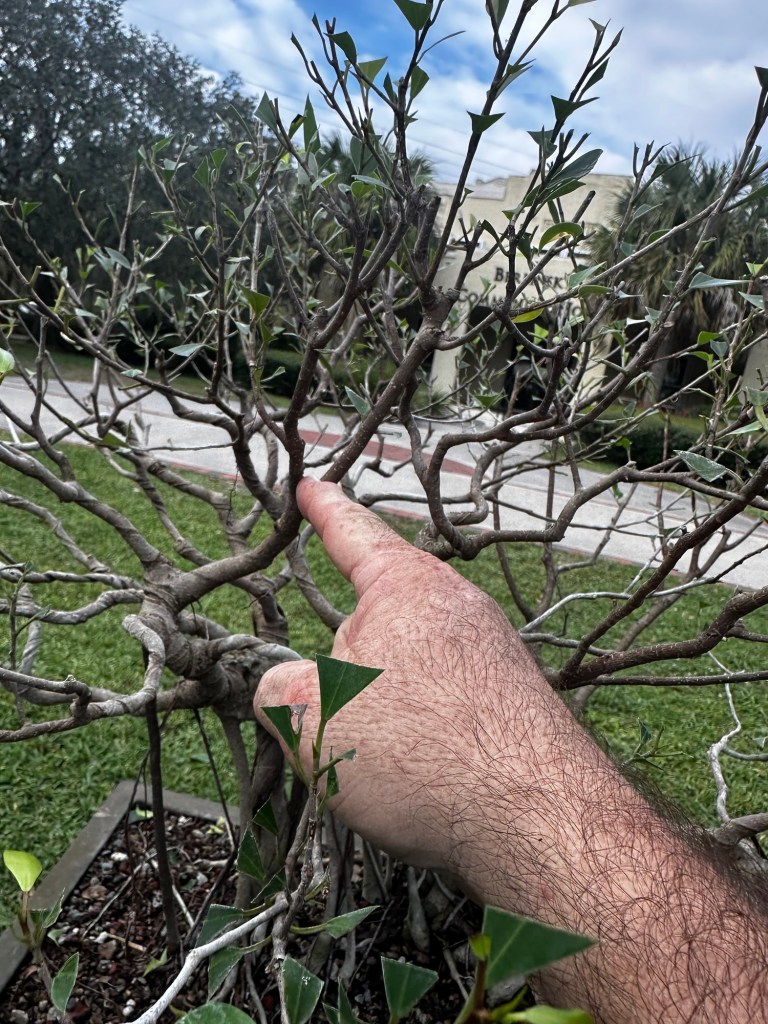
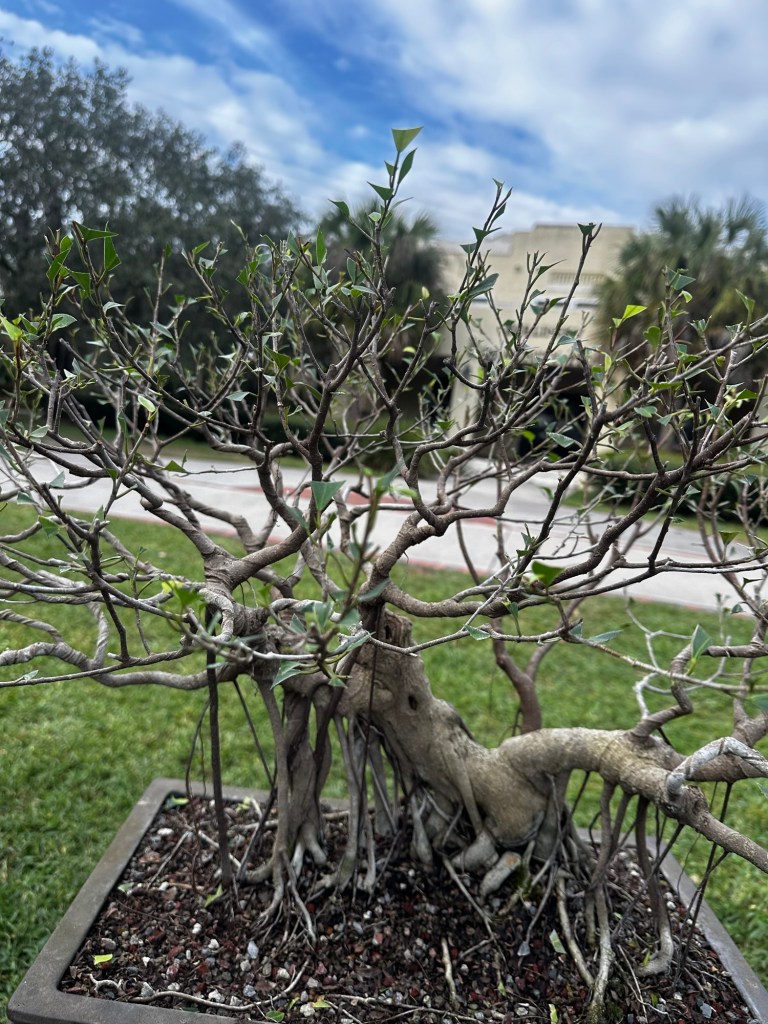
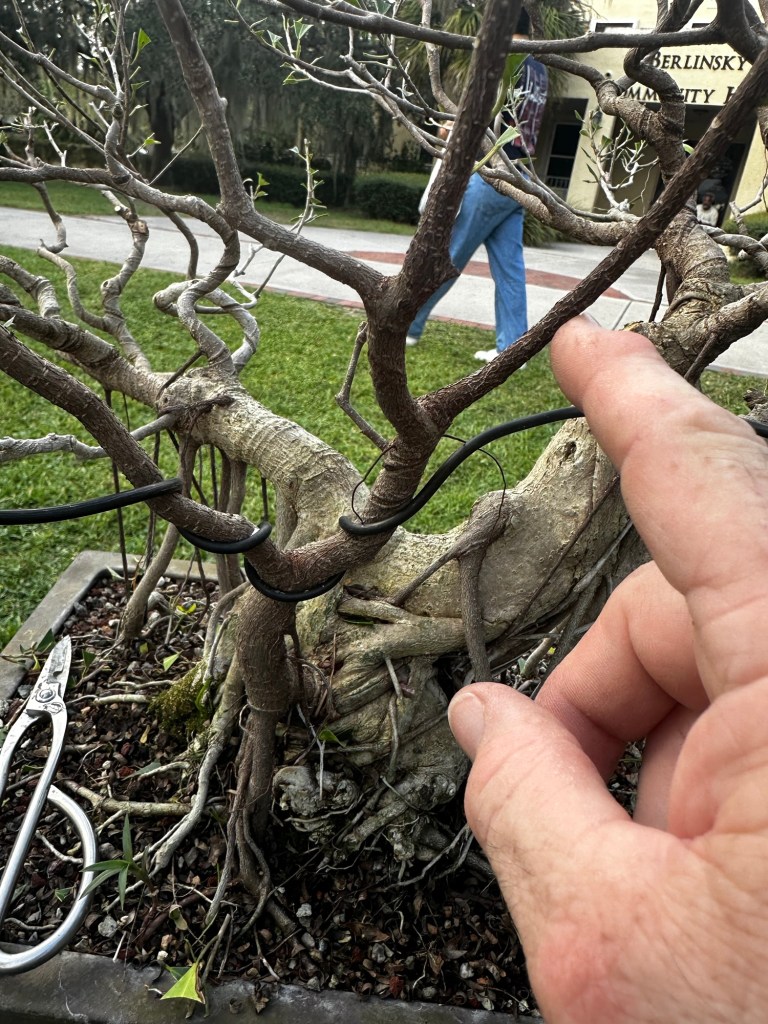
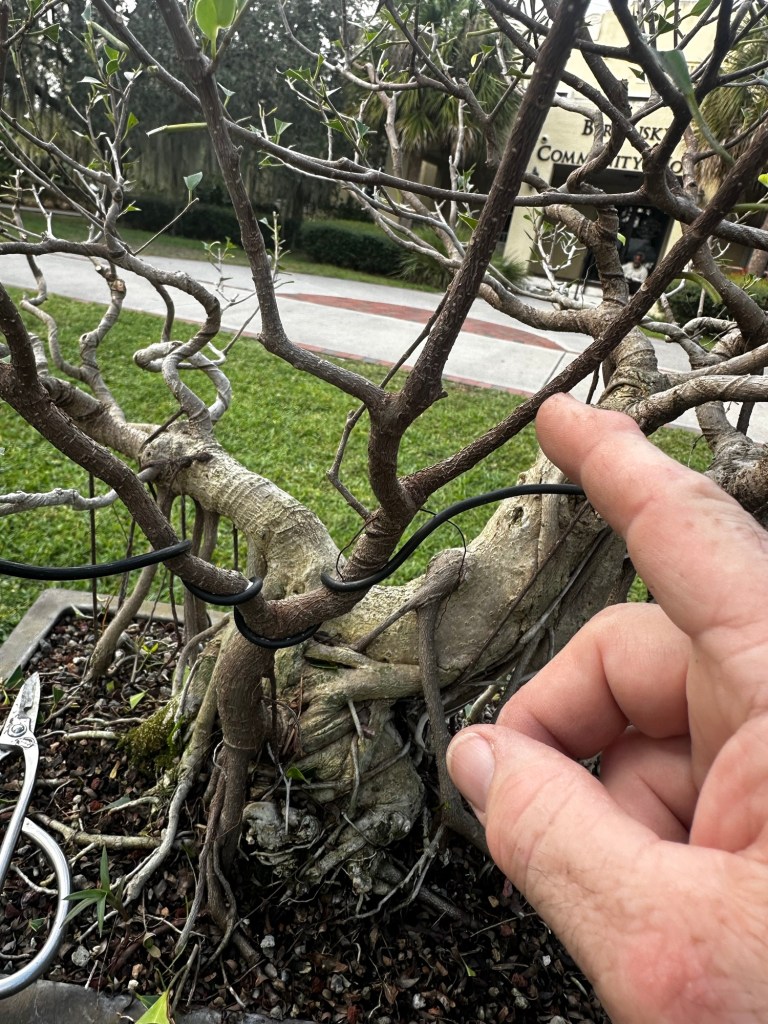
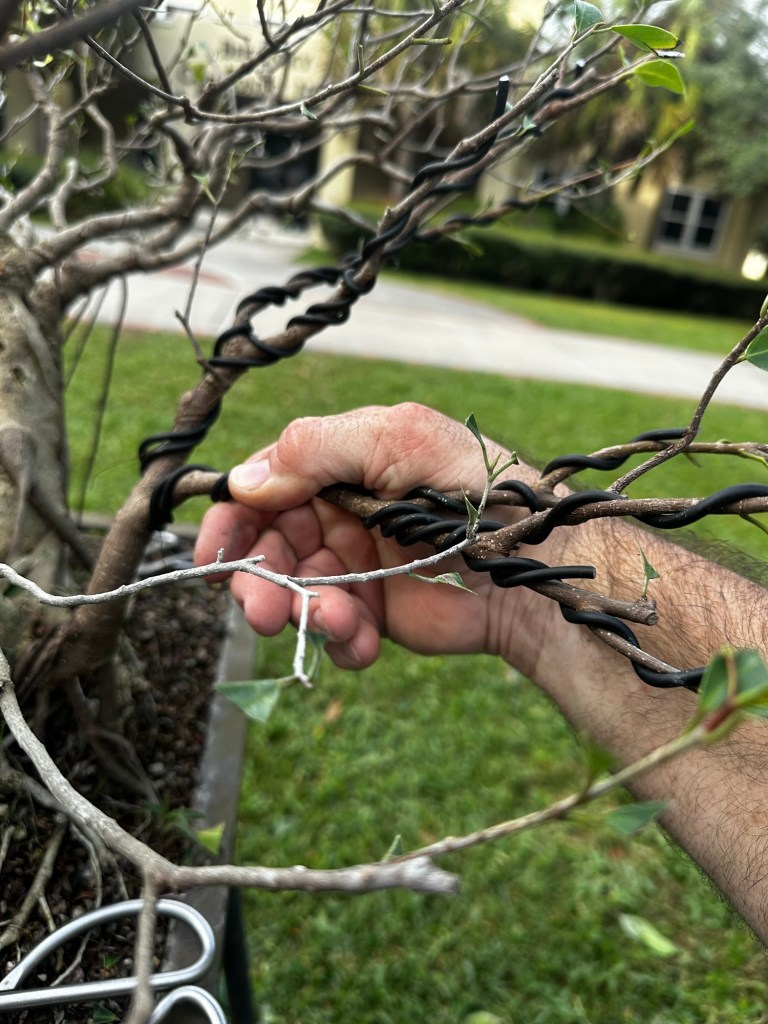
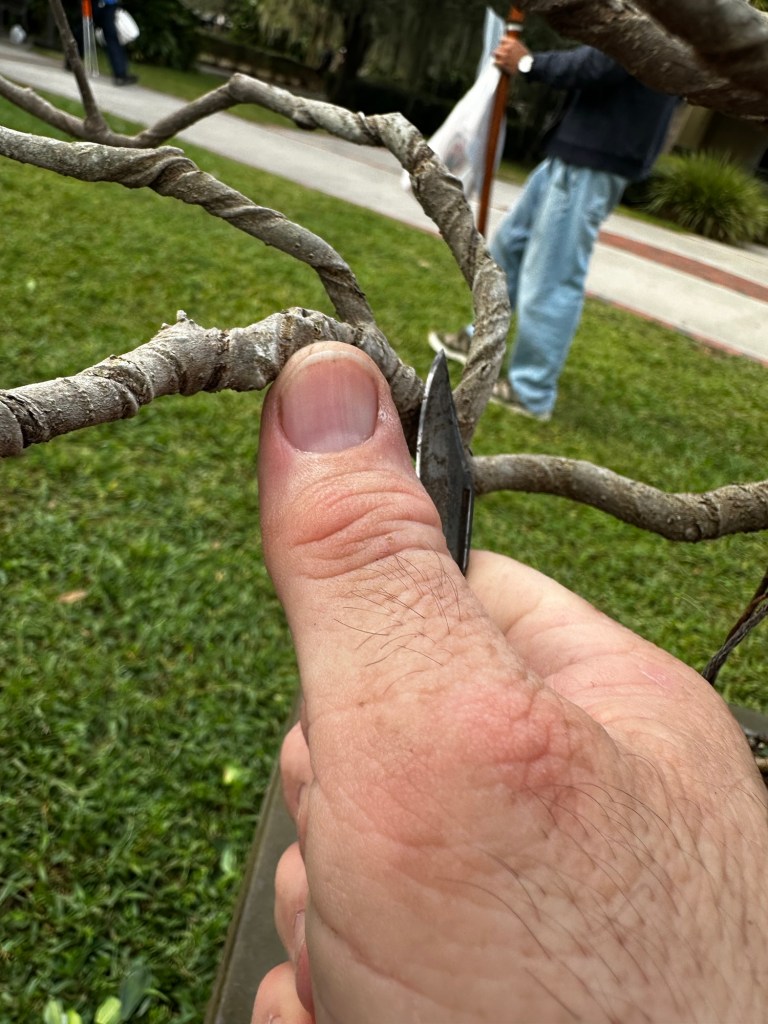
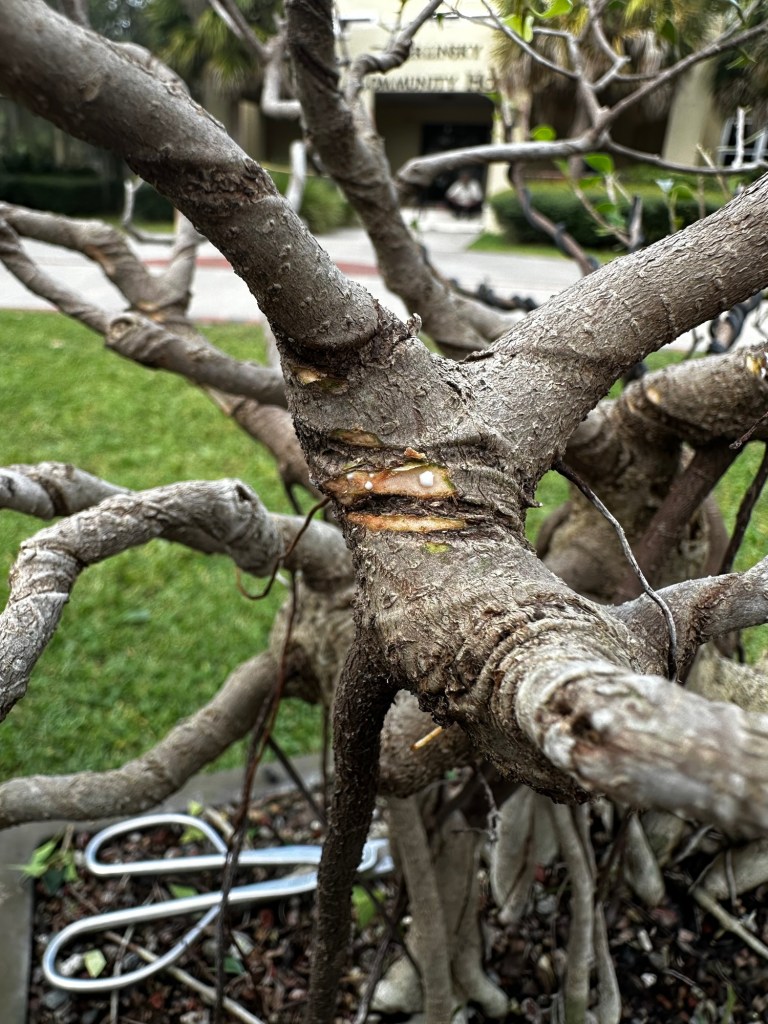
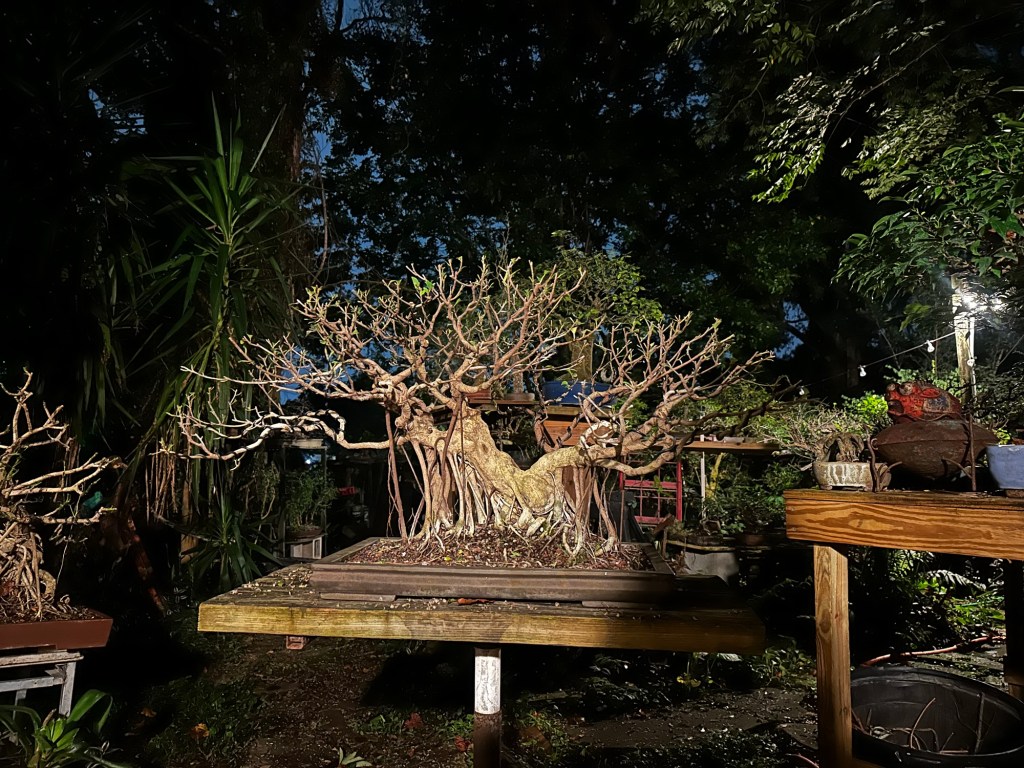
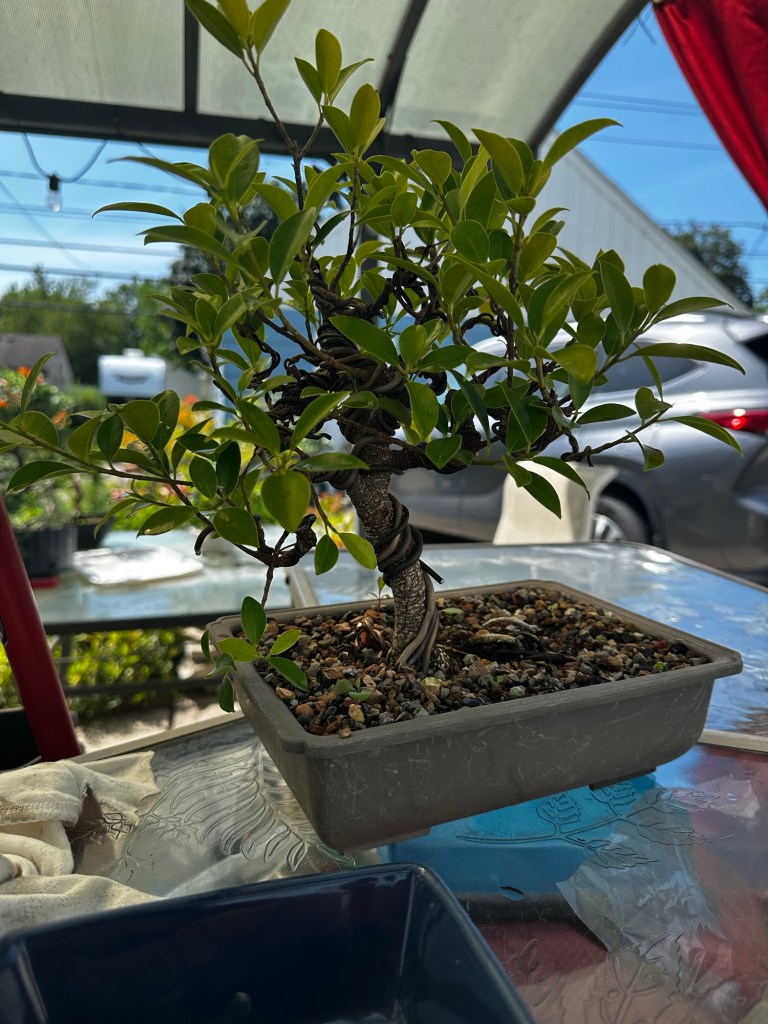
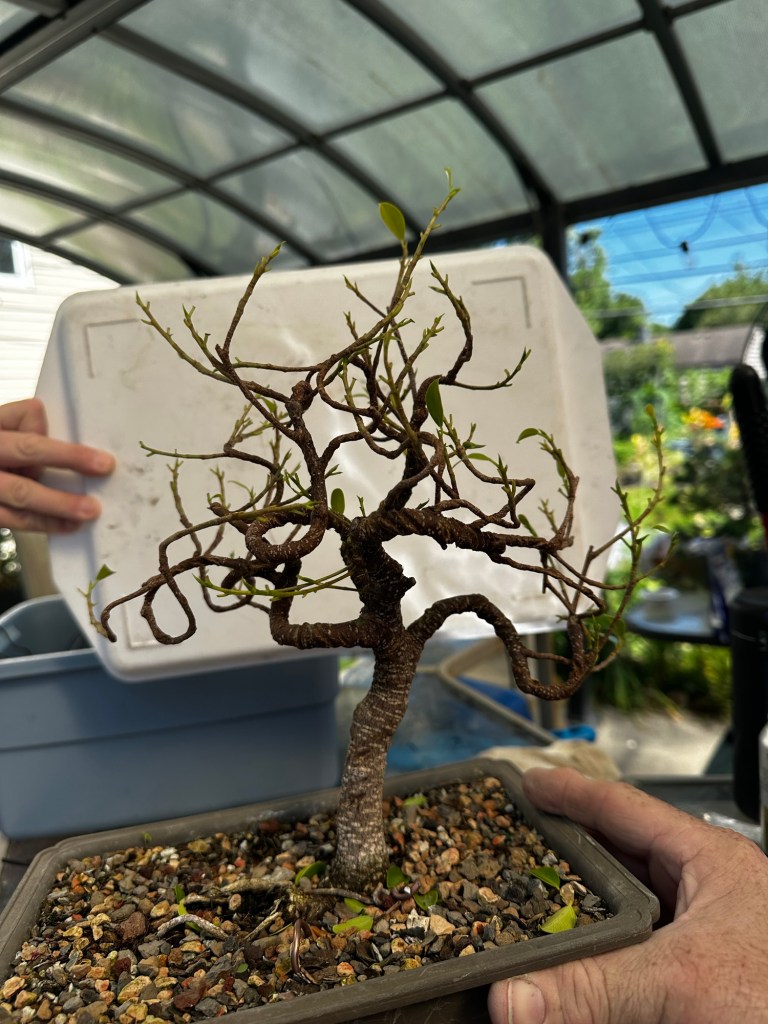
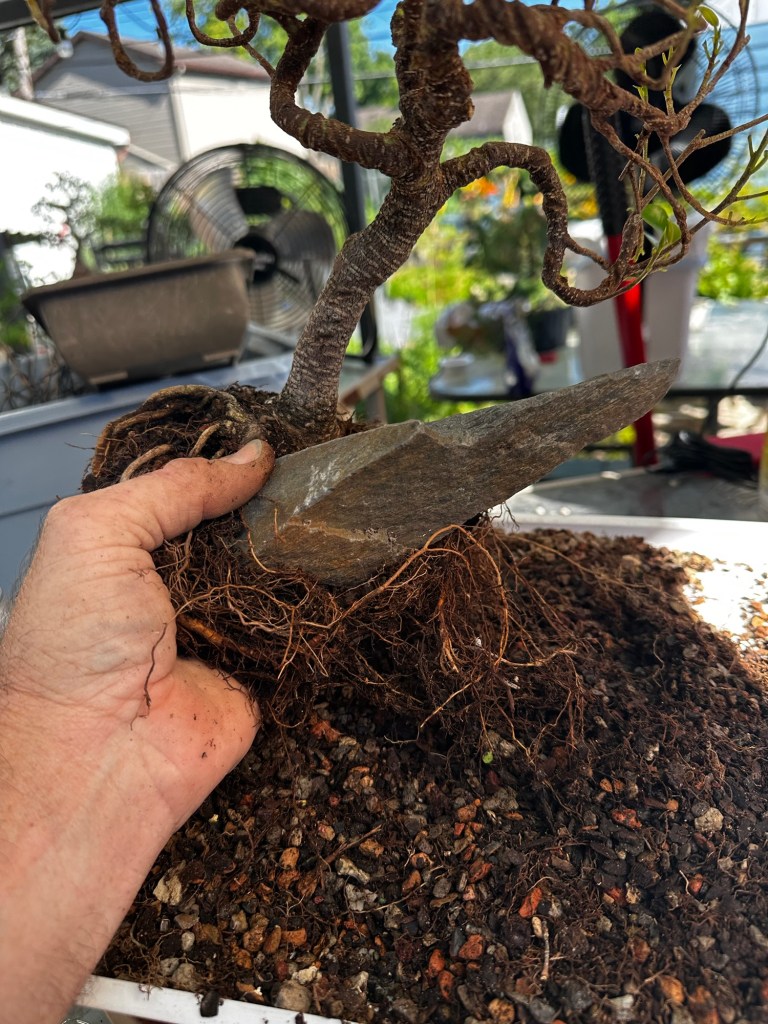
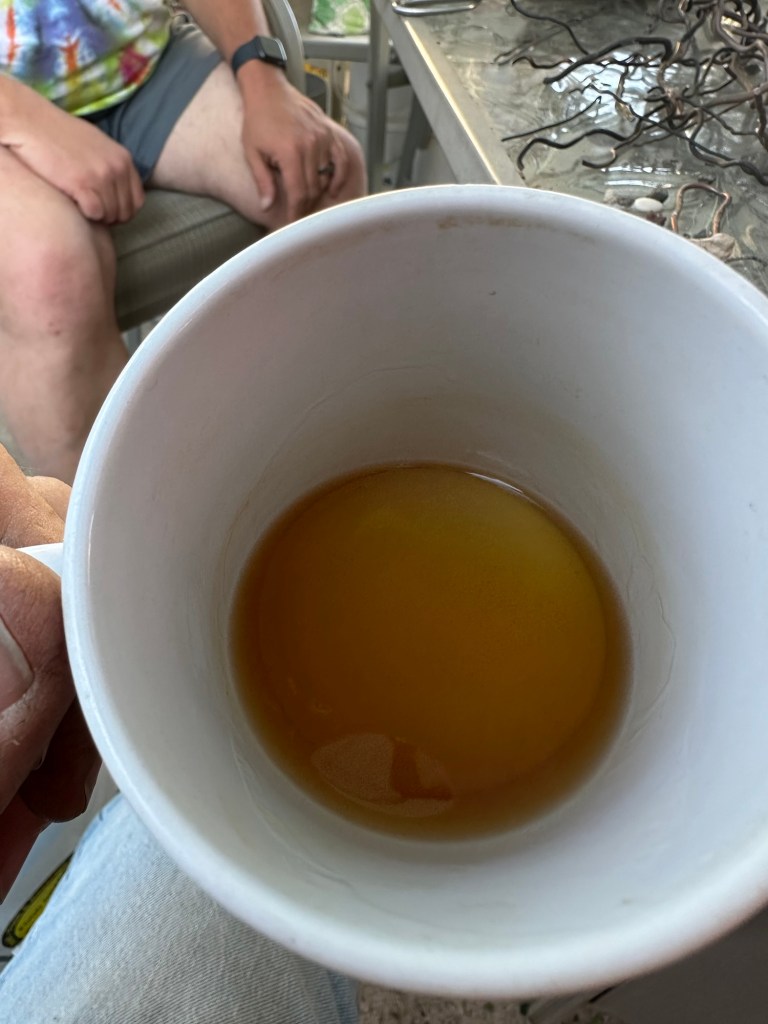
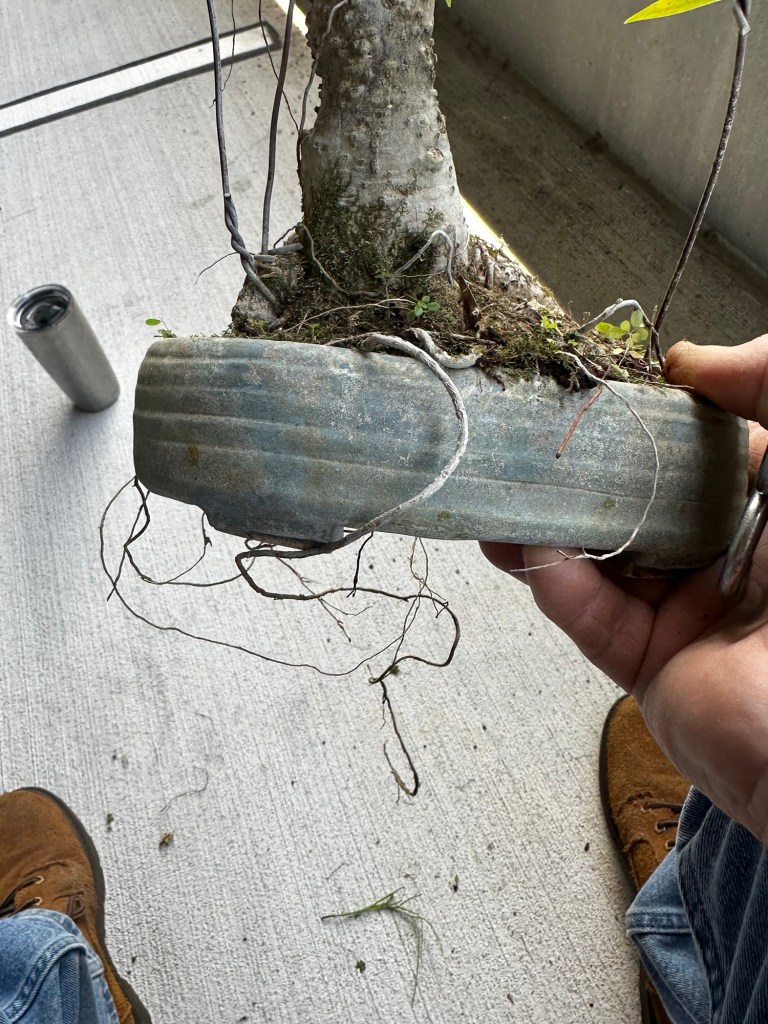
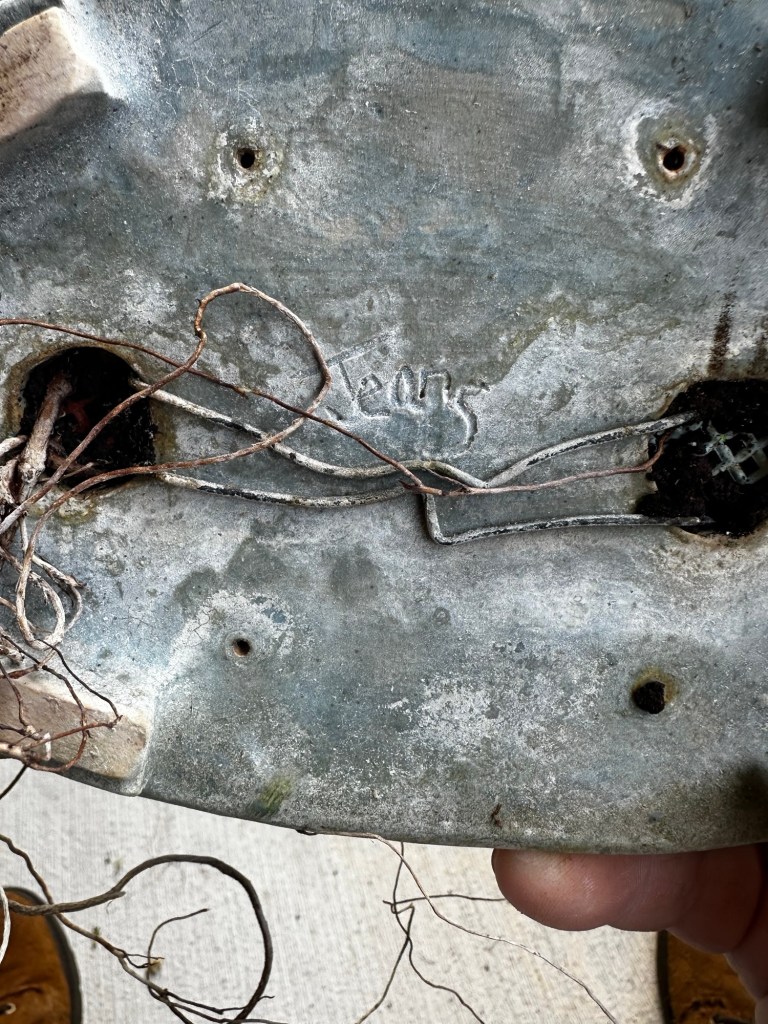
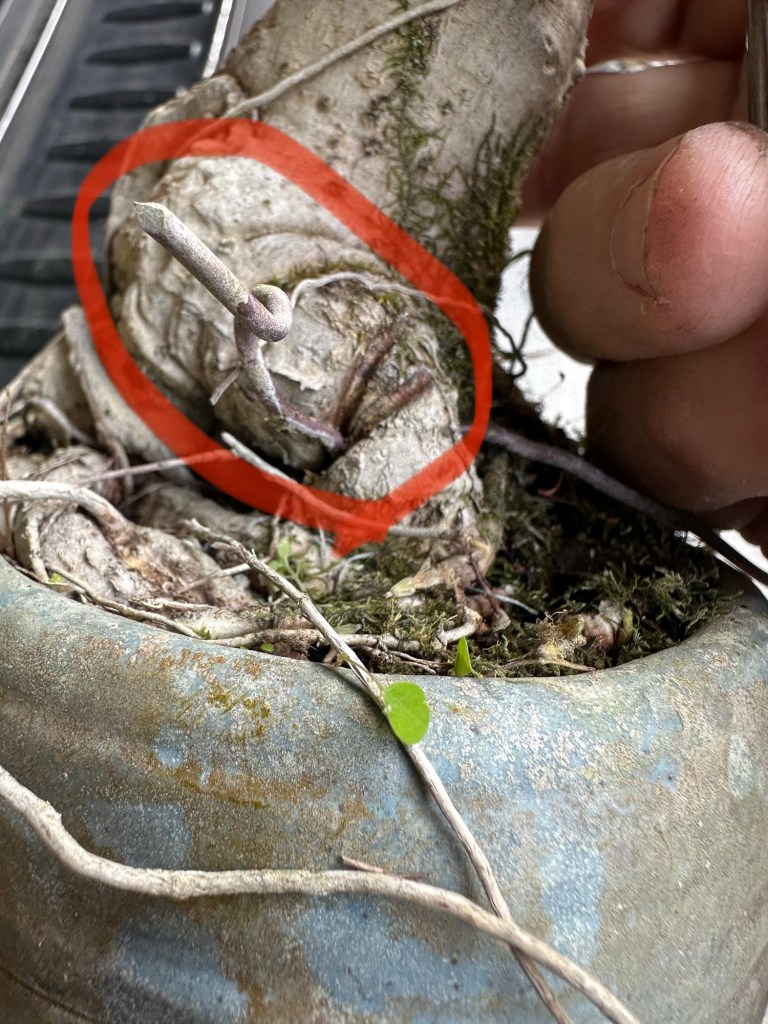
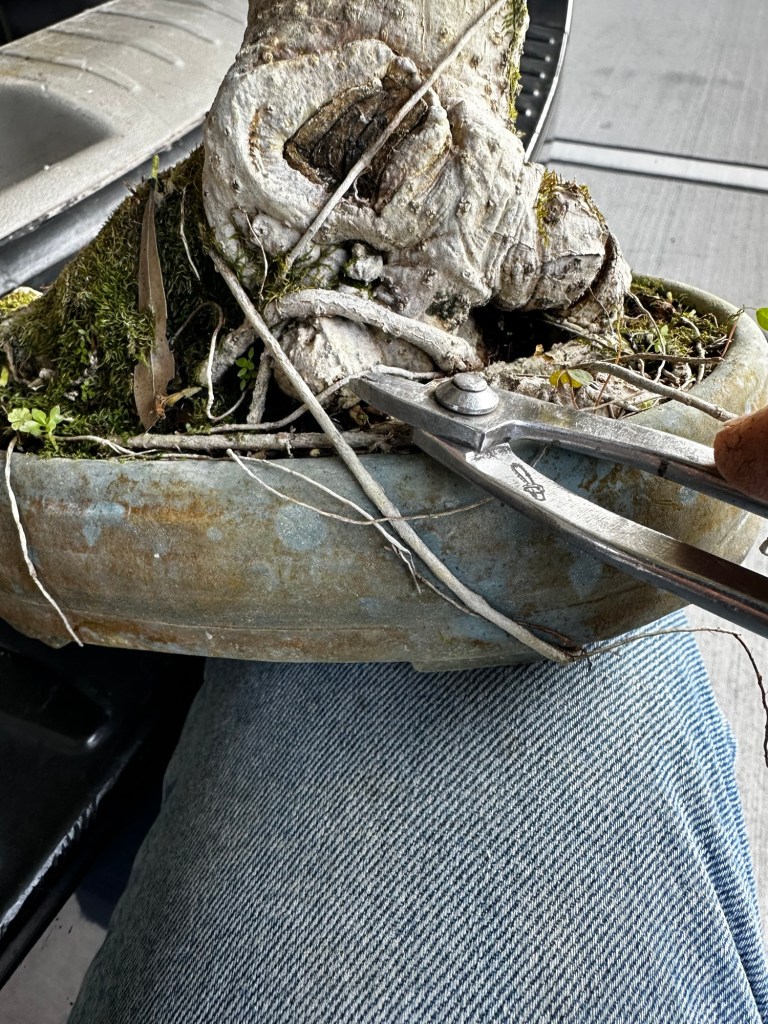
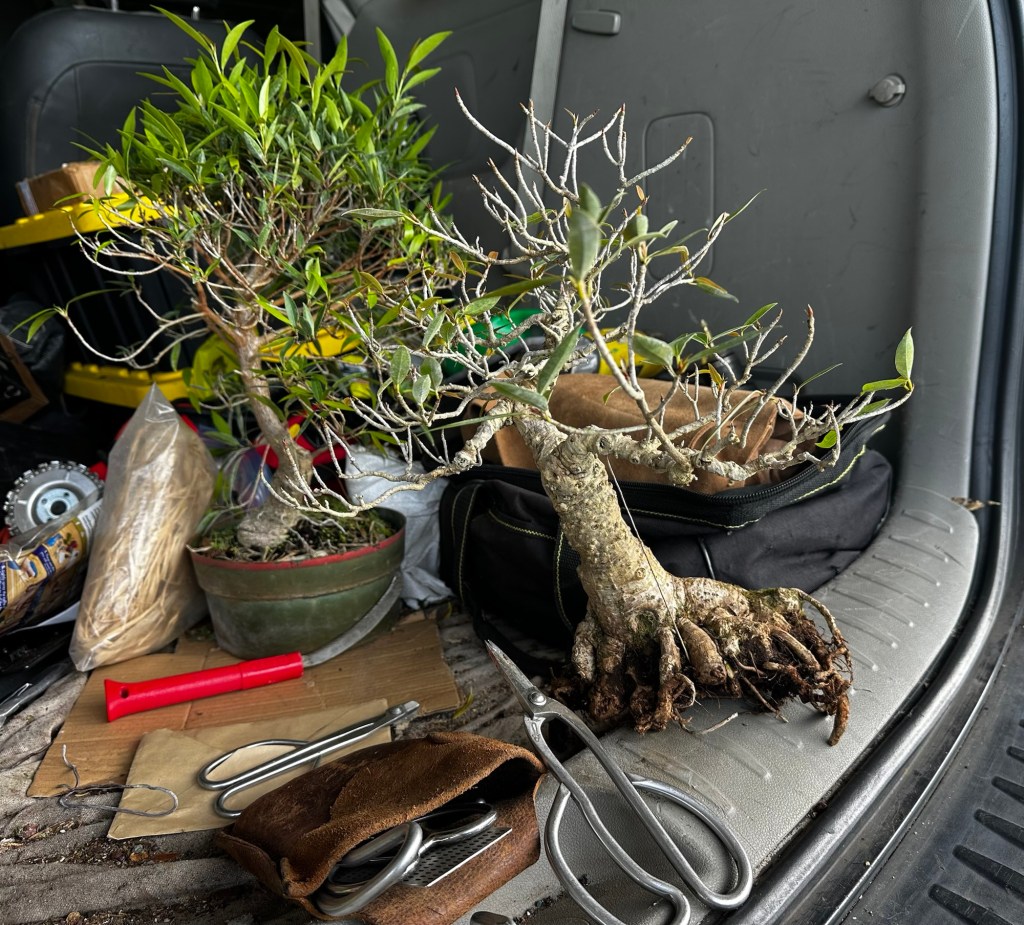
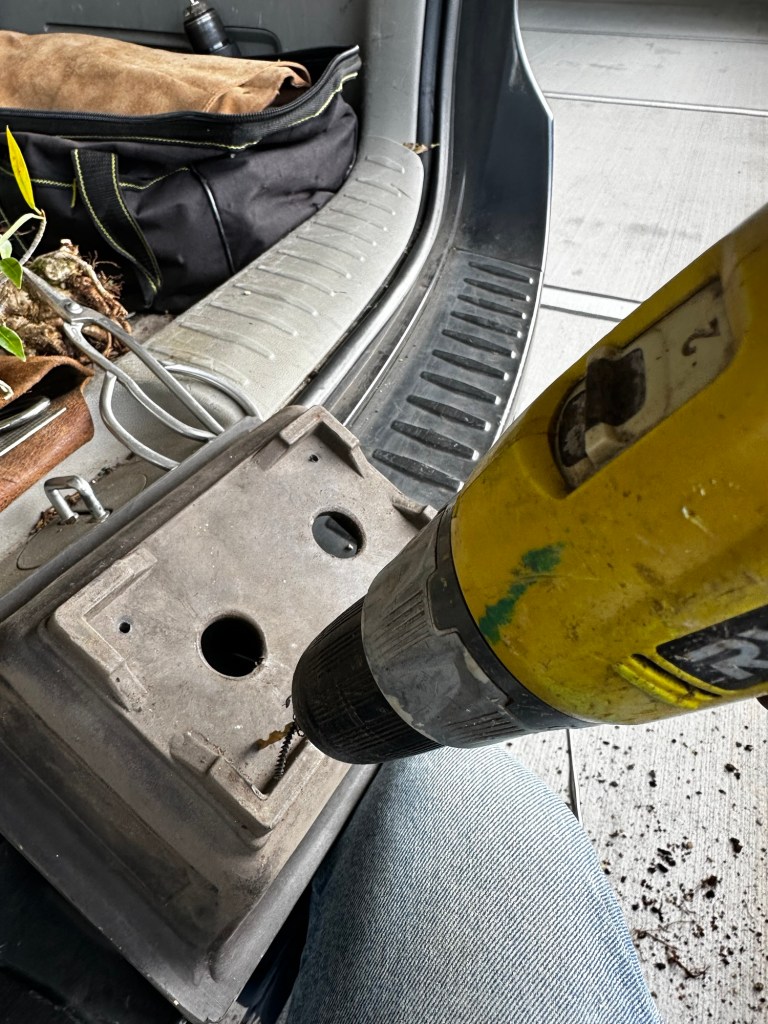
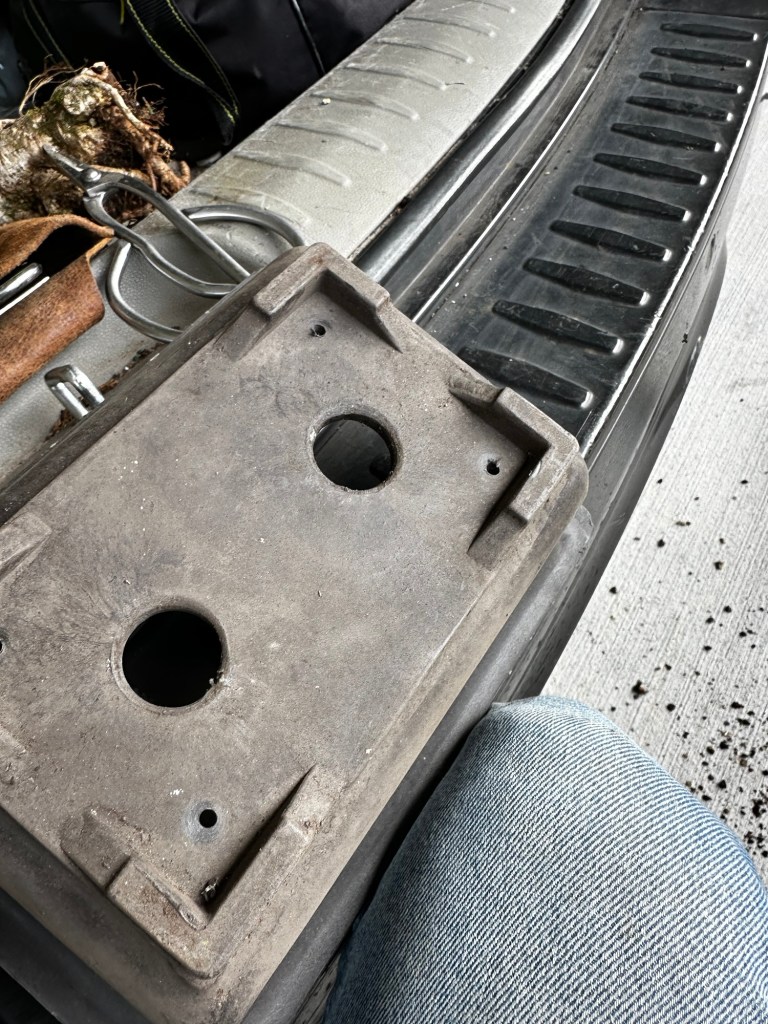
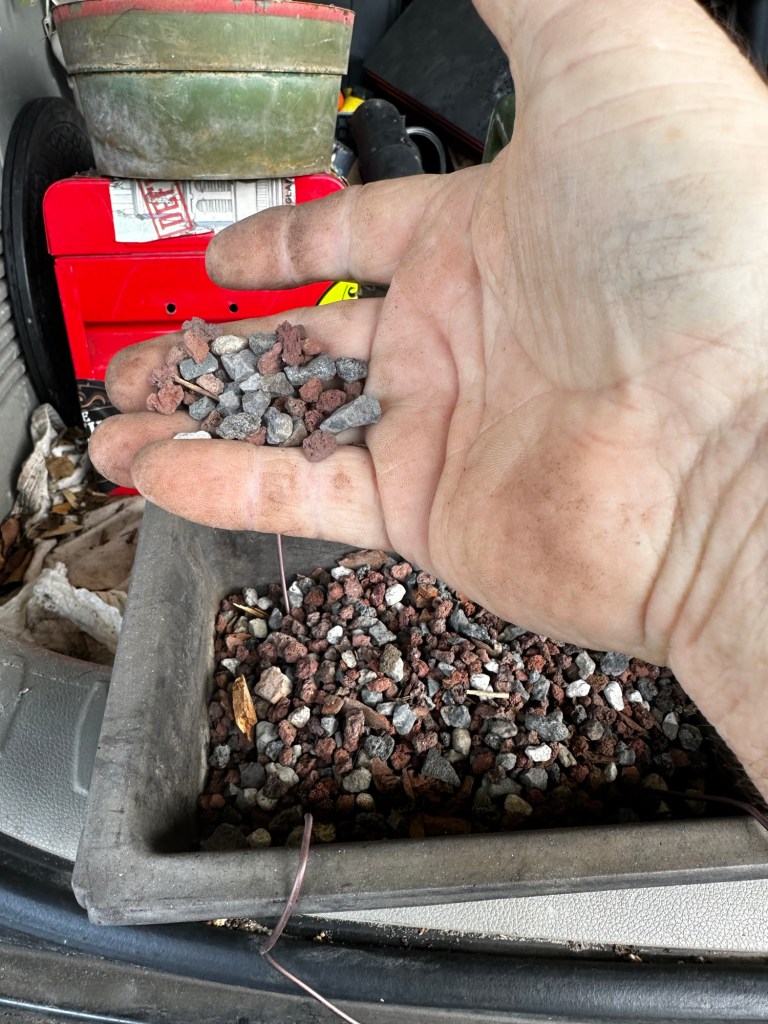
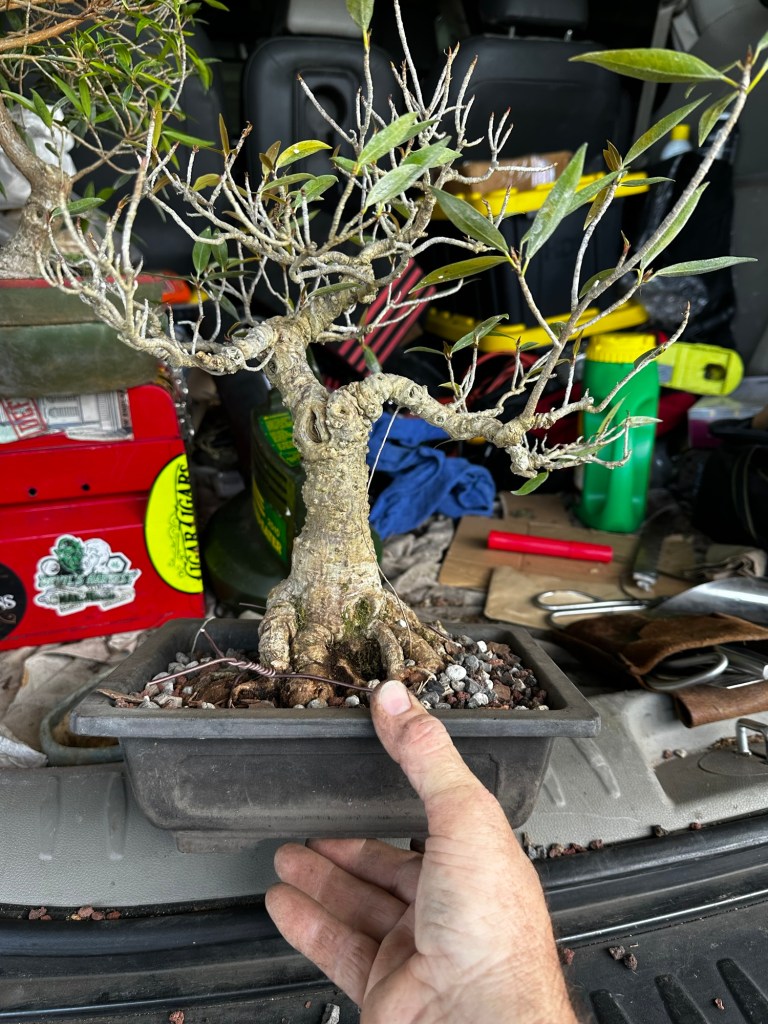
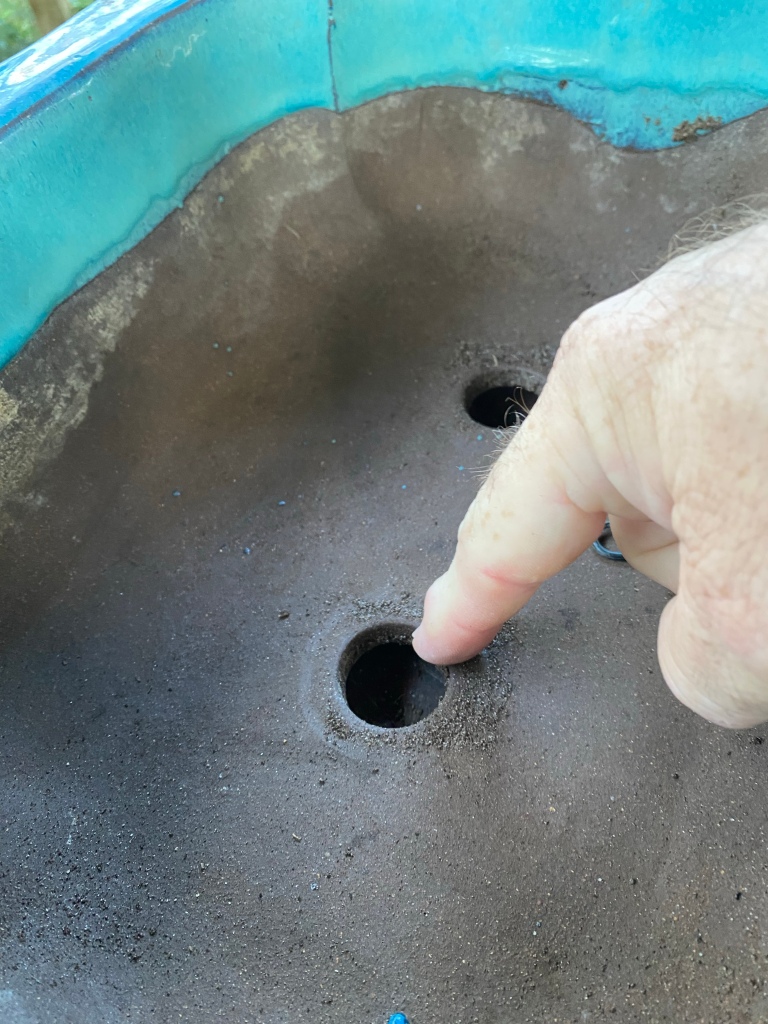
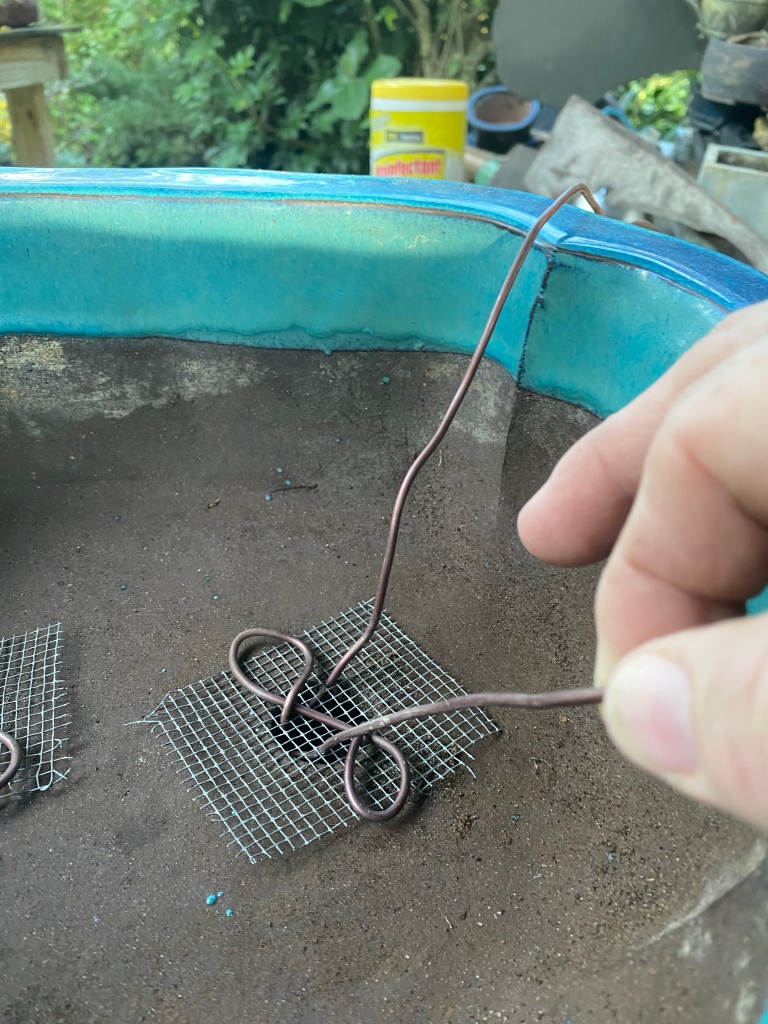
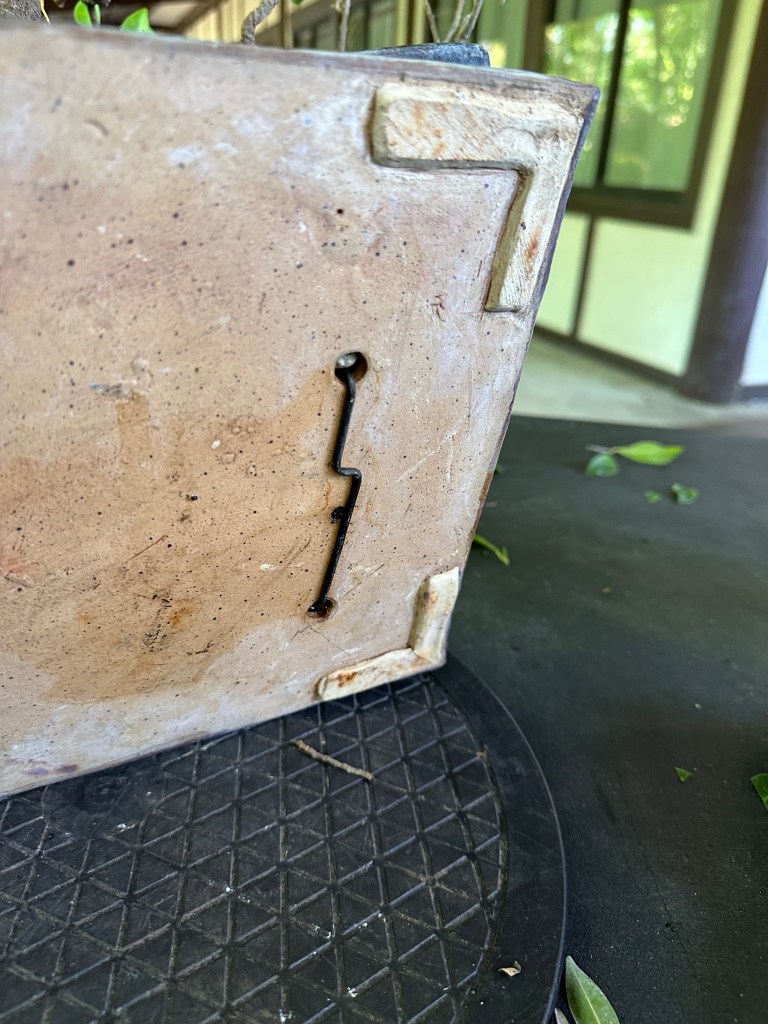
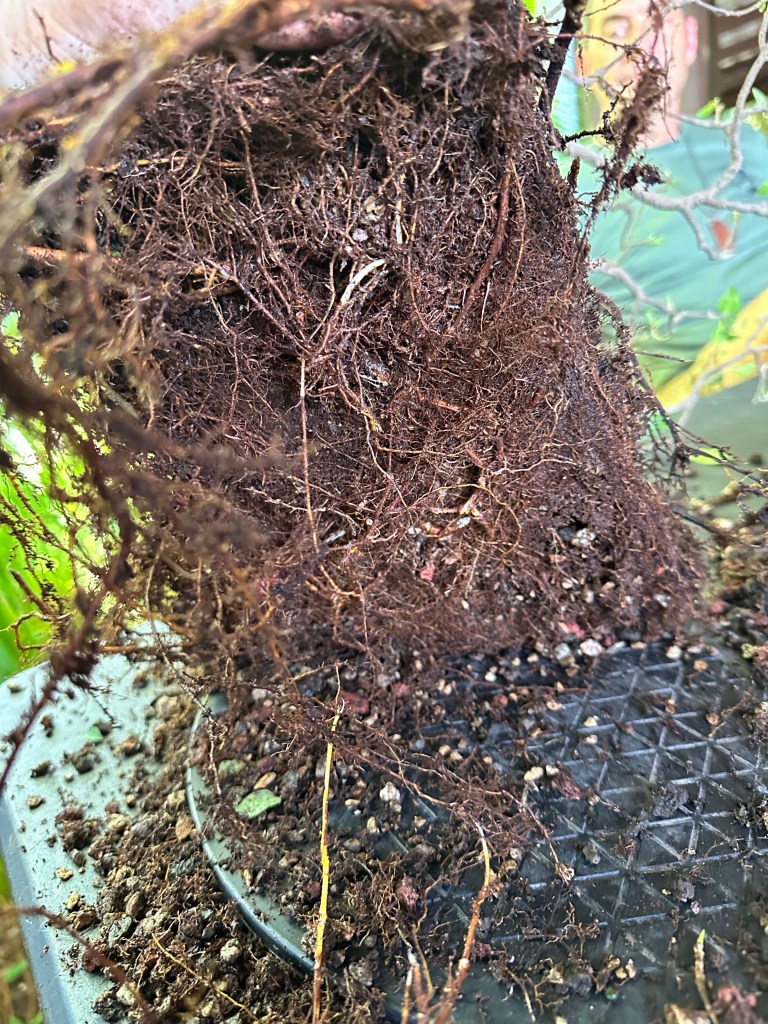
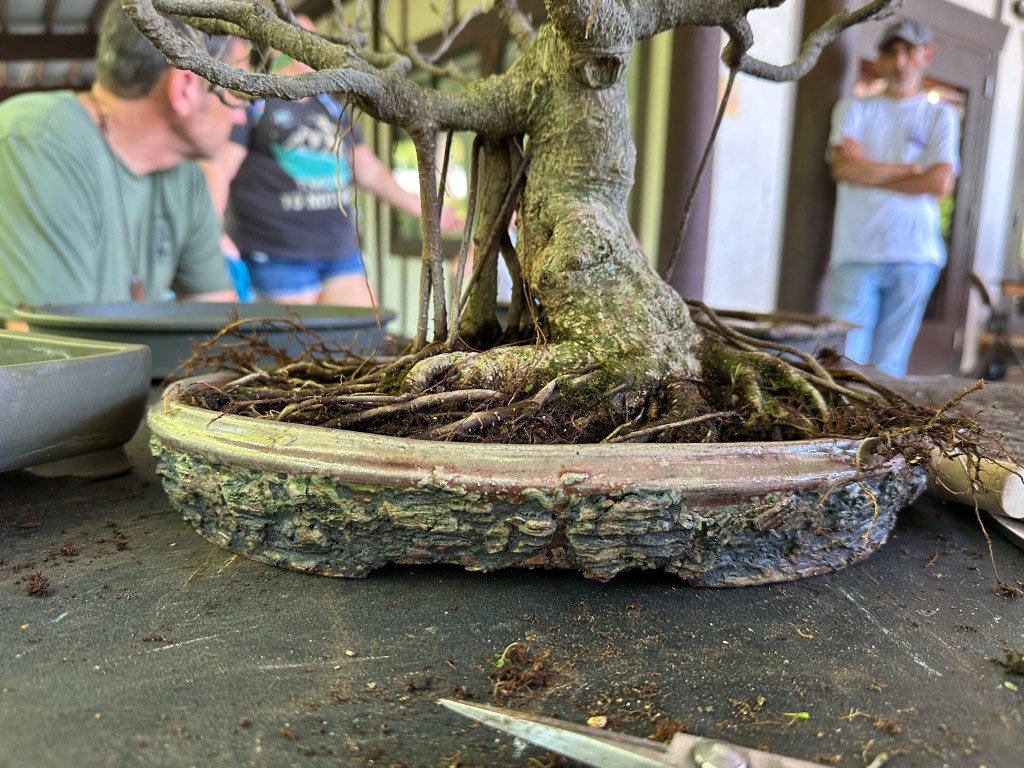
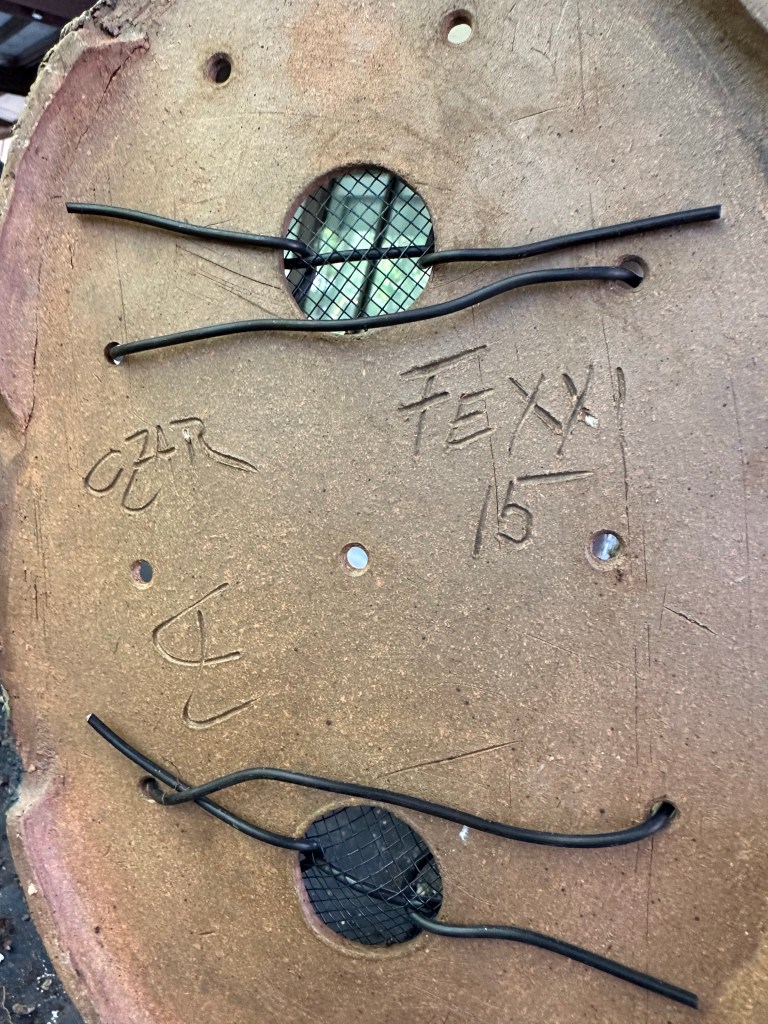
Here’s a pet peeve. And I’ll start with “there are many ways to skin a cat” but there are ways, and better ways. See the hole above? A drain hole in a bonsai pot. We cover these with screen so the bonsai soil we use (use what you like and what works for you) doesn’t fall out the bottom.
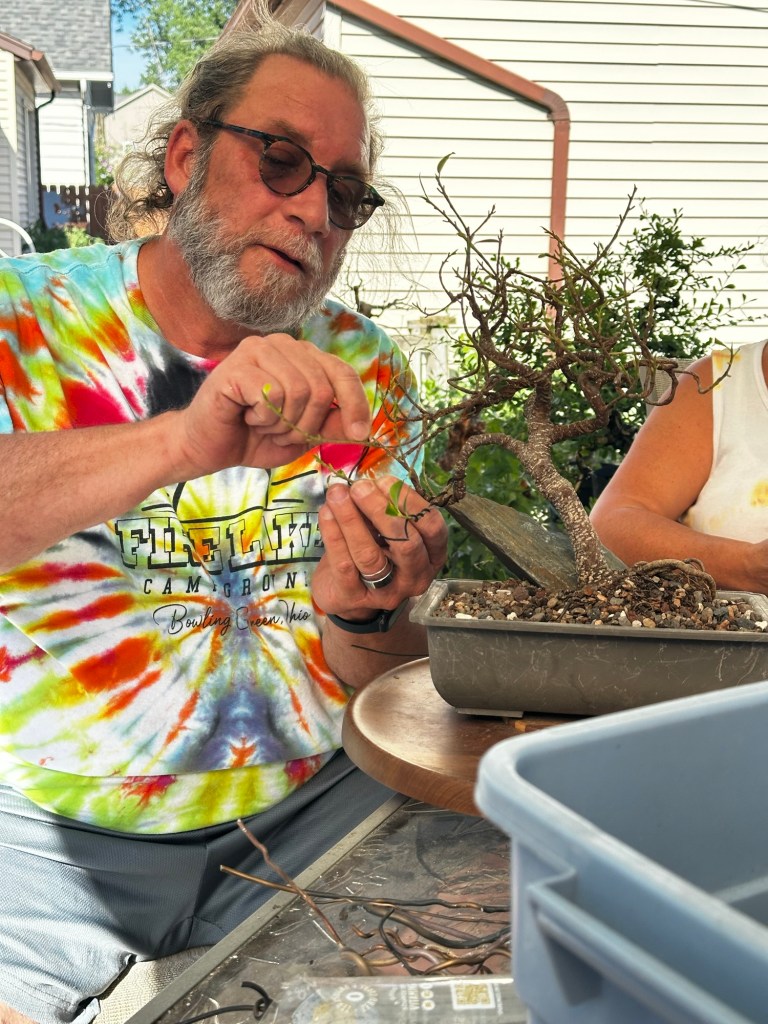
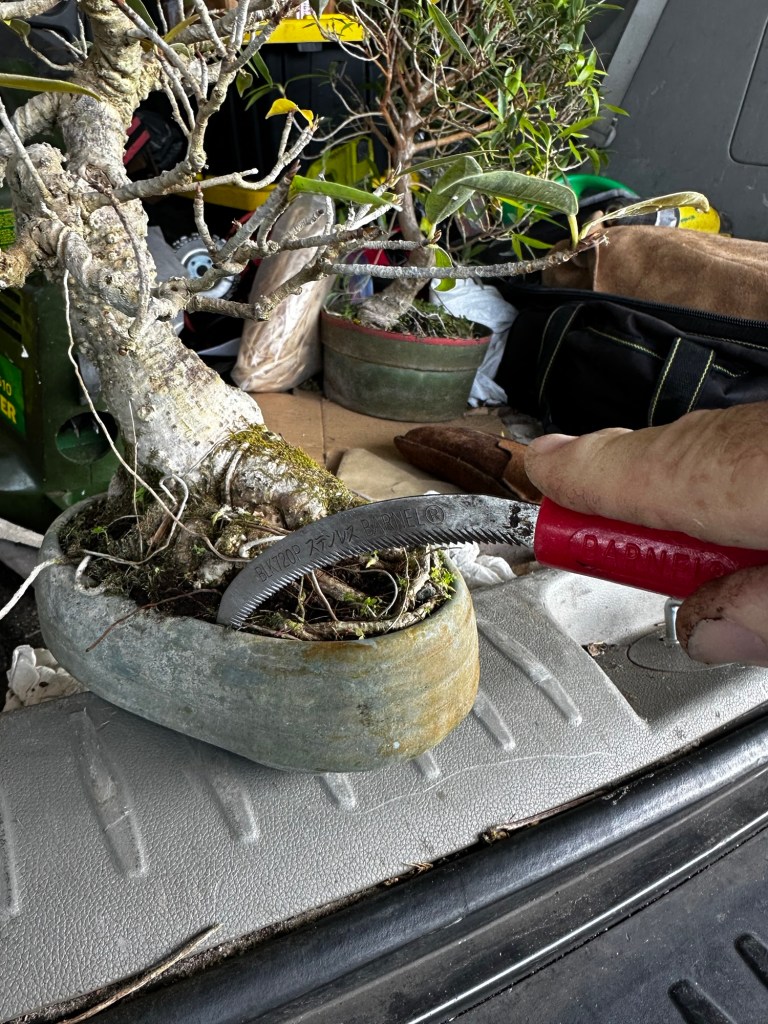
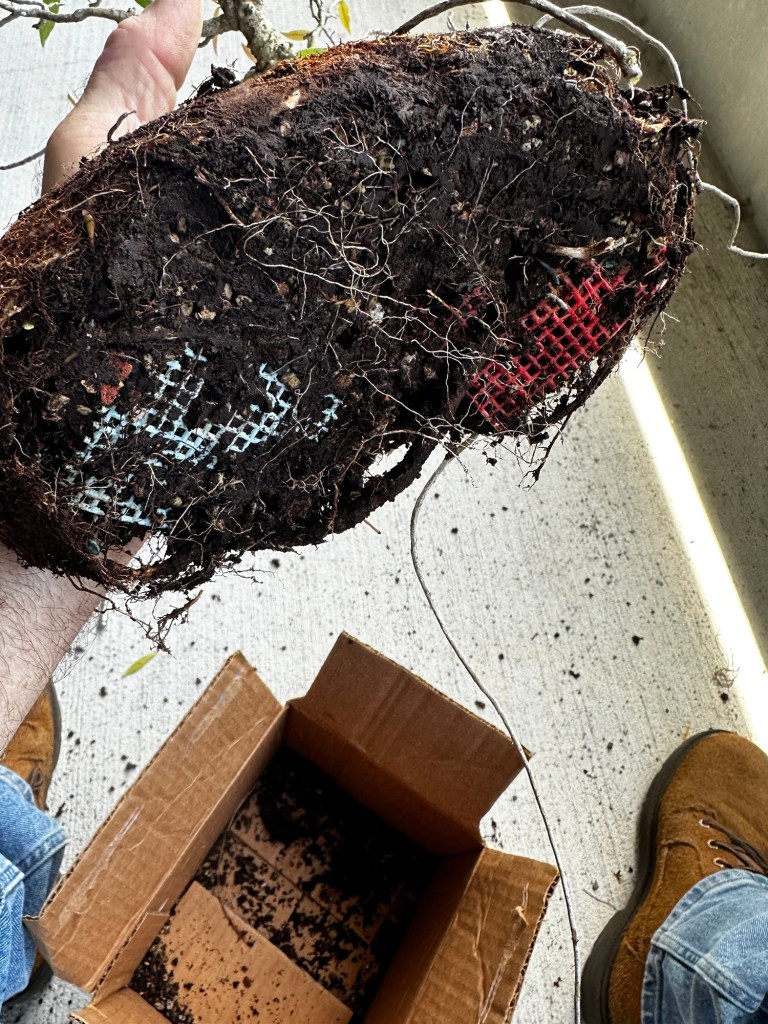
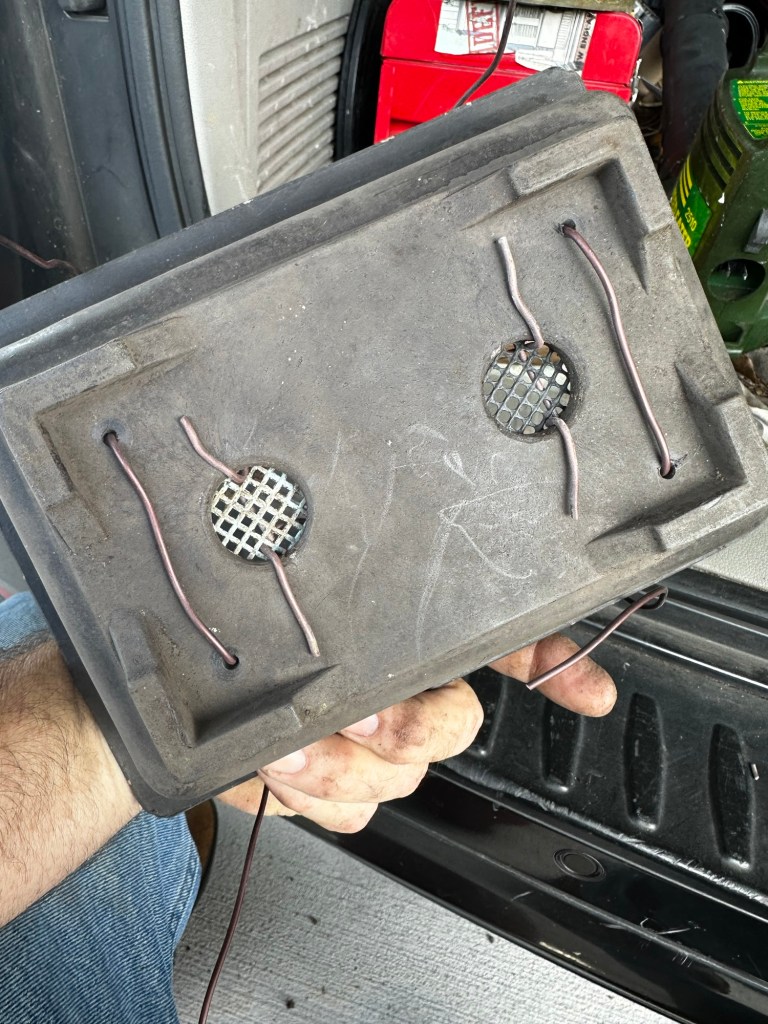
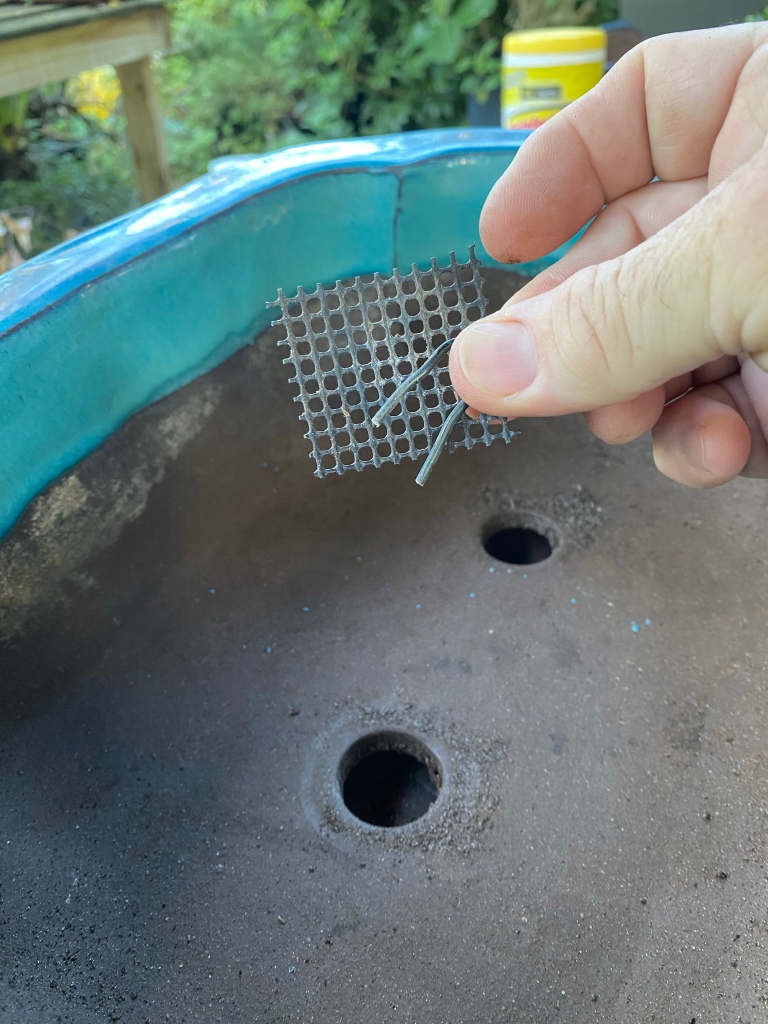
I’m repotting a client’s tree. I find this as the drain hole screen. It’s good material, actual bonsai screen, but would it hurt you to cut it a little bigger? It’s not even a penny’a worth to add an extra half inch to it.
And the wire holding it? It doesn’t even bend around the floor wall of the pot.
What’s that gonna hold?
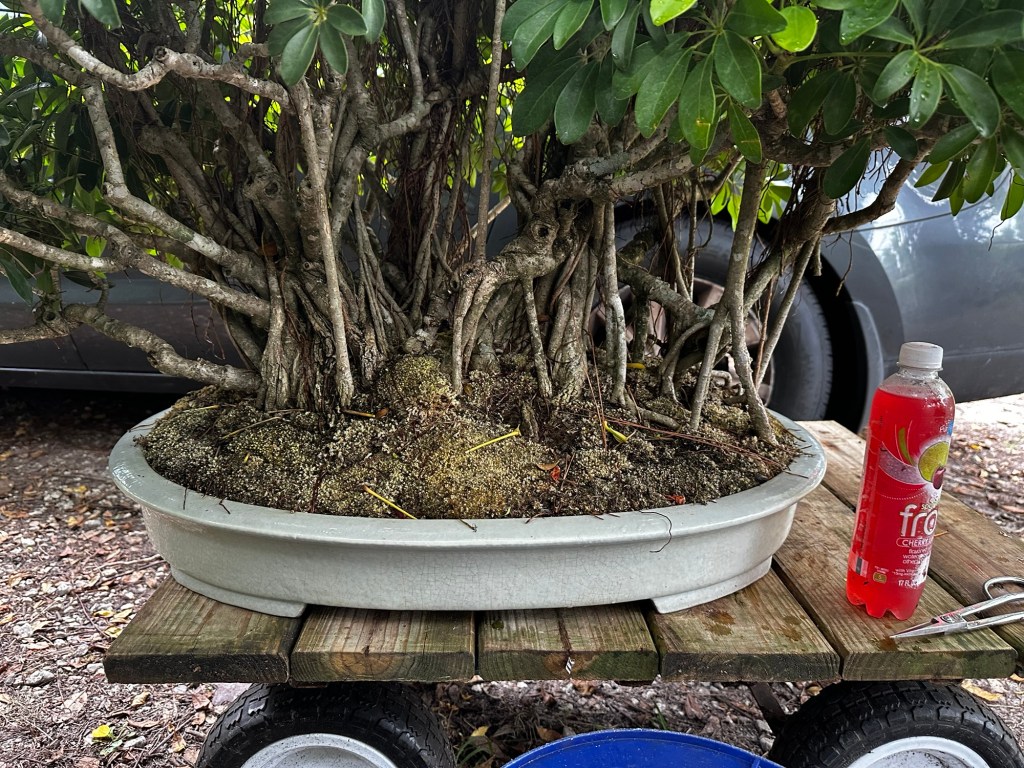
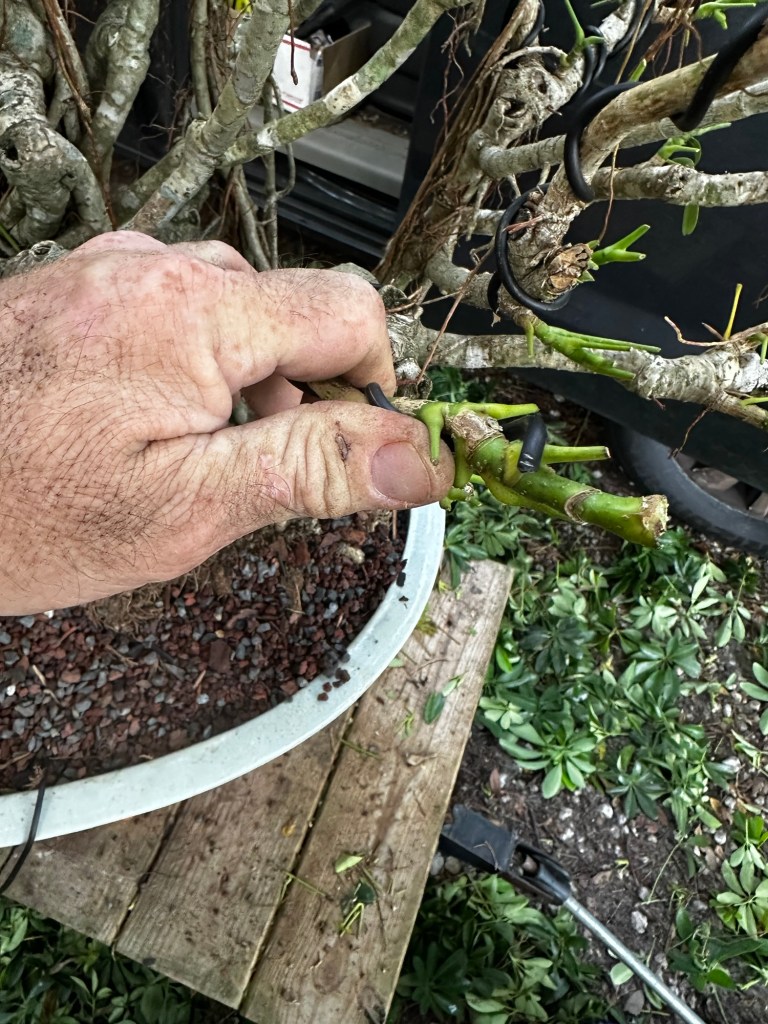
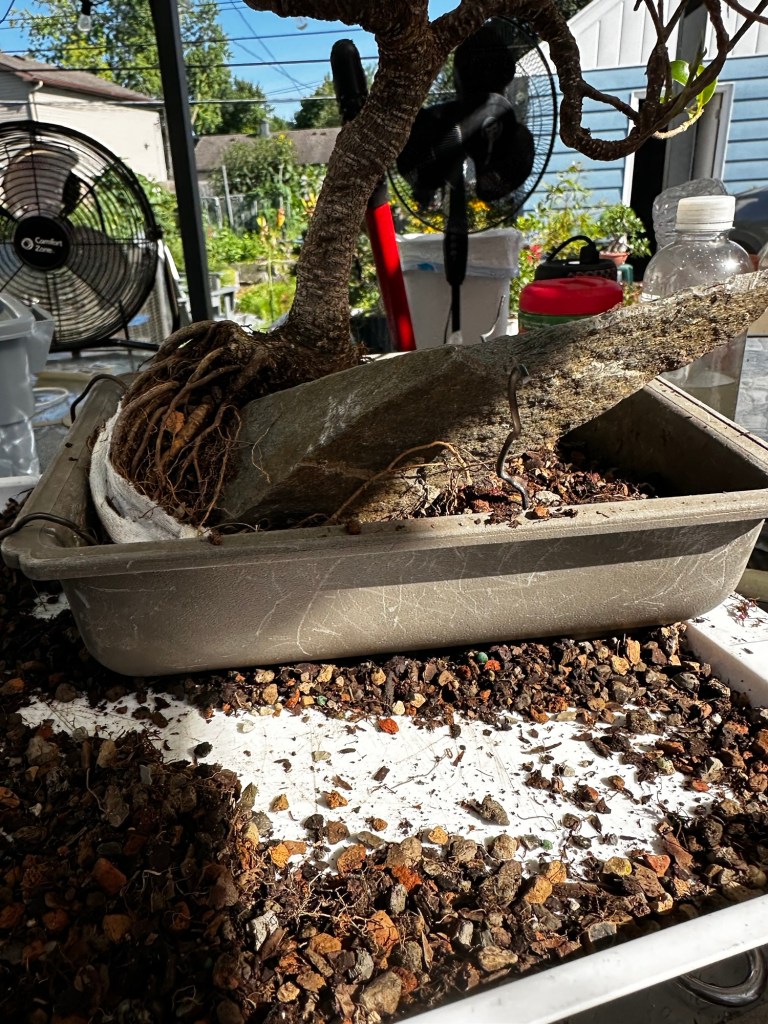
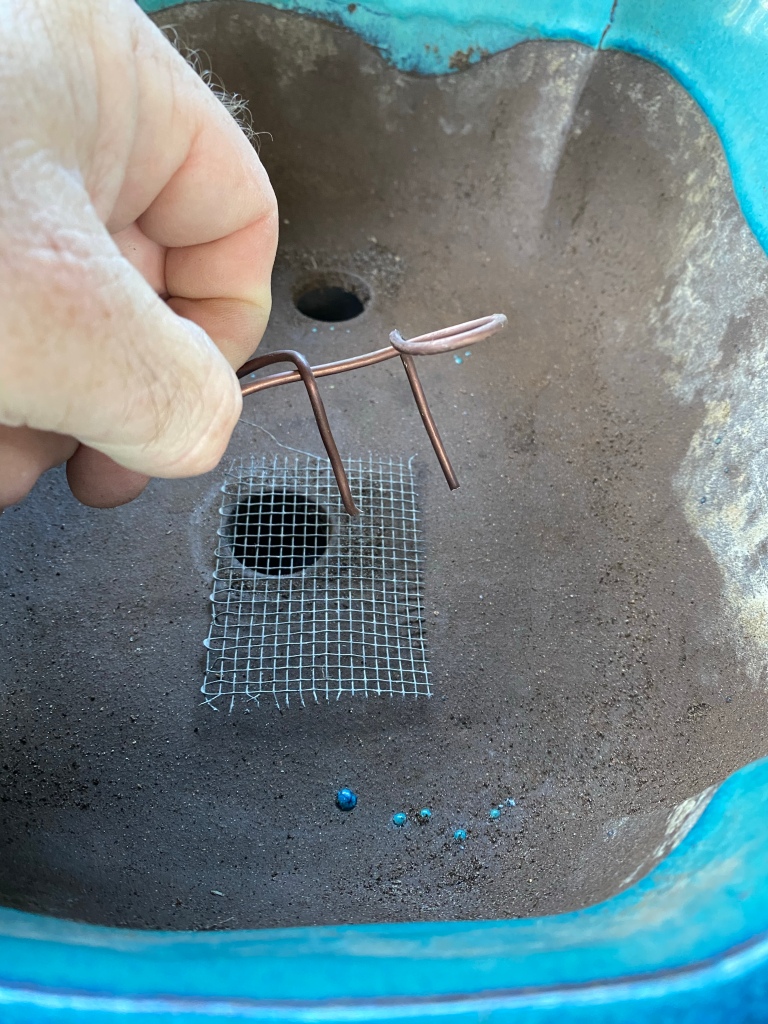
I’ve been using galvanized steel. It’s strong, lasts for years, and drains well.
And I don’t skimp.
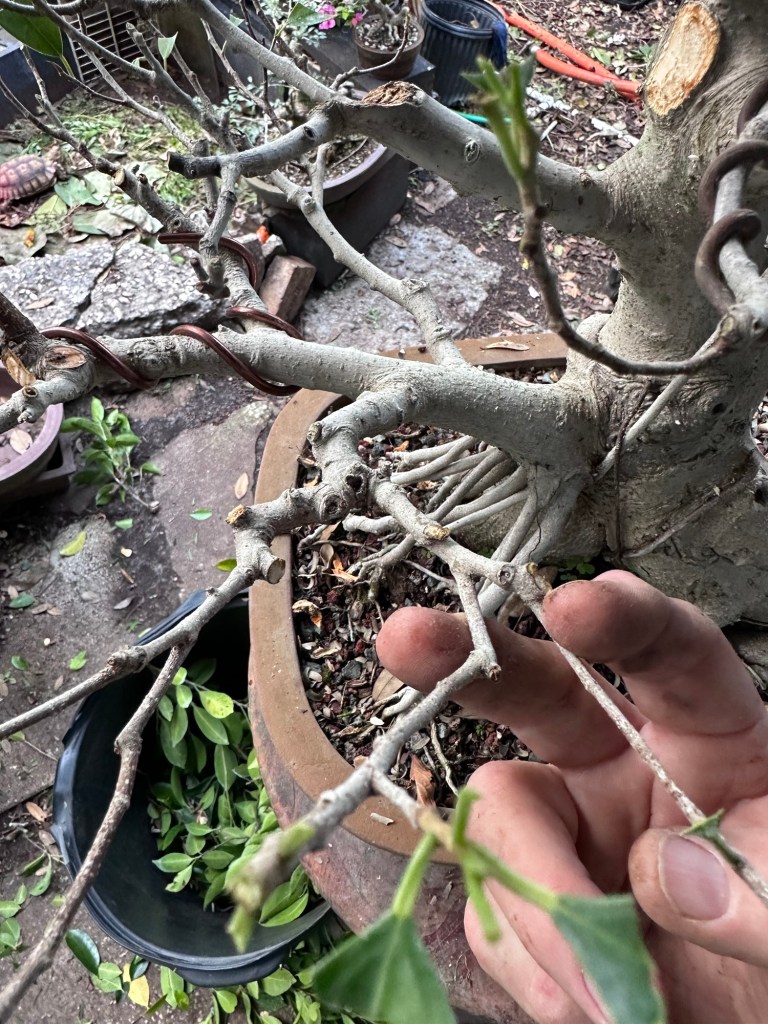
And the wire I use to hold it in: it’s heavy gauge, and bent so as to hold the screen in place.
The loops hold the screen and there’s enough underneath to hold it to the pot. (Ignore the calcium buildup, it’s from south Florida, where the water is hard as a politicians heart.
See that? It ain’t moving.
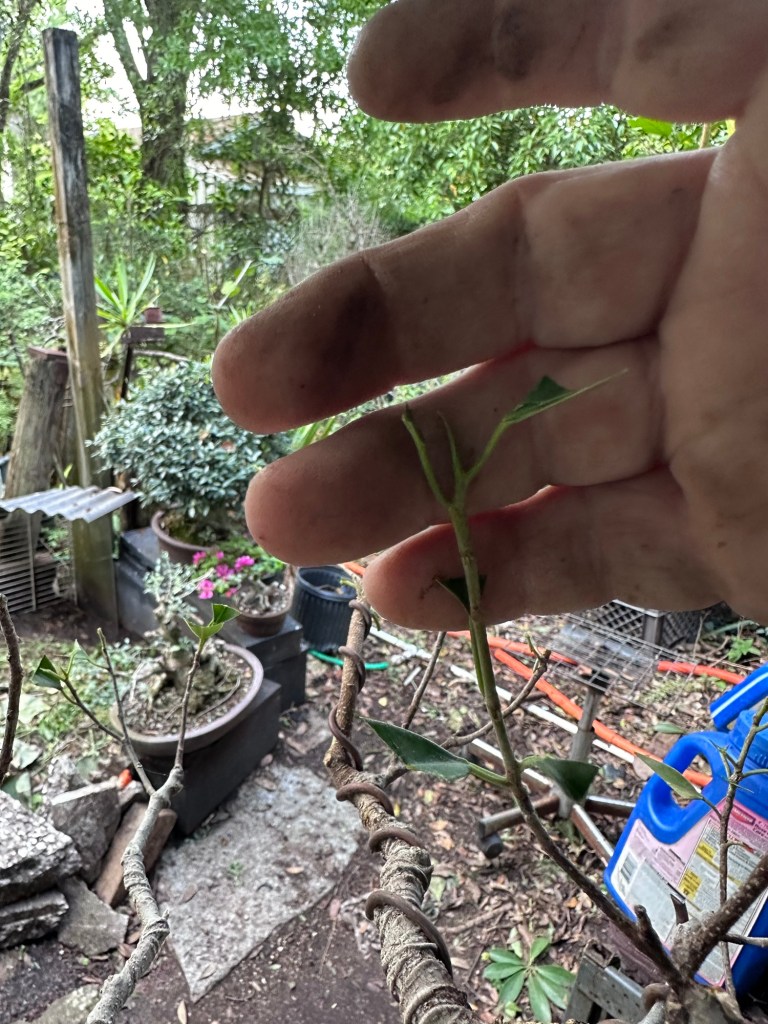
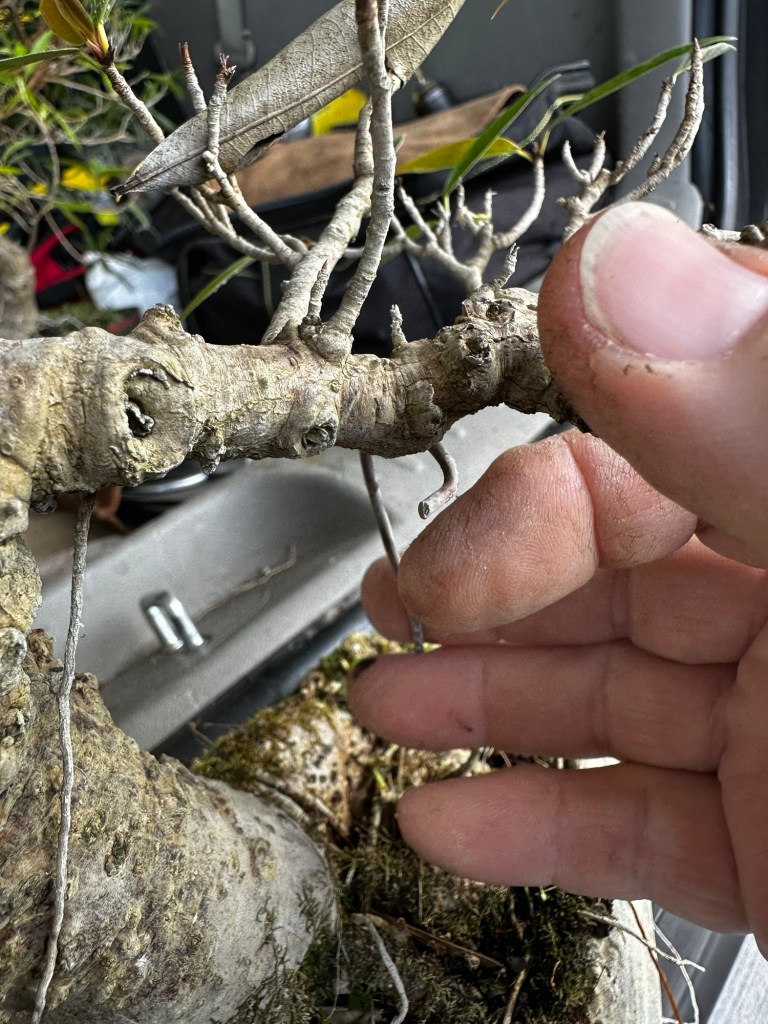
And while I’m at it, tie down wire should be heavy too. At least 2mm, this is 2.5.
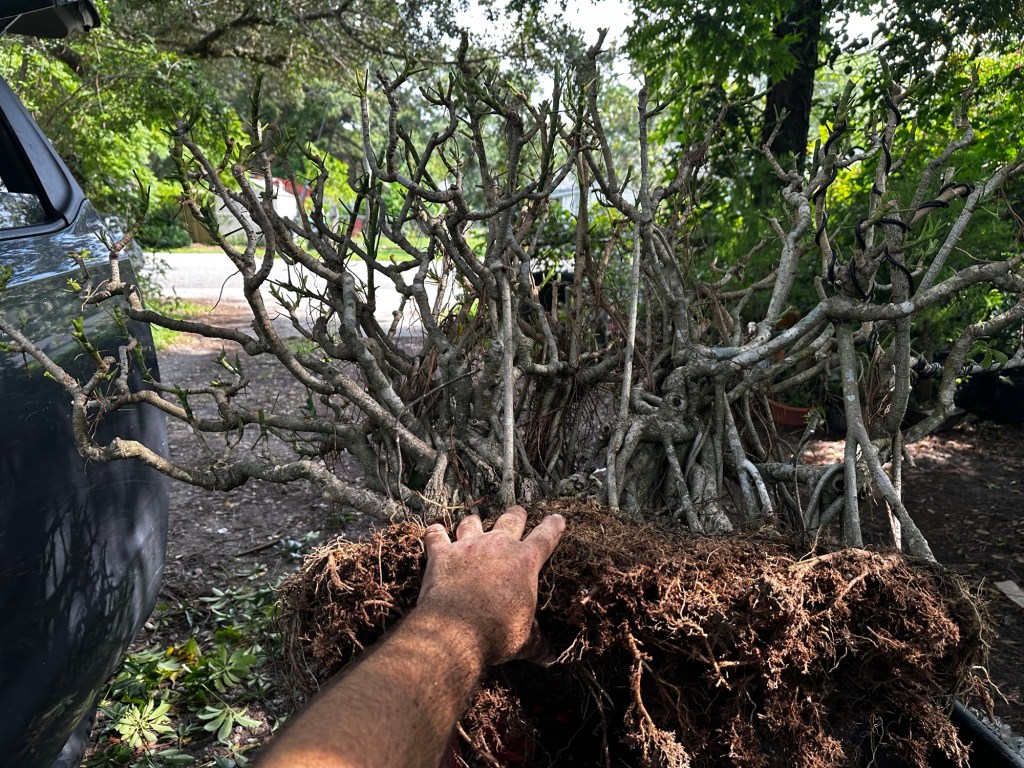
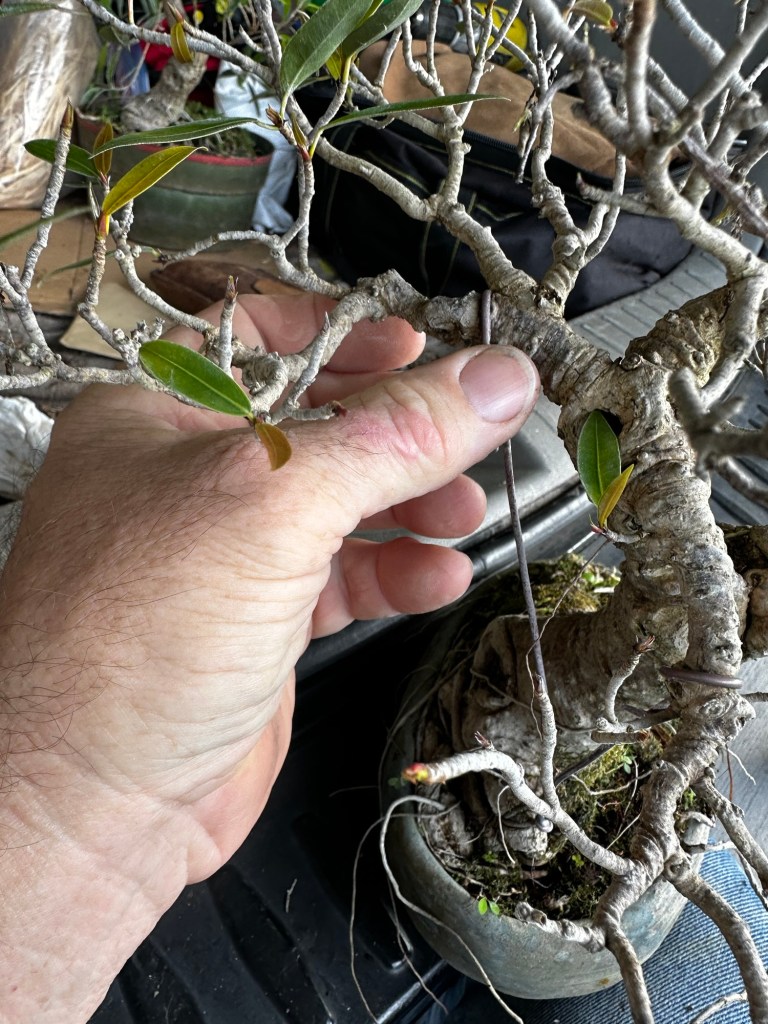
I can pick the tree up by the trunk, with no worries that the tree will be damaged (could, but not usually….well, sometimes. Do as I say, not as I do…).
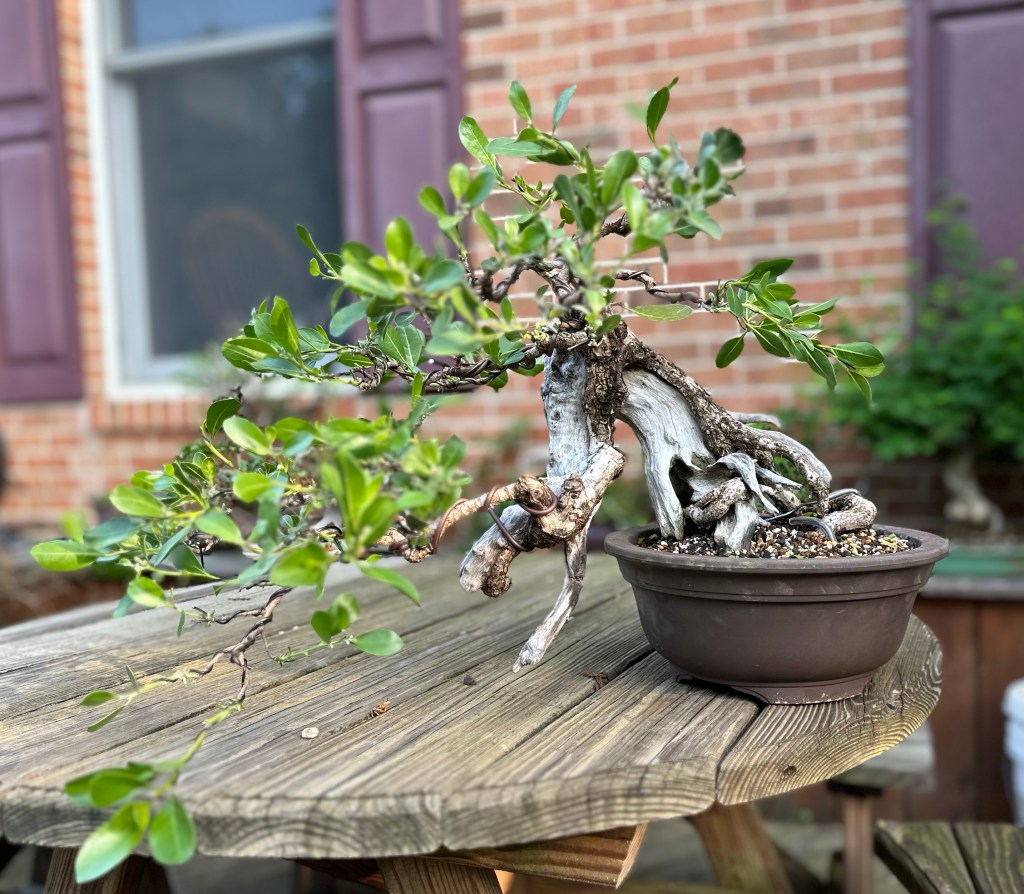
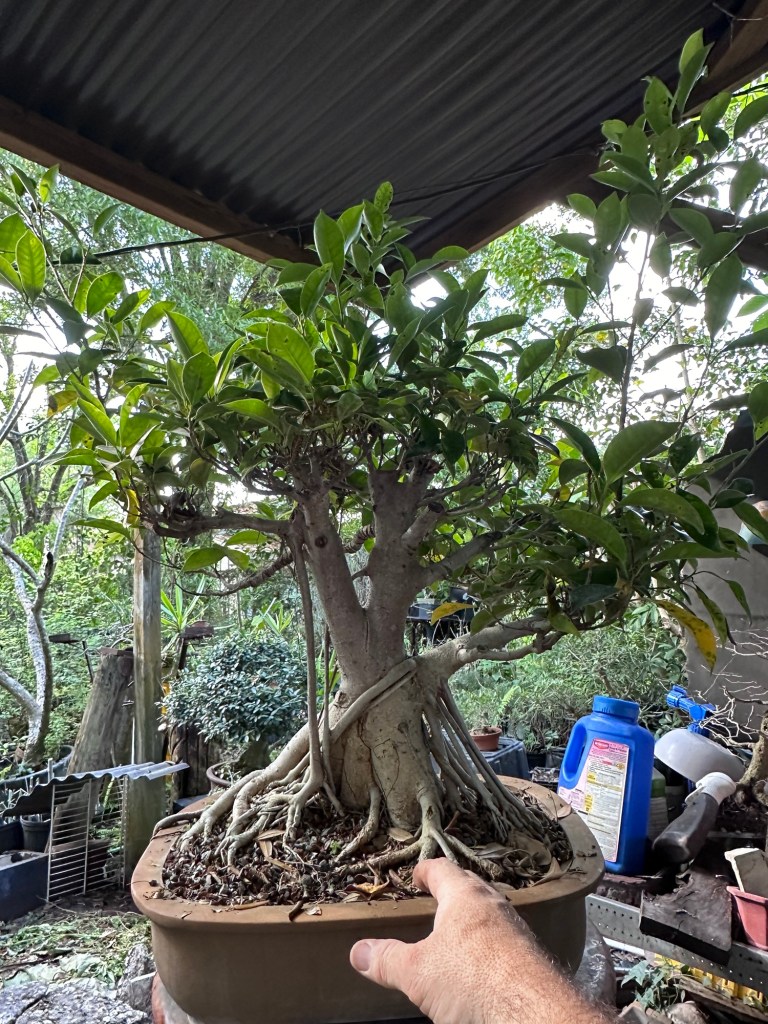
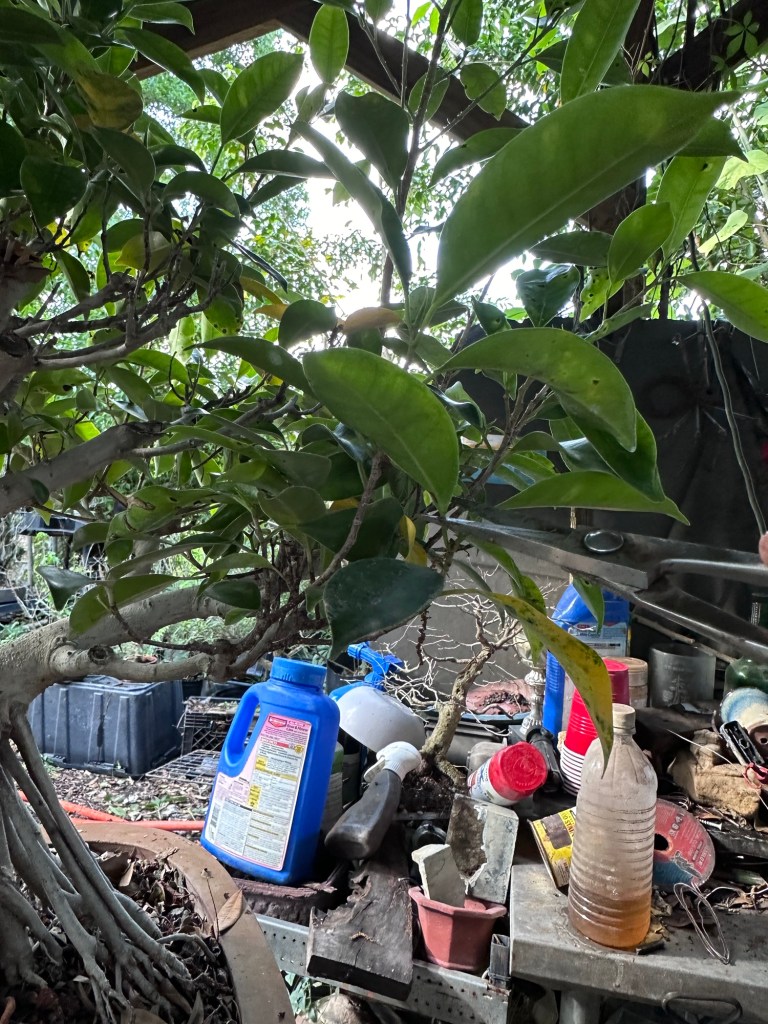
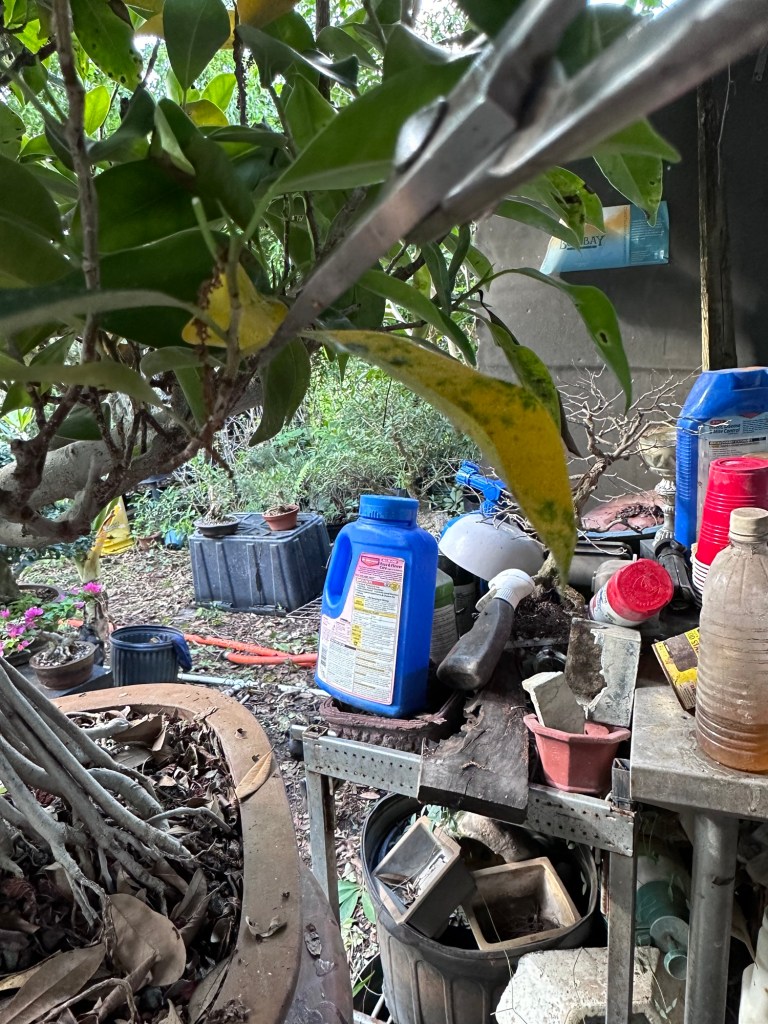
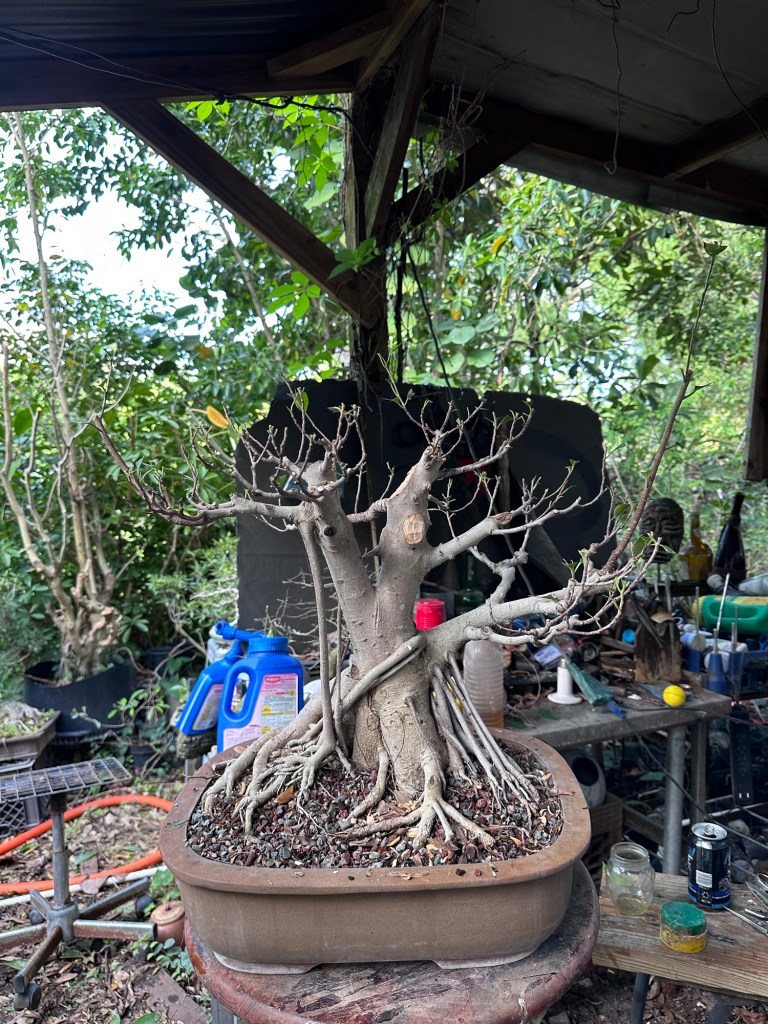
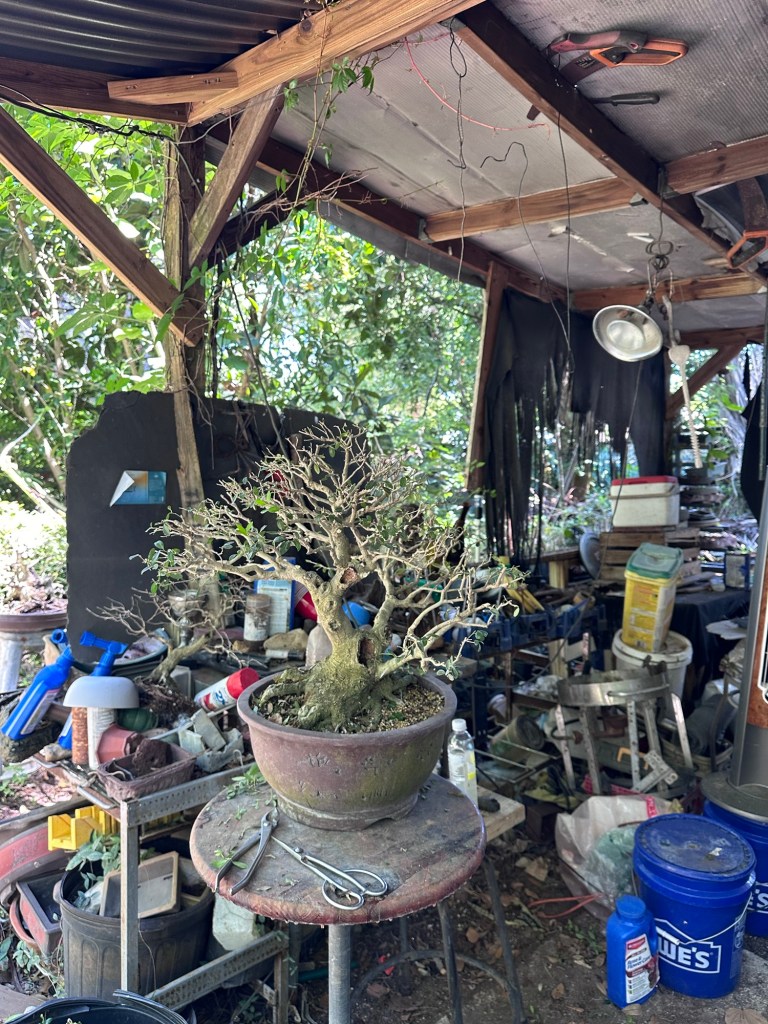
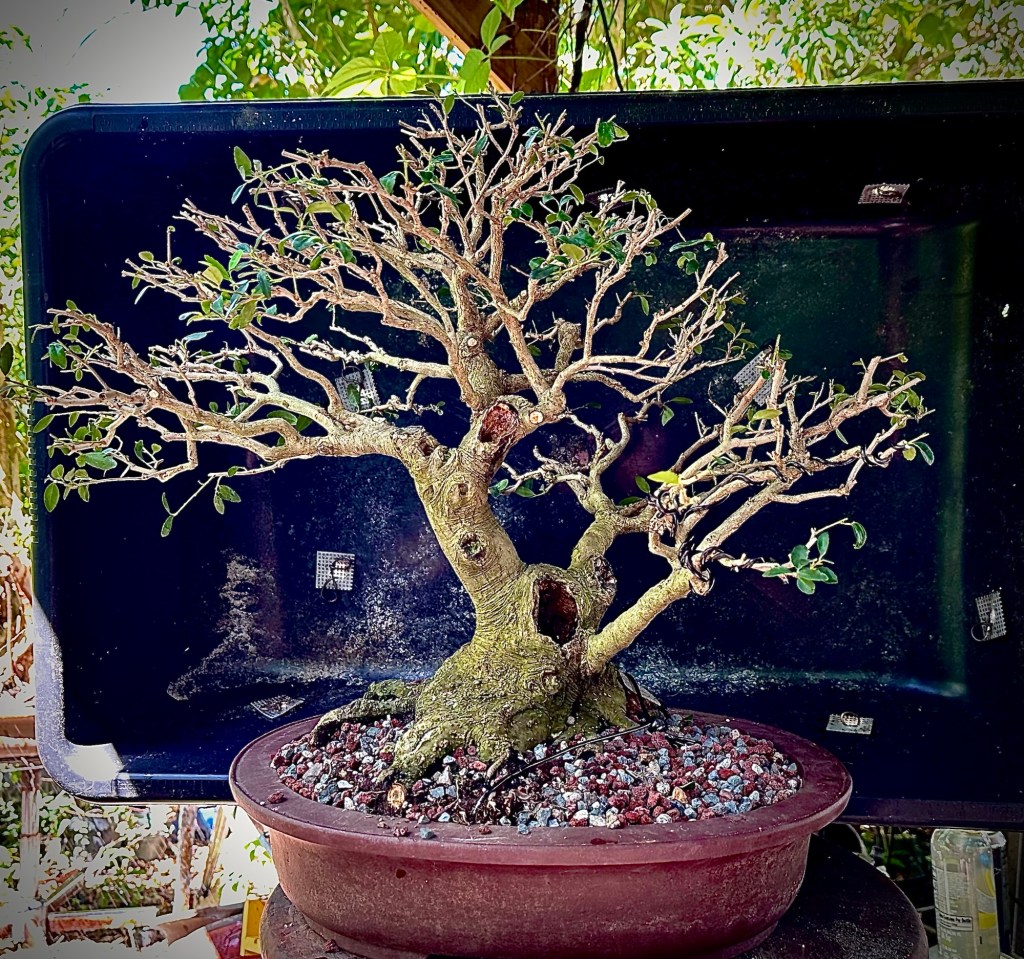
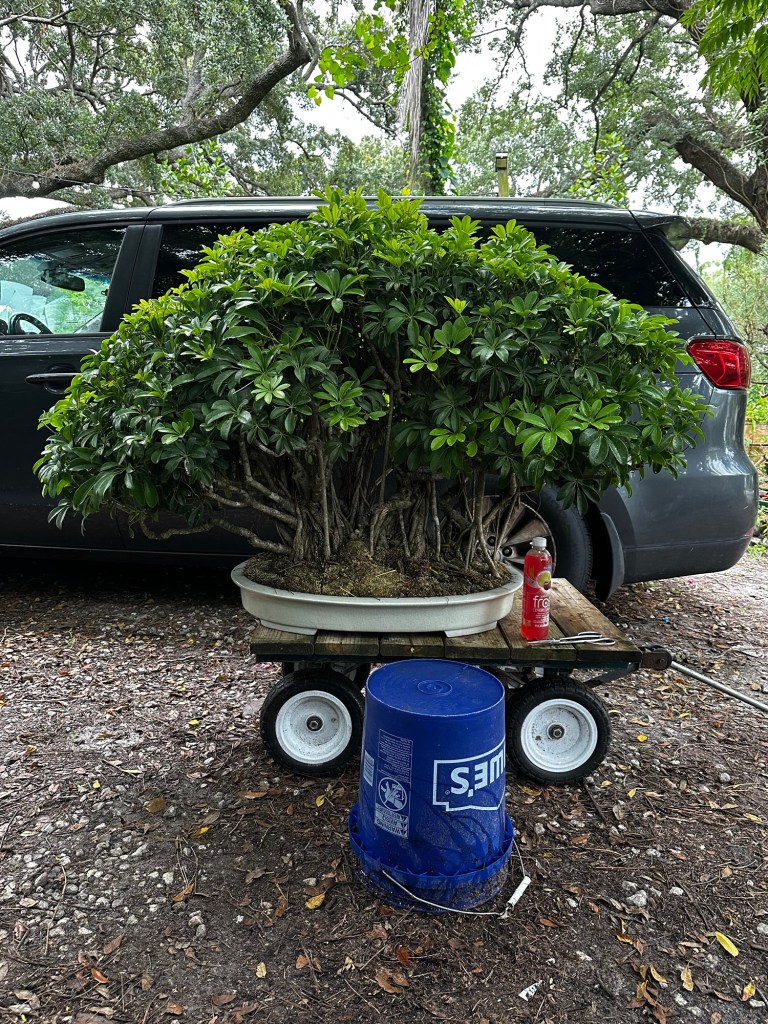
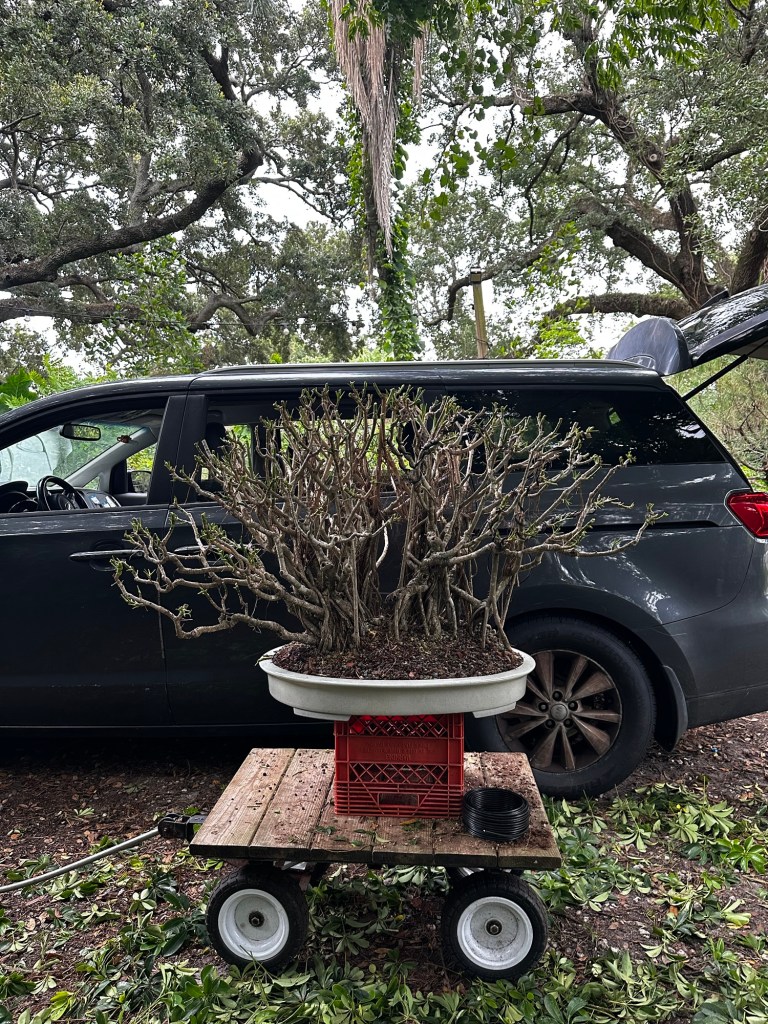
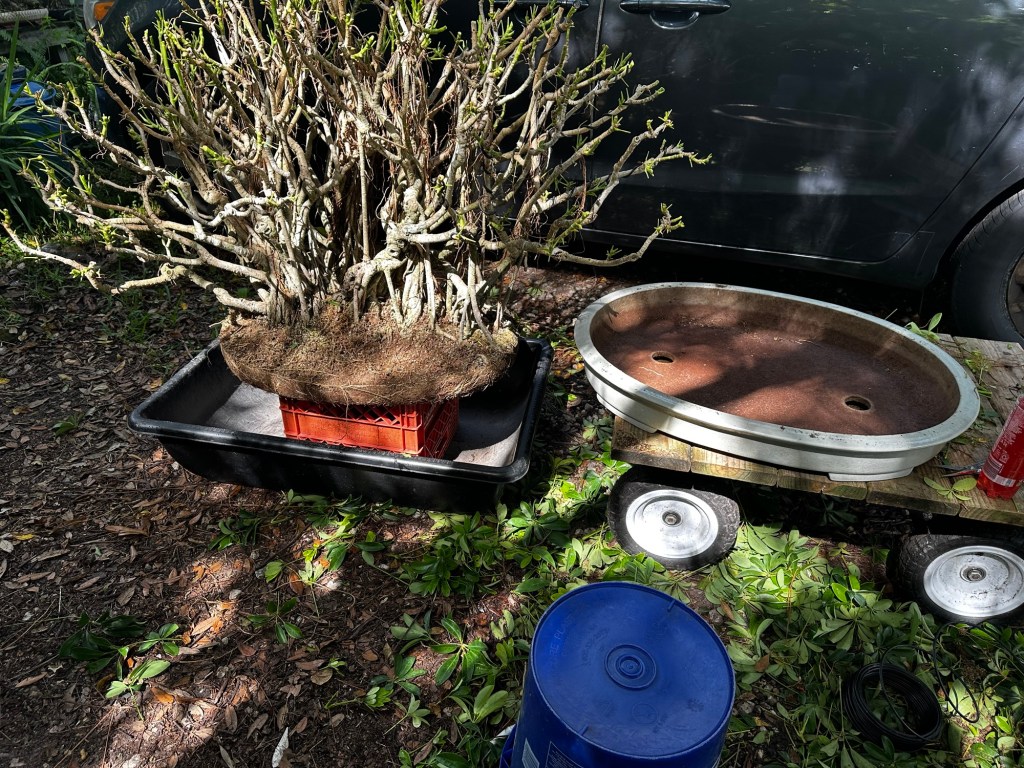
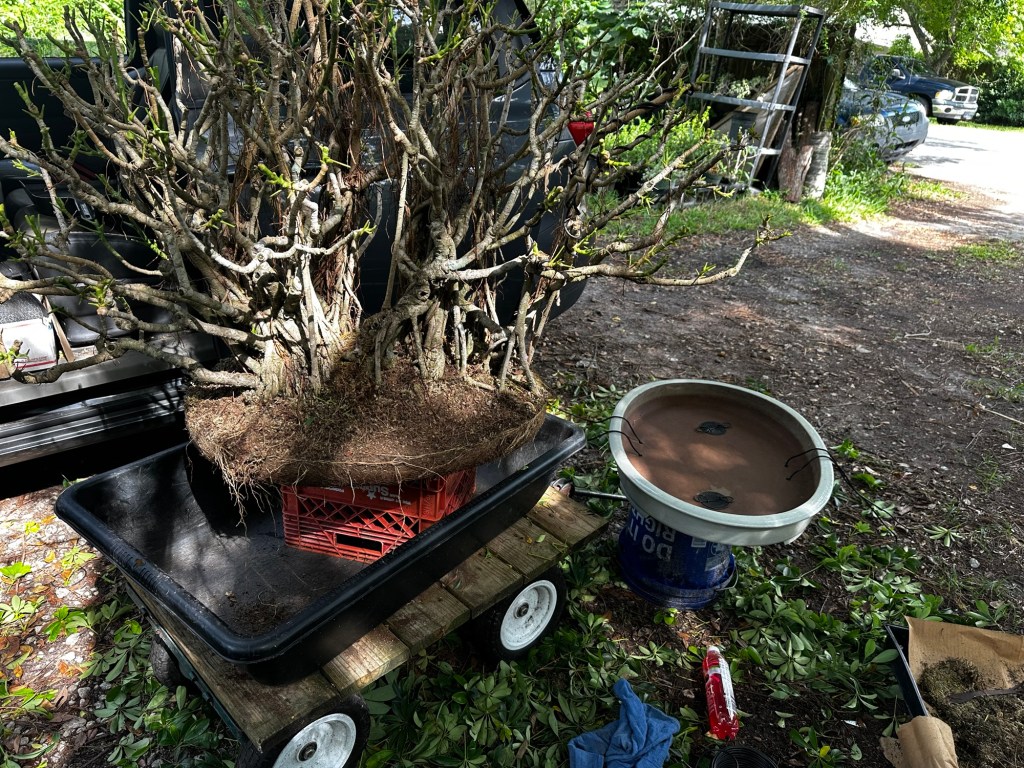
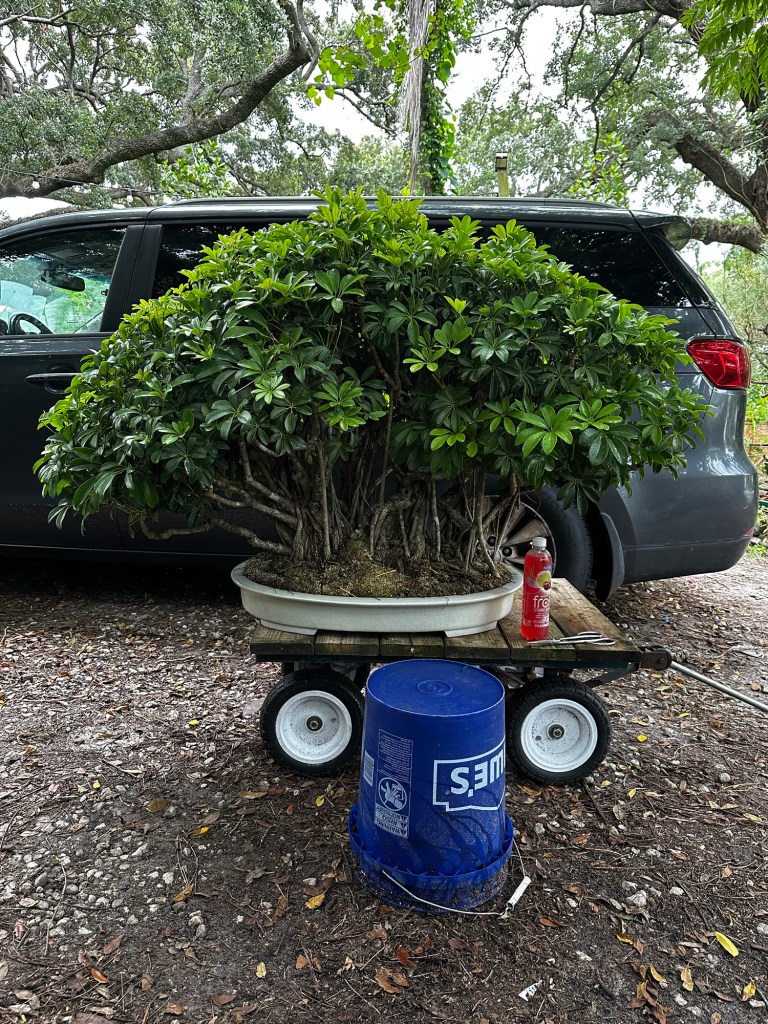
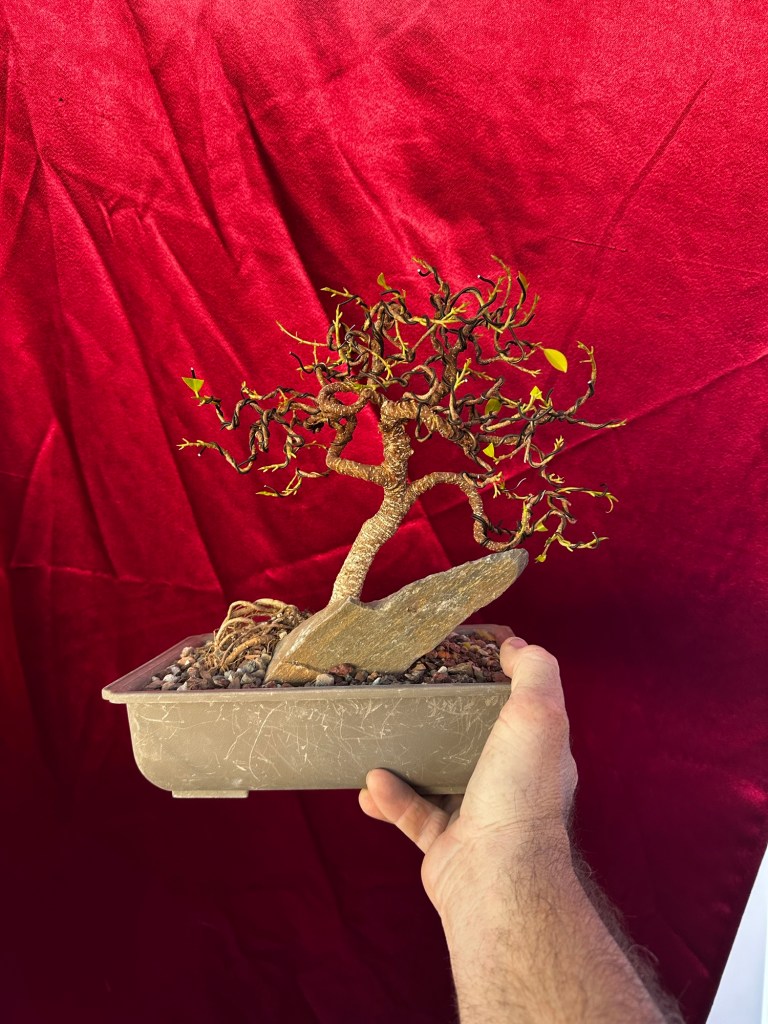
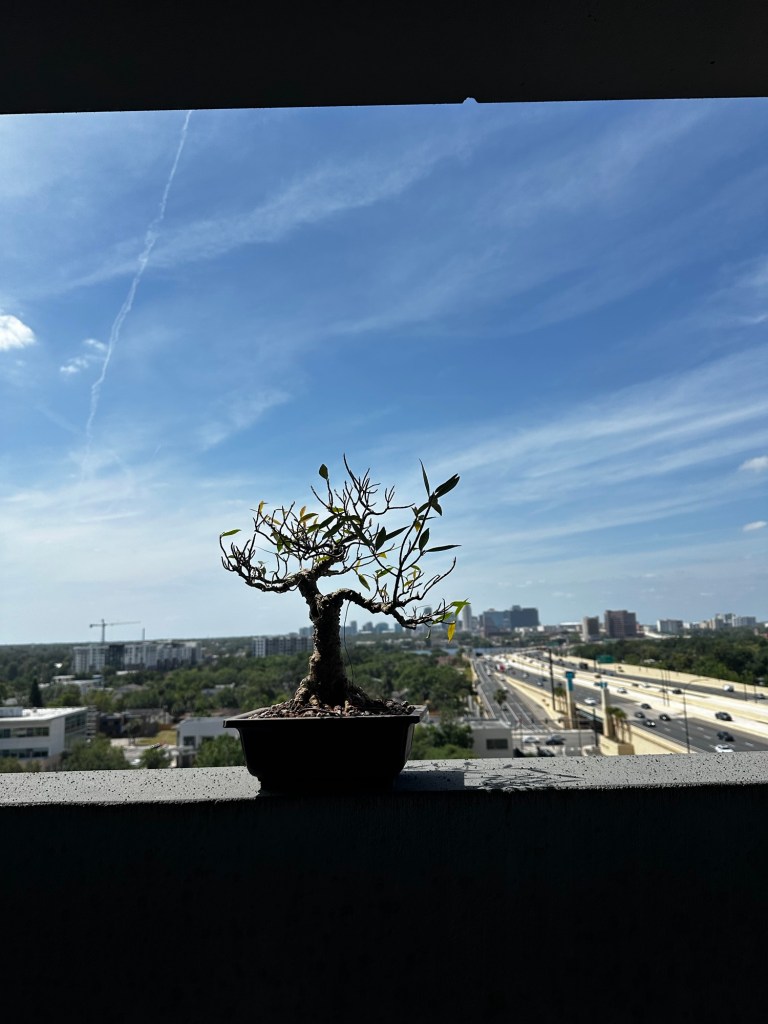
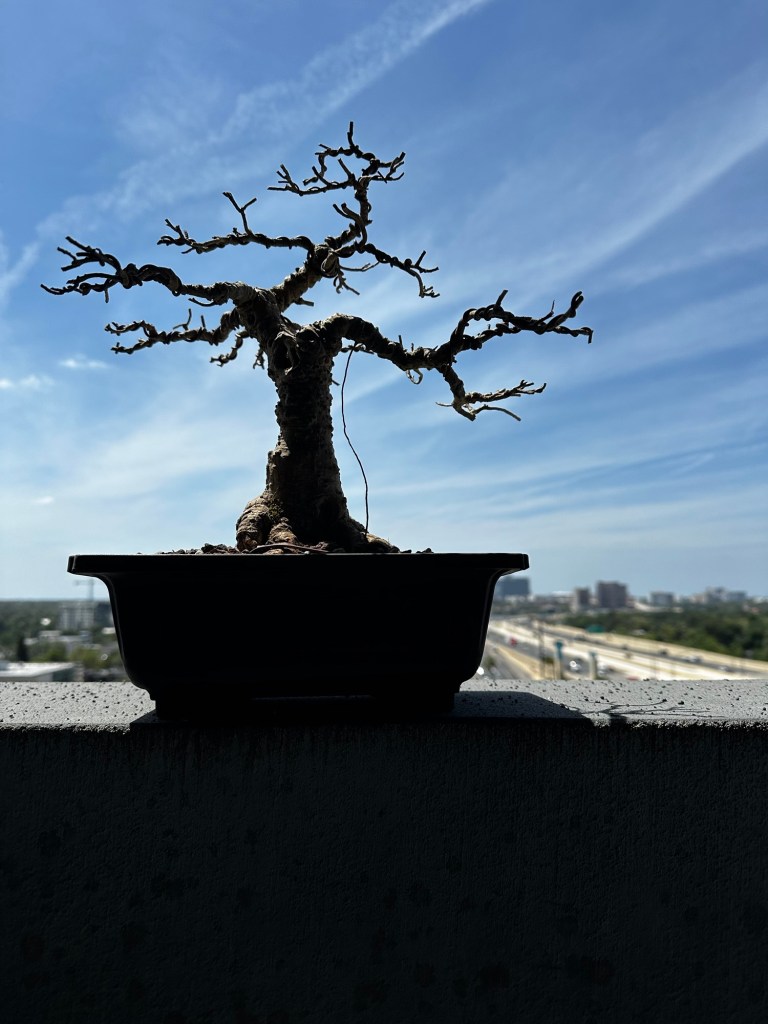
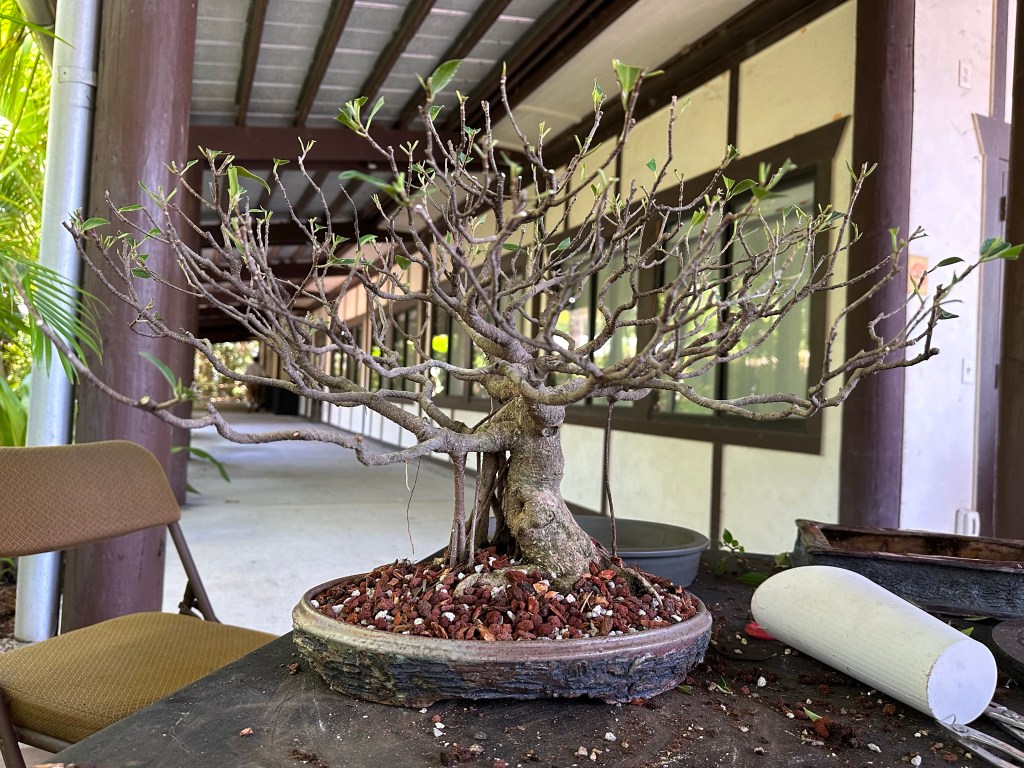
Here’s the tree. Portulacaria afra. It’s not going anywhere.
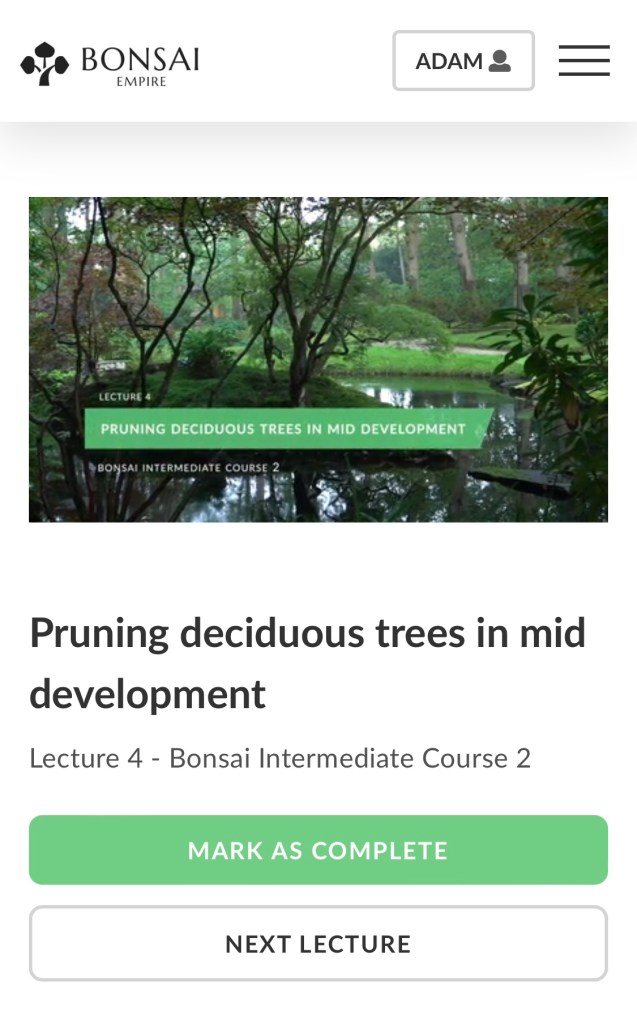
A few months ago, I got an email from Oscar Jonker, from Bonsai Empire , asking me to give an honest review of his newest online class. I’ve collaborated with Oscar in the past, providing some media, hosting livestreams, etc, so I said “sure”. Little did I know that the class was so in-depth and full of information that it would take me days to finish!
So, my friends, here is The Review…..well, after the mandatory legal statement: according to the US FTC, I have to disclose whether I’ve received any compensation from Oscar or Bonsai Empire. I have not. This is not a paid review, simply a service provided to my friend and to let the Bonsai World know about a valuable resource. I was provided access to the class though, which you see by the above pic, costs a mere $59.99.
Some of you might wonder why I, as a possible competitor, might want to promote Bonsai empire (always ask why!). Easy answer, I don’t see myself as a competitor nor do I think any Art is a competition. Down that road is where we find division and strife. My business model has me providing in-person bonsai instruction. I have done online classes and courses, and you can find those easily, but my blog (Da’ Blog) is free to anyone. Besides, the business of bonsai is not a zero-sum game. It’s not a pie to be cut up and the only way your piece gets bigger is to take from someone else’s piece. By supporting and promoting bonsai, the pie gets bigger.
Ok, with all that said, THE REVIEW!
The course is laid out with 21 video lectures, starring Bjorn Bjorholm and Michael Hagedorn, two of my favorite bonsai artists from the USA. Both trained in Japan, both with amazing content (I subscribe to Michael’s blog). And both very knowledgable.
The video quality is top notch, as expected from a Bonsai Empire production. The knowledge imparted is in plain English, and presented in a humble way. You don’t need to know what a “moyogi momji with a melting nebari in a nanban pot with an understated namako glaze” is. Very accessible. By the way, who would put a moyogi in a nanban?
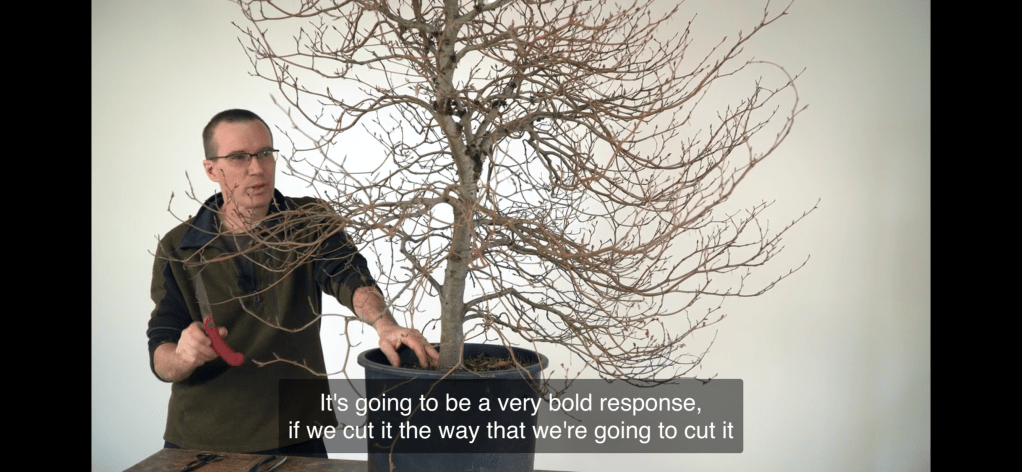
One refreshing thing, Bjorn isn’t averse to trunk chopping:
The information: both artists describe what they are doing and, most importantly, why. The chop above is for taper and movement. And after care is discussed, the how and why and when. There’s one spot where Michael explains that if you do this, at this time, you’ll see this result. But if it’s at another time of the year, you’ll see this.
It’s also set out in terms of the trees various stages of development.
I followed the courses on my iPhone, and the video transitions from the different views was flawless.
You can watch like this:
With the video in the text.
Or with just the video (here in portrait mode).
Or in landscape, full screen mode (turning your phone horizontally).
There is also a closed captioned mode, for when you’re with company and don’t want the sound to bug those near you.
Above, Michael is tackling a huge beech.
The course covers both deciduous and coniferous trees. And styles.
The pruning strategies between the two are covered, and contrasted.
If there are any drawbacks, I might have added some still photos that one could zoom in upon. You can zoom in on the video, but you have to pause it, and it’s not a full zoom (where you can see the dirt under the fingernails). I’m not sure how you could structure the addition of still shots, that’s above my skill level, but it would be cool.
You can also ask questions and comment, and they are answered pretty well.
At the end, you get a certificate of completion, which you can print out for framing
All in all, I’d say this course (after taking the previous courses, of course) would be a good addition to your digital library (did I mention you have lifetime access to the courses you’ve taken? Meaning you can go back and review what you’ve watched any time).
Well done Bjorn, Michael, and Oscar, and all the people at Bonsai Empire.
If you’re inclined to increase your bonsai knowledge (and I recommend you learn from as many artists as you can) take a look at Bonsai Empire’s courses (the full curriculum can be found here )
Today, I got to diagnose what’s wrong with a 2012 Jeep Compass, take my daughter to PT, and go and take a dog outside to poop.
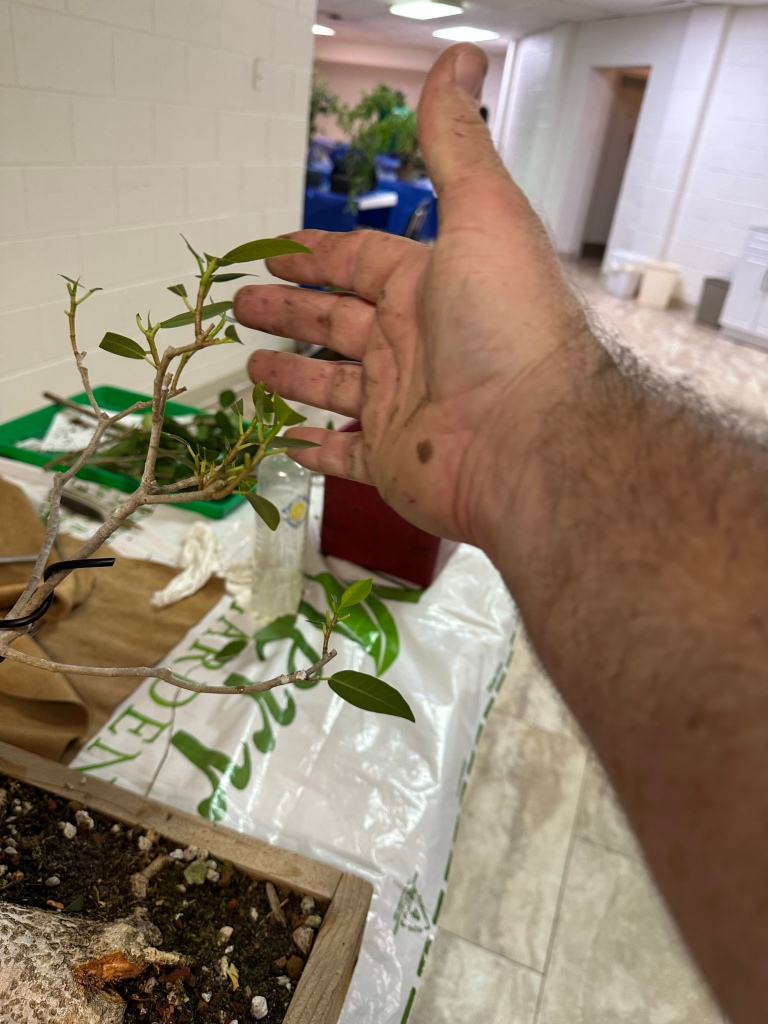
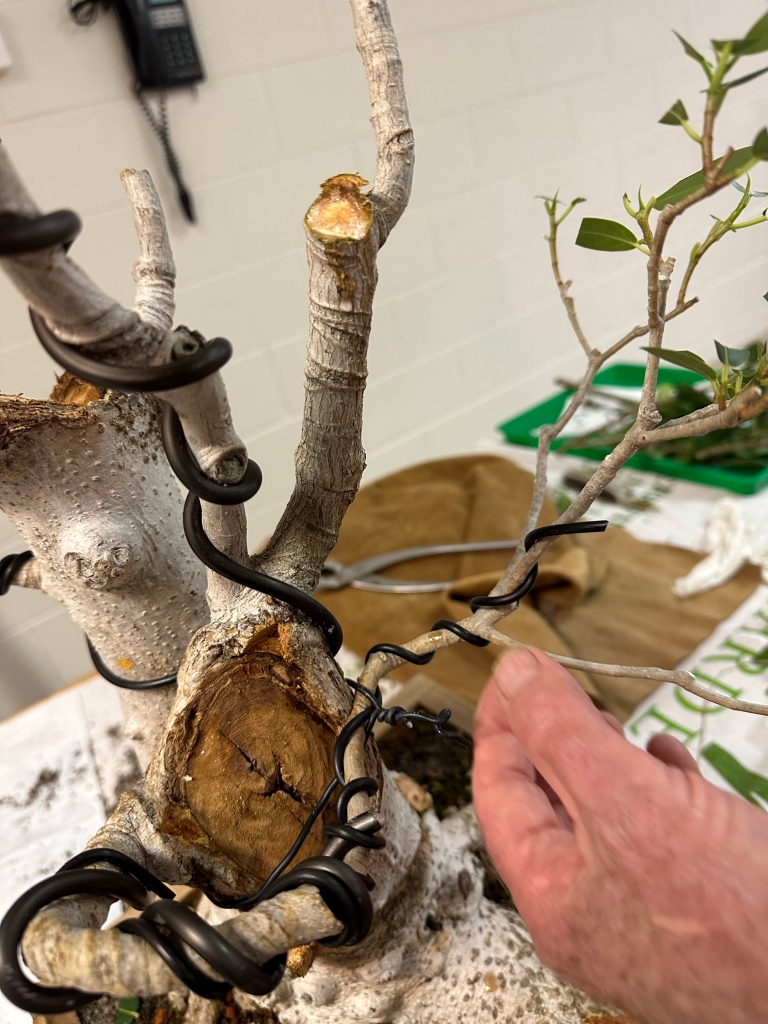
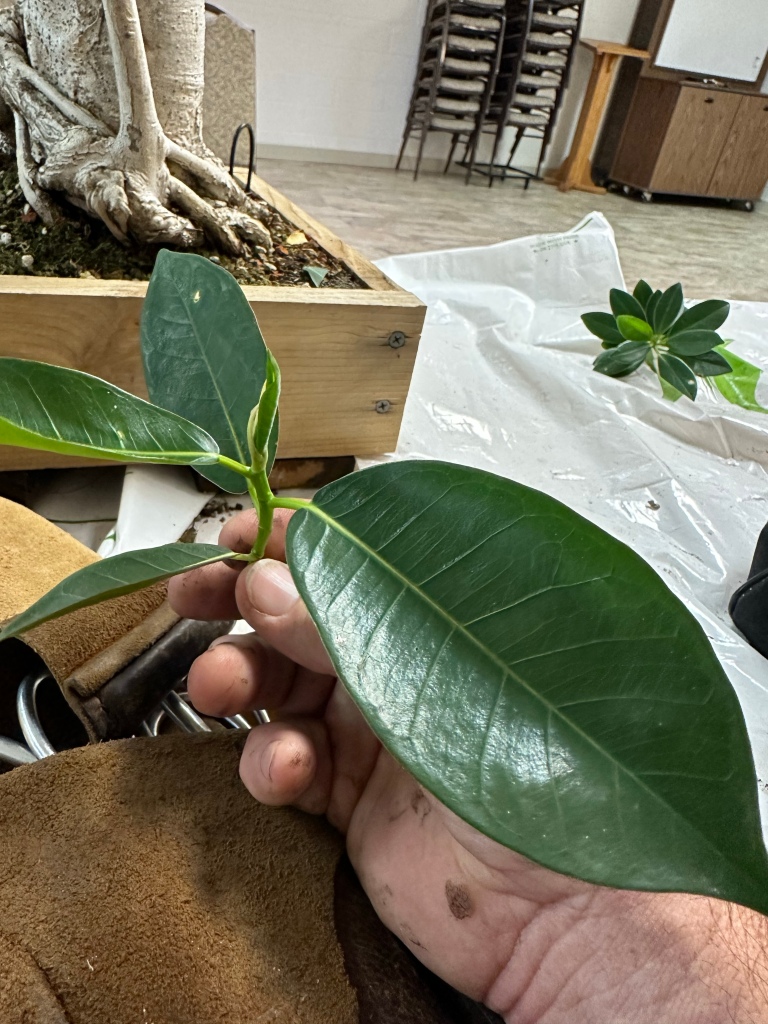
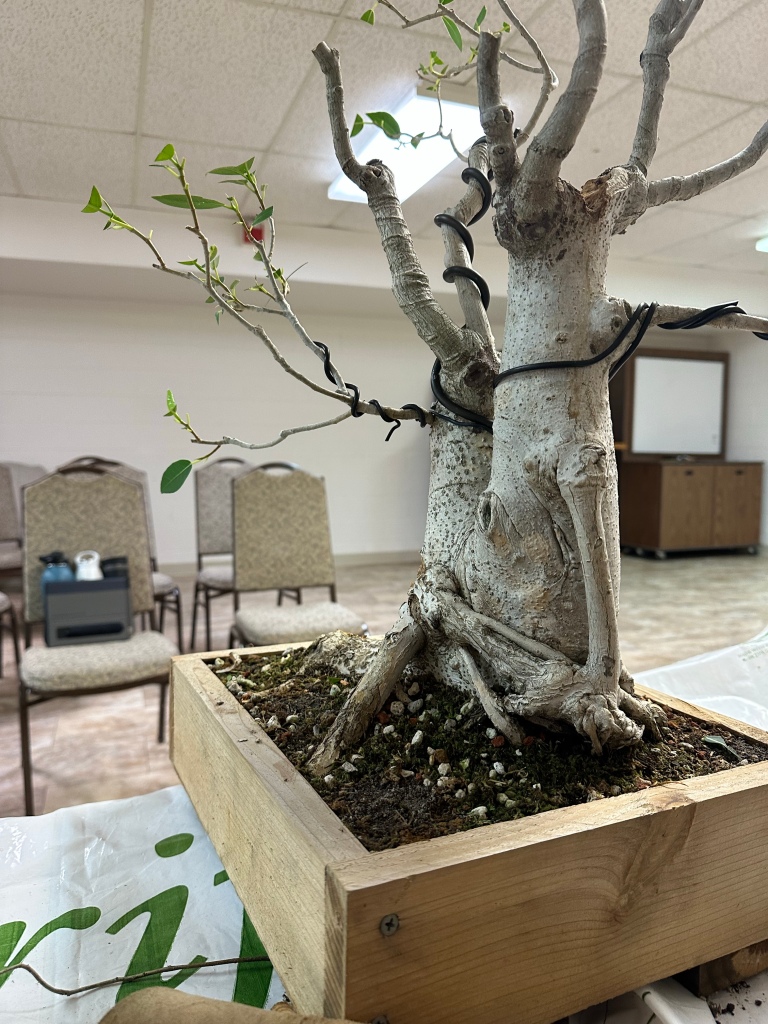
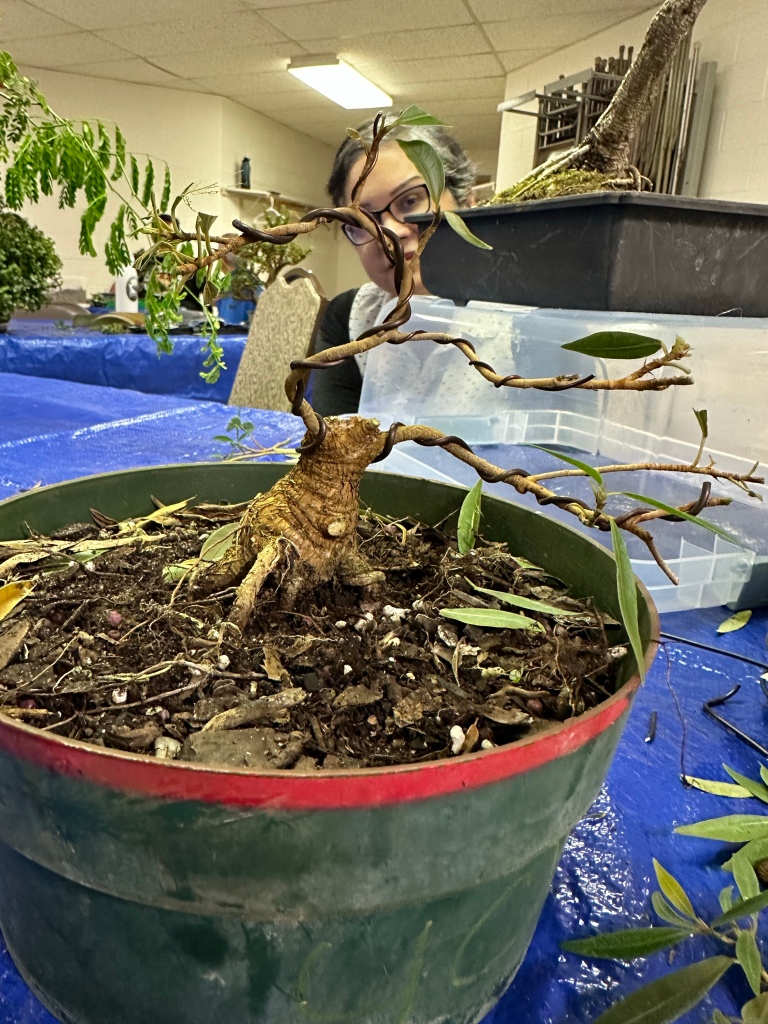
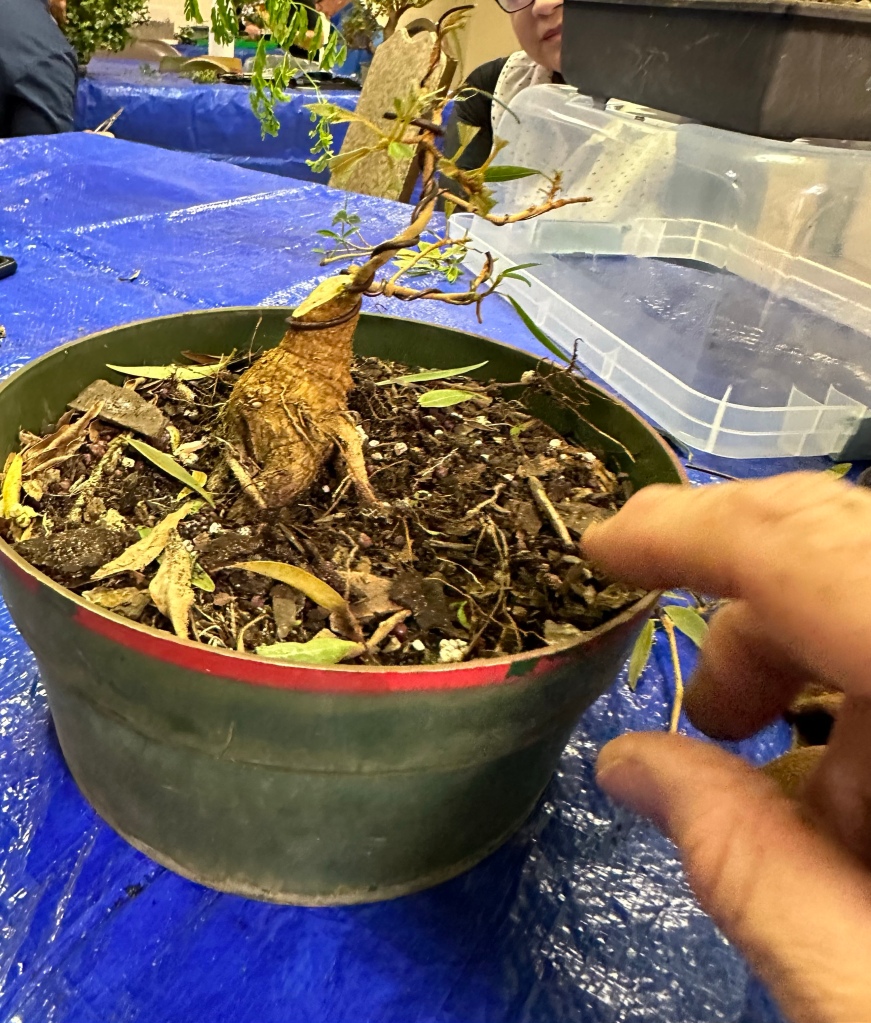
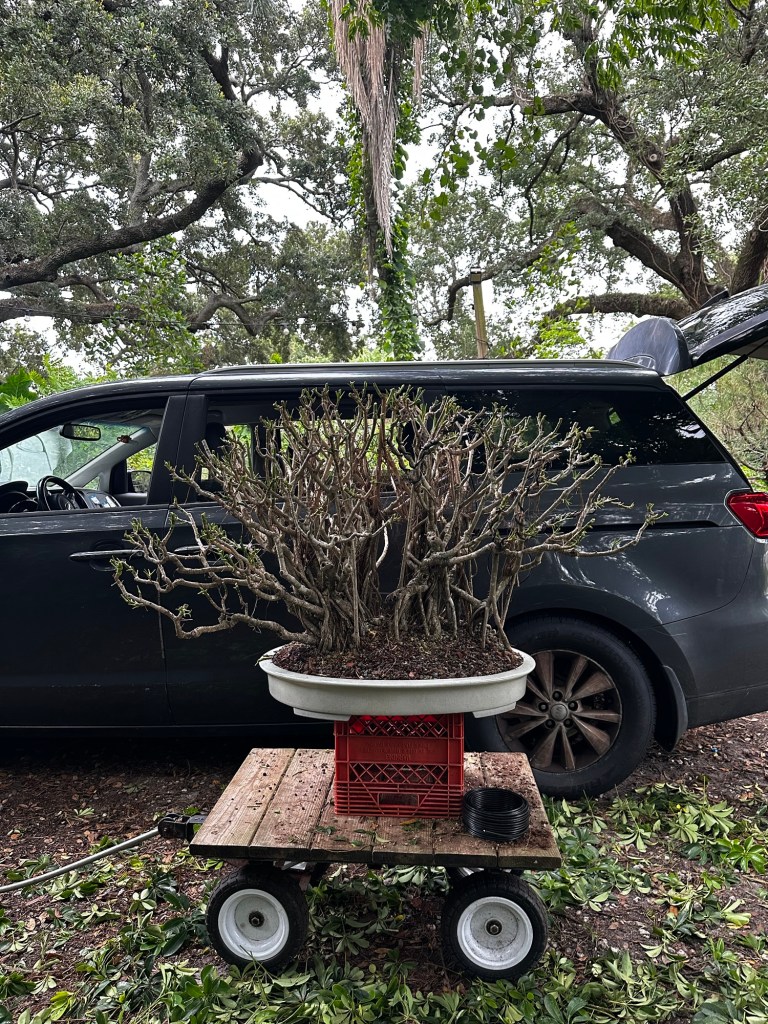
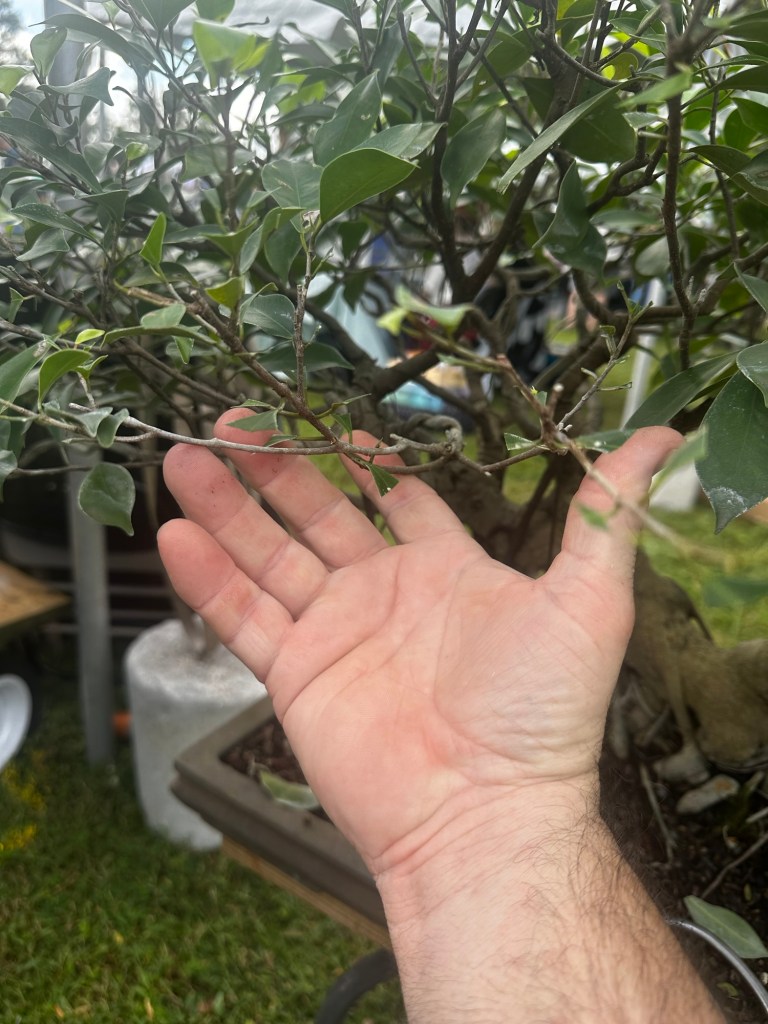
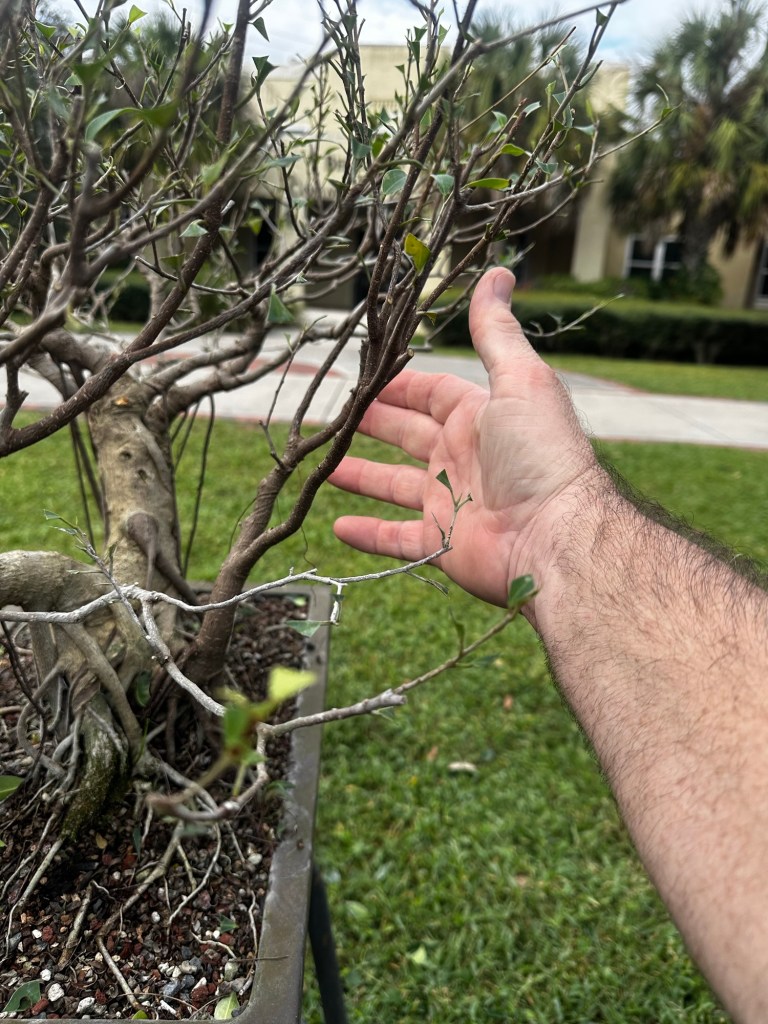
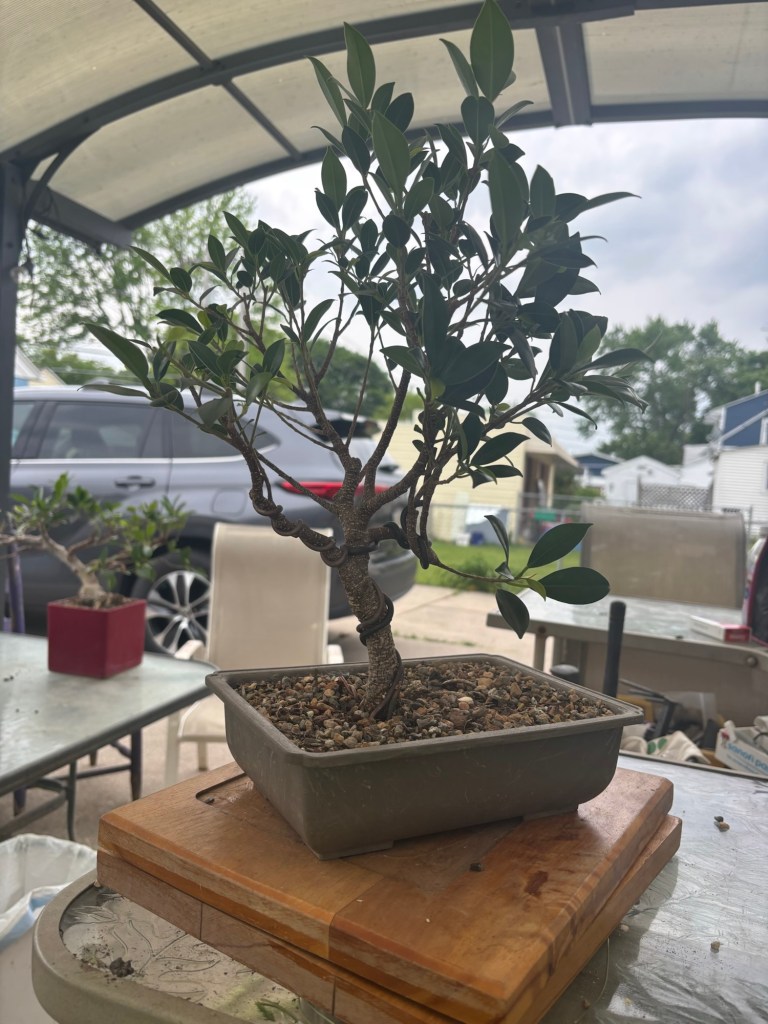
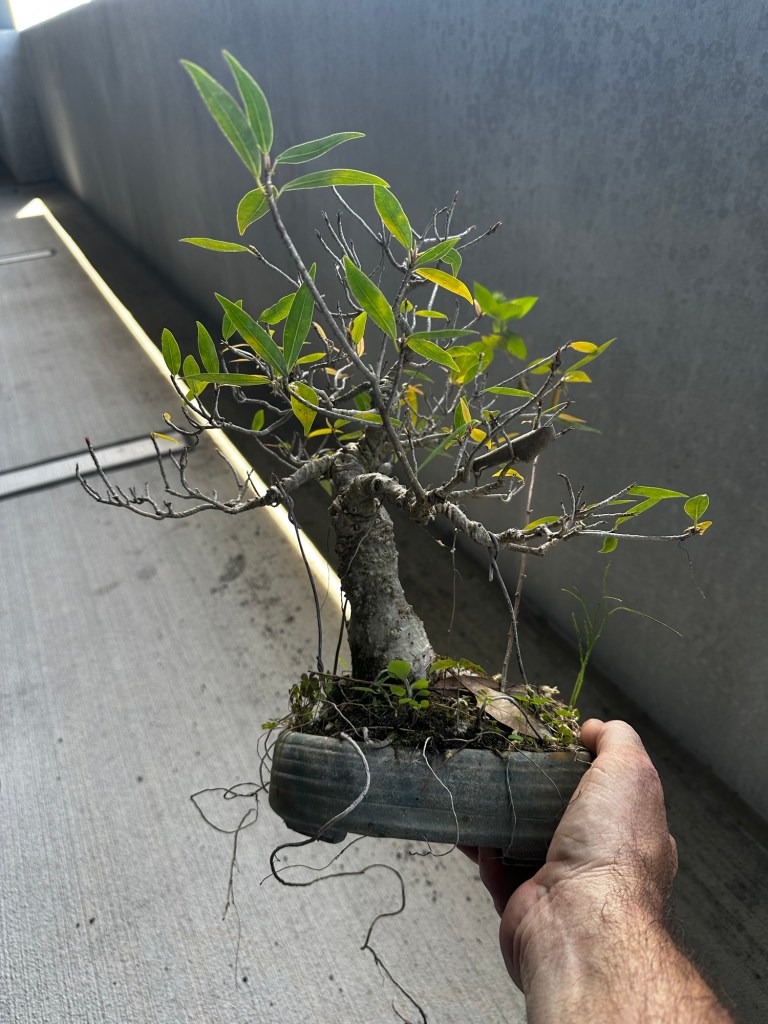
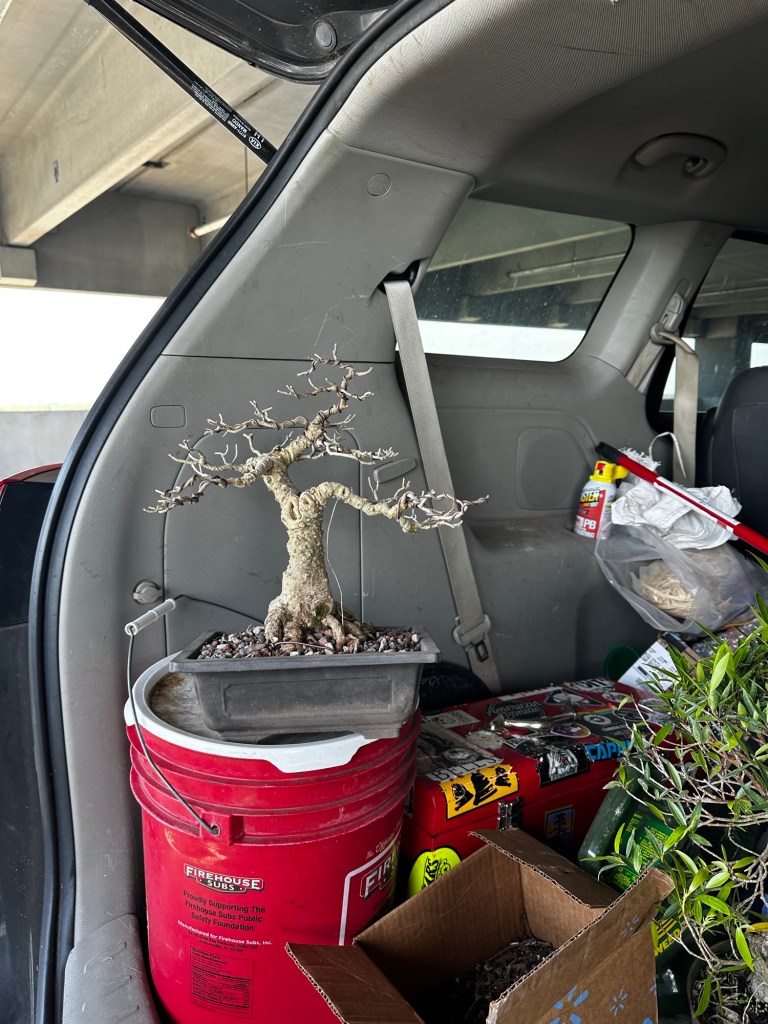
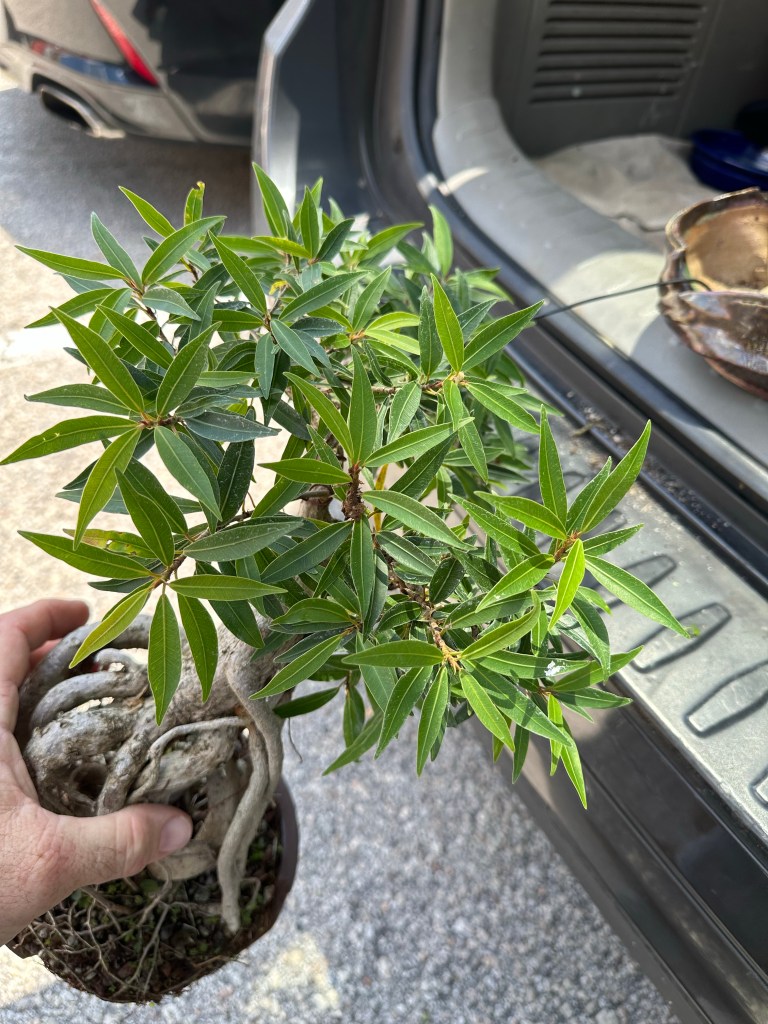
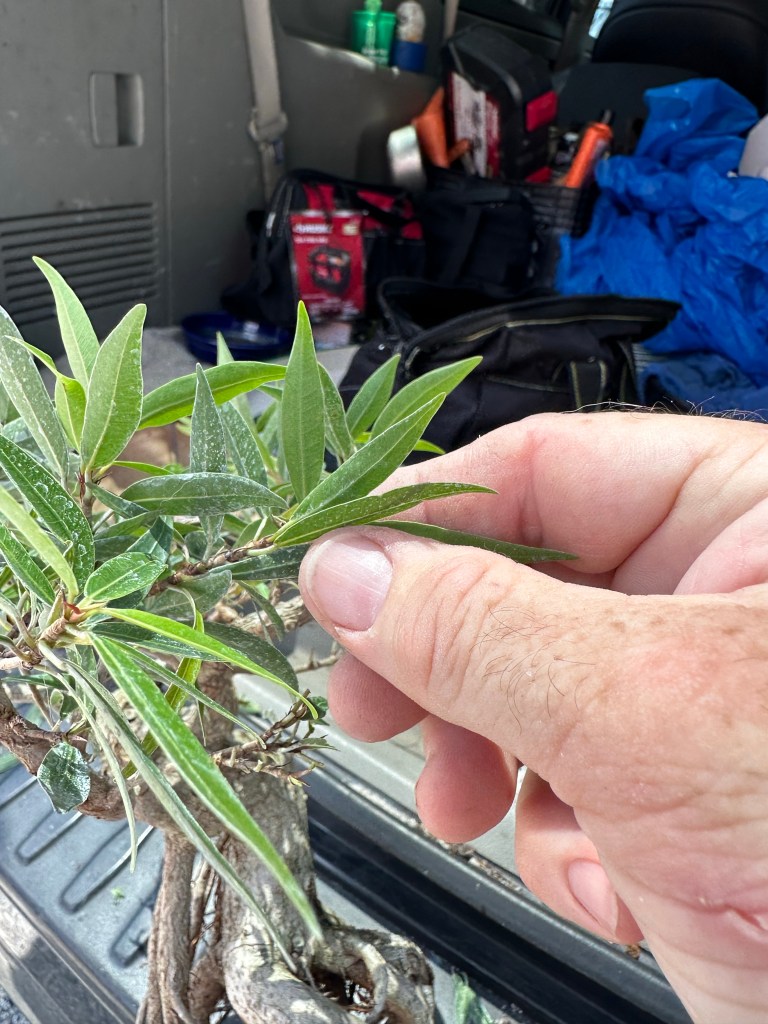
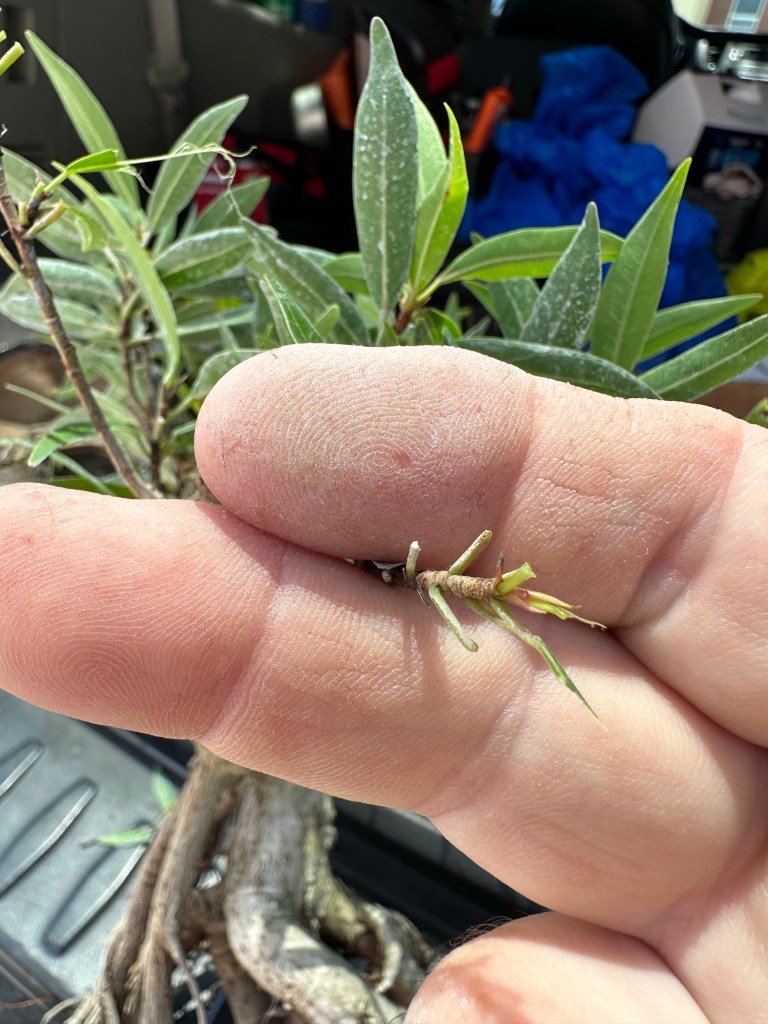
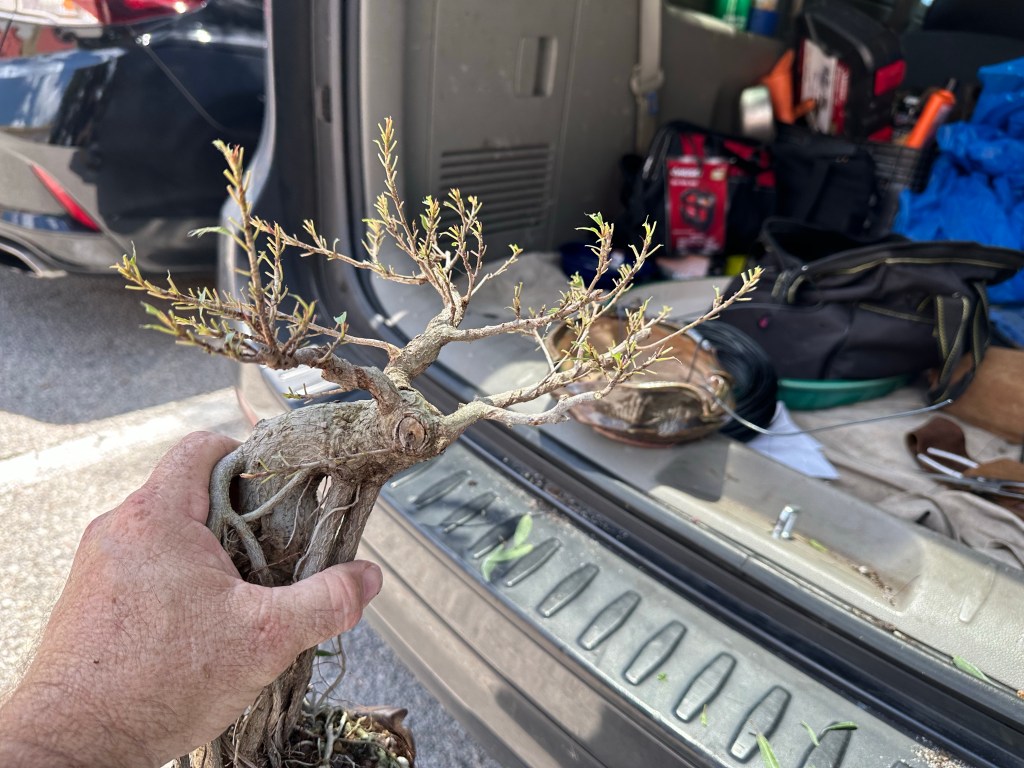
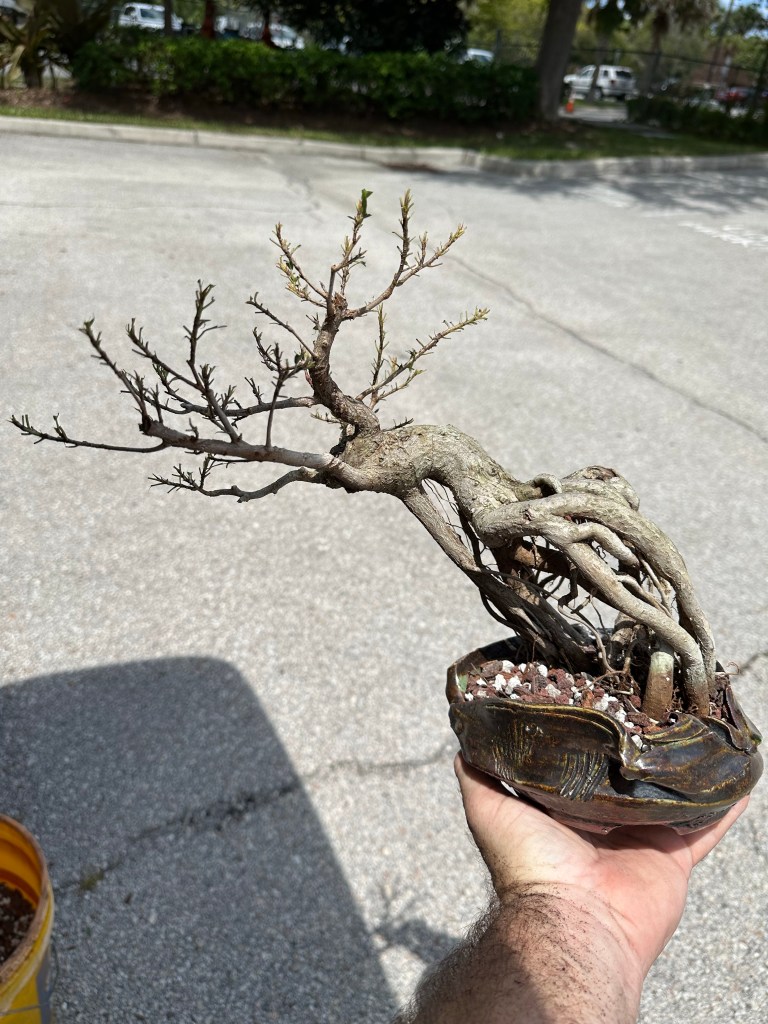
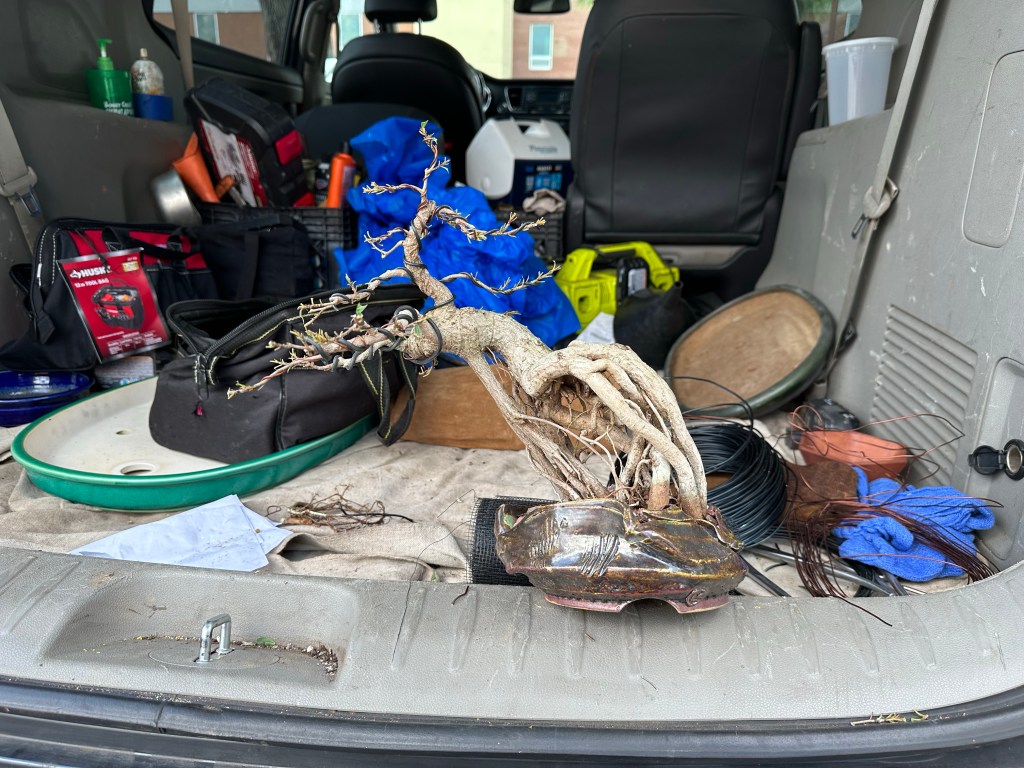
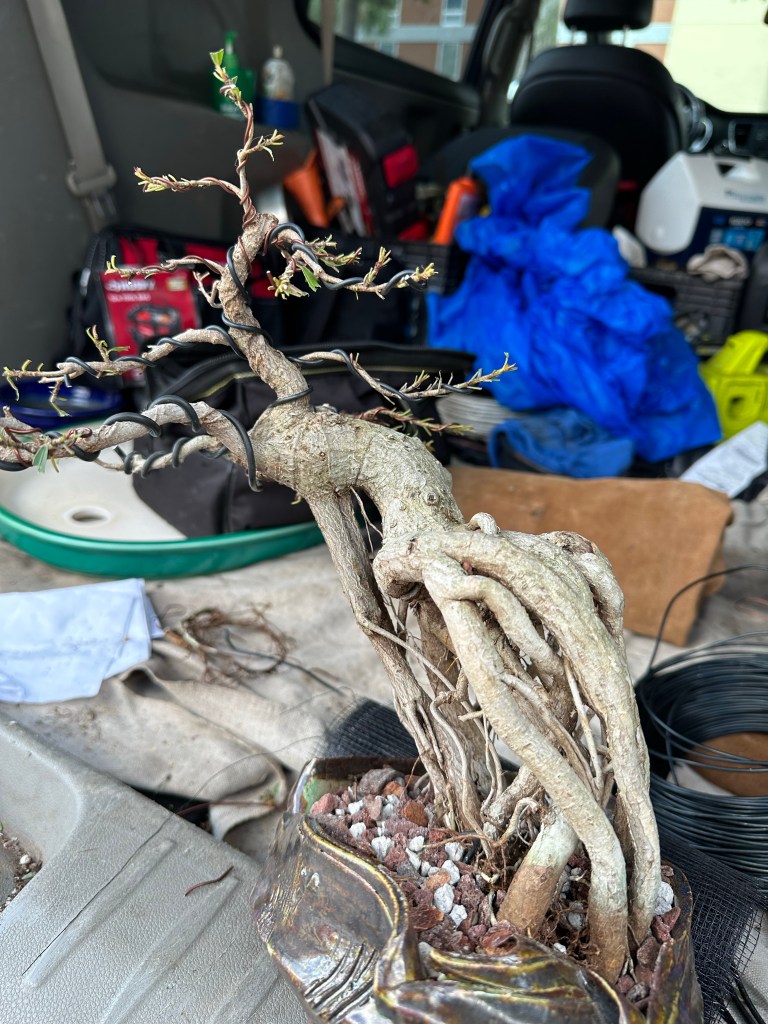
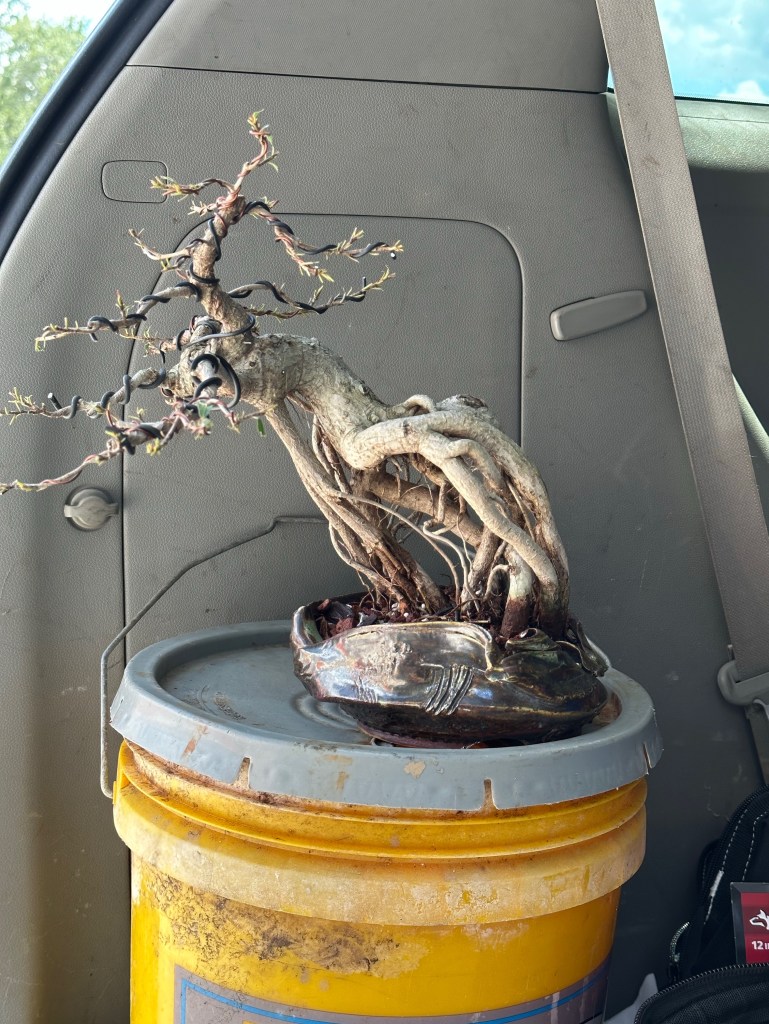
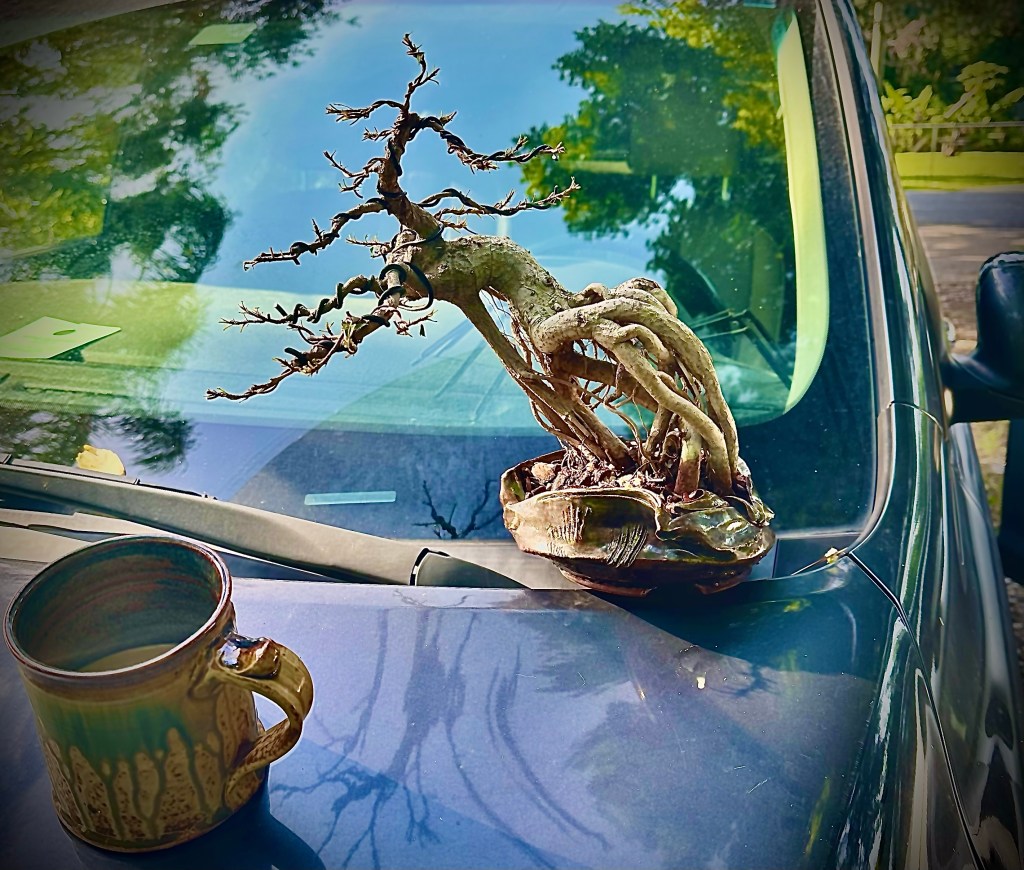
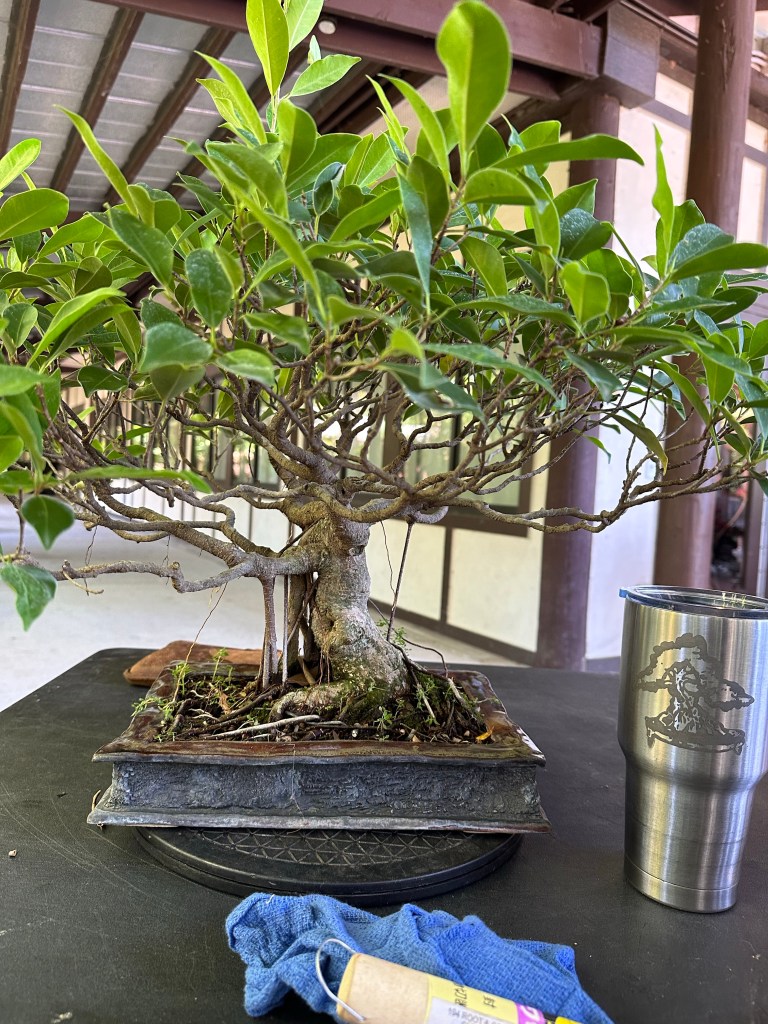
In between the PT and the Dog poop, I practiced a little Back Bumper Bonsai, just like the old days. Here’s the tree, a willow leaf fig (Ficus salicaria, ofttimes erroneously called Ficus nerifolia, or F. salicifolia, or whatever it was called when you grew up in bonsai).
Here’s the facility my daughter is getting tortured at.
Here’s the dog. Ugly thing, ain’t it? Lily. Stupid dog. It has no tail, so when it poops, you have to wipe its ass. Not me, no way, no how, not ever. My sister does though.
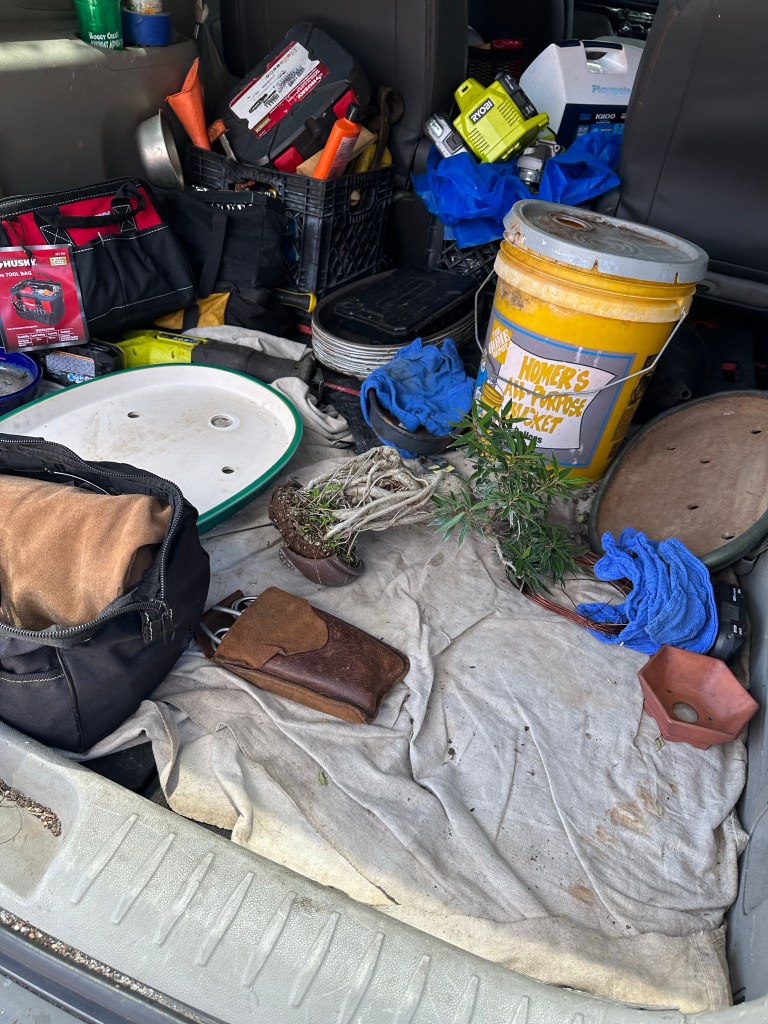
And here’s the Back Bumper bonsai studio.
A Kia minivan. For those that remember the old days, I graduated the PT Loser to the junkyard years ago.
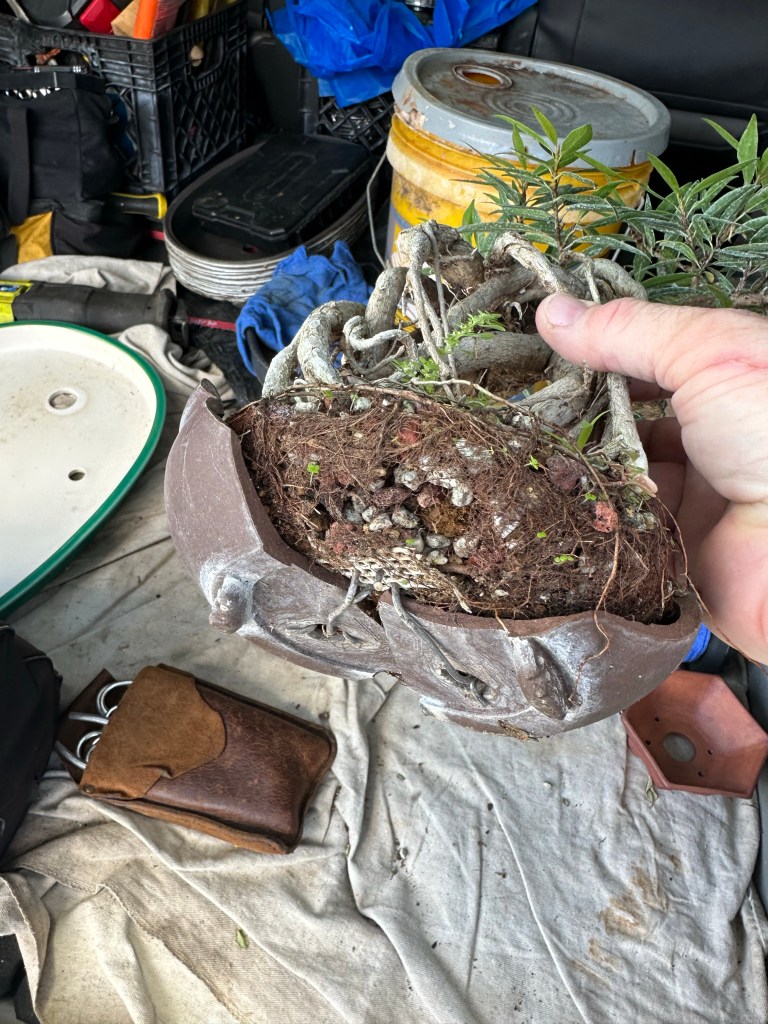
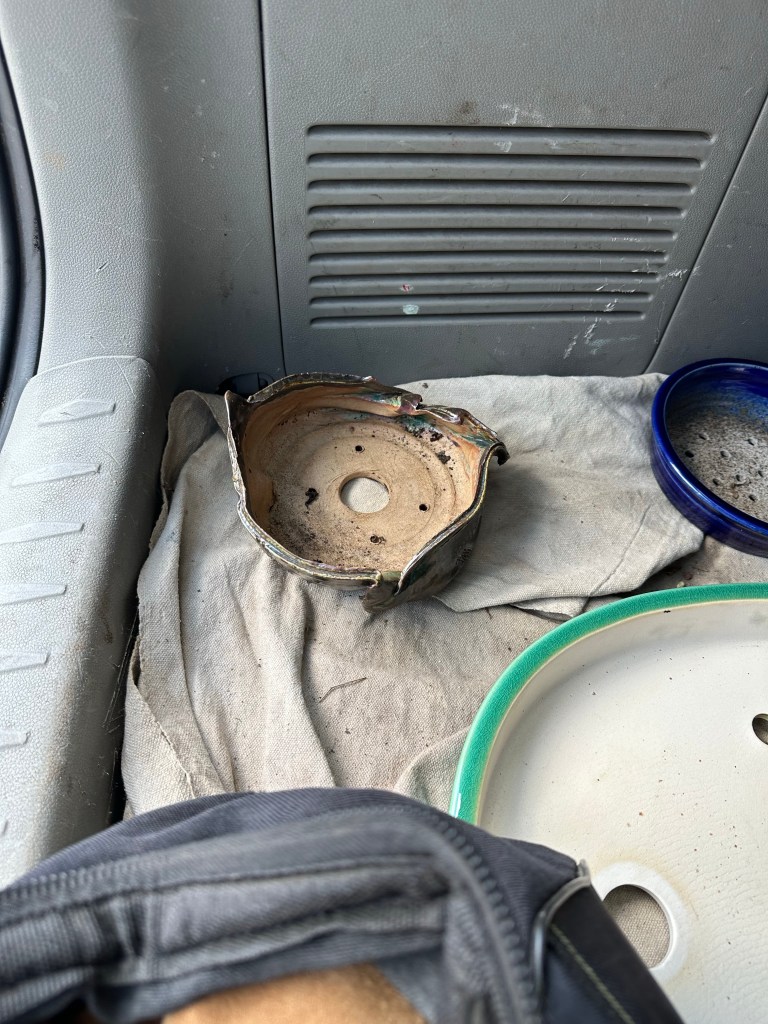
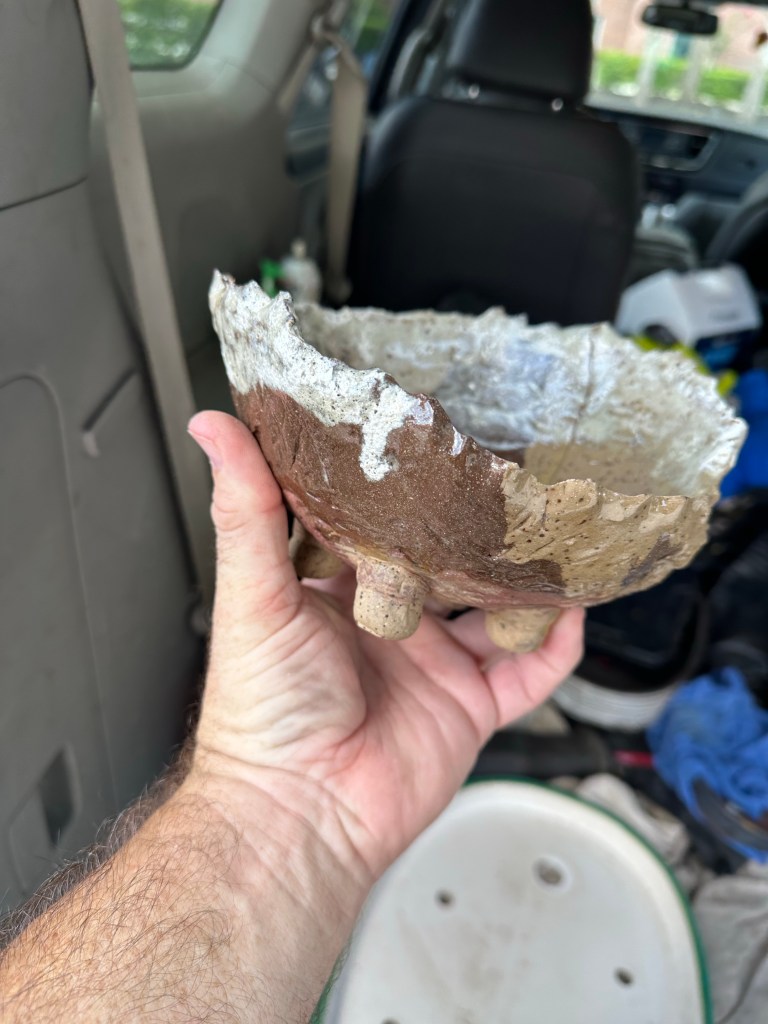
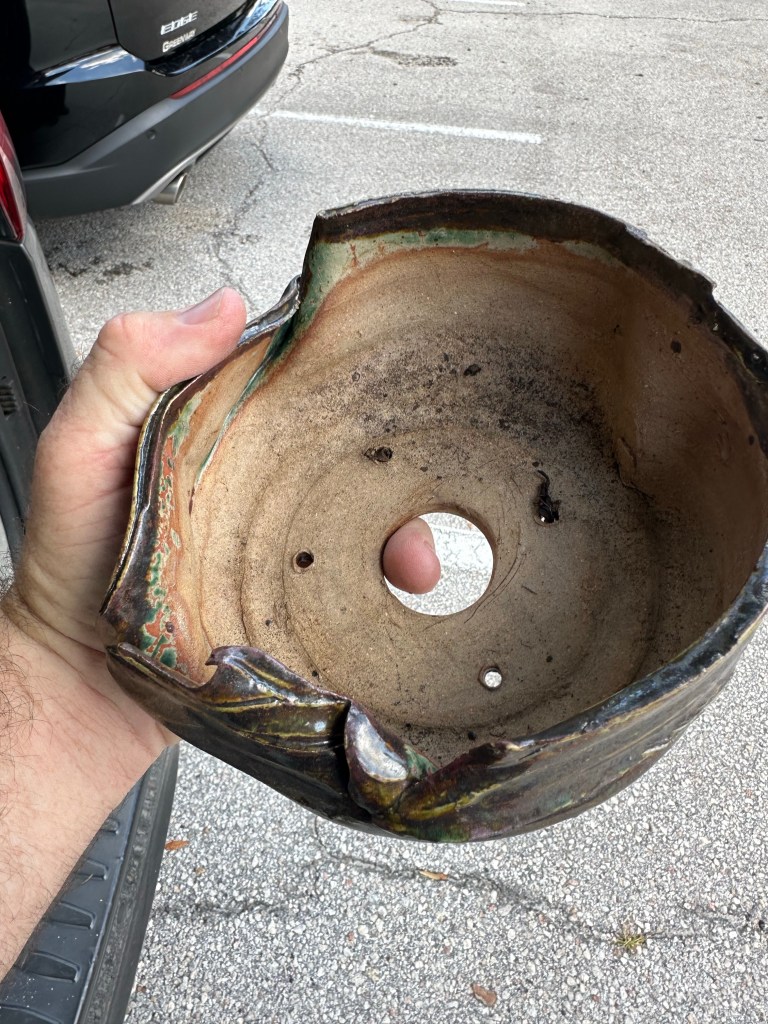
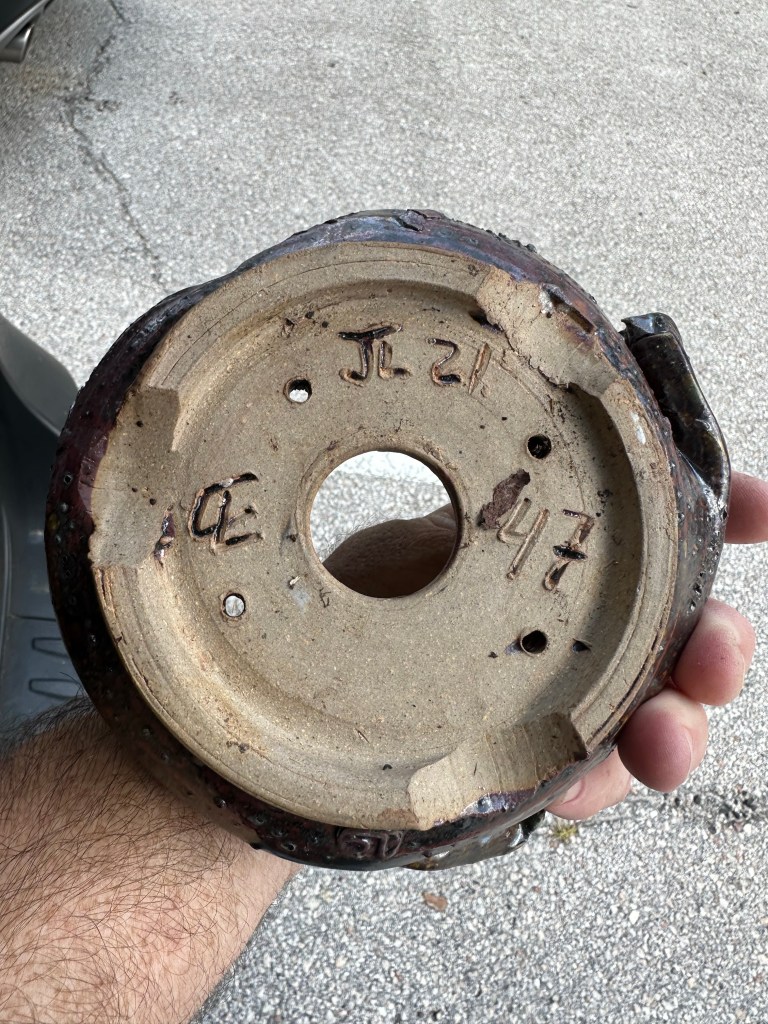
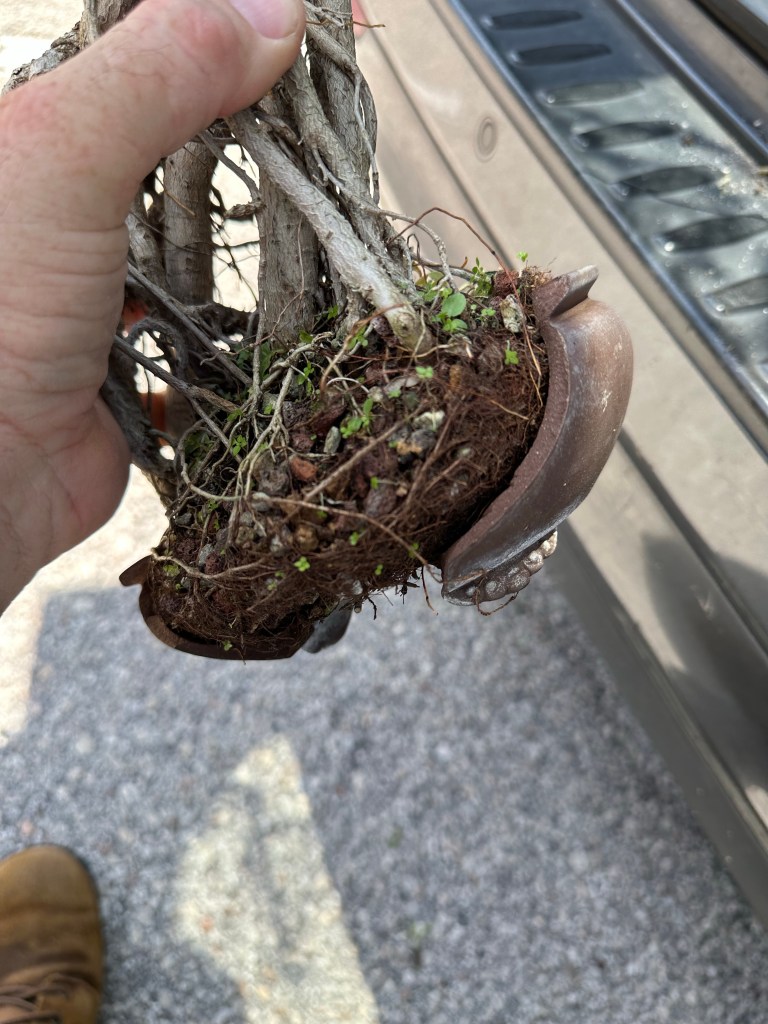
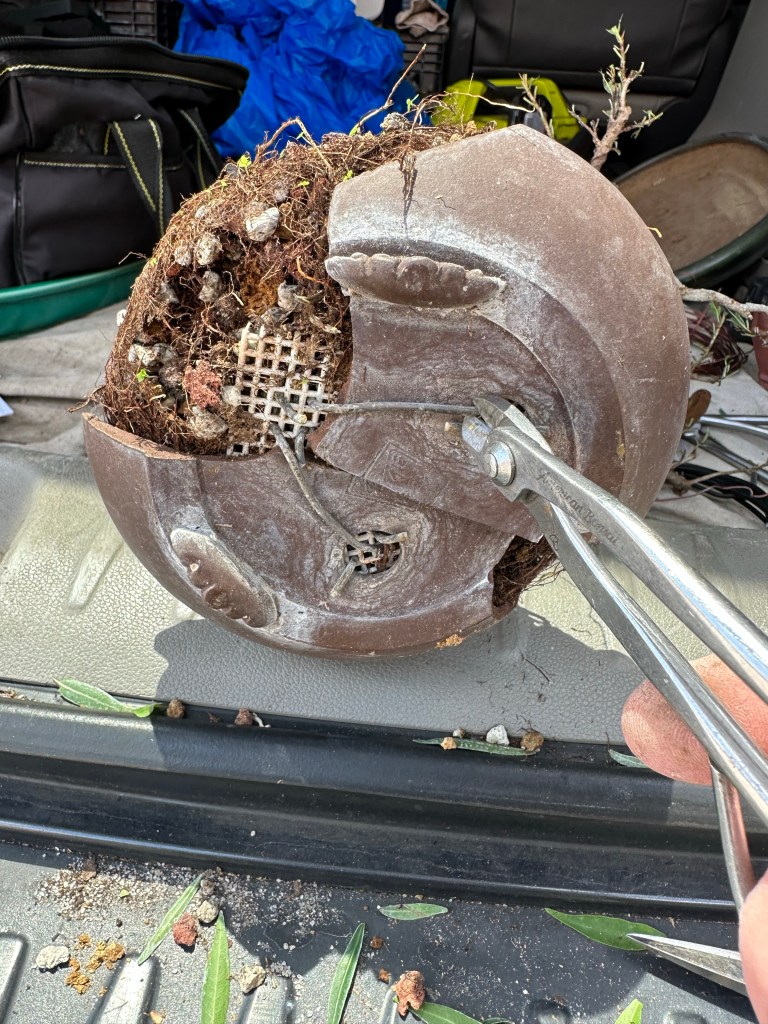
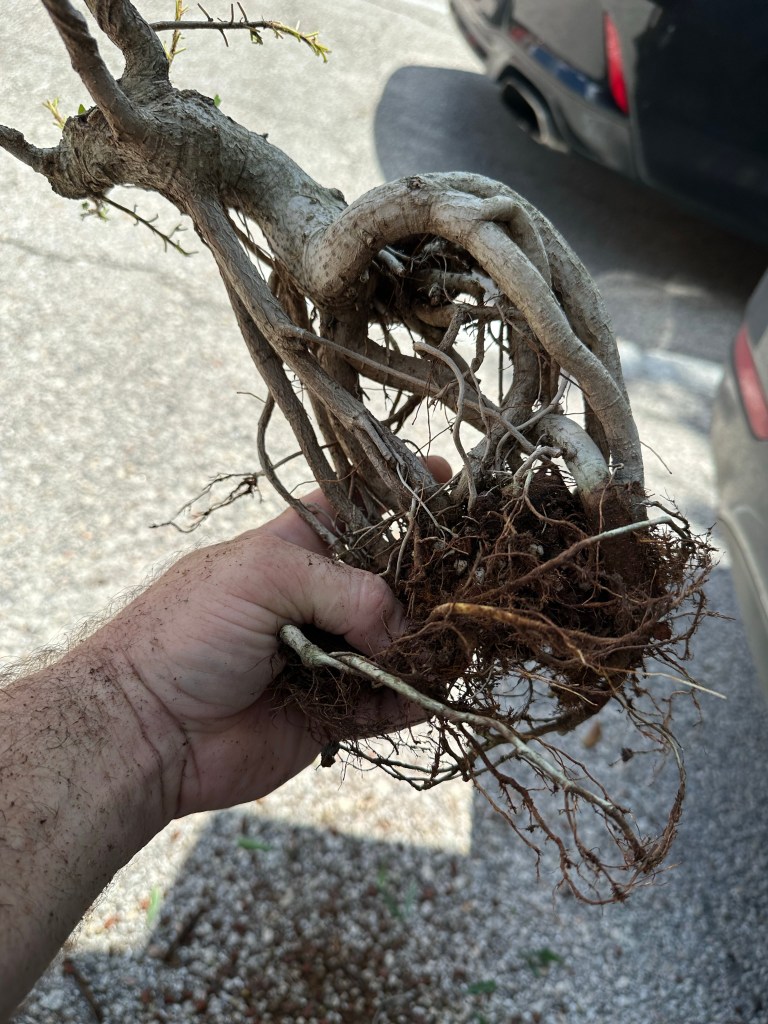
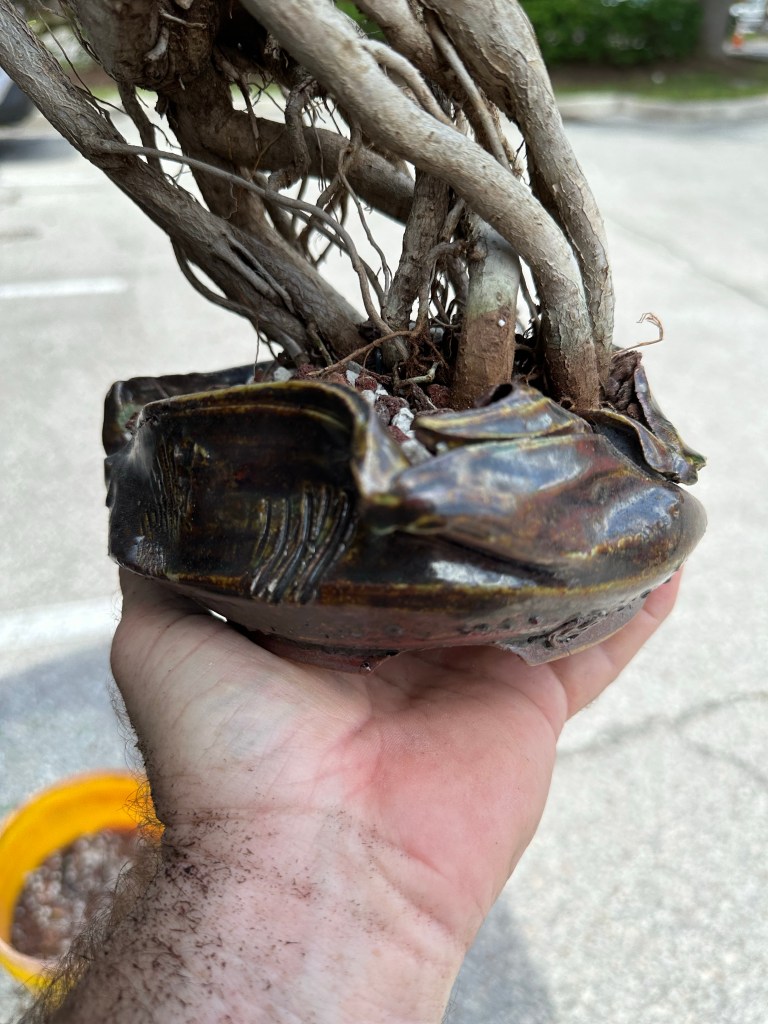
The willow leaf has a, uh, structural problem with the pot.
It done broke.
So today, I’m going to repot it, cut it back, defoliate, and wire. In that general order I guess.
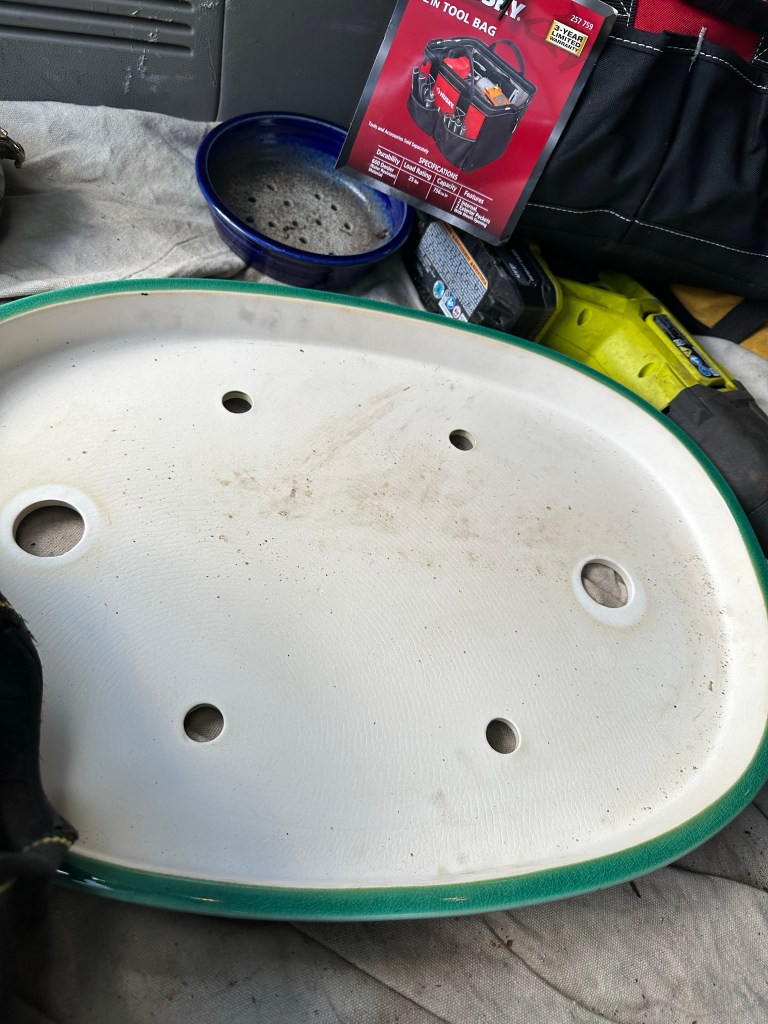
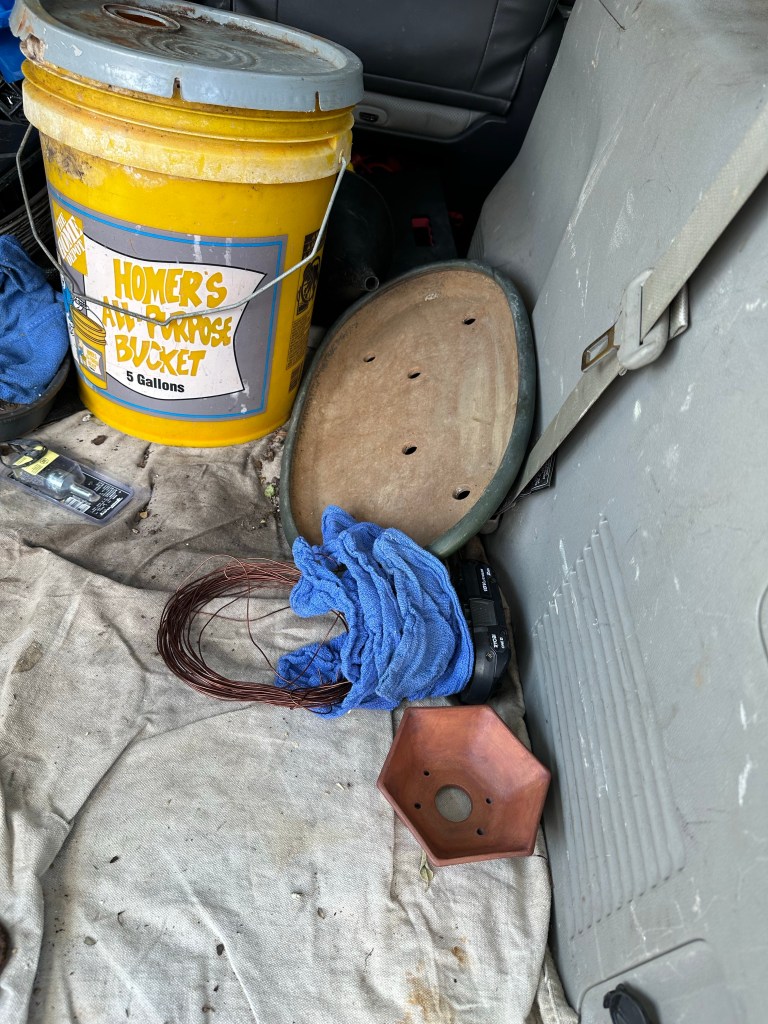
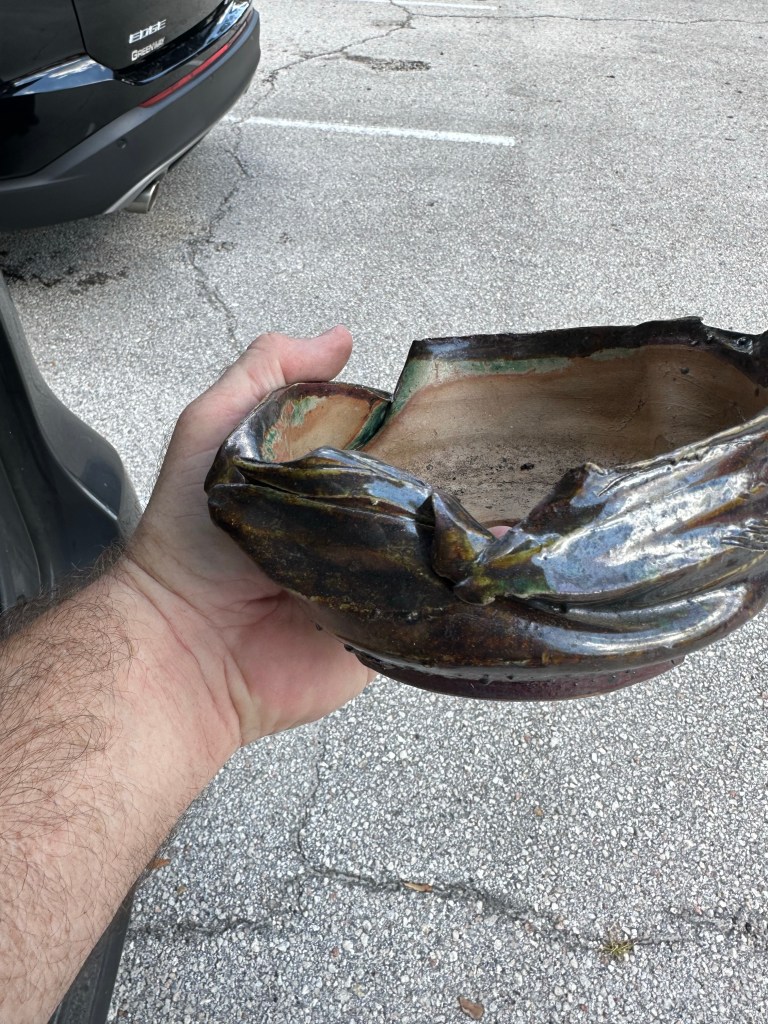
Here are some pots to choose from.
Not the big one of course.
Or that old Japanese one either.
The one below is from my student, Peter Penico. It could work.
But it’s going the wrong way. Nice pot though.
The one I’m going with is this one from Cesar Labrador, a Florida artist living in the Tampa/St. Pete area.
You’ll see his work on the Bonsai Pot Facebook auctions every once in a while.
Sweet details and shape.
It’s perfect. Let’s see about the tree now.
I think I’ll actually defoliate first.
I’ll be using the “chicken plucking” technique today.
Grab the leaf, and pull forward. The leaf will break at the petiole and you’re done.
Pretty quick and easy. Doesn’t work on all species of trees though.
Next is to remove the old pot.
Gently massage the old soil out.
Tie the tree into the new pot, add soil.
And now for the magic. Wiring!
Here’s the before.
And…..here’s my daughters Jeep and what’s wrong with it (see what I did there? I’m going to make you wait for the after. Wait, don’t scroll down yet…..dammit!). Well, if you’re still here, she has a blown head gasket. The design of the cooling system allows for the coolant to get low and you don’t know it because the overflow reservoir stays full. So, in typical Chrysler fashion, the car overheated and blew up the gasket.
She liked the color of the Jeep. But it’s a bit too much of a job for me to fix, so its for sale, as is. If you’re interested. Call me….
Ok, now for the after.
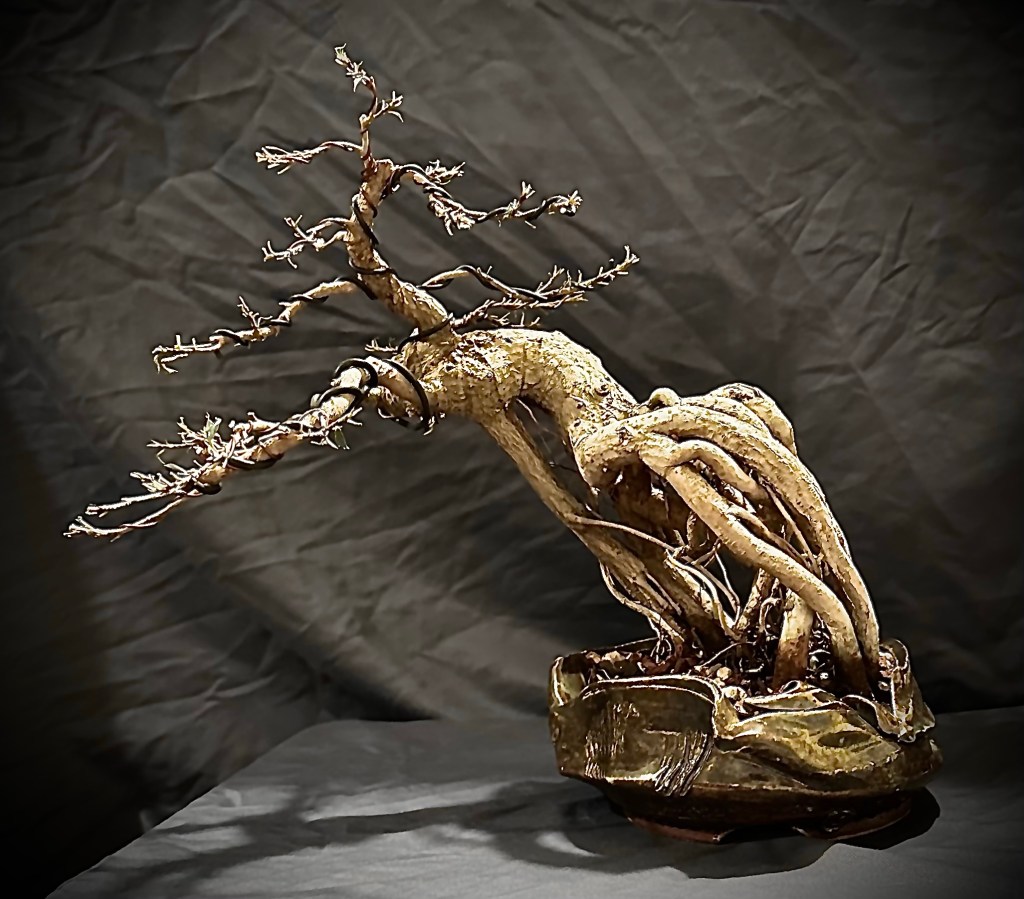
I think the pot goes well with the exposed root style of the tree.
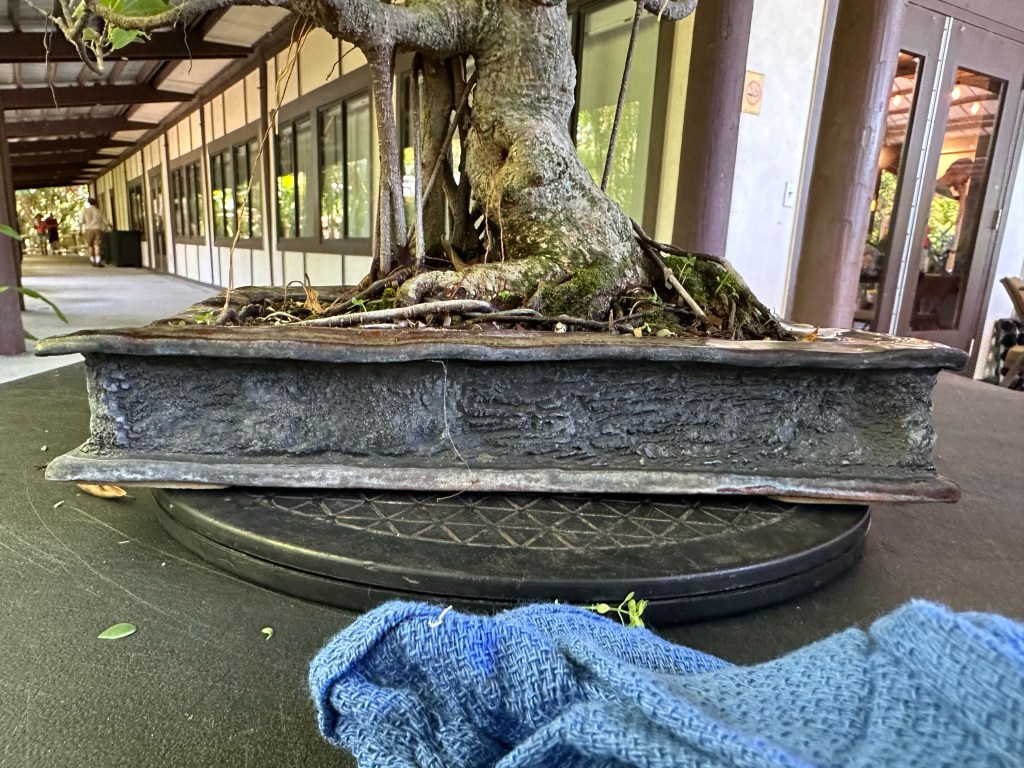
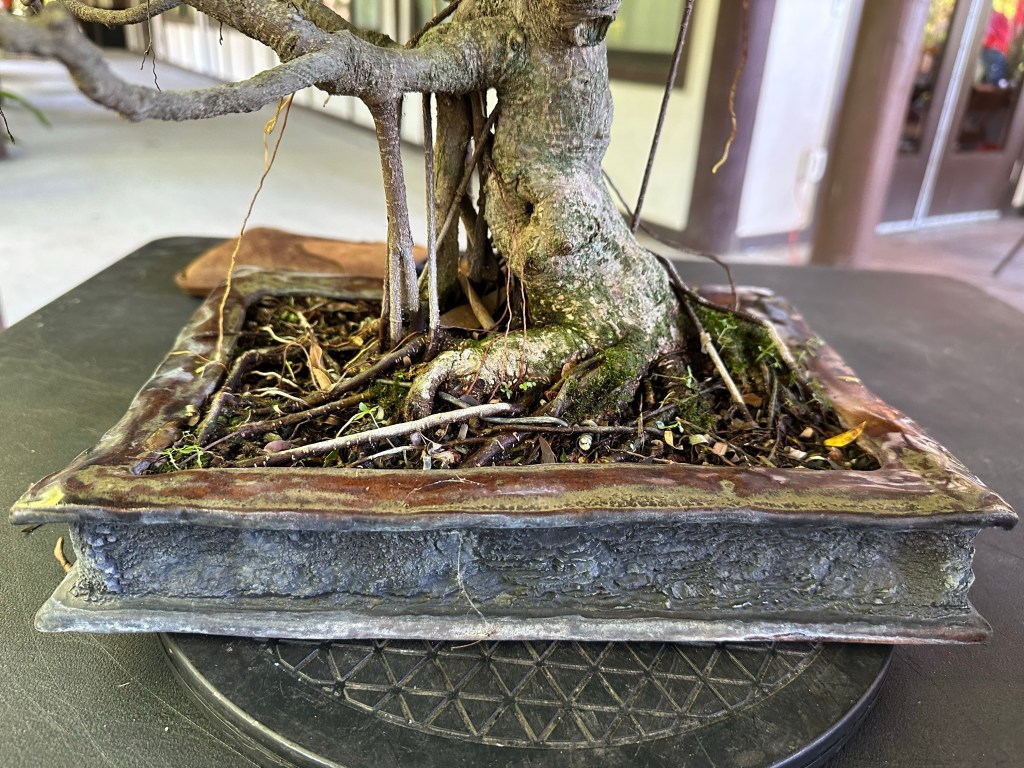
This ficus has been in this remarkable container for..ahem..four or five years, without a repot. I’m sad to say it needs a bigger pot. Sad because I love the pot and the tree combo.
Today, I’m hanging out, selling my wares and shooting the shit (as I’m known to do) at the Brevard Zoo. No, I’m not joining the swamp ape exhibit as the first living specimen ….
…the Bonsai Society of Brevard has an annual show at the zoo, uh…every year (I guess that’s what “annual” means), and I’m here (or there. Sometime the tenses get mixed up in my wandering and rambling prose style. I think it adds flavor and character. Some people say it drives them crazy. I say to those people that their insanity was there already, and I just exacerbated it, allowing it to blossom into the full blown psychotic episode that they’ve been waiting for their whole lives. You see, some people need an excuse but we of lesser gods, we know you don’t…..).
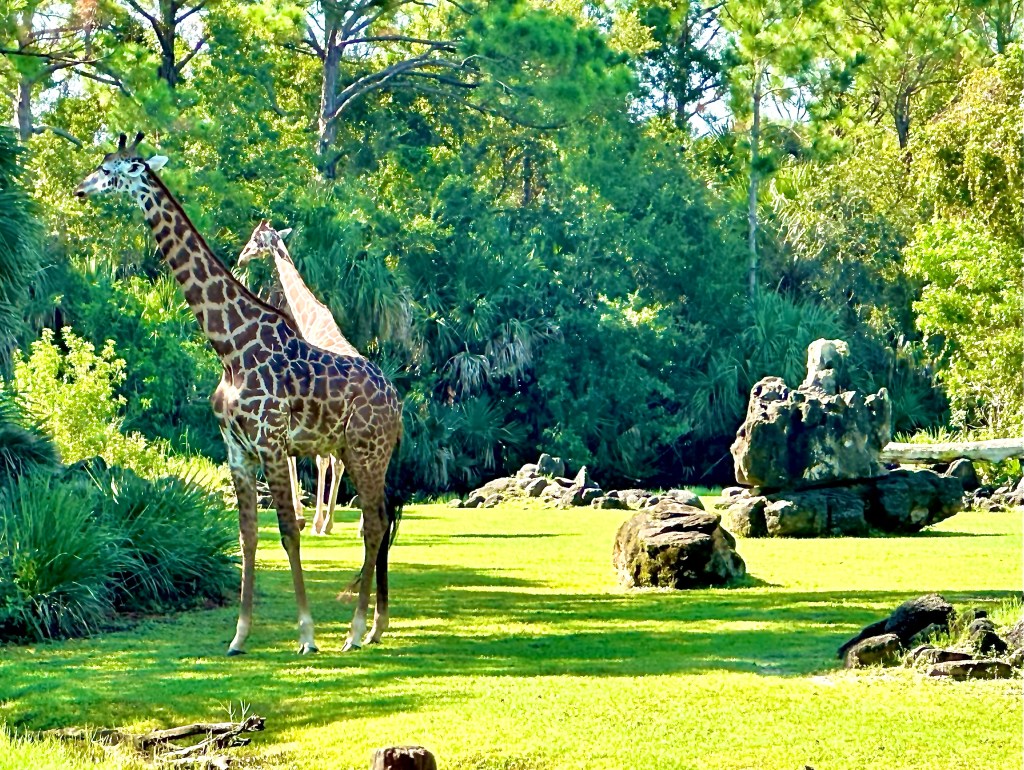
Above, we have the local fauna, Floridanus nativitus, below, are some imported beasts, Giraffa camelopardalis.
And my wife, or, as we call her on Da’ Blog, “She Who Must Be Obeyed”; she’s from Indiana.
Now, since you know where I am, and what I’m doing, and I’ve gotten in enough trouble with the wife, let’s get back to the tree.
The job is to remove the tree from the pot.
For those “in the know”, it’s really really really (really) advised against potting a ficus in a pot that has an inwardly curving lip.
Ficus (I’m going to pronounce that the British way, “Fick-us”, as I’m feeling all fancy right now), make roots. Lotsa roots.
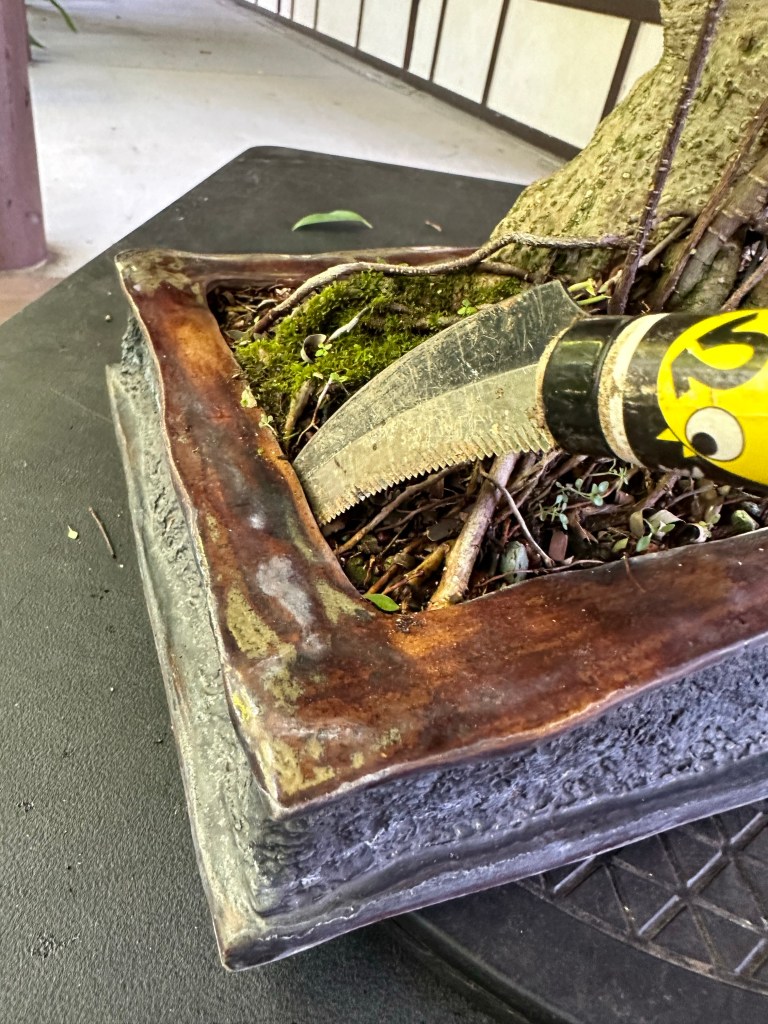
I have to bring in a highly specialized (and imported) root cutter (and sod cutter too, I guess, if you read the handle. But I just don’t see myself on my knees, my face in the grass, cutting out pieces of sod).
But first, the inevitable cutback and defoliation.
You don’t need to see that part, just scroll back to the hundreds of articles I’ve written and in which I’ve described the process.
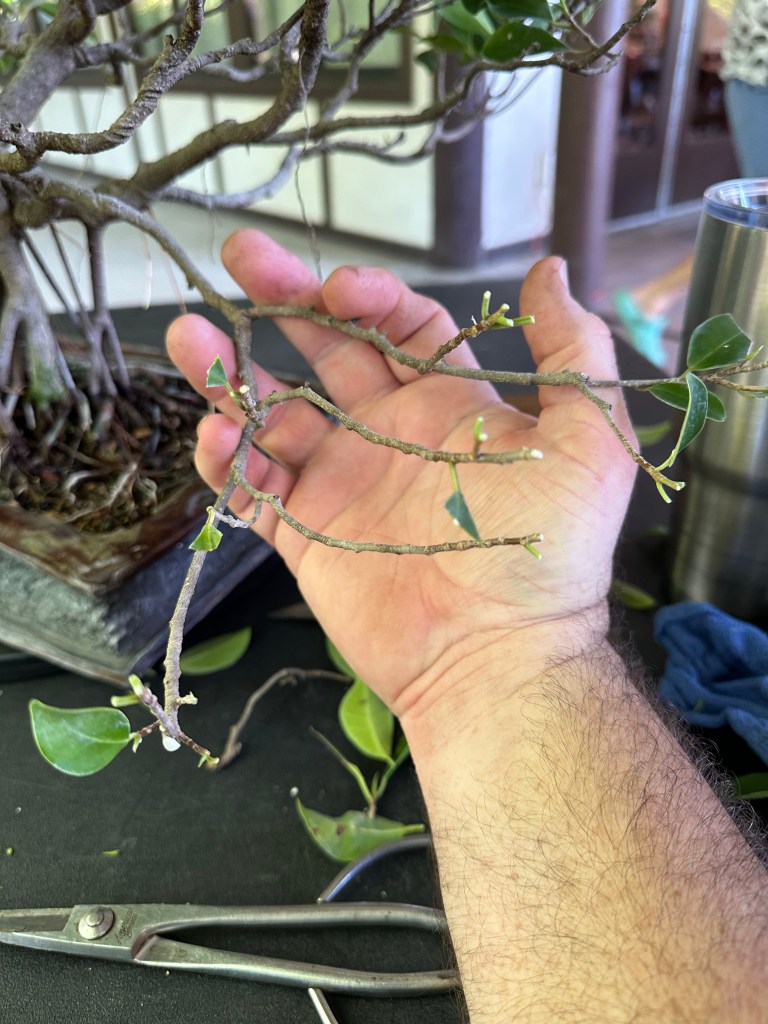
I will, however, note that this tree is the species standard Ficus microcarpa. And that means I leave a little green on the tips so there won’t be dieback.
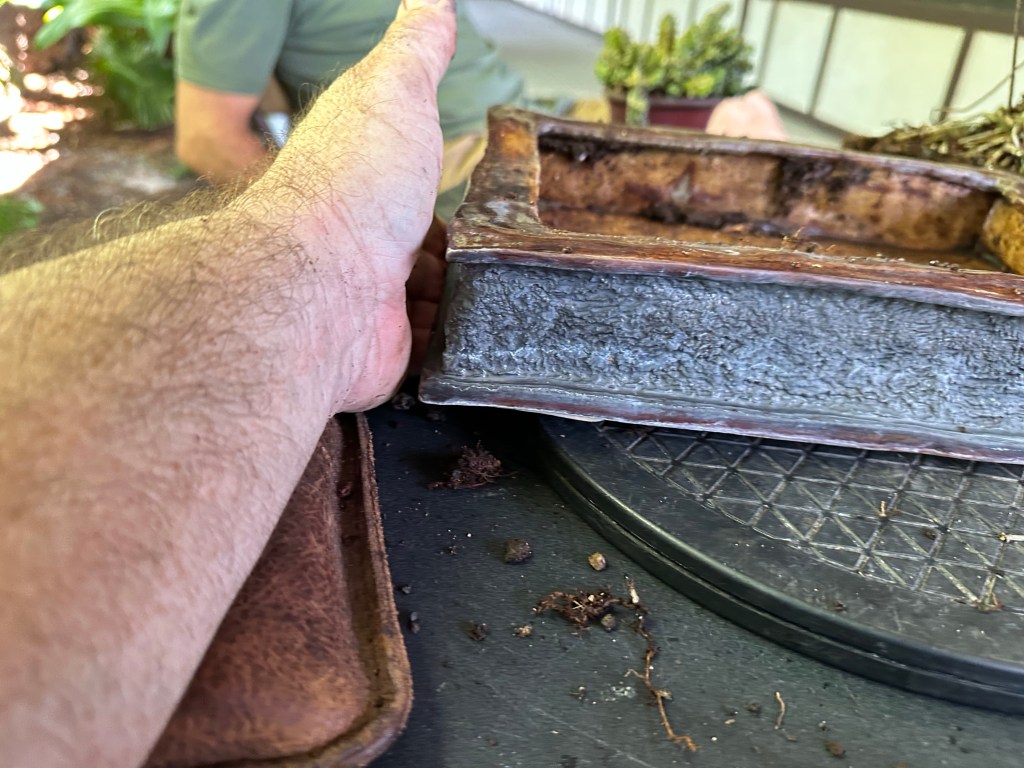
Now to the hard part, removing the tree from the pot. First, cut the tie down wires, on the bottom and top.
Then we start cutting around the pots perimeter.
As shown below.
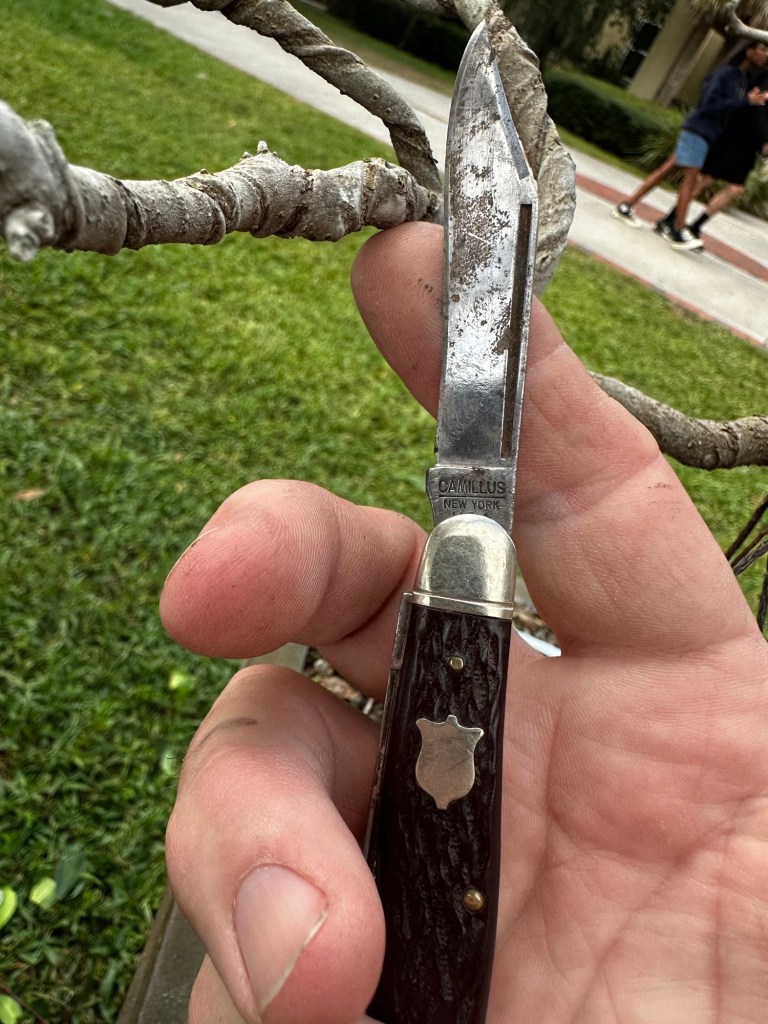
Not too hard with that tool. I usually use a steak knife (which was stolen from The Sizzler Steakhouse and Buffet) but it’s at home in The Book. The gentleman I’m speaking with is Doug, The Hippie Dad.
Now to birth the tree. Another video. Yes, I’m using my scissors. They worked. I use my scissors for many things I’m not supposed to use them for.
Looks like a tortoise mouth, right? And again, that was Doug. Thanks for the muscles.
The pot was made by Daniel Holderer. He called it “Cradle for Life”.
I’ll find something else to put in in. It’s been a good container for this tree.
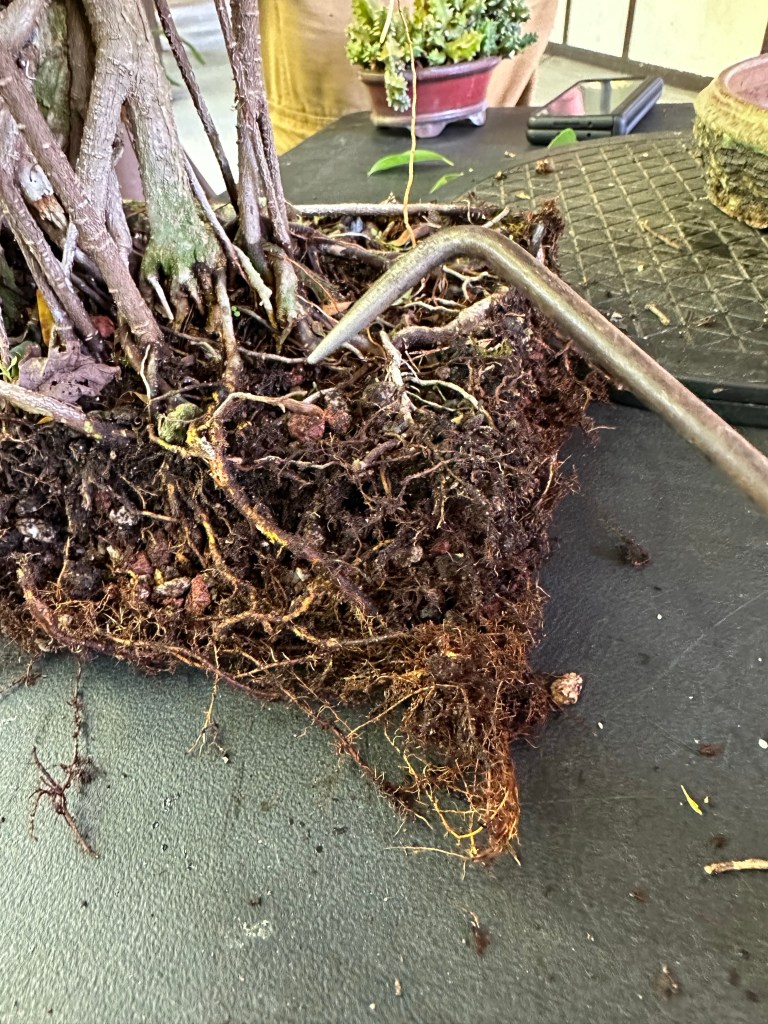
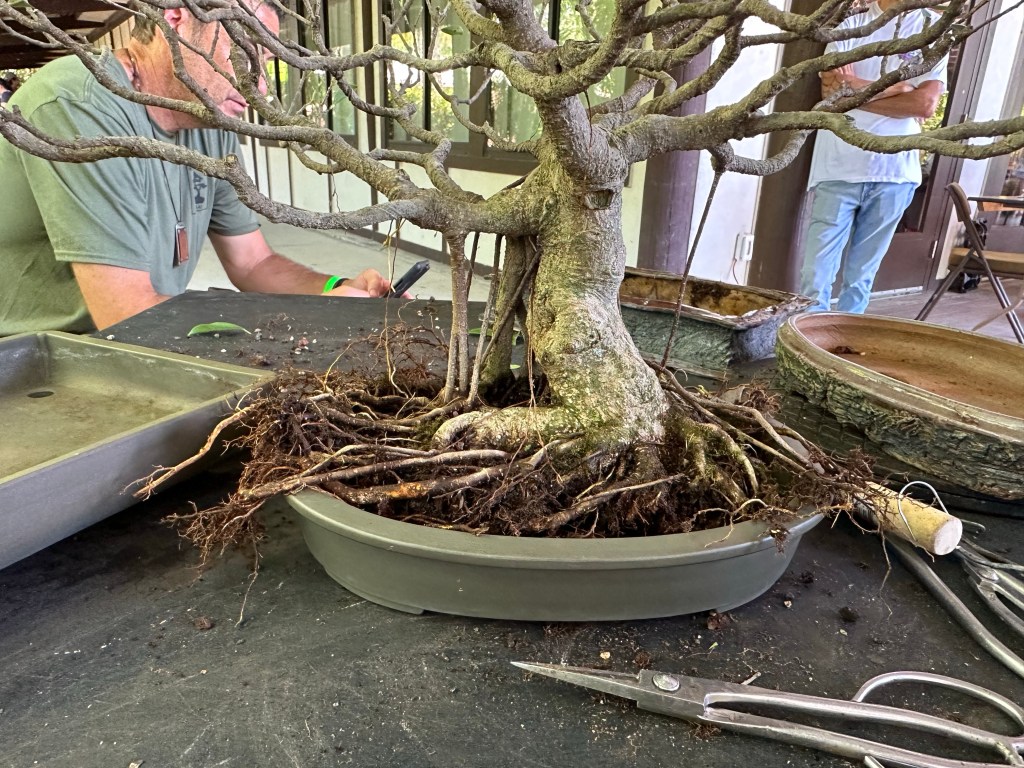
Now to rake out the roots.
It’s just a little root bound.
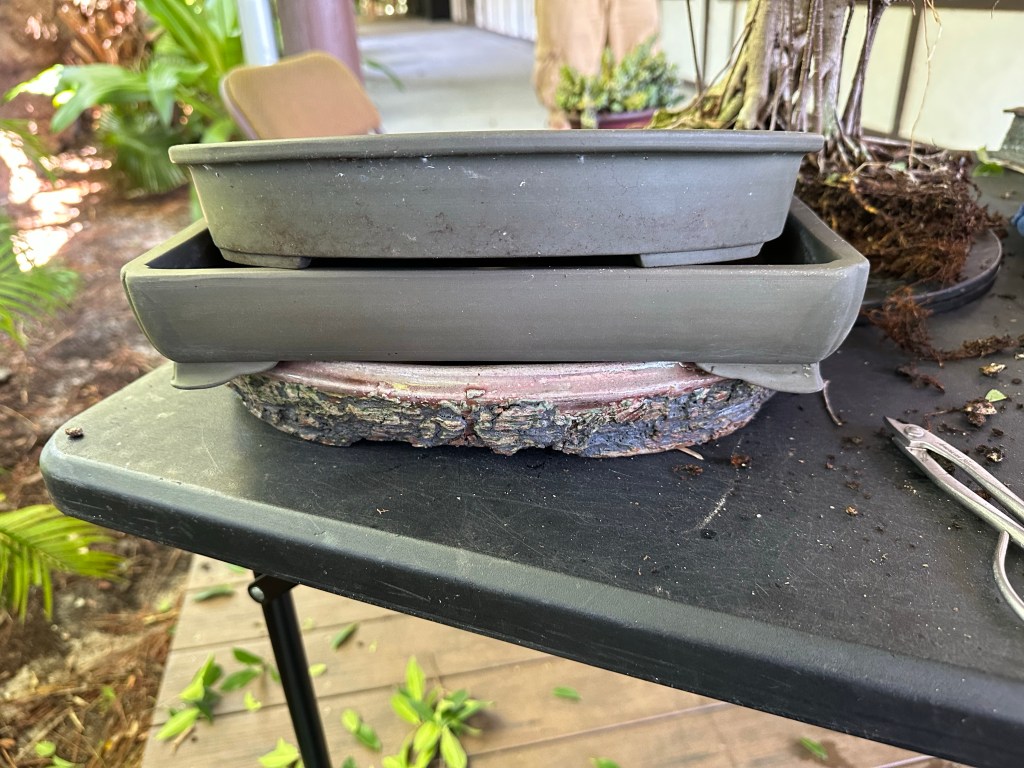
I brought three pots with me to choose from. Two of those antique Japanese pots with the weird green clay, and a beautiful oval from my friend Cesar Labrador.
The oval one’s too small…
….the rectangle one’s about right, but the style is too formal for my “Tropical Broom Style” ficus….
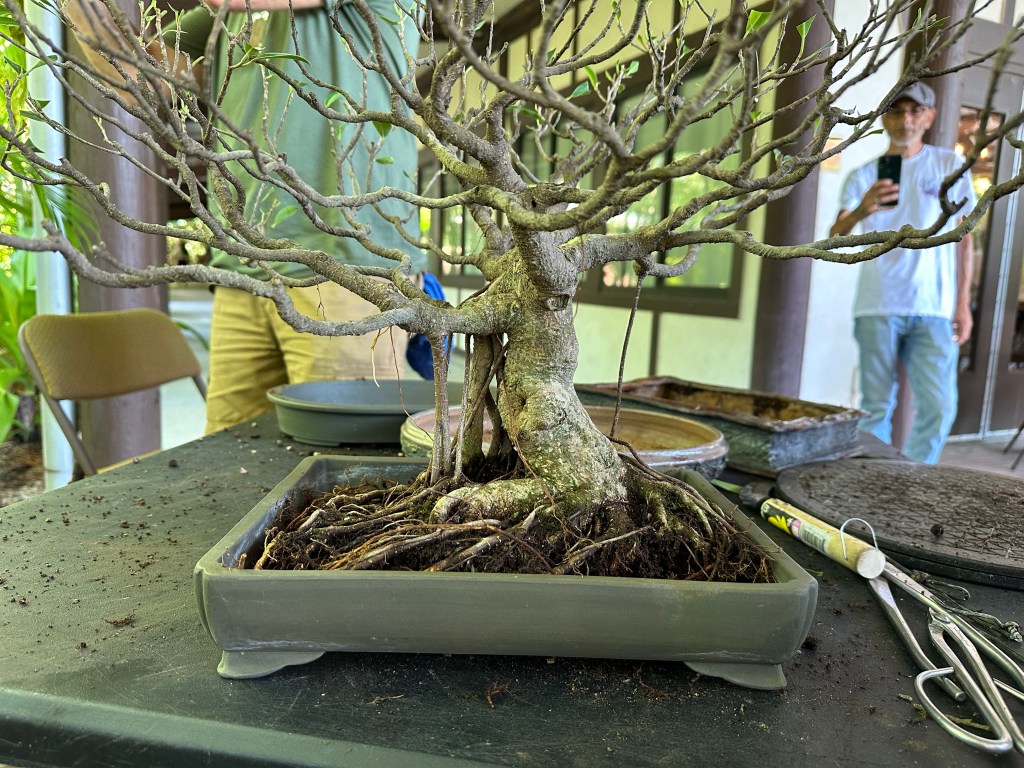
….ahhh, this one is just right!
Some screen, tie down wire….
Soil….
And we are done.
Looks good back on the bench at the nursery.
Tropical Broom Style. I made that up years ago but I think it’s appropriate for this ficus. And everything was made up in the beginning anyway. Whoa! Wait! Mind blown! Right? You mean you can just make up things?
Well now, did the story start with scotch? Or end with scotch? It’s kind of hazy looking back now. But I’ll try….wait, I remember…it started with bourbon!
It actually began in 2019, but you didn’t see the tree until 2021, 2 years ago (or, two years from the post, in case you are reading this in the year 3023. It’s now 2023, taking place in the month of July. If you don’t use the word July, it’s the seventh month of the solar year, named for Julias Caesar, the first Roman emperor (or dictator) after abolishing the Roman republic. the Terran summer solstice in the northern hemisphere occurred on June 21, 2023, and this debauchery occurred 28 days later. Terra or Earth, is the third planet from our sun, called Sol, in the Solar System, in the Milky Way Galaxy. Hopefully that’s enough for the far future readers to understand how we told time back in the ancient 21st century days of legend.)
Today , or rather, late July (don’t make me go through that again). We have a ficus microcarpa, what one might call “ginseng”. But that’s just a marketing term. Ginseng are not figs, figs aren’t ginseng. You make Newtons out of figs, and Monsters out of ginseng. The cookie and beverage, that is.
Ok, now that you’re up to speed, let’s get to the work….
I’m in Toledo, or Maumee, to be precise. It’s pronounced just like “mommy” by the locals. I feel a song should be sung. I wanna go back to my Maumee.
I’m with my two good friends, John and Julie. They take care of me when I’m there.
The tree is potted in an aluminum serving container. There were a few who said that we’d be poisoning the tree with the metal tray.
Looking below…
….I’d say, naaah! in fact, it looks good for a ficus in the north. Damn, I mean, it’s almost Canada fer crissakes. They don’t say “Holy Toledo!” for nothing.
Anyway, we did a lot of work that day. But not much on this ficus. We didn’t have a pot, you see. So we decided to get all “Muckety Mucked” up.
24 year…25 year….26 year, or, as the bottle suggests, one little piggy, two little piggies, and three little piggies.
We finished the 24 year. Made a dent in the 25 and 26. Wait, is this a bonsai blog or a drinking blog?!
It’s both. Sometimes.
And to the dead soldiers, we salute you!
The next morning, hangovers and bright lights notwithstanding, we had to get up early to go to Michigan (I know, that sounds like the first line in the “Great American Novel” we writers all would love to write. Maybe…..).
We had to get a decent pot, so we visited the Flower Market (Which has changed its name to Green Witch Gardens)
It’s a damn cool place to visit. Not only do they have bonsai, but there are cats…
…that’s cats, plural.
And pottery from amazing American artists.
The trees!
Julie hiding behind a tree.
Familiar weeds. These are what are called wandering dudes now. I feed them to the tortoises. Speaking of which….
Tortoises!
Only the best bonsai nurseries have tortoises.
We got some pots.
Then went back to Toledo.
And we got back to work.
For being in a shallow aluminum pan, it’s grown some good roots.
The “pot” has even held up well. We could use it again.
Looks solid.
Raking out the roots….
Here’s the new pot we got for the ficus.
Sweet, ain’t it?
Tree is ready
Can I mention again how good the roots are?
We had split some of the larger ones (go back and read the first post).
Hey, it even fits in the new pot.
Damn those are sexy roots. Must be the soil. The vaunted, rare and near mythic “All-American Red, White, and Blue, Adamaskwhy SuperMix” .
Just to prove we did other work, here’s some examples. A willow leaf.
A tigerbark.
An azalea.
A willow leaf root cutting.
And another.
I must say, I can’t believe what an amazing two days that was.
But I had a hard day while I was writing this piece. Something that should not be happening is. And I posted to Facebook; I quoted JRR Tolkien, the part where Frodo asks of Gandalf:
“I wish it need not have happened in my time,” said Frodo. “So do I,” said Gandalf, “and so do all who live to see such times. But that is not for them to decide. All we have to decide is what to do with the time that is given us.” J.R.R. Tolkien, The Fellowship of the Ring
And John replied “and what you do happens one word at a time, one leaf at a time, one sunrise at a time.”
Here’s the tree all those years ago. We ground layered it (hence the post title).
One tree at a time. Even if it takes years to bring it to its potential.
One leaf at a time.
One branch.
One root sometimes.
The two years ago..
And now.
Bonsai is a journey. And getting there is sometimes the only reason to go somewhere. You can buy a tree, but making a tree, especially this one, that started so humbly, is way more fun.
John has done well with it. I’m honored to have helped him, and thanks to both John and Julie for letting this strange bonsai guy (me) into their home.
I promise, I wasn’t hanging out with any rich men in Northern Virginia. It was all cool bonsai peoples. See?
Not a single politician (I don’t consider Roberto a politician, and he was in Peru anyway).
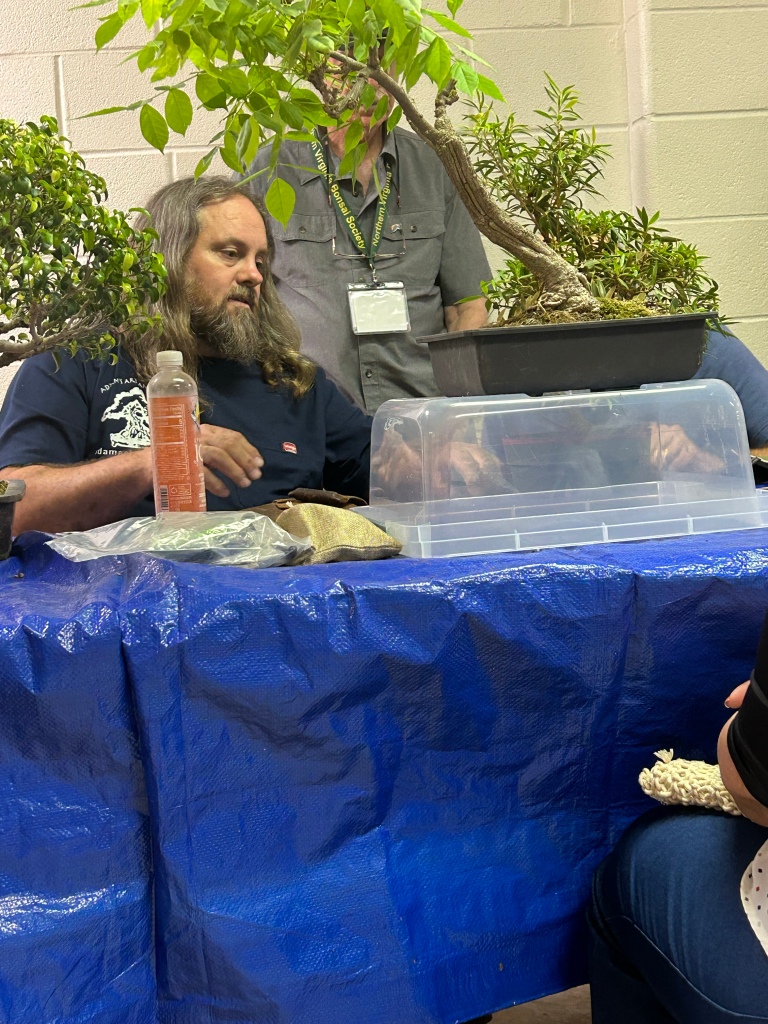
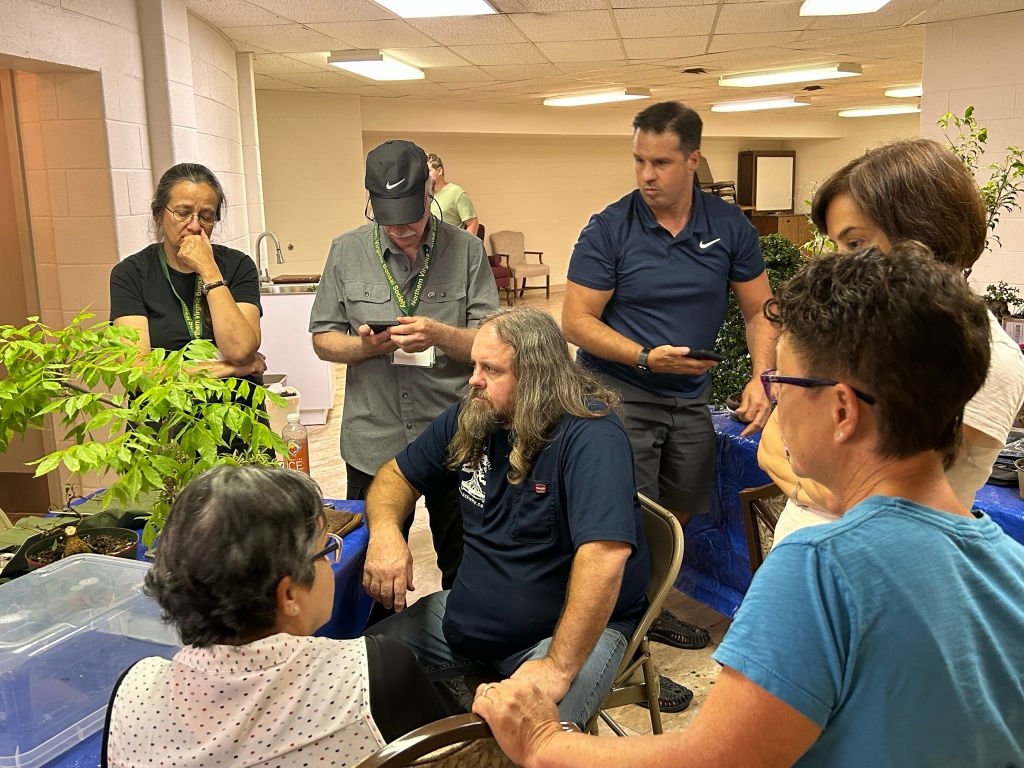
I was at the beginning of my summer tour, making a triumphant return to the Northern Virginia Bonsai Society. I brought a lot of trees for the workshops.
They gave me a tree, what I believe is a Ficus macrophylla (or the Moreton Bay fig, a ficus from Australia) as the demo tree. . This particular specimen has been passed around in the club a few times, with no one really doing much with it. Maybe a trunk chop or two. I liked it and the challenge.
I kinda like an underdog, so I tried my best, using my tropical tree bonsai superpowers to bring out the most I could from the tree.
We start with an approach graft.
Cut it back in places, let it grow in others.
The graft….
The growth….
The cut back.
And below, my hand in an anticipatory gesture of the “Let it grow!” number, along with choreography and three part harmony.
This was the demo. Along with the work, I told the chicken sexter story (I’ll have to tell you, the readers, that story sometime), I explained what different plant growth growth hormones do (see this post: I use some fancy words to justify my defoliation habit, go figure ). I talk about my childhood trauma and how I use it in the styling and care of tropical trees in the sunshine state (not really, my trauma is manifested in less healthy ways, as it should be).
I told the story of my youth in bonsai, trying to find as much about bonsai as I could, and happening upon a website from a guy that not only grew tropical bonsai in the Great White North (coincidentally, in Massachusetts, about four miles from where I grew up), but developed spectacular tropical bonsai, better than most bonsai artists from Florida. His name is Suthin Sukosolvisit. One of the only true Masters in American Bonsai.
Anyway, I had some fun making a fool of myself on stage and hopefully imparting some knowledge.
I’d love to have the tree for myself. Maybe there will be some altruistic NVBS member who bids on it and sends it down to the FLA as a gift.
After the demo, and some lunch, we had a workshop. My wife took the pics with me in them. I think she’s biased, but she likes them.
In my element, surrounded by trees and students.
The trees got smaller as my ego got bigger.
Love a good trunk chop. It’s like the smell of napalm in the morning.
And just the video. For those that don’t like Led Zepplin.
My wife channeling her inner Jack Kirby with the wacky camera angle.
Now, we get to a cool tree. It’s a tree originally from Ed Trout, one of the last true gentlemen of bonsai. Ed had sold it to a man named Jonah Hill.
I know. Adam lavigne helping Jonah Hill work on a bonsai tree. The joke writes itself.
Study the pic just above. You’ll notice a hole in the middle of the trunk.
Below, I have a tree that no one wanted. So we are going to graft that into the hole.
I cut off a piece of the tree, a piece with a good aerial root. The red circle is where I cut it and the graft will occur.
This, below….
….needs to fit into here. that’s the front of the tree, to keep you correctly oriented.
There’s Jonah, at the top of the pic. I’m about to stick the graft through the hole. Yup. Through it. That’s Jack behind me.
This is the back of the tree. The leaf end of the graft will act as a new back branch.
We use a brass screw (use a non reactive metal) to attach the graft.
Here’s the front of the tree. I arrange the roots, artistically, so that they compliment the tree. Notice the screw in the bottom left. And my wife giving me the “Look”
To get the graft to grow faster, I remove all the leaves except the last few, and I leave the grow tip.
There is still a hole, but as the graft grows, it’ll fill it up. That’s LeAnn, on the left, who was my host, giving me the same look my wife gave me. Both of them want me to work on her buttonwood. don’t worry ladies, it’s next.
Some more pics to give you some detail.
Jonah has done well reducing the leaf size.
Just about done. We tied some aerial in place (bottom left).
And, finito!
For the next tree, and the next post, we get to meet LeAnn’s buttonwood. An amazing tree, also from Florida (like Jonah’s tigerbark), and originally from none other than Mary Madison, the Buttonwood Queen.
That’s Washington DC. I think. Lots of converging lines and paths layered on top of each other. I posted a similar insane street map last time I was up in the area and I visited the Bonsai and Penjing Exhibit at the National Arboretum .
I was too busy working this tour to get to see the Collection. That’s ok by me. I like working. To be human is to work. To find meaning in that work is the sole purpose of this life on this earth.
Anyway, there’s room for philosophy later on in the mid and last section of this essay, so, as promised in the last post, here is LeAnn’s buttonwood.
She said it was collected (as most in the USA are) by the Buttonwood Queen herself, Mary Madison.
LeAnn is the lady in lavender (purple? Lilac? Not periwinkle, or plum, for sure) hovering behind me.
She waited very patiently while I worked through all the other workshop attendees trees and finally got to her tree.
It desperately needed a repot. I teach my students in Florida that buttonwoods need a repot every year. Up north, like here in Virginia, it’s not so important. Unless you use a horticultural heating pad, that is. (Wait, is Virginia “Up North”? I’m not sure. Where’s the Mason-Dixon Line?)
Ok now…..WHAT? (not the North/South thing, even I’m not getting into that). What’s a horticultural heating pad?!
Here’s a few secrets for my northern tropical bonsai growers. First: get grow lights. We are in a golden age of indoor growing of plants. Yes, due to the legalization of cannabis, mostly, but we gain from it because all kinds of grow lights, from full spectrum LEDS to metal halide, are available almost anywhere for cheap. So get yourself one. But…BUT..secondly: heating pads!!! Horticultural heating pads are the game changer for those that need to bring in their tropical trees for the winter (one should always put your trees outside for spring and summer, there’s no replacement for the sun and rain. None). Most tropical trees growth habits are dependent on temperature. But not just ambient air temps. It’s the temperature at the root zone, in the soil, during the evening, that makes tropicals grow.
Which is why we here in the Sunshine State don’t repot buttonwoods until nighttime temps are above 65°F for at least 6 weeks after the repot.
In sweet Virginy, this particular operation is taking place in the middle of July, and LeAnn has the rest of July and most of August to grow more roots. So no worries there for her. But I knew of a guy in Cincinnati that repotted his buttonwoods in January. He had a greenhouse and heating pads. That’s where I got the idea.
Anyway, we got the buttonwood out of this pot:
And into this pot:
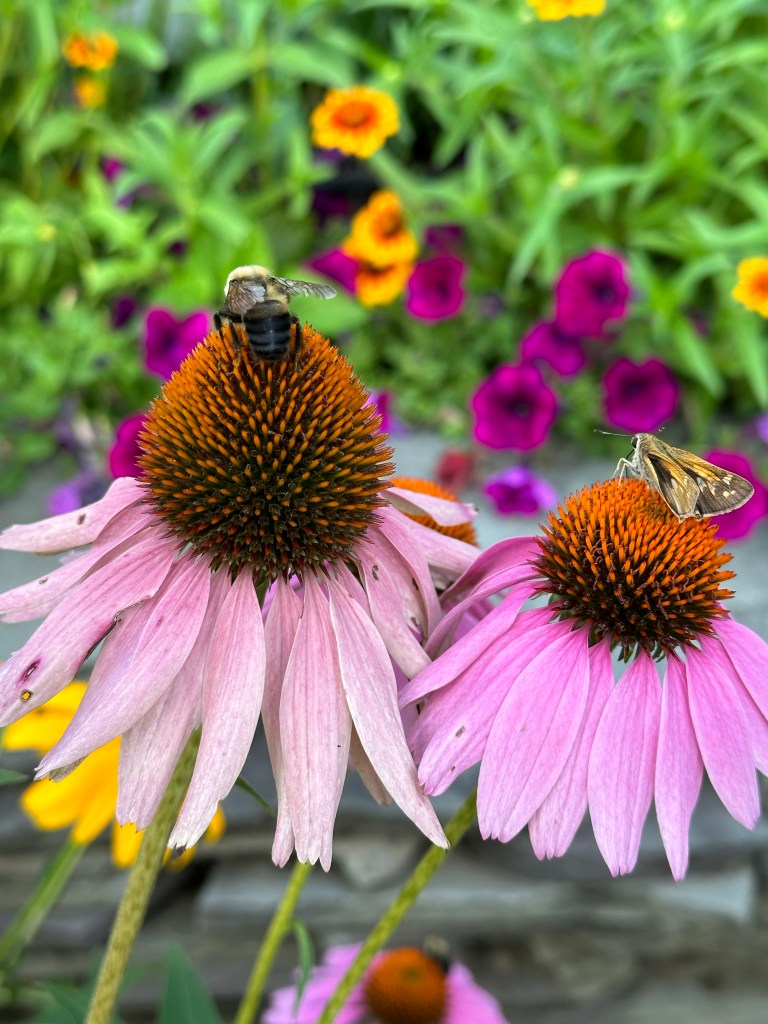
We wired it, tried to bend some deadwood with the torch and steam technique (only partly successful) and, now, just to make you wait, how about a bumble bee and a moth on a coneflower?
Awwwww, ain’t that cute?! LeAnn has an amazing garden and an even amazing collection of trees.
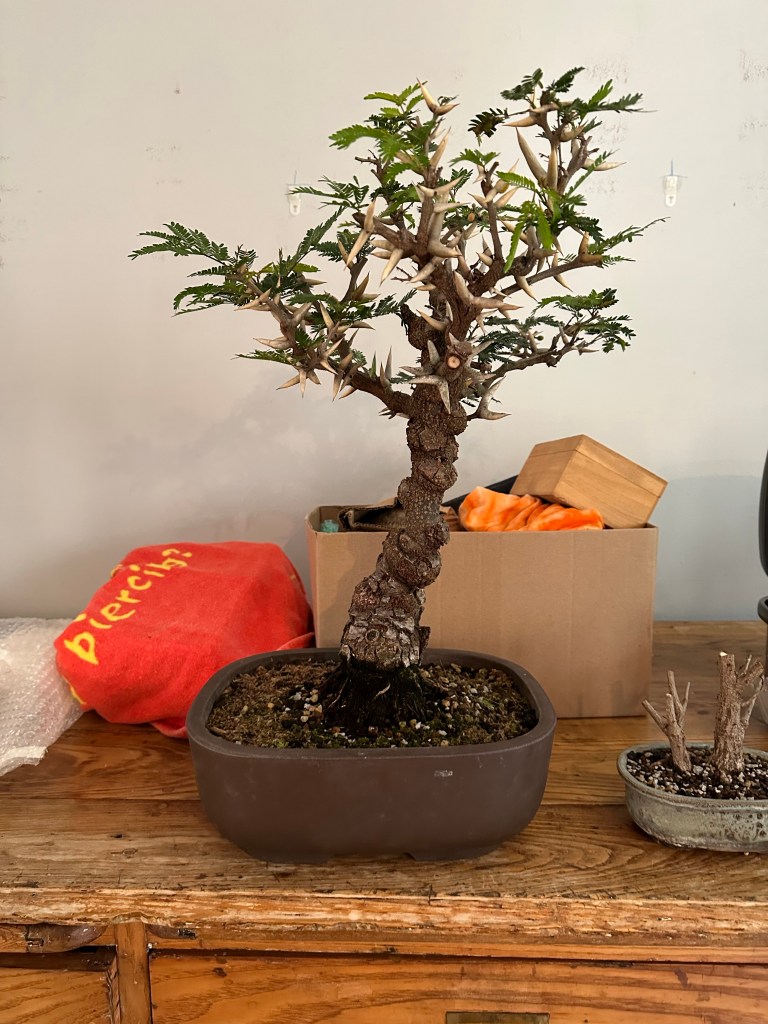
Here’s one of the more developed bullhorn acacias I’ve seen.
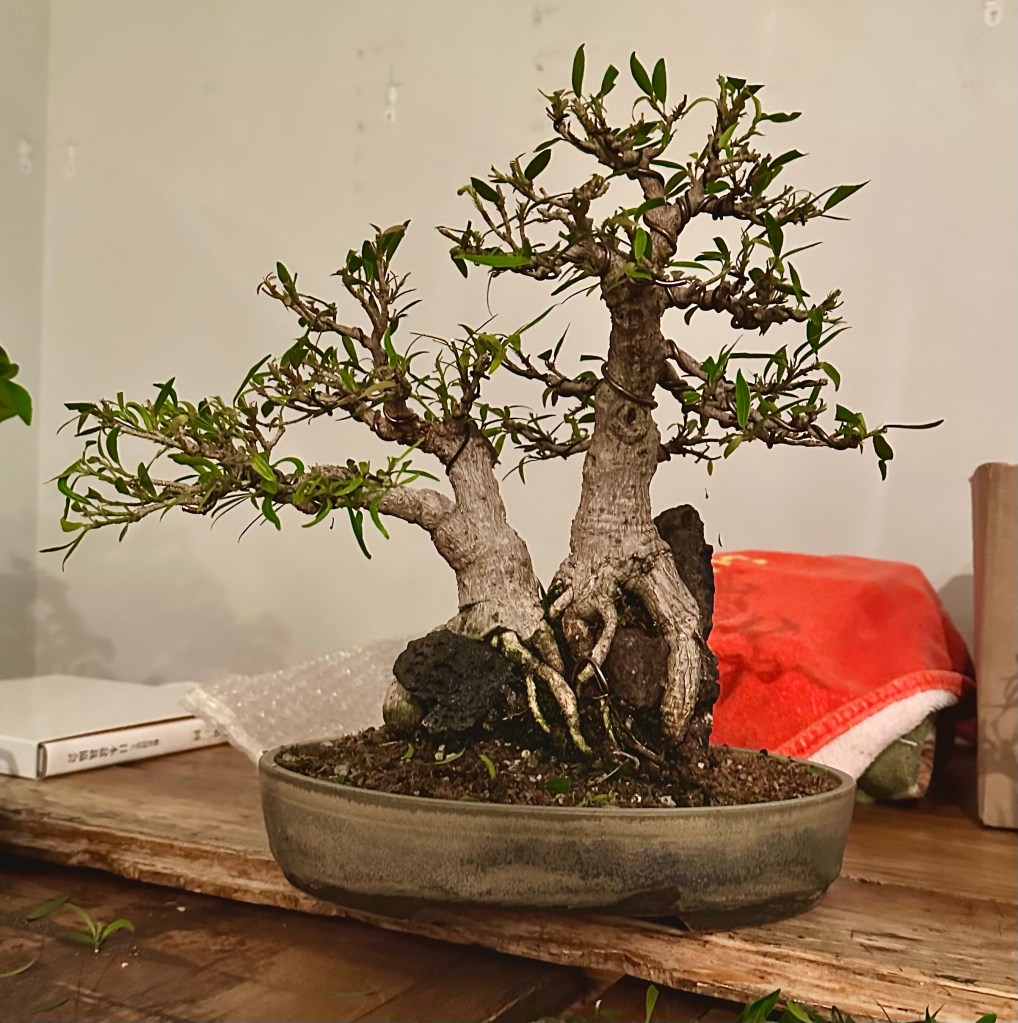
And a twin trunk willow leaf on a rock (a rock from Hawaii I believe, where LeAnn hails from).
And now, the buttonwood.
It’s an impressive specimen.
You can kinda see the burnt section where I tried to bend a straight piece of deadwood (middle of the below pic. It was ramrod straight).
View from above.
The constant reader is asking, “Why are there still leaves on it?”
Well, we are in The North, and the sun isn’t quite so strong as in La Florida, so, even though we are in full summer, I’m not comfortable totally defoliating a buttonwood up here.
And the main thing I don’t want to do is to kill this special tree. We really beat up the roots when the repot happened, and foliage is what grows new roots, so I left the foliage. Simple calculus, as they say in the movies.
And the tree was collected by Mary. Here’s the last pic I got of her before she passed away (that’s her daughter Terri, behind her).
Mary was such a force in bonsai, it’s hard to believe she’s gone. I truly miss her. There won’t ever be a woman in bonsai like her again.
And it was an honor working her tree with LeAnn. Thank you!
One last tip, and I learned it from Mary. Since we beat up the roots so much, I advised LeAnn to set the pot in a tray of water. One deep enough to cover the drainage hole. This will help the tree to grow new roots. Contrary to what I’ve said before about air being important for root growth on other trees.
A buttonwood lives in the coastal saturated zone, where mangroves grow, by the ocean, and are used to water. In fact, to make a cutting root, the easiest way is the old fashioned “Put the cutting in water” method. Oftentimes (don’t tell anyone) when we collect buttonwood, it’s really just a big cutting, with no roots at all, and we place the tree into the pot, and, as LeAnn is doing, place that pot into a tub of water.
One can, as many often do in bonsai, point out the unscientific practices of bonsai people. I do it often. But I have a saying I use religiously, and it applies to bonsai practice distinctly:
“Horticulture is a science, but the practice of horticulture is an Art”
I’ll leave you with that to mull over. Quote it to your best friend and your most divisive foe. It’ll separate the wheat from the chaff, real quick.
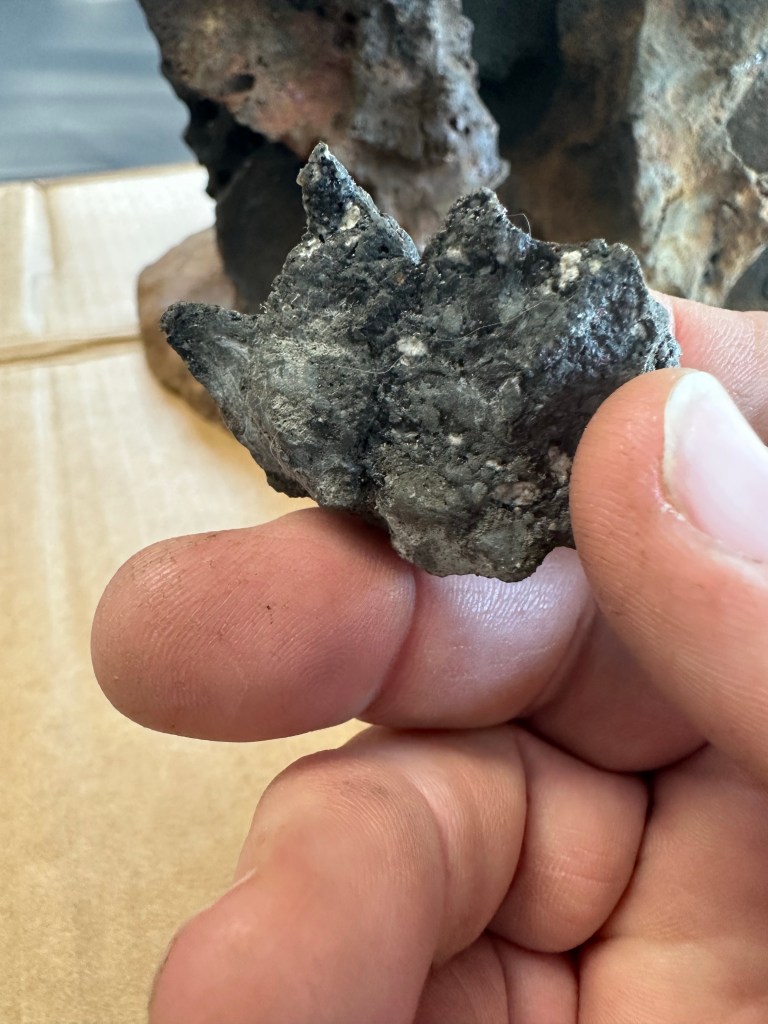
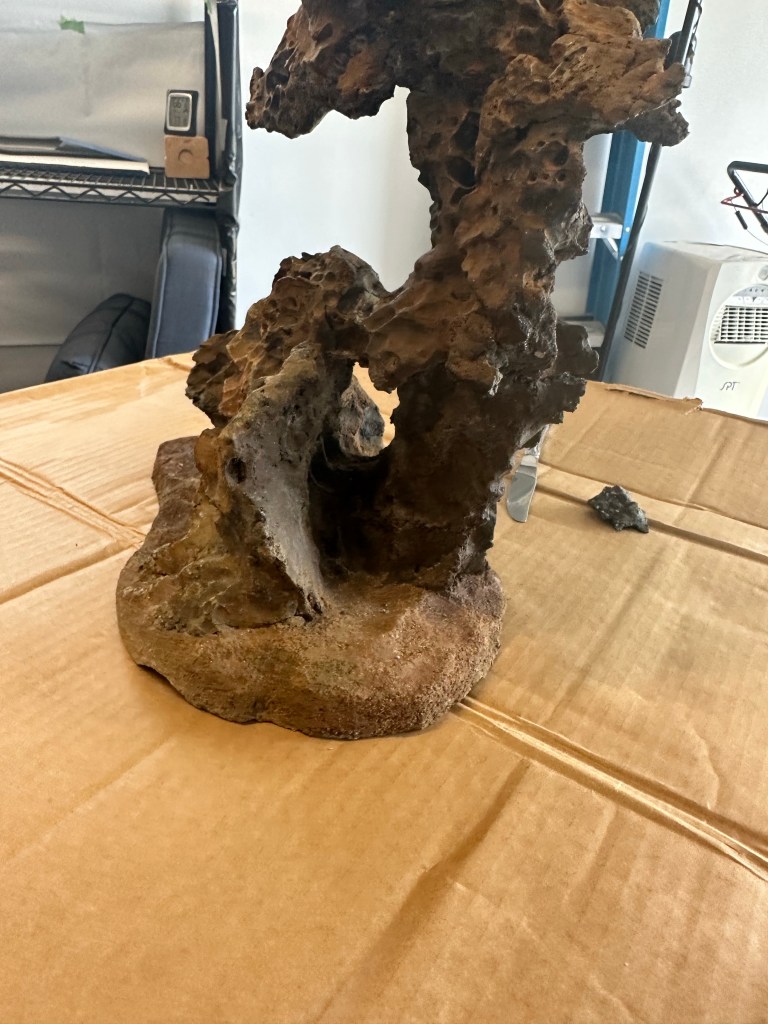
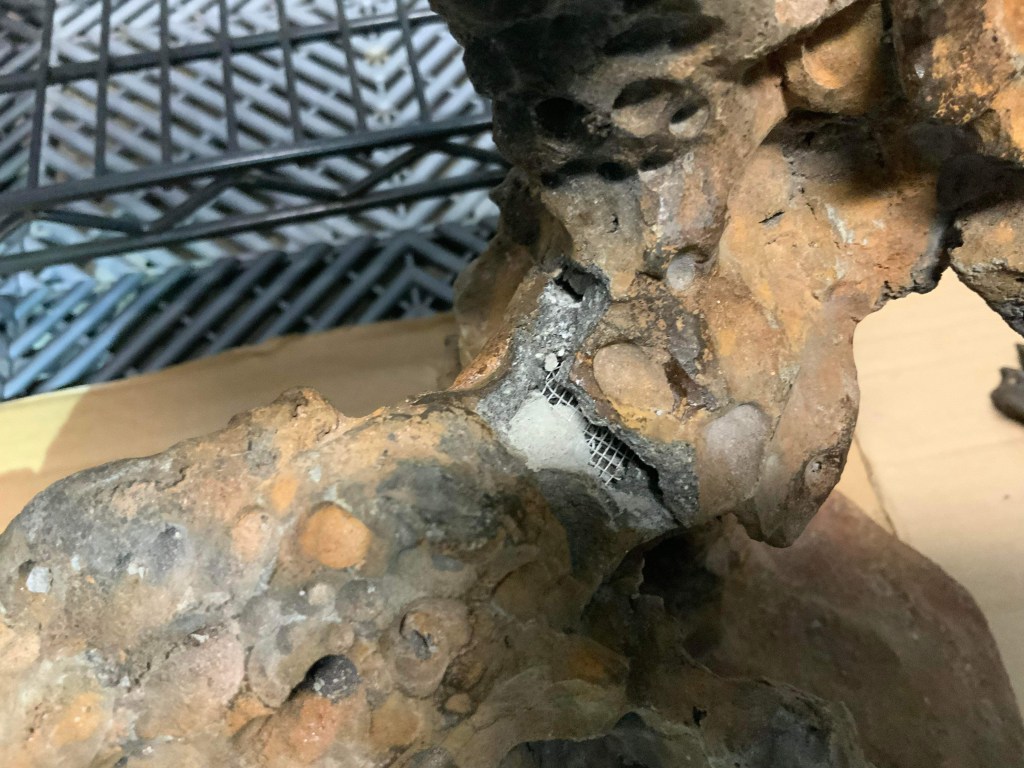
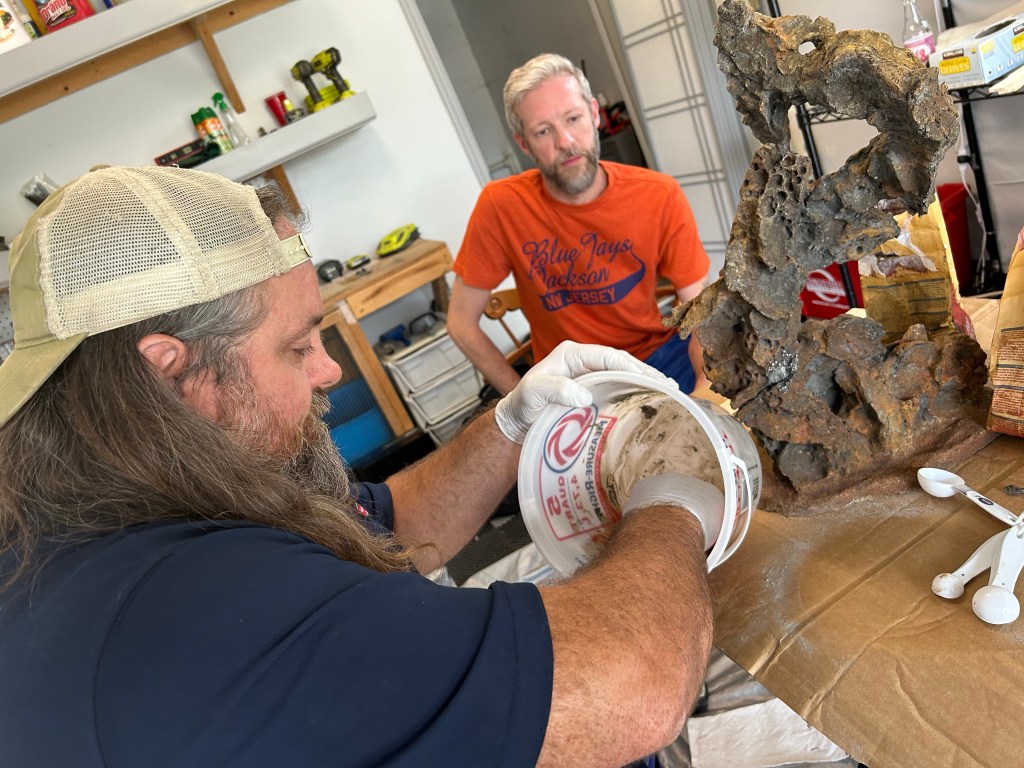
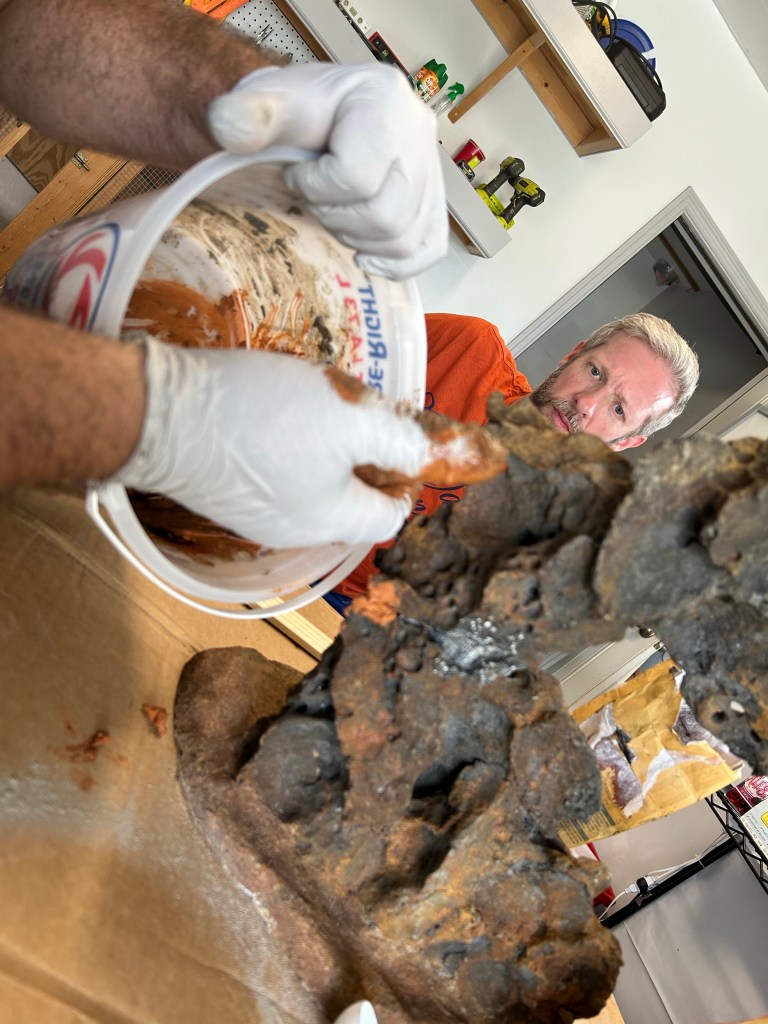
Now that’s a chunk of a block of a rock or something. Actually, it’s concrete, a manmade rock. But it’s “done broke” as they say…
It looks like a reptiles beak, below.
The story begins with a text, including some pics and videos, from Cincinnati.
The text was from Brendan. Say “Hi!” Brendan:
That’s him, my wife and me.
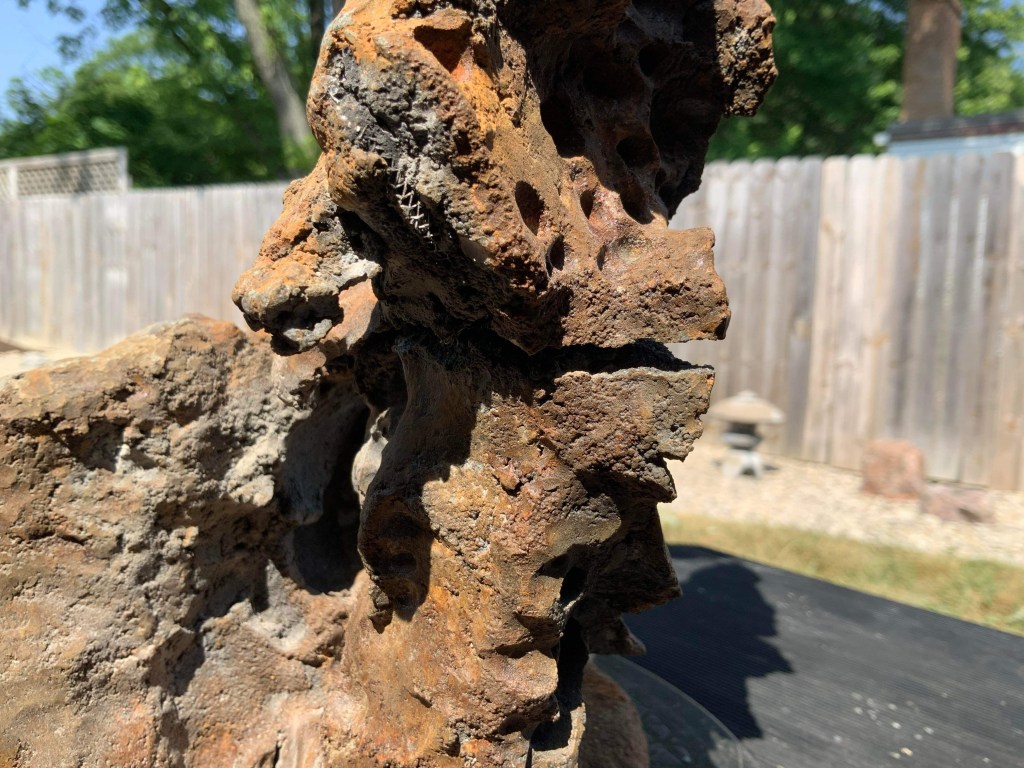
He got this “stone” from Poland, believe it or not. From a guy named Jacek Motyl. He makes rocks. Amazing rocks. Click on his name.
Anyway, Brendan ordered this stone and Jacek shipped it to him. In transit, it got “done broke”.
I’m not blaming the packing job. Jacek packed the rock well. I’m not blaming the Polish post office. Nor the USA postal service.
Let’s blame providence. The rock breaking gave me an opportunity to try something I’ve never done before. Sorry Brendan. Yes, this is my first attempt. I shall try my best sir.
The type of rock is technically called “tateishi”, or standing stone, used in a root over rock style called, in many modern spellings, “ishisuki”. When I was growing up in bonsai, we spelled it “ishitsuki”. Yeah, ishitsuki, I shit you not….but the modern spelling helps us to pronounce it correctly. The “T” and the “S” make a singular sound in Japanese. Kinda like an “tssss” sound.
Anyway, that’s my joke about root over rock style. It’s better in person, with the hand gestures and all.
Watch the video below to see how bad the break is.
Not to give away secrets, but the shape was created by taking screen or hardware cloth and making the basic shape.
Then the screen is built up with cement. And colored, shaped, sculpted, aged, etc.
Pretty cool right?
My job is to fix the break and match the colors and texture. So I first had Brendan try to find Ciment Fondue. I had remembered reading about the stuff reading in the old books and magazines when I first started in bonsai (books and magazines are these amazing learning tools that one held in one’s hands, printed on paper. You would flip pages and read and the knowledge was amazing. I could tell you about encyclopedias but you’d zone out quickly).
Brendan couldn’t find Ciment fondue. Searching on google, I found it. What is it?
CIMENT FONDU® is a hydraulic binder with an alumina content of approximately 40%. Composed mainly of calcium aluminate.
It’s a brand name, only available in Europe, so I told him to find something similar. And he did.
Refractory mortar.
Why something similar? So it expands and contracts in similar ways to heat and cold cycles as the original sculpture. And refractory cement is waterproof. An important thing up north, as water freezes in the cold, and can explode our rock. That might sound spectacular. But that’s not conducive to stable bonsai plantings.
There’s something soothing playing with cement.
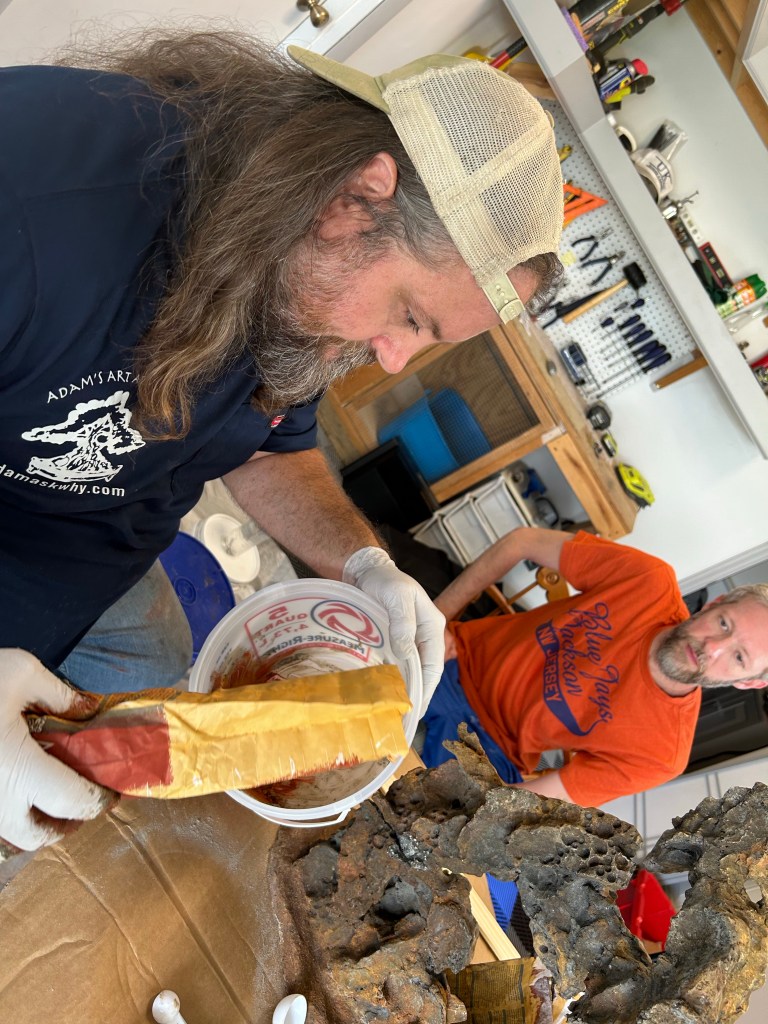
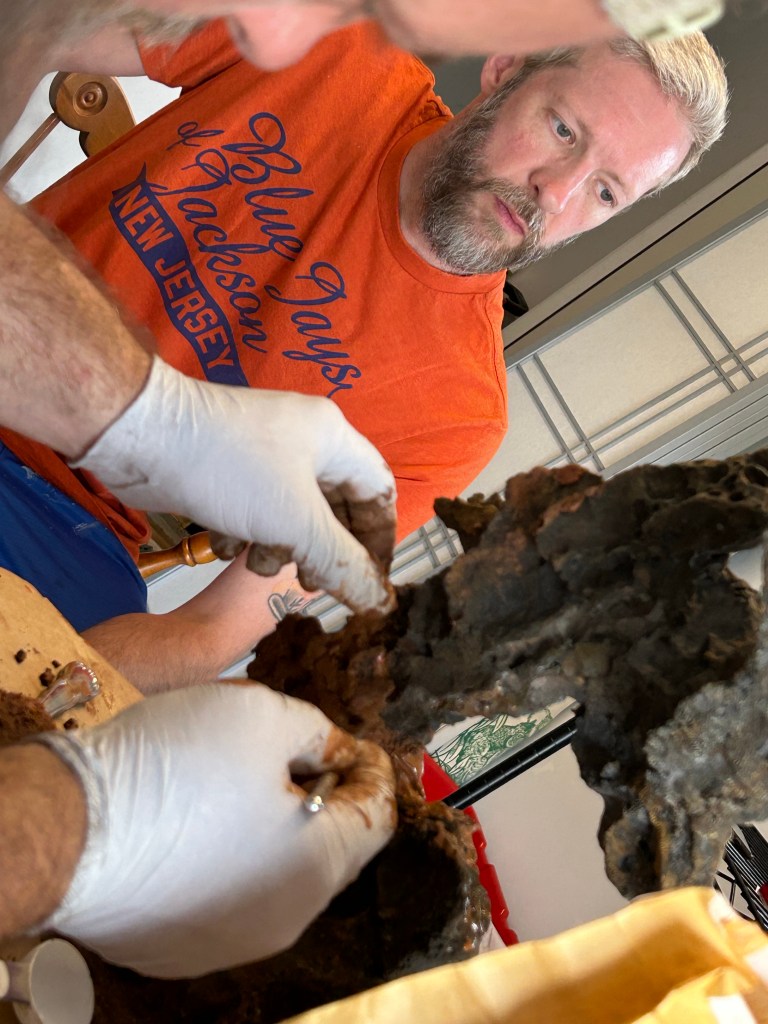
Measure out a portion….
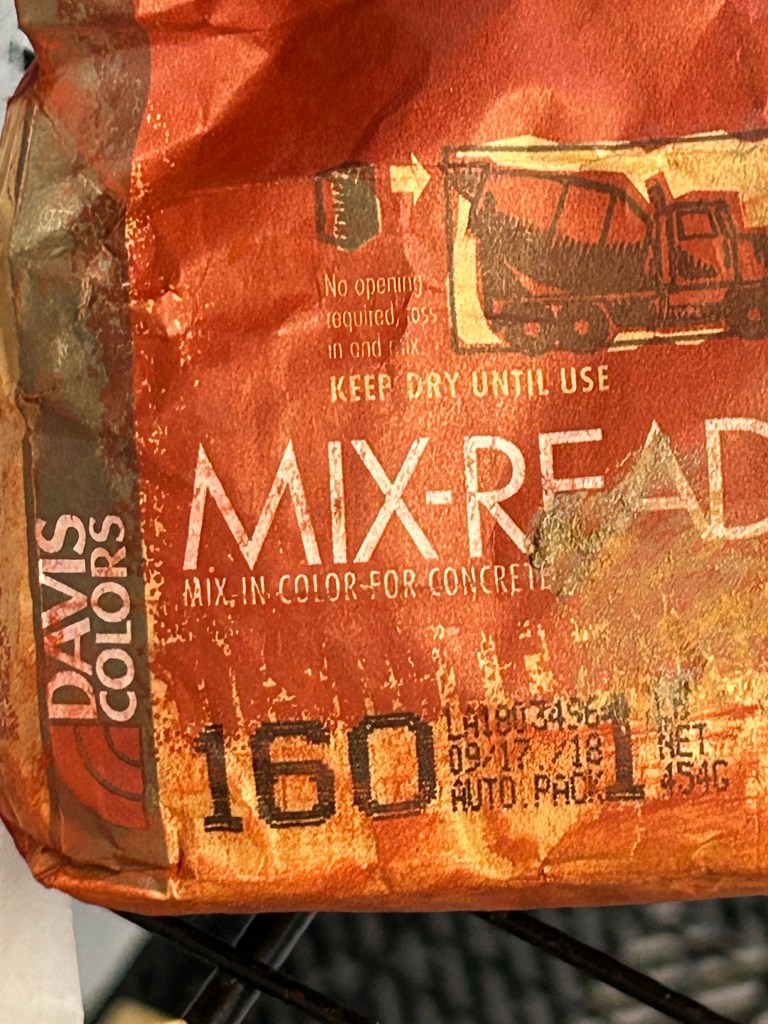
Add color (we had red, tan, called buff, and black. I eyeballed it).
And a trick, don’t mix it fully. You want variations.
Add water.
And move fast.
Brendan was watching me closely.
I smeared it, chopsticked it, blotted it. It’s a feeling thing.
I made sure to push the material into the cracks to ensure the repair of the rock, and not just make an aesthetic facade.
And with the leftover cement, I played around a little.
Yeah, I know what it looks like.
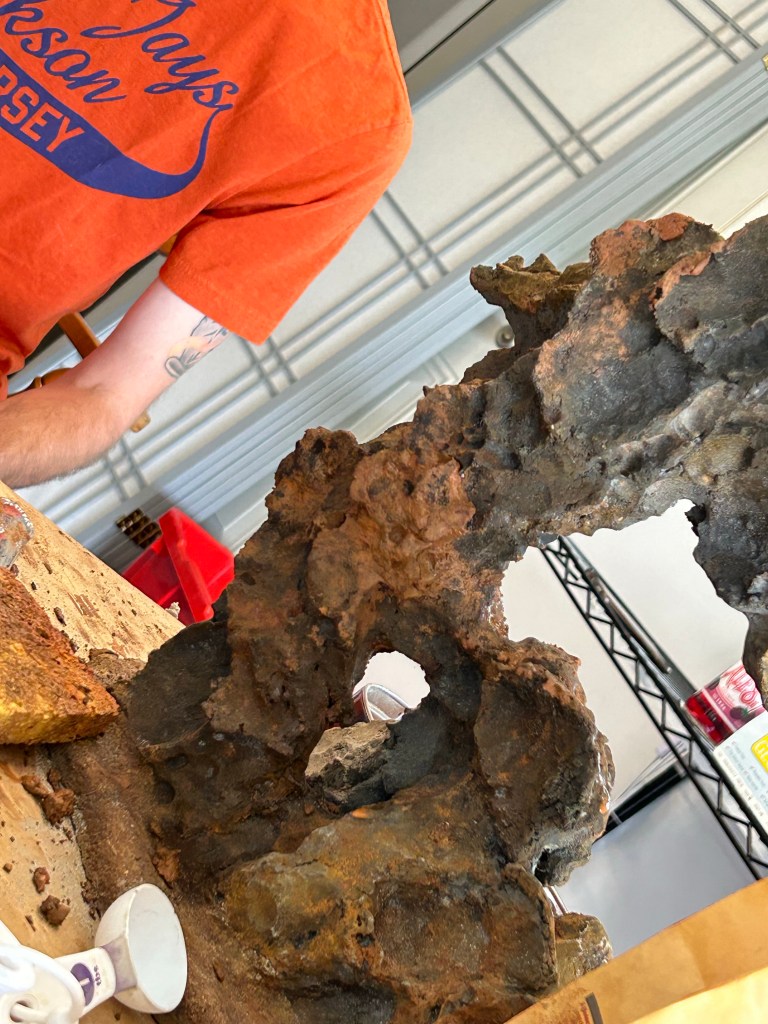
After the repair dried, I think it looks good.
I matched the texture and color. But most importantly, it’s solid.
I wouldn’t drop it, but it’s one piece again.
Below, is where I cemented that chunk back into place:
It’s been about four years since I found this, and every year, looking at it and pondering the next move, I’ve missed the opportunity to work it. Why? I needed to repot it, get a look at the roots, figure out what was happening under the soil. You can only do the root thing in the late winter/early spring, before the tree sprungs, or you’ll tend to kill it. We don’t try to do no killin’ ’round here.
It’s my favorite deciduous tree, Celtis lævigata, and you need to repot it before the new leaves emerge. This year I got to it in time.
Let’s see what we can figure out.
I love odd shapes and challenging trunk lines in my personal trees. This is a root, I’m sure, off a bigger tree, and I love it.
The dead wood. The reverse (inverse, obverse, blah blah blah) taper. The species. I call it the ficus of the deciduous world. You just have to search “Hackberry ” in the search on the front page and you’ll get a bunch of hits on articles I’ve written on the tree (except that one Brazilian Raintree hit….).
Funny thing just occurred to me. When I write my blog I try to explain what’s happening, or what’s going through my head, as I work on the tree.
During a demo, I’ll often just get lost in the tree, and forget that the audience is there and I’m supposed to be performing. A bonsai demo is really a kind performance art (and I say that tongue in cheek, because many bonsai practitioners are kind of conservative when it comes to bonsai-as-Art, no matter their taste in art or politicians. Me, I can’t stand the taste that a politicians actions leave in my mouth, except I don’t mind that one bonsai guy in Virginia. You know who you are, Roberto).
When I’m asked what’s going through my head during a demo I usually say “not much”. It gets a few laughs. Or I’ll say “you don’t wanna know what lives inside my brain”. That gets some too.
Sometimes I tell the story of how the chicken came to the west.
I’ll say, ” How many of you have heard the chicken story?”
Those who have, groan. But they encourage it because, though they’ve suffered through it, they want others to know the pain of sitting through it as well.
Shared pain is lessened, after all.
Anyway, the chicken story:
What you may not know, is that the chicken originally came from Asia. Look it up, I ain’t lyin’. And in Asia, there is a strong Master/Apprentice relationship in the passing down of knowledge.
Now, anyone who’s raised chickens knows that it’s prit’near impossible to tell the difference between a male and a female chick (baby chicken). And it should be self explanatory that a female chick is more valuable than a male chick, because of, you know, eggs and all that, so there evolved a very prestigious occupation in the world of animal husbandry know as a “Master Chicken Sexer”. A real job. A dirty job you might say (you remember Mike Rowe and Dirty Jobs? There was an episode about just this thing).
So, being that chickens are from Asia, and they were imported into the West (how else do we have omelettes?), it soon became clear that the western farmers needed help trying to figure out how to distinguish between a male and female chick. Still obvious, right?
So the western farmers hired the Asian Master Chicken Sexers to teach the westerners how to do this.
The scene: we have the apprentice chicken sexers sitting at the conveyor belt, and the yellow chicks are coming down the chute, onto the belt, and the apprentice picks up the chick, tickle its butt or something, and throw the chick into either the male bin, or the female bin.
The poor male chicks are mostly made into….ah, feed for other chickens. The females were let go to make nests and lay eggs for the farmers to harvest and make their scrambled egg breakfast or quiche (if they’re French farmers).
As I mentioned before (about 100 words earlier) it is exceedingly hard to figure out the difference between the male and female chicks; they’re both yellow, the males haven’t learned to cock-a-doodle yet, the females don’t even gossip. So the apprentices are sitting there, chucking the yellow birds in whatever bin they thought they should go into. When they got it wrong, the master, who was standing behind the apprentice, would whack the poor student on the back of the head.
Slap!
Eventually, the apprentice could unfailingly tell the difference between male and female chicks.
Now, they had no idea how they knew, but they did know. That slap hurt.
Again, obviously, the point of the story isn’t about chickens or East and West or even farmers. It’s more about how to teach. Some bonsai teachers teach using the rod, telling you you’re wrong and to do it again, and again, and again, until you have it right.
That’s not me. My online name is Adamaskwhy. Most people think it’s that way so you can ask me “Why?”
And you can.
Most of the time I know the answer, or I can find it.
Or I make something up that sounds plausible.
But the real reason for my name is that, as a student, I don’t just want to know the answer. I want to know why. I was (and still am) that annoying kid in the back row that said “oh yeah, prove it!” And it angered some teachers, bothered others, and I was loved by the smallest percentage. Those were the good ones.
I’ve talked about this before, so excuse me if I’m repeating myself, but a teacher who doesn’t know why, ain’t much of a teacher.
If you can only recite your lessons, then you haven’t learned a thing.
Which brings us to the initial styling of this hackberry. You remember it? The subject of this article and all? I know, you got lost in the chicken story. It happens.
What in the hell is going through my head?
Well, you’ll have to trust me on this one, and see what happens this year.
It seems that a lot of “rules” are being thrown away with this tree.
I mean, they do say that “rules are meant to be broken”. But why do they say that?
Let me tell you another story, this time about a boy named Pablo. Pablo’s father, Ruiz, was an artist that specialized in realistic drawings and paintings of wildlife. He was an instructor and professor at several art schools. He started training Pablo at the age of seven, and insisted that Pablo learn how to draw and paint properly, in the classical and realist style that was popular at the time, and was profitable, as artists jobs back then was to paint portraits and art to be hung in wealthy patrons homes.
So Pablo learned. It came easily to him. At age thirteen, his father, Ruiz, proclaimed that Pablo had surpassed him in talent and technique, and enrolled him in a prestigious art school in Spain.
Pablo quickly understood what art school was for, and formed serious friendships that would help him later in life, all the while slacking off on his lessons. He knew them anyway.
That, by the way, would be the one lesson to take away from this parable, college is to make contacts in school, that will help you later in life. The bosses who hire you only want to know that you got the degree, not that you were a “C” student. But if they know you were in their sorority or the chess club they were in, you, my friends, are in, as they said in my youth, like Flynn.
Pablo was so good a draughtsman that, in his later years, when everyone called him Picasso, he would sit and drink his coffee at the cafés in Paris, and draw photorealistic flies and bugs on the walls. Drawings so real the waiters would rush over and try to swat the fly off the wall. Pablo, as you might think, got great pleasure in these escapades.
We are all just boys and girls, trying to smile at the tragedy that life sometimes is.
What is to be learned by this last story?
If you learn to do the work, as a craftsman should, you can then use that work to accomplish the Art that your soul requires to feel alive.
It seems I’m at the end of the work.
I would try to get a good pic, but my photography area has been battered by a hurricane or two. It’s on the list to repair.
And here’s the obligatory tortoise pic. I need to build him a proper enclosure. That’s sooner on the list than the photo spot.
This is the best I can do for now.
I’ll post updates as I make changes in the tree. Maybe. I have a long list of “To-Do’s”.
The Shofu Bonsai Society of Sarasota has a pretty good auction every year. Granted, some years are better than others, but the year I got this one, maybe 2021, was spectacular. This tree was on the silent auction.
Yeah, not the live auction, the silent auction! I didn’t have to raise my hand or pull my earlobe to win this beauty. I just wrote a bid down on a piece of paper.
I don’t even think I went higher than $100 on it.
Since I’ve had it, it seems like only a few branches have grown.
But that’s typical. I don’t do anything to it for those few years except to water it. And when you ignore this species, a Ficus microcarpa, it will pick one shoot on each branch to feed the sugars to, and, like the pic above, you get long spindly branches and the smaller, interior branches tend to die off.
The lack of sun is the impetus to tell the tree how to allocate the resources.
(Not to belabor a point, but that’s another reason for timely defoliation techniques on figs. Defoliate to let sun in, calm down the randy shoots and allow everyone to grow. )
Oh! Notice the blue bottle? That is one thing I’ve kept up on for this tree. That bottle has a systemic insecticide in it called “imidacloprid”, which is a synthetic nicotine (what they call a neo-nicotinoid) that I treat all my F. microcarpa with to control thrips. An insidious insect that takes the leaf and folds it to make an incubation structure to breed more thrips.
Below, there’s one on my arm. They call this one the “Cuban Laurel Thrip”, as that’s one of the common names for this ficus, Cuban laurel. I call it the “Indian laurel” as it’s more indigenous to India than Cuba, though it is endemic in the island.
The tree does have flaws, like the wire scars below.
And, as a species, the leaves are bigger than say, the “tiger bark” variety. And they are prone to branch dieback (like the Ficus benjamina) if you don’t leave strong growth on the tips when you prune.
Let’s open it up and select some branches.
Hmmmmmm….might be useful. Below?
Nah
Below, there’s that growth tip.
I’ll leave it to grow longer.
But some I’ll cut back to encourage back budding.
Clean up, clean up….everybody do your share.
Kah-chop!
There we go.
Some wire.
The result of clip and grow. Good movement.
More grow tips to preserve.
Now just let it grow.
But not willy nilly growth, directed growth.
If you ever take a class with me, and I say let it grow, you should let the things left, to grow, but get rid of growth that’s not needed.
Here’s a video
And here’s an idea of what it’ll look like. Needs a better pot.
Let’s see what happens, I promise to show the repot and updates
This work was from February or March of this year, 2024. It took me that long to figure out where the comma goes in the title. And which words to capitalize. Not really but an excuse is an excuse.
So, with that said, here you go, a little late is all…
An Ilex vomitoria “schillings”. From my student, Sharon. She grows them in her landscape and has some impressive bonsai specimens as well.
But this one came from a Bonsai Societies of Florida convention workshop from several years ago. I’m not sure why she took the class, but she did, and I get to work on it. The yaupon holly is one of my favorite species and this one is fat and chunky.
I believe the trees for the workshop were collected somewhere in Brevard county. By the Bonsai SOB’s.
I know, bad joke. But clever. The Bonsai Society Of Brevard: Bonsai SOB’s.
One of the clubs that’s seat to my heart and I consider it a home away from home (I belong to the Central Florida Bonsai Club in Orlando).
For clarification purposes, Sharon lives in the Tampa/St. Pete area of Florida. Opposite coast from Brevard.
My Job, which I did late winter early spring (for y’all confused peoples out there) is to prune, style, and repot this old tree into this classic oval-shaped bonsai pot.
Damn what a sweet trunk. Like an ancient oak tree out of a story, maybe a Robin Hood and Maid Marion fairytale, enjoying a late spring, early evening stroll amongst the fireflies and sweet blooms of Nottingham Forest.
And that hollow, or, as they call it in some Japanese bonsai nurseries, an “uro”. Roll the “r” in the Japanese way.
Let’s get into it. Those concave cutters are ready, looks like.
Snip!
There are a lot of branches, which is good, more to choose from. The craft of bonsai is knowing the most amount of branches to remove from your tree and still survive. The art of bonsai is knowing what to keep so your tree still looks like a tree.
Craft, knowing the whens and hows to cut. Art, knowing the whys and becauses.
Early spring (in Florida that’s mid-February) the tree begins to push new growth. Below, that new growth has begun to harden off.
Now’s a good time to get some cutting in.
This’ll be quick, so pay attention.
Sharon has been selectively pruning for movement, as you see below.
And if I had the druthers, I’d make some warriors roasted yaupon tea with all the leaves on the ground.
There we go. Lookin’ good.
A mind puzzle for ya’ll:
I have a farm. There’s a drought, but I have a deep well.
It’s drying up, but there’s still water left to live off of to water the crops and for the animals and my family.
Maybe enough until the rainy season.
Maybe. My house, where I live, catches fire. Do I let the house burn down or do I use up my water to put out the fire.
For the smarty pants, those two options are your only choices.
What should I do?
Now that’s a root ball!
The tree is old in this pot and well established. Ilex like good drainage and this depth pot is well suited for it. But aesthetically, the art part, it’s not.
That’s a question, why do we use shallow pots when, horticulturally, a deeper pot is better.
Not many know. I’ll ask this question during demos and I’d get answers like: it helps to dwarf the tree, or, it slows the growth. The only reason is it makes the trunk look bigger.
Bigger trunks look older. And that’s what the Art of Bonsai is: making a little, young tree, look like a big and old tree.
In fact, most of all the craft of bonsai, and the soil components and composition, are there to serve the art.
Take the roots. We know that the roots are responsible for most of the water absorption and nutrient uptake. They’re also the main storage facilities for excess sugars for those lean times a tree has to endure. The only reason we use expensive aggregate as soil is to increase drainage when we put our trees into shallow containers. Bonsai soil is not magical, and it’s not really suited for deep containers, as it dries out too fast (there’s a lot to say about that, but those posts have already been written. Start at this post: Akadama, the Ideal Bonsai Soil and follow the related posts at the bottom), but it works for bonsai containers.
For this tree, and its roots, it’s been prepped for a more shallow container, but there are still a few roots to get rid of.
I’m not worried too much about chopping those big roots (they hold the sugar remember) because the species grows fast and makes tons of sugars. So just leaving the feeder roots (the small ones) is good enough for the health of the tree. Knowing that (to continue the theme) is the craft. You have to learn the craft just as much as the art part.
The tree is healthy enough to handle this rough treatment.
And I know how to sharpen my scissors, so I don’t want to hear anything about using my good scissors on the roots. But you shouldn’t. Do as I say, not as I do.
Here’s a crossing root. Kinda straight too.
Cut it off and that’s what’s below it. It’ll puff back out, but it was beginning to girdle the lower root.
And I might just need a shoe horn. Maybe I should advise American Bonsai tools to make one…….
And it fits! Bob’s yer uncle!
I’m still on the fence with that first branch on the right. I can’t bend it, so Sharon either lives with it, or we cut it off.
You read earlier that this tree lives in St. Petersburg FL. If you’ve been reading the news, you should know about the two hurricanes that have impacted the Gulf Coast of Florida. Sharon stayed for Helene, but she evacuated for Milton. I don’t have the heart to ask her how her trees have fared (her house and family are well).
This year has been trying, especially for those in the path of Helene; Florida, Georgia, Tennessee and especially North Carolina. I had very little damage, just a little debris. All I did was sweat a little cleaning it up. But there are people who’ve lost everything. The towns they live in are even gone.
All the loss of life is devastating. I have no words for it.
Well now, this tree is bigger than my head. Which is saying something, I got a big head. This is what they used to call, in the seasons of my youth, in bonsai, when I was green and learning the words of this , our Bonsai World, a Schefflera arboricola. Being that I also learned it in the southern latitudes of my country, they pronounced the last part, arbi’cola.
Now, they’ve changed it, and it’s just an unpronounceable and easy to forget name: “Heptapleurum”. Hepta- meaning seven, and pluerum-meaning side. Seven leaflets on each leaf. I feel sorry for the poor botanist, Johann Peter Ernst von Scheffler (born in 1739), who they named the genus for. He is an unknown man (in our time) but ever the hard worker I’m sure, who I can’t find hardly a biography on, but did something, either great or enduring, that made them name a whole genus of plants after; Schefflera.
I’m sorry but suddenly I’m feeling some existential pondering. Try to keep up….I’m a wandering ponderer, I’ll take lefts, rights, u-turns and switchbacks. Ready?
Can you think for just a moment about all the people who have ever lived, either important or unimportant lives, and their everyday existence, with families, friends, meals, whether they used chamber pots or outhouses or just pissed in the streets. Whether they ate with spoons (silver?) or just a knife, or a full place setting at the table. There are those that lived, struggled, and died never knowing the pleasure of biting into the juicy, sun drenched goodness of a red tomato with just a little salt, or a bowl of strawberries with fresh whipped cream. Or the caress of a lover, the slap of an enemy, or the warm embrace of a bed on a cold winters morning.
I know that’s hard to imagine, all the billions of joys and defeats, triumphs and pain. We can’t do it easily. It’s hard just to be aware of what’s happening across the street. Across the street, like my neighbor Bob, how he lost his wife from smoking induced emphysema, how he lives next to his mom and took her away for the last hurricane, Milton. His struggles with health, and pain. His life playing on the coasts of Florida, fishing and staying up all night on the beach, huddled around a bonfire, with his friends, drinking beer and smoking what used to be much more illegal, back in the 1960’s and ’70’s. His loves, and children, and his profession. He was a contractor. A builder of homes for so many others to live their lives in. Will anyone remember him? I’ll try.
How about just all the lives lived in the life of today’s tree. I’d say it’s close to 50 years old. Oh, don’t worry, you can’t really tell, it’s so bushy, but there’s a tree in there.
I got it from Dragon Tree nursery in Palm City FL. From a man who I’ll try to remember and remember to my students and fellow bonsai friends, Robert Pinder. Robert is, along with Ed Trout, one of the last gentlemen of Florida Bonsai left. That includes me. I grew up in a rough city in Massachusetts, called Brockton, as a feral child, born in 1975, out exploring the world on my own or with friends. I never learned to talk to people (my sisters tried to tame me, they mourn the failure every day). I try to be nice but I’m far from a gentleman.
I first styled the tree during one of the pandemic era meetings we had for the Central Florida Bonsai Club. We held it at my nursery, outside in the sunshine. Safe.
Here we go, halfway defoliated.
Robert sold this to me for less than I paid for my first automobile, a 1966 American Motors Rambler four-door sedan (no, not the hot rambler, it was a family car. Single barrel Holley carburetor, in-line six cylinder engine, four doors, army green. I bought it from an older lady who owned it new. I miss that car, but it became obsolete. No parts, worn out upholstery. And I’m just a poor itinerant bonsai traveler from the projects of Brockton Massachusetts. At the time I had no money to fix it, not that I could fix it now).
Now we can see what we have. There’s some wire on it. I’m thinking it’s been there since late 2020. Hmmmm….wire. Brings me back to my first Central Florida Bonsai Club meeting.
Here’s a cautionary tale. A famous (at the time) bonsai guy from Canada came down to tour the state and the club hired him to do a critique/help session.
It was my first meeting, and it was a cute couples first meeting too. They were waiting their turn, with a small schefflera held between them, like a child sitting up on the table. They looked so proud, bringing their tree in to get help from this “master”.
He was up at the front, and the tree was placed in front of him. He picked it up, holding it with his fingertips and turning it around, peering at the pot and the branches. Almost like he was examining a turd, trying to find a clean end to hold it.
He proclaims, in his best expository voice, projecting to the rear of the room,
“Well, we don’t have this in Canada, or we might, but we don’t consider them ‘bonsai'”
You could see the couple slowly deflate like those giant, blow up snowman holiday decoration on January 2nd when people start to take them down. The bonsai artist continues,
“I’m not sure you can even wire these, and I do believe that wire is necessary for bonsai…”
“In fact, I like to call these ‘Mutt Bonsai’, meaning they look like bonsai but really aren’t”
That poor couple took their tree and sat down, heads lowered and eyes averted. I never saw them again.
There’s no place in bonsai for that pomposity.
Anyway, I took all the wire off and now it’s time to prune again and rewire those branches that I’ve let grow. This is the growth tip.
In case you’re curious, when I begin a blog, and as I write it, I research. Here’s a snippet of the type of papers I read:
“Attachment of branches in Schefflera is unusual in that it involves fingerlike woody extensions that originate in the cortex and pass gradually into the woody cylinder of the parent shoot. We tested the hypothesis that these structures could be roots since Schefflera is a hemi-epiphyte with aerial roots. These branch traces originate by secondary development in the many leaf traces (LTs) of the multilacunar node together with associated accessory traces. In the primary condition, the LTs may be described as cortical bundles. Leaves are long persistent and can maintain a primary stem connection across a broad cylinder of secondary xylem. Under the stimulus of branch development, the LTs form a template for secondary vascular development. Because the LT system is broad, with many traces, the branch attachment is also broad. The fingerlike extensions are attached to the surface of the woody cylinder of the parent stem but are progressively obscured as a continuous cambium is formed. Bark tissues are included within the branch axil because of the extended cortical origin of the initial attachment. The results are discussed in the context of branch-trunk unions in tropical plants, an important component of canopy development.”
A what they call a “scholarly” publication, meaning that when you research a subject, put in whatever you’re looking for and add “scholarly” and you’ll get primary research papers, by real scientists doing real science work.
This one branch decided to grow the most of any branch. It’s fortuitous as the branch is in good proportion now, instead of a skinny shoot.
That’s what we want. You could say that the practice of bonsai is just: cut, wire, grow, unwire, cut again, rewire, let it grow. The one thing, considering all the aging techniques we have available to us, we can’t fake is the element of time, which is demonstrated by the concept we call “ramification”.
How do we get there? We cut the growth tips, which then causes back-budding, and a branch goes from one, to two, to four, to sixteen. In bonsai, those layers of ramification are called:
Primary, secondary, tertiary.
Cut, wire….
The debris after all that cutting. Thats a thirty gallon pot (what they call a “number 30” in metric system nations) easily halfway filled with schefflera.
Wired up and made pretty.
That night, I went to see my friend Jack (on the left in the red coat playing guitar) in his new band Afterglow).
He’s a great player, with great feeling. And his knowledge of music allows him to figure out a song just by hearing a few chords. Music is akin to math, notes and progressions follow certain rules and you can figure out a song if you understand this. Much like botany.
Jack has been playing professionally since he’s been a kid. He’s been in several original bands, and cover bands (he was the founder of the central Florida area band called Papa Wheely). He’s seen more faces than Bon Jovi, and has rocked them all (sorry, had to make the joke). I appreciate him and try to see him play, no matter the band or the song.
His life, though ordinary, is also exceptional. If you take all the ups and downs, he may give more weight to the one or the other, but to live at this time, in this place, is a privilege. And he has fun.
As do I. As you should too. Take pride in the small things, because it those are the things that make up the big things. Learn that b sharp minor chord, learn the bass line picking technique. Then you can play along when I play the songs too.
What we used to call a “Shefflera aboricola” back when I grew up in bonsai, has now been renamed to the oddly hard to pronounce “Heptapleurum arboricola”.
This time it was actual genetic testing that changed the eggheads minds. But, to quoth Kipling, “it’s not ours to wonder why, only to do, and to die”.
This morning at 4 am, myself and the best bonsai artists in Florida (yeah, what the hell was I doing there, right?) picked up the bonsai on display for the 2025 Epcot International Flower and Garden Festival. The trees were there for about three months, outside in the Florida heat and rain, on view to about 4 million viewers as they passed through the Japanese Pavilion in the World Showcase at Epcot.
That’s another tree that was on display, a Neea buxifolia. And that’s Rosie Posie Puddin’ Pie, the cat.
She kisses all the boys and makes them cry.
And the schefflera.
What’s the work today? A hard cut back and defoliation. Then a repot.
It’s been eating up all the Florida sunshine for the last few months, and it’s bursting and ready for some work.
It’s about to walk out of the pot.
The question is, I’m sure, why do you feel the need to defoliate?
It explains more precisely what defoliation does. But basically, the tree does things, like grow, flower, drop leaves, etc., because of hormones. All because of hormones. Some people say “energy” is what causes growth. But no. Nope. Nada. Energy facilitates growth. But a tree will grow itself to death. It will use all its energy without anything left, and it will die.
Why? Because of hormones. So when we hear “them” say that by utilizing a specific pruning regimen of techniques, they are “balancing the energy, what they are really doing is utilizing the hormones to make the tree grow a certain way we find favorable.
By defoliating, first, we are taking the trees ability to feed itself. Therefore, the hormones cause growth of new leaves, and, by proxy, more branches.
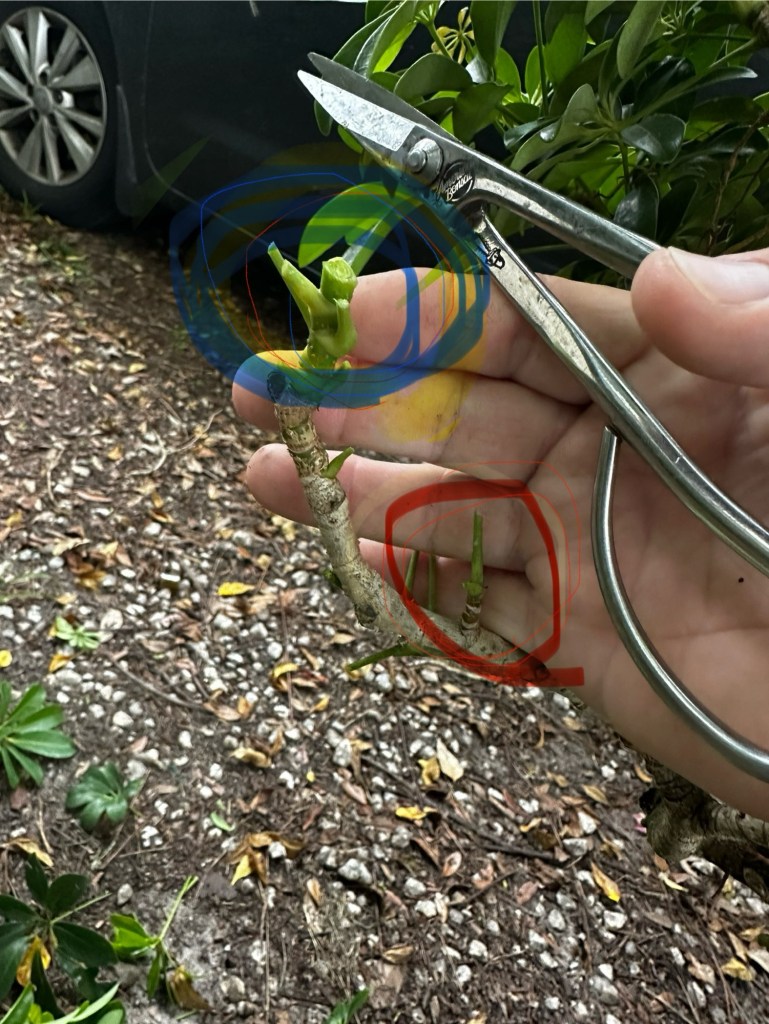
But, if we cut the terminal buds (like the blue circled branch below) and remove the hormone that causes branch elongation, we will free the hormone that causes backbudding to cause, well, more backbudding (auxin and cytokinin, respectively). Go back and read that post I linked earlier.
If we defoliate, and leave the terminal bud (like the red circled branch above) the branch will get longer.
Now to prune the aerial roots. I know, I know, we like aerial roots.
But we also like to have a believable tree. And aerial roots this high….
…don’t make for believable banyan trees. An artist isn’t a camera, we don’t have to copy nature as it grows, we show you what should be, or could be, or, simply, what we see.
Snip snip snip!
Getting close.
Take a look, from all sides.
That’s a lot of leaves. Looks like an explosion.
Needs some wire….
And a “quick” repot. Remove the old moss, save for later, it’ll green up again.
Maybe the repot won’t be so quick. Those roots are rooty.
Old bark on on a big sheff. Looks old, like my face in the morning after a night out.
Or just any morning. I’m getting old.
Yeah, this will be a chore removing the tree.
DOH! Actually not bad. It just popped out.
The damn thing is heavy and I’m alone in my driveway, that ain’t gonna work.
That’s a better setup. Now for the hook
THE HOOK! A new product made by my friends at American Bonsai Tools, based in part on my handmade hook.
Makes for short work.
I’ll tell you what, the fragrance from a schefflera will clean out the nasal passages
The Central Florida Bonsai Club, my club in Orlando, has been representing Florida Bonsai at this festival for several years now.
I like to go for the day and work one of my bigger trees to show the public that bonsai don’t need to be, or are limited to, small hand-held trees.
This year I brought a Ficus microcarpa. Just the plain species. Not tiger bark or green island or melon seed. Here’s how it looked after I cut it to a line way back in 2013.
I got the trunk from my good friend Ronn Miller, a Florida bonsai artist of great renown.
The link below shows a previous blog post on the tree:
Defoliation, unwiring (I think I did that already) and pruning for shape/taper/ramificatiom, and rewiring of course. But not every branch.
Sometimes that’s needed, wiring every branch, but most times it’s not. I had a former friend who insisted on wiring every branch because that’s how he learned (he watched a video on YouTube that told him to ALWAYS wire every branch, and he was a paid subscriber to this channel, so he obviously has to do what he’s told, cuz it’s worth more to him. I wish I had a simple mind like that. I have to question everything. Just last week I was tying my boots and I wondered if they’d be tighter if I used an overhand knot instead of a sideways, underneath knot. Took me 15 minutes to tie my boots…..
If you’re looking at the leaves closely, you’ll notice the white build up on some of them.
Like above. I see this question a lot on the bonsai forums: “What is this? Is it harmful? How do I get rid of it? “
It’s usually just water spots from dissolved solids in your water. Like calcium, or lime. If it’s red or orange, it’s iron rust. it’s not harmful acutely, just ugly, but it could be a problem if it’s built up so much that it blocks the sun and restricts photosynthesis. And how do you get rid of it? You can polish the leaf, or use leaf shine, or, like I’m doing, cut them off. A ficus can hold a leaf for up to three years (it’s a tropical, broadleaf evergreen). But you can defoliate one, as long as it’s healthy, up to four, five times a year. I usually do at least twice in my normal maintenance. If I’m really pushing a tree, 3-4 times.
Anyway, I have a bunch of leaves. Let’s see if I can count….
There we are. I counted 2,713 leaves.
Actually no, but that’s a good number. It’s a prime number (only divisible by itself) and sounds good saying it out loud
“two thousand seven hundred and thirteen”.
Sounds like it belongs in the first, or last, sentence in the Great American Novel:
“In the year two thousand, seven hundred and thirteen, the hero man was born.
Or died.
It was a time of illogic and lost tales, with many great humans born or killed. Some by the hands of evil men, or by their own hands as the era was one of pain.
The world had just gone through a bloody interregnum, accented by war and famine, city and states wiped off the countryside and built up into empire. Cultures distilled out of the quirks and pathology of a leader, or group.
Our hero begins the day chopping wood, collecting water, and making tea.”
I’d read that book. Maybe I’ll even have to write it.
Let me finish this post first. The branch my hand is on has risen from its original place in the design.
So that’ll need to be wired back down.
That’s the life of a ficus bonsai owner: put the wire on, take the wire off, put the wire on, take the wire off.
Anyway, enjoy the next twenty following pics of me pointing at various parts of the tree.
Straight lines must be made curly.
Some things gotta go.
I just realized that in the background of these pics, you’ll be seeing a pretty detailed accounting of certain attendees visiting the restroom.
Now for wire..
For the sake of a good anchor, one should try to wire two branches with one wire.
Always start in the branch crotch (I just learned that “crotch” is a word first used to describe the meeting of two branches, or the trunk and branch, and not the area between your legs).
And wire one side clockwise, and the other counter clockwise.
There’s a straight line that’s offending my eye.
I know I need to wire three branches. I’ll use two wires.
This will let me put two wires on some branches, to give better holding power.
Then the bend.
I usually use two hands to bend, but that’s hard to hold a camera, and bend. Pretend my left hand is steadying the branch.
There we go, one done.
Now for the rest
Zooming in, you’ll see wire marks. One of my favorite bonsai lines comes from an English man, he said “I’f’n you ain’t got no wire mahks, yer not using enough wire”.
Say that in a John Lennon accent.
Should you find yourself with too many wire marks, you can scrape off the ridges with a blade.
It mitigates them and makes the branch look gnarly.
And chicks dig scars.
And that’s it.
A video from the top
There’s just something satisfying in wheeling a tree around on a garden cart.
Walk this way!
We all have to walk the path we see before us. Sometimes we cross others paths at the same time they’re on it, and sometimes those paths parallel each other. Relish those times of a companionship, but realize you can’t get off your own path.
Hmmm. Cosmic Bonsai in the Great White North? I’m in Ohio, and I guess they like outer space a lot; it’s a fact that more U.S. astronauts have been from Ohio than any other state.
John, from Toledo, one of my friends for a long time, has been going to the convention for the Bonsai Societies of Florida for two years now. He got to see Walter Pall, Mauro Stemberger, and many others in years past.
This year he got to meet and take workshops with Laurent Darrieux from France, the creator of the Cosmic Bonsai approach to styling trees.
Some people see it as blasphemy, some see it as a narcissistic offense, some see it as silly. But what it really is, in imaginative terms, is a question “what if we travel to another world, with, maybe, higher gravity, or two suns, or a long rotational period, what would those trees grow like?”
Artistically, it is a valid question. Artistically, it works too. When it is practiced well (just like any style, any idea, or even traditional bonsai) it works as Art. There are those that may say it isn’t bonsai, but some of those same people say that the flat top style of trees, whether the American bald cypress flat top, or the South African style Pierneef flat top, aren’t bonsai either. Uh huh.
I’m sorry, but bonsai is not a Japanese art. It is a Japanese word, and it is very Japanese traditionally (but it’s dying in the country) but that’s just because, when we modern practitioners of bonsai decided to give it a universal name, a certain Chairman in the east was intent on destroying traditional arts with his Cultural Revolution. so it was named “Bonsai”.
When I was learning bonsai, I read all the old books, and took to heart the challenge that the early Japanese bonsai masters gave us when they started to travel and teach bonsai throughout the world.
They told us not to mimic Japanese bonsai, but to find new species of trees, and new forms of design, and expression, to celebrate not only the character of our countries, but also the natural world we saw around us.
Here’s my question to you: What if our imaginations also let us see the world differently too? Say another world? That’s Cosmic Bonsai.
To categorically discard the concept because it’s not how you learned it is everything that people accuse Laurent of: arrogance.
He’s an artist. He has to create. And to show others his vision. He’s not being allowed to do it. Well, except in Florida, my backyard.
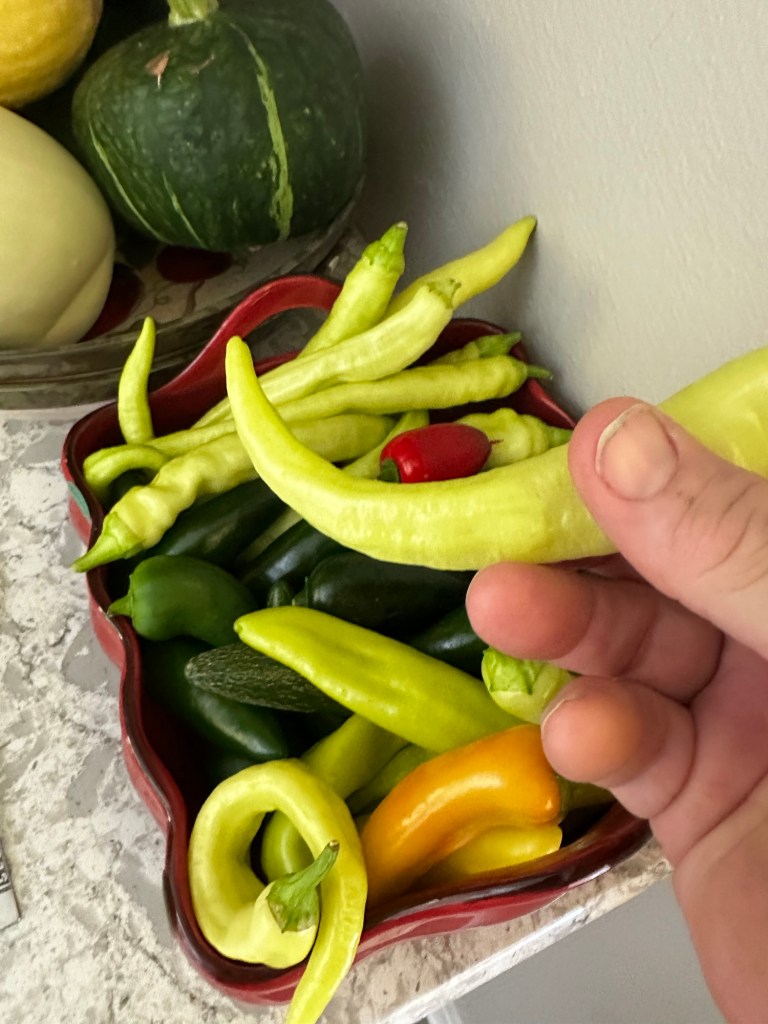
Phew, that’s some heady stuff. Anyway…Here’s a banana pepper in the traditional style.
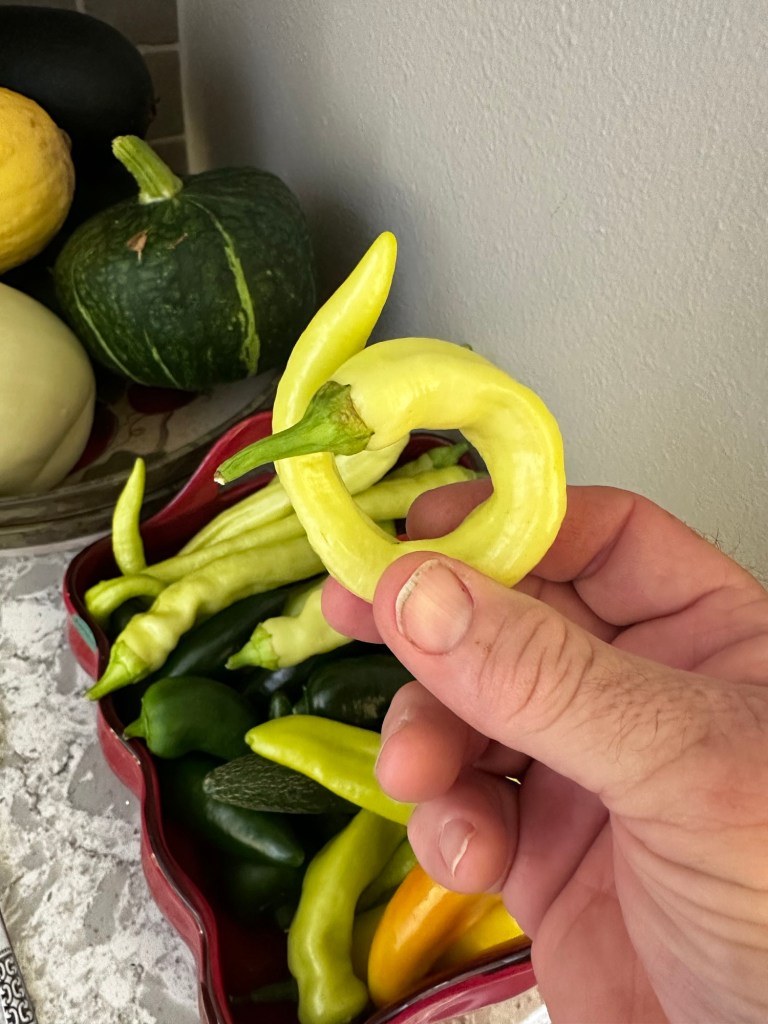
Here it is in the Cosmic Style:
They both go well in an omelette (French word btw).
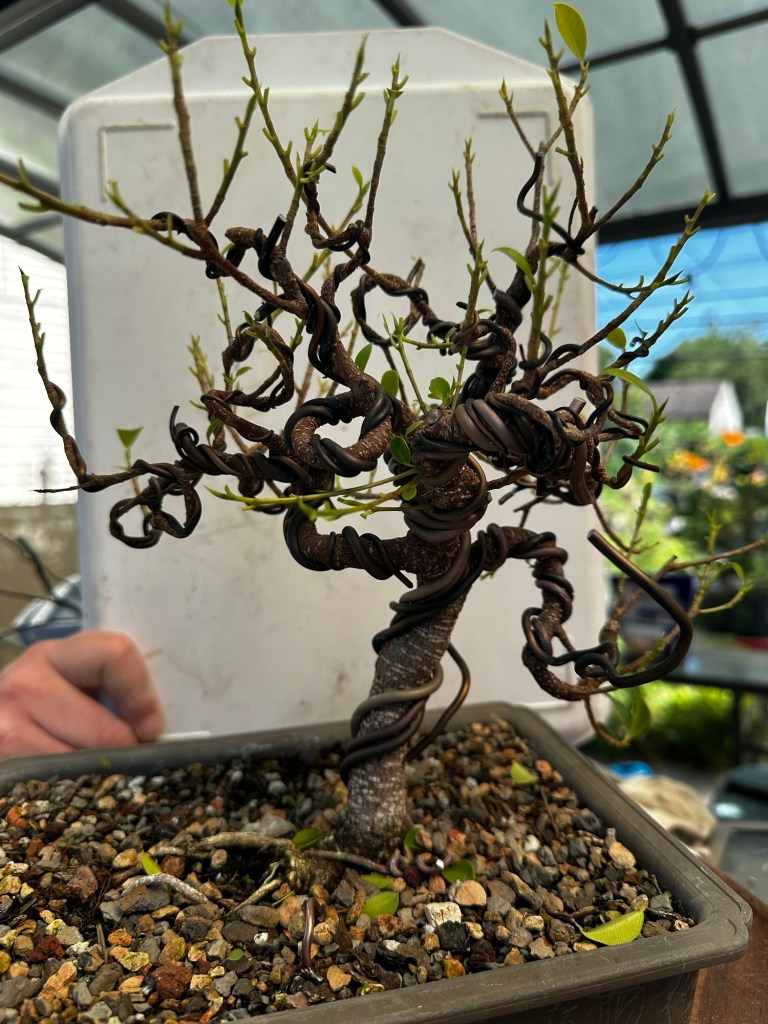
Below (and some pics above) is a tiger bark ficus (or Golden Gate, or kinman, or kemang, or whatever you want to call it) that John made in Toledo after he got back from the Orlando convention.
I took the wire off and…
….the branches stayed put. Surprisingly. It was a mere two months or less.
I think we need a rock outcropping to give the base some drama. and to expose the roots and give some repetition of movement to the composition.
John had the idea to add some fossil looking carvings to the rock (maybe next year).
Hi John. I made him rewire it.
While I enjoyed some….
….coffee?
And that’s it for now. I’ll add updates as I get them.
Let me know how you think, feel, or not, about the Cosmic style.
I won’t censor them. I’m not about that, I believe in freedom of expression.
Here’s a tree. Willow leaf fig. Yeah, the one everybody says they can’t decide on a name for. Nerifolia? Salicifolia? Wilowleafyanus? But they did, about ten years ago. “They” being botanists: it’s called Ficus salicaria, which is literally -willow leaf fig. Also, I’ve been writing this post for about six months, and the work was done early spring, before the rainy season in Orlando.
Let’s start with an interesting note on growing the willow leaf ficus outside all year in Orlando. In the spring, if you’ve done no work on them since last summer, they will drop all their leaves and grow new ones within a week, much like a deciduous tree, or, more specifically, like Quercus virginiana, the southern live oak. First time it happened to me I was freaking.
Don’t worry though, the leaf drop may seem pathological (meaning caused by a pathogen or illness) but it’s natural. It quite literally drops its old, winter leaves, which are adapted to the lower light intensity and short light intervals of winter, and grows new ones that are better adapted to the heat, length, and intensity of spring and summer in Florida.
If that sounds familiar to my northern peeps, it’s this process, plus my own experience pruning and moving trees around in my nursery during the Florida Winter, that informed and enriched my own teaching. Mainly, I recommend this technique to my northern students: when moving a tropical tree from outside to inside, or versa vice, inside to outside, defoliate. A tropical tree will drop old leaves instead of trying to change them according to their new environment.
Meaning, outside leaves are not adapted to inside light. Remove them and the tree will grow new, indoor leaves, when it’s inside. And do it again when returning the tree outside.
Works for me, and those students up north who follow the advice.
The pot it’s currently in was made by a friend’s wife, Jean. But it’s too small now.
Jean is an all around artist, and has done theatrical make-up work in movies and even on some of the actors in Star Wars events. You’ve seen her work I’m sure.
She makes a good container too. But it’s time to get a bigger one for the tree.
The tree was acquired from one of the Facebook Bonsai Auction pages. From a former friend named Seth Nelson.
There’s a name that gives me a bitter taste in my mouth. There are very few of my readers and students who’ve heard the story about this kid. Or man by now, I’m thinking.
When I knew him, he was both young in temperament and age. I’m thinking that he has grown up now.
When I first met him, he was looking for a mentor. Unfortunately, that was me for a few short years. I say “unfortunately” on his behalf, not for me.
I can hear it now, “What does that even mean?” Well, this will be hard to write, and I’m not going to be pointing fingers, except back at myself, or trying to persuade you that I’m an angel, because I’m not, but at that time in my life, I was still young and stupid too. I’m not sure I’ve matured.
Let’s work on the tree and I’ll throw in my thoughts. And, Hell, if you don’t want to read it, just look at the pictures. I’m very reluctant to write it.
I guess the ficus has been in this pot for too long. That wire is just a bit cut in. The reality is that I have been thinking about this tree for years and ignoring it at the same time. I knew if I worked on it, I’d have to document the process and then its story had to be told.
The red circle shows the tie-down wire cuts. You gotta tie them down so they don’t get up and walk away.
Seth was selling the tree to help pay for something, I think maybe a starter for his truck. I surprised him by using the BIN option (B.I.N. means “buy it now”). And he brought it to the nursery for me.
Release the chains! The tie down wires
Ah! That, below, is a root. Maybe the tree doesn’t want to be repotted?
It’s in there like the second wicked stepsister’s foot crammed into the glass slipper.
A tad bit of irony, but me having to use a repotting scythe to cut the tree out of the pot, goes with the original Brothers Grimm telling of Cinderella, where the stepsisters cut their foot so it would fit in the slippers (in the original, the slippers were gold, not glass).
Sounds like a lot to do to yourself just so you can be a part of the ruling elite, cutting off pieces of yourself so you fit in.
As you see in the video below, it’s in there tight.
Jeez. Do I have to break the pot?
There’s some ASMR for you.
I got it out, finally.
It has some roots on it alright. Ficus are very good at saving sugars in their root structures (being partially epiphytic is the reason. Most ficus are epiphytes, meaning they can live without soil, usually in a tree as strangler figs, so they’ve adapted by growing tuber-like roots to store carbohydrates and moisture for when they need it. Think of the so-called “ginseng” ficus, looking like a potato with the caudex looking roots. It isn’t a distinct species, but a trade name given to seedling Ficus microcarpa. Almost every species of ficus will do that with their roots).
Some pruning.
A few heavy root cuts.
Now to pot it up.
I have soil, wire, fertilizer, granular systemic insecticide, but one thing I didn’t remember to put in the van this morning was a good pot. I do have a pot made out of mica, from Korea. It’s at least bigger and will serve the purpose.
Needs some more holes for tie-down wires. That’s the great thing about mica pots, they are good containers, and they can be easily modified however you want. One of these days I’m going to carve a design into one.
Now we are cooking with gas.
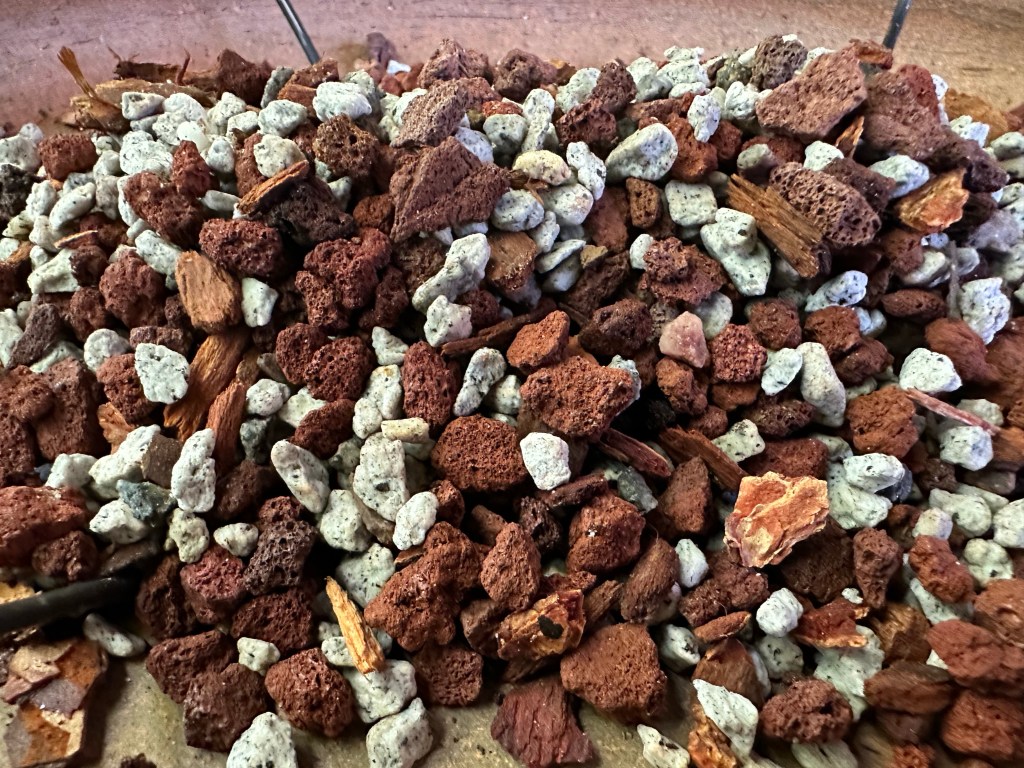
Some soil. Soil, that’s how it started; Funny story, I’d been in a casual conversation with Seth, and he saw a post of mine where I was repotting, and he asked where I got the red lava. He’d been buying the consumer grade and mulch sized red lava they sold at Home Depot, and was trying to use a hammer to crush it down to bonsai sized (about 1/4 inch size) and discovered that it just makes dust. It’s hard to crush lava with a hammer. I told him that I was going to be at a bonsai club meeting that met close to where he lived, and I’d bring him some of mine.
It was a good way to get a meeting with me. I like to help people, and Seth figured it out.
Fast forward a year or so to when I first got the tree from him, he thought I was going to do the famous Adamaskwhy trunk chop.
I didn’t, but instead decided to use all the branches to make it work. For some reason, he wanted a chop, so he was disappointed. It wasn’t the last time I disappointed him.
I said earlier I was young and stupid. When I met Seth, it was just around the time I began my journey with an ileostomy. There’s even a blog post where I go into the hospital after I visit him and he was one of the only people to come and visit me (Click here). I was angry at the world and I tend not to suffer fools gladly (I still don’t, but I’m getting better, now I just suffer them stoically). Seth had a hard time with his stepfather at home and we both would commiserate by saying bad things about people we didn’t like.
And here is where I couldn’t live up to my ideals. I have a flair for writing well, and he and I would DM each other on FB messenger. That made for some interesting screenshots. But I have come to the realization that, even though he shared private messages between he and I, two good friends, it was still my fault that I wrote those messages.
But I think I’ve grown. I question myself and my motivations often. Like Plato said, “The unexamined life is not worth living”. I also try to align my life with the idea that a meaningful life is one dedicated to beauty, truth, and virtue. And when it comes to my interactions with other people, I know that I can’t ever figure out why other people do things, only why I do things. And it could be argued that I don’t have a right to know another’s thoughts, only to deal with those actions. It’s entirely possible that how they act is really a reaction to how I am acting.
Before styling:
After styling.
Eagles-eye view.
It is a complex tree. You really have to watch the video to see the depth of the trunk movements.
It’s a good tree, and I’ll cherish it for what it represented, a friendship. One I’ll never have again with Seth. I did wrong and I’m sure I’ll never be forgiven, but that’s ok. I’m close to forgiving myself, but I’m not sure I can forget.
I’ll just keep talking to my trees, and be guarded with people. I’m not sure how else to be and not hurt or be hurt. The trees, though it’s a difficult language, still speak in plain sentences.

 Login
Login


















 , just like the old days. Here’s the tree, a willow leaf fig (Ficus salicaria, ofttimes erroneously called Ficus nerifolia, or F. salicifolia, or whatever it was called when you grew up in bonsai).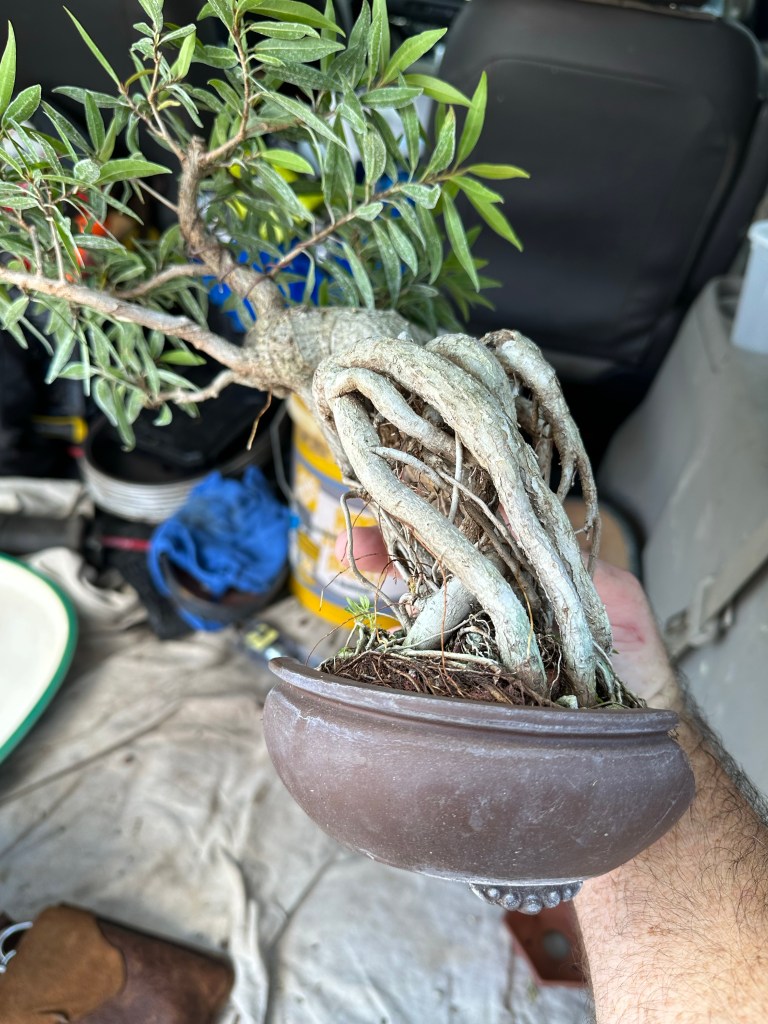








 I wanna go back to my Maumee