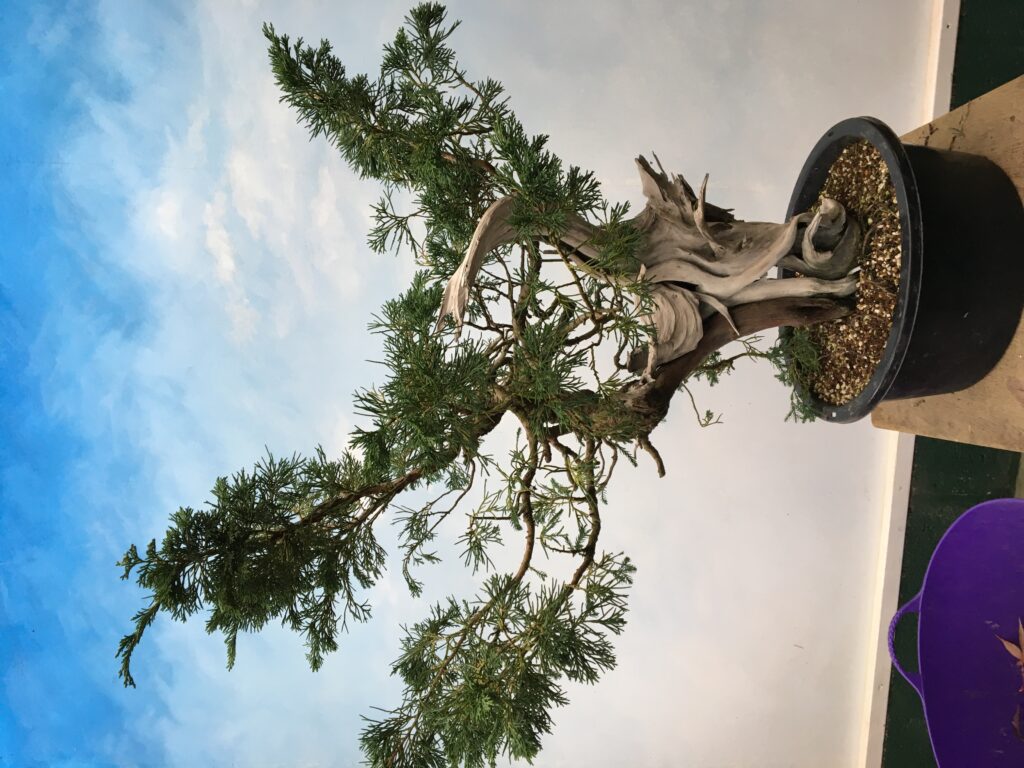
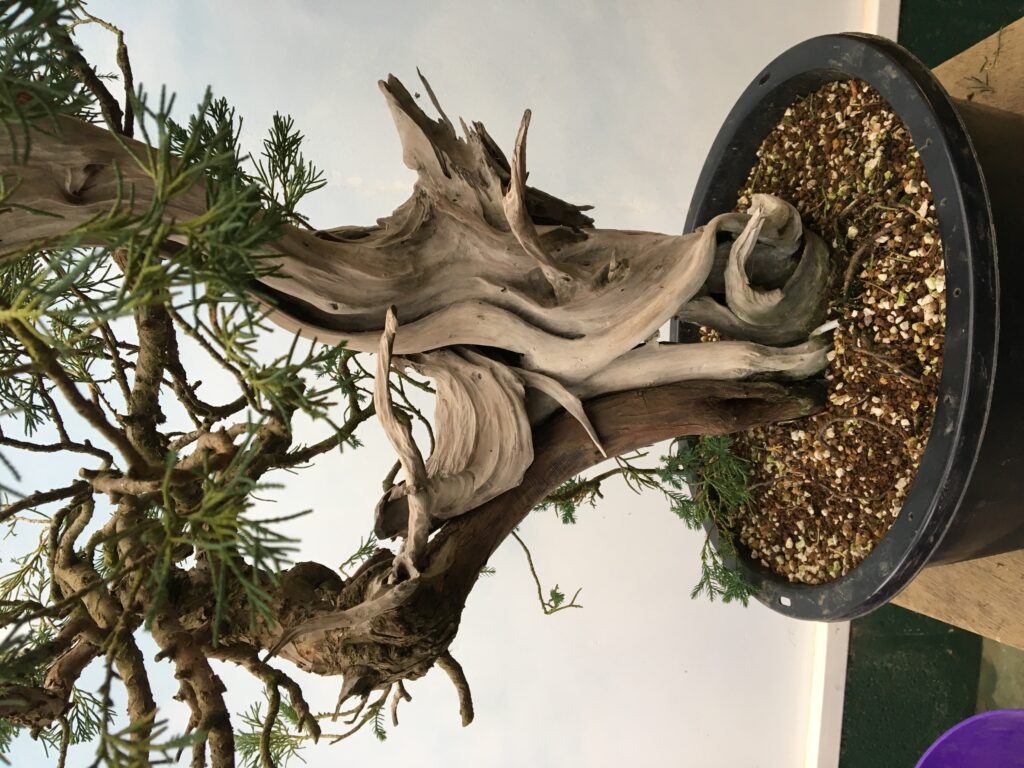
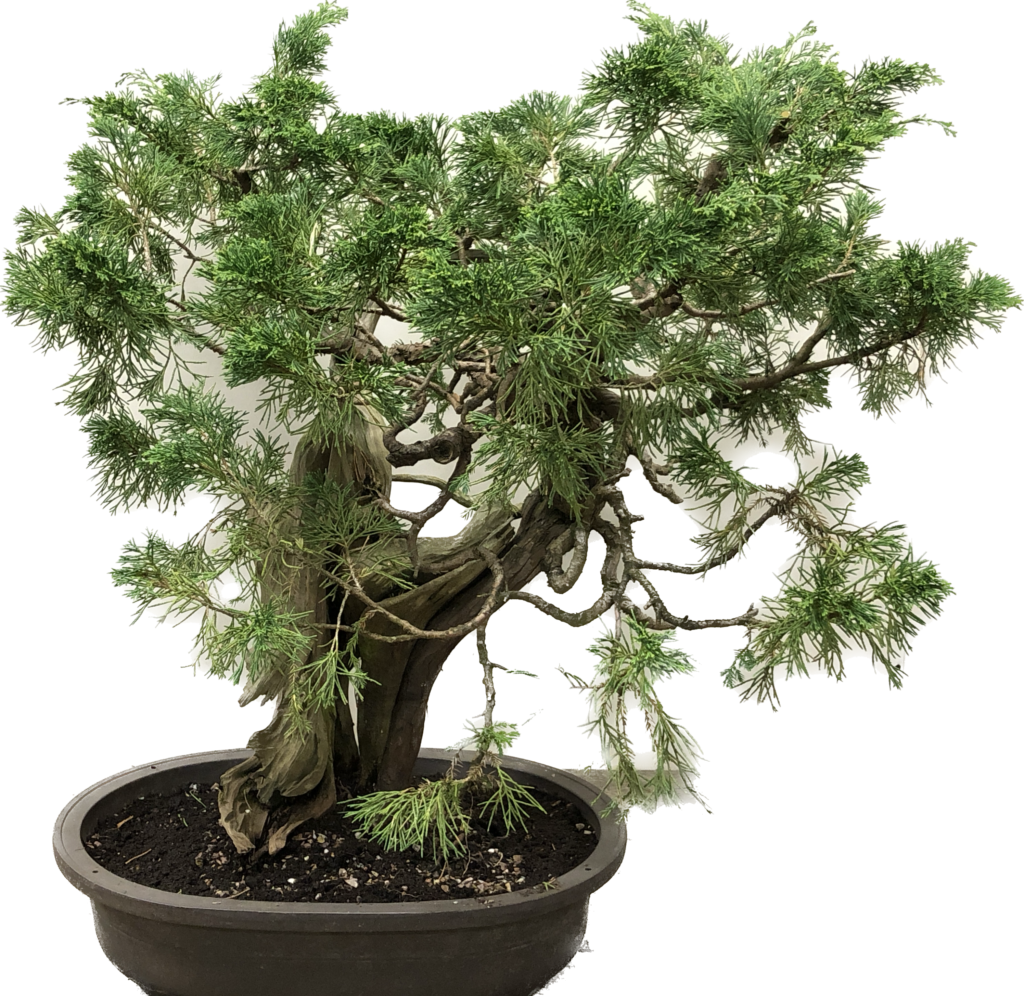
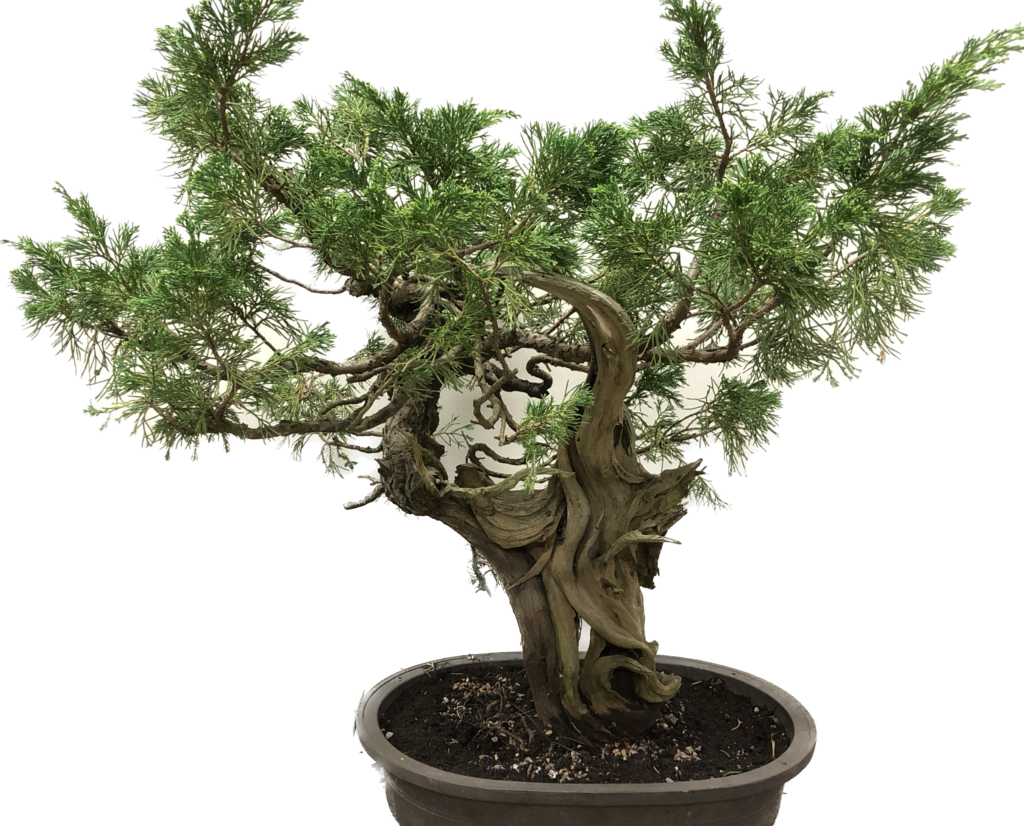
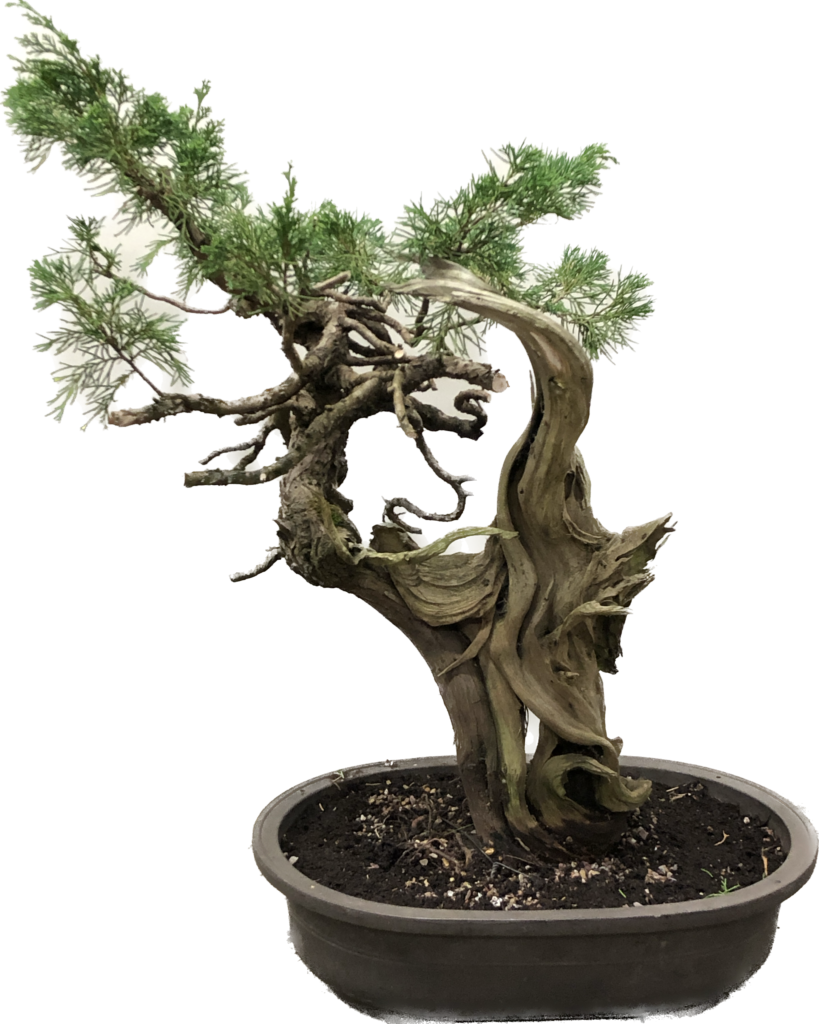
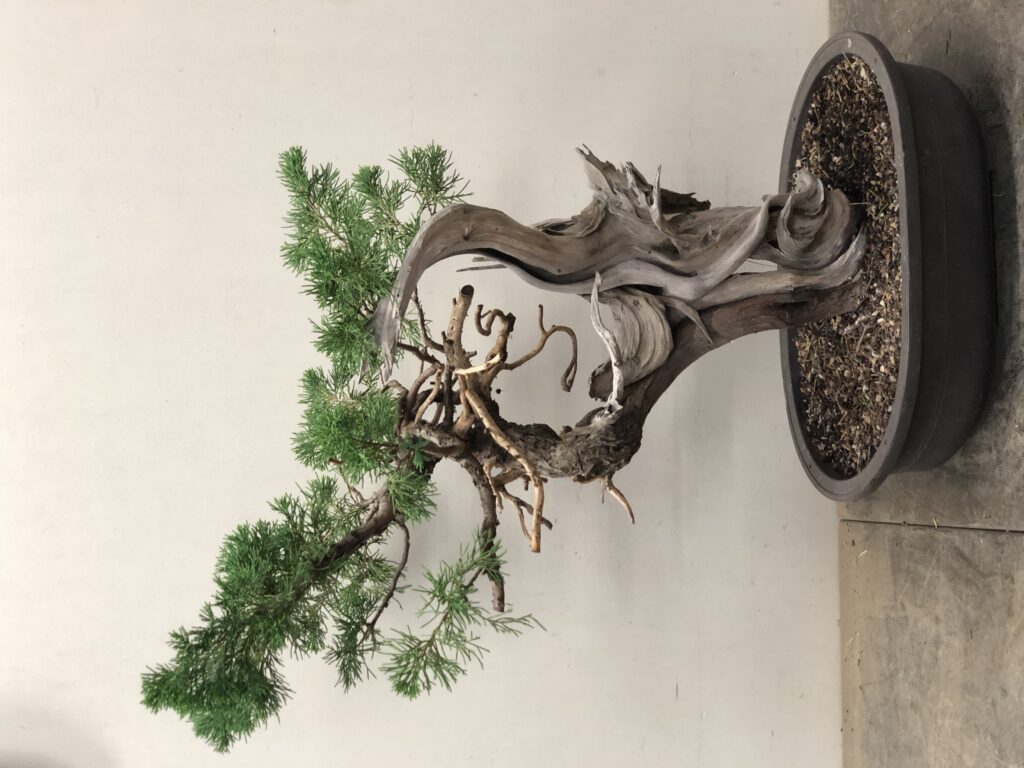
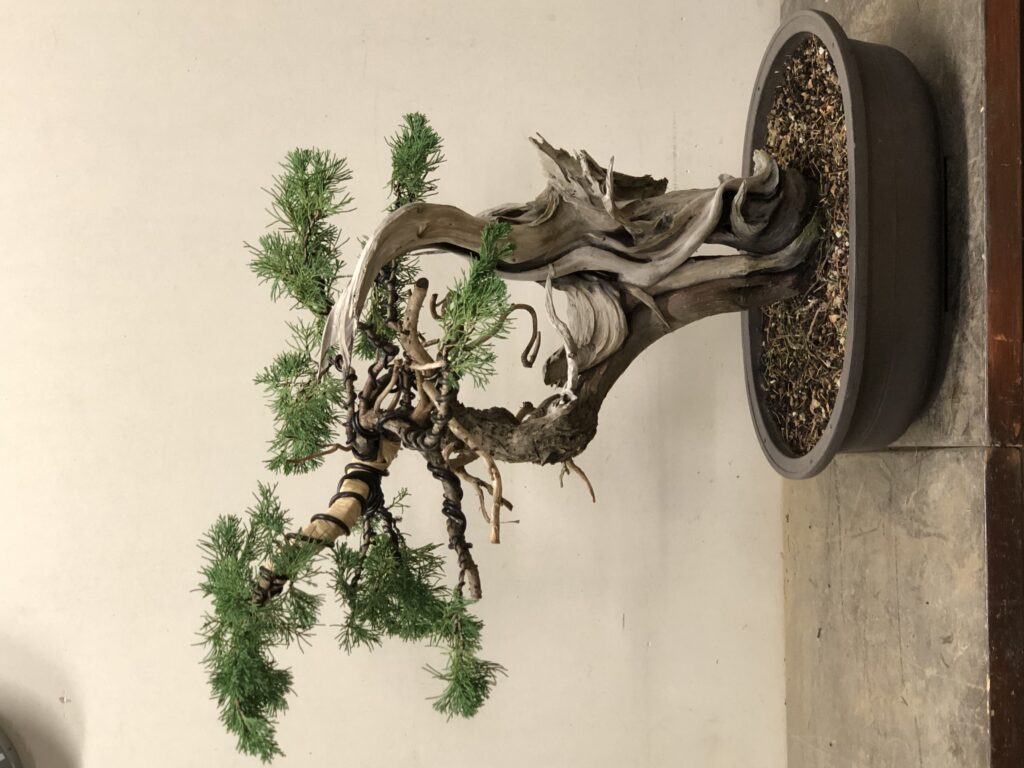
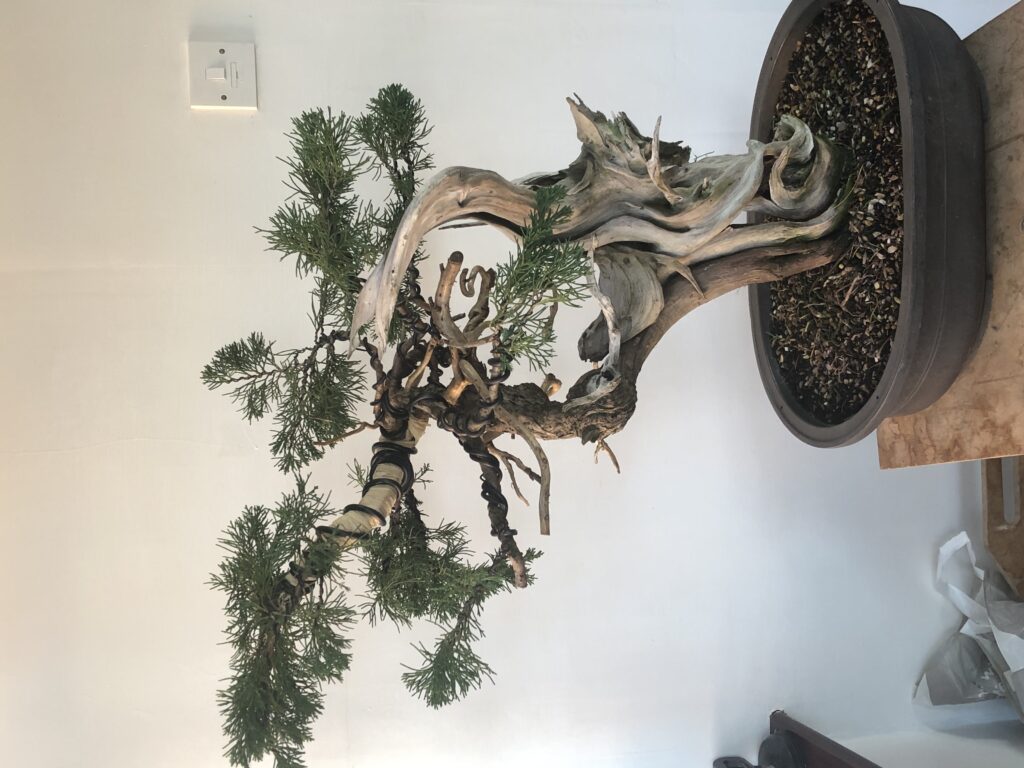
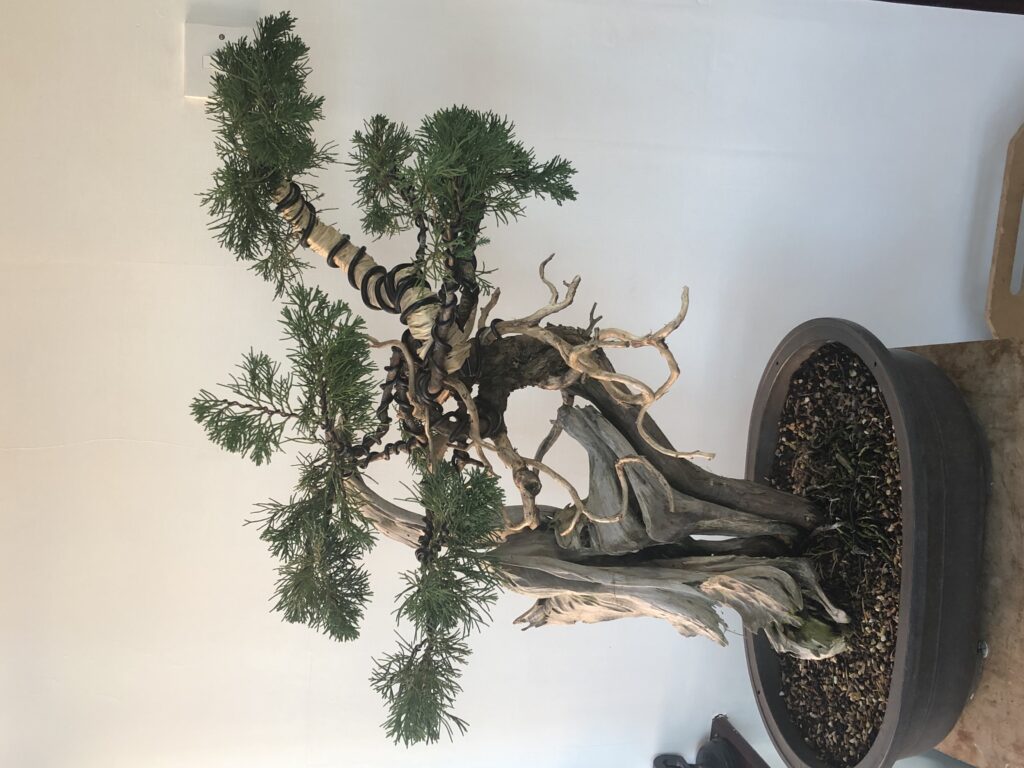
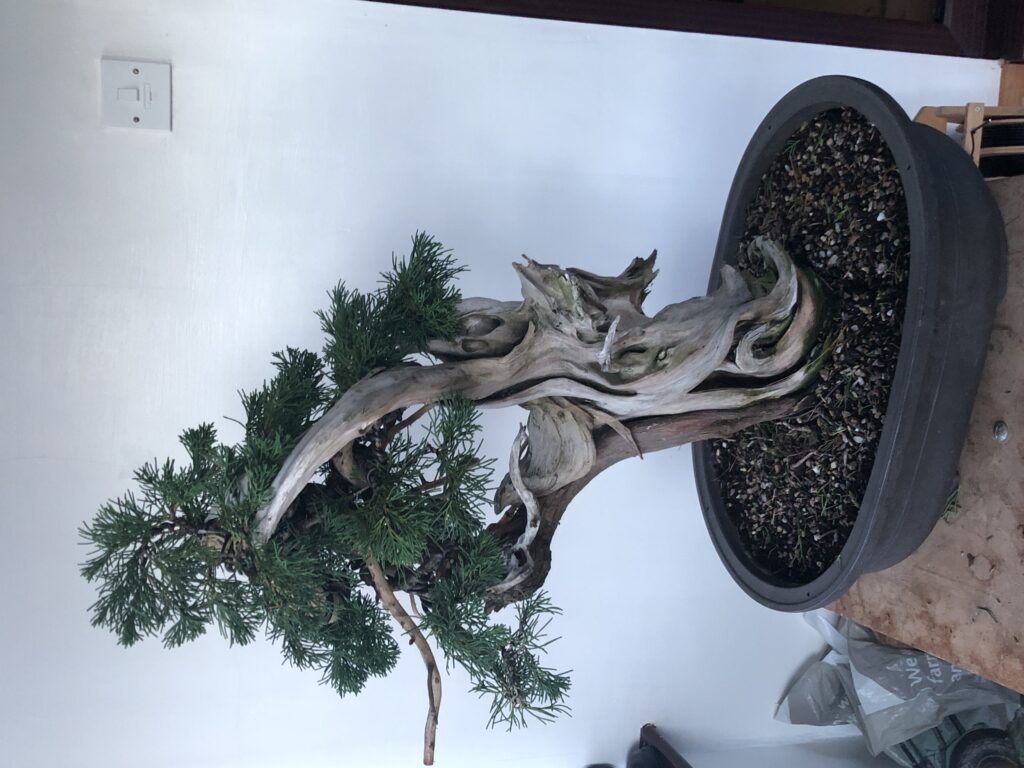
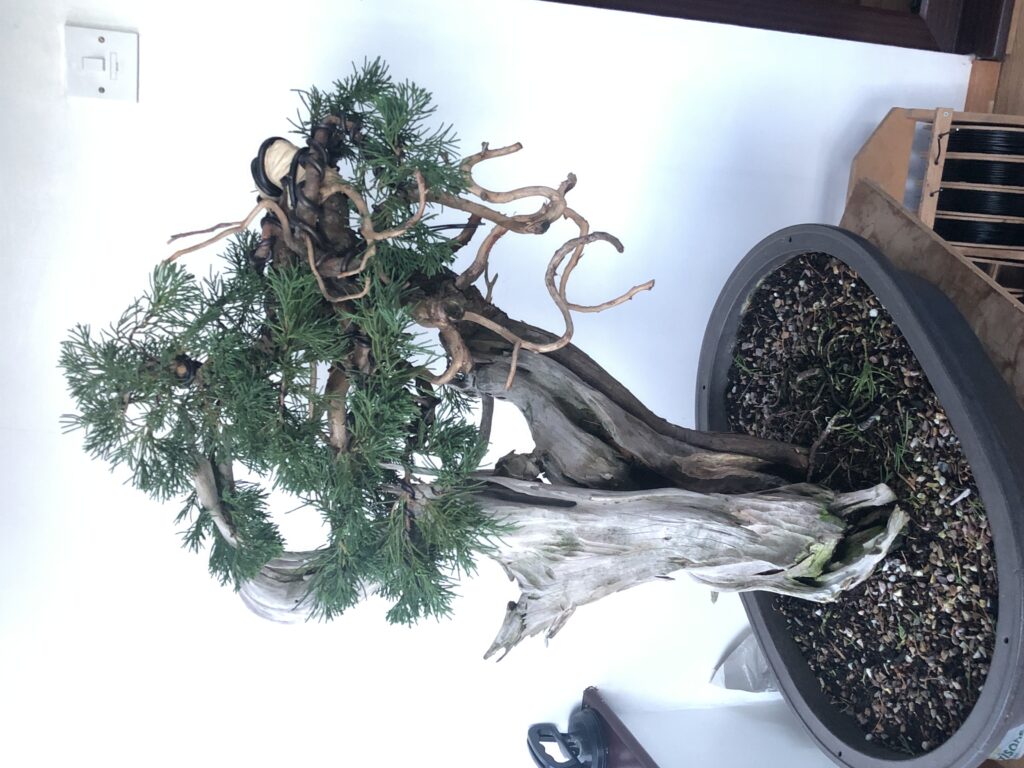
November 2016 – My first encounter with the tree. Interesting deadwood but the foliage is just so far away from the trunk. We needed to just let the tree grow to try and force growth nearer the trunk.The natural deadwood is amazing. It is very difficult to determine whether this is in fact a natural tree or an old “tanuki”. The two elements are firmly attached together and follow very close natural lines.April 2022 – Well the tree has certainly put some growth on and is in good condition.A view from the other side.The tree after a branch selection and thinning out of foliage.September 2022 – The selected branches have grown well and the unwanted branches have been made into deadwood.November 2022 – Rob had wired the tree including longitudinal wires and raffia on the main trunk as I had envisaged some tight bending. We then discussed the possibility of removing the live section completely and attaching a young Juniper Ittogawa to the deadwood.January 2023 – The tree had been left with me to sort out. I studied my stock of Juniper Ittogawa looking for a suitable tree to attach to the deadwood. The tricky part was determining where I would attach it to make it look convincing.The tree seen from the other side. After much deliberation and taking into account the excellent work Rob had done in getting the existing living section to this stage I decided to see what I could do with the wired branches. If I could create a reasonable image with what we have we could try and develop this further knowing that we could still always revert to plan B using the Ittogawa if we were unhappy with the result. This was the image I managed to create from what we had. When the tree is next repotted it would be tilted slightly towards the right to bring the apex more over the deadwood.The view from the other side. This turned out much better than I expected and Rob was happy with the result too.
We will now persevere with the foliage to try and get it denser and more compact. At least we now have a good foliage canopy to match the impressive deadwood. There is potential here to create a really good tree.
I will keep you posted and if we do feel the need to resort to plan B I will follow it up with photographs and explanations.
At some point in your bonsai life you will lose a tree. If you have been doing bonsai seriously for any length of time then sadly you will have already experienced this, and more than likely, more than once.
Sometimes it’s down to you! You did too much work, you expected too much, you didn’t give the tree time to recover. Maybe you neglected the tree or got something wrong.
Because we are dealing with a living thing sometimes it’s down to circumstances beyond your control. Like any living entity unfortunately trees can just die! It could be attributable to pests and diseases or it could be extreme weather conditions.
Fortunately, the more experienced we become, the more diligent we are, the less likely we are to encounter this sad demise. When I look at my students and think of the large number of trees we actually have as a group it is very rare that we lose a tree.
This was a Taxus belonging to a client. This must have been a natural disaster because my client has an excellent collection of bonsai and takes great care of them.A view from the rear where the former live section and vein are visible.The deadwood is really spectacular and one feels the original live section did not really do the tree justice.When I remove the tree from the pot I get a clue as to what probably caused the trees demise. A previous owner had used a full sheet of mesh to cover the full base of the pot. DON’T ever be tempted to do this! Fine particles and roots find it easy to fill the holes in the mesh and impair drainage which can then lead to roots rotting in a compost which is now almost permanently wet. Always cut small pieces of mesh just big enough to cover each drainage hole. The tree removed from the pot.The deadwood removed from the dead tree.The rear of the deadwood showing the remains of what was the live section.
I had to do something with this amazing deadwood to try and salvage something for my client. I will show you what I did in Part Two.
I still get a buzz when I see the result of that initial styling whether it be a tree we have created in class or pictures on social media. To see the styled organised image appear out of a dense unkempt bush is still an exciting transformation for me.
This instant creation from seemingly nothing was what fired me up all those years ago and kept me coming back for more. I feel sure most bonsai enthusiasts will relate to this.
Once you start pursuing the hobby more seriously you soon begin to appreciate that this initial styling, as dramatic as it may be, is really just a start, a beginning! This has to be followed by the routines of watering, feeding and general care. When the time is right the necessary interventions have to be made to select, to prune, to create space, to guide the tree to his next level.
After that initial transformation of seemingly biblical proportions I am afraid the subsequent journey to anything approaching a reasonable specimen takes place at a much more sedate pace. Time is what you need to develop branches and twigs, create dense foliage clouds and allow the tree to put on a show of mature bark under a breathtaking canopy.
I suppose you can be sucked in to this sedate pace, maybe becoming a little despondent but the tree creeps up on you! One day carrying out your normal routines you may just catch the tree from a different angle or maybe you weren’t in such a hurry this time and actually looked over him. Suddenly it’s a WOW moment. You realise that after all this time the tree has finally started to arrive. The shape is good, branches are uniform and in the right place, you now have lots of twigs/leaves. You can see and appreciate the results of your work over the years.
This journey after the styling can be a source of frustration and disappointment for many enthusiasts. People can have a tree for 10 years or more and not see any significant change. You have to intervene at the right time and then do the right things. My intervention helps my students manage this precious time to achieve the desired result.
Most of my students are excellent bonsai technicians. They just need that intervention or guidance from me often only a couple of times a year just to keep them on the right path and to pull them back if they are going astray. Some students attend classes once a month, some come just a few times a year. Many students now have me go to their garden to go over more of their trees especially where these are larger and difficult to transport.
Below are pictures of some of my trees which have benefited from time…..years of care and attention but mostly just being left to grow. Leave them alone, let them grow, and then when the time is right you intervene….then you let them grow again. Some of these trees have left me now but hopefully the new owners can take them to their next level. After all the time I put in to them it was like parting with my children.
Enjoy the euphoria of the initial styling, marvel at the dramatic change, applaud the artist…….just like I did (and still do!)…..but then appreciate that this is just a start, a new beginning…….now the real work begins and its time to create your tree!

 Login
Login