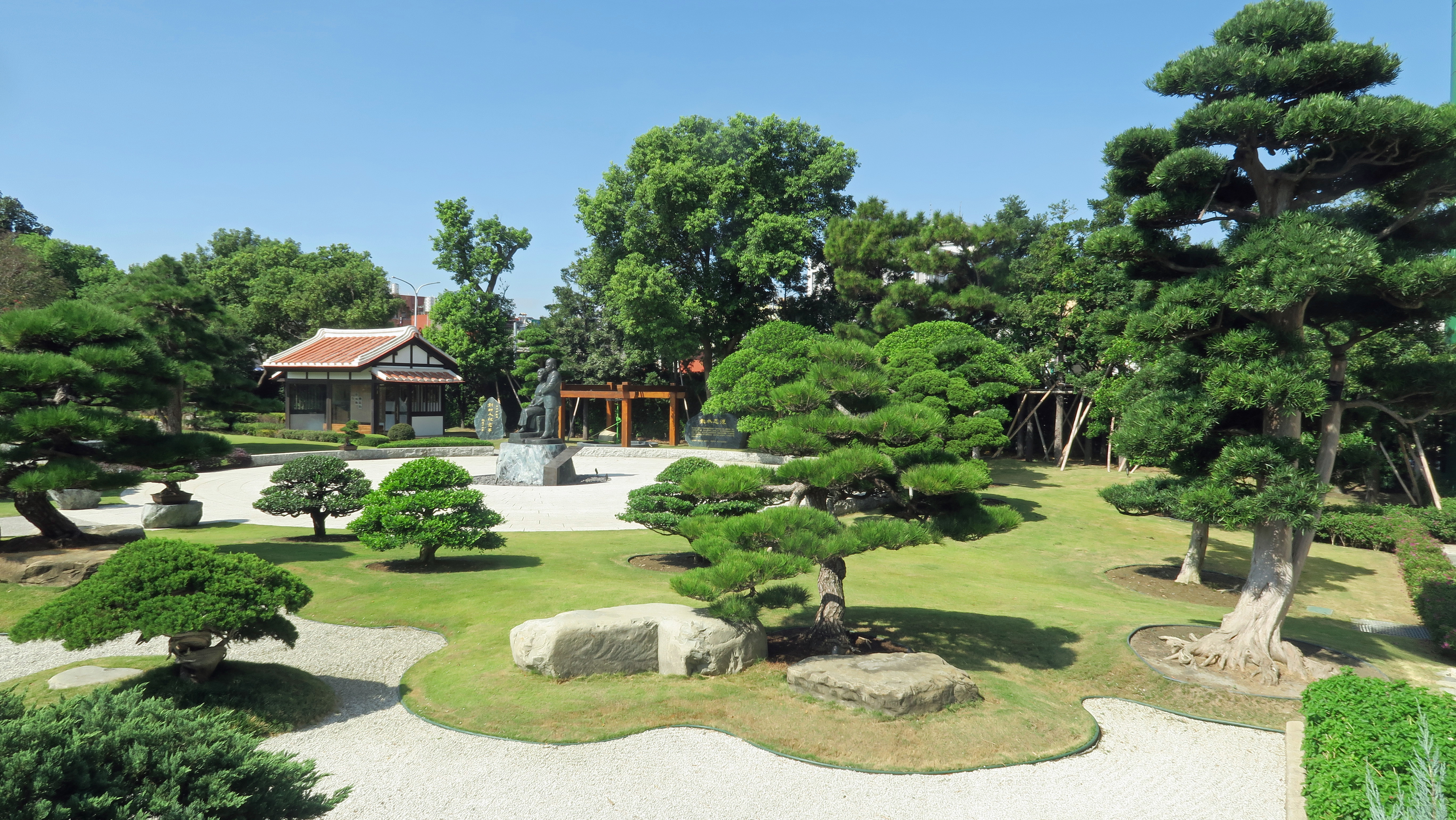
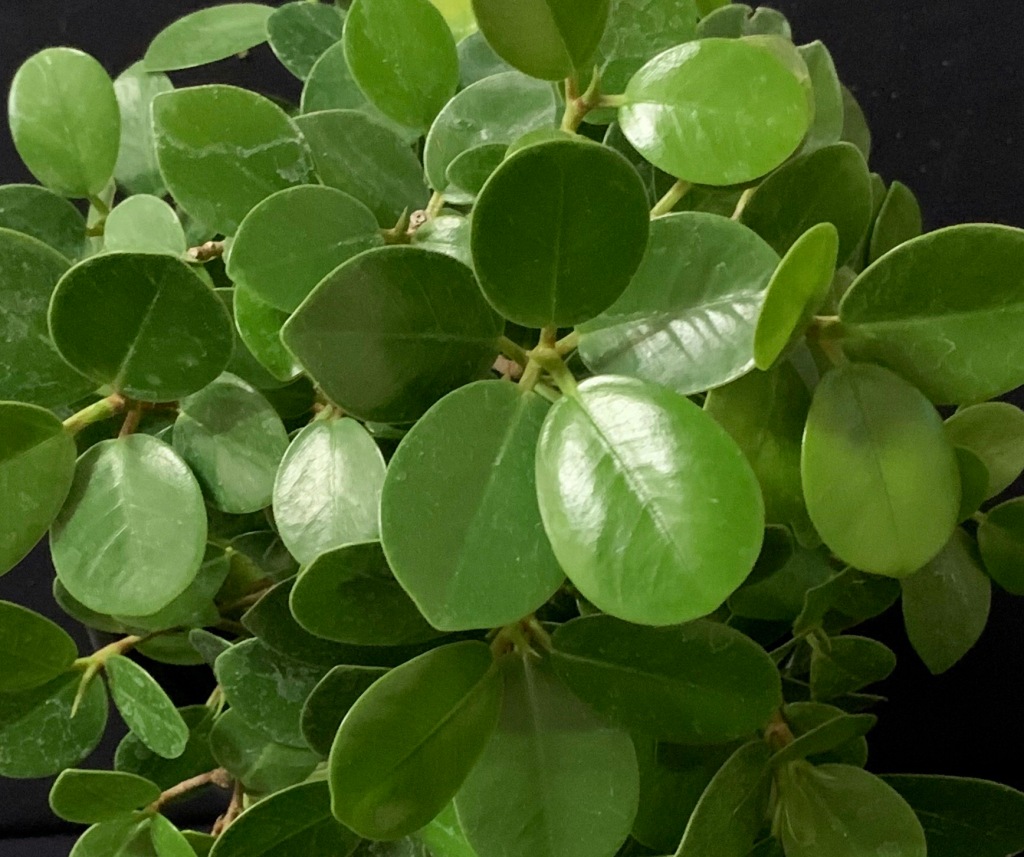
We all take vacations or have to go away for a few days, who is going to water our bonsai? I mean the whole family is away, there is nobody home! Some people hire a house sitter, a friend or a neighboring kid to water their bonsai; the outcome can be great or disastrous depending on how reliable is the help.
My wife and I often take vacations from a few days to as long as 5 weeks, we need a reliable watering system for our bonsai. I experimented with several automatic sprinkler systems for the last 20 years or so, and found the one we have been using for about 10 years works well for us. When we set up this sprinkler system, our objective is to allow us to go away, the bonsai are watered and are alive when we come back. Not necessarily they receive the best of cares. For that, you need to stay home or board them in a professional nursery. I want to share how we do it, hopefully, readers will also share their experience and watering system benefitting others too.
We recently went on a 10-day trip to Utah and spent two days at the Monument Valley. Route 163, mile post 13 is where Forrest Gump suddenly stopped his cross-country run. Now a tourist spot.
Our system is quite simple, it relies on duplications and backups. We use two hose-end water timers to deliver water to one set of sprinklers. The logic is chances for two watering timers to fail during the period we are away are quite low, and that turned out to be true so far.
Each timer is attached to its own spigot. Water from both spigots are fed to a common pipeline which delivers water to the bonsai sprinklers. One timer runs in the morning, the other in the afternoon. Two watering cycles. Should one timer fail to work, the bonsai are watered at least once a day. Here is a schematic of the set up:
This is our physical set-up.
We installed four spigots, each with a DIG four cycle water timer. Two are used for watering bonsai, two for flower beds.
We use battery operated timers instead of electrical solenoid control valves, this is to make sure power failure does not mess up the main electronic control. The simpler the control, the less chance of mishaps. An orchid friend told a story of someone in his Society built a fancy greenhouse with computer controlled temperature and humidity; the computer failed one day and went into default heating mode. All his orchids were roasted upon his return.
It is important to use a reliable water timer. We liked our old Gilmore 8-cycle timers but they were no longer in production. We switched to the DIG 4-cycle timers, it is not as flexible as the old Gilmore in setting multiple cycle times, but they have been reliable so far. As a precaution, we also give a spare timer to our neighbor should we need to have him to replace if one were to fail, and this has not happened.
The outlet hose of each timer is connected to a check-valve to prevent back-flow when the other is operating. The two check valves are connected to a T-joint which feeds into a common underground pipe line to the sprinklers in the bonsai patch.
Check valves,
How Do You Know Your Bonsai Are Watered?
Security cameras! I position one close to the sprinkler. It detects motions when the sprinkler is on and the cloud server sends me an email alerting motions have been detected. When I hear a ping from my phone at say, 3 PM, a time set for one of the timers, I know the sprinkler is on. I can see the video in real time or review it later from the server. I also set cameras close to some of the more important bonsai trees so I can see how they are doing at any time by turning on the video and zooming in. Since my cameras are several years old and has only 720 dpi resolution, the video is fuzzy especially when water is splashing on the lens. Nevertheless, it is adequate for us to see water droplets coming out the sprinkler and our bonsai are watered.
My free WordPress blog does not support video. This is a screenshot of the alerting video showing the sprinkler is on.Instant check on how the trees are doing from security camera.
These days security cameras come with 1080 dpi and 4K resolutions, wider field of view etc. Many competitive models are available for you to find one that suits your purpose. It is also time for me to update some of my security cameras.
Nothing is fail safe. It is how well you prepared for it. I replace the timers with new batteries, test the system several days before we go on vacation, adjust spacings between bonsai so it does not block water reaching the neighboring trees, that they receive enough water and there is no sign of distress during this test period. I also surround the taller bonsai with bricks to make sure wind or squirrels do not tip them over. Most of all, be prepared to accept dead bonsai should accident happened. If you accept that, the automatic sprinklers will set you free, allowing you to travel.
Ficus microcarpa, commonly called the Chinese Banyan or Indian Laurel, is the most used ficus species for bonsai. Although it has many cultivars and varieties, Tiger Bark, aka Golden Gate, Kinmen, Kingman, Kimeng, Kin Men etc. is perhaps the most popular because it is easy to grow, has a beautiful bark, and their leaves reduced easily. Where do these names come from?
My ‘Tiger Bark’ ficus which won the Best Tropical Bonsai in the 2016 US National Bonsai Exhibitions. The history of its training from a pre-bonsai was described in an older blog.
Min Hsuan Lo gave a short description on the discovery and naming of Kinmen (Tiger Bark) ficus in his book, “Bonsai Journey”. Since it was written in Chinese and not many ficus enthusiasts in the West read Chinese, I will retell the story with explanations on related Taiwan history and background.
This cultivar was discovered in the 1970s by a grower in southern part of Taiwan, and was named after the grower’s nickname, “Kim M’ng”, which means blond or golden hair in Taiwanese dialect for his blond hair. I do not know whether he is a natural blond or not; the Dutch colonized southern Taiwan from 1622 to 1644 until they were driven out by the Ming General, Chen Cheng Kong. To this day, blond hair occasionally show up in family members of mixed Dutch and local descendents.
When the Communists took over mainland China in 1949, the Nationalists retreated to Taiwan; military confrontations continued for many years especially in the Nationalist controlled group of small islands, called Kinmen in the Taiwan Strait. As Kinmen is literally across from the City of Xiamen of mainland China, it became military important and was heavily fortified. Three battles were fought over Kinmen between 1949 and 1958, but ended in stalemates. Both sides settled upon a routine of bombarding each other every other day, i.e. I fired on you on odd days and you fired on me on even days. This ended in 1979 after the US established diplomatic relationship with the Peoples Republic of China. Today the underground tunnels, bunkers and other military facilities are tourist attractions from both side of the Taiwan Strait.
The island, pronounced, Kinmen (which means Golden Gate) in Mandarin Chinese, has always been called “Kim M’ng” by the local Taiwanese and Fujian people in the mainland, who speak the same dialect. In Taiwanese, “Golden Gate” Kim M’ng sounds the same as “Kim M’ng” for blond or golden hair; the written Chinese name of “Kim M’ng” ficus thus became 金门榕, Kinmen (official Mandarin Chinese name written in English) ficus. I guess it would be awkard to write the new cultivar name as 金毛榕, blond or golden hair ficus. To the Taiwanese speakers (note: not everyone in Taiwan speak the local dialect because the Nationalist government enforced the Mandarin Language Policy; students had to learn and speak Mandarin Chinese only, and were forbidden to speak local dialect in schools until 1987) ‘Kim M’ng” will always have the dual meanings, golden gate or golden hair, but the etymology might be lost over time.
Now we know the origin and how Kinmen (Kim M’ng) ficus got its name, it is apparent Golden Gate (a direct translation of Kinmen, and it has nothing to do with the San Francisco Golden Gate Bridge), and the spelling variations of Kingman, Kimeng etc. refer to the same cultivar.
What about the name Tiger Bark? Since the newly discovered cultivar has conspicous white blotches and stripes in the bark of young trees, which look like tiger stripes, the name “Tiger Bark” ficus (虎皮榕) became a popular alternate name in Taiwan nursery trades. The whitish stripes would fade in old tree.
Do ficus grow in Kinmen Island? Of course, F. microcarpa grows all over Taiwan and Fujian Province. There are many old F. microcarpa in Kinmen. This travel blog has several photos of old ficus; they were cataloged with estimated age by the local Forestry Department. Interestingly, the tattered name tag in the blog reads F. retusa, which, of course is wrong. F. retusa grows in the Malay Archipelago, the name has long been misapplied to F. microcarpa and caused considerable confusions among bonsai enthusiasts.
Kinmen Island also has a Ficus Park, interestingly the outdoor war museum is right there too displaying tanks, big guns and aircrafts!
The stone behind a tank from the 1958 bombardments reads “Ficus Park” !
Unlike scientific name which follows rules set by the International Code of Nomenclature for algae, fungi, and plants (ICN), the meanings of cultivar and variety are often blurred and are used interchangeably in nursery trades and among hobbyists. Strictly, they mean different things. Plants grown from cultivar seeds are not true to type, whereas a geographically different variety can.
So among the many names of Tiger Bark, Kinmen, Golden Gate etc., which should we use? If we were to follow the rule of priority, I think it should be called cv. ‘Kinmen’ or ‘Kim M’ng’ when the cultivar was discovered. But as hobbyists, we call them by any name we choose to but just be aware that they all refer to the same cultivar. This name variations occur only in the West but not in Taiwan because they are called either 金门榕 (Kinmen ficus) or 虎皮榕 (tiger bark ficus).
I wrote this blog after returning from the 2017 Taiwan National Hwa Fong Show but did not finish it. I can give many excuses, truth is I was just lazy. Procrastination has become a way of life for a retiree; there is never a rush to finish things I used to hurry and complete over the weekends while I was still working.
With the coronavirus pandemic, many of us are staying home for various reasons, doing our best to cope in this difficult time, and I want to wish every safe and well. I thought I should pick up this old draft, add some more ficus bonsai from the show and post it.
The main entrance decoration to the show.
Without a doubt Taiwan has among the best ficus bonsai in the world, and there are many things we can learn from studying the trees upclose in person.
I counted 15 ficus in this show; each one is a masterpiece. Since my wife and I travelled to the show on our own, unbound by group activities and schedules, we could spend time studying and admiring trees we like; how the trunks were fused, how aerial roots were used to enhance the trunks and nebari, how side branches, ramifications, and pads were formed. In fact, we came back to the show two days later since we were not done admiring so many amazing bonsai in our first visit. Studying top-notch trees in person and talking to high level practitioners are among the best ways to learn.
Massive Ficus From Fused Trunks
The majority of the very large ficus we saw were fused from several smaller trees.
The first one I want to discuss is a massive Ficus microcarpa with an umbrella shape canopy. A lot of ficus bonsai in Taiwan are shaped this way with variations in how the pads are arranged. The roots are powerful, anchoring the tree firmly onto the soil level, giving the whole tree a feel of stability and unmovable.
Ficus microcarpa by Rui Long Tsai (蔡瑞隆).
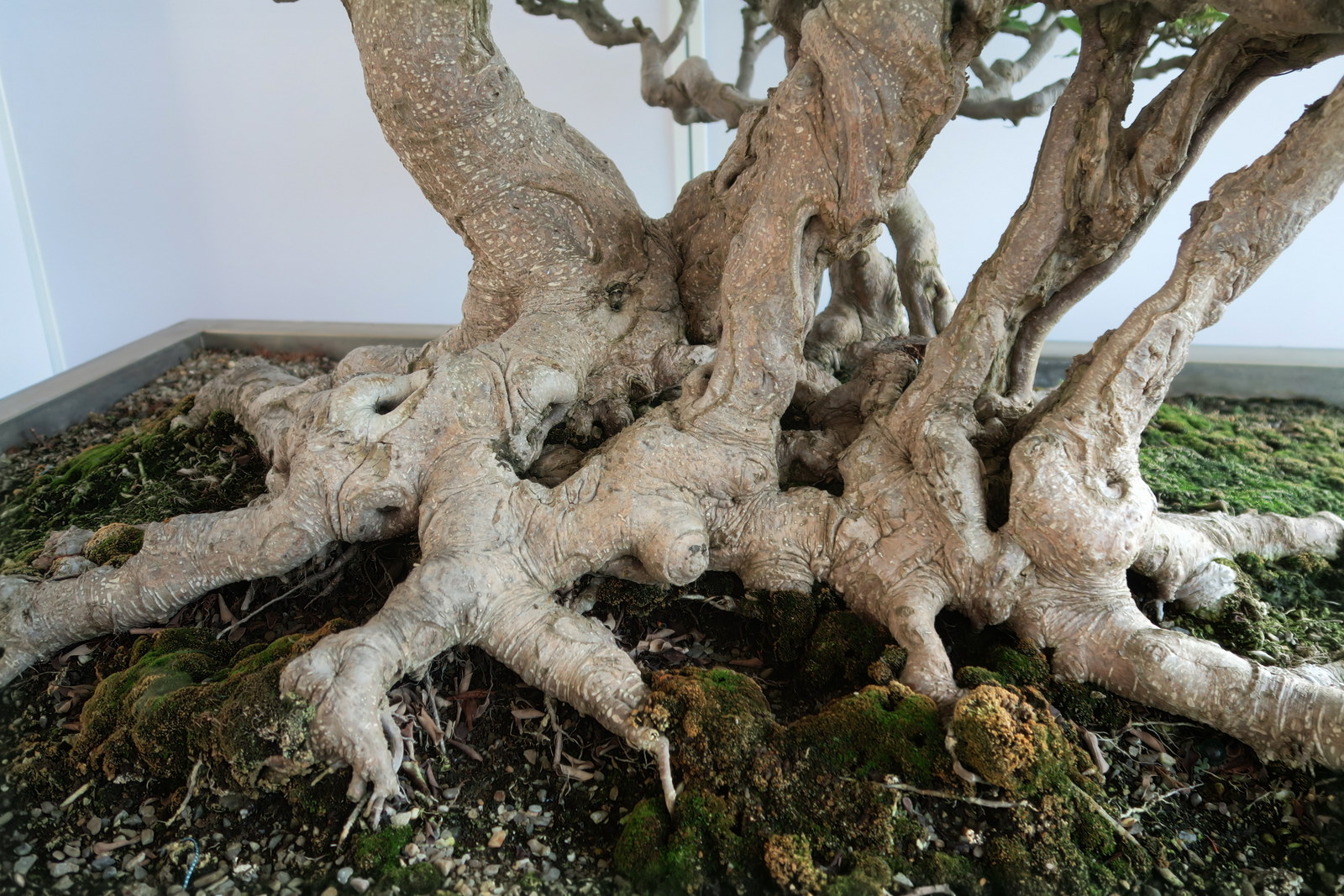
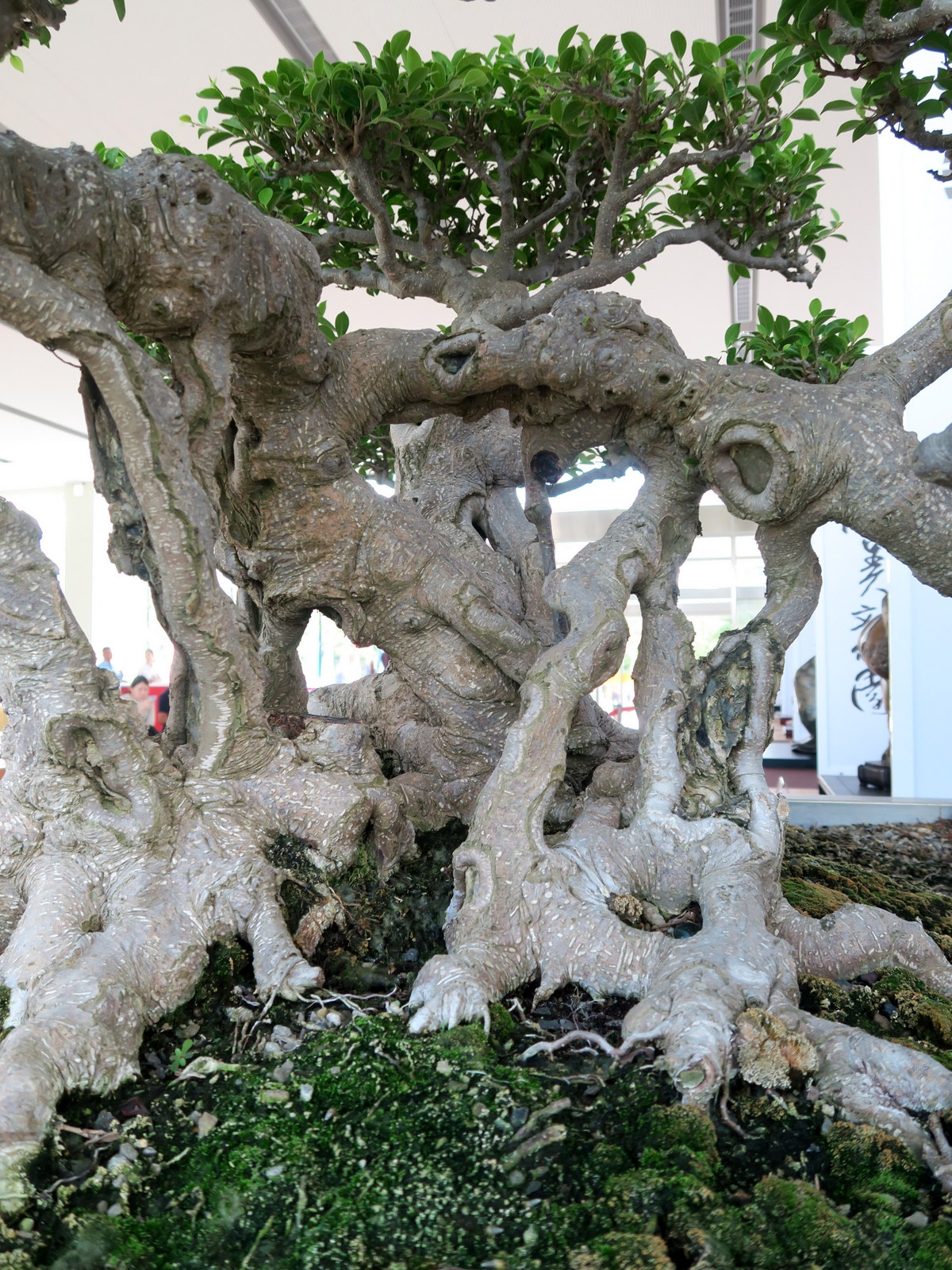
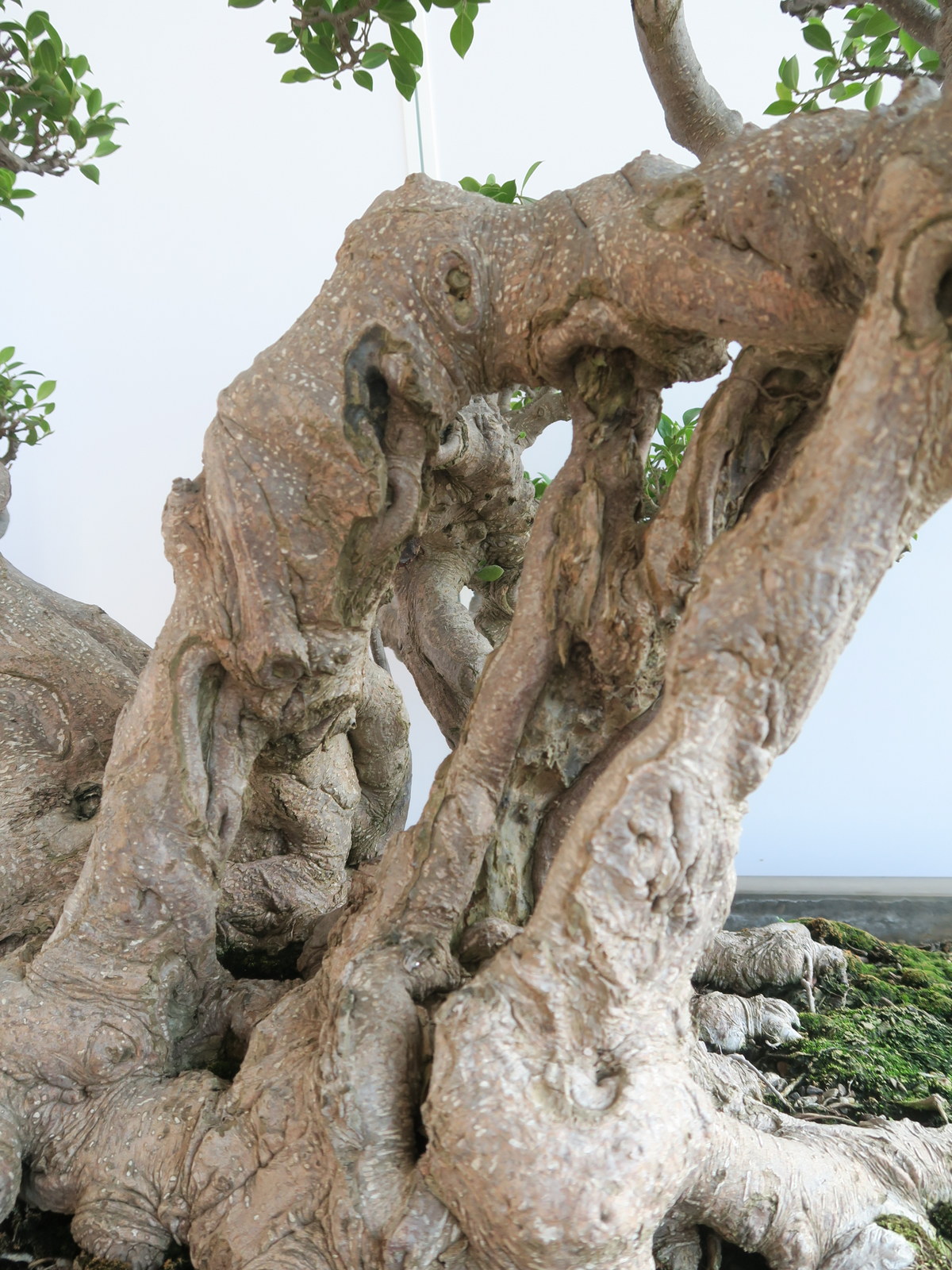
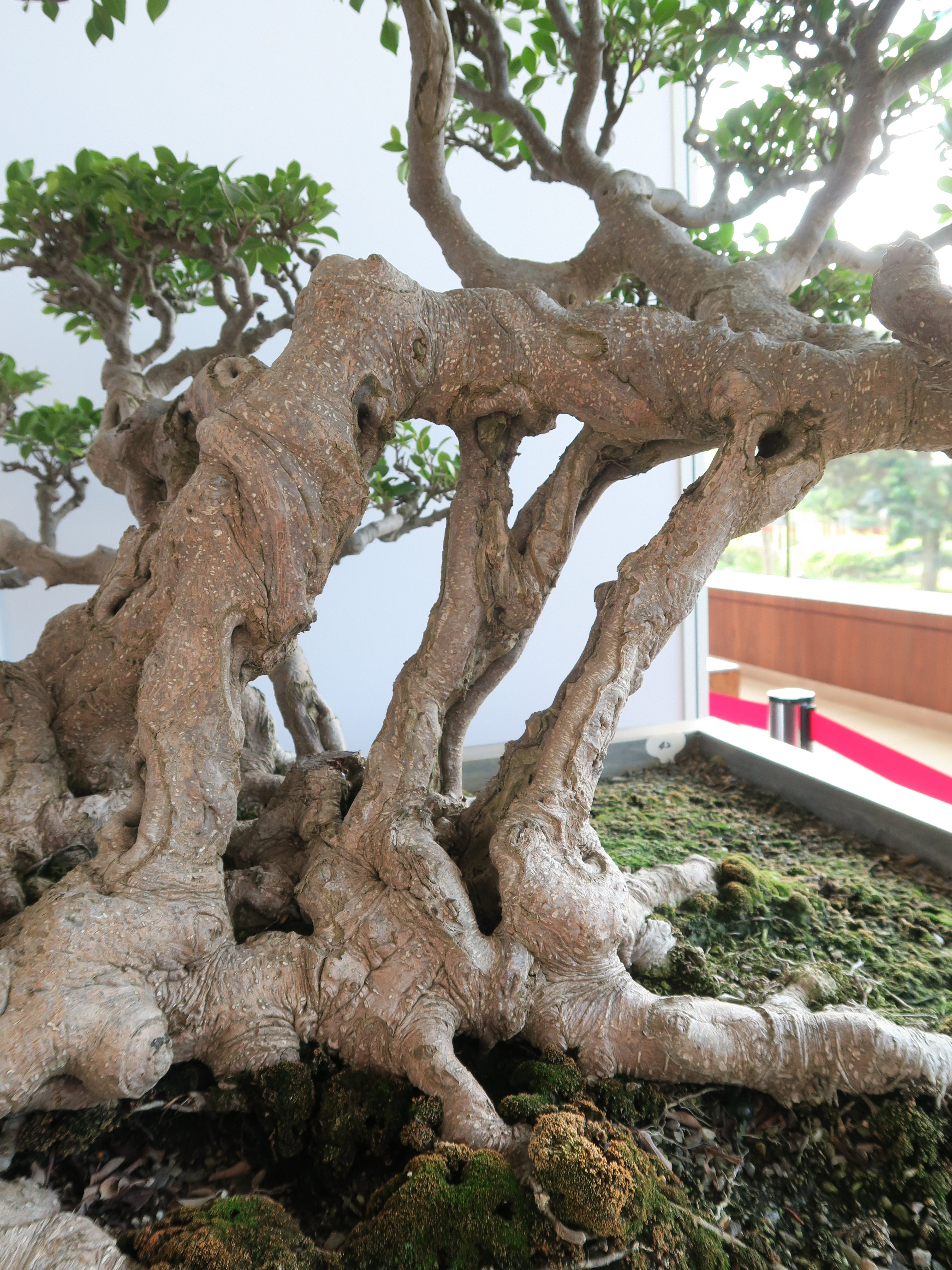
The main trunk is made up of several fused smaller plants. Although some could have been created from fused aerial roots. Surface roots that became too fat were split to form smaller V-shape roots. This is an important part of maintaining old ficus bonsai, preventing the roots from become overly and disproportionally fat.
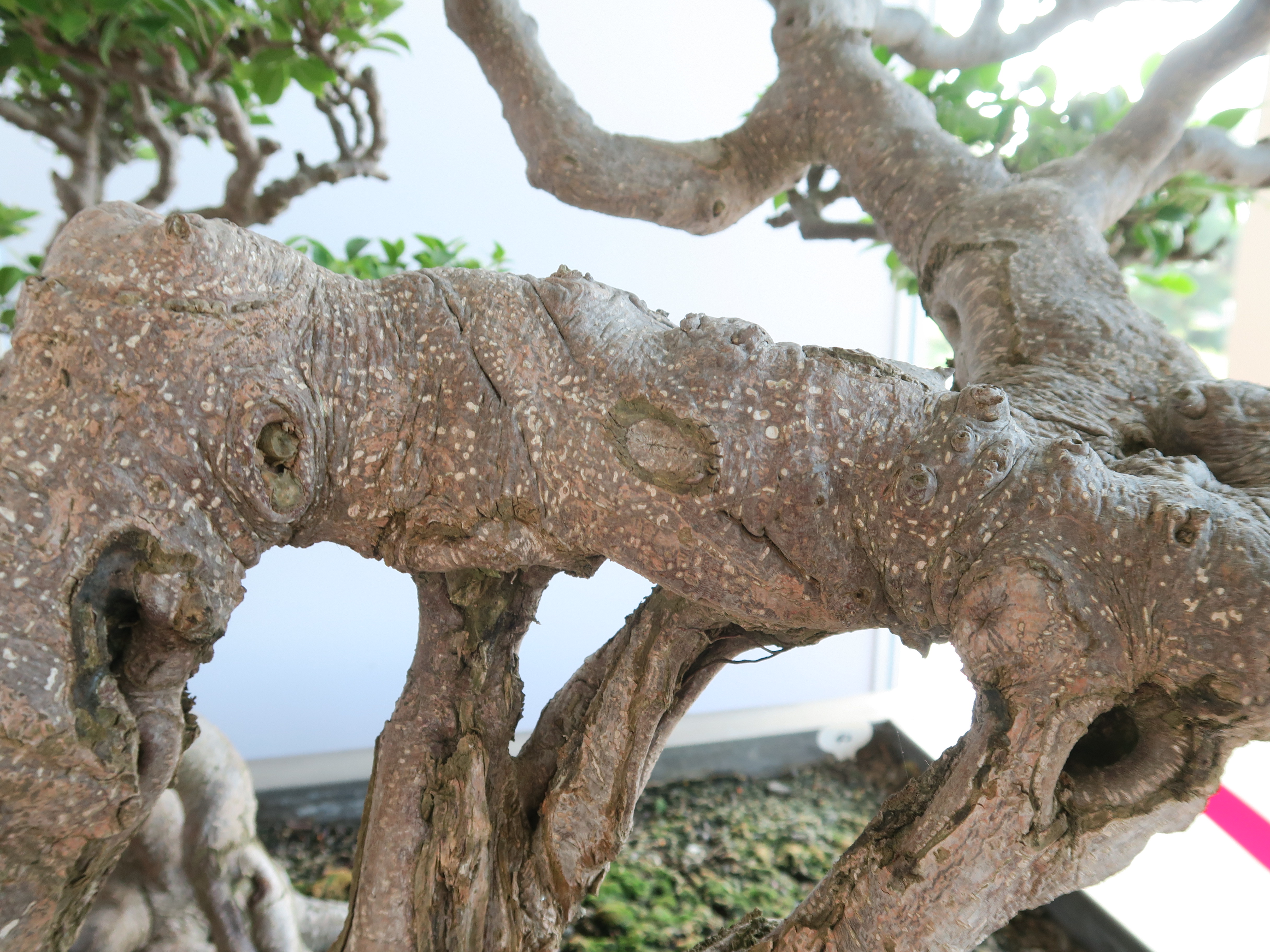
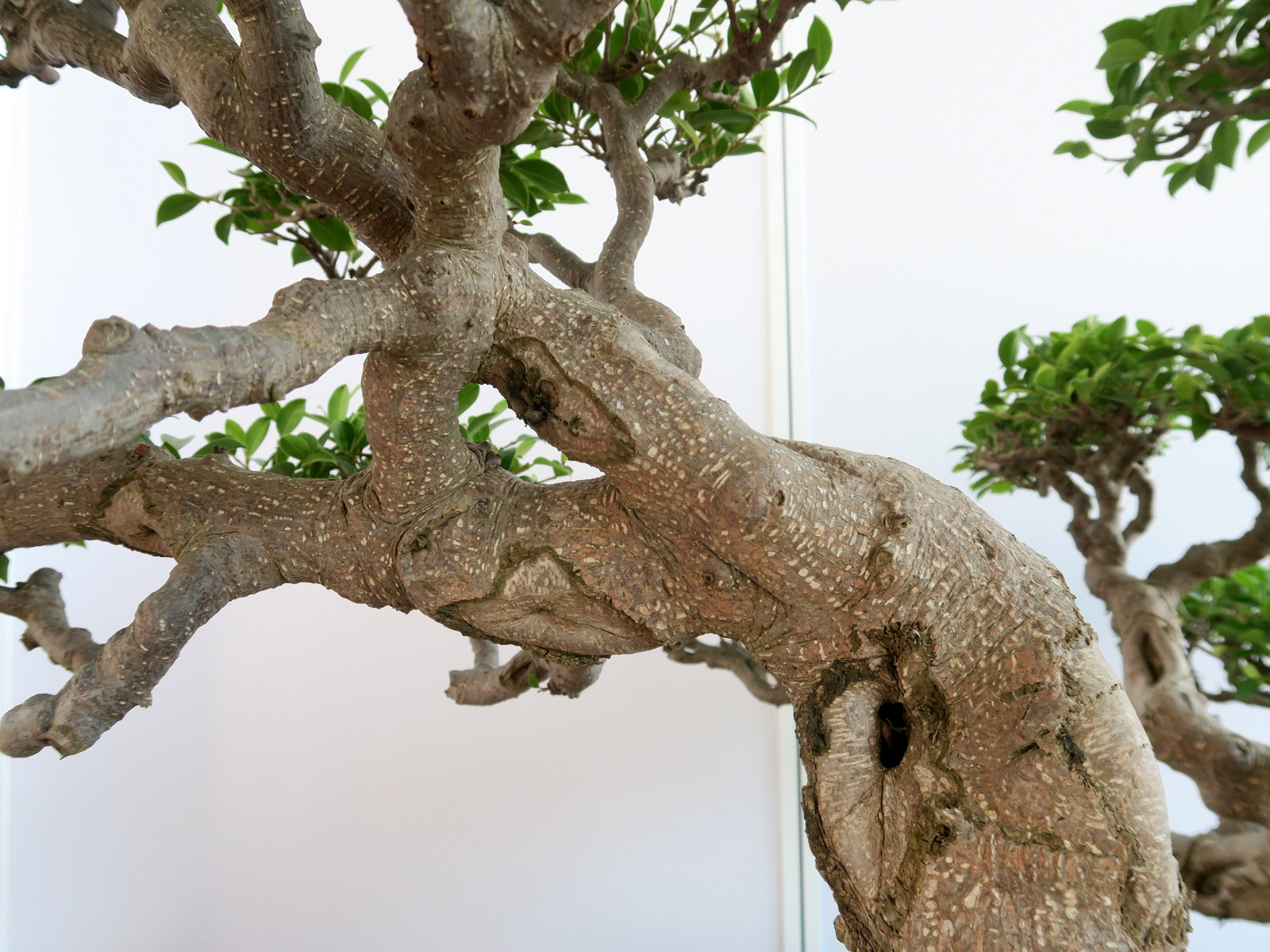
Looking from under the pads, I saw healed wire marks on some of the branches which prompted some questions. Since the wire marks were closely spaced and were nearly perpendicular to the branch, not at the typical 45 degree angles we are familiar with; were these marks created from successive wiring and dewiring, or were they wired purposely close together and allowed to bite into the wood to speed up branch thickening? Since these branches are very thick and there are perhaps easier ways of bending thick ficus branches, I surmised they could be used to accelerate branch thickening, a technique sometimes used in Japanese black pine. I did not have a chance to ask and find out, anyone out there could answer this, please?
Note the closely spaced wire marks.
More umbrella top ficus from fused trunks and separate trees:
Ficus microcarpa by Jian Cheng Liu (刘建成).Ficus microcarpa by Qing Lian Li (李清连). The bark looks like a ‘Kinman’ aka ‘Tiger Bark’ cultivar.Ficus microcarpa by Gui Zhi Hsieh (谢贵子). This tree is about 100 years old and won the Best of Show. I previously wrote my discussion with one of the judges who explained why this ficus won the Best of Show, a Grand Champion, over so many beautiful trees, especially over other very imposing ficus. His explanations enlightened me to nuances judges see, the illusion of age instead of just wow, “What a beautiful tree!”Ficus microcarpa by Jin Lian Chen (陳锦莲).Another Ficus microcarpa by Jin Lian Chen (陳锦莲).Ficus microcarpa by Rui Long Tsai (蔡瑞隆).Ficus micrcarpa by Mao Di Fang (方茂地).
This is where I stopped my draft in 2018! I just added a few more photos with some notes.
Ficus microcarpa by Xi Xiong Hsieh (谢喜雄). A very interesting ficus with extensive ground hugging roots. Someone once posted this photo On Ficus Study Group and asked whose tree is it, I did not reply right then and forgot about it. Whoever you are, this is the tree and its owner.
The following one is a seldom seen clump style ficus bonsai by Zheng Xing Tsai (蔡正信) of Taipei. My friend, Chun Shen Chen, later took me to visit Mr. Tsai’s nursery.
Mr. Tsai, me and Mr. Chun Sheng Chen at Mr. Tsai nursery.
In Taiwan, all participants in major shows receive a framed photo of his or her entry with show information. This is something bonsai societies in the US might consider doing as most participants would like to have a photo of their tree professionally photographed for keepsake. Of course, it would be nice to have it in an exhibition book like in the US Nationals but not many shows could afford publishing a book.
A post from my wife, Soon Cheah, a kusamono aficionado.
Our Facebook friend, Uwe Harwardt from Germany, sent us a selfie video showing how he made a kusamono pot from a lump of clay into a pot with surface cracks; at the end of the 20+ minute video he asked whether we like this pot or not, if so he would send it as our Christmas present. We were delighted when it arrived in time for the 2017 Christmas.
Uwe and I have been Facebook friends for several years and we communicated often about kusamono. Every time I received Uwe’s pot, I would put my heart into creating a kusamono that I felt we both would like and enjoy, and shared photos with him on the outcomes.
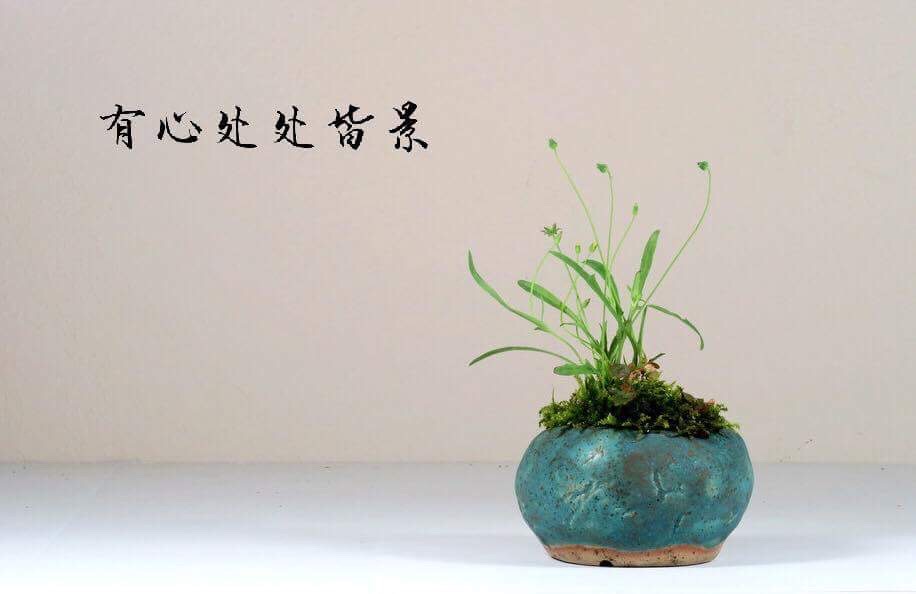
This is one of the early pots I received from Uwe. I planted a false dandelion (Pyrrhopappus multicaulis), a common weed from our backyard in it, and asked our Houston Chinese Bonsai Society friend, Dr. Sun-Chueh Gao (高珊爵), to write a Chinese poem to accompany this kusamono. My husband and I selected a verse from his poem, which we thought best summarized how one could even enjoy such a simple ubiquitous weed as long as it appealed to our hearts and souls, and pasted this verse on the photo like in a Chinese painting.
This is the translation:
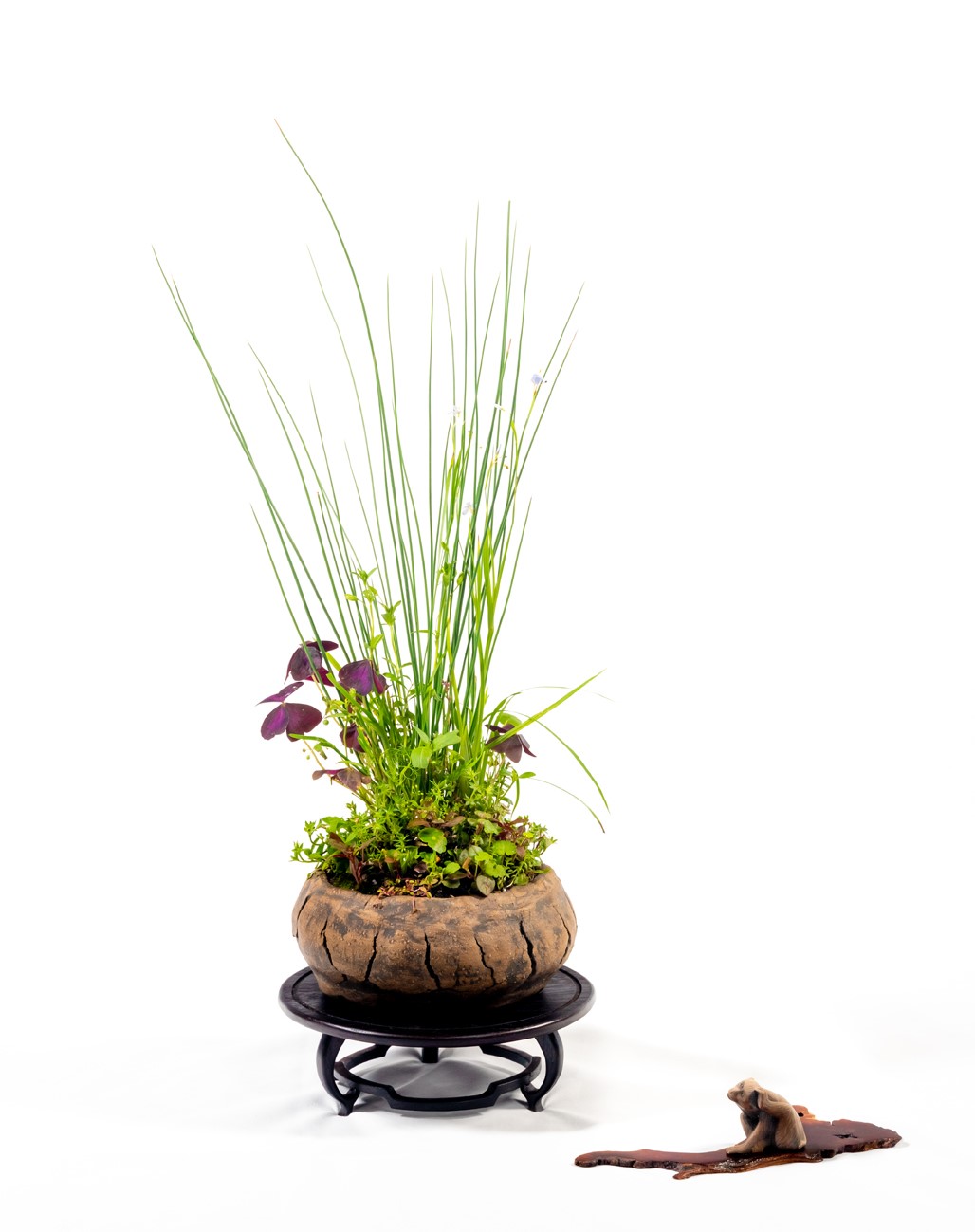
I created a mixed planting with Uwe’s Christmas gift. Uwe and I love mixed kusamono plantings that reflect something we see in nature, a blend of common flowers, grasses and weeds, as randomly and naturally as possible, yet encompassing the three basic elements of kusamono aesthetics representing the relative heights between heaven, earth and people, 天,地,人.
Our joint work exhibited at the 2019 American Bonsai Society Convention, ‘Bonsai on the Bayou” held in Houston, Texas. The clay scratching monkey is a gift from out Taiji class senior, Marcia Yang. Photo taken by Shau Lin Hon of Slyworks Photography.
We submitted this joint effort to the April 2019 American Bonsai Society Convention, “Bonsai on the Bayou” held in Houston, Texas. Our description of this entry is as follows:
Uwe Harwardt made this earth tone pot in December, 2017. He videotaped the pot making process for Soon and Hoe Chuah, and sent the finished pot as a Christmas gift. A cross-Atlantic joint effort, Soon planted the kusamono, discussed and fine-tuned the planting with Uwe via internet.
I drew most of my mixed kusamono planting inspirations from seeing and learning from scenes I saw in parks and in nature walks like the one below.
A “mixed planting kusamono” at the Crater Lake National Park.
I also exhibited a mixed kusamono planting in the “Bonsai on the Bayou” show, I called it a “Nurse Log”. It was created on a piece of driftwood we found in Lake Jackson, Texas, while beach combing with our friends, Ben and Amy Chang (张本, 劉渝螢) . The log is 20 inches long. The inspiration came from our yearly summer visits to parks in the Pacific Northwest when we visit our younger son.
“Nurse Log”, photo by Shau Lin Hon of Slyworks Photography.
Nurse logs are fallen trees, which during the process of decaying provide nutrients to young plants sprouted on top of them, with elevated heights they have the advantage of competing for sunlight more than those growing on the ground, and eventually into trees; these logs are also covered with moss, ferns etc. favored by the high humidity. They are common in the Pacific Northwest’s temperate rain forests such as in Mt. Rainier and the Hoh National Parks.
Nurse log in the Olympic National Park.
They are also found in streams, forested areas all over the world. This is a nurse log we saw in Croatia’s Plitvice Lakes National Park, I like to grow one like this covered with mushrooms; this swirling mushroom, though beautiful, is one I would not want to handle without cautions.
I like to learn how to grow mushrooms as part of my kusamono journey.A possible inspiration for creating group planting at tip of a submerged nurse log in a suiban filled with water? Plitvice Lakes.
Ryan Neil was one of the featured artists at the “Bonsai on the Bayou”. One of his assistances told him after seeing my kusamono exhibits, he was so gracious to accept our request, gave us personal critics on these two kusamono at the end of the day before heading out for dinner. On the “Friendship Kusamono”, he liked the earth-tone pot, but commented it was a powerful pot and is hard to use for a kusamono; he was pleased that I pulled it off by blending the mixed plantings with appropriate heights, colors and combinations. On the “Nurse Log”, being from Oregon, he recognized it instantly. He likes the creativity; instead of the traditional Japanese kusamono, this is something he encourages American to create, be it a bonsai or a kusamono, something American. We were so grateful to him, grateful that a famous artist willingly spent 10 minute personal time with us, we were flabbergasted. We learned so much from his insights and perspectives.
Now I will write about a pot I just received from Hermann Wallenhaupt, Germany.
Uwe met Hermann in one of the European bonsai events, and mentioned me to him. Lo and behold, Hermann sent me a kusamono pot he made. Thank you very much, Hermann! It arrived when we are staying home responding to containing the coronavirus curve plea. It is a very beautiful pot. I like the way the lip sloped towards the center. The folds resemble our favorite Chinese BBQ buns from dinsum restaurant. It is also a big challenge! With the slope, diameter of the opening is reduced by about half and the planting area opening is reduced to about one quarter!
I bet the process of making those folds are the same.
I started working on it right away. My first thought was to do a mixed planting. With the reduced planting opening, I had to look for smaller plants to use, a slender grass to establish the height (the heaven) as a main focal point. Since the ground (the earth) hugging plants are very small, I had to use tweezers to insert them into the pot. The result looks OK but not very satisfying because the tweezers damaged some delicate parts of those small flowering plants. It will take sometime for them to perk up again and settled naturally.
I started with the skinny grass towards the rear of the pot and began filling it with ground covers; after completing it I thought I should do the plants justice and let them establish in a more open pot and transfer them into Hermann’s pot later on.
Meanwhile, I found a Brookweed, Samolus paviflorus, also called water pimpernel, which I thought would match Hermann’s pot nicely. It is just a weed from my backyard, what I like most are the delicate small white flowers with outspreading skinny stems that would not over power this small pot.
We live in such a wonderful time. Although I have not met Uwe and Hermann personally, but will always treasure their friendships through the internet. Hope to meet them one day in Europe.
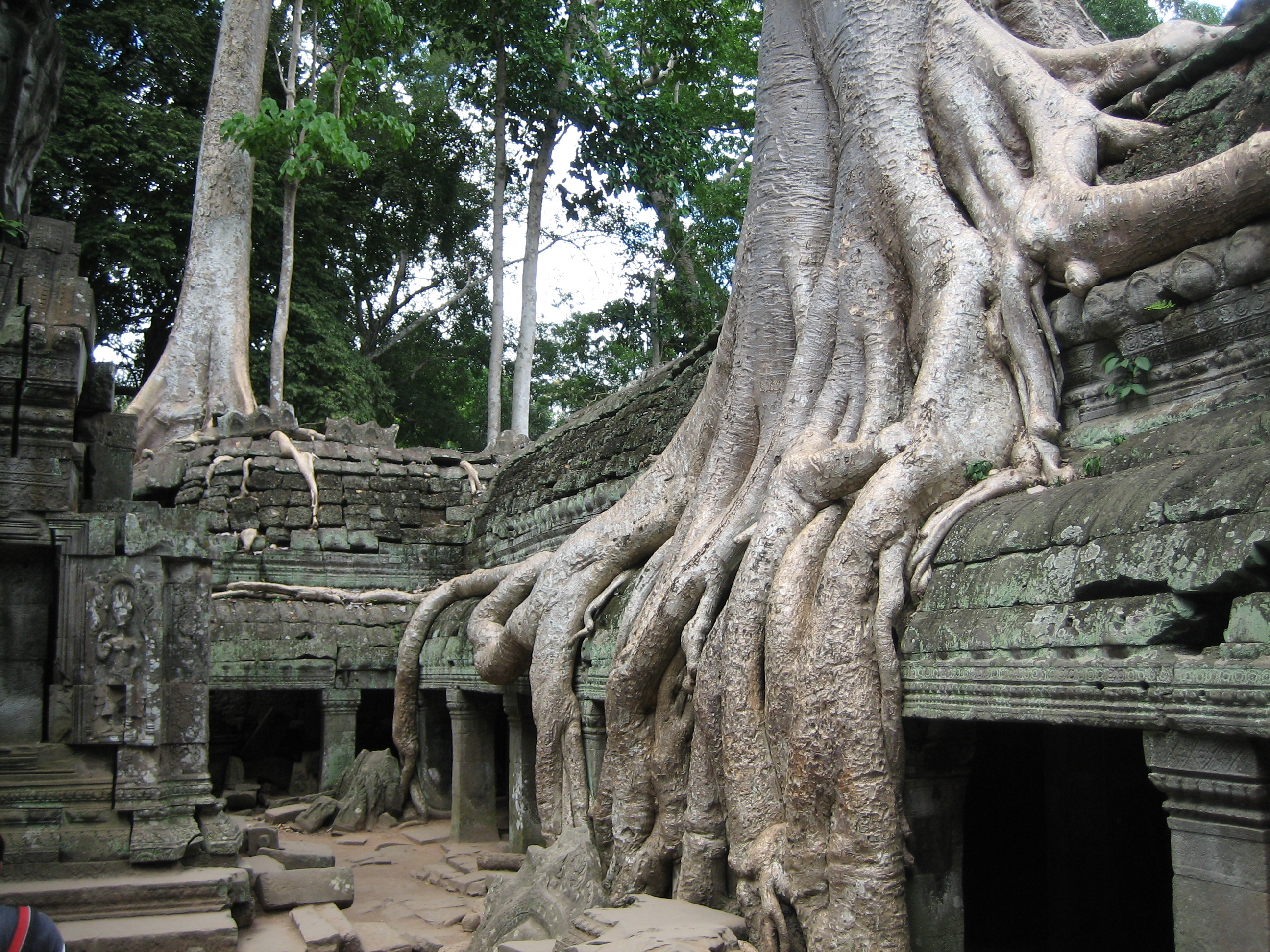
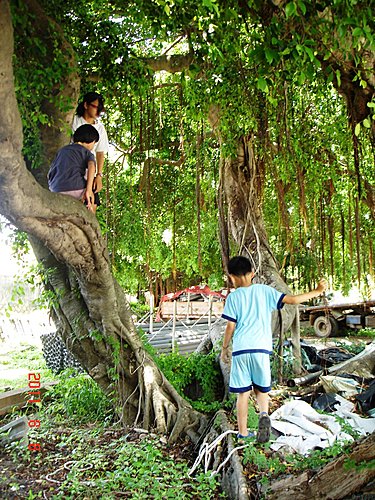
Huge tree roots clinging onto this ancient Ta Phrom Temple ruin in Cambodia is an iconic image. They are not ficus, but silk-cotton, aka kapok, (Ceiba pentadra) tree roots.
“Tomb Raider” was filmed at the Ta Phrom Temple. Waiting for Angelina Jolie to come out.
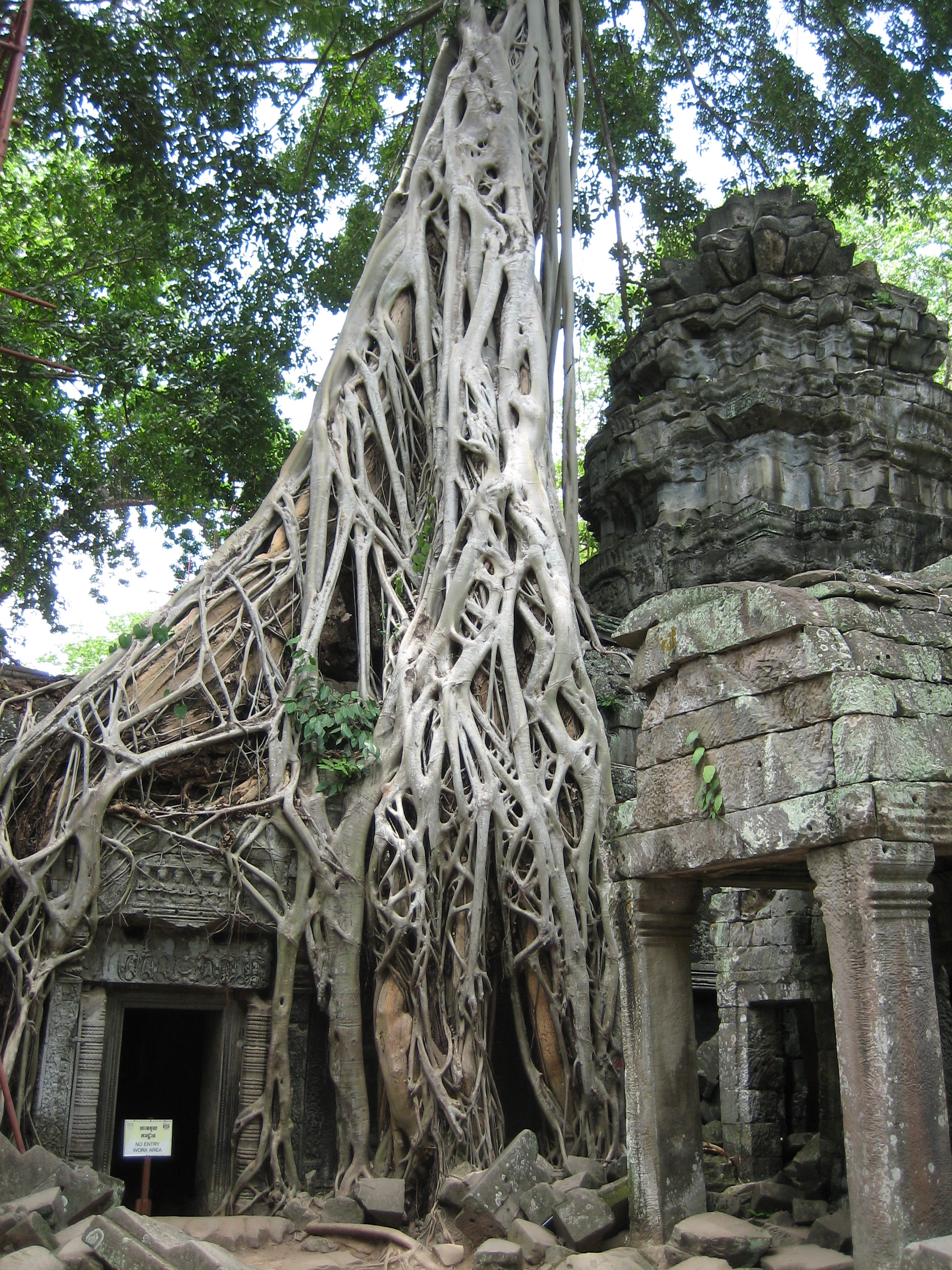
Strangler figs, Ficus tinctoria spp. gibbosa, (thank you Kasu Bonsai for correcting the subspecies name) do claim Ta Phrom, however, they look different with distinctive mesh-like aerial root networks.
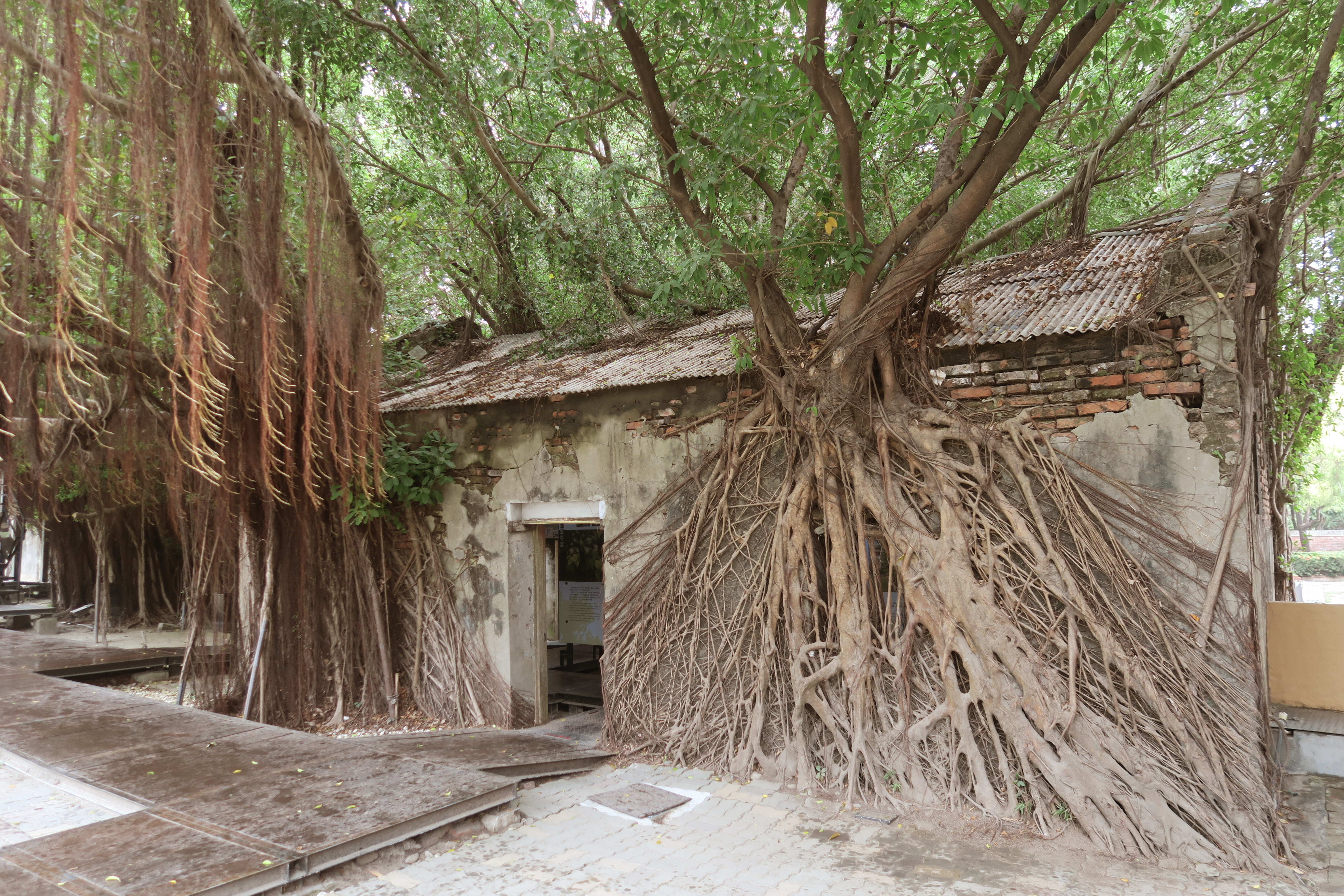
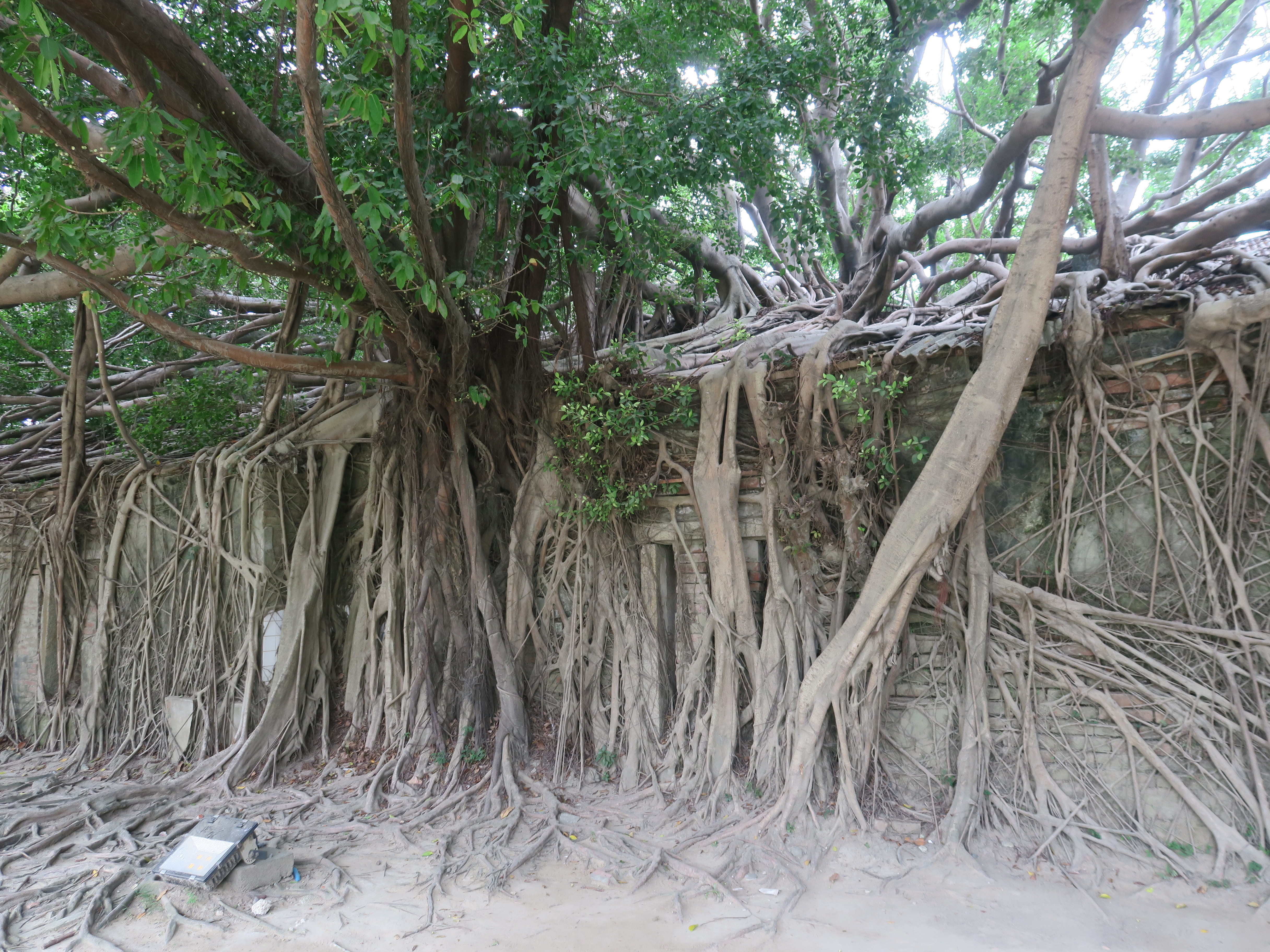
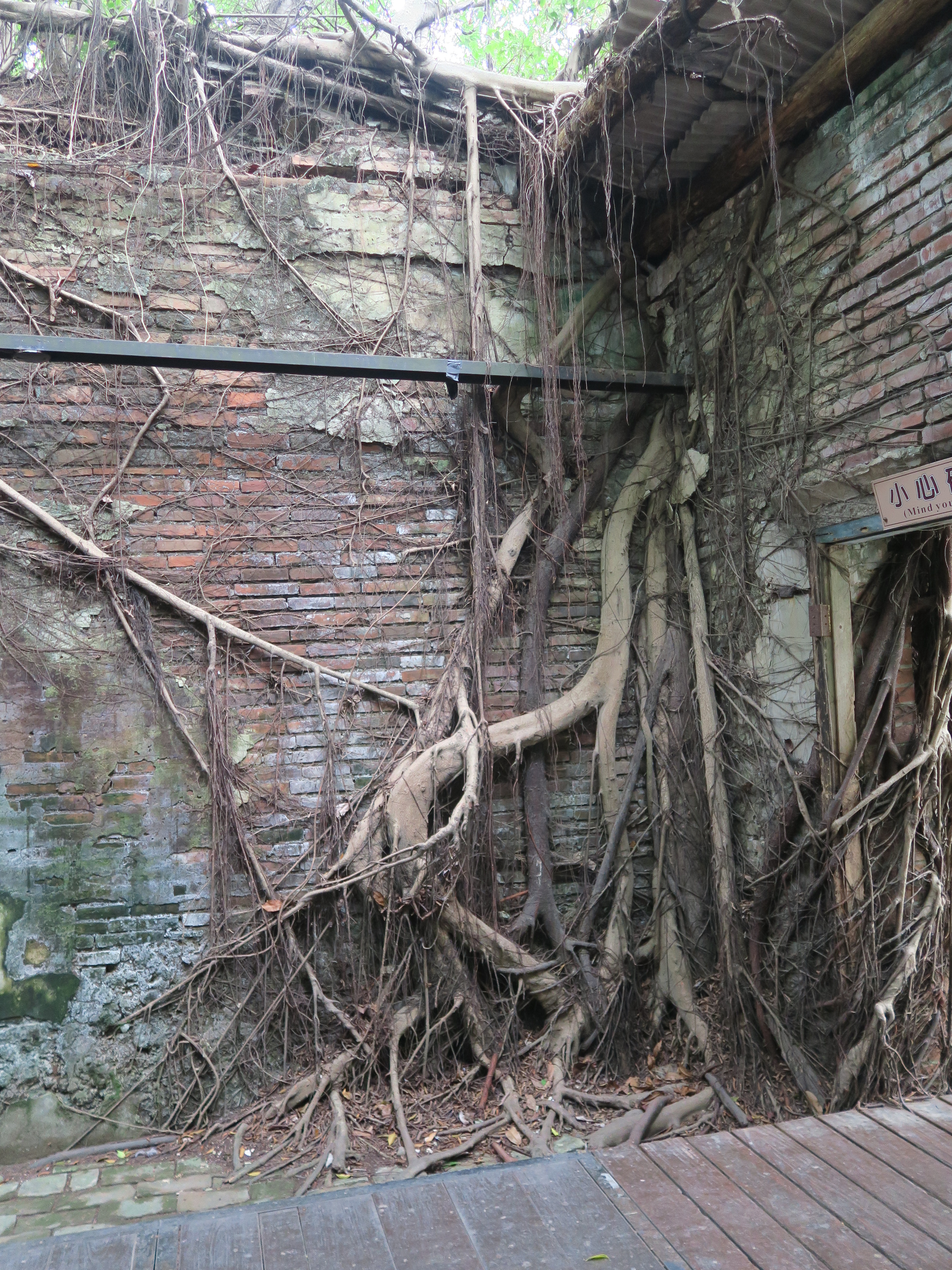
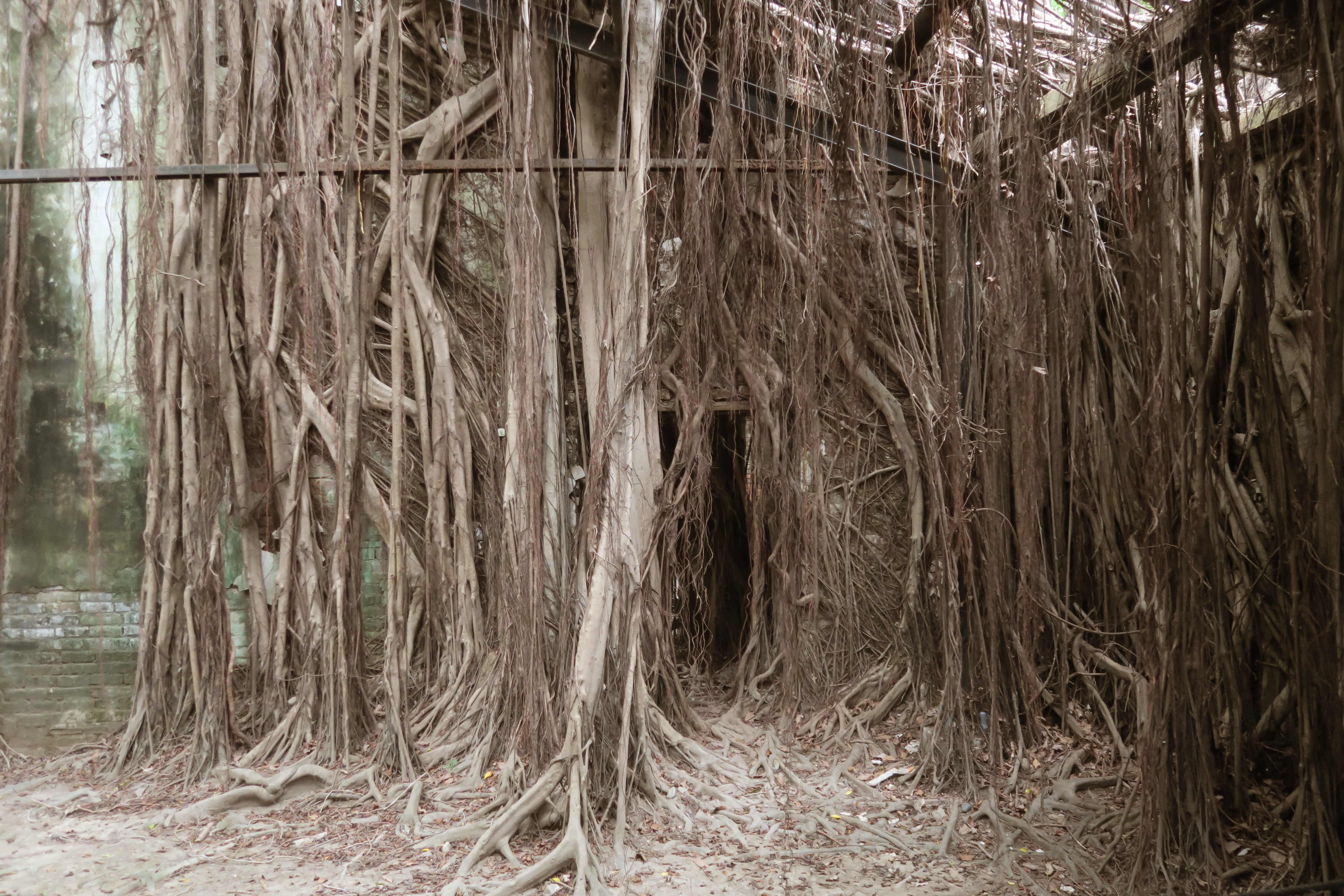
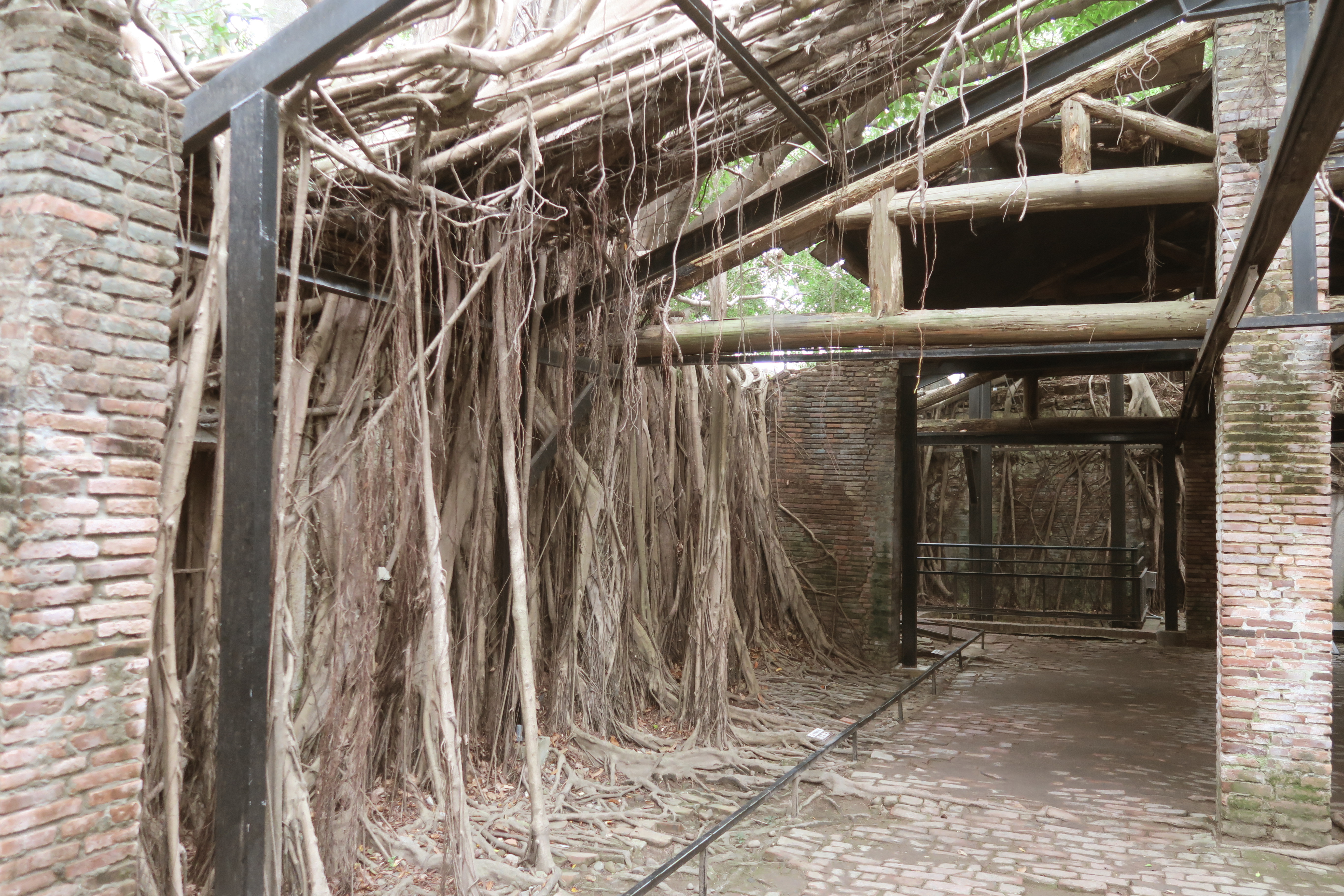
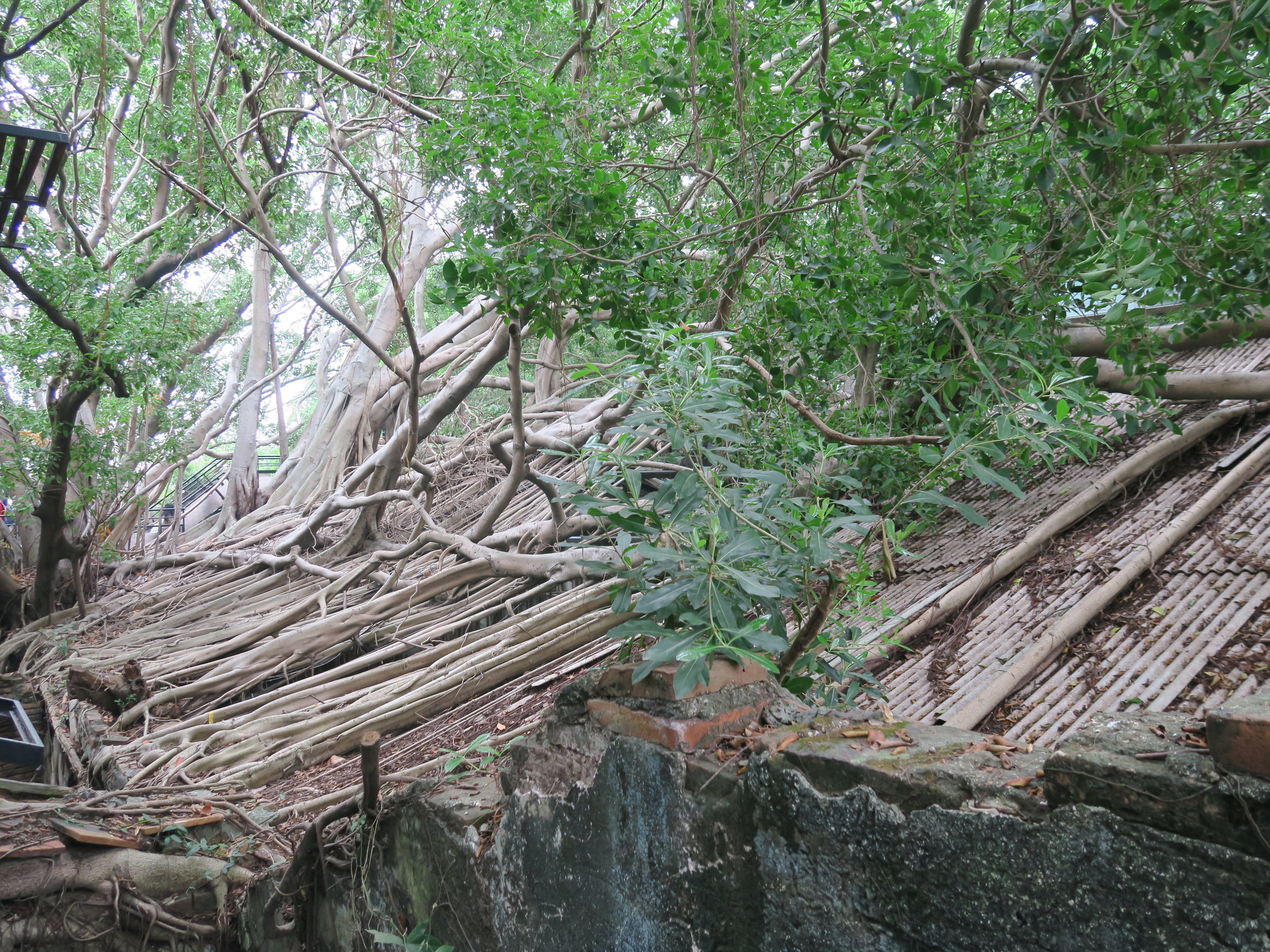
Ficus grows rapidly in the tropic, it does not take very long for it to completely engulf an abandoned building. Let me take you to the Anping Tree House in Tainan, Taiwan. It was a warehouse built in 1867 by the Tait Company, a British trading company. The Japanese later took over the building and used it for salt trading. After the Second World War ended in 1945, the Taiwanese continued to use it for some years, and the building was abandoned.
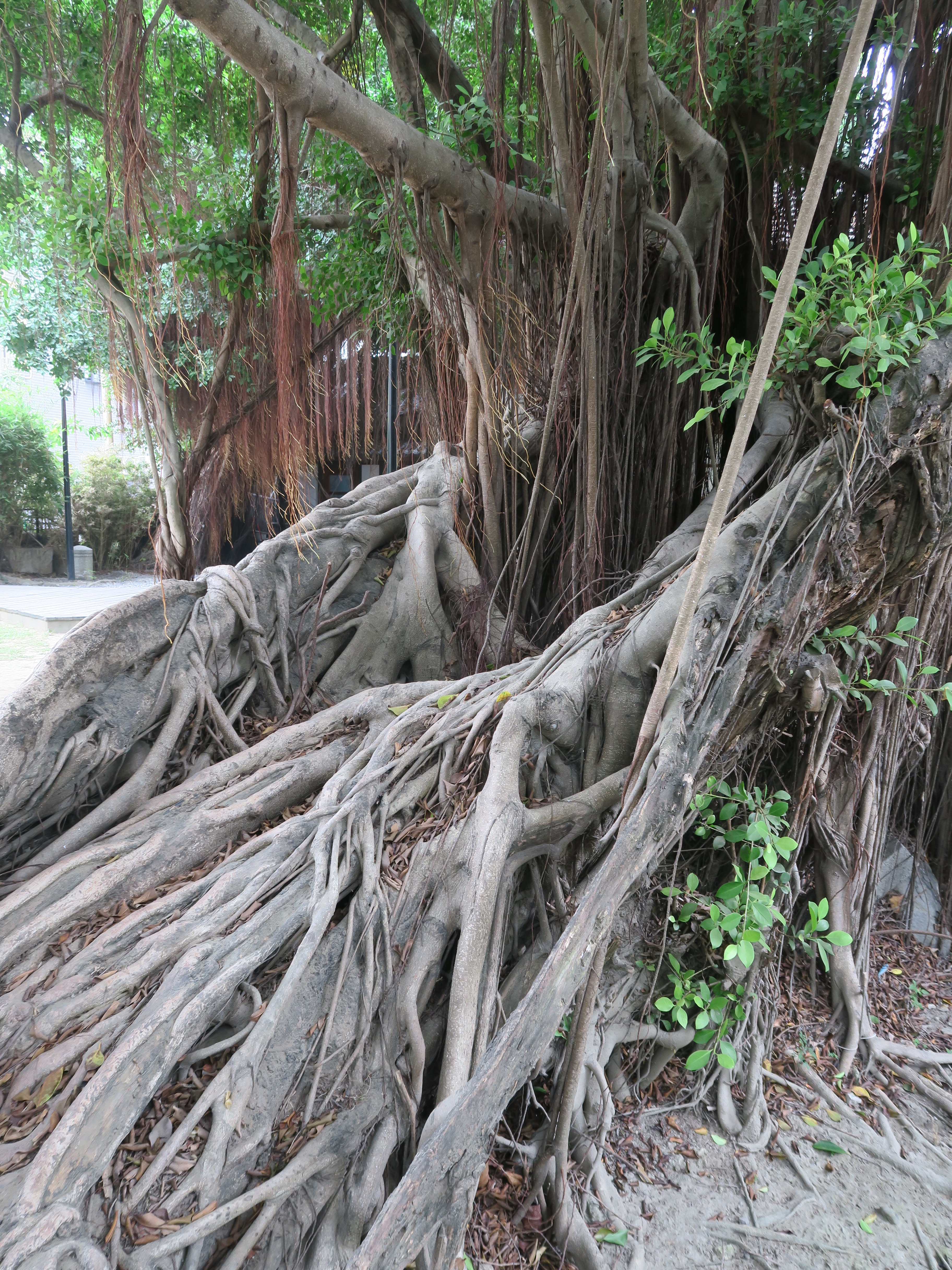
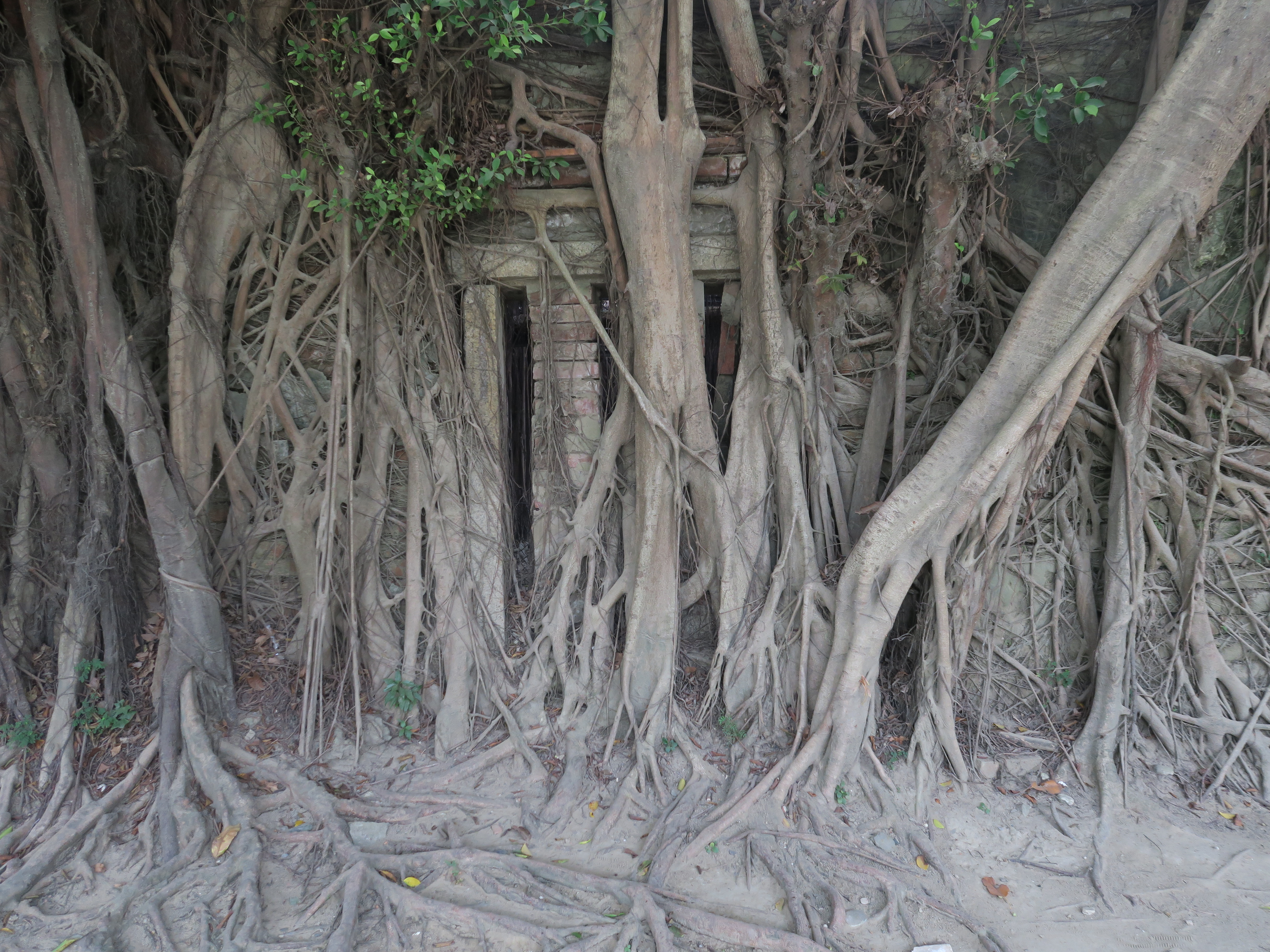
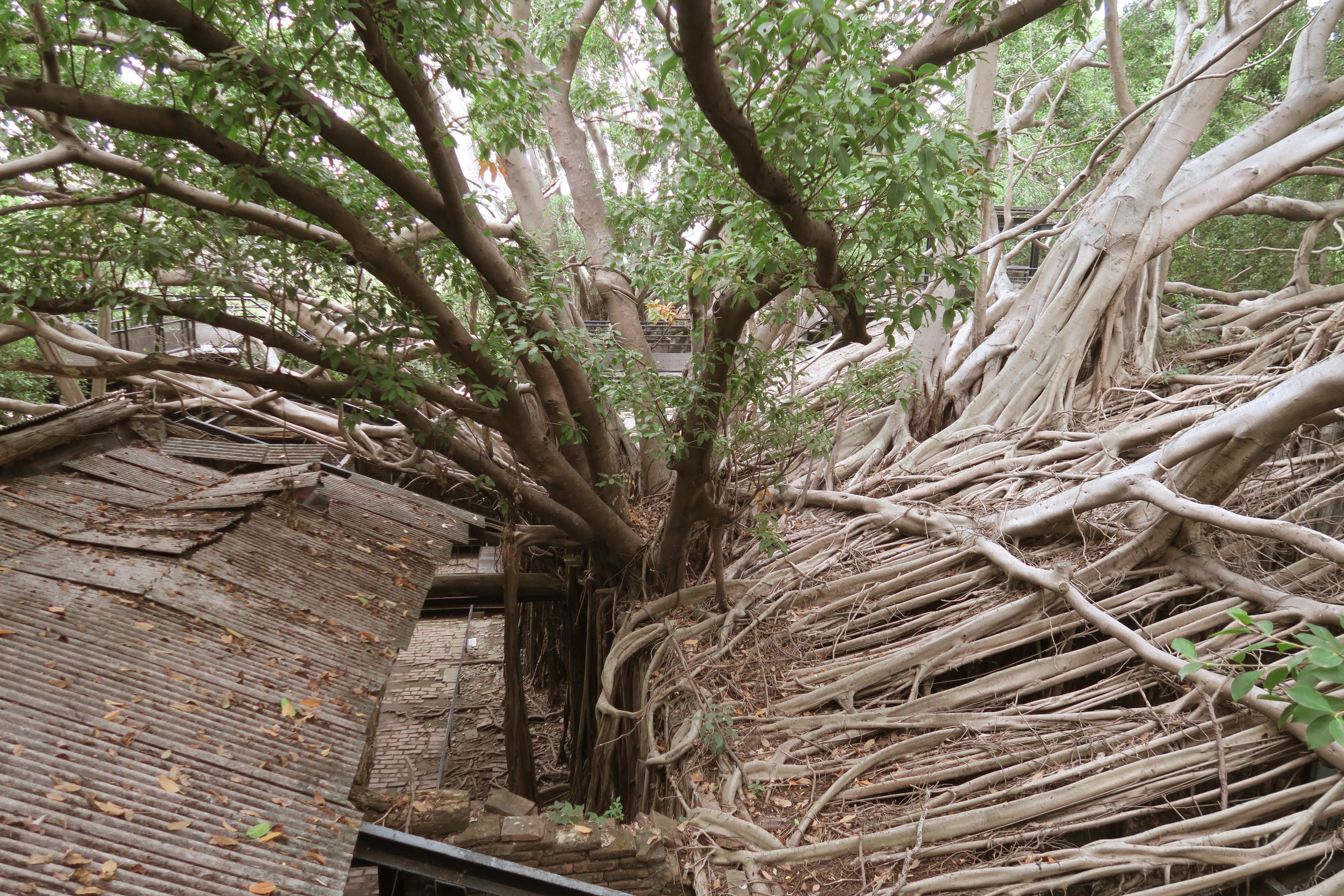
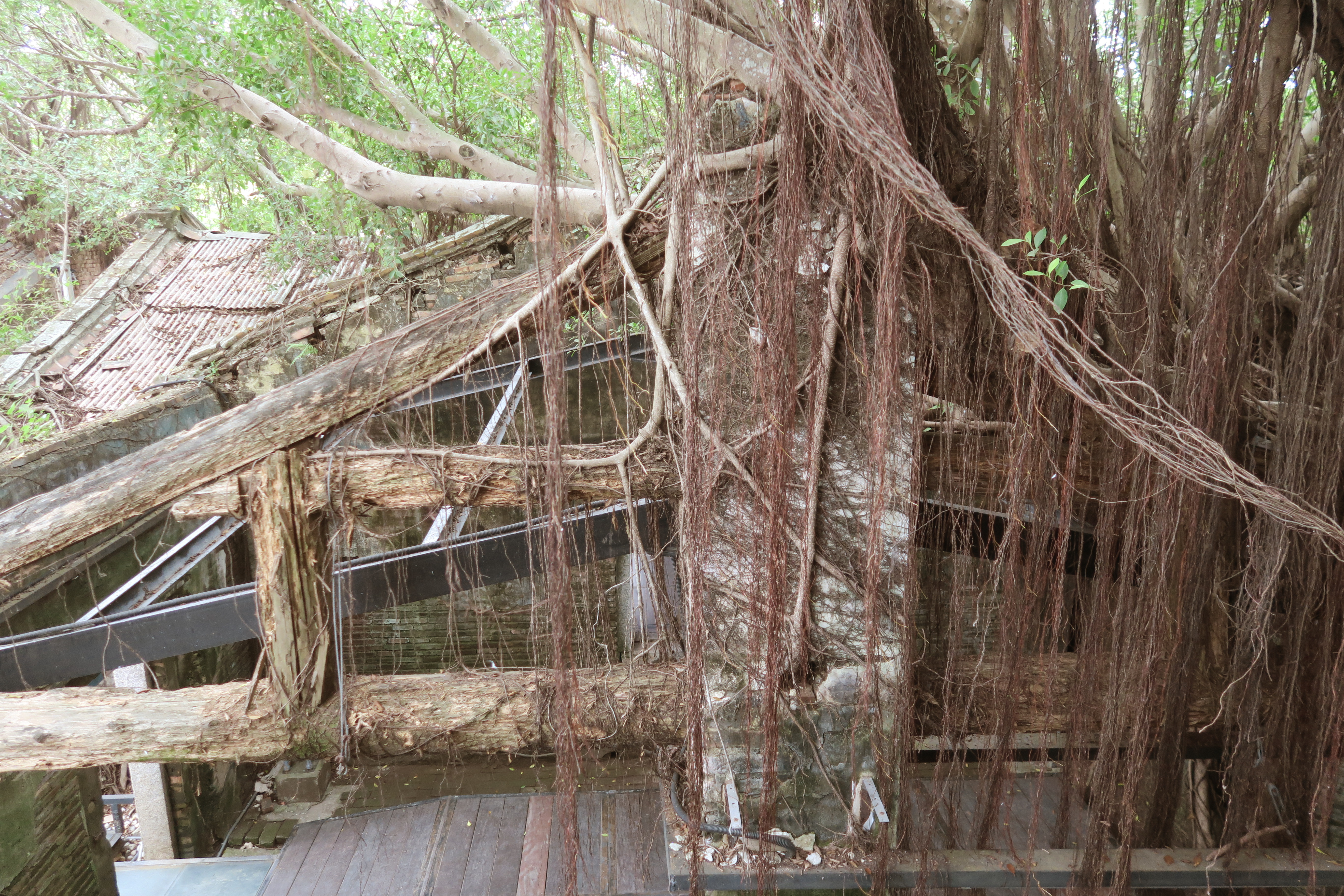
Birds dropped some banyan seeds onto this abandoned building, in about 70-80 years, the old Tait Company warehouse became known as the Anping Tree House, completely engulfed by banyan tree trunks and aerial roots, transformed from an abandoned warehouse into a popular tourist attraction in less than 100 years!
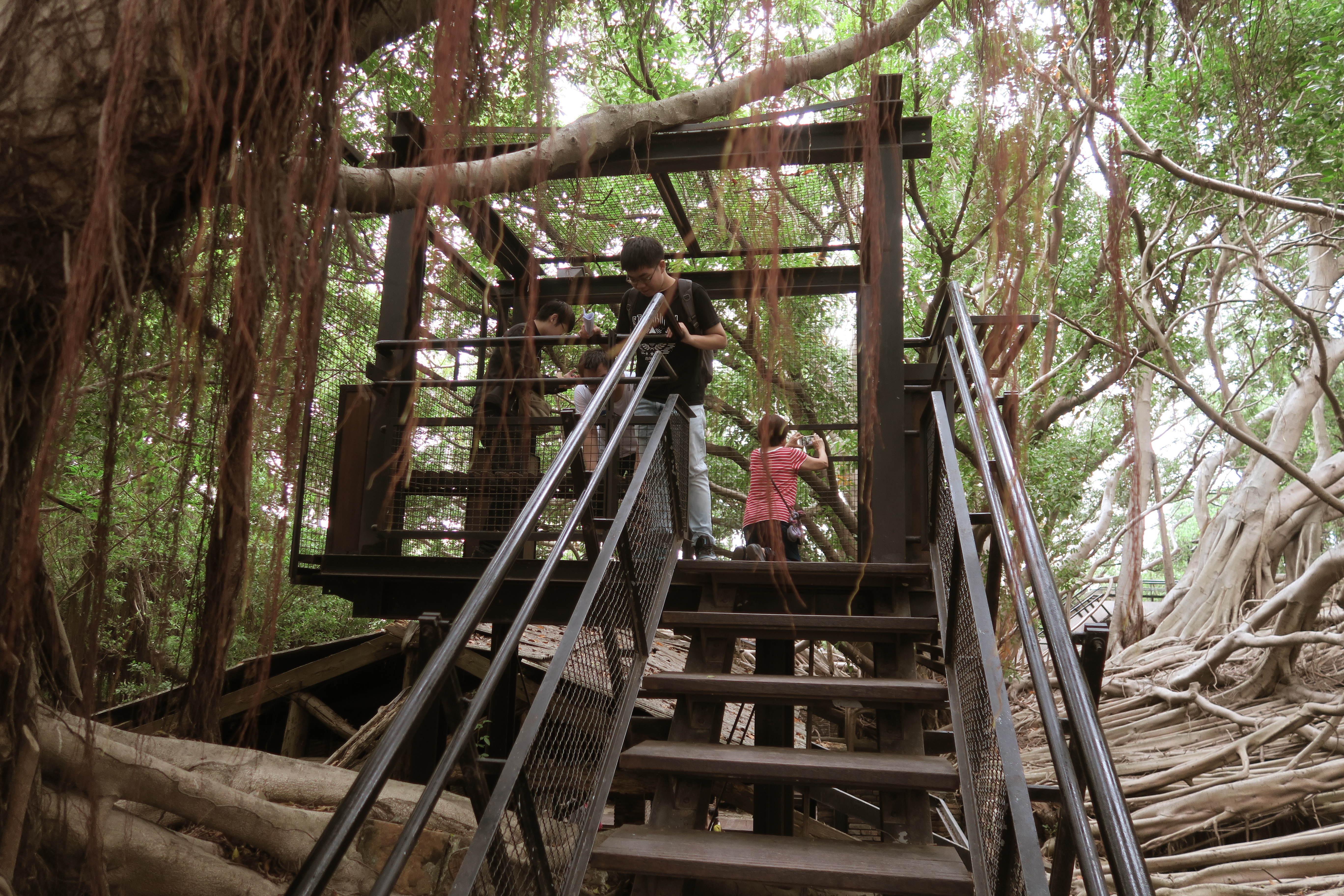
Instead of razing down this condemned building, the city mayor had the foresight of building steel supports and stairs; it opened to the public in 2004 as a tourist attraction.
That’s my wife, Soon, in the red striped shirt.
One can now safely reach the roof top or the tree top, whichever you want to call it. It offers some wonderful views of aerial root formations over different sections of the building.
Aerial roots grew parallel like carefully laid roof beams. The corrugated roof probably served as a template for their growths.
This is not a typical big umbrella-like canopy, big trunk ficus we see in Taiwan. Can some creative artists make a ficus tree house bonsai, please?
This article was written by Mr. Xuenian Han (韩学年), a well-known Lingnan penjing master. It was published in Mr. Shaohong Liu’s (刘少红) “The World of Penjing” (盆景世界), the most widely read online penjing magazine in China with over 135,000 subscribed readers. Both Mr. Han and Mr. Liu gave me permissions to translate this article and share it with English readers on how this new style was developed.
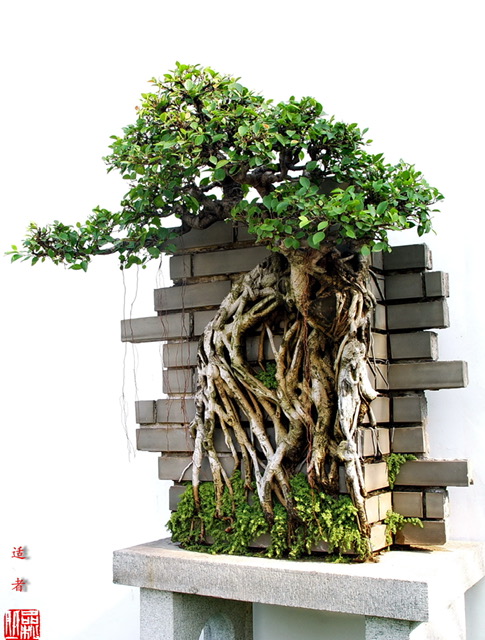
“The Fittest”, a “root-on-wall” ficus created by Mr. Xuenian Han. 韩学年作品《适者》(附壁榕)
Ficus microcarpa is a native tree species in the Lingnan region. As a fast growing tree and an ability to grow in a broad range of habitats, it is widely cultivated in urban and rural areas. In the Pearl River Delta, especially in villages and towns along the river, banyan trees with broad canopies provide shades and are popular with villagers, where they could gather and cool themselves during the hot summer days.
Ficus has large, powerful tree trunk and wide spreading, old gnarly roots. Since Lingnan penjing practitioners often model their trees based on close-range observations of how trees grow in nature, thus, the Banyan style was born. Ficus is a popular species for Lingnan penjing, whether the material is field grown or collected, key banyan features are artistically recreated and portrayed in a grow pot. There are many excellent examples of banyan style penjing.
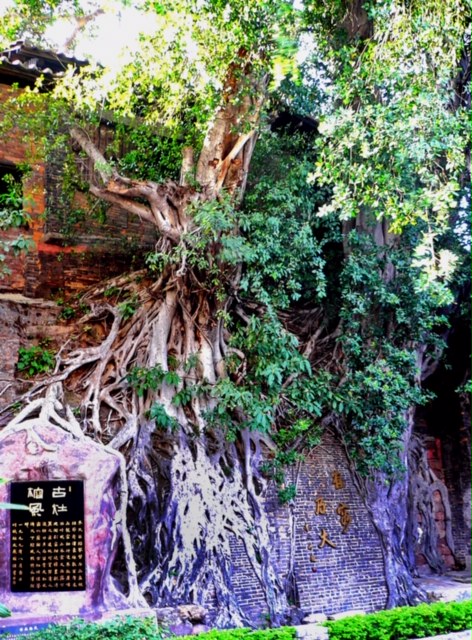
Ficus growing on the old Nanfeng kiln wall in Foshan city, Guangdong. 佛山市“南风古灶”古榕
Ficus have aerial roots, when these roots touch and anchor themselves onto the ground the tree would continue to grow outwards, creating a forest-like image even though it is just a single tree; and this is the familiar banyan image. Since ficus is a strong survivor and adapts to myriads of environments, there is another tree form from which these two “root-on-wall” penjing were based upon, and I will discuss how I created them.
An old ficus growing along a river in Shunde, Guandong. 本地(顺德)一河边古榕
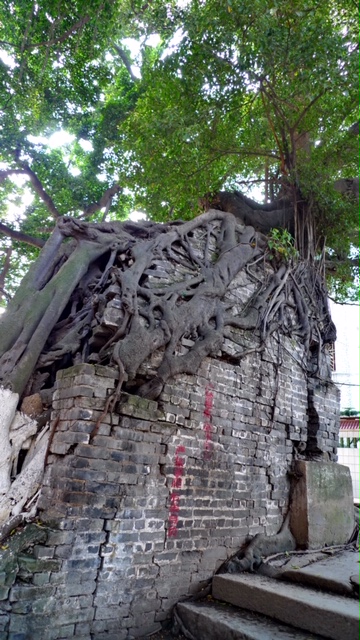
Figs are eaten by birds, and their seeds are scattered via bird droppings. If such a dropping were to fall into rock crevices or cracks in walls, they would root and grow when the surrounding humidity is high, and aided by rainfalls and fogs. They take roots in buildings and houses. These roots are very destructive and are usually removed. However, in some out of sight or abandoned corners and crevices, their presence is tolerated or ignored, and they eventually grow into trees that look different from the typical banyan.
An old ficus on the wall of the old Shajiao fort ruin, Dongguan city. 东莞市沙角古炮台古榕
Under these adverse conditions, such ficus does not grow into a large tree as its priority is to send out roots seeking for nutrients and to anchor itself onto the surface it is growing on. These roots criss-cross each other, sometimes bulging out from the wall, sometimes burrowing deep into the crevices. This creates a tree form which the locals called, feirong, 飞榕, literally means a Flown-in or Flying Ficus. (Translator’s note: It is so called because the seeds were dispersed by birds. In this translation the local description, feirong, is used to retain the vernacular flair of its Cantonese origin).
With the passage of time and as the substrate deteriorates, feirong continues to thrive, a testament to its tenacity to survive. It is a natural selection at works, survival of the fittest. Feirong can be found in several prominent tourist spots, such as the ancient ruin of the Hujiao Shajiao Fort; the Qing dynasty city wall ruin in Lianhua, Guangzhou; the 500-year old Nanfeng Ancient Kiln in Foshan, etc.
A “root-on-wall” ficus on the Lianhua City wall in Guangzhou.
Sights of feirong clinging onto walls are quite common in our region. In the long history of Lingnan penjing, there is never a penjing created based on a feirong image. In my penjing pursuit, I often put on thinking hat and sometimes come up with crazy ideas like: “Can I recreate this unique and beautiful image of a feirong in a penjing?”
My inspiration came in 1987 when I saw a Chinese ink brush painting in a “Guangzhou Literature and Art” magazine; it depicted a group of old, gnarly but vigorous growing ficus clinging firmly onto a dilapidated wall. This black and white painting captured the survival spirit of a ficus, a stark contrast between a broken wall and the powerful roots, a familiar and ubiquitous scene in our region.
A 1993 photo of my “root-on-wall” ficus, the “Survivor”. Five years after it was created.
This painting inspired me. Although there is already a root-attaching-to-rock style penjing (translator’s note: this is not a root-over-rock style frequently seen in bonsai, this penjing style has either one or a few long, thick roots growing along a tall stone, plunging from the top of the stone to the bottom of the pot), none captured a feirong. I thought it would be a break-through if I could create such a scene in penjing. However, I was not sure how to proceed with it, whether it would be possible or not, and sometimes doubts if I could succeed? Those thoughts swirled in my head. There was no physical penjing model I could copy from, I just kept on thinking.
A top view of the “wall-pot”.
What is penjing? It is a visual art of growing artistic looking tree in a pot which primary function is to serve as a carrier for the tree. Without a pot (pen), would I be able to call it a penjing, a “potted scene”? Feirong has to be on a wall, not in a conventional pot. But I needed a wall which could also function as a pot. It had to look natural and aged, able to bring out the spirit of a feirong and at the same time allowed it to grow. The design required out-of-the box thinking and creativity.
Traditionally we think of “tree, pot and stand” as integral parts of penjing, and in that relative order of importance. In this case, I reversed the order, putting pot (container) first, then the tree, and lastly the stand. My priority was to make a functional “pot”; if I could do that half of the battle was won, I only had to find a suitable ficus to grow on it.
Exhibited for the first time in the 1997 Guilin Penjing Show.
I was building my house in early 1987, and was decorating the walls with reproduction antique ceramic tiles. Suddenly it donned on me I could use these tiles to make the “wall”! I went ahead and made a cement wall with a trough at the back according to dimensions of the tiles. After plastering the tiles onto the cement wall, a jagged “wall” was completed. This was the first but important step in this creation process.
The roots on wall showed prominently after defoliation, 2007.
After the completion of the wall-basin, I found a ficus tree I had, reduced its height to just above the lower section, made a hole in the wall and planted the ficus. A year later, the planting took shape but far from what I envisioned. Although more growing years were needed, it was, nevertheless, my second milestone in creating a feirong penjing. Although exposed roots is the most important part of a feirong penjing every trunk and branches have to be carefully grown in proportions. The “root-on-wall” feirong took shape 10 years later, I named it the “Survivor”, and exhibited it for the first time in the 1997 “Hong Kong Cup” Bonsai Exhibition held in Guilin, Guangxi.
The “Survivor” root-on-wall ficus. 韩学年作品《生存》(附壁榕)
In the “Survivor”, I used a tree that was originally trained for other purposes. Although it developed exposed roots, they were not as powerful and tenacious like those seen in a naturally occurring feirong. Therefore, the “Survivor” can only be said to have a feirong look, but lacked its struggling, tenacious life force.
1998, Year 2 of my second “root-on-wall” ficus, named “The Fittest”. 《适者》附植的第二年(1998年)
In 1997, a penjing friend told me he saw a feirong that might be suitable for a “root-on-wall” penjing. He brought me to where the tree was growing. It was a dormitory building marked for demolition. This ficus grew close to a ditch and was lush green; the wall was covered with roots running in whichever directions they chose. By coincidence, a resident of this dormitory was my former colleague, and whe told me this ficus had been growing there for more than 20 years.
In 2000.
I studied and committed this material in memory, a new design began to congeal to feature the root base prominently. I then built a wall specifically for this tree. In the “Survivor,” I built a wall-pot first, found an ordinary ficus and force-fitted it onto the wall; looking back the result was barely satisfactory. This time, I found a feirong tree, and built a taller wall-pot to accommodate and show off wits spreading root system. My second attempt of a “root-on-wall” ficus was done in reversed order.
In 2002.
Exhibited at the 2006 Chinese Penjing Exhibition at Quanzhou, Fujian. 参加泉州第六届中国盆景展览(2004年)
After about seven years of cultivation, I succeeded in creating my second feirong “root-on-wall” penjing. It was a step forward, it was a much better looking penjing, meeting my expectations more than the first “Survivor”. I called this second creation, “The Fittest”, and submitted it to the 2004 6th National Penjing Exhibition held in Quanzhou, Fujian.
These two works, the “Survivor” and “The Fittest” were inspired by a natural occurring landscape. The processes in creating these two feirong fulfilled my dream during my long penjing journey.
“The Fittest”, a “root-on-wall” penjing by Mr. Xuenian Han. 韩学年作品《适者》(附壁榕)
I was searching online for ficus information, came across “FigWeb” and saw this reference:
Berg, C.C. & Corner, E.J.H. 2005. Moraceae – Ficus. Flora Malesiana Series I (Seed Plants) Volume 17/Part 2. National Herbarium of the Netherlands, Leiden.
Holy Moly! Was Corner still alive in 2005? No, he passed in 1996. The monograph was published posthumously.
As a ficus bonsai enthusiast, I think there are two botanists whose names are worth knowing beside Carolus Linnaeus the Younger who first described our ubiquitous Ficusmicrocarpa. These two botanists are:
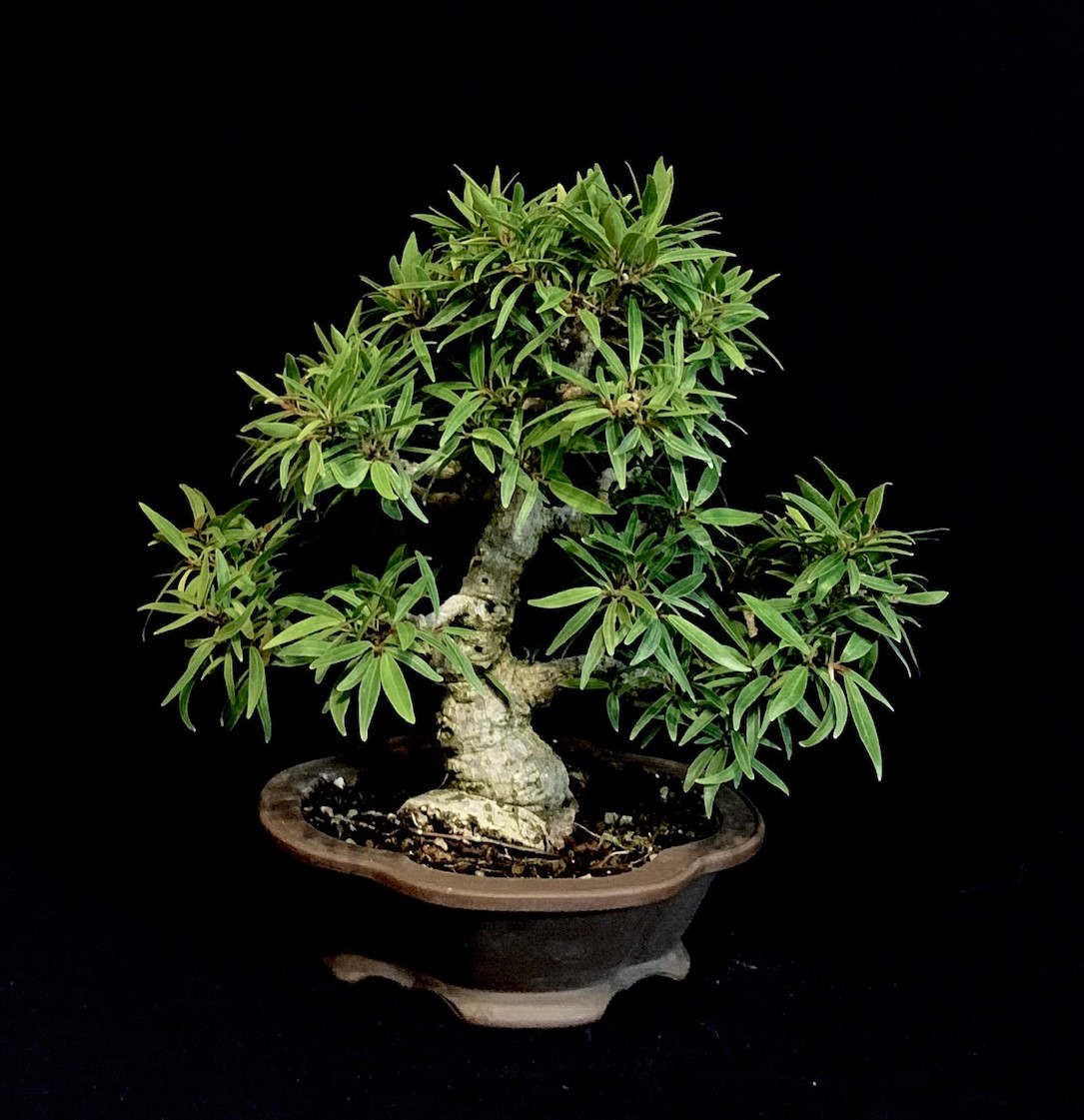
C.C. Berg: He was the one who clarified the scientific name of Willow Leaf aka Narrow Leaf Ficus, described it in a paper with a very interesting title: “A New Species of Ficus (Moraceae) of Uncertain Provenance”. His description was based on container plants (bonsai, pre-bonsai??) from Florida, which became the type specimens. So Willow Leaf Ficus’ scientific name is officially Ficus salicaria; and salicaria means willow-like in Latin, a round about way of calling it a willow-like ficus. Many people still use the names F. nerifolia, F. salicifolia, but they are different species, not the one we grow in bonsai.
Cornelius (Kees) Christiaan Berg 1934-2012
My Ficus salicaria CC Berg shohin bonsai.
E.J.H. Corner: This is the man this blog is about, an authority on Asiatic ficus; another botanist I think we ficus bonsai fans ought to know too.
E.J.H. Corner, 1906-1996.
For years F. microcarpa is erroneously called F. retusa, and still is. Below are F. retusa specimens in the Kew Garden herbarium, determined by Corner in 1958 for his revision of Flora Malanesia. It is a species found only in the Malay Archipelago and is not available in the nursery trade. The ‘Kinmen’, ‘Tiger Bark’, ‘Ginseng’ bonsai we grow are F. microcarpa from Taiwan and China, not F. retusa, so please stop calling them a retusa.
F. retusa, determined E.J.H. Corner, 8/1958.
Why do I write a blog on E.J.H. Corner?
I met Corner by chance in late 1978. I was not into bonsai then, nor did I know he was an Asiatic ficus authority. I was searching for a group of small, iridescent butterflies belonging to the genera Poritia and Simiskinia in Penang Hill, Malaysia.
These nine Proritia and Simiskina species were collected in Penang, Kedah and Perak states in Malaysia in 1978 and 1979. Some of them look very similar to each other and could only be identified by going through the “Keys”.
Two gentlemen came along the trail, one asked what was I doing and we struck up conversations. He introduced himself, a Mr. Corner, the author of “Wayside Trees of Malaya”, published in 1940. He was very happy that a young man with a net in hand, in the middle of a jungle trail, recognized his name. Serious butterfly collectors also learn to identify butterfly host plants and their life histories. He jovially lifted his white cotton hat and showed me his white hair, that he was indeed old enough to be the author of the 1940 book. We had something in common to talk about. Later, the other gentleman, who was the Director of the Penang Botanical Garden, hurried him to move along as they were heading somewhere else,
I never thought about the man I met until I came across “Figweb”, began to read about him on the internet and found a book written by his estranged son, “My Father in His Suitcase”. It was a fascinating biography of Corner by his son who left home in 1960, aged 19, and would never see his father again. Corner was a very difficult father; I could not have imagined that since he was talkative and jovial when we met in Penang Hill.
Corner, his Malay assistance and his monkey collector.
Corner left letters, photos and memorabilia for his son in a suitcase, which was nearly thrown away without being opened. After 46 years, John K. Corner faced his estranged father in a suitcase. It is a well written biography of this brilliant botanist. Here is a little background on Corner to pique your interest:
After graduating from the University of Cambridge, Corner thought it was a waste of time to get a Ph.D. (like Bill Gate?), so he headed out and worked in the Singapore Botanical Garden in 1929. There, he trained MONKEYS (!!!) to collect specimens from treetops of the rainforest. During the Japanese Occupation, he felt it was his duty to safeguard the Botanical Garden’s scientific collections, and was branded by some as a collaborator! The Emperor of Japan, a biologist and an orchid enthusiast, had his “Wayside Trees of Malaya” for bed time reading, so Corner was ‘well treated”, at least not confined in a POW internment camp during war time. Post war, he became a highly regarded botanist, head of tropical botany in the University of Cambridge, and received several honorary doctorate degrees and accolades!
You can read part of this two volume work in this link. Note a trained monkey collecting tree specimen on the book cover.
I won’t go further, please read the book if the above short note intrigues you. A brilliant man could indeed be a very difficult man to be around.
The book mentioned he re-visited Penang in 1978 but I could not find the exact sentence mentioning it; it was somewhere 2/3 or 3/4 into this 400+ page book. I should have marked it. As butterfly enthusiasts, we are meticulous in labelling detail information on every specimen we collected, and my Penang Hill field trip dates were from November 14, 1978 to January10, 1979. A little note on the dates if John K. Corner ever read this blog.
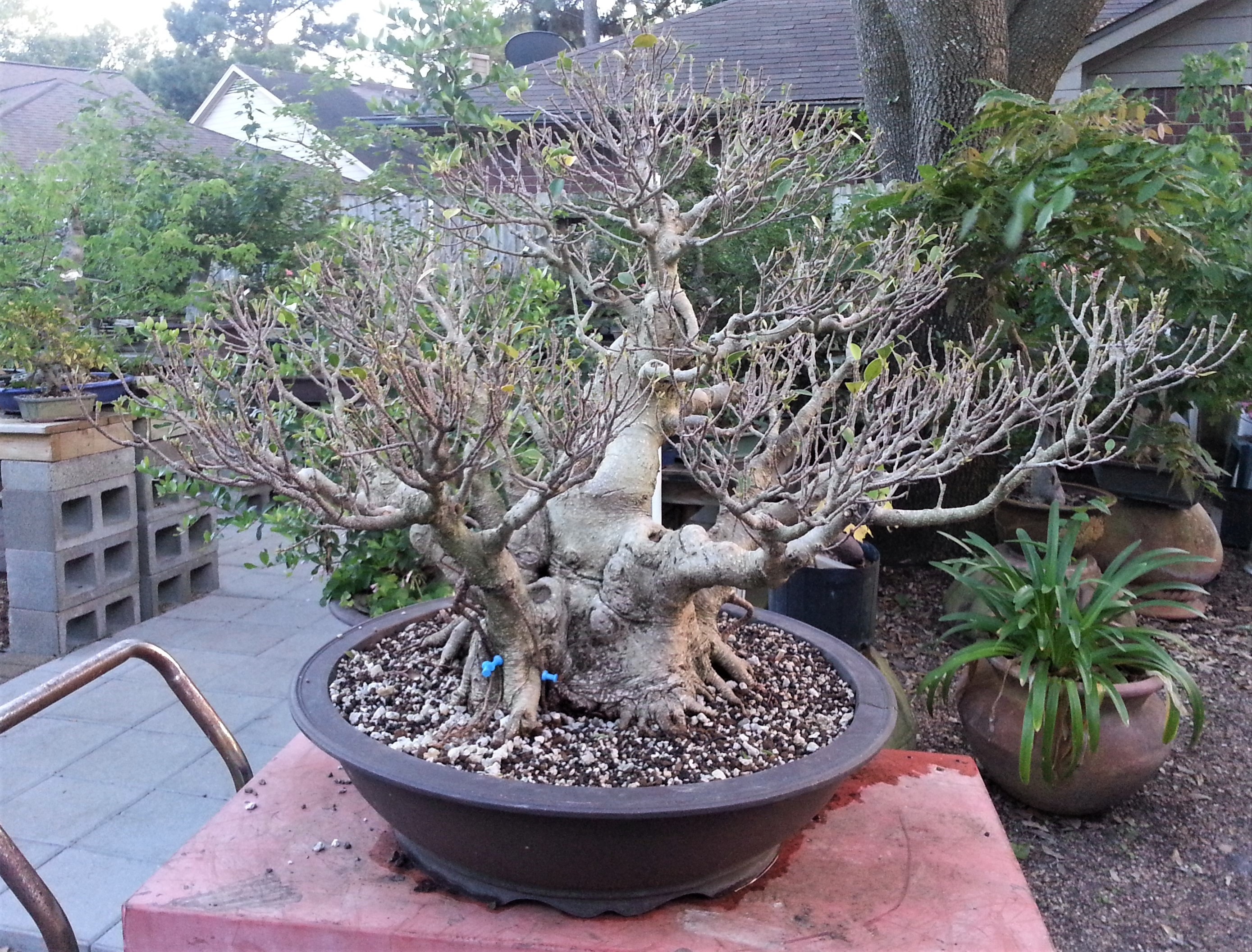
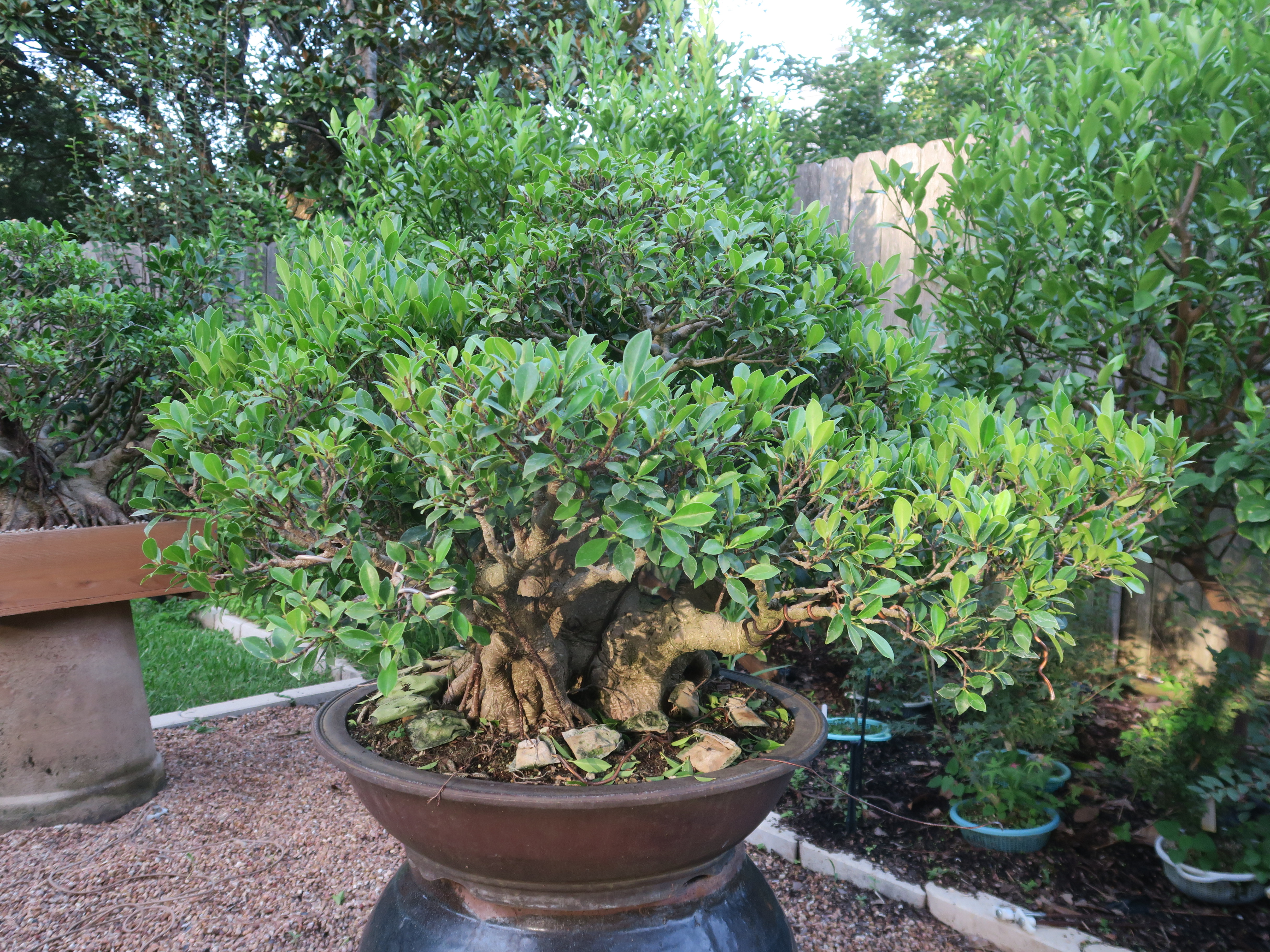
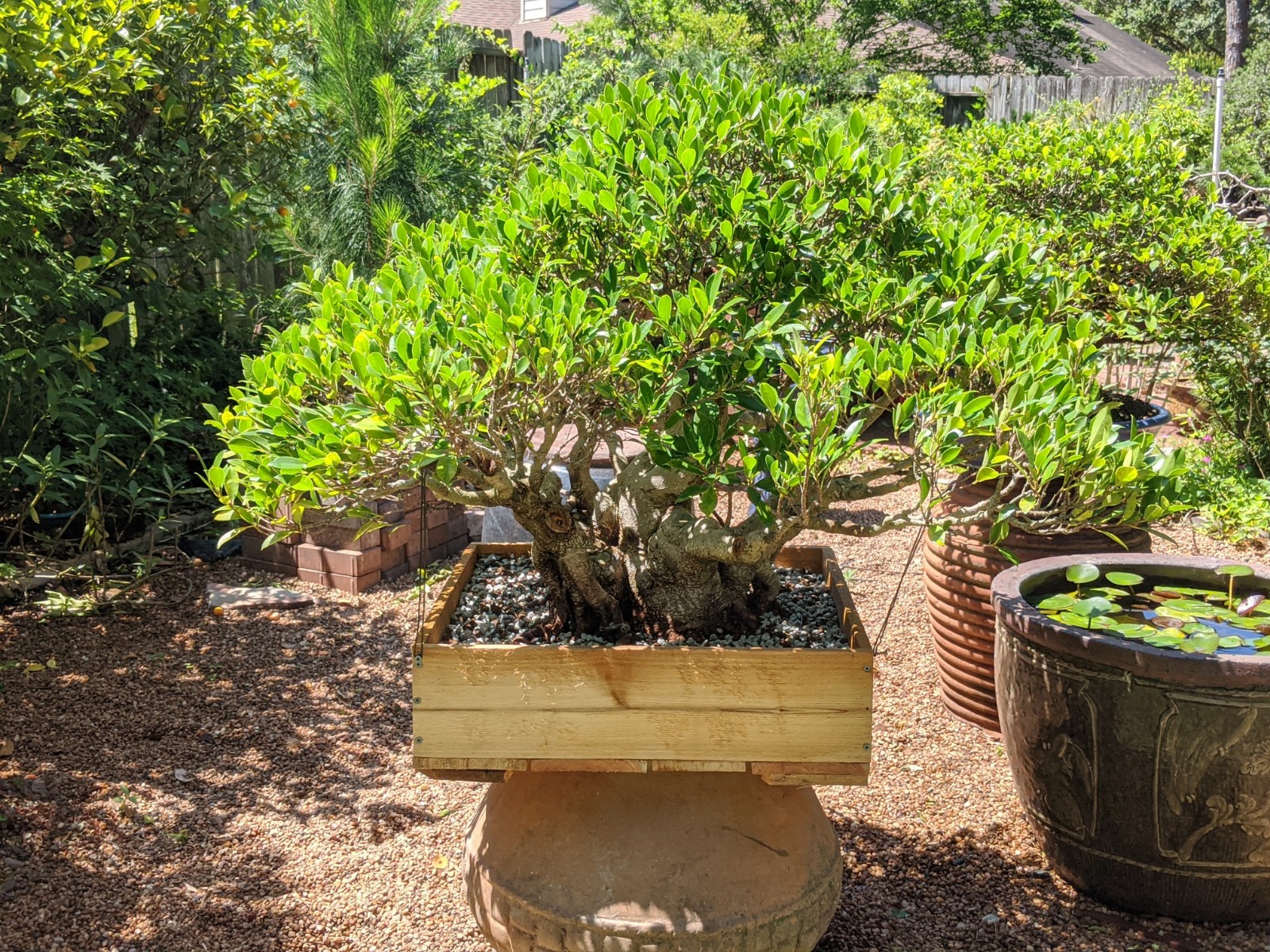
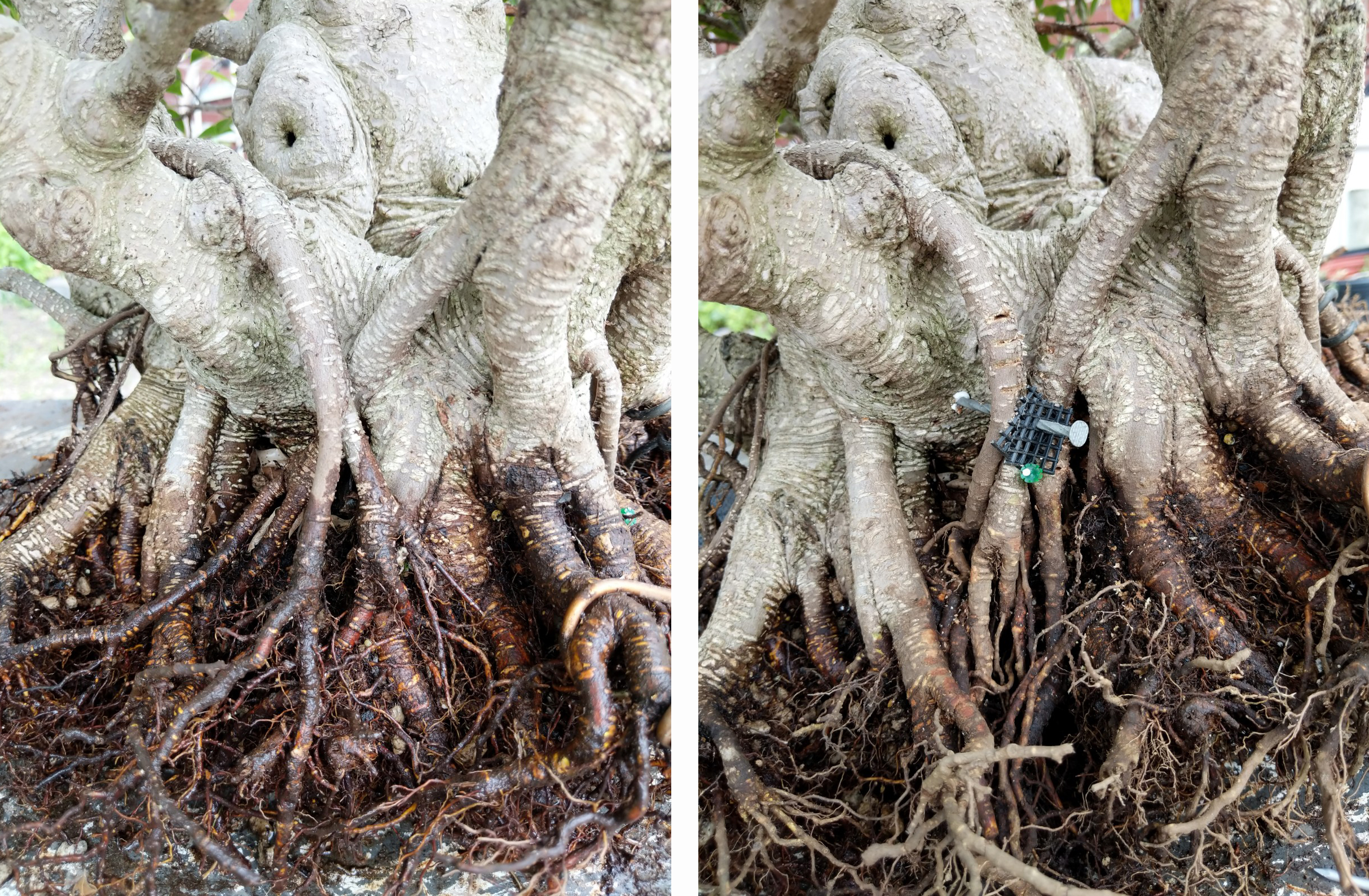
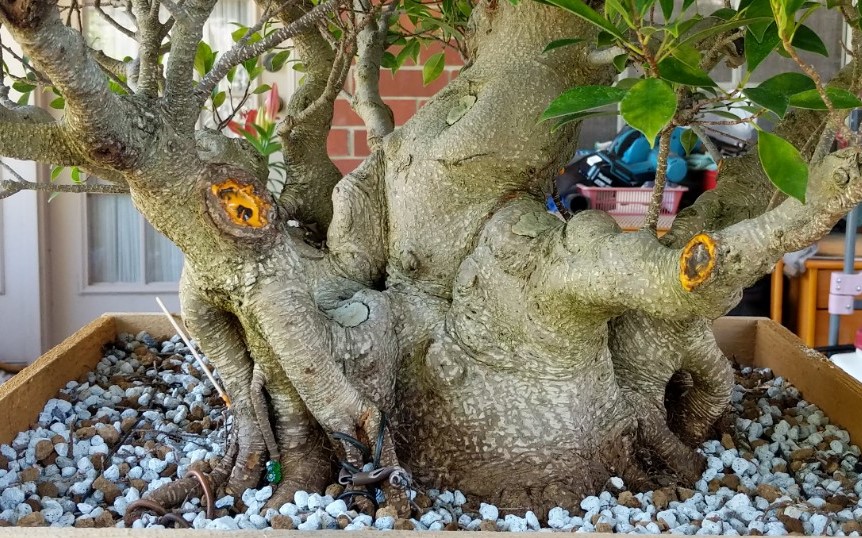
This Ficus microcarpa was potted into a 24″ round ceramic pot in 2015. By 2018, it needed repotting again but I procrastinated and did not do it in 2019 either. I finally repotted it a few days ago, but into a wooden box. I jokingly said it was because I needed to reduce the overall weight. That is true but there are more important horticultural reasons repotting it into a wooden box, like rejuvenating the roots, regaining the tree’s health, and working on the overgrown aerial roots and nebari.
Potted into a 24″ round ceramic pot, May 2015.July, 2018. Ready for a repot but did not do it.
Why Use a Wooden Box?
To restore a bonsai’s health, it is a good idea to repot the tree into a slightly larger container, preferably in a terra cotta pot, a wooden box or a Styrofoam box. A slightly larger container provides more soil volume and extra rooms for the roots to rejuvenate, increased surface areas between soil aggregates also allow the roots to breath better and grow more fibrous roots. A cedar picket fence wooden box is an obvious choice since I cannot find a larger terra cotta pot or a big Styrofoam box. Although the latter can protect the roots from over heating during our intense summer heat, it is too glaring and stands out too much among the other trees, unless I could paint it.
As for weight, the 24″ ceramic pot weighed 32 lb., a comparable wooden box weighed about 5 lb. I made a rough calculation, this round pot with tapered wall has a volume of about 1,100 cubic inches (about 18 L.), a square box holds almost twice the amount of soil. Your tree will thank you for the extra room while in recovery.
Reworking Overgrown or Thickened roots
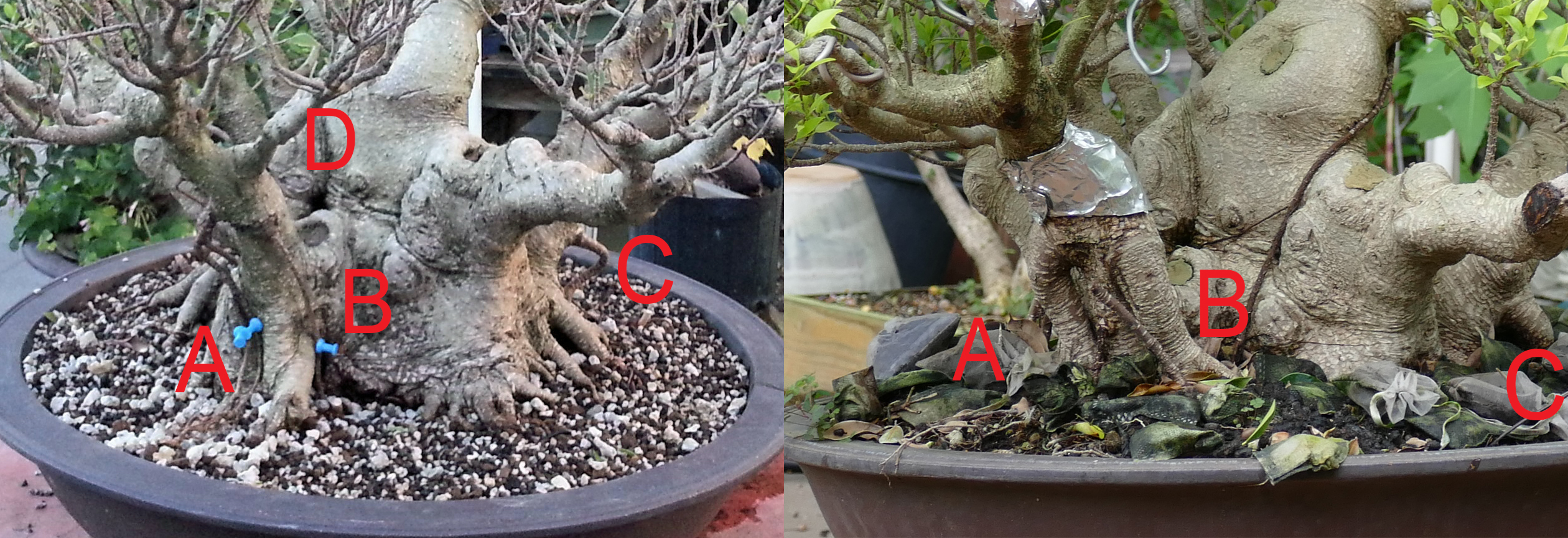
Aerial roots are great for improving the tree’s nebari, but they can become too big, crisscrossed or grew in unintended direction if one is not diligent in controlling and incorporating them to the intended design.
These two photos show how the skinny grafted aerial roots grew in 4 years without repotting in between:
Grafted aerial roots A, B and C in 2015 and 2019. Branch D was removed as it was sticking too much towards the front.
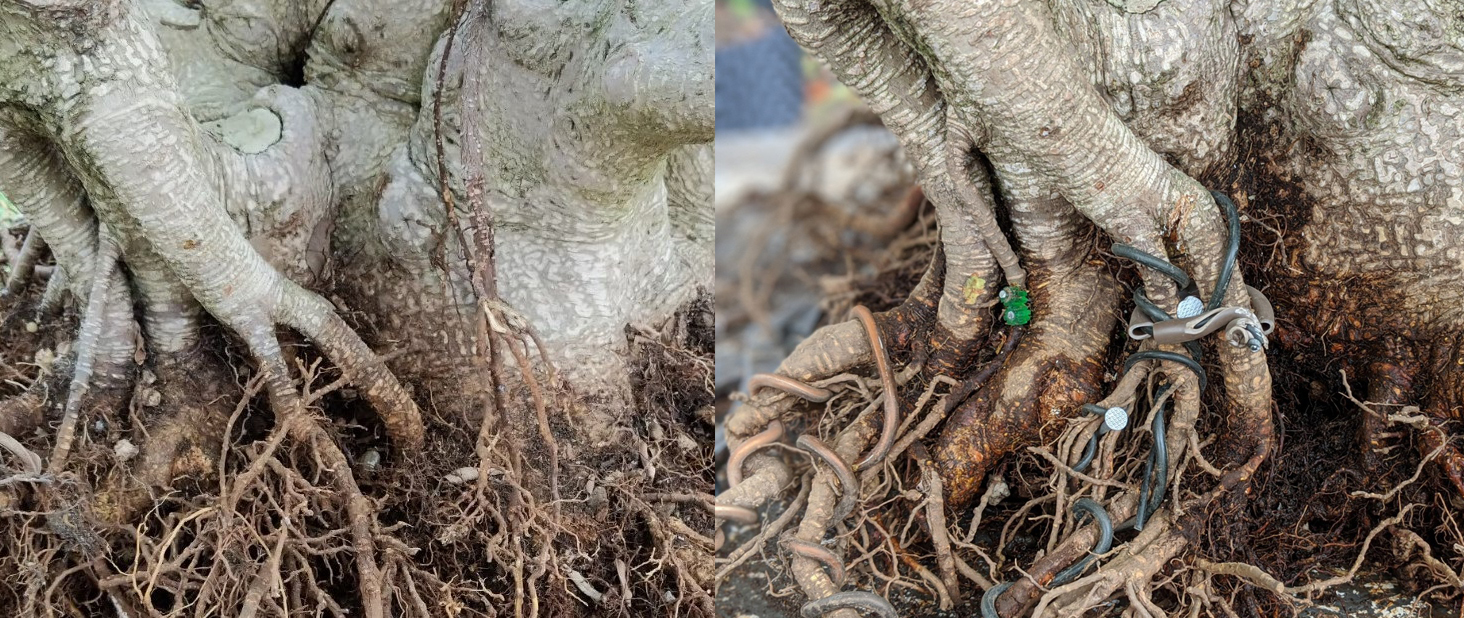
These grafted roots needed repositioning and incorporating into the nebari:
Repositioning thicker roots using aluminum wires and tourniquet.
Crossed roots repositioned, once fused, the top sections will be cut off.
Exposing More of the Nebari
Every time I repotted, I raised and exposed the nebari by about 1/2”. This time I raised it by about an inch. Exposing it gave the tree a larger nebari in each repot.
Root base raised by about an inch, shown by differences in tree bark colors.
Another advantage of using a wooden box is I could easily put in a few screws on the box to attach guy wires to bring down branches.
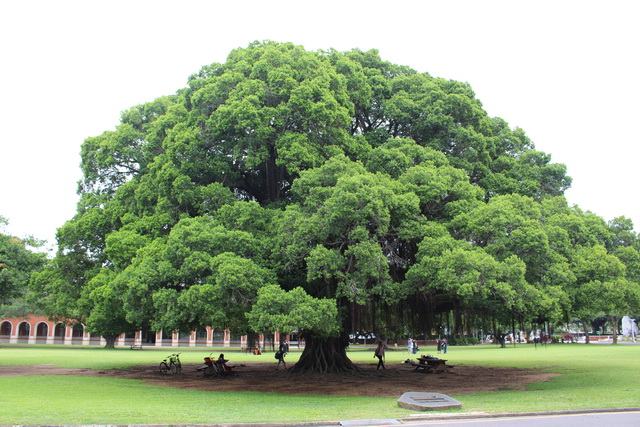
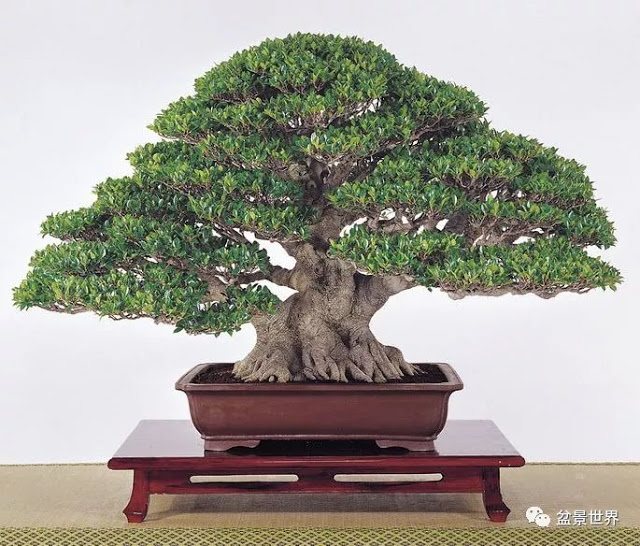
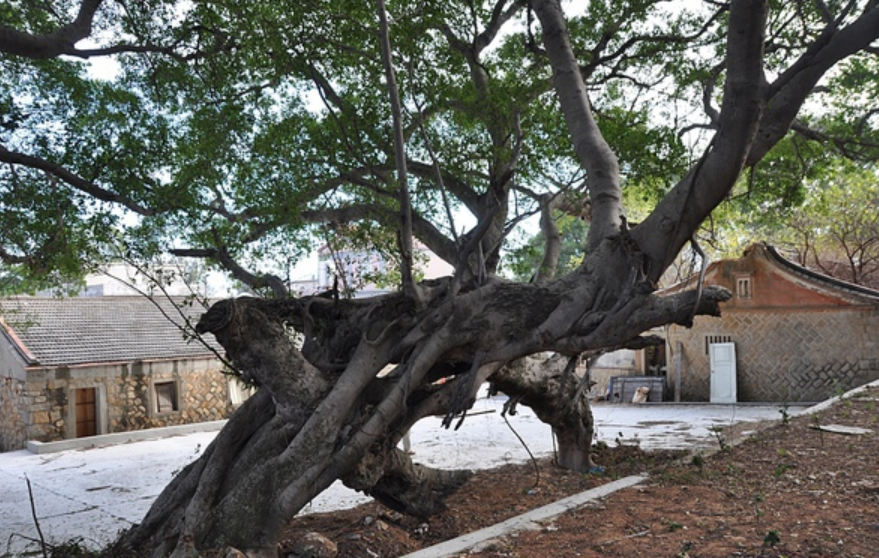
Huge massive trees with umbrella-like canopies and neatly arranged pads are hallmarks of Taiwan’s ficus bonsai. They are created and modeled after an old majestic Ficus microcarpa in Tainan’s National Cheng Kung University campus.
F. microcarpa at the National Cheng Kung University campus
An Award Winning F. microcarpa modeled after the National Cheng Kung University ficus, height: 87 cm, by Hisu Yang
Over the last decade, there have been increasing criticisms among some Taiwanese artists that too many of their ficus bonsai look like each other, prompting comment like “if you have seen one, you have seen a hundred”. The artist of the above award winning “standard” ficus, Mr. Hsiu Yang, 杨修, did something unusual; he created two “non-traditional” ficus bonsai.
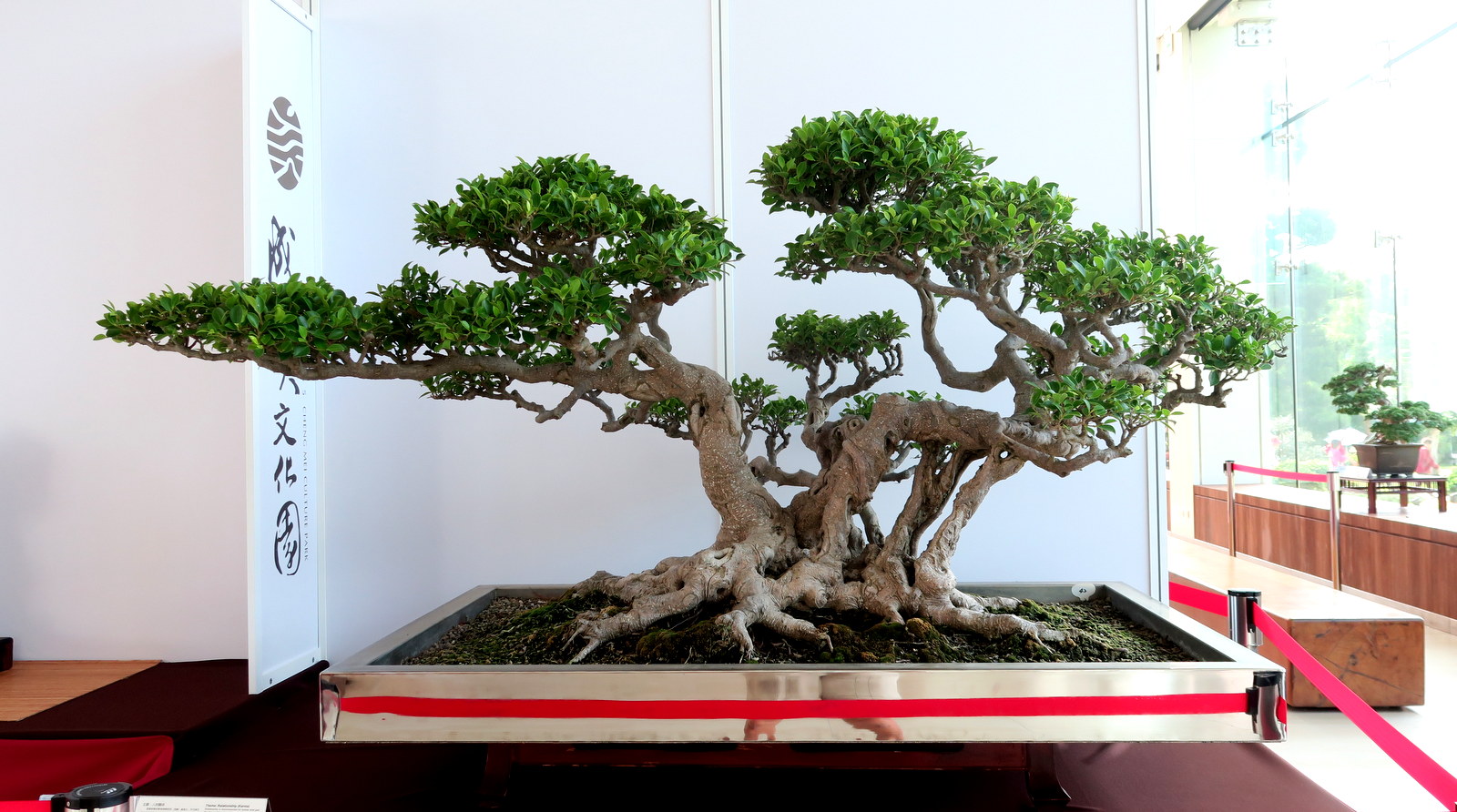
Planted in stainless steel tray, size of tray is 6-8 foot long if I recall correctly.
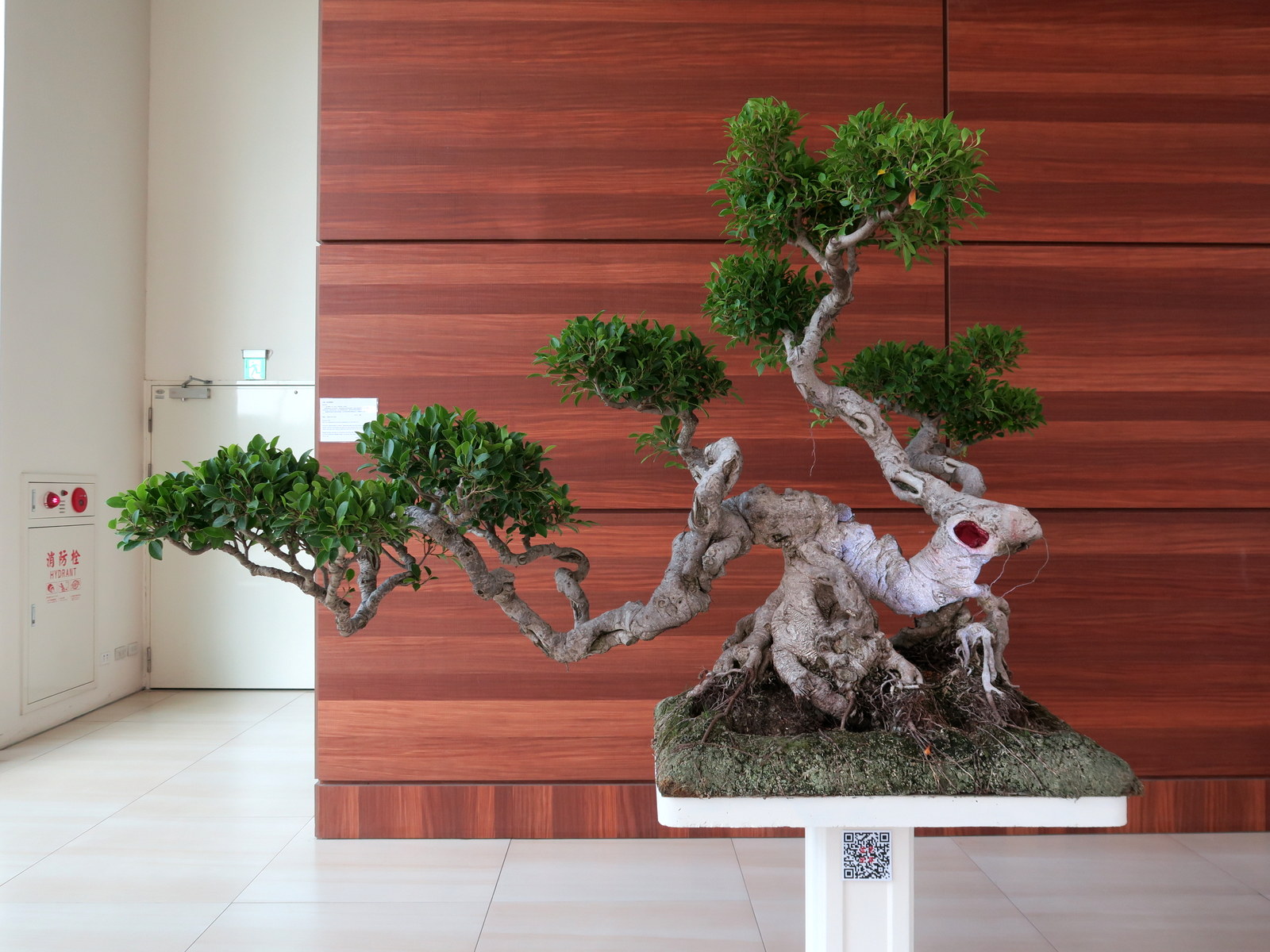
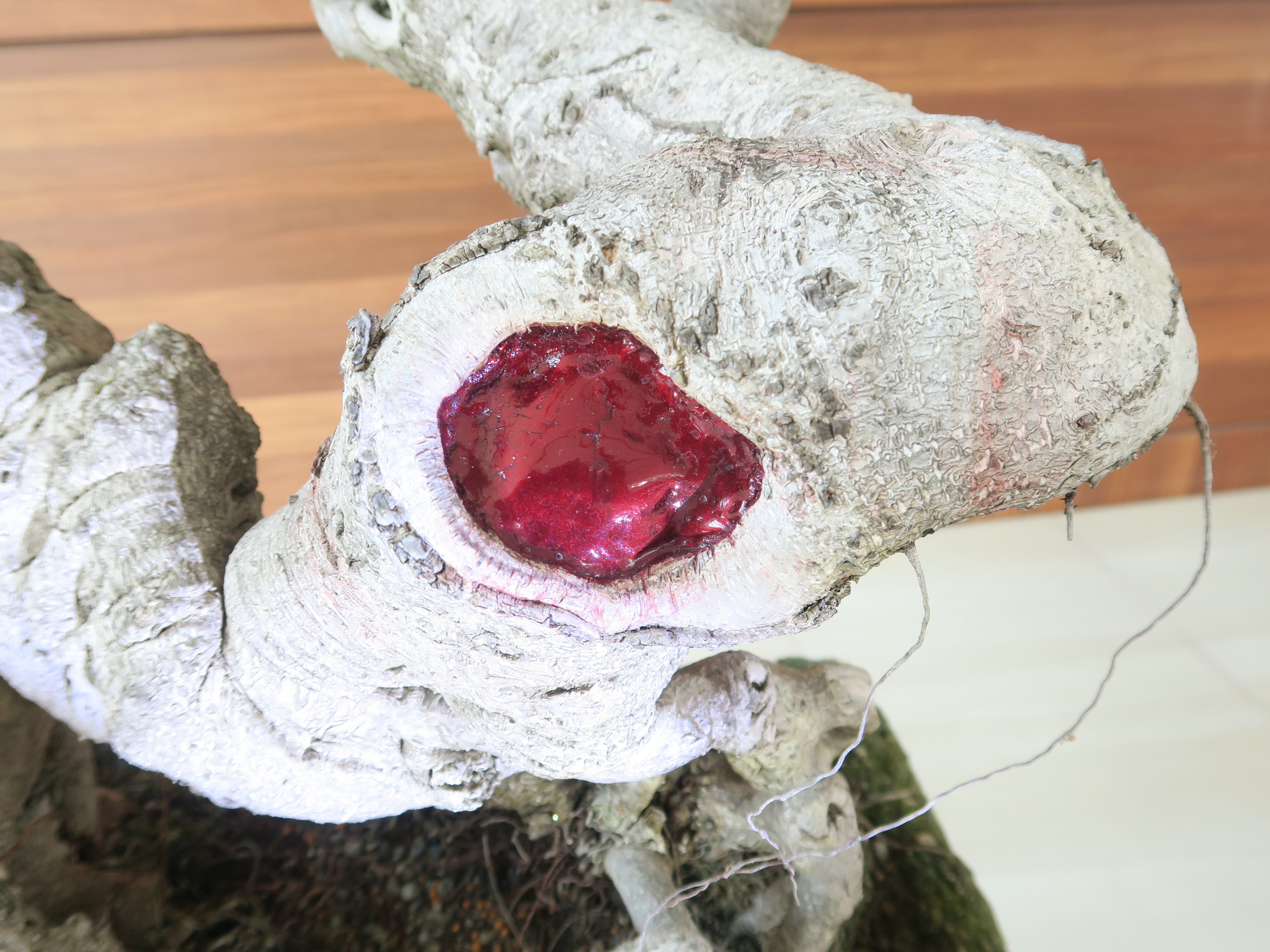
Another Mr. Yang’s creation. Note a cut wound filled with clear red resin. He had a spot light illuminating that red resin.
When I saw these two ficus at the Cheng Mei Cultural Park (成美文化園), I was shocked. I would not be surprised to see bonsai styled this way in China, but in Taiwan? However, these trees looked familiar and they appealed to me; I could appreciate them because I have seen oddly shaped ficus just like these two growing in suburban parks, street corners and village squares.
Taiwan is densely populated and is very crowded. Although ficus are widely grown as landscape trees in subdivisions and small community parks, as they grow their extended limbs eventually encroach nearby buildings, fences, etc., they compete for space with human dwellings.
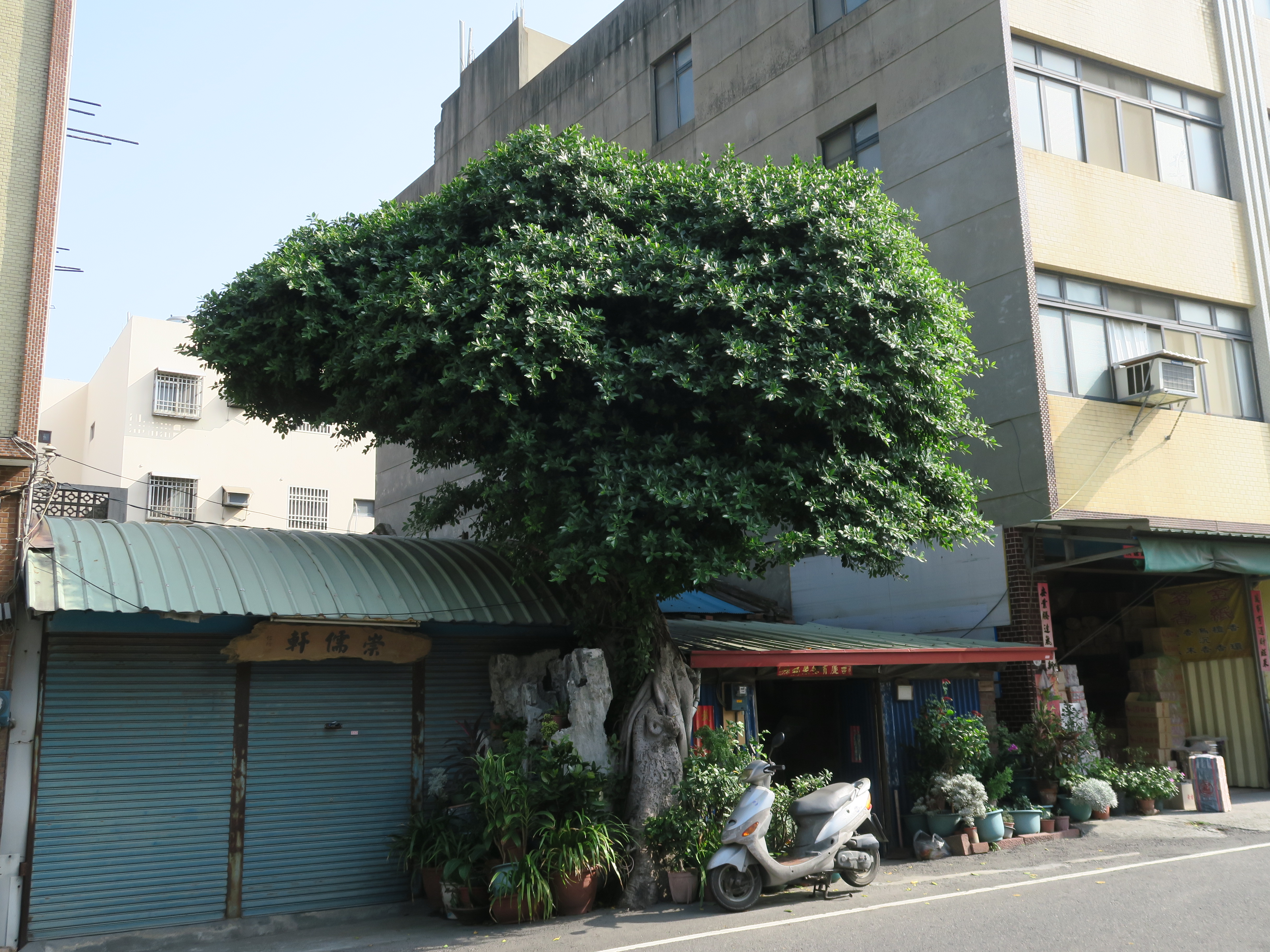
When these encroaching limbs were cut off, since bonsai rules do not apply during tree trimming, new branches grow at odd angles and finally into a form which I could only ascribed to “a cohabitation between ficus and human competing for space”.
A ficus I saw in Lukang, which has become too big and too close to a shop house. It ended up a mushroom shape.
To many bonsai eyes, they are ugly looking trees but are nonetheless alternative “natural” models for bonsai inspirations. There is a Chinese proverb which says “there is beauty when ugliness is at its extreme,” and it might apply in this case.
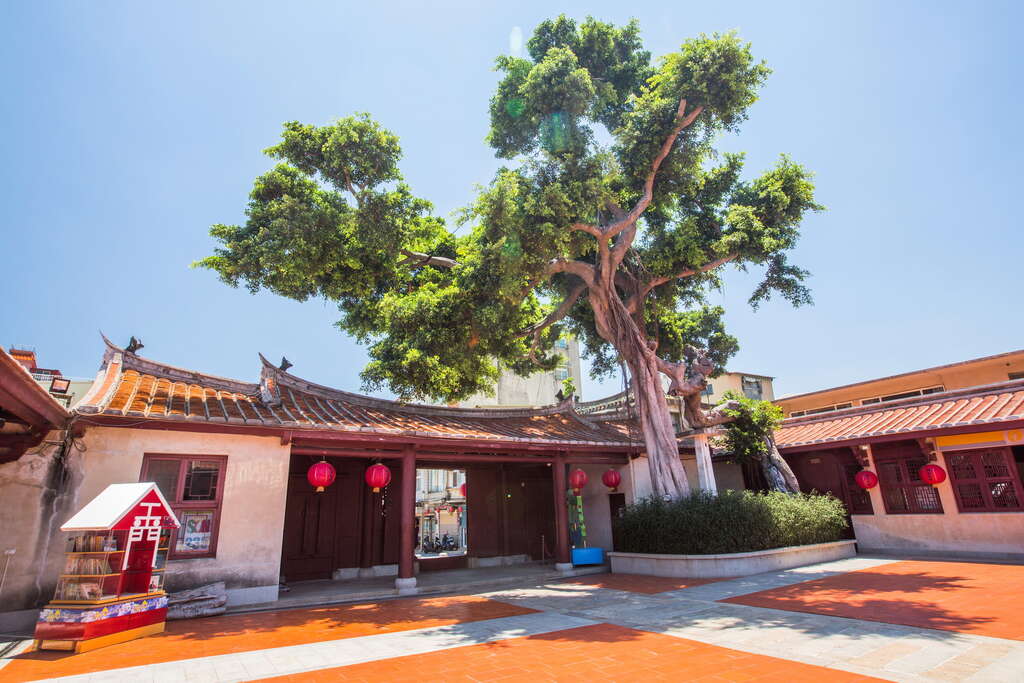
Here are some photos from Taiwan streets and squares I downloaded from the internet with their respective sources:
A plaque, not in this photo, said it was planted in 1886.
I thought these urban ficus inspired Mr. Yang’s creations but I was wrong! I later found out he got his Master degree from the Mingdao University using the ficus in the stainless steel container as a project, and his thesis was entitled “A Study of Bonsai Sculpture Creative Method and Ficus microcarpa Linn. f. Example.”
In his thesis, Mr. Yang discussed applying aesthetic principles to bonsai creations. This ficus was created based on his Buddhist believes of causality; aerial roots were used to create a more organic tree without an obvious massive trunk, and the whole creation process represented the three stages of past, present and future in Buddhism.
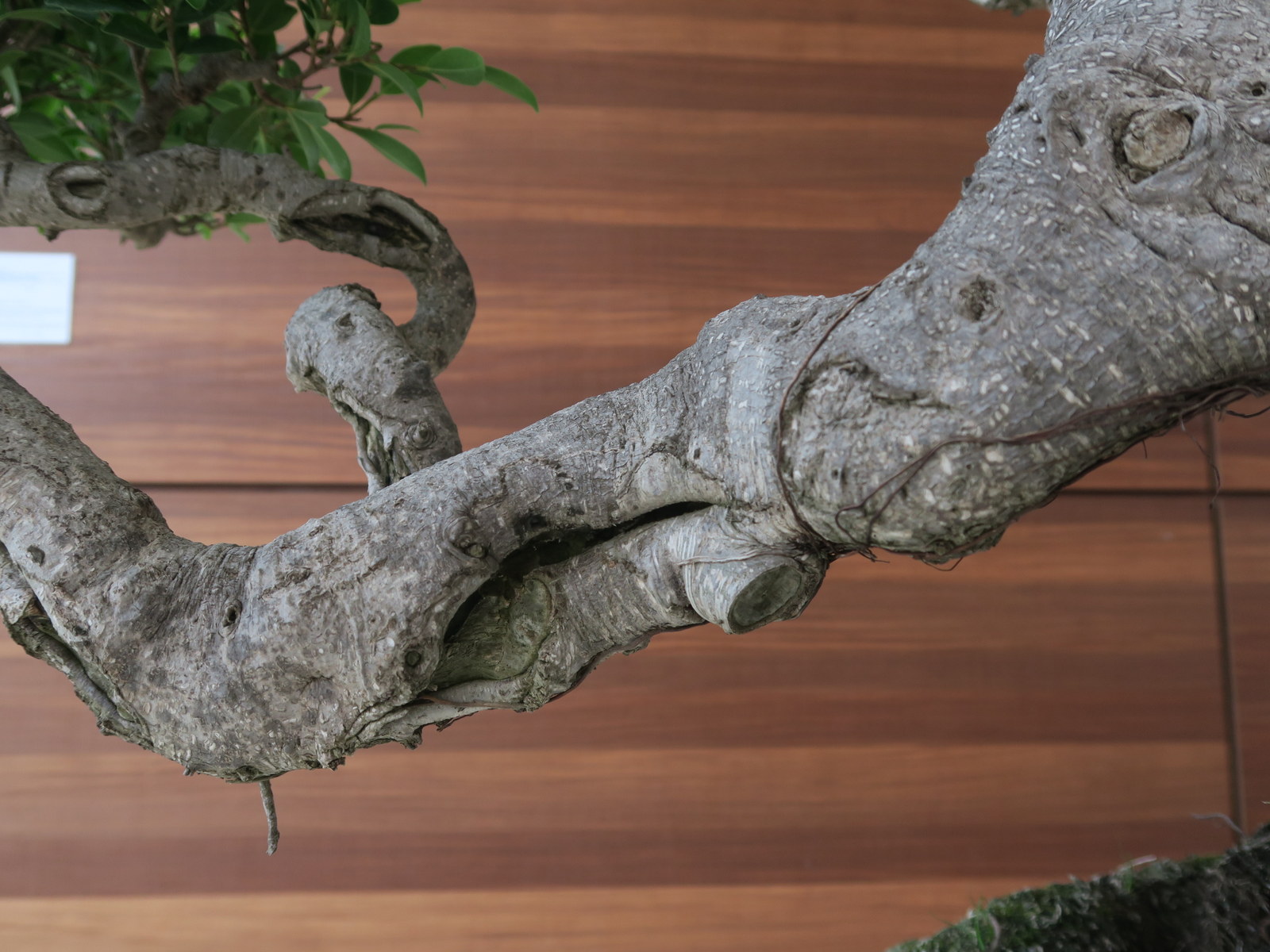
I do not understand the religious and philosophical meanings in this creation but I can relate to it because I have seen ficus growing in crowded urban areas. There are a lot of intentional “imperfections” from partly peeled irregular aerial roots, crisscross branches to unclosed large wounds, called “horse eyes,” throughout the bonsai. They are very different from the Japanese aesthetics of perfections.
Anyway, please enjoy detailed photos of these two unusual ficus bonsai.
Ficus in Stainless Steel Container:
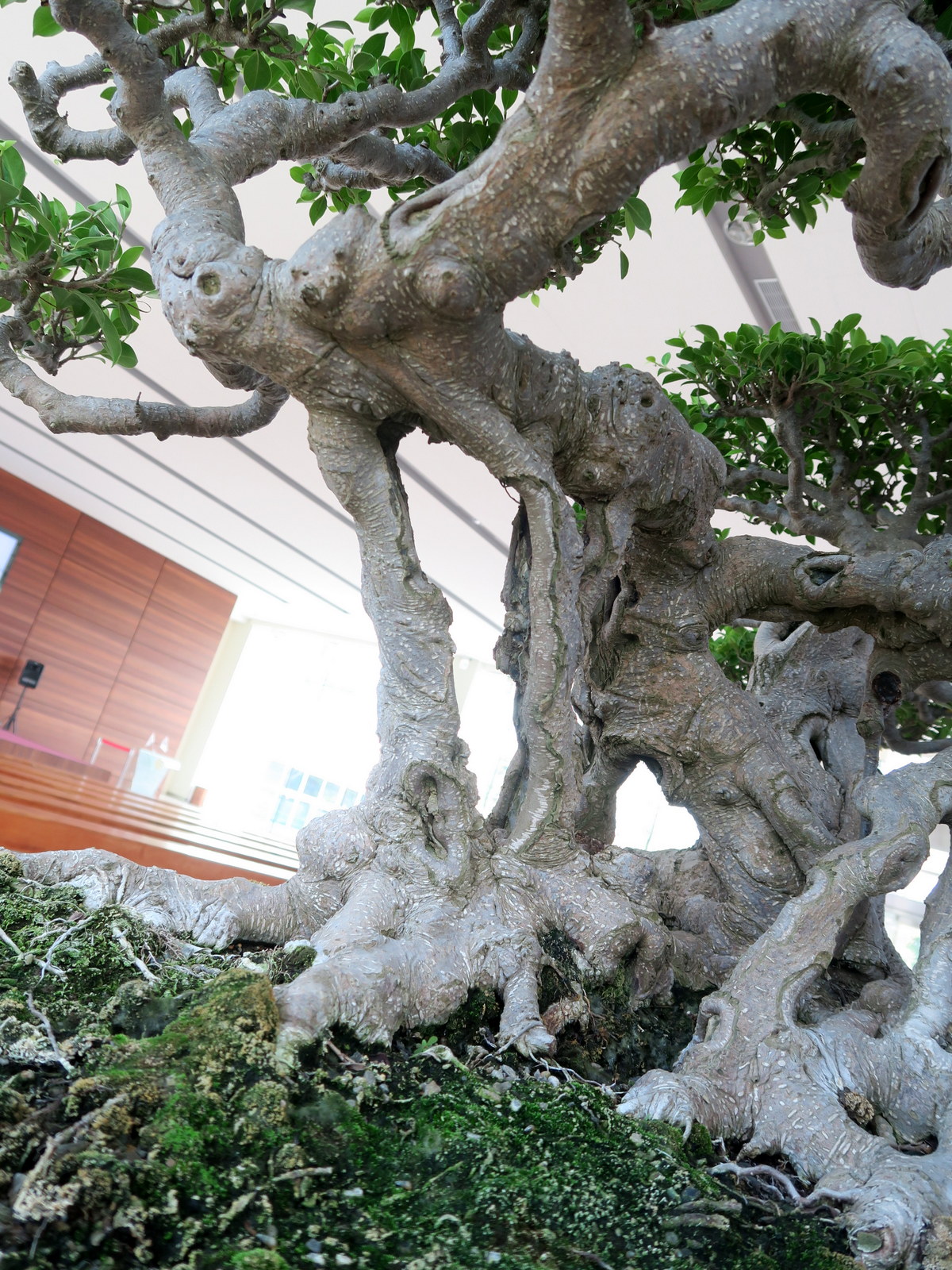
Multiple trunks created with aerial roots; they are not fused together into massive trunk we see in most Taiwan ficus bonsai.
Fused irregular aerial roots as part of the “organic” trunks. Even the moss dressings were not neatly arranged like those in Japanese bonsai exhibits.
Large unclosed wounds, “horse eyes,” accentuate imperfections.
Ficus with Filled Red Resin:
A light inside a 5-gallon white plastic bucket was aimed directly at the resin to capture the “tree goblin”.
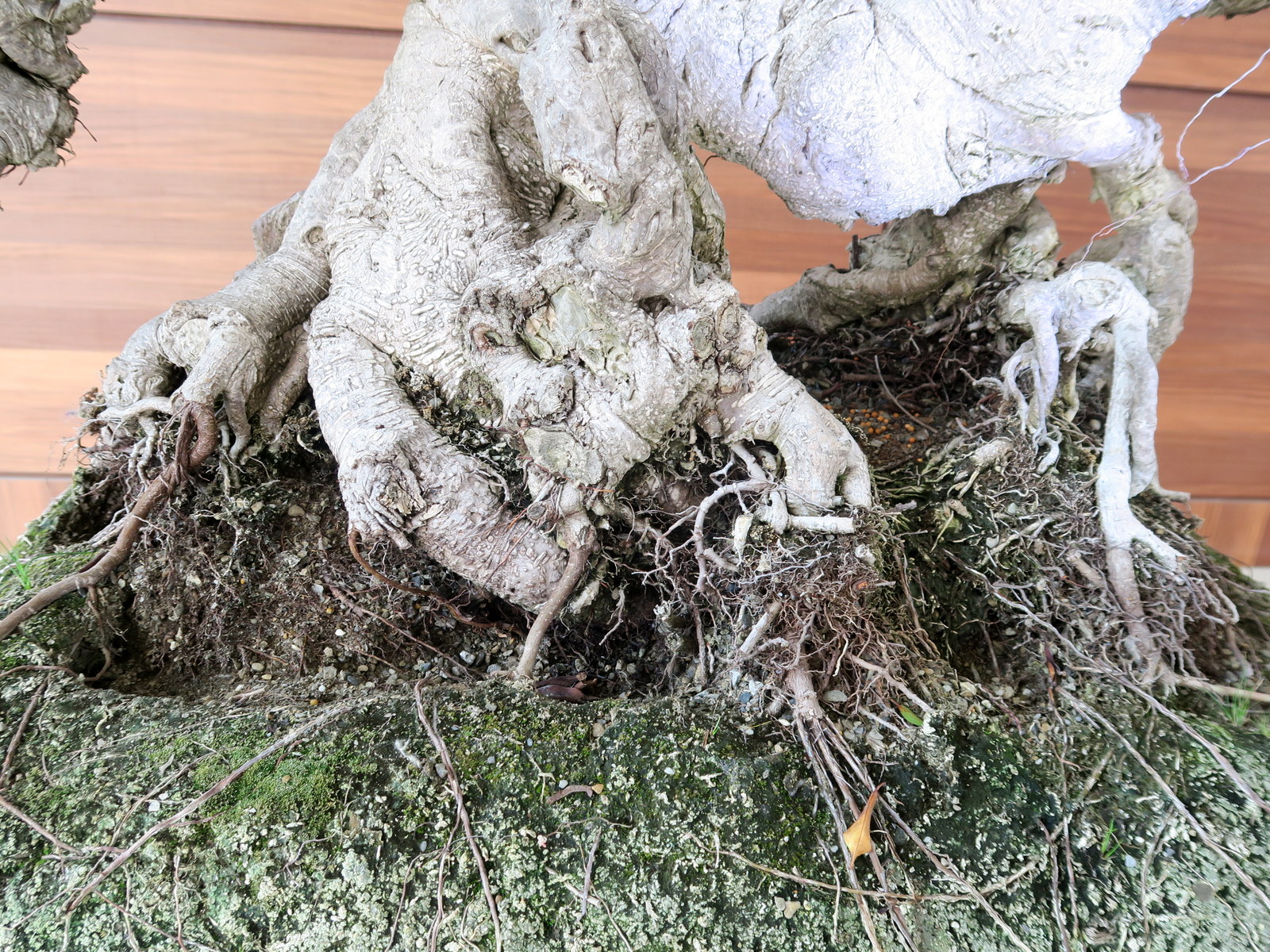
No massive nebari for this tree.
The Cheng Mei Cultural Park is a beautiful garden worth a visit if you go to Taiwan.
A joint blog with Kasu Bonsai (Jose Luis Lopez Casulleras), Spain
Green Island and Green Mound are two very popular Ficus microcarpa cultivars for tropical bonsai. Both have thick leaves. Several internet articles show how to distinguish them by their leaf shapes.
Green Island Ficus Ficus microcarpa ‘Green Island’ aka Wax Fig, Panda Ficus, Dollar Ficus
Green Mound Ficus Ficus microcarpa ‘crassifolia’ aka Long Island, Wax Fig, Panda Ficus, Korea Ficus
Heavy-textured leaves, a little longer than wide, the shape would be described botanically as “orbicular’ with only an obscure tip.
Same heavy texture but more than twice as long as wide; widest a little above the midpoint of the blade (i.e., obovate) with a blunt but obviously pointed tip.
So the rounder leave ficus is Green Island and the more elongated leave ficus is Green Mound or sometimes called Long Island. Seems simple enough, but there are problems with these names. (P.S. The above names and distinctions based on leaf descriptions from a Florida nursery trade article are wrong!)
In this blog, we will explain the confusions, resurrect their original names based on Taiwan literature, where these two ficus came from.
What Are the Confusions with These Names?
After publishing my blog on the synonyms of Kinmen, Tiger Bark, Kingman, Kimeng, Golden Gate F. microcarpa, Kasu Bonsai (co-author Jose) wrote and asked me to look into how Green Island and Green Mound got their names. As both came from Taiwan, he hoped I could find information in Chinese texts from Taiwan.
The situation is also confusing in Taiwan because some bonsai people simply call both of them ‘Green Island’ ficus such as the winning ficus shown below regardless of whether the leaves are round or elongated. However, a segment of the bonsai people such as the Taiwan Bonsai World no longer lists Green Island as a ficus used for bonsai on their website and lists the rounder leave ficus by its original name, ‘crassifolia’, as described in the literature. On the other hand, people interested in plant identifications are not so confused because their identities are clear in plant field guides. So ‘Green Island’ confusion is largely confined within bonsai circle.
This 2014 Taichung Bonsai Exhibition winner with elongated leaves was labeled Green Island Ficus. H.F. Yan wrote an article commenting on it and correcting it’s name to Ficus microcarpa cv. ‘I-Non’, which was originally described and named by J.C. Liao in 1982.
Fortunately, there is an article by H.F. Yan, the curator of the Botanical Garden of the Taichung Museum of Natural Sciences, who is also a bonsai enthusiast and tried to clarify these confusions so that people could call them correctly by their original names. He further noted that ‘Green Island’ Ficus is actually the name of a totally different species, F. pubernervis, which is endemic to Green Island (Lu Dao. Yes, it is the name of a small outer volcanic island in Taiwan); it is so named for where it is found. It is unclear how it got confused with bonsai’s ‘Green Island’. After reading Yan’s article, we further verified their descriptions with photos and illustrations in The Taxonomic Revisions of the Family Moraceae inTaiwan Ed. (II), a monograph by the late J.C. Liao who was involved in the naming these two ficus.
Since Yan’s article is in Chinese and is probably not much read in the West, we summarized his clarifications in this blog. A key feature of Yan’s article is he illustrated and compared the leaves of the four microcarpa cultivars used for bonsai. We added notes for each leaf illustrated.
A: Round thick-leave ficus, called ‘Green Island’ in the West and by some bonsai people in Taiwan. This is a naturally occurring variety found growing on the coastal limestones in the Hengchun Peninsular in southern tip of Taiwan. The plant is a small shrub, sometimes creeping, and has nearly round thick leaves. It was described by W.H.Shieh in 1963 and named ‘crassifolia‘ which means thick leave in Latin. Its Chinese name is ‘Hou Ye Rong’ which means thick-leave ficus. For unknown reasons and don’t know when, the name became ‘Green Island’ and got confused with the actual Green Island F. pubernervis.
Since it is a coastal plant with a compact growth habit, it is a popular low maintenance landscape plant in Florida and was voted 2001 ‘Plant of the Year’ by The Florida Nurserymen and Growers Association.
Detail descriptions and more photos of the leaves, branches, leaf stalk and syconia of ‘crassifolia’ can be found in this online identification guide
B: Elongated thick-leave ficus, called ‘Green Mound’ in the West and by some bonsai people in Taiwan without distinguishing it from the round leave ‘crassifolia’ variety. It was described By J.C. Liao in 1982 as a new cultivar found growing in the I-Lan Agriculture School. Liao named it ‘I-Non’, pronounced like ‘Yi Non’, which is a contracted name of the agriculture school in Chinese. ‘I-Non’ is certainly hard to pronounce in the West and meaningless to most people, which might be the reason why it is called ‘Green Mound’ for its growth form when sold as a landscape plant. Some online Florida nursery trade articles give its scientific name as var. ‘crassifolia’, which is wrong, it should be Ficus microcarpa cv. ‘I-Non’.
Landscape ‘I-Non’, note the elongated thick leaves. Photo from Liao’s Revision of Moraceae of Taiwan’Ficsu microcarpa cv. ‘I-Non’, correctly named by some bonsai people. This photo is from a Taiwan internet bonsai discussion forum..
C: Large leaf Ficus microcarpa main species.
D: Medium size leaves microcarpa used for bonsai, such as the popular ‘Kinmen’, aka ‘Tiger Bark’. As far as we know, this cultivar has not been described in any scientific journal.
E: Small-leave microcarpa cultivar described and named ‘pusillifolia‘ by Liao in 1989. ‘Pusillifolia‘ means small leaves, it is also called a Melon Seed ficus in bonsai circle. This cultivar was discovered growing in the Botanical Garden of the National Chung Hshing University.
What Should We Call These Two Ficus?
The use of common names is irrelevant in the binomial naming system, they are just for the convenience of we lay people, hobbyists and for nursery trades. However, cultivar and variety names are valid, they are denoted by cv. and var. after their binomial names. ‘I-Non’ and ‘crassifolia’ are cultivar and variety names, respectively.
‘Green Mound’, ‘Green Island’, and several other names like Long Island, Panda Ficus etc., are entrenched common names but not the original names, and it would be very very difficult and near impossible to change. For example, many people still use the name F. retusa for F. microcarpa even it was corrected decades ago.
We propose resurrecting their original names as they were first described. It is a respect to the botanists who discovered and described them. After all, if your parents name you Paul and someone mistakenly call you Peter, wouldn’t you want to correct it and be called Paul?
So…
Round leave variety be called by its original name ‘crassifolia’ or ‘Hou Ye Rong’ which has the same meaning in Chinese but would be more difficult to call or remember by non Chinese speakers. The full name is Ficus microcarpa var. ‘crassifolia’.
Rounder-leave Ficus microcarpa var. ‘crassifolia’.
Elongated leave cultivar be called by its original name ‘I-Non’ which the original author intended to honor the I-Lan Agriculture School where the cultivar was discovered. The full name is Ficus microcarpa cv. ‘I-Non’.
Elongated-leave Ficus microcarpa cv. ‘I-Non’.
For taxonomists who took broader views in naming species, called the ‘lumpers’, names like ‘I-Non’, ‘crassifolia’ etc. are not needed for the overall picture, and all these names are relegated to just Ficus microcarpa. For example, Berg and Corner lumped them all into F. microcarpa in their Revisions of Malanesia Ficus.
The next penjing garden we visited was in a Daoist monastry, Qingsong Guan (青松观) or Ching Chung Koon in Cantonese dialect used in Hong Kong. It is located a little out-of-the-way in Tuen Mun (新界屯门) in the New Territory area. The late abbot, Mr. Hou Baoyuan (候宝垣 1914-1999) was one of the early pioneers of Lingnan penjing. As a Daoist monk, his penjing were steeped into his philosophical thoughts and believes, they are unpretentious and follow the Daoist Way of harmonizing with nature. His penjing also tell stories and have distinct personalities. Their compositions are not from the typical old school teaching.
Instead of showing photos of penjing after penjing, I am going to select a few and describe my impressions the way I saw them.
A Two-Trunk Penjing that Broke the Rules
Twin-trunk Chinese Hackberry
When we make a two-trunk bonsai or penjing, we are taught to place the two trees, one large and one small, close to each other like a mother and child. Who would have ever thought of planting two large trees at opposite ends of a pot? Oh no, that would be breaking the rules! Yes, Abbot Hou did just that and he did it very well.
This bushy fierce looking Shiwan figurine is Zhong Kui (钟馗) with his sword, an evil slayer in Chinese mythology.
He approached this creation by envisioning the viewer is inside a forest, facing two large trees at close range. Don’t we often encounter such a familiar setting when we take a walk in a mature woods or an old forest? To reach for light, trees in old growths grow straight up to the top, the canopies do not overlap but just away from each other. That type of canopy does not allow much light into the interior, competitive smaller trees eventually die off. So the tall trees tend to be a little apart from each other, and without much penetrating light they do not have low branches
It would be very boring to see two straight trunk trees in a pot. He broke up the monotony by putting a figurine between them, which creates the look of a traveler resting in the woods in his journey. This close range scene suddenly becomes believable and that makes this penjing different from the typical twin-trunk. Further more he kept the ground unkempt with some weeds here and there. Using a proportional size figurine is key in this composition, without it the composition would collapse.
One of the principles in Lingnan penjing is to create a large tree as if you view them at close range (近树造型). In this case Abbot Hou pushed the limit, instead of seeing a forest, he moved us so close that we see just two unassuming trees out of the many of a forest. One could say he broke the rules and that is the beauty of his creativity, perhaps a vision only a Daoist monk could venture into.
A Gnarly Ficus
The next one is a gnarly overgrown ficus. The acute angular bend of the main trunk makes the tree looks like it lacks a primary apex, the secondary branches make up an umbrella shape canopy. The long out-stretched trunk also makes the tree looks highly unstable. Yet there is an un-describable harmony when he placed an old monk figurine and a dwarf mondo grass beneath that bend. The large negative space is partially filled and the tree no longer looks unstable with the exaggerated out-stretched trunk.
Look at the following photo, I wiped out the old monk and mondo grass in Paint and the tree looks highly unstable.
Buddha is said to achieve enlightenment while meditating beneath a banyan tree, Ficus religiosa. Travelling mendicant monks often seek shelter under big trees. To me, this penjing tells a story.
If we were given a pre-bonsai with such an acute curvature in the main trunk, how would we tackle it? Perhaps we will try to correct the “fault” by tilting the planting angle, use bending large trunk techniques to bend the curve back a little, chopping off a large section of the trunk, etc. In this case, the fault was skillfully used to create a dynamic looking penjing by simply putting an old monk beneath the tree.
It also reminds me of street arts in Georgetown, Penang, Malaysia. The city encourages artists to paint on sidewalks and commissions mural artworks on walls of old buildings. Julia Volchova of Russia painted this old Indian woman in prayer, skillfully merged her with a mass of entangled ficus roots growing over a wall,, a very similar imagery to the lower half of this penjing.
Georgetown is a UNESCO heritage city. The British TV drama, “Indian Summer”, was filmed in Georgetown and its hill stations. The film crew could not find suitable old colonial buildings in India because they were obscured by so many new modern buildings and made filming difficult. They found Penang to be a good substitute filming location.
Two Trees Planted at the Far Corner of a Pot
Now onto the third penjing I wanted to discuss in more details. One of the fundamental penjing and bonsai principles is to plant the tree slightly off center or at two-third the width of the pot to create asymmetry. However, the two trees in this penjing were planted side by side at the far right rear corner of the pot, a very unorthodox placement.
We would appreciate this odd choice when we examine the trees in detail.
The outer edge tree has a hollowed out trunk inscribed with three red Chinese characters “Le Ma Ya” (Stop the Horse Cliff). A Chinese person would readily connect these three words to an old teaching: “hold back your horse before it overshoots the edge of a cliff”, an advise to people to desist things that they will later regret, stop before falling into the abyss. The bark of the tree was peeled to inscribe the warning and that tree is at the very corner of the pot, symbolizing danger lurks ahead. A second shorter tree is planted next to the big one to counter balance the setting. Perhaps Abbot Hou wanted to gently remind viewers to heed old traditional teaching of not overly indulgence in any pursuit.
Also note the hollowed wood has aged and rotted down to the lower part of the trunk. I do not know the age of this penjing but Abbot Hou passed away in 1999, It is amazing the hollowed out wood still survive. The highlight of this penjing is the aged peeled trunk with the warning inscriptions.
As an overseas Chinese descendent, I appreciate the subtle meaning and readily accept this kind of penjing. Some people may find them unrefined like the Japanese bonsai, or even too wild for people looking for ‘natural’ bonsai. It’s all in the eyes of the beholder. I just want to share what I see and interpret.
Abbot Hou used Shiwan figurines (石湾公仔) extensively in his penjing. Their sizes are appropriate and proportional to the trees. When done correctly they tell stories. In the West, we call these Shiwan figurines mudman, and tend to use them indiscriminately with mismatch sizes such as a hut is smaller than the person sitting next to it. Perhaps they originate from people trying to sell so called “Chinese Bonsai”. Such a practice gives penjing a bad reputation, and wrongfully become a connotation of Chinese penjing. There are a lot to learn from penjing in this monastery. I hope readers of this post do not use figurines indiscriminately and make their penjing look ridiculous.
Shiwan figurines is an art by themselves and are highly collectible. Those used in the Monastery’s penjing are probably antiques now. In my next post, I will feature antique figurines from the Hong Kong Art Museum.
Before I go, here are more photos of the monastery, penjing and garden.
A joint blog with Kasu Bonsai (Jose Luis Lopez Casulleras), Spain
Green Island and Green Mound are two very popular Ficus microcarpa cultivars for tropical bonsai. Both have thick leaves. Several internet articles show how to distinguish them by their leaf shapes.
Green Island Ficus Ficus microcarpa ‘Green Island’ aka Wax Fig, Panda Ficus, Dollar Ficus
Green Mound Ficus Ficus microcarpa ‘crassifolia’ aka Long Island, Wax Fig, Panda Ficus, Korea Ficus
Heavy-textured leaves, a little longer than wide, the shape would be described botanically as “orbicular’ with only an obscure tip.
Same heavy texture but more than twice as long as wide; widest a little above the midpoint of the blade (i.e., obovate) with a blunt but obviously pointed tip.
So the rounder leave ficus is Green Island and the more elongated leave ficus is Green Mound or sometimes called Long Island. Seems simple enough, but there are problems with these names. (P.S. The above names and distinctions based on leaf descriptions from a Florida nursery trade article are wrong!)
In this blog, we will explain the confusions, resurrect their original names based on Taiwan literature, where these two ficus came from.
What Are the Confusions with These Names?
After publishing my blog on the synonyms of Kinmen, Tiger Bark, Kingman, Kimeng, Golden Gate F. microcarpa, Kasu Bonsai (co-author Jose) wrote and asked me to look into how Green Island and Green Mound got their names. As both came from Taiwan, he hoped I could find information in Chinese texts from Taiwan.
The situation is also confusing in Taiwan because some bonsai people simply call both of them ‘Green Island’ ficus such as the winning ficus shown below regardless of whether the leaves are round or elongated. However, a segment of the bonsai people such as the Taiwan Bonsai World no longer lists Green Island as a ficus used for bonsai on their website and lists the rounder leave ficus by its original name, ‘crassifolia’, as described in the literature. On the other hand, people interested in plant identifications are not so confused because their identities are clear in plant field guides. So ‘Green Island’ confusion is largely confined within bonsai circle.
This 2014 Taichung Bonsai Exhibition winner with elongated leaves was labeled Green Island Ficus. H.F. Yan wrote an article commenting on it and correcting it’s name to Ficus microcarpa cv. ‘I-Non’, which was originally described and named by J.C. Liao in 1982.
Fortunately, there is an article by H.F. Yan, the curator of the Botanical Garden of the Taichung Museum of Natural Sciences, who is also a bonsai enthusiast and tried to clarify these confusions so that people could call them correctly by their original names. He further noted that ‘Green Island’ Ficus is actually the name of a totally different species, F. pubernervis, which is endemic to Green Island (Lu Dao. Yes, it is the name of a small outer volcanic island in Taiwan); it is so named for where it is found. It is unclear how it got confused with bonsai’s ‘Green Island’. After reading Yan’s article, we further verified their descriptions with photos and illustrations in The Taxonomic Revisions of the Family Moraceae inTaiwan Ed. (II), a monograph by the late J.C. Liao who was involved in the naming these two ficus.
Since Yan’s article is in Chinese and is probably not much read in the West, we summarized his clarifications in this blog. A key feature of Yan’s article is he illustrated and compared the leaves of the four microcarpa cultivars used for bonsai. We added notes for each leaf illustrated.
A: Round thick-leave ficus, called ‘Green Island’ in the West and by some bonsai people in Taiwan. This is a naturally occurring variety found growing on the coastal limestones in the Hengchun Peninsular in southern tip of Taiwan. The plant is a small shrub, sometimes creeping, and has nearly round thick leaves. It was described by W.H.Shieh in 1963 and named ‘crassifolia‘ which means thick leave in Latin. Its Chinese name is ‘Hou Ye Rong’ which means thick-leave ficus. For unknown reasons and don’t know when, the name became ‘Green Island’ and got confused with the actual Green Island F. pubernervis.
Since it is a coastal plant with a compact growth habit, it is a popular low maintenance landscape plant in Florida and was voted 2001 ‘Plant of the Year’ by The Florida Nurserymen and Growers Association.
Detail descriptions and more photos of the leaves, branches, leaf stalk and syconia of ‘crassifolia’ can be found in this online identification guide
B: Elongated thick-leave ficus, called ‘Green Mound’ in the West and by some bonsai people in Taiwan without distinguishing it from the round leave ‘crassifolia’ variety. It was described By J.C. Liao in 1982 as a new cultivar found growing in the I-Lan Agriculture School. Liao named it ‘I-Non’, pronounced like ‘Yi Non’, which is a contracted name of the agriculture school in Chinese. ‘I-Non’ is certainly hard to pronounce in the West and meaningless to most people, which might be the reason why it is called ‘Green Mound’ for its growth form when sold as a landscape plant. Some online Florida nursery trade articles give its scientific name as var. ‘crassifolia’, which is wrong, it should be Ficus microcarpa cv. ‘I-Non’.
Landscape ‘I-Non’, note the elongated thick leaves. Photo from Liao’s Revision of Moraceae of Taiwan’Ficsu microcarpa cv. ‘I-Non’, correctly named by some bonsai people. This photo is from a Taiwan internet bonsai discussion forum..
C: Large leaf Ficus microcarpa main species.
D: Medium size leaves microcarpa used for bonsai, such as the popular ‘Kinmen’, aka ‘Tiger Bark’. As far as we know, this cultivar has not been described in any scientific journal.
E: Small-leave microcarpa cultivar described and named ‘pusillifolia‘ by Liao in 1989. ‘Pusillifolia‘ means small leaves, it is also called a Melon Seed ficus in bonsai circle. This cultivar was discovered growing in the Botanical Garden of the National Chung Hshing University.
What Should We Call These Two Ficus?
The use of common names is irrelevant in the binomial naming system, they are just for the convenience of we lay people, hobbyists and for nursery trades. However, cultivar and variety names are valid, they are denoted by cv. and var. after their binomial names. ‘I-Non’ and ‘crassifolia’ are cultivar and variety names, respectively.
‘Green Mound’, ‘Green Island’, and several other names like Long Island, Panda Ficus etc., are entrenched common names but not the original names, and it would be very very difficult and near impossible to change. For example, many people still use the name F. retusa for F. microcarpa even it was corrected decades ago.
We propose resurrecting their original names as they were first described. It is a respect to the botanists who discovered and described them. After all, if your parents name you Paul and someone mistakenly call you Peter, wouldn’t you want to correct it and be called Paul?
So…
Round leave variety be called by its original name ‘crassifolia’ or ‘Hou Ye Rong’ which has the same meaning in Chinese but would be more difficult to call or remember by non Chinese speakers. The full name is Ficus microcarpa var. ‘crassifolia’.
Rounder-leave Ficus microcarpa var. ‘crassifolia’.
Elongated leave cultivar be called by its original name ‘I-Non’ which the original author intended to honor the I-Lan Agriculture School where the cultivar was discovered. The full name is Ficus microcarpa cv. ‘I-Non’.
Elongated-leave Ficus microcarpa cv. ‘I-Non’.
For taxonomists who took broader views in naming species, called the ‘lumpers’, names like ‘I-Non’, ‘crassifolia’ etc. are not needed for the overall picture, and all these names are relegated to just Ficus microcarpa. For example, Berg and Corner lumped them all into F. microcarpa in their Revisions of Malanesia Ficus.

 Login
Login